Dubai’s CHS GROUP’s Founder-President Nasir Syed to Sponsor Event
Anjuman Taraqqi-e-Urdu Urdu, DK and Udupi districts is set to host the Urdu poetry festival, ‘Urdu Mehfil-e-Mushair,’ at the Town Hall in Mangaluru on Friday, November 24, with the aim of promoting Urdu language, literature, and culture. The event, scheduled to begin at 6:30 pm, will feature renowned Urdu poets from Karnataka and other states.
The event is sponsored by Nasir Syed, a distinguished NRI businessman and founder-president of the CHS Group of Dubai. Abdul Salam Madani, President of Anjuman Taraqqi-e-Urdu of Dakshina Kannada and Udupi districts, announced the event through a press release.
Participating poets include Azizuddin Aziz Belgaumi from Bengaluru, Dr. Mohammed Haneef Shabab, and Syed Ahmed SaliK from Bhatkal, Siraj Sholapuri from Mumbai, Rahmatullah Rahmat from Shivamogga, Usama Qazi Asad Karnataki from Gangolli, and Abdul Salam Madani from Mangaluru. Nasir Syed will chair the event.
The program will not only feature poetic performances but also include the distribution of prizes for various competitions and the acknowledgment of emerging talents.
Anjuman Taraqqi-e-Urdu President has urged Urdu poetry enthusiasts to actively participate in the event along with their friends and family members.
source: http://www.english.varthabharati.in / Vartha Bharati / Home> Karavali / by Vartha Bharati / November 22nd, 2023
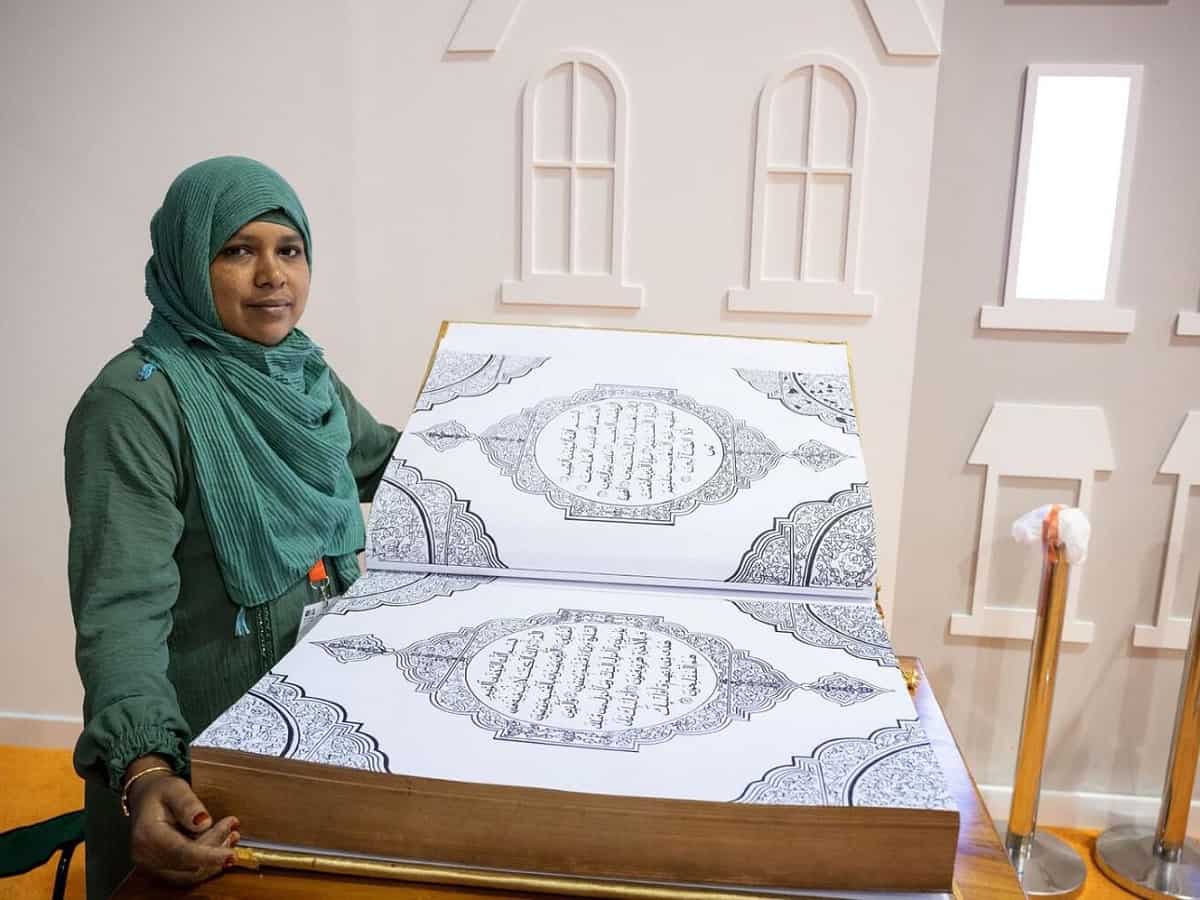
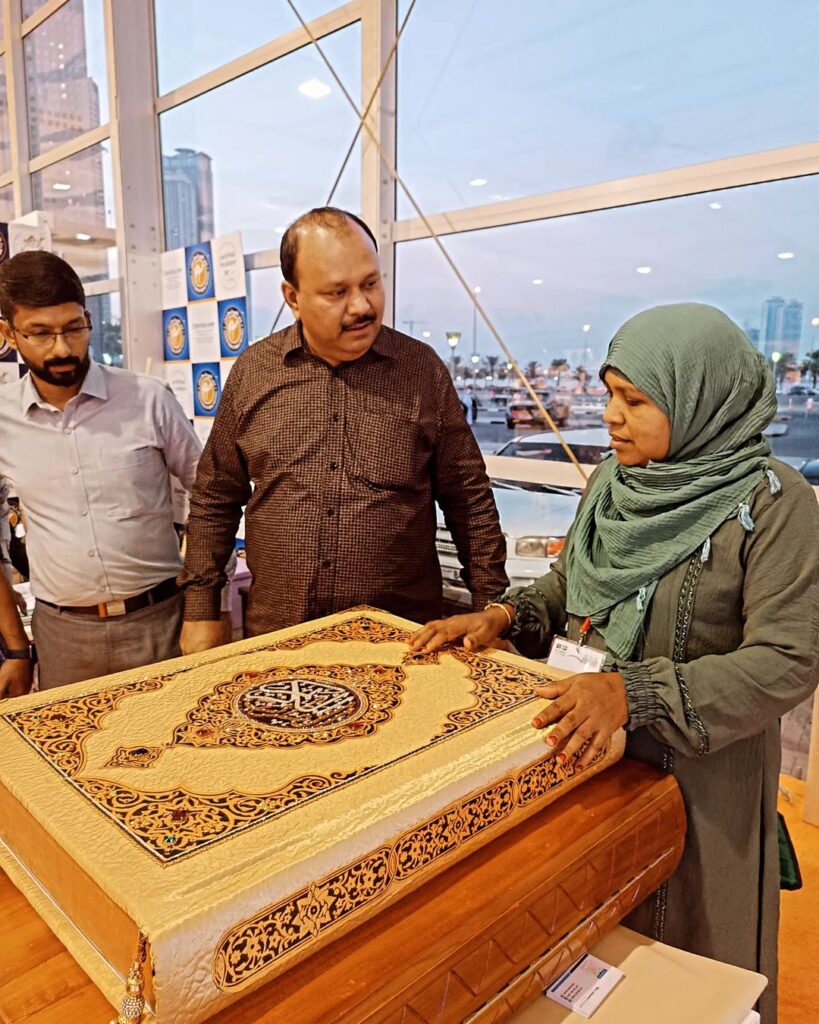
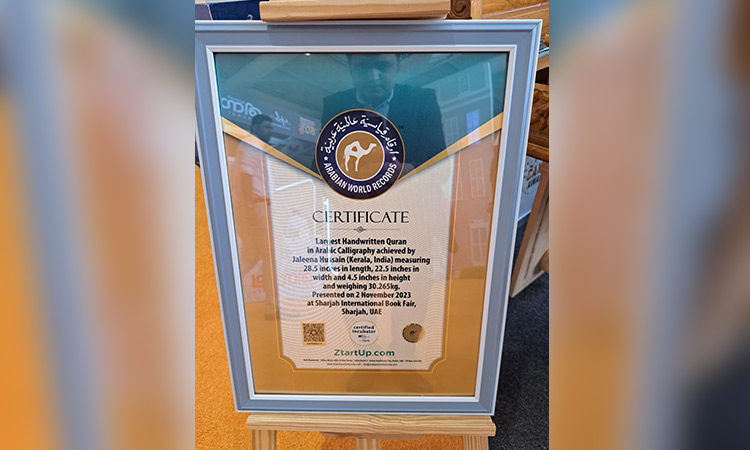
The holy book, which weighs 54 kg with the cover, measures 28.5 inches long, 22.5 inches wide, and 4.5 inches high.
Abu Dhabi:
A 46-year-old Indian woman has displayed her handwritten Holy Quran in Arabic calligraphy weighing over 30 kgs at the 42nd Sharjah International Book Fair (SIBF).
Jaleena Hussain, who hails from Indian state of Kerala, has spent over a year creating a unique edition of 114 surahs, covering 604 pages.
Speaking to Sharjah 24, Jaleena said writing the Quran was her way of fulfilling her desire to memorize the Holy Book.
She expressed gratitude to the Sharjah authorities for allowing her to showcase her talent.
Jaleena, a former rubber plantation worker and Urdu teacher, has been recognized by the Arabian World Records and the India and Asia Book of Records for her handwritten Quran.
source: http://www.siasat.com / Siasat.com / Home> News> India / by Sakina Fatima X / November 12th, 2023
Sherghati, a small town in the Gaya district of Bihar which till recently was known for the Naxal insurgency is in the news for good reason. Three daughters of a local artist Imran Ali – Bushra, Saadia, and Anam – are studying to become doctors.
The three sisters are perhaps the first ones from a middle-class Muslim family in the district to have achieved this distinction.
In the recent NEET examination Bushra, the youngest of Ali’s daughters was declared successful and she followed in the footsteps of her sisters, Saadia and Anam, and joined the Medical College.
Aman Imran, the firstborn of Imran Ali and Zareen Kausar, is pursuing her doctorate from the National Institute of Homeopathy (NIH), Kolkata, one of the country’s top medical colleges. The second daughter Sadia Emala is studying in her final year of degree course at Mahesh Bhattacharya Homeopathic Medical College and Hospital, Kolkata.
Bushra Kausar has also been admitted into the Government Homeopathy Medical College and Hospital. The sisters have chosen homeopathy.
People in Sherghati are proud of the three sisters and everyone speaks about them.
Imran Ali and Zareen Kausar live in the Urdu Bazaar locality. On May 21, Imran Ali was awarded the Rajiv Gandhi Global Excellence Award 2023 in New Delhi.
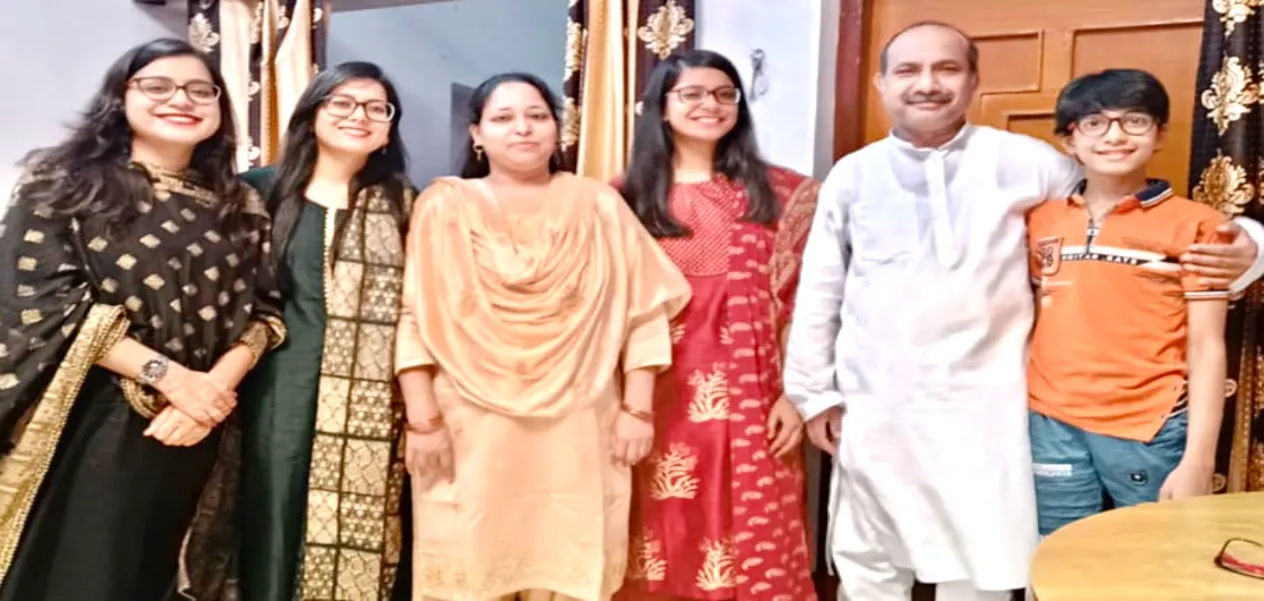
Imran Ali and Zareen Kausar withtheir daughters and son
He runs an advertising agency and undertakes projects for publicity painting and advertising flex hoardings.
He is also a musician and given his music for the Bhojpuri films. He also performed the official functions on Republic Day and Independence Day for two decades.
Anam, Saadia, and Bushra grew up in a middle-class family, and through hard work reached this position.
The Sherghati sub-division was once highly infested with Naxal violence.
While studying at DAV, Bushra Kausar became the state topper in the inter-school slogan writing competition and was awarded ₹ 10,000 by the then Deputy CM of Bihar Sushil Kumar Modi.
She cleared her medical entrance examination on her second attempt and got admitted into the Medical College. She is planning to sit again for NEET to join the MBBS course in a medical college.
Imran Ali and Zareen Kausar believe that daughters are born to lucky parents.
Zareen Kausar said that along with becoming doctors, her daughters have set their eyes on the civil services. “You should not ignore your daughters but give them enough opportunities to move forward,” she said.
source: http://www.awazthevoice.in / Awaz, The Voice / Home> Story / by Seraj Anwar, Patna / November 09th, 2023
Twenty years ago, at the instance of my cousin late Shakil Ahmad Khan, our whole extended family donated its houses and vast lands in our ancestral village of Badharia in Azamgarh for a grand dream: to build a world-class school in a rural setting.
Today that school is a reality. After visiting this school sometime back, Prof. Vipin Tripathy of IIT Delhi told me that this school is at par with DPS Mathura Road! What an apt compliment!
Today, this school is flourishing in a rural setting attracting students even from Azamgarh city! With dedication and doggedness, miracle can happen even today.
This world-class school in a backwater village in eastern U.P. is a living proof.
Please watch this documentary prepared by the son of one of the founders of this school.
source: http://www.zik.in / Zafarul Islam Khan / Home / by Zafarul Islam Khan / August 20th, 2023
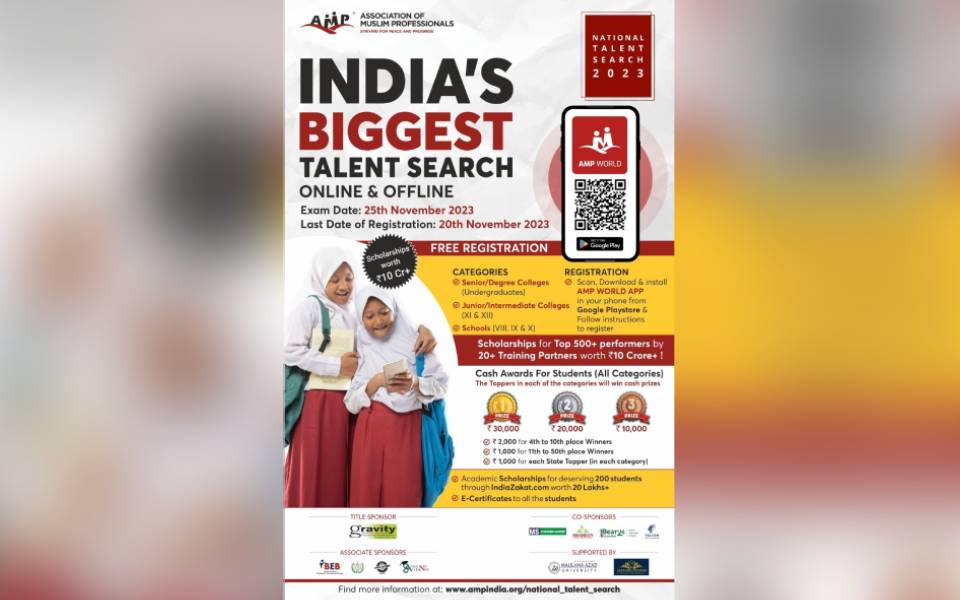
The Association of Muslim Professionals organization is all set to host its annual competitive National Talent Search examination. The exam which started in November 2020, was being held online for the past three years and will this year be hosted in dual mode (i.e both online and offline). While, in the last 3 years, over 1.5 lakh+ students from 600+ districts across India participated, this year, the organization expects 1 lakh+ Students from 650+ Districts across India to participate, making it the biggest competition in the Country.
Different modes of participation:
This year, the AMP NTS will be conducted both online and offline, providing flexibility to participants.The offline mode offers candidates the chance to compete at 300+ centers across different cities and districts in India. The online participants, while not eligible for rewards, will receive a participation certificate and have the option to avail benefits by appearing for a written physical test in the future.
Examination details:
Date: Saturday, 25th November 2023 (Rajasthan State: 2nd December 2023 – Offline) Registration Deadline: Monday, 20th November 2023 Time & Duration: 11 am, 90 minutes Format: 100 multiple-choice questions (MCQs) Scholarships and Rewards:
Scholarships worth Rupees 10 Crore+ await the top 500+ performers, ranging from 50% to 100% for IIT-JEE/NEET coaching from esteemed training partners. The selection process for scholarships involves a physical test, counseling, and other parameters. Financial support, academic scholarships, and mentorship initiatives are available for deserving and needy students.
Cash Prizes:
Coming to the cash awards section for top performers in various categories, with the first-place winners receiving ₹30,000. State toppers in each category also receive recognition and cash prizes.
In the meantime, E-certificates will be awarded to all participants, with special recognition for top national and state-level performers.
Additionally, the organization emphasizes understanding students’ strengths and weaknesses, providing valuable insights for career and study planning. Initiatives like Employability Training Programs, Job Fairs, Campus Placement Programs, Skill Training, and Mentorship by Industry Experts are prioritized for participants.
How to register?
Download the AMP World App from Google Play store. Sign up with personal details. Register for NTS by filling the form at the Student’s Registration tab. Visit AMP NTS Scholarships List for detailed scholarship information. Explore Training Partners for coaching opportunities.
About Association of Muslim Professionals
The Association of Muslim Professionals (AMP),for over 15 years, has dedicated itself to fostering Education Support, providing Employment Assistance, and driving Economic Empowerment within the community and the nation. In November 2020, AMP introduced the AMP National Talent Search (NTS), a transformative National Level Competition aimed at enhancing students’ General Awareness and nurturing a competitive spirit
source: http://www.english.varthabharati.in / Vartha Bharati / Home> Karavali / by Vartha Bharati / November 11th, 2023
He was a poet, playwright, lyricist, folk singer and social and political activist.
When it comes to Bhojpuri literature or music, many people are only familiar with the vulgar songs raking in “likes” on YouTube and social media. But there is more that remains unknown outside.
Bhojpuri literature, especially folk music, is profoundly rich and covers a wide range of social, cultural and political issues such as dowry, child marriage, migration, freedom, communalism and caste.
Migration has always been central to Bhojpuri literature. Over the last two centuries, large numbers of people have migrated from this region. Bidesiya, a play written by Bhikhari Thakur that marks the trend, has been adapted into a film. Mahendra Misir and Master Nazir, too, are known for writing on migration and many other issues.
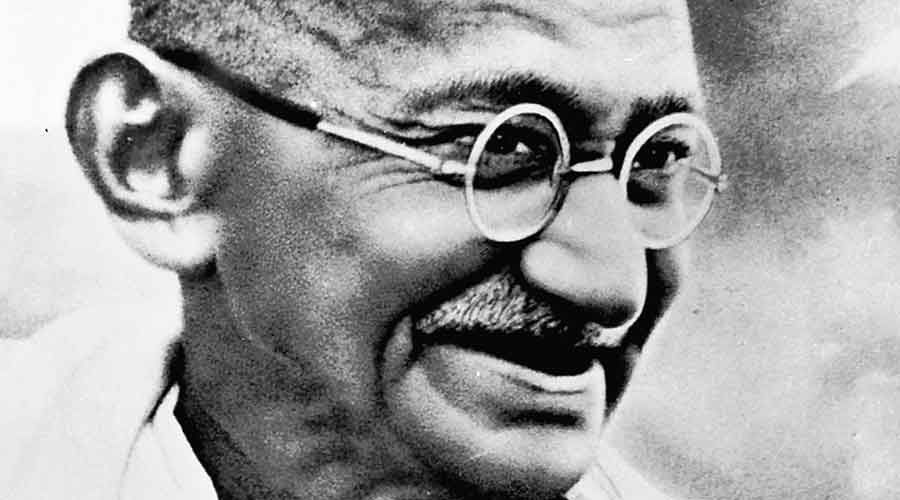
But before them, there was Rasul Miya whose work was not limited to cultural and social issues. He wrote also about the political problems of the time. His poetry is full of agony over issues such as colonialism, feudalism, the Partition, Hindu-Muslim unity and Mahatma Gandhi’s assassination.
Rasul Miya was a poet, playwright, lyricist, folk singer and social and political activist. He was born in 1872 in a village called Jigna in Gopalganj district (neighbouring Siwan) of Bihar and died in 1952. His father and other family elders, too, were members of a drama company known as Naach in the region.
He learnt from his elders but did not follow their tradition. He incorporated contemporary political ideas into his songs. His poetry bore the influence of Mahatma Gandhi.
‘Kalkatwa’ connection
Bihar and eastern Uttar Pradesh have a very old relationship with Calcutta. Since colonial times, this region has not had much employment opportunities, so people migrated to countries like Fiji and Suriname as “girmitiya mazdoors” (indentured labour), to the Gulf countries (called Pardesi) as unskilled labour, and to Calcutta in search of a prosperous life.
Therefore, migration was a very important reason why such literature came into being. In a way, Calcutta was seen as evil because it always snatched the male members of the household.
The people of this region often call the city “Kalkatwa” — a name that carries a negative connotation that is far removed from the “Kalkattey” of Mirza Ghalib, who loved the city.
As Bhikhari Thakur wrote: “Hey sajni re hey sajni, piya gaile Kalkatwa he sajni (Oh, my darling, my beloved has gone away to Calcutta).”
As his father, too, had migrated to Calcutta, Rasul Miya used to go there quite often and perform on stage. The city had a huge number of migrant labourers from Bihar and Uttar Pradesh.
Once, before Independence, Rasul Miya performed in a police station in Calcutta, singing a song that inspired many Indian personnel to quit the British-led force.
“Chhod da gorki ke ab tu khusami balma/ Ekar kahiya le karab ghulami balma (Give up serving the British/ How long will you be slaves to them),” he sang.
The exodus, mainly by personnel from Bihar and eastern Uttar Pradesh, drew the attention of the British. The colonial government arrested Rasul Miya because it felt threatened by his songs. He was taken to a police station through a red-light zone. Later, sex workers of the area pawned their jewellery to secure Rasul Miya’s release.
On the day of the Mahatma’s assassination, Rasul Miya was in Calcutta and was about to perform at a factory. Gandhi’s death shook him. But when he was asked to cancel his show, he insisted that he would perform but would change the content.
He changed the entire performance on the spot. One of the songs he sang was: “Ke maral hamra Gandhi ke goli ho dhamadham teen go/ Kalihe azadi milal aaj chalal goli (Who killed my Gandhi, firing three shots/ We got freedom just yesterday and fired the bullets today).”
Rasul Miya never met the Mahatma but staunchly believed in his ideas. It’s people like Rasul Miya, who registered their protest despite having many limitations, that we need to remember today while dealing with political majoritarianism.
Fearlessness
Other Bhojpuri poets and drama companies portrayed social evils. Bhikhari Thakur, the “Shakespeare of Bhojpuri”, wrote on subjects like child marriage and dowry.
Mahendra Misir’s songs are still popular and help understand the pain of migration, while Master Aziz was a champion of Hindu-Muslim unity through his songs and was known as “Kabir of Bhojpuri”.
But Rasul Miya’s venture into political issues reflected his fearlessness. He wrote against the zamindari system and on the Partition, communal politics, religion and caste, as well as on his philosophy of life.
Why do we need to remember him?
First, when we are dealing with hatred against minorities — especially Muslims but also Dalits — we need to know about a Muslim poet-lyricist who wrote Ram Ka Sehra.
(Sehra is a genre of Urdu poetry. In Poorbi culture, during Muslim and Hindu marriages, sehras are sung for the bridegroom when he arrives at the bride’s door.)
People like Bhikhari Thakur and Mahendra Misir are remembered through books, statues and government facilitation but Rasul Miya has been forgotten. Even his family does not have a single photo of him. Rasul Miya should be remembered the same way as figures like Gaddar, Faiz and Paash.
Although Rasul Miya had been easily forgotten because of the lack of records, the author Subhas Chandra Kushwaha has revived his memory and legacy.
He went to Rasul Miya’s home and collected his songs and details about his life orally from his relatives and other residents of the village.
Chandan Tiwari, a Bhojpuri folk singer, is known for reinventing forgotten Bhojpuri folk songs. He has made Rasul Miya popular and familiar again by singing his songs and making them accessible to the masses.
source: http://www.telegraphindia.com / The Telegraph Online / Home> India / by Nehal Ahmed / May 16th, 2022
A Jamia Millia Islamia University student provides a snapshot of history made at Shaheen Bagh.
The content of Nothing Will Be Forgotten is as direct as its title. A Ph.D. scholar at Jamia Millia Islamia University, Nehal Ahmed, was present on the campus during the days leading up to the police attack on Jamia students on December 15, 2019. What he witnessed on that “darkest day of his life”, he documents in detail.
The 138-pages centre around the peaceful agitation turning into a warzone and the unique gathering of Muslim women in nearby Shaheen Bagh to lead the protest against the Citizenship (Amendment) Act, 2019 (CAA). Ahmed writes a passionate first-hand account of a student shattered by the violence inside his university and how it led to a creative resistance and evolved into an inspiring movement spanning three months.
Harrowing experience
Fearless discussions in college canteens, lawns and libraries taught him more about meaning and purpose of life, values, tolerance and faith. But on that fateful day when police beat up his fellow mates purportedly for joining the protest march against the CAA on December 13, Ahmed felt the only way to give vent to his angst would be to write a book.
“Pliant media demonised us; the distorted truth and incorrect portrayal of a Jamia student’s identity and overnight labelling them as rioters, anti-nationals and terrorists made me put out my version of truth as I experienced it,” he writes.
While the world vividly saw and remembers the visuals on TV channels, Ahmed revisits those horrific hours when he himself was caught in the crossfire and had to run helter-skelter for his life. He details how the police rampaged through reading rooms and libraries, hunting for students, dragging them out and beating them brutally. Bloody wounds, injuries and broken limbs crushed their belief in the ethos of constitutional values and inflicted grave psychological wounds.
Ahmed talks of the harrowing experience of state violence for speaking out against laws that discriminated against Indian Muslims. The venue of agitation shifted to Shaheen Bagh and Ahmed mentions how a three km walk by students and residents brought Jamia and Shaheen Bagh together, shining with the idea of secular India.
But Hindu majoritarianism gave it a communal colour. What transpired between December 15, 2019, and February 24, 2020, (the orchestrated riots in northeast Delhi) was traumatising. The innate power of people cannot be denied but after more than two years, many emotional scars have not healed.
Moments of solidarity
A heartwarming chapter in the book is on ‘Resistance Through Art’ that highlights how students responded to violence and hatred with love, peace, poetry and painting. It radiates positivity and hope that is true of revolutions through art. They focussed on engaging with the community; and created walls of graffiti, slogans, paintings and posters, wrote poems and sang songs of resistance, set up a library with books and pamphlets to educate and explain the CAA to people.
In between the many stories of sadness, fear and pain were also entwined moments of solidarity, happiness and a sense of fire to safeguard the country’s secular fabric. But when the riots began in northeast Delhi, Ahmed says for the first time he felt scared as an Indian minority. “I lost hope as a citizen but the cycle of learning has not stopped,” he writes.
Nothing Will Be Forgotten: From Jamia To Shaheen Bagh; Nehal Ahmed, LeftWord, ₹250.
soma.basu@thehindu.co.in
source: http://www.thehindu.com / The Hindu / Home> Books> Review / by Soma Basu / April 16th, 2022
Nilambur Ayesha, Sameera & Ayishumma Thavanur share their struggle to claim rights.
Khadeeja Mumtaz and Nilambur Ayesha during the Muslim Women’s Conference in Kozhikode on Saturday | E Gokul
Kozhikode :
The Muslim Women’s Conference with the theme ‘Equality is Justice’ held in Kozhikode became a platform for an open discussion on property rights issues being faced by women in the Muslim community and other violations of fundamental rights.
The conference organised by the Centre for Inclusive Islam and Humanism at Nalanda Auditorium on Saturday also witnessed Nilambur Ayesha, Sameera Bukhari and Ayishumma Thavanur sharing the struggle they took up to claim their rights in the community.
“Women should be treated with respect and love. In Kerala, many women are suffering torture from their husbands and in marriages, they are just focusing on mahr and dowry. After receiving dowry, the women are treated in a pathetic manner,” said Nilambur Ayesha, who also shared how she struggled to overcome the restrictions of conservatives in the community and became the first female film actor from the Muslim community.
Similar is the case of Ayishumma Thavanur who has been fighting for the past five years for her three daughters to inherit their sole property. “Since we don’t have any sons, our sole property, which was registered under my late husband’s name, has to be partitioned and a portion should be given to the husband’s brothers also. As per Islamic law, my daughters can’t inherit the property fully. But we are facing financial issues and we are fighting for my daughters’ rights. God didn’t make such rules that make human lives difficult, but they are made by the elites and patriarchal society. This should be changed,” Ayishumma said. Meanwhile, Sameera Bukhari shared her painful experiences that she faced in her married life and how she overcame it and became a motivational speaker.
C H Musthafa Moulavi, advisor for the Centre for Inclusive Islam and Humanism, said that Muslim Personal Law is entirely against the teachings of the Quran. The conference had special sessions led by experts on various issues being faced by Muslim women such as inheritance, guardianship of children and permitting divorce in marriages.
source: http://www.newindianexpress.com / The New Indian Express / Home> States> Kerala / by Express News Service / March 05th, 2023
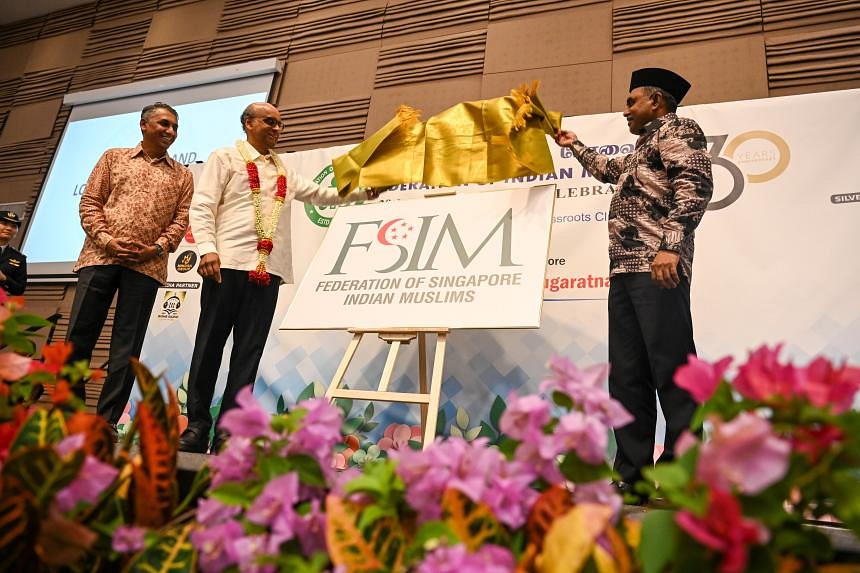
President Tharman Shanmugaratnam (second from left) was the guest of honour at the federation’s 30th anniversary celebrations on Oct 27, 2023. PHOTO: BERITA HARIAN
Singapore :
The Federation of Indian Muslims – the umbrella body encompassing 18 Indian Muslim organisations – is now known as the Federation of Singapore Indian Muslims (FSIM).
The federation unveiled its new name and logo at its 30th anniversary celebrations held at The Grassroots’ Club in Yio Chu Kang on Friday.
President Tharman Shanmugaratnam was the guest of honour at the event, which was attended by 500 people including community leaders.
Four individuals were honoured during the event for their contributions to the Indian Muslim community in Singapore.
Hindu Endowments Board chief executive T. Raja Segar and former Islamic Religious Council of Singapore (Muis) president Mohammad Alami Musa were presented the FSIM Harmony Award.
The FSIM Community Service Award was presented to the federation’s founding member, Mr Shaik Alaudeen Osman, while fellow founding member A.R. Mashuthoo was presented the M.K.A. Jabbar Lifetime Achievement Award.
The award is named after FSIM’s founding president, who was also a former MP for Radin Mas.
Speaking at the event, FSIM’s president, Mr Mohamed Bilal, 55, paid tribute to previous generations of Indian Muslim community leaders.
“In the coming years, we strive to focus on the educational development of students, welfare of youth, identifying young leaders, and honing their skills,” said Mr Bilal.
In recent years, the federation has been reaching out to young people. It has co-opted IMYouth, an Indian Muslim youth organisation, as its youth wing.
source: http://www.straitstimes.com / The Straits Times / Home / by Irshath Mohamed / October 29th, 2023
Historians and enthusiasts are taking public education into their own hands to tell the story of the country’s Muslim communities.
The Chronicles of Mehrauli heritage walk. Sonia Sarkar for The NationalThe walk takes visitors through Mehrauli Archaeological Park. Sonia Sarkar for The Nationalit is led by Purani Dilli Walo Ki Baatein. Sonia Sarkar for The NationalIt is one of the oldest inhabited places in the subcontinent. Sonia Sarkar for The NationalMehrauli is rich in historical ruins, tombs and monuments from many eras of Delhi’s past. Sonia Sarkar for The NationalThe Qutb Minar heritage tour. Sonia Sarkar for The NationalPigeon-watching on a tour. Photo: Purani Dilli Walon Ki BaateinA kotha, now a private property, in old Delhi taken during the walk titled ‘Tawaifs and Kothas: Exploring Chawri Bazaar’ by Enroute Indian History. Sonia Sarkar for The NationalThe road leading to Jama Masjid in old Delhi, with guide Anoushka Jain showing an old picture of the same road in the 19th century. Sonia Sarkar for The NationalA tour group on the steps of Jama Masjid. Photo: Enroute Indian History
Chaotic narrow lanes lined with opulent old mansions, shops selling spices, dried fruits and kebabs, all overhung by dangling power cables – any trip to Old Delhi, a bustling Muslim hub built by Mughal ruler Shah Jahan, is a full sensory experience.
Abu Sufyan weaves through the crowd with about 20 people in tow, making his way through streets smelling of flatbread soaked in ghee, the call to prayer at a nearby mosque mingling with the bells of a Hindu temple.
He is on a mission to change negative perceptions of Muslims by showing visitors more of their history in the capital.
“People in old Delhi were labelled as ‘terrorists’ and ‘pickpockets’ because they were predominantly Muslims from the lower economic background, and Mughal rulers were vilified as cruel invaders, as they were considered the ancestors to Indian Muslims,” Abu Sufyan, 29, says.
“My walks involve the local community members including calligraphers, pigeon racers, cooks and weavers with ancestral links in the Mughal era to showcase old Delhi’s heritage beyond these stereotypes.”
Abu Sufyan is one of a growing crop of enterprising men and women using the medium of heritage walks to educate the Indian public and tourists on the nation’s lesser-known history.
He started his walks in 2016, when hatred against Muslim communities was on the rise after Prime Minister Narendra Modi’s ruling Bharatiya Janata Party introduced several anti-Muslim policies.
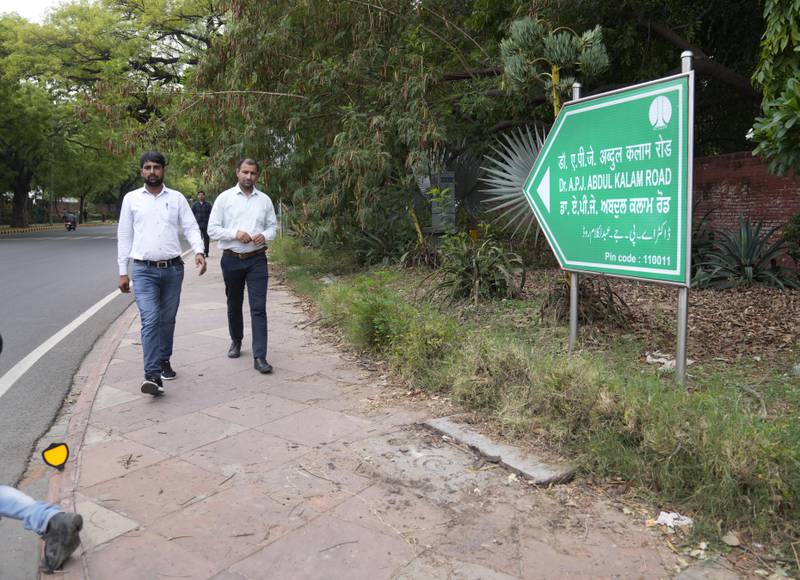
People walk on a road earlier named Aurangzeb Road, after the Mughal emperor, now renamed to Dr. A. P. J Abdul Kalam, India’s former president, in New Delhi, Thursday, June 2, 2022. / AP Photo/Manish Swarup)
In 2015, a BJP politician urged the local civic body in Delhi to change the name of Aurangzeb Road to APJ Abdul Kalam Road. The civic body immediately obliged, removing the reference to the Mughal ruler from the road by naming it after the former president of India, who was always considered a “patriotic” Muslim.
Later, the 2019 Citizenship (Amendment) Act caused further division, as critics said it could be weaponised against Muslims, who are designated as “foreigners” under the National Register of Citizens.
Occasionally, divisions lead to violence: Thirty-six Muslims were killed in Hindu mob attacks for allegedly trading cattle or consuming beef between May 2015 and December 2018, according to Human Rights Watch.
‘A sense of belonging and togetherness’
Chennai city is also a major cultural site, offering many things to do and sights to see. Frederic Soltan / Corbis
Over 2,000 kilometres away in Chennai, documentary filmmaker Kombai S Anwar hosts walks in Triplicane to tell stories of Tamil Muslim history, Tamil Nadu’s pre-Islamic maritime trade links with West Asia, the arrival of Arab traders, Mughal emperor Aurangzeb’s rule, the appointment of a Mughal minister’s son Zulfikhar Ali Khan as the first Nawab of Arcot, and the lives of the subsequent nawab’s descendants.
“Predominantly, non-Muslims participate in these walks because they are ‘curious’ about local Muslims and their heritage. During [Ramadan], they are invited to the historic Nawab Walaja mosque, where they experience the breaking of fast and partake in the iftar meal,” Mr Anwar says.
Tickets for heritage walks across India range between 200 and 5,000 Indian rupees ($2-60).
Historian Narayani Gupta, who conducted heritage walks in Delhi between 1984-1997, said any controversy related to history generates more interest.
“Whether history is right or wrong or good or bad, it has to be backed by research findings,” she says.
17th-century Jami Masjid, India’s largest mosque. Unsplash
Saima Jafari, 28, a project manager at an IT firm, who has attended more than 30 heritage walks in the past five years, says it is hard to ignore the historical monuments in the city since they are almost everywhere.
Delhi-based Ms Jafari recalled one of her best experiences was a walk, in 2021, trailing the path of “Phool Waalon Ki Sair”, an annual procession of Delhi florists, who provide sheets of flowers and floral fans at the shrine of Sufi saint Qutubuddin Bakhtiyar Kaki and floral fans and a canopy at the ancient Hindu temple of Devi Yogmaya in Mehrauli.
“When I walked along with others in that heritage walk, I realised that heritage enthusiasts across religion walk together in harmony,” Ms Jafari says.
“One of the best parts of heritage walks is the storytelling that connects places with lives of people of a certain period. Plus, it always gives a sense of belonging and togetherness.”
Anoushka Jain, 28, a postgraduate in history and founder of heritage and research organisation Enroute Indian History, which holds walks to explore the erstwhile “kothas (brothels),” and “attariyas (terraces)” of old Delhi, said during pandemic lockdowns, posts on Instagram helped sparked interest.
“Before the pandemic, barely 40 people participated in two weekly walks as opposed to 50 in each of the four weekly walks which we conduct now,” she says.
But it is not all smooth sailing.
Ms Jain says some people feel uncomfortable when they are given historical facts and research that show Hindu and Jain temples constructed by Rajput rulers were repurposed during the rule of Delhi Sultanate, Qutb ud-Din Aibak.
Iftekhar Ahsan, 41, chief executive of Calcutta Walks and Calcutta Bungalow, adds that sometimes, participants come with preconceived notions that Muslims “destroyed” India for more 1,000 years – but walk leaders hold open conversations to “cut through the clutter” with authentic information.
For some, heritage walks often change perceptions.
“Until I visited mosques in old Delhi during a walk, I didn’t know that women were allowed inside mosques,” law student Sandhya Jain told The National.
But history enthusiast Sohail Hashmi, who started leading heritage walks in Delhi 16 years ago, cautions that some walk leaders present popular tales as historical fact.
A mansion called Khazanchi ki Haveli in old Delhi’s Dariba Kalan is presented as the Palace of the Treasurer of the Mughals by some walk leaders, Mr Hashmi says. The Mughals, however, were virtual pensioners of the Marathas – Marathi-speaking warrior group mostly from what is now the western state of Maharashtra – and later the British and had no treasures left by the time the mansion was built in the late 18th or early 19th century.
Another walk leader had photo-copied an 1850 map of Shahjahanabad, now old Delhi, passing it off as his own research, he adds.
“The walk leaders must be well-read and responsible enough to ensure that the myths are debunked,” Mr Hashmi says.
source: http://www.thenationalnews.com / The National / Home> World> Asia / by Sonia Sarkar / June 01st, 2023