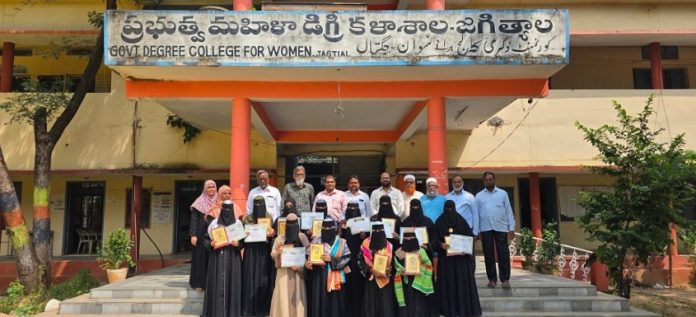
Government Degree College for Women, Khodmukhtar, hosted a special felicitation programme to honour students for their outstanding academic achievements. The event was organised by the Emirate-e-Millat Islamia Education Committee and Bazm-e-Urdu Adab, Jagtial.
The ceremony was presided over by Principal Professor Rama Krishna. Distinguished guests included Muhammad Abdul Bari, President of Emirate-e-Millat Islamia, Liaquat Ali Mohsin, President of Bazm-e-Urdu Adab, and Muhammad Munemuddin, President of the Education Committee.
Eight students who secured first positions in their respective degree courses were awarded medals, mementoes, and certificates. The awardees were Asna Takreem, Shifa Sadaf, Mehdi Falak, Umm Khadija, Aafia Sultana, Zeba Firdous, Nasira Begum, and Samira Sultana.
A speech competition on the topic “Role of Muslims in the Freedom Movement” was also held. Rimsha Fatima won the first prize of Rs. 3000. Samina Sultana secured second place with Rs. 2000, while Samiya Sania took third place with Rs. 1000.
In addition, students Hajra Maheen, Areeba Shahwar, and Nahanaz, who achieved excellent ranks in Urdu in the Telangana State Common Post Graduation Entrance Test, were honoured with shawls, medals, and mementoes.
The event was conducted by Urdu lecturer Qasim Ali. Faculty members Muhammad Abdul Rahim, Yasmin Sultana, Irfana Begum, and Satyam were present, along with Education Committee members Sheikh Naseem Ahmed, Muhammad Sajid Patwari, and Iftikhar Hussain.
The programme highlighted the role of community organisations in encouraging education and celebrating student achievements.
source: http://www.radiancenews.com / Radiance News / Home> Education> Latest News> Report / by Radiance News Bureau / September 12th, 2025
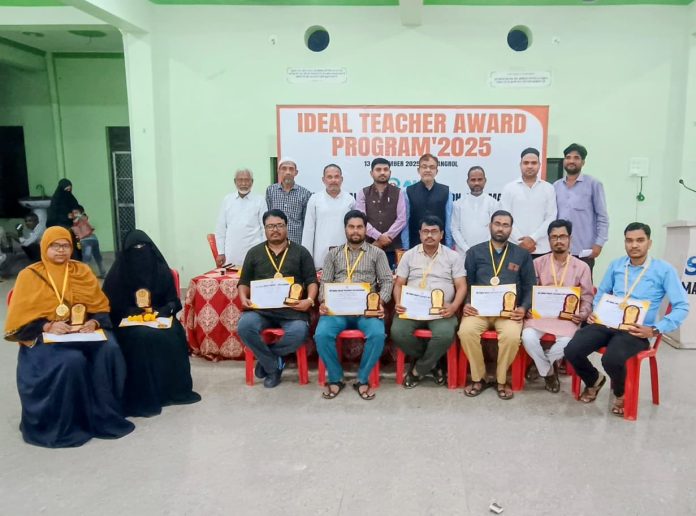
The All India Ideal Teachers Association (AIITA) Unit Mangrol, district Baran, Rajasthan, organized the Ideal Teacher Award 2025 to honor the contributions of educators in the community. The event brought together teachers, dignitaries, and residents to recognize the vital role of teachers in shaping students and society.
Applications were invited from educators across schools and madrasas. A seven-member committee evaluated candidates based on moral character, punctuality, religious integrity, contribution to student development, social engagement, and community impact. After a rigorous selection process, ten educators were chosen for recognition. They were awarded certificates, shields, and medals. The awardees included Rafiq Ahmad, Ejaz Hussain, Mohammad Iqbal, Fakhruddin (Siswali), Tarannum Parveen, Mohammad Saleem (Principal, Madrasa Suiwalan), Mohammad Irfan (Anjuman Madrasa), Meraj Ahmad, Wahid Anwar, and Rizwana Kausar.
A highlight of the ceremony was the Lifetime Achievement Award presented to Tahir Hussain for his decades of service to education. His work was described as leaving a lasting impact on the community and inspiring both teachers and students.
The event was attended by prominent figures including AIITA State President Khalid Akhtar, who spoke on the moral and social responsibilities of teachers, and Media Secretary Dr. Raheem Khan, who encouraged the use of technology in classrooms. State Secretary Yunus Ansari and other guests also expressed appreciation for the teaching community.
The program concluded with words of thanks from Unit Secretary Haider Ali Ansari and Unit President Mohammad Irfan. The ceremony reinforced the value of education and highlighted the role of teachers as community leaders.
source: http://www.radiancenews.com / Radiance News / Home> Latest News> Report / by Radiance News Bureau / September 17th, 2025
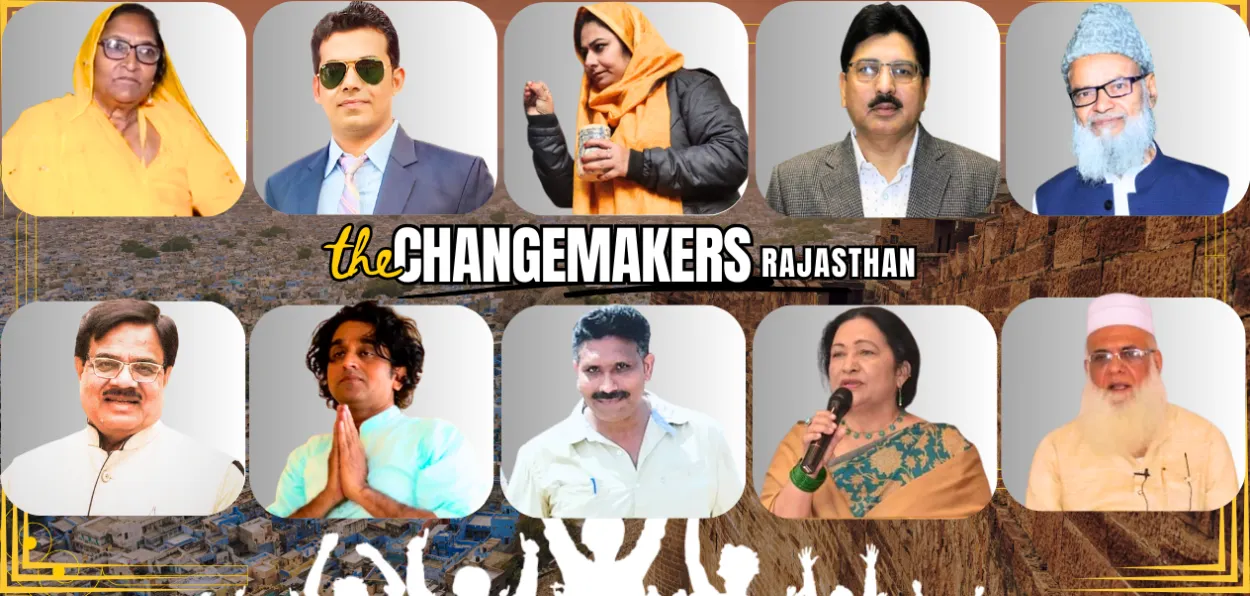
Rajasthan is known for its sandy deserts, historical monuments, especially forts, vibrant culture, and above all, its brave people, some of whom are inspiring others and changing society for the better. Under our series ‘The Changemakers’, Awaz-The Voice, brings you ten such personalities of Rajasthan, who have done extraordinary and pioneering work. Batool Begum: A living legacy of musical heritage.
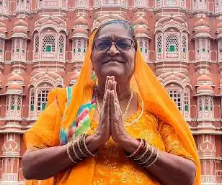
Batool Begum: Woman who took traditional music to the world
One name that resonates in the streets of Jaipur is that of Batool Begum. Born in Kerap village of Nagaur district, Rajasthan, this extraordinary singer is a living legacy of Indian classical music. Batool developed a deep passion for music in her childhood. Despite facing social and economic challenges, she continued her singing.
Her melodious voice and her passion for music not only earned her recognition as an artist but also proved that talent can break all barriers. Her art is a source of inspiration for her community and the entire Rajasthan.
Abdul Salam Johar: A lac bangle maker who received global recognition
The vibrant spirit of India’s Pink City, Jaipur, doesn’t only emanate from its colours and people but also from the traditional handicrafts that are made and sold here. Bangles worth lakhs are made in these streets, which are a symbol of the traditional beauty and hard work of thousands of its people.
Abdul Salam Johar is one such artist who not only preserved the traditional art of the State but also brought about a social change in a major way. Coming from the Manihar community, Johar was born in a family with little means, but his dreams were extraordinary. Seeing the struggles of his grandfather Hafiz Mohammad Ismail and parents Haji Abdul Aziz and Hajjan Qamar Jahan, he made hard work, dedication, and social service the main mantra of his life.
He began his journey from his ancestral shop ‘Indian Kangan and Colour Store’ located in Tripolia Bazaar of Jaipur, and today his wares are being sold under brands ‘Johar Design’, ‘Johar King’ and ‘Indian Crafts’ in the global markets. He is not only a successful entrepreneur, but also a social reformer who took his community and traditional art to new heights.
Abdul Latif ‘Arco’: A confluence of business and social service
Abdul Latif, who lives in Chini ki Burj in the capital Jaipur, and is known as ‘Arko’ in Rajasthan, is one such special personality. Born in a small village of Chomu in 1946, Abdul Latif’s father, Rahmatullah, and mother, Hafijan, taught him hard work, honesty, and the passion to help people, which became the basis of his life.
His company, Abdul Razzaq & Company (ARCO), is today a big name for social service along with electric motors, fans, and coolers. Apart from this, his hotel, ARCO Palace, is a symbol of his hard work and foresight. Abdul Latif’s story is not just of a businessman, but of a person who chose to work as a changemaker by combining his business and social responsibilities.
Qazi Nishat Hussain: A new voice breaking stereotypes
The voice rising from a small office located in the narrow streets of Johri Bazaar in Jaipur, the capital of Rajasthan, is today inspiring society to change. This voice is of Nishat Hussain, Rajasthan’s first Muslim female Qazi, social worker, and a strong advocate of the rights of Muslim women.
Her life journey is an example of courage, struggle, and change, which not only made thousands of women aware but also gave them a new direction to live.
Born in Sitabari Mohalla of Karauli district, Nishat’s childhood was spent in an environment of communal harmony. His family was the only Muslim family in the neighbourhood. There were three temples in front of her house. She says, “We did not know who was a Hindu and who was a Muslim.” In a backward area like Karauli, where girls’ education was not given importance, Nishat created history. She became the first Muslim girl in the district to pass the tenth standard, that too as the only Muslim student among 1200 girls. Today, she has become a torchbearer of the rights of Muslim women.
Captain Mirza Mohtasim Baig and Ruby Khan: An Inspiring couple in social service
An inspirational couple, Captain Mirza Mohtasim Baig and his wife Ruby Khan, hail from Jaipur. Captain Mirza is the first Muslim pilot of Rajasthan and has been operating national and international flights for the last 25 years. At the same time, his wife Ruby is an active social worker and politician.
Both believe that if one wants to bring change in society, then he has to take the initiative. Together, they had organised medical camps, documentation camps, free ration distribution, and offered financial help to families in the marriage of their daughters. The couple is an epitome of change brought about by spirited people.
Dr. Arif Khan: The village scientist who created history
Thirty-four years ago, a child was born in the small village of Masani in the Hanumangarh district of Rajasthan. Today, he is Dr. Arif Khan, a scientist who has brought laurels to India. In his village, most of the people toiled in the fields. His father, Advocate Farid Khan, wanted his son to become a doctor. His mother and grandfather also had the same dream. But there were few schools in Masani, and the path to making dreams come true was difficult. Still, Arif had a passion to do something extraordinary in his life.
With his hard work and dedication, he became a bio-scientist and brought glory to his family and village. His research on milk and food products brought a wave of change. His story proves that if the intentions are strong, then even a boy from a small village can become a scientist and make the country feel proud.
Mainuna Nargis: First Shia Muslim woman in art conservation
In a vast country like India, art conservation is important since it not only preserves history but also connects future generations to our heritage. Mainuna Nargis, the country’s first and so far the only Shia Muslim woman art conservator, does the same work. Born in Bahjoi, a small town in Moradabad district of Uttar Pradesh, Maimuna’s childhood was ordinary, but her dreams were extraordinary. Rajasthan has now become Mainuna’s second home.
Her father, a Policeman in UP, always encouraged her. After studying Fine Arts from Aligarh Muslim University (AMU), she did a diploma in Museology, which became the most decisive turning point in her life. Maimuna’s story is not just of professional success, but a story of passion, struggle, and self-confidence, which revived the broken pieces of history.
Yoga Guru Naeem Khan: Global journey from music to yoga
The life journey of Yoga Guru Naeem Khan, who rose from the streets of Jodhpur, the cultural capital of Rajasthan, to spread his spiritual aura on international platforms, is a unique example. He rose from a common man to a global yoga guru and presented yoga as a universal energy beyond religion, culture, and boundaries.
Naeem Khan was born in a family where music was in every breath. His grandfather, Ustad Umardin Khan, was the court musician of the Jodhpur royal family, while his maternal uncle was Padma Bhushan-awarded Sarod player Ustad Sultan Khan. However, with changing times, that traditional flame of music started to fade. Naeem and his brother got involved in business, but yoga gave Naeem a new direction, and he took it to a global platform.
Syed Anwar Shah: A man who introduced girls to education
Thirty years ago, a dream was born in a small room in Jaipur, which has today become the light of education for thousands of girls. This is the story of Syed Anwar Shah, whom people fondly call Master Anwar Shah. He not only dreamt of his daughter’s education, but also made it a means of progress for the daughters of society.
Today his educational institution, Al-Jamia-tul Alia, is spreading the message of knowledge and Islamic ethics not only in Jaipur, but also in the whole of India and abroad. After completing his M.A. in Public Administration from Rajasthan University in 1980, he dedicated his entire life to the welfare of society and the service of education. In 1995, when his daughter Alia was born, he decided to set up an institution for the education of girls, which would impart both worldly and divine teachings.
Today, his effort has become a boon for thousands of families.
Padma Shri Shakir Ali: Patron of Miniature Painting
It’s no exaggeration to say that Jaipur is the art capital of Rajasthan. And in the field of miniature painting, the name of Syed Shakir Ali comes to the fore spontaneously. This genre of painting is an identity of the state of Rajasthan.
Padma Shri awardee Syed Shakir Ali is not only a great practitioner of this art, but he is also the guardian of that heritage, which is an integral part of the cultural identity of Rajasthan. Born in 1956 in Jalesar village of Uttar Pradesh, Shakir Ali’s family soon settled in Jaipur, where his art got a new direction.
Today, he has given recognition to this traditional art of Rajasthan not only in India but also on international platforms.
source: http://www.awazthevoice.in / Awaz, The Voice / Home> The Changemakers / by Aasha Khosa, ATV / September 14th, 2025
Human Welfare Foundation inaugurated the ambitious Vision Academic City” project in Mewat, one of Haryana’s most backward districts. Spread across 24 acres in Maroda village, the campus aims to transform the socio-economic landscape of the region by providing quality and affordable education, healthcare, and community services.
Speaking on the occasion, local MLA Mamman Khan described the campus as a “blessing” for the people of Mewat and assured full support to strengthen its educational initiatives.
P. Mohammed Ali Gulfar, Patron of Human Welfare Foundation and founder of the Gulfar Group, recalled that the dream of Vision 2026 was envisioned in 2005 and is now becoming a reality. “We will continue working for the educational and social upliftment of this region,” he said.
Adding to this, T. Arif Ali, Chairman of Vision 2026, emphasized that the sacrifices of Mewat’s people are deeply rooted in India’s soil, and the time has come to turn the dreams of their forefathers into reality.
Mewat is counted among the most underdeveloped districts of the country, grappling with poor education levels, lack of healthcare facilities, and inadequate sanitation. To address these challenges, the Vision Academic City has been developed under the Vision 2026 Programme.
During the inauguration, several institutions within the campus were formally opened, including Al Jamia Islamia Mewat Off-Campus, an undergraduate college building, separate hostels for boys and girls, and Chirag Middle School. The foundation stones of Scholar School and a Skill Development Centre were also laid.
The event also highlighted Mewat’s rich cultural heritage through Tarang Cultural Fest, Mewat Kitchen, and the Mewat Heritage Wall, showcasing the region’s traditions and identity.
Prominent guests included Engineer Mamman Khan (MLA, Ferozepur Jhirka), P. Mohammed Ali (Founder, Gulfar Group of Companies), and Maqbool Ahmed Anarwala (Retd. IPS Officer). Educationists, community leaders, and several eminent personalities also graced the occasion.
Speakers stressed the urgent need for quality education and skill development in Mewat, noting that Vision Academic City would not only provide modern infrastructure but also open pathways for higher education and research.
Among those present were M. Sajid (General Secretary, Human Welfare Foundation), Shibli Arslan (Academic Director, Al Jamia Mewat Campus), and many local dignitaries.
The inaugural ceremony concluded with a commitment to make Vision Academic City a hub of learning, development, and cultural pride for Mewat.
source: http://www.indiatomorrow.net / India Tomorrow / Home> Society / by Mohammed Naushad Khan / September 08th, 2025
On the occasion of its Founder’s Day, the Al-Ameen Educational Society felicitated M. Nurul Islam, Founder and General Secretary of Al-Ameen Mission, West Bengal, with the prestigious “Al-Ameen All India Community Leadership Award 2025” for his remarkable contributions to education and community empowerment, reported the MPositive.
The annual event, held in memory of the Society’s visionary founder, the late Dr. Mumtaz Ahmed Khan, brought together members and supporters of the Al-Ameen movement. Nurul Islam was invited as the chief guest and was honoured for his tireless efforts in transforming the educational landscape, particularly for underprivileged students in West Bengal.
Islam began the Al-Ameen Mission in 1986 by establishing a hostel and the Institute of Islamic Culture in Khalatpur through community donations—famously collected as a fistful of rice from every household. In 1987, he renamed the initiative Al-Ameen Mission, inspired by the title Al-Ameen (the trustworthy), given to Prophet Muhammad ﷺ.
Since its inception, the Mission has achieved phenomenal success. With 77 residential branches, it currently houses more than 22,000 students, boasts a strong network of 50,000 alumni, and has produced over 2,400 doctors, 2,500 engineers, and numerous other professionals. In 2022 alone, nearly 500 students secured admissions in MBBS and BDS courses.
The late Dr. Mumtaz Ahmed Khan, who founded the Al-Ameen Educational Society in 1966 at the age of 30, is remembered as a renowned educationist, humanitarian, and reformer who dedicated his life to uplifting marginalized communities through education. His legacy continues to inspire the movement’s expansion across India.
source: http://www.radiancenews.com / Radiance News / Home> Education> Latest News> Report / by Radiance News Bureau / September 08th, 2025
On the occasion of Teacher’s Day, Mr. Mohsin Ali, a dedicated Urdu teacher at The Mansoora School, Alur, has been honoured with the District Best Teacher Award by the Deputy Commissioner.
Mr. Mohsin Ali has been serving The Mansoora School, Alur, for over 35 years, inspiring and motivating students through his teaching and active participation in cultural activities. Despite opportunities for government jobs, he has chosen to dedicate his service to the welfare of his students.
Under his guidance, many students have achieved exceptional marks in Urdu and gone on to secure high positions in their careers. This award is a testament to his teaching excellence and commitment to education.
The Mansoora family congratulates Mr. Mohsin Ali on this prestigious achievement and wishes him continued success in his endeavours.
“Mr. Mohsin Ali’s dedication and passion for teaching have made a significant impact on the lives of his students. We are proud to recognise his outstanding contribution to education.”
source: http://www.radiancenews.com / Radiance News / Home> Awards>Latest News / by Radiance News Bureau / September 07th, 2025
Lakhimpur Kheri District / Aligarh, UTTAR PRADESH :
A leading scholar of Islamic studies with focus on Seerah literature and history, he unconventionally broke many stereotypes—both orthodox and modern and all his life epitomized the cause of Islam on the intellectual front.
With the death of Yaseen Mazhar Siddiqui, at the age of 76, Muslims in South Asia lost one of the most respected and leading scholars of Islam. A graduate of, and now professor at Aligarh University is less known in the West for his 29 books than for his Catalogue of Arabic Manuscripts at the Aligarh Muslim University, India, published in London in 2002 by the Furqan Heritage Foundation.
An eminent Muslim religious scholar, academic and historian who served as director of the Institute of Islamic Studies at Aligarh Muslim University. Siddiqui was a well-placed and reputed figure of great spiritual and intellectual insight recognized on national as well as international level.
Siddiqui was instrumental over the past 30 years in the framing, development and streamlining the influence of Islam in Aligarh Muslim University. To commemorate the outstanding services of Hazrat Shah Waliullah and to promote the Islamic values, the Institute of Objective Studies instituted an Award known as “Shah Waliullah Award” to honour eminent scholars who have done outstanding work in Social Sciences, Humanities, Law and Islamic Studies. The fifth Shah Waliullah Award was rightly conferred on Prof. Mohd Yasin Mazhar Siddiqi, as the renowned scholar for his contribution to Sirah and Historiography in Islamic Perspective in 2005.
Siddiqui was an exceptionally modest and humble man, with an intellectually engaging and honest commitment to Islam, away from self-eulogizing claims of pseudo-intellectualism. His commitment to Islam, which occupied him for his whole life, left an indelible mark in the hearts and minds of people across territorial boundaries.
One thing all this illustrates is Siddiqui’s intense sense of duty — a sense that he unthinkingly expected his colleagues to share. Siddiqui’s well-stocked mind, clarity and unflinching intellectual honesty devoted to respond the questions of Orientalist scholarship on Sirah literature and subsequent other corollaries. He had little time for Islam’s own accounts of its origins rather his interest revolved around “Qurʾān and Sirah” and its role in shaping the worldview of Muslims who are struggling to makes sense of their identity amid the challenges emerging from dominant discursive colonial Eurocentric episteme. Leaving the conventional hollow claims, without efforts to prove how and why so much sanctity is attached to Islam and its sources—Qurʾān and Sunnah/Sirah being the primary one, he reckoned, to fill the gap using contemporary sources and knowledge of Hadīth, from orientalist and now its pedigree of modernist claims. This task required both personal and intellectual bravery. As he knew the central beliefs of Islam, such as the way the Quran took shape, the place of Sirah, its underlying methodology, he was equally aware how outside scrutiny has tempered the flare, especially when the conclusions are expressed in a witty and sardonic style.
His soft way of speaking, affectionate manner and hospitable nature made him a much-loved figure. Because of his erudition most people who came in contact with him thought of him as a teacher; many saw him as a spiritual mentor. With his humble appearance, it was easy to mistake him for a country bumpkin.
Born in India in 1944 in the Lakhimpur Kheri district of United Provinces of British India. He graduated in the traditional Dars-e-Nizami (pure religious textual studies of Islamic texts) studies from Nadwatul Ulama in 1959, and Master’s in literature from the University of Lucknow in 1960. He passed the intermediate exams from the Jamia Milia Islamia in 1962 and then acquired a B.A. in 1965 and B.Ed. in 1966 from the same University. In 1968, Siddiqui recieved a M.A. degree in History, M.Phil. in 1969, and Ph.D. in 1975 from the Aligarh Muslim University. Yasin Mazhar Siddiqui benefited from great teachers like Maulana Rabi Hasni Nadvi, Maulana Syed Abul Hassan Ali Nadvi, Maulana Ishaq Sandelvi K. A. Nizami, Abd al-Hafīz Balyāwi and Rabey Hasani. Anwar was welcomed as an independent member of various advisory committees and expressed pride in the research done in the field of Sirah.
Professor Siddiqui wrote more than 40 books and 300 research articles in Urdu, Arabic and Persian.
His publications and presentations have reverberated throughout the discipline of Islamic studies and social sciences, profoundly shaping the scholarship of a new generation of scholars as they develop a thoughtful, knowledgeable, and critical approach to Seerah and history. He was well known for the great quality and high calibre of his originality of research in Islamic studies and all related subjects.
He was recognized as one of the compelling and intellectually grounded voice on Seerah studies. As a scholar and teacher, he embodied and followed strong moral and political principles, and formulated new ways of understanding the subject of Seerah, history, religious freedom, and the rights of religious minorities. His writings on the Prophet and his teachings garnered wide acclaim.
He wrote extensively in reputed literary journal, ‘Nuqoosh’ and got international ‘Nuqush Award’, ‘Seerat-e-Rasool Award’ and ‘Sirah Nigari Award’.
Two of his most popular works are Muslim Conduct of State and Introduction to Islam. The first book was Ehd-e-Nabwi mai Tanzīm-e-Riyāsat-o-Hukūmat and the second book The Prophet Muhammad: A Role Model for Muslim Minorities has gained such wide acclaim—mainly for the reason that its contents are divided into chapters (which stand on their own as a monograph) which deal with related specific subject matter. It is easy to understand how his style of presentation has endeared the book not only to common folk, but also to the people who would like to gain a reasonable insight into the true spirit of the teachings of Islam.
For such Muslim communities, the political perspectives reflected by the corpus of traditional fiqh are of little or no relevance, and can even be hugely problematic. Siddiqui therefore takes it upon himself to develop an understanding of Muslim jurisprudence that is particularly suited to their context, making a valuable contribution to the limited, but slowly expanding, corpus of writings on fiqh al-aqalliyat or fiqh for [Muslim] minorities. Siddiqui argues that the basis of fiqh for Muslim minorities must lie in the Makkan period of life of the Prophet Muhammad and his companions, a period of around thirteen years when the Muslims were a minority and did not enjoy political domination. In many senses, their position resembled that of Muslim minorities today. Muslim minorities need to see the role of the Prophet and the early Muslims in that period as a model for them to emulate, Siddiqui suggests:
The Prophet had close personal ties with several non-Muslims in Mecca, and Muslim minorities, Siddiqui advises, must emulate him in this regard and must have “excellent social relations with non-Muslims” (p. 194).
As Siddiqui succinctly puts it:
Muslims all over the world, especially Muslim minorities, have to prove that they are the best community, devoted to the cause of protecting mankind against suffering and blessing everyone with happiness, regardless of caste, colour or creed. Their position is of the best community and their duty is to serve mankind […] Their presence must guarantee help for everyone, especially of their non-Muslim country. However, this cannot be affirmed merely verbally or by recounting old stories. They have to prove it by their conduct. (p. 194)
This monograph and his other works are a brilliant contribution to the on-going debates about fiqh for Muslim minorities. It provides valuable insights for developing new and more relevant understandings of Islamic jurisprudence in Muslim minority contexts, envisaging the possibility of reconciling Islamic commitment with Muslim minority-ness, an issue that has largely escaped the attention of Islamic scholars but one that has sometimes been, and continues to be, a troubling one for many Muslims living as minorities.
Siddiqui’s diverse and intellectually engaging work that speaks eloquently to a wide spectrum of readers with different backgrounds and interests. To use terms such as “monumental”, “one-of-a-kind”, and “exceptional” to describe this work is not exaggeration.
A committed Muslim, throughout his career Siddiqui maintained the principle of genuinely evidence-based research. Dapper and courteous, he was a highly effective communicator, quoted widely in the local context as well as cited in academia.
A direct criticism to his work also emerges from scholars who assert that in his Introduction of The Prophet Muhammad—A Role Model for Muslim minorities’ Siddiqi (p. 62) formally describes himself as a humble and error-prone human being. However, he then proceeds to negate the worth of all previous biographies of the Prophet, claiming that these ‘conventional’ authors used ‘outdated methodology and lines of argument’. Consequently, according to him, all previous studies of the Makkan period were ‘markedly inadequate’ and ‘the entire life history of the Prophet remains to be analysed’ since ‘no biographer of his has ever given thought to this obvious fact that the Makkan period of his life represents the phase of subjugation’. Therefore, Siddiqi considers the conventional treatment of the Makkan and Madinan periods of Islamic history as ‘downright pernicious’ (p. ix). One wonders indeed whether the author is aware of some of the most popular biographies of the Prophet—beyond the classical ones: Ibn Ishaq, Ibn Hisham, and Ibn Kathir—including the works by Muhammad Hamidullah, Muhammad Haikal, Martin Lings, Karen Armstrong, and Tarik Jan, all contradicting his assertions.
With quite a serious criticism on his assertions about various aspects of mis-reading the Seerah of the Prophet there still remains a lot to be talked about his contribution to diverse areas of Islamic Studies. And though he is no longer here to share his thoughts, he has done enough to enable us to think with him. Certain towering intellectuals become integral to the very alphabet of our moral and religious imagination. They live in those who read and think them through-and thus they become indexical, proverbial, to our thinking.
Siddiqui lived so fully, so consciously, so critically through the thick and thin of our times that he is definitive to our critical thinking, just like Mustafa Azami, Abul Hasan Ali Nadvi, or other Muslim luminaries are. He was – and remains – a brilliant intellectual, whose legacy of rethinking certain conventional assertions around Islam and efforts still reverberate today and will continue to do so.
He cultivated with joyous attention her relationships with family and friends. He mentored, as one of his students mentioned once, with remarkable care and intensity, demanding their best work, listening, responding with a sharp generosity, coming alive in thought, and soliciting others to do the same. He immersed himself, in illness and heath, in reading the Quran post morning prayers and transformed himself and transmitted the values of thought and love, leaving now a vibrant legacy that will persist and flourish among all whose lives were touched by his life and work.
May Allah Almighty bless him with the loftiest of abodes in the Gardens of Firdaus in the company of Allah’s beloved Messenger and grant all those who cherished him patience.
source: http://www.muslimmatters.org / Muslim Matters / Home> Islam / by Dr Mehraj Din / September 22nd, 2020
Apart from the need for education, it underlines the importance of representation in legislative bodies and jobs
Syed Ahmed Khan biopic | Photo Credit: SPECIAL ARRANGEMENT
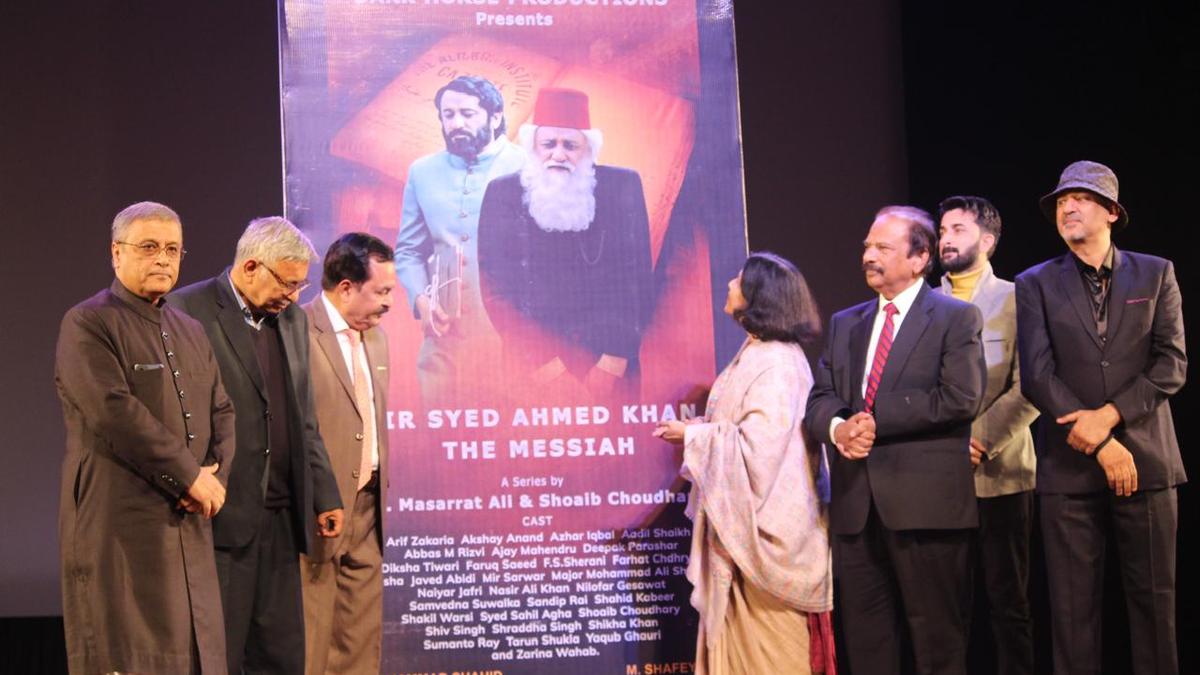
He is one of the architects of modern India or a proponent of the two-nation theory. However, moving away from easy binaries, the first biopic of Sir Syed Ahmed Khan attempts to find answers to the contested legacy of the founder of the Muhammedan Anglo-Oriental College that took the shape of Aligarh Muslim University (AMU). Long in the works, a two-hour cut of the OTT series, The Messiah premiered at the iconic Kennedy Auditorium in AMU on Monday, before the series streamed on Apple TV.
Coming at a time when the minority status of the Central University is being hotly debated in courts and society, the series details how Sir Syed confronted a section of the clergy and conservative elements within the Muslim community by creating a modern centre of learning to build bridges between the Muslims and the British government after the revolt of 1857, when the colonial power held the community largely responsible for the rebellion. “He held the ignorance as the primary reason behind the political decay of Muslims and thus pushed for modern education,” says Shoaib Hussain Chaudhary, who not only directed the series but also played the title role. “The role fell into my lap after big names declined to take up the challenge, perhaps because of the stigma attached to him.”
A known name in the television circuit, Chaudhary sees Sir Syed as an advocate of Hindu-Muslim unity, who was wrongly associated with the two-nation theory. “The theory came into being long after his demise in 1898. What he asked for was Muslim representation in legislative bodies and it remains relevant considering the political status of the community today.”
As someone who believed in answering a book with a book, Sir Syed responded to William Muir’s controversial commentary on Prophet Muhammad with a rational interpretation of Islamic tradition in Khutbat-e-Ahmadiya.
An adaptation of Hayat-e-Javed, Khwaja Altaf Hussain Hali’s biographical account of Sir Syed’s life, the series puts him in the league of reformists like Raja Ram Mohan Roy and Ishwar Chand Vidyasagar and argues that he was not a communal figure but a communitarian who was conscious of the fact that Hindus of Bengal were at least 50 years ahead of Muslims in taking up modern education.
Interestingly, the spark came from Mirza Ghalib. When Sir Syed approached the poet to write the preface of his translation of Ain-e-Akbari, he advised him to concentrate on the contemporary issues of the community and said there was no point in celebrating Akbar’s rule when the constitution of the world was being written in Calcutta.
‘Controversial ideas’
The series also critiques Sir Syed’s point of view on girls’ education and backward Muslims and debates whether he made a mistake by not joining hands with the Indian National Congress. It also explores his tumultuous relationship with his son Syed Mohammad, the first Muslim judge of a High Court during the British Raj, whose proclivity towards alcohol created problems in his personal and professional life. “Sir Syed’s character appears dichotomic but if you see him as a product of his times, things fall in place,” says screenwriter Mutyim Kamalee. “While Islam abhors slavery, he opted for pragmatism as after the revolt of 1857, the community was not in a position to take on the colonial power. Mahatma Gandhi also didn’t take the path of armed rebellion.” Kamalee says Sir Syed didn’t join the Congress but towards the end of his life he showed a change in his point of view and perhaps would have joined the Congress had he lived longer.”
Describing the series as an authentic portrayal of Sir Syed’s life and works, Prof. Shafey Kidwai, an authority on Sir Syed says, “Sir Syed views on women’s education and backward Muslims are widely misunderstood. The film tries to put the record straight in a convincing manner.”
Made on a tight budget, the series was shot on sets after AMU declined permission. “Filmmakers in the past didn’t live up to their promises, so the previous administration was circumspect about our intentions but I am glad now the university has embraced the film,” says Chaudhary.
Apart from Chaudhary, the series stars Akshay Anand, Zarina Wahab, Arif Zakaria, and Deepak Parashar in important roles.
source: http://www.thehindu.com / The Hindu / Home> News> India> Uttar Pradesh / by Anuj Kumar / December 20th, 2024
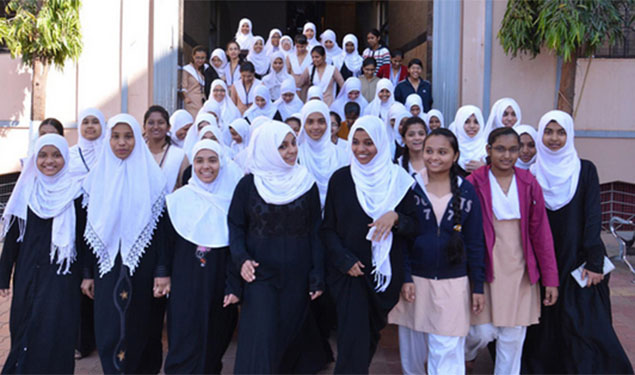
[Female students of Shaheen in a group photo. (File)]
Bidar (Karnataka):
Qurratul Aian, Shooa Fatima Khanam and Ammatulah Fatiha Nabisat, who passed the National Eligibility cum Entrance Test – UG (NEET 2018) and became eligible for admission to various medical courses, are Hafizah.
Hafizah is the Arabic term used to identify the females who memorise the entire Holy Quran comprising of 114 Suras or Chapters, and 6,236 Ayats or Verses.
While Hafiza Qurratul Aian scored 550 marks securing an All India Rank (AIR) of 7,446, Hafiza Shooa Fatima Khanam scored 483 marks with AIR 28,443 and Hafiza Ammatulah Fatiha Nabisat scored 462 marks and got 38,033th position in the NEET 2018 All India Rank (AIR).
The National Eligibility cum Entrance Test – UG (NEET 2018) result was declared on Monday June 04. A total 7,12, 635 candidates have qualified from India, 342 qualified students are from abroad, 1200 are Non Resident Indians (NRIs), 367 are OCI and 36 are PIO.
Qurratul Aian, Shooa Fatima Khanam and Ammatulah Fatiha Nabisat, the 03 female memorisers of the Holy Quran are the students of “Hafizul Quran Plus” program of Shaheen Group headquartered in Bidar, Karnataka.
The 04-year integrated course especially designed for Urdu speaking Huffaz and Aalims is divided into Foundation Course: (6 months), Bridge Course: (6 months), 10th class: (1 year) and Junior College: (2 years) preparation of 12th class along with NEET, JEE and other competitive examinations.
Besides the above three female memorisers of the Holy Quran, 10 other Huffaz of Shaheen Hafizul Quran Plus program have also passed the NEET 2018. A total of 1,600 Shaheen students had appeared for the National Eligibility cum Entrance Test – UG NEET in 2018. Of them, 1,363 students scored more than the minimum marks in NEET 2018.
“Out of the total 1,363 who qualified the medical entrance this year, 300 students have scored enough marks to get admission in different medical colleges”, Abdul Qadeer, Founder Chairman of Shaheen Group of Institutions, said while talking to ummid.com.
“Among them are 13 Huffaz including 03 Hafizah – female memoriser of the Holy Quran. One of the Huffaz who passed NEET 2018 is Waheed Abdullah of Gorakhpur, Uttar Pradesh. Like other students of Shaheen Hafizul Quran Plus, he never went to a school. He got free coaching at Shaheen’s Bidar center and scored 579 out of the total 720 marks to secure All India Rank (AIR) 3295”, he added.
Shaheen Group of Institutions was established in 1989 with Shaheen School to provide quality education to students from Urdu medium. Started with just 18 students, it now has more than 12,000 students and centers running in different cities of India including Bengaluru, Mysore, Belagavi, Shimoga, Kolar, Gulbarga, Raichur, Bidar, Basavakalyan, Humnabad, Aurad, Chitguppa, Aurangabad, Patna and Lucknow.
Besides special integrated course for Huffaz, the Shaheen Group also runs NEET coaching for regular students. It had sent more than 200 students to different medical colleges in 2017, 152 in 2016, 111 in 2015, 93 in 2014, 89 in 2013 and 71 in its first batch in 2012.
source: http://www.ummid.com / Ummid.com / Home> Education & Career / by ummid.com news network / June 11th, 2018
The Aligarh Muslim University community deeply mourned the sad demise of noted cardiothoracic, vascular surgeon and former Pro-Vice Chancellor of AMU, Prof Mohammad Hanif Beg, 69, who took his last breath early morning today in Moradabad.
Extending condolences to the bereaved family of Prof Beg and the AMU fraternity, the Vice Chancellor, Prof Mohammad Gulrez said, “I offer my deepest condolences to Prof Beg’s family and AMU community and pray for the comfort for his loved ones at this difficult time. He was a selfless soul who earned admiration, respect and esteem as a distinguished surgeon and seasoned academic who anchored a number of developmental works at the J N Medical College and the university.”
“At this moment of sorrow and grief, we share the pain of Prof Beg’s family and pray to the Almighty for giving them strength and courage to bear this loss,” he added.
Prof Azam Haseen (Chairman, Department of Cardiothoracic Surgery) expressed a deep sense of sorrow on his demise and prayed for solace to the bereaved family.
“Prof Beg mentored students with steadfast dedication, inspiring them to achieve their maximum potential. He also guided younger colleagues at key career moments for educational and professional strides,” he added.
Prof Beg served as the Dean, Faculty of Medicine and Chairperson, Department of Surgery, JNMC. He played a key role in the establishment and development of the Department of Cardiothoracic and Vascular Surgery and started the Open-Heart-Surgery procedure in 1988 at the JNMC.
Prof Beg completed his MBBS from K G Medical College, Lucknow in 1976 and attended PGIMER Chandigarh for his MS (Surgery) and M Ch (CVTS) from 1980 to 1982. He joined JNMC as a lecturer in 1983 and became Reader in 1988 and Professor in 1993.
Prof Beg is considered a pioneer in performing endoscopy and endoscopic removal of various foreign bodies from aero-digestive tracts since 1983. He has invented many new techniques such as designing of ‘Intercostal Tube drainage System’, which saves precious lives daily.
Prof Beg is survived by his wife, a daughter and two sons.
source: http://www.amiu.ac.in / Aligarh Muslim University (AMU) / Home / by Public Relations Office, AMU / April 06th, 2023





 and his companions, a period of around thirteen years when the Muslims were a minority and did not enjoy political domination. In many senses, their position resembled that of Muslim minorities today. Muslim minorities need to see the role of the Prophet and the early Muslims in that period as a model for them to emulate, Siddiqui suggests: