Category Archives: Leaders

Malegaon shows the way

Malegaon (Nashik District) , MAHARASHTRA :

Life in Malegaon appears to have retur­ned to normal, even as Maharashtra struggles to contain the pandemic. As of July 15, the state had 107,963 active cases, with 10,695 deaths.
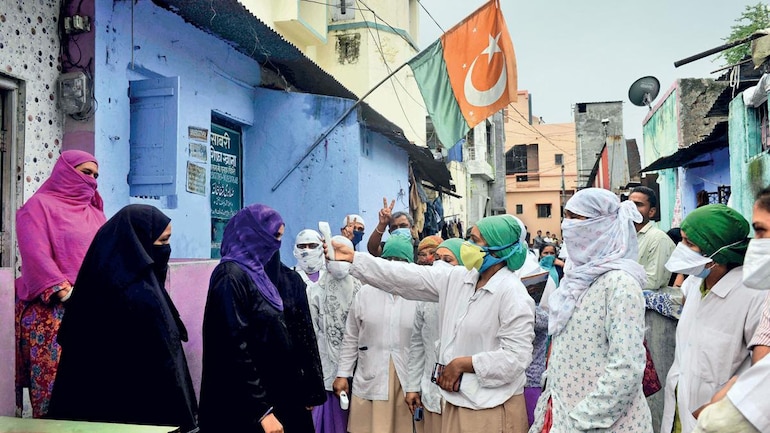
A new normal: Healthcare workers on a door-to-door Covid-19 test drive in Malegaon, July 14. / Photo by Milind Shelte

The covid-19 battle

On July 14, Malegaon’s Moha­mmad Ali Road, the city’s main commercial street, was full of shoppers, mirroring the sort of normalcy seen in days before the national lockdown in March, and presenting a stark contrast to the fearful retreat from public spaces seen in many areas of Maharashtra. The shops were open, selling everything from cutlery to electronics, and the restaurants and street food vendors were busy serving crowds of customers. Burqa-clad women thron­ged the ladies’ market. Life in Malegaon appears to have retur­ned to normal, even as Maharashtra struggles to contain the pandemic. As of July 15, the state had 107,963 active cases, with 10,695 deaths.

Malegaon’s return to normalcy is striking and worthy of note because, till recently, the city was one of the state’s five Covid hotspots, alongside Mumbai, Pune, Nagpur and Aurangabad. Until May, the city had seen a daily average of five deaths due to Covid-19, and reported about 200 fresh cases in the early part of that month. Today, there are just 60 active cases in the city, most of them non-residents of Malegaon, with no coronavirus-linked deaths since May 25. The doubling period has improved from 2.2 days in April to 112 days on July 15, the best in Maharashtra. At 82 per cent, the rate of recovery in Malegaon is also much better than the state average (54 per cent). The turnaround was so hard to miss that, in the first week of July, the Indian Council of Medical Research (ICMR) sent a confidential letter to the state government, asking for permission to study the ‘Malegaon model’.

Mal­egaon is a Muslim-majority city (80 per cent residents are from the minority community), with a population of 750,000. The city administration’s success in controlling the pandemic is especially laudable given that the average population density here is 19,000 per sq. km, the state’s highest. In areas like Kamanipura, this goes up to 72,000 per sq. km, second only to Mumbai’s Dharavi, where 800,000 live in a 2.1 sq. km area. Maintaining physical distance, the standard-format safety protocol to avoid infection, is then practically impossible. The Malegaon Municipal Corporation (MMC) was also working with severe limitations, it still does not have a single ventilator.

Municipal commissioner Deepak Kasar says the MMC was struggling on two fronts. First, it had to tackle a staff shortage, with many workers refusing to report to work for fear of being infected. This even led to the MMC being unable to make use of the ambulances provided by the Bharatiya Jain Sanghatana, an NGO focused on disaster response. Second, Kasar says convincing people to come forward for screening, testing and quarantine was a Herculean task, especially since a communally sensitive environment had been created in the initial days of the pandemic.

The MMC’s task was made much more complicated by rumours on social media, one of which was that the coronavirus screening efforts were a conspiracy against Muslims. This led to people refusing to be tested and even attacks on MMC health workers who were conducting screening tests. In the last week of April and the first week of May, six ASHA (accredited social health activist) workers suff­ered burns after being attacked with boiling water. Many residents also reportedly refused to give their real names and symptoms to health workers. Superstition played its part, for instance, many believe the dead will not reach heaven if their eyes are open, leading to people touching infected bodies and increasing the risk of transmission. Another tradition requires women from households in which a death has taken place to isolate themselves for four months and eight days, this complicated contact tracing.

To address these problems, Kasar appealed to community leaders for help, especially the influential Mufti and local MLA Mohammad Ismail. Leaders like Ismail made appeals at mosques for people to stay at home and to cooperate with the MMC health workers. As a result, people increasingly came to see that the administration’s efforts were genuine, leading to more and more coming forward for testing. The success of the appeals to stay home was clearly visible on Eid-ul-Fitr (May 25). Malegaon’s Idgah Maidan was deserted, normally around 300,000 people gather here to offer prayers on the holy day.

Another initiative was to enlist community members for outreach, to spread information about the virus. Kasar roped in students of Ayurvedic and Unani medicine, aware that they were trusted within the communities. A Unani concoction called mansura kadha, with claimed immunity-boosting properties, prepared by the local Mohammadia Tibbia College, also played a bit role; the trust that runs the college has received requests for some 250,000 packets. The MMC also made short informational videos and uploaded them on YouTube, aiming to improve awareness about the coronavirus among Malegaon’s younger residents, especially women. Also important were the MMC’s efforts to give vulnerable households the resources they needed for home isolation. “We provided oxygen cylinders, though the police department was against the move,” says Kasar.

Maulana Imtiaz Ahmed Iqbal Ahmed, secretary of the Jamiat Ulema-e-Hind in Malegaon, says the comm­unity “scored over the fear factor…the mohalla clinics were the game-changer”. Kasar also points out that the success did not come at a major financial cost. “We did not send any patients to private hospitals, so the treatment bill was zero. We also spent less than Rs 20 lakh in the past two months on arrangements for quarantine and treatment,” he says. This stands in stark contrast to the efforts of other municipal corporations in the state; Pune has budgeted Rs 294 crore to fight Covid-19 for a population of about 4 million. Kasar says Malegaon has not only shown a decrease in Covid-19 cases but also other diseases, including those affecting the heart, lungs and kidneys. The ICMR study, once completed, will be submitted to a committee headed by Prime Minister Narendra Modi.

The MMC’s efforts have not only improved the health of Malegaon’s citizens, it has also rehabilitated the city’s reputation. Home to a local film indu­stry and a textile cluster with around 125,000 power looms, Malegaon attr­acted some bad press in the noughties for being communally charged, a riot in 2001 and bomb blasts in 2006 and 2008 seemed to lend credence to its reputation for being volatile. But it has moved on since, and now with the success of the ‘Malegaon model’, it has built a case for an image makeover.

source: http://www.indiatoday.in / India Today / Home> News> Magazine> UP Front / by Kiran D Tare / New Delhi, July 18th, 2020
Let’s talk about how Tablighi Jamaat turned Covid hate against Muslims around

NEW DELHI :

After all those days of hate, there was redemption for Tablighi Jamaat in the end. Some say it was in keeping with what Quran teaches.

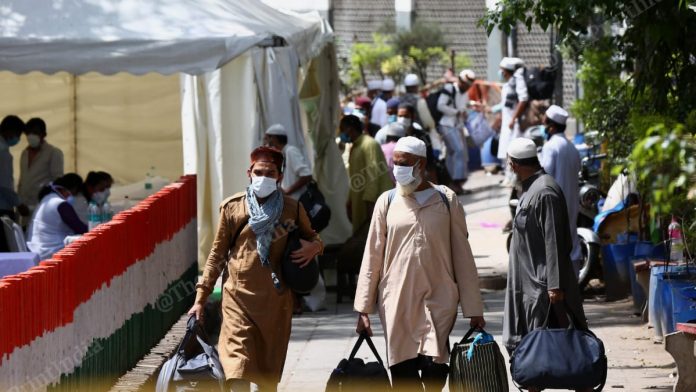
Nearly 4,000, including foreigners, had attended the Tablighi Jamaat event in Delhi (representational image) | Photo : Suraj Singh Bisht | ThePrint


Elisabeth Kubler-Ross’s seminal work, Death and Dying, describes the five distinct stages of grief: denial, anger, bargaining, depression and acceptance. While the Swiss-American psychiatrist was speaking about the series of emotions terminally ill patients go through, the first of the five stages that she postulated possibly holds true for a section of India’s people when the country was trying to come to terms with COVID-19 in the initial days of the pandemic.

The spread of the virus in the early months had then exposed the country’s second-largest religious group to a vulnerability born out of denial. Indiscretion and reckless behaviour by members of the Tablighi Jamaat had purportedly led to a spurt in coronavirus-positive cases, not only in Delhi but also in many other parts of the country.

An international gathering of Tablighis — preachers or a society to spread the faith —had taken place in New Delhi’s Nizamuddin area in March 2020, drawing hundreds of foreign nationals from Thailand, Nepal, Myanmar, Indonesia, Bangladesh, Malaysia, Sri Lanka and Kyrgyzstan. Despite a government order prohibiting large gatherings, more than 4,500 people had assembled at the Tablighi Jamaat Markaz (headquarters).

Media reports had quoted government sources as saying that since 1 January 2020, over 2,000 foreigners from 70 countries had arrived in India to participate in Jamaat activities. As the Covid-19 lockdown came into force on 25 March 2020, over 1,000 were left stranded in Nizamuddin.

Within days, a state of panic had set in as reports of Covid-19 deaths and positive cases started coming in from various parts of the country. By early April, private television news channels had begun insisting that over 30 per cent of the corona-positive cases had the “Tablighi Virus.”

Political factors were at play too. The country was already in ferment over the Citizenship Amendment Act and the National Register of Citizens.

The Tablighis’ state of alleged ignorance was dubbed a “Himalayan” blunder as a heavy dose of media onslaught, Islamophobia and blame game followed. As Najmul Hoda, a Chennai-based IPS officer, lamented on his Facebook wall, Covid-19 looked like a common cold in comparison to the plague of communal hatred.

Tablighi virus, Corona Jihad, stories of discrimination, Quran, divine injunction, Muslim society, deadly virus, Covid-19, Muslim clergy, Indian Muslims, social distancing, community prayers, letter of appreciation.

Political factors were at play too. The country was already in ferment over the Citizenship Amendment Act and the National Register of Citizens. Shaheen Bagh and its women protesters were making international headlines and the February 2020 riots in Delhi had deepened the sectarian divide, exacerbating religious tensions. It was in this situation that the Tablighi Jamaat held its congregation. According to data shared by Equality Labs (a digital human rights group) with TIME magazine, the hashtag ‘Corona Jihad’ appeared nearly 300,000 times.

The online attack became more and more vicious as reports of people leaving for different parts of the country from the Markaz poured in. For days, “Tablighi virus” and “Corona Jihad” trended on Twitter. Our entire focus shifted from fighting and containing COVID-19 to fighting the Tablighis and the Muslims, who the general population started equating as one and the same. Those were the initial days of our COVID-stricken lives, unsure of what awaited us and we were quick to blame the Markaz for all our misery.

The usual practice of portraying Muslims as the other came into play, as did indulging in victimhood.

In the midst of this Islamophobic onslaught, many articles and tweets expressed fears of a Muslim apartheid. The usual practice of portraying Muslims as the other came into play, as did indulging in victimhood.

“Social media, as ever, remained truculent and toxic. Generally speaking, Muslims continue to use social media space to indulge in their victimhood addiction,” observed Najmul Hoda.

While the community needed to address the elephant in the room and could not be absolved of its responsibility for wrongful acts by the Tablighis, the polarised discourse that was unleashed in mainstream media impacted the psyche of the general population. Most Muslims came out against the Jamaat, but the entire community was still clubbed together and labelled the “Superspreader”.

But the way the Tablighi Jamaat’s role and, by extension, of the entire Muslim population’s involvement in the spread of the virus was covered by the mainstream media, it suddenly felt that Covid-19 had a religion.

The Tablighis were guilty for sure for the congregation of thousands of people despite the prohibitory orders, and of not reporting cases, but the wave of hatred failed to see that the Tablighi Jamaat is not the sole representative of India’s 170 million Muslims and its actions should not be linked with the larger community. It is also pertinent to note that the Tablighi Jamaat preaches a narrow interpretation of Islam to some sections of Muslim society.

But the way the Tablighi Jamaat’s role and, by extension, of the entire Muslim population’s involvement in the spread of the virus was covered by the mainstream media, it suddenly felt that COVID-19 had a religion.

Soon, stories of discrimination against the poorer sections among Muslims started coming out. NDTV reported how vendors in Mahoba district of Uttar Pradesh were allegedly targeted and stopped from selling vegetables by people who accused them of being members of the Tablighi Jamaat and of spreading the coronavirus.

Old sociological problems, such as overcrowded ghettos, lack of hygiene and low levels of awareness, became handy tools again to stigmatise the community.

The Bharatiya Janata Party (BJP) MLA from Deoria in Uttar Pradesh, Suresh Tiwari, warned people against buying vegetables from Muslims. The defiant leader was later asked to explain his comment by his party chief.

A video shared widely on Facebook and on Twitter purportedly showed Muslims intentionally sneezing on each other. It was later debunked by the fact-checking website AltNews.

Tablighi virus, Corona Jihad, stories of discrimination, Quran, divine injunction, Muslim society, deadly virus, Covid-19, Muslim clergy, Indian Muslims, social distancing, community prayers, letter of appreciation

Several video clips purportedly showing COVID-positive members of the Tablighi Jamaat misbehaving with hospital staff and other patients found space on prime-time debates. Old sociological problems, such as overcrowded ghettos, lack of hygiene and low levels of awareness, became handy tools again to stigmatise the community.

The reaction from the community was at times defiant, while some took to social media to counter the hate being peddled with tweets that were either equally toxic or full of self-pity.

A closer look at the role the Muslim clergy played reveals a far more constructive engagement than what has been projected by the mainstream media.

It was at this point that the Muslim clergy, intellectuals and other community leaders stepped in. On 2 April, seven signatories — Dr. Zafarul Islam Khan, Chairman, Delhi Minorities Commission; Prof. Akhtarul Wasey, President, Maulana Azad University, Jodhpur; Prof. Mohsin Usmani Nadwi, President, Human Welfare Society; Prof. A.R. Kidwai, Director, K.A. Nizami Center for Quranic studies, AMU; Masoom Moradabadi, Secretary, All India Urdu Editors Conference; Zaheeruddin Ali Khan, Managing Editor, Daily Siasat, Hyderabad, and Prof. Iqtedar Mohd. Khan, Deptt. Islamic Studies, Jamia Millia Islamia, Delhi — issued an appeal to the government to take into consideration the “genuine constraints faced by certain people.” They argued that it was not a time to find fault. “Any attempt to give it a sectarian twist would weaken our battle against the deadly virus,” they said.

A closer look at the role the Muslim clergy played reveals a far more constructive engagement than what has been projected by the mainstream media. As early as 6 March, Maulana Khalid Rasheed Firangimahli, Lucknow-based Imam, Eidgah, had asked mosque-going Muslims to take preventive measures against Covid-19, and told them to avoid congregations and coughing and sneezing in public.

Firangimahli was among many religious heads across the country who issued fatwas saying that the fight against the coronavirus was a religious obligation.

A broad consensus that was worked out decided against special Eid prayers at Eidgahs and at mosques, etc. Islamic seminaries, such as the Darul Uloom, Nadwa and Deoband, issued fatwas asking the faithful to offer Eid prayers at home.

A major challenge came during the month-long period of Ramadan — that began in the last week of April — in terms of enforcing social distancing and avoiding guests at the breaking of fast (iftar) and at community prayers (tarahwih), etc. But enforcing a sense of discipline among 170 million people sharply divided on sectarian and linguistic lines was done with remarkable ease and voluntary compliance.

As Ramadan is closely followed by Eid, suspension of the customary Eid prayer posed another hurdle. However, a broad consensus that was worked out decided against special Eid prayers at Eidgahs (where special Eid prayers are held) and at mosques, etc. Islamic seminaries, such as the Darul Uloom, Nadwa and Deoband, issued fatwas asking the faithful to offer Eid prayers at home.

The results were so good that Uttar Pradesh Chief Minister Yogi Adityanath called up Firangimahli in Lucknow and congratulated him, saying that Eid prayers throughout the state had been observed without any incident of the virus spreading. The state government also issued a letter of appreciation.

Those members of the Tablighi Jamaat who had tested positive for the virus, and have since been cured, came forward in huge numbers to donate their blood plasma — containing anti-viral antibodies — and helped cure many affected people.

Eid ul-Fitr 2020 saw the largest ever participation of women in family prayers. That prompted Najmul Huda, the IPS officer, to say “thanks” to the virus for bringing gender equality to every Muslim home. “May it get institutionalised. Corona, I can’t really say thank you to you, but it’s thanks to you,” he wrote .

There were other positives too. Charity acted as a great succor as appeals were issued to channelise Ramadan and Eid shopping for the needy. Maulana Naeem Ur Rahman Siddiqui, secretary of the Islamic Centre of India, claims that zakat — or charity — saw a rise of over 50 per cent as compared to the previous year.

Not to forget, the redemption and acknowledgement that came after all those days of hate. If the members of the Tablighi Jamaat were guilty of ignorance in the initial phase of the pandemic, they turned adversity they had wrought upon themselves into opportunity in the form of penance. Those who had tested positive for the virus, and have since been cured, came forward in huge numbers to donate their blood plasma — containing anti-viral antibodies — and helped cure many affected people.

Some say it was in keeping with what the Quran teaches — that divine injunction is not for returning evil with good, but with the best. It says: “Good and evil are not equal. Repel (evil) with what is best, and you will see that the one you had mutual enmity with, will become the closest of friends.” (41:34)

Rasheed Kidwai is Visiting Fellow at Observer Research Foundation (ORF). He tracks politics and governance in India. Naghma is Senior Fellow at ORF. She tracks India’s neighbourhood — Pakistan and China — alongside other geopolitical developments in the region. Views are personal.

This article was first published by ORF.

source: http://www.theprint.in / The Print / Home> Opinion / by Rasheed Kidwai and Naghma Sahar / July 12th, 2020

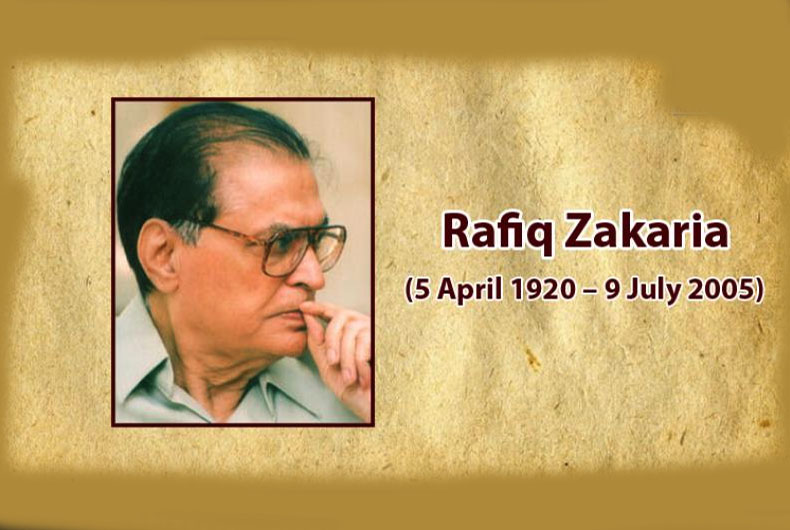
Dr Rafiq Zakaria: A Patriot, Politician and Scholar

Mumbai, MAHARASHTRA :

Sadly today there is no one of Dr Zakaria’s caliber, scholarship and forceful articulation to bat for Indian Muslims

One evening in the late 1990s, as a cub reporter working for The Asian Age, founded and then edited by eminent journalist M J Akbar, I landed at the iconic Nehru Centre in Mumbai. It was a lecture by Samuel Huntington, the famous American scholar who had stirred a huge controversy with his Clash of Civilizations hypothesis. After Huntington’s speech, Dr Zakaria spoke and, while acknowledging the renowned scholar’s debt in mentoring the Zakarias’ son the famous author and journalist Fareed Zakaria, Dr Zakaria disagreed with Huntington’s hypothesis and attacked him for spreading fear among the peace-loving section of the world community.

That was the first time I saw Dr Zakaria. Subsequently, I attended a screening of a documentary made by a British channel on the eve of 50 years of India’s Independence in 1997. The documentary, complained Zakaria, had truncated version of his interview and post-screeing Dr Zakaria was understandably disturbed and livid. In my excitement to have got a “hot” story about a leading Islamic scholar like Dr Zakaria trashing a documentary by a British channel I reported it in the paper but wrongly said that it was produced by the BBC. Next day the BBC sent a letter to my editor denying its ownership. It was a huge embarrassment for me, the editor and the paper and, the then resident editor, rapped me for such a lapse and carelessness while reporting. To my pleasant surprise Dr Zakaria didn’t pull me up, forgetting and forgiving with a remark that it was a misreporting.

Dr Zakarai and his wife Madam Fatma Zakaria were very close to M J Akbar, and he could have got me fired for the blunder that I had committed. But Dr Zakaria saw it as a minor mistake on the part of a young, fledgling reporter and didn’t make it into a big issue. I fell in love with the scholar-politician for his magnanimity and sense of justice.

For the next one decade or so I remained immensely close to the Zakarias. Hardly a week passed when I didn’t call doctor sahib or he didn’t inquire about my progress as a journalist. I can’t remember the number of times I quoted him for stories or interviewed him for The Asian Age or The India Express, the paper I left in 2005 to join The Times of India. He was happy that I joined TOI, the newspaper he had contributed to for decades. Sadly, he didn’t live long to see my works in TOI, except the first story which announced my arrival to the Times. It was about Sare Jahan Se Accha completing a century and doctor sahib, as always, was effusive in his praise for me for this front-page story which in a way also announced my arrival to the Times of India.

I cannot forget a note that he wrote on one of his books he gifted me. Seated at his spacious study at the Cuffe Parade House in South Mumbai, in long hand, doctor sahib wrote:

“To Mohammed Wajihuddin for whose bright future I am genuinely concerned.”

It was a big compliment for me. I felt adopted by the Zakarias who showered unreserved love and affection on me. There was no artificiality in doctor sahib’s expression of concern and love for a boy who had arrived in the city from the backwaters of Bihar without a godfather. After his passing away, I missed him a lot and miss him every day, every moment.

Dr Rafiq Zakaria: An Impressive Journey

Dr Zakaria belonged to a generation which had not only witnessed the horrors of partition but had deeply felt pained at the vivisection of India into Islamic Pakisan and Secular India. Son of a maulvi in Nala Sopara, Zakaria scaled the height of scholarship and politics mainly because of his love for reading and a drive to excel.

A brilliant student, he devoured books on history, fiction, law, religion and everything between them. He had befriended Bernard Shaw, heard Harold Laski and met Bapu the Mahtma who always remained a paragon of truth and non-violence to Zakaria. Even as a student, both in Bombay and in London, he wrote for some leading newspapers of the day. An argumentative mind, he would not take things on their face value. He would question the status quo and side with the victims.

A patriot to the core, Zakaria never lost hope in the Hindu-Muslim unity and never forgave Mohammed Ali Jinnah for formulating the Two-Nation Theory which caused immeasurable damage to the sub-continent’s Muslims. In his autobiographical book The Price of Partition, the release function of which I had the fortune to attend, he has detailed the circumstances leading to the partition of India. He would often quote the famous Urdu couplet about the disaster that partition brought: Lamhon ne khata ki thi/sadiyon ne saza payee.

Dr Zakaria’s views about Muhammad Ali Jinnah

In his lucid prose which, as Zakaria confesses in almost all his books that he authored, was fine-tuned by the veteran editor and his better half Madam Fatma, Zakaria has quoted several interesting anecdotes about Jinnah whom his supporters called Quaid-e-Azam (the leader) but who actually misled the sub-continent’s Muslims. The pork-eating Jinnah who loved his whisky had nothing to do with the genuine concerns of the Muslims. He was authoritarian, egotist and desperate to see his dream of carving out Pakistan, the so-called Pure land for Muslims. One of the anecdotes in Zakaria’s immensely readable book goes like this:

“Jinnah had started reorganizing the League after the assembly elections in 1937; he was on an enticing spree. Hasrat Mohani, who was a firebrand, went to see Jinnah on some urgent work at his bungalow. He had not taken an appointment. It was after dusk; Jinnah was enjoying his peg of whisky. He called Mohani to his room and thinking then that he was more a revolutionary than an orthodox Muslim, offered him a drink. Mohani, somewhat baffled, said that he wished he had as little fear of God as Jinnah had. Jinnah retorted: “No, Maulana! You are wrong. I have more faith in His mercy than you have.”

Dr Rafiq Zakaria: A Successful Politician

He was a successful politician who even represented India at the United States to counter the arguments of Zulfiqar Ali Bhutto, then Pakistan’s foreign minister and later the Prime Minister, on the dispute over Kashmir. Besides, Zakaria was a passionate scholar of Islam. His seminal work Muhammad and the Quran, written in response to Salman Rushdie’s The Satanic Verses, is a labour of love for which Muslims will be eternally indebted to him. About the huge positive response this book received from noted scholars from across the world, Dr Zakaria once told me:

“After reading this book, a big Pakistani Maulana said, “Mujhe nahim maloom Dr Zakaria ne kitni neki or aur kitne gunah kiye hain lekin main gawahi deta hoon key eh kitab unki bakhshayesh ka zariya banegi. [Truly, if nothing else, at least this book will inshallah help our late doctor sahib find a place in jannah.]

Dr Rafiq Zakaria’s love for Allama Iqbal

His love for the poet-philosopher Allama Iqbal was immense. He defended Iqbal like few in India did. His book on Allama Iqbal, penned to prove that Iqbal was wrongly credited with fathering the idea of Pakistan, is testimony to Zakaria’s love and respect for Iqabl who was undoubtedly a great poet but a failed politician. Dr Zakaria never failed to quote the famous line from Iqbal’s Naya Shivala –Pather ki moorton mein samjha hai tu khuda hai/khake watan ka mujhko har zarra devta hai–whenever he needed to show Iqbal or other Indian Muslims as nationalists.

One thing that is of great relevance to us today is Dr Zakaria’s unshakeable faith in Kashmir’s accession to India. He had even penned a poem on Kashmir, expressing his love for the valley and why it needed to be with India. He justifiably believed that, if Kashmir secedes from India, it will not only be ruinous for the Kashmiris, but Muslims in the rest of India will have to pay heavily for this crime. As anti-Muslim hysteria grips parts of India in the aftermath of the recent terror attack on the Amarnath Yatri, Dr Zakaria’s fears only seem true. It is in the interest of Indian Muslims that Kashmir remains an integral part of India.

Sadly today there is no one of Dr Zakaria’s caliber, scholarship and forceful articulation to bat for Indian Muslims either in the media or in the corridors of power, the two arenas that are increasingly getting poisoned. As majotarianism marches ahead, threatening to turn the secular India into a Hindu rashtra, the absence of a patriot, politician and scholar like Zakaria is greatly felt.

(The author, a journalist with The Times of India, presented this paper at the one-day seminar on Dr Rafiq Zakaria on July 15, 2017 at Aurangabad. The article is reproduced here with the permission of the writer on the occasion of the 15th death anniversary of Dr Rafiq Zakari on July 9.)

source: http://www.ummid.com / Ummid.com / Home> India> Views & Analysis / by Mohammed Wajihuddin / July 17th, 2020

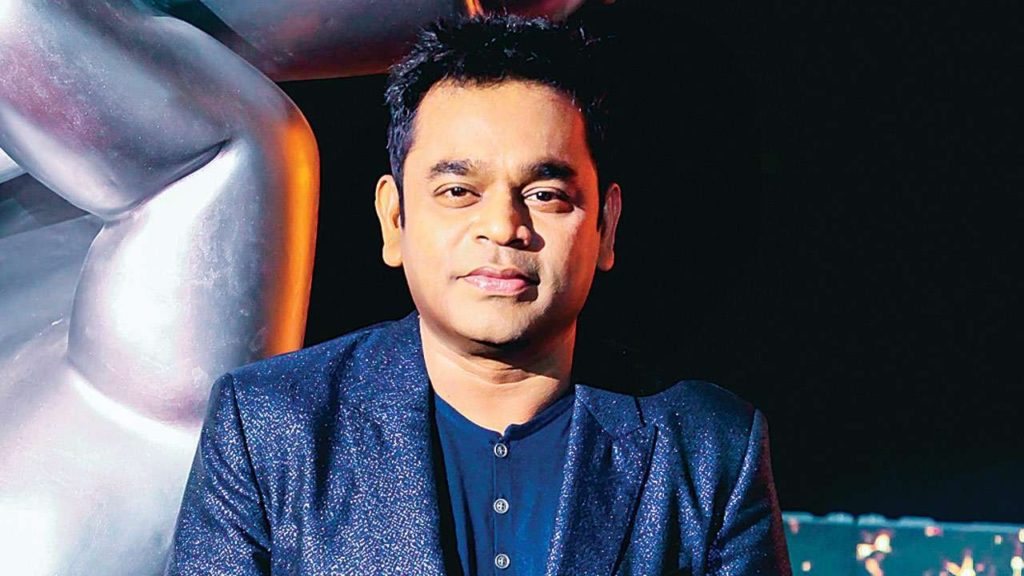
A.R. Rahman named the most influential person in Asia, Shruti Haasan also honored

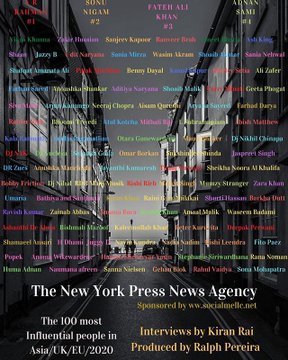
A.R. Rahman has been named the most influential person in Asia by the New York Press News Agency. The others in the list of 100 include Shruti Haasan, Benny Dayal, Sania Mirza, Saina Nehwal and Wasim Akram.

The Isaipuyal’s current release ‘Dil Bechara’ touted as the last movie of Sushant Singh Rajput is streaming on Disney Plus Hotstar. His upcoming films include Mani Ratnam’s multistarrer ‘Ponniyin Selvan’, Vikram’s ‘Cobra’, Sivakarthikeyan’s ‘Ayalaan’ and Dhanush’s Bollywood venture ‘Atrangi De’.

The multifaceted Shruti Haasan who is currently starring in ‘Laabam’ with Vijay Sethupathi has posted a video on her social media page expressing her thanks for the recognition. She has written “I’m so honored to be voted one of the 100 most influential people in Asia 2020. Interviewed by Kiran Rai @kiran_rai99. Talking about a whole bunch of fun things !! Stay tuned”.

source: http://www.indiaglitz.com / IndiaGlitz / Home> Tamil > Cinema News / July 16th, 2020

Sadaqt Ashram, Patna : Mazharul Haque’s gift to the Nation

Patna, BIHAR :

Attitude of the British government towards India after the First World War, where the Indians backed the British war efforts in hope of better treatment, exacerbated the already suppressed Indian feelings. The Rowlatt bill, satyagraha in its opposition, Jallianwala massacre, and brutal suppression of the satyagraha led Mahatma Gandhi to call for Non-Cooperation movement coupled with Khilafat movement. 

Gandhi urged his followers, through Young India, on 11 August, 1920, to ‘formulate an education system completely independent of government control’. Only then, in his view, non-cooperation holds any real meaning.

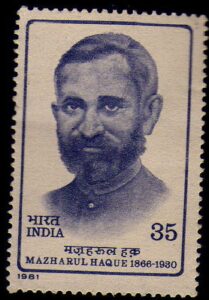
Mazharul Haque was the first in Bihar to respond to Gandhi’s call of developing indigenous education system. On 22 November, 1920 Haque opened a National School in Patna with Dr. Harnandan Lal Nandkeoliyar as its principal. But, the moment of glory was yet to arrive.

Mazharul Haque

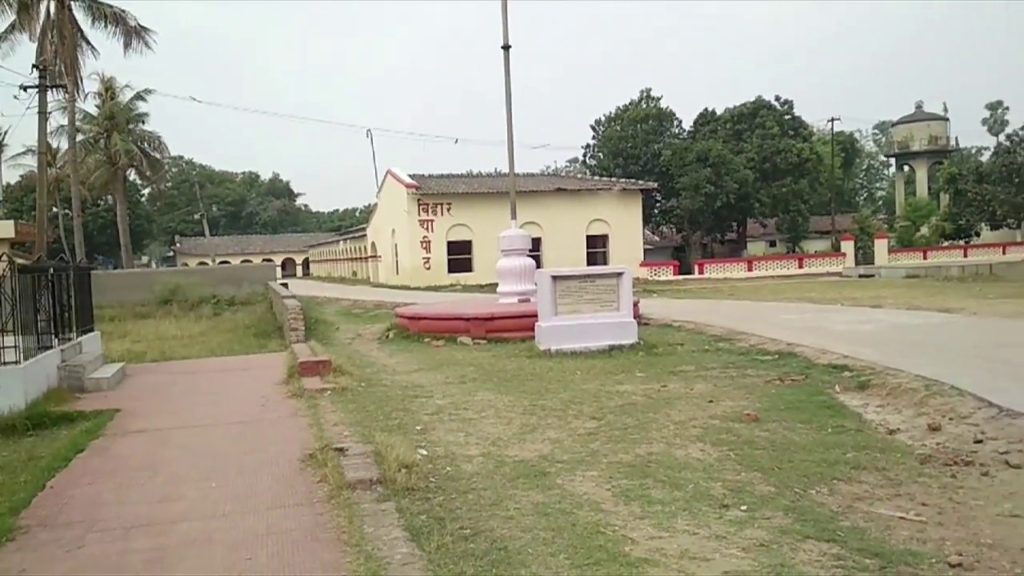
On 11 December, 1920, One Hundred & Ten (110) students of Bihar Engineering School (B.E.S) boycotted classes and with all their belongings, with raised flags of ‘Free B.E.S’ marched to Sikandar Manzil, residence of Mazharul Haque, at Fraser Road in Patna. Students urged Haque to lead them into the non-cooperation movement. Haque left his house with 103 students, since seven (7) were taken by their parents to home, for an orchard in a rather scantily populated area on Patna- Danapur road. The orchard was a property of Khairu Mian, who donated it to the students without any hesitation. Haque, with the help of the students, made huts with straws, woods and leaves. The orchard, where now 103 students and Mazharul Haque were living, was named Sadaqat Ashram.

Sadaqt is a Persian/ Urdu word for truth while Ashram is a Sanskrit/ Hindi word for Abode. So, the place was Abode of Truth.

Now all the residents of Ashram were studying and spinning Charkha (cotton spinning wheel) and the ashram became a focal point of nationalist activities in Bihar.

Mahatma Gandhi, in December, emphasised upon having a Bihar Vidyapith to oversee all the nationalist education and coordinate National Schools running in Patna. Dr. Rajendra Prasad and other Congress leaders were unable to raise enough funds to secure land for Vidyapith in Patna. When the difficulty was put in front of Haque, he immediately started construction of a building, with his personal funds, at the Ashram site.  

 On 6 February, 1921, Mahatma Gandhi, Kasturba Gandhi and Mohammad Ali arrived in Patna, by Punjab Mail, to formally inaugurate the Bihar Vidyapith (Bihar University). At the inauguration Gandhi said that without the efforts of Mazharul Haque it would have been impossible to open a National College at Patna. It was only because of Haque that Gandhi was inaugurating the Vidyapith.

Mazharul Haque was chosen as the Chancellor, Braj Kishore Prasad as the Vice Chancellor and Rajendra Prasad as the registrar of the newly formed Bihar Vidyapith.

Sadaqat Ashram did not stop at this. In September, 1921, Mazharul Haque started printing newspapers, journals and books from the Ashram. An English weekly The Motherland and an Urdu daily Sheristan were two prominent newspapers published from the Ashram. Apart from these, books like Tufan-e-Nuh, Khilafat and England, etc., were also published from the Ashram press. 

Mazharul Haque set an example by renouncing his lavish lifestyle to live in Sadaqat Ashram with the students. Mahatma Gandhi wrote about Haque, “The Sadaqat Ashram near Patna is a fruit of his (Mazharul Haque’s) constructive labour. Though he did not live in it for as long as he had intended, his conception of the Ashram made it possible for the Bihar Vidyapith to find a permanent habitation. It may yet prove a cement to bind the two communities together.”  

Later, Rajendra Prasad lived at Sadaqat Ashram after retirement, Jayprakash Narain launched his movement from here and presently it serves as the Bihar Congress headquarters. 

With the Sadaqat Ashram, the legacy of Mazharul Haque remains alive.        

(Author is a well known historian)

source: http://www.heritagetimes.in / Heritage Times / Home> Bihar / by Saquib Salim / July 08th, 2020

Two Indian Muslim Women Bring Glory to the Community

Aroha, UTTAR PRADESH / Sanghvi, MAHARASHTRA :

In India Muslims number about 180 million and are found in good numbers in most regions. After ruling for a period of about 600 years (1200 to 1857), during which beginning from limited footholds in north India they expanded their rule and the followers of their faith through most of the Indian subcontinent, from the Khyber pass in the west to Assam in the east, and from Kashmir in the north to Kerala at the southern tip of the Indian subcontinent. At the end of the British colonial rule in 1947, when the Muslim population formed about one-third of India’s population, the subcontinent was divided between a Muslim majority Pakistan and a Hindu majority India.

Following the partition and the formation of the new India, the situation of the Muslim community, whose population was reduced to about 14 percent, has continued to decline. While discrimination in various walks of life from the government as a reaction to the partition of the country is a major factor for that, the lagging behind in education at all levels and the poor condition and standard of education in the community and the community’s schools has substantially reduced the ability of Muslims to compete with others in various walks of life. The educational backwardness is a lot more pronounced among Muslims in north and west India compared to south and east India

Since 2014 when BJP acquired power in New Delhi, the overall progress of Muslims has declined further due to substantial increase in governmental bias against them. However, every so often one comes across instances of remarkable successes. It is interesting to note that more Muslim young women compared to men are found among the list of high achievers. I recently came across two such instances.

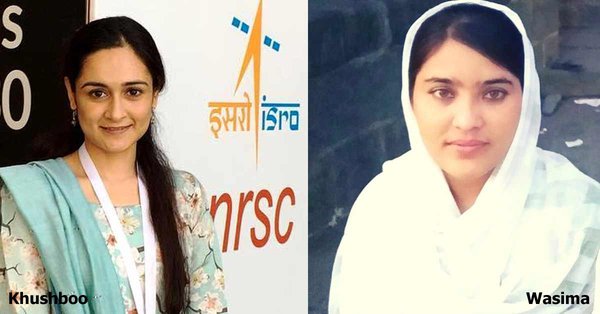
Khushboo Mirza

One such instance is a relatively young Muslim woman by the name Khushboo Mirza from Amroha, a city in western Uttar Pradesh. Khushboo Mirza is an electronics engineer with the Indian Space Research Organization (ISRO) since 2006 when she graduated from the engineering college of the Aligarh Muslim University, Aligarh, U.P. She was a bright student in high school and at the engineering college.

ISRO, headquartered at Bangalore, Karnataka, is one of India’s high performing, high technology organizations. At low budget it has achieved much success in launching several pathbreaking outer space exploration missions and satellites. ISRO launches a variety of communication and weather satellites on contract to various global space organizations like National Aeronautics and Space Administration (NASA) of US, Japanese Exploration Agency, Japan et al. This is in addition to space research satellites that they develop and build themselves. Some of the most notable recent ISRO missions include the Chandrayan 2, 2019, a moon orbiter that circled moon and sent data. And Chandrayan 1, 2008, that sent a satellite to impact the surface of moon.

Khushboo Mirza was a team member on the Chandrayan 1 mission. For that, she received good recognition from ISRO management. Just recently ISRO promoted Khushboo, where she will lead groups in challenging tasks.

In the last few decades several professional women in India have reached leadership positions in private sector companies, banks, Science & Technology organizations, universities and government bodies. But it is extremely rare to find a Muslim woman among them. There are two main reasons for this sad happening. One is the bias of the government authorities against Muslims and the other is the fact that a large number of Muslim families do not encourage their women to seriously focus on attaining leadership roles in their professional careers. Muslim families are happy with women becoming principal of a girl’s school.

Wasima Shaikh

The second instance that warmed my heart recently is the story of the young woman by the name Wasima Shaikh of village, Sanghavi, district Nanded, in Maharashtra. Wasima is among four children of a Muslim farm laborer in the village of Sanghavi. Her mother is also a farm labourer and they live in a small hut in the village. Her father has been sick for a few years and her mother is shouldering the responsibility for the family in these years. Wasima’s village is plagued with the problem of men habitually drinking liquor and indulging in violence. Wasima is a brilliant student who topped the list of successful candidates in in Nanded taluka in the Maharashtra State Secondary School Certificate examination. In 2015 studying on scholarship she obtained the BA degree from the Yashwant Chavan University, Nanded.

Then she sat in the tough competitive examination of the Maharashtra State Public Service Commission for an officer job in the state. To prepare for the competition she needed training from a coaching center and additional books that cost money, that her mother could not afford, especially since her brother was also studying for B.Sc. degree. To help Wasima with the coaching center fees, in her quest, her brother dropped out of college and started driving an auto-rickshaw. Wasima did succeed in the competitive examination but did not achieve a high enough rank. Due to that she was selected as a Class II sales tax officer for the Maharashtra Sales Tax Office in Nagpur.

However, both Wasima and her mother wanted that in view of her brilliant academic record she should get a better Class I Maharashtra State civil service job, like a Deputy Collector. Although her extended family members pushed strongly that she should get married now, her mother encouraged her to try the State Public Service Commission competition one more time. While working as a government Sales Tax officer Wasima prepared for and sat in the competition again in 2019. With her salary she also put her brother back in college to complete B.Sc. degree. This time her perseverance and merit paid off and she achieved third rank from top among all women competitors in Maharashtra. And just last month she has been selected for the position of a Deputy Collector in the state of Maharashtra.

On our part we Indian Muslims must strive to give better high quality educational opportunities to promising young women and men from our community. Women must be encouraged as much as men to try harder and achieve higher levels of success. That is the only way the Indian Muslim community is going to overcome the intense discrimination and injustice and deprivation from economic opportunities that is happening to them in India.

—The writer is the executive director of the Association of Indian Muslims of America, Washington DC.

source: http://www.milligazette.com / The Milli Gazette / Home> News> Education & Careers / by Kaleem Kawaja / June 30th, 2020

Thousands of records are registered in the name of this player

Patna, BIHAR :

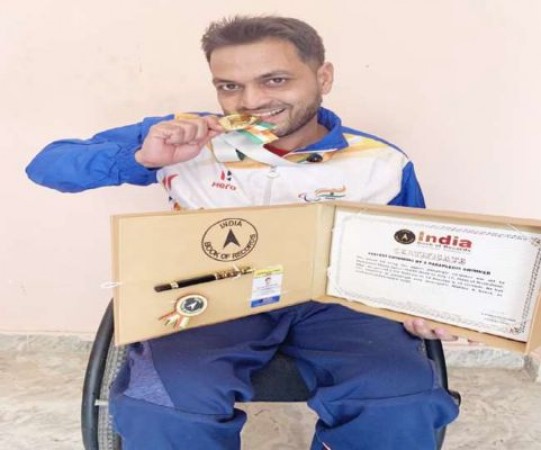
National-international para swimmer Mo Shams Alam has registered his name in the India Book of Records, performing excellently. On December 8, 2019, 24 general and differently abled swimmers took part in the Misri Lal Smriti Open Swimming Championships organized by Bihar Swimming Association at Ganga on Law College Ghat in Patna. Shams completed the first place by completing two km of swimming in 12 minutes 23 seconds. Mohammad resident of Rathaus village of Bisfi Block Shams (33), son of Naseer, says that after getting the name in the India Book of Records, now the Asian Book of Records, Limca Book of Records and Guinness World Record will apply for registration. In the Lok Sabha elections 2019, the commission made them brand ambassadors.

Did not lose courage, started working hard: Even after half of the body is paralyzed, Shams has received five dozen medals from district to international level. In the year 2010, while studying mechanical engineering, there were complaints of spine pain. Operation was done in a hospital in Mumbai. Five months later, the operation took place in another hospital. In the year 2012, the doctors said to be Divyang. Days passed with the help of wheelchairs. But, I did not lose courage. Started working hard in swimming. He wishes to pursue disabled sports talents in rural areas.

Participated in competitions in several countries: Shams, who won the title in Florida in the US in Para Swimming, has won several awards including gold medal in Para Swimming Competition in different parts of the country. Black belt shams in martial arts In the year 2018, he was selected for the Global Sports Mentoring Program organized under the joint aegis of the US Government Department of Sports and Tennessee University of America.

Record Rate Record: In the year 2017, the Umoja Beach Festival organized by a Travels Company in Goa set a record by swimming eight km in four hours and four minutes. At the Para World Series Swimming Championships held in Berlin in July 2017, with 634 players from 54 countries, they achieved seventh rank in the S5 category in performance. Participated in the wheelchair rugby championship of Patna as captain of Bihar team in August 2017. Participated in the Asian Para Games to be held in Jakarta in the year 2018. The year 2017 was conferred by the Bihar Divyang Sports Academy and the Bihar Government in the same year at the Sports Honor ceremony in Patna.

source: http://www.english.newstracklive.com / NewsTrackLive.com / Home> Sports / by Harshita Jain / June 25th, 2020

Tipu Sultan the warrior-king of Mysore, who died fighting the British.

Mysuru, KARNATAKA :

“To live like a TIGER for a day is far better than to live like a jackal for a hundred years.” – Tipu Sultan

Today marks the 221th death anniversary of Sultan Fateh Ali Khan Tipu, better known as Tipu Sultan the Muslim warrior-king of Mysore, who died fighting the British today, May 4th 1799. Tipu ruled the kingdom of Mysore, which he inherited from his father Haidar Ali. His bravery, valour and skills were so talked about that French commander-in-chief Napolean Bonaparte once sought an alliance with the ruler of Mysore.

Tipu Sultan was born as Sultan Fateh Ali Sahab Tipu on November 10, 1750 in Devanahalli, present-day Bangalore. He was born to Fatima Fakhr-un-Nisa and Hyder Ali, the Sultan of Mysore. Tipu Sultan succeeded his father in 1782. The 18th-century ruler is popularly known as the Tiger of Mysore and Tipu Sahib.

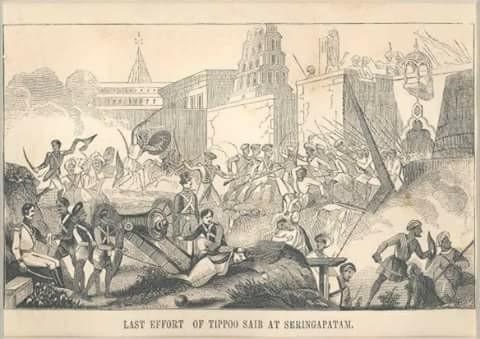
We, as a citizen of India pay heartfelt tribute to Tipu Sultan, the Tiger of Mysore on his 221th death anniversary and salute his valour against the British forces. He was considered to be the first Indian freedom fighter, was a great patriot of India, who fought whole life against the British occupation and colonialism. He was glorified as India’s original Missile man by Ex-President of India A.P.J. Abdul Kamal. Tipu Sultan is revered as a pioneer in the use of rocket artillery. Sultan’s rockets were the first iron-cased rockets successfully deployed for military use. He deployed the rockets against advances of British forces and their allies during the Anglo-Mysore Wars. The rockets used during the Battle of Pollilur in 1780 and Siege of Seringapatam in 1799 were said to be more advanced than the British had previously seen.

Tipu’s portrait is in a NASA facility. It shows his passion and willingness towards scientific and technological advancements as well as innovations. It is said that Tipu was fascinated by western science and technology.

Admired by Abdul Kalam, Ex-President of India

After becoming President, in 2006, Kalam sent a top Defence scientist to Srirangapatana in Karnataka to study Tipu Sultan’s efforts to use rockets against the British over 200 years previously.

At the end of his visit to various sites associated with Tipu Sultan’s rocket launching activities at Srirangapatna, then Chief Controller of Research and Development at Defence Research and Development Organisation (DRDO), A Sivathanu Pillai declared, “There is no doubt that this is the birthplace of rocketry.”

“Now, I will report to the President what I have seen here (Srirangapatna). He (Kalam) is a rocket scientist. Naturally, he is interested to know,” Pillai had said.

After this visit, Pillai said he would recommend President Kalam to build consensus in the community of rocket scientists that Srirangapatna was the birthplace of rocketry by holding seminars and other initiatives.(courtesy: The Quint)

Tipu’s startup hubs and rockets

“Tipu Sultan was perhaps the first ruler to understand that there was a marked difference between Europe of the 1700s and 1790s, thanks to scientific innovations,“ says aerospace scientist Roddam Narasimha, who has been studying Tipu’s rockets for many years now. “He realised the power of technology , combined with discipline, and set up four innovation hubs (like modern-day tech parks) in Bengaluru, Chitradurga, Srirangapatna and Bidanur. He called them Taramandalpets.”(courtesy: The Economics Times)

He was the only Indian ruler who understood the dangers the British posed to India, and fought four wars to oust them from India – in that sense, he could be called the first freedom fighter in the subcontinent. He fought four wars against British colonialism with heroism, valour, and bravery, moreover to the last. He sacrificed his life for the nation and martyred a historical and brave death.

Tipu was a generous patron of several Hindu temples, including the Sri Ranganatha temple near his main palace at Srirangapattana, and the Sringeri Math, whose swami he respected and called Jagadguru. The Editor of Mysore Gazetteer Prof. Srikantaiah has listed 156 temples to which Tipu’s regularly paid annual grants. His progressive measures in the administration were equally commendable.

His reign is remembered for many technological and administrative innovations. Among them was introduction of new coin denominations and new coin types. He also introduced a luni-solar calendar. During his rule, he introduced a land revenue system which gave a boost to the Mysore silk industry and helped in establishing Mysore as a major economic power.

In the Fourth Anglo-Mysore War between 1798-99, he was defeated when the forces of the British East India Company, the Marathas and the Nizam of Hyderabad came together. He was killed on May 4, 1799, while defending his fort of Srirangapatna, present-day Mandya in Karnataka.

Md Irshad Ayub, Founding English Editor at Millat Times

http://www.heritagetimes.in / Heritage Times / Home / by Team HT / May 02nd, 2020

Two Congressmen take oath as MLCs

Naseer Ahmed who was a minister in S Bangarappa’s cabinet has been a council member three times previously.

Bengaluru : 

Two Congress members, B K Hariprasad and Naseer Ahmed, took oath as members of the Legislative Council on Thursday. Speaking to TNIE, Hariprasad said, “After decades in national politics, the party high command has decided to bring me into state politics.’’ Naseer Ahmed said, “The State is facing grim challenges like Covid-19. We will fight to make the lot of the citizen better.’’

Hariprasad, a four-time Rajya Sabha member and who has served as AICC general secretary and state in-charge of 17 states, is expected to add to Congress’ formidable strength in the Council. They already have 32 members. In comparison, BJP’s numbers will go up to 23 after getting four new members.

Naseer Ahmed who was a minister in S Bangarappa’s cabinet has been a council member three times previously.  BJP MLC Ravi Kumar said that the party’s Council members will take oath at 12.15pm on Friday.The lone JDS member, Inchara Govindraj, said he would take oath after July 20 depending on the availability of former PM H D Deve Gowda.

source: http://www.newindianexpress.com / The New Indian Express / Home> States> Karnataka / by Express News Service / July 03rd, 2020

Rebel Sultans: Tracing the origins of Malik Ambar, the hero of the Deccan who started out as an African slave

KARNATAKA / THE DECCAN :

In Rebel Sultans, Manu S Pillai traces the history of the Deccan from the end of the 13th century to the dawn of the 18th, punctuated by tales of drama, betrayal and murder.

Editor’s note: The Deccan, miles away from the empire of the Mughals, was eyed with envy by rulers such as Aurangzeb, so much so that it is said to have contributed to his downfall. Its kingdoms had much to offer; in their courts were Persians and Marathas, in their ranks were African nobles, and in their treasuries were gold and fortunes.

In Rebel Sultans, Manu S Pillai traces the history of the Deccan from the end of the 13th century to the dawn of the 18th. He tells the story of the Vijayanagar empire, the court of the Bahmani kings, and the Rebel sultans — punctuated by drama, betrayal and murder. The book features characters such as Malik Ambar, Chand Bibi and Krishnadeva Raya, and is published by Juggernaut Books.

The hero of the Deccan had skin the colour of coal. Emperors snarled at him from afar, while enemies at home rattled in fear when he marched into their neighbourhoods. Many were those who despised him, but many more still were the masses who discerned in him a champion. His story was certainly unusual, though he was neither the first of his people to serve in the Deccan, nor extraordinary in his antecedents. And yet he emerged as the strongest of them all, reigning indeed as king in all but name. ‘He has a stern Roman face,’ wrote one traveller, ‘and is tall and strong of stature’ though his ‘white glassy eyes’, it was added, ‘do not become him.’ His charities were legendary, as was the valour of the men who pledged themselves to his service. When at last he died, not on the battlefield but secure in a formidable fortress, the Mughals admitted that this enemy was ‘an able man. In warfare, in command, in sound judgment, and in administration he had no rival or equal… He kept down the turbulent spirits of [the Deccan], and maintained his exalted position to the end of his life, and closed his career in honour. History,’ the obituary concludes, ‘records no other instance of an Abyssinian slave arriving at such eminence.’ It was high praise, coming as it did from the imperial court, where two generations of emperors revealed nothing but spite for the man called Malik Ambar.

The Deccan, as we know, had long attracted foreigners to its shores, offering them wealth and a future in these eastern lands. Persians arrived, as did Arabs and Central Asians. Some graduated to princely ranks, while others soared to gratifying aristocratic heights. But among the legions of men absorbed by the Bahmanis and their heirs were also Africans who came primarily from the land we now call Ethiopia. And they too would thrive in the Deccan far above the stations where they began their lives. Some were associated with tales of treachery – Mahmud Gawan’s confidant, who struck his seal on the forgery that delivered him his death warrant, was a habshi (an African) as was his executioner. When Yusuf Adil Shah died, one of the regents who ruled in the name of his son was a black man from Ethiopia – the latter was stabbed to death for displacing Westerners and favouring the Sunni faith. When years later Chand Bibi was imprisoned, her liberator who briefly stood at the forefront in Bijapur was a habshi, as was the man Ibrahim Adil Shah II rejected after eight years of living under his guard. In Ahmadnagar, during the wars of succession in the 1590s, one ruler, whose reign lasted less than a year, found himself without support from his nobles because his mother was ‘a negress’, though when Chand Bibi was besieged by the Mughals, the man who led Bijapur’s and Golconda’s troops to her rescue was also a habshi called Suhail Khan. And many years later, on the eve of the final Mughal conquest of the Deccan, in Bijapur once again would rise a habshi exercising as a short-lived vizier the full and tragic authority of power.

The habshis had almost all of them begun their careers as slaves. And there certainly was a thriving market for men from Ethiopia in the courts and demesnes of the east. Writing as early as the 14th century, Ibn Batuta reports how habshis were ‘guarantors of safety’ for ships sailing in the Indian Ocean, with such fearsome reputations that ‘let there be but one of them on a ship and it will be avoided by… pirates’. Centuries later a Portuguese missionary noted how ‘all the country of Arabia, Persia, Egypt, and Greece are full of slaves’ who made for ‘great warriors’. In India too, this was true. The favour and affection shown by Raziya Sultan in the 1230s to Jamal al-Din Yakut, an Abyssinian warrior, provoked a rebellion and contributed to her brutal murder in Delhi at the close of that decade. At the end of the 14th century, a habshi servant of the Delhi Sultans had established a near-sovereign state in Jaunpur, in present-day Uttar Pradesh, which sustained itself till 1479. Firoz Shah Bahmani in the early 15th century had habshis in his harem, while in that same century a 1487 coup by Africans in the court of the ruler of Bengal led to the rise of a short-lived ‘Habshi Dynasty’ hundreds of miles away, on the other side of the Indian subcontinent. The exquisite Siddi Saiyyed Mosque in Ahmedabad was built by a habshi in 1572, and generations later the Mughal emperor Aurangzeb would appoint the African lord of the fortress of Janjira his naval commander, allocating to him an annual grant of 400,000 rupees to maintain the imperial fleet. In the old quarter of Delhi there is even an area by the name of Phatak Habash Khan, named, evidently, after a habshi courtier who bid farewell to the Deccan, embracing the cause of the Mughal emperor.

While these are episodes that stand out, where Africans from humble origins arrived at positions of honour and power (and sometimes infamy), the beginning of their journeys on this path were never happy. The habshis were often taken as children and sold at a price to be transported abroad. Ethiopia, at the time, was called Abyssinia in the trading world, and the very word ‘habshi’ is a derivation denoting the origins of these slaves. Malik Ambar, too, emerged from this commercial exchange of human goods. Born around 1548 into the Oromo tribe, he was captured as a boy and sold to an Arab for 20 gold ducats. In Baghdad he passed, temporarily, into the hands of another owner, who then sold him to the man who would bring him to India – and to his destiny. It was this master who educated him, though by now he had renounced his name, Chapu, and converted to Islam. ‘Whether he assumed a Muslim identity at the time as an act of genuine faith or simply as a practical matter of assimilation is not known.’ But it certainly helped him in his life ahead, to share faith with the powerful kings and noblemen of the east, in whose service lay his ascent.

Around 1571, now in his early 20s, Ambar, as he was known, arrived in the Deccan where his long-time master sold him to the peshwa (chief minister) of Ahmadnagar. The sale itself was not unusual – though his master had brought him up, the ‘bottom-line was never in dispute: Ambar was property’ and not ‘an heir or son’. However, the man who had just purchased the slave must have opened Ambar’s eyes to a world of possibilities, for the peshwa was himself black and had arrived in the Deccan under similar circumstances. He would, in due course, be assassinated, but to Ambar it must have been clear that in India it was possible to rise beyond slavery and to come into great power and wealth – he himself was merely one of a thousand habshis the peshwa possessed.

Rebel Sultans by Manu S Pillai is published by Juggernaut Books

source: http://www.firstpost.com / FirstPost / Home>Living News / by Manu S Pillai / June 21st, 2018