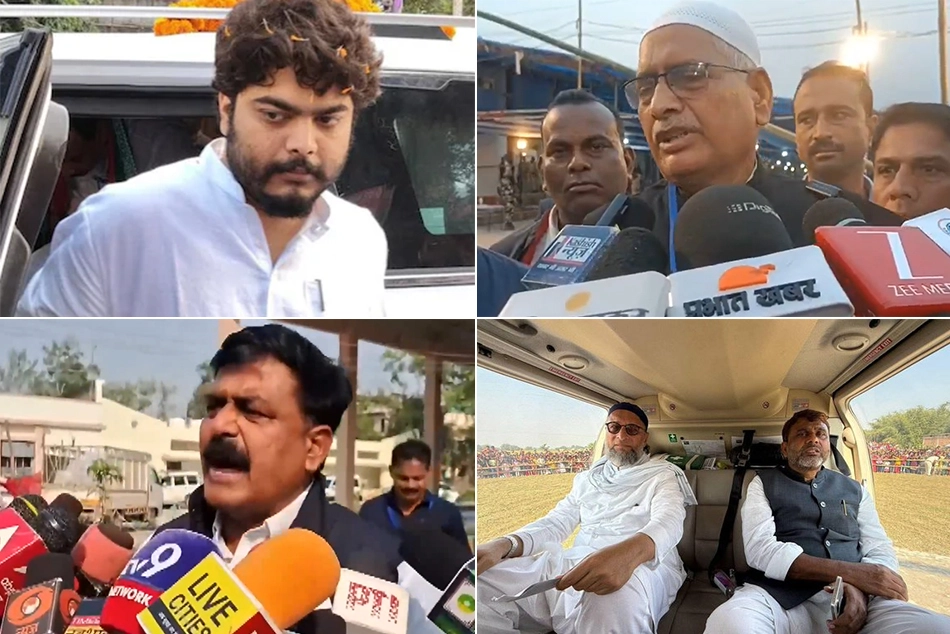
The newly elected assembly in Bihar will have 11 Muslim MLAs, down by 8 as compared to their tally in the last assembly, the final results of the 2025 state elections announced Friday showed.
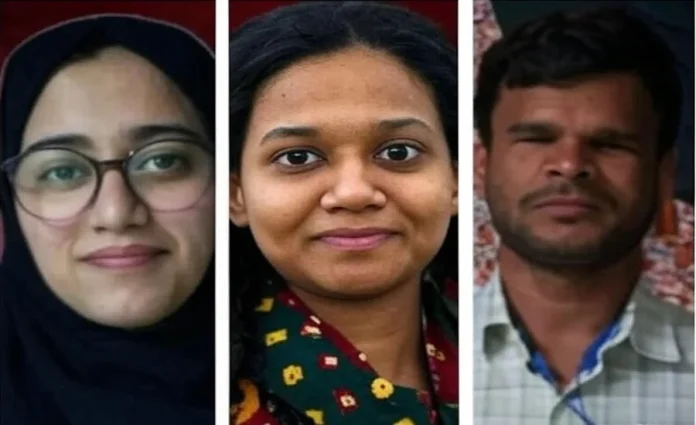
(Clockwise from left) Osama Shahab (RJD), Qamrul Hoda (Congress), Akhatrul Iman (Seen with AIMIM Chief Asaduddin Owaisi) and Zama Khan (Janata Dal United)
List of Muslim MLAs in Bihar 2025:
The newly elected assembly in Bihar will have 11 Muslim MLAs, down by 8 as compared to their tally in the last assembly, the final results of the 2025 state elections announced Friday showed.
A total of 24 Muslims belonging to different political parties were elected in the 2015 election whereas 19 Muslims were elected to the Bihar Assembly Elections in 2020.
The representation of Muslims went further down after the 2025 Bihar Assembly Elections the results of which were announced after counting of votes held on Friday November 14, 2025.
How Many Muslims Contested Bihar Vidhan Sabha Elections 2025?
The All India Majlis e Ittehadul Muslimeen (AIMIM) of Asaduddin Owaisi had fielded a maximum 23 Muslim candidates from as many constituencies of Bihar in the 2025 state assembly polls. Of them 05 Muslims have won.
On the other hand, Rashtriya Janata Dal (RJD) had fielded 18 Muslim candidates, Congress had given the party tickets to 10 Muslims, Janata Dal (United) had nominated 04 Muslims, and 02 Muslims contested as CPI (M) candidates.
Of these candidates 03 from RJD, 02 from Congress and just 01 from Janata Dal (U) won the 2025 Bihar elections.
Kumari Mayawati’s Bahujan Samaj Party (BSP), Prashant Kishor’s Jan Suraaj Party (JSP) and Lok JanShakti Party (Ram Vilas Paswan) had also given their party tickets to some Muslims. No Muslim fielded by these parties could win the 2025 Bihar elections.
The Bhartiya Janata Party (BJP) has not given the party symbol to any Muslim.
7. Mohammad Murshid Aalam (Jokihat) 8. Md Tauseef Alam (Bahadurganj) 9. Md. Sarwar Alam (Kochadhaman) 10. Akhtarul Iman (Amour) 11. Ghulam Sarwar (Baisi)
The most shocking defeat of a Muslim candidate was in Balrampur where AIMIM candidate Advocate Adil Hasan lost the seat to the BJP by just 389 votes.
2025 Bihar Election Final Results
Assembly or Vidhan Sabha elections in Bihar were held in two phases. Polling for the first phase was held on November 06, 2025 which ended with a voter turnout of 65.08%.
On the other hand, Polling for the second phase was held on November 11, 2025 which saw the voter turnout of 68.76%.
The overall poll percent, as per the Election Commission of India, was 66.91% – highest since 1951 when the first assembly election was held.
The counting of votes was held today, and as per the final result announced by the Poll Panel, the NDA alliance has won 202 seats whereas the RJD-Cong INDIA bloc could win just 35 seats.
The Election Commission final results show, the BJP has won 89 seats and emerged as the single largest party in Bihar for the first time in the state’s history.
The JD (U) has won 85 seats. Lok Janshakti Party Ram Vilas Paswan candidates won 19 seats.
On ther hand, the RJD candidates could win just 25 assembly seats and Congress 06. Owaisi’s AIMIM won 05 seats.
source: http://www.ummid.com / Ummid.com / Home / by ummid.com news network / November 14th, 2025
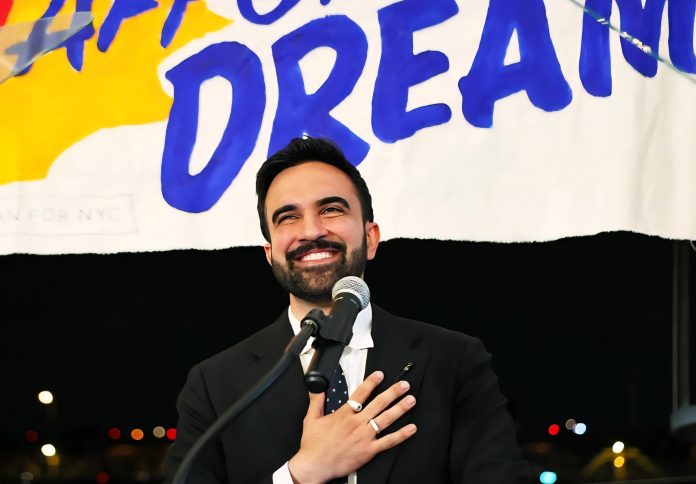
“I am a Democratic Socialist, I am a Muslim… I am not apologizing for either.” With these words, Zohran Mamdani declared victory in the New York City mayoral race, a symbolic global capital of commerce and culture. His triumph rekindled hope among conscientious citizens in New York and resonated worldwide, especially amid the rise of populist, authoritarian-leaning leaders who thrive on division and privilege wealthy allies.
Only a year prior, Mamdani was widely seen as an underdog. Yet he defeated Andrew Cuomo, the former governor who ran as an independent and received informal support from prominent national figures, including the sitting president. Mamdani garnered just over 50 percent of the vote, becoming the youngest mayor in a century and the first Muslim and South Asian to hold the office. His campaign also achieved one of the highest voter turnouts in New York City since 1969, signalling renewed civic engagement for a progressive, inclusive agenda.
Political Polarization and Economic Context
While such a victory might appear routine in an established liberal democracy, it must be understood against the backdrop of deep U.S. political polarization since the Trump era. Divisive rhetoric and exclusionary policies fractured communities and workplaces, stifling dreams and limiting opportunity.
During the Trump administration, harsh immigration enforcement via ICE and other agencies fuelled fear in immigrant communities. Arbitrary detentions, wrongful arrests, and forced family separations became emblematic of policies that disregarded due process and human dignity. At the same time, tariffs and trade disputes increased living costs, particularly in metropolitan areas like New York. Rising rents and price hikes strained households across demographics, as economic hardship transcends ethnicity, citizenship, or geography. Some commentators noted that the political climate during Mamdani’s election was marked by tension between the federal administration and certain Democratic-led cities. Debates around federal funding, social welfare programs, and executive rhetoric heightened the stakes of the mayoral race, creating a context in which Mamdani’s message of local accountability and inclusion resonated strongly with voters.
The Socioeconomic Landscape of New York
New York City, with a population of approximately 8.48 million as of 2024, is among the world’s most diverse urban centres. Over 30 percent of residents are foreign-born, representing more than 100 nationalities. Yet the city struggles with high income inequality, reflected in a Gini coefficient of 0.555. Housing shortages, rising rents, and long commutes—averaging 41 minutes—have made the city increasingly unaffordable for lower- and middle-income households, prompting out-migration to suburbs.
Employment levels have recovered post-pandemic, with private-sector jobs growing 2.8 percent in 2024–25, yet the income gap continues to widen. Households in the highest quintile earn more than twenty times those in the lowest quintile. Policies favouring high-income earners during prior administrations exacerbated this structural inequality.
A Campaign Grounded in Inclusion
Mamdani’s success can be attributed to his focus on everyday concerns of New Yorkers: affordability, public transportation, universal childcare, housing, and progressive taxation. He positioned himself against divisive political rhetoric, resonating across New York’s diverse communities and appealing to those marginalized economically or socially helping unite both conservatives and liberals as economic hardship doesn’t see political allegiance.
A defining moment in his campaign was his emphasis on local priorities. During a mayoral debate, while other candidates pledged their first visit abroad to Israel, Mamdani highlighted his responsibility to New Yorkers first, reinforcing his commitment to municipal governance over symbolic foreign policy gestures.
He also navigated sensitive international issues with nuance, affirming support for the safety and rights of Jewish residents while criticizing the humanitarian crisis in the occupied Palestinian territories. His stance on human-rights accountability, including adherence to ICC mechanisms, underscored a principled approach that strengthened his political credibility.
Major New York City billionaires marshalled tens of millions of dollars to thwart Zohran Mamdani’s mayoral campaign, deploying deep-pocketed political machinery in support of his opponents. For instance, former Mayor and billionaire Michael Bloomberg is reported to have donated approximately US$8.3 million to the pro-Andrew Cuomo super-PAC Fix the City. Hedge-fund billionaire Bill Ackman contributed at least US$1 million to the anti-Mamdani PAC Defend NYC, and additional sums to Fix the City.
Concurrently, opposition efforts against Mamdani involved advertisements and mailers that his campaign denounced as blatant Islamophobia. For example, a mailer circulated by the pro-Cuomo super-PAC Fix the City was reported to have altered his appearance, darkening his beard and lightening his skin, a move Mamdani characterized as racially and religiously discriminatory. In addition, opponents sought to question his political allegiances, falsely portraying him as a supporter of Hamas and suggesting that he did not recognize Israel’s right to exist—claims that his campaign firmly rejected as misleading and defamatory.
Engaging Communities on the Ground
Mamdani’s outreach strategy was multifaceted and culturally inclusive. Campaign messaging spanned multiple languages, reaching New Yorkers across diverse linguistic and ethnic backgrounds. Beyond digital platforms, he visited places of worship, including Hindu temples, Jewish synagogues, and Christian churches, reinforcing interfaith solidarity.
He also engaged with ethnic food outlets and small businesses, highlighting immigrant contributions to the city’s cultural and economic life. This ground-level engagement translated into broad support across communities—Muslims, Christians, Jews, and secular groups alike—demonstrating a shared alignment with his vision for an inclusive, socially just New York.
Diasporic Resonance and Global Context
Mamdani’s heritage evokes transnational connections to India and Uganda, reflecting the experiences of diaspora communities navigating multiple cultural and political identities. His election elicited reactions from segments of Indian nationalist (Hindutva) movements, including online circulation of Islamophobic commentary. In contrast to widely celebrated Indian-origin figures such as Rishi Sunak, Kamala Harris, Tulsi Gabbard, and Usha Vance—often cited as symbols of India’s soft power abroad—Mamdani’s identity as a Muslim and his candid critique of the 2002 Gujarat riots have positioned him outside these narratives. He has reflected thoughtfully on the experiences of Muslims in New York, observing that “to be Muslim in New York is to expect indignity,” while emphasizing that such challenges do not define the broader community. His principled approach extends to global issues as well; his measured stance on the Israel–Palestine conflict underscores a commitment to human rights and ethical governance, reinforcing his reputation as a leader guided by conscience and social justice rather than partisan or sectarian considerations.
Zohran Mamdani’s unapologetic assertion of his identity, faith, and commitment to the public good offers a potential model for Indian Muslims and other marginalized communities confronting the rise of militant Hindutva and an increasingly adversarial state. His example demonstrates that principled, assertive engagement—grounded in inclusivity and social justice—can effectively challenge exclusionary and sectarian politics. Secular political parties in India, which in recent years have often sidelined Muslim voices in public life, might draw lessons from Mamdani’s approach: defeating divisive politics requires active, unapologetic advocacy for inclusion and pluralism, rather than silence or timidity. In essence, countering the forces of social and political exclusion demands a combination of ethical clarity, strategic assertiveness, and public visibility.
A Template for Inclusive Politics
Domestically, Mamdani’s rise occurs amid American ideological polarization and Democratic Party struggles to counter authoritarian rhetoric. His unapologetic advocacy for inclusive, pluralistic, and redistributive policies offers a potential model for progressive politics, reinforcing democratic values while countering divisive populism.
Mamdani’s victory, therefore, represents more than a personal or partisan success: it is a reassertion of democratic ideals, a rejection of exclusionary politics, and a renewed belief in a morally grounded, economically just, and inclusive vision that resonates far beyond New York City.
Diasporic Resonance and Global Context
Mamdani’s heritage evokes transnational connections to India and Uganda, reflecting the experiences of diaspora communities navigating multiple cultural and political identities. His election elicited reactions from segments of Indian nationalist (Hindutva) movements, some of whom circulated Islamophobic commentary online.
In contrast to celebrated Indian-origin figures such as Rishi Sunak, Kamala Harris, Tulsi Gabbard, and Usha Vance—often cited as symbols of India’s soft power—Mamdani’s identity as a Muslim and his critique of the 2002 Gujarat riots positioned him outside such narratives. He has reflected on the experiences of Muslims in New York, noting that “to be Muslim in New York is to expect indignity,” while emphasizing that these challenges do not define the broader community. His principled, humanitarian approach extends to global issues, with a measured stance on the Israel–Palestine conflict that underscores his commitment to ethical governance and human rights.
A Model for Marginalized Communities
Mamdani’s unapologetic assertion of his identity, faith, and commitment to the public good offers a potential model for Indian Muslims and other marginalized communities confronting militant Hindutva and adversarial state policies. His example demonstrates that principled, assertive engagement—grounded in inclusivity and social justice—can effectively challenge exclusionary politics. Secular political parties in India, which in recent years have often sidelined Muslim voices, might draw lessons from Mamdani’s approach: defeating divisive politics requires active advocacy for inclusion and pluralism rather than silence or timidity.
A Template for Inclusive Politics
Domestically, Mamdani’s rise occurs amid increasing ideological polarization in the U.S. and ongoing struggles within the Democratic Party to counter authoritarian and exclusionary rhetoric. His unapologetic advocacy for inclusive, pluralistic, and redistributive policies offers a potential model for progressive politics, reinforcing democratic values while challenging divisive populism.
Ultimately, Mamdani’s victory represents more than a personal or partisan success: it is a reaffirmation of democratic ideals, a rejection of exclusionary politics, and a renewed belief in a morally grounded, economically just, and inclusive vision—one that resonates far beyond New York City.
source: http://www.muslimmirror.com / Muslim Mirror / Home> Opinion / by Mushtaque Rahman / November 11th, 2025
Mecca, (Ottoman-SAUDI ARABIA / Kolkata, WEST BENGAL / DELHI :
Abul Kalam Ghulam Muhiyuddin (November 11, 1888-February 22, 1958), better known as Maulana Azad, was a writer-activist-statesman.
Historian S Irfan Habib speaks on Maulana Azad on his birth anniversary at an event organised by the Maulana Azad College alumni association in Calcutta on Tuesday / The Telegraph
Historian S. Irfan Habib, while delivering his Maulana Abul Kalam Azad memorial lecture titled “Revisiting Maulana Azad in Contemporary India” on Tuesday, rued how in today’s India, anytime he posts anything on social media on the freedom fighter, 80 per cent of the comments comprise hateful abuse.
“Full of abuse… 80 per cent of the comments. And from people who have no idea of who he was, what he stood for, and what he did for India,” said Habib, whose lecture on the Maulana on the icon’s 137th birth anniversary was organised by the Maulana Azad College alumni association to mark the college’s centennial.
Abul Kalam Ghulam Muhiyuddin (November 11, 1888-February 22, 1958), better known as Maulana Azad, was a writer-activist-statesman.
One of Mahatma Gandhi’s most trusted lieutenants and the youngest president of the Indian National Congress, he made crucial contributions to the freedom movement. He was also Independent India’s first education minister.
“I will speak about those issues relevant for today’s India. What he did for education, how he defined nationalism — today all those who have no idea of what nationalism is are nationalists — and how he defined Islam…. Islam too is in danger when we see what we believers have done to our own faith,” said Habib, former Maulana Azad Chair at the National University of Educational Planning and Administration, New Delhi.
Maulana Azad’s family moved from Mecca to Calcutta when he was two. He spent several decades of his life in this city, his residence on 5 Ashraf Mistry Lane of Ballygunge now a museum.
November 11 is celebrated as National Education Day to recognise his contribution in establishing the education foundations of India — from the Indian Institutes of Technology, the University Grants Commission, the All India Council for Technical Education, the Council of Scientific and Industrial Research, the Indian Institute of Science, and the Sahitya Akademi, the Sangeet Natak Akademi and the Lalit Kala Akademi, besides the Indian Council for Cultural Relations.
“Patriotism, nationalism and humanism, the difference between them Maulana tried to look at. In this (the belief in the culmination in humanism) he was very close to Gurudev Rabindranath Tagore, and he actually writes about it, that he believes in the idea of nationalism which was pitched by the idea of Tagore’s humanism and universalism,” said Habib.
“True relationship is only one, where the entire earth is one’s native land. This is necessary is today’s India, where we indulge in othering among own citizens, in the name of religion, caste, language, all sorts of issues, all sorts of divisive tools we use to divide Indians, while Maulana says mankind is one family and all humans are brothers, this is the idea of humanity of nationalism which Maulana left behind,” he added.
Habib underscored how the Maulana began as a pan-Islamist, speaking against the subjugation of Muslim nations by imperialist powers — a sentiment expressed strongly in his papers Al-Hilal and Al-Balagh, and it was because of his role as a fiercely upright journalist that the British Raj viewed him as one of the most dangerous persons in India.
Habib stated that after the Maulana was released from exile in Ranchi in 1920, he was torn between reading and writing in seclusion, or public life and the freedom struggle. It was soon after coming out of exile that the Maulana met Gandhi on January 18, 1920, for the first time.
“The meeting seemed to have had a profound impact on both… and they remained inseparable for the rest of his (Gandhi’s) life,” he said.
According to Habib, the Maulana fought on multiple fronts, not only against the British, but also Hindu and Muslim communalists.
“Maulana stressed on indivisible or composite nationalism, where he went back to early Islamic history, when the Prophet (Muhammad) created the first Muslim nation in Medina by aligning with the Yehudis (Jews). He saw no reason why Muslims could not join hands with Hindus and others in nation-forming…. He was appalled with communalists busy with sectarian campaigns when the need was to fight the British as a composite nationalist group,” Habib said.
“Maulana stood for a united India and remained steadfast in this resolve till the end. We are amid polarising politics where religion has become a distinct marker of identity…. The majoritarian nationalism being flaunted today runs contrary to the idea of composite nationalism espoused by Maulana all his life,” he added. “Maulana found the demand for Pakistan absurd as he was conscious of the fact that religion cannot be a binding factor for a nation.”
source: http://www.telegraphindia.com / The Telegraph Online / Home> West Bengal / by Meghdeep Bhattacharyya / November 12h, 2025
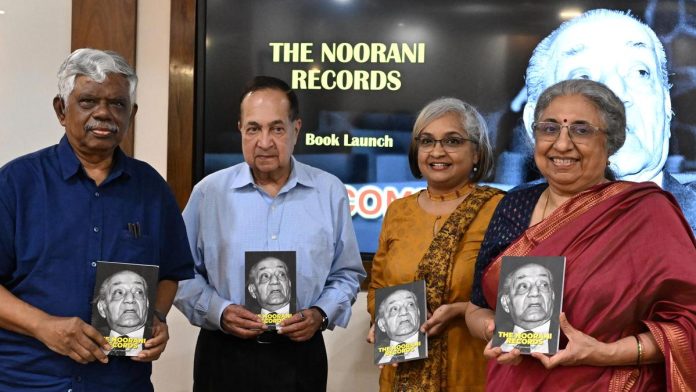
The Hindu Group’s Frontline magazine has launched The Noorani Records, a collection of essays by the late lawyer and constitutional expert A.G. Noorani (1930–2024). The book was released at The Hindu’s head office in Chennai on November 11. N. Ram, Director of The Hindu Publishing Group, presented the first copies to retired Madras High Court judges Justice K. Chandru and Justice Prabha Sridevan.
Justice Chandru praised Noorani’s ability to explain complex legal and political ideas in simple language that appealed to both experts and lay readers. Citing Noorani’s writings on the Rashtriya Swayamsevak Sangh (RSS) and Mahatma Gandhi, he urged that such essays be introduced to students to counter historical distortion and promote constitutional awareness. He also recalled Noorani’s detailed account of the trial of the Ali brothers during the Khilafat Movement, which reflected Hindu–Muslim unity.
Justice Sridevan remarked that Noorani’s work could inspire reflection and change among readers. She said his clarity of thought and disciplined writing offered valuable lessons for young lawyers.
N. Ram described Noorani as a passionate journalist and an uncompromising voice in legal and political commentary. He recalled that Noorani preferred handwriting his articles, ensuring precision and punctuality in his contributions to Frontline. Editor Vaishna Roy called him an erudite jurist whose essays combined intellectual depth with accessibility.
pix: thehindu.com
The book, released on the first anniversary of Noorani’s passing, compiles some of his finest columns for Frontline. It is available for purchase through The Hindu’s online bookstore.
source: http://www.radiancenews.com / Radiance News / Home> Latest News> Report / by Radiance News Bureau / November 13th, 2025
Irshad Mirza, a prominent Kanpur leather industrialist and chairman of Mirza International, has passed away at the age of 95. Irshad Mirza had been ill for a long time. His death has sent shockwaves through Kanpur and the industry.
Kanpur:
Irshad Mirza, chairman of Mirza International, the country’s largest leather exporter, passed away at the age of 95. Irshad Mirza was ill for the past several years. He breathed his last on Sunday in a private hospital in Kanpur. As soon as the news of Irshad Mirza’s death spread outside the hospital, a crowd of people gathered at his residence in Civil Lines.
Irshad Mirza’s contribution to the leather industry can never be forgotten. He has been honored with several awards including Padmashree. Irshad Mirza was also called the pride of Kanpur. Irshad Mirza has also got his name registered in Forbes magazine.
Irshad Mirza founded Mirza International in 1979. Mirza International manufactures leather, finishing, and tanning. The leather produced by Irshad Mirza’s company was in high demand abroad. The leather produced by the company is exported abroad. He was also the former chairman of the Minority Commission. During this time, he contributed to the betterment of society. Irshad Mirza
His passing has caused a wave of mourning in Kanpur and the industry. He had a strong influence not only in the industry but also among social workers, political parties, and leaders. He also worked extensively for the betterment of society in Kanpur. He also taught how to work in the leather industry.
source: http://www.navbharattimes.indiatimes.com / Nav Bharat Times / Home> Hindi News (translated)> State> Uttar Pradesh> Kanpur / by Abishek Shukla / December 04th, 2022
Muslim students have made a strong mark in this year’s Jawaharlal Nehru University (JNU) student union elections, with Danish Ali, Hafsa Bukhari, and Mohammad Aslam among the winners. The elections saw the Left alliance secure all four top posts, defeating the ABVP. Aditi Mishra was elected President, K Gopika Babu as Vice President, Sunil Yadav as General Secretary, and Danish Ali as Joint Secretary.
Danish Ali, a research scholar at the Centre for Historical Studies, defeated ABVP’s Anuj to win the Joint Secretary seat. Coming from Narsinghpur, Madhya Pradesh, Danish belongs to a family of educators. She was active in student mobilisations during the 2019 CAA protests and said her victory belongs to all students who value justice and democratic rights.
Hafsa Bukhari from Poonch, known for her hijab-wearing identity, also won a councilor seat. Her election is seen as a step forward for women’s representation and Muslim inclusion on campus. Alongside her, Mohammad Aslam, a visually impaired PhD scholar from Bihar, earned a councilor position. Despite his challenges, Aslam has consistently spoken up for equality, disability rights, and social justice.
Faculty members at JNU described their wins as a reflection of courage, resilience, and commitment to equality. Students across the university have welcomed the outcome, seeing it as a mandate for inclusivity and democratic engagement.
source: http://www.radiancenews.com / Radiance News / Home> Latest News> Report / by Radiance News Bureau / November 08th, 2025
Mangaluru, KARNATAKA / Kozhikode, KERALA / Dubai, U.A.E :
Shabana Faizal with her husband Faizal Kottikollon
New Delhi :
Mangalore-based Shabana Faizal has emerged as the youngest woman among India’s top 10 philanthropists, according to the EdelGive Hurun India Philanthropy List 2025.
She has donated ₹40 crore (approximately $1.5 billion) through the Faisal & Shabana Foundation to education, health, and social development.
Shabana Faisal’s journey from being raised in a small town in Mangalore to co-leading a global enterprise is about he hard work and ambition.
Her entrepreneurial journey began in 1995 as a retailer of unique, speciality and luxury products. After leading the company for eight successful years, she decided to team up with her husband, entrepreneur Faizal Kottikollon, and support him in running the world-class foundry, Emirates Techno Casting (ETC).
Shabana took charge of all human resources and administrative processes at ETC, where she created a significant impact in shaping the company’s business success.
In her role as Vice Chairperson of KEF Holdings, she is actively involved in guiding the business’s growth strategy across global markets. Deeply committed to social improvement, Shabana and her husband founded the Faizal & Shabana Foundation in 2007, with the vision of ‘Giving to Create Impact’.
At 53, Shabana’s work has placed her among some of the most influential women in India’s philanthropy world, including Rohini Nilekani, Kiran Mazumdar-Shaw and Bina Shah.
EdelGive Foundation, in collaboration with Hurun Research Institute, recently released the 12th edition of the EdelGive Hurun India Philanthropy List 2025.
The list honors India’s most generous individuals and families. Over the past three years, 191 philanthropists have donated a total of ₹10,380 crore, representing an 85% increase in contributions.
The education sector continues to lead as the top donor, receiving ₹4,166 crore from 107 donors.
Shabana is the mother of four children – Sophia, Sara, Zakaria, and Zarina – but continues to play an active role in business and philanthropy. Her work makes her one of India’s most influential female philanthropists, exemplifying how professional leadership and a commitment to giving can combine to create widespread social impact.
The EdelGive Hurun India Philanthropy List 2025 states that the top 25 donors contributed ₹50,000 crore in just five years, or an average of ₹46 crore per day. Mumbai leads in philanthropy, contributing 28% of total donations, followed by New Delhi and Bengaluru.
source: http://www.awazthevoice.in / Awaz, The Voice / Home / posted by Aasha Khosa / November 10th, 2025
Tushar Goel’s film, ‘The Taj Story’, has reignited controversy over the Taj Mahal’s origins, claiming it is a Hindu temple rather than a mausoleum built by Mughal emperor Shah Jahan. The film’s debut highlights debates about the interplay of history and ideology in contemporary India.
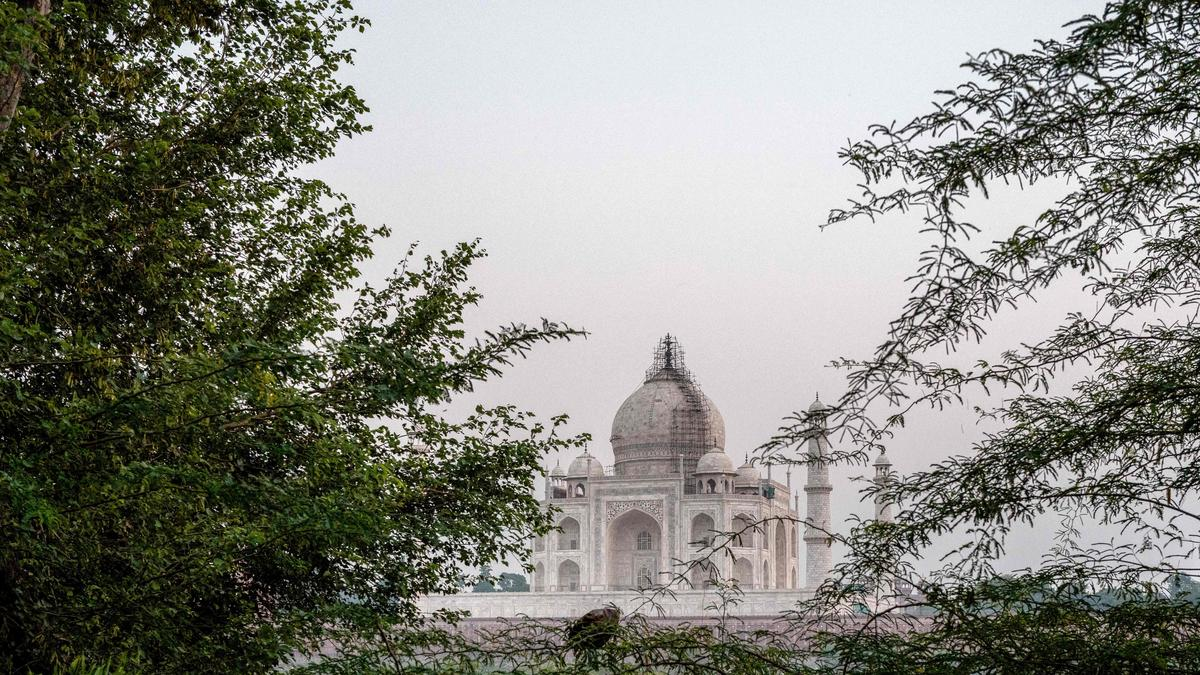
Scaffoldings are pictured as restoration work goes on at the dome of the Taj Mahal in Agra on October 17. | Photo Credit: AFP
A little over 60 years ago, Purushottam Nagesh Oak slept and dreamt. He woke up and claimed that the Taj Mahal in Agra was actually a Hindu palace going back all the way to 4th century. Friends of Mr. Oak, an English teacher-turned-lawyer-turned-journalist but never a historian, told him that the Taj Mahal couldn’t have been a fourth century structure as the technology employed in building the Taj in the 17th century didn’t exist back then. The fantasist turned a pragmatist, and Oak brought his argument forward by a few centuries. The Taj was now claimed to be a Hindu temple. This was in 1989. He wrote articles and a book too, but found no support from historians. Even the Supreme Court dismissed his claims as “a bee in his bonnet” in 2000.
But post-2014, history is like a revolving door, you enter and exit at your ease and pleasure. You pick and choose, you circumvent and invent. Dress it up as a movie and claim you are looking at history anew. That is how we get a movie like Tushar Amrish Goel’s The Taj Story, starring former BJP MP Paresh Rawal; just like we had The Kashmir Files and The Bengal Files, starring Anupam Kher and Mithun Chakraborty, all ideological partners of the Bharatiya Janata Party (BJP).
With The Taj Story, Goel goes where no historian has gone. Proof, evidence and knowledge amount for nothing as the director makes a case for the Mughal monument being actually a Hindu temple, much like the BJP leader Sangeet Som who called it alternately a Shiva temple and a monument built by a man who incarcerated his father. Mr. Som obviously couldn’t make out a Shah Jahan from an Aurangzeb and hence got mixed up. Much like Oak, oops, Goel, who sees no difference between history and mythology, facts and fantasy.
Recorded history
Talking of facts, the Taj Mahal was built by the Mughal emperor Shah Jahan after his favourite wife Arjumand Bano Begum breathed her last after bearing the last of their 14 children. Its chief architect was Ustad Ahmed Lahori. The land for her last resting place was procured from Mirza Raja Jai Singh of Amber who had inherited it from Raja Man Singh, a celebrated general of Akbar, who was Shah Jahan’s grandfather. Shah Jahan compensated Jai Singh with four havelis from the royal property for the massive haveli in which rests Mumtaz Mahal. His firman to Jai Singh, the latter’s agreement and the Mughal emperor’s subsequent letter of granting him four havelis in lieu of one, are all part of history; unlike the claim of The Taj Story which talks in terms of a massacre and genocide of the locals for fulfilling the wishes of an emperor and his consort!
The work on the tomb started in 1632 with the finest craftsmen from across the country and West Asia. The chief mason was Mohammed Hanif from Baghdad who earned ₹1000 a month for his efforts. The pinnacle was built by Qayam Khan of Lahore and its Quranic inscriptions were done by Amanat Khan Shirazi. The mosaic work was done by local Hindu workers. Above all, some 20,000 workmen toiled for 22 years to build the monument to love. Its white marble came from Jaipur, lapis lazuli from Sri Lanka, crystal from China and coral from Arabia. The monument uses the double dome technique, previously seen only in the Humayun’s tomb in Delhi, and never seen in the country before the arrivals of the Turks.
Not the first time
Over the years, many have tried to appropriate credit for its beauty and majesty. In the 17th century, it was claimed by many in the West that the architect of the Taj was Venetian Geronimo Veroneo, a jeweller by profession. Then came the claim by Mughal Beg in Tarikh-e-Taj Mahal that it was designed by Muhammad Effendi, an architect supposedly sent by the Sultan of Turkey. Effendi though was as much an architect as Oak was a historian. In the mid 19th century it was claimed that the monument was the result of the genius of Frenchman Austin de Bordeaux, a jeweller. However, Austin died in 1632, the year the work on the Taj began. With his death all claims of Austin being the Taj’s architect were buried. And facts began to be raised.
As for fantasy, well there is Goel’s film, never mind its claim of presenting the “untold history of the Taj Mahal”. The film, replete with stereotypes of kohl-lined, skullcap-donning Muslims aims at building a nation’s memory on unreasoned mythology, far removed from the well argued debates of history. Much like Oak’s view that Christianity was nothing but Krishan-Niti. Not game for any ridiculous claims in an insipid film which opened with a mere 14% attendance in the first show? Watch M. Sadiq’s 1963-saga Taj Mahal. Sure, you would remember its song, ‘Jo wada kiya woh nibhana padega’, penned by Sahir Ludhianvi and sung with much love by Mohammad Rafi and Lata Mangeshkar. Sadiq’s film with Pradip Kumar and Bina Rai in the lead cast, made no effort at replacing history with mythology.
source: http://www.thehindu.com / The Hindu / Home> Entertainment> Movies> In the limelight / by Zia Us Salam / November 07th, 2025
Renowned Scholar and Former Jamia Dean Recognized for Five Decades of Academic and Social Contributions
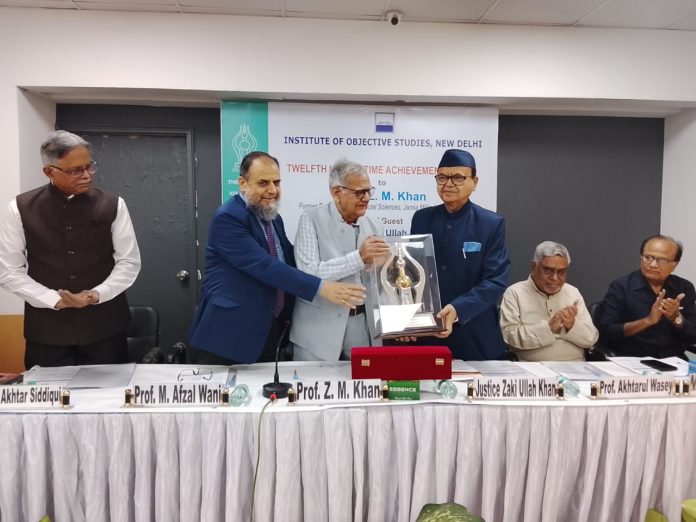
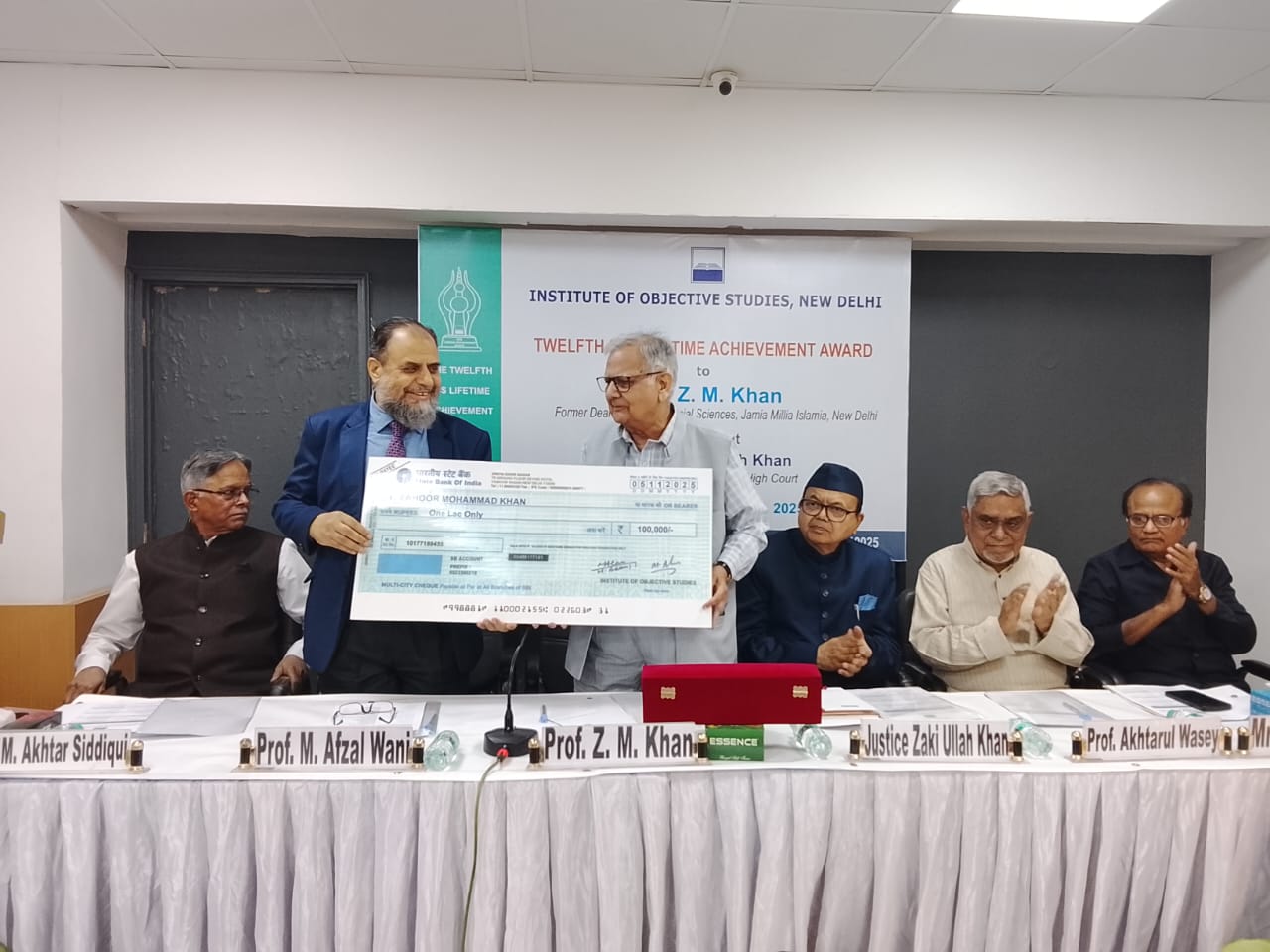
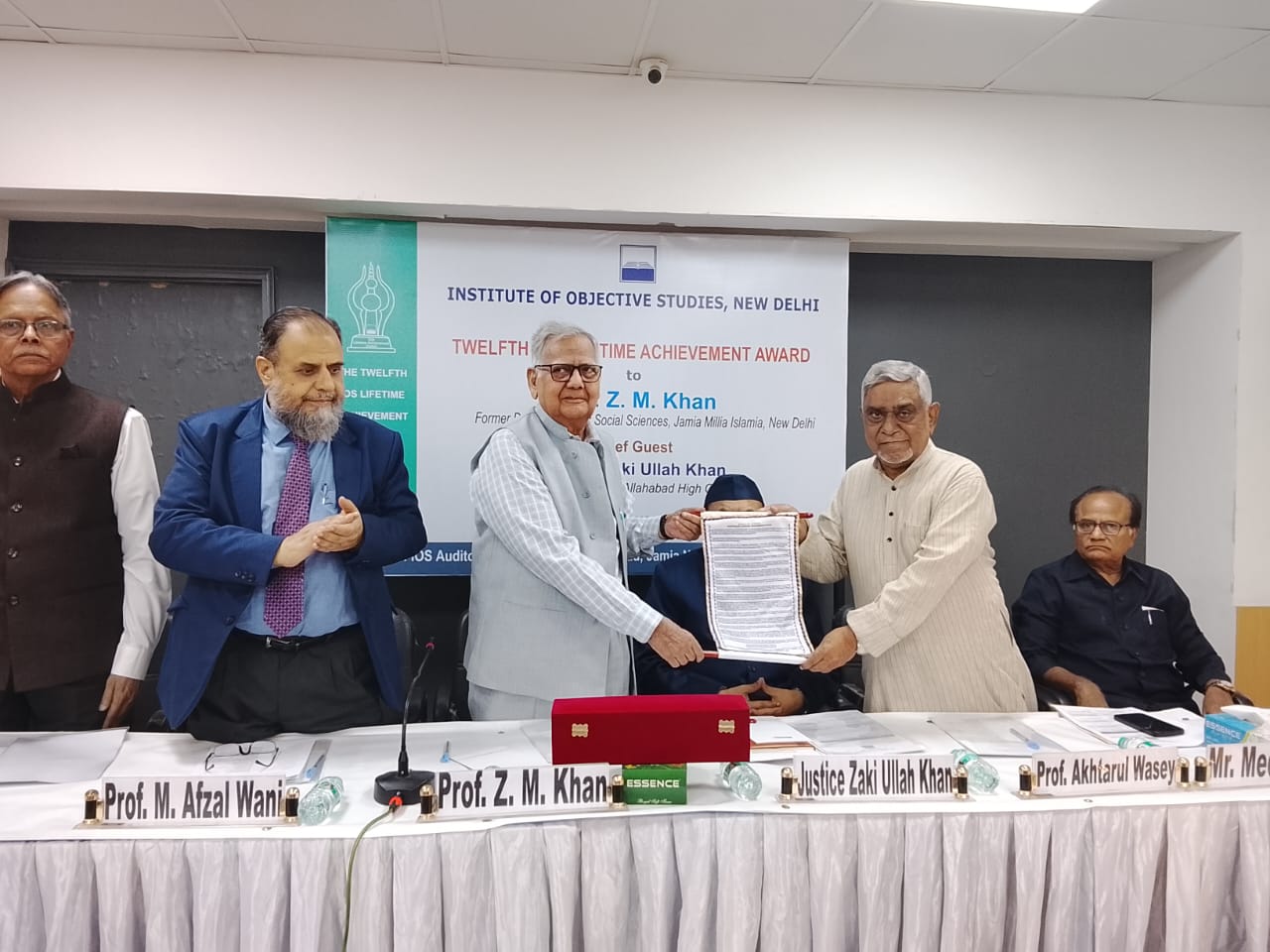
In a grand ceremony held in the capital, the Institute of Objective Studies (IOS) conferred the prestigious IOS Lifetime Achievement Award upon Professor Zahoor Mohammad Khan (Z.M. Khan)— an eminent scholar, researcher, author, and former Dean of Social Sciences at Jamia Millia Islamia.
Prof. Khan, who also served as the former Secretary General of IOS, was presented with a citation, memento, and a cash prize of ₹1 lakh in recognition of his outstanding services to education, research, and social development.
Prof. Khan’s illustrious career spans over five decades, marked by his multifaceted roles as an academician, researcher, author, and institution builder. He has authored eight books and dozens of research papers, contributing significantly to the study of political science and sociology in India. During his 23-year tenure as Secretary General of IOS, the institution evolved from a modest initiative into a nationally respected think tank. He also played a pivotal role in launching the IOS Scholarship Programme, which has supported numerous students and researchers over the years.
The IOS Lifetime Achievement Award, instituted in 2007, aims to recognize individuals, organizations, or voluntary groups who have rendered exceptional service to the nation and society, irrespective of religion, caste, or creed.
Previous recipients of this distinguished award include former Chief Justice of India A.M. Ahmadi, Dr. A.R. Kidwai, Prof. B. Sheikh Ali, A.G. Noorani,, Prof. Akhtarul Wasey, Prof. Mohsin Usmani Nadwi Maulana Hakim Abdulllah Mughaisi, and K. Rahman Khan, among others. Prof. Khan’s inclusion in this eminent list was greeted with enthusiastic applause from the audience.
Expressing his gratitude upon receiving the honour, Prof. Z.M. Khan said, Faith in God and the spirit of service are the most precious blessings one can receive. Faith brings with it a sense of responsibility and accountability to the Creator — that is the greatest reward of life. He also acknowledged the crucial role of institutions such as Delhi University, Jawaharlal Nehru University, Jamia Millia Islamia, and the Institute of Objective Studiesin shaping his academic journey.
The ceremony was chaired by Prof. M. Afzal Wani, Chairman of IOS, and graced by Justice Zakiullah Khan (former Judge, Allahabad High Court) as the chief guest.
Distinguished guests included Prof. Akhtarul Wasey (Jamia Millia Islamia & former Vice Chancellor, Maulana Azad University, Jodhpur), Prof. M. Akhtar Siddiqui, Mr. M. Afzal (former MP), and Prof. Furqan Ahmad.
The event began with a recitation from the Holy Quran by Dr. Nighat Husain Nadwi, a welcome address by IOS Secretary General Mohammad Alam, and was conducted by Prof. Hasina Hashia Vice Chairperson of IOS, who also delivered the vote of thanks.
The event not only celebrated Prof. Khan’s extraordinary contributions but also reaffirmed IOS’s commitment to honouring individuals who have significantly influenced India’s intellectual and moral landscape.
source: http://www.radiancenews.com / Radiance News / Home> Latest News> Report / by Radiance News Bureau / November 07th, 2025
Social activist and Former Bihar Minister Parveen Amanullah passed away today in New Delhi. She was suffering from cancer for some time.
The family had moved from Patna to Delhi for treatment. She also went to America for treatment and recovered from there. Her health had deteriorated for two-three days. she passed away today at seven PM.
Amanullah was the daughter of former Kishanganj MP Syed Shahabuddin and the wife of senior Bihar cadre IAS officer Afzal Amanullah.
Before entering politics she was known for her activism, especially in regard to her use of the Right to Information Act, 2005 to bring out the apathy prevalent in government institutions.
Amanullah was elected as a member of the Bihar Legislative Assembly in 2010 from the Sahebpur Kamal constituency in Begusarai district as a candidate of the Janata Dal (United) after defeating Rashtriya Janata Dal’s Shreenarayan Yadav.
She became the Social Welfare minister of Bihar in Nitish Kumar’s government and held the portfolio until February 2014 when she resigned from JD(U) citing “governance issues” and “lack of work satisfaction”. She joined Arvind Kejriwal’s Aam Aadmi Party two days later.
source: http://www.theindianawaaz.com / The Indian Awaaz / Home> Quami Awaaz / by Indian Awaaz / October 01st, 2023