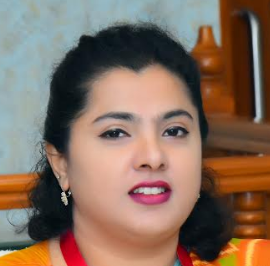
Tehmina Punvani (second from left) with Salman Khurshid and Manish Tewari releasing the Book
Tehmina Punvani offered a rare glimpse into her grandmother’s life. Her grandmother, Begum Qudsia Rasul, was no ordinary woman; she was the only Muslim woman in the Constituent Assembly that drafted India’s Constitution in 1949.
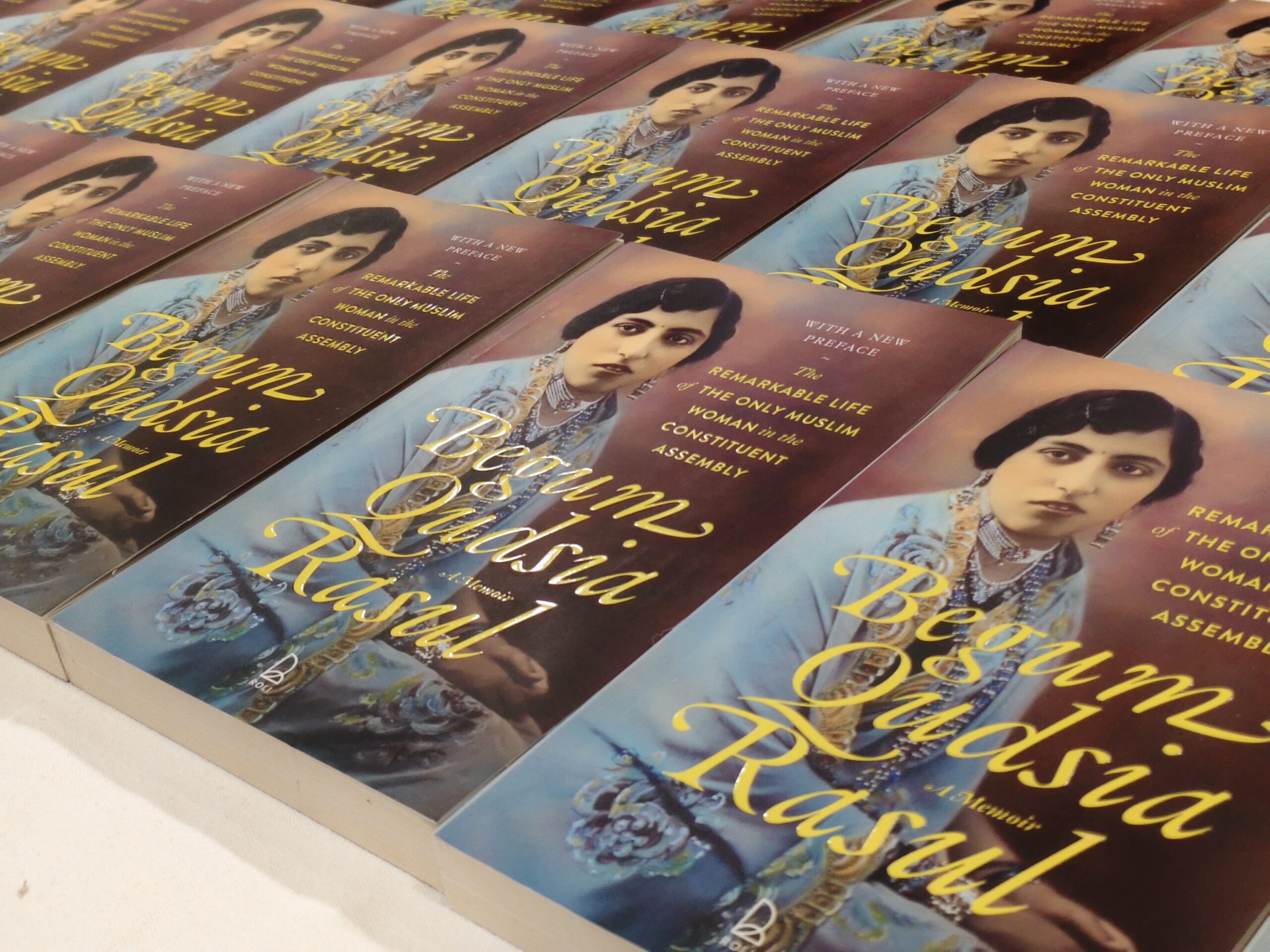
The occasion was the launch of Begum Qudsia Rasul’s book, 24 years after her death.
Tehmina Punvani, a lawyer, is the daughter of Begum Qudsia’s daughter.
Speaking at the book launch in Delhi, Tehmina said, “For the world, she was a fearless political figure, but for me, she was my Ammijan, gentle, grounded and unwavering in her integrity.”
Punvani recalled the period when a fatwa was issued against Rasool for entering public life. While the family felt fear, Rasul was composed.
“If my conscience is clear, no decree can frighten me,’ she would say,” Punvani recounted, drawing applause from the audience.
The book, Begum Qudsia Rasul – The Remarkable Life Of The Only Muslim Woman In the Constituent Assembly, is a relaunch of her autobiography “From Purdah to Parliament: The Memoirs of a Muslim Woman in Indian Politics” on the life and political legacy of this remarkable Muslim woman leader of India.
The Book Begum Qudsia Rasul – The Remarkable Life Of The Only Muslim Woman In the Constituent Assembly
The event brought together journalists, lawyers, and political leaders to revisit the contributions of a woman forgotten in mainstream historical narratives.
Moderated by journalist Nidhi Razdan, the panel featured Salman Khurshid, Indira Jaising, Manish Tewari, and senior lawyer Tehmina Punvani.
Begum Qudsia Rasul, born in 1909, was the only Muslim woman in India’s Constituent Assembly. A trailblazing politician, she opposed religious reservations, championed minority rights, and promoted women’s hockey.
Elected to the Rajya Sabha and Uttar Pradesh Assembly, she received the Padma Bhushan in 2000.
Besides being the only Muslim woman in the 1946 Constituent Assembly, she fought for minority equality and opposed religious reservations.
Qudsia Begum was also elected to the UP Assembly, Rajya Sabha and served as a minister.
She is credited with promoting women’s hockey, and a Hockey Cup is named after her. She was a trailblazing woman for giving up purdah. Besides her autobiography, she has authored a travelogue, Our Bapu, a book on Mahatama Gandhi and Hayat-e-Qudsi, about Bhopal’s Begums.
Tehmina said that despite her political stature, Rasul stayed close to the grassroots. “She met women daily, listened to their concerns, and worked for them without fanfare. Activism, for her, was a duty, not an identity.”
Other speakers highlighted Rasul’s exceptional resilience in an era when Muslim women faced social barriers.
Former Union Minister Salman Khurshid explained that Qudsia had won from a general seat to the United Province Assembly despite many technical hurdles. “It was an extraordinary act of courage,” he said.
Congress MP Manish Tewari underlined the democratic significance of her public life: “Her presence in the Constituent Assembly reflected India’s openness at a time of enormous political and social turbulence.”
Noted lawyer Indira Jaising praised Rasul’s moral clarity and empathetic leadership, calling her “a rare combination of conviction and humility.”
Speakers were unanimous in calling for acknowledging Begum Qudsia Rasul’s contributions and a prominent place for her in India’s political history.
Rolli Books has published this book.
source: http://www.awazthevoice.in / Awaz, The Voice / Home / by Aasha Khosa, ATV / December 11th, 2025
Member of Parliament from Kishanganj, Dr. Mohammad Javed, met Aligarh Muslim University Vice Chancellor Prof. Naima Khatoon to review administrative and academic progress at the AMU Kishanganj Centre. The meeting focused on staffing approvals and pending regulatory processes affecting campus development.
The Vice Chancellor informed Dr. Javed of approvals granted by the AMU Executive Council for required teaching and non teaching posts at the centre. These approvals followed sustained engagement by the MP on staffing needs. University officials plan to upload proposals for the sanctioned posts on the Samarth Portal soon. This step clears the path for regular recruitment and improved academic delivery.
The newly appointed Director of the Kishanganj Centre, Prof. Tariq, joined the discussion and reiterated the university administration’s commitment to institutional growth. He said the leadership has initiated concrete steps to develop the centre into a fully functional academic unit with stable administration.
Dr. Javed raised concerns related to environmental clearance. He referred to a communication from the Ministry of Environment, Forest and Climate Change which noted absence of an application from AMU on the Parivesh 2.0 portal. Lack of such filing has delayed approvals for buildings and campus infrastructure, slowing project progress.
Prof. Tariq responded with an assurance of direct oversight of the Parivesh 2.0 application process. He committed to completing the filing promptly and pursuing required clearances with concerned authorities.
Students from Kishanganj and nearby districts met Dr. Javed during the visit. They shared academic and facility related concerns. The MP listened to the students and assured continued efforts toward faster development and smoother academic operations at the centre.
Observers view the meeting as a step toward addressing long pending gaps in staffing and infrastructure at the AMU Kishanganj Centre.
source: http://www.radiancenews.com / Radiance News / Home> Latest News> Report / by Radiance News Bureau / December 14th, 2025
Former state leaders of Haritha, the women students wing linked to the Muslim League, recorded decisive victories in Kerala local body elections, strengthening the United Democratic Front’s position across Malabar.
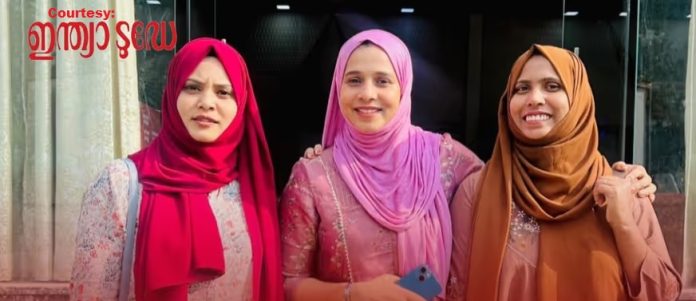
Advocate Fathima Thahliya, Advocate Mufeeda Thesni, and Advocate Najma Thabsheera won their respective contests with large margins. All three previously held top positions in Haritha at the state level.
Thahliya contested from the Kuttichira division of Kozhikode Corporation as the UDF deputy mayor candidate. She defeated the LDF supported candidate by a margin of 2,273 votes. She also serves as state secretary of the Youth League.
Najma Thabsheera won from the newly formed Valambur division in Perinthalmanna Block Panchayat. Contesting as block president candidate, she secured 6,730 votes against her rival’s 4,118 and continues as standing committee chairperson.
Mufeeda Thesni emerged victorious from the Tharuvana division of Wayanad District Panchayat. She polled 13,292 votes and defeated her opponent by 5,710 votes.
All three leaders have strong organisational backgrounds in Haritha, MSF, and the Youth League. Their victories come years after internal controversies linked to Haritha, which were later resolved. The results underline the continued political relevance of young Muslim women leaders in grassroots governance.
source: http://www.radiancenews.com / Radiance News / Home> Latest News> Report / by Radiance News Bureau / December 14th, 2025
A total of 39 Muslim candidates have won Gram Panchayat elections across Telangana, marking a clear rise in local level representation. Several winners include women, reflecting wider participation from within the community in rural governance.
Nizamabad district recorded the highest number of Muslim winners with nine candidates elected from different political parties. The outcome showed voter preference for local credibility and grassroots engagement over party labels. Other districts with notable results include Jagtial, Sirsilla, Nagarkurnool, and Siddipet, where five Muslim candidates secured mandates.
Muslim sarpanches also won in Warangal, Narayanpet, Medak, Karimnagar, Adilabad, Nirmal, and Bhadradri Kothagudem. These victories point to steady public trust in Muslim leadership at the village level. Candidates focused on local concerns such as water access, sanitation, roads, and welfare delivery during their campaigns.
Women candidates formed a visible part of this success. Districts such as Warangal, Narayanpet, Medak, Khammam, Kamareddy, and Mahabubnagar elected Muslim women as sarpanches. Their victories signal gradual social change within rural political spaces and stronger acceptance of women in decision making roles.
Community observers note these results counter long standing patterns where Muslims remained underrepresented in local bodies. The spread of victories across districts and parties suggests sustained voter engagement rather than isolated outcomes.
The newly elected representatives now face expectations to deliver transparent governance and address everyday civic issues. Their performance at the village level is likely to influence future participation and confidence in local democratic processes across Telangana.
source: http://www.radiancenews.com / Radiance News / Home> Latest News> Report / by Radiance News Bureau / December 15th, 2025
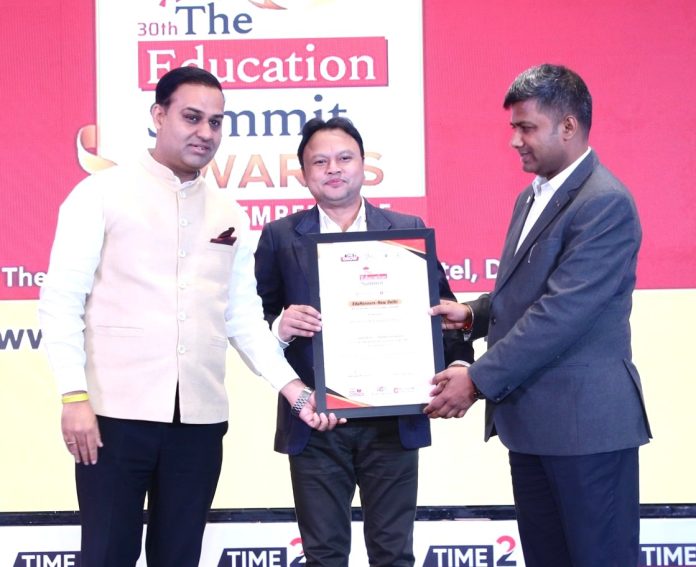
Dr. Qazi Muhammad Miyan was awarded with EduHonors Award during 30th edition of “The Education Summit” organised by Time2Grow Media in association with NSDC National Skill Development Corporation, Skill India, and Department of Art, Culture and Languages, Government of Delhi, held at The Leela Ambience Convention Hotel, Delhi.
The award was presented in the presence of Shri Harsh Malhotra, Union Minister of State – Ministry of Corporate Affairs, Minister of State – Ministry of Road Transport and Highways, Government of India, , Shri Biney Kumar Singh, Director – Dr. Syama Prasad Mookerjee Research Foundation, New Delhi, Akshay Kapoor, Senior Leader – BJP Delhi, Dr. Vinusha Reddy, BJP Spokesperson Dr. Alok Kumar Gupta, Deputy Director (Acad.) – National Institute of Open Schooling (NIOS), Ministry of Education, Govt. of India, Dr. Shashi Pandey Sharma, Manmeet Khurana – Founder & CEO, Time2Grow Media and other eminent school leaders, policy makers and educationists.
Dr. Qazi Muhammad Mian is the Administrator of The Scholar School, Delhi and an Executive Member of the All India Education Movement. He is also associated with several national and international educational organisations and has previously been honoured several awards by various educational institutions and organisations.
source: http://www.radiancenews.com / Radiance News / Home> Pride of the Nation> Awards> Latest News / by Radiance News Bureau / December 12th, 2025
The National Federation of Girls Islamic Organisation (NFGIO) has announced its newly elected Federal Committee. Adv. Sumaiya Roshan, from Tamil Nadu, has been re-elected as President, marking a continuation of her leadership in advancing the organisation’s mission.
The GIO has a legacy spanning four decades, focusing on the overall development of Muslim women and their education, leadership, and social contribution across the nation. The newly elected Federal Committee brings together a dynamic team of accomplished individuals from across the country, ensuring representation and inclusivity in its leadership.
The Vice President, Afeefa Tahniyath from Andhra Pradesh, and General Secretary, Anamtha Dildar Ahmed from Maharashtra South, will lead key efforts in expanding the organisation’s outreach. The Secretaries include Fehmeeda Ilyas Qureshi (Gujarat), Maseera Firdous (Telangana), Fathima Noureen (Kerala), Momina Affaf Taiyebati (UP East) and Safeeda Hussain (Kerala).
Adv. Sumaiya Roshan said, “The NFGIO was founded to recognise the potential of young Muslim women in India and to guide them toward excellence in all areas of life, empowering them to shape the future and drive meaningful societal progress.”
The election was conducted under the guidance of Syed Sadatullah Husaini, President Jamaat-e-Islami Hind, at JIH headquarters here.
source: http://www.radiancenews.com / Radiance News / Home> Latest News> Report / by Radiance News Bureau / December 10th, 2024
Muslims not affiliated to political parties have very little chance of making it to public life.
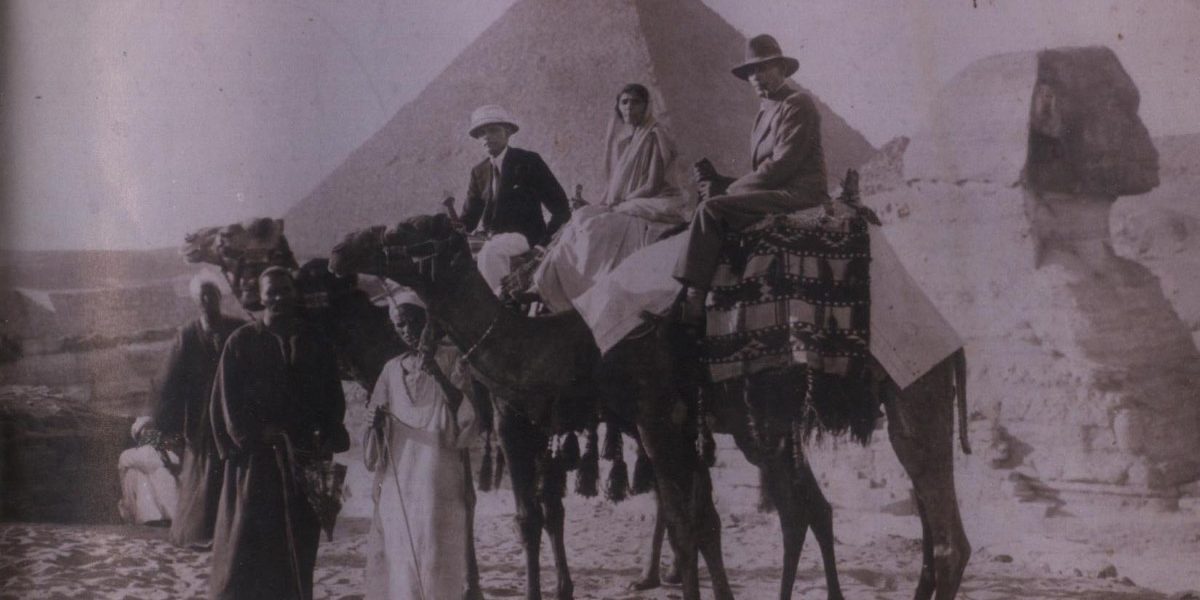
Sir Shafaat Ahmed (left) in Egypt with Jinnah and his sister Fatima.
On September 2, 1946, members of the Interim Government took oath in Delhi. The Interim Government was formed to facilitate the transfer of power from the British to Indians, and consisted entirely of Indians, except for the Viceroy and the commander-in-chief. The plan was for it to have a total of 14 members which was to include five Hindus, five Muslims, and one member each from the Scheduled Caste, Parsi, Sikh and Christian communities, but before it finally took office, there was much debate and politicking, some of its acrimonious, about its composition and structure.
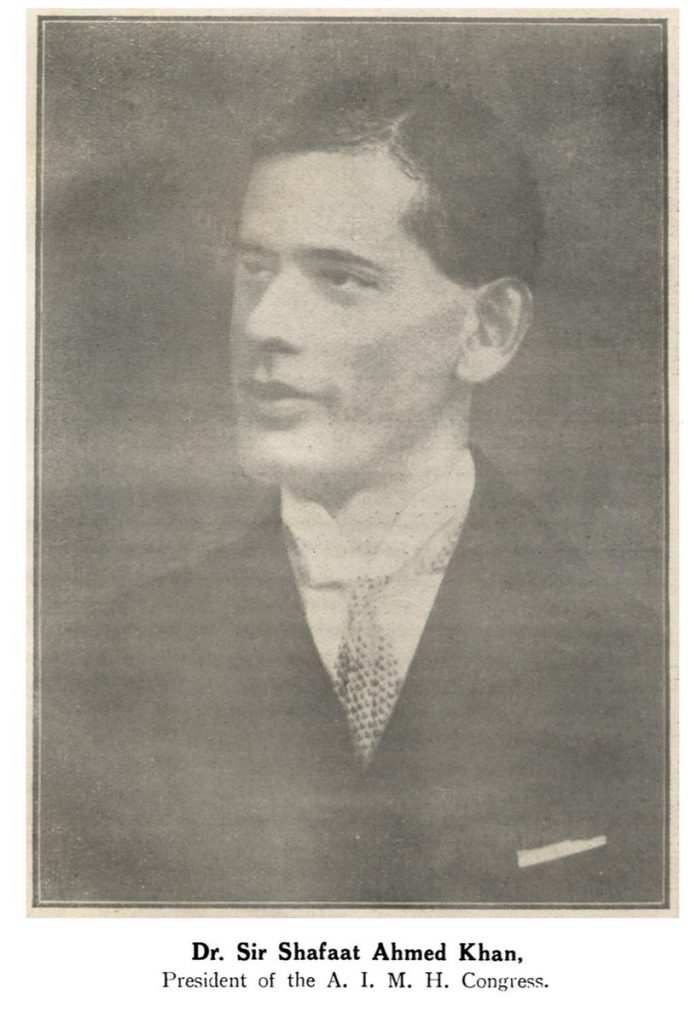
Only 12 positions were finally filled: Jawaharlal Nehru, Sardar Patel, Rajendra Prasad, C. Rajagopalchari, Sarat Chandra Bose, Dr John Matthai, Sardar Baldev Singh, Jagjivan Ram, C.H. Bhabha, Asaf Ali, Syed Ali Zaheer and Sir Shafaat Ahmed. Mohammed Ali Jinnah, who had broken away from the Congress, stayed away as he wanted the Muslim members to be only from the Muslim League. One of the names he objected to was that of Sir Shafaat Ahmed Khan, a scholar politician.
His appointment offers an example of how to the political trajectory of ‘independent’ – i.e. non-politically affiliated – Muslims in India has been fraught with strife.
The inclusion of these three Muslims undermined Jinnah’s constant demand that all Muslim members of the Interim Government should be from the League. “The Viceroy only added insult to injury by nominating three Muslims who, he knows, do not command either the respect or the confidence of Muslim India,” said Jinnah after Viceroy Wavell’s announcement. The inclusion of Sir Shafaat had particularly riled the Muslim League because he had left it over fundamental differences. While in the League, he had defended it publicly but also disagreed on many issues – the final parting came when the League asked that titles given by the British be returned, and Sir Shafaat disagreed strongly.
On the evening of August 24, 1946, as Sir Shafaat was returning from his walk, he was attacked by two youngsters near Darbhanga House (which now houses a school) in Shimla. He received deep wounds on his head, chest and neck. The incident happened just a few hours after Wavell announced on radio that Sir Shafaat would be a member of the Executive Council. This was a rare and outrageous physical attack on a high-ranking Muslim, and is also a telling statement on the precarious position of the independent Muslim.
Jinnah’s notion of non-League Muslim leaders as lacking respect among Muslims was central to his self-declared position as the sole spokesman of the community. He also argued that even the Congress be not allowed to nominate a Muslim, a condition that was never accepted by the British. The attack on Sir Shafaat Ahmed was reflective of the rather restricted space in the political firmament for Muslims who were not in either the Congress or the Muslim League camp. Two more Muslim leaders could have been inducted in the Interim Government (to take the total number of Muslims to five), but the questions of acceptability and legitimacy of any non-League, non-Congress Muslim prevented that.
‘Congress Moslem’
Reporting on the tussle over the composition of the Interim Government, newspaper reports would describe the Muslim members as either “Congress Moslem”, “non-League Moslem”. For, as the formation of the Interim Government shows, there was hardly any scope for the ‘Muslim’ equivalent of a C.H. Bhabha, who was a businessman, or the Sikh leader Sardar Baldev Singh, both independent of political affiliations, a situation which continues even now.
Discussing the problems facing the composition of the Executive Council with Leo Amery, the secretary of state for India, Viceroy Wavell on June 20, 1945 wrote from Delhi: “The main difficulty is likely to arise over non-League Moslems if Congress insist on putting forward Moslem names. There would also be difficulty in inclusion of non-League non-Congress Moslems.” This is very similar to independent Muslim political actors/formations, not aligned with big parties, struggling to gain legitimacy or patronage.
Sir Shafaat’s inclusion may indicate that there was a scope for a non-Congress non-League Muslim, but it was predicated by the non-participation of Jinnah’s League. On October 26, 1946, three members – Sarat Bose, Sir Shafaat and Syed Zaheer – resigned to make way for the Muslim League, after Jinnah agreed to join the Interim Government.
This brief elevation to a top public office was the highpoint in the political career of Sir Shafaat. In January 1947, there were talks of appointing him as India’s high commissioner to Canada, but it never happened. He had been a member of the UP Legislative Council in the 1920s, part of the Muslim delegation to the Round Table conference and also was India’s high commissioner to South Africa from 1941 to 1944.
Sir Shafaat’s entry to politics was through academia, and not through the popular routes of law or journalism. He is perhaps best remembered as a historian who played a role in the establishment of the Indian History Congress and presided over its first meeting in June 1935 in Pune. As chairman of the Modern Indian History at University of Allahabad he started the Journal of Indian History in 1924. He also taught at University of Madras and Aligarh Muslim University.
He died in Shimla in July 1947, having fallen ill two months earlier. Reporting his death the Congress-supporting Bombay Chronicle noted: “During the greater part of his public career, Dr Shafaat Ahmed Khan, an eminent professor of History and a politician, belonged to a school of thought and activity which quite rightly did not find favour with nationalist India and the Congress. That is why the news of his inclusion in the first Interim Cabinet was received with surprise rather than satisfaction.”
This characterisation of his appointment by the Bombay Chronicle as a “surprise rather than satisfaction” was at odds with the official Congress stand, but was still more charitable than the views of those who placed a greater importance on the joint participation of the Congress and the League in the Interim government. Reflective of the wider mood of the period, Sir Chimanlal Setalvad, for example, termed Sir Shafaat’s inclusion as “unfortunate” and “provocative” to the Muslim League, signifying that the idea of a representative national government during the high politics of Partition could only include Muslims from the League and the Congress.
Muslim representation today
It is only in retrospect that we can assess the figure of Sir Shafaat in the context of the idea of Muslim representation, which requires moving away from the dominant narratives of Congress-Muslim League matrix in the years leading to Partition. It seems that the restrictive bracketing of the nature of Muslim representation is not new, and has a tradition of being inherently inimical to independent voices and movements. It has now taken a much uglier turn.
In colonial India, there was a strong Muslim political presence in Punjab and Bengal, which has continued post-Independence in the form of IUML, MIM and other regional parties. But the story of the national level since then has been different. In independent India, Muslims voted largely for the Congress, which also gave a platform to community leaders. But now with the Congress’s electoral losses, the political sphere has shrunk.
In the current Lok Sabha (like the previous one) too, the ruling Bharatiya Janata Party (BJP) does not have a single Muslim. As the dominant political party, this situation raises a larger existential question on the conception of a Muslim politician itself.
The recent rhetoric of ‘UPSC jihad’, implying the infiltration of the civil services by Muslims, further shows the discomfort in certain sections of the Indian society over Muslims holding positions in public life. Whether it is bureaucracy or politics, it is clear that a narrative of hate and fear, driven by a dangerous construction of undesirability of Muslims in high offices seems to be the driving impulse.
The percentage of Muslim bureaucrats in India has been historically low, and the community’s shrinking political representation in Parliament brings to focus the vexed issue of Muslim representation and shows that walking the political terrain for Muslims has been difficult without patronage from established parties.
Danish Khan is a UK-based journalist and a doctoral candidate at University of Oxford.
source: http://www.thewire.in / The Wire / Home> Analysis> History / by Danish Khan / September 02nd, 2020
At the India AI Impact Summit, which will be hosted by New Delhi in Feb. 2026, global tech leaders will also address issues surrounding the fear of job losses and equipping job-seekers to meet the needs of the changing job market, says the director, IndiaAI Mission.
The India AI Impact Summit to be held in New Delhi in February 2026 will witness deliberations between world leaders and top global tech leaders, leading to a formal declaration on ways to balance innovation and safety and the areas to be focussed for artificial intelligence innovation, Mohammed Y. Safirulla K., Director, IndiaAI Mission under the Union Ministry of Electronics and Information Technology, has said.
In an interview to The Hindu on the sidelines of a pre-summit conference here on Thursday, Mr. Safirulla said India can take pride in that it is the first country in the Global South to host the summit. New Delhi is hosting the fourth edition of the summit.
Objectives of summit
The objectives of the AI Impact Summit include democratisation of AI and bridging the AI divide, development of indigenous and local AI, aligning global standards and models for AI governance and innovation to needs of the developing world, harnessing AI for social good and development, and positioning India as a leading voice of the Global South on AI. The deliberations will take place across seven working groups, in which experts from over hundred countries will participate.
“We can see that there is a concentration of AI resources in certain countries in the Global North, especially when it comes to high-end data centres. There are biases which are coming out of algorithms because it is developed only from situations focussing on certain countries. We can also notice a language-wise divide since much of it is in English. One of our focusses will be on democratising AI so that no country in the Global South is left behind,” says Mr. Safirulla.
The summit will also address issues surrounding the fear of job losses and equipping job-seekers to meet the needs of the changing job market.
Training for youth
“We will look at how to train the youth coming into the job markets to be ready for AI-related jobs. Also, we need to see how we can use AI to increase the efficiency of the people who are already in the job markets working in various domains or how do we reposition them. We also have to nurture this intentionally in society so that we achieve economic growth,” he says.
Earlier this year, the IndiaAI Mission had opened up the MyGov platform to collect innovative ideas across sectors from researchers, startups, and students. Some of the innovation will be focussed on developing tools to authenticate AI-generated content, ensuring it’s traceable, secure, and free of harmful materials. Deepfake detection tools will also be developed to enable real-time identification and mitigation of deepfakes.
source: http://www.thehindu.com / The Hindu / Home> News> India> Kerala / by S R Praveen / November 20th, 2025
From the tech labs of Bengaluru to the coffee plantations of Coorg, from the ancient ruins of Hampi to the bustling streets of Mysore, Karnataka exudes energy. This is where India’s IT revolution was born, where classical arts thrive alongside cutting-edge innovations, and where every district tells a story of transformation.
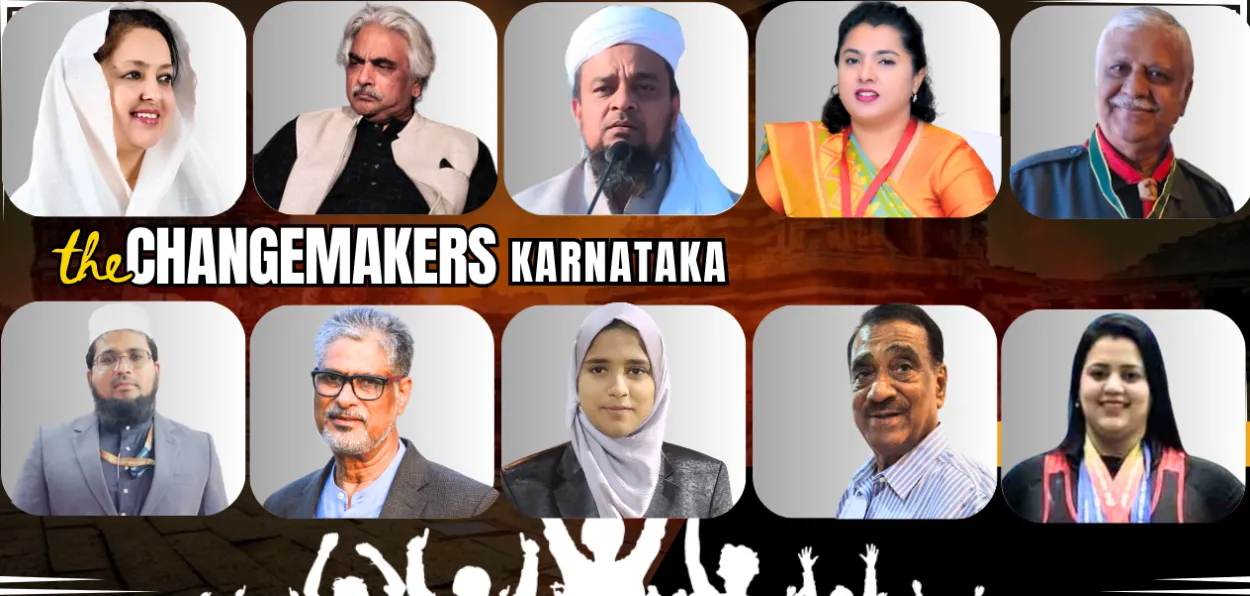
Many Kannadigas have built empires and earned acclaim—but some went further. They didn’t just succeed; they became the Changemakers—individuals who shattered barriers, rewrote destinies, and ignited revolutions that ripple far beyond their own lives. Here are ten personalities of Karnataka whose courage and vision are reshaping the future:
Rifah Taskeen
A 15-year-old firecracker from Mysore started racing at age three in a custom car built by her ex-racer father, Tajuddin. By five, she was driving Mysore to Bengaluru; by seven, she was drifting in school shows and stealing Republic Day parades.
Fighting red tape and disbelief, she stormed past every “too young” barrier to claim seven world records (Golden, Elite, High Range, India, Asia, Worldwide & Wonder Books), mastering bikes, JCBs, cranes, buses, tippers, road rollers, and even flying a plane at eight.
Mysore’s cleanliness ambassador for five years and tuberculosis state warrior for four, she’s also a state-level boxing medalist and karate fighter. She’s drifted for Rahul Gandhi, flown with Sonia Gandhi’s blessings, and left global crowds speechless.
Self-funded, unstoppable, and dreaming of IAS wings after SSLC, Rifah doesn’t just break records; she rewrites what “impossible” means. Age is just a number.
Mushtaq Ahmed
A Bengaluru-born visionary landed in Dubai when it was still sand dunes and a dream. For 41 years as head of Dubai Police photography (until 2018), the retired 1st Warrant Officer framed an entire nation’s rise—capturing the Burj Khalifa’s skeleton, the Kaaba from a crane, Sheikh Mohammed’s 1979 wedding, and sacred Medina in rare reverence.
From helicopter shots above a bridgeless Dubai to standing beside Sheikh Zayed and global icons like Lata Mangeshkar and Mohammed Rafi, the 79-year-old chronicler turned fleeting moments into eternity. Honoured, hugged, and kissed on the forehead by Dubai Police upon retirement, Mushtaq’s lens didn’t just document history—it built it. His quiet mantra: “The best shot is yet to come.”
Tazaiyun Oomer
Tazaiyun Oomer was 13 when she fought through a crowd in Parliament House and got Indira Gandhi’s autograph, an electric moment that taught her leadership has no gender.
From a Kutchi Memon girl helping in her father’s textile shop, she grew into Bengaluru’s quiet revolution. In 1999, she founded Humane Touch Trust: 100+ corrective surgeries for disabled children, Al-Azhar School, 1,750 dignified mass weddings, 2,000+ Muslim women turned entrepreneurs, and yearly scholarships lifting nearly 300 girls into tech careers.
Recipient of the Sulthan Nari Shakti and Karnataka’s Rising Beyond the Ceiling awards, she proved compassion can shatter centuries-old barriers. Where tradition once whispered “a woman’s place,” Tazaiyun built schools, businesses, and futures. Her mantra: “Change begins the moment you decide to act.”
Mohammed Ali Khalid
Mohammed Ali Khalid, India’s Bronze Wolf Award recipient —the highest global honour in Scouting—has lived the Scout promise for over four decades with breathtaking sacrifice and impact.
Mohammed Ali Khalid stands as one of India’s most influential Scout leaders, a visionary whose four decades of service have shaped millions of young lives. From volunteering at the 1980s National Jamboree to becoming Additional Chief National Commissioner of Bharat Scouts and Guides, he has built global partnerships, led landmark events like the 2017 National Jamboree and the 2022 International Cultural Jamboree, and strengthened Scouting across the Asia-Pacific Region. A strategic thinker behind Vision 2013 and a respected global diplomat, Khalid’s selfless leadership, mentorship, and bridge-building continue to inspire generations—earning him the Bronze Wolf and global admiration.
Architect of Vision 2013 for Asia-Pacific, broker of WOSM’s global fee consensus, founder of SAANSO, and mentor to countless young leaders, Khalid turned India into Scouting’s most connected powerhouse. At 70, he still pushes for 20% membership growth and 50% youth representation worldwide.
Rahmath Tarikere
Rahmath Tarikere, born in 1959 in Tarikere’s syncretic lanes, grew up where Hindus and Muslims shared the same street and stories. The 1992 Babri demolition jolted him into action: he left pure literary criticism to unearth Karnataka’s living pluralistic traditions—Sufi saints, Nathpanthis, Shakta poets, and folk Moharram rituals that united communities for centuries.
Author of 30 books—including four Karnataka Sahitya Academy winners and the 2010 Kendra Sahitya Akademi winner Kattiyanchina Daari—he returned the national award in 2015 protesting intolerance and the murder of M.M. Kalburgi. A humble professor who insists “I am not a changemaker,” Tarikere quietly weaves pluralism into Karnataka’s soul, proving unity is not uniformity but a vibrant mosaic of differences.
Khudsiya Nazeer
Khudsiya Nazeer, the “Iron Lady of India,” was born 1987 in Bangarpet and lost her wrestler father at two. Raised in a conservative Muslim family amid depression and mockery, she turned pain into power.
Post-Caesarean, she deadlifted 300 kg to set a world record (2022), then stormed the global stage: three golds at Asia Pacific Masters 2023 (South Korea), silver in Athens, golds in Commonwealth (Australia) and Germany. The first Indian Muslim woman to win international weightlifting medals, she lifts drug-free while working full-time at KSRTC.
From burqa-clad walks guarded by police to Harvard’s stage, Khudsiya proves motherhood multiplies strength. Her mantra: educate, play sport, write your own destiny. This Iron Lady doesn’t just break records; she shatters every ceiling for women.
Fouzia Tarannum
Fouzia Tarannum, 2015-batch IAS (AIR 31), cracked UPSC on her first attempt from Bengaluru’s public libraries—no coaching, pure grit. From IRS gold-medallist to Karnataka cadre, she turned arid Kalaburagi into a national millet powerhouse with “Kalaburagi Rotti,” empowered thousands of SHG women, lifted districts to top SSLC ranks, revived gram panchayat libraries, and delivered India’s cleanest electoral rolls—earning the President’s Best Electoral Practices Award in 2025.
At 36, this quiet DC faced Islamophobic slurs yet answered only with work. Unfazed, empathetic, and fiercely people-centric, Fouzia proves bureaucracy can have a heart and a steel spine. She doesn’t shout change—she builds it, one roti, one vote, one woman at a time.
Zafer Mohiuddin
pix09
Zafer Mohiuddin, Raichur’s radio-struck boy who once ghostwrote love letters in school, turned a bus-ride compliment from R. Nagesh into a lifetime on stage. He quit UPSC and Air Force postings to found Kathputaliyaan Theatre Group (1988), wielding puppets and plays as weapons against taboo.
From translating Girish Karnad’s Tipu Sultan ke Khwaab (Theatre Olympics 2018) to shattering Urdu myths with Zaban Mili Hai Magar, his raw, Amitabh-like voice has roared in ten languages, narrated Swaraj Namah, and defended Urdu’s secular soul alongside Karnad.
In November 2025, Karnataka crowned him with the Rajyotsava Award—its highest honour—for four decades pulling society’s strings toward truth and harmony. The puppet master still refuses to cut his own.
Moulana Dr. Mohamed Maqsood Imran Rashadi
Moulana Dr. Mohamed Maqsood Imran Rashadi, Principal and Chief Imam of Bengaluru’s iconic Jamia Masjid, memorised the Quran in 18 months, earned a PhD in Urdu literature, and turned a struggling madrasa into a 100%-pass powerhouse for 400 underprivileged students.
From quietly removing provocative meat thrown to spark riots to defusing the 2025 “I Love Mohammed” banner crisis with one calm sermon, he prevents violence before it begins. He negotiates fair loudspeaker rules across faiths, hosts Hindu swamis for iftar, and, after the Pahalgam terror attack, thundered “Terror has no religion—we love Hindustan.”
A scholar who preaches in Tehran, meets Saudi royals, and still walks the KR Market uniting traders, Moulana Maqsood proves that unity is built by deeds, not banners. Bengaluru’s heartbeat of harmony beats in his voice.
Syed Nawaz Miftahi
Syed Nawaz Miftahi, fully sighted yet forever changed by the tear-filled Quranic recitations of blind children in Mumbai in 2011, vowed to become their light.
He mastered Braille, invented the “broken-rice touch” technique to awaken ageing fingers, and turned Sultan Shah Markaz, Madrasa-e-Noor (70 students), and daily phone classes into sanctuaries where the visually impaired recite flawless tajweed and complete multiple khatms every Ramazan.
From Hyderabad to Kashmir, his model now trains teachers who were once his students. In November 2025, he launched Umang Foundations—a residential beacon run by seven blind trustees and one fearless young sighted woman—where every visually impaired soul, of any faith, learns Quran, computers, and independence.
Nawaz doesn’t give sight; he proves the heart’s vision is brighter.
source: http://www.awazthevoice.in / Awaz, The Voice / Home> The Changemakers of Karnataka / by ATV / posted by Aasha Khosa / November 22nd, 2025
From Mughal ports to Dutch wars to Bombay’s merchant dynasties, Gujarati Muslims once shaped the Indian Ocean world — long before one of their descendants took New York.
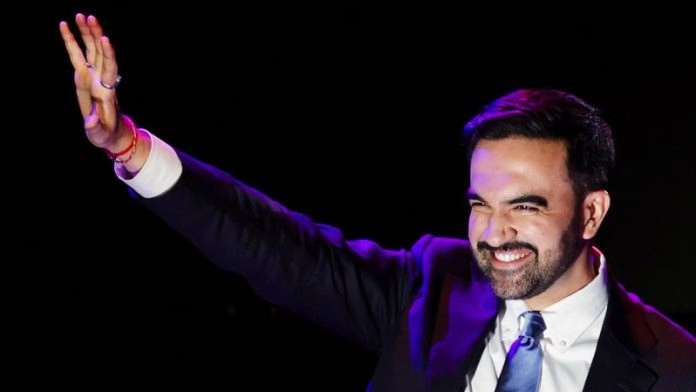
File photo of Zohran Mamdani | Reuters 2025
_______________________________________________
What You Need to Know
Zohran Mamdani’s election highlights a forgotten Indian Muslim cosmopolitanism. Historically, Gujarati Muslim communities dominated Indian Ocean trade, challenging European powers and fostering diverse business relationships. Later, groups like the Khojas adapted through “corporate Islam” (jamaats), becoming powerful economic forces globally. This rich, diverse history is increasingly overshadowed by modern religious nationalism.
*AI-generated summary. Check context in original text.
________________________________________________
Having delivered speeches in Gujarati, Bengali, Arabic, Hindi, Luganda, and Spanish, Mamdani is a reflection of a long-forgotten Indian Muslim cosmopolitanism. The Gujarati Muslim communities he descends from once challenged the Dutch for hegemony in Indonesia; poured money into schools, hospitals, and printing presses from Japan to Arabia; and helped the British Empire consolidate its grip over Africa. To this day, that Indian Muslim history still echoes — in high-end London auction houses as much as in the working-class boroughs of New York.
The election of Zohran Mamdani as Mayor of New York last week has struck a surprising chord in the world’s media — especially considering he is technically the head of just one American city’s administration. But the buzz around this young Indian-origin Muslim, an avowed democratic socialist, is a ripple in a much older ocean.
Gujaratis in the Indian Ocean
This column began with a rather innocuous tweet pointing out that Mamdani’s multilingualism would have made him a fortune in the early modern Southeast Asian spice trade. As of writing, it has racked up over one million views and 54,000 likes — and it’s a pretty accurate reflection of what propelled Gujarati Muslims to international trade superstardom in the first place.
In her paper ‘Gujarat’s Trade with South East Asia (16th and 17th centuries)’, historian Ruby Maloni describes the great port of Khambhat in Gujarat as having “stretched out two arms — one towards Aden, the other towards Malacca.” While Banias were especially prominent in East Africa and the Persian Gulf at the time, Gujarati Muslim merchants dominated the Malacca trade, conveying relatively cheap block-print textiles from manufactories in Ahmedabad deep into Southeast Asia to trade for spices.
The most prominent among these merchants effectively formed ‘dynasties’ closely linked to the Mughal court, among others. But there was also a strong aspect of caste-based collective organisation, paralleling that of Hindu and Jain Gujaratis.
Nowhere was this more evident than in Surat, perhaps the most impressive port on India’s west coast. Its multilingual babble included Gujarati, Arabic, Persian, Urdu, Dutch, English, and Portuguese. Certainly, there were clear distinctions between caste and religious groups, and within their communities Gujarati merchants — Hindu and Muslim alike — could be quite rigid. At the same time, in interpersonal and business relationships, their shared Gujarati heritage encouraged cosmopolitan attitudes.
Historian Jawaid Akhtar offers several examples in his paper ‘The Culture of Mercantile Communities in Mughal Times.’ In Surat, Armenian merchants were in business with Parsis and Muslims; Vaishnavite Bhatias, despite a taboo against crossing the ocean, jointly owned cargo and ships with Muslims. Akhtar cites documentary evidence of Bania men adopting Muslim practices such as offering dowers to their wives. Muslim and Hindu merchants also collectively represented their grievances to Mughal authorities.
On one occasion in 1669, when the Qazi of Surat compelled a Vaishnavite Bania to convert to Islam, nearly 8,000 merchants — apparently of all religions — emigrated to Bharuch in protest against this infringement of their privileges.
Gujarati Muslims quickly identified Europeans as a threat to their trade dominance in Southeast Asia. Maloni notes that Dutch East India Company records mention their difficulties with these merchants, who took them on through price wars and by installing their own candidates as port authorities. It seemed that there was nothing the Dutch could do to prevent Gujarati Muslims from trading. The Sultanate of Johor welcomed ships belonging to the merchant Haji Zahid Beg, who bought tin in flagrant defiance of Dutch embargoes. Other merchants, Maloni writes, hired cargo space on English ships; the spectacularly wealthy merchant Abdul Ghafur of Surat even flew Dutch flags on his own ships. It was only when the Dutch forcibly colonised much of Indonesia that Gujarati Muslims finally lost their grip on Malacca. But by then, new opportunities were already emerging on the horizon.
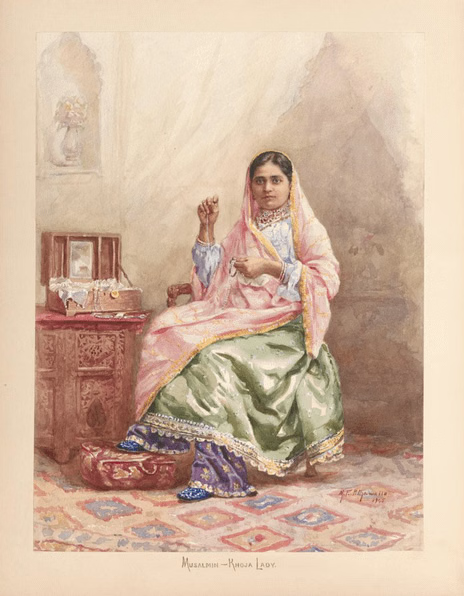
Khoja Lady | From the album presented to the Princess of Wales by the women of Bombay, featuring 13 full-page watercolours of Indian women by artist Manchershaw Fakirjee Pithawalla (1872-1937) | Wikimedia Commons
The rise of ‘Corporate Islam’
As the Mughal juggernaut began to shake and unravel in the 18th century, the old order of great merchant princes and dynasties started to fall apart. Surat, repeatedly raided by the Maratha king Shivaji, faced growing competition from the East India Company’s new port at Bombay.
Three Gujarati Muslim communities — the Bohras, Memons, and Khojas — who had hitherto been relatively small-time traders, found themselves ideally placed to benefit from the changing political landscape. Zohran Mamdani descends from the last of these.
In his seminal book No Birds of Passage: A History of Gujarati Muslim Business Communities, 1800–1975, historian Michael O’Sullivan notes that these three groups had spread “as far east as Ujjain, as far west as Karachi, as far south as Poona, and as far north as Udaipur… They thus inhabited a territory that was, by the reckoning of an Indian lexicographer in the 1840s, larger than Great Britain and Ireland, with their shared mother tongues [Gujarati] serving as the principal language of business in Central and Western India.”
The Bohras, Memons and Khojas had all converted to Islam around the 15th century, but their social and cultural practices varied drastically. Subgroups were affiliated with various Sunni and Shia sects; some were Ismaili and revered the Aga Khans, while others traced descent by region and worshipped Sufi saints.
What these groups shared, though, was the jamaat —an institution that O’Sullivan describes as a form of “corporate Islam”. Essentially, members of each jamaat shared some resources in common — schools, hospitals, that sort of thing. Particularly wealthy members, who often held senior religious positions, also maintained private family trusts and companies.
What the jamaat ensured, O’Sullivan writes, was a mechanism for organisation, exclusivity, and interpretation, allowing these communities to adapt the changing contours of Islamic practice to an era of globalisation. Jamaats could mobilise capital, human resources, and theological flexibility at a rate few other Indian institutions could match.
Collectively, these Gujarati Muslim jamaats emerged as some of the most powerful Indian economic forces of the late 19th and early 20th centuries. Though now outshone in the popular imagination by Parsi and Bania entrepreneurs, Gujarati Muslims similarly negotiated with the Marathas and the British, benefited from the Opium Wars, and switched soon after to manufacturing all sorts of commercial goods, especially in Bombay.
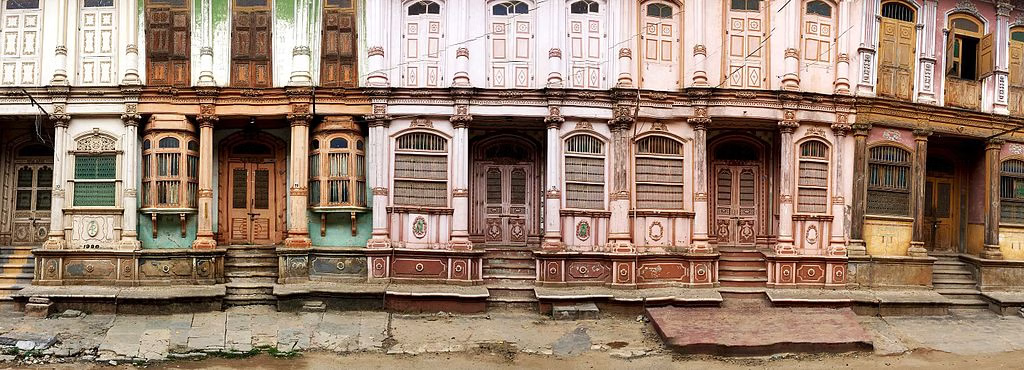
In the 1840s, Gujarati Muslims commissioned pioneering printed texts — in Gujarati — including travelogues and cultural primers for new markets like China. Their growing wealth also funded spectacular mansions, such as those in Sidhpur, now eerily abandoned. It was Gujaratis, perhaps more than any other Indian group, who built the financial infrastructure of the British Raj in East Africa — a migration line from which Zohran Mamdani himself descends.
All of this amounted to a decisive shift in the centre of gravity of Indian Ocean Islam. It was for this reason that the Aga Khan, revered by Ismaili Khojas, moved his seat from Iran to Bombay before Partition.
Sidhpur city in Gujarat | Wikimedia Commons
A cosmopolitanism forgotten
The versions of Islam promoted by Gujarati Muslims absorbed the modernist vocabulary of capital accumulation and inheritance, frequently splintering into new jamaats as they expanded into ever-new markets and cultures.
At the same time, as researcher Danish Khan notes, Gujarati Muslims attained positions of leadership and influence in Bombay well before they had even set foot in the United States of America. “The first Muslim baronet in colonial India,” he writes, “was a Khoja and the first Muslim ICS officer was a Sulaimani Bohra. Badruddin Tyabji and Rahimtoola Sayani were the first two Muslim Presidents of Congress party. Sir Adamjee Peerbhoy presided over the first session of the Muslim League in Karachi.”
But with the rise of pan-Islamic and Hindu nationalism in the early 20th century, the scales swung once again, and mercantile, oceanic histories were overridden by grievances inspired by long-dead inland kings.
Where does the history of Gujarati Muslims fit now? Mamdani’s election is ironic on many levels. In Bombay, once the historic home of the community, a BJP politician declared, in response to Mamdani’s victory in New York, that “We won’t allow any Khan to become mayor.”
The fact is that before and since, the history of Gujarati Muslims has, for all intents and purposes, disappeared into the ever–widening gap between radical Hindutva and radical Islam. Every news cycle, it seems, tears India’s many intertwined histories further apart.
Anirudh Kanisetti is a public historian. He is the author of ‘Lords of Earth and Sea: A History of the Chola Empire’ and the award-winning ‘Lords of the Deccan’. He hosts the Echoes of India and Yuddha podcasts. He tweets @AKanisetti and is on Instagram @anirbuddha.
This article is a part of the ‘Thinking Medieval’ series that takes a deep dive into India’s medieval culture, politics, and history.
(Edited by Prashant Dixit)
source: http://www.theprint.in / The Print / Home> Opinion> The Fine Print / by Anirudh Kanisetti / November 13th, 2025