Dr. Hashima Hasan tells AMT about her dream of working for NASA and her extraordinary role in launching the largest, most expensive space telescope in history.
A young girl stands in awe with her family in their yard, as their heads tilt back to watch the Russian Sputnik satellite pass through the clear morning sky in Hazratganj, India, in 1957.
“I still remember watching it and saying, ‘Wow, I’d like to do that,’” said Dr. Hashima Hasan. “That was an inspirational moment.”
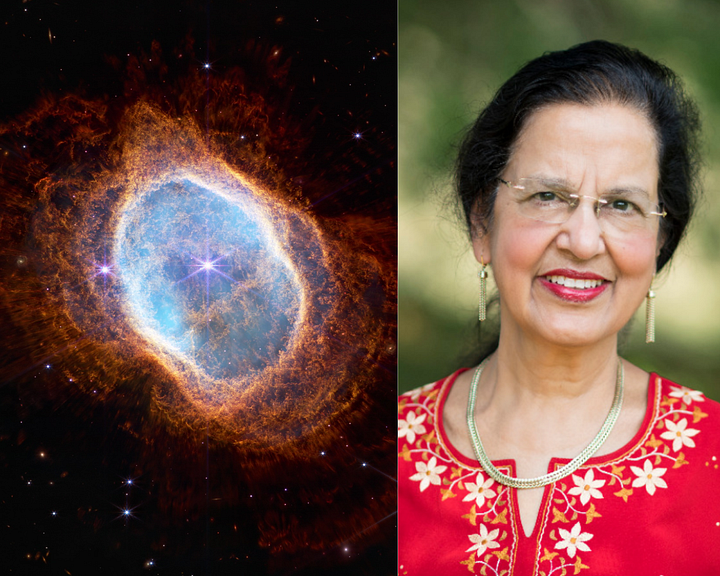
Over half a century later, Dr. Hashima is now one of NASA’s leading scientists and has helped develop the device that is currently enthralling the world, by relaying the first quality images of billions of years of the universe.
The James Webb Space Telescope is being used to focus on the first light in the assembly of galaxies in the early universe, the birth of stars and protoplanetary systems, as well as planets.
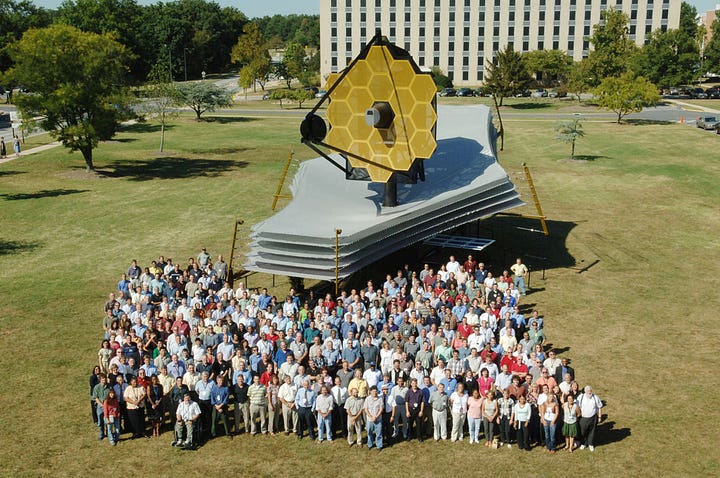
James Webb Space Telescope
“I am personally delighted to see the hard work of the thousands of talented individuals across the nation, Europe and Canada rewarded by the success of the mission as evidenced by the flawless launch, commissioning and the stunning images,” says Hasan. “My colleagues and I are eagerly awaiting the scientific discoveries which are yet to come.”
From the images captured, which were released at a live event by NASA on July 12, scientists will be able to make discoveries about the life cycle of stars, galaxies, and planets and use that information to understand the ever-expanding universe. Hasan was part of the committee that identified candidate objects to be imaged to demonstrate that the powerful new instruments were ready for science.
“Although I didn’t know which images we would use for the demonstration, I was overwhelmed by the depth and details of the images,” said Hasan.
Hubble Space Telescope
Hasan is an expert when it comes to optics, which are used to control the telescope instruments and keep the mission on track. She was actually hired by NASA in 1985 to write simulation optics for the Webb’s predecessor, the Hubble Space Telescope, and played a critical role in fixing the flawed mirror that resulted in it relaying blurry images.
“I was appointed as the Telescope Scientist at the Space Telescope Science Institute and my job was not only to analyze the error but to keep the telescope ‘in the best focus’ while we were trying to figure out how to fix it,” said Hasan.
A few years later in 1989, Hasan was put on the project, at the time called the next-generation space telescope. This project was renamed in 2002 to what is now known as the James Webb Space Telescope, after the former NASA chief who headed the space agency from 1961 to 1968. In her role as the Deputy Program Scientist for the $10 billion telescope, Hasan and her team are responsible for ensuring the instrument stays on mission.
The Webb telescope will play a huge role in advancing understanding of the origins of the universe. The telescope took 30 days to travel almost a million miles away from Earth and will remain to capture infrared light from stars that formed 15 billion years ago.
Carina Nebula
“Until now, we have not been able to see the first stars and the first galaxies forming, so this is the key knowledge that we are planning to get from this telescope,” said Hasan. “We can even look closer to Earth in our own galaxy and we can see stars being born within our own galaxy. We can also see our planets more clearly and get more information on them. We can also see how the elements which form life.”
The James Webb telescope had a number of false starts through its decades of development due to a myriad of issues. Its first planned launch in 2007 was delayed by over a decade but its 2018 launch was canceled due to technical difficulties. As the Covid-19 pandemic hit it was rescheduled two different times. Finally, on Dec. 25, 2021, the telescope successfully launched from Kourou in French Guiana.
As the Webb joins the Hubble telescope it is expected they will work together in capturing images of celestial objects. However, the Webb surpasses its predecessor in its technological abilities. The Hubble telescope does not have the capability to capture infrared light in the same way and the Webb will orbit the sun rather than the Earth as the Hubble does.
Hasan says scientists have already lined up a menu of observations with Webb for the coming year and will soon submit proposals for which celestial mystery they will begin to uncover next.
“What excites me the most is the discovery of the unexpected and unknown,” said Hasan.
source: http://www.medium.com / Medium.com / Home / source: American Muslim Today / by Maya Gayler / July 15th, 2022
Deralakatte Renjali (Ullal Taluk),Mangaluru, KARNATAKA / Saudi Arabia/ UAE:
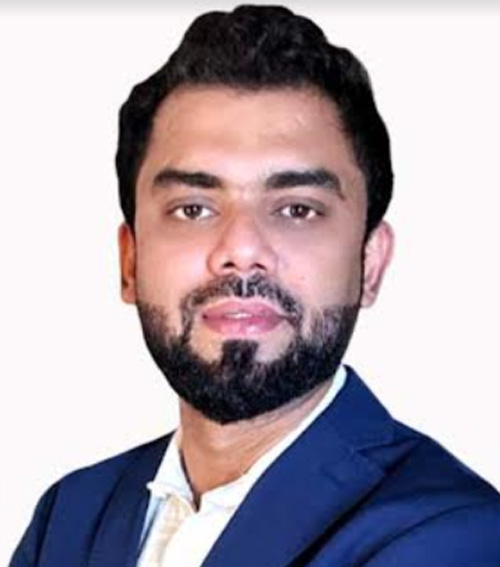
Dr Abdul Shakeel has been selected for the coveted Asia Achievers award given by Indian Council for Cultural Relations, Swami Vivekananda Cultural Centre Colombo and High Commission of India Colombo for his social service including providing rice to more than 10000 eligible families cutting across religion and caste during Covid pandemic, adopting students who are financially poor and encouragement to outstanding students.
The award will be presented by Vidura Vikramanayake, minister for religious and cultural affairs, government of Sri Lanka and higher education minister of Sri Lanka Surena Raghavan at the 40th International cultural convention that is organized on August 25 at the auditorium of University of Visual and Performing Arts in Sri Lanka.
Dr Abdul Shakeel is the son of Abdul Khader Harekala and Maimuna couple, residents of Deralakatte Renjadi under Ullal taluk.
He is NRI entrepreneur having business interest in gulf countries. Dr Shakeel is the managing director of MMA Advertisement and interiors Saudi Arabia, Dubai, managing director of Grey Line Interior and Advertisement (UAE) and director of Readymix Concrete, India.
Dr Shakeel reserves 50% of profits of his business for social work through Dr Abdul Shakeel Charitable trust. During Corona pandemic he felicitated doctors, medical profession helpers and social workers who worked risking their own lives. Dr Shakeel supports youth, who are financially poor, to compete in national and international level sports and other activities. He has encouraged hundreds of children to get educated. He has also adopted several children. Dr Shakeel paid the educational expenses of students of backward community who have scored high marks in examinations and also took complete responsibility of their education. He has built houses for homeless people. Dr Shakeel also rendered financial help to those who get stuck in overseas countries. In addition, he has provided employment to hundreds of people in gulf countries.
source: http://www.daijiworld.com / DaijiWorld.com / Home> Karnataka / by Daijiworld Media Network – Mangaluru (MS) / August 25th, 2023
While much has been written about the educational background of several engineers and scientists involved in the Chandrayaan-3 spacecraft that soft-landed on the moon’s South Pole on August 23, bringing India into the ranks of the US, Russia, and China in the field of space technology.
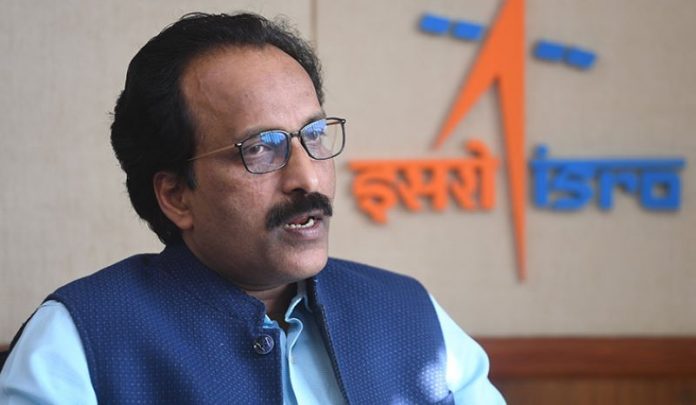
However, Chandrayaan’s hero and ISRO chairman S. Somanath has been totally ignored as far as his educational background and his alma mater are concerned.
Many people may not know that he is a product of TMK College of Engineering, at Kollam in Kerala, set up by a Muslim businessman – Thangal Kunju Musaliar – in 1958. An Aided autonomous institution, the college is affiliated to APJ Abdul Kalam Technological University, Kerala.
College’s Placement Manager Harish TP, when contacted, told this scribe that Somanath visited the college last year and also signed a memorandum of understanding (MoU) for setting up a course in spacecraft at his alma mater in collaboration with ISRO.
According to Harish, the course is in the process of being designed by ISRO scientists and the college’s faculty members.
Former director of ISRO’s satellite centre TK Alex also studied at this college.
The college has the distinction of being the first private engineering college in Kerala, indicating the educational interest of its founder Thangal Kunju Musaliar, or in short TKM who died in 1966. He traced his ancestry to Malik ibn Deenar, an Islamic missionary who came to India in 8th century, and in a later generation to Sheikh Ali Hassan Musaliar whose tomb exists in the premises of the Sheikh Masjid at Karunagapally.
According to the college’s website, TKM, a cashew nut businessman set up TKM educational trust in 1956 paving the way for the setting up of the college.
The college’s foundation stone was laid on February 3, 1958, by India’s first president Dr. Rajendra Prasad, and formally inaugurated on July 3, 1958, by Prof. Humayum Kabir, the then Union Minister for Scientific and Cultural Affairs.
TKM’s eldest son Dr. Shahal Hassan Musaliar is now the chairman of the TMK trust. The trust now runs several institutions including TKM College of Arts and Sciences, TKM Institute of Technology, TKM Institute of Management, TKM School of Communication and Information Technology, TKM Centenary Public School, TKM High School, TKM Higher Secondary School, and more recently the TKM Centre for Advanced Learning and TKM School of Architecture, having thousands of students.
source: http://www.indiatomorrow.net / India Tomorrow/ Home> Debate / by Syed Khalique Ahmed / August 28th, 2023
Gulzar Azmi, Jamiat Ulema-I-Hind leader and known for his legal representation of Muslim youth falsely accused of terrorism, died in Mumbai on Sunday, 20 August.
Azmi, who was 89 years old, had been undergoing hospital treatment for a head injury he suffered in a recent slip and fall accident.
Azmi rose to prominence by spearheading Jamiat’s legal division, which assumed the responsibility of representing numerous Muslim youths wrongly charged with terrorism. Throughout the last decades, Jamiat has championed the legal rights of these accused youth, who were targeted by India’s draconian laws, leading to their prolonged incarceration.
Born in Mumbai on May 1, 1934, Azmi studied up to 5th grade at an Urdu Municipal School. He then had three years of religious education at the Darul Uloom Islamiya.
In 1958, he became the secretary of Jamiat Ulema’s Mumbai unit. Later, in 1968, he became the General Secretary of Jamiat Ulema Maharashtra and in 2002, he became the Vice President.
Azmi has been a part of Jamiat Ulema for more than 60 years. He was also a member of the Maharashtra Minority Commission.
“I won’t stop fighting for justice for the exploited. If they’re left alone, they’ll suffer from biased police investigations,” Azmi had said to TCN news website.
He asked, “I’m not scared for my life. I believe the time, place, and circumstances of my death are already decided. So why should I stop helping the oppressed in society?”
Azmi assisted the Sri Krishna Commission, which investigated the Mumbai serial blasts. He translated the Commission’s report into Urdu, making it available to Urdu readers in the country.
Azmi’s funeral was held at Bada Qabrastan.
source: http://www.maktoobmedia.com / Maktoob / Home> Central India> India> Latest / by Maktoob Staff / August 21st(.), 2023
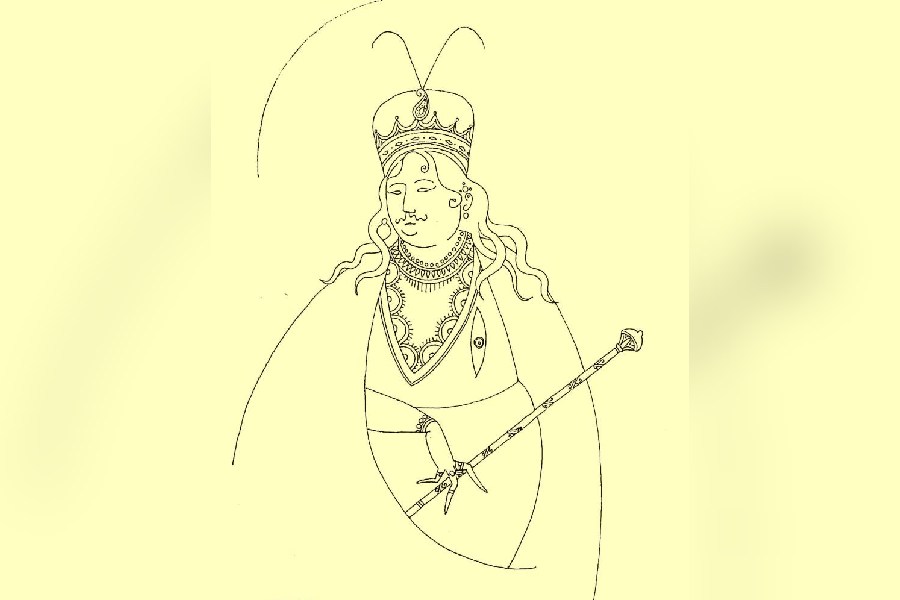
Calcutta may not have a birthday, but there can be no disagreement that the city is an alchemy of multiple events and influences. One such is the arrival of the ruler of Awadh. Wajid Ali Shah arrived in Calcutta in 1856, remained here till his death in 1887 and continues to tick on in the city’s DNA.
Illustration: Visual artist Soumyadeep Roy’s portrait of Wajid Ali Shah, a detail from his exhibition Dastaan e Akhtar celebrating the King’s bicentenary year at his resting place, the first ever exhibition held at the 159-year-old Sibtainabad Imambada in Metiabruz / Sourced by the Telegraph
Metiabruz
Before 1856, Metiabruz was a nondescript place on the outskirts of Calcutta taking its name from a matiya burz or earthen tower. The shipbuilding yard of Garden Reach had just started developing. It was the advent of Wajid Ali that transformed the very nature of the place. He purchased land from the King of Burdwan and built around 22 palatial residences in Metiabruz. With these at the core, an entire mini-Lucknow came up. “He made this city his home and left a legacy, some tangible and mostly intangible,” says Talat Fatima, one of the king’s progeny and currently working on the English translation of the book Wajid Ali Shah Ki Adabi Aur Saqafati Khidmat by Kaukab Quder Meerza. Meerza Sr’s son, Kamran, points to the remnants of the king’s mimic kingdom — Sibtainabad Imambara, Begum Masjid, Shahi Masjid, Baitun Nijat and Quasrul Buka.
Thumri
Until the early 19th century, Calcutta’s aristocracy had some exposure to Nidhu Babu or Ramnidhi Gupta’s semi-classical tappa. As for dance, there was the form practised by the khemtawalis of the red-light areas of Chitpore and Bowbazar in central Calcutta. Enter Wajid Ali Shah. He was, historians note, an “enthusiastic” patron of the arts. The “light classical” vocal form of thumri flourished in his court. He himself composed thumris under the pen name of Akhtar or Akhtar Piya. The thumri was traditionally performed by tawaifs or courtesans. And though there are arguments to the contrary, their dance style had “undeniable links” with Kathak. To make a long story very short, the king arrived in Calcutta with his musical entourage, thus stirring into its environs and culture a new rhythm. Courtesans like Malka Jaan were appointed by his court. Other ustads and musicians arrived too and many Bengali-speaking singers such as Bamacharan Bandyopadhyay were also groomed. A new style of thumri evolved with folk influences and it came to be known as the bol banao thumri. The babus of Calcutta loved it. Many of the musicians and courtesans settled down in the Chitpore area of north Calcutta, turning it into a production hub of musical instruments. This legacy, somewhat contagious, influenced commercial theatres and produced musical exponents such as Gauhar Jaan, Angoorbala and Indubala who went on to cut gramophone records and became the first artistes to do so. If Wajid Ali had not left Lucknow nagari, Ray’s Jalsaghar would be missing the jalsa; the sound of Begum Akhtar singing, “Bhar bhar aayi mori akhiyan piya bin…”
Haute Couture
It was not just Wajid Ali who arrived in Metiabruz; he was accompanied by his family, his many wives, dancers, a retinue of specialised servants and tailors. By some estimates, within a decade of his arrival, the palace had 2,000-plus employees and 1,000 soldiers. All of these people needed clothes, as did the king, who loved to dress. In his early 20th century work Lucknow: The Last Phase of an Oriental Culture, Abdul Halim Sharar suggests that the achkan was Wajid Ali’s gift to Indian haute couture. And so the fitted tunic with its stylish necks debuted in Bengal, as did the angrakhas. The king also wore an elaborate cap called the alam pasand. The royal tailors, their pupils and their descendants popularised Awadhi fashion — the chapkan, the churidar, the shararas, the ghararas… Their progeny has now turned Metiabruz into one of the largest tailoring hubs of unbranded garments. None of this would exist if it had not been for the good old trendy king. But for him, homegrown celebrity designers who are synonymous with wedding wear, sherwanis and fancy achkans would have been making patterns on their bottom line today.
Kabutarbazi
The king was famous for his menagerie and also for the thousands of kabutars or pigeons he reared and kept. He employed hundreds of people to look after the birds. Among the varieties were peshawari, gulvey, choya, chandan, shirazi — many fetched from Lucknow. Some of them were trained to perform manoeuvres during flight. “You’ll still find breeders invoking the royal pigeons while making a sell in the bird market,” says Kamran Meerza, the great-great-grandson of Wajed Ali Shah. Many babus of north Calcutta eventually embraced the hobby and pigeon roosts were a common architectural feature in old mansions of the city. The king also brought one of the best kite fliers of Lucknow, Ilahi Baksh Vilayat Ali, with him. He himself could design kites and encouraged others to compete with his team of kite fliers. The tradition of flying kites from those days still survives in Calcutta. Beginning August 15, right through to winter, the city skies are dotted with kites, most of them made in Metiabruz. Kabutarbazi and kite flying are not just random sports, they are synecdoches of a culture of great panache even in great leisure.
The Calcutta Biryani
The king’s khansamas gave Calcutta a taste of the Awadhi style of dum pukht or slow oven-cooking. Their descendants spread across the city and continued to popularise and adapt this style of cooking to fit the plebian kitchen. The Calcutta Biryani would be nowhere on the culinary map had it not been for the banished king. Manzilat Fatima, who is Wajid Ali’s great-great-granddaughter, wields her secret family recipes to create the Calcutta Shahi Biryani and Awadhi Galauti Kebab among other Lucknavi delicacies in her boutique restaurant in south Calcutta. Manzilat clarifies that the potato, an exotic tuber in the 19th century, was used as an experiment by the king to enhance the taste of the biryani and not to incorporate a cheaper substitute as has been suggested. Jab tak rahega biryani mein alu…
source: http://www.telegraphindia.com / The Telegraph Online / Home> Culture / by Prasun Chaudhuri / August 27th, 2023
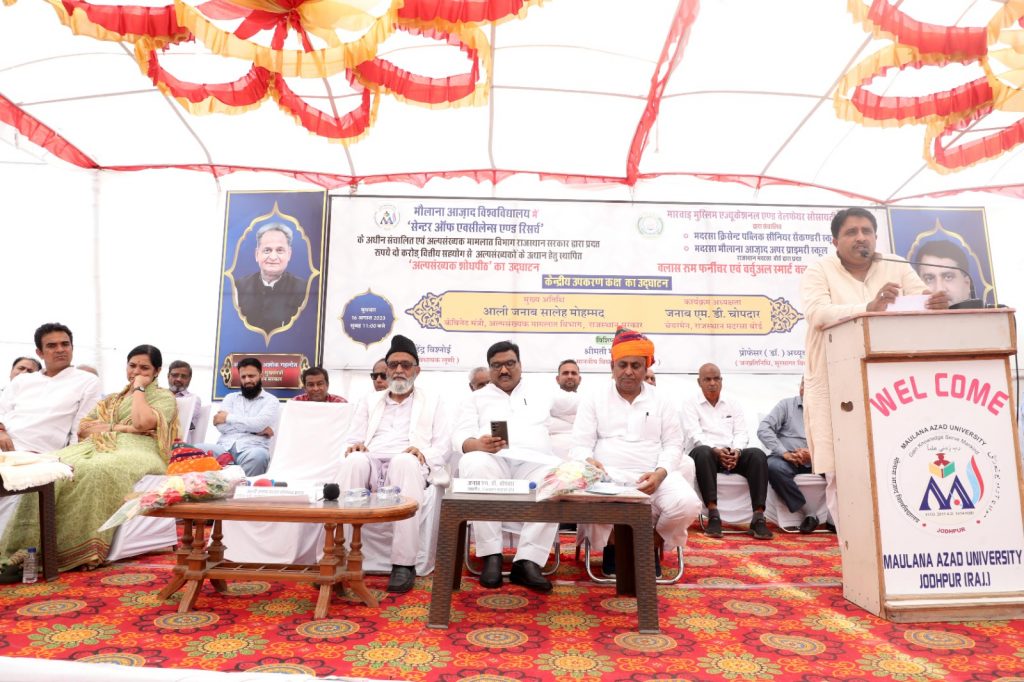
In a major initiative set to generate new avenues, the Jodhpur-based Maulana Azad University, which is the first private university established by the Muslim community in Rajasthan, has set up a Minorities Research Chair for conducting targeted studies and research on the issues, problems and challenges confronting the minority communities in the state. The research chair will make important recommendations after its studies.
The Minorities Affairs Department of the Congress government in Rajasthan has sanctioned Rs. 2 crores as financial assistance for the research chair. The university was established by the Marwar Muslim Educational & Welfare Society (MMEWS) at Bujhawar village on the outskirts of Jodhpur in 2013. The institution of higher education is now imparting education to more than 15,000 students belonging to Muslim and other less privileged communities in multiple disciplines of studies.
The Minorities Research Chair will function under Maulana Azad University’s Centre of Excellence and Research, for which Chief Minister Ashok Gehlot had granted Rs. 15 crores in 2022. The research chair, which is expected to make a meaningful intervention for the development of Muslims and other minorities, is the brainchild of noted educationist Mohammed Atique, who is the MMEWS Chief Executive Officer and the Founder-Chancellor of Maulana Azad University.
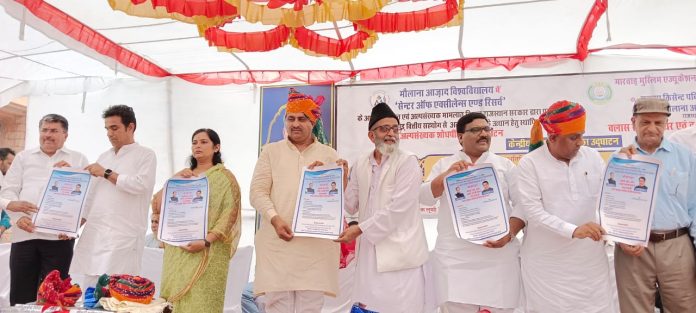
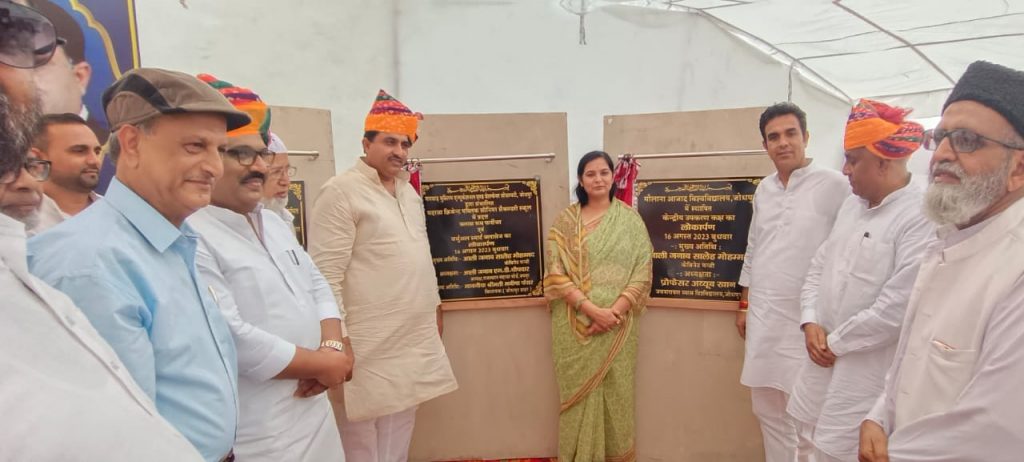
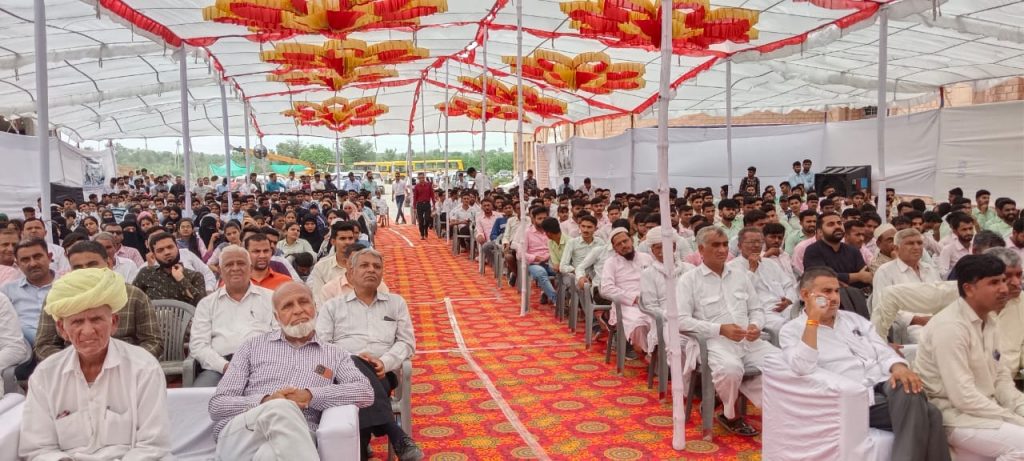
The research chair was inaugurated at a grand function organized on the university premises in the presence of Rajasthan Minorities Affairs Minister Saleh Mohammed, Rajasthan Madrasa Board Chairman M.D. Chopdar, several MLAs, public representatives, government officers, educationists, distinguished citizens, journalists and social activists on August 16. The university is already running M.Phil and Ph.D. programmes in various streams.
In his address, Saleh Mohammed said the Maulana Azad University, which had made consistent progress during the last 10 years, was another name for high-quality scientific education in the future. The Minorities Research Chair would prove to be extremely beneficial for research and education in the areas crucial for the development of minority communities, he said.
After the research chair’s inauguration, the Central Equipment Room of the university’s Faculty of Pharmacy, and the classroom furniture and virtual smart classes of Crescent Public School and Maulana Azad Upper Primary School run by MMEWS were dedicated to the students. A poster of the foreign language training programme under the Chief Minister’s Minority Language Proficiency and Communication Skills Development Scheme was also released on the occasion.
Mr Atique said the Maulana Azad University was making sincere efforts to achieve the goal of “education for all” with a clear objective that no child from the weaker sections of any community should be deprived of education because of the lack of basic facilities. University president Jameel Kazmi said the research chair would review the progress of the government’s schemes for the development of minority communities and evaluate their achievements and success, besides identifying the obstacles in their implementation.
Presiding over the function, M.D. Chopdar described Atique as “Sir Syed” of the modern era while pointing out that the initiatives taken under his leadership in Jodhpur had made a record of sorts. He said the Madrasa Board was taking steps for the modernization and development of madrasas, for which the MMEWS was rendering full cooperation to it. Chopdar also flagged off a vehicle carrying the furniture supplied by the Madrasa Board to various schools in the city.
Luni MLA Mahendra Singh Bishnoi, Jodhpur City MLA Manisha Panwar and Congress leader from Soorsagar Assembly constituency, Ayub Khan, were special guests at the function. All of them praised the stellar role played by the MMEWS and Maulana Azad University in improving the educational standard of the Muslim community in Jodhpur. A large number of distinguished citizens from Barmer, Jaisalmer, Pokhran and Phalodi in western Rajasthan also came to attend the function.
The MMEWS, established in 1929 during the pre-Independence era, runs as many as 330 educational, health and social institutions. Atique has been instrumental in easing the lives of more than 45,000 youths through these institutions working in varied fields of education, health care, community development, rural development, waste-to-wealth initiatives and skill development programmes during the last four decades.
The then ruler of Jodhpur princely state, Maharaja Umaid Singh, was the patron of MMEWS and had gifted a school named ‘Durbar Muslim School’ to the Society in 1936. The Rajasthan government allotted five acres of land to the MMEWS in 1978, on which the Maulana Abul Kalam Azad Muslim Senior Secondary School was constructed.
Since then, the MMEWS has established several institutions, including the Industrial Training Institute, Nursing College, Pharmacy College, B.Ed. College, Mai Khadija Hospital, Rahmatul-Lil-Alameen Blood Bank, Marwar Adarsh Gaushala and Bujhawar Veterinary Hospital.
The MMEWS established the university in 2013 with the intention of providing higher education to the most deprived and marginalized sections of society.
The first president (Vice-Chancellor) of Maulana Azad University was the noted Islamic scholar from New Delhi, Akhtarul Wasey. The current president, Jameel Kazmi, hailing from Jaipur, has taken steps for interdisciplinary studies while maintaining the indigenous ethos and the spirit of plurality in the university’s functioning.
About 45,000 students have so far passed out from the MMEWS group of institutions and become doctors, engineers and business people and entered other professions as well. Some of them have also established nursing homes and clinics in remote rural areas, which are often ignored in the government’s development plans. Maulana Azad University has set the motto, “Gain Knowledge and Serve Mankind”, for itself.
source: http://www.indiatomorrow.net / India Tomorrow / Home> Education / by the India Tomorrow Correspondent / August 25th, 2023
Chance, coincidence and an unflinching belief in the plans of the cosmos propelled Samina Bano to quit the corporate world to champion children’s right to equitable access to education.
Sometime in late 2012, Samina Bano, then a Chicago-based consultant with Deloitte Consulting, started to notice what she believed to be ‘omens’ all around. She loved her corporate life – thrived on its challenges and enjoyed its ceaseless travelling, yet was convinced it was time to move on. “There was this persistent feeling that I was meant for something else,” she says.
A hazy idea of what that ‘something else’ entailed was brought about by a chance reading of How to Change the World by David Bornstein. “Till that point, I did not know how to make the best use of my education and skills. I first read the term ‘social entrepreneur’ in the book and figured out that was the way ahead for me,” she recalls.
It would take a chance reaching out to one such change maker in Bihar for Samina to understand that Uttar Pradesh – a state with some of the poorest development indicators, was where she must use her skills. Another chance conversation on the Right to Education Act (RTE) helped her decide the area she must work on.
Samina’s work channelled initially through the Bharat Abhudaya Foundation and subsequently through the RightWalk Foundation (both of which she founded), has focused on Section 12(1)(C) of the above Act. The Section mandates that all private unaided schools (with the exception of minority-run schools) reserve 25 percent seats in their entry-level class for children from socially and economically disadvantaged groups.
Since 2009, when the Act came into force, that Section had never been implemented in UP- home to the world’s largest child population. In 2012, two years before Samina started working, the State recorded zero admissions under the Section, but in 2017, this number had leaped to 27,726.
This was made possible by the bringing together of various stakeholders, awareness building, handholding of parents, creating interface with the government, activating a helpline for RTE admissions and creating an online digital system to institutionalise the admission process. The most prominent push in this effort came yet again from a chance fight.
“The first parents who approached us for admissions fell within a one-kilometre area of a branch of City Montessori School. Under the State government’s rules, it was the ‘neighbourhood school’ to which the children were entitled to admission. We were turned away 15 times by the school. Finally, when the District Magistrate ordered the school to admit 31 children, it approached the High Court”, Samina recounts. It turned out to be a David versus Goliath fight which the school (recognised in 2013 by the Guinness Book of World Records as the world’s largest school) had every reason to win had it not been for Samina and her team’s persistence.
“We did not leave the court case to the government. We worked with its counsel to provide the right arguments. The school was represented by the likes of Gopal Subramanium and Shanti Bhushan. At no point in time were we assured of a win. Yet, we were sure we were going to try,” she says.
The High Court’s order in September 2015 against the school (which then went on to appeal against it only to have its plea dismissed by the Supreme Court) was the most strongly worded message of Samina’s persistent belief that inclusive education was the way ahead for a more egalitarian society. She says, “The law is the same for everyone. Injustice is not acceptable. If you take an initiative with the right conviction, dedication, faith, belief, integrity and truthfulness, God will help you to find the right path”.
This was a lesson Samina had first learned as a child of eight at one of the air force stations her airman father was posted. “I did not understand why there must be a playground reserved only for the children of officials,” she says. Then when she learned in civics class one day that a playground was public property, she rallied classmates and marched up to the station commander demanding that the playground either be opened to all children or their lessons be modified to reflect the inequality. “My victory gave me the hope that anything wrong happening with the world need not stay that way. If we try, even an eight-year-old can make a difference,” she says of that learning.
The transition to working with the government and bureaucrats has been tough admits Samina, While the communication, problem-solving, team and interpersonal skills she learned in her corporate stint helped her, she was hamstrung by women’s inherent inability to network after work hours. Her background in high-end technology did little to convince men of her abilities. “My disability made them think that I must have gotten into engineering through a quota,” she says referring to an accident that left her with more than 50 percent paralysis in one leg.
She has been challenged by vicious rumours of her being related to a prominent politician, accused of having a communal agenda in her dogged pursuance of the RTE and even faced physical threats. “I have had to work almost thrice as hard for recognition of my abilities,” she says. She has also had to bear criticism of her supposed aggressiveness which in men would have been lauded as leadership ability.
Yet never one to shy away from challenges, Samina believes she has been guided by instinct in her work life. This was first manifested when she gave up her MBBS course for a change to engineering, driven by her love for Physics and Mathematics, and refusing to bow to the stereotype that the medical professional was the safest bet for women who studied science.
Her dogged fight against being typecast has yielded rich honours for Samina. She is the recipient of the International Ashoka Fellowship, and the Acumen Fellowship, and counts the APJ Abdul Kalam Award for Innovation in Governance and Women Super Achiever Award from the World Women Leadership Congress, among her many recognitions. Yet it’s in the heartfelt gratitude of parents and children that she finds her greatest reward.
Having created an enabling environment for the implementation of the RTE – not just through admissions but by training government officials at every level, bringing private school managements up to speed on how to provide inclusive education and effecting policy changes, Samina is ready to move on to her next challenge. “Our philosophy is to strengthen government systems for effective and efficient delivery of services, such that they can function independently of us”, she explains. Thus, after 2018, she sees RightWalk as addressing new challenges in education and in other sectors.
And through it, all as Samina, 31, says, “I shall continue to listen to my heart and heed the omens.
source: http://www.yourstory.com / Your Story / Home> Stores / by Puja Awasthi / February 20th, 2018
“In today’s world, if something goes wrong in our household, women are held responsible,” said Mubeena Ramzan, an iconic figure for women’s rights and upliftment in Kashmir. Featured in “The World’s 500 Most Influential Muslims of 2019” and born in the ‘apple town of Kashmir’, Sopore, she had always been a “sensitive” child who always looked around for people who were not so privileged. She had a strong desire to help the underprivileged but financial constraints made her helpless. Growing up, she aimed to change this and be instrumental in helping the lesser fortunate women around her.
“When I initially started, we were just a few people but the recognition of our Kashmiri people who stood with me and joined our cause made me happier,” she shared about being among the most influential Muslims of 2019. Mubeena completed her studies in her native town and joined a private college run by Anjuman Moin-ul-Islam which was the only college for women at Sopore then. “Whenever things are wrong at home, a woman is asked to do a job and support the family,” she recalled. Speaking about her immediate surroundings, she detailed how women were still suppressed “in the garb of religion as interpreted by the village elders and religious leaders.” Disturbed by such wrong interpretations of the status of women in Islam, she was motivated to get educated and work towards improvisation concerning women rights.
“There is an ayah in the Quran which talks about women to remain inside four walls of their homes but we have forgotten that every ayah had its own context,” Mubeena stated while defining her motivation to pursue Islamic Studies. “Our so-called maulvis used Islam as a tool to suppress women while Islam is the only religion which empowers women in every aspect of her life,” she added. Driven by this zeal, she went to the University of Kashmir for pursuing Masters in Islamic Studies. Her choice of studying the interpretation of Islamic teachings was aimed “to look inside the teaching which catered to women.”
“In Islam, women have been given property rights but whenever a daughter asks for her share she is abandoned and fought off,” says Mubeena. Her harrowing experiences of witnessing abandoned women with limited access to clothes, food or water motivated her to enrol for a B.Ed., M.Phil and PhD in Islamic Law. Her vision remained to challenge the deliberately flawed interpretations of Islamic teaching that caused Muslim women untold misery. After her studies, she initially started working as a research associate, looking for opportunities to educate, help and empower women through Islamic teaching. She feels that when people “want to truly empower a woman they should give her the share from the property.”
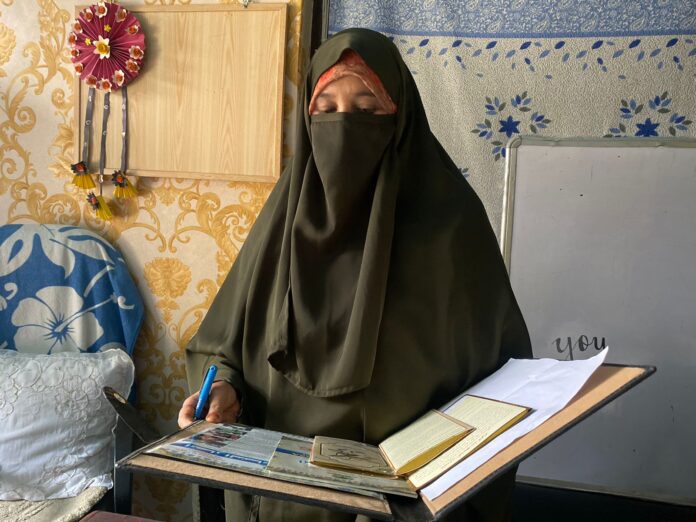
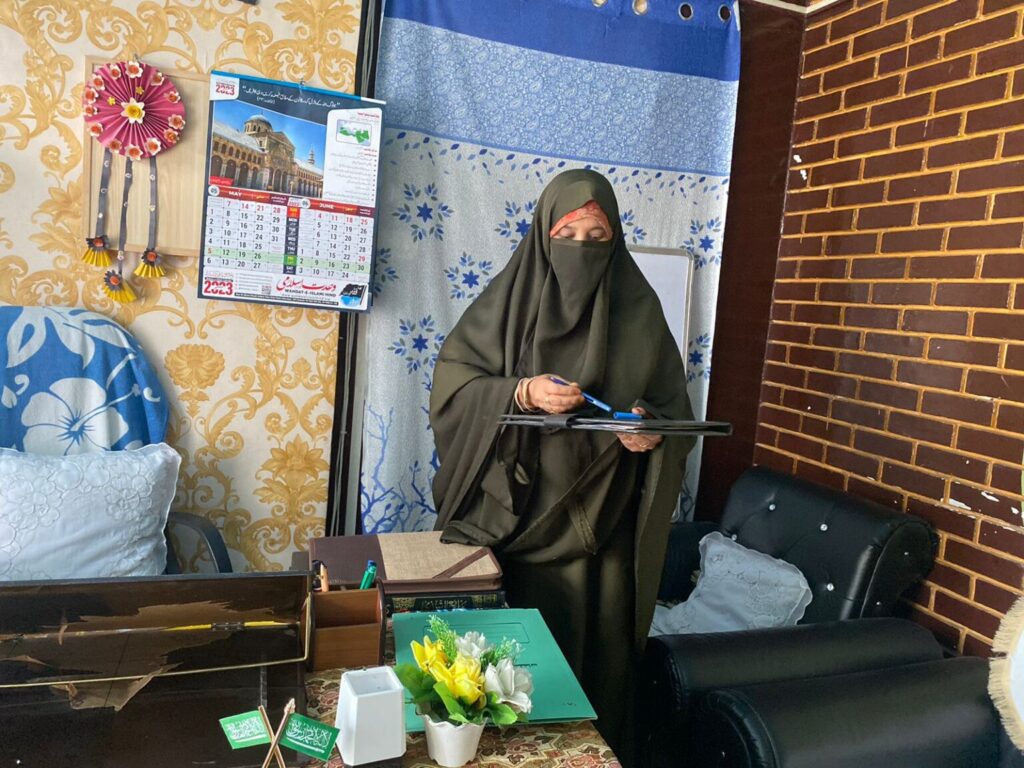
“In Islam, women don’t have any economic liabilities, men were created as the protector and guardian of women so it’s his responsibility to look after her,” Mubeena explained. She completed two theses on Islamic Law and Social Evils as well as on Shah-e-Hamdan and Orientalism. Her education has taught her that “there needs to be more resources for women’s empowerment and education.” To contribute to the cause, she continued working in various educational institutions as a contractual lecturer and research associate and went on to open her own institution for women, Jamia Islamia Mahdul Muslimaat.
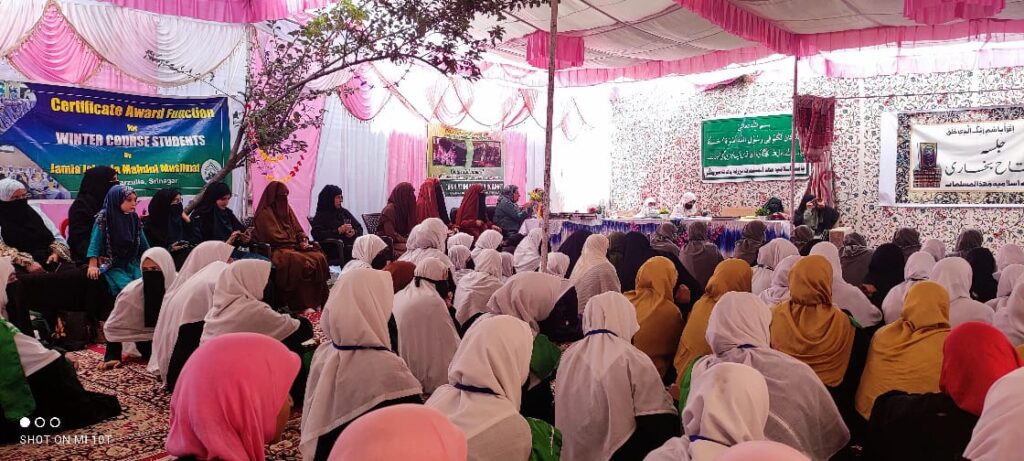
“The vocational training in activities like cutting, tailoring, and computer skills here empower and helps us to support ourselves financially,” says Nahila Wani, a senior student at Jamia Islamia Mahdul Muslimaat. The school provides shelter, food, clothes, and education free of cost to all needy students. “Many students who have received an education from this institution have gone on to open their own schools, benefiting our society,” shares Nahila who added that the well-balanced curriculum “fosters independence and awareness among women, making them conscious of their duties and rights.”
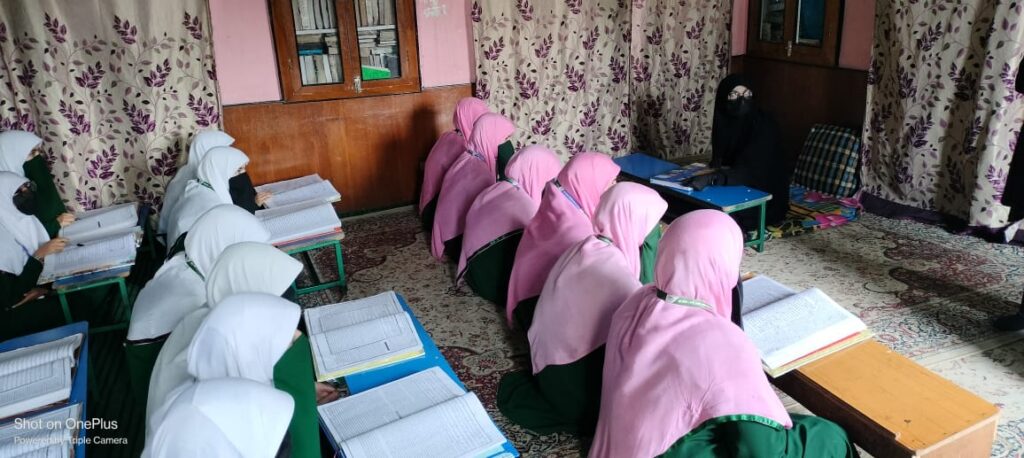
“There were so-called preachers who said that I can’t run this institution as I am a woman,” she said while recounting the initial three years of starting the institution. She explained that initially the establishment faced many problems but over time they installed networks with professional teams including top doctors in the valley. The emphasis here lies in educating women in Quranic exegesis, science of Hadith, Jurisprudence, and History, while also training them in languages like Arabic, English, Urdu, and computer skills. “Our goal is to equip them with the necessary skills to become self-reliant and competent individuals,” said Mubeena.
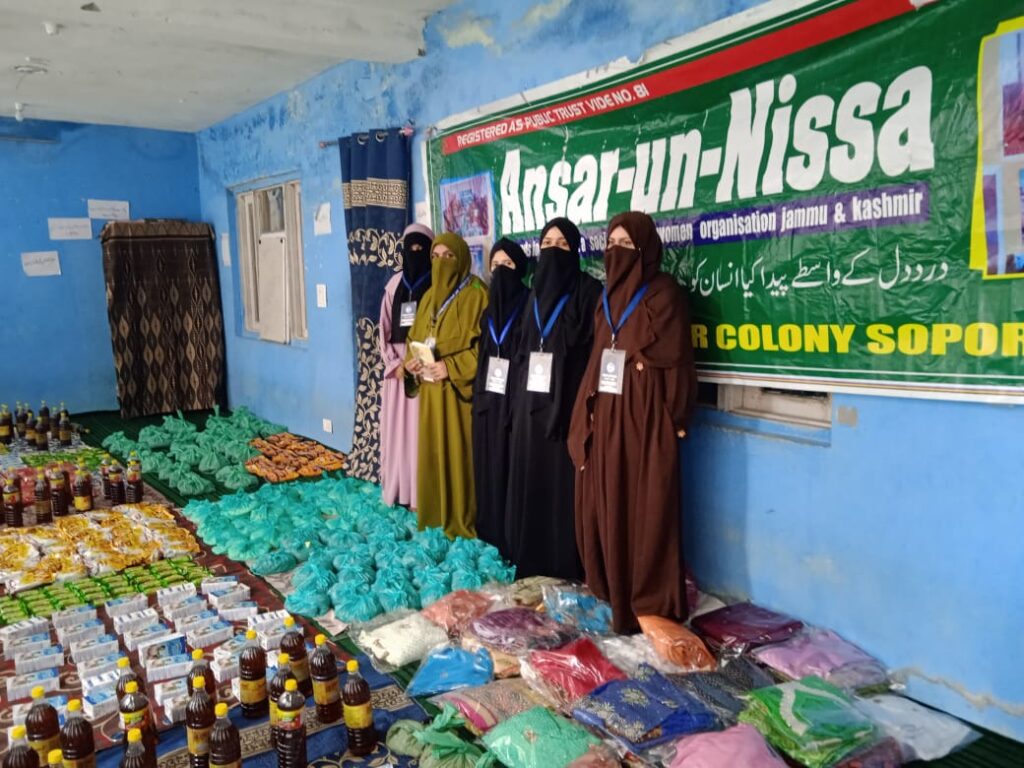
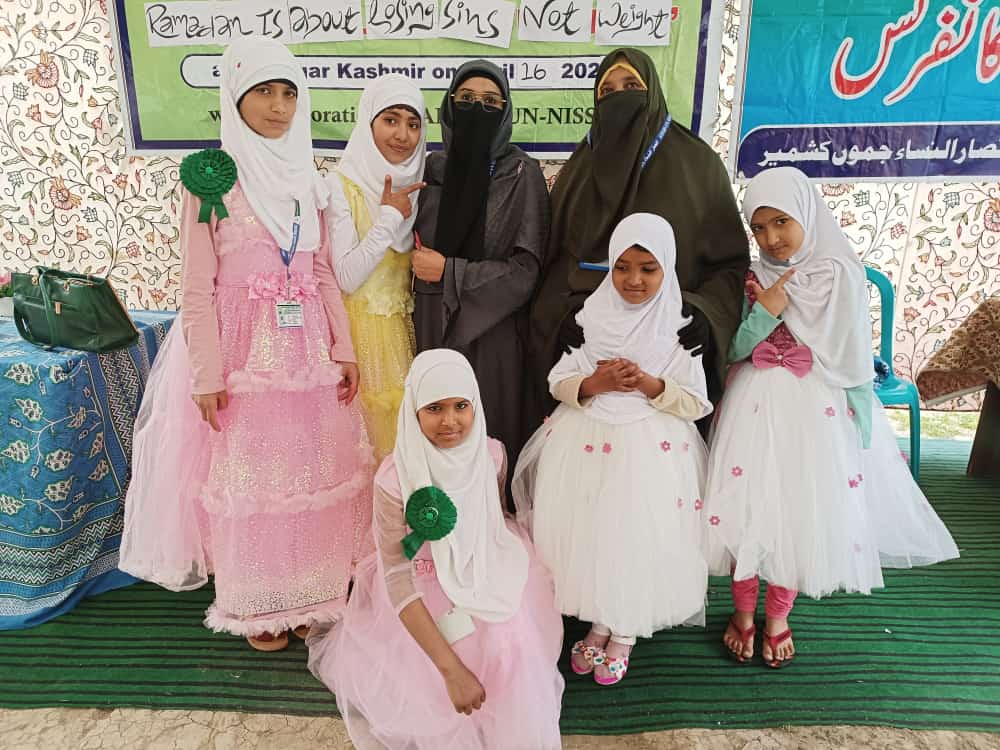
In 2014, Mubeena also started Ansar-ul-Nisa, a socio-religious organization that provides special support to needy orphans, would-be-brides, and widows. Through the organization, she came across several cases of suicidal cases of women, especially among married women. According to the latest National Crime Records Bureau (NCRB) report, there was a 15.62% increase in crimes against women in 2021 compared to the year 2020. Over 7,000 arrests were made in cases of women harassment in the union territory in 2021. In the 2011 Census, among 64 lakh women in the valley, the crime rate per lakh population in stood at 61.6% as of 2021. 315 cases of rape, 1,414 incidents of attempt to rape, and 14 dowry deaths were reported in 2021 wherein 91.4% of cases showed that the accused were known to the victims. Around 1,851 cases of physical assault on women with the intention to outrage their modesty was also caused. The figures clashed with the lockdown in COVID-19 when suicidal tendencies among Kashmiri women grew rapidly, the same time around Mubeena’s team was expanding women counselling activities.
The counseling cell works 24×7 hours to help Kashmiri women in such events wherein one of the cases she dealt with was involving a girl who was abandoned by both her parents who had separated and remarried and registered her as an orphan. Her organization fought on the social front against her father ultimately convincing the local elders to rightly grant some portion of the property in her name. The girl was married off soon after and is currently living happily with her husband and a daughter. Two more orphan sisters studying in Jamia Islamia Mahdul Muslimat received legal help to secure property share from their grandfather and are now living with their mother in their own house. Stories like this abound in Mubeena’s organizations.
“We believe in providing a safe space where newly married women, divorcees, and those suffering from mental health disorders can come to share their stories and find relief,” shares Mubeena. Through her institution’s counseling team of highly qualified professionals including top doctors and professors, they divert efforts to support them financially and emotionally. “As we look to the future, we aim to establish a helpline number to further expand our reach and continue to provide crucial support for those in need,” she said. At present, 600 girls are studying in the institutions and about 500 widows also receive financial assistance. Due to lack of funds, her plans of opening a college for skills-oriented courses are delayed.
Speaking about her future plans, she detailed that she aims to build an institution where all modern subjects are taught at par with Islamic education, alongside martial arts and vocational skills like cutting, designing, oratory, etc. “Our whole motive is to make women empowered through education,” Mubeena iterated her future plans.
Sadaf Shabir is an independent journalist. She tweets @sadafreports
source: http://www.twocircles.net / TwoCircles.net / Home> India News /by Sadaf Shabir / May 24th, 2023
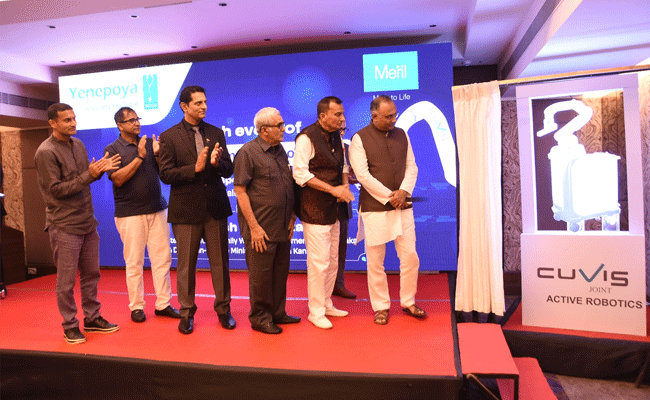
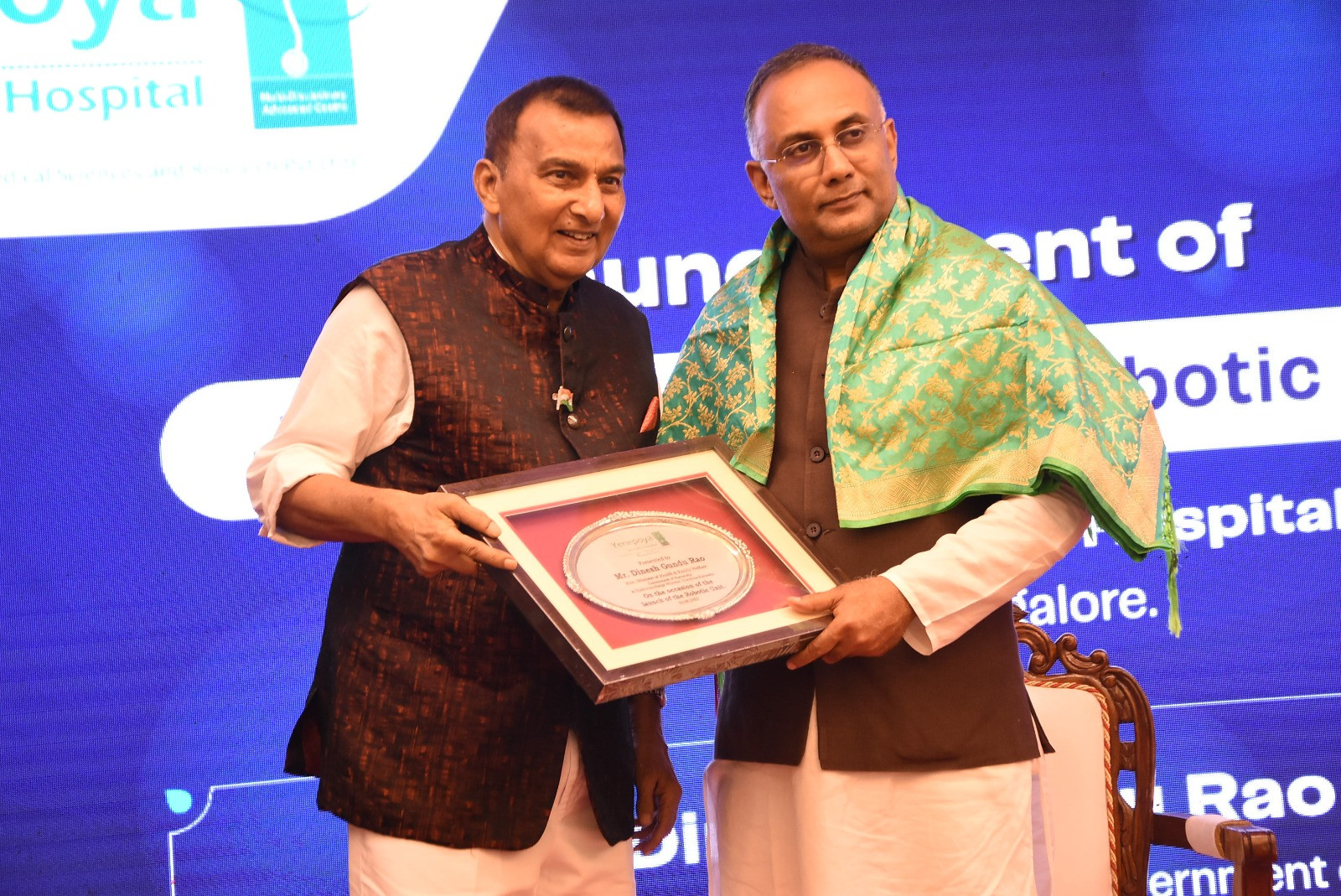
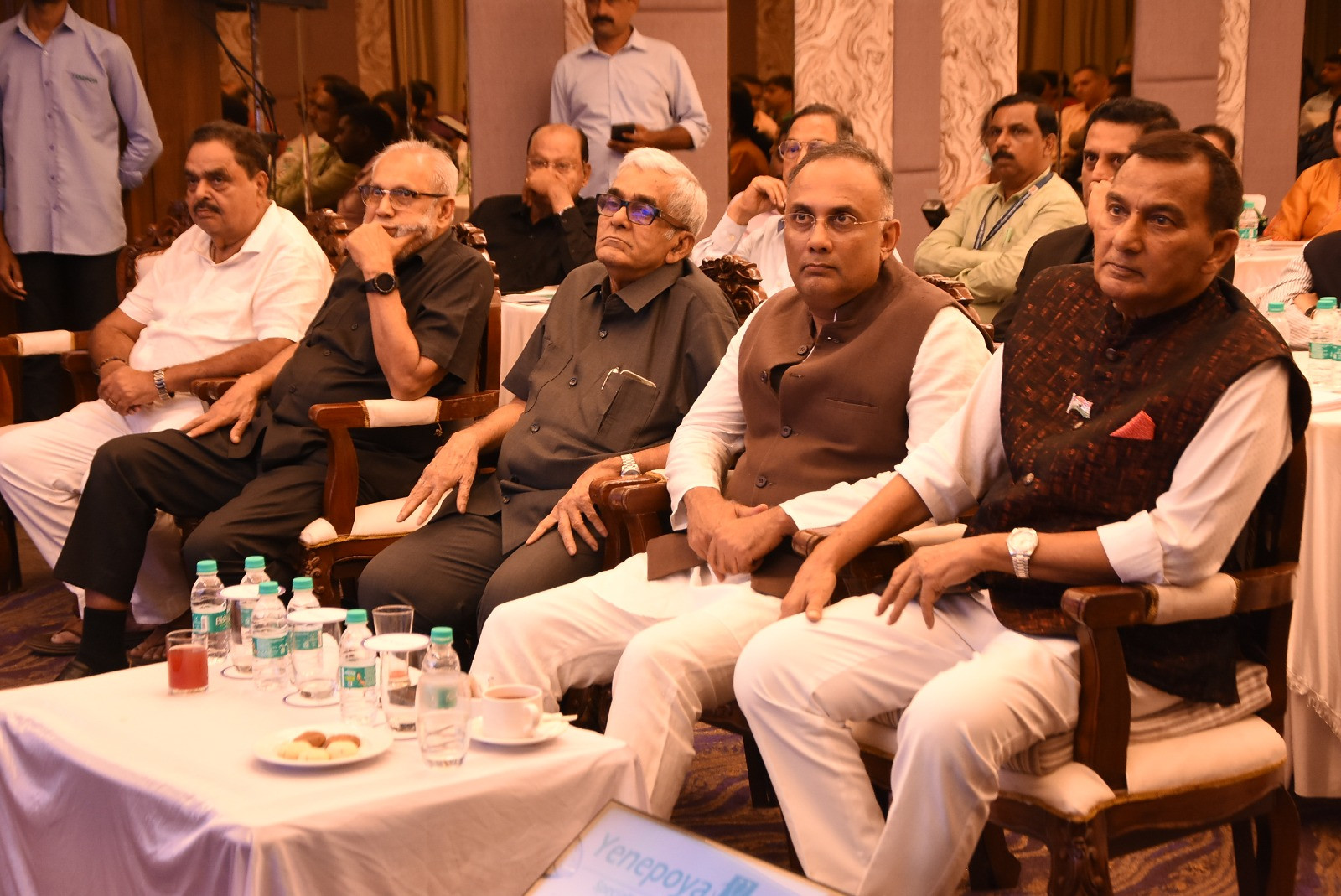
Yenepoya Specialty Hospital marked a significant milestone with the launch of its cutting-edge Joint Replacement Robotic Unit. The launch event took place at the Taj Vivanta Hotel in the city on Tuesday. Gracing the occasion, Karnataka Health Minister and Dakshina Kannada In-charge Minister Dinesh Gundurao inaugurated the revolutionary unit, which is a collaborative effort with Meril Life, a global med-tech company.
This pioneering initiative stands as the first-of-its-kind facility not only in Dakshina Kannada but also as the first outside Bengaluru in the state of Karnataka.
Dr. Muhammad Thahir, the Director – Medical at Yenepoya Hospital, extended a warm welcome to the esteemed guests and attendees, setting the tone for the event. Dr. Yenepoya Abdulla Kunhi, Chairman of Yenepoya Group, followed with introductory remarks that shed light on the transformative potential of the newly launched robotic unit in the realm of healthcare. Dr. Kunhi also emphasized the need for adapting to technological advancements for the betterment of humanity and acknowledged the district’s continuous commitment to healthcare excellence.
Suvdeep, representing Meril, provided an insightful overview of the Cuvis Joint Replacement Robotic Unit, now available at Yenepoya Specialty Hospital. Highlighting its uniqueness, Suvdeep explained that it’s the sole fully-automatic robotic joint replacement unit currently accessible. The technology empowers doctors to offer personalized alignments based on a generated 3D model from CT scans, underscoring the critical role of medical expertise in the process.
Dr. Deepak Rai, Consultant Orthopaedic Surgeon at Yenepoya Specialty Hospital, applauded Abdulla Kunhi and Mohammed Farhaad Yenepoya for their visionary efforts in elevating healthcare standards in Dakshina Kannada. Dr. Rai elucidated the profound impact this robotic joint replacement unit is anticipated to bring to the future of healthcare over the next decade.
Explaining the concept of Joint Replacement Robotic Surgery, the Cuvis system was described as a tool that employs accurate CT scans of the knee and meticulous measurements pre-surgery, delivering enhanced precision and benefits in the field of joint replacement.
Minister Dinesh Gundurao commended the new service and urged the public to utilize such advanced offerings in the region. He also stressed the importance of researching why arthritic issues are increasingly affecting the younger generation. Minister Gundurao applauded the healthcare contributions of Yenepoya Group and underscored their resolute commitment to elevating healthcare in the district.
The event concluded with Dhanush Shetty extending a vote of thanks, while Clinical Dietitian Haifa Ansari efficiently compered the proceedings.
Managing Director of Yenepoya Group, Yenepoya Mohammed Kunhi, Director Operations Yenepoya Abdulla Javeed, Pro-Chancellor of Yenepoya Deemed to be University Yenepoya Mohammed Farhaad, Vice-Chancellor Dr. Vijay Kumar, Former Minister Ramanath Rai, Dr. Bhaskar Shetty, Dr. CP Habib Rehman, Dr. Savita Shetty, and others were present during the significant occasion
source: http://www.varthabharati.in / VarthaBharati.in / Home> Karavali / by Vartha Bharati / August 15th, 2023
The famous writer Kushwant Singh, once wrote: “Indian Freedom is written in Muslim blood, since their participation in the freedom struggle was much more, in proportion to their small percentage of the population.”
The story and history of India’s independence are written with the blood of Muslims. According to historical references, 65% of those who stood, fought and sacrificed against the British for India’s independence were Muslim freedom fighters, the hams live reported.
A large number of people from all religions and castes took part in the freedom struggle, undoubtedly. However, the struggles of many Muslim prominent personalities who also contributed to India’s freedom and even sacrificed everything including their lives are little known. Muslims have been at the forefront to oppose the British and stood shoulder to shoulder with people from other communities while fighting against them. Getting freedom was not easy, our ancestors had to go face a lot of struggles and difficulties to get us the freedom that we are enjoying now.
The First Call To Oppose British
In the 1750s, Nawab Siraj-ud-Daulah was the first awakened Indian ruler, who stood his ground against the British. He lost the Battle of Plassey in 1757 due to the betrayal of Mir Jafar (Commander of Nawab’s army). With this, Siraj-ud-Daulah’s reign marks the end of the last independent rule in India and the beginning of the East India company’s rule that was unabated for the next two hundred years.
First Freedom Struggle By Muslim Rulers
The first freedom struggle against the British was started by the rulers of Mysore Hyder Ali and his son, Tipu Sultan, during the 1780s and 90s. Both used the first iron-cased rockets and cannons effectively against the British invaders.
Tipu Sultan is considered to be one of India’s first freedom fighters for his fierce fight and brave against the East India Company. He resisted the conquest of the British in southern India and was reluctant to welcome them on his soil. He was the only Indian ruler who understood the dangers that the British posed to India, and fought four wars to oust them from the country.
The Unsung Heroines Of India’s Freedom Struggle
Begum Hazrat Mahal, the unsung heroin, played a very important role in India’s war of Independence. Being a woman, she led a rebellion against the British East India Company in 1857. She shot the British ruler, Sir Henry Lawrence and defeated the British army in a conclusive Battle at Chinhat in 1857.
In the great revolt of 1857, as many as 225 Muslim women sacrificed their lives in the uprising. These unsung Muslim women freedom fighters who have sloganeered, shed blood and given their lives for the country’s independence have now been forgotten to due biases.
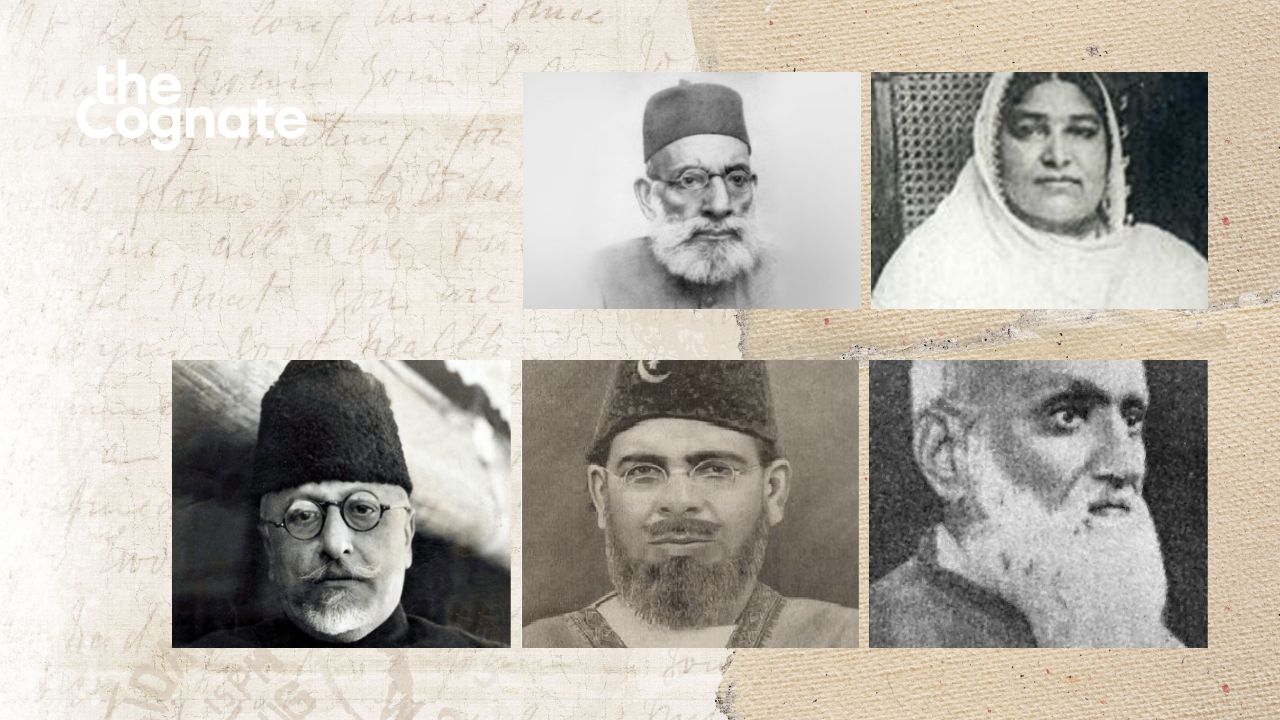
A majority of freedom fighters did a nameless service to the nation and one such lesser-known name was Abadi Bano Begum (Bi Amma). Bi Amma was the first woman to address a political rally wearing an abaya. She took part in National freedom struggles, Khilafat Movement and propagated Hindu-Muslim unity. Following Mahatma Gandhi’s advice, Bi Amma played an. An important role in encouraging women to take part in the freedom movement. Further, she played a pivotal role in the Swadeshi movements.
In the book, Gandhi and the Ali Brothers: Biography of a Friendship by Rakhahari Chatterji, Maulana Mohammad Jouhar says, “Suffice it to say that, although she was practically illiterate, I have, in all experience, of men of all sorts of types, come across none that I could call wiser and certainly that was more truly godly and spiritual than our mother.”
Bi Amma was also the mother of Muhammad Ali Jauhar and Shaukat Ali popularly known as the Ali Brothers whom she raised on her own after her husband died when she was young.
Amjadi Begum, the wife of Muhammad Ali Jauhar and daughter-in-law of Bi Amma, is yet another Muslim women freedom fighter. Mahatma Gandhi also dedicated an article on her titled ‘A Brave Woman‘ where he admired her as a courageous wife of a courageous man.
At the age of 45, Asghari Begum, another forgotten Muslim woman, has also taken part in the 1857 revolt and challenged British rule in the present-day Uttar Pradesh. However, she was captured by the British in 1858 and burnt alive.
Habiba, a Muslim woman’s fought many battles against the British in Muzaffarnagar in 1857. However, she was captured and hanged along with 11 other female warriors at the age of 25.
The Great Revolt of 1857
During the Great Revolt of 1857, Hindus and Muslims under the leadership of the last Mughal emperor Bahadur Shah Zafar tried to oust the British from India. A majority of Hindu sepoys requested Zafar to lead them in the war of Independence. Although the Revolt failed due of several reasons, Muslims have always stood on the front line to oppose the British.
Former Prime Minister of India, Rajiv Gandhi during his visit to Bahadur Shah’s grave, wrote in the visitor’s book: “Although you (Bahadur Shah) do not have land in India, you have it here; your name is alive… I pay homage to the memory of the symbol and rallying point of India’s First War of Independence….”
Muslims came to India and ruled here for over 800 years but they did not steal anything from here as the British, the Dutch and the French did. By bringing plenty of knowledge in literature, architecture, judiciary, political structure, government body and management structure, which is still used in Indian management strategy, they helped India to progress into a unified and civilized nation.
Lighthouse of Rebellion
How many of us know that the organizer and leader of “First Indian freedom struggle” in 1857 was Moulavi Ahamadullah Shah. Known as the ‘Lighthouse of Rebellion’ in Awadh, he Faizabad free from British rule for almost one year, until his death at the hands of British agents on June 5, 1858.
“With being a practicing Muslim, he was also the epitome of religious unity and Ganga-Jamuna culture of Faizabad. In the revolt of 1857, royalties like Nana Sahib of Kanpur, Kunwar Singh of Arrah fought alongside Maulavi Ahmadullah Shah. Maulavi’s 22nd Infantry Regiment was commanded by Subedar Ghamandi Singh and Subedar Umrao Singh in the famous Battle of Chinhat,” according to researcher and historian Ram Shankar Tripathi.
The important role of Muslims in the uprising is the reason that the British government singled out the community for the worst revenge. From the Nawab, the King of Mysore, the last Mughal King, Princes, the landlords, the Ulemas, intellectuals, Urdu journalists, including common people, all members of the Muslim community have made great sacrifices for the freedom of India.
In the uprising of the 1857 revolt, thousands of ulema were slaughtered and the whole of Delhi was emptied of Muslims, according to excerpts from Syed Ubaidur Rahman’s book Biographical Encyclopedia of Indian Muslim Freedom Fighters. They were not even allowed to return to their homes and reclaim their properties.
First Journalist To Sacrifice His Life During The Great Revolt
Moulvi Muhammad Baqir, a scholar and activist of Indian independence activist was the first journalist to be executed following the rebellion in 1857. The editor of Urdu newspapers, Delhi Urdu Akhbar, was washed dead on 16th September 1857 for writing Nationalist articles, without even a trial.
Although India got independence on 15 August 1947, the foundation of the freedom struggle was laid before 1857. Since the time of the Revolt of 1857, which is considered to be the beginning of India’s freedom struggle, Muslim leadership has spearheaded the cause.
First Muslim To Be Hanged For Conspiring Against East India Company
At the age of 27 years, Shaheed Ashfaqulla Khan was the first Muslim to be hanged for conspiring against the British Raj. Khan was hanged to death on December 19, 1927. With this, he became a martyr and a legend among the people because of his love for the country and his unshakeable spirit.
Reshmi Rumal Tehreek (The Silk Movement)
Muslims not only took the lead in the uprising, but also stood in the front line in all other efforts to topple the British colonial regime in India.
After the revolt of 1857, the Muslim leaders changed their strategy of resistance by setting up educational institutions across the country. Reshmi Rumal Tehreek or The Silk Letter Movement (1913-1920) was an initiative by Deobandi Leaders Maulana Mahmud Hasan and Maulana Ubaidullah Sindhi to topple the British Empire.
However, when British intelligence learned about it, hundreds of sympathizers of the initiative were arrested and put in prison for years without any trial. The top leaders including Maulana Mahmud Hasan and half a dozen of his followers were banished to Malta after a faux trial where they faced the worst hardship.
Role of Muslims in Congress’ anti-colonial struggle
Justice Abbas Tyabji, an Indian freedom fighter from Gujarat and associate of Mahatma Gandhi, was the first Muslim president of the Indian National Congress party. Justice Tyabji is also known for leading Salt Satyagraha following Gandhi’s arrest in 1930.
Another Congress president during the colonialism was Maulana Abul Kalam Azad, who is one of the chief Muslim leaders of the anti-colonial nationalist movement. He became the youngest President of the Indian National Congress in 1923 at the age of 35. He faced multiple imprisonments by the colonial state.
From Justice Tayabji to Maulana Abul Kalam Azad, there have been eight Muslim leaders who were in the Indian National Congress’s freedom movement. The other prominent Muslim leaders include, Muhammad Ali Jauhar, Shaukat Ali, Maulana Azad, Dr Mukhtar Ansari, Hakim Ajmal Khan, Maulana Mahmud Hasan and many others. They made every possible sacrifice for the cause of the end the colonial rule.
Frontier Gandhi
Khan Abdul Ghaffar Khan was a Pashtun independence activist who campaigned to end the rule of the British Raj in India. He founded the Khudai Khidmatgar resistance movement against British colonial rule in India. He was also known as Frontier Gandhi for his principles of non-violence and friendship with Gandhi. Khan worked towards the formation of a united, independent, secular India.
Muslim Man Coins “Jai Hind”
The patriotic slogan “Jai Hind” was initially coined by Zain-ul Abideen Hasan, but it was adopted by Netaji Subhash Chandra Bose. It is now used as a way of salutation throughout India. It means “Victory to India” in English.
The Creation Of the National Flag
For a majority of us, the current national flag was designed by Pingali Venkayya. However, it was a Muslim Lady Surayya Tyabji, who created the flag’s final look today.
Although we have recounted several names of the Muslims who have contributed to India’s freedom struggle, there are several thousands of them who fought on the streets against the British Raj.
source: http://www.thecongnate.com / The Cognate / Home> History / by Rabia Shireen / August 15th, 2022