Category Archives: Leaders

Shaukat of INA liberated Manipur on 14 April, 1944

Moirang (Manipur), ASSAM:

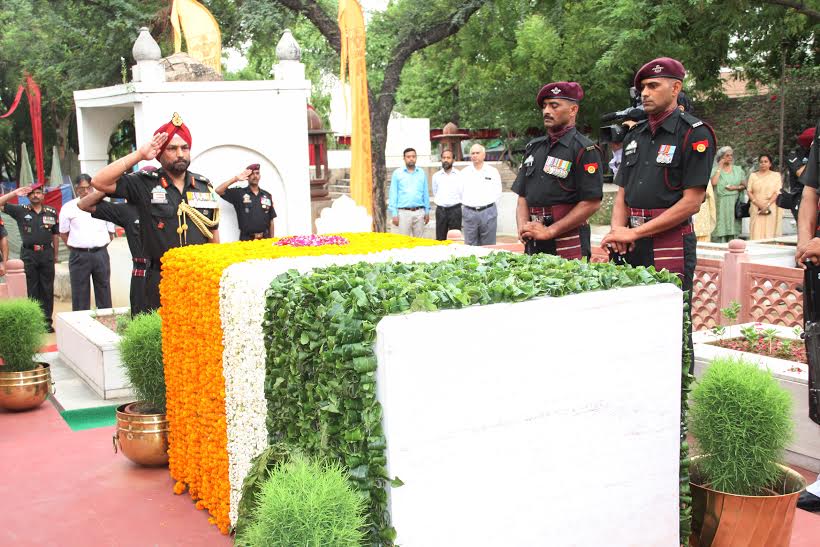
INA memorial at Moirang, Manipur

“The Indian National Army (INA) has now crossed the Indo-Burmese border and in the course of the struggle for the liberation of the people of India from the British Yoke, we have now reached Moirang, the ancient citadel of Manipur. Our commitment is the march to Delhi and the unfurling of the Tricolour Flag then at Lal Quila.

Many had died on our way to reach near Moirang and many would die on our way to Delhi. However, the expulsion of the enemy from the sacred soil of India is a compulsion for us… Freedom of India is very near and near at hand. We shall win it and we shall have progress and prosperity of the people of India after it.” Colonel Shaukat Ali Malik of Azad Hind Fauj addressed these words to a large gathering at Moirang in Manipur on 14 April 1944 after hoisting the National Tricolour. In this way, Moirang became the first liberated territory of India, which came under the administration of Azad Hind Sarkar headed by Netaji Subhas Chandra Bose. 

Col. Malik led INA’s victory march over Moirang, liberated the Indian territory, unfurled the national flag, and established a national government.

In his recently published book, Professor Kapil Kumar wrote, “Col. Malik while commanding the Unit, always led from the front and displayed Great feats of Bravery in difficulties achieving successes at various places. Netaji conferred upon him the great honour of Tamgha-e-Sardar-e-Jang.”

Kumar also lists several Indians from Manipur who joined INA forces. Prominent among them were Mairembam Koireng Singh, who later became CM of Manipur, and Naqi Ahmed Chaudhary, an INA soldier from Manipur who helped Col. Malik with the local language and terrain.  

But, the importance of this operation goes beyond the hoisting of the flag and establishment of civilian government. 

In the official newsletter of Azad Hind Fauj, Dr. M. R. Vyas one of the most trusted men of Netaji explained the importance of the victory of Moirang. He wrote, “When the INA first entered India, it appeared as if they would launch a direct assault on Imphal, the capital of Manipur. The British, in this expectation, concentrated powerful forces, consisting of 3 divisions and 2 motorized brigades at Imphal. However, the INA troops avoided any such frontal attack which would necessarily have meant big losses. Instead, the Indian and the Japanese High Command planned for the rendering impotent of a powerful enemy force by encircling it.” 

So, the capture of Moirang “brought about the virtual encirclement of Imphal, thus rendering an entire British force of 60,000 – 80,000 men impotent of launching a major counter-offensive. This force became dependent on air supplies, which, from their very nature, are limited and insufficient for big operations.” 

The plan was to further annihilate this British force with the onset of Monsoons. For more than two months, INA under Col. Malik remained in total control and kept attacking the British posts from there. The British would have faced a humiliating defeat if US Air Force wouldn’t come to their rescue. 

More than 100 US fighter planes bombed Moirang and Bishnupur in Manipur. Fleets of B-25, P-51, and A-31 started bombing INA positions and civilians on 8 May 1944. Hundreds of these US fighter planes bombed civilian areas, INA positions, bridges connecting Myanmar to Manipur, and any supply line available to the Indians. The scale of US operations in Moirang is a testimony to the importance of this victory. 

source: http://www.awazthevoice.in / Awaz, The Voice / Home> Stories / by Saquib Salim / April 14th, 2023

No Less Than Psychological War: Saltanat Praween Cracks UPPCS In 4th Attempt

Lucknow, UTTAR PRADESH:

Highlights

  • Lucknow’s Saltanat Praween secures 6th rank in UPPCS-2022 in her fourth attempt
  • Her mother believes she will pass the toughest of all, UPSC CES, as well
  • Preparing amid a joint family atmosphere boosted her support system
Saltanat Praween (in the middle) with her parents (Credit: Saltanat Praween)

“Khudi ko kar buland itna/Ke har taqdeer se pehle/Khuda bande se khud pooche/Bata, teri raza kya hai?” an old saying that completely fits Saltanat Praween’s journey in delivering as one of top scorer in the UPPCS-2022 exams.

A national-level volleyball player, Ms. Praveen, who is from a lower-middle-class family in Lucknow, cracked the UP PCS exams after giving in 7 years of her life and in her 4th attempt. She terms the exams “no less than psychological war”.

Ms. Praween was ranked sixth and got the post of deputy collector.

Saltanat Praween, UPPCS-2022, 6th Rank

Journey So Far

Speaking with Indian Masterminds about her success, Ms Praween got emotional and said, “Like others, my journey was also full of struggles. But what matters now is the win that came with overcoming all those hurdles that made me what I am today.”

She was a national-level volleyball player until 2016, and it was later that she moved toward civil services.

In her previous three PCS attempts, Saltanat, who originally hails from Salemgarh of Tamkuhi Raj Tehsil in Kushinagar district of Uttar Pradesh, could not reach the Interview Round.

She had succeeded in qualifying for UPPCS Forest (ACF/RFO) Interview round though, but could not make it to the final list lagging by just 10 marks.

“It was heartbreaking and I nearly lost hope. But something kept me going,” remembers Ms. Praween, who now lives in Aliganj, Lucknow, in a 35-member joint family.

Her father runs a general store and her mother is a housewife. She is the only girl child of her parents.

Sultanat Praween, who was always a meritorious student and a good sportsperson, completed her primary education in Salemgarh. After completing her Intermediate, she completed her B. Tech in Computer Science (CS) from Integral University, Lucknow in 2016.

Saltanat Praween with her family

Preparing for PCS

She started preparation after completing B. Tech and cleared the Residential Coaching Academy (RCA) exam from Jamia Millia University for civil services coaching in the 2021 session.

She focused on topic-specific targets. “Until I achieved my target, I never stopped studying the topic,” she said.

Ms. Praween, a CS student, had to take up Anthropology as her optional subject as CS was not available.
What went down for her though were the objective-type questions in the preliminary exam.

“I could not succeed earlier in Prelims, though my Mains were better. One thing that also contributed to repeated failures was I never went in with an integrated approach,” Ms. Praveen accepts.

She says anyone preparing for the civil services should prepare for prelims and mains together.

“One does not need to stop socialising or be cocooned in a room but just don’t lose your prime focus — the studies, and also minimise social media use.


No Less Than Psychological War: Saltanat Praween Cracks UPPCS In 4th Attempt  - Indian Masterminds - Bureaucracy, Bureaucrats, Policy, IAS, IPS, IRS,  IFS, Civil Services, UPSC, Government, PSUs complete information, NEWS,  Transfers,
Saltanat with her father and his friend

Word of Advice

Her suggestion to all civil service aspirants is to have a support system that will always motivate and stand by them.

“This exam is no less than a psychological war, where sometimes you feel disheartened and distracted. But if you have the right support system and people who care about you, then you will certainly overcome all those difficulties,” Ms. Praween said.

She said while studying one shouldn’t count the hours. “Studying fewer hours doesn’t matter if the focus is unwavering. Nothing is unachievable if you are determined and have faith in yourself,” she added.

source: http://www.indianmasterminds.com / Indian Masterminds / Home> Features> UPSC Stories / by Ayodhya Prasad Singh / April 11th, 2023

Bearys Chamber of Commerce and Industry holds Iftar get-together in Mangaluru

Mangaluru, KARNATAKA:

Mangaluru: 

Bearys Chamber of Commerce and Industry (BCCI) on Monday organized an Iftar get-together at the Taj Vivanta Hotel here in the city.

Moulana Shoaib Nadvi was present as the Chief Guest of the event that was presided over by BCCI Chairman SM Rasheed Haji.

In his address, Moulana Shoaib Nadvi spoke about the importance and benefits of Zakat (Charity) – one of the five pillars of Islam.

He also explained how Zakat was used to overcome poverty with a centralized distribution system during the time of the Islamic regime.

Arrangements were made for Iftaar followed by dinner during the event.

Deputy Leader of Opposition in Karnataka Assembly UT Khader, Yenepoya (Deemed to be University) Chancellor Yenepoya Abdulla Kunhi, Former Chancellor of Kannur University Prof. Dr. M. Abdul Rahman,, former MLA Moideen Bava, Unity Hospital’s Dr. C.P. Habibur Rahman, Dr. Abdul Rahman of Highland Hospital, Dr. Yusuf Kumble of Indiana Hospital, Dr. Ali Kumble, Dr. Ismail Hejamady, Dr. U.T. Iftikhar Ali, Dr. Hussain Kunhi, Dr. Arif Masood, Dr. Akhtar Hussain, Dr. Sihab Hasan, Abdul Razaq Mukka, Feroz Bawa, Rahim Karnire, C. Mahmood Haji, Haji Ibrahim Kodijal, P.A. Abdul Hamid, Hasif Sufi Khan, SM Mustafa, former mayor K. Ashraf, K.M. Sharif, Muhammad Kunhi, Abdul Razak of Jamiatul Falah, Abubakar Siddique, Ziauddin Ahmed, Badruddin Panambur, Haider Parthippadi, and others were present during the event.

BCCI General Secretary Muhammad Imtiaz, Treasurer Mansoor Ahmed Azad, Shaukat Shouri, Nisar Fakir Muhammad, Goltamajlu Abdurrazzak, Abdul Rauf Puttige, and others were also present.

source: http://www.english.varthabharati.in / Vartha Bharati / Home> Karavali / April 10th, 2023

Australia-Returned Young Muslim MLA Makes A Mark In Rajasthan By Improving Social Conditions In Meo-Dominated Region

Sikri Village (Nagar Pahari Tehsii, Bharatpur District), RAJASTHAN:

Wajib Ali.

Jaipur:

A successful young Indian Muslim educationist from Australia, who has made his way into the Rajasthan Assembly as an MLA with the dream to bring about a change at his native place, has made a mark by improving social conditions in the Meo-dominated region in the eastern part of the state. The MLA from Nagar constituency in Bharatpur district, Wajib Ali, 40, defies the image of typical politicians.

Born in a Meo Muslim family of Nagar block’s Sikri village, Ali had left his native place to pursue higher studies in 2005, when he first went to New Delhi’s Jamia Millia Islamia and later migrated to Australia. He came back to Bharatpur in 2013 and contested the State Assembly election as a National People’s Party candidate, but he lost to Bharatiya Janata Party’s sitting MLA Anita Singh.

MLA from Nagar constituency Wajib Ali with Chief Minister Ashok Gehlot

Ali has a thriving real estate business in Australia and he runs eight colleges and a school, along with his two brothers, in the cities such as Sydney, Melbourne and Brisbane. He led a successful election campaign in the rural heartland during the December 2018 Assembly polls and was elected an MLA on the Bahujan Samaj Party’s ticket from the Nagar seat.

In 2019, Ali defected to the ruling Congress along with five other BSP MLAs while declaring that all of them wanted to ensure the State Government’s stability. The move came amid reports of the BJP trying to lure the BSP MLAs in a bid to repeat a Karnataka-type upheaval in Rajasthan. Ali and  his fellow MLAs also supported Chief Minister Ashok Gehlot during the political crisis in 2020, caused by the rebellion of the then Deputy Chief Minister Sachin Pilot, and voted for the Congress candidates in the Rajya Sabha elections held in June 2022.

Ali was later appointed the Chairperson of the Rajasthan State Food Commission in August 2022. He has been active in the Meo-dominated region since 2013, extending support to the people’s struggles and raising their issues with the Government authorities.

Ali says that he had come back to India with the desire to make a difference in people’s lives and improve the social conditions in eastern Rajasthan. “This is the most backward area in Rajasthan and the basic facilities are lacking here. Moreover, the people belonging to the Meo Muslim community are treated with suspicion,” he says.

In his election campaign, Ali succeeded in convincing the voters about his honest intentions. “People from all castes voted for me in Nagar constituency, where Muslims comprise 20% of population. The voters were convinced that I had sacrificed my comforts in Australia to do something for them,” he says with a sense of satisfaction.

“Moreover, I have defeated the idea of communalism and hate campaign, which is used for climbing up the ladder in politics. Common people have reposed faith in me,” Ali says. In the election results, BJP’s Anita Singh was relegated to the third position, while Samajwadi Party’s Nem Singh was the runner-up. Having secured 62,644 votes, Ali won with a margin of 25,467 votes.

Ever since his election, Ali has focused on education and health in his constituency in order to raise the standard of living of the villagers. “I have been working for improving the quality of Government education system. Private education is not a solution. Even if I open schools and colleges in Nagar, it cannot serve the numbers. Only a robust Government education set-up can benefit everyone,” he points out.

As regards the health sector, the condition of Government facilities was earlier pathetic in the villages, where 95% of the women’s delivery cases were referred to private hospitals. Ali’s interventions at various levels have helped improve the situation. He has also brought relief to Muslims and other marginalised groups by raising their issues on various forums.

Ali has drawn the attention of Government authorities to the law and order situation and corruption in various offices with public dealing. He has sought to utilise his position as an MLA for betterment of society and setting the things correct on various occasions. He recently raised the issue of suspension of an Urdu teacher, Amin Kayamkhani, with the Education Minister when the teacher drew the Minister’s attention to the Urdu subject being sidelined in the schools.

As a result of Ali’s sustained efforts, a large number of announcements were made for the development of the Nagar Assembly constituency in the 2023-24 State Budget presented in the Assembly last month. The announcements included construction of a hostel for girls belonging to minority community and a new sub-district hospital, establishment of an Agriculture College, installation of a faecal sludge treatment plant and upgradation of Khoh and Jaluki village panchayats as sub-tehsils.

The selfless and dedicated work by Ali in the eastern Rajasthan region both before and after his election as an MLA has set an example of how the young educated Muslims can bring a change by entering the multifarious fields of public service. The common people in Nagar constituency, who have reposed faith in Ali’s leadership, are hopeful that he will set new standards of public service and bring a new identity to the backward region.

source: http://www.indiatomorrow.net / India Tomorrow / Home> News> Society / by India Tomorrow Correspondent / March 31st, 2023

Prof. Muzaffar Assadi Elected As President Of Indian Social Science Academy

Shirva (Udupi Taluk) / Mysore: KARNATAKA:

Mysore/Mysuru: 

Prof. Muzaffar Assadi, former acting Vice-Chancellor and currently Dean of the Faculty of Arts and senior-most Professor at the University of Mysore, was elected unopposed  as the President-Elect of the Indian Social Science Academy for the year 2024-2025. He was formerly its Vice-President.

Indian Social Science Academy (ISSA) was founded in 1974 with the goal of evaluating, integrating and disseminating scientific knowledge about man, society and nature in relation to India’s specific circumstances and fostering harmony between social sciences, natural sciences and technology. ISSA is the only institution in the world that defines science as social and encompasses all fields of natural, social and behavioural sciences.

ISSA organises the Indian Social Science Congress (ISSC) every year with the goal of discovering, developing and disseminating science of Nature. The UGC, DST, ICSSR, ICHR, ICPR, INSA, ISRO, CSIR and ICMR are supporting ISSA.

Prof. V.K.R.V. Rao, one of the greatest economists in India and founder of the Delhi School of Economics, Institute of Economic Growth, and Institute of Social and Economic Change in Bengaluru, is among its former Presidents.

A Professor in the Department of Studies in Political Science, Prof. Assadi is also the Chairperson of  the Department of Studies in Public Administration, University of  Mysore and in-charge Chairperson, Department of English.

Prof. Assadi is a native of Shirva, Udupi Taluk, and a former student of St. Mary’s Institutions and Hindu Higher Elementary School in Shirva. He graduated from Mangalore University,  JNU, New Delhi  and University of Chicago.

source: http://www.starofmysore.com / Star of Mysore / Home> News / (headline edited) / April 10th, 2023

Dargah of Bahadur Shah Zafar in Yangon — where the last Mughal Emperor rests

Yangon (Rangoon), MYANMAR (formerly BURMA):

Close to the Shwedagon Pagoda in Myanmar, this dargah is the last tribute to the Mughal ruler and poet.

The main hall at the Dargah of Bahadur Shah Zafar
Photos: Subhadip Mukherjee

Myanmar (Burma) has some uncanny ties with India when it comes to the freedom struggle. Netaji Subhas Chandra Bose was imprisoned in Mandalay and the last Mughal emperor Bahadur Shah Zafar, who was also imprisoned, later died in Yangon (Rangoon).

If one visits Yangon, then one must visit the Dargah of Bahadur Shah Zafar. It is an irony of sorts when one thinks of the last Mughal emperor not being able to spend the last days of his life in a country where his ancestors once ruled. For the British, Bahadur Shah Zafar was more like a threat; they were constantly worried that he could be used as a proxy leader for another attempt at a revolt in India. 

The Dargah of Bahadur Shah Zafar in Yangon

After being arrested from Humayun’s Tomb during the Sepoy Mutiny on September 19, 1857, he was spared the death sentence and negotiated a life in exile instead. They thought it was better to have him sent to exile in Myanmar, and considering his health, they were almost certain that he would never set foot in India again. Bahadur Shah Zafar left Delhi along with his wife, two sons, and some close support staff on October 7, 1858.

More than a rebellious ruler, Bahadur Shah was more into poetry and that’s exactly how he spent the sunset years of his life in Myanmar. The British were paranoid and even prevented him from getting supplies of pen and paper fearing that he would pass messages to his supporters back in India. 

Life in Yangon

Room next to the main hall, housing the tombs

He lived in a small wooden house that was located very near Shwedagon Pagoda. If you are visiting Yangon, then you’ll find Shwedagon Pagoda as one of the major landmarks in the city. His life was miserable out here with a very limited supply of food and without any pen and paper. So, as a last-ditch attempt, he started using charcoal and scribbled poetry on the wall of his home. 

His life came to an end at the age of 87 on November 7, 1862. By then, he was completely bedridden and unable to eat or drink. A very unfortunate end to the last Mughal emperor of India.

Memorial plaques inside the dargah

Even after his death, the British were paranoid and hurriedly buried him without giving him the last respect that he deserved as the last emperor. Just a small plaque was placed on top of the grave and the rest was kept as simple as possible. This was purposely done to prevent his followers from making this place into a pilgrimage spot.

Four years later, his wife also passed away in Yangon and was buried right next to him.

The Lost Grave

The Lost Grave

With time, people simply forgot about this grave just exactly as the British wanted. To make matters more complicated no official records were kept as to the exact place where he was buried. 

The discovery of the grave happened by chance in the year 1991 during an expansion work of a prayer hall that was being carried out by labourers. Two graves were found with small inscriptions on top of them. While one had the name Bahadur Shah Zafar, the one next to it was that of his wife Zinat Mahal. 

Further excavation was carried out on the two graves and upon opening up the grave of Bahadur Shah Zafar, the skeletal remains were found wrapped in a silk shroud.

Interiors of Bahadur Shah Zafar Memorial Hall at the dargah

After this discovery and realising the importance of the grave, it was decided to restore and renovate the graves and the surrounding area. With support from the local community, the local government, and further support from the Government of India, a permanent structure was constructed over these two graves. A dargah was constructed at this very spot making it fit for the last Mughal emperor.

Dargah of Bahadur Shah Zafar

Original grave of Bahadur Shah Zafar at the basement

The dargah has two levels, the top level has a large prayer hall and a room with three decorated tombs. These tombs are that of Bahadur Shah Zafar, Zinat Mahal, and his granddaughter Raunaq Zamani. The surrounding walls in this room have only three known photographs of the emperor and poetry written by him lamenting his life in exile.

Kitnaa hai badnaseeb ‘Zafar’ dafn ke liye do gaz zamin bhi na mili kuu-e-yaar mein

Bahadur Shah Zafar

There is however another secret to this place. There is a room located in the basement of the dargah. This is the room where the original grave of Bahadur Shah Zafar was located when it was discovered. The grave now has been converted into a decorated tomb. This is the very place where the last Mughal emperor was buried and was thought would be forgotten.  But as luck would have it, it is now somewhat fit for an emperor. It’s sad that Bahadur Shah Zafar could never return to the country he once ruled. He remained in exile even after he died in Myanmar.

The Kolkata Connection

A representative from the Dargah reading poetry written by Bahadur Shah Zafar

Bahadur Shah Zafar along with his wife Zinat Mahal were also accompanied by their two sons Jawan Bakht and Jamshed Bakht. His sons never left Burma and settled there and ultimately died there only. Jamshed Bakht had two sons. One of his sons, Mirza Bedar Bakht, came back to India and settled in Kolkata. He married Sultana Begum with whom he had five daughters. Mirza Bedar Bakht had a very quiet life living in a slum and earning by sharpening knives and scissors. He died in the year 1980 in this very city and was buried here in Kolkata. 

Working for more than a decade in the book retail and publishing industry, Subhadip Mukherjee is an IT professional who is into blogging for over 15 years. He is also a globetrotter, heritage lover and a photography enthusiast.

source: http://www.telegraphindia.com / The Telegraph Online / Home> My Kolkata> Historical Landmark / by Subhadip Mukherjee / April 03rd, 2023

Ghazal Khan”s dedication helped disabled cricket come of age in India

Agra, UTTAR PRADESH:

Ghazal Khan with a trophy

“I dedicated my second life to specially-abled people; especially helping the wheel-chair bound cricketers make their careers. Nowadays they are the talk of the town; they are scoring runs and playing well,” Ghazal Khan, CEO of Divyang Cricket Control Board of India (DCCBI), says.

Ghazal Khan, 28, from Agra, Uttar Pradesh, is the youngest woman in the world to be involved in the promotion of wheelchair cricket. She is also the Vice Chairperson of the International Council of Wheelchair Cricket and the Secretary of International Affairs of the International Cricket Council for the Physically Challenged.

Ghazal Khan narrated an incident from her childhood that changed the course of her life,

At the age of 21, Ghazal had a close shave with death. “On 22 December 2015 when I was preparing for the examination of the second semester of the MBA my blood pressure suddenly fell. I was riding a scooter when it happened. I fainted and fell off it. I opened my eyes after 9 days in the ICU of a hospital in Agra.”

Ghazal Khan with the winning team after a tournament

Ghazal spent 20 days in the ICU. He was told that she was in critical condition and on a ventilator for 2 days. Doctors had declared her almost dead and given her only a 2% chance of survival.

“I was reborn on December 24 that year on my birthday. I had been in a coma for 9 days. My face was sewn up to close the injuries. I lost the beauty of my face. When I looked in the mirror, I couldn’t recognize myself.”

After this experience, Ghazal wondered why she survived even after doctors had given her a 2 percent chance.

“I asked myself, why did He (Allah) save me..? During this period, I received several calls from disabled cricketers from my father’s association.”

Ghazal Khan with her father Haroon Rashid (right) and another official

Ghazal’s father Haroon Rashid was a famous pacer of the Indian team. He too met with a mishap and had to give up cricket on doctors’ advice.

He founded the Divyang Cricket Control Board of India (DCCBI) to enable cricketers facing disabilities to pursue their interests. He is the general secretary of the Board and Ghazal the CEO.

Ghazal says, “I volunteered to help them during the first Asia Cup in 2015. It also helped me develop a good relationship with disabled cricketers.

“I realized that I had lost the beauty of my face, but they lost their body parts and yet they are very happy and thankful to the almighty. So, why should I be ashamed of my ugly face?

 “I realized that Allah has saved me for a reason; I decided to prepare for UPSC civil services examination and become an IFS officer.

“I was sure of cracking the examination on the first attempt. However, I day before my preliminary exam, I fought with my fiancé. Thereafter I became depressed and was diagnosed with severe clinical depression. 

Ghazal Khan posing with officials and the winning team

“Suddenly I behaved like a child of 8-9 years’; had a loss of memory. Biologically, I was 23 but mentally I was 8 years old. I had lost all senses.

 “One day while playing with the wheelchair cricketers before the IWPL tournament, a miracle happened. I felt normal. It was a pleasant shock for my family.”

Ghazal decided to work for the disabled cricketers. “This was the moment when I realized why Allah saved me. From that day till now I have given all my time and energy to Divyangjan’s cricket.

Ghazal is also Vice President of the International Council for Wheelchair Cricket (ICWC) and is secretary, International Affairs in the International Council for the Physically Challenged Cricket (ICPCC).

Almost four years ago she launched the Divyang Premier League DPL T-20.

Ghazal says she aims to elevate disabled cricketers to the status of others. Due to her efforts, on the lines of IPL, the Divyang Premier League IPL was played between 6 teams in 2021 at the Sharjah International Cricket Stadium in Dubai.

Ghazal Khan with players

She gives the credit for her success to her father.

Ghazal Khan said she is also influenced by Prime Minister Narendra Modi. She was impressed by Modi’s remarks in o address ‘Mann Ki Baat’ on December 27, 2015, which said that physically challenged people have a divine ability and for this, they should be called Divyangjan and not disabled.

Ghazal Khan recently received the Global Excellence Award from the Samarth Seva Sansthan of Rajasthan. Last year she received the Icons of Asia Award.

Ghazal Khan told Awaz-The Voice that she is also planning to work for women’s disability cricket, improving the commentary of the game and setting up a sports business industry.

source: http://www.awazthevoice.in / Awaz, The Voice / Home> Story / by Onika Maheshwari, New Delhi / March 29th, 2023

Repository Of Historic Islamic Manuscripts And Rare Artefacts Cries For Attention At Rajasthan’s Arabic-Persian Research Institute

Tonk, RAJASTHAN:

Jaipur:

A repository of historic Islamic manuscripts, documents, books and rare artefacts is crying for attention at the Rajasthan Government’s Maulana Abul Kalam Azad Arabic & Persian Research Institute (APRI) in Tonk. A significant project for the conservation and digitisation of manuscripts has come to a standstill following a change of guard at the institute.

Tonk, situated 103 km south of Jaipur, was the only Muslim princely state in the erstwhile Rajputana before Independence. It was considered a major centre of art and culture, as the Nawabs patronised the scholars and invited them to inhabit the town. As a result, many poets, artists and historians came to live in Tonk and made it a hub of intellectuals and professionals. In addition, the Islamic religious preachers established a culture of Quranic sermons and teachings in the town.

The APRI, established as an independent Directorate of the Rajasthan Government in 1978, boasts of a rare collection of historiography, orientology and Islamic studies and has over 8,000 hand-written volumes. Researchers from India and abroad have been visiting the institute to study manuscripts belonging to the medieval period. Besides, prominent people, such as the Vice-Presidents, Governors and Union Ministers, have visited the institute and seen its rich collection.

In the treasure trove of historical books, the main attractions include a 17th-century copy of the Holy Quran in bold Naksh calligraphy, autographed by Mughal Emperor Aurangzeb, Hamail Shareef (commentary on the Holy Quran) of 11th century and Unwan-ul-Sharaf of 19th century, comprising five subjects with a single running text. The APRI also has the world’s largest copy of the Holy Quran, prepared in Tonk in 2014.

Most of the rare books and manuscripts in the institute are those shifted from the Saeedia Library of the erstwhile Tonk princely state after 1961 when it was established as the district office of the Rajasthan Oriental Research Institute. The books were collected by Mohammed Ali Khan, the third Nawab of Tonk, who was deposed by the British and exiled to Varanasi.

The collection of books in the APRI may be ranked equal to those in the famous Raza Library in Uttar Pradesh’s Rampur and Khuda Baksh Oriental Library in Patna. The copies of famous books of the Mughal era, Shahjahannama and Tuzuk-i-Jahangiri, are also in its collection. In addition, the institute has about one lakh judgements of Tonk’s Adalat Sharah Shareef (canonical courts), which have been published in several volumes. Besides, there are documents related to Rajasthan’s political and cultural history with special reference to the Tonk state.

The project for the conservation and digitisation of these books and manuscripts was launched four years ago, but it slowed down during the covid pandemic. It picked up pace after the pandemic when the task was assigned to the Patna-based Heritage Consortium in view of the expertise required to deal with the fragility of papers and ink used in the books. A 20-member team was engaged in testing the material of books and their treatment with the appropriate chemical elements.

The local youths were also given a fortnight-long training to join the conservation work with the de-acidification of papers, consolidation of ink, flattening of folios and stitching and binding of books. As a result, the team working at the institute completed the preservation of 80,000 folios after a sluggish pace during the pandemic. In the tedious work, the experts could conserve only 10% of the APRI’s collection, but they also preserved the threads and glue used in the books for research in future.

The digitisation project in the institute adopted the meta data format prescribed by the National Mission for Manuscripts and the National Archives of India. The digitisation was carried out by the APRI staff with the state-of-the-art scanners, while the State Government-owned Rajcomp Info Services Limited was also involved in the exercise.

All of these activities have reached a standstill with the recent change of guards at the institute. Syed Sadiq Ali, the new Director of APRI, who took over on February 22, said the State Government’s Art & Culture Department had appointed a Curator to review the conservation and digitisation work and decide on its continuation. The move followed the appointment of a committee on the project in December 2022, when the Director’s post was vacant.

Even as the art and culture experts have expressed concern over the conservation project having been halted, the APRI is organising a series of events, seminars and festivals to promote the Khattati (calligraphy) art and Chaar Bayt (four stanzas) performances. Ali, a retired Associate Professor in Urdu Department at the Government Post-Graduate College, Tonk, has evinced interest in holding the events regularly.

A five-day calligraphy art festival, organised from March 15 to 19, witnessed the participation of a large number of experts and different days were devoted to Chaart Bayt, Mushaira, Ghazal rendition and Qawwali singing. Similarly, a three-day seminar on Insaniyat Ka Paigham (message of humanity) was organised between March 15 and 17 with the participation of 40 experts from across the country. These events elicited a huge response and witnessed the enthusiastic participation of students, researchers and the public.

Ali pointed out that the international researchers also regularly visited the institute since he took over as the Director. They included a research team from France and individual researchers on Islamic manuscripts from Jordan and Iran. Ali said the classes in Arabic and Persian languages, which were stopped earlier, would be restarted, an extension lecture series would be organised during the Rajasthan Mahotsav in March-end, and all the vacancies in the APRI would be filled up shortly.

Former Vice-President Mohammed hamid Ansari at APRI, Tonk

The institute also plans to establish a museum on its premises to display rare manuscripts and artefacts in different sections. Chief Minister Ashok Gehlot announced the construction of a Publication and Museum Block in the APRI while replying to the debate on the Finance and Appropriation Bill in the State Assembly on March 17.

Former Vice-President Mohammed Hamid Ansari during his visit to APRI, Tonk.

source: http://www.indiatomorrow.net / India Tomorrow / Home> Education / by India Tomorrow Correspondent / March 27th, 2023

Nikhat – fragrance – from Hyderabad fills world atmosphere; her control over mind game puts her on top

Hyderabad, TELANGANA:

Three other female boxers from India add to women power. India has emerged as the topmost country in the championship. With four gold medals, India pushed the mighty China to second spot and powerhouse Russia had to be content with third place.

New Delhi: India’s Nikhat Zareen reacts after winning over Vietnam’s Nguyen Thi Tam in 50 kg finals at the 2023 IBA Women’s Boxing World Championships, in New Delhi, Sunday, March 26, 2023. (PTI Photo/Gurinder Osan)

The women’s world boxing championship in New Delhi ended in a blaze of glory for India. Four times the Indian tricolour flew on the topmost mast and four times the Indian national anthem reverberated around the hall. Our four golden girls namely Nitu Ghanghas, Saweety Boora, Nikhat Zareen and Lovlina Borgohain made all Indians proud with their achievements inside the boxing ring.

India emerged as the topmost country in the championship. With four gold medals, India pushed the mighty China to second spot and powerhouse Russia had to be content with third place.

The outstanding display of our triumphant girls was analysed by Omkar Nath Yadav, who has been associated with boxing for four decades. Yadav was a national level boxer who served as a talent scout and coach. He was the first to spot the potential of Nikhat Zareen way back in the year 2009. “Nikhat was then a skinny 13-year-old girl. After I had watched her in a few bouts I realised that this girl is outstanding. Her footwork and punching speed were exceptionally good. I was then a talent scout and I decided to take a gamble on her. She was a very lively (chulbuli) girl and I felt that she would definitely do well,” said Yadav.

“I entered her name for the PYKA Games which were to be held in Anandpur Sahib in Punjab. My colleagues were skeptical of my decision and warned me that she is not yet fully developed in physique. She is a 13-year-old girl. How can she compete against 19-year-old rivals? She will be knocked out by the stronger girls from Haryana and Punjab. She may suffer grievous injuries. But I persisted because I felt that she had a rare spark and we should give her a chance to prove her merit inside the ring against tough opponents,” said the coach.

“Far from being knocked out, Nikhat put up such a wonderful fight that she fully justified my faith in her. Thereafter I persuaded experienced girls from Manipur to do sparring with Nikhat. That improved her technique and confidence. After that her career took off like a rocket. In 2010 she won the national championship. In 2011 she won the sub-junior world boxing championship in Antalya in Turkey. In 2014 she won a silver medal in the World Youth boxing championship and thereafter an impressive list of victories followed,” said Yadav.

When asked to analyze Nikhat’s game, the coach said:
“Her greatest asset is her ferocious determination and her mental abilities. She never gives up. She is able to learn fast. A coach does not have to struggle with her. She picks up her instructions quickly and smoothly. Today she has made all of us in the boxing fraternity of Hyderabad and in India proud of her achievements,” stated Yadav.

“In this championship she was facing a very tough opponent–Nguyen Thi– Tam of Vietnam, who is the Asian champion. The Vietnamese girl was a hard punching fighter and Nikhat had to pull out an extra effort to win. But Nikhat has that ability. When the struggle is hard, she can bring out an extra effort from within herself,” said Yadav.

“Among the other boxers, Nitu Ghanghas was very good too. She is a product of Bhiwani in Haryana and has been coached by Jagdeesh Singh, the same man who coached Olympic medalist Vijender Singh and others. Nitu was very aggressive and knew how to dominate the fight against her opponent from Mongolia. From start to finish there was no doubt that Nitu would win. Saweety Bora faced a tough time and so did Lovlina Borgohain. But I am glad that they too won and enhanced our gold medal tally,” concluded Yadav.

India’s top celebrities and political leaders hailed the victory of our girls. Mamata Banerjee, Chief Minister of West Bengal had a special word of praise for Hyderabad’s Nikhat. She tweeted: “Nikhat you are a world champion again. Congratulations for winning the gold medal.”  Mahindra and Mahindra Company handed over a Mahindra Thar SUV vehicle to Nikhat. It was good to see that our women boxers got the recognition and rewards that they deserved. The victories of these girls will inspire many more youngsters to take up sport and achieve excellence at the world level.

source: http://www.siasat.com / The Siasat Daily / Home> Featured News / by Abhijit Sen Gupta / March 28th, 2023

Justice Ahmadi: A Judge With Courage, a Man With a Conscience

Surat, GUJARAT / NEW DELHI :

Justice Ahmadi showed his courage and conviction in upholding the constitutional culture in our diverse system and ensured that the spirit of diversity in the Constitution is not nullified.

Justice A.M. Ahmadi was born in Surat, Gujarat in the year 1932 and passed away on Thursday at 5 am in New Delhi at the age of 91 years. He had an exceptional career, handling the judicial process at all three levels of the judiciary apart from being the chief justice of India for about three years, out of his total term as judge in the Supreme Court for about nine years. I started my practice in the year 2000 but he had already demitted office in 1997, so I had no occasion to see him as a judge. However, in the limited interactions with him and after reading his judgments and lectures, I wanted to write a few lines about him.

As a judge of the Supreme Court of India, he was part of many constitution bench judgments, starting from a five-judge constitution bench judgment in Charan Lal Sahu v Union of India (1989) relating to the constitutional validity of legislation regarding claims of victims of the Bhopal gas leak disaster. In that case, the three-judge majority opinion was written by Justice Mukherjee, while Justice Ahmadi agreed with a partly dissenting opinion written by Justice Ranganathan saying that the old antiquated Act should be drastically amended or freshly enacted, and should contain appropriate provision for the payment of fixed minimum compensation on “no fault liability” during the pending adjudication of the claims by a prescribed forum.

In another Bhopal gas leak case (1991), Union Carbide v. Union of India, Justice Ahmadi along with Justice R. Mishra held that there is no power in court to confer immunity for criminal prosecution and punishment; such immunity may amount to preferential treatment violative of the equality clause. They further stated that the citizen is entitled to be under the rule of the law and not the rule of discretion.

He was also part of a five-judge bench in the Cauvery basin water dispute, where the Ordinance of 1991 by the Karnataka government was held to be beyond the legislative competence of the state and therefore held to be ultra vires.

In the Mandal reservation judgment, he was the part of the majority judgment of the nine-judge bench written by Justice B.P. Jeevan Reddy (for three other judges) which was further concurred by separate opinions of two more judges. In another nine-judge bench, which created the Collegium system (the 2nd judges case) for the appointment of judges, he disagreed with the majority judgment, while giving a different interpretation of Articles 124 and 217 of the Constitution of India. However, he still held that the degree of judicial independence is near total after a person is appointed and inducted into the judicial family, and on the administrative side the chief justice of India enjoys limited primacy with regard to managing the court business. At the same time, the president, i.e. the executive, does not enjoy the right of veto in the same sense that the president is not bound to act according to his views. He held that graded weight has to be attached to the views of the chief justice of India.

On the other issue, relating to exclusion of powers of the high court in relation to Articles 226/227 of the Constitution of India, while heading a seven-judge bench, Justice Ahmadi struck down certain provisions of the Constitution of India introduced through amendment by stating that though power of amending the Constitution is with the Parliament, it cannot be exercised so as to damage the basic features of the Constitution or to destroy its basic structure.

We can also not forget Justice Ahmadi’s concurring view to the majority judgment in the S.R. Bommai casewhere he commented on secularism under the Constitution. He stated that India is a country with a rich heritage. Several races have converged in this sub-continent. Consequently, these diversities have thrown up their own problems but the early leadership had showed wisdom and sanctity in tackling them by preaching the philosophy of accommodation and tolerance.

In 1993, the Union government acquired land measuring about 67 acres in Ayodhya, which included the land where the Babri Masjid existed before its demolition in 1992. The Acquisition of Certain Area of Ayodhya Act also declared the abatement of the all the pending legal proceedings. The majority view of the three Judges authored by Justice J.S. Verma upheld the Act in part and held that the acquisition was valid. Justice Ahmadi dissented with the majority view, and agreed with the dissenting opinion written by Justice S.P. Bharucha setting aside the Act in totality. While setting aside the Act, the dissenting opinion noted that “Ayodhya is a storm that will pass. The dignity and honour of the Supreme Court cannot be compromised because of it.”

In my view, the majority opinion was a balancing act by the Supreme Court which paved the way for further judicial proceedings, culminating into a final unanimous verdict of the constitution bench in 2019 completely ousting the Masjid from the place where it stood for a period of more than 400 years.

After demitting office as a judge of the Supreme Court, Justice Ahmadi was the chief trustee of the Bhopal Memorial Hospital Trust for a period of over 10 years, which was essentially meant for the victims of the gas tragedy. During his tenure, the hospital was very effectively administered and rendered true public service. He was chancellor of Aligarh Muslim University. He conducted arbitrations and delivered lectures on various public fora.

Justice Ahmadi showed his courage and conviction in upholding the constitutional culture in our diverse system and ensured that the spirit of diversity in the Constitution is not nullified by giving certain interpretations which go against the spirit of the Constitution itself. As a judge, he showed judicial statesmanship and took a strong position to uphold the sanctity of the Constitution. He will be remembered amongst those judges who were strong and did not succumb to the will of the executive.

As an academic and a citizen of India, he opposed hate speech, imposition of one culture over the other and arbitrary police power, and propagated unity in diversity and appealed to citizens to treat every denomination as a part of the larger society rather than trying to marginalise certain groups. His wife passed away in August 2022, he has joined her within six months. His son, senior counsel Huzefa Ahmadi, and daughter, advocate Tasneem Ahmadi, will carry forward his legacy.

M.R. Shamshad is an advocate, Supreme Court of India.

Edited by Jahnavi Sen.

source: http://www.thewire.in / The Wire / Home> Opinion> Law / by M R Shamshad / March 03rd, 2023