Category Archives: Travel & Tourism

When the 1918 Spanish flu reached Bengaluru

Bengaluru, KARNATAKA :

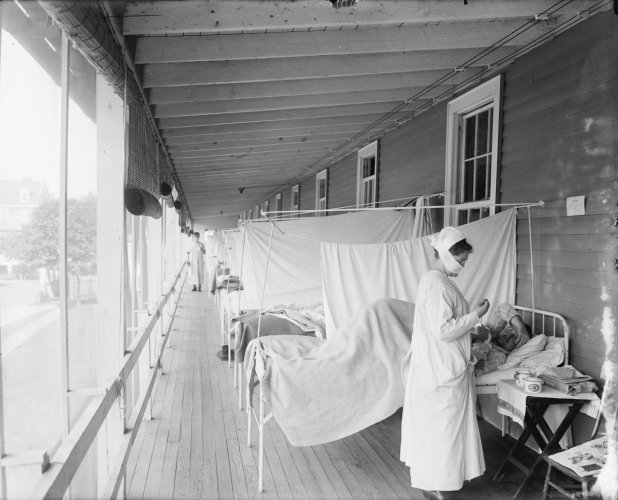
The Spanish Flu’s name comes from the fact that even as wartime censorship in the United States and most of Europe suppressed news of the influenza, the media in neutral Spain reported on it extensively. Photo: Wiki Commons

June 1918. A debilitating disease suddenly swept through Mumbai. Thousands fell ill, complaining of debilitating fever and cough, sometimes with intestinal problems.

For hundreds of unfortunates, their lungs filled with fluids and they died as their body was starved of oxygen. This was the Spanish influenza pandemic of 1918-19, which killed an astounding 50 million worldwide. Recent estimates put the death toll in India at a staggering 12 million.

Scientists refer to Spanish influenza as the ‘mother of all influenza pandemics’, since it is the common ancestor of human and swine flu viruses. The disease is inextricably associated with World War I.

The name comes from the fact that even as wartime censorship in the United States and most of Europe suppressed news of the influenza, the media in neutral Spain reported on it extensively, including when their king Alfonso XIII fell ill with it.

Spanish influenza’s first wave reached Mumbai when soldiers returned from Europe, carrying the virus with them. An even more lethal second wave hit in September.

When the pandemic reached Mysore State, it hit it hard. The State had still not shaken off the plague. Wartime shortages had pushed up the prices of food and other essentials. To make matters worse, the monsoon failed that year.

The disease first passed through Bengaluru in late June without causing much harm. The second wave in mid-September was deadlier. Suddenly, entire families fell ill.

Higher fatality

Dispensaries, clinics and hospitals were overcrowded. Doctors, nurses and compounders were completely overwhelmed. Corpses piled up. Unlike COVID-19, Spanish influenza had a far higher fatality among the young and able-bodied than the old.

Offices emptied as people across all professions and classes fell ill, among others, the health officer in Bengaluru and the then Chief Secretary of Mysore State.

In early October, Bengaluru’s City Municipal Council, under the leadership of the President KP Puttanna Chetty, took several quick, creative and effective steps to deal with the health crisis. Temporary dispensaries were opened, some housed in municipal schools that were closed at the time.

Mobile dispensaries were set up to ensure medicines reached everyone. All dispensaries were directed to stay open for longer hours and to stock enough of the medicines required, including thymol, which was prescribed a preventative.

Since hospitals were filled beyond their capacity, temporary tents and sheds were set up to accommodate the sick. Retired medical staff and medical students were brought in to help with the workload. Health officers went around neighbourhoods to see if there were any infected people and to persuade them to move to the hospitals or the camps to prevent the disease from spreading.

Leaflets in Kannada and English were distributed, which explained the symptoms of influenza, how it spread, and how it was important to ‘separate the sick from the healthy,’ and to avoid ‘the entire family congregating in the sick room.’

People were advised to ‘tie a clean handkerchief on which a teaspoon of eucalyptus oil is sprinkled, across the nose and mouth’ when entering the sick room, to provide a certain extent of protection. They were also strongly urged to avoid crowded places.

A striking feature of the response to the influenza pandemic was the voluntary effort in providing relief. Much like today, when several people are working, often with the police and the BBMP, to ensure the poor are not forgotten during the lockdown, in 1918 too, volunteers helped ensure relief supplies reached the poor and families where there was no one left to tend to the sick.

In Bengaluru, the relief operation was coordinated by Chief Officer R Subba Rao. He divided the city into several blocks with a relief party in charge of each. Supplies included medicines, milk and kanji, a lot of which was prepared at a government facility and then distributed by car, carts and even lorries.

Municipal councillors and volunteers who worked ceaselessly included Father Briand, Ramachandra Rao Scindia, Rev D A Rees, B Usman Khan, B Chinnaswami Setty, Ghulam Dastangir, B K Garudachar, R Gopalaswami Iyer and many, many others.

Assisting them were the Social Service League, Young Men’s Christian Association, students of the Wesleyan, London Mission and National High Schools, and many others. Puttanna Chetty toured the city himself to assist the relief works and ensure they went on smoothly.

By the end of November, the disease was finally under control. More than 1,95,000 people died in Mysore State, 40,000 in Bengaluru alone. With the compounding problems of agrarian distress, rural areas were affected much worse.

source: http://www.deccanherald.com / Deccan Herald / Home> Spectrum> Spectrum Top Stories / by Meera Iyer / April 08th, 2020

The Delhi prof who said tombs & mosques were not just ‘Muslim’, but ‘Indian Muslim’

NEW DELHI :

In the anxiety to label Indian architecture as Hindu, Buddhist, British imperial and Islamic, the buildings lost some of their power to evoke wonder and surprise.

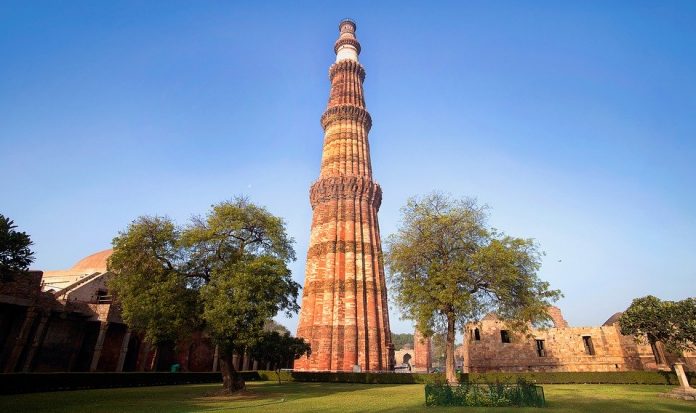
Qutub Minar in New Delhi | Commons

In the 1950s and ’60s, visitors to Delhi’s Qutub Minar often saw a crowd of schoolchildren following an unlikely Pied Piper, a frail man in a white kurta and pyjama, wearing a Gandhi cap, and giving them their first lesson in art history. Mohammad Mujeeb was one of those iconic professors who communicated just as easily with schoolchildren as he did with college students and his colleagues. He instilled in them a love for historic cities, made them see the places as works of art.

In those years, the Delhi skyline and groundline were dominated by monuments. For many families, these landscapes were synonymous with Sunday picnics. For art historians, these spaces became popular hunting grounds, and a number of case studies on architecture took shape in the 1970s.

But the lay reader was more familiar with surveys of Indian architecture. Of these, Percy Brown’s books were the most sought after. His volumes, Indian Architecture (Buddhist and Hindu), and Indian Architecture (The Islamic Period), published in 1942, contain a mine of information. However, because he divided the theme in a binary, he missed out on capturing the special quality of the 14th-17th centuries — the cosmopolitanism in architecture — when rich and powerful rulers, irrespective of religion, engaged skilled artisans and engineers from across south and west Asia to design beautiful public spaces.

Architectural crossover 

In that era of increasing globalisation, artisans met and exchanged recipes for architectural design, and travelled great distances, confident of their patronage. Guilds from the Middle East were employed to design the great pillars of Yorkminster, and Indian stone-masons learned structural engineering from Uzbek architects. Chinese porcelain gave its name to the funerary monument Chini Ka Rauza (China Tomb) in Agra. British tourists to Italy brought back fragments of Roman sculpture to display proudly in their country estates, while Feroz Shah Tughlaq had two Ashoka pillars (only no one knew what they were) ferried to Delhi from Meerut and Topra (Haryana), to embellish his mosque and his estate on the Ridge.

James Fergusson, in the mid-19th century, had sought to make sense of the myriad buildings in India. He found it simplest to classify them by ‘style’. Function, it was assumed, shaped the form, and buildings were labelled ‘Buddhist’, ‘Hindu’ or ‘Islamic’. The term ‘Indo-Saracenic’ was coined to describe styles with elements of both, as well as for the British imperial style, which deliberately included decorative Indian elements. In this anxiety over labels, the buildings lost some of their power to evoke wonder and surprise, to speak to the hearts and minds of the people.

Indian-Muslim architecture

Both mosques and tombs adopted from and adapted to the local environment, which is why Mujeeb insists that they be described not as ‘Muslim’ but as ‘Indian Muslim’. They, and other public areas — streets and walled gardens — made for beautiful cities, with a quality of repose and of camaraderie. Soaring arches and minars (towers) connected the earth to the sky, to heaven. (Mujeeb was too much of a rationalist to fall for the belief that djinns lived in historic buildings and could fulfil people’s prayers.)

Communal practices do shape houses of worship — and there is a fundamental difference of form between a congregational masjid (‘beauty without mystery’) and a mandir, where there is mystic communion between deity and worshipper. As for the tomb: “[It] was a symbol of unifying life, death and eternity; primitive beliefs associated with kingship gave the royal tomb a mysterious significance…The tomb of a ruler was the expression of personality, of a force which the community needed to maintain its self-confidence in a world of conflicts,” Mujeeb wrote  in The Indian Muslims (1967). He was not averse to sounding tongue-in-cheek while describing Humayun’s mausoleum: “There is nothing we know of Humayun that would justify our regarding him as an outstanding personality; his tomb is much greater than he.”

The urban architecture of early modern India has some of the features of Persian or Turkish cities, but is most similar to those of Rajput kingdoms, contemporary with those of the Mughals. Both were shaped by the climate, conditioned by topography, the fact that they were built by skilled stone-masons rather than brickworkers, and by the deliberate choice of Indian ornamental motifs.

The Indian-Muslim architect rejoiced in being “free from the beginning, free from fear and hatred, from law and custom, from the conflicts of ideals and interests. There were no limits fixed except those of his own aptitude and means, and the nature and availability of structural material.” They created an architecture that was not just frozen music, but also frozen poetry. It was both the architecture of Urdu poetry and the poetry of our architecture that made cities in India the grandest in the early modern age.

This article is the seventh of an eight-part series on ‘Reading A City’ with Saha Sutra on www.sahapedia.org, an open online resource on the arts, cultures and heritage of India. 

Dr Narayani Gupta writes on urban history, particularly that of Delhi. Views are personal.

Read the series here.

source: http://www.theprint.in / The Print / Home> Opinion> Sahapedia / by Narayani Gupta / January 12th, 2020

Hubballi hotelier offersrooms for quarantine

Hubballi, KARNATAKA :

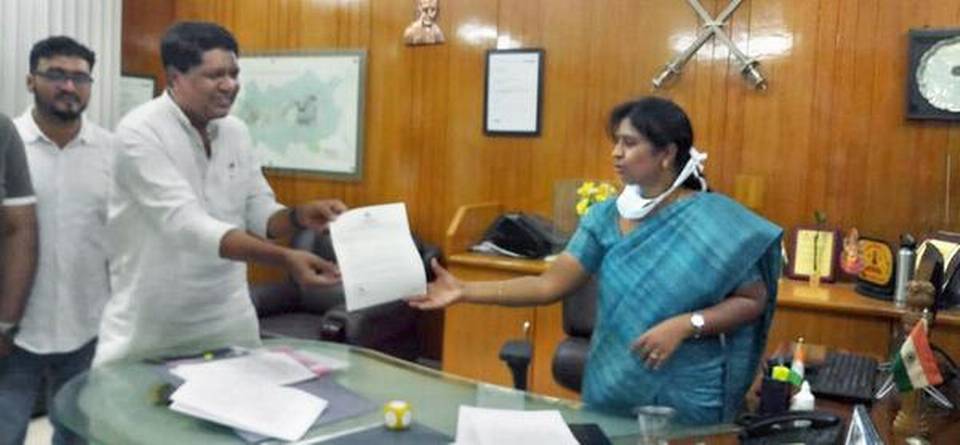
Managing Director of Hotel Metropolis handing over a letter to Deputy Commissioner Deepa Cholan in Dharwad on Tuesday offering 46 rooms of his hotel for quarantine purposes.

At a time when apprehensions about the spread of COVID-19 pandemic are increasing, a hotelier from Hubballi has offered a total of 46 rooms in his lodge for quarantine purposes of those who have returned from foreign countries.

Apart from providing 46 rooms in one section of Hotel Metropolis on Koppikar Road in Hubballi, Managing Director of the hotel Ashraf Ali Basheer Ahmed has offered to provide food to those quarantined.

Mr. Ashraf Ali handed over a letter on offering rooms for quarantine purposes to Deputy Commissioner of Dharwad Deepa Cholan here on Tuesday. Lauding the initiative by Mr. Ashraf Ali, Ms. Deepa Cholan termed the act of the hotelier as a model one.

Mr. Ashraf Ali requested Ms. Deepa Cholan to send a team of officials to inspect the hotel. He said that the Metropolis Group had already handed over 70 rooms owned by the group near the international airport in Mumbai to the Government of Maharashtra. The hotel group had taken up the initiative under its CSR activities, he said.

source: http://www.thehindu.com / The Hindu / Home> News> States> Karnataka /  by Special Correspondent / Hubballi, March 25th, 2020

Kasaragod man offers to put up quarantined people at his hotel

Kasargod, KERALA :

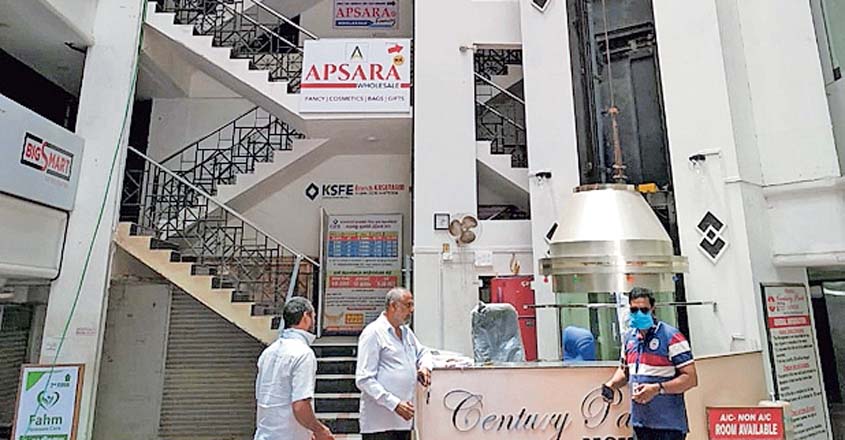
The Century Park building near the new bus stand in Kasaragod would be handed over to the authorities to be converted into an isolation ward

Kasaragod:

Even as authorities struggle to find accommodation facilities for quarantined people amid COVID-19 outbreak, responsible citizens have offered to help.

C I Abdullahkunji of Kudlu in Kasaragod district has informed the authorities that his three-star  hotel can be used as an isolation facility for free.

The Century Park building near the new bus stand in Kasaragod would be handed over to the authorities. Eighty-eight rooms of the top three floors of the seven-storeyed building would function as isolation ward.

The daily rent of one room is Rs 1,500.

All rooms have two beds each and the bathrooms have geyser facilities. The hotel has a water tank with a storage capacity of 45,000 litres.

The hotel owner said the necessary precautions have being taken. The water tank has been sanitised  and filled up. The hotel premises have also been cleaned.

Municipal secretary S Biju, and deputy DMO Dr Geetha Gurudas carried out an inspection at the building.

source: http://www.english.manoramaonline.com / OnManorama / Home> Districts> Kasargod / by Manorama Correspondent / March 27th, 2020

Malappuram youths start coffee shop to fund their higher education

Malappuram, KERALA :

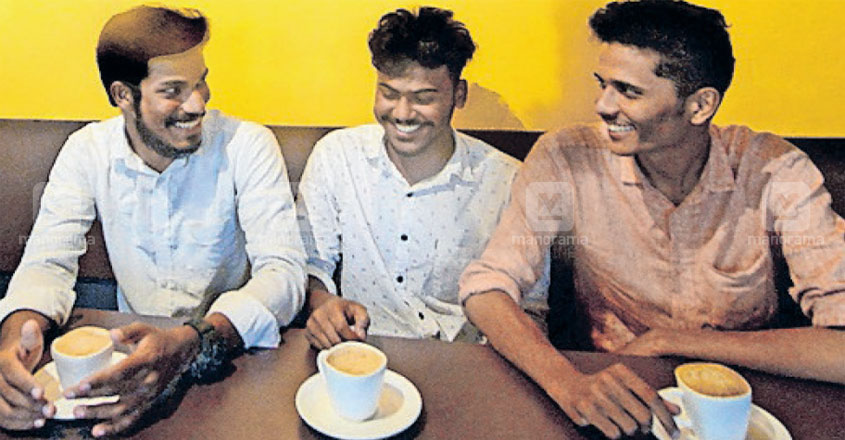
BrownCoffeeMPOs20mar2020

They dream of pursuing higher education without adding to their parents’ financial burden. And to fund their dream, these three friends decided to start a coffee shop. Thus, the Le Brown Coffee and Restaurant came up near Angadipuram railway overbridge in Kerala’s Malappuram district.

The trio behind this restaurant is P S Sabiq, K T Nabeel, and K T Mohammed Thasleem.

Sabiq from Kodenchery in Kozhikode and Nabeel from Thrithala in Palakkad have completed BSc MLT course, while Thasleem of Vengara in Malappuram secured an MLT diploma.

All three of them are students of MES Medical College at Perinthalmanna. They wanted to pursue higher studies but were reluctant to seek money from their families. Thus, they came up with the idea to start a coffee shop to fund their studies.

But even setting up the coffee shop was an uphill task. They had to run from pillar to post to secure the advance amount for a coffee shop. Then, the husband of a classmate came to their rescue at the last minute.

Since they had been nurturing this dream for three years, the youths had a clear idea about how they wanted to set up the coffee shop. The trio along with their friends arranged the interiors  of the shop.

The total cost of Rs 15 lakh was mostly borne by the classmate’s spouse.

And their dream became a reality on January 5. The trio kept their families in the dark about their dream project. The families got a big surprise on inauguration day but even then they found it hard to believe.

The food items are priced at a range that is reasonable for all.

Some of their specialities are selfie chino and smoked barbeque charcoal dosa.

They have also recruited five people to help run the shop.

source: http://www.english.manoramaonline.com / OnManorama / Home> News> Campus Reporter / by Sandeep Chandran / March 19th, 2020

UP Muslim man to gift ancient coin for Ram temple construction in Ayodhya

Majbhita Village (Azamgarh District ), UTTAR PRADESH :

The coin has an image of Lord Ram, Sita and Hanuman inscribed on it and its value is said to be several lakhs of rupees.

Syed Mohd Islam, a Muslim man living in Uttar Pradesh’s Azamgarh district, has decided to gift an ancient coin made of ‘ashtadhatu’ (eight metal alloy) for the Ram temple construction in Ayodhya.

The coin has an image of Lord Ram, Sita and Hanuman inscribed on it and its value is said to be several lakhs of rupees.

According to Syed Mohd Islam, who lives in the Sitaram locality, he has found the coin while he was reconstructing his ancestral home in the village.

“On November 30, 2019, when the plinth of the house was being dug, we found these two coins. I decided to gift them for the temple construction. I will soon be going to Ayodhya and will hand over the coin to Mahant Nritya Gopal Das who is the chairman of the Ram Teerth Kshetra Trust that will construct the Ram temple,” Syed Mohd Islam said.

However, recently, when he went out for some work, his wife Kaneeza Fatima went to a local jeweller and sold off one coin for Rs 3 lakhs.

Syed Mohd Islam further said that he will request the Mahant to sell the coin and use the amount in construction of the temple.

Syed Mohd Islam hopes that his contribution to the construction will encourage other Muslims to make similar contributions and present a perfect example of communal harmony.

source: http://www.indiatoday.in / India Today / Home> News> India / by Indo-Asian News Service, Azamgarh / March 07th, 2020

Little-known fact: Aurangzeb had more Rajput administrators than Akbar

DELHI , INDIA :

In ‘Understanding Mughal India’, Meena Bhargava writes about how Aurangzeb patronised several Hindu institutions & was supported in the war of succession by Rajputs.

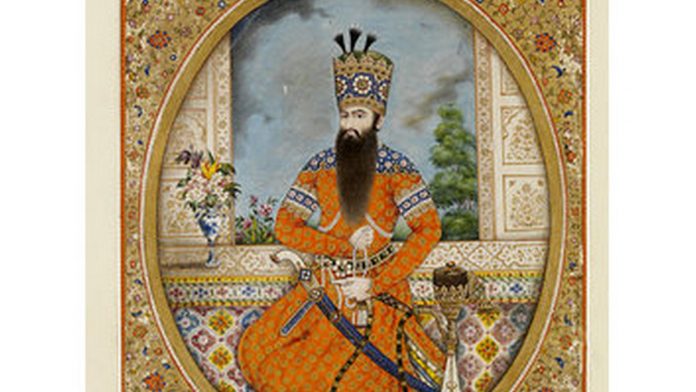
A portrait of Mughal ruler Aurangzeb | Photo: collections.vam.ac.uk/

That Aurangzeb’s orthodoxy and his dedication to his beliefs was personal rather than a matter for political interference is evident in his reactions and responses during the war of succession of 1658, a quadrangular conflict between Dara, Shuja, Aurangzeb, and Murad. Throughout the struggle, Aurangzeb was concerned about Dara’s political manoeuvres. Their individual feelings and religious outlook—which stood in sharp contrast—remained confined to the personal level. Aurangzeb referred to Dara as mushrik (heretic) while Dara called Aurangzeb kotah pyjama (narrow pants), a symbolic attribute of orthodoxy. Both attempted to rally public opinion, but never on religious grounds. In fact, the support that largely came for Aurangzeb was from the Rajputs, notably Rana Raj Singh of Mewar, Raja Jai Singh Kachwaha of Amber, and later, Maharaja Jaswant Singh of Marwar. In this context may be related an interesting nishan that Aurangzeb sent to Rana Raj Singh of Mewar, condemning such kings who practised intolerance that could become the cause of dispute, conflict, and harm to the people, and could ‘devastate the prosperous creations of God and destroy the foundations of the God-created fabric’. Such attitudes of kings, Aurangzeb ordained, deserve ‘to be rejected and cast off’. This document from the Udaipur records is a clear revelation of what Aurangzeb intended as his public policy. It further confirmed that Aurangzeb, in the struggle for succession, did not raise the cry of jihad or Islam in danger, nor did he promulgate a new religious policy contrary to that of his predecessors; neither did Dara claim to be the champion of liberal forces. The issue was not religious or ideological, or whether orthodoxy would triumph or liberalism. It was a question of personal vested interest, political in nature but free from religious connotations, that is: Who would be the emperor of India, Dara or Aurangzeb? It is in such a context that Aurangzeb deserves to be assessed.

Debating Aurangzeb’s leanings—religious orthodoxy or political pragmatism—one needs to ask: Did Aurangzeb really intend, as Jadunath Sarkar suggested, the establishment of dar-ul-Islam or a truly Islamic State in India, the conversion of the entire population to Islam, and the annihilation of dissenters? Or, as Ishtiyaq Husain Qureshi argued, was it rigid adherence to the shari’a and undoing the damage caused by Akbar; or the triumph of Muslim theology, as Shri Ram Sharma asserted? If this was really the case, then the emperor’s personal valour, military skills, and single-minded commitment to achieving territorial expansion and consolidation would stand negated. The biased ideological portrayal of the emperor, regardless of historical accuracy, makes it difficult to explain the increase in the number of Rajput mansabdars in Aurangzeb’s administration as compared to Akbar’s period, and their rise from 24 per cent under Shahjahan to 33 per cent in 1689. Nor can Raghunath Ray Kayastha’s dominance as diwan-i kul be understood rationally. Raghunath Ray not only supported Aurangzeb but also participated in several expeditions of the period. Aurangzeb honoured him with the title of Raja and when Raghunath Ray died in 1664, the emperor, in his obituary written in Ruqa’at-i Alamgiri, remembered him as the greatest administrator he had ever known.

There are well-documented evidences of Aurangzeb’s patronage of various Hindu religious institutions, namely temples, maths, grants to Brahmins and pujaris:

  • Land grants were renewed to the temples at Mathura, Banaras, Gaya, Gauhati, and others, while the emperor is known to have donated ghee for the navadeep in a few temples, including the Mahabateshwar temple at Agra;
  • Gifts were offered to the Sikh gurudwara at Dehradun;
  • Madad-i ma’ash grants, as listed in the Rajasthan documents, were continued to a math of Nathpanthi yogis in pargana Didwana, sarkar Nagor;
  • Grants were also made to Ganesh Bharti faqir and his successors in pargana Siwana with the instructions that the faqir should not be disturbed so he could ‘pray for this sultanat’.
  • The Vrindavan document of 1704 referred to a parwana which sanctioned the rights of Chaitanya gosains who had founded Vrindavan and established pilgrimages in Braj Bhumi, and recognised the right of Brajanand Gosain to receive a fee from the followers of the sect on account of kharj sadir o warid, that is, expenses on guests and travellers from each village. In effect, it was a government levy for the benefit of Brajanand Gosain and his Vaishnavite followers.

From the above description, Aurangzeb’s patronage to temples appears without doubt. And yet some temples were attacked, while others were spared. This aberration in the emperor’s attitude can be explained by only one rationale: it was not iconoclasm, but reprisal for rebellion or political misconduct or disloyalty to the emperor. This exposition can be applied to understand the attack on the Vishwanath temple at Kashi, the Keshav Dev temple at Mathura, and several prominent temples in Rajasthan. In 1669, during a zamindar revolt in Banaras, it was suspected that some of them had assisted Shivaji in his escape from imperial detention. It was also believed that Shivaji’s escape was initially facilitated by Jai Singh, the great-grandson of Raja Man Singh, who had built the Vishwanath temple. It was against this background that Aurangzeb ordered the destruction of that temple in September 1669.

Around the same time, in a Jat rebellion that had erupted in the neighbouring regions of Mathura, a patron of the local congregational mosque was killed, leading to Aurangzeb’s order in 1670 to attack the Keshav Dev temple at Mathura. Temples in Marwar and Mewar were also attacked following the death of Maharaja Jaswant Singh to reprimand and crush the Rathor rebellion and the development of a Sisodia– Rathor alliance. These included temples in Khandela patronised by rebel chieftains; temples in Jodhpur maintained by a former supporter of Dara Shukoh; and the royal temples in Udaipur and Chittor patronised by Rana Raj Singh after the Rana entered into an alliance with the Rathors that signalled the withdrawal of loyalty to the Mughal State. It may be observed that the Rathor rebellion was not a reaction or a protest against the re-imposition of jizya. Instead, this re-imposition, as Abu’l Fazl Ma’muri observed in the context of the suppression of the Satnami revolt and prior to the emperor’s expedition to Ajmer, was meant for ‘the affliction of the rebellious unbelievers’.

MughalBookMPOs24feb2020

This excerpt from Understanding Mughal India: Sixteenth to Eighteenth Centuries by Meena Bhargava has been published with permission from Orient BlackSwan.

source: http://www.theprint.in / The Print / Home>  Page Turner> Book Excerpts / by Meena Bhargava / February 19th, 2020

Take note of this…

Bengaluru, KARNATAKA :

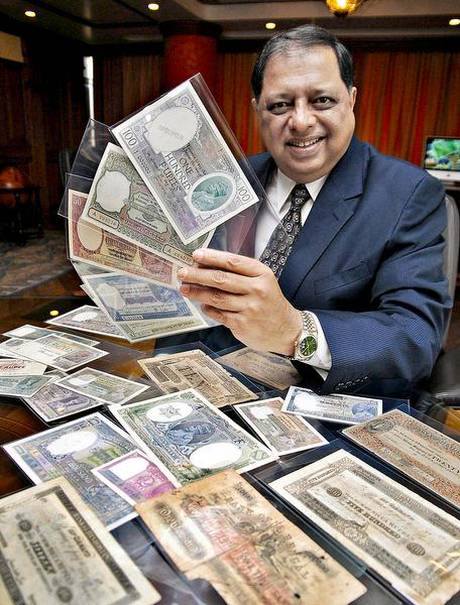
India’s history in currency is the subject of Rezwan Razack’s Museum of Indian Paper Money

Back in timeThe concept of money has existed since almost the beginning of civilization, says Razack / bhagyaprakash k

India’s history in currency is the subject of Rezwan Razack’s Museum of Indian Paper Money

Hailed as the largest collector of Indian currency, Rezwan Razack has opened South India’s first currency museum in Bengaluru. “I am so happy that the former Governor of the Reserve Bank of India, C. Rangarajan inaugurated the museum,” says Razack.

Razack, co-founder and joint MD of Prestige Group, is the Chairman of the International Bank Note Society, India Banknote Collectors’ Chapter, and is recognised for his contribution to the advancement of numismatic knowledge. Razack, who built his collection over 50 years with exhaustive research, enjoys sharing his knowledge with students and encourages budding collectors to promote numismatics as a hobby.

He has co-authored The Revised Standard Reference Guide to Indian Paper Money in 2012, and in 2017 wrote One Rupee One Hundred Years 1917-2017 to mark the centenary of the issuance of the one rupee note. “Rezwan Razack’s Museum of Indian Paper Money will not only be the first of its kind in India, but also the world,” says Razack.

The museum at Prestige Falcon Towers on Bruntun Road, has trained guides to take visitors through the history of currency in India. “The story of money is woven into our very being, uniting us, dividing us, giving us a sense of identity and mapping people or the nation’s power, crises and triumphs. I consider it a comprehensive restoration and preservation of an important national heritage. It is also something that numismatists worldwide will benefit from.”

The initiative, he says, is to help educate, inform and entertain. “The rupee is one thing that is ever present in our lives but never seen as a source of history, information and national pride. I hope visitors understand, enjoy and value this museum of our collective economic heritage.”

The museum displays a diverse collection of Indian paper money and the related material drawn from the Indian subcontinent. “While the concept of money has existed since almost the beginning of civilization, the invention of paper currency is more recent,” says Razack. From the early barter systems and the use of coins as currency, the museum introduces the visitor to paper currency, its origins and its use.

Apart from its selection of banknotes dating back to the early 1800s, an auxiliary collection has also been put together to explain the inspirations and techniques of making paper currency. While original hand-painted essays, patterns, proofs, trials, specimen notes, autographed notes and a rare Star of India Medal demonstrate fascinating aspects of money, meticulously sourced cheques, stamp papers relating to Indian paper money, booklets and banknotes help decode the world of money.

“This museum has been planned meticulously over three years to conform to international standards of lighting and climate control,” says Razack, adding that people don’t often retain paper money  My visits to cut-note dealers in Chickpet and in Fort Bombay gradually increased my collection,” he says, acknowledging that his persistence paid off.

Razack says his collection includes the oldest surviving note from 1812 of Bank of Bengal right up to the notes of 2017 of all denominations. The rare ones are the early Presidency Banknotes of Bank of Hindostan, Bank of Bengal, Commercial Bank, Calcutta Bank, Bank of Bombay, Bank of Western India, Asiatic Bank and Bank of Madras; British India’s Portrait Notes of Queen Victoria, Portrait Notes of King George V and King George VI; and Indian Notes used in Burma and Pakistan; Notes of Indo-Portuguese and Indo-French Territories and Indian Notes since Independence, also used by Haj Pilgrims and in Persian Gulf States.

There is also a lot of importance behind his book dedicated to the One Rupee note. The first One Rupee Note in India was issued on November 30, 1917. “To celebrate 100 years of the one rupee note in India, my book focusses on the origin and journey of the smallest existing denomination through the century, while examining its genesis. As the general population in India were unacquainted with paper notes until 1917, one of the methods adopted to increase the popularity of the one rupee note was to print a picture of the silver one rupee coin on both sides of the note.”

At Prestige Falcon Towers, 19 Brunton Road, Bengaluru; 10-30 a.m. to 5-30 p.m.; closed on Mondays and public holidays;entry Rs. 100

While the concept of money has existed since almost the beginnings of civilization, the invention of paper currency is more recent

source: http://www.thehindu.com / The Hindu / Home> Features> MetroPlus / by Ranjani Govind / February 17th, 2020

JMI Faculty gets American research fellowship to study Amarnath Yatra

NEW DELHI :

Dr Adfer Rashid Shah of Sarojini Naidu Centre for Women’s Studies, Jamia Millia Islamia (JMI), has received George Greenia Research Fellowship of USA to study Amarnath Yatra.

Dr Adfer Rashid Shah of Sarojini Naidu Centre for Women’s Studies, Jamia Millia Islamia (JMI) has been awarded with George Greenia Research Fellowship in Pilgrimage Studies from USA’s William & Mary University for a qualitative study of Amarnath Yatra in Kashmir Valley.

The fellowship by George Greenia, the second-oldest university in the US after Harvard, provides funding for faculty to support original scholarship on pilgrimage.

Dr Shah’s project titled, ‘Understanding a Perpetual Pilgrimage in a Conflict Zone from Stakeholders’ Views and Experiences: A Qualitative Study of Amarnath Yatra in Kashmir Valley‘ has been accepted for the fellowship.

Dr Shah has been researching Muslim Endowments (Auqaf), peacebuilding and pilgrimages in India, especially Amarnath Pilgrimage in Kashmir valley for many years, this fellowship is the recognition of his years of work in this field.

He was chosen for this award during the Annual Symposium hosted by William and Mary’s Institute for Pilgrimage Studies in November this year.

The award also contains a cash prize of one thousand US dollars. Dr Shah also presented a paper (in absentia) titled ‘pilgrimage and peacebuilding in conflict zones: Notes on Amarnath pilgrimage in India’s Kashmir Valley’ in the symposium.

About Dr Adfer Rashid Shah

Dr Shah earned his doctorate in Sociology from JMI in 2015 and has authored three books and about 40 research papers in prestigious journals. He also edits Eurasia Review as Associate Editor and also served Women’s Link Journal as Associate Editor besides writing columns for leading newspapers.

source: http://www.indiatoday.in / India Today / Home> News> Education Today> News / by India Today Web Desk / New Delhi – December 07th, 2019

Kerala NRI in London converts Old Scotland Yard police HQ into 5-star hotel

KERALA / U.A.E. :

At the helm of this 300 million pounds (over Rs 28,06,09,18,200 roughly) investment is the Kerala born NRI businessman MA Yusuff Ali.

Kerala NRI in London converts Old Scotland Yard police HQ into 5-star hotel

A night stay at the hotel will cost you over Rs 40,000 and lunch over Rs 10,000 | Photo from Twenty14 Holdings website

Once upon a time in London, United Kingdom the address people would have wanted to avoid might be now the place they might aspire to be in – The Great Scotland Yard Hotel.

Better known as the Old Scotland Yard that served as police headquarters, now is a plush 5-start hotel.

At the helm of this 300 million pounds (over Rs 28,06,09,18,200 roughly) investment is the Kerela born NRI businessman, MA Yusuff Ali of Lulu Group’s hospitality arm, Twenty14 Holdings.

Calling it a “dream come true” to transform world’s most historic addresses, Adeeb Ahamed, the managing director of Twenty14 Holdings said, “This building holds more tales than ever told and our approach has been multi-layered, with emphasis on stories that are unheard, the hotel is a tribute to the intrinsic spirit of London.”

Opened to public from the December 5, it was inaugurated by Nicky Morgan, UK secretary of state for digital, culture, media and sport.

Speaking about the “exceptional transformation” that the building has undergone Sir Edward Lister, special advisor to the Prime Minister, said, “It is a place which is right at the heart of the city and the government and the West End of London. It’s just a perfect location for a tourist.”

Event was also attended by the High Commission of India, her excellency Ruchi Ghanshyam amongst other Lords and dignitaries.

It might cost upward of 430 pounds (Rs 40,000 roughly) to stay for a night and 100 pounds (Rs 10,000 roughly) to lunch at the The Great Scotland Yard Hotel that has Trafalgar Square, Whitehall and the West End just round the corner.

Current building at 3-5 Great Scotland Yard has grand five storey Imperial Red brick and stone facade with arched main entrance | Photo from Twenty14 Holdings website

From staff wearing brass hand cuff in their belts to retaining some of the writings on the walls, this dog-friendly hotel endeavours to give its guests an eclectic experience of past and the present.

Shafeena Yousuff Ali, the daughter of Yusuf Ali, the woman behind the art and decor of the hotel said that they have tried to give their guests “a transformational experience that will inspire their souls”.

The operations of the hotel have been handed over to The Unbound Collection by Hyatt.

source: http://www.indiatoday.in / India Today / Home> News> World / by Loveena Tandon / December 06th, 2019