The artworks in acrylic and of different sizes have adorned the walls of the restaurant.
Hyderabad:
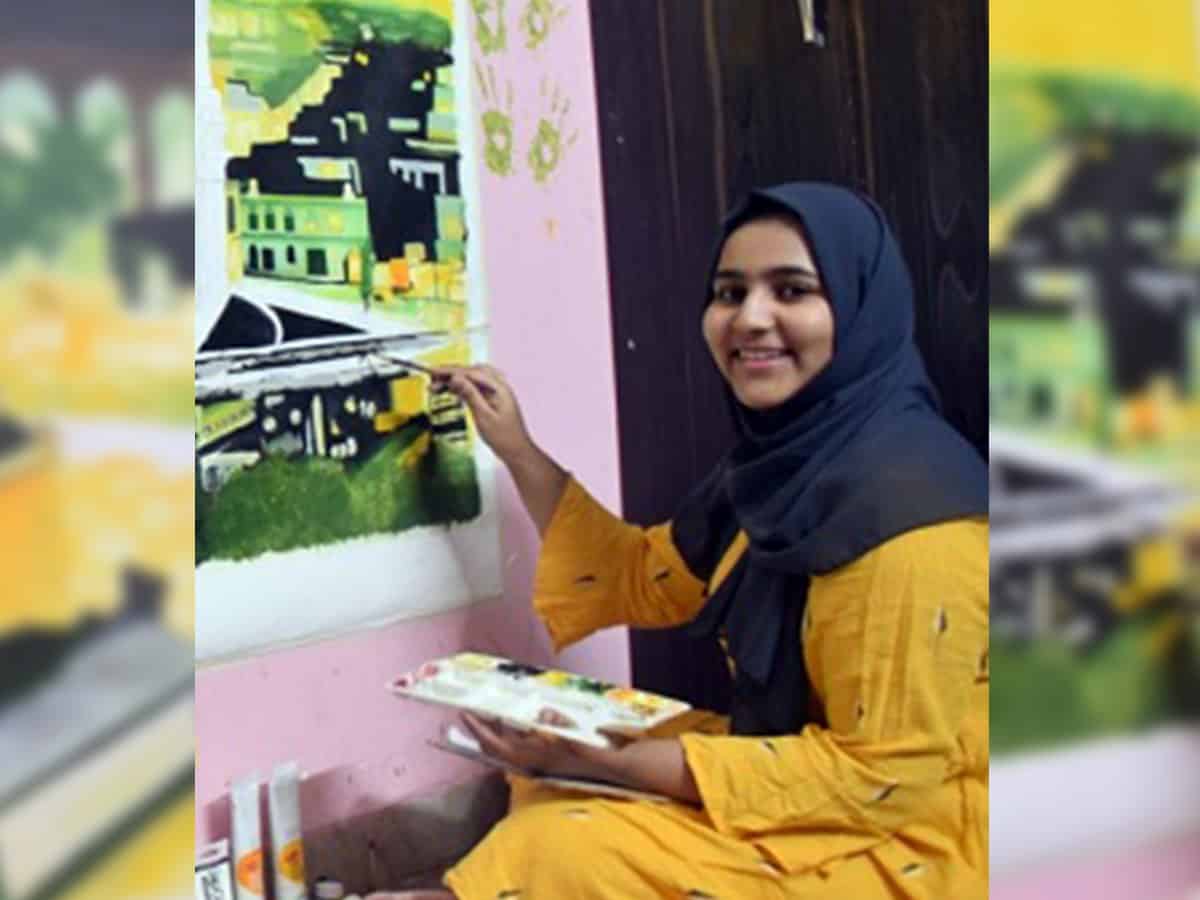
A 14-year-old girl’s passion for painting paid off as her artworks have made their way to London to adorn the walls of a restaurant.
Syeda Ashna Turabi, a class 10 student, is elated as her six paintings including an art work of historic Charminar, Mecca Masjid and its surroundings have been displayed at Adeena’s Kitchen, a restaurant opened in South London last week.
The art works attracted the attention of a businessman when Ashna’s father had posted them on social media.
Impressed by her paintings, Syed Amjad Ali bought six of them for his restaurant, which serves Indian, especially Hyderabadi food.
The artworks in acrylic and of different sizes have adorned the walls of the restaurant.
“Thanks to Almighty Allah I have achieved this success and I hope to carry this forward,” Ashna told IANS.
Painting came naturally for this Hyderabadi who took keen interest in drawing and colouring since her nursery school days.
Like many children of her age, she was fond of drawing and colouring. However, she persisted with her hobby as she moved to high school and it turned into a passion.
Urooj Ahmed, a freelance photojournalist, did everything possible to encourage Ashna, the eldest of his three daughters.
“I realized that she has some special talents in her and provided her all the required support and encouragement,” he said.
Ashna has done her artworks with all including oil paint, coffee, ink, water colours, and acrylic
What makes Ashna’s achievement special is she learnt the art on her own. “She used to spend hours working on canvases and with every painting she improved,” said Urooj Ahmed.
Ashna, however, received some guidance and useful tips from Fawad Tamkanat, a leading artist and son of well-known Urdu poet Shaz Tamkanat.
Last year, Urooj Ahmed started uploading her works on Facebook and other social media platforms.
Ashna now plans to do a series of paintings on Indian culture and heritage. “I want to do a series of paintings on different subjects like various dynasties and monuments,” she said.
She also wishes to organise an exhibition to display her artworks. “It will take some time as I want to focus on studies while continuing the art in the available time,” she added.
Source: IANS
source: http://www.siasat.com / The Siasat Daily / Home> Top Stories / by Minhaj Adnan / by IANS / September 21st, 2020
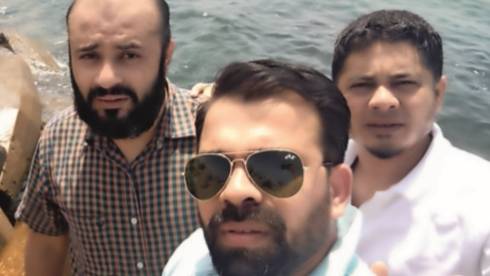
Shahid Rukhnuddin, Mudassir Kola and Mohiddin Anas / supplied image / khaleejtimes.com
Shahid Ruknuddin, Mudassir Kola and Mohiddin Anas had been fishing when they saw the Omanis crying for help.
Three Indian friends risked their own lives to save two Omanis from drowning after their boat reportedly capsized on Seeb Beach.
On the night of August 29, Shahid Ruknuddin, Mudassir Kola and Mohiddin Anas, based in Oman’s Seeb, went fishing.
For the first time, the trio tried fishing from the sea walls and not the seashore.
However, the trio couldn’t catch any fish, felt uncomfortable hearing sounds coming from the dark and decided to leave. But it was then they could spot two Omanis shouting for help. Ruknuddin jumped into the water, Kola followed him while Anas informed the police. The timely act helped save the lives of two Omanis.
Anas said it was destiny that they were at that spot at the right time. “I have been fishing since 2014 but for the first time we went to the sea walls. It was Ruknuddin’s idea to go there.
“Right from the start, we kept hearing some sounds. It was dark and a bit scary. I told Ruknuddin and Kola that maybe the fishermen were trying to scare us by making such sounds.
“We were not finding any fish and decided to leave. But whenever I switched off my flashlight, the sound got louder,” Anas said. The trio wondered if someone was in trouble and seeking help in Arabic.
So they decided to check all the spots. “For 15 minutes, we flashed our torch in different parts of the sea to spot any person. Our search was in vain and we decided to give up. Just when we were leaving, suddenly Kola spotted a face. They were two Omanis in the water seeking help. They were at a distance and we shouted at them with little Arabic we know.
“I informed the police. But we know even if police would reach the shore quickly, it would take a while to reach our spot. We kept encouraging them to try and swim towards us, but we felt they were exhausted,” Anas said. It was then that Ruknuddin jumped into the water and helped save the Omanis.
Recollecting the experience, Ruknuddin said: “It’s a great privilege that Allah gave me this opportunity to save lives. I jumped into the waters without thinking about anything else. By Allah’s grace, I was able to help two people.”
Anas added: “Ruknuddin is the real hero. He never thought about his life. He jumped into the water which had sharp rocks beneath.
“He got injured in the process but was strong.”
ashwani@khaleejtimes.com
source: http://www.khaleejtimes.com / Khaleej Times / Home> Region> Oman / by Ashwani Kumar, Khaleej Times, Abu Dhabi / September 03rd, 2020
Farsi, or Persian, was once counted among the great global sultans of language and culture. In a corner of Calcutta, the flame still glows. We chart the bygone glory of the tongue, and speak to some who keep its flicker alive.
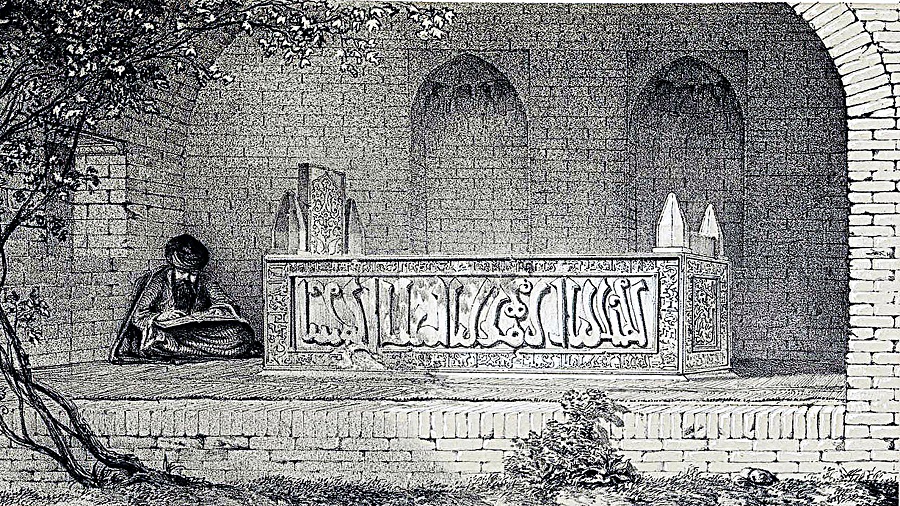
LANGUAGE LEGACY : The tomb of the great Persian poet Sheikh Saadi in the Iranian city of Shiraz, sketched by the 19th century French painter Eugene Flandin . Voyage en perse, avec flandin, ed. gide et baudry, 1851 : from Wikimedia Commons
Bani adam a’za-ye yekdigar-and/ke dar afarin-aš zeyek gowhar-and. All human beings are members of one frame, or body/Since all, at first, from the same essence came/When life and time hurt a limb/Other limbs will not be at ease/ You who is not sad for the suffering of others/Might not deserve to be called human.”
The portals of the Iran Society, a 75-year-old centre for Persian studies in Calcutta, reverberated with the musical rendition of verses one afternoon. The recitation of 13th-century poet Saadi Shirazi’s verse by Persian teacher Abid Hossain leaves a delegation from Tajikistan speechless.
Tajikistan is one of the central Asian countries where Persian is spoken and used officially, the others being Iran (earlier Persia), Iraq, Afghanistan, Ujbekistan and Azerbaijan. The Tajik delegates, a team of five experts, have been collecting samples of Persian literature, especially poetry, from across the world. “We didn’t know that this region, so far away from the Persian Gulf, had once been a seat of Persian literary activities. We knew about Delhi, Kashmir, Punjab, but not of Calcutta, Dhaka or Chittagong,” says Abdughani Mamadazimov, who teaches international relations at the Tajik State University in Dushanbe and is the leader of this delegation.
Persian or Farsi was introduced in the Indian subcontinent by the Persianate rulers of Central Asia in the 13th century. The language was not only the lingua franca of the classes — just like English in modern India — but also the language of creative literature and philosophy. In fact, the word Hindu, connoting people living in a geographical region beyond River Indus, is of Persian origin. So is the word Hindavi (later Hindi), used for the language spoken by the people in large parts this land. After having played a key role in communication and literature, the language was replaced by English in late 19th century. And now it faces ignominy or oblivion.
During the Muslim conquest of Persia in the mid-7th century, the Parsis took refuge in Gujarat and parts of western India to avoid religious persecution. And that is how Farsi floated into India. “Persian language, with pre-historic roots in southwestern Iran, is one of the oldest Indo-European languages,” says Amit Dey, a senior historian and professor at Calcutta University. He continues, “The Arabs conquered Persia but failed to impose Arabic on the conquered. The Persians were forced to accept the Arabic script but did not sacrifice their language. Instead, Farsi turned into a prestigious cultural language in various empires in Western Asia, Central Asia and South Asia. New literature, espe-cially Farsi poetry, developed as a court tradition in the eastern empires. Thus, Farsi became a vehicle of cultural conquest defying Arabic political hegemony.”
As a result, some of the classics of literature, such as Rumi’s Mathnawi, Firdausi’s Shah Nama, Omar Khaiyyam’s Rubaiyat, Hafez’s Divan and Saadi Shirazi’s Gulistan, were written in Farsi in the medieval period. Farsi also became the vehicle of Sufi mysticism, defying all orthodox religious boundaries.
Its secular, liberal and strong cultural moorings helped Farsi survive political threats from Arabic and other languages. Even rulers of Turko-Afghan origin in medieval India, including those of the Delhi Sultanate and the Mughal regime, accepted it as the language of the court and diplomatic discourse. “They chose Farsi rather than their mother tongue Turkish, or Arabic. Persian flourished in the Indian subcontinent, unlike in northern Africa where the conquered nations were Arabised,” says Dey.
According to him, the decision to embrace Farsi was actually a political move by the rulers to get the better of the orthodox ulemas or Muslim theocrats — mostly proponents of Arabic and Turkic.
Patronage of the language encouraged the flow of Persian texts and Persian speakers — soldiers, merchants, administrators, scholars, poets, Sufi saints, artists and artisans — to South Asia between the 11th and 18th centuries.
Irrespective of their ethnic, religious or geographical origin, these migrants from central and western Asia had skills in Farsi that would help them earn a livelihood in courts and bureaucracy.
Farsi reached its pinnacle in south Asia when Mughal emperor Akbar established it as the official or state language in 1582.
Mind you, this was despite the fact that the Mughals were native speakers of Chagatai Turkic. “He used the language as a tool to knit together diverse religious and ethnic communities in his court as well as his burgeoning kingdom, culturally,” adds Dey.
Not just Muslim aristrocrats, but also scribes of upper caste Hindu lineage — Brahmins, Kayasthas and Khatris — who served as clerks, secretaries and bureaucrats, learnt the language and got acculturated in Persian etiquette for social mobility. Ghazals, nazms and qawwalis (at Sufi shrines) in Farsi were wholeheartedly accepted as forms of literary and musical expression by the educated of all faiths and ethnicity.
Akbar and Jahangir commissioned Persian translations of the Ramayana and the Mahabharata. Dara Shikoh went a step further when he took up the task of translating the Upanishads into Persian, aided by veteran bureaucrat Chander Bhan. Persian romances, such as Laila Majnu and Yusuf Zuleika, were translated into many Indian languages.
The medieval Bahamani Sultanates and successor Deccan Sultanates and even the Hindu Vijayanagara kingdom had highly Persianised culture. The Sikh gurus as well as the Maratha ruler Shivaji were well-versed in Persian. The language had been used by the Bengal Sultanate as one of the court languages and in the chancery’s administration mainly in urban centres in Gaur, Pandua (today’s Malda), Satgaon (a port in Hooghly) and Sonargaon (near Dhaka), long before the Mughal period.
One of the principal patrons of Farsi in the early 15th century Bengal was Sultan Ghiyasuddin Azam Shah who established contact with the legendary Persian poet, Hafiz. Poet Alaol composed literature in the language and translated Persian classics into Bengali.
Royal patronage encouraged a section of non-Muslim elites in Bengal, especially the Bengali Hindu gentry and aristocracy, appropriate aspects of Persian culture, such as dress, social practices and literary taste. Rammohun Roy wrote treatises in Persian and started India’s first Persian newspaper Mirat-ul-Akhbar in 1823. The country’s first Persian printing press was also set up in Calcutta.
In the initial phase of the British administration, Persian was used as the language of the courts, correspondence and record-keeping. Governor-General Warren Hastings, well versed in the language, founded the Calcutta Madrasa where Persian, Arabic and Islamic Law were taught. The remnants of Persian judicial terms adalat, mujrim, munsif and peshkar are still used in courts across India.
The sharp decline of Persian began when English was made the language of governance through Lord Macaulay’s education policy in 1835. The emergence of vernacular languages, especially Urdu, ushered in further decay of Persian.
Says Dey, “Persian was, after all, a language of the elite. Urdu first emerged as the common language of soldiers of heterogeneous origin (Mughals, Rajputs, Pathans, Turks, Iranians, etc.) in the Mughal camp, and then became a language of the masses.” Urdu borrowed elements from Persian — idioms, styles, syntax, script — and mixed these with the local dialects, such as Poorvi and Brajbhasha. “Sufi saints like Nizamuddin Aulia also chose Urdu for discourse with his followers,” he adds. Furthermore, many madrasas started focusing on religious education with more emphasis on Arabic scriptures.
Notwithstanding its decay, Farsi survives in Hindi and Bengali as thousands of loan words used in everyday life. Sample these: abohawa (weather), jomi/zamin (land), maidan (ground), rang (colour), maja (fun), kalam (pen), chashma (spectacles), pyaz (onion), pulao (flavoured rice), jharu (broom), badmash (rogue) and so on.
It also survives as a discipline in “foreign language” departments of many universities in Calcutta, Delhi, Mumbai, Lucknow, Hyderabad, Guwahati and Patna. Says Iftekhar Ahmed, head of the department of Persian in Calcutta’s Maulana Azad College, “There are plenty of jobs for students of Persian in Central Asia and the Middle East. Some of the graduates are even hired by giant tech companies such as Amazon and Google.” Institutes like the Indian Institute of Persian Studies, Delhi, and Calcutta’s Iran Society are trying to keep the language and its heritage alive.
The Iran Society, founded by M. Ishaque, a Persian scholar, is the country’s oldest functioning centre for Persian studies.
The society offers a Farsi course and is a treasure trove of old and rare Persian books and journals. Fuad Halim, a council member of the society, says, “Most of our students are researchers of medieval Indian history, which is primarily documented in Persian. But there are some retired people too who join the course just for the sake of learning.”
Pritam Goswami and Prateeti Bhattacharya are two such PhD scholars. Pritam is researching the evolution of food habits of Bengalis which include food of the Nawabs of Murshidabad and Dhaka. Prateeti is working on the position of women in the Delhi Sultanate. She says, “Since there is a lot of misconception and misrepresentation of the history of the period, I want to read the original documents and treatises penned in Farsi.” Subhashini Majumder is a retired state land revenue officer who joined the course because she wants to read Rumi and Saadi in Persian.
The institute has been serving as a window to the Persian world hidden in the heart of the city. While visiting the institute at Kyd Street (now known as Dr Md Ishaque Road), Tajik scholar Abdughani expresses hope that the institute and the language can “build a bridge between secular Indians and secular central Asian nations.”
According to him, Persian is a language that has defied all borders and divisions. He adds, “It’s a neutral language of poetry, philosophy and culture that has united political and sectarian divisions for thousands of years.”
source: http://www.telegraphindia.com / The Telegraph, online / Home> Culture> Heritage> Big Story / by Prasun Chaudhuri / September 13th, 2020
The late former British secret agent Noor Inayat Khan plays a Veena.(File/AFP)
English Heritage described her as “Britain’s first Muslim war heroine in Europe”
Khan was the first female wireless operator sent to Nazi-occupied France but was captured, tortured and shot dead
London :
A woman of Indian-origin dubbed “the spy princess” on Friday gets a new memorial in Britain honoring her espionage work and refusal to betray secrets in World War II.
English Heritage is putting up a Blue Plaque honoring Noor Inayat Khan outside 4 Taviton Street in the Bloomsbury area of central London where she lived from 1942-43.
In 2012, Queen Elizabeth II’s daughter Princess Anne unveiled a bronze bust of Khan in nearby Gordon Square Gardens.
Her biographer, Shrabani Basu, said Khan, born into a princely Indian Sufi family and descended from Tipu Sultan, the 18th century ruler of Mysore, was an “unlikely spy.”
She believed in non-violence and religious harmony but gave her life in the fight against fascism when her adopted country needed her, she said. “It is fitting that Noor Inayat Khan is the first woman of Indian origin to be remembered with a Blue Plaque,” said Basu, who wrote “Spy Princess: The Life of Noor Inayat Khan.”
“As people walk by, Noor’s story will continue to inspire future generations. In today’s world, her vision of unity and freedom is more important than ever.”
Khan was the first female wireless operator sent to Nazi-occupied France but was captured, tortured and shot dead aged 30 at the Dachau concentration camp in September 1944.
English Heritage described her as “Britain’s first Muslim war heroine in Europe.” She was killed after refusing to give away secrets under repeated torture by the Gestapo.
Khan was posthumously awarded the George Cross and is one of only four women to have directly received Britain’s highest non-combat award for gallantry.
English Heritage has acknowledged that the proportion of women celebrated by its blue plaque scheme remains “unacceptably low.” It is planning to unveil tributes to the secret agent Christine Granville at a west London hotel where she lived and the sculptor Barbara Hepworth in north London.
Another is planned for the headquarters of the National Union of Women’s Suffrage Societies, which campaigned successfully for women to be allowed to vote.
source: http://www.arabnews.com / Arab News / Home> World / by AFP / August 29th, 2020
Do not miss this exhibition that extols the contribution of 20th-century Indian Muslim women
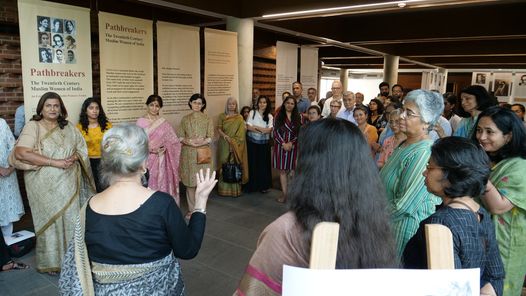
An interesting travelling exhibition is set for a re-run in New Delhi once the pandemic containment rules are eased further. Titled ‘Pathbreakers: The 20th Century Muslim Women of India’, it showcases 21 Indian Muslim women who broke the proverbial glass ceiling and refused to be stereotyped. The exhibition was earlier held in the national capital in 2018.
Speaking to the media in 2018, Syeda Hameed, chairperson of Muslim Women’s Forum (MVF), the organisation which assembled the exhibition, had said that the main idea was to bring to the forefront a galaxy of Indian Muslim women who contributed to nation building in various ways but largely remained unrecognised and unsung.
The women featured in the earlier exhibition include Anis Kidwai, Atiya Fyzee, Attia Hosain, Aziza Fatima Imam, Fathema Ismail, Hamida Habibullah, Hajrah Begum, Masuma Hosain Ali Khan, Mofida Ahmed, Mumtaz Jahan Haider, Qudsia Zaidi, Qudsia Aizaz Rasul, Razia Sajjad Zaheer, Saeeda Khurshid, Safia Jan Nisar Akhtar, Saliha Abid Hussain, Sharifa Hamid Ali, Siddiqa Kidwai, Surayya Tayabji, Tyeba Khedive Jung, and Zehra Ali Yavar Jung. Most of them left their marks in fields as diverse as politics, literature and social work.
Muslim Women’s Forum / 5 months ago / facebook.com
Tyeba Khedive Jung, the first Indian Muslim woman to receive a university degree in 1894, wrote a feminist novel ‘Anwari Begum’ way back in 1905 that spoke about women’s emancipation, and also chaired an annual conference of Brahmo Samaj, a Hindu reformist organisation. Sharifa Hamid Ali was a member of the Constituent Assembly. Although the jury is still out about who designed the Indian National Flag, according to many it was Surayya Tayabji who was responsible for the inclusion of the Ashok Chakra. Qudsia Zaidi, among other things, is famous as the founder of the Hindustani Theatre in 1955, said to be Delhi’s first post-independence professional theatre troupe. Fathema Ismail was instrumental in opening rehab clinics for children suffering from polio.
The exhibition was visiting Bengaluru just before the COVID-19 related lockdown was implemented.
source: http://www.outlookindia.com / Outlook Traveller / Home> Explore > Story / by Uttara Gangopadhyay /August 14th, 2020
At a time when people are turning on their old parents or sick family members, a 48-year-old auto driver, Mohammed Khalid , has become a hero of sorts for those who are dealing with the ongoing COVID-19 pandemic. Unlike most others who would think twice before ferrying across patients, Khalid has been providing service to COVID-19 patients those who require transportation.
Mohammed, since July 13 has been only providing transportation to people from Gandhi Hospital to private and government hospitals as and when required. Moreover, he also privodes service to COVID-19 patients to others from any part of Hyderabad as well. “This is the time to help people in need, irrespective of cast and culture I have been regularly ferrying COVID-19 patients from Gandhi Hospital to Osmania, King Koti, and Fever Hospital,” stated Khalid.
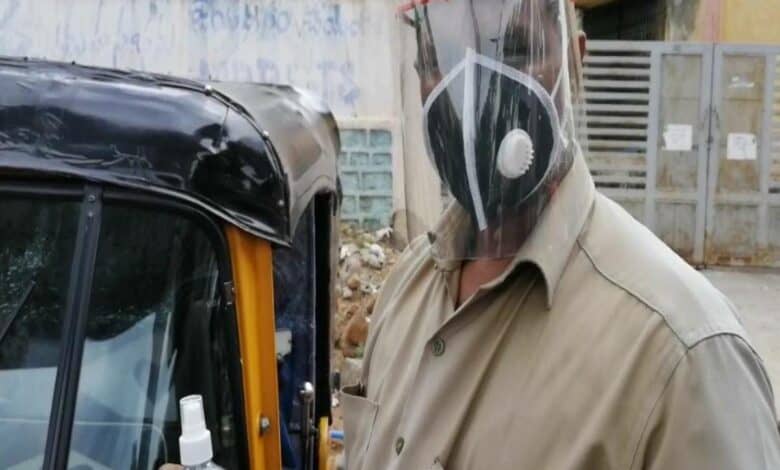
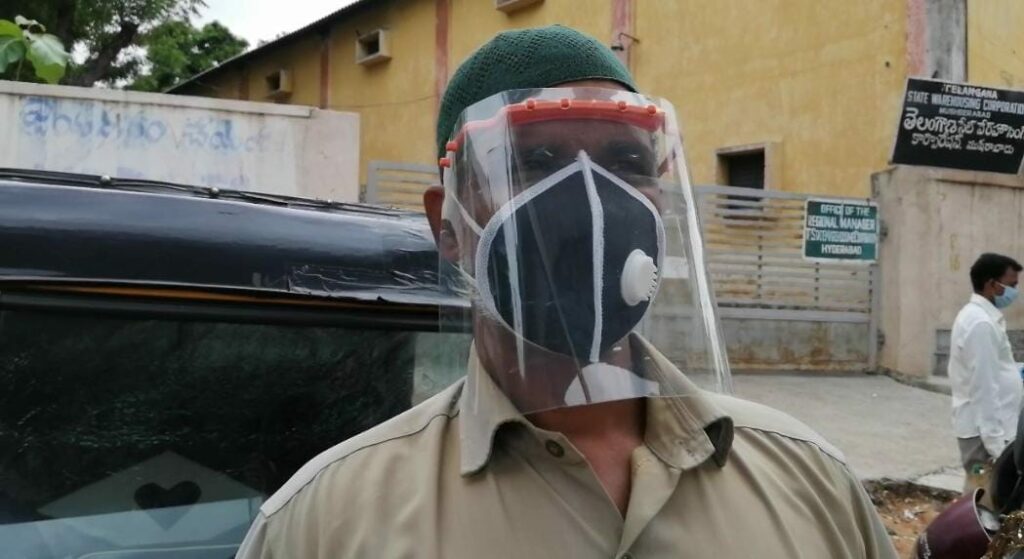
Mohammed Khalid ensures safety measures for his passengers.
Even after the Centre relaxed lockdown rules a few months (post May) ago, there has been a dearth in passengers, recalled Khalid. “So on July 13 I went near Gandhi Hospital in Musheerabad, the main treatment centre for COVID-19 patients, and noticed that emergency patients were unable to get ambulance services as there were many cases. Then I decided to start service for them at affordable rates,” said Khalid.
The 48-year-old believes that in these difficult times, we must help each other irrespective of any religion, caste or creed. “Sab jane dare to kaisa jo log bimaar hai unlo ku kaun lekar jainga dawakhano ku (If everyone is scared, then how will people travel to the hospital)” Khalid rhetorically questioned? He has a point however, as several citizens have been complaining of slow or lack of ambulance services.
Mohammed Khalid provides service to COVID-19 patients at Gandhi Hospital in Musheerabad.
The auto rickshaw driver is also not scared of the pandemic. Furthermore, going and waiting for passengers in front of Gandhi makes him proud of what he is doing. “Carrying a patient itself is a matter of pride for me, and sharing the happiness with those who have recovered is amazing,” Khalid added. He also felt that the Telangana government should provide some monetary relief or schemes for autorickshaw drivers, as they have also been hit hard due to the lockdown.
source: http://www.siasat.com / The Siasat Daily / Home> News> Hyderabad News / by Mohammed Hussain / August 24th, 2020
Triben generally refers to the confluence of the three rivers Ganga, Yamuna and the illusive Saraswati near Allahabad.
But the Hooghly district of West Bengal also houses another Tribeni, where the Bhagarati or Hooghly River disintegrates into three branches. The three branches are Hooghly, Sarswati and Jamuna (Kanchrapara Khal).
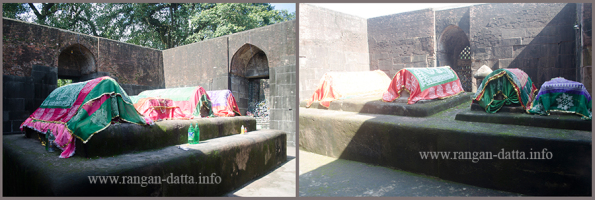
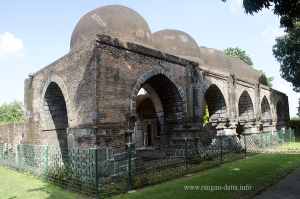
Zafar Khan Gazi Masjid, Tribeni, Hooghly
So like the Prayag near Allabahad, the Tribeni of Hooghly has also attracted pilgrims for centuries and is mentioned in ancient Bengali literature like the Mansamangal and Chandimangal .
Today Tribeni is located about 70 km north of Kolkata on the Bendel – Katwa rail line and is approachable both from Howrah and Sealdah by train.
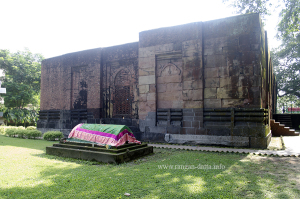
Dargah of Zafar Khan, with a grave outside it, Tribeni
Today the prime attraction of Tribeni is the Dargah of Zafar Khan Gazi. The dargah is located on a small mound over looking the Hooghly river.
It is housed inside a walled complex which also contains a mosque and several other scattered tomb. It remains an active religious site.
The mosque is not only the oldest Mosque in West Bengal but also happens to be the oldest Islamic structure in the whole of undivided Bengal.
Zafar Khan was a general of Delhi Sultan Feroze Shah, who invaded Hooghly in the late 13th century, he defeated the local Hindu king and established the Turkish rule in Bengal.
Zafar Khan settled in Tribeni as he was mesmerized by the beauty of the Hooghly River. The locals started considering him as a learned man and he came to be know as Zafar Khan Gazi. But soon after Zafar Khan was killed in a battle with another Hindu king of the region.
Inside the Zafar Khan Gazi Dargah. L: Eastern Chamber, R: Western Chamber with Zafar Khan’s grave at the extreme right
The Dargah was constructed in 1315 and is located on the eastern end of the walled complex. It has two chambers and the roof has long collapsed. The western chamber contains the grave of Zafar Khan along with the graves of his two sons Ain Khan Ghazi and Ghain Khan Ghazi. The fourth grave in the complex and the wife of Ughwan Khan, another son of Zafar Khan Gazi.
The eastern complex houses the grave of Zafar Khan’s third son Barkhan Ghazi. He is buried along with and his two sons Rahim Khan Ghazi and Karim Khan Ghazi. The identity of one tomb remains unknown but it shape suggests it belongs to a woman.
The Dargah is located on a high plinth and both the chambers are approached by flight of stairs. Both the chambers are provided with Jali screens allowing sunlight to filter into the chambers.
Both the mosque and the dargah are built with a combination of stone and bricks, some thing quiet unusual in the land famous for terracotta.
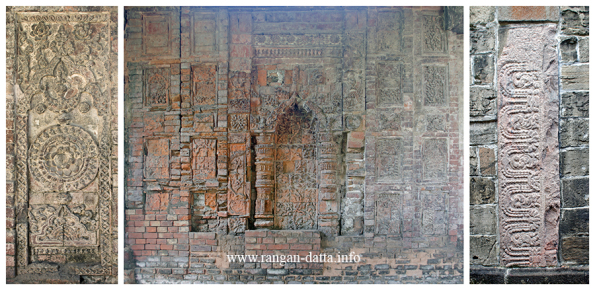
Both the most unique feature of the Dargah and the Mosque is the presence of several Hindu motifs and symbols in its walls.
Hindu ornamentation from the outer walls of the Dargah of Zafar Khan Gazi, Tribeni, Hooghly
Both the structure contains stone panels of Hindu deities but most of them have been chiseled off leaving an faint imprint. It is quiet likely these motifs were removed from abandoned or demolished Hindu Temple and were used in the construction of the Mosque and Dargah.
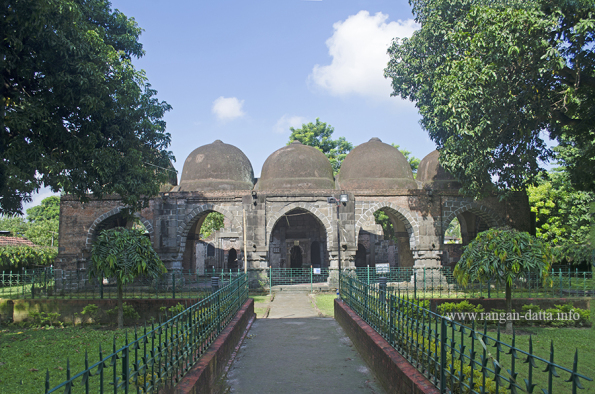
Mosque of Zafar Khan Gazi, Tribeni
The rectangular Mosque measures 76 feet by 36 feet and dates back to 1292. It has five arched entrance in the front and two aisles create 10 squares, each of which is topped by a dome. Sadly only 6 of the 10 domes can be seen to this day.
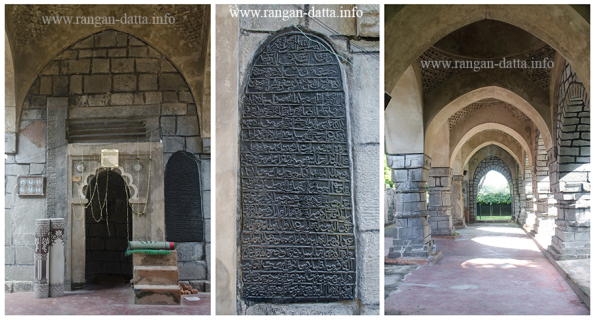
The Zafar Khan Mosque, Tribeni. L: Central Mihrab, C: An Arabic Inscription and R: Arched aisle
There are five mihrabs on the western wall, out of which three are more or less intact. The central mihrab is ornamental and is made of stone. The two miharab flanking the central mihrab is made of bricks with beautiful terracotta ornamentation. Like the Dargah the Mosque also contains ornamentation from temples.
Ornamentation inside the Zafar Khan Gazi Mosque, Tribeni, Hooghly
A trip to Tribeni is never complete without the visit to nearby Bansberia Bansberia famous for its Haneswari Temple and Ananta Basudev Temple.
source: http://www.rangandatta.wordpress.com / Rangan Datta / Home> Bengal Archaeology, Bengal History, General / by Rangan Datta / photographs : www.rangan-datta.info / December 01st, 2016
Hyder Ali, who is famously known as ‘the Nepoleon of South India’ for his relentless fighting against the conspiracies of the East India Company and its henchmen and for checkmating the British ambitions of expansion in South India, was born in 1722 at Devanahalli village, Karnataka state. His father was Fateh Mohammad Ali and mother Mujidan Begum.
Though he did not have any formal learning, he received training in martial arts. Hyder Ali was sharp in intellect, strong in will, capable of handling multiple tasks simultaneously and was brave at heart.
He had participated in Devanahalli war in 1749 as a young soldier of Mysore State. Recognizing his gallantry, Nanjaraj, the Minister of Mysore kingdom, honoured Hyder Ali with the title of ‘Khan’ and promoted him as the Chief of a battalion in the Mysore army.
They attacked Mysore several times with the help of the East India Company.
Though Hyder Ali suffered initial losses, he resisted them successfully and proved a virtual nightmare to East India Company. Even then, the British rulers provoked Hyder Ali again which led to the second Mysore war in July 1780. He went to the battlefield along with his son, Tipu Sultan.
While Hyder Ali captured the Arcot, his son Tipu defeated the East India Company troops and captured Kanjeevaram, which was about 50 miles from Madras. This sent shivers to Warren Hastings, the Governor General of East India Company.
He immediately sent additional troops from Culcutta, Madras with abundant funds under the control of his Commander General, Sir Eyre Coote. While fighting against the foreign enemy on one side, Hyder Ali and Tipu Sultan taught a befitting lesson to Malabar Nayars and chieftains, who revolted against him with the active support of Nizam of Hyderbad.
Hyder Ali, while leading his troops towards successive victories, fell ill and died in the battlefield on 7 December, 1782, near Narasingarayuni Peta village, which is now in Chitoor district of Andhra Pradesh.
source: http://www.siasat.com / The Siasat Daily / Home> Featured News / by Nihad Amani / August 22nd, 2020
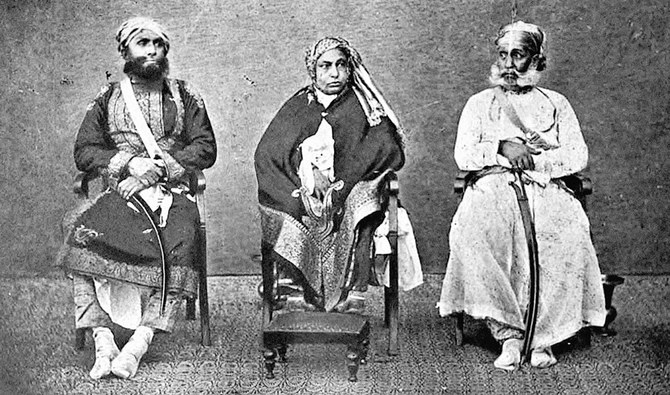
Sikandar Begum with her prime minister, left, and second minister. The photo was published in “A Pilgrimage to Mecca” (1870). (The Asiatic Society of Bombay via AN)
One of the most interesting aspects of Sikandar Begum’s account is her open criticism of Ottoman governance in Makkah
Imprecise library records obscured access to the original Urdu manuscript for decades
Warsaw :
History recently came to life in a manuscript with royal stamps discovered in the archives of SOAS University of London. The historic find? A tantalizing insight into the journey of the first ruler from the Indian subcontinent to set out for Hajj.
In November 1863, the ruler of the princely state of Bhopal, Sikandar Begum, began the sacred pilgrimage many other sovereigns of her time could not make for fear of losing power — in the 19th century, sea travel from India to Makkah meant long months of absence from the throne. Unlike them, Sikandar was safe. Her Hajj included a mission to compile a travelogue for those who guaranteed her reign.
Bhopal had gained independence from the declining Mughal Empire under Dost Mohammad Khan, a Pashtun warrior who, in the early 18th century, founded the Muslim state in today’s Madhya Pradesh. Under British rule, for more than a century the country was led by four women. Sikandar, who ruled from 1844 to 1868, was the most reform-oriented of them. She reorganized the army, appointed a consultative assembly and invested in free education for girls. She was also the first Indian ruler to replace Persian with vernacular Urdu as the official language.
In late January, SOAS librarians came across a title recorded in their archives’ catalogue as “‘Journal of a trip to Mecca’ by Skandar Baigam, Ra’isah’ of Bhopal. Bound manuscript in Urdu. Written at the suggestion of Major-General Sir Henry Marion Durand, 1883.”
“I was really intrigued that such a beautifully bound-in-silk manuscript with obvious royal stamps in its colophon could be linked to such an opaque and short library record,” SOAS Special Collections curator Dominique Akhoun-Schwarb told Arab News.
“It quickly became obvious that there was a bit more story and depth behind the note ‘written at the suggestion of Major-General Sir Henry Durand,’ when the author was a queen herself, a pioneer, since she was the first Indian ruler to have performed the Hajj and authored an account of her pilgrimage.”
The imprecise note had for decades obscured access to the text for researchers. A deformed transliteration of Sikandar’s name had compounded the issue.
Until the chance discovery a few months ago, all scholarship on the Bhopal ruler’s pilgrimage had to rely on two translations of the text as the original Urdu version had been missing for some 150 years. One was the abridgment of Sikandar’s account in Persian, compiled by her daughter, Shah Jahan Begum. The other one, “A Pilgrimage to Mecca, was an English translation by Emma Laura Willoughby-Osborne, wife of a British political agent in Bhopal, which was published in 1870, two years after Sikandar’s death. The two texts are quite different.
In the English version, Sikandar quotes a letter she received from Durand, the British colonial administrator mentioned in the SOAS record, and his wife: “He was anxious to hear what my impressions of Arabia generally, and of Mecca, in particular, might be. I replied that when I returned to Bhopal from the pilgrimage, I would comply with their request, and the present narrative is the result of that promise.”
The letter is nowhere to be found in the Persian text.
A preliminary reading by Arab News of the Urdu manuscript, which has been digitized by SOAS, reveals that Durand’s letter is mentioned in the very first pages of the text. The correspondence and accuracy of other parts, however, are not immediately obvious.
In the preface to “A Pilgrimage to Mecca,” Osborne said that the Urdu manuscript consisted of “rough notes” demanding some arrangement. According to Dr. Piotr Bachtin, from the Department of Iranian Studies of the University of Warsaw, who studied female pilgrimage of the era and translated the Persian version of Sikandar’s account, the English translator’s note immediately raises questions regarding Osborne’s interference in the text.
Osborne’s assurance that the only license she had allowed herself had been the “occasional transposition of a paragraph” seems to be an understatement. It appears that the text was heavily edited. Bachtin suggested that Sikandar might have been a “reporter” entrusted with a specific task and became an “incidental informer” in the service of the British Empire.
The most interesting aspect of the travelogue, which the manuscript may verify, was Sikandar’s political involvement with and open criticism of Ottoman governance in Makkah. One of the most prominent instances of Sikandar’s criticism is the following:
“The Sultan of Turkey gives thirty lakhs of rupees a year for the expenses incurred in keeping up the holy places at Mecca and Medina. But there is neither cleanliness in the city, nor are there any good arrangements made within the precincts of the shrines,” Sikandar wrote, adding that had the money been given to her, she would have made arrangements for a state of order and cleanliness. “I, in a few days, would effect a complete reformation!”
Sikandar’s political commentary is completely missing from the Persian version of her text. “Only in the English translation did she openly criticize both the Pasha and the Sharif of Makkah, going as far as to say that she would have managed Makkah better herself!” Bachtin said, “However, we must remember that her book was commissioned by Sir Henry Marion Durand. For me, this paradoxical dynamic is particularly interesting.”
With the original manuscript now available to researchers, further study should soon reveal how much of the Hajj account was informed by the colonial circumstances Sikandar faced at home, and to what extent it was guided by her own ambitions to be a modern and reformist Muslim ruler.
source: http://www.arabnews.com /Arab News / Home> Latest News> Middle East / by Natalia Laskowska / August 02nd, 2020
Sadia Dehlvi, master storyteller who chronicled capital, dies at 62
Dehlvi was also a close friend of celebrated author Khushwant Singh, who dedicated his book Not a Nice Man to Know to her. (File)
Of all the roles that 62-year-old Sadia Dehlvi played in her life, the one she mastered was that of a storyteller. From her childhood memories, she dug out stories of “nihari Sundays” at home, the jinns that inhabited Shama Kothi where the Dehlvis lived, and the family’s contribution to society in the form of the iconic Urdu and Hindi magazines called Shama and Sushma.
On Wednesday night, Dehlvi — author, activist and food connoisseur — passed away after a long battle with cancer. She had been admitted to the hospital for a few days, and on August 1, her son Arman Ali Dehlvi posted a “cancer treatment fundraiser request” for his mother on social media. A close friend of Dehlvi’s said she passed away at home on Wednesday night.
Activist John Dayal, who also knew Dehlvi’s father, told The Indian Express , “I wished her on her birthday in June, she was fighting cancer so bravely. Her family contributed immensely to the syncretic culture of the city, and so did she. She popularised Mughal cuisine with her writing.”
City chronicler Rana Safvi recalled several meetings with Dehlvi at the Nizamuddin Dargah. Safvi said, “I love her writing, especially her book The Sufi Courtyard: Dargahs of Delhi. I used to often see her at the Dargah… With her gone, the dargahs will feel empty.”
Apart from The Sufi Courtyard, Dehlvi also wrote Sufism: The Heart of Islam in 2009, and Jasmine and Jinns: Memories and Recipes of My Delhi in 2017. She also scripted the hugely popular TV show, Amma and Family, starring Zohra Sehgal. Dehlvi founded Al Kauser, the restaurant in Chanakyapuri, with her mother in 1979.
In 2017, she had told The Indian Express, “Al Kauser was the first roadside kebab shop in New Delhi. It became quite the rage in the ’80s and ’90s. The kitchen was in our house.”
The Dehlvis, who were essentially traders, moved to Delhi in the early-17th Century and took the name “Dehlvi”, which means “the one from Dehli (Delhi),” said writer Sohail Hashmi. “The family started publishing Shama, one of the first Urdu magazines on Hindi cinema, which also served as a quasi-literary magazine. Then came Sushma, a magazine in Hindi. Actor Dilip Kumar was a patron of the magazines,” he said.
Dehlvi was also a close friend of celebrated author Khushwant Singh, who dedicated his book Not a Nice Man to Know to her.
Later, Dehlvi produced a television serial called Not A Nice Man to Know, in which Singh was the anchor.
source: http://www.indianexpress.com / The Indian Express / Home> Books and Literature / by Somya Lakhani / New Delhi / August 06th, 2020