Once the land on which the Jino-ki-Masjid and the Dargah was build was to the tune of 600 acre.
Hyderabad :
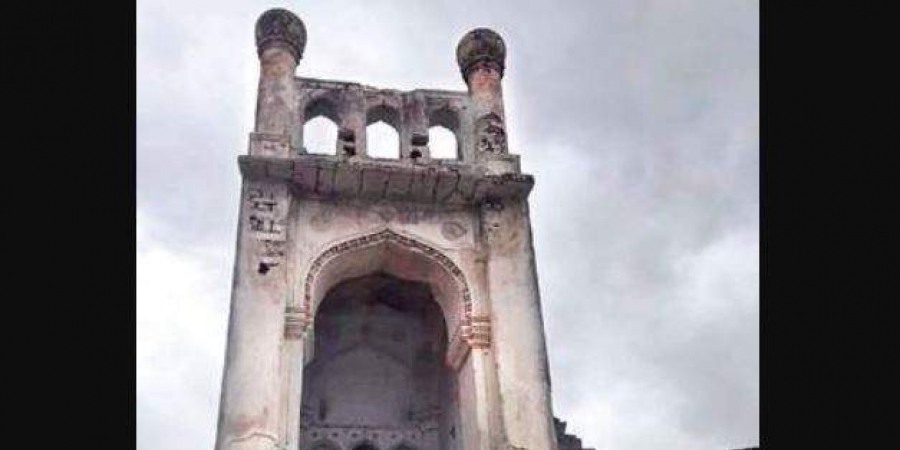
Located a stone’s throw away from the Dargah Hazrath Syed Shah Imaad Uddin Mahmood Al Hussaini, a nondescript structure stands out in front of the scenic hilltop on the banks of Mir Alam tank. This Qutub Shahi structure, popularly known as the Jino-ki-Masjid, may well be the ‘smallest mosque’ in the world.
Less than 10 sq m in area, this structure has the traditional elements of Qutub Shahi architecture including turrets and a big arch, under which there is a small space for devotees to pray. However, although it is located within the complex of the Dargah, the small structure stands dilapidated. The lime plaster has given away at various places, revealing the skeletal brickwork underneath.
The turrets are also broken at places, and so arch. The way to the mosque is also rocky, with no clear path. The mosque’s state could very well pose as a risk for visitors. The mosque gains importance as the Dargah complex was home to Syed Shah Imamuddin Husaini alias Mir Mahmood Nimatullahi, one of the oldest sufis of Hyderabad. In ‘Landmarks of the Deccan’, its author Syed Ali Asgar Bilgrami wrote, “He first came to Hyderabad from Najaf (Mesopotamia) during the reign of Sultan Abdullah Qutub Shah and stayed on this hillock.”
Mahmood had laid several buildings erected on this hill. “The mason who worked here were paid over and above the wages and the pregnant women-labourers were paid double the wages,” Landmarks of the Deccan said, adding that since no one knew his source of income, “it was a general belief that the Saint had some supernatural means of income”.
Once the land on which the Jino-ki-Masjid and the Dargah was build was to the tune of 600 acre. However, now, with time, most of it is occupied with houses built on one side of the hillock. The place comes alive during Urs, usually held on the 13th Shaban of the Islamic Calender, which was on April 19. During that time, many visit the Dargah, and hence it becomes important to conserve and repair the ‘smallest mosque’.
source: http://www.newindianexpress.com / The New Indian Express / Home> States> Telangana / by Express News Service / April 23rd, 2019
Conservation architect Vikas Dilawari’s work on Worli shrine is a significant chapter in the city’s built heritage
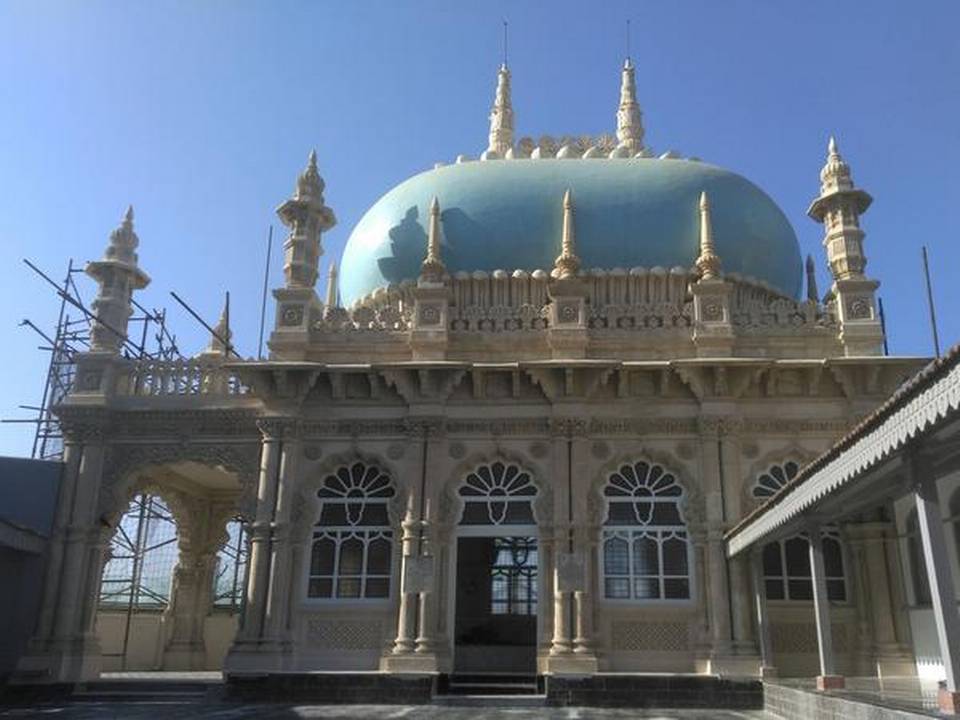
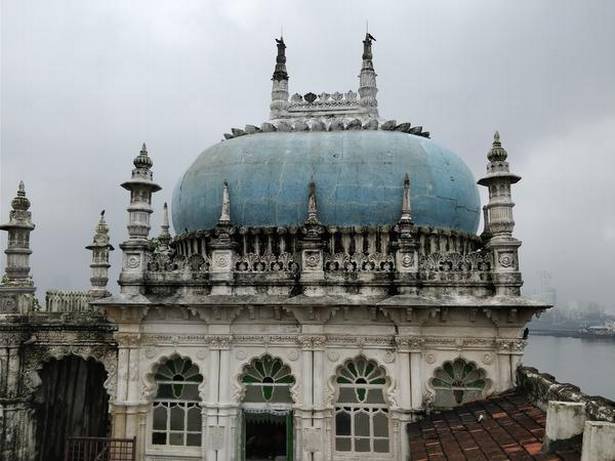
Cocooned in the shielding hold of the bay, just off the arterial, traffic-clogged road that hugs the coastline, is the 111-year-old Ma Hajiani Dargah, restored to its former glory. The restoration of the building began in November 2017 and was completed by conservation architect Vikas Dilawari on April 19, which also marked the eve of Shab-e-Baraat.
The dargah is one of the lesser-known spots of quiet in the city, often interchanged with the more popular Haji Ali Dargah, a stone’s throw away. Built in 1908 when Sir George Sydenham was the Governor of Bombay — primarily in Porbandar stone and basalt ashlar plinth — it is an ideal example of Indo-Saracenic architecture. Subtle influences of the colonial style of construction are evident, particularly in the ornamental work. “This is a very unique building. It is a magical place, of tranquillity, at the tip of the land on a natural rocky outcrop, elevated so gracefully,” Mr. Dilawari said.
Over the years, the dargah’s neighbouring plots of land were sold to private developers. The towering Samudra Mahal — a piece of prime real estate — was where the residence of the Scindias of Gwalior once stood, before being demolished in 1960. “Until a few decades ago, the Mahalakshmi temple, the Haji Ali Dargah, and the Ma Hajiani Dargah would have been the beacons along the coast of Bombay. The proliferation of high-rises without appropriate urban design is certainly impacting the pristine setting, and this might change further with the introduction of the impending coastal road,” Mr. Dilawari said.
A nautical past
The dargah is the site of three graves: Ma Hajiani, Haji Ismail Hasham Yusuf, and his son, Sir Mohamed Yusuf, draped in red and green brocaded chaddars and rose petals. The Yusuf family has been eminent in shipping trade and philanthropy in the city. Haji Ismail Hasham Yusuf founded the Bombay Steam Navigation Company in the late 19th century, and established the erstwhile Marine College at Rashid Mansion in Worli as a charitable institute, later moved to the island of Nhava and still functional as Training Ship Rahaman.
The mausoleum is built in honour of Ma Hajiani, a saint believed to be the sister of Saint Pir Haji Ali Shah Bukhari. The Haji Ali Dargah, houses the tomb of the latter. According to legend, they died at sea and their bodies were washed ashore, a few metres from each other. They were then buried at the respective spots they were found. Subsequently, two tombs were built — Haji Ali for the brother and Ma Hajiani for the sister. At the Ma Hajiani Dargah, women have always been allowed to access the maqbara. Women frequent in large numbers, making offerings of red or green glass bangles: red indicating one’s wish for marriage, and green for offspring.
source: http://www.thehindu.com / The Hindu / Home> Society> History & Culture / by Khorshed Deboo / Mumbai – April 23rd, 2019
A vivid piece of maritime history is hidden in the memories of the cooks and deckhands who once sailed off the Malabar coast
By noon, the sun would heat up the vast blue expanse through which they sailed at great risk to their lives. By evening, when salt and dirt clung to their bodies, the skies would turn crimson, symbolising streaks of revolt. Later, weather permitting, the shimmering stars would give them clues to the voyage that lay ahead through the inky waters of the Arabian Sea, often to the Persian Gulf. On the shore, they would unload the goods they had loaded on to the wooden dhows: timber, bamboo, coconuts, tapioca, tiles, salt, sugar, fertilizers. And sometimes, hidden among the cargo, people .Being smuggled to the far shores.
But even when they returned to their homes in Kerala, none of the deckhands of the dhows wrote about their experiences; in fact they actively strove to forget this tempestuous period in their lives that ended when better transportation facilities arrived. It’s been nearly four decades since these traditional vessels with their distinctive masts set sail from the Malabar coast, either along the coastline or farther afield. But it’s only now that the world has begun to hear the stories of these intrepid men, an integral part of the maritime history of peninsular India.
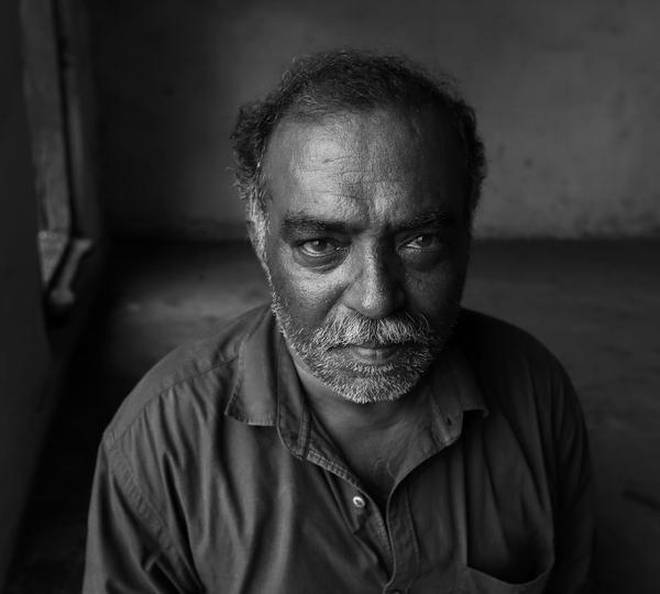
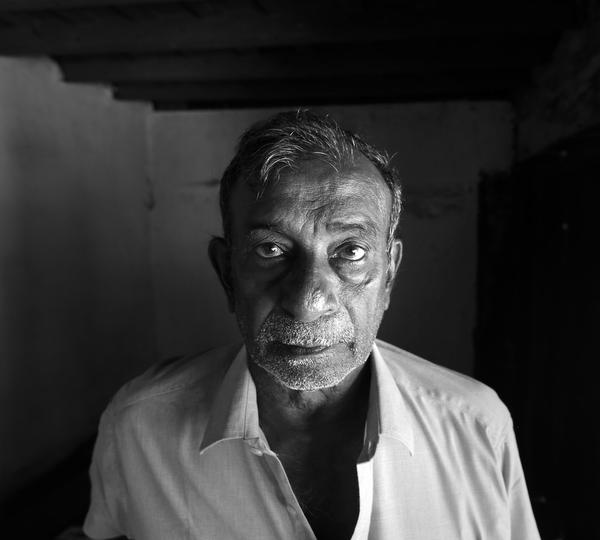
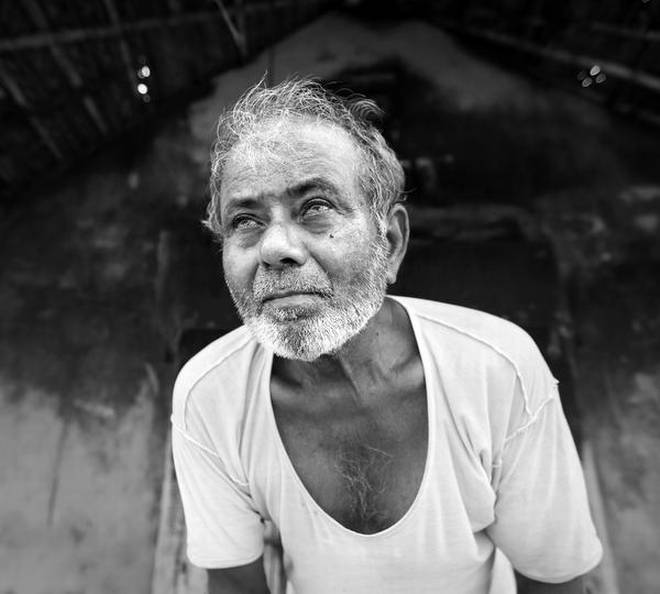
And this is thanks to a photo artist from Kerala’s port town of Kodungallur, around which scholars speculate the ancient Muziris harbour existed until destroyed by the 1341 calamity. K.R. Sunil’s photographs, a series titled ‘Manchukkar — The Seafarers of Malabar’, captures the faces of 34 deckhands. It was on show last month at URU Art Harbour in Kochi. Through them we learn of the misery of people caught in a vortex of exploitation and unshielded from nature’s furies.
Bare frames
The faces are stark, the frames bare. But every black-and-white image tells a story. Of how poverty forced pre-teen boys to pack themselves off in an uru or sailing vessel on long-distance voyages battling rough seas and uncertainty for weeks on end, and then return home — if lucky — only to set off on another strenuous voyage. Years would pass, the boys would turn into middle-aged men. Then, seen as worthy of nothing else, plagued by ill-health, they would be sent home, discarded like boats with rotten hulls.
T. Ibrahim is now 80 and lives an unremarkable life in Ponnani, a fishing town in Malappuram district. He considers himself fortunate to have lived this long. As a youth, he recalls how he once sailed a dhow laden with tiles and a dozen sailors that got caught in a storm on its way to Ratnagiri in Maharashtra. Ibrahim joined his panicked colleagues and began jettisoning cargo. The vessel sank nevertheless. “Some of them managed to get away on a lifeboat. Ibrahim and four others held on to a piece of wood and floated for two days,” says Sunil, recalling his meetings with Ibrahim.
Ibrahim’s …
The youngest in Sunil’s photo series is also called Ibrahim, or simply Umboocha. Now 53, the man from Kasargod, along the Karnataka border, had his final sailing trips on motorised dhows in the 1990s. Memories of manchu, as the boat is called in his part of Malabar, where people also speak Tulu and Kannada, still make him shudder. Their vessel once sank during a cyclone when they were bound for Iran. They roped together emptied cargo barrels and drifted on the improvised float for three days. Rescue came, but they landed in jail: all of them had lost their identity documents.
Siva Sankaran, also from Ponnani, remembers that his first trip on a dhow to Bombay took seven weeks instead of four days. Reason: bad weather. But tempests were just one part of the deckhands’ ordeal, says Sunil. From starvation to sexual exploitation to unhygienic conditions to taxing work hours, the voyages were invariably hellish. “Circus in the seas,” is how Abdul Rahiman, 68, recalls them. “One had to climb 50 feet up on swinging ropes to set the sail. You may have to do it deep in the night, when the boat is violently rolling,” Sunil quotes the sailor as recalling.
The artist’s first trip to Ponnani was in 2014, though it was only two and a half years ago that he turned his focus on these deckhands of yore. “As a child, I had heard a lot about Ponnani. We had country boats with merchandise travelling there from Kodungallur.” The town charmed him on his first visit and inspired several more. The next time he brought his camera along. A photo series from these trips was shown at the 2016 Kochi-Muziris Biennale.
Steeped in pathos
Then, four months before the biennale, Sunil stumbled upon an old man singing a song to his friends. “There was something curious about its lines and the tune steeped in pathos. I thought I should explore more,” he says.
This was T. Ibrahim and this wasn’t the only sailing song he knew. He had learnt several from Rasakh Haji, a merchant of essential oils who owned the boat in which Ibrahim was a deckhand. Haji had a talent for creating songs and had composed one about the dhow. They sailed together from Mumbai to Kerala and “the ditties seeped into Ibrahim too,” says Sunil.
Most deckhands began their careers as cooks (pandari) when they just 11 or 12 and were routinely sexually exploited. Those who moved up the ladder became deckhands or khalasi. The capable among them rose to become captains or srank.
Abdul Lathif thought himself lucky to become a deckhand at 17, but is now repulsed by the memories. “The boat’s woodwork was always infested with roaches and scorpions. You would see them floating even in the drinking water. We were covered with lice. The winter winds gave us mouth ulcers,” he trails off. “After unloading the goods, we would appy a mixture of oil, lime and ghee to the boat’s keel to prevent barnacles. The work was done standing in a slush of mud and human excrement.”
C.M. Ummar was a young man during the 70s when he crewed in dhows carrying people looking for work in West Asia. Illegally. “A couple of hundred job-seekers would be taken aboard along with the cargo. You’d hide them with a tarpaulin. And in the high seas, another boat would come to fetch them,” he recalls. “Sea-sick, they would sometimes plead to be taken back home. Getting them back was equally dangerous.”
Deaths weren’t uncommon — whether from falling from the mast or from disease. Hussain, 64, recalls a friend’s demise: “With a heavy heart we offered prayers, and buried him at sea with a rock tied to his body.”
The primary duty of Muhammad Koya, 81, was to smear kalpath, a mixture of coconut-fibre, cow-dung, sawdust and ghee, on the keel to plug gaps. “It involved holding one’s breath under water for long periods; the job affected Koya’s hearing,” notes Sunil, who is now in the process of making a documentary on this bit of “ignored history”.
Floating bodies
P. Ummar is 20 years younger than Koya, and recalls how armed pirates would sometimes rob their cargo. “Such encounters were common along the Maharashtra coast,” he says. Koran, now an oracle for the traditional Theyyam dance in Kasargod, talks of the dead bodies he saw floating near the Bombay port during his manchu days. He suspects this was from the smuggler-customs encounters.
Kochi, Kerala, 07/02/2019 : K K Khadher, from the series ‘Manchookar – The seafarers of Malabar’ by K R Sunil. Photo: Special arrangement
K.K. Kadar talks of how seasoned sailors would read signs of impending danger in “unusual changes in the colour of seawater, the rising froth, intertwined sea-snakes, dead fish…. they were indicators for the crew to prepare themselves for eventualities,” he says. Today, he is a public worker, and preoccupied with the 80th anniversary of a historic beedi workers’ strike that had once been held in Ponnani.
T.V. Moideenkutty …
For T.V. Moideenkutty, too, life is calmer. The 54-year-old lives on the tranquil shore of Ponnani with his family in a tile-roof house. He started life as a cook in a dhow and then worked as a deckhand for eight years. At least it staved off poverty, he says, smoking a beedi.
Life on the dhow taught him a lesson: the value of drinking water. “I learned the word for water in many languages, especially before hitting ‘Hindistan’ during our Mumbai voyages,” he says, retying his mundu and tucking it in at the waist.
The lighthouse near Moideenkutty’s house stands tall with its gas flasher scanning the ocean. Standing outside URU gallery, I can see the sea dotted with gleaming new-age ships filled with crew and cargo heading out to harbours around the world.
The Delhi-based journalist is a keen follower of Kerala’s traditional performing arts.
source: http://www.thehindu.com / The Hindu> Voyager> Society / by Sreevalsan Thiyyadi / April 13th, 2019
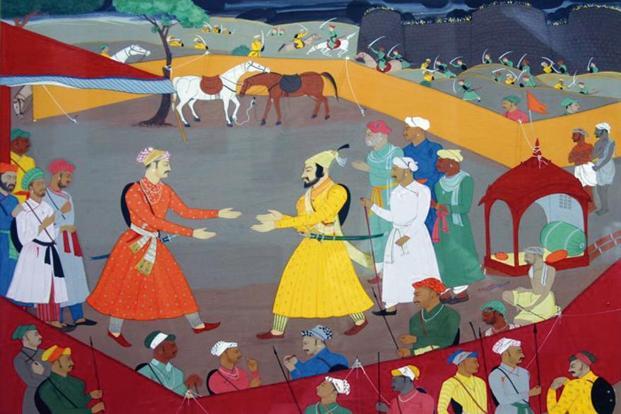
In 1674, Shivaji crowned himself king, with classical ritual in full display. Photo: Wikimedia Commons
By accepting the concept of the Thulukka Nachiyar, within the temple, was a space created to locate the newcomer Muslim within the world of the orthodox Hindu?
India is a mosaic of many curious tales. But very often, seemingly incongruous elements that reside in the realm of fable and myth end up lending an ironic congruence to the concrete world of men. Throughout Indian history, whenever politics has found itself at an awkward crossroads, a generous fabrication of mythology has helped ease the process. One prominent example is Shivaji’s—the Maratha warrior had emerged as a powerful force in the late 17th century, with armies, treasure, and swathes of territory at his command. But rivals painted him merely as an over-strong rebel, so that in addition to power, what he needed was legitimacy too.
The answer to Shivaji’s woes came in 1674, when he decided to crown himself king, with classical ritual in full and extravagant display. A genealogy was invented connecting him to an ancient royal line, and retrospective rituals permitted him to take his place as a “pure” Kshatriya, when so far Brahmins had deemed him inferior in caste. It was a masterstroke: Shivaji now towered over other Maratha clans in status, while simultaneously alerting his Mughal enemies that he was no longer a “mountain rat”—he was an anointed, lawful monarch.
As a society too, India has been capable of negotiating disruptive changes through the invention of tradition. Reading scholar Richard H. Davis’ work recently reminded me of the bizarre, clever and typically Indian ways in which this was achieved. When Muslim might arrived in India in the form of invaders, a new chapter was inaugurated in the story of our subcontinent. The old order fell, and a different structure was fashioned. One way in which the elites on both sides tried to rationalize, in their respective world views, these painful changes is through what historian Aziz Ahmad called epics of conquest and resistance. Thus, for instance, we have Muslim accounts that exaggerated the “destruction of infidels”, when, in reality, even the terrifying Muhammad of Ghor’s coins prominently featured the “infidel” goddess Lakshmi, countered by Hindus with their own stories, the case of Padmavati preferring fire to the embrace of a Muslim being one such. Rhetoric was amplified on both sides, legends and tales competing for narrative dominance to come to grips with changes under way on the ground.
One such fascinating story from the 14th century features a Muslim woman recalled to this day by Hindus as Thulukka Nachiyar (literally, “Tughluq Princess”), who is said to have fallen in love with a Hindu god. The outline of the story is as follows: When Muslim troops from Delhi plundered temples in southern India, on their list was the great Vaishnava shrine at Srirangam in Tamil Nadu. Temple chronicles show that indeed idols were seized, and, in this story, the processional image of the deity is taken to Delhi. The reigning sultan consigns the idol to a storeroom, while a local Tamil woman, who had followed the troops, returns to Srirangam and informs the temple authorities of the precise whereabouts of their deity. Dozens of priests now make their way to court, where, after entertaining the sultan with a series of performances, they request the return of their lost idol. The cheerful Tughluq king is happy to grant them this, commanding his men to go to the storeroom and fetch Srirangam’s deity. Everyone is, at this point, rather pleased with the turn of events, and we have every hope of a happy ending.
This is where the twist occurs. It so happens that the sultan’s daughter had long before gone into the storeroom and collected the idol, taking it to her apartments and there playing with the deity as a doll. The implication, however, is that by dressing “him”, feeding him and garlanding him, as is done to deities in Hindu rituals, the princess was essentially worshipping the image, winning divine affection. When the appeal from the Srirangam party is heard, the deity puts her to sleep and agrees to return south, only for the Tughluq princess to wake up distraught—she hastens to catch up with the Brahmins, who meanwhile have split, one group hiding the idol in Tirupati. Arriving in Srirangam but not finding the deity even there, the princess perishes in the pangs of viraha (separation).
Her sacrifice is not for nothing, though. When eventually the deity comes home, He commands the priests to recognize his Muslim consort, commemorated ever since in a painting within the temple. On his processional tour of the premises, to this day, the deity is offered north Indian food at this spot (including chapatis).
The story is a remarkable one, with an exact parallel in the Melkote Thirunarayanapuram temple in Karnataka, where, in fact, she has been enshrined as a veiled idol. Though it seems unlikely that a Tughluq princess actually came to the south head over heels in love with a deity, could it have been that there was a Muslim woman instrumental in having idols released from Delhi? Or is it, as Davis suggests, a “counter-epic” where the roles are reversed: Instead of a Muslim king chasing after Hindu princesses, we have a Muslim princess besotted with the Hindu divine. By accepting the concept of the Thulukka Nachiyar, within the temple, was a space created to locate the newcomer Muslim within the world of the orthodox Hindu? The truth might lie in a combination of these possibilities, but we can be sure that it is a colourful, revealing narrative with a splendid cast, telling us once again that while there were moments of crisis between India’s faiths, legend and myth allowed them to see eye to eye and move on to fresh ground—a lesson we would be wise to remember in our own contentious times.
Medium Rare is a column on society, politics and history. Manu S. Pillai is the author of The Ivory Throne: Chronicles Of The House Of Travancore.
He tweets @UnamPIllai
source: http://www.livemint.com / LiveMint / Home> Explore / by Manu S. Pillai / March 30th, 2018
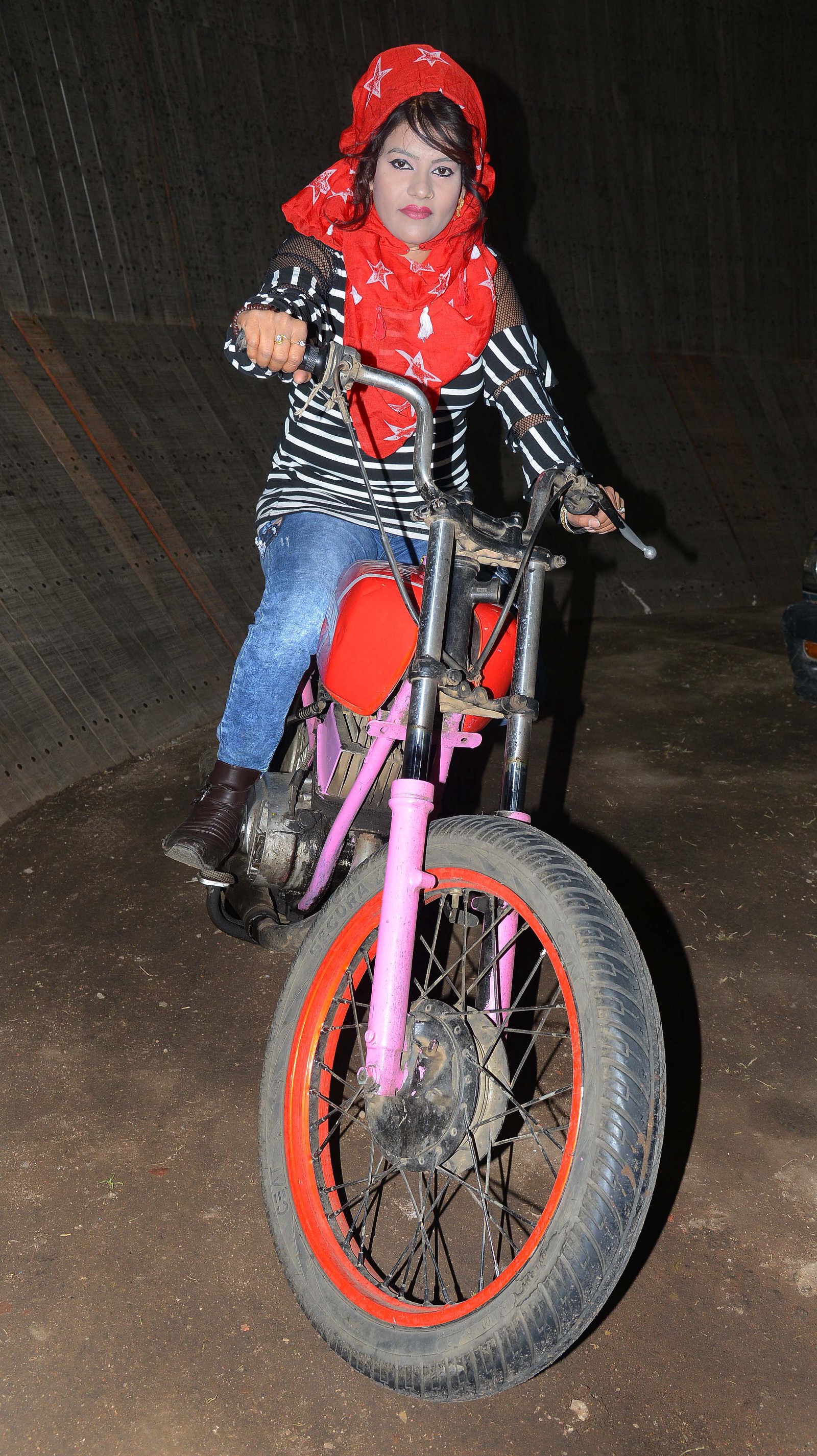
Rehana Khan, perhaps the first female stunt-woman to entertain the guests at Maut ka Kuan in Numaish, Hyderabad
28-year-old Rehana Khan
Numaish has been an integral part of every Hyderabadi, where year after year one doesn’t miss to take a stroll around the many stalls and rides. Not just the stalls but also the well of death — or maut ka kuan as it is popularly known — has always been a crowd-puller. Kids and adults alike would be excited to watch men get onto their bikes and cars as they take a round of the near-vertical pit with walls lined by wooden planks, at a high speed, often giving the audience a high five as they ride up!
However, this year the crowd hooted and cheered, as a stuntwoman made her entry and joined the team for the first time. 28-year-old Rehana Khan, who hails from Uttar Pradesh, has been performing stunts for the last six years and has been invited to be a part of Numaish for the first time.
Calling it her passion, Rehana says, “I would watch men do stunts on their bike and think to myself that if they can, then I can do it too. That is when I took it up as a challenge and started practising. It feels good that being a girl from a small town, I am doing something different, and not treading on the usual path.”
It’s been a little over two weeks and Hyderabad has welcomed the daredevil with open arms. “The audience here is very happy to watch my performance. They meet me after the show and I love the respect I have been getting. As girls have a bad (and clichéd) reputation for not riding properly on the road, when people see one attempt such deadly stunts, it leaves them in awe. Women feel happy and tell me that girls are not behind boys anymore,” she adds further.
Rehana stuns the audience at Numaish, Hyderabad
Stunts take Rehana to different parts of the country — Ranchi, places in Bihar and Chhattisgarh and Assam among others — but it is the respect she is getting in Hyderabad that she will “cherish forever”.
Rehana started practising right after college and it took her about six months to perfect the stunts. “If someone wants to pursue a career in it, they would require proper training. You have to make sure that you have no dizziness during or after riding on the ground. It would take a while for it to go, but once you get rid of it, the path ahead would seem easy,” she says adding, “Girls should try to create their own identity and not bow down to the stereotypes of the society. In today’s time, they are not behind men and can work as hard as them or even more.”
Her husband is always by her side, encouraging and proudly watching Rehana perform the stunts. “My family sees it as a dangerous profession but at the same time supports it since it is my passion,” she says adding that the money a stunt-woman earns is decent but it is the respect that she gets that makes it all worth.
Rehana stuns the audience at Numaish, Hyderabad
She entertains the audience from 5 to 11 pm every day with minimal breaks, but Rehana has no complaints and says with pride that she took the right path. “I wanted to be known for what I do, for the society to recognise me, to meet new people and to travel to different parts of the country showcasing my talent. Money is decent but what gives me happiness is to be among people, and be known for my talent. They respect you for taking up an unusual career. I must add that Hyderabad’s reaction has been very encouraging. I like it here,” concludes the daredevil, as she rushes to get ready for another show.
source: http://www.medium.com / Medium / Home / by Neha Jha / January 20th, 2019
A night’s stay in the hotel, which is set to open later this year, might cost up to Rs 8 lakh.
A view of the Great Scotland Yard (Photo | http://www.twenty14holdings.com)
Kochi :
Malayalee billionaire Yusuff Ali, who bought the Great Scotland Yard, which served as headquarters for the Metropolitan police in London, has converted it into a luxurious 5-star hotel. The renovation that cost Rs 685 cr. (£75 Million) was done in 3 years.
The business tycoon, who is chairman of Abu Dhabi-based retail giant LuLu Group had earlier bough the iconic building in 2015 for Rs 1000 crore (£110 Million). The renovated hotel is all set to open later this year and will be managed by the Hyatt Group.
When asked about the property, Yusuff Ali said: “This is a very prestigious project for us as this is one of the most well-known property not just in the UK but around the world. We have not left any stones unturned to make this the most sought-after hotel while retaining the essence of the original building, so that each of our guests get a truly memorable experience”.
Great Scotland Yard has special relevance in UK history as it was chosen by the then Prime Minister Sir Robert Peel as the headquarters for the Met police in 1829. Even after the renovation, the essence of the original building has been preserved.
The hotel will have 153 rooms and the tariff per night is expected to go up to Rs 7,79,842 (10,000 euro). These suites offer guests picturesque views of Nelson’s Column, Westminster Abbey and Buckingham Palace, making it one of the most unique locations in London.
The luxury hotel that is steeped in British political history will include references to the famous criminals of the time gone by. In a secret whisky bar, a decadent chandelier made of glass shards will be a nod to the Forty Elephants, the 19th-century gang of women known for smashing shop windows to steal jewellery. There will also be artwork by prisoners and old military uniforms.
Adeeb Ahamed, Son-in-law of Yusuff Ali and the Managing Director of Twenty14 Holdings, the hospitality arm of Lulu Group said, “Renovating the Great Scotland Yard building and unveiling the UK’s first Unbound Collection hotel will bring a truly individual and world-class hotel to London.
“The Great Scotland Yard is really an important part of the fabric of London and it is a great opportunity for us to be a part of the culture and legacy of this great city and help in its development. The Great Scotland Yard will be an enriching landmark in Westminster as a high-end luxury boutique hotel that recaptures the history, culture and essence of the London of yore.”
source: http://www.newindianexpress.com / The New Indian Express / Home> States> Kerala / by Express News Service / March 26th, 2019
The urs of Mughal emperor Shahjahan will be observed at the historic Taj Mahal for three days from April 2 next. Entry into Taj Mahal will be free for visitors after noon on April 2 and 3 while it will be free for the entire day on April 4.
Lakhs of devotees will throng the 17th century monument during the three-day event and will pay homage at the graves of Shahjahan and his wife Mumtaz, in whose memory the Taj Mahal was built.
On the last day, a ‘saptrangi chadar’ (multi-coloured bedsheet ) will be offered at the graves as part of a ritual. Sandalwood powder will be sprinkled on the grave too.
The urs of the Mughal king Shahjahan is celebrated on the 25, 26 and 27th day of Rajab, which falls of April 2, 3 and 4.
The Shahjahan urs committee will meet here on March 8 to decide on the arrangement and preparation to be made for the urs.
Officials said that a notification was issued by the ASI on the urs of Shahjahan. The administration will prepare a fool proof strategy to ensure full security to devotees attending the urs.
source: http://www.dailypioneer.com / The Pioneer / Home> State Editions> Lucknow / by PNS, Lucknow / March 06th, 2019
From the desk of Sunday magazine to a celebrated chef now on Netflix’s Chef’s Table, Asma Khan’s story is one of strength, confidence and ambition
The first British chef to make it to Chef’s Table, Asma Khan is also opening all-women kitchens in conflict zones in Syria(Ming Tang-Evans)
It is a funny feeling when a colleague from decades ago becomes a success in a totally different field. And it feels even stranger when you find yourself writing a profile of somebody you once knew as a sub-editor.
In 1990, when I edited Sunday magazine, a young girl came to see me to ask if she could try her hand at journalism. She worked at Lintas, the ad agency, she said, and wanted to do something different but not entirely unrelated.
I hired her on the spot and all of us in the office thought she was very bright and articulate. Then, a few months later, she announced that she was getting married, resigned from her position and went off to live in Cambridge with her new husband.
And that, I thought, was the last I would hear of Asma Khan.
Wrong, very wrong.
A few years ago, she sent me an email. She was now a chef in London, she wrote. Not only did she organise private dinners at home but she was also running a pop-up in a pub in Soho. Why didn’t I drop in and try her food?
I had to search my memory to remember Asma (time to be candid!) and when I asked old colleagues from the Sunday days, they said that they found it hard to believe that she was now a chef.
Then, in 2015, my friend Fay Maschler, London’s most influential critic, wrote about Asma’s pop-up. It was an unqualified rave review and she rated Asma’s little restaurant serving Kosha Mangsho and Kathi rolls ahead of most of London’s fancy Indian places.
The day the review came out, there was a line outside the pub where Asma ran her pop-up. It began raining but the people still continued queuing. Asma and her cooks were stunned. But like good Indians, they felt bad for the crowds. So they made little bowls of rice with dal and distributed them for free to those lining up. The gesture did not go unnoticed and every night after that, the small restaurant was packed. It became the cool place to go for people who wanted real Indian food.
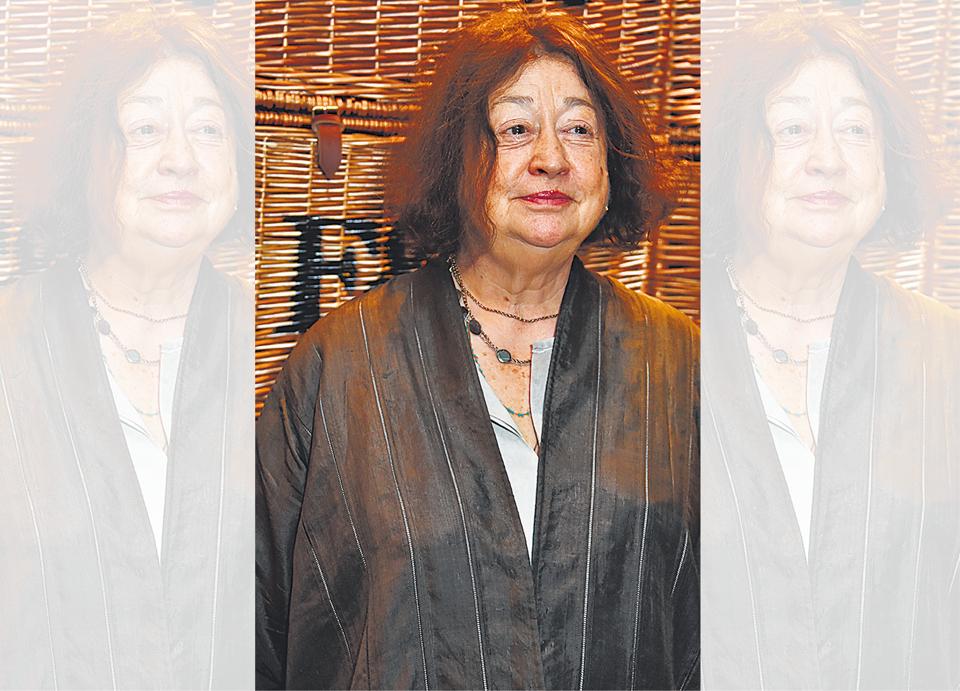
“Fay Maschler changed my life,” says Asma now. And indeed, the changes have been dramatic. A year and a half ago, the owners of Kingly Court, a new development off Carnaby Street in the centre of London, offered her a dream deal on a site for a full-fledged restaurant. The restaurant opened to glowing reviews and became a symbol of the new London. Nigella Lawson came. Sadiq Khan, the Mayor of London, praised it. And Asma appeared on the list of the 100 most influential people in food in the UK.
Fay Maschler, London’s most influential critic, discovered Asma
But a few months ago, Asma received her biggest accolade yet. The Netflix series Chef’s Table has featured some of the world’s greatest chefs. It has the power to turn a chef’s life around. Gaggan Anand says that even more than all the honours and awards he has earned (two stars from Michelin, number one restaurant in Asia for an unprecedented four years in a row etc.), it is Chef’s Table that made people from all over the world fly in to Bangkok to eat at his restaurant.
There has been much heartburn in the UK that no British chef has ever made it to Chef’s Table.
So when Netflix announced that it had finally selected a British chef, there was much anticipation. To everyone’s surprise, they chose Asma.
The show airs later this month and as I told Asma, her life will never be the same again. She will soon be one of the world’s most celebrated chefs, the best known Indian chef in the UK and perhaps globally, with the exception of Gaggan.
Chicken samosas served with spicy sesame and red chillies chutney, and tamarind chutney ( Ming Tang-Evans )
As wonderful as all this is, a little voice inside my head kept asking, “How did Asma, the same old Asma from the Sunday desk end up becoming one of the great chefs to be featured on Chef’s Table? Had she been a secret cook all along even as she laboured over copy? Had she worked at some of the world’s best restaurants? Had she reinvented classic Indian dishes?”
The answer: none of the above.
The Asma story is so incredible that if you made a movie with this plot, you would be accused of asking too much of the viewer. Suspension of disbelief is okay, but Asma’s life takes us far beyond that.
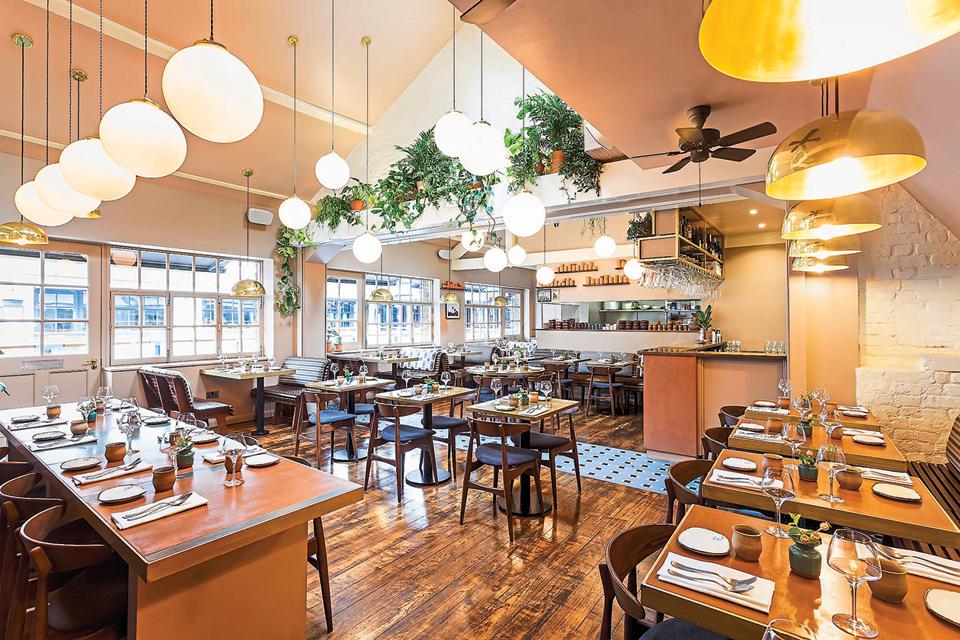
Darjeeling Express started as a dinner for 12 guests at home and is now a hugely successful restaurant ( Ming Tang-Evans )
She was born in Calcutta to a family with roots in nawabi culture (what we would call landed gentry, I guess). She had a standard middle-class upbringing (La Martiniere and Loreto) before going out to work (Lintas and then Sunday). Her parents introduced her to Mushtaq, a brilliant Bangladeshi economist who was a don at Sidney Sussex College in Cambridge. Asma and Mushtaq had, what was for all practical purposes, an arranged marriage and she moved to Cambridge.
Beetroot chops, Bengali spiced croquettes made with British beetroots ( Ming Tang-Evans )
She was miserable. “I thought the Quran had it wrong when it described hell,” she recalls. “Hell was Cambridge.” She hated the cold, the greyness, the drab English environment (especially after the sights, smells and sounds of Calcutta).
Asma’s book, a collection of authentic Indian recipes
Though her mother had run a catering business in Calcutta, Asma did not know how to cook. She could read copy, she could give clever headlines. But she had no kitchen experience. Fortunately Mushtaq had no interest in food.
So she turned to studying. She got a law degree, and then decided to do a PhD in law. By then, Mushtaq had shifted to the School of Oriental and African Studies in London so she applied to King’s College at London University. She talked the dons at King’s into letting her go directly to a doctorate without a Masters.
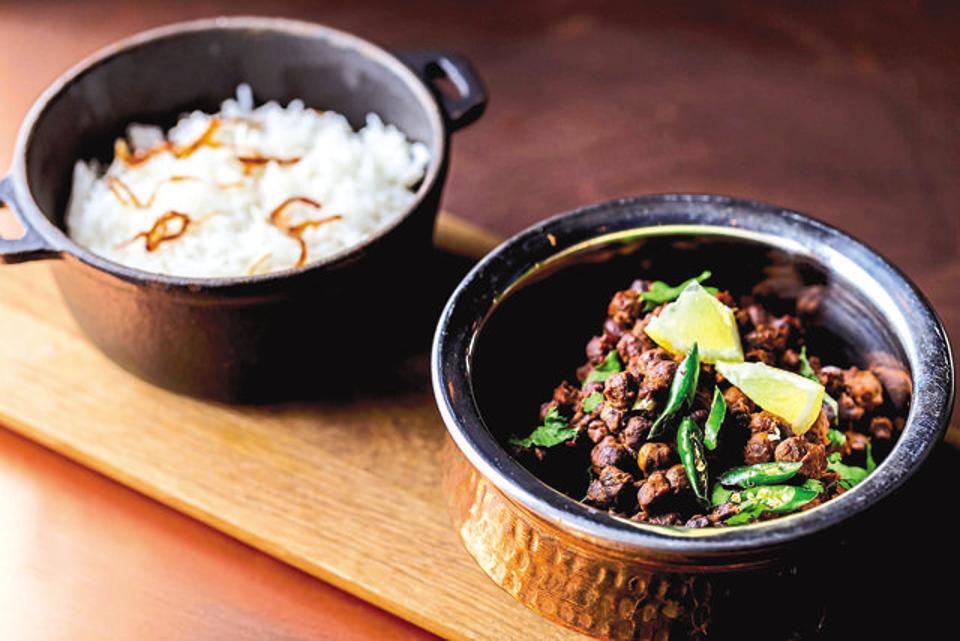
Black chickpeas (kaala channa) cooked with ginger and dried red chilies at Darjeeling Express ( Ming Tang-Evans )
She chose, for her thesis, a subject that was as far removed from Calcutta as possible: how the UK handles the separation of Church and State. But even as she was discussing whether the British monarch should be ‘defender of the faith’, a hitherto undiscovered cooking gene deep inside her reasserted itself.
Chef Vivek Singh offered Asma a pop-up at Cinnamon Club
She began to make the food of her ancestors, going back to old family recipes. Eventually, cooking became such an obsession that she started hosting pop-up dinners. Her husband disapproved of the idea so she cooked the dinners when he was travelling. (“We cleared up the house so well,” she laughs “that usko pata hi nahi chala!”)
But her two children, who were not happy with having the house taken over by strangers, complained to their father and soon the jig was up.
Asma is nothing if not super confident, so she called such famous London chefs as Cyrus Todiwala and Vivek Singh to her house for dinner to try her biryani. Even though none of them knew her, they came anyway. They were kind and encouraging. Vivek Singh was so impressed that he offered her a pop-up at his The Cinnamon Club restaurant. She took her all-women team of cooks and won over the all-male Cinnamon Club kitchen team. (“I will always be grateful to Vivek for that,” she says.)
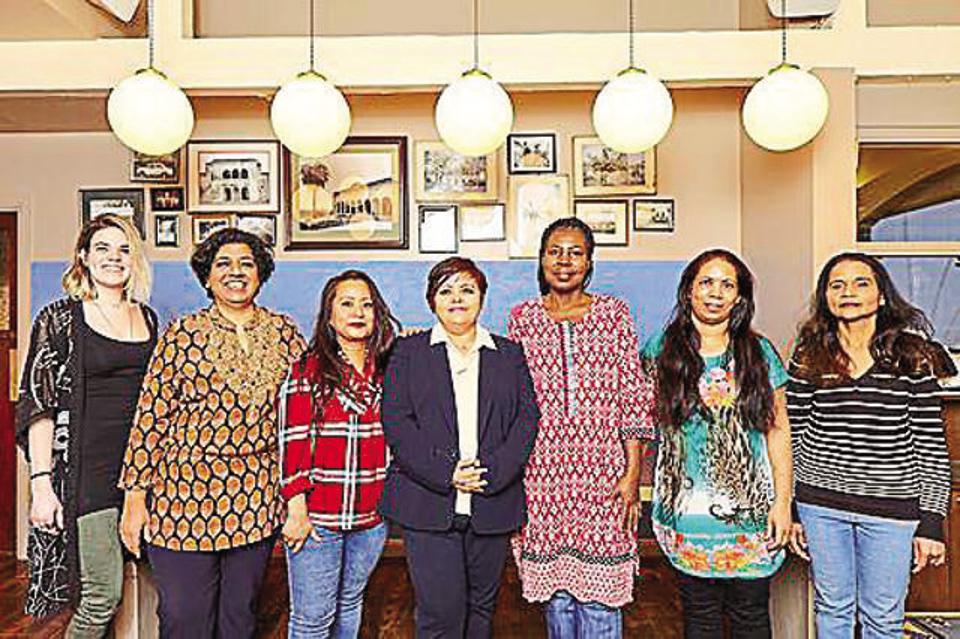
The all-women kitchen team at Darjeeling Express, London
That gave her the credibility to do a full-time pop-up. Word of her skills got out. Fay discovered her. And the rest is the stuff Chef’s Table episodes are made of.
Now, with the success of Darjeeling Express, Asma is well-known in London. People make much of her nearly all-women team. (My wife, who came to lunch at Darjeeling Express with me, loved the female energy; she was sold on the restaurant even before the first dish arrived.) Asma is overtly political, speaking out about sexual harassment in restaurant kitchens, breaking the conspiracy of silence that women in the business have gone along with and has become a symbol of the success that Asian women can find if they overcome prejudice and their own apprehensions.
But ultimately, I judge chefs by their food not by their stories. And Asma’s was terrific. We had puchkas, Bihari phulkis (like pakoras), Kosha Mangsho, a Calcutta mutton chaap, kaalachanna, chicken samosas, beetroot chops and so much more. None of it was molecular or clever, clever. It was just excellent.
You will hear more about Asma in the months ahead.
After Gaggan, she is Kolkata’s second contribution to the global food world.
And you will hear about her in non-food contexts. She is opening all-women kitchens in conflict zones in Syria. As she says, “I don’t want to be remembered as a great chef. I want women to come to my grave and say ‘she changed my life’; that’s what matters.”
She is not short on confidence and ambition, our Asma. And I have a feeling that she will end up being the most successful person to ever emerge from the offices of Sunday magazine!
From HT Brunch, February 24, 2019 / Follow us on twitter.com/HTBrunch /Connect with us on facebook.com/hindustantimesbrunch
source: http://www.hindustantimes.com / Hindustan Times / Home> Brunch / by Vir Sangvi, Hindustan Times / February 24th, 2019
A view of Nagore Dargah, in Nagapattinam | Photo Credit: B. VELANKANNI RAJ
Cutting across faiths, sailors pray to Nagore Miran for a safe journey
“There are so many boats named after ‘Nagore Andavar’ in Kasimedu (a fishing harbour in Chennai). Don’t hastily jump to the conclusion those are owned by Muslims. They actually belong to our people,” cautions Manoharan, to me and writer Nivedita Louis. We were at his residence to record songs on Nagore Andavar as sung by Manoharan, aged about 80 and a retired fisherman of Olcott Kuppam in Chennai. Though the Nagore Andavar he refers to is a 16th century Muslim Sufi saint who transcended religious divides, it still comes as a surprise to know that Hindu fishermen living some 300 km north of Nagore where the Sufi lies buried, name their boats after him.
Continues Manoharan, “When the sea gets turbulent and we feel our lives are at risk, it is to Nagore Andavar that we plead, through songs to rescue us. And miraculously the winds will change, push us to the safety of the shore,” he says. He immediately breaks into a song in Tamil that pours out their fears and pleads for their safety from the wrath of the sea. A hundred km away from Chennai, fishermen at Veerampattinam of Pondicherry, praying for their safety before sailing into the rough sea, make their offerings to Nagore Andavar at Nagoorar Thottam.
Interestingly it was not just fishermen of the Tamil coast, but anyone who left the Tamil coastline in the 19th century placed their faith in the saint to safely cross the seas, and wherever they landed, they built a memorial or shrine for him. Those shrines today stand as testimony to the path taken by the Tamil Diaspora across continents, from maritime traders to indentured labourers. From Penang in South East Asia to the Caribbean in the Americas, with recent additions in Toronto and New York, the influence of Nagore Miran as the Sufi is also known, can be seen.
Nagore Miran, the 16th century Muslim Sufi saint, buried, as the name suggests in Nagore in Nagapattinam district of Tamil Nadu was born as Sahul Hameed in Manikhpur in North India. He took to spiritualism early in his life and travelled through West Asia to Mecca and to Burma and on to China before touching Ceylon and the South Indian coast. Travelling through the Tamil country with his band of followers, local lore has it that the Sufi cured an ailing Achutappa Nayak, the ruler of Thanjavur, and a grateful Nayak gifted land for the Sufi to stay at Nagore. Interestingly, the Sufi arrived at at a time when the Indian seafarers, particularly the Tamil Muslim ship owners, were being harassed by powerful Portuguese naval fleets.
With the hostile Portuguese at Nagapattinam, the presence of the Sufi at nearby Nagore was a great solace not just to the harassed maritime traders but to the sea faring fishermen. Among the miracles attributed to him, it was widely believed by the fishermen that, the Sufi, while residing at Nagore was able to plug the hole in a ship which was otherwise sinking off the coast.
His mysticism touched the lives of people across faiths — from Kings to commoners. They flocked to him and after his death to the Nagore dargah where he lies buried. The dargah received endowments from the Thanjavur Nayaks, Marathas and Nawabs. One of the five minarets at Nagore dargha, the tallest at 131 feet, was built by the Maratha ruler Maharaja Pratap Singh Bhonsle in the mid-eighteenth century. Govindasamy Chetty, Mahadeva Iyer and Palaniyandi Pillai are some of the donors.
In the late 18th century when the British founded Penang in Malaysia as the fourth presidency, it attracted considerable Tamil Muslim traders who were already doing business in South-East Asia. Mostly known as Chulias (those from the land of the Cholas), they became one of the earliest settlers in Penang. By early 19th century, when the settlement had grown considerably, the Company enabled them to build the Kapitan Keling mosque. They built a memorial for Nagore Sahul Hameed at the junction of Chulia street and Kings street. Similar memorials were built across South-East Asia, in Aceh, Burma, Vietnam, Ceylon, Singapore and many other parts of Malaysia wherever the traders went.
However unlike the Tamil Muslim traders, who traded within the Asiatic region, the indentured labourers were taken to distant continents by the colonial rulers, to work in the new plantations. In the early 19th century, as ships set sail from Nagapattinam, the indentured labourers, placed their faith on Nagore Miran for their safe journey across the turbulent seas. The labourers reached lands as distant as the Caribbean Islands. “When in early 20th century they moved to better pastures in Canada and the U.S., Nagore Miran along with Madurai Veeran, Mariamman and many other gods and saints found place in the newly constructed temples at Toronto and New York,” points out Prof. Davesh Soneji of University of Pennsylvania.
If the Muslim traders treated Sahul Hamid as an Awliya, the Hindu indentured labourers, used to idol worship, gave him a form and placed him in the sanctum along with other Hindu deities such as Madurai Veeran, Muneeswaran and Mariamman. “…this divinity is an integral part of most of the ‘Madrassi’ or South Indian Hindu temples in this region. In French Caribbean Islands of Guadeloupe and Martinique, Nagore Mira is worshipped in the form of a Boat and mast decorated with colourful flags. 786, the sacred Islamic number, can be found engraved on the boat,” writes Suresh Pillai, an interdisciplinary artist working at the intersection of arts, archaeology, and cultural artefacts to locate material history and empirical knowledge among living cultures.
Interestingly in Tamil Nadu itself, every year, at the beginning of the Kandhurior Urs festival in honour of the saint, festooned boats resembling ships, adorned with various flags, navigate their way through the streets of the old harbour town of Nagapattinam, before cruising through the national highway leading to Nagore. “It is really surprising how these big boats squeeze themselves through the narrow streets of Nagapattinam and Nagore before finally halting at the saints abode. After which the flags are raised on different minarets of the dargah on the first day of the Urs,” says Harini Kumar, a research scholar on Tamil Islam. Typical of the syncretic nature of the Sufi shrines, as the festival gathers momentum, various communities pay their respects to the saint, with specific non-Muslim families, including the fishermen, accorded hereditary honours.
While the syncretic nature is a common thread that runs through the Sufi beliefs, it is Nagore Miran the Sufi, emerging as the patron saint of the seas, enabling us to trace the path taken centuries ago by the Tamil Diaspora, that seems unique.
source: http://www.thehindu.com / The Hindu / Home> Society> History & Culture / by Anwar’s Trails / by Kombai S. Anwar / March 07th, 2019
Ajmeri Khatun’s life has been a rags-to-financial security story
Ajmeri Khatun with her collection of waste / Image: Moumita Chaudhuri
The Topsia Canal Road of south Calcutta is home to 4,000 ragpickers. Forty seven-year-old Ajmeri Khatun is not one of them anymore, strictly speaking. About 10 years ago, she purchased her first rickshaw and today she owns a fleet of 11. But whenever she has some time on her hands she likes to sort waste.
The job of a ragpicker is to sort dry waste, the kind that can be recycled — plastic bottles of shampoo or detergent, glass bottles, tin containers, plastic caps. Ragpickers also look for electrical waste such as regulators of fans, metal changeover switches. “Copper, brass, iron, steel, they all fetch good money. Sometimes we even find silver,” says Ajmeri. Once sorted, these are sold to dealers or the kabadiwallah.
As Ajmeri and I take a walk along Canal Road, we spot some shanties with waste materials heaped in front of them. Some women are sitting on the road with their day’s collection spread out; they are segregating different kinds of waste. Ajmeri explains, “Ragpickers keep things in store for weeks. Only when they collect a biggish heap, do they sell it. Or else there is no money in it.” But before that they have to rummage through a lot of rubbish. She points to the hands and feet of these women, soiled with dirt, their skin rough and coarse from the day’s work.
Ajmeri is not a jaat kachrawali; her father was a rickshaw puller. Once she turned 14, he married her off. She says, “My husband was not employed, but his family owned agricultural land in south Bengal. My parents thought that would guarantee me a good life.” But in time Ajmeri got fed up of her husband’s joblessness. “He would do nothing the whole day. Sometimes he would be out flying kites, sometimes he would lay traps to catch birds, which he would sell at a price. I refused to stay in the village and asked my parents to bring me back to Calcutta,” says Ajmeri.
Back in Calcutta, at first, Ajmeri did not know what to do for a living. She says, “I used to sit at home all day. It was from my neighbours that I got to know that ragpicking could fetch me Rs 80 to Rs 100 a day. It was quite a lot of money in the 1990s.”
When she broached the topic to her family, no one was pleased. “But I was not ashamed of picking up waste,” says Ajmeri, her expression hardening at the memory. It fetched her money enough to pay for her daily expenses and according to her, that is all that mattered.
She continues with a straight face, bereft of any emotions, “The life of a ragpicker is not easy; that dirt will wash but not people’s impression of you. The men are regarded as thieves. And women ragpickers are twice as much despised,” she adds, all the while studying my expression. She keeps talking about how ragpickers get to work very early, often within hours of midnight; she talks about the stiff competition; the suspicious gaze of cops; the stray dogs breaking into a chase; and of course, the unwanted advances.
She narrates an incident wherein a local goon had once attacked her friend. Shehnaz had gone out all by herself one morning. A man whom she had seen earlier in the neighbourhood had followed her with the intention of snatching her silver bangles. There was a tussle and the goon slashed her cheek with a knife.
Says Ajmeri, “Shehnaz is brave girl. She went to the Beniapukur police station [in central Calcutta] bleeding and got her complaint registered. When she came back and told us about the attack, all the ragpickers went to the police station, and gheraoed it until the culprit was arrested and punished.”
She talks about seasonsal challenges too. “In the monsoon months, everything we collect is wet and the kabadiwallah gives us half the money because of this. Also, the waste is far more messier,” she says.
“You have to ignore the smell and the sight of the dirt. You have to put your hand into it to fish out something worthwhile. You have to wade through the rubbish. Nails have pricked my feet through my chappals so many times, I have lost count. Broken glass, rotten tin, sharp objects, there are so many things you have to be careful of,” she goes on.
Ajmeri Khatun with her son and some of the rickshaws she has acquired over the years / Image: Moumita Chaudhuri
Ajmeri has given up ragpicking for some years now. “But it is from the money that I earned as a ragpicker that I have built myself a pucca house,” she says pointing to the room where we are sitting. The room is painted a deep green. It has a double bed, an almirah neatly covered with blue synthetic curtains, a brand new refrigerator, a showcase stacked with crockery and shelves lining the walls, laden with aluminium utensils. There is a small kitchen adjoining this room and two more stand-alone rooms that she has built for her children.
It was in 2006 that Ajmeri came to know of the NGO, Tiljala Society for Human and Educational Development, that works towards improving the lives of ragpickers. Heera Ghosh, who works for the NGO, talks about how ragpickers are being phased out. She points out how the civic body has installed compactor machines in almost every place. Also, there are vans that collect domestic waste from households in the mornings. “So the ragpickers do not get to collect the waste at all, however early they might start,” she adds.
The NGO gave Ajmeri a generous grant. Says she, “I used the first instalment to buy a second-hand rickshaw. After three months, when I got the rest of the grant, I spent it to repair the rickshaw, which was in a poor condition.”
In between, Ajmeri lost her husband. He had been working as a daily wage labourer since they moved to Calcutta, but now with him gone Ajmeri says she felt overwhelmed at the prospect of bringing up four children all by herself. “I put the rickshaw on rent and continued to ragpick,” she says.
In 2009, she bought another rickshaw, and thereafter she bought eight more. “I had also opened a bank account and saved some money. I availed every loan that came my way. I am still paying some of them,” she says chirpily.
Today, she has married off two daughters. Her youngest has read up to Class IX. She now gives tuitions to children and attends Urdu classes herself at the local madrasah. “I have also bought a brand new rickshaw three months ago for my son,” she says and then laughingly adds, “My son did not want to pull a rickshaw. He said it was below his dignity but I told him that no work is low or mean as long as it gives you a respectable living.”
She talks about the changes in the ragpickers’ working conditions. “Now ragpickers have identity cards issued by the Rag Pickers Association of India.” Ajmeri along with 11 other women have started a self-help group. “We are saving Rs 100 per member every month and creating a fund which can be used to generate loans to any member who needs the money. That way, we will not have to depend on moneylenders or banks, we would also earn interest, and our kitty would become stronger and stronger,” she says with a sparkle in her eyes.
Ajmeri has given up ragpicking, but she has not given up working. Currently she works as a domestic help. She tells me how she collects plastic shampoo bottles and other waste from the family she is employed with. She says, “Seeing me recycle things, my employers too have started to recycle products of late, instead of throwing them hither and thither.”
source: http://www.telegraphindia.com / The Telegraph, online edition / Home> People / by Moumita Chaudhuri / March 10th, 2019