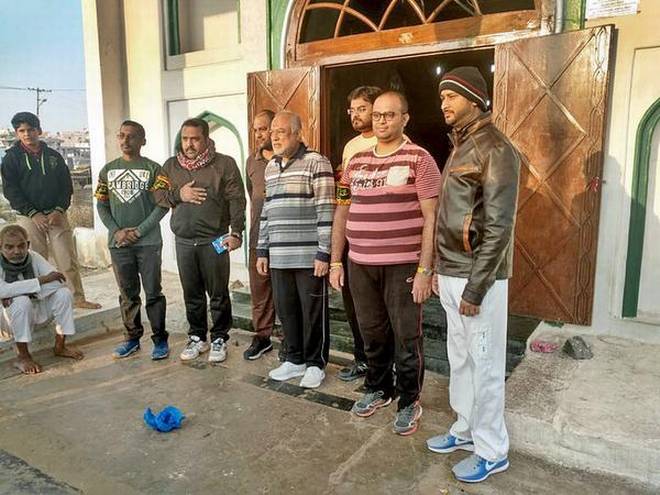
Rituals a mix of Hindu-Muslim traditions, says committee
The experts’ committee, constituted by the State government to look at the nature of rituals and worship at the controversial Bababudangiri shrine in Chikkamagaluru, has made it clear that Shah Khadri is the administrator of ‘Sree Dattatreya Bababudan Swamy Dargah’ and also the performer of the rituals.
The committee, headed by Justice Nagamohan Das, said the issue of management of the shrine was part of the “concluded findings” from the historical records.
Shah Khadri is Sajjada Nasheen (hereditary administrator) of the shrine. Syed Ghouse Mohiyuddin Shah Khadri holds the post at present.
The three-member committee submitted its report to the State government and the same has been accepted by the State Cabinet. The government has said that the report would be submitted to the Supreme Court, as the hearing of contempt petition against the government is coming up on April 6. Shah Khadri had moved the SC alleging that the government had been delaying to settle the issue, despite clear instructions from the court.
Ritual status
The committee, after verifying historical records and previous legal proceedings held since 1837, listed seven findings on the dispute. They include the name of the place (which is Sri Guru Dattatreya Bababudan Swamy Dargah) and location of the shrine on the hills. Both Hindus and Muslims are the devotees of the institution, it says. Regarding the rituals at the institute, the report states that the practice of reading Fateha, offering food items, placing flowers on the tomb and paduka, applying sandalwood paste, burning of incense, lighting of Nandadeepa, raising flags, beating of nagara (drums) and offering holy water to the devotees are performed by Shah Khadri. The institution is declared not a wakf property, but one under the jurisdiction of the Muzrai Department.
With regard to allegations against the administrator, the committee states that whenever Sajjada Nasheen committed acts of mismanagement, misappropriation etc., the Muzrai Department had taken action in accordance with the law.
Based on these findings, the committee rejected the Endowment Commissioner’s recommendations filed before the Supreme Court on March 10, 2010. The commissioner had recommended the appointment of a Hindu priest to offer prayers in accordance with Agama. Citing the Places of Worship (Special Provisions) Act, 1991, the committee opined that the Endowment Commissioner’s report was liable to be rejected. The Act prohibits a change in the religious character of any such place after August 15, 1947.
The Endowment Commissioner’s report had cited historian Suryanath Kamath’s article titled ‘KarnatakaDattatreya Aradhane’ to recommend the appointment of a Hindu priest. The experts’ committee stated that Mr. Kamath’s article was “not based on any authentic evidence.”
source: http://www.thehindu.com / The Hindu / Home> News> States> Karnataka / by Sathish G.T. / Chikkamagaluru, March 15th, 2018
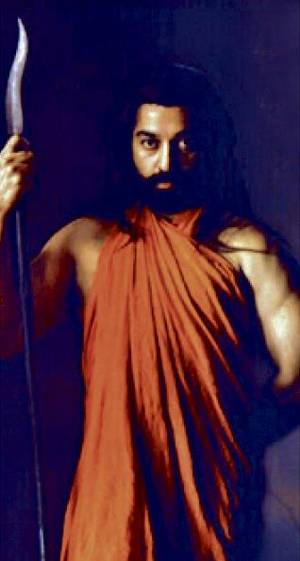
One explanation for Kamal Haasan launching his political party in Madurai was that his hero was Maruthanayagam Pillai, soldier, rebel and valiant son of the district.
It was about this hero that he wanted to make a film extraordinaire several years ago.
I was on the fringe of the project as, coining a term, the factioneer, engineering fact with fiction.
Part of the fiction is the name Maruthanayagam. More factual is the name Yusuf Khan, and it’s as Yusuf Khan he’s a military hero of mine. Much has been written about this soldier of fortune, but the Tamil ballad Khan Saibu Sandai (The War of Khan Sahib) offers much more personal detail. In it Maruthanayagam finds no mention; who it sings of is “the hero who belongs to the Alim family”. Adding, “…let me sing the story of the brave warrior of Sikkandar Sahib”.
Whatever his lineage, it is agreed he ran away from Panaiyur in the Pandya heartland and worked with Jacques Law in Pondicherry c.1744, where, possibly, he learnt his soldiering.
Then we hear of him with a troop of Nellore lances-for-hire teaming with Chanda Sahib and the French to besiege Robert Clive in 1751 at Arcot. Seeing him in action, Clive bought over the Nellore Subedar, as he called Yusuf Khan, who the next year helped Clive win at Kaveripakkam. Later, after action near Srirangam, Clive was told by a friend, “Your Nellore sepoys are glorious fellows, their Subedar as good a man as ever breathed. He is my sole dependence.”
Next, when the French besieged Nawab Wallajah and his British protectors in Trichy, Yusuf Khan lost not one food convoy from Madras over three months. Stringer Lawrence, ‘The Father of the Indian Army’, wrote, “He is an excellent partisan… brave and resolute, but cool and sensible in action – in short, a born soldier, and better of his colour I never saw … He never spares himself, but is out on all parties…” All this led to Lawrence recommending Yusuf Khan being made “Commandant of all the Sepoys” in 1754 and for a gold medal from the Company.
With the Nawab and the Company unable to collect revenue from the southern districts they had won, Khan Saheb who had been responsible for the gains was appointed Governor of Madurai.
Over the next three years, he subdued the local chieftains, collected revenue and earned a reputation for outstanding administration. But Yusuf Khan could never get away from soldiering. When Lally besieged Madras in 1758-59, he failed, because Yusuf Khan, racing up from Madurai, cut almost daily over two months Lally’s supply lines. Lally was to say, “They were like the flies, no sooner beat off from one part, they came to another.” Yusuf Khan was a master of guerilla warfare.
With such praise, Yusuf Khan began growing more ambitious. When he found revenue he collected going mostly to Wallajah from the English, he decided to rebel. He hoped for support from Hyder Ali (which never came) and from the French, who supplied a few hundred mercenaries led by a Marchand.
From August to November 1763 the English besieged Madurai, constantly shelling it, but unable to breach Yusuf Khan’s defences. They then withdrew to regroup. In February 1764, they recommenced the siege, but without significant progress. Yusuf Khan sent them a message early in April 1764: “As long as I have a drop of blood in my body I shall never render the place to nobody.”
English attack after attack was beaten back, many a British officer, once his comrades, killed. A British officer wrote: “You’ll easily form an idea of Yusuf Khan’s abilities from his being able to keep together a body of men of different nations, who with cheerfulness undergo the greatest miseries on his account; wretches who have stood two severe sieges, one assault and a blockade of many months.”
By September 1764 Yusuf Khan was prepared to negotiate surrender terms. The English insisted on unconditional surrender. And Marchand and his ilk, impatient with the negotiations (or heavily bribed), acted, arresting Yusuf Khan and surrendering Madurai on October 15, 1764.
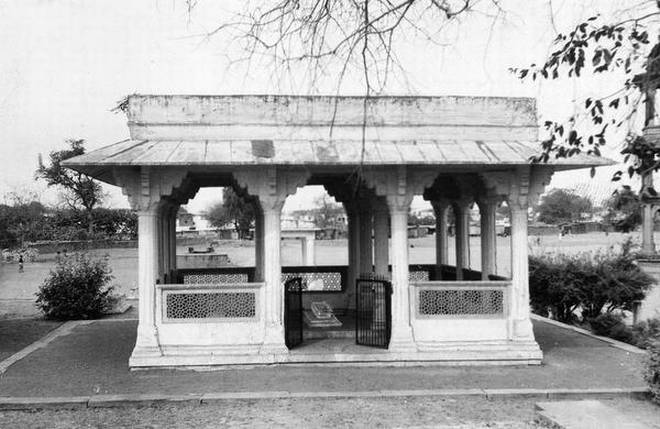
The Company wanted Khan Saheb brought to trial in Madras, but Lawrence ordered him given to the Nawab who immediately hanged him and desecrated the body. He was buried where he was executed, two miles west of Madurai, his tomb at Samattipuram a dargah to some, a pallivasal (mosque) to others, but venerated by all in the Pandya country.
Footnote: A dissertation by Dr Asadulla Khan, then of New College, discusses Yusuf Khan’s family. It would appear that he married a Christian girl, Maza, c.1759; father, very likely Portuguese or French, her mother, possibly, a Maravar, a community which she often interceded for with Khan Saheb. They had a son, Mohammed Sultan, born c.1762. As a young man he joined Hyder Ali’s army. Mother and son, it is suggested, sought refuge in Mysore after fleeing Madurai.
The boats on the Canal
It was a lively presentation that Manohar Devadoss made recently at the Madras Literary Society on his life with books, most he’d illustrated. One striking illustration at the presentation is what I feature today; a boat in full sail on the Buckingham Canal. Mano says he saw this long country boat near Pulicat in 1966 and thought it “an artist’s delight”. His sketch became the first subject of “our heritage greeting card project,” ‘our’ being wife Mahema, who used to write the text for the illustrations he did for greeting cards they sold for charities.
Mahema concluded that year: “These boats are very picturesque, with sails billowing in the breeze. When there is no breeze, the boats are sometimes dragged by the boatmen from along the banks, their bare bodies glistening in the sun. As the boats approach the city, the sails are lowered so that they could pass under the numerous bridges. The men then punt the boats in rhythm to their melodious folk songs.” Taken up as he was with them, Mano did his first oil painting that year, based on his sketch, and several water-colours in later years, one of which I feature.
The chronicler of Madras that is Chennai tells stories of people, places, and events from the years gone by, and sometimes from today.
source: http://www.thehindu.com / The Hindu / Home> Society> Madras Miscellany – History & Culture / by S. Muthiah / March 06th, 2018
Tansen’s tomb in Gwalior | Photo Credit: HINDU PHOTO ARCHIVES
He created many ragas, could produce any sound and lent a distinct style to Senia gharana
This gharana is made up of the legend of Tansen, the father of Indian classical music. Though Tansen was a vocalist, the gharana also produced sitar maestros. The Senia style of sitar playing started with the legendary Ustad Maseet Sen, who belonged to the sixth generation in the Tansen lineage. ( The pioneer of Maseetkhani style, even today, 100 years later, the Maseetkhan Baj is played by the sitarists of this gharana. These musicians came to be known as the sitarists of Jaipur Senia Gharana. They lay emphasis on the purity of raga and technique. Their style of playing was that of the bin or veena. Ustad Mushtaq AliKhan, son of Ashiq Ali Khan of Varanasi had the privilege of learning from Ustad BarkhatAli khan of Jaipur, who went by the title ‘Aftab-e-Sitar’. Pt. Debu Choudhuri was fortunate to learn from ‘Dada Guru’ (Ustad Mushtaq Ali Khan).
On the vocal front, the gharana is referred to as Qawwal Bachcha. Its most well-known exponent of our time is the Lucknow-based Ustad Shamshudeen Khan, popularly called Ustad Gulshan Bharathi (recepient of ‘Yash Bharathi’ award). This style is known as bol bant ki gayaki and bol banav ki gayaki. Short and crisp bol taans are significant features, while the aakar is sparingly used. Many of his disciples have made a mark in films, notable among them being Shashi Suman, music composer of Bajirao Mastani and Harjeet Saxena.
Coming back to Mian Tansen. He was born as Ramatanu and later came to be known as Tanna. There are many legends woven around his life. It is said that he could produce any sound. The story goes that once when the sadhus were crossing a field they heard a lion’s roar and located it to a young boy sitting on a tree. They advised his father to send him to Swami Haridas for training.
However, it is believed that Tansen was born dumb and was taken to the Sufi saint MurshidMohammed Ghouse Gwaliari. On reaching Gwalior, he visited the Sufi saint and found him in the company of Swami Haridas. The saint blew air into the mouth of the child and Tanna began to speak. When the saint came to know the child was also deaf, he blew air into his ears and he was cured. The Sufi saint then asked Swami Haridas to take him into his fold. Thus began his musical journey (M.A Bakhy).
Titles to Tansen
Tansen was the title given to him by Raja Vikramjit of Gwalior. Tansen was a court musician in the darbar of Raja Ramachandra of Bandavagarh (Rewa).
When Akbar heard of his prodigious talent, he sent a ‘firman’ to the king asking for Tansen and made him one of the Navaratnas in his court. He gave him the title of ‘Mian’. Tansen is also known as the ‘Sangit Samrat’, according to Musical Heritage of India by Lalita Ramakrishna.
Abul Fazl records in his Ain-i-Akbari that Akbar gave Rs 2 lakhs to Tansen for his first performance in the court. He composed many dhrupads on Ganesha, Shiva, Parvati and Rama. He also composed songs on his patrons.
Kalpadruma is a compliation of 300 of his dhrupads that were in Gauhar Bani. Tansen composed in his favourite ragas — Multani, Bhairavi and Todi .
He invented the night raga Darbari Kanhra, morning raga Mian Ki Todi, mid-day raga, Mian ki Sarang, seasonal raga Mian ki Malhar. His descendants and disciples are called Seniyas.
While Tansen graced the court of Akbar, many aspiring singers would practice round the clock and caused a lot of disturbance to him. This came to the notice of Emperor Akbar and he banned one and all from pursuing music. The story goes that a competition was organised between Baiju Bawra, also a disciple of Swami Haridas, and Tansen. The loser was to be executed. The two sang under the magic spell of love and reverence to their Guru. Tansen’s tanpura string broke. Baiju asked Akbar to grant him three wishes — not to execute Tansen, to lift the ban on singers and to set free the people who were innocent.
Another famous story is about theintrigue to bring about Tansen’s end by making him sing Raga Deepak. Tansen, who was known for the purity of his renditions, foresaw his fate, but could not say ‘no’ to the emperor. He had asked all the lamps in the court to be extinguished. As he sang, the lamps lit and the flames engulfed him.
On hearing this, his wife Husseini broke into raga Megh Malhar, beckoned rains and saved Tansen. This was a turning point in the legendary singer’s life and he went back to Sufi saint Hazrat Ghouse Gwaliari. While the Tansen samorah in Gwalior commemorates him as a singer, the yearly Urs has canonised him as a saint.
source: http://www.thehindu.com / The Hindu / Home> Entertainment> Music / by Jyoti Nair / March 01st, 2018
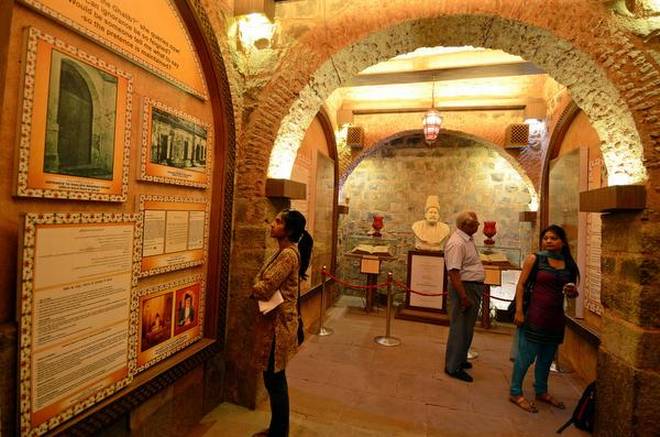
AT HOME Visitors at Ghalib’s Haveli | Photo Credit: Sushil Kumar Verma
We know Mirza Ghalib as a Dilliwallah, but the bard had a strong emotional connection with Agra as well
Mirza Ghalib’s death anniversary on 15th February did not evoke the same interest as his birth anniversary two months earlier. Of course, there was a literary festival in Connaught Place and another in India International Centre, one can say the 210th birth anniversary drew greater public attention than probably that of any other Urdu (or Hindi) poet. The haveli he lived in and the Town Hall were the main venues of the functions then, along with the Subz Burj Park in Nizamuddin, now named after him. But nobody thought of holding a function at Kala Mahal in Agra, where Mirza Nausha was born on December 27, 1797 and of which he was so nostalgic because of childhood memories. Just goes to show how possessive Delhiwallahs have become of Ghalib and of Mir Taqi Mir, who was not only born in Agra but also had an affair with his cousin in the vicinity of the Taj. An enraged family then shunted off the Mir to Delhi where he attained great heights before moving to Lucknow at the invitation of the Nawabi Court of Awadh, where his outdated attire provoked him to recite his famous introduction: “Dilli jo ek Shahr tha alam mein intikhab…/Jisko falak ne loot ke bezar kar diya/Hum rehne wale hain usi ujre dayar ke” (I’m a resident of the same looted garden, Delhi, devastated by heaven).
Incidentally, it was the Mir Sahib who had predicted that the boy Ghalib (whose early recitals he had heard) would one day become a big shair. But Yours Truly spent a whole afternoon in and around Ghalib’s haveli last week and wondered at the sudden twist of destiny that has brought it into the limelight again. The area of Ballimaran, of which Gali Qasim Jan is a part, got its name (there are other versions too) from the boatmen who once inhabited it. Thereafter, it saw a sea-change with the high and mighty deciding to build their havelis there. It is after Nawab Mir Qasim Jan, an Iranian nobleman, that the gali is named. Qasim Jan at first lived in Lahore, where he was attached to the court of the Governor, Moin-ul-Mulk, in the 1750s. That was the time when Ghalib’s grandfather also migrated to India from Turkey.
Qasim Jan was an influential man and a great friend of the Governor. But when the latter fell fighting Ahmad Shah Abdali, who had invaded Punjab, Qasim Jan helped Moin-ul-Mulk’s widow, Mughlai Begum, to rule the province in the name of her infant son. He seems to have been particularly close to the begum, who admired his sagacity. But the admiration was mutual for Qasim Jan could not have been immune to the charm of the begum who continued to defy Abdali despite losing her husband.
It was during the reign of Shah Alam that Qasim Jan joined the court at Delhi. He was conferred the title of Nawab, and in order to be close to the Red Fort built his haveli in Ballimaran. After the death of Qasim Jan, his son Nawab Faizullah Beg resided in the haveli. Ghalib also lived in Ahata Kale Sahib for some time after his release from debtors’ prison and that is the time he is said to have remarked that after being an inmate in the “Gora” (white man’s) jail he had moved to Kale’s (black man’s) jail.
Ghalib subsequently moved to the haveli in Qasim Jan Street. But during the First War of Independence of 1857, he lived for some time in Sharif Manzil where Hakim Ajmal Khan’s father used to reside. The reason was that Sharif Manzil was a protected place in those days because its owner was the personal physician of the Maharaja of Patiala, who was on good terms with the British. After the upheaval, Ghalib went back to his house, where his wife Umrao Begum held sway and made it into a virtual mosque.
However, there is still a mosque next to Ghalib’s house. An old bearded man, wearing a brand new sherwani and with a stick in hand, was standing next to it. Asked if Ghalib ever visited the masjid, he shook his head and declared, “I don’t think so, unless when he became old. What else can you expect from a man who wrote: ‘Masjid ke zer say ek ghar bana liya hai/Ek banda-e-qamina hamsaye khuda hai” (I have set up abode in the vicinity of a masjid so a wretch is now God’s neighbour). As one walked away after hearing him, the first “degh” of biryani was being opened by the roadside seller and the smell was too appetising to resist the temptation of tasting it. Ghalib too must have eaten like this sometimes or sent his faithful servant Kallu to buy the stuff.
Before settling down in Gali Mir Qasim Jan, Ghalib lived in the house of his in-laws, where several mushairas were held. Why they were discontinued at the haveli is not known but one reason may have been the opposition of his puritanical wife. So the mushairas the poet attended were generally the ones held at the Red Fort and Haveli Sadr Sadur in Matia Mahal. In Agra, of course, he was too young to take part in poetry recitation and instead flew kites with the son of Raja Chet Singh at Kala Mahal, where some claim that his spectre is still seen on moonlit nights. He, no doubt, missed Kala Mahal and the Redstone Horse at Sikandra, Agra, to which he always sent greetings through his friend Mirza Tafta Secundrabadi. The Ballimaran haveli somehow did not evoke the same nostalgia in him, probably because most of his children died in it in infancy. Wonder if he would have approved of the museum set up there! But at Kala Mahal fateha is still offered for his repose.
source: http://www.thehindu.com / The Hindu / Home> Society> History & Culture> Down Memory Lane / by R.V. Smith / February 26th, 2018
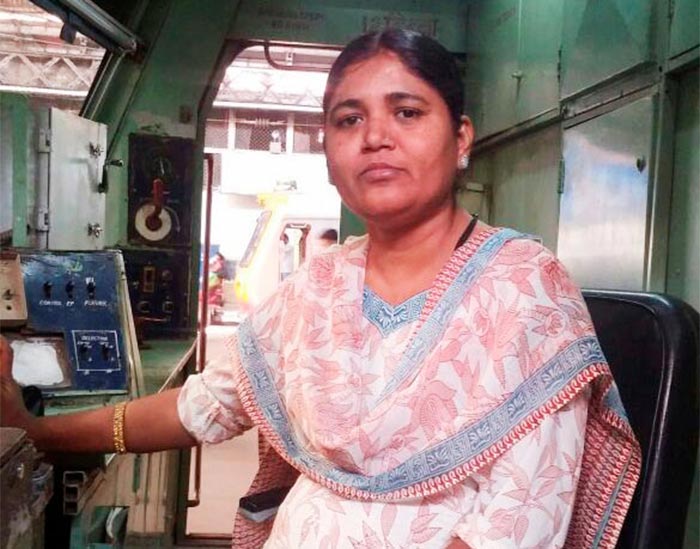
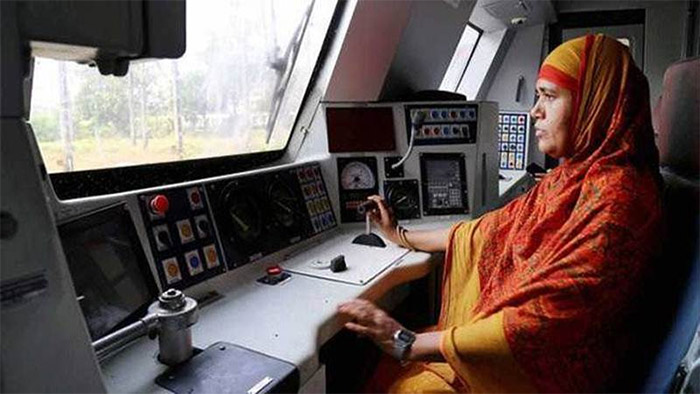
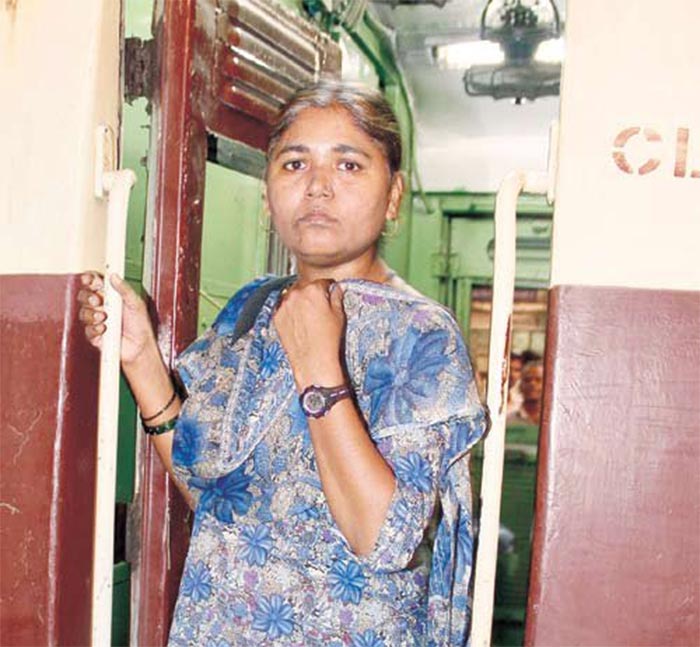
Women are going places, they say. But Mumbai’s Motorwoman, Mumtaz Kazi takes people places by driving them in Mumbai’s local trains. Not only is she one of the few motorwomen the world has seen, but she’s also a first in Asia, to begin with.
In a career span of more than 20 years, Mumtaz has driven various kinds of trains. She is also Asia’s first woman train driver.
Sure that didn’t come easy, did it?
From a very young age, Mumtaz wanted to be in Railways. Her father was a Trunk Superintendent at Churchgate railway station. She grew up in the railway quarters and used to watch the trains pass by.
She was born and brought up in Mumbai and went to Seth Anandilal Poddar High School. In 1989, just after her SSC, she applied for the job of the motorman.
Since that very year there was a change in the railway recruitment board policy in India, Mumtaz could sit for the examinations and applied for it.
She did extremely well in examinations, leaving everyone impressed with her ambitiousness. And, was appointed in 1991 just after her class twelve examination.
While she was extremely happy about the job, she faced a bit of resistance from her father’s side upon her decision. Her father, Allahrakhu Ismail Kathawala, asked her to complete her Diploma in Medical Laboratory Technology (DMLT) course first.
After much convincing, Mumtaz’s father gave in and gave her his blessings. And, she became the first motorwoman. In its 1995 edition Limca Book of Records acknowledged Mumtaz’s success and she became the first woman diesel engine driver in Asia at the age of 20.
Not only that, Mumtaz also went on to become the first train driver to possess the skill of driving both Electric and Diesel engine.
Throughout her journey, Mumtaz was the courageous support system to her family. It was because of her, they could buy a home in Mumbai and she also helped with her brothers’ education. Both her brothers, Imtiyaz and Feroz, are engineers and settled abroad.
But that’s not the only thing for which she makes all look up to her. When she’s not driving trains and being on the job, she is a homemaker and loves spending time with her family.
She got married to an electrical engingeer from Nandoorbar, Maqsood Kazi, in 2002 and is a proud mother of two kids Tausif Ahmed and Fateen.
In the year 2015, she was awarded Railways General Manager Award.
And, in 2017, on International Women’s Day, she was awarded the Nari Shakti Award by President Pranab Mukherjee.
Mumbai’s local train is one of the busiest railway network and Mumtaz, like a boss, pilots the busiest local trains. With her grit and determination, Mumtaz, over the course of more than two decades, has set an example that there’s no job that women can’t do. After all, the levers on the train don’t know if it’s a man or a woman’s hands operating them.
source: http://www.storypick.com / StoryPick. / Home> Culture / by Rachna Srivastava / March 10th, 2017
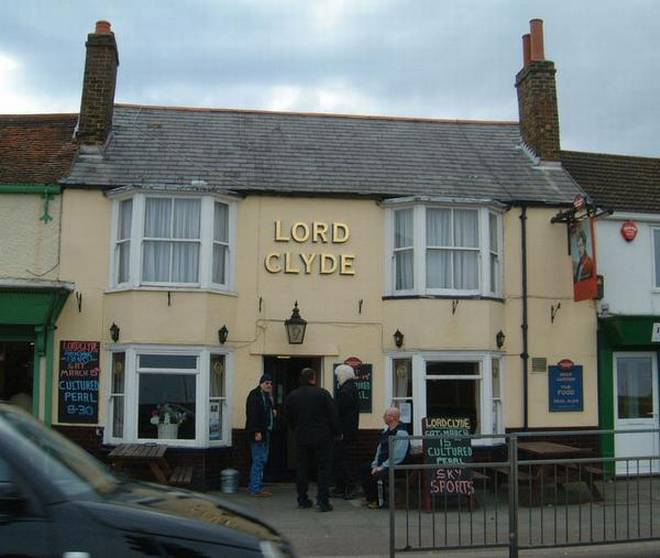
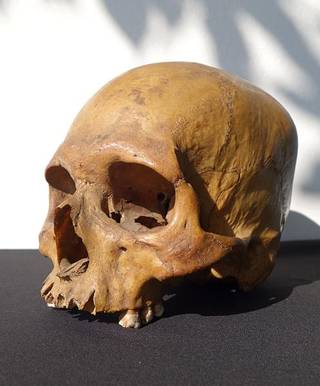
The resting place: The skull was found in a store room of The Lord Clyde pub in London. | Photo Credit: Special Arrangement
Skull of soldier, executed by the East India Company for rebellion in 1857, found its way to London pub; it’s now with historian Kim Wagner
Headhunting is usually associated with primitive tribes and contemporary terrorists, but the colonial rulers of India also collected heads of Indian soldiers as war trophies.
A 160-year-old skull of sepoy Alam Beg, now in the possession of a historian in London, is proof that colonial rulers who brought many modern practices to India were also at times inhuman.
In 1857, Alam Beg, also known as Alum Bheg, was a soldier with the 46th Bengal Native Infantry, an arm of the East India Company.
The Mutiny that year, after having covered the north Indian heartland, spread to Sialkot (now in Pakistan), where Alam Beg and his companions tried to follow their fellow soldiers and attacked the Europeans posted there. On July 9, 1857, they killed seven Europeans, including an entire Scottish family.
Alam Beg, along with his comrades, left Sialkot and trekked all the way to the Tibetan frontier only to be turned away by the guards on the Tibetan side. He was reportedly arrested from Madhopur, a scenic town on the northern part of the Indian Punjab and taken back to Sialkot. A year later, he was tried for the brutal killing of the Scottish family and blown up from the mouth of a cannon. The Mutiny ended soon after. Alam Beg’s tragic story surfaced more than a century later thanks to an Irish captain Arthur Robert George Costello, who was present at his execution.
The skull of Alam Beg. | Photo Credit: Special Arrangement
Present at execution
The Irishman was a captain in the 7th Dragoon Guards, dispatched to India after the Mutiny had shaken the bonds between the East India Company and the native soldiers. Costello had not seen any episodes of the Mutiny but was present at the execution, said historian Kim Wagner, who possesses the skull now.
Costello picked up the skull and returned to London with it. In 1963, the skull was discovered in a store room of The Lord Clyde pub of London, after it had changed hands. The new owners were less than happy to find this war ‘trophy’ from 1857, but treated it as a solemn object from a disturbing past of British history in the subcontinent. The owners of the pub learnt from a note left in an eye socket that it belonged to Alam Beg, who played a leading role in the mutiny of sepoys in Sialkot. They desired to repatriate the skull to the soldier’s family. For years, they tried but failed. It is not known how the skull of Alam Beg ended up in the Victorian-era pub. But it is possible that the Irish captain who witnessed the execution of the leader of the mutinous soldiers visited the pub or someone deposited it there, given the fact that it had links with the history of the Indian Mutiny. In fact the pub was named after Collin Thomson, also known as Lord Clyde, who was a military commander and played a role in crushing the mutiny in north and northwest India. So it is possible that soldiers after their Indian stint would visit the pub.
In 2014, the owners of the pub contacted Kim Wagner who has been writing about South Asian history for years. They urged him to take the skull and return it to the descendants of Alam Beg. Mr. Wagner brought it home and the skull finally added to his research on South Asia which was published late last year as “The Skull of Alum Bheg: The Life and Death of a Rebel of 1857.” The historian believed that only by making people aware of the skull that Alam Beg can be returned to his motherland.
His research showed that most of the soldiers of the 46th Bengal Native Infantry were from modern states of Uttar Pradesh and Bihar and Havildar Alam Beg most probably hailed from Uttar Pradesh. Though he wanted to return him to a dignified family grave yard of Beg’s family, it was not possible as the East India Company left no records of the soldiers of the 46th Bengal Native Infantry.
“There are no longer any records for sepoys of the Bengal Army – the best I could do was locate the area where the 46th regiment recruited from,” Mr. Wagner said.
The Mutiny of 1857 was crushed mercilessly and many gruesome incidents of that era find mention in official records. In 2014, around the time when Mr. Wagner began writing his book on Alam Beg, Ajnala in Punjab’s Amritsar hit the headlines when authorities discovered skeletons of 282 soldiers who were executed after the Mutiny. They apparently had surrendered hoping for a fair trial, but the Deputy Commissioner of the district Frederick Henry Cooper ordered execution of the rebels. They were buried with medals and even money of the East India Company that many of them had in their pockets. The grisly discovery is yet to receive a closure as the family members of those soldiers remain untraced.
Similar is the condition of Alam Beg as his journey back home remains incomplete but Mr. Wagner believed that his only physical remain should find a proper peaceful burial. Mr. Wagner is aware that the government of Prime Minister Narendra Modi has been vocal about honouring the fallen soldiers of India in various colonial era battles. He says that something similar can be done in case of Alam Beg as well.
“After all these years, it is high time for Alum Bheg to return home…he was probably born in what is today India, he was executed in what is now Pakistan,” Mr. Wagner wrote in his book proposing that a burial for Alam Beg near the India-Pakistan border would be the most suitable tribute to his sacrifice.
The historian said that in the absence of the descendants of such soldiers, it is the Indian government that should bring back Alam Beg to his motherland.
Headhunting by colonial rulers from Europe was a rampant practice in the 19th century and activists worldwide have been vocal in demanding human remains from Western museums and collectors should be returned to their countries of origin. Such a movement is yet to begin in India whose soldiers from the colonial past in many instances continue to remain anonymous and abroad.
source: http://www.thehindu.com / The Hindu / Home> News> National / by Kallol Bhattacharjee / New Delhi – February 04th, 2018
Awadh, UTTAR PRADESH / London, U. K / Paris, FRANCE :
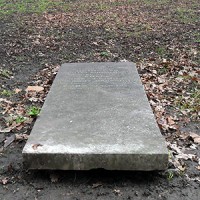
While walking around Paddington Old Cemetery during my lunch break earlier today, for some reason I felt compelled to read the faded stone slab that marked the resting spot of Princess Omdutel. Instantly my attention was grabbed, a Princess buried in Kilburn, North West London of all places, that sure wasn’t something I was expecting to find.
I have walked past the grave of Princess Omdutel, perhaps a 100 times or more since I moved to Kilburn and never paid it any attention. Now she had my full attention.
The badly worn and faded inscription on the stone slab was barely readable, but after a lot of scratching of my head, I finally managed to decipher the words: Sacred to the memory of Princess Omdutel Aurau Begum, daughter of the late General Mirza Sekunder Hishmut Bahadur, Brother to His Majesty King of Oude, who died 14th April 1858 aged 18 months.
With a little help from Google and www.findagrave.com, I managed to find the following information: Princess of Oude. Oude, or Awadh, which was the epicentre of the 1857 Indian Mutiny, when the sepoys rebelled against the British after baulking at orders to use cartridges greased in pig and beef fat. Members of the Awadh Royal Family arrived in London soon afterwards, lobbying unsuccessfully for the return of their lands. The princess’s father, Mirza Bahadur, died two months before her and is buried in Père Lachaise in Paris.
The British obviously offered the Awadh Royal Family a haven in London after they were ousted. I’m not sure how long the family had ruled for in Awadh, which is a region in India. But from what I can gather it seems likely that they were a puppets installed by the British Government.
Princess Omdutel Aurau Begum, her life had barely begun, when she died at only 18 months of age. I wonder if any of the family survived and if so what became of them. It is also intriguing that her father died two months before her in Paris. No mention of the mother, which is kinda sad if you ask me…
I find it strange that I have walked past the grave of Princess Omdutel numerous times over the past twenty months and never once read it, until today. Very strange. Maybe she was wanting a mention on London Is Cool…
source: http://www.londoniscool.com / London is Cool – a blog about Life in London / Home> Out and About in London / by William Wallace / February 21st, 2011
Awadh, UTTAR PRADESH / London, U. K / Paris, FRANCE :
The tragic story of Malika Kishwar, who rests in an unmarked grave in France’s most famous cemetery
The grave of Malika Kishwar at the Père Lachaise cemetery in Paris. Photo: Wikimedia Commons
She lies buried amidst sepulchres that house the remains of many who are still famous.
There is Jim Morrison on the premises, the American rock legend whom trains of tourists come to pay homage, like pilgrims bearing flowers. Edith Piaf, the waif who sang her way to greatness, finds her peace nearby, as does Frederic Chopin, the composer whose pickled heart is in Warsaw but whose body dissolves in the French capital. Benjamin Franklin’s grandson rests here, and in the vicinity there is a man believed to have been sired by Napoleon. Oscar Wilde’s sculpted grave competes with Marcel Proust’s neat bed of stone, and many more still are the artists, writers, and persons of esteem who crowd the hillside cemetery that is Père Lachaise in Paris.
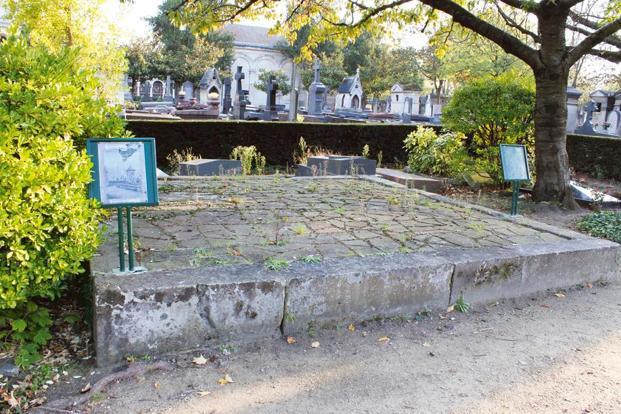
And yet, between them all, under a platform of rugged rock, lies this tragic Indian woman. Her name and cause have been largely forgotten, but since 1858, she has been here, longer than many of her revered neighbours. Tourists walk by with cameras, oblivious to her unmarked square existence. But every now and then there is a stray visitor who arrives on a quest: to locate the final resting place of that remarkable woman, the last queen of Awadh.
I was that visitor a few days ago, when I trekked up Paris’ most famous graveyard to look for this forgotten tomb.
The lady appears in yellowed old books by several names. She was to some Malika Kishwar, while others knew her as Janab-i Aliyah, Her Sublime Excellency, mother to the ruler of “Oude”, Wajid Ali Shah.
In 1856, when the British deposed this nawab from his ancestral seat in Lucknow, his family departed for colonial Calcutta, with all the money they could gather and what dignity they had left. But while the son (a “crazy imbecile” in the eyes of his sneering oppressors) prepared to fade quietly into history, the mother was determined to win back that which was her family’s by right.
That very year, this woman who knew little beyond her sequestered palace, set foot on a ship, determined to sail to England so she might speak—woman to woman—to the English queen in person. After all, declared the middle-aged begum, Victoria was “also a mother”; she would recognize the despair her people had unleashed, and restore to the House of Awadh territory, titles, and its rightful honour. And so proceeded Malika Kishwar, her health already in decline, braving cold winds in a foreign land, to plead the cause of royal justice.
The mission was doomed from the start. Advisers were many and much was the money they sought for the privilege of their counsel. The results, meanwhile, were nowhere to be found.
As historian Rosie Llewellyn-Jones records, Kishwar discovered quickly enough that Queen Victoria, in her “circular dress”, had little power to bestow anything more than polite conversation on her and her Awadhi line—when an audience was granted, they spoke about boats and English mansions, not about imperial treacheries and the unjust business in Lucknow.
In the British parliament, things got worse. A prayer at long last prepared was dismissed on spurious bureaucratic grounds: the begum was to submit a “humble petition”, words that she failed to use in the document laid before the House. While her son accepted British imperium, the mother was obstinate in battle. So, when she wished to travel, they sought to dragoon her into acknowledging their suzerainty—if Malika Kishwar and her ménage wanted passports, she would have to declare herself a “British subject”.
The begum refused to do anything of the sort, prepared, at best, to be under “British protection”, but never anybody’s “subject”. And legal quibbles aside, the Great Rebellion of 1857 compounded matters—there was now no prospect of relinquishing even a fragment of British power when the hour called for a demonstration of obdurate strength alone. Awadh was lost forever.
The tide having turned, in 1858, the begum decided to return at last, defeated and unhappy in the extreme. But in Paris she fell ill and died on 24 January. The funeral was simple, but there was yet some dignity and state—representatives of the Turkish and Persian sultans gave this Indian queen the regard the British denied her and her line.
A cenotaph was constructed by the grave, but it has long since fallen to pieces—when decades later the authorities at Père Lachaise sought funds to repair the tomb, her exiled son decided from Calcutta that it was simply not worth his pension, while the colonial state was even less inclined to honour a difficult woman lying several feet underground in an alien European country. And so, since that time, in a graveyard full of magnificent memorials, the queen of Awadh has remained, a shell of broken stone sheltering her from the weeds and overgrowth that alone have made a claim upon her and the story that she tells.
Others of her suite also suffered. A younger son had come with her, Sikandar Hashmat by name. He died in England, and was carried to join his mother in her unmarked grave. A grandson’s infant child was also buried within, turning the tally in Paris to three.
But it was in London that one more of the delegation fell, this one a baby princess, born to Sikandar Hashmat from his Rajput wife on British shores. I walked around a dull little place called Kilburn to look for this grave. And there, in a cemetery, after an hour between tombs set in the soggy English ground, I found a memorial to the child: Princess Omdutel Aurau Begum, “who died 14th April 1858”, months after her grandmother who was once a queen.
But Omdutel, all of 18 months, had a minor triumph where her royal grandmother had none—lying by a pathway in that cemetery in Kilburn, her grave at least bears her name.
The begum, on the other hand, has become to the passing tourist at Père Lachaise in Paris a plinth on which to rest, smoking a cigarette and looking on to a horizon full of the dead, till a stranger might appear to tell how they have under them.
Medium Rare is a column on society, politics and history. Manu S. Pillai is the author of The Ivory Throne: Chronicles Of The House Of Travancore.
He tweets at @UnamPillai
source: http://www.livemint.com / LiveMint / Home> Leisure> Medium Rare / by Manu S. Pillan / Friday – Jan 12th, 2018
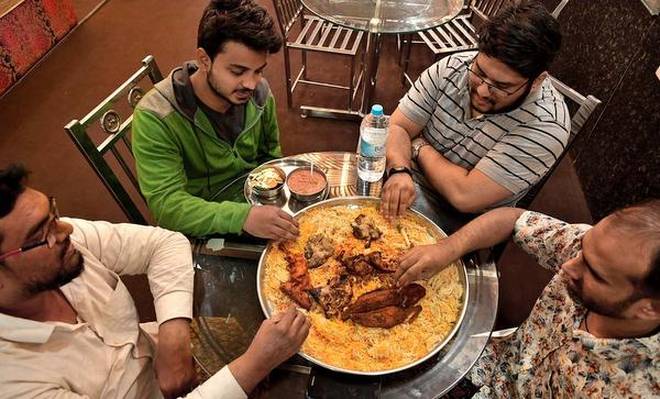
A must-try: Foodies having a Mandi, a combination of large chunks of mutton and rice garnished with dry fruits, at Mataram Al Arabi at Errakunta on Saturday.
Restaurateurs in Barkas and Yerrakunta suburbs arrived here from Hadhramaut in Yemen over two centuries ago
A 20-minute drive south of Charminar is all it takes to wonder whether one has teleported oneself to a west Asian country. For, once in Barkas and Yerrakunta suburbs, one is greeted by exotic signage in Arabic on restaurants like Mataam al Arabi, Al Saud Bait al Mandi and Al Khaleej serving the Arabian delicacy Mandi. And the business is booming.
The connection is clear. The two neighbourhoods are home to those who arrived here from Hadhramaut in Yemen over two centuries ago. Several of these restaurateurs continue to bear Arabian tribal affiliations. While one eatery is owned by those from the Bin Ziyad tribe, another belongs to the Nahdis. There are dozens of tribes as are the restaurants run by them.
Abdul Raheem Yamani, proprietor of Real Arabian Dhaba, pegs the number of Mandi restaurants along the six-km stretch that connects Barkas to Shaheen Nagar along the Srisailam highway at approximately 35. “This is the reason why the highway has a new moniker – Mandi Road,” he says.
The restaurateurs say that the spurt in the number of Mandi restaurants began in 2011 when the Arab community realised that it was a profitable business. Restaurants started mushrooming not just along the margins of the main thoroughfares, but in the by-lanes of Barkas.
With diners converging from across the city, observers say that while traditional Hyderabadi biryani continues to be famous, Mandi is giving it a run for money.
One of the first Mandi restaurants in the area is Mataam al Arabi. Its proprietor Abdullah Bashaadi says the dish is a combination of large chunks of mutton and rice garnished with dry fruits.
The 38 year old recounts that he began the business in 2010 soon after returning from the Haj. “We were served Mandi during the pilgrimage. All ate from the same large thaala sitting on the floor. That is when I struck upon the idea to start a Mandi restaurant,” Mr. Bashaadi says.
The traditional Arabian method of dining—sitting on the floor and eating from the same large dish—has been retained in all the Mandi restaurants.
Like most who trace their ancestry to the Arabian Peninsula, Mr. Bashaadi’s great grandfather Ahmad bin Awad Bashaadi arrived in the city from Hadhramut, Yemen. In fact, noted scholar Omar Khalidi writes in Muslims in the Deccan: A Historical Survey that Hadramis were a part of Afwaj-e-Beqaidah(Irregular Army) of Asaf Jahs. Their numbers swelled so much so that the Diwan, Salar Jung, constituted a separate court, the Qazaat-e-Uroob, for them. Further, two Hadramis served as Commissioners of Police of Hyderabad State.
Taha Quadri, a professional caterer specialising in Arabian cuisine, explains the Mandi variants. The rule of thumb is three parts of mutton to one part of rice. The rice is cooked in the same water that is used to boil the meat. “Mutton can be replaced with fish, chicken and even quail,” he says.
But while diners converge at the Old City from all across Hyderabad, the dish is a hit with the IT crowd of Hitec City. The uptown area of Jubilee Hills has one.
“There was a great demand for the dish in this part of the city which is why we started the restaurant around nine months ago. A majority of our customers are those working in Hitec City,” says Syed Waaris Ali, proprietor of Mandi @ 36.
source: http://www.thehindu.com / The Hindu / Home> News> Cities> Hyderabad / by Syed Mohammed / Hyderabad – January 13th, 2018
The group of seven led by Syed Abdul Ali beginning their journey from Daira Mir Momin in the city on Saturday.
To take at least six months to reach the shrine of Hazrat Imam Hussain
Faith and devotion make people do remarkable feats. It can make them test their limits and transcend spatial and political boundaries. Even if they have to walk hundreds of miles across three countries in their quest for spirituality. Seven men from the city have embarked on this very journey to reach the shrine of Hazrat Imam Hussain in Karbala, Iraq.
A revered and loved figure for both the Shi’ites and Sunnis, Hazrat Imam Hussain was the grandson of Prophet Muhammad. Each year, dozens of Shi’ites embark on what they call ziyarat or pilgrimage, from the city to Karbala.
The group of seven led by Syed Abdul Ali, a 66 year old from Purani Haveli in the Old City, left for New Delhi from the Daira Mir Momin early on Saturday morning. The others making the journey on foot are Syed Sharif-ul-Hasan Razvi (28), Mir Asim Ali Moosvi (33), Syed Ali Razvi (31), Syed Saqib Zia Naqvi (33), Ali Asghar (31) and Syed Ali Ahmed (37).
“The journey to Karbala will take at least six months. Our intention is to walk between 35 and 40 km every day along the National Highway 44. In other words, eight hours of walk every day. That way, we will reach New Delhi by the end of February or the first week of March,” the leader and sexagenarian said.
Out of the seven, two have made the pilgrimage on foot twice.
To avoid crossing into Pakistan on foot, they will take a flight from the national capital to Tehran in Iran. From there, they intend to go to Yazd and then cross into Iraq where they will proceed to Karbala.
A vehicle carrying supplies such as food and bedding will trudge alongside till New Delhi.
The six wayfarers began to prepare for the journey more than two months ago. “We practised walking every day without fail. It’s not possible to go without preparing yourself for something like that,” they said.
Explaining what the journey means to him, Mr. Ali Asghar, a businessman, said, “I got a job in Dubai, but I gave it up since I wanted to go to Karbala. Going there on foot is a great act of piety. What more could I want?”
source: http://www.thehindu.com / The Hindu / Home> News> Cities> Hyderabad / by Syed Mohammed / Hyderabad – January 06th, 2018