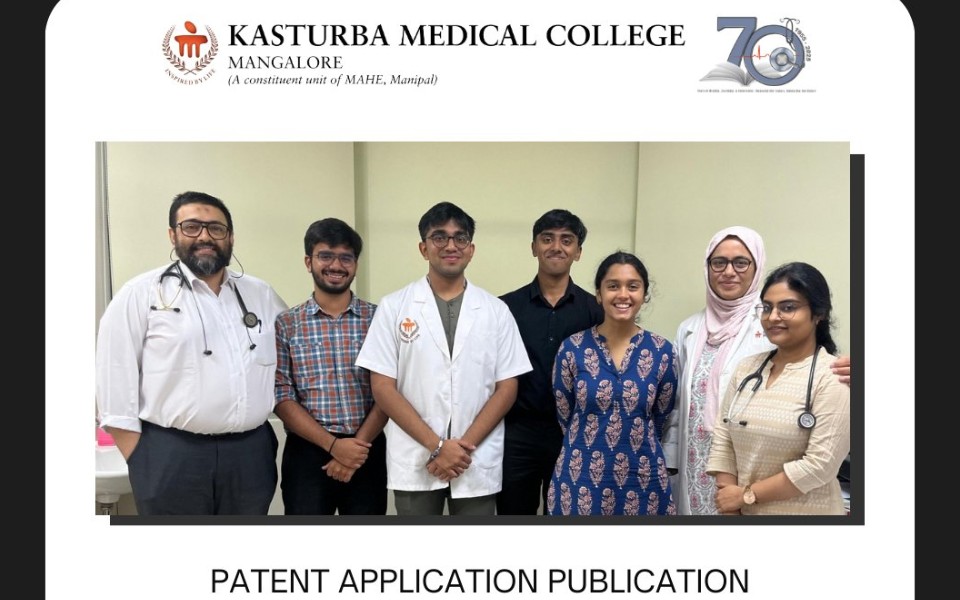
Developed by KMC Mangalore team led by Dr. Haroon, Dr. Sameena, Dr. Chiranjith
Mangalore:
A patent application for a groundbreaking medical device, Device for Monitoring Gynaecological Disorders, has been officially published, marking a significant achievement for the team of doctors and student inventors from Kasturba Medical College (KMC) Mangalore.
The device is designed to enhance early detection and diagnosis of gynaecological disorders. It incorporates a flexible probe, a rotational brush for effective sampling, and an enzyme-coated detection system, improving precision and efficiency in clinical examinations.
The innovation is credited to Dr. Haroon H, Dr. Sameena H, and Dr. Chiranjit Ghosh from MIT, along with student inventors Krisha Janaswamy, Shashank Sanjay, Adithya Harikrishnan Namboothiri, and Shubham Bhusari.
The official Twitter handle of KMC Mangalore also recognized the accomplishment, congratulating the team for their work in medical innovation.
Dr. Haroon is son of M. Hussain and late Akhila Begum from Arehalli village in Hassan while Dr. Sameena Haroon is daughter of KA Sadiq and Maimoona.
Mr. Tanmaya Tyagi being honoured by Prof. Mohammed Naved Khan and Prof Badar jahan during the Art Utopia 2025
“Art is not just about skill but also about passion, perseverance, and discipline.”
Aligarh:
The University Fine Arts Club of the Cultural Education Centre, AMU, organised Art Utopia 2025, bringing together students for a celebration of creativity, learning, and artistic expression.
The event opened with Safar-e-Rooh, an impactful live performance by Mr. Haris Raza Ashraf, portraying the global scenario and its impact on individuals, captivating the audience.
The event featured two skill-building workshops – one on Resin Art by Dr. Atiya Parveen and another on the Art of Caricature by Mr. Tanmaya Tyagi. These sessions enriched participants with artistic techniques and perspectives.
Adding to the creative atmosphere, three unique art installations were displayed. A group of students presented Chai, symbolising its significance in campus life. Mr. Salik Tariq, the club’s secretary, crafted a striking 3D image of Sir Syed Ahmad Khan, while another group depicted the societal limitations faced by girls in pursuing their dreams through an artistic portrayal using natural elements.
The second day featured competitions in Canvas Painting, Face Painting, and Painting on Decorative Items, drawing enthusiastic student participation. A panel of faculty members judged the competitions, recognising exceptional talent.
The event concluded with a felicitation ceremony honouring the resource persons and awarding winners. First prizes were secured by Mr. Aaryan Pratap Singh (Canvas Painting), Ms. Falak Javed (Face Painting), and Ms. Uzma Ansari (Painting on Decorative Items).
During the closing ceremony, Prof. Mohammed Naved Khan, Coordinator CEC, emphasised that “Art is not just about skill but also about passion, perseverance, and discipline.” Prof. Badar Jahan, President of the Fine Arts Club, praised participants for their creativity and urged them to stay focused on their artistic journey.
Art Utopia 2025 successfully promotes a culture of artistic excellence and innovation on campus.
source: http://www.radiancenews.com / Radiance News / Home> Latest News> Report / by Radiance News Bureau / March 03rd, 2025
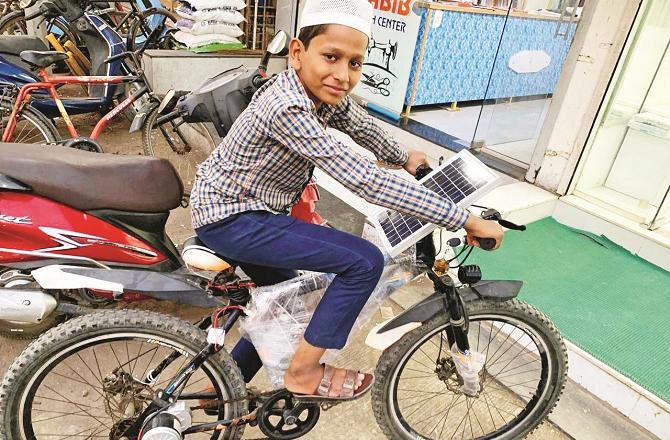
In a remarkable display of innovation, 12-year-old Abdullah Imran Mangalgeri from Solapur has converted a regular bicycle into a hybrid model that runs on battery and solar power, eliminating the need for pedaling.
A Class 7 student of M.A. Pangal Anglo-Urdu High School & Junior College of Arts and Science, Abdullah received the bicycle as a prize for excelling in a district-level speech competition on ethics. Instead of using it conventionally, he invested ₹9,000 and spent six months modifying it into a three-mode bicycle that can be powered by pedaling, a rechargeable battery (lasting up to 25 km), or solar energy (for continuous daytime use).
Abdullah incorporated a solar panel, battery, voice controller, speedometer, central lock system, GPS, and a network controller, giving his bicycle features akin to modern e-vehicles. His passion for science and innovation has driven him to attempt similar experiments in the past, including efforts to create a solar-powered air cooler.
Expressing gratitude for his success, Abdullah stated, “I love inventing. My next project is a solar-powered motorcycle.”
Recognizing his achievement, the school organized a felicitation event where Principal Dr. Haroon Rashid Bagban lauded his potential, calling him a bright mind with a promising future.
source: http://www.radiancenews.com / Radiance News / Home> Latest News> Report / by Radiance News Bureau / March 03rd, 2025
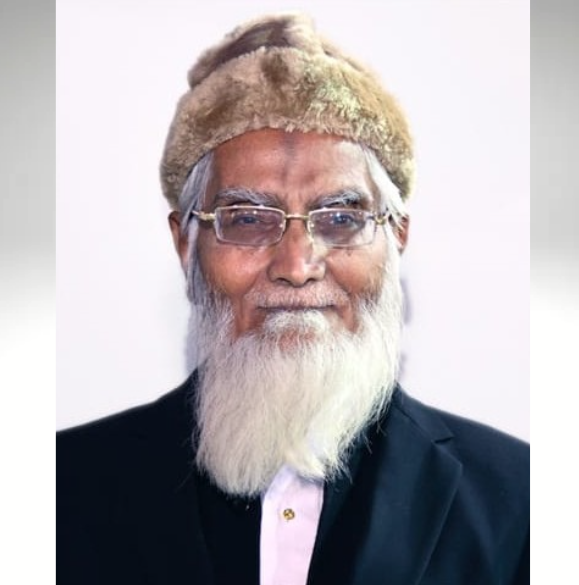
The All India Unani Tibbi Congress (AIUTC) has expressed its condolences on the passing of the esteemed Unani physician and patron of the Gujarat State chapter of the organisation, Hakim M.A. Razzaq Qureshi Qasmi. He passed away on March 2 (1st Ramadan) in his hometown, Ahmedabad, at the age of approximately 85.
His deep connection with Unani medicine led him to educate his children in this field and appoint them as his successors. His son, Hakim Yasir Qureshi, currently serves as the General Secretary of the AIUTC, Gujarat State, and is diligently fulfilling his responsibilities.
Dr. Syed Ahmad Khan, General Secretary of the AIUTC, expressed his condolences, stating that under the patronage of Hakim Maulana Abdul Razzaq Qureshi Qasmi, several significant programmes of the Tibbi Congress were organised in Gujarat, which played a vital role in raising public awareness about Unani medicine.
Besides Dr. Syed Ahmad Khan, those who expressed their condolences were Professor Mushtaq Ahmad, Dr. Akbar Umar Shargaonkar, Dr. S.M. Hussain, Dr. S.M. Yaqoob, Dr. Ashraf Ansari, Dr. Shakeel Ahmad, Dr. Mirza Asif Baig, Dr. Ghayasuddin Siddiqui, Hakim Aftab Alam, Israr Ahmad Ujjaini, and Muhammad Imran Kannauji, among others.
source: http://www.radiancenews.com / Radiance News / Home> Latest News> Obituary / by Radiance News Bureau / March 04th, 2025
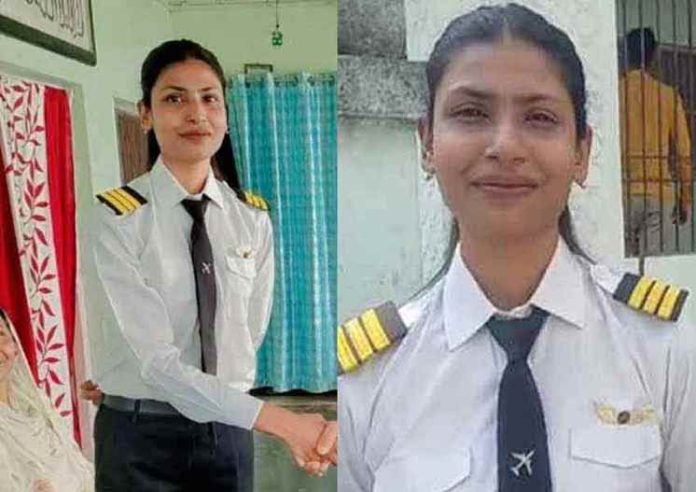
Taiba Afroz, hailing from Jalalpur village in Bihar’s Saran district, has soared above economic and societal challenges to become a commercial pilot.
Her journey from a modest background to the skies is a testament to determination and familial support.
From a young age, Taiba aspired to touch the skies. Recognizing her passion, her father, a small-scale grocer, made significant sacrifices to fund her education, even selling land to support her ambitions. This unwavering support propelled Taiba to achieve her dreams.
In 2020, Taiba completed her training at the Government Aviation Training Institute in Bhubaneswar, Odisha. She fulfilled the mandatory 200 hours of flight training, with 100 hours solo, earning her Directorate General of Civil Aviation (DGCA) license.
Today, she stands as the first female commercial pilot from Saran, drawing an impressive monthly salary.
Taiba’s journey wasn’t devoid of societal challenges. Facing criticism for donning the pilot’s uniform, she stood firm, asserting that her attire symbolizes her identity and achievements. Her story serves as an inspiration, illustrating that with determination and support, one can overcome obstacles to realize their dreams.
source: http://www.radiancenews.com / Radiance News / Home> Focus / by Radiance News Burear / March 04th, 2025
Maraikkayar (Marakkalalaayar/Marakkar) name refers to the community people who drive business belonging to boats, ships, fishing etc. Maraikkayar is the community they belong to TamilNadu, Kerala & Lanka.
The muslim trade community history record is available in pandiyas, portuguese, french, english.
They are also called Maraikka, Naguda, Malumi, Sukkani & Serangu. (4Kunjali Maraikkayar – Kunjali Maraikkayar I = Kutty Ahmad Ali (1507 – 1531 / 1507 – 1538 / 1520 – 1531 / 1520 – 1538), Kunjali Maraikkayar II = Kutty Pokker Ali (1531 – 1569 / 1531 – 1571), Kunjali Maraikkayar III = Pattu Maraikkar (1571 – 1595), Kunjali Maraikkayar IV = Muhammad Ali Maraikkar (1595 – 1600) Kunjali Maraikkayar was the leader of the marine force for the Kozhikode Raja Samoothiri (Zamorin Dynasty).
Maraikkayar people have done the export business such as rice, ginger, cardamon, pepper, turmeric. Vasco Da Gama landed in Kozhikode in 1498 May 17 or 28 From that he stayed for 86 days. The Portuguese and European traders were not like the Arab traders, Europeans expected monopoly business. European objectives like we only should do the business and not others. The Europeans used firearms, which were invented, produced by the Chinese and then exported to Europeans directly.
In the year 1498 Nov he went back to Portugal. In the year 1503 Vasco da Gama again came back to Hindustan with 1200 Dutch forces. Martin De Souza came with 25 navy ships to attack Kozhikode Samoothiri. Samoothiri made the discussions to attack the Portuguese. Kunjali Maraikkayar advised Samoothiri Raja (Maana Vikraman) that he would start the merchant navy force and attack the Portuguese. Kunjali Maraikkayar constructed the ships with his own wealth.
Vasco da Gama asked (Kalappana Nambudiri) the messenger of Samoothiri whether can we do something to defeat Samoothiri, but he was very honest for his Raja so Vasco da Gama slaughtered the messenger’s ear and stitched the dog’s ear in Kalappana Nambudiri. Vasco da Gama was the one who ordered Samoothiri to avoid doing business with Arabs and to do business only with him. So Vasco da Gama went to ask help with Kochin Raja and he helped to attack Zamorin ships.
Kunjali Maraikkayars fought against the Portuguese for 80 years. Kunjali Maraikkayar I fought against Portuguese Robbers in Kunjali Maraikkayar I fought against Portuguese Robbers in Kilakarai & Vedalayam (Rameshwaram), Kayalpattinam, Nagore, Thoothukudi, Kunjali Maraikkayar I In Thoothukudi dist. There is a perumal koil in madavankurichi (Kunjali Maraikkayar) is worshipped as merchant navy god!
*In the year 1510, Portuguese (Martin De Souza) captured the place Goa. *In the year 1520, Youe De Emiliyo (Leader of Portuguese) attacked Kunjali Maraikkayar navy ships. But Kunjali Maraikkayar attacked and defeated Portuguese from Kozhikode till Goa. At this time from the Deccan (South Hindustan) Avvaro Sante Mehri (Portuguese Leader) attacked Kunjali Maraikkayar with the help of (Portuguese Robbers) Viceroy Di Mento’s 36 ships attacked Kunjali Maraikkayar’s ships. Kunjali Maraikkayar attacked back and killed Viceroy Di Mento (Portuguese Trade Robbers).
*In the year 1521, the Portuguese tried to capture ponnani. So Ahmad Maraikkayar, his brother Kunjali Maraikkayar I, their uncle (mama) Muhammad Ali Maraikkayar from Kochi started to stay in Kozhikode.
*In the year 1523,Samoothiri II made an agreement with the Portuguese because of fear. But Kunjali Maraikkayar I was not getting any help from the government even though he prepared 200 navy force ships for the battle against the Paraingyar. *In the year 1524, Kunjali Maraikkayar I Vs Paraingyars fight was furious, Kunjali won the match, he was shown in the eyes of Parangyars Kunjali hero! *In the year 1525, Kunjali Maraikkayar I and his team lost the battle against the Portuguese. *In the year 1526, Portuguese Robbers attacked suddenly in Barkoor (place name) but Kunjali Maraikkayar and his team attacked and defeated Portuguese. But both of them were having losses. *In the year 1528, Kutty Ali & Kunjali Maraikkayar I and his team Vs Portuguese fought in Barkoor but Kutty Ali was prisoned by the Portuguese. *In the year 1528 in Sethvai, Portuguese stealed, robbed many goods and planned to travel by many ships to Portugal but Kunjali Maraikkayar I attacked Portuguese ships, killed all Portuguese enemies and won the battle. *In the year 1531, Kutty Ahmad Maraikkayar fought against Paraingyars, but due to the extreme war event Kutty Ahamd Maraikkayar was martyred in the battle.
*In the year 1535, Admiral Suleiman Batcha went along with (ruler of Kozhikode) Samoothiri fought and won the battle against Parangiyars.
*In the year 1537, the nomad ‘Kunha’ became the governor and tried to capture Kozhikode, also tried to build the fort in Chaliam, this time Kunjali Maraikkayar II fought against them and won the battle. In the Nagapattinam seashore also the war happened, Kunjali Maraikkayar II went with 51 ships that included around 8000 soldiers to attack them. *In the year 1538, Kunjali Maraikkayar I fought against the Portuguese but he lost the battle. (source Prof. MH Jawahirullah)
*In the year 1565, Thirumala Devarayan Vijayanagar Raja (Krishnadevarayan’s 5th Generation/Grandson of Krishnadevans Grandson’s son) helped the Portuguese by providing money to fight with Maraikkayar & Zamorin. Raja told the Portuguese you attack from the sea, we will attack from the land. Even though they can’t handle Kunjali Maraikkayar III = Pattu Maraikkar (source; Portuguese viceroy’s book – The travels of Francois spirad in the East Indies, Morocco and Brazil)
*Kunjali Maraikkayar I was martyred for the country of Lanka.
*After him, his family took incharge of the protest and fought against the enemies, drohis. In the year 1570 Peppur lake, Chaliam Fort battle Kunjali Maraikkayar II fought against enemies of 65 years war, won and controlled them.
*In the year 1572, Parangyars force stealed, robbed the goods from the masjids, temples, kozhikode port, Thirukodi port, Kappakkattu port, Ponnani port and made huge losses.
*In the year 1586, Kunjali Maraikkayar III fought against the enemies and won the battle.
*In the year 1589, Son-in-Law of Kunjali Maraikkayar III Kuwaji Musa fought against Parangyars and won the battle.
*In the year 1595, Kunjali Maraikkayar IV fought against Parangyars. But the ruler of Kozhikode Samuthri had a secret agreement with the grandson of Vasco da Gama – Francisco da Gama. Kunjali Maraikkayar IV was not aware of this secret agreement, he went to meet the Kozhikode ruler Samoothiri, but the Kozhikode ruler prisoned him and gave it to the parangyars (Lanka Burghers). They tortured by chaining him, without providing any food, sleep made him to die.
Source: India Veeramigu Muslimgal Book by Sh. AbdKader Kashifi, Kasimi
Note: Haji Pakkir Muhammad Sett was the one who donated Rs.2,00,000 to buy the Sudeshi Ship, VO Chidambaram was the captain of the ship.
(Kunjali IV also fought for Sultan of Bijapur & Rani of Pulal!)
Kunjali Maraikkayar built 999 ships, finally his last 1000th ship he planned to build it without any screws. He fought against the Portuguese in Lanka, but portuguese were angry with him and got angry with him they used the chance to kill 700 people in Thoothukudi. So Kunjali Maraikkayar came to Thoothukudi to fight against the Portuguese and won the battle.
And then he went to Lanka. After a couple of months he was martyred by a Portuguese gun bullet in Lanka and buried there. For 25 years he has done the trade by ships. Kunjali Maraikkayars and his team have built 4 forts near the seashore. The fort itself 20 mile from the one to another! Portuguese spied in a wrong way to the raja that he will build a new nation for the mopillas. Raja cheated Maraikkayars by handing him to the Portuguese but Portuguese cheated Zomarin Samoothiri Raja by killing them!
Article by :
AlWaris Art & History Project, KONAKIND FOUNDATION (This AlWaris Art & History Project will focus for Indian history, modern India and the comparison with current India.)
Contributions Welcome:
Contribute your wealth to improve & develop the projects for art & history project you can send Rs.1000 for books also you can email us if you can send us the historical books, Rs.1000 for travel expenses & Rs. 2000 to collect and store the historical coins/clothes, etc:
A/c info: KONAKIND FOUNDATION A/c: 42849410432 IFSC Code: SBIN0003994 KONAKIND FOUNDATION Email: konakindfoundation@gmail.com
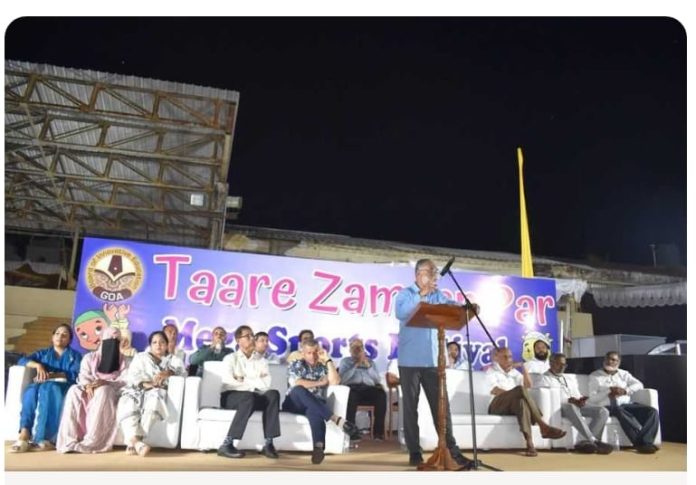
The Board of Innovative Education (BIE), Goa, successfully organised a state-level mega sports festival at the Raia panchayat grounds, Salcete on December 29-30.
Praising the efforts of BIE, Vice-President of Jamaat-e-Islami Hind, S Ameenul Hasan said that BIE is nurturing champions and stars of the future not just in the community but also the State and the nation. Through various activities and unique annual events, BIE has been showing the path for community’s unified efforts in development of the children.
He advised the parents to promote the talents in their children in order to ensure overall development of their personality. Sports is one of the many facets of human activity.
“Islam promotes physical fitness and sports. The Prophet Muhammad ﷺ is the best example for the humanity and he encouraged not just men and children but also women. He himself competed with his wife in running races,” Hasan added.
The two-day sporting event witnessed more than 1,000 participants varying between the age of 5-14 years compete in 15 different sports.
The concluding ceremony was graced by numerous Muslim political leaders, social workers, sports personalities and Ulama (Islamic scholars), who adorned the dais. A large number of parents attended the ceremony to witness their children receiving medals, trophies, mementos and certificates.
BIE Chairman and JIH Goa President Asif Hussain appealed to the parents to ensure that their children are nurtured to become responsible citizens and leaders for the Goan society.
Chief Organiser of the Mega Sports Festival, Meenaz Banu informed that BIE Goa operates through nine branches across the State where weekend classes for the overall development of children are conducted every Sunday.
One of the striking highlights of the event was that nine separate tents for boys and nine for girls were set up for participants representing the nine BIE centres. These tents served as areas for students to strategize, discuss, rest, and have their meals.
During the closing ceremony, 55 Muslim athletes from the State who have competed at state, national, and international levels and received accolades for Goa were felicitated. Children as little as 4 years, differently-abled, to adults who have been coaching students to excel in sports were among those who received special appreciation mementos. The sports personalities came from various sports including swimming, karate, kickboxing taekwondo boxing, cricket, squash, etc.
Earlier, on Sunday, December 29, Maulana Ibrahim, community leader and businessman from Margao was the chief guest. He expressed joy on seeing Raia sports ground filled with little children all set to enthral parents and audience. He said that such sporting events are the need of the day to showcase the talents that Muslims behold.
Asif Abbas Ahmed, President of the Thai Boxing Association, Goa made a special mention and encouraged the girls for their participation wearing hijab. He said that beyond the misrepresentation of oppression, girls participating in the sports festival in hijab have sent across a resounding message of modesty in sportswear.
BIE launched its organisational anthem during the closing ceremony.
source: http://www.radiancenews.com / Radiance News / Home> Latest News> Sports / by Radiance News / January 02nd, 2025
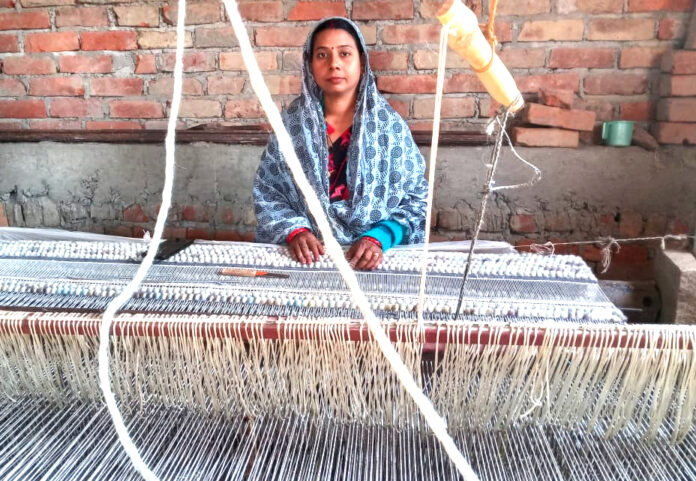
Shakeela Bano’s journey from a housewife to an entrepreneurial inspiration in her village, Katsil in Sakaldiha Tehsil, is one that exemplifies the power of determination. Faced with the challenges of a sudden job loss of her husband during the COVID-19 pandemic, she decided to turn adversity into opportunity by starting a home-based rug weaving business.
What began as a way to support her family has now evolved into a flourishing self-help group that is helping many women in her village achieve financial independence and self-reliance.
Shakeela’s Journey
“My husband used to work on a power loom in Varanasi, but during the pandemic-induced lockdown, he became unemployed. The challenges of running the family became significant. I was already running the ‘Hariom Self-Help Group’ in the village. I held meetings with the women in the group and got their consent to start rug weaving. After 20-22 days, we made our first income. After deducting expenses, each person received Rs 2,000,” Shakeela, the president of the group, told TwoCircles.net.
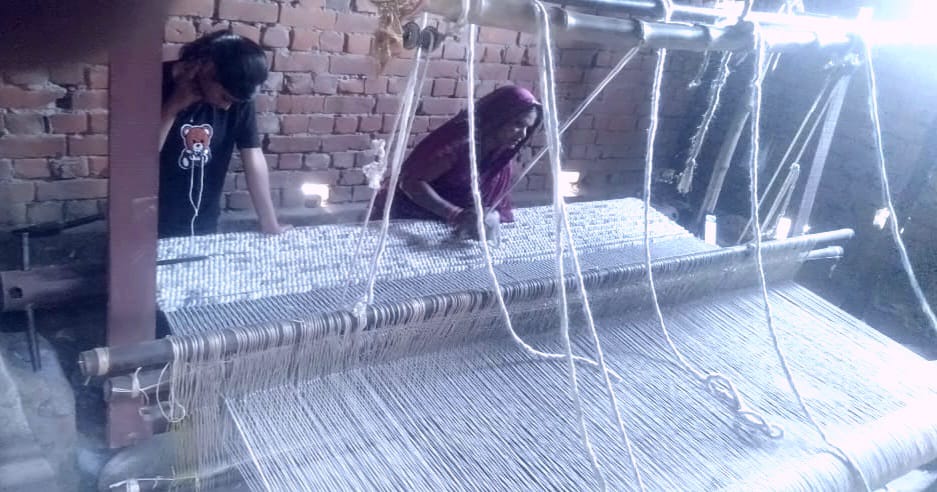
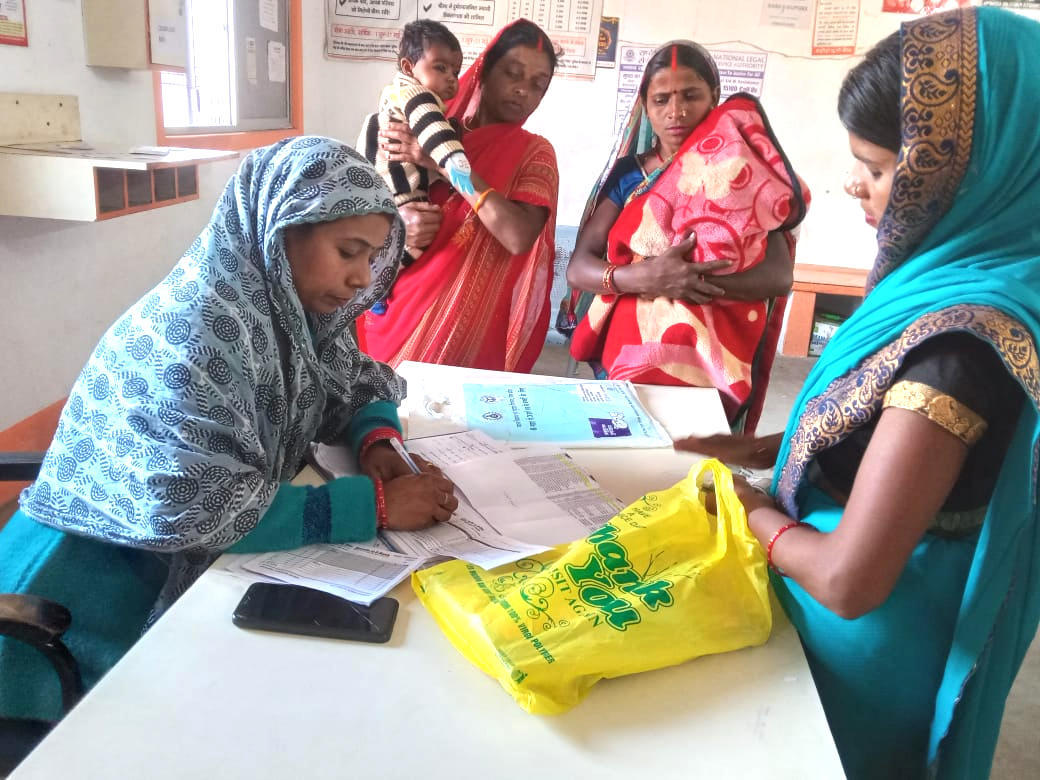
Young girls and women weaving carpet in Shakeela Bano’s house
From then on, they worked with even more enthusiasm. Now, each woman member earns Rs 4,000-5,000 per month. The raw material for making one rug costs Rs 400. It involves labor costs another Rs 400. “We make 60-70 rugs and 150-170 mats per month, and each rug sells for Rs 1,100 rupees,” she said.
In a region where unemployment and lack of opportunity have been longstanding issues, Shakeela’s determination to succeed sparked a change. Her initiative not only transformed her own life but also empowered others around her, especially women, by providing them with meaningful work that helped them earn an income, gain confidence, and become self-reliant.
Today, Shakeela’s business is a model of success, and her group has expanded to include men as well, offering them a chance to work alongside women in the rug weaving business.
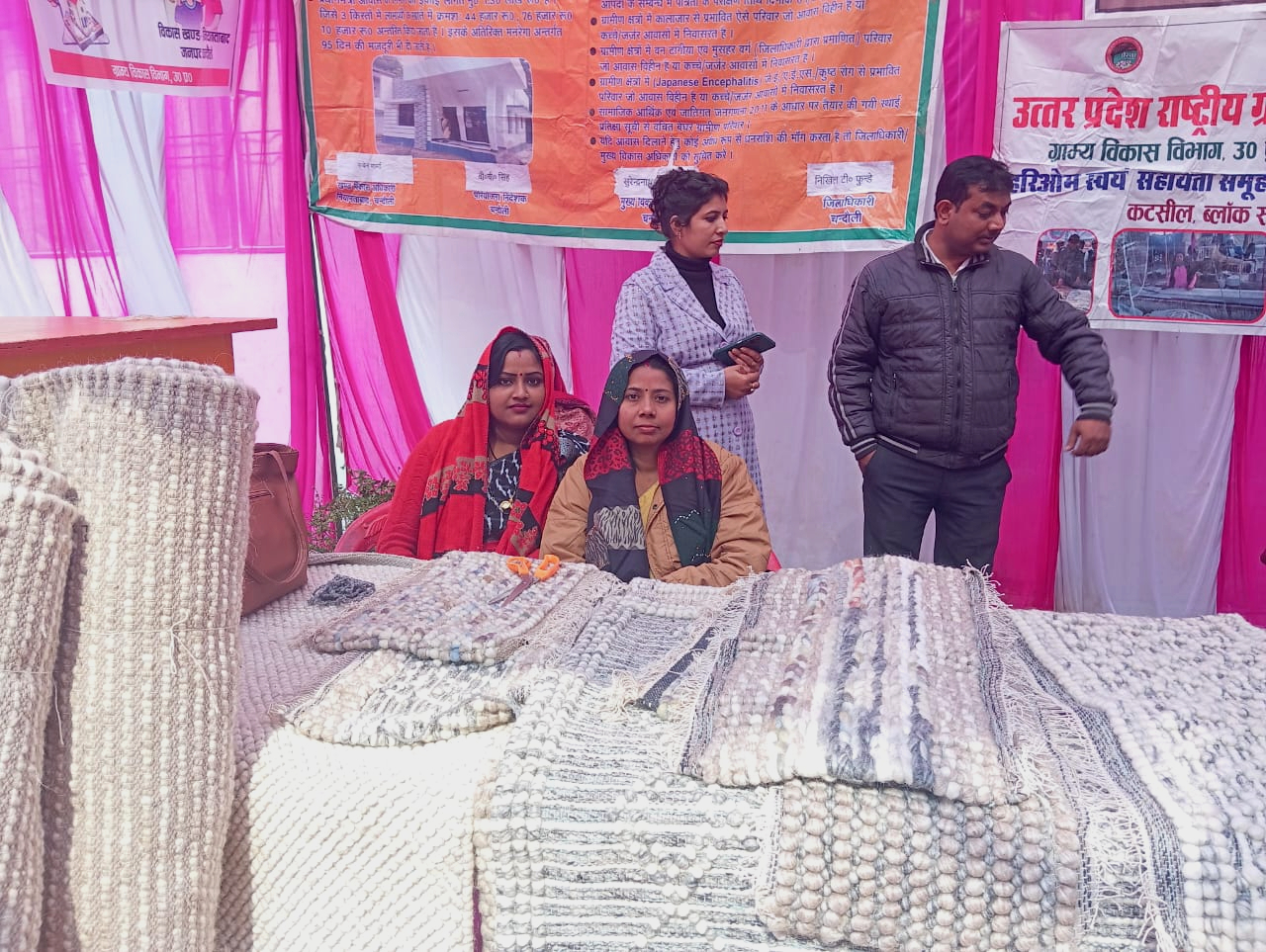
Hand products – carpets and rugs, on display in the Kastil village exhibition
New Opportunities for Local Women, Youth
With timely payments, local women and unemployed young men started flocking to Shakeela’s center. Initially, she had set up only two machines, but now, with two sets of 10 machines each, rug weaving work is progressing rapidly. She said she has recently purchased land and plans to install rug weaving machines there as well after arranging funds for the same.
Shakeela, a graduate and also a BC Sakhi or Bank Sakhi, further said, “Just 10 days ago, a district-level village industry exhibition was organised in the Niyamatabad development block by the district administration, where mats worth Rs 5,000 were sold. There is a high demand for small hand-woven mats that are sold for Rs 100-120 in local markets and district-level exhibitions. In addition to making mats here, women from half a dozen nearby villages are taking raw material and weaving mats at home to become self-reliant.”
Chameli Devi, who is associated with the Nai Bazar Chameli Devi Self-Help Group and works in rug weaving, first learned weaving at Shakeela’s workshop. After learning there, she set up three machines at home to weave mats. “I get raw materials from Shakeela didi (sister). After delivering the finished products to the traders, payment is made immediately. The better income from rug weaving is opening doors to prosperity,” she said.
Shakeela depositing the money of the women of the group in the bank branch located in Nai Bazar.
Support Systems, Market Integration
The availability of banking facilities and having a savings account for village dwellers is considered an essential indicator of development in rural economy. The women involved in the group deposit the income and savings from rug weaving in a newly established bank in the local market.
Shakeela also provides them with loans at low interest rates for their self-employment and necessary expenses.
Shakeela’s husband, Raju Ansari, said they procure raw materials from Saiyadraja town, 10 kilometers from the Katsil village, without paying any sum in advance. “Anyone interested in making rugs can get raw materials and receive payment after delivering the finished products. From here, the rugs are sent to Bhadohi. They are then exported from Bhadohi to Gulf countries, Turkey, the United States, Russia and Europe,” he said. The easy sale of products has boosted the pace of work and increased the enthusiasm of the workers. Due to rug weaving, the unemployment rate among the youth in his village has reduced.
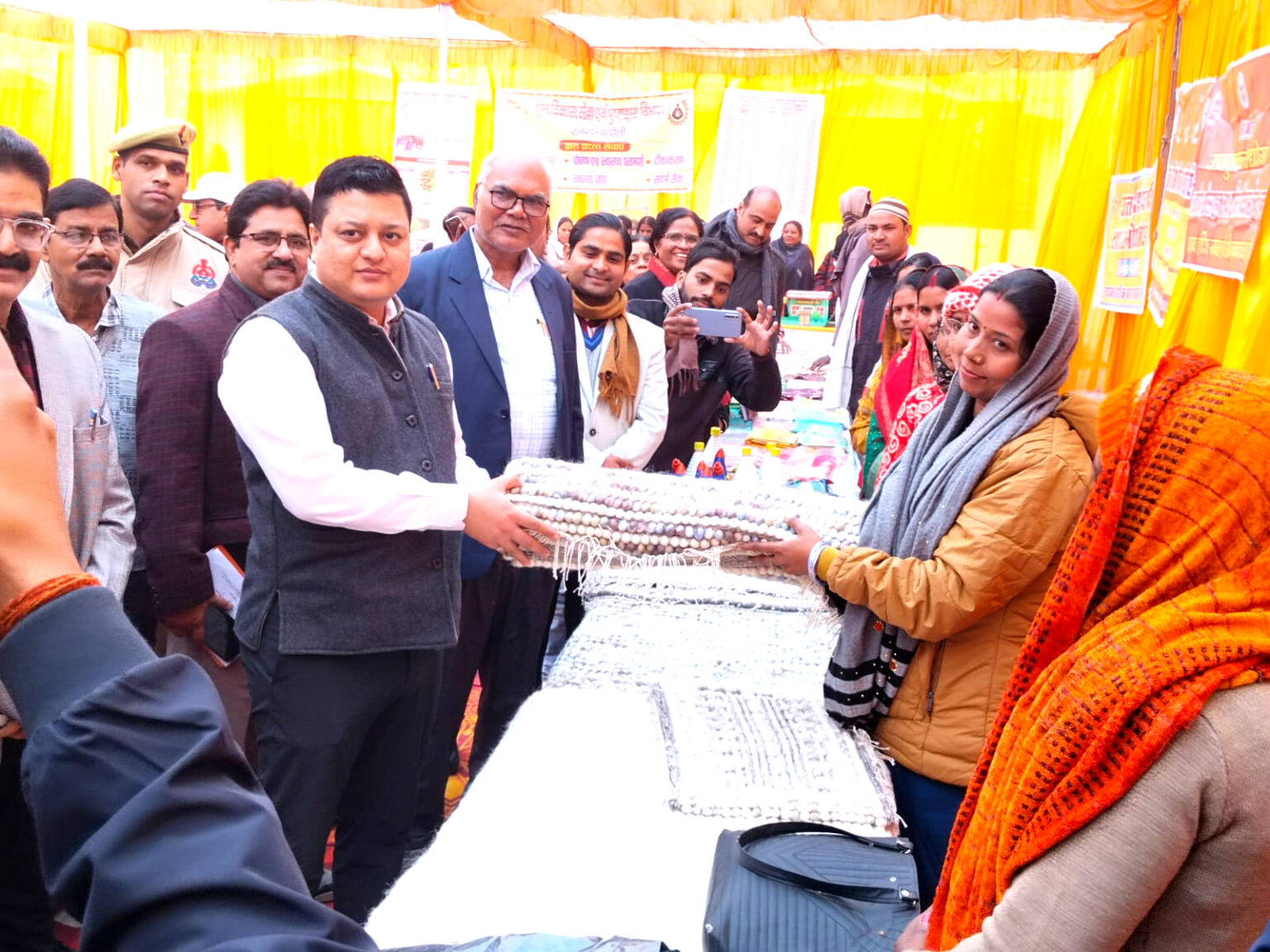
Chandauli District Magistrate Nikhil T Funde buying doormat from Shakeela Bano’s stall in the exhibition
Traders from the carpet city of Bhadohi send raw materials to be woven into carpets (rugs) by village workers. This not only increases employment opportunities in the villages but also reduces the time required to complete the goods. The finished rugs are brought to Bhadohi, where they are given a final touch in factories before being prepared for the international market, where they are called carpets.
At the district-level village industry exhibition, Chandauli District Magistrate Nikhil Tikaram Funde appreciated Shakeela’s home-based industry initiative and appealed to people, “The women, men and youth of the district can also earn a better income through self-employment and small industries and provide employment to others. The Government of Uttar Pradesh and the district administration are ready to offer all possible support.”
(Pavan Kumar Maurya is an independent journalist. He tweets at @pavanmaurya17)
source: http://www.twocircles.net / TwoCircles.net / Home> Art-Culture> India News>India Politics> Indian Muslim / by Pavan Kumar Maurya, TwoCircles.net / February 22nd, 2025
Member of Parliament Tariq Anwar speaking at the first year celebration of Sahyog credit co-operative society in Abul Fazal Enclave, Jamia Nagar, on February 23, 2025.
New Delhi :
Delhi’s Jamia Nagar-based Sahyog Credit Cooperative Society Ltd celebrated its first anniversary on Sunday, offering a comprehensive range of services, including Daily Deposit Accounts where daily wage earners and small businesses can deposit a minimum of Rs. 100 daily at their doorsteps, and providing interest-free loans and financial assistance ranging from Rs. 50,000 to Rs. 2 lakh under various personal consumption, consumer, and commercial loan schemes.
Sahyog is working under the nationwide Sahulat Microfinance Society, a game-changing initiative in the interest-free finance sector that operates in 13 states and has 130 branches serving 3.5 lakh members across the country.
Its first annual programme was held at Milli Model School in Okhla, New Delhi, with Congress MP Tariq Anwar speaking as the chief guest and attended by various local dignitaries and prominent personalities.
Sahulat’s Groundbreaking Work in Microfinance: A Beacon of Hope for Low-Income Families
Speaking at the event, Usama Khan, CEO of Sahulat Microfinance Society, highlighted the organization’s 14-year history of providing interest-free microfinance services across India. He shared that Sahulat currently has 63 registered interest-free credit cooperative societies affiliated with it, operating 121 branches across 13 states. These branches serve nearly 3.5 lakh members, with the number steadily increasing.
Usama further detailed its impressive figures, including annual deposits of approximately Rs. 1460 crores and annual loan disbursements of around Rs. 625 crores, both of which are doubling every year.
Emphasizing that Sahyog’s success is built on the strong foundation of Sahulat’s 14 years of experience, Usama said, “Sahyog’s journey is not just one year; it is backed by the proven track record of Sahulat’s nationwide operations.”
“Credit cooperative societies worldwide are supply-side models,” Usama said. “Similarly, Sahulat-affiliated societies help low-income individuals save a small portion of their income, whether from daily wages, small businesses, or other livelihoods, which, over time, can accumulate and be used for essential needs.”
Assuring the audience, Usama stressed that the foundations of Sahyog and other affiliated societies are robust, adhering to both Indian regulations and international microfinance standards. He also praised Sahyog’s office bearers, including President Shamsuz Zoha and Vice President, as trustworthy persons.
Defining Sahyog, Usama Khan explained that the society is registered under the Delhi Cooperative Societies Act as a credit cooperative society. It offers thrift schemes to its members, mobilizes deposits, and provides interest-free loans and financial assistance of up to Rs. 50,000 to meet the various consumption and business needs of small-income individuals in the Jamia Nagar locality, regardless of caste, class, or religion. Usama highlighted that Sahyog primarily serves small-scale businessmen and low-income people in areas such as Zakir Nagar, Batla House, Abul Fazal, Okhla Vihar, and Shaheen Bagh.
Usama further detailed Sahyog’s services, including the Daily Deposits Account. This initiative allows daily depositors, such as daily wage earners, shopkeepers, street vendors, and auto and cab drivers, to make deposits without leaving their workplaces or shops. Sahyog’s staff collects deposits directly from members’ homes, doorsteps, shops, or other locations, starting with a minimum of Rs. 100. Under this scheme, daily wage earners and small shop owners can deposit a minimum of Rs. 100 daily at their doorsteps. The service also provides e-receipts (via SMS) and passbooks for members.
For salaried individuals, working women, and both skilled and unskilled professionals, Sahyog offers a Saving Account with a minimum deposit of Rs. 200. This account is designed to cater to their future needs and is supported by deposit collection both in the field and at the branch office.
Micro Finance institution Backed by Strong Islamic Interest-free norms
Speaking about Sahyog’s interest-free loan offerings, Usama Khan outlined three types of loan schemes: Demand Loan, Consumer Murabaha Financing, and Commercial Murabaha Financing. He explained that the Demand Loan is specifically designed for consumption purposes, such as personal use, with a maximum tenure of 12 to 18 months. Under this scheme, Sahyog charges no interest or profit, not even based on depositor profits or institutional standards. Instead, the society only applies a minimal surcharge of 1-2%, covering the actual costs of office maintenance, such as doorstep collections, record keeping, and expenses related to core banking software and office staff.
Usama emphasized that Sahyog, as a non-banking institution, operates with core banking software to ensure transparency and efficiency in its operations.
Addressing concerns regarding the minimal surcharge being equated with interest, Usama firmly stated that all of Sahyog’s schemes strictly adhere to Islamic teachings, reinforcing the society’s commitment to providing interest-free financial services.
Usama made a heartfelt appeal to marginalized and low-income people, encouraging them to save and invest in the scheme to meet their daily needs. He also urged the affluent members of society to contribute resources and support this initiative to uplift those in need.
Sahyog: Expansion Plans and Promising Future
In a conversation with Indiatomorrow.net, Sahyog Vice President Abdul Mannan clarified that the society does not charge interest or fixed percentage fees on loans. Instead, it only recovers the actual costs associated with services like doorstep collections, office maintenance, and software upkeep. These costs are minimal, typically ranging from Rs. 500 to Rs. 2,000 per loan of 20-50 thousand. He also shared that Sahyog’s Jamia Nagar branch has been operating smoothly, with 750 members joining within its first year. The members have shown great cooperation, with loan repayments being made responsibly. Abdul Mannan revealed plans to expand Sahyog’s branches in different areas of Delhi and aimed to increase the membership to 1,000 by 2025.
Regarding the Consumer Murabaha Financing scheme, Abdul Mannan explained that it allows Sahyog to provide durable products to members for consumption. The loan repayment period ranges from 3 to 18 months, with amounts between Rs. 10,000 and Rs. 1 lakh. For example, if a member wants to purchase a refrigerator priced at Rs. 20,000, Sahyog buys the refrigerator at that price, and then negotiates a one-time profit share with the seller. The member then repays the exact Rs. 20,000 in easy instalments. Abdul Mannan emphasized that this profit is in compliance with Islamic teachings.
Abdul Mannan also introduced the upcoming Commercial Murabaha Financing scheme, which will provide commercial products to members. Loans for these products will range from Rs. 10,000 to Rs. 2 lakh. Members can also invest in one-time shares up to Rs. 50,000 and make time-bound savings of up to Rs. 1 lakh.
Moreover, the Sahyog official mentioned the Haj and Umrah Account, which allows individuals planning to undertake the sacred pilgrimage to open an account with a minimum deposit of Rs. 200 per day or Rs. 5,000 per month. The term period for this account can range from 1 to 5 years, depending on the member’s needs.
Lauding Sahulat and Sahyog’s services for their focus on human care and the empowerment of low-income individuals, MP Tariq Anwar praised the society’s constructive work, highlighting its crucial impact on society. He commended the society’s interest-free loan schemes and financing programmes as a significant and commendable effort to assist those in need.
The MP said, “India is still not a developed country. We are still struggling to reach that goal. Even after 75 years of independence, our dream of a developed nation remains distant. It is a sad fact that around 90% of the population in this country is either poor or below the poverty line. Nearly 80 crore people depend on government rations or food.”
Urging people to work together and support initiatives like Sahyog to help elevate the country from poverty, Tariq Anwar emphasized the importance of cooperation. He reminded the audience that the cooperative movement in India began even before independence and has since become an integral part of the nation’s structure, with cooperatives playing key roles in different sectors including agriculture.
Lauding the progress of Sahulat and Sahyog, Prof. D.K. Dhusia, Head of the Department of Commerce and Business Studies at Jamia Millia Islamia, stated that microfinance is synonymous with empowerment. He emphasized that microfinance is particularly beneficial for small-scale businesses, noting that these cooperative societies operate interest-free, in alignment with Islamic banking principles that also function on a zero-interest basis. He highlighted that microfinance societies play a vital role in empowering low-income groups within society.
During the event, Dr. Majid Ahmed Talikoti, a renowned surgeon and chairman of the 600-bed Medicant Hospital and Research Centre in Bokaro, Jharkhand, made a significant announcement. He pledged to offer free OPD treatments to all members of Sahyog and provided a 50% discount on cancer treatments. Dr. Talikoti also committed to extending full support and assistance to Sahyog’s members at his hospital.
source: http://www.indiatomorrow.net / India Tomorrow / Home> Economy / by Anwarulhaq Baig / February 24th, 2025
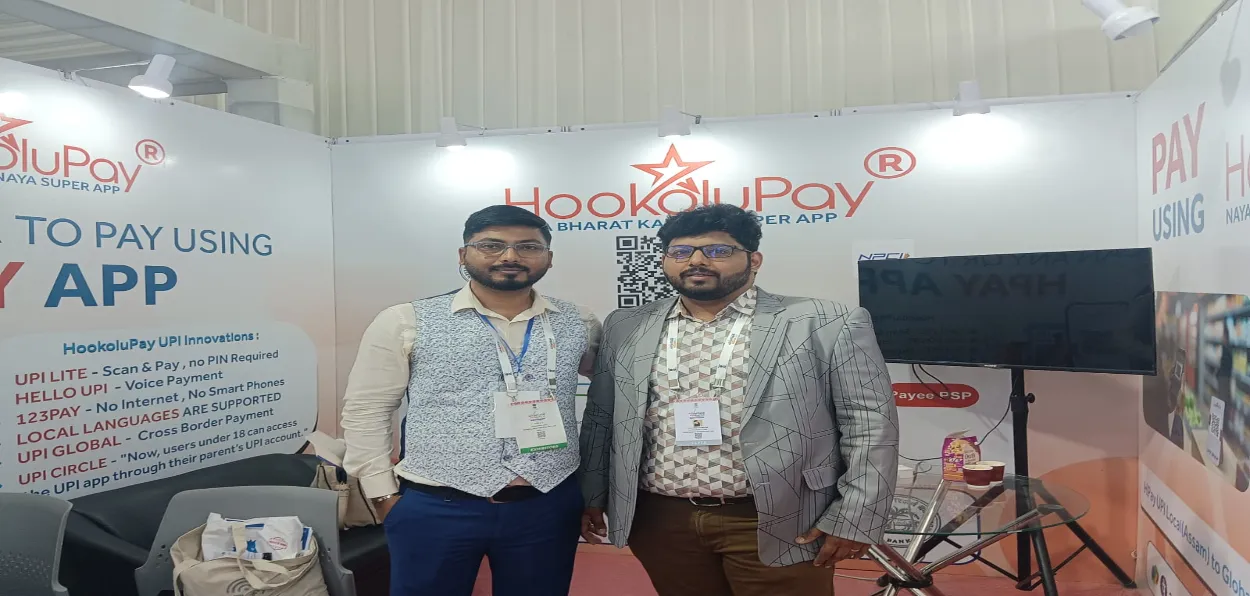
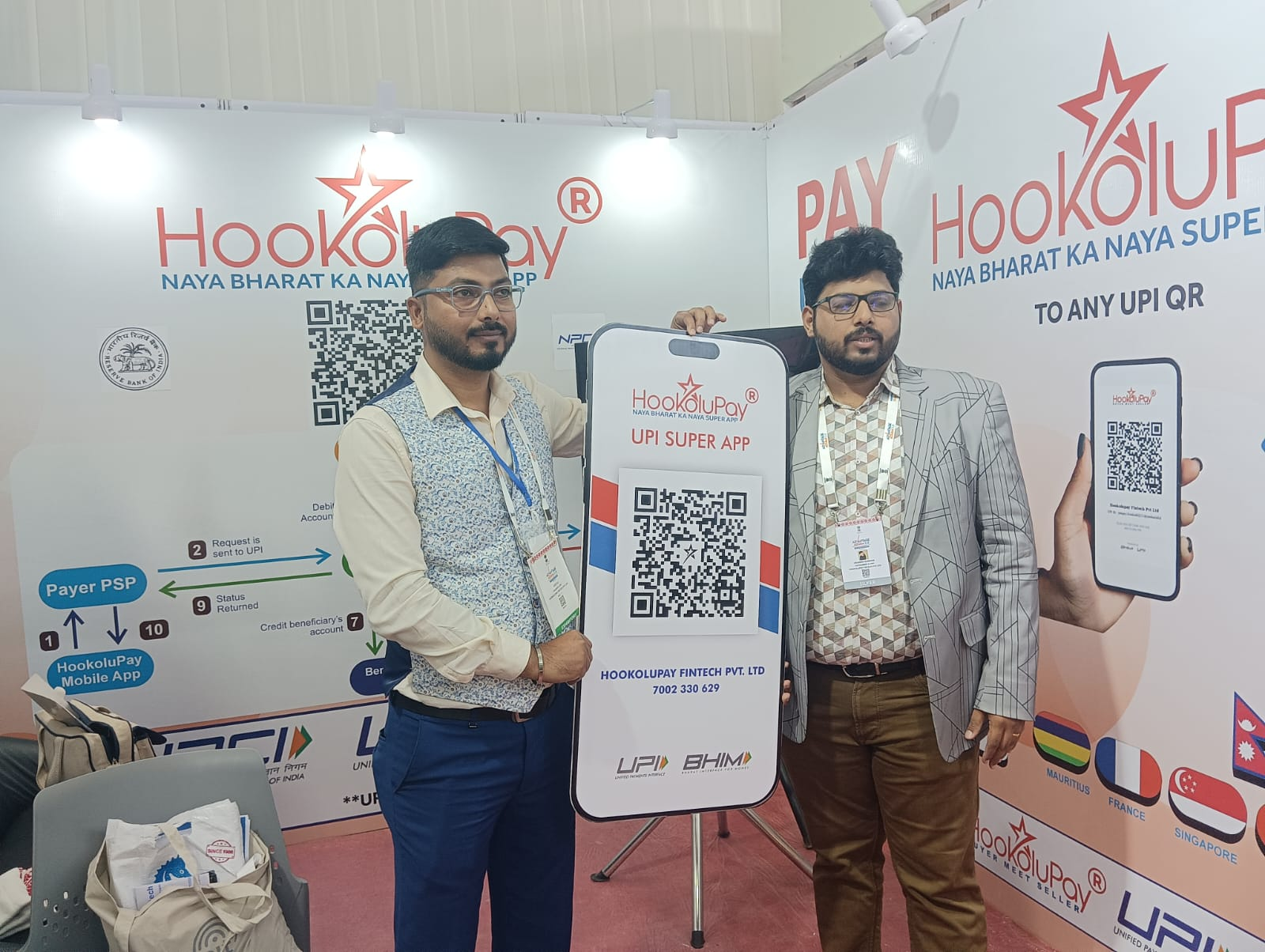
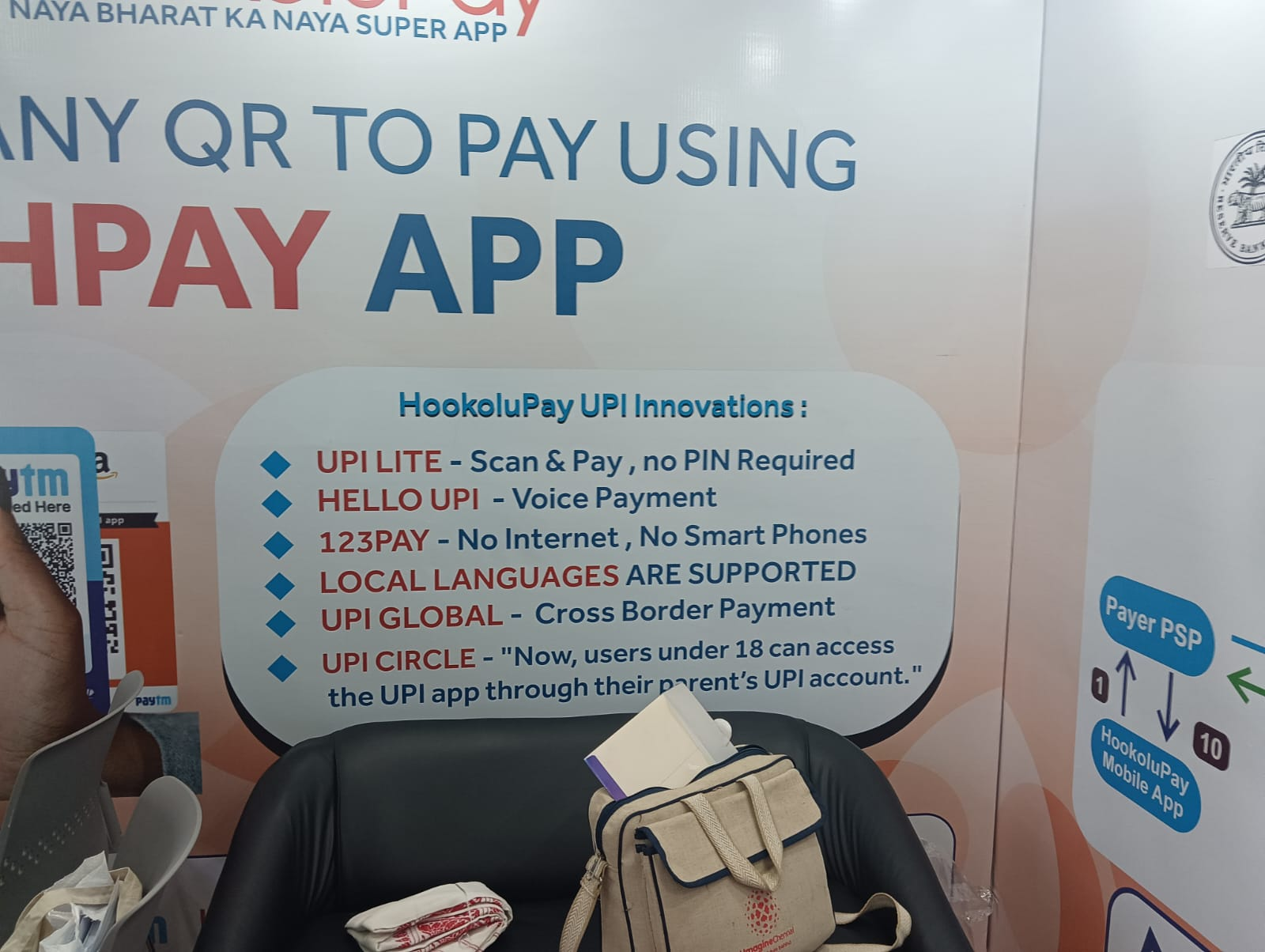
Ali and Anand Kannan displaying HookoluPay at Advantage Assam conclave
People in India’s northeast can get set for a new UPI (Unified Payment Interface) experience. The new UPI service, HookoluPay, has received a license from the Reserve Bank of India (RBI) and the National Payments Corporation of India (NPCI) as a digital payment platform using local languages of the Northeast region.
It’s likely to be launched by May or June.
Developed as part of a startup initiative by Assam-based entrepreneur Aziz Ali, HookoluPay is likely to help users with most of the local dialects available in the northeast region apart from English and Hindi.The
Ali, a B.Com graduate and an MBA has also kept the option of offline payment in HookoluPay because most places in the northeast still lack high-speed data.HookoluPay is set to break the existing language barrier with the existing UPI services.
“I have started working on HookoluPay in 2018. We got the license from the RBI and the NPCI in November last year. Once launched, HookoluPay will help users in India’s northeastern states with their own languages and dialects.
“While India is on the path of digital transformation, one must keep in mind that 60 percent of the people are still not included in the financial services. In many places, particularly in the hilly regions of the northeast people still use cash.
Ali and Anand Kannan displaying HookoluPay at Advantage Assam conclave
“Although there are UPI services like the GPay, PhonePe, PayTm, etc, most of them have English or Hindi language options. HookoluPay will have services in most of the dialects that are available in the region,” said Ali while talking to Awaz-The Voice.
Ali, who had set up a stall at the Advantage Assam 2.0 summit to showcase the product, received large-scale encouragement from the visitors. Even Prime Minister Narendra Modi visited the stall put up by Ali and appreciated the initiative.
The Prime Minister reportedly asked Ali to take the new UPI service to every nook and corner of the country, mostly in India’s northeast where there is still a lack of digital payment services.
“Our main focus behind developing this new payment gateway is to bring more financial inclusion in the rural areas,” said Ali who is the founder of HookolyPay. Ali is a native of Jeypore near Naharkatiya in Assam’s Dibrugarh district. HookolyPay is a locally developed Fintech startup based in Assam.
An advertisement of the HookoluPay
m Ali’s partner and Co-founder of HookoluPay, Anand Kannan said that HookolyPay can be used for institutions, small enterprises, businesses for governments, travel, etc.
“Like any other payment gateway like GPay, PhonePe, PayTm, it can be used anywhere and by anyone. We are going to launch it pan India but our focus area will be Assam and Northeastern states as we are a startup from this region,” Kannan said.
“At present, we have the options of Hindi, English, Assamese, Mizo, and some other languages but more languages are being added so that it becomes user-friendly to the people,” said Ali.
This will help digital payments in India’s northeast, said Ali.
“Our stall was visited by the Hon’ble Prime Minister of India during his visit to the Advantage Assam 2.0 summit on February 24 evening. The Prime Minister’s words are very encouraging for us,” said Ali while adding that they are also taking this new UPI service to seven other countries which include Singapore, UAE, Bhutan, etc.
source: http://www.awazthevoice.in / Awaz, The Voice / Home> Story / by Karabi Sharma, Guwahati / March 01st, 2025