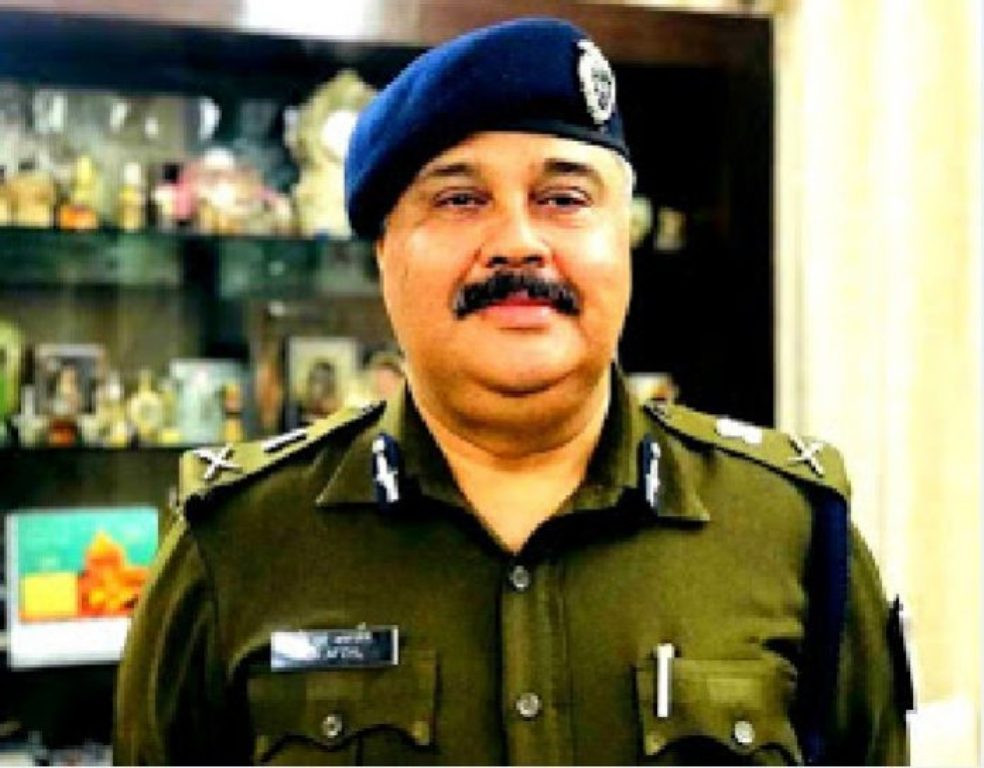
Former Aligarh Muslim University (AMU) Registrar, alumnus and Madhya Pradesh cadre IPS officer, Mr Syed Mohammad Afzal passed away at a hospital, battling cancer. He was 56-years-old.
Expressing condolences on the former AMU Registrar’s demise, the Vice Chancellor, Professor Tariq Mansoor said that deceased will be remembered for numerous contributions to the university.
He added that Mr Afzal was a caring and compassionate person with a larger-than-life personality. His demise is a huge loss to the AMU community.
May the Almighty bless his soul with peace, said Prof Mansoor.
Mr Afzal served as the AMU Registrar from 2000 to 2002 and joined as the Jamia Millia Islamia Registrar in 2005. He also served as a regular resource person to Academic Staff College-AMU, taught IPC, CRPC course to the students of law at AMU regularly and also instructed different subjects of law to IPS probationers at NPA and to DSPs and Sub-Inspectors at State Police Academy, Sagar.
In his distinguished career, Mr Afzal was posted as the DIG of CID, SSP Telecommunication and Commandant 14th Battalion and SP Gwalior, SP Rajgarh and Chattarpur, Commandant of Jammu and Kashmir Battalion, Additional SP Jabalpur, ASP Sagar-Bhopal and ASP, SVP National Police Academy, Hyderabad.
Mr Afzal attended AMU for LL.M (1987), LL.B (1985), B.A Hons (1982) and PUC (1979). Mr Afzal’s brother, Dr Syed Mohammad Amin is a professor of Urdu at AMU and his family resides at Kabir Colony in Aligarh.
He used to run the Aligarh based Al Barakat Educational Society.
source: http://www.amu.ac.in / Aligarh Muslim University / Home / by Public Relations Office, AMU / December 16th, 2020
Colonial historians and scholars often claim that the Indian Freedom Movement was a disjointed movement with no nationalistic feeling among the people participating in it. This belief, that Indians fought against the British for local communal reasons without any coherence, has been further propagated by the Indian historians as well, after the independence. Often, we are made to believe that Muslims fought to secure their religion or Caliphate while Hindus to protect regressive social institutions. Similarly, urban elite, peasantry, tribal, and others have their own narrow interests in fighting against the British.The idea may be true and open to debate, but the fact that there was a coherence among different groups within India while fighting against the British is an undeniable fact.
During the early 19th century, the British decided to partition Bengal. Hindus and Muslims, together, rose up against the decision which based itself upon religious segregation. India in general, and Bengal in particular, adopted the Swadeshi campaign to oppose this decision. In 1905 Bengal got divided, agitating the youth. It must be noted that the present Bihar was part of Bengal at the time. The youth, led by people like Barin Ghosh, started adopting militant methods to oppose the British.
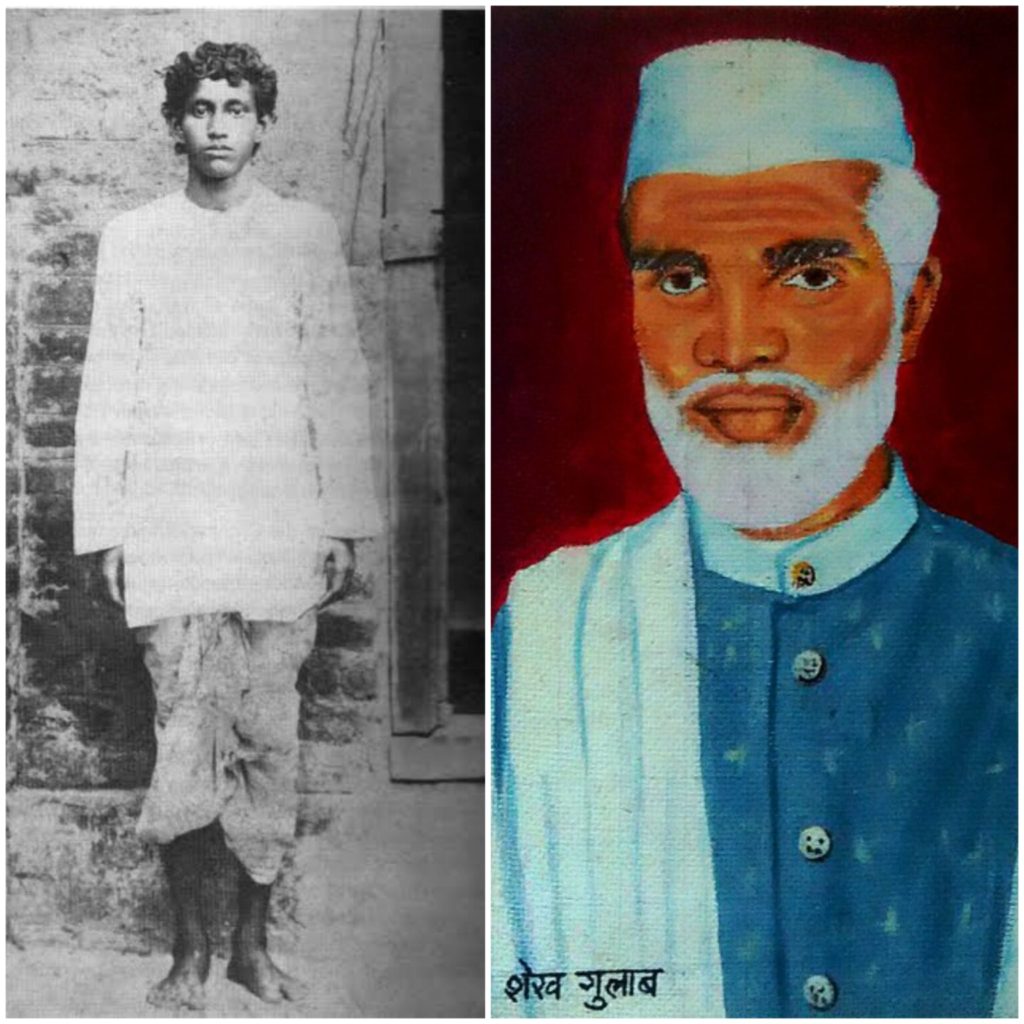
At the same time, in Champaran of Bengal (now, in Bihar) indigo planters led by Sheikh Gulab started a non-cooperation agitation against the British indigo planters. Gulab defied the tinkathia system, where indigo had to be planted on the best portions of land, on his 60 bigha land which was near Sathi factory in Champaran. It was 1907 & Champaran was part of Muzaffarpur commissionerate.
More and more peasants joined Gulab in his movement and another Sital Ray rose as another prominent leader. Planter’s Association had their own army called Bihar Light Horse, famous for its cruelties over peasants. In 1907, the government passed an order appointing Gulab and his comrades as the special constables in police. Gulab defied this appointment and did not join. Police arrested him under the Special Police Act, 1861.
Sentence of Gulab was reversed later by Kolkata Court in March, 1908.
Next month, in Muzaffarpur a judge, Kingsford, was transferred from Kolkata. Champaran lied under his jurisdiction. Indians were already angry with the judge for his anti Indian attitude and there was this apprehension that he had been brought to crush the anti British peasant movement. British reports were already pointing towards a collaboration between Kolkata based Bengali revolutionaries and the peasant movement of Champaran.
The arrest of Sheikh Gulab had stirred the local emotions and this transfer of Kingsford acted as a catalyst.
Within a few days, Khudiram Bose, a young boy of 17, and Prafulla Chaki, both of them Bengali tried to assassinate Kingsford with a bomb. Accidentally, they killed two English women.
Khudiram Bose was hanged till death in August, 1908.
Khudiram’s martyrdom instilled a new spirit in Sheikh Gulab. In September, 1908, he organized more peasants at Vijayadashami Mela in Bettiah, Champaran. Now, peasants were openly defying the planters and attacking them. On 16 October, 1908, peasants attacked the Parsa Indigo factory. Government reacted brutally. Sital Ray was arrested along with more than two hundred peasants.
In the Legislative Assembly of Calcutta, it was argued that Bengali and Bihari have worked in unison against the British in Champaran during 1907 – 1908. Further reports that a Burkha clad Muslim woman provided shelter and help to Khudiram Bose during his attempt on Kingsford’s life also point towards an association between Sheikh Gulab’s movement and Bengal revolutionaries. P.C Roy, implicitly, contends that the arrest and case against Sheikh Gulab may be one of the reasons that Khudiram Bose attacked Kingsford in Muzaffarpur.
(Writer is a well known historian)
source: http://www.heritagetimes.in / Heritage Times / Home> Bihar> Freedom Fighters / by Saquib Salim / July 17th, 2020
The tomb stands within an ensemble of 16th century medieval monuments in the Nizamuddin area of the national capital
New Delhi:
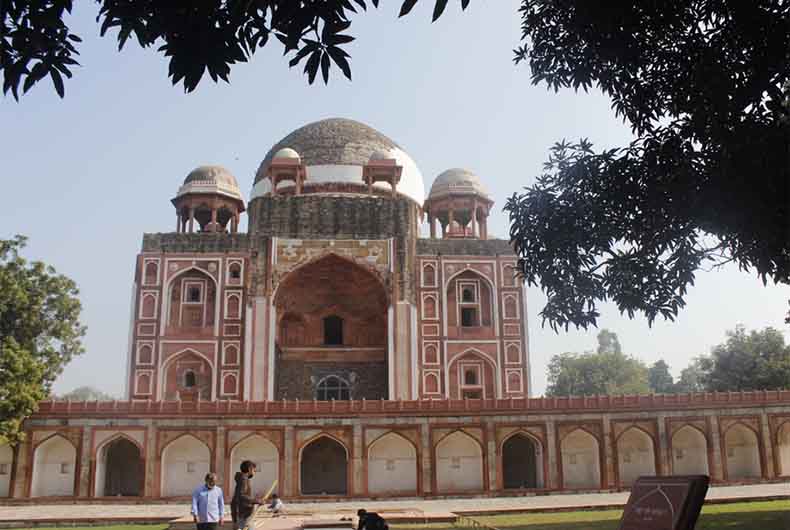
The tomb of Abdur Rahim Khan-I-Khana (1556-1627), popularly known as ‘Rahim — one of Akbars navratnas and a military leader — will open for visitors from December 17 here after completion of restoration work by Aga Khan Trust for Culture (AKTC) and InterGlobe Foundation.
The tomb stands within an ensemble of 16th century medieval monuments in the Nizamuddin area of the national capital.
The conservation project started in 2014, and included a cultural revival of Rahim’s legacy and poetry.
The Union Minister of State for Tourism and Culture Prahlad Singh Patel is scheduled to preside over the completion ceremony of Rahim’s Tomb on December 17, Rahim’s birth anniversary.
An expression of Mughal architecture, Rahim’s tomb informed the design for the Taj Mahal. Clad in red sandstone and marble, the interiors of the mausoleum are decorated with ornamental incised plasterwork, and decorative motifs such as the six-sided star and lotus medallions.
It stands at the edge of the buffer zone of the Humayun’s Tomb World Heritage Site, within an area of high archaeological significance.
Archeological Survey of India (ASI) is the custodian of the monument of note.
According to the organisations involved in the conservation effort, the physical revival of the tomb included repairs to the major damaged structures on the interior and exterior of the mausoleum dalans, canopies (chattris), dome, facade and landscape, along with the wall and ceiling surfaces.
The landscape around Rahim’s tomb has been restored to original slopes and height. The conservation of the dome has been completed with a symbolic addition of marble cladding.
“Conservation at Rahim’s tomb has been possible with a public-private partnership. Not only has a significant monument been conserved for posterity but dignity has been restored to the resting place of the cultural icon, Rahim. Conservation in the Indian context can benefit from thousands of years of building craft traditions and recourse to an interdisciplinary scientific approach. 175,000 craft days of work has helped restore this grandeur,” Ratish Nanda, CEO, Aga Khan Trust for Culture said.
The cultural revival efforts also witnessed compilation of Rahim’s literary works and archival research on his life and works by scholars, culminating in an English publication titled ‘Celebrating Rahim’.
A three-day music festival was also held in 2017 to disseminate Rahim’s literary works that saw a confluence of musical renditions, scholarly discussions on the multifaceted personality of Rahim and an informative exhibition.
The tomb was originally built by Rahim for his wife, making it the first ever Mughal tomb to be built for a woman, with the more celebrated Taj having been built later. As with other tombs in Nizamuddin, Rahim was buried here due the close proximity to the shrine of Hazrat Nizamuddin Auliya, as it was considered auspicious to be buried near a saint, said AKTC.
source: http://www.ummid.com / Ummid.com / Home> India / by IANS / December 16th, 2020
On Wednesday, headlines in an English newspaper read: ‘Kashmir Girl, 20, Adds Wings to Her Dreams, Bags Commercial Pilot’s License.’ The report in Greater Kashmir newspaper was about Neha Fida Wani, who became the second girl from Kashmir to achieve this feat at such a young age.
Commercial Pilots License
Neha Fida Wani, has become the second girl from Kashmir after Ayesha Aziz. Ayesha had become the youngest student pilot in India in 2011 at the age of 16 years, the report said.
Neha, who hails from K.P Road area, did her schooling from south Kashmir’s Anantnag district, and later moved to Chandigarh for higher studies. “After finishing 12th class in September 2018, I joined Chimes Aviation Academy in Madhya Pradesh,” Neha told Greater Kashmir.
She said the thing that fascinated her to become a pilot was the thought of flying an airplane. “I was clueless about this profession and would always spend hours surfing the Internet to know how to pursue this career. I have been fascinated by the pilots too,” said Neha.
Neha said she remembers flying the Cessna 172 aircraft for the first time in her life after getting a commercial license. “I was absolutely thrilled when I flew the aircraft for the first time. The whole journey through attaining my commercial pilot’s license (CPL) was surreal. I flew in all kinds of weather situations,” she said.
Neha has completed 200 hours
“I completed 200 hours of flying training, of which 185 hours were on Cessna 172 and 15 hours on DA42 aircraft. As a child I used to think whether one day I will be able to do that or not. I am glad that I am a pilot now. My dream is gradually becoming a reality,” she said, beaming with pride.
Revealing her future plans, Neha told the newspaper that said that she wants to work with Indigo airlines airlines. “It’s my dream,” she said.
2nd Kashmiri Girl Pilot
Neha has been very lucky as she has enjoyed the support of her family in pursuing her dream. “They (parents) have always been very supportive both financially and emotionally throughout the journey,” she said.
Her father, Fida Wani, who owns a business, said that they kept supporting Neha despite many people talking bad about them. “Sometimes it was getting very difficult for us but we never backed down. It did hurt us but it didn’t demotivate us. We are all very proud of her,” he said.
Neha said that everybody has a potential to do something out of the box, especially young Kashmiri youth. “All we need to do is to know our goals and work hard to achieve them,” she said.
source: http://www.aviatorsbuzz.com / Aviators Buzz / Home> News / by AB Editorial Team / December 10th, 2020
The award has been conferred upon noted Indian scientists including APJ Abdul Kalam, MS Swaminathan and KG Menon earlier, and Prof Asad is the first recipient as AMU faculty member.
Prof Asad Ullah Khan, Coordinator, Interdisciplinary Biotechnology Unit, Aligarh Muslim University
Aligarh:
Noted biotechnologist and scholar, Prof Asad Ullah Khan (Coordinator, Interdisciplinary Biotechnology Unit, Aligarh Muslim University ) has been decorated with Sri Om Prakash Bhasin Award-2019 for his trail-blazing research in Biotechnology.
The award, held in high esteem across the country and is given to eminent scientists in the field of Agricultural Sciences, Biotechnology, Electronics, Engineering and Medical Sciences, carries a cash prize of Rupees one lakh with a citation and plaque.
The award has been conferred upon noted Indian scientists including APJ Abdul Kalam, MS Swaminathan and KG Menon earlier, and Prof Asad is the first recipient as AMU faculty member.
Prof Obaid Siddiqui, an alumnus of AMU, received this honour in 1993.
The Vice-Chancellor Prof Tariq Mansoor has congratulated Prof Khan on this awe-inspiring academic honour and said ‘it is given on his seminal contribution to study of Antimicrobial resistance and infection biology of bacteria’.
The award will be given during the first week of November 2020, said a statement from AMU.
source: http://www.ndtv.com / NDTV / Home> NDTV Education / by Shihabudeen Kunju C / April 12th, 2020
Baghpat District, UTTAR PRADESH / Norela, NEW DELHI :
Shakeel Mohammed Qureshi, whose father is a farmer in Uttar Pradesh’s Baghpat district, has distributed around 300 jackets and sweaters for free among the peasants.
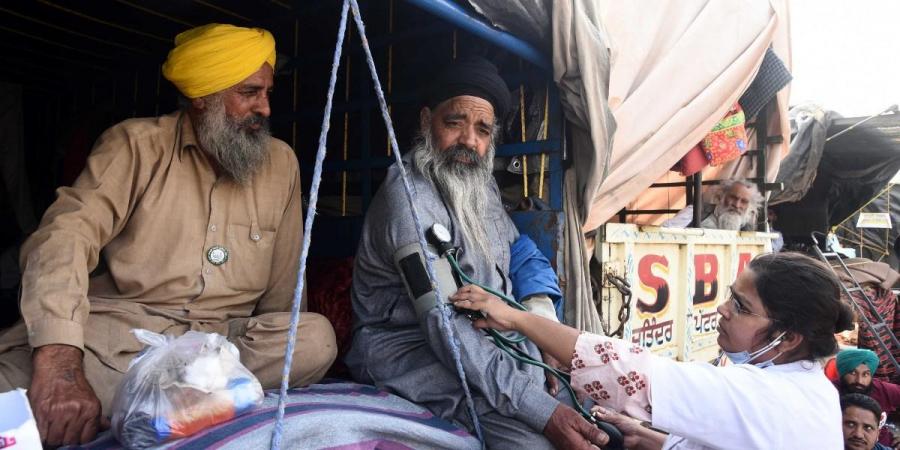
A doctor examines a farmer during their ongoing protests against the new farm laws at Delhi’s Singhu border on Thursday. (Photo | Parveen Negi, EPS)
New Delhi :
Not everything comes with a price tag. Not love, not respect and not the sweaters and jackets that Shakeel Mohammed Qureshi gives away free to protect farmers protesting at the Singhu border from the biting cold.
Around 8 am everyday, Qureshi starts setting up his roadside stall, from where he sells locally-manufactured warm clothes for free to the farmers protesting at the Delhi-Haryana border against the Centre’s three new contentious farm laws.
The 35-year-old man, whose father is a farmer in Uttar Pradesh’s Baghpat district, has distributed around 300 jackets and sweaters for free among the peasants. On average, he used to earn a profit of around Rs 2,500 daily by selling the winter wear.
“My father is a farmer, too, so I know that their life is very tough,” says Qureshi, who lives in Narela in north Delhi with his wife and children. “Farmers don’t ask for much from the government, except a fair price for their produce.”
Unwilling to talk about the price, Qureshi says: “This is my contribution to a good cause. That”s all.”
Help has been pouring in from different quarters for the protesting farmers at the border. While some individuals and NGOs have been organising langars (community kitchens) and distributing items of daily need, others have set up free medical camps. Many have volunteered to clean utensils, collect garbage, charge mobile phones and wash clothes.
The farmers have been protesting at several border points into Delhi for the past two weeks over their demands to repeal the new legislations, which they claim would benefit the corporates and end the traditional wholesale markets and the minimum support price regime. The union leaders had rejected a government proposal on Wednesday to amend the new legislations and announced that they would intensify their agitation.
Most of the farmers have come prepared, but a few need support to keep fighting, according to Qureshi, who hopes to have a merchandise store of his own before he turns 40.
His head held low, Qureshi smiles when a protesting farmer, who just got a free jacket from his stall, said: “The god will give you a fortune in return. You have a small shop, but a large heart.”
As dusk settles, a group of Nihang Sikhs approached the Samaritan, but he has run out of stock.
Assuring the band of armed Sikh warriors, Qureshi said: “I will be back with jackets for you tomorrow morning.”
source: http://www.newindianexpress.com / The New Indian Express / Home> Good News / by PTI / December 10th, 2020
At a time when the world has turned online for education, work, shopping, business and whatnot, here is a couple from Malappuram district in Kerala who has brought out a new online method of learning, integrating computer coding with school subjects for kids. Let’s meet Aisha Sameeha and Shahid Jabbar from Nilambur.
Hailing from the village of Melattur, Aisha Sameeha was just one among the many girls in Malappuram – who studied well, graduated in BTech, got married and settled with her husband in his workplace Dubai.
Soon, they got their first child and Sameeha got busy with her daughter Eshal.
However, sitting idle or being content with the homely chores alone was not her cup of tea. Sameeha tried her hand at different trades such as content writing for technical websites, cooking and baking, stitching and embroidery etc. She also attended and won a few cooking competitions held in Kerala and Dubai.
Into the field of education
Having born and brought up in Kerala and abroad, Sameeha had got familiarized with different methods of education. And that encouraged her interest in learning and teaching. “Teaching has always been my passion, even when doing BTech. And that is also a reason I didn’t take up the job offers that came my way after the completion of my studies,” said Sameeha. She especially mentioned the methods followed in the PeeVeeS Public School, Nilambur, where she studied from class 1 to 6 and the MES Engineering College. The two institutions taught her the importance of encouragement by teachers and the effectiveness of grouping and sharing to learn better.
Once her daughter began to attend school, it opened her to another world in the field of education. The kindergarten that Eshal attended in Dubai followed the Reggio Emilia approach, which gave high importance to interaction between parents, teachers and students. Parents were encouraged to come to the school and be a part of various activities. Each class had a library and several other items that caught children’s attention and interest, where they could gain knowledge. “I had thought that I couldn’t manage small kids, but it was proved wrong when I began to go there,” confessed Sameeha. “I used to observe how they were doing things, dealing with the children, the method of teaching etc. That was a sort of experimental and experiential learning. Eshal liked it a lot there.”
source: http://www.thesite.in / The Site / Home> Empowerment / by Najiya O / December 07th, 2020
A 30-year-old Iram Habib, a resident of Srinagar, won the first Kashmiri woman being a commercial pilot.
According to the report of the Indian newspaper, The Tribune, Iram Habib crossed several obstacles to fulfill his will, when he expressed his desire to become a pilot, she was told that a Kashmiri girl could never become a pilot. she had a 6-year period in pleasing his parents for acquiring because of his parents, in the field of disputes, did not make the women staying in Kashmir.
Iram Habib graduated from the University of Dera Dune and graduated from the University of Kashmir to agricultural science and technology. She said that during the time, the dream of blowing up the education ship was always with them. She trained the United States to blow up the ship, which in 2016 she returned to India to get a commercial pilot license.
In the United States, Iram Habib passed the air test after a hard work and received a 260 hour flight experience required for the license.
source: http://www.todayheadings.com / Today Headings / Home> India / August 31st, 2018
The Rehnuma centre in Mumbra, a suburb of Mumbai, offers young Muslim women – many from migrant families – a space to chat, relax with a book, learn English or dream about their village homes
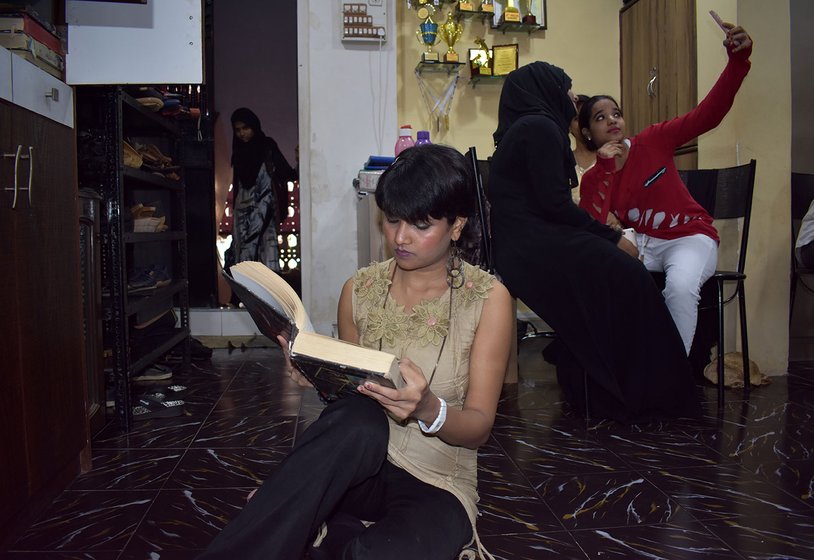
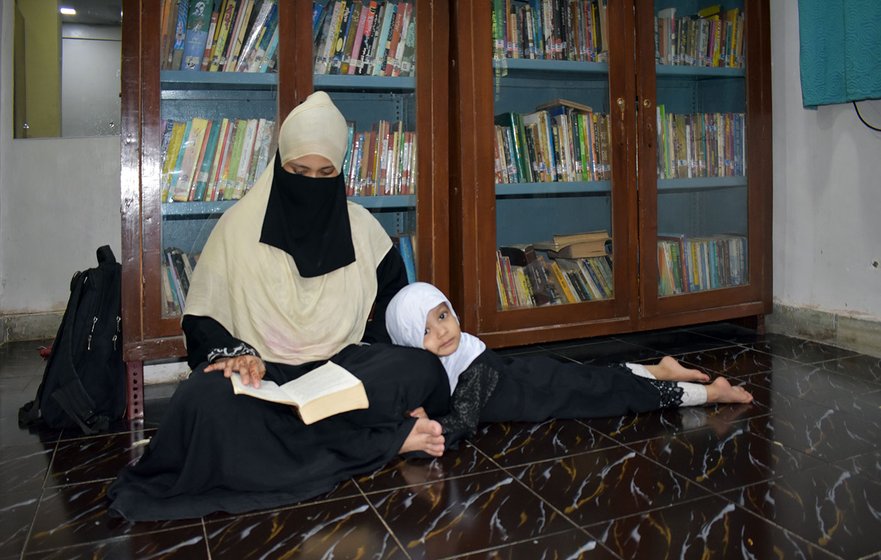
“Shall I compare thee to a summer’s day?” says 19-year-old Faiza Ansari in a low voice, almost a whisper. We are sitting cross-legged on the tiled floor of the only library for women in Mumbra – the Rehnuma Library Centre.
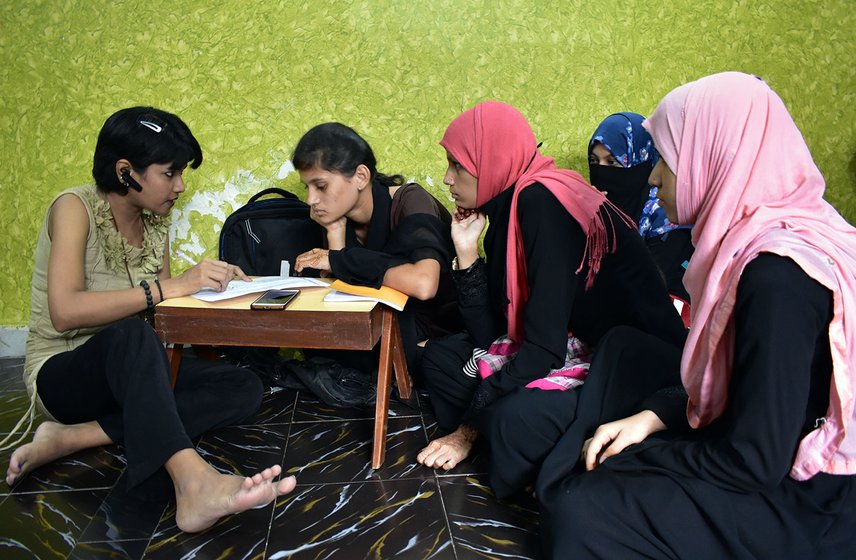
More young women come and go from the two-room apartment turned library on the first floor in a decrepit building near the Darul Falah mosque. They hang their burkhas on idle plastic chairs and sprawl on the cool floor. It’s 36 degrees outside in this northeastern suburb roughly 35 kilometres from central Mumbai.
As Faiza recalls Shakespeare’s Sonnet 18, I insist on hearing more. All eyes turn towards her, including her sister Razia’s. Faiza paraphrases a line from Romeo and Juliet, “A beautiful heart is better than a beautiful face.” Razia looks at her sister coyly. The other girls hoot, nudge each other, and bashfully giggle. The joke is anybody’s guess.
Razia Ansari, 18, is not as shy. She presents to me an intriguing summary of the only Shakespeare story she has read. “Twelfth Night is like a Hindi film. Viola has a double role,” she says of Viola’s disguise as Cesario. Razia is trying to improve her English and has joined the spoken English class at the library. Classes are conducted here five days a week in numerous one-hour batches from 11 a.m. to 6 p.m.
Faiza and Razia Ansari, from Asansol in Jharkhand, are regulars at the libraryLibrarian Faiza Khan also doubles up as an English teacher
Faiza and Razia’s family moved to Mumbra from Asansol village in Dumka district of Jharkhand around 18 months ago. The sisters dislike Mumbra. “There’s garbage everywhere,” Razia says. Faiza agrees: “There are more eateries than bookshops.” The sisters were not expected to wear a burkha in their village. “We had a lot of freedom back home,” Razia says. “But here,” Faiza continues, “our mother says that the mahol [environment] is not good.”
Their father owned a wholesale groceries shop in Asansol and decided to come to Mumbai, where their grandmother and other family members already lived, “to make more money and for better education for the children,” Razia says. He has since set up a groceries shop near their house.
The sisters spend a majority of their day at the nearby A.E. Kalsekar Degree College, where they are studying in the first and second year BA, respectively. But it’s in the Rehnuma library, a short walk from their home, that they are reminded, Razia says, “of the home they left behind [in the village].”
For Bashira Shah, from Babhnan village in Harraiya tehsil of Uttar Pradesh, the library is where she can stop thinking about home. Bashira got married when she was around 14 years old and moved to her husband’s house in Ashokpur village near Gonda city. Her husband was a construction labourer in Saudi Arabia. Now 36, she has been widowed for two years and lives with her mother, her four children, and two younger sisters in Mumbra.
Her parents moved here in the 2000s but in October 2017, her father passed away. He had a dry fruits shop in Masjid Bunder which is now leased out. Two of Bashira’s sons, 16 and 15 years old, have dropped out of school. But Bashira, who received a religious education and studied Urdu till Class 3, has decided to study more. “My dream, she says, “is to be able to talk to Shamshir and Shifa in English.” Shamshir, 12, her youngest son and her daughter Shifa, 9, study at the Mumbra Public School in English.
Since the Rehnuma Library – rehnuma means a ‘guide’ in Urdu and Hindi – was started in 2003, women come here throughout the day to converse, laugh, relax, or curl up with a book. The library was set up with donations and a crowd-funding campaign by Awaaz-e-Niswaan, a non-governmental organisation. The space is also the NGO’s Mumbra centre, where they focus on literacy for women and legal aid – many women come here with issues related to divorce, polygamy and domestic violence, among others.
The locality was chosen because of its predominantly Muslim population and, as Yasmeen Aga, Awaaz-e-Niswaan’s coordinator for Mumbra says, “the lack of spaces for women to take off their burkha, interact with each other and relax.” The library initially acquired members by telling schoolgirls and their mothers about it, but as college girls found out, they too wanted to join.
The library’s 350 patrons – all women, many of them from families that have migrated to Mumbai from various villages – renew their Rs. 100 membership every year to return home with books or magazines and occasionally participate in book club meetings and workshops.
At the library, Bashira Shah, from UP’s Babhnan village, can stop thinking of home. Faiza, the librarian, also helps visitors become members
In the last book club meeting in mid-January, 12 young women discussed the poems of Mirza Ghalib and Faiz Ahmed Faiz. Librarian Faiza Khan says, “The readers were divided into two camps – each wanting the other to concede and admit that the poet they admired was the best.” Faiza, was in the Ghalib camp, but chose to remain sternly neutral.
Faiza, now 28, started coming to Rehnuma when she was 19. She was born and brought up in Mumbra, has a degree in Management Studies, and was offered the librarian’s job in 2014. “The public spaces are dominated by men,” she says. “And women are locked inside their houses”. But at the library, she says, “women can be unabashed and sit and talk like men do.”
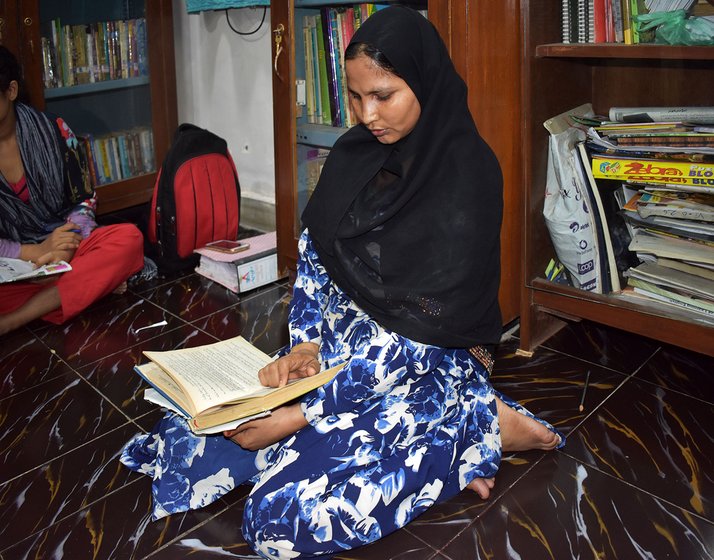
She not only holds the key to the library, but also helps wandering visitors become members, and nurtures their reading tastes. “Urdu books,” she says, “are the most sought after.” These make the majority of the 6,000 books stocked in the library’s five wood cabinets.
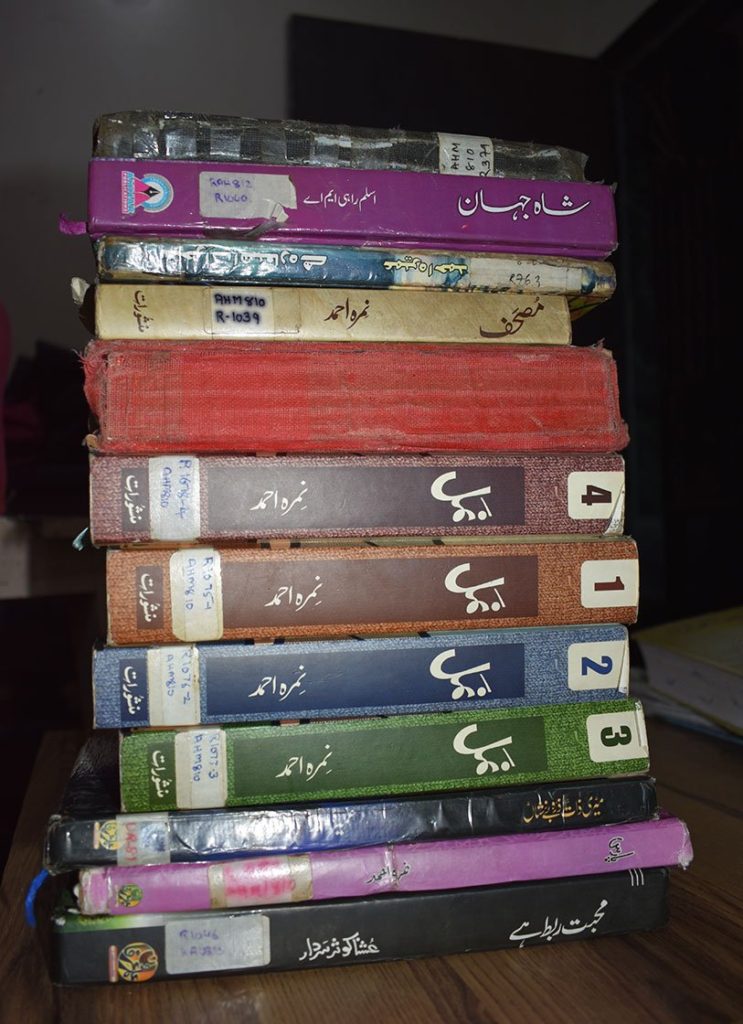
Some of the most popular books are by Pakistani authors that have been on long journeys. The pages of Ibn-e-Safi’s Imran series and Jasoosi Duniya, highly popular spy novels, have turned yellow. The library has a collection of 72 Ibn-e-Safi novels.
The plaque at the entrance of the building that houses the Rehnuma centre
And the pages of the novels of Umera Ahmad (the library’s most-read author), to Faiza’s utter dismay, are dog-eared with plenty of margin notes. There are also books by Razia Butt, Ismat Chughtai, Munshi Premchand, Saadat Hasan Manto, along with the Urdu translations of Shakespeare. And there is Harry Potter, and of course, Chetan Bhagat too.
Zardab Shah, 20, who came to Mumbra from Khizirpur Ali Nagar village in Ghazipur district of Uttar Pradesh, has been reading Ujaale ki Talaash, a thriller in Hindi by Sharad Pagare, but wistfully looks at the World Book Encyclopaedia placed at the top of a cabinet. “We are not allowed to take these home,” she says, regretfully. “I like to look at the maps and imagine going on an adventure to Switzerland.”
The closest Shah has got to a sense of adventure was when she secured admission at Banaras Hindu University for an MA in English last year. But her parents didn’t let her go. Her father is a truck driver, her mother a homemaker. “They didn’t want me to live in a hostel,” she says. Instead, they moved Zardab from her uncle’s home in the village – where she was staying while studying – to be with them in Mumbra. She is now trying to get admission in a Mumbai college. When someone in her building told her about Rehnuma, she immediately joined.
“I was wasting my time in the village… here, at least, I am reading and learning,” she says. It took her some time to get used to Mumbra, but Zardab doesn’t miss her village. “There are no opportunities,” she says. “It’s a place you can love as a child but not as a grown-up.” And now she has forged an attachment so strong with the Rehnuma Library, that, she confides, “this might be all the adventure I need”.
Shafiya Shaikh, one of the library’s most voracious readers, often reads aloud to her daughterThe novels of Nemrah Ahmed are a hot favourite
A large number of Muslim families moved to Mumbra after the 1992 riots in Bombay. Shafiya Shaikh’s family too shifted at that time, distraught but physically unharmed, from Worli in south Mumbai. The first time she came to Rehnuma was when she was seeking help to get a divorce from her husband. He had abandoned a pregnant Shafiya after eight months of marriage. But when she saw the stacked books, she was confused, “I thought that like everything else for women in our society, even books were out of reach.”
Soon, Shafiya and her mother Haseena Bano became members. Shafiya, now 27, also reads some of the books out to her four-year-old daughter Misbaah Fatima. The Shaikhs are now among the most voracious readers the library has seen – they check out 2-3 books and 2-3 magazines per week while others read and return one book in a couple of months.
Shafiya is currently reading Jannat Ke Pattay by Nemrah Ahmed, an acclaimed Pakistani novelist. It’s about sexual violence against a girl, and the story’s male lead doesn’t save her. “It’s not like a hero will come to save everyone,” she says.
Apart from the lure of the books, the library brings women together to enjoy the company of others. Here, Zardab says, “We can sit however we like, laugh, play, or chat. There’s freedom here that we don’t find at home.” A current hot topic is the popular Zee TV show about triple talaq – Ishq Subhan Allah.
Librarian Faiza has also become a role model for the young women – a job she has reluctantly accepted. She now takes it upon herself to gather them and discuss books they may not read themselves. The last book she discussed was Rana Ayyub’s Gujarat Files – on the investigations in the 2002 riots in the state – and unlike the Ghalib-Faiz session, this discussion remained utterly sombre.
source: http://www.ruralindiaonline.com / PARI – People’s Archive of Rural India / Home> Things We Do> The Rural in the Urban> Women / by Apekshita Varshney / July 04th, 2018
Wife of a retired army man, Shakeela had her elder son also serving in the army as a major and now with her younger son also in the army, she said it is all her “good fortune.”
On Saturday, she had come with her husband Naik Shaukat Ali (retired) and elder son Major Javed Khan to see her younger son Lieutenant Jafar Khan, 22, getting commissioned as an army officer. (HT photo)
It was a moment of immense pride for 52-year-old T Shakeela from Madurai when she witnessed her younger son being commissioned as an officer in Indian Army in the passing out parade held at Indian Military Academy (IMA) Dehradun on Saturday.
Wife of a retired army man, Shakeela had her elder son also serving in the army as a major and now with her younger son also in the army, she said it is all her “good fortune.”
On Saturday, she had come with her husband Naik Shaukat Ali (retired) and elder son Major Javed Khan to see her younger son Lieutenant Jafar Khan, 22, getting commissioned as an army officer.
“My husband served for 22 years in the army and then my elder son also joined the army. Today, when my younger son also became an Indian Army officer, I think this is the most memorable day for me. It’s all my good fortune that almighty has shown me this day,” said Shakeela.
Expressing happiness while showering love on younger son Jafar, she said, “I have two sons, both wanted to join the army. I supported them to pursue their dreams as nothing is bigger than serving your nation. If I had two more sons, I would have given them also to the army.”
Informing that both her sons went to Sainik School in Coimbatore with “excellent” marks, Shakeela said, “With the kind of upbringing I gave to them, I am all sure that they will perform their duty with full integrity.”
Her husband Shaukat too expressed happiness on seeing both his sons donning the olive green like him.
“Having served in the army, there is nothing I could have asked from almighty than seeing my both sons in the army. I am proud of both them,” he said.
Jafar who got commissioned in the army said he drew inspiration to join the army from his father.
“I had dreamt in the childhood itself to join the army after seeing my father. I went to Sainik School after that I sat for the NDA exam but could crack it only in the third attempt followed by IMA to see this day. I am happy that I made my parents proud,” he said.
source: http://www.hindustantimes.com / Hindustan Times / Home> India News / by Kalyan Das, Hindustan Times, Dehradun / December 12th, 2020