The last king of Xinjiang: how Bertram Sheldrake went from condiment heir to Muslim monarch

BRITAIN :

  • Bertram Sheldrake converted to Islam at the age of 15 and spent much of his fortune promoting the religion in Britain
  • His efforts brought him an invitation from leaders of the newly proclaimed Muslim nation of Islamestan in China’s far west
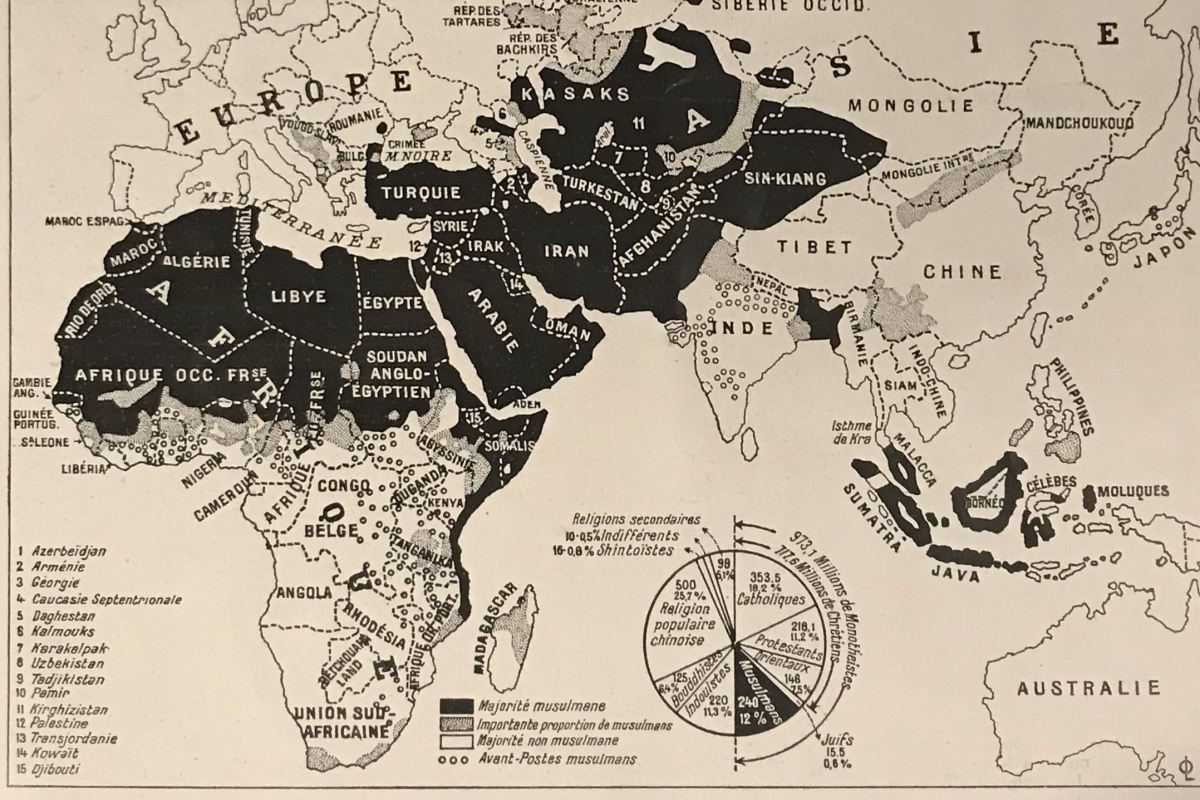
The Muslim distribution in the world, circa 1940.

It’s a long way from the south London suburb of Forest Hill to the once dreamed of Republic of Islamestan.

You may never have heard of Islamestan, in Chinese Turkestan, or its one-time “king”, Bertram Sheldrake. Islamestan is long gone, swallowed up in the historical shifts of a turbu­lent region, but for a brief and unlikely moment, an English pickle-factory heir ruled, with his wife, Sybil, over the newly independent Muslim country, to the far west of China.

The whole of what was then referred to as Chinese Turkestan, or Sinkiang (now Xinjiang), was, in the 1930s, subject to tribal rebellions and warlord uprisings. It was ultimately concluded by the chiefs of various tribes in the region that only an outsider (but necessarily a Muslim one) could bring unity to the region. Having read news­papers brought by travellers, they sent a delegation to south London to visit an Englishman who had caught their attention. Sheldrake was invited to assume the throne of Islamestan. Not being quite sure of the correct title for the new ruler, the British press helpfully offered some suggestions – “The Pickle King of Tartary”, “The English Emir of Kashgar”, “Lord of the Rooftop of the World”.

To contemporary British newspaper readers, it must have seemed as if Rudyard Kipling’s The Man Who Would Be King(1888), wherein two English adventurers, Dravot and Carnehan, become the leaders of Kafiristan, a remote region of Afghanistan, had come true. Having had a good public-school education on his father’s pickle profits, Sheldrake would have known Kipling’s cautionary tale. Things hadn’t turned out well for Dravot and Carnehan in Kafiristan; neither would they go smoothly in Islamestan for “The Pickle King of Tartary”.

Bertram William Sheldrake was born in the same year that Kipling’s cautionary tale was published, the son of Gosling Mullander Sheldrake (known simply as “George”), who ran the successful firm of G. Sheldrake, Manufacturers of Pickles, Sauces, Chutney, Ketchup, Vinegar, etc.; Bottlers of Capers, Curries, and other Condiments, located at 293-295 Albany Road, London, SE5. The business had done well since being founded in the 1870s, changing its name to the rather pedestrian South London Jam and Pickle Manufactory and then Sheldrake’s Pickles while trading up from the insalubri­ous surroundings of Southwark to the leafier environs of Denmark Hill.

Bertram must have been a precocious schoolboy. Although raised Catholic, in 1903, at the age of 15, he converted to Islam (then generally termed “Mohammedanism”), learned Arabic and changed his name to Khalid.
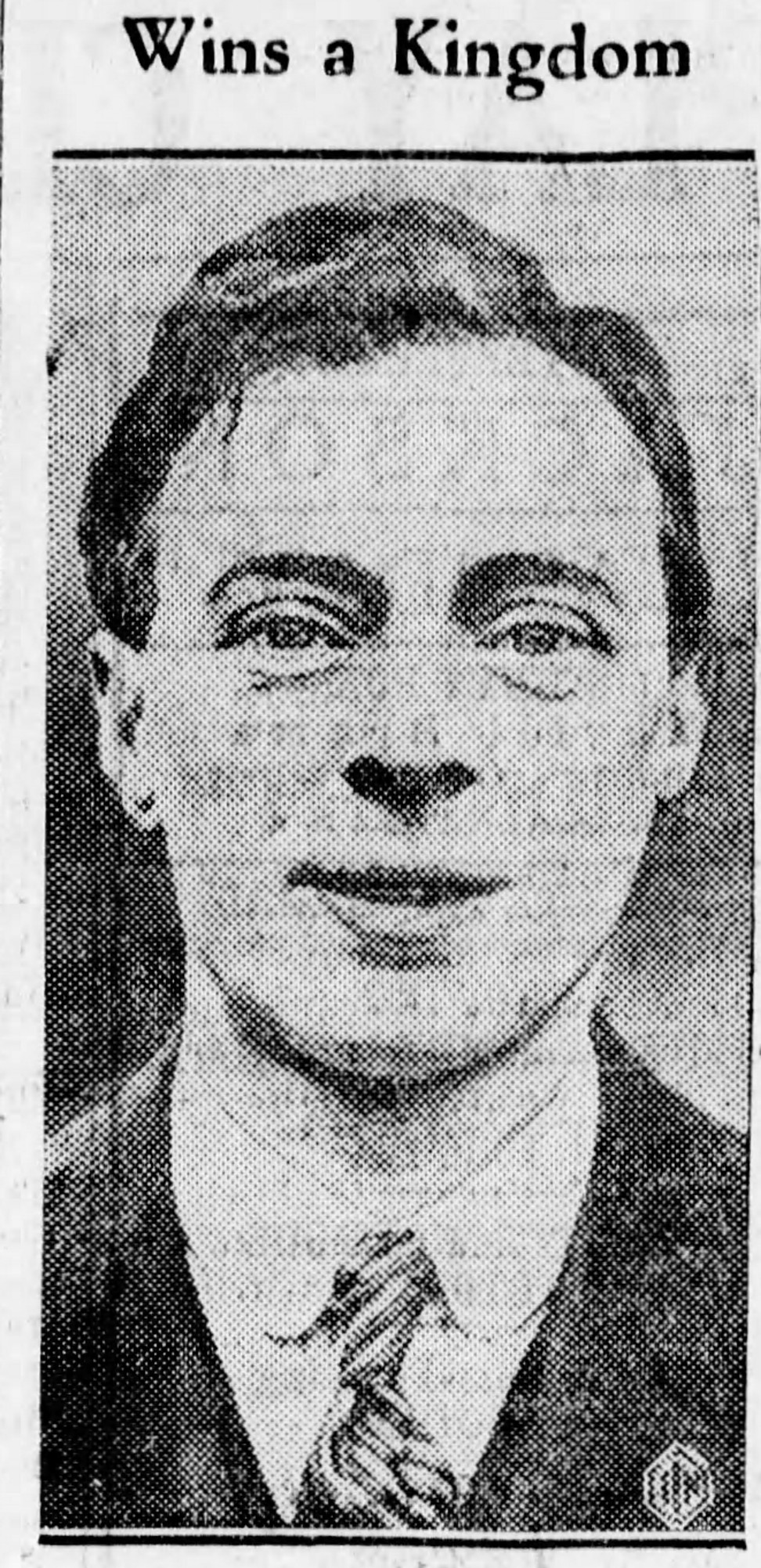
Sheldrake in an Evening Report newspaper article dated March 14, 1934.

Sheldrake was a relatively early convert. A decade later, the first Muslim missionary to Britain, the Indian Khwaja Kamal-ud-Din, would make several high-profile conversions among socially connected and wealthy British people. These included Irish peer Lord Headley, who became known as Shaikh Rahmatullah al-Farooq, or more commonly in the newspapers as “The Moslem Peer”, and the scholar and novelist Marmaduke Pickthall, who became, more prosai­cally, Muhammad Marmaduke Pickthall. In 1930, Pickthall was to publish the most complete English translation of the Koran to date.

British people converted for various reasons. For Headley and Pickthall, it seems to have been because of an aesthetic appreciation of the Middle East and “Arabia”. Similarly so for the Scottish noble­woman and Mayfair socialite Lady Evelyn Murray, who had grown up in Cairo and Algiers. She converted and became Zainab Cobbold, undertaking the Hajj pilgri­mage to Mecca, Saudi Arabia, several times. She was buried on her estate in the Scottish Highlands facing Mecca.

For others, such as Charles Hamilton, who converted in 1924, it was part of a wider search for order. Hamilton became Sir Abdullah Charles Edward Archibald Watkin Hamilton. A staunch Conservative, he would, in the 1930s, change tack and join Oswald Mosley’s far-right British Union of Fascists.

Less extreme was well-known Liverpool solicitor and temper­ance advocate William Quilliam, who converted after visiting Morocco. Having changed his name to Abdullah Quilliam, he used a donation from Nasrullah Khan, the crown prince of Afghanistan, to buy three terraced houses, establishing the Liverpool Muslim Institute in one of them.

The success of Sheldrake’s Pickles meant young Khalid didn’t need to work full-time for the family firm. He devoted his spare hours to Muslim causes, helping to found the journal Britain and India in 1920, launching the Muslim News Journal and serving as editor of The Minaret, an Islamic monthly based in London. He wrote frequently and sometimes provocatively. An article by Sheldrake in The Minaret in September 1927 suggesting Napoleon had flirted with conversion to Islam caused a stir on both sides of the English Channel.

Dr Khalid Sheldrake, as he was now referred to in the newspapers (having been awarded an honorary Ecuadorean doctorate of literature), found a wife, Sybil, who also converted, becoming Mrs Ghazia Sheldrake. They had two sons, who they raised in the Muslim faith. The family set up home in a detached house on quiet Gaynesford Road, in Forest Hill. It had a decent-sized front drive, a well-tended rear garden and was only a short commute from the Denmark Hill pickle factory.

Sheldrake worked hard and committed his resources to opening mosques in Britain. He was involved with the financing and construction of London’s first purpose-built mosque, in Wandsworth, in 1926 (previously, London’s Muslims had gathered in private houses). He organised another mosque in Peckham Rye, in the converted base­ment of a house he donated.

Here, Sheldrake presided over his own group of activists and missionaries, the Western Islamic Association, which sought to spread the word of the Prophet among the Christian English. In 1927, it was reported that he had opened a mosque in East Dulwich, known as the Masjid-el-Dulwich, after raising funds through “Oriental Bazaars”.
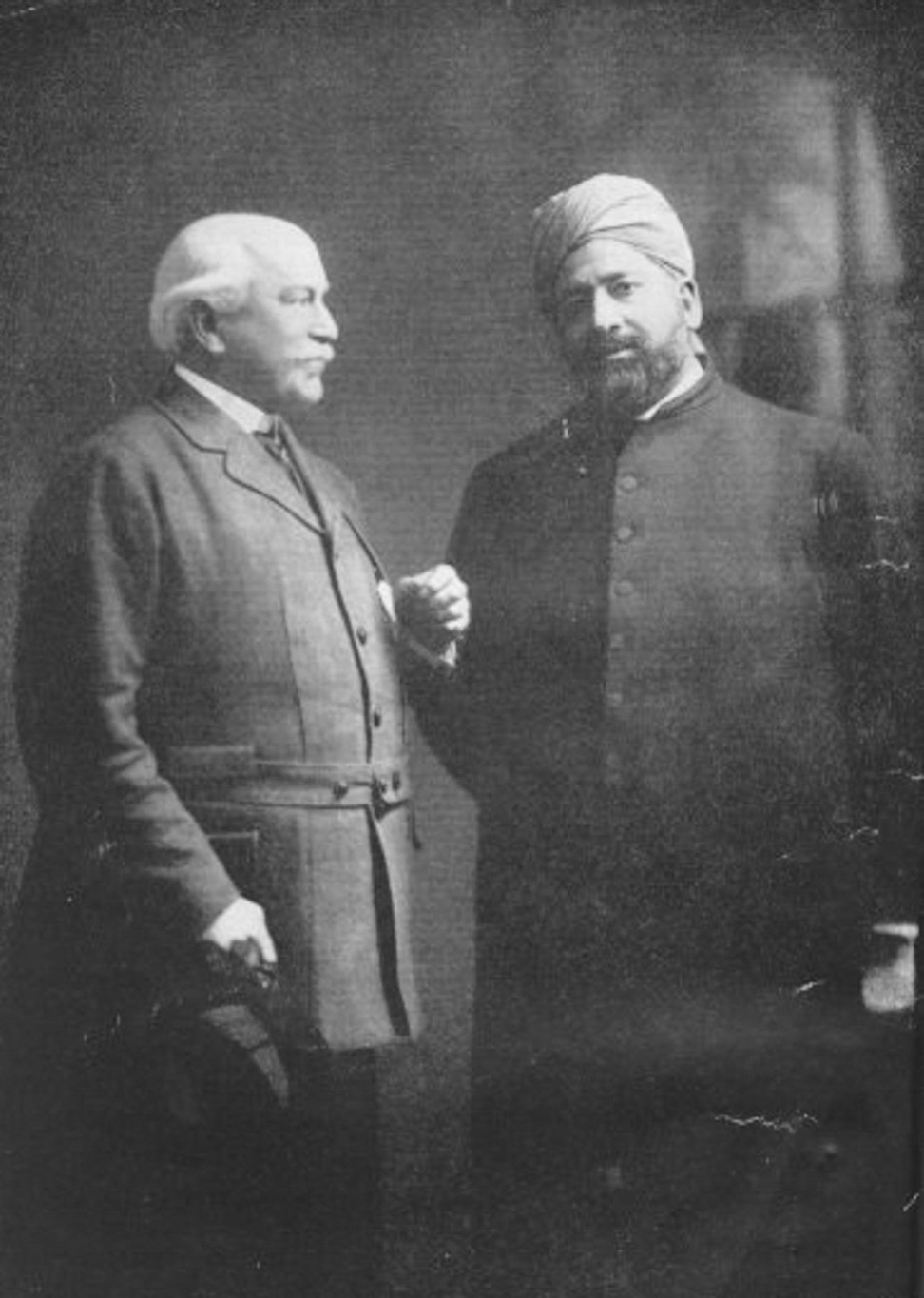
Lord Headley (left), who became known as “The Moslem Peer”, with the first Muslim missionary to Britain, Khwaja Kamal-ud-Din.

Sheldrake also paid for the funerals of Muslims who had died in Britain. In 1928, his self-financed Indigent Muslims’ Burial Fund bankrolled the funeral of Sayed Ali, the long-standing elephant trainer at London Zoo.

Fleet Street was confused by Sheldrake. He was refer­­red to as the “Sheik of all British Moslems” (which isn’t and wasn’t an official position) and often a picture of an unknown Muslim, portly, dark-skinned and in traditional clothing, was featured and identified as “Khalid Sheldrake”.

In reality, Sheldrake was slight, with sharp features, and not dark-skinned in the slight­est. He did, though, often wear a red fez. The papers made various claims: that he was a noble­man of French or Irish stock and that he had renoun­ced his ancient title to become a Muslim. It was suggested he converted to Islam to become poly­gamous and have several wives. It seemed inconceivable to the newspapers that he could simply be the son of a suburban London pickle manufacturer who had volun­tarily adopted Islam.

Sheldrake toured Britain giving talks on Islam. He visit­ed small Muslim communities, such as the Yemeni former seamen in South Shields and Hull, who had grouped together in the 1860s and were subject to much misunder­stand­ing and racism around race-related riots in 1919 and 1920. He toured Morocco in 1927 and, following a large party to celebrate the 25th anniversary of his accep­tance of Islam, undertook a lecture tour of India, in 1928.

Nevertheless, Sheldrake by this time was feeling disheart­ened at the lack of uptake of Islam in Britain. In the early 1900s, when he had converted, there had been fewer than 300 converts in the country; 30 years later, there were still fewer than 600 among only 3,000 Muslims resident in Britain. He started to think about a future in the wider Muslim world.

Sheldrake considered launching a missionary campaign in America. Writing in The Minaret, he said he felt the time might be right for the United States to embrace Islam. He was encouraged by Muslim conversion rates in Brazil and Guatemala but, ultimately, he opted against what would have been, by any stretch of the imagination, a massive undertaking.

In 1930, The Malaya Tribune newspaper in Singapore commented that Khalid Sheldrake’s name was known in almost all Muslim countries because of the propaganda work he conducted in Britain on behalf of the faith. And, by the time the Xinjiang delegation arrived in Forest Hill, the Muslim world was familiar with Sheldrake’s part in the conversion of Gladys Palmer, better known at the time as the daughter of Lord Walter Palmer, of the Huntley and Palmer biscuits empire, and the Dayang Muda of the Kingdom of Sarawak.

At 21, Gladys had married Captain Bertram Willes Dayrell Brooke. The British Brooke family, known as the “White Rajahs”, had ruled Sarawak, on the island of Borneo, as a private kingdom for a century. As a brother of the raja, Charles Vyner Brooke, her husband was titled Tuan Muda (literally “Little Lord”). When he married Gladys, in 1904, she became Dayang Muda, and was referred to as “Her Highness” in English.
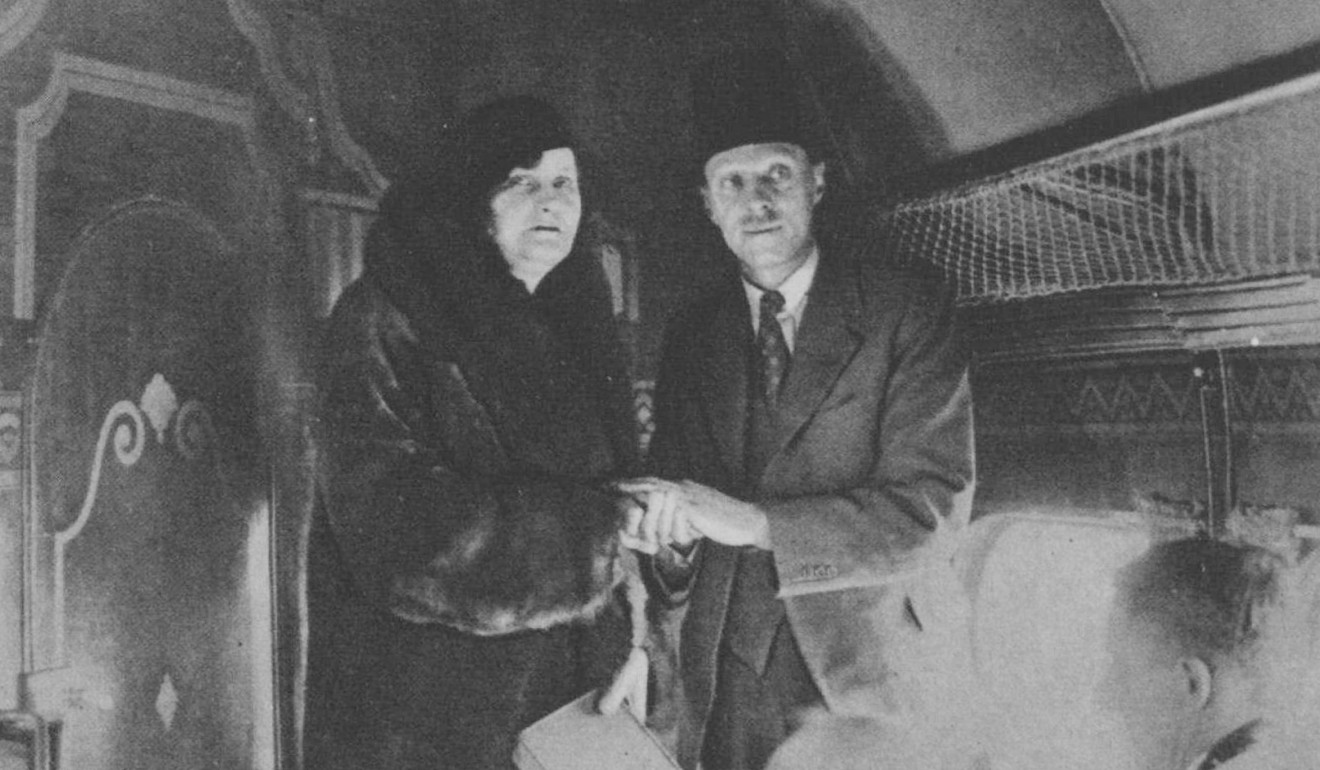
Gladys Palmer and Sheldrake on the plane aboard which she converted to Islam.

Gladys, however, never spent much time in Sarawak. A leading socialite, she relished mixing with peers of the realm, minor royalty and show-business celebrities. She discussed literature with James Joyce in Paris; attended opening nights in London with actress Ellen Terry; and toured the cellar bars of Berlin with the sexually rapacious Irish writer Frank Harris. She formed a movie company in 1922, which made a single (forgotten and lost) film. By the late 1920s, the London society columns were reporting that the celebrated marriage was on the rocks. The couple parted, with Gladys gaining a very favourable settlement.

Then, in 1932, Gladys decided to convert to Islam.

Despite her love of the social whirl, Gladys had long sought spiritual enlightenment. Born into the Church of England, she had already passed through Catholicism (having had a personal audience with the pope) and Christian Science before accepting Islam.

Being wealthy, Gladys didn’t convert in any normal way but rather, “wishing my conversion to be performed on no earthly territory”, undertook the ceremony while flying over the English Channel in a chartered 42-seat Imperial Airways aircraft. Sheldrake, having boarded the plane at Croydon Aerodrome with the Dayang Muda, performed the ceremony mid-flight, reportedly shouting to be heard over the roar of the engines.

Gladys Palmer Brooke, the Dayang Muda of the Kingdom of Sarawak, clad in quite extraordinary robes for the occasion, was renamed by Sheldrake, Khair-ul-Nissa (“fairest of women”). Visiting a mosque in Paris soon afterwards, Gladys Khair-ul-Nissa told the press she had now, after a couple of false starts, found the “perfect faith” and was planning a pilgrimage to Mecca before an extended trip to the US.

Muslims in Xinjiang are facing human rights abuses: time to break the silence

Newspapers across Europe, America, the Middle East and Asia covered Gladys’ mid-air conversion. Many Muslim readers, even in the remote far west of China, were fascinated by Khalid Sheldrake – this Englishman who had converted to Islam at just 15 and subsequently done so much for their faith and seemed so well connect­ed. Perhaps he was a man destined for higher office? Perhaps he was the man to rule a fledgling Muslim kingdom looking for a king?

What is now known as Xinjiang (“new frontier”), home to the Uygur people, was largely converted to Islam in the 9th and 10th centuries by Turkic Muslims. In the 1200s, Uygur rulers retained control of their kingdom by offering taxes and troops to the Mongol empire. Tribal alliances formed and collapsed, khanates came and went. By the time of the Qing dynasty (1644-1912), part of the region was under Peking’s control and, by the 1870s, the Chinese considered it a province.

All of this was (and, of course, still is) contentious and many tribal chiefs, warlords and political factions bickered, fought and brokered alliances only to break them the next day. China was the dominant influence, though the area was contested by first the Russian empire and then the Soviet Union, just over the border in Central Asia.

In November 1933, the Islamic Republic of East Turkestan (known simply as the ETR) was officially announ­ced by various tribes and warlords who were united in their desire to form an Islamic kingdom with the city of Kashgar as its capital. It was decidedly not to be part of either the Chinese empire or the Soviet Union.
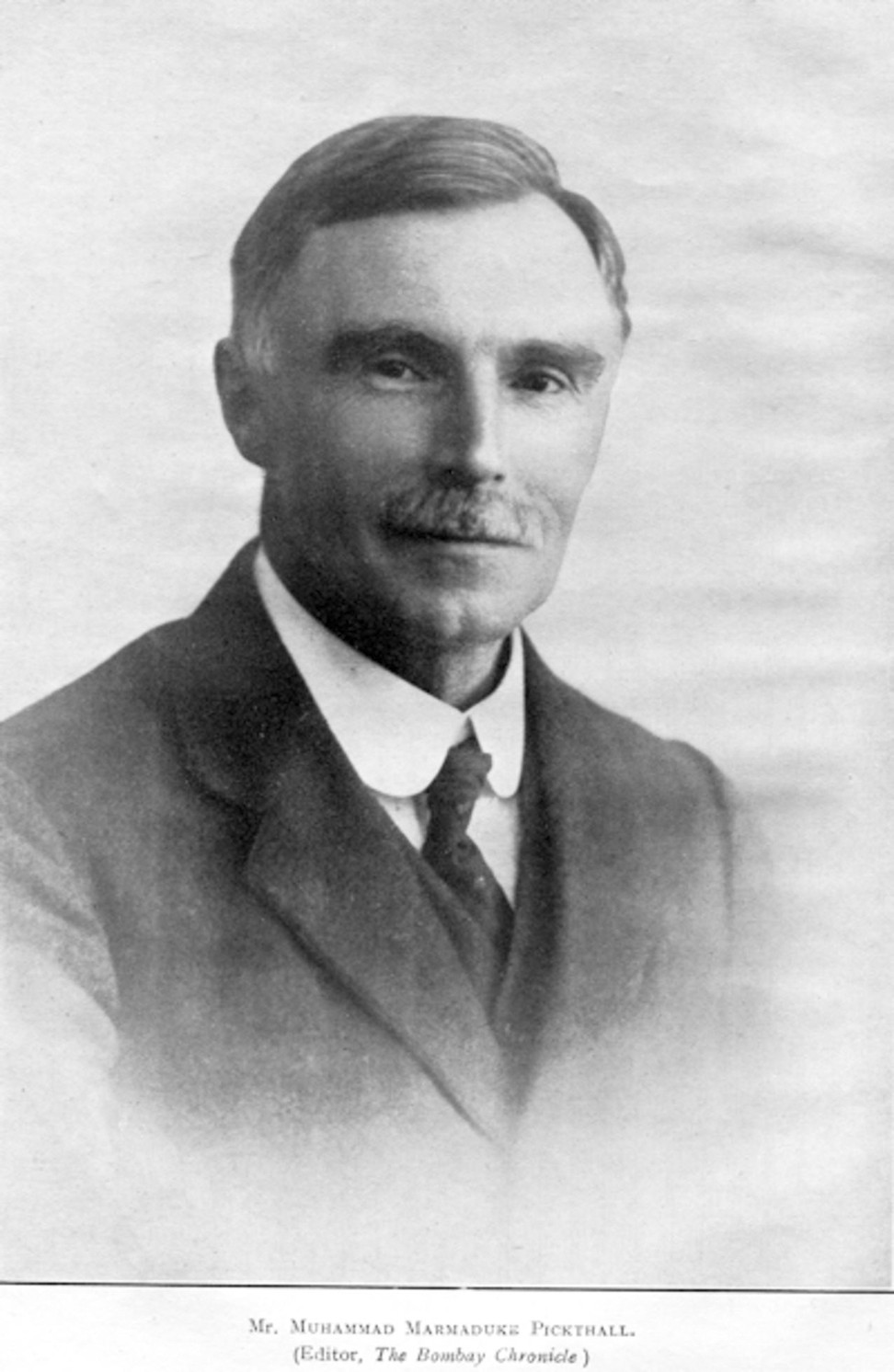
Upon his conversion, novelist Marmaduke Pickthall became Muhammad Marmaduke Pickthall.

The 150,200 sq km ETR, often dubbed “Islamestan” in the Western press, was Uygur-dominated, but with Kyrgyz and other Turkic ethnic groups included as equals. The fledgling government claimed the ETR’s population was about 2 million people.

In Kashgar, Uygur warlord Hoja-Niyaz Haji had assumed the presidency of the ETR; Sabit Damolla, the post of prime minister; and Mahmut Muhiti was appoint­ed minister of defence. Deputations were imme­diately sent to key people and nations. But nobody was swift to officially recognise the ETR. The Nationalist Chinese government in Nanjing thought the whole thing preposterous; the Soviets refused to deal with religious Muslims; while Afghanistan’s King Zahir Shah was wary of annoying the Chinese.

Still, one deputation had been dispatched to London to sound out Dr Khalid Sheldrake, and there they received a more positive reception.

Over tea in his living room, served by Ghazia (formerly Sybil), Khalid Sheldrake welcomed the deputation from Kashgar. The men sat around making pleasantries, admiring Mrs Sheldrake’s prize-winning marigolds and dahlias and Sheldrake’s goldfish bowl. In Sheldrake’s telling, there was only one question: would he consider becoming the king of Islamestan, his wife queen, and the couple taking on the “Overlordship of Sinkiang”?

He told them he would … and that he would leave for Asia immediately.

Among the arrivals by the Dollar liner President Coolidge yesterday was Dr Khalid Sheldrake, the Moslem leader of the West, who is visiting Hongkong as part of his tour to meet Moslems of all Eastern lands South China Morning Post report, March 30, 1934

In 1933, Sheldrake headed east, first visiting Muslim communities in the Philippines and Borneo. He lectured on “The Beauties of Islam” at each stop, attracting – according to the Sarawak Gazette – large and enthusi­astic Malay audiences. From Kuching, in Sarawak, Sheldrake headed to Singapore and then Hong Kong.

On October 3, 1933, the South China Morning Post reported, “Among the arrivals by the Dollar liner President Coolidge yesterday was Dr Khalid Sheldrake, the Moslem leader of the West, who is visiting Hongkong as part of his tour to meet Moslems of all Eastern lands.” While in the city, he gave a series of lectures, including one at the Lane Crawford restaurant.

On March 30, 1934, under the headline “King of Sinkiang”, the paper reported that “When Dr Sheldrake was in Hongkong a few months ago, he told a South China Morning Post reporter that he had been offered the kingdom of Sinkiang, but swore the reporter to the strictest secrecy, on the ground that if the news reached certain quarters, attempts on his life would most certainly be made.”

Leaving Hong Kong, he headed to Shanghai and then to Peking. In May 1934, he checked into the Grand Hotel des Wagons-Lits, near Peking’s main railway station. A delegation from Kashgar met Sheldrake at the hotel.

From the start, the Chinese authorities were nervous about just what this Muslim Englishman intended to do in Xinjiang. A very obvious police watch was kept on his hotel and on the entourage of ETR officials who came to meet him.

Upon entering his room, according to Sheldrake, the officials fell to their knees and kissed his hand, render­ing him exceedingly embarrassed. They then formally requested he be their head of state. Sheldrake later told The Times of India, “I had the choice of becoming a monarch or refusing these earnest and poor people, who might lose heart and become desperate, or fall the prey of some political adventurer.”

A formal title was agreed upon – His Majesty King Khalid of Islamestan.

Sheldrake then briefly visited Japan and Thailand, for scheduled lectures, before planning to leave for Kashgar. In the meantime, the British newspapers had taken up the story – “Deserts Pickles to Become King”.
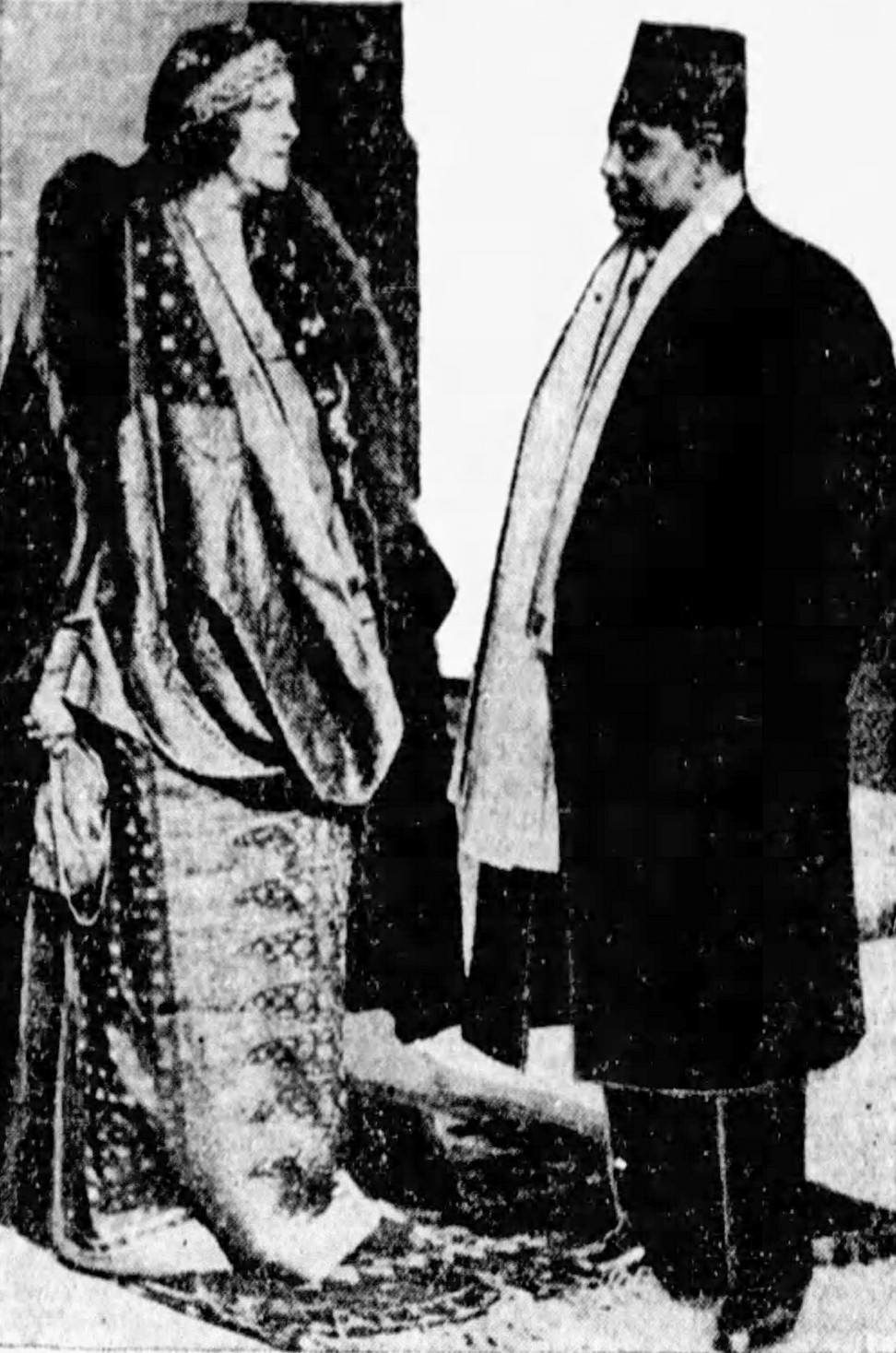
A 1932 picture of Palmer with the mystery Muslim who was often and incorrectly identified as Sheldrake.

Returning to China, Sheldrake told journalists that he would proceed immediately to Kashgar and that Queen Ghazia had arrived from England with ceremonial robes run up by her seamstress in Sydenham. She was reportedly keen to become queen of Islamestan, and her sons delighted to be princes, though she regretted that she would have to forgo her regular bridge games back in Forest Hill as these had been a great comfort to her while the future King Khalid was engrossed in his books on Islamic history, preparing to rule.

Departing Peking, the king and queen of Islamestan headed 4,350km overland to Kashgar, to attend their coronation. They travelled by camel train, accompanied by their trunks of ceremonial robes and two portable metal bathtubs Ghazia had bought in Croydon.

By June 1934, however, the newspapers were reporting that Islamestan had “hit a snag”. Rumours swirled that Sheldrake was becoming king only to steal all of Xinjiang’s not inconsiderable deposits of jade; that he was a British spy; and that, if he assumed the throne in Kashgar, then Islamestan would become a “British-controlled kingdom”.

The Chinese, naturally, complained to London; London assured Nanjing that it would not tolerate a British national attempting to rule “any form of independent regime within Chinese territory”. Japan, keen on extending its own influence in the region, also lodged an objection to Sheldrake’s coronation while fellow Muslims in Afghanistan withdrew their support for the ETR under Chinese pressure.

The shaky coalition in Kashgar started to fall apart, factions split, fighting broke out across Xinjiang. Two Chinese warlords fought each other as well as any forces either once or still aligned to the ETR. But it was probably the Soviet Union’s hostility that finished off the Islamestan dream.

The Islamic Republic was part of the buffer zone between Soviet territory and British India as well as bordering Mongolia. Succeeding the tsarists, the Soviets had continued the infamous “Great Game”, vying for influence with Britain on the Indian border while being concerned about an expansionist Japan on the Soviet-Mongolian border.

Russian news­paper Izvestia hinted that Khalid’s coronation could presage a British annexation of Xinjiang in a style similar to Japan’s recent annexation and occupation of Manchuria. There, Tokyo had placed the “last emperor” Puyi on the throne as chief executive of what they now called Manchukuo. Islamestan, a self-declared Muslim theocracy effectively controlling the large strip of land bordering Soviet Central Asia, and perhaps influencing Russia’s Muslim population under the guidance of a British subject as king, was unthinkable to Moscow.

Sheldrake, deprived of access to newspapers during his long overland journey, approached Xinjiang in early August to find the ETR collapsing and its last loyal troops surrendering to what appeared to be Soviet-backed forces. The dream of the ETR was dead and Sheldrake’s dream of ruling the new state was disappearing, too – “King’s Dreams of Asian Rule Smashed”, reported veteran United Press China correspondent John R. Morris.
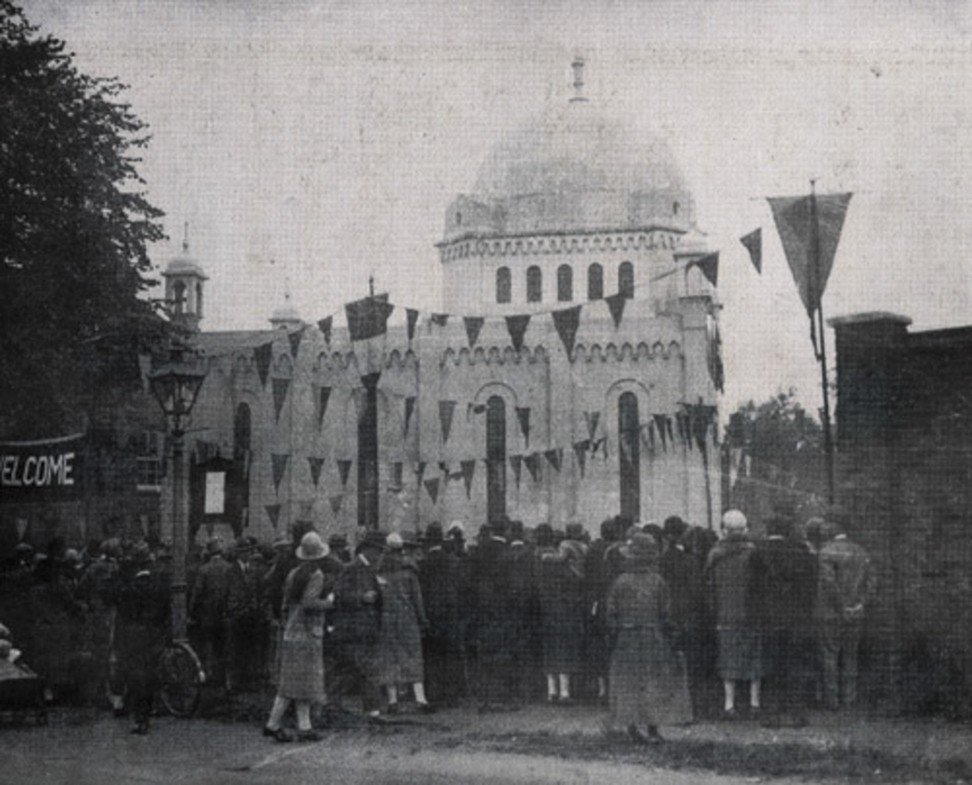
The 1926 inauguration of London’s first purpose-built mosque, in Wandsworth, which Sheldrake helped finance. Picture: Alamy

King Khalid and Queen Ghazia swiftly changed direction and fled with some of the deposed leaders of Islamestan towards India, and the city of Hyderabad. Once safely in the British Raj, Sheldrake explained his relocation to India to The Irish Times, “I am not ready to be the pawn of any political game or the nominee of any particular political power. For the moment I prefer to be an ‘absentee king’. I am awaiting events before actually proceeding to my kingdom.”

He would never proceed to Islamestan.

Eventually, Khalid and Ghazia made it back home to Forest Hill, her magnolias and his goldfish. China was glad to see the back of him, as was Moscow. His return averted a potential diplomatic incident for the Foreign Office in Whitehall. Xinjiang descended back into warlord feuding.

Back in England, Sheldrake gave lectures on Turkestan affairs but few were interested in some­where too far away, too foreign and too complex to understand. He went back to raising funds for new mosques and Muslim charities in Britain. He travelled to Libya and Egypt; to Switzerland and Austria. He also went back to the family business, as a buyer of sour pickles in Turkey. During the second world war, he worked for the British Council in Ankara.

He returned to Forest Hill in 1944 and died in 1947, still technically the exiled king of a state that had ceased to exist 13 years earlier, and had hardly existed at all.

source: http://www.scmp.com / Post Magazine / Home> Long Reads / by Paul French / March 02nd, 2019
Guardian Angel of mariners

Nagapattinam, TAMIL NADU :

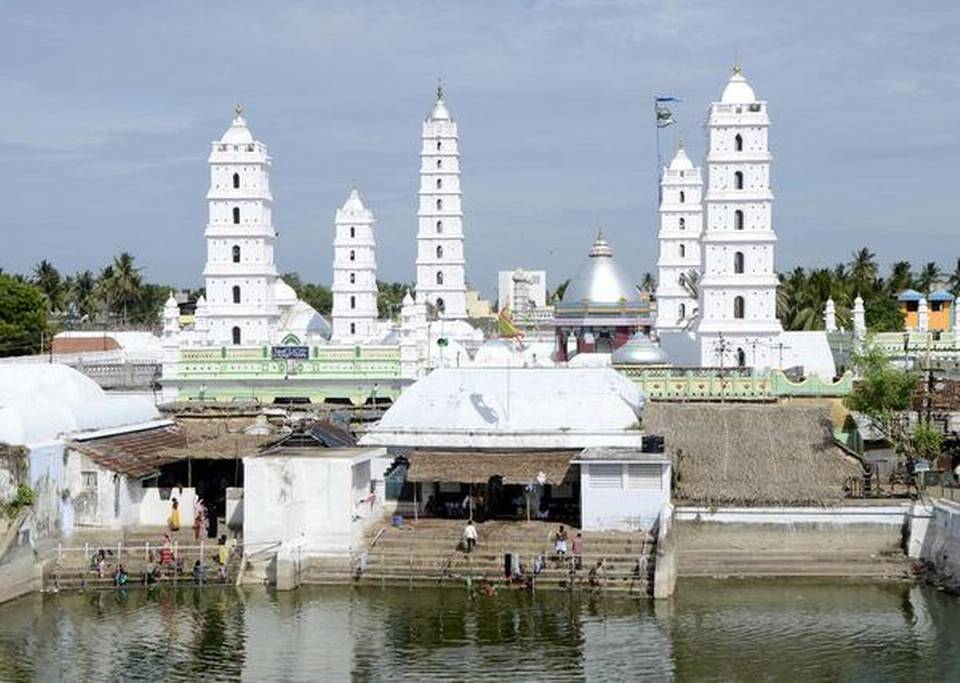
A view of Nagore Dargah, in Nagapattinam | Photo Credit: B. VELANKANNI RAJ

Cutting across faiths, sailors pray to Nagore Miran for a safe journey

“There are so many boats named after ‘Nagore Andavar’ in Kasimedu (a fishing harbour in Chennai). Don’t hastily jump to the conclusion those are owned by Muslims. They actually belong to our people,” cautions Manoharan, to me and writer Nivedita Louis. We were at his residence to record songs on Nagore Andavar as sung by Manoharan, aged about 80 and a retired fisherman of Olcott Kuppam in Chennai. Though the Nagore Andavar he refers to is a 16th century Muslim Sufi saint who transcended religious divides, it still comes as a surprise to know that Hindu fishermen living some 300 km north of Nagore where the Sufi lies buried, name their boats after him.

Continues Manoharan, “When the sea gets turbulent and we feel our lives are at risk, it is to Nagore Andavar that we plead, through songs to rescue us. And miraculously the winds will change, push us to the safety of the shore,” he says. He immediately breaks into a song in Tamil that pours out their fears and pleads for their safety from the wrath of the sea. A hundred km away from Chennai, fishermen at Veerampattinam of Pondicherry, praying for their safety before sailing into the rough sea, make their offerings to Nagore Andavar at Nagoorar Thottam.

Interestingly it was not just fishermen of the Tamil coast, but anyone who left the Tamil coastline in the 19th century placed their faith in the saint to safely cross the seas, and wherever they landed, they built a memorial or shrine for him. Those shrines today stand as testimony to the path taken by the Tamil Diaspora across continents, from maritime traders to indentured labourers. From Penang in South East Asia to the Caribbean in the Americas, with recent additions in Toronto and New York, the influence of Nagore Miran as the Sufi is also known, can be seen.

Nagore Miran, the 16th century Muslim Sufi saint, buried, as the name suggests in Nagore in Nagapattinam district of Tamil Nadu was born as Sahul Hameed in Manikhpur in North India. He took to spiritualism early in his life and travelled through West Asia to Mecca and to Burma and on to China before touching Ceylon and the South Indian coast. Travelling through the Tamil country with his band of followers, local lore has it that the Sufi cured an ailing Achutappa Nayak, the ruler of Thanjavur, and a grateful Nayak gifted land for the Sufi to stay at Nagore. Interestingly, the Sufi arrived at at a time when the Indian seafarers, particularly the Tamil Muslim ship owners, were being harassed by powerful Portuguese naval fleets.

With the hostile Portuguese at Nagapattinam, the presence of the Sufi at nearby Nagore was a great solace not just to the harassed maritime traders but to the sea faring fishermen. Among the miracles attributed to him, it was widely believed by the fishermen that, the Sufi, while residing at Nagore was able to plug the hole in a ship which was otherwise sinking off the coast.

His mysticism touched the lives of people across faiths — from Kings to commoners. They flocked to him and after his death to the Nagore dargah where he lies buried. The dargah received endowments from the Thanjavur Nayaks, Marathas and Nawabs. One of the five minarets at Nagore dargha, the tallest at 131 feet, was built by the Maratha ruler Maharaja Pratap Singh Bhonsle in the mid-eighteenth century. Govindasamy Chetty, Mahadeva Iyer and Palaniyandi Pillai are some of the donors.

In the late 18th century when the British founded Penang in Malaysia as the fourth presidency, it attracted considerable Tamil Muslim traders who were already doing business in South-East Asia. Mostly known as Chulias (those from the land of the Cholas), they became one of the earliest settlers in Penang. By early 19th century, when the settlement had grown considerably, the Company enabled them to build the Kapitan Keling mosque. They built a memorial for Nagore Sahul Hameed at the junction of Chulia street and Kings street. Similar memorials were built across South-East Asia, in Aceh, Burma, Vietnam, Ceylon, Singapore and many other parts of Malaysia wherever the traders went.

However unlike the Tamil Muslim traders, who traded within the Asiatic region, the indentured labourers were taken to distant continents by the colonial rulers, to work in the new plantations. In the early 19th century, as ships set sail from Nagapattinam, the indentured labourers, placed their faith on Nagore Miran for their safe journey across the turbulent seas. The labourers reached lands as distant as the Caribbean Islands. “When in early 20th century they moved to better pastures in Canada and the U.S., Nagore Miran along with Madurai Veeran, Mariamman and many other gods and saints found place in the newly constructed temples at Toronto and New York,” points out Prof. Davesh Soneji of University of Pennsylvania.

If the Muslim traders treated Sahul Hamid as an Awliya, the Hindu indentured labourers, used to idol worship, gave him a form and placed him in the sanctum along with other Hindu deities such as Madurai Veeran, Muneeswaran and Mariamman. “…this divinity is an integral part of most of the ‘Madrassi’ or South Indian Hindu temples in this region. In French Caribbean Islands of Guadeloupe and Martinique, Nagore Mira is worshipped in the form of a Boat and mast decorated with colourful flags. 786, the sacred Islamic number, can be found engraved on the boat,” writes Suresh Pillai, an interdisciplinary artist working at the intersection of arts, archaeology, and cultural artefacts to locate material history and empirical knowledge among living cultures.

Interestingly in Tamil Nadu itself, every year, at the beginning of the Kandhurior Urs festival in honour of the saint, festooned boats resembling ships, adorned with various flags, navigate their way through the streets of the old harbour town of Nagapattinam, before cruising through the national highway leading to Nagore. “It is really surprising how these big boats squeeze themselves through the narrow streets of Nagapattinam and Nagore before finally halting at the saints abode. After which the flags are raised on different minarets of the dargah on the first day of the Urs,” says Harini Kumar, a research scholar on Tamil Islam. Typical of the syncretic nature of the Sufi shrines, as the festival gathers momentum, various communities pay their respects to the saint, with specific non-Muslim families, including the fishermen, accorded hereditary honours.

While the syncretic nature is a common thread that runs through the Sufi beliefs, it is Nagore Miran the Sufi, emerging as the patron saint of the seas, enabling us to trace the path taken centuries ago by the Tamil Diaspora, that seems unique.

source: http://www.thehindu.com / The Hindu / Home> Society> History & Culture / by Anwar’s Trails / by Kombai S. Anwar / March 07th, 2019

The matriarch who grew a moustache

Rampur (British India) , UTTAR PRADESH :

An exhibition reveals the life stories of three generations of women of a powerful Rampur family

Qamar Zamani’s granddaughter Mumtaz / Source: From the family collection
Qamar Zamani’s granddaughter Mumtaz /
Source: From the family collection

Before India’s Independence, Rampur used to be a princely state in Rohilkhand in western Uttar Pradesh. And the Rohila Pathan sardars were the rulers of Rampur. Qamar Zamani was the wife of Akbar Ali Khan, home minister of the Nawab of Rampur.

Though 19th century Rampur was a feudal and patriarchal setup, Akbar Ali’s household was different. Women not only had a say in most matters, they also had their way. In time, when Akbar Ali was executed by the Nawab, the reins of the family were taken over by his widow.

The exhibition, Gold Dust of Begum Sultans, narrates the life-stories of Qamar and the other matriarchs of Rampur. Curator Ranesh Ray is loath to call it a travelling exhibition, but fact is the exhibits did travel all the way from Delhi to Calcutta, where they were displayed at the Kolkata Centre for Creativity.

Apart from photographs, clothes and family jewellery, the exhibition hall is fitted with large screens showing films and speakers playing audio clips on a loop. “I have tried to give viewers a haptic experience, wherein you can feel as well as see things,” says Ray.

The exhibition is based on the book, Sunehri Rait, which is Urdu for gold dust, and is the story of Akbar Ali’s family as chronicled by his descendant, Zubaida Sultan, in 1989 and translated into English in 2016 by two other descendants, Zakia Zaheer and Syeda Saiyidain Hameed. Says Syeda, “The manuscript of the book was lying in our family for a long time. It was in fragments; we have fleshed it out. We have also altered the names of the characters.”

At the core of the narrative of Sunehri Rait is the relationship between Asad Ali, the Nawab of Rampur, and his uncle and chief confidante, Akbar Ali Khan. Ray says, “It is a complex story — a story of three generations, touching on the fourth. It is about the relationship with each other, the relationship with the Nawab and it also takes into account the traditions and customs.”

Asad Ali was known for his sexual profligacy; he would often marry a woman for one night only. And not just that, writes Zubaida, “Once the bridal night was over, they were buried alive within the four walls of the palace.” But one such wife got away and even gave birth to a son. The Nawab acknowledged his son, but at some point when the boy went against him, he ordered his men to execute him and it was Akbar Ali who was supposed to ensure it.

But Akbar Ali could not get himself to obey the Nawab in this case. He fled the state to escape Asad Ali’s wrath, but was eventually found and summoned, and thereafter he died in Rampur under mysterious circumstances. Says Syeda, “It is said that Akbar Ali Khan was poisoned to death.” The exhibition too is structured around this story.

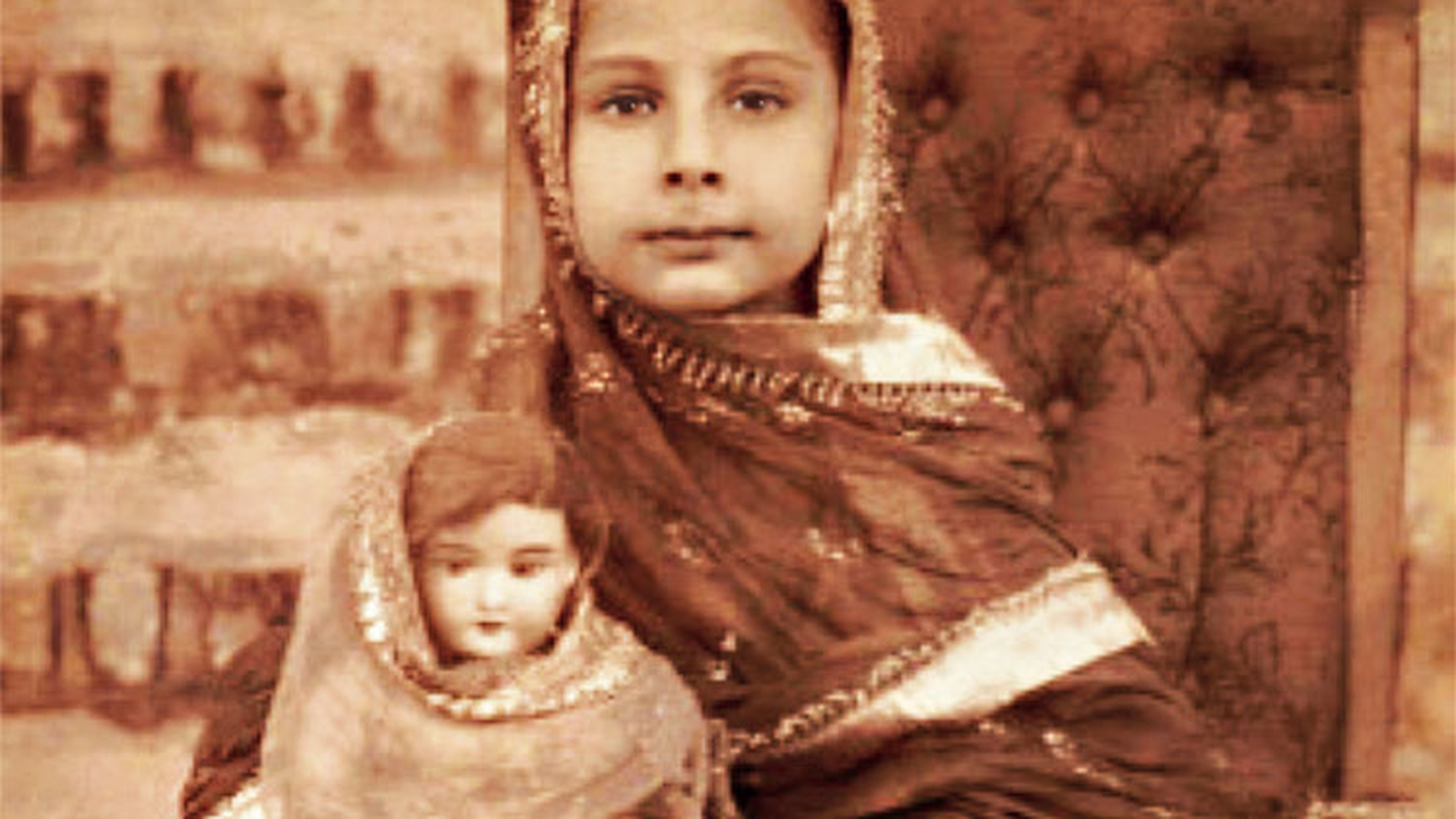
Qamar as a bride at nine / Source: From the family collection
Qamar as a bride at nine /
Source: From the family collection

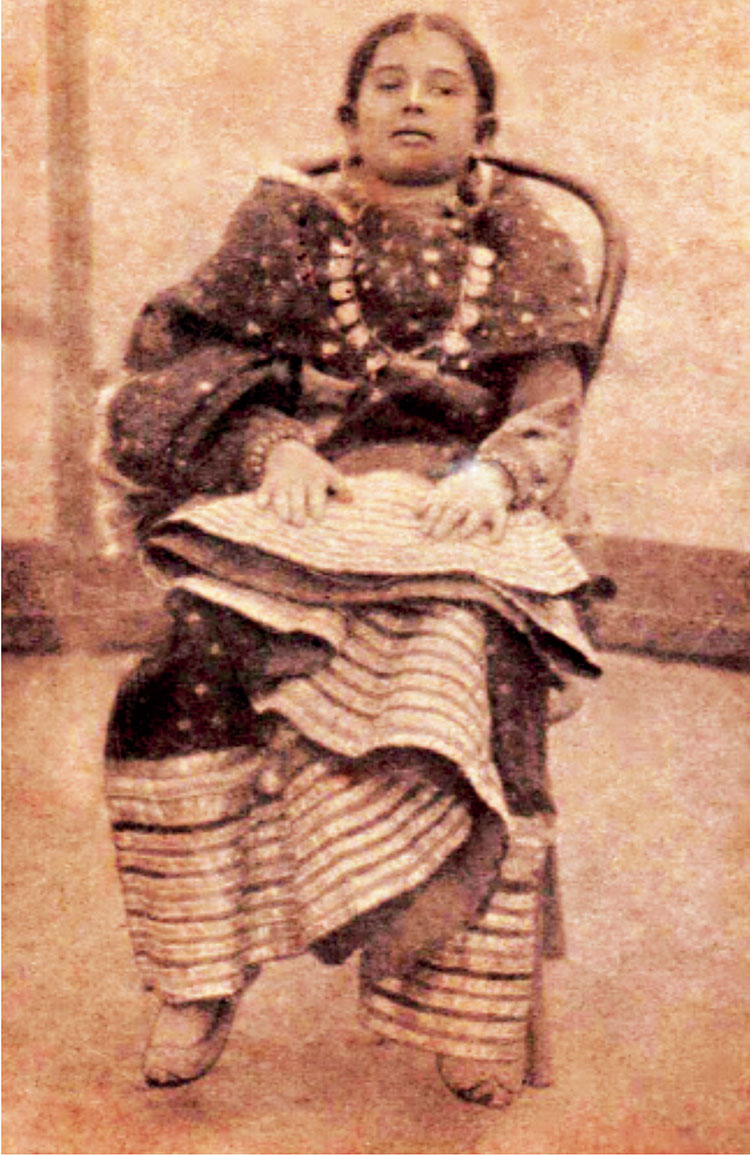
One of the exhibits that arrests attention is a photograph of Qamar Zamani as a little girl. It shows a little girl in a chair, swaddled in several yards of cloth, a weighty looking necklace around her neck, bangles on either hand and loopy earrings. Her head is tilted back, her little hands are stiff and downturned on her lap and her feet barely touch the ground. According to the legend below the photograph, she was married when she was nine and by the time she was 12 , she had given birth to a daughter.

It is difficult to imagine this little girl growing up to become the man in charge of Akbar Ali’s household. Says Syeda, “It is said that she wanted to be called ‘dada’ instead of ‘dadi’. She started speaking in a guttural voice and grew a beard even.” There is a sketch of a telescope on display and Ray tells us that Qamar Zamani was known to spend hours looking through it at the world beyond.

Says Zakia, “Qamar was a tyrant. She made the rules of her own household and dominated to the extent that she did not allow her husband to come into her room during the day, something unheard of in those days.” The other rule she introduced was that the women in the family could not bring up their own children.

Zakia does not have an explanation for this other than it was atypical of Qamar’s highhandedness. But could it have been crafty domestic politics, a way of blunting any imminent battle for succession? Who knows? And when it was her turn to marry off daughter Jahanara, she ensured that her son-in-law stayed with them.

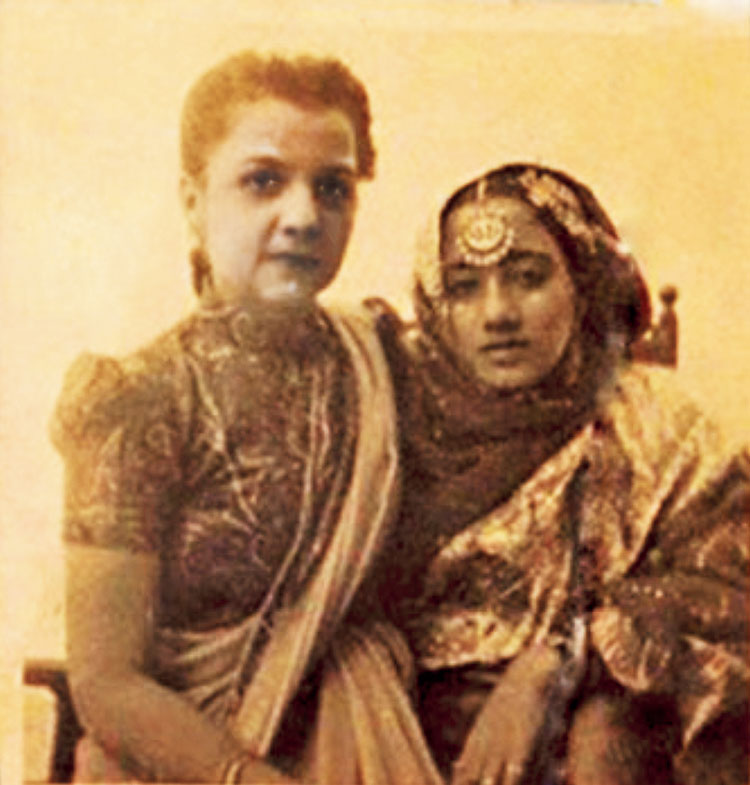
Qamar's granddaughter-in-law (left) / Source: From the family collection
Qamar’s granddaughter-in-law (left) /
Source: From the family collection

There are not too many exhibits from Jahanara’s personal collection — it is said she set fire to all her finery after her husband left her as he felt suffocated in his in-laws’ home. But the belongings of her granddaughter, Mumtaz, and granddaughter-in-law Shehzadi have been put on display. There are cloth dolls in all their miniature glory, including a wealth of dolls’ trousseau.

As visitors pause before an exhibit or a scroll, Begum Akhtar’s ancient voice fills the air; curator Ray says she belonged to the Rampur gharana. In one of the adjoining rooms, Satyajit Ray’s Jalsaghar plays on the giant flatscreen. Iffat Fatima, in charge of the audio-visual part of the exhibitions, says, “The clip from Jalsaghar I have chosen is one where a majlis is on. After all, a majlis used to be integral to Shia Muslim households of a certain time.”

Qamar’s true successor, as far as the spirit of matriarchy goes, was Shehzadi. Zakia tells The Telegraph how Qamar first spotted her while peering into her telescope and fell in love with her good looks. But as Shehzadi grew older, she came into her own. She went against Qamar and brought up her youngest child herself. She stopped wearing the burqa.

“It is said her friend, Rehana Sharif, who was one of the first women graduates from Aligarh Muslim University, helped her,” says Ray. Shehzadi also started socialising.

The book ends with Qamar and Shehzadi reconciling against the ruins of a golden legacy. The exhibition, however, is missing a crescendo or even a wrap. But curator Ray would have one believe that the abruptness is symptomatic of the final swift drizzle of the sand through a clenched fist and the consequent all-enveloping emptiness. Indeed, it is an empty feeling.

source: http://www.telegraphindia.com / The Telegraph, online edition / by Moumita Chaudhari in Calcutta / March 03rd, 2019

Break conventions, VC exhorts historians, researchers

KERALA :

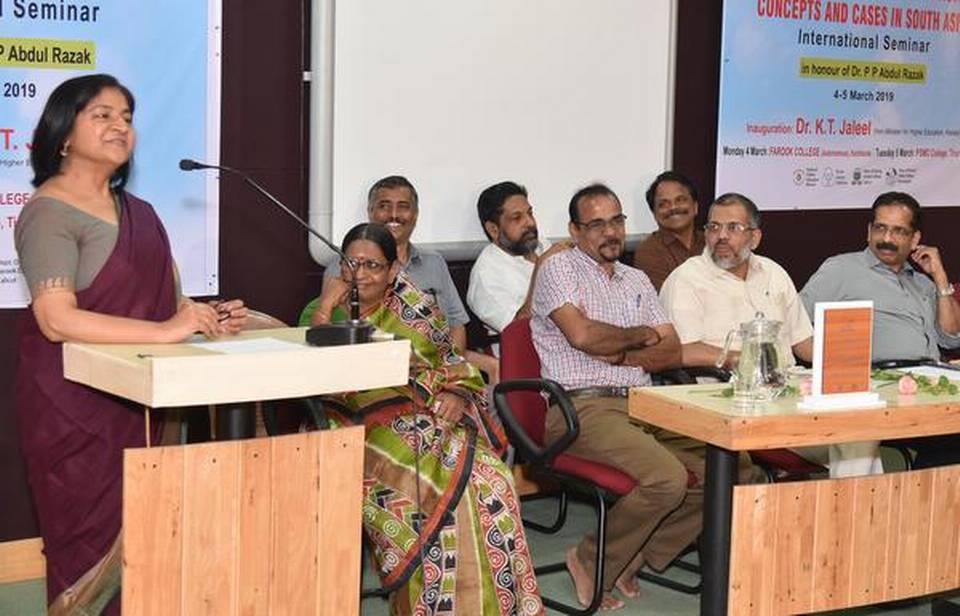
History professor Seema Alavi from Delhi University addressing an international history seminar at Farook College on Monday

Two major colleges of Malabar are jointly hosting an international history seminar in honour of well-known academic P.P. Abdul Razak, who is retiring soon from P.S.M.O. College, Tirurangadi, as its History Department head.

Calicut University Vice Chancellor K. Mohammed Basheer inaugurated the seminar on ‘Early modern and colonial in history: concepts and cases in South Asia’ at Farook College on Monday.

Dr. Basheer called upon historians and researchers to take a diversion from the traditional methods of historiography. He exhorted them to widen the study of history by including the colloquial languages and local history.

“History should be linked to the lives of ordinary people,” he said. Several reputed historians, including Seema Alavi from Delhi University, Mahmood Kooria from Leiden University, Nirmal Renjit Devasiri from Colombo University, K.N. Ganesh and K.S. Madhavan from Calicut University, are attending the two-day meet.

Farook College principal K.M. Naseer presided. T. Mohammedali, head of History Department at Farook College, welcomed the gathering. Kerala History Congress general secretary N. Gopakumaran Nair, Farook College History Old Students Association president P. Ramdas, Vijaya Lakshmi from Malayalam University spoke. K. Lukmanul Hakeem from Government Arts and Science College, Kozhikode, proposed a vote of thanks. While Farook College hosted it on the first day, PSMO College, Tirurangadi, will host the proceedings on Tuesday.

The National Higher Education Mission is supporting the seminar jointly organised by Farook College and PSMO College in association with the Social History Collective, Kozhikode.

source: http://www.thehindu.com / The Hindu / Home> News> States> Kerala / by Staff Reporter / Malappuram – March 05th, 2019

Woman conquers river and gender hurdle

Chennai, TAMIL NADU / Kolkata, WEST BENGAL :

As a river pilot, Naha’s work is to guide ships from Sagar right up to the Calcutta and Haldia ports through the meandering Hooghly

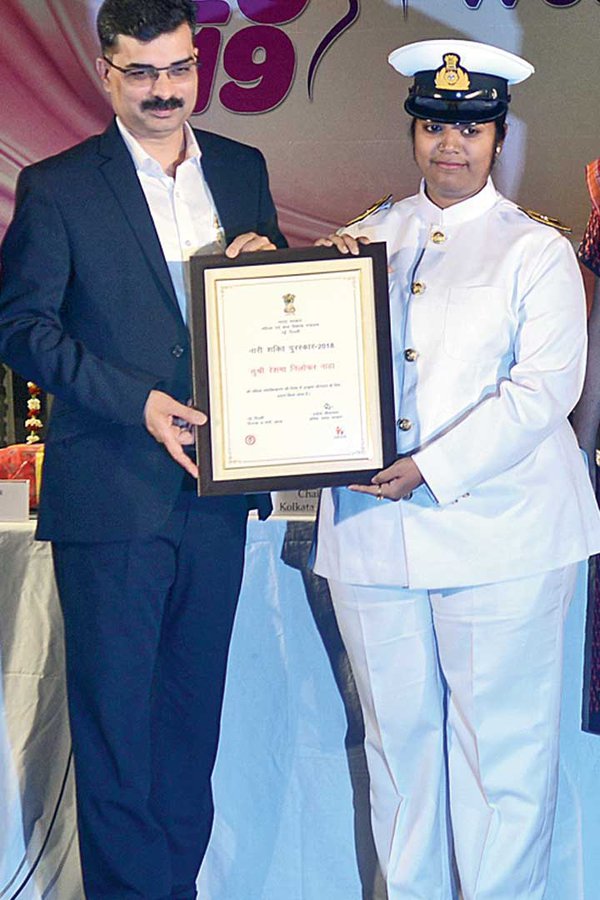
Reshma Nilofer Naha, India’s first woman river pilot, with Vinit Kumar, chairman, Calcutta Port Trust, at ICCR on Monday. Picture Bishwarup Dutta
Reshma Nilofer Naha, India’s first woman river pilot, with Vinit Kumar, chairman, Calcutta Port Trust, at ICCR on Monday.
Picture Bishwarup Dutta

Reshma Nilofer Naha goes to the high sea on a small boat, climbs on to a large vessel with a rope ladder and enjoys it.

India’s first “river pilot” was felicitated at a women’s day programme hosted by the Calcutta Port Trust on Monday, having returned from Delhi where she received the Nari Shakti Puraskar from President Ram Nath Kovind.

As a river pilot, Naha’s work is to guide ships from Sagar right up to the Calcutta and Haldia ports through the meandering Hooghly, something she has been doing “efficiently and professionally”.

“If you think there are no boundaries then you think everything is possible. There is no glass ceiling. It is just an imaginary concept we all have heard for many many years,” Naha, 30, said during a panel discussion on Challenges: Work and Life.

A BE in marine technology, Naha said she had been keen on an offbeat career ever since she was a child. The Chennai woman joined the Calcutta Port Trust in 2011 as a trainee pilot and qualified as a river pilot in 2018.

“It is a great feeling (to be the only woman river pilot) on one hand but on the other hand I would like to have other female colleagues very soon and I look forward to it. I think my story will inspire more women to get in here,” she said.

Naha said navigating the Hooghly is tough because of “bends and narrow channels” where the depth of the water is a concern. “We have different kinds of ships and each ship behaves differently. The tides are strong here… and all this makes pilotage tough,” she said, recalling how she had to once anchor for four days because of bad weather and strong winds.

“It is a proud moment for the Calcutta Port Trust to have India’s first lady river pilot with us…,” said Vinit Kumar, chairman, Calcutta Port Trust, who felicitated her.

“It is a long treacherous journey she has undertaken. To be a first in anything is always a challenge because the infrastructure, the attitudes, the systems are not very friendly or they are made with keeping only men in mind…. So the struggle of the first person is always more than those who follow,” Kumar said.

source: http://www.telegraphindia.com / The Telegraph, online edition / Home> West Bengal / by Jhinuk Mazumdar and Cordelia Nelson in Calcutta / March 12th, 2019

City kid to represent India at international competition

Vijayawada, ANDHRA PRADESH :

A three-day grooming session for children by D’La Valentina at Hotel Aira in city concluded here on Sunday.

Vijayawada :

A three-day grooming session for children by D’La Valentina at Hotel Aira in city concluded here on Sunday.

On the occasion, various competitions were conducted in which kids, trained by Valentina Mishra ( who is the national director of International Kids Pageants) took part. Along with training on personality development and communication skills, the children were introduced to concepts of oral care and hygiene by Dr Kavya and Dr Madhu.

In an audition conducted in February, eight students–Parineeta Sinha (8), Darsh Joshi (7), Taufiq Mansoor Ansari (9), Sanvi Kongra, (11), Gagana K (6), N Yashasvi Sai (8), Safin (10), Aditya Vasudev (12)–were selected for this three-day grooming session.

Among them, Yashasvi Sai from Vijayawada was selected to represent India in the ‘little category’ at the ‘Little Miss Galaxy Contest’ to be held from March 16 to 23 in Bulgaria. Aditya Vasudev from Visakhapatnam was selected to represent the country in the ‘pre-teen’ category at the ‘Best Prince of the World’ contest in Georgia from April 23 to 28.

A photo shoot was organised for them to showcase their style quotient, and mementoes and participation certificates were distributed.

Speaking on the occasion, Mishra said: “Learning to groom oneself at such a tender age will help a child improve his/her self-confidence. It also boosts public speaking and leadership skills.”

Recently,  Yamini Patibandla (6), who was groomed by the organisation, won the World Rising Stars contest in Georgia.

source: http://www.newindianexpress.com / The New Indian Express / Home> Cities> Vijayawada / by Express News Service / March 04th, 2019

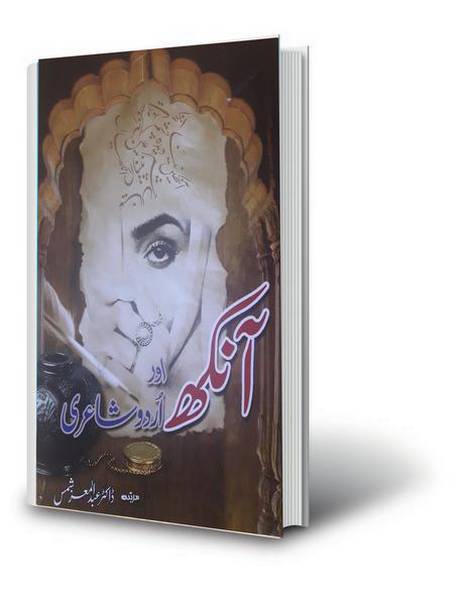
The book ‘Aankh Aur Urdu Shayeri’: A poetic eye on ‘aankh’

Aligarh, UTTAR PRADESH :

UrduBookMPOs11mar2019

An anthology of Urdu verses and proverbs, all on eyes, was launched recently

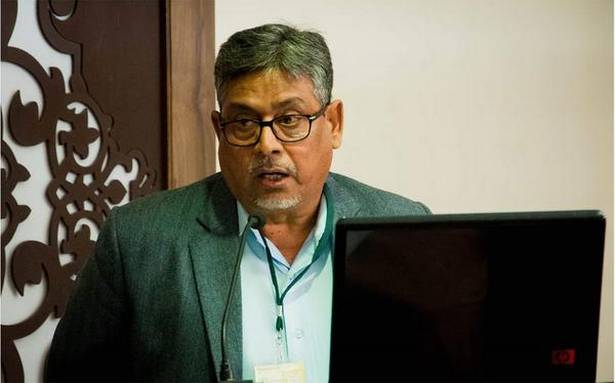
Eyes are a mirror of the soul, it is said. Some eyes are sly and roguish, some serene and shining, a few, seductive and mysterious. Prod Dr Abdul Moiz Shams and he reels out details about a variety of eyes and their intrinsic worth. He should know considering he is an ophthalmologist by profession, but then Dr Shams also has a keen eye for Urdu  poetry.

DrAbdulMoizMPOs11mar2019

During his long service as an ophthalmologist, he has looked into innumerable defective eyes holding a little flashlight. While restoring vision, he has also looked beyond, into the soul. And what he has come up with is a book titled Aankh Aur Urdu Shayeri.

Inki aankhen ye keh rahi hain Faraz

Ham pe tasneef ek kitab karo

(Her eyes tell Faraz

Write a book on us)

Dr Shams has compiled a 389-page book containing couplets of different shades and emotions on eyes. It’s a treasure trove for connoisseurs of poetry. From Mirza Ghalib, Allama Iqbal to Meer, Sauda, Shaad, Faiz, Majaz, Jigar Muradabadi, Ali Sardar Jafery, Parveen Shakir — a whole lot of Urdu poets and their verses on aankh have been listed.

The book is divided into three parts — the first one contains couplets beginning with aankh, the second one has verses which are allegorical in nature and the third part has proverbs containing the word aankh, listed topic-wise. The book is a ready reckoner of sorts, on eyes. This is perhaps the only book of its kind where all the pages are full of verses on one body part.

Right from his student days Dr Shams had a love for poetry and when he became an eye specialist, his passion took a different turn. He started focussing on poetry of eyes. It’s no wonder that he has four other books to his credit: Hamari Aankhen, Jism-o-Jan, Jism-Be-Jan and Aab-e-Hayat.

“The eye is the jewel of the body. Its function is not just to see but to look beyond and sense colour, form, light and movement. That’s why I started collecting couplets on eyes,” says Aligarh-based Dr Shams who released his book in Hyderabad.

The insightful couplets are real eye-openers. Sample this couplet of Parveen Shakir.

Aankh ko yaad hai wo pal ab bhi

Neend jab pehle pehal tuti thi

Full-length ghazals of Ali Sardar Jafery, Khaisar Siddiqi, Hasrat Mohani and Basheer Badr, all on eyes, make for delightful reading.

Gulab aankhen, sharaab aankhen

Yehi to hain lajawab aankhen

Aankhen uthen to dard ke chashme ubal pade

Palken juhken to payar ka badal baras gaya

One can get an eyeful of couplets in this book which was released at the recent two-day National Urdu Science Congress at the Maulana Azad National Urdu University. “There is no dichotomy between science and literature. In fact they complement each other,” says Dr Abid Moiz, who is also a good humour writer.

source: http://www.thehindu.com / The Hindu / Home> Life & Style> Book / by J S Ifthekhar / March 06th, 2019

The ragpicker who made it

Kolkata, WEST BENGAL :

Ajmeri Khatun’s life has been a rags-to-financial security story

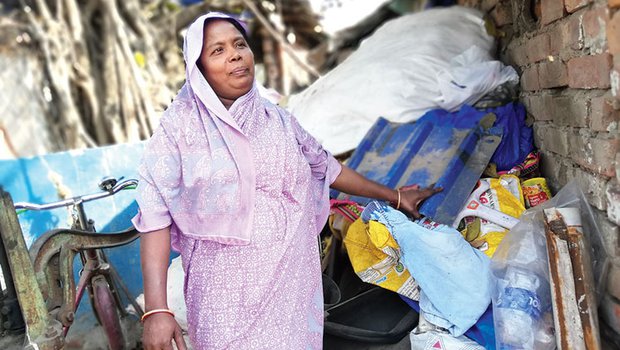
Ajmeri Khatun with her collection of waste / Image: Moumita Chaudhuri
Ajmeri Khatun with her collection of waste /
Image: Moumita Chaudhuri

The Topsia Canal Road of south Calcutta is home to 4,000 ragpickers. Forty seven-year-old Ajmeri Khatun is not one of them anymore, strictly speaking. About 10 years ago, she purchased her first rickshaw and today she owns a fleet of 11. But whenever she has some time on her hands she likes to sort waste.

The job of a ragpicker is to sort dry waste, the kind that can be recycled — plastic bottles of shampoo or detergent, glass bottles, tin containers, plastic caps. Ragpickers also look for electrical waste such as regulators of fans, metal changeover switches. “Copper, brass, iron, steel, they all fetch good money. Sometimes we even find silver,” says Ajmeri. Once sorted, these are sold to dealers or the kabadiwallah.

As Ajmeri and I take a walk along Canal Road, we spot some shanties with waste materials heaped in front of them. Some women are sitting on the road with their day’s collection spread out; they are segregating different kinds of waste. Ajmeri explains, “Ragpickers keep things in store for weeks. Only when they collect a biggish heap, do they sell it. Or else there is no money in it.” But before that they have to rummage through a lot of rubbish. She points to the hands and feet of these women, soiled with dirt, their skin rough and coarse from the day’s work.

Ajmeri is not a jaat kachrawali; her father was a rickshaw puller. Once she turned 14, he married her off. She says, “My husband was not employed, but his family owned agricultural land in south Bengal. My parents thought that would guarantee me a good life.” But in time Ajmeri got fed up of her husband’s joblessness. “He would do nothing the whole day. Sometimes he would be out flying kites, sometimes he would lay traps to catch birds, which he would sell at a price. I refused to stay in the village and asked my parents to bring me back to Calcutta,” says Ajmeri.

Back in Calcutta, at first, Ajmeri did not know what to do for a living. She says, “I used to sit at home all day. It was from my neighbours that I got to know that ragpicking could fetch me Rs 80 to Rs 100 a day. It was quite a lot of money in the 1990s.”

When she broached the topic to her family, no one was pleased. “But I was not ashamed of picking up waste,” says Ajmeri, her expression hardening at the memory. It fetched her money enough to pay for her daily expenses and according to her, that is all that mattered.

She continues with a straight face, bereft of any emotions, “The life of a ragpicker is not easy; that dirt will wash but not people’s impression of you. The men are regarded as thieves. And women ragpickers are twice as much despised,” she adds, all the while studying my expression. She keeps talking about how ragpickers get to work very early, often within hours of midnight; she talks about the stiff competition; the suspicious gaze of cops; the stray dogs breaking into a chase; and of course, the unwanted advances.

She narrates an incident wherein a local goon had once attacked her friend. Shehnaz had gone out all by herself one morning. A man whom she had seen earlier in the neighbourhood had followed her with the intention of snatching her silver bangles. There was a tussle and the goon slashed her cheek with a knife.

Says Ajmeri, “Shehnaz is brave girl. She went to the Beniapukur police station [in central Calcutta] bleeding and got her complaint registered. When she came back and told us about the attack, all the ragpickers went to the police station, and gheraoed it until the culprit was arrested and punished.”

She talks about seasonsal challenges too. “In the monsoon months, everything we collect is wet and the kabadiwallah gives us half the money because of this. Also, the waste is far more messier,” she says.

“You have to ignore the smell and the sight of the dirt. You have to put your hand into it to fish out something worthwhile. You have to wade through the rubbish. Nails have pricked my feet through my chappals so many times, I have lost count. Broken glass, rotten tin, sharp objects, there are so many things you have to be careful of,” she goes on.

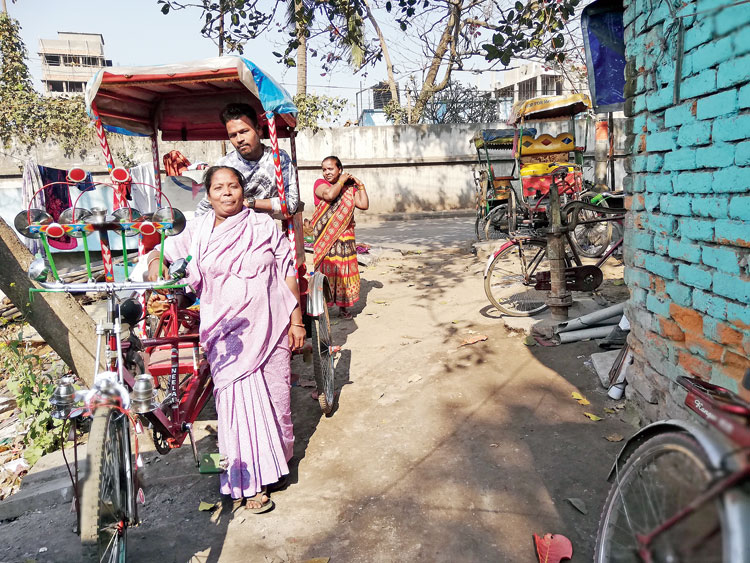
Ajmeri Khatun with her son and some of the rickshaws she has acquired over the years / Image: Moumita Chaudhuri

Ajmeri has given up ragpicking for some years now. “But it is from the money that I earned as a ragpicker that I have built myself a pucca house,” she says pointing to the room where we are sitting. The room is painted a deep green. It has a double bed, an almirah neatly covered with blue synthetic curtains, a brand new refrigerator, a showcase stacked with crockery and shelves lining the walls, laden with aluminium utensils. There is a small kitchen adjoining this room and two more stand-alone rooms that she has built for her children.

It was in 2006 that Ajmeri came to know of the NGO, Tiljala Society for Human and Educational Development, that works towards improving the lives of ragpickers. Heera Ghosh, who works for the NGO, talks about how ragpickers are being phased out. She points out how the civic body has installed compactor machines in almost every place. Also, there are vans that collect domestic waste from households in the mornings. “So the ragpickers do not get to collect the waste at all, however early they might start,” she adds.

The NGO gave Ajmeri a generous grant. Says she, “I used the first instalment to buy a second-hand rickshaw. After three months, when I got the rest of the grant, I spent it to repair the rickshaw, which was in a poor condition.”

In between, Ajmeri lost her husband. He had been working as a daily wage labourer since they moved to Calcutta, but now with him gone Ajmeri says she felt overwhelmed at the prospect of bringing up four children all by herself. “I put the rickshaw on rent and continued to ragpick,” she says.

In 2009, she bought another rickshaw, and thereafter she bought eight more. “I had also opened a bank account and saved some money. I availed every loan that came my way. I am still paying some of them,” she says chirpily.

Today, she has married off two daughters. Her youngest has read up to Class IX. She now gives tuitions to children and attends Urdu classes herself at the local madrasah. “I have also bought a brand new rickshaw three months ago for my son,” she says and then laughingly adds, “My son did not want to pull a rickshaw. He said it was below his dignity but I told him that no work is low or mean as long as it gives you a respectable living.”

She talks about the changes in the ragpickers’ working conditions. “Now ragpickers have identity cards issued by the Rag Pickers Association of India.” Ajmeri along with 11 other women have started a self-help group. “We are saving Rs 100 per member every month and creating a fund which can be used to generate loans to any member who needs the money. That way, we will not have to depend on moneylenders or banks, we would also earn interest, and our kitty would become stronger and stronger,” she says with a sparkle in her eyes.

Ajmeri has given up ragpicking, but she has not given up working. Currently she works as a domestic help. She tells me how she collects plastic shampoo bottles and other waste from the family she is employed with. She says, “Seeing me recycle things, my employers too have started to recycle products of late, instead of throwing them hither and thither.”

source: http://www.telegraphindia.com / The Telegraph, online edition / Home> People / by Moumita Chaudhuri / March 10th, 2019

The Winners scripts a success story in Kolkata Police

Kolkata, WEST BENGAL :

The Winners, an all-women patrolling team by the Kolkata Police, was launched in July 2018, with an aim to check crimes against women and make public places safer for them.

“Oye, akeli hai kya? Chalegi park me? 300 dunga. Arey bol na, jyada chahiye? (Hey, will you come with me to Park, I will pay you 300 bucks. If you want more, tell me,” said a man in his twenties to a woman near Mohor Kunja Park under Hastings police station area around four months ago. The offender had no clue that he was messing with the wrong person. Arpita Mallik, a constable with the Kolkata Police and a member of the team The Winners, made her first arrest that day.

The Winners, an all-women patrolling team by the Kolkata Police, was launched in July 2018, with an aim to check crimes against women and make public places safer for them. The team with personnel trained in self-defence has so far apprehended more than 200 “Road Romeos”.

“I was on duty in civil dress. When the man teased me, I asked him to wait and grabbed him by the collar. He put up stiff resistance but was soon surrounded by a group of policewomen and he started apologising. We arrested him and I felt good,” Arpita said with a wide smile. She stays alone and meets her husband in Malda on holidays.

EXPLAINED

Step towards better gender equation in Kolkata Police

The Kolkata Police has always been keen on increasing the presence of women in their force. The State Home Department has set up eight women-only police stations in Kolkata to investigate crimes against women. A rape or molestation survivor will be comfortable with a woman police officer, they feel. More women in the force means more women reaching out to report incidents that bother them. Several crimes, including eve-teasing, often go unreported. An all-women battalion is a step towards betterment of city police’s gender equation — 800 women in the 26,000-strong police force.

“He wasn’t very keen on me joining police but I managed,” she said. The Winners has 28 women personnel, including three senior officers. All the 25 constables are in their mid-twenties. In white uniform, they conduct patrol on scooty.

“They have been rigorously trained in self-defence and have revolver licence. Our objective is to make the city safe for women,” said Sampa Guha one of the senior officers of the team. “I am happy to see such young, smart women cops in our city. Once a man in lungi started following me on the street and retreated as soon as he spotted a group of policewomen. Cheers to these ladies,” said Anindita Ray Choudhuri, a management student.

However, the team has to fight odds while on duty. Once a constable in the team was bitten on her hand while another was heckled while on patrol inside the Millennium Park. Six persons, including two women were arrested for allegedly harassing personnel on duty.

“We face a lot of challenge and even get teased but when we are in uniform, people respect us also. There have been instances when during midnight patrolling, women came and thanked us for making them feel safe. It gives us immense satisfaction,” said Zinnatara Khatun, another member of the team.

Team Winner is headed by three sub-inspectors, including Sampa Guha, Mita Kansabanik and Zinnatara Khatun. Sampa has various accolades to her credit in power lifting in international, Asian and national events. Zinnatara Khatun is an athlete who has won the Indian Police Medal. Mita is also a power lifting champion.

When Kolkata Police decided to launch the all-woman team under the instruction of Chief Minister Mamata Banerjee, these three women were the first choice. “We were the only three women in the force who could ride a Bullet and had an edge over the others. All the team members are extremely hardworking, managing their personal and profession lives pretty well. We enjoy our job,” said Mita.

“We love catching Road Romeos,” laughs Zinnatara. Mita is married and has a 16-year-old daughter, while Zinnatara and Sampa are single.

“Earlier marriage used to give a woman financial security and an identity, but nowadays it has nothing exceptional to offer a woman,” said Zinnatara and Sampa.

Madhumita Mahapatra, another member of the team, says, “My husband is very proud to see me in uniform. I have a tight schedule but he is always there to pick me up when I finish work.” Another member, Debolina Das Rai, feels they stand for themselves to bring the change. “My husband mostly takes care of our son as I have a tight schedule. We manage well and he never complains,” she said.

Their message on Women’s Day

“People talk about women empowerment but hardly practice it. We are educated and present ourselves well but our mentality remains the same. Real change has to come from within. All women should be financially independent and should speak up. Once a woman starts sharing financial responsibility of her family and her parents, people will stop craving for male child. To bring a change, it is important for women to learn self-defence. Girls are mentally much stronger than men and we must celebrate womanhood.”

source: http://www.indianexpress.com / The Indian Express / Home> Cities / by Sweety Kumar / Kolkata / March 08th, 2019

44 women chosen for Nari Shakti Puraskar-2018

Chennai, TAMIL NADU / Kolkata, WEST BENGAL :

Other awardees included spiritual leader Sister Shivani, commando trainer Seema Rao and the only woman marine pilot in India, Reshma Nilofar Naha.

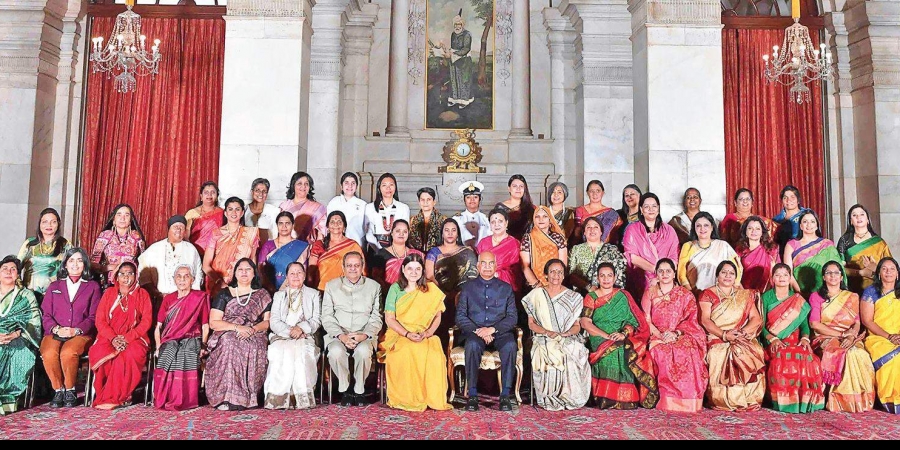
President Ram Nath Kovind with recipients of ‘Nari Shakti Puraskar-2018’ at Rashtrapati Bhawan in New Delhi on Friday.| PTI

New Delhi :

President Ram Nath Kovind on Friday presented the Nari Shakti Puraskar 2018, the highest civilian honour for women, on the occasion of International Women’s Day.

Among 44 awardees selected out of around 1,000 nominations received by the Women and Child Development Ministry were names such as scientists A Seema and Ipsita Biswas, Doordarshan News anchor Neelum Sharma, acid attack survivor Pragya Prasun, radio music composer Madhuri Barthwal and activist Manju Manikuttan.

Other awardees included spiritual leader Sister Shivani, commando trainer Seema Rao and the only woman marine pilot in India, Reshma Nilofar Naha.

“The awardees are a face of change, reflecting a shift in the status of women, from women development to women-led development,” said WCD Minister Maneka Gandhi adding, “No field has been left untouched, where women have not left their indelible mark, making women the leading force of our development trajectory,” she added.

A statement by the ministry said that while making the selection from the nominations,  the nominee’s contributions in empowering vulnerable and marginalised women was taken into account.

source: http://www.newindianexpress.com / The New Indian Express / Home> Nation / by Express News Service / March 09th, 2019