The rebirth of Nai Duniya

DELHI :

The seven-decade-old Urdu paper is set to go digital
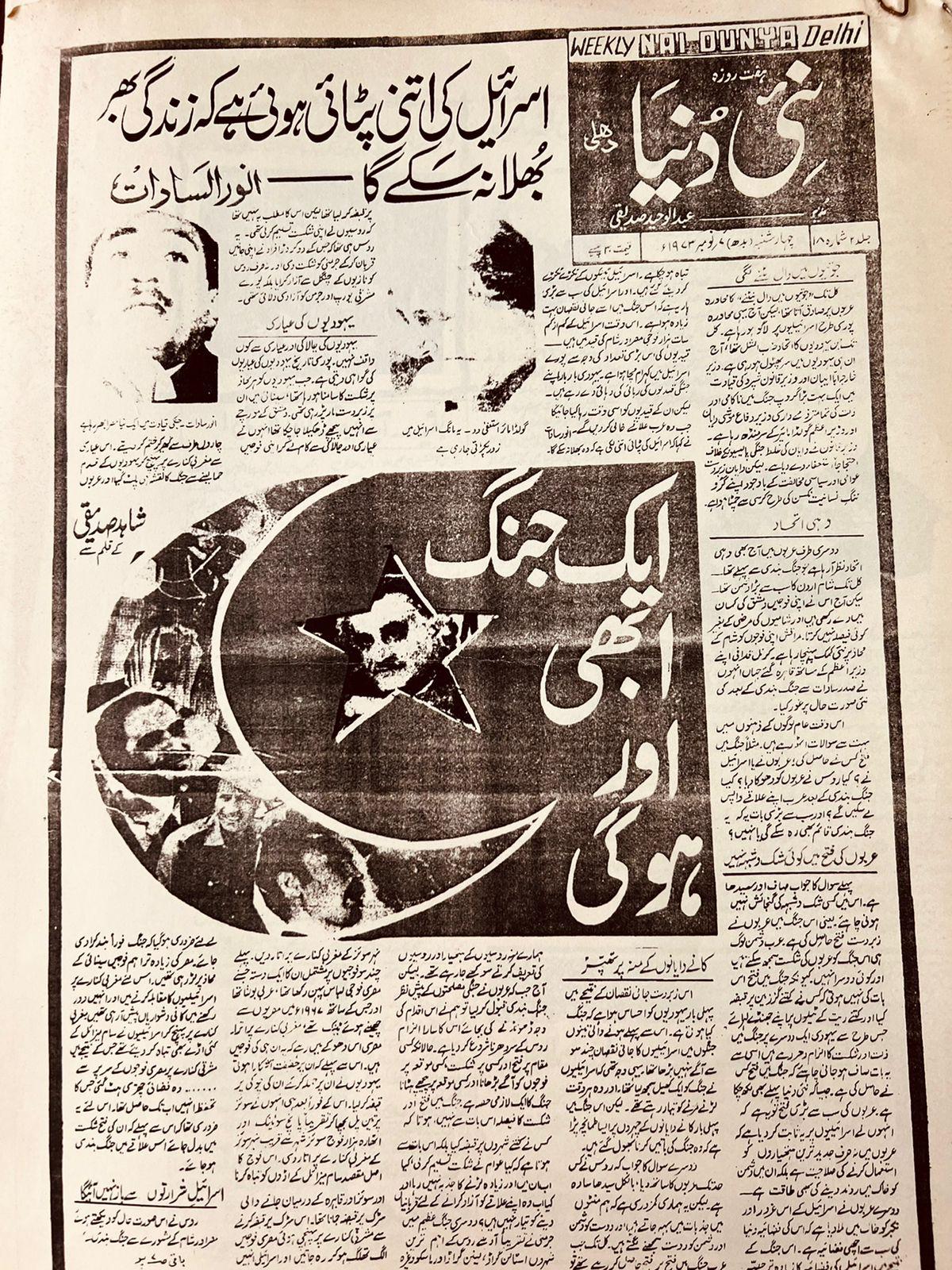
Milestone: Nai Duniya issues of 1973 | Photo Credit: Special Arrangement

A 72-year-old newspaper is ready to shave off its white beard. Helping it speak to the hep and happening young readers is the equally old editor-politician-author Shahid Siddiqui.

Starting in 1950 as an eveninger, Nai Duniya was among the first victims of COVID-induced restrictions and challenges. Now it is poised for a comeback albeit as a weekly in digital format. Siddiqui says, “At a time when it is difficult for even English magazines to find vendors, and given the increased online traffic, it makes sense to re-launch Nai Duniya in the language of the new world. We will revive Nai Duniya as an Urdu weekly in digital format.”

Siddiqui is the right person to revive the paper. He had re-launched it in 1973 after his father Abdul Waheed Siddiqui had to pay the price for skirmishes with the government. Recalls Siddiqui, “I was still pursuing my Master’s degree from Delhi University when I realised there was a demand for Nai Duniya. I revived the paper a little before Emergency and took on an established paper like Blitz which was quite popular among Urdu readers. At the time of Emergency, we were the only Urdu newspaper to criticise the government. Incidentally, Indira Gandhi gave us an  interview soon after losing power in 1977.”
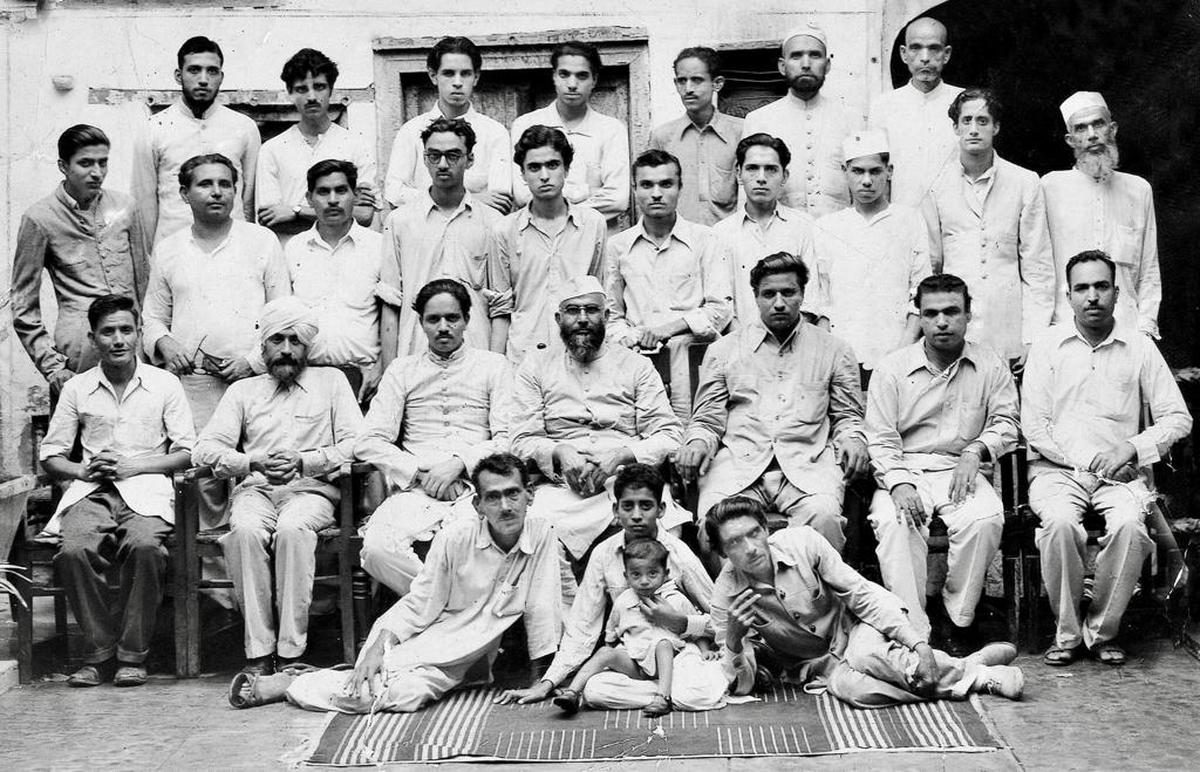
THOSE WERE THE DAYS Staff of Nai Duniya in 1951 with the founder Abdul Waheed Siddiqui (seated in the centre). Young Shahid Siddiqui, the present editor, can be seen in the lap of his brother.  | Photo Credit: Special Arrangement

Though Nai Duniya developed distinct political contours over time, it started as a hangout zone for the best Urdu writers and poets of Old Delhi. Shortly after the paper went to press around 3 p.m., the poets and writers would gather at its office in Haveli Hisamuddin in Ballimaran. Over endless cups of tea, they would recite poetry, crack jokes and take a dig at the society and polity. Among them were the likes of Zubair Rizvi, Salam Machchlishahri and Josh Malihabadi.

As Siddiqui says, “My father had worked with Al Jamiat. After Independence, the newspaper refused to speak against the Congress party. He parted ways and started Nai Duniya instead.”

The good times of soirees and gentle jokes did not last long. Soon the paper found itself embroiled in a controversy related to Kashmir. The paper had opposed the arrest of Sheikh Abdullah. Its entry was banned in the State. The declaration of the paper was cancelled, its security forfeited and in 1964-65, the paper had to fold up.  

“My father brought out two other papers instead – Himmat and Taqat. They did not last long. Then Nai Duniya was revived after Feroz Gandhi introduced a private member’s Bill in Parliament against asking for a security deposit for a newspaper. The Bill was passed. Nai Duniya once again raised its voice against the ongoing riots and paid the price. There were raids at our place, all the stuff was checked, even the pillows were ripped apart to see anything suspicious hidden there,” recounts Siddiqui.

Milestone: Nai Duniya issue of 2002 | Photo Credit: Special Arrangement

Finally, Nai Duniya came back in a new avatar as a weekly. Within six months, it became the highest-selling weekly in the country, selling from stalls in Kashmir to Karnataka. Denizens of Old Delhi, in particular, used to wait for it and would discuss its stories over endless cups of tea all over again. The government took note too. Its founding editor Abdul Waheed was arrested during the Emergency.

The Kashmir challenge remained for the paper. Siddiqui received death threats from Lashkar-e-Taiba, Hizbul Mujahideen, etc in the mid-80s. Recalls Siddiqui, “I was arrested under TADA after Farooq Abdullah’s government was felled.”

Yet amidst all the challenges, Nai Duniya flourished. Its office moved from the cultural hub of Old Delhi to the more upmarket Nizamuddin. From an eight-pager, the paper grew into a 24-page tabloid with stories carrying a punch. Along the way, it was the first to introduce computers in Urdu newspapers, started the concept of theme-based pages and invited the best journalists to write for it.

It worked well until the pandemic enforced its closure. Now at 72, it is set to revive again, this time as a digital newspaper, yet with the same old fire and punch.

source: http://www.thehindu.com / The Hindu / Home> News> Cities> Delhi / by Ziya Us Salam / June 24th, 2022
Shared experiences

DELHI :

Speakers talked poignantly at the launch of Shahid Siddiqui’s novel about the indivisible history of India and Pakistan

Shahid Siddiqui. Photo: R.V. Moorthy

The love-hate relationship between the people of India and Pakistan has been masterfully woven around the lives and aspirations of two brothers, Shiraz and Aijaz, by the politician and journalist turned author, Shahid Siddiqui. The launch of Siddiqui’s first work of English fiction, “The Golden Pigeon”(Harper Collins), saw a packed house at the India International Centre this Wednesday.

pix: harpercollins.co.in

The book was released by veteran journalist Kuldip Nayar who spoke passionately about the need to believe in Gandhi’s ideas of secularism and pluralism in this time of increasing hatred and ‘love jihad’. Barkha Dutt, group editor NDTV, moderated an interesting dialogue between the author, Nayar and noted film director Mahesh Bhatt.

Nayar recounted his experience of covering the post Partition riots — the disillusionment, horror of countless people rendered orphans and homeless, killed and maimed, families torn apart — and felt that Siddiqui’s book brought out the trauma and fear of Partition in a very sensitive manner. “The book reminds me of my younger days in Ballimaran — the old world charm, the magic of an era forgotten, the memories of riots. Reading the book brought tears to my eyes,” he said.

Barkha commented that the book is a story at many different levels, of schizophrenia about Pakistan’s devious designs to stir trouble in India, of dysfunctional love, manufactured stories about love jihad and passion.

Siddiqui said the book was rooted in his experiences of growing up in Shahjahanabad, the struggles of people in post Partition India, the invisible line drawn between the two countries, of aspirations, anger and fear of a people divided by a political decision. “My book is full of magical realism and begins from where the famous movie Garm Hava ends. It is a bird’s-eye view of the social upheaval and political turmoil in the subcontinent and post Partition angst. But this is not a political book at all,” said Siddiqui emphatically.

Bhatt felt that the book has what he likes to call ‘the perfume of sorrow’ and said he could easily identify with the central characters in the novel. “This book caught me by my jugular. It’s my life in print — a fiction of facts,” said Bhatt while discussing at length the dichotomy of growing up as the love child of a Muslim woman and a Hindu man. He recounted how his mother braved the odds to raise him as a Hindu while she hid her own identity as a Muslim under the garb of a mangalsutra and bindi. He also said the character of the beautiful Hina Kauser in the book was a portrayal of his mother’s steely determination to survive the odds. “The compass of our nation and that of Pakistan points towards hope. A time will come when the boundaries in our hearts and minds will fade away. The change has already begun,” said Bhatt.

source: http://www.thehindu.com / The Hindu / Home> Features> Metroplus / by Anasuya Basu / image edited : Harper Collins / November 21st, 2014

Ballimaran in its infinite labyrinth of turmoil

DELHI :

An excerpt from Shahid Siddiqui’s fascinating memoir of culture, society and politics

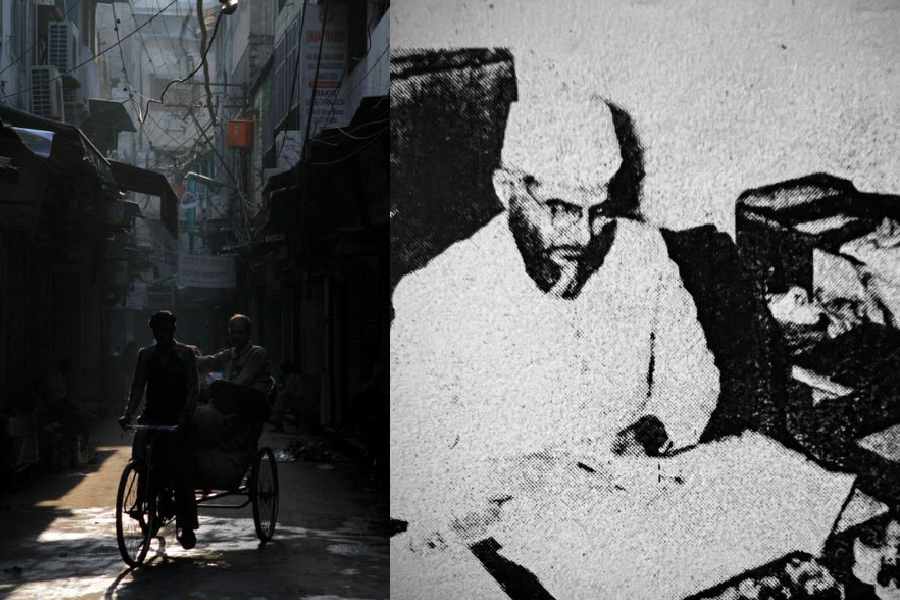
WORLD APART: The tangled lanes of Old Delhi where Abdul Waheed Siddiqui (right) started the evening daily Nai DuniyaSourced by the Telegraph

In those post-Partition days, there were unseen borders drawn in old Delhi — what in today’s parlance is called Delhi-6. There were Muslim and Hindu areas within the same lane. Haveli Hesamuddin in Ballimaran was the mohalla (locality) of a prosperous Muslim business community called Punjabis or the Shamsi baradari. It was, therefore, in common parlance known as ‘Punjabi Phatak’ (Punjabi Gate). In reality, they were not Punjabis, but had migrated from Central Asia; they were very fair-skinned, some of them had blue eyes and blond hair. None of them spoke Punjabi. Most of them owned shops and businesses in Chandni Chowk and Sadar Bazar. Many of them owned large showrooms and hotels in Connaught Place and Kashmiri Gate, with palatial houses in Civil Lines, which was at that time the most expensive and posh residential area of Delhi. Our family was one of the few non-Punjabis living there, and was looked upon with suspicion. The government and administration allotted us a house that belonged to a prosperous Muslim family that had migrated to Pakistan…

…In the 1950s, Ballimaran was in great turmoil, and undergoing significant demographic and emotional changes. While some prominent families had migrated to Pakistan, others were gravitating to this place from different parts of India. It emerged as the hub of new post-Partition Muslim politics and cultural renaissance. Things were changing, and education was becoming popular. Mohani shifted to our mohalla, and brought all the writers, poets, revolutionaries and freedom fighters with him. Ballimaran was known as the Mohalla of Mirza Asad Ullah Khan Ghalib. With Mohani also spending his last days here, it became a centre of activity for all those with patriotic zeal and revolutionary ideas. Prominent journalist Kuldip Nayar, who migrated from Lahore, came here to spend time with Mohani and practise Urdu journalism. Famous poet Josh Malihabadi, whenever he was in Delhi, preferred to stay here. Theatre practitioners like Habib Tanvir and Baba Niaz Haider found refuge in Haveli Hesamuddin and Ballimaran.

When Abba decided to resign from Aljamiat and launch a daily newspaper Nai Duniya in 1951, the ground floor of the haveli was converted into a newspaper office. For some time, we lived on the upper floor of this two-storey house, but later shifted to a house next door. The upper floor, with large rooms and enormous terraces, became the refuge for those who had no place to go. Nai Duniya was an evening newspaper, so all office work was over by the afternoon. After that, the whole office, its courtyard and terraces were available to idealists, culturally adventurous political mavericks, revolutionary young men, and the most outspoken journalists to spend their time there.

There would be rehearsals for a play on one terrace, while impromptu mushairas would be organized on the other if Jigar Moradabadi or any other famous poet were visiting the city. While Communist Party members would have heated debates on the class character of Nehru’s government in one room, in another, some ulema would plan relief work for some place where a communal riot had broken out. From Habib Tanvir and young M.F. Hussain to poets like Gulzar and Zubair Rizvi, many creatives spent their time in the Nai Duniya office. There were dozens of cots (charpai or khat as we call them in Hindustani) on the terrace. Anyone could sleep there, and have a cup of tea and nahari-roti for breakfast. Thus, in my growing years, my young mind was exposed to the most exciting and dynamic melee of ideas and cultural cocktails possible.

In 1952, a young woman called Sarla Gupta, who belonged to a prominent family of Delhi lalas, and lived in Haveli Hyder Quli in Chandni Chowk, came to meet Abba. She wanted to contest the municipal corporation elections from Ballimaran on a Communist Party of India ticket. She had just graduated from Delhi University, and was burning to change society and build a new India. It was unthinkable for a communist to contest and win from a predominantly Muslim constituency, and that too when the candidate was a young woman who had just graduated from university.

Muslims, who had been divided between the Indian National Congress and the Muslim League before Independence, believed that in independent India only Congress could help and protect them. Even those who harboured a dislike for Nehru, Azad and Patel now looked at them as their saviours, and voted for Congress.

They looked at the Hindu Mahasabha and the newly formed Bharatiya Jana Sangh (BJS) with suspicion and fear, apprehending that if these parties came to power, they would marginalize them and treat them as second-class citizens. They regarded any third party as ‘vote katwa’ (divider of their votes), which would ultimately help parties like the Hindu Mahasabha and BJS, which were trying to gain a foothold among Hindus in the post-Partition atmosphere of suspicion and hatred.

Abba’s undeniable spirit pushed him forward, and he agreed to back Sarla Gupta. She defeated the powerful Congress candidate with Abba’s support. It was a prestigious election for Muslim Congressmen, and a test case inasmuch as it was the first post-Partition election. This made the Congress government extremely wary.

Govind Ballabh Pant, a freedom fighter, close confidant of Sardar Vallabhbhai Patel, and the first chief minister of Uttar Pradesh from 1946 to 1954, was highly wary of communists, and regarded them as dangerous for the country. Sarla’s victory from a Muslim area was exaggerated to foment the fear that Muslims were gravitating in large numbers towards the communists. Some rightist Hindu organizations saw this election as a massive conspiracy — a political takeover of India by the communists with the help and support of Muslims. In the aftermath of the Partition when most Muslim leaders, even progressive ones, had left Indian Muslims in the lurch and migrated to Pakistan, the latter had no one to look up to or raise their voice, and believed that democracy was not meant for them, but only for the Hindu majority.

Reproduced with permission from I, Witness; by Rupa Publications

source: http://www.telegraphindia.com / The Telegraph Online / Home> Life / by Shahid Siddiqui / August 17th, 2025

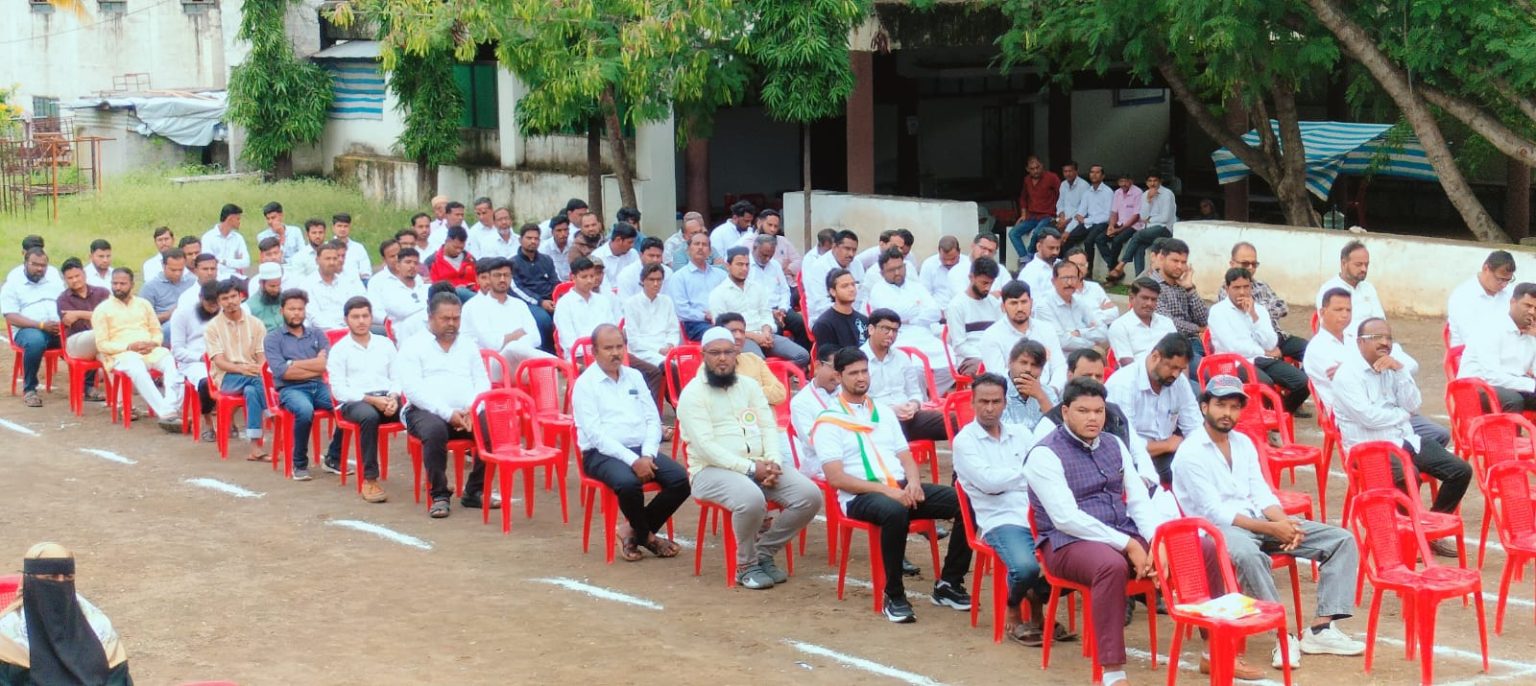
Secab Engineering College Vijaypur Celebrates 79th Independence Day

Vijaypur (Vijayapura), KARNATAKA:

Vijaypur:

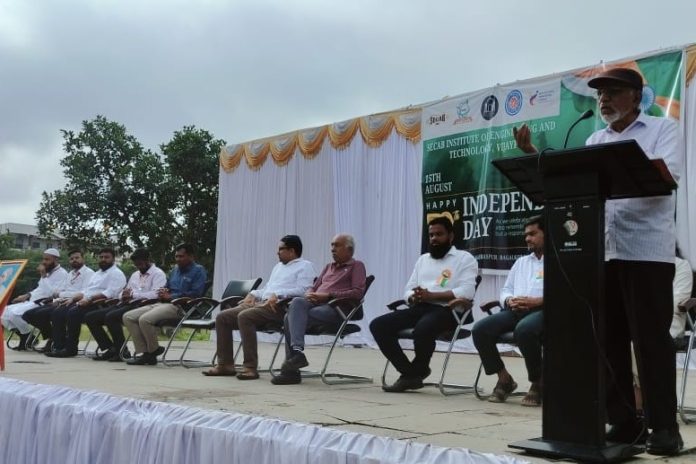
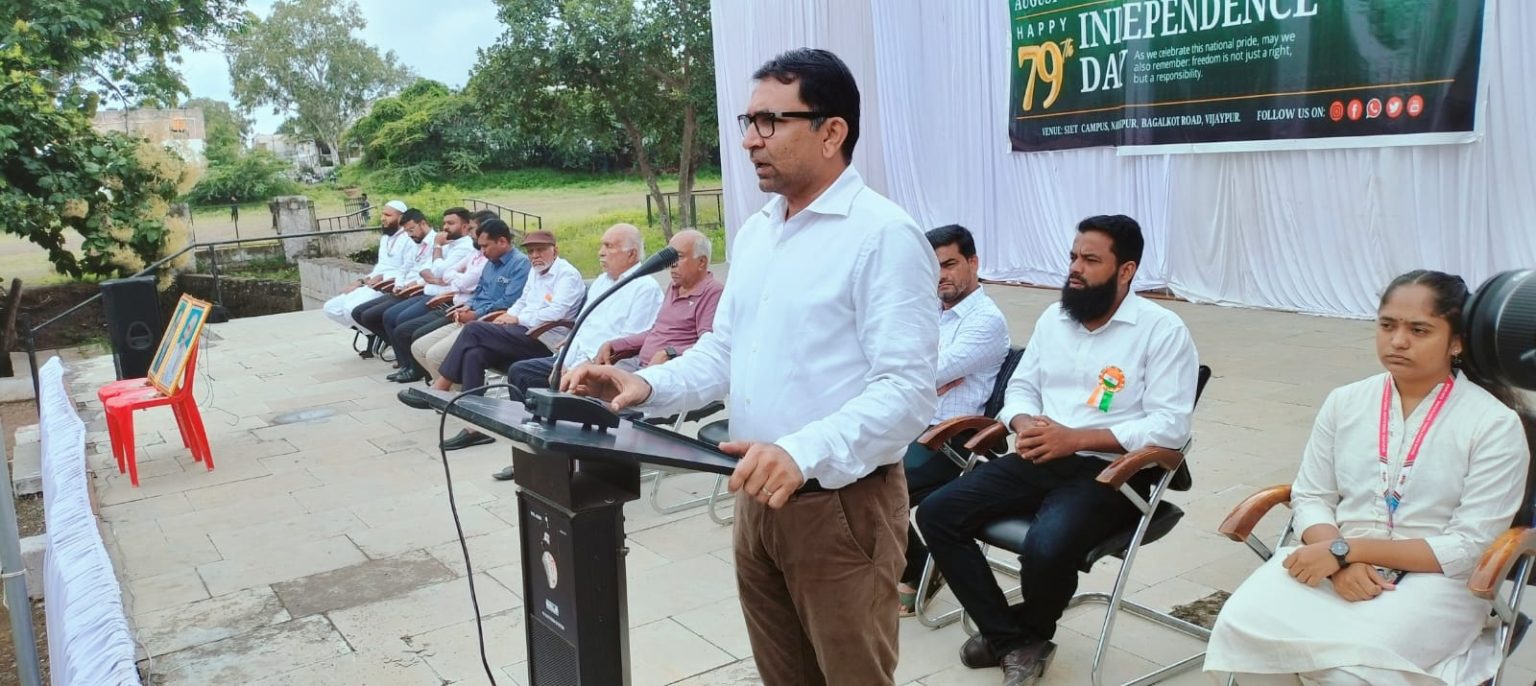
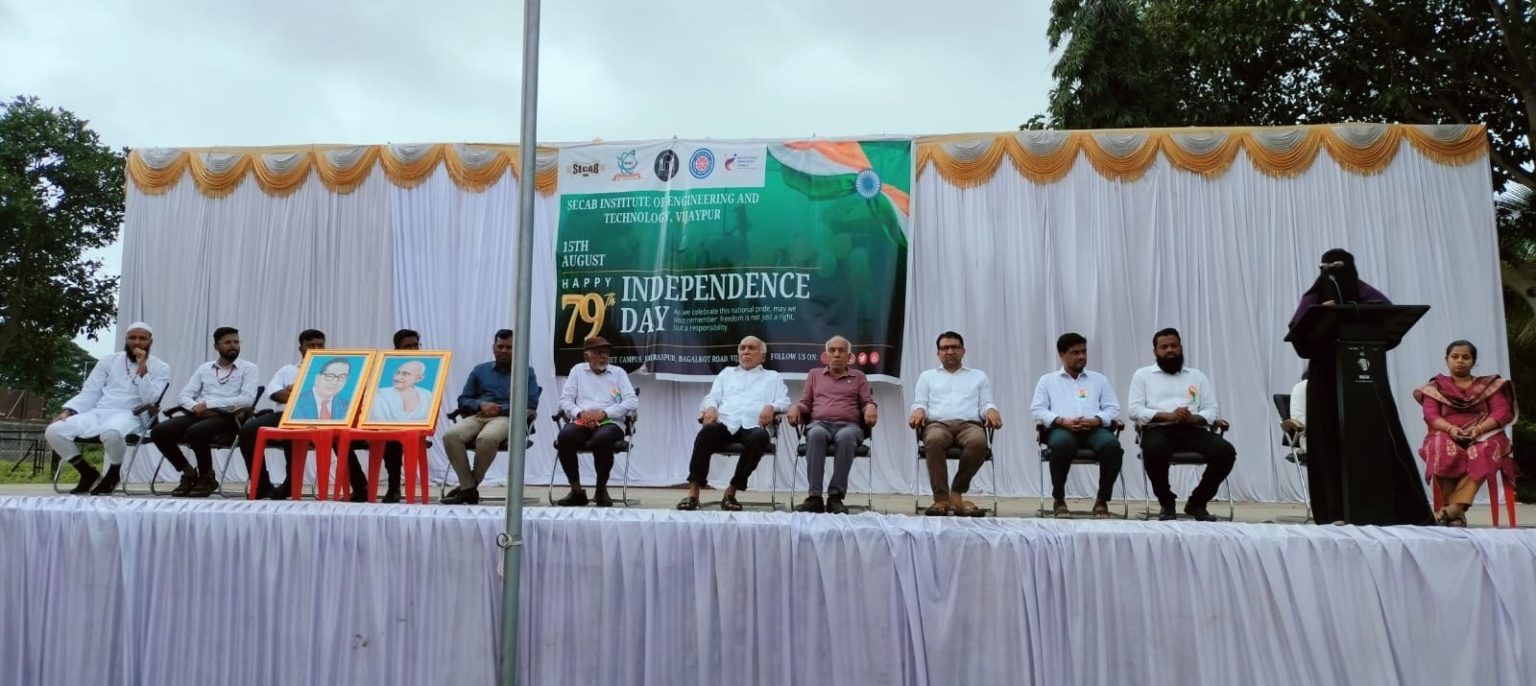
The 79th Independence Day was celebrated at Secab Engineering College here on 15th August 2025 with great enthusiasm. The chief guest of the function was Salauddin Ayub Punekar.

After the flag hoisting, Nazeer Ahmed Kazi, Retired Executive Engineer, addressed the gathering. In his speech, he highlighted that India, with a population of 140 crore, is home to people of many religions, yet united as one nation. He said, “Unity in diversity is the true culture of our country. Nowhere else in the world do we find such an example. Let us be proud of it.”

He reminded everyone that Independence Day marks India’s freedom from British colonial rule on 15th August 1947. The day honours the courage and sacrifices of the freedom fighters and inspires citizens to uphold the values of liberty, unity, and responsibility. He recalled the contributions of great leaders like Mahatma Gandhi, Jawaharlal Nehru, Maulana Abul Kalam Azad, and Lokmanya Bal Gangadhar Tilak, who declared in 1916: “Swaraj is my birth-right and I shall have it.”

Quoting Dr. APJ Abdul Kalam, he stressed the need for India to be self-reliant and globally competitive. Addressing the students, he said that engineers have a dual responsibility – both as citizens and as professionals – in nation-building. Referring to Pandit Jawaharlal Nehru’s vision of engineers as the builders of the nation, he urged them to come to the forefront in technology development and achieve technological independence through innovative and globally competitive practices.

He also acknowledged India’s remarkable progress, standing today as one of the world’s largest and fastest-growing economies. However, he cautioned against persisting challenges like communalism, casteism, corruption, unemployment, and social injustice, calling for collective efforts to overcome them.

The Director of SECAB Association, Salauddin Punekar, in his address, emphasised that independence should not remain a symbolic celebration but must reflect in every walk of life.

Several students and staff members also spoke on the occasion.

The Founder of SECAB Association, Shamshuddin Punekar, was present on the dais along with Principal Abbas Ali. The programme concluded with the President’s address, who welcomed all and extended heartfelt Independence Day wishes.

It was a memorable and meaningful celebration.

source: http://www.radiancenews.com / Radiance News / Home> Latest News> Report / by Radiance News Bureau / August 17th, 2025

Kadaba: Student Fathima Sajla Ismail creates record by handwriting Quran in five years

Baitadka ,Kaniyur Village (Kadaba Taluk, Dakshina Kannada District) , KARNATAKA :

Kadaba :

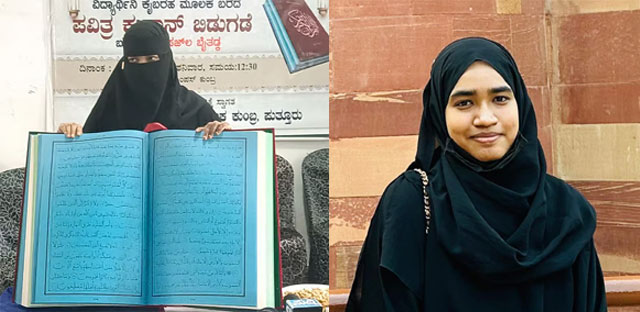
A remarkable achievement by a student from Kumbra’s Markazul Huda Women’s College has drawn attention, as she meticulously handwritten the entire Quran using an ink pen.

The achiever, Fathima Sajla Ismail, a BCom student, hails from Baitadka in Kaniyur village of Kadaba taluk and is the daughter of Ismail and Zahra Jasmine. She dedicated nearly five years to this extraordinary work, beginning in January 2021 and completing it in August 2025.

For the handwritten manuscript, Sajla used white, light blue, and light green papers, along with a black ink pen. The Quran consists of 604 pages, bound with a red and gold-coloured protective cover, and weighs about 14 kg.

“Writing a single page would take me around four hours. On some days, I managed to write two pages in eight hours. In total, I completed the work in 302 days, spending 2,416 hours,” shared Sajla.

The unveiling of the handwritten copy and recognition of her achievement took place at Markazul Huda Women’s College in Kumbra.

The manuscript was officially released by Yaseen Sakhafi Al Azhari, a Mudarris from Markaz Knowledge City, Kerala.

source: http://www.daijiworld.com / Daijiworld.com / Home> Top Stories / by DaijiWorld Media Network – Kadaba (headline and name edited) / August 18th, 2025

All India Muslim Development Council (AIMDC) Unveils List of 40 Future Leaders 

INDIA :

The All India Muslim Development Council (AIMDC) has officially unveiled the final list of “40 Under 40 Leaders” — a landmark initiative aimed at identifying, nurturing, and empowering the next generation of Muslim leaders in India. The announcement follows one of the most exhaustive and merit-based selection processes in the nation’s recent history, spanning a year-long journey and involving multiple stages of evaluation.

From 950 Applications to 40 Leaders 

The initiative drew an overwhelming response, with approximately 95 applications from across the country. Candidates came from diverse fields — education, politics, corporate leadership, engineering, medicine, activism, journalism, law, research, academia, entrepreneurship, economics, Shariah scholarship, counselling, motivational speaking, Ulemas, students and governance.

The journey began with a meticulous application process, requiring detailed documentation of qualifications, achievements, contributions to society, and personal background. Based on rigorous assessment criteria, 215 applicants were shortlisted for personal interviews.

An expert panel then conducted comprehensive interviews, narrowing the field to 112. Following further scrutiny, 105 exceptional candidates earned a place in the in-person finale for 4 days.

Four Days of Intense Evaluation in Bengaluru 

In India’s startup capital, Bengaluru, hosted the four-day in-person selection event.

Candidates participated in group discussions, parliamentary-style debates, and collaborative tasks designed to assess both individual brilliance and teamwork capabilities.

Organizers also closely evaluated their commitment to nation-building, sincerity towards the Community, Human Relations and personal discipline

From this stage, 70 leaders were selected, each awarded a Certificate of Leadership in addition to a Certificate of Participation.

Silent Assessment for the Final 40 

On July 1, 2025, the same day as the 70 Leaders’ announcement, AIMDC formed an Adhoc (Consultation) Committee of 40 Under 40 Leader blending self-nominated leaders and organizer nominations.

They were asked to pick two projects of their interest from a curated list of initiatives aligned with Community and nation-building. The objective: evaluate their decision-making capabilities, foster team bonding, spark brainstorming, and plant the foundational seeds of advanced leadership skills.

Unbeknownst to many participants, this period doubled as an “invisible” final evaluation. Organizers monitored sincerity, akhlaaq (good character), ikhlaas (pure intentions), punctuality, and the ability to follow through on commitments. Participation in educational events, organizational skills, and collaborative spirit were also critical factors in determining who would advance.

The Final 40 — India’s Muslim Leaders of Tomorrow 

After months of observation, assessment, and engagement, AIMDC has now announced the final 40 Under 40 Leaders — individuals under the age of 40 whose vision, expertise, and dedication position them as catalysts for positive change.

We were truly overwhelmed by the remarkable talent, dedication, and vision demonstrated by all 70 leaders who participated in the process. After a rigorous evaluation, the final 40 leaders selected under the 40 Under 40 Initiative will form the National Executive, serving as the strategic and driving force of the initiative.

Recognizing the immense value and potential of the remaining 30 outstanding leaders, we have proudly welcomed them as members of the National 40u40 Team. They will play a pivotal role in executing projects and events at all levels, ensuring our mission reaches communities across the country and contributes meaningfully to nation-building.

“This initiative is more than a recognition program — it is the foundation of a Change,” said an AIMDC Gen Secretary. – Mohammed Imthiyaz “These leaders represent the intellectual, moral, and strategic strength needed to guide our community and contribute meaningfully to the nation.”

“I came here thinking I would meet other young leaders. I leave knowing I am part of a network, a brotherhood and sisterhood of purpose,” said one of the selected leaders from Maharashtra.

“The process was humbling. It wasn’t just about our CVs — it was about our character, our sincerity, and our ability to work for something bigger than ourselves,” added another finalist from Kerala.

Sidebar: Fields of Expertise Represented in the Final 40

•                   Education Specialists

•                   Politicians & Policy Advocates

•                   Corporate Leaders & Entrepreneurs

•                   Engineers & Doctors

•                   Activists & Journalists

•                   Legal Experts & Researchers

•                   Shariah Scholars & Counsellors

•                   Motivational Speakers & Coaches

•                   Economic Policy Experts

•                   Ulemas

•                   Students

Names of the Selected  Candidates: 

Afza Khan

Imaan Hawwa Hafiz

Amreen Farooq

Juveriya Sarkar

Amrin Ayaz Shaikh

K. HAJIRA SULTHANA

Areefa ali

Ramsa Jaan

B Seeni Rahfu Nisha

Raniya Zulaikha

Fathima Saba

Rikza Pervez

Gulzar Karishma Malik

Shabnam Mohammed Akbar Khan

Hina Fatima Sarfraz Ali Sayed

Zulekha S Rajani

Mufti Yahya Moin Samar

Mohd Imad Ali

Abdul Gani Nadeem Punjabi

Mohd Ovais

Adil kampoo

Mohd Zeeshan

Afsar Rayeen

Mossab Mustafa Khan

Asadullah Waliullah Khan

Muhammed Rafi KE

Asiruddin Shaikh

Mujtaba Muneeb

Dr Bilal Sheth

Nawaz S

Dr Mirza Alamdar Ali Baig

Nouman Alam

Fahad Abdul Basit Hani

Ramiz Abdul Wadood

Khan Abdur Rehman

Reyaz Haider

Md Faizan

Sarfaraz Khan

Md Faizan Ahmad

Sarfraj Nawaj

Md Faizul Bari

Seemab Qayyum

Md Fateen Raza

Shaaz ahmed faruqui

Md Hifzur Rahman

Shaik Shabeer

Md Osama

Sharukh Syed

Md Sadaf Kamran

Sheikh Khurshid Alam

Md Saleh Umar

Suhaim ul islam

Md Yazdani Feroze

Syed Ansar Ali

Meer Faisal

Syed Hamid Ali Moin

Mohamed Maaz

Syed Shoaib Qasim

Mohammad Aamir Ansari

Syed Umar Ahmed

Mohammad Abdul Ahad

Tariq Abdullah Akhon

Mohammed Aftab Ahamed

Umar Farooq Masoodi

Mohammed Feroz

Wafi Shihad

Mohammed Gulam Ahmed Khan

Yusuf Mohamedy

Mohammed Ismail

Zubair Ahmed

About AIMDC’s Vision

The All India Muslim Development Council (AIMDC) is committed to fostering leadership that serves both the Community and the nation with excellence, integrity, and unity. The 40 Under 40 Leaders Initiative is envisioned as an incubator for change-makers, equipping them with networks, mentorship, and the moral compass required to navigate the complex challenges of modern society with Collective Efforts

source: http://www.muslimmirror.com / Muslim Mirror / Home> Indian Muslims> Positive Story / by Muslim Mirror Network / August 16th, 2025

Dr M G Anwar Batcha Celebrates 50 Years of Literary Service

Coimbatore, TAMIL NADU :

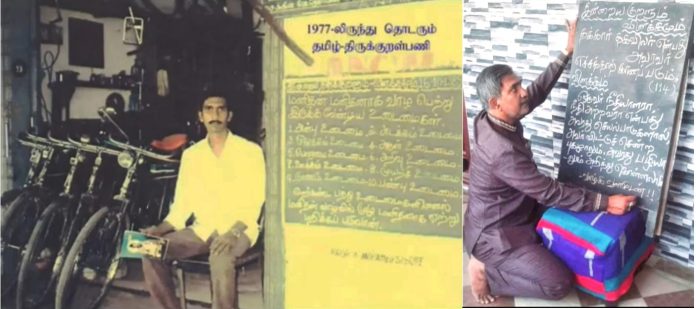
THEN AND NOW: Dr M G Anwar Batcha started writing a Thirukkural couplet with its meaning everyday since 1977 on a black board kept at a cycle shop at Coimbatore Gandhi Park. Post retirement, he continues his mission of popularising and promoting Thirukkural among the public.

So goes the inspiring quote of Missile Man of India Dr APJ Abdul Kalam – “Every small step taken with determination leads to great achievements.” Taking a cue from this, a former Tamil teacher Dr M G Anwar Batcha, known as Kural Yogi in the literary circle, celebrated 50 years of his literary journey penning books, writing a couplet with its meaning everyday on a board kept at a cycle shop at Gandhi Park in the heart of Coimbatore city since 1977.

It’s always fascinating to rewind the golden days of teaching, speaking at literary meetings and what not. As a faculty with 25-year service at Chokkampudur SBOA Matriculation Higher Secondary School in Coimbatore city, Thirukkural Batcha, a resident of Kuniyamuthur, took a trip down the memory lane to share his experience about Thirukkural, which is close to his heart.

It may be noted that a special story was featured on him in 2010 in The New Indian Express when S Kamalakannan was a senior photographer and during a routine round across the city found him writing a couplet on a black board. Worth mentioning that he makes it a point to sensitise people through his books and speeches at a plethora of events both inland and abroad. Words cannot express the amount of happiness he has in doing this literary service for over 50 years or so.

In all smiles, he said, “Life is indeed a journey filled with ups and downs, and how we navigate these fluctuations defines our resilience and character.” And that’s what Saint Thiruvalluvar had said in his 1330 couplets. Elaborating on it further, he remarked, “This ancient Tamil text is a profound testament to the intellectual and cultural achievements of Tamil civilization. Beyond its philosophical depth, the Thirukkural holds immense historical significance as a cornerstone of Tamil literature and a universal guide for human conduct. Shedding more light on it, he said Thirukkural’s focus on equality is evident in its rejection of caste discrimination, a radical stance in an era when hierarchical structures were prevalent.

Crossing a 50-year milestone,  Anwar Batcha no doubt is creating a silent revolution. All credit goes to his mentors Pulavar Rasiannan and Pulavar Arumugam, while studying at City Municipal High School at Variety Hall Road, who groomed him and brought the best out of him to be what he is now. In a step further, they motivated him to enhance his skills in Tamil.

To his credit, Anwar Batcha has awards including Tamil Nadu Government honour, Kural Neri Chelvar, Thirukkural Thoothar, Thirukkural Vendar and Thirukkural Thondar. And he penned a book on Thirukkural with English translation besides a book titled Valluvar Manimozhigal and Valluvaridam Kettathum Kidaithathum. Batcha is quite proficient in Urdu, Hindi, Malayalam and Telugu.

Retired, but not tired to actively involve in literary organisations like Thirukkural Aaivu Kazhagam, Ulaga Kalai Tamil Mandram, Coimbatore World Thirukkural Centre and organiser of Kovai Islamiya Tamil Sangam, Anwar Batcha did his doctorate on ‘Samuga Nokkil Thirukkuralum, Thirukkuranum’. US-based writer of inspirational maxims William Arthur Ward rightly categorised teachers thus: The mediocre teacher tells. The good teacher explains. The superior teacher demonstrates. The great teacher inspires. True to his words, Dr Anwar Batcha has inspired scores of his students who have made their ‘guru’ proud.

[The author is former Indian Express and Deccan Chronicle chief]

source: http://www.radiancenews.com / Radiance News / Home> Latest News / by M Rafi Ahmed / by Radiance News Bureau / August 16th, 2025

Misbah Fatima shines in academics and sports

Doda District (Jammu), JAMMU & KASHMIR :

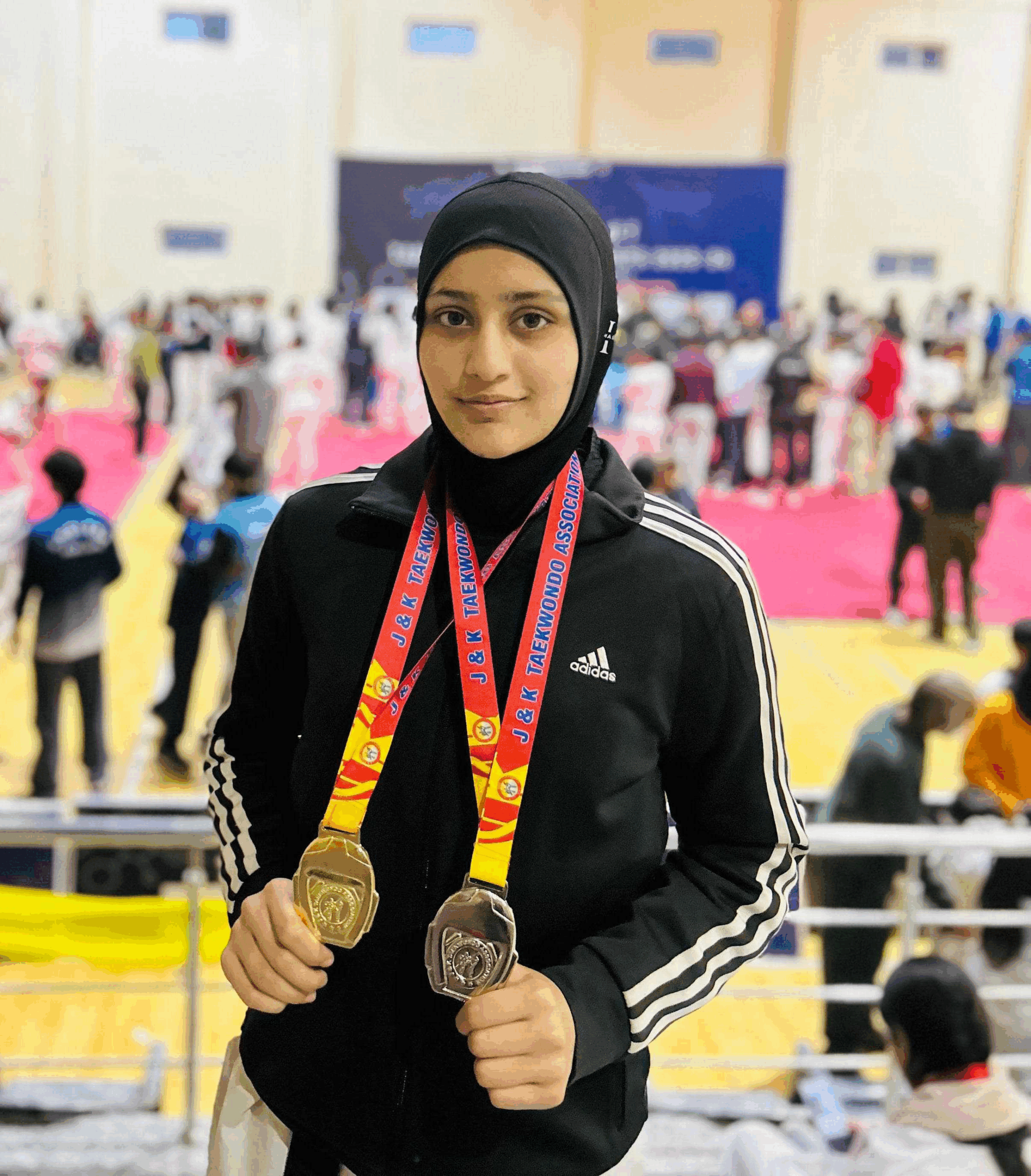
Misbah Fatima, a prominent Taekwondo athlete from district Doda and daughter of Mr. Liaqat Ali Shah, has made her community proud by securing 85% marks in her 11th class examinations.

A resident of Doda, Misbah is not only excelling in academics but also has an impressive track record in Taekwondo.

She is a National and State Taekwondo Medalist and has participated in various esteemed championships, including the Khelo India Women’s Taekwondo League.

The community and her well-wishers extend their heartfelt congratulations to Misbah Fatima for her outstanding academic performance. Her dedication and perseverance in both her studies and sports are truly inspiring. We wish her continued success in all her future endeavors.

source: http://www.brighterkashmir.com / Brighter Kashmir / Home / by Abid Pampori / July 17th, 2024

Afshan Fathima breaks social shackles to take her place among MMA’s elite

Chennai, TAMIL NADU :

Mixed martial arts were never on the horizon for the 23-year-old from Anna Nagar in Chennai. Even sport wasn’t really part of the picture.

Afshan Fathima defied odds, reaching the final of IMMAF World Championships despite challenges and stereotypes. | Photo Credit: Special Arrangement

Afshan Fathima walked away from her very first bout of the 2024 IMMAF World Championships in Uzbekistan last week not only with a win but also with a prodigious, rapidly darkening contusion under her eye. Although the injury was caused by an accidental headbutt rather than a punch from her opponent, many thought it meant the end of her campaign in the women’s strawweight division (52.2kg) at her debut World Championship.

“Everyone who saw me thought I wasn’t going to be declared medically fit to take part in the next bout. But I did make it. And then after I won that bout, everyone thought my injury was not going to let me compete in the next bout. After every bout I fought, the other fighters thought I wasn’t going to be able to make the next round because of how big the swelling had got. But I kept doing this. There was no way I was going to quit,” she says.

By the time Afshan’s campaign at the IMMAF World Championships ended, she had gone further than any other Indian – reaching the final –at the premier global amateur competition in mixed martial arts. Amongst her wins, was a guillotine choke submission of Ireland’s Lisa Murtagh who trains at the prestigious SB Gym– with the same team as former UFC champion Connor McGregor – and picked up a decision win over reigning World champion Matilda Bachurina of Kazakhstan in the semifinals.

Afshan however couldn’t return from the competition with the gold medal she had hoped for. She ended up losing the final by a narrow points decision to Isabel Calvo of Spain. “Unfortunately, the day of my final coincided with the start of my period. It was pretty bad. I was puking and had really bad cramps. I wasn’t anything close to 100 percent,” she says. Afshan says she returned from the tournament with mixed emotions. “It stings of course to go so far and fall short in the final but at the same time, I’m a little happy that I at least came this far,” she says.

Few might not have predicted Afshan would get anywhere near where she’s gotten. “Even I wouldn’t,” she says.

Mixed martial arts were never on the horizon for the 23-year-old from Anna Nagar in Chennai. Even sport wasn’t really part of the picture. “There’s no one in my family who has chosen sports as a career,” says Afshan, the eldest of three sisters. That was the case for her as well. It wasn’t as if she wasn’t interested in sport. Some of her earliest memories are of watching WWE pro wrestling matches with her father and uncle. At school, she says she was one of the few children to actually make the most of the games period.

“Most of the other kids would be chatting with each other or catching up on their studies. I was the only one who would pester the games teacher to start a basketball match or something. I was also someone who used to roughhouse with my friends. They’d all tell me I was really strong or that I hit really hard. But I didn’t know what I was going to do with that. While I really wanted to play something, my family only really wanted me to study. My grandmother was a teacher and my aunt was a lecturer. I was also fairly good in studies so I had no option but to focus on my books. Perhaps if I was a bit dull, they might have been more open to the idea of putting me in sports,” she says.

It was only after her school when she began studying for a degree in Electrical Engineering at Hindustan Institute of Technology that Afshan says she finally got the chance to pursue her passion.

“I always wanted to do some sort of fitness activity. So, in my third year of college I joined a crossfit gym. The gym where I trained also had a sign for mixed martial arts classes although they didn’t have any instructors. That was the first time I had heard about mixed martial arts. Although they didn’t have classes at the gym. I did a Google search and found out about Combat Kinetics Chennai and coach Ajit Sigamani,” she says.

At that time, Afshan says she told her parents she was just staying back to play basketball in her college since she knew the alternative would be something they would never agree with.

“I’m from an extremely orthodox Muslim family. Back when I was in school and in college I would wear the burkha. I couldn’t even think of leaving the house if I wasn’t wearing the burkha. While my parents were supportive of my education, they would have drawn the line at my getting into a sport like martial arts. So I used to wear the burkha when I left home. Then, when I went into the gym, I would change into my gear and back into the burkha when I was heading back home. It almost felt like I was living two lives. I tried to balance those two lives as much as possible. I knew I would have to tell my family eventually but I was hoping I could ease them into it,” she says.

It was at the Combat Kinetics Gym though where she felt she truly belonged. “Because I had been somewhat sporty in the past, I didn’t really struggle getting physically in shape. I enjoyed doing all the push ups and pull ups. I absolutely loved actual combat training. A lot of our training in MMA is mixed gender and I sometimes would think just how scandalised my family would be if they walked in on one of our grappling sessions. But, I genuinely didn’t think too much about it when I started. I just got on with it. It wasn’t as though I’d stopped becoming religious or stopped praying but I think it’s what’s inside your heart that counts a lot more than what you are wearing on the outside,” she says.

Afshan says she knew she was someone who was meant to be a fighter when she stepped into the fighting cage for her first sparring session. “In contrast to a lot of the other individuals who were starting out, I was also someone who wasn’t scared of sparring. A lot of beginners are scared of being hit. They close their eyes and turn their head. When they get hit on the face for the first time, they decide, this isn’t what they want to do with their life. But fighting just came naturally to me,” she says.

Over time, Afshan’s parents have come to terms with her choices. | Photo Credit: Special Arrangement

Her biggest fight though would come outside the cage when her parents eventually found out that she was training in mixed martial arts. “My dad freaked out. There was a lot of screaming and shouting. They took away my phone and I wasn’t allowed to leave the house for a week. But I kept insisting that I would go and eventually my parents gave in,” she says.

Over time, Afshan’s parents have come to terms with her choices. “I don’t think my father and mother were personally against my taking up MMA. I think they were more concerned about what the society I came from would think about what I did. I think they first thought it was a weird sort of fad that I had picked up. Initially, as a compromise my father would drive me to the classes and bring me back right after. Later though, I learned how to drive a motorcycle and began to go myself. That gave him the confidence that I was really serious about what I was doing,” she says.

Within a few months of training, Afshan says she was sure combat sports was what she wanted to do with her life. “I can say I was a quick learner. As part of our training, we usually compete in boxing, judo and wrestling competitions. Within a few months of training, my coach entered my name in a district level competition in boxing. Although I was nervous since I hadn’t competed before, I ended up winning. Another few months later, I competed at my first national amateur championships in Lucknow that once again I ended up winning,” she says.

While the gold medal she won in Lucknow earned her some level of respect at home, Afshan knew it will always be hard for her parents to completely come to terms with her career. That was her key to becoming as independent as possible. “My parents have already gone far beyond their comfort zone to even accept that I can be an MMA fighter. Sometimes when they see me in shorts, they will grumble and say they gave me too much freedom. I like to live life on my own terms. I’ve never asked my parents for any money to fund my training or competition. My dad used to be in business but he had to shut that down after he made a lot of losses. I also have two younger sisters, who my parents are responsible for. At first, I used to beg my coach to charge me a nominal fee. I promised I’d pay him back when I started earning. After graduation, I worked in sales for Jaguar India but I realised I wasn’t getting the time to train like I wanted. I then started working as a coach in my MMA gym itself. MMA isn’t a sport where as an athlete you get easily sponsored by the government or private organisations. So, if I have to compete in competitions, I have to raise my own funds,” she says.

Afshan says she had to save up for a year in order to pay for her fight camp, nutrition, travel and competition fees for her first IMMAF World Championships this year.

It’s not been an easy journey and Afshan has to keep herself motivated even when it’s not the easiest to. Within her family, Afshan says she is a bit of a polarising figure. “Just because I’m a fighter doesn’t mean everyone’s opinion has changed. My family is still very conservative. A lot of people wonder why I’m still not married. Both my younger sisters wear the hijab and most of my cousins still wear the burkha. My relatives tell them not to hang around with me because I’m seen as a bit of a bad influence. My mother loves me but she will still come up to me and say that I should retire as a fighter and get married. But she doesn’t understand that I’ve only just started,” she says.

Afshan though doesn’t have any regrets. She’s already looking to her next target – turning professional. “The amateur system is mostly a way to get some sort of experience. I think I’m a fairly well-rounded fighter. The next level for a fighter is to turn professional. My coach and I are still weighing our options. We have some offers but I’m still to decide whether I want to compete for one more World Championship and win a gold or take the jump into professional fighting,” she says.

The professional ranks will be yet another giant step for Afshan to climb. She’s looking forward to it. “There’s this quote I always try to live by. It’s that the mountains you carry are the ones you have to climb. There’s no point taking pressure because of everything that I had to get through to get to where I am. When I look back, I think to myself ‘Wow, I’ve broken so many stereotypes not just for women but for Muslim women in particular. Every once in a while, some woman will come up to me and say she lives through me or that she wants her child to become like me. That gives me a lot of motivation. I’ve faced some hard obstacles. I can deal with next to anything,” she says.

source: http://www.sportstar.thehindu.com / Sportstar / Home> More Sports / by Jonathan Selvaraj / November 21st, 2024

17-year-old feted for sterling show at aquatic tourney

KERALA :

Liyana is the holder of 15 Kerala state aquatic championship records and five CBSE national records.

Kochi :

Liyana Fathima Umer Nizar, 17, who made history winning gold in all the five events she competed at the Kerala Games Aquatic Championships, was felicitated by Global Public School chairman P Jacob on Wednesday.

The GPS International Thiruvaniyoor student, currently pursuing her A levels (Grade 12), was adjudged the fastest woman of aquatic championships held at Dr Ambedkar International Aquatic Complex, Thiruvananthapuram from May 6 to 8. She had contested in the 100-metre freestyle, 50-metre freestyle, 50-metre butterfly, 100-metre butterfly and 200-metre butterfly events.

Liyana is the holder of 15 Kerala state aquatic championship records and five CBSE national records.

In 2016, her gold medal in 50-m freestyle at the state meet in Bengaluru finally ended the medal drought for Kerala. The 17-year-old started swimming when she was in Grade 1. Ever since Liyana began training under the watchful eyes of her school coach Santhosh Kumar in 2012, she has been creating waves at the state and national-level.

source: http://www.newindianexpress.com / The New Indian Express / Home> Kochi / by Express News Service / May 12th, 2022