All posts by mpositiveone@gmail.com

Hindustani Sitar-Vocal Concert

Mysuru, KARNATAKA :

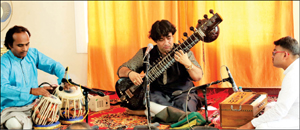
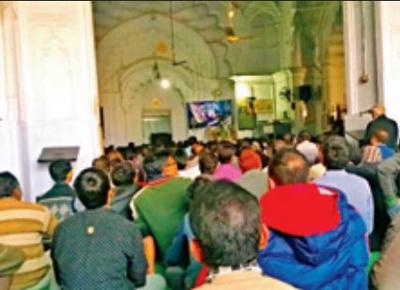
Ustad Hafiz Balekhan is seen presenting a Sitar recital in city recently accompanied by Ustad Nisar Ahmed on Tabla and Pandit Harikrishna Purohith on Harmonium.

Pandit Taranath Foundation is the brainchild of the famous Sarod Maestro Pandit Rajiv Taranath, who is its Managing Trustee – named after his father. Besides being a leading Sarod player himself, Rajiv Taranath has a penchant for organising music festivals in Hindustani style in Mysuru and Bengaluru.

He is presently stationed in Mysuru and organising three or four music programmes here every year, thus encouraging youngsters in the line and also with a sprinkle of stalwarts once in a way. He has pupils in America also and he visits that country every year. I have the privilege of offering a venue for small baitak kacheris in the first floor hall of my residence in Saraswathipuram (chairs and squatting capacity to about 80 connoisseurs). The sessions are usually in the mornings for two-and-a-half hours from 10 am onwards. I am beholden to Rajivji for this.

In the above series, the Foundation had organised a grand Hindustani Sitar-Vocal concert by the famous youngster Ustad Hafiz Balekhan on Sunday, the 25th instant, at the above venue. Ustad Hafiz is the younger brother of Ustad Rais Khan (settled in Pune) and the brothers give individual and duet concerts also. Ustad Nisar Ahmed from Dharwad gave Tabla support while Pandit Harikrishna Purohith was on the Harmonium.

Ustad Hafiz commenced his Sitar concert with a number in the beautiful ‘Ahir Bhairav’ Raga and delineated in detail all the beautiful strands of this number on the string instrument, over which he seems to have mastery. The next number was in raga ‘Pilu’ and came out very diligently. I do not know why it was that while he played Ahir Bhairav the only accompaniment was Tabla and Pandit Purohith joined him on Harmonium afterwards.

A ‘Thumri’ followed and was elegantly handled by the Ustad. A Ghazal “Chupke Chupke” followed in quick succession.

At this juncture, Pandit Taranath asked Hafiz Khan to turn to vocal keeping the string instrument on his lap for support and lo! a surprise sprang on the over seventy-five strong connoisseurs when the Ustad started to sing “Nara Janma Bandaga Naalige Iruvaga Krishna Enabarade,’ a Purandara Dasa number in Raga ‘Mishra Charu Keshi’. Wide applause greeted this number. This proves, if proof if necessary, that music knows no religion or language and we have ample evidence for this in our own Jesudas, American John Higgins Bhagavathar and Ustad Fayaz Khan, all of whom have enthralled the connoisseurs by their singing. The concert ended with the usual Bhairavi.

source: http://www.starofmysore.com / Star of Mysore / Home> Feature Articles / December 29th, 2016

Discoverers worry for the ‘ World’s Longest Cannon ’

KARNATAKA :

Researchers hope the government will act to protect the cannon at Gulbarga Fort

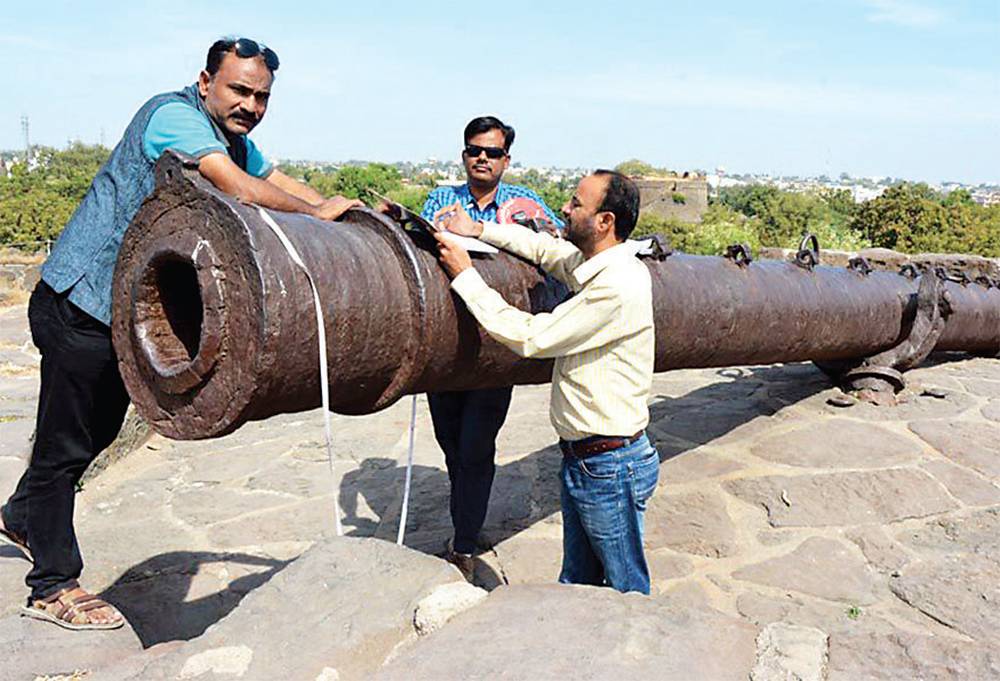
Mohammed Ayazuddin Patel, Dr Rehaman Patel and Mohammed Ismail measuring the Bara Gazi Toph

The three researchers, Mohammed Ayazuddin Patel, the national award winner, artist and photographer, Dr Rehaman Patel, artist and researcher at Indo-Islamic Art, Kalaburagi, and Mohammed Ismail, Bahmani researcher and coin collector who recently discovered a cannon in a fort in Kalaburagi, which they say is the longest in the world, are worried over its preservation.

It was their visit to Gulbarga Fort in search of the name of the first Bahmani sultan, Alauddin Hasan Bahaman Shah among the Persian inscriptions on the Jama Masjid that led to its discovery. Speaking of the cannon to Bangalore Mirror, Mohammed Ayazuddin Patel said, “Since 2010, I have been researching on the subject. The existing world record is in the name of Tsar Cannon that is 17.5 feet long and was built in the 15th century in Russia. The cannon has been named in Guinness Book of World Records, when the fact remains that the top three longest cannons exist in India. It is a matter of pride for the people of Kalaburagi and the Hyderabad-Karnataka region that the longest cannon in the world is located in Bahmani Fort and was manufactured during the reign of Bahmani Empire in the 14th century. It is made of the alloy Panch dhatu.”

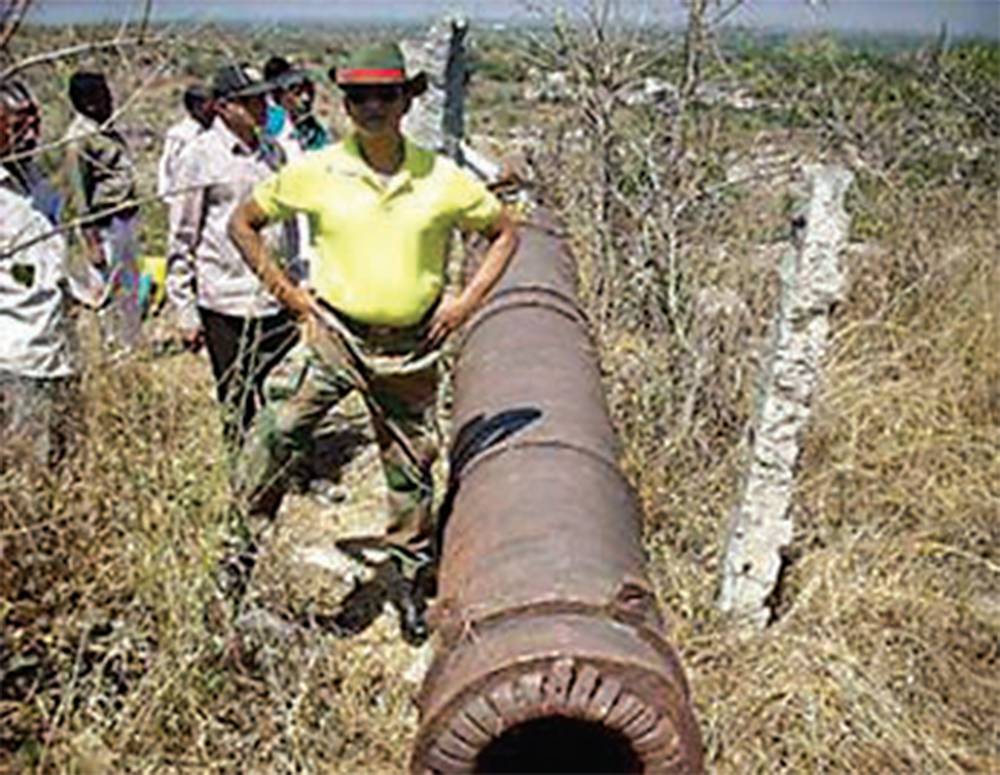
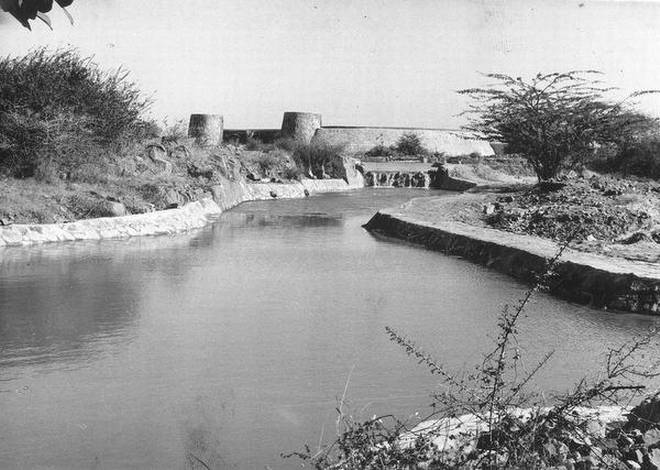
The cannon is known as Bara Gazi Toph and measures about 29 feet in length. Its circumference is 7.6 feet and diameter 2 feet. The barrel is 7-inch thick. In India, the largest recorded cannon is about 23 feet long and is located in Koulas Fort in Nizamabad district of Andhra Pradesh. Asaf Jah-1 (first Nizam) granted the Koulas Fort to the Rajput king Raja Kunwar Gopal Singh Gaur in 1724 AD for his bravery in the battle of Balapur and Shakkar Keda. The biggest cannon on wheels, built by Raja Mansingh, is in Jaipur and measures 20.6 feet in length.

“The Jaipur cannon weighs about 50 tonnes. We assume that the weight of the Kalaburagi cannon could be around 70-75 tonnes. While, the firing range of the Jaipur cannon is about 35 kilometres, that of Bara Gazi Toph could be 50-55 kilometres,” Ayazuddin Patel said.

The Bahmani monarchs, who ruled from the present Kalaburagi (Ahasnabad), stand out among other rulers for their contribution to the city. The founder Alauddin Hasan Bahaman Shah (1347-1422) made Gulbarga the capital and before his death he became the master of a vast empire. Even as they extended their territory, the rulers made significant contribution to the fields of art, architecture and literature.

The Bahmani sultanate was the first independent Islamic state of the Deccan in South India and one of the larger medieval Indian kingdoms. They ruled for 191 years (1347-1538 AD). Their other capital was Bidar.

The Gulbarga Fort was significantly expanded in 1347 by Alauddin Hasan Bahmani after he cut off ties with the Delhi sultanate. Islamic monuments such as mosques,
palaces, tombs, and other structures were also built later within the refurbished fort. The Jama Masjid built within the fort in 1367, is a unique structure of Persian architectural. It is fully enclosed, and has elegant domes and arched columns, which is unlike any other mosque in India.

The biggest challenge about historic monuments in the state is their protection, a fact not going to be any easy with the region being a backward area. “The Archaeologi-cal Survey of India and state archaeology department should take steps to protect the cannon at the Bahmani Fort and it should be included in the world record list. It should be fenced. The cannon is filled with sand and pebbles, so should be properly cleaned. Also, a signboard stating its details as the longest cannon in the world is a must. The fort and Jama Masjid must be declared heritage centres,” added Ayazuddin.

The team submitted a memorandum with their pleas to the district in-charge minister Sharan-prakash Patil, the deputy commissioner, regional commissioner, as well as the departments concerned.


GIGANTIC CANNONS OF THE WORLD

Jagadamba Bhavani Tope: Located at the historic Koulas Fort in Andhra Pradesh is believed to be the largest cannon in the world. The cannon (left), which is 23 feet in length and weighs 70 tonnes, is predominantly made of iron. It has a 16-inch calibre with an explosive head of 150 kg.

cannon02mpos28dec2016
Jaivana: Recorded as the world’s largest cannon on wheels, Jaivana was manufactured during the reign of Maharaja Sawai Jai Singh II (1699–1743) at a foundry in Jaipur, Rajasthan. Jaivana’s barrel measures 20.19 feet in length and 11 inches in diameter. The 50-tonne cannon is mounted on four wheels. The rear wheels are mounted on roller pin bearings, to turn it 360° and fire in any direction. It was designed to fire a 50 kg cannon ball to a distance of 35 km. This cannon was never used in any battle as the Rajput rulers of Amber had friendly relations with the Mughals.

source: http://www.bangaloremirror.indiatimes.com / Bangalore Mirror / Home> News> State / by Deepthi Sanjiv, Bangalore Mirror Bureau / December 28th, 2016

Standup comic bags film role

KARNATAKA :

ahmedshariffmpos28dec2016

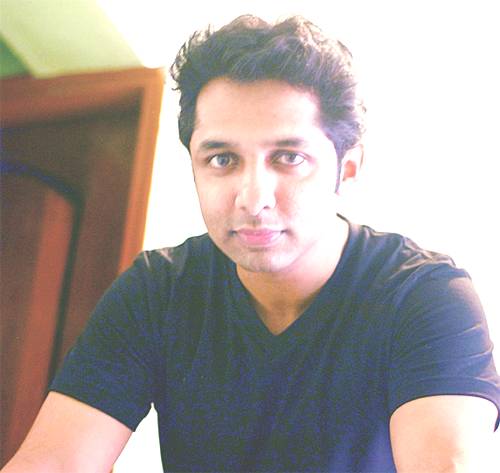
Comedian Ahmed Shariff  will soon be seen in the upcoming Kannada film, Humble Politician Nograj, which stars Danish Sait as a manipulative politician.

Telling us more about this, Ahmed says, “I went for the audition two weeks ago after seeing the ads, and thought that I fared badly because the lines were in Kannada, and I am not a native Kannada speaker. However, they liked how I acted and I got a call when I was in Hyderabad for a show. I still don’t know the role that I will be offered.”

He added that he will be going for a screen-test soon. Ask him if his being a comedian helped him get the role and he says, “Not at all. I stood in line with hundreds of people. There was no special privilege.”

source: http://www.timesofindia.indiatimes.com / The Times of India / News> Entertainment> Kannada> Movies> News / by Stuti Agarwal / TNN / December 28th, 2016

Majlis to remember city’s noted nawabs

Lucknow , UTTAR PRADESH :

Friday's majlis in progress
Friday’s majlis in progress


Lucknow :

In a unique step, from now on Lucknow will pay obeisance to its nawabs who played an important role in starting and continuing with the Muharram rituals that took the city’s name to the world.

Paying tribute to their souls, every Friday after Jumah prayers, a majlis (religious sermon remembering the martyrdom of Imam Hussain  and the tragedy of Karbala) will be organised at the Bara Imambara.

 Earlier,majlis for a few nawabs were organised by their descendants or caretakers of the respective Imambaras set up by them. This is the first time that tribute will be paid in a systematic manner. A list with 25 names has already been drawn which will further be expanded to include descendants who, even in poverty, continued Muharram rituals, and clerics on whose advice the nawabs ruled Avadh.

On Friday, Maulana Kalbe Jawad presided over the majlis in memory of Nawab Ghasiud-din Haider while also talking about the latter’s and his role in Lucknow’s Muharram.

source: http://www.timesofindia.indiatimes.com / The Times of India / News> City News> Lucknow News / TNN / December 24th, 2016

Telugu writer brings out calendar of Indian Muslim freedom fighters

ANDHRA PRADESH :

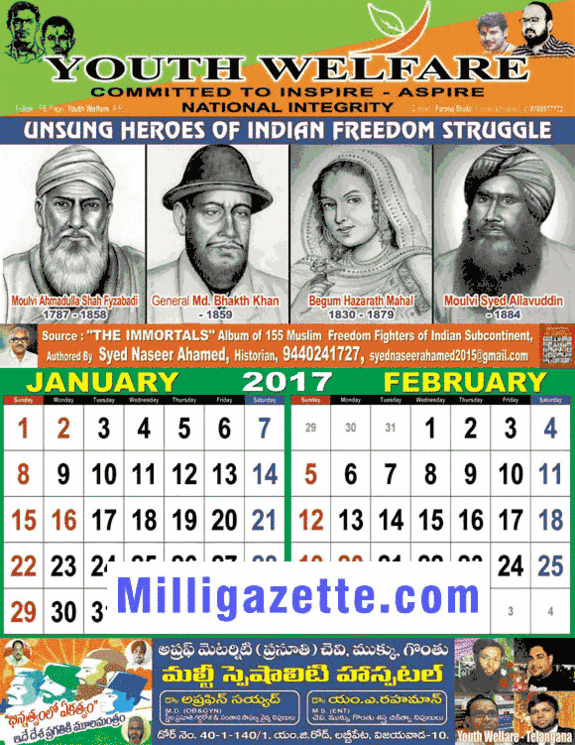
Telugu writer Syed Naseer Ahamed, with the help of Mohammed Farookh Shubli, Founder President of Youth Welfare, Vijayawada, has brought out a calendar for 2017 bearing photos of India’s Muslim freedom fighters.

Syed Naseer Ahamed has been consistently writing about Muslim freedom fighters including his pictorial album The Immortals. The calendar consists of 6 pages. Each page of two months has four photos of Muslim freedom fighters who are less known to general public. A total of 24 freedom fighters have been accommodated in six pages. Role of Muslim freedom fighters in India’s Independence has been printed often in the print edition of The Milli Gazette.

calendarfreedomfightersmpos28dec2016


This calendar is in English. Syed Naseer Ahamed is trying to release the calendar in various centres across the country in order to inform people about the part played by Muslims in the freedom struggle of India.

For more information, please contact Syed Naseer Ahamed at syednaseerahamed2015$gmail.com.

source: http://www.milligazette.com / The Milli Gazette / Home> Online News> Community News / The Milli Gazette Online / December 23rd, 2016


The generous Sultan

NEW DELHI :

A GEOGRAPHICAL LANDMARK - A part of Delhi ridge along which Buddha Jayanti Park has come up | / Photo Credit: HINDU PHOTO ARCHIVES
A GEOGRAPHICAL LANDMARK – A part of Delhi ridge along which Buddha Jayanti Park has come up | / Photo Credit: HINDU PHOTO ARCHIVES

The news of a maulvi living in an alcove of the Ridge area makes one reflect on the legacy of Feroz Shah Tughlaq who respected men of divinity

Police accosting a maulvi in a forest bordering the Bodyguard Lines of the President’s Estate recently should cause little wonder. Ghazi Norool Hassan, say reports, was found living in an alcove of the Ridge area along with his son, claiming to be the caretaker of a mazar. This shrine is supposed to be very old and in keeping with the legacy of the reign of Feroz Shah Tughlaq. A large part of Delhi was forest area in the 14th Century and this helped the Emperor to indulge in his favourite past-time of hunting. Right from Mehrauli to North Delhi there is evidence of the Sultan’s hunting lodges where he sometimes rested at night too.

While in North Delhi he built an observatory, besides a hunting lodge, a Pir of his time also set up abode in the area and, after drawing a lot of devotees, disappeared one fine day, leaving his admirers shocked. The place has come to be known as Pir Ghaib. On the Ridge near Karol Bagh is the ruined gate of Bhuli Bhatiyari-ka-Mahal. Though Sir Syed Ahmad Khan thought it was a distortion of the name of a nobleman, Bhu Ali Bhatti, there are not many takers for this assertion.

If oral history is to be believed, Bhuli Bhatiyari was the comely daughter of a dhaba owner (Bhaitiyara) with whom the Sultan fell in love while passing that way. There is incidentally a Bhuri Bhatiyari-ki-Masjid (dedicated to a fair innkeeper) opposite the Khooni Darwaza. Another story says Feroz Shah actually fell in love with a gypsy girl for whom he built a palace as she had stolen his heart after offering him a drink of water on a hot summer day while the Sultan was out hunting.

Historian Ishwari Prasad says that Feroz Shah was a pious man, despite being an orthodox Sunni who ill-treated the Shias and non-Muslims. But at the same time he was generous and not fond of shedding blood, like his cousin and mentor Mohammed Bin Tughlaq, whom he had succeeded. Feroz was a great devotee of dervishes, many of whom flourished in his empire. One of them probably was the Pir Sahib of the place where the maulvi was found living secretly for 40 years. The forest area of which the shrine is a part, had many other dargahs which were demolished when New Delhi was built. Raisina Hill was also covered with a forest where wolves, leopards and hyenas were found. So a Forest Ranger’s bungalow was set up there. In later times, this bungalow became part of the Sacred Heart Cathedral and now after renovation, is known as Maria Bhawan.

Some old mosques still exist in nearby areas which may be dating back to Tughlaq times, for that matter the place where now stands Gurdwara Rakabganj was also a jungle once in which during Aurangzeb’s time lived a contractor, Lakhi Singh of the Mughal court. When Guru Tegh Bahadur was beheaded on the orders of Aurangzeb, there was a violent storm, taking advantage of which Lakhi Singh and his eight sons (who had come on horses and bullocks) took the body away, while the Guru’s head was taken away by a man named Jatha. Lakhi Singh drove all the way from Chandni Chowk to the forest where he lived and putting the body in his house set it on fire to avoid suspicion. Later Gurdwara Rakabganj came up there.

But to come back to Feroz Shah, the number of mosques and dargahs that were set up in his reign rivalled the inns, gardens and hospitals. He is said to have laid 1,200 gardens around Delhi and nearby areas in each of which a Sufi found refuge. The Sultan lived up to the age of 90, the longest living ruler of Delhi after Aurangzeb. He was so generous at heart that even while laying siege to a city he would often turn back on hearing the cries of women in distress and suffering from the pangs of hunger, along with their children. Even while on shikar, Feroz Shah would pay obeisance to saints who had set up abode in his empire. Many of them were helped by him to set up khankahs or hospices, and when they died the Sultan was always ready to build a mazar for them.

Once while visiting a dervish he was puzzled on seeing a goat and a tendua (panther) lying in the courtyard of the jungle abode. Seeing his amazement at the sight the dervish told him that in the royal darbar this may not be possible but in his khankah the goat and the panther could lie side by side, forgetting their enmity. When the British built what is now President’s Estate, they reclaimed a lot of forest land in which wild animals roamed. But still a lot of the area acquired by Lutyens and Baker was left as forest land. The mazar of which Noorol Hassan claims to be caretaker is only one among many hidden away from the public eye. Don’t be surprised if in course of time the mazar becomes a regular shrine with an annual Urs. But for this the history of the mazar and of the saint buried there would first have to be determined. Until then Ghazi Noorol Hassan can continue to be caretaker of the legacy bequeathed to him by Fakhruddin Ali Ahmed. The late President himself preferred to be buried outside the New Delhi Jama Masjid, opposite Parliament House, where once the heart-broken poet Hasrat Mohani of “Chupke, chupke aansoon bahana” fame had made his bachelor’s quarters.

source: http://www.thehindu.com / The Hindu / Home> Society> History & Culture / December 25th, 2016

Central Sahitya Akademi award for 2 Dakshina Kannada writers

KARNATAKA :

Mangaluru  :

TWO well-known authors — Edwin Joseph Francis D’Souza from Mangaluru and Bolwar Mohammed Kunhi from Puttur —  have been chosen for the prestigious Central Sahitya Akademi Award for 2016 in Konkani and Kannada languages, respectively.

This is the first time that two writers from Dakshina Kannada have been recognised for the prestigious national award in the same year.

Edwin J F D’Souza
Edwin J F D’Souza

Edwin D’Souza has won the award for his Konkani novel Kallem Bhangaar (Black Gold), while Bolwar Mohammed Kunhi won the award for his 1,110-page Kannada work Swatantryada Ota (Run of Independence). Kunhi is the only writer to have got the Central Sahitya Academy award twice. Earlier he got it for his children’s novel Gandhi Thata Bapu hege Aadaru.

BM Kunhi
BM Kunhi

Kunhi was born in 1951 in a village in Puttur called Bolwaru. He is a short story writer, novelist, playwright and scriptwriter, and one of the pioneers to have introduced Muslim culture in Kannada prose.
Won award at the right time, says D’Souza

D’Souza is elated after winning the Kendra Sahitya Akademi award for Konkani.
He  said, “There could not be a better award when given at the right time and without lobbying. What is more important is to get an award when you feel that you deserve it. In my case all these three factors played their role.”

He was born in Valencia, Mangaluru in June 1948 and studied in St Aloysius (Autonomous) College, Mangaluru. He holds a degree in commerce, a postgraduate diploma in Konkani and five online diplomas from the Bible School, US, in Christian Theology.

His first short story in Konkani was published in 1964. Since then he has penned 33 novels, over 100 short stories, columns and satires. Many of his short stories have been translated into English, Kannada, Hindi, Kashmiri, Malayalam and Tamil.

He has won 13 state, inter-state and international awards for literature. His acclaimed short story A Cup of Hot Coffee was published by Late Khushwant Singh in his anthology, Our Favorite Indian Short Stories.  Several of his short stories have been published by Kendra Sahitya Akademi, in its publications Prateechi and Indian Literature. The Goa Konkani Akademi published his 450-page novel Kallem Bhangaar in Devanagari script.

His spouse of 41 years Jane D’Souza was immensely happy. “I would consider it as the best-ever Christmas I ever had in my life so far. Sometime I wondered how he can write so much and so effortlessly without being distracted. Now I know he was born to write.”

Speaking to Express from his home in Koramangala in Bengaluru Kunhi said, “I could not have been better honoured. I had  no clue, I am also honoured that the Akadami has recognised my work not once but twice, earlier in 2009 for my children’s literature. Kannada is a beautiful language and can effectively express and portray literature in any culture, which is the strength and the beauty of the language”.

source: http://www.newindianexpress.com / The New Indian Express / Home> States> Karnataka / by Express News Service / December 22nd, 2016

Revisiting the life and times of Hayat Bakshi Begum

Hyderabad, TELANGANA :

A day after staging the internationally-feted heritage play, Quli: Dilon ka Shahzaada , actor-director-playwrighter Mohammad Ali Baig staged its sequel, Saavan-e-Hayat in Golconda Fort this Sunday celebrating the splendour of the Qutub Shahs.

A biographical play on the life of Golconda’s de facto empress, Hayat Bakshi, the only child of Mohammad Quli Qutb Shah and perhaps the most powerful lady of medieval Deccan.

A magnificent blend of great writing and commendable acting ensured the 65 minute play in Hindustani kept the audience glued to their seats.

The play featuring Mohammad Ali Baig in triple roles as Hayat’s father, husband and son, Rashmi Seth as old Hayat, Noor Baig as young Hayat and Ayushi Gupta as adolscent Hayat also featured Vijay Prasad, Kavita Golechha and SA Majeed in prominent roles.

It was well-attended and generously applauded by the theatre lovers and the locals alike who thronged the fort to watch the historic play.

source: http://www.timesofindia.indiatimes.com / The Times of India / News> City News> Hyderabad News / December 20th, 2016

`Pilot girl’ gives wings to dreams of many

Hyderabad, TELANGANA :

pilotgirlmpos28dec2016
Charminar  :

A narrow, unpaved lane in Moghulpura leads us to a first floor two-room rented apartment. Awards, shields and certificates lining the tiny drawing room wall show the dizzy heights Salwa Fatima has scaled. Daughter of a sales manager at a bakery, Fatima is the first Muslim woman pilot from the city and would soon be flying commercial planes once she finishes her advanced training.

The story of the ‘pilot girl’, as she is popularly known in the area, has in fact given wings to the dreams of many more girls from the area. They are charting new career paths and English is now a priority. “Currently two Muslim girls from the area are studying in IIT. The girls are doing much better than boys academically in some cases,” says Urdu daily Siasat chief editor Zahid Ali Khan who was instrumental in fulfilling Fatima’s dream.

Living with her parents and three siblings — two sisters and a brother — Fatima broke the chains of conservatism to dream big. So, while other girls from the community joined teaching or the few ambitious ones became doctors, Fatima had her sights set on flying higher as a pilot.

Trained first at Andhra Pradesh Aviation Academy, she completed a course in Multi-Engine Rating (MER), necessary to become a commercial pilot, this September from New Zealand. A few more months of training and she will join an airline to fly passenger planes.

But her journey began many summers ago when she read that there were just three women pilots in India. “I found that there was no Muslim woman pilot in the city and secretly dreamed to become one,” says Fatima, 28, as her father Syed Ashfaque Ahmed and mother Syed Siraj Fatima look on.

And lady luck smiled on her. Siasat chief editor Khan, who was a guest at a programme conducted by Fatima, was impressed with the girl’s fluency in English. Khan asked what she wanted to become. “When uncle (Zahid Ali Khan) heard that I dreamed to become a pilot, he told me to meet him,” she says.

Next, Khan decided to contribute to funds required for her education. He even approached some friends. “It was a revelation for me. A Muslim girl from the Old City, which is often described as backward, wanted to be a pilot. I had to support her,” says Khan.

But when she needed a massive 36.02 lakh for advanced training, Khan approached Telangana CM K Chandrasekhar Rao and the state agreed to give her a scholarship.

Fatima, who is married to a management graduate, says: “I am fortunate to have the backing of my parents, husband and in-laws.” Her mother-in-law, a retired school principal, supports her dream completely.

Fatima already has big plans for her 18-month-old daughter. “I want her to become an IAS officer,” she says.

source:  http://www.timesofindia.indiatimes.com / The Times of India / News> City News> Hyderabad News / TNN / December 20th, 2016

The joys of reverse sweep

NEW DELHI / Mumbai, MAHARASHTRA :

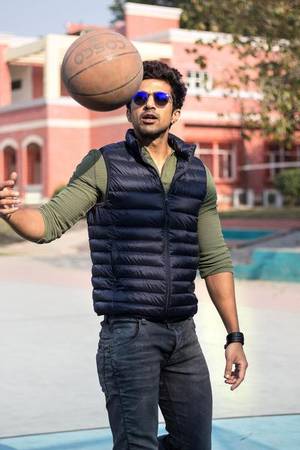
HAVING A BALL Saqib Saleem at Hindu College in New Delhi | Photo Credit: Photo: Abhimanyu Sindhu

In a candid conversation, Delhi boy Saqib Saleem revisits his college days

My encounter with Saqib Saleem happens as he converses, overcome with nostalgia, with his college cricket coach Jai Pal Singh about the good old days. His eyes survey the familiar area of the Hindu College staff room as he leads me to the Sports Complex where he ‘lived, ate and slept’ during his stint as a cricketer. So, he used to play cricket? His coach corrects me and says he still does. “Once a sportsman, always a sportsman.”

“The college has changed a lot, yet the air is unchanged”, remarks the actor seeing the new administrative building cornering the famous Virgin tree. With searching eyes attempting to gather the familiar, he spots Manish pakodewaala where he used to come in the middle of practice to satisfy hunger pangs.

Entering the sports complex, he sits at the higher end of a staircase, good enough to give him a panoramic view of the landscape. Quite seemingly distracted by the urge to relive the experiences of the college, Saqib intently looks at the field reconstructing the space for us.

Composed, yet gushed, his manner is amiable as he talks to some college students in between. He wears aviators concealing his gaze lest I intervene in his reconstruction of a personal journey. Going back in time, Saqib talks about his experience as a college student, his journey to Bollywood and his upcoming film.

Excerpts:

Tell us about your time in college.

College was the best time there could be. I used to come at 7 a.m. and leave at 8 p.m. It had become my second home. Even today I tell my friends in Mumbai that if given a chance to go back in time, I would like to relive the three years of college.

I was the president of Nakshatra, the fashion society of the college. We did fashion shows across different colleges and participated in competitions. I didn’t want to be a model or actor in the beginning but walking the ramp gave me a temporary high. I used to get the best model trophy everywhere. I thought, maybe what I do, people like that, and as a result garnered confidence. It all started with Nakshatra!

You’ve also represented Delhi and Jammu and Kashmir in cricket. Didn’t you want to pursue a career in the sport?

My love for cricket started early. I wanted to be a professional. But as I got exposure, I got a reality check. I saw better talent around me. There is no harm in accepting there are better people. Appreciation for others and recognition gives me the boost to work harder in life. I wanted to figure out something I was best at and could prove my mettle in. I wanted to carve my own niche. Thus the detour happened, Mumbai happened.

Any particular interesting incidents that you’d like to recall from your college life.

There are many. You need to be there on Valentine’s Day in the college to see the spectacle. I was active in university politics as well. My support for candidates used to be agenda-based, irrespective of party affiliations. It is necessary to indulge in campus politics as it completes your college experience. It is a huge learning experience. You get to meet interesting people and learn public dealing.

Although I was a day-scholar, I rented a flat near campus with a few friends which acted as our ‘crash pad’ in case we didn’t want to go back home after a party. I also had plenty of friends in the hostel. The annual college festival Mecca was the best time of the year. You could feel the energy of the college in just three days.

How did you end up going to Mumbai? Did you have anything to fall back on there?

Well, you won’t believe me, but I went there for a girl. I was dating a senior who wanted to be an actress, so she went to Mumbai after college. At that time, I was working with my father managing the restaurants. She called me one night and said that a long distance relationship won’t work. I asked if I could move to Mumbai to be with her. She said yes and I eventually moved hoping to make a career in modelling. But, we broke up in three months. Yes, so that’s how I stayed in Mumbai and ended up being an actor.

How was your experience in the advertisement industry working with different directors and brands?

The experience was very interesting. As an actor, I don’t really enjoy doing ads. But there are some really brilliant ad makers who make your realise your true potential and help you throughout. They make you see things you never really thought you had. My whole education in acting was through advertisements. It taught me how to face the camera. I had no background in theatre or acting. Ads helped me better my craft. People who don’t have any professional background in acting can use the medium of ads to get recognition and move forward.

You’re in the city for the shoot of your upcoming movie, Koroli Loves Sumit. How has the experience been working with Aleya Sen?

Well, I worked with her in a music video called “Tum ho Toh”. Both Taapsee Pannu, my co-actor in the movie and I featured in the video. She offered us the movie after the video. It is exciting and interesting to work with her as she also comes from the advertisement industry, and has a unique style.

I was excited as I was asked to play a Lajpat Nagar gym trainer, a role quite close to my experiences in the city. The movie is a love story about two people who’re not meant to be. It will hopefully hit the screens in the first quarter of next year.

As a new age actor, what advice would you like to give to aspiring actors and people wanting to enter the industry?

You just got to believe in yourself. If you respect yourself, others will respect you as well. There is no rocket science to it. You have to enjoy what you do. If you don’t believe in yourself, no one will. You should always be ready to learn new things and acquire experiences.

source: http://www.thehindu.com / The Hindu / Home> Entertainment> Movies / by Sidharth Yadav / December 17th, 2016