The fact that Supreme court lawyer and fashion icon Sana Raees Khan is an inspiration for the modern-day youth is no hidden fact.
Her legal prowess and meticulous journey which is all about excellence in her legal field speaks for itself and no wonder, she’s emerged as the go-to lawyer in the country for everyone, especially the ‘creme de la crème’ of this country for her ability to handle complex legal matters with ease and finesse.
Her body of work is enviable for a lot of individuals and well, no wonder the credibility she has earned by delivering results for her clients who have shown faith in her is unbeatable. One of her most amazing victories include the infamous Sheena Bora murder case, Aryan Khan Drugs Cruise case, Vaibhav Raut UAPA case and many more. She is known for her victories in the most controversial and complicated cases in the country. She is a noted Celebrity lawyer who is known for being strongly opinionated and vigorously defends the rights of her clients.
Sana Raees Khan has to be the perfect blend of ‘beauty with a brain’. On one hand, her legal expertise is seen time and again in the courts and on the other hand, the way she dominates the oomph game and swag quotient everywhere effortlessly is something to learn from.
She’s the perfect youth icon and certainly, no one in this country is a better blend of legal excellence and fashion innovation. Well, no brownie points for guessing that she is the most deserving personality to win a prestigious honour on a similar note. Yes that’s right.
Sana Raees Khan unlocked another major milestone for herself as she won the prestigious ‘Legal Fashion Innovator, Epitome Of Excellence in Law & Style’ award at the reputed Mid-day Showbiz Icons 2024.
Sana’s winning moment was lauded immensely by the stalwarts in the audience who too felt that she was the most deserving to win this special title. Sana looked breathtakingly beautiful in a custom-made multi-layered gown and given the fact that she is a natural beauty, minimalistic make-up was all that she needed to complete her look. Photos of her smiling moment posing with the trophy is winning hearts all over the internet.
Check out below – It is to be noted that this time, it’s truly raining awards for Sana. She also won the ‘Fitness Icon Of The Year’ award at a recently-held International Yoga day event and not just that, she’s set to make the country proud at a global level as she will be honoured with a special award at the Asian UK Business Meet and Awards 2024 on 3rd July 2024 at the renowned House Of Commons in London.
On the work front, Sana Raees Khan is officially set to get going with her own legal firm ‘SRK LEGAL’ from July and we simply can’t wait.
Congratulations to Sana for consistently bagging awards one after the other and here’s wishing her good luck and success for her future endeavours.
source: http://www.morningkashmir.com / Morning Kashmir / Home> Entertainment / by MK Online Desk / June 28th, 2024
Shaheen Tadipatri, who secured 90% marks in Civil Engineering, was felicitated in a programme jointly organized by Karnataka Dalit Sanghrash Samiti, Adi Jambav High School and Dr. Ambedkar Multi-Purpose Cooperative Society.
While inaugurating the program, Police Sub-Inspector Parshuram Mirjigi appreciated Shaheen Tadipatri for brightening the name of this small town by securing a distinction in engineering. Her future is bright and she will occupy higher positions in life, he expressed.
The SI advised the students to burn the midnight oil in their studies with keen interest. Get up early in the morning at 4 to 5 am and make it a habit to study.
A reception was held for the 8th class students of 2024-25 batch and a meeting was organized to commemorate the performance of the Maher soldiers in the British Army on 18th June.
On this occasion, the founder president of Adi Jambav High School Faqir Appa felicitating Shaheen Tadipatri presented a cheque of Rs.5 thousand on behalf of the society. Office bearers of the society and school staff were present in the program.
source: http://www.radiancenews.com / Radiance News / Home> Focus> Markers of Excellence / by Mohammed Atherulla Shariff (headline edited) / June 22nd, 2024
Khaleel ur Rehman, a noted Urdu poet and former Inspector General of Police, Karnataka breathed his last on Friday after a cardiac arrest.
Born here in 1948 and better known by his pen name Mamoon, he won the 2011 Sahitya Academi Award for his poetry collection Aafaaq ki Taraf. In 2004, Mamoon became the first Urdu writer to win the Karnataka Rajyotsava Prashasti.
After working as a staff artist for All India Radio, Delhi and later working as an Assistant editor of Daily Salar, Mamoon joined the Indian Police Service in 1977 and eventually promoted to IPS and retired as IGP in 2008.
Mamoon has published a number of works. Lissan Falsafe Ke Aine Me on the philosophy of language. Unnees Lillahi Nazmen is a translation of poems written in praise of Prophet Muhammad ﷺ by Scherzade Rikhye. Nishaat-e-Gham is a collections of Ghazals. Kannada Adab is a collection of translations of Kannada language poetry and fiction. His poems are published in ‘La Ilah’ and ‘Andherey Ujaley Mein’ – two voluminous poetry collections.
His poetry stands out for its animated use of everyday images, sometimes shocking metaphors and use of wit that lay bare everyday experiences. His poetic sensibilities are steeped into the sufi-mystical traditions of Indo-Persianate culture. He experimented in the genres of both classical ghazal and azad nazam in a collection Saanson ke paar. He was most prolific in the genre of nazm which he thought suited to articulate the changing experiences of contemporary times – Jism-o-Jaan se door, Banbas ka Jhoot, Saraswati ke Kinare.
He served as the President of Karnataka Urdu Academy during 2008-10. During his tenure, he also edited the literary organ of the Karnataka Urdu Academy Azkaar.
source: http://www.radiancenews.com / Radiance News / Home> Focus / by Mohammed Atherulla Shariff / June 22nd, 2024
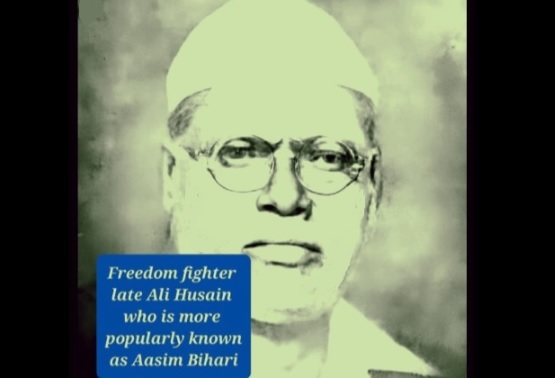
Ali Husain Aasim Bihari who was a freedom fighter, big leader, organised workers in Bihar & Bengal, brought out newspapers, formed multiple organisations.
He, led Momin Ansari community, and all his life fought for workers’ rights. Suffered a lot in process and his family also lived in challenging circumstances.
Hailing from Bihar Sharif, Nalanda, he had to shift to Kolkata to earn a living and it was here that he began involved in freedom movement and started an unprecedented political and social journey despite financial constraints.
Aasim Bihari left a huge legacy but led a tough life. His family bore consequences of his immense passion for awakening the masses, at the cost of his own health and finances. He opposed partition of India and worked for uplift of downtrodden. He passed away in independent India and was buried in Allahabad.
I don’t think it is easy to write about his missionary zeal and his sacrifices without getting tears in eyes. He faced personal tragedies, the death of his brother, the lack of money that caused hardships to his daughter, the suffering of his wife and entire family.
He was ailing and couldn’t be treated. He had declined the post of minister, also refused to take a princely sum, luring offer from a major political party, and his integrity for the cause was unquestionable.
In a life of constant struggle. Aasim Bihari formed organisations, led agitations, ran campaign to release nationalist leaders from jails after Jallianwalabagh massacre by sending letters from people of all parts of country to Queen & Viceroy. Brought out journals, weavers were organised amd turned into a political force.
Born in 1889 [1890*], he passed away in 1953. From Jamiatul Momineen, his lifelong fight for rights, awareness, awakening and education among masses, continued.
CM recently released book on him and it has been decided to add a chapter on his life in school textbook.
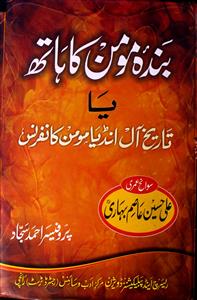
Book ‘Banda e Momin Ka Hath’ by Prof Ahmad Sajjad , pic: rekhta.org
[There is slight variation in references about his year of birth. However, the date of birth is April 15.]
source: http://www.anindianmuslim.com / Indscribe / Home / by Shams ur Rehman Alavi (image of book cover edited – source: rekhta.org) / June 22nd, 2023
A quick glance at Roshni Misbah’s Instagram account and she seems like every other young woman today, posing in the occasional high-heeled boots, with her own unique style and a definite flair for fashion, and a loyal following of over 130,000 people. Okay, maybe that last one isn’t all that typical and once you scroll through her profile, you quickly see that Misbah isn’t very ordinary at all!
Misbah’s love for motorbikes is more than evident on her page and most of her posts will attest to that. Dubbed the Hijabi Biker of Delhi, the 23-year-old rider from India has been spotted around her city riding her Honda CBR 250 cc, to the surprise of many in Delhi and quickly becoming an inspiration to young hijabis across the world.
Her IG profile describes her as Punjabi-Muslim, an Arab and Islamic Studies scholar (at Jamia Millia Islamia in New Delhi), a businesswoman, and the only “girl in Indian to own the fastest bike.” According to Hindustan Times, Misbah started riding bikes in her school years, in the ninth standard. After practicing on her friend’s and her father’s motorcycle for years, she got her very first bike, a Bajaj Avenger Cruiser 220, which she paid half for and her father the rest.
Speaking to the news site, Misbah said, “Unlike many girls, I wanted to ride a bike rather than a scooty (gearless). I always had a passion for bikes and I am fulfilling it.” The young rider is today part of several biking groups in her city, including Bikerni, which is an all-female bikers’ group based in Delhi. Her celebrity status is not restricted to social media as the young rider often has fans around the city who recognize her and wave at her. In university, she also receives praise from other female students, who often ask if she could teach them to ride a motorbike.
To date, Misbah has driven over 24,000 kilometers across India and more than 60 bikes, according to SportsWallah.com. When she’s not riding the streets of Delhi and beyond, Misbah is working on plans to continue a PhD in Arab culture, helping her father in the family business, and planning her next motorbike purchase, her sights set on a Triumph Rocket 2300 cc.
source: http://www.abouther.com / About Her / Home> Lifestyle> Influencers
Dr Anis Ahemad Ansari, Mechanical Engineering Section, Aligarh Muslim University Polytechnic has been granted a patent by the Patent Office, Government of India on his novel work, entitled, “A system for water and energy conservation in a Reverse Osmosis based water purifier”.
Dr Ansari said that a reverse osmosis (RO) based water purifier used in houses and offices generates a heavy amount of non-potable water which is continuously drained unutilized, although this water is clean and free from suspended matter. He said that the wastage of clean water on such a large scale increases the crisis of water manifold.
He stated that his invention provides a system for water and energy conservation in a reverse osmosis-based water purifier by making a provision for the collection of clean non-potable water generated from the reverse osmosis process. The hydraulic pressure is utilized in transferring this water into a tank and a flow control valve controls the discharge of accumulated clean water from the said tank, as and when required.
“Thus, the clean non-potable water generated from the RO process can be utilized for several purposes such as hand washing, utensil washing, floor washing, plantation, room cooler, toilet flushing, construction, vehicle washing, firefighting, etc. Moreover, it would save the electrical energy which is required otherwise to pump additional groundwater for these purposes,” he added.
source: http://www.amu.ac.in / Aligarh Muslim University / by Public Relations Office / June 04th, 2024
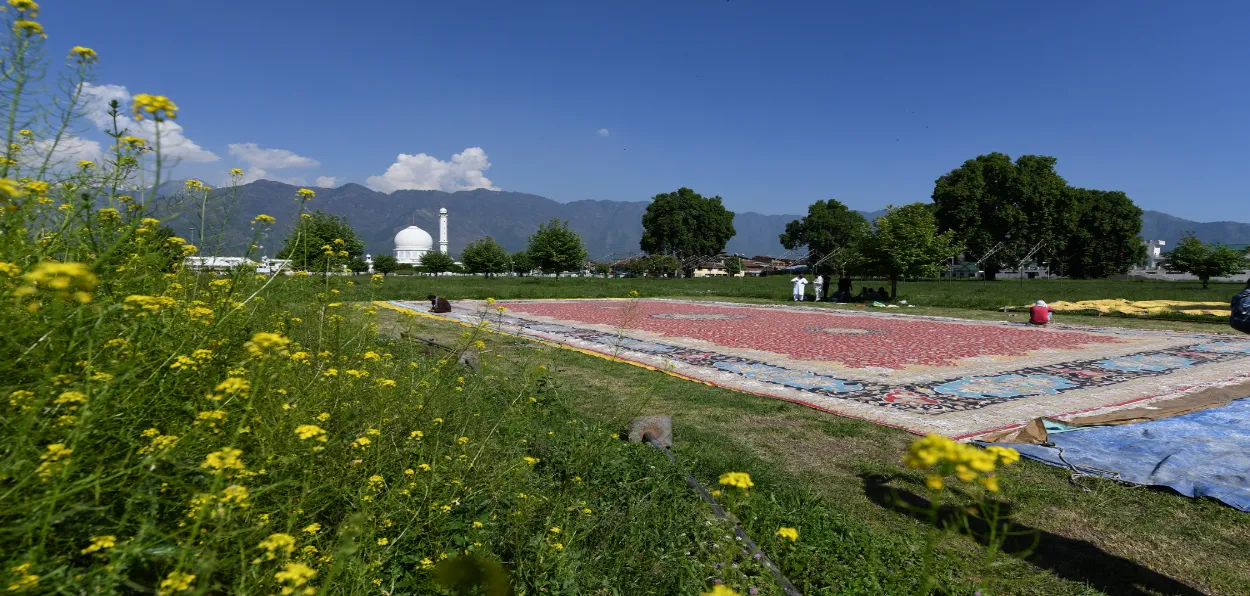
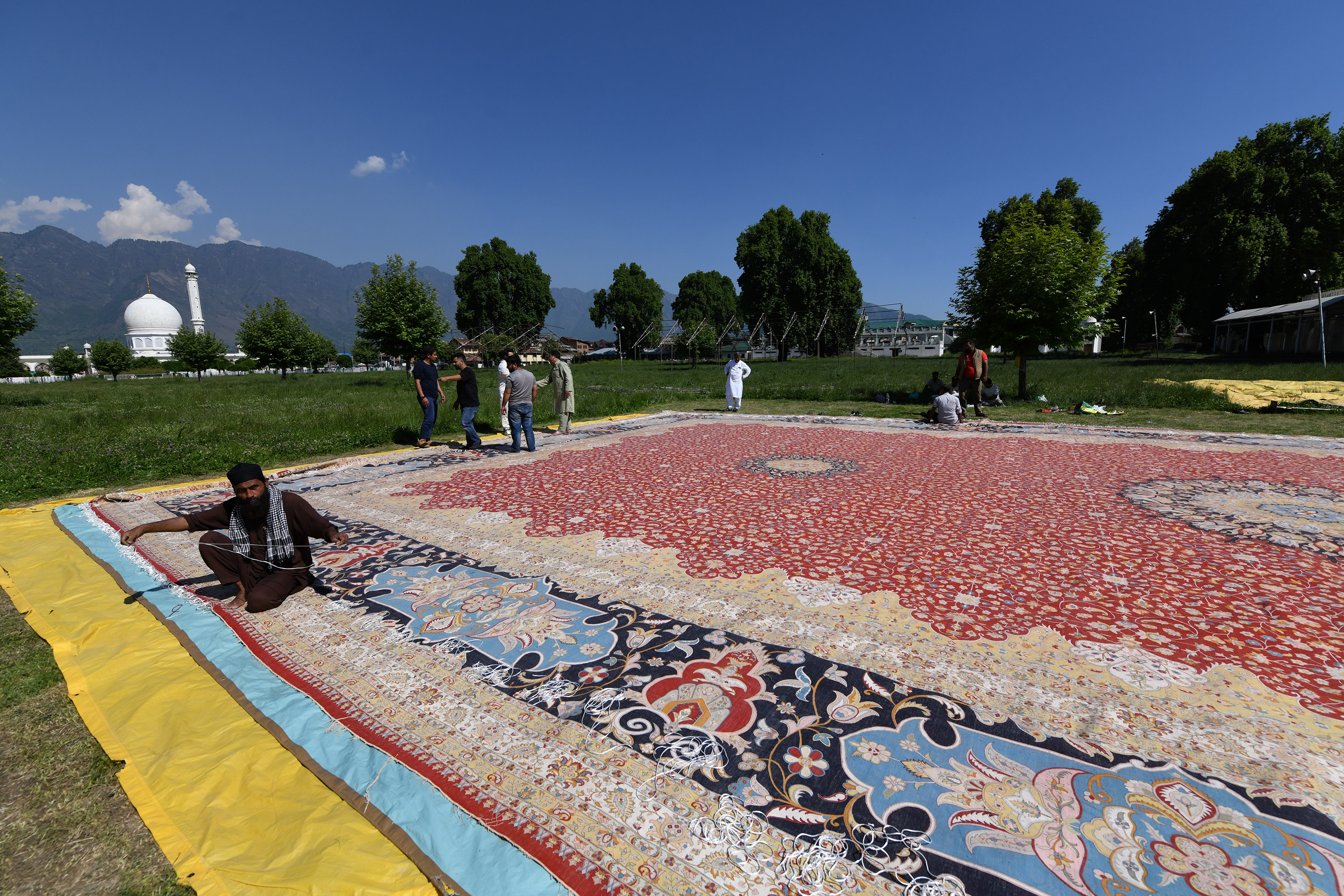
Asia’s largest carpet on display in Srinagar (Pics by Basit Zargar)
After Srinagar was designated among the most creative cities in the world, Kashmir Valley’s artisans are making sure to live up to the expectations of this title. In a village called Wayil in North Kashmir’s Kralpora area, a team of Kashmiri artisans have created a masterpiece touted as Asia’s largest handcrafted carpet.
This hand-knotted carpet measuring 72 by 40 feet covers an area of 2,880 square feet. It took over 25 artisans around eight long years to complete this masterpiece.
The huge carpet on display in Srinagar
The whole carpet industry of Kashmir Valley is priding itself on this masterpiece. The intricate weaving of this exceptional carpet was overseen by two seasoned artisans – Fayaz Ahmed Shah and Abdul Gaffar Sheikh. It is due to their dedication that this monumental piece has found shape.
”This was an order by someone from our country only. This carpet is 72 feet long and 40 feet broad, and we have never made such a big carpet in the Kashmir Valley ever. We had to put our minds to a lot of things as it required a huge loom to be woven on.
“It was a big challenge and thank god it’s been finally completed. I am sure it will be sold abroad, and I am sure that in future we will make something bigger than this, ” said Fayaz Ahmed Shah, a craft dealer.
Asia’s largest carpet
The last eight years of weaving this masterpiece have not been smooth. There have been multiple obstacles that the artisans faced particularly the COVID-19 Pandemic. The lockdowns led to a lot of supply chain-related disruptions.
This mammoth carpet has written a new chapter for Kashmir’s rich legacy of art and craft.
According to the craft dealers, hundreds of artisans are returning to looms to pick up carpet weaving again.
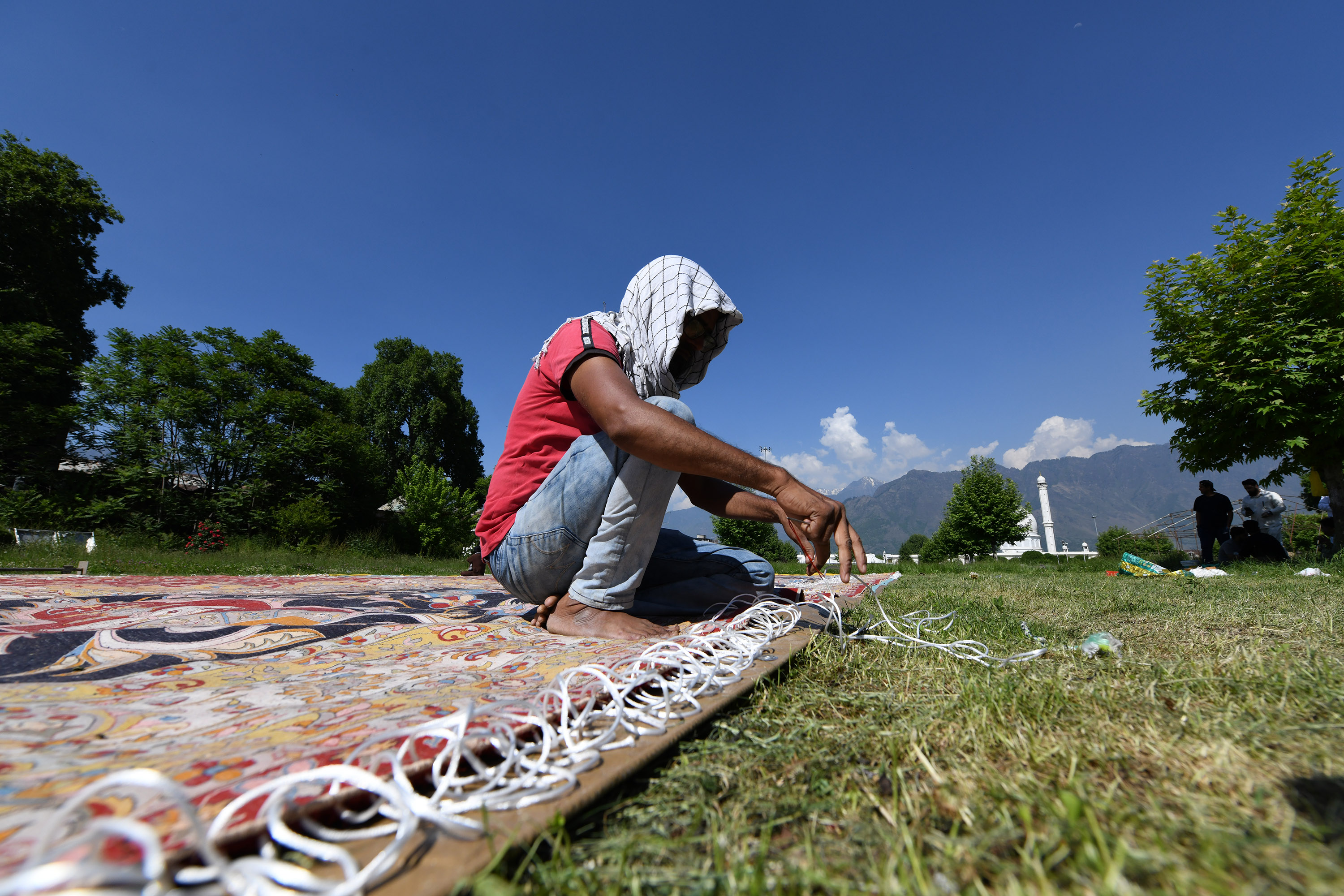
An artisan tying the loose threads of Asia’s biggest carpet
”We have artisans coming back to us after this carpet was made. Around 226 artisans have come back to us and said that they want to work again. We just hope the way any employees get paid; it has to be the same and equal wages for them as well. Our artisans need to have a life of dignity and they should be able to afford their families… I am telling you they will never leave the work if they are paid well. This is a teamwork. From the designs to artisans, everyone has worked very hard for the making of this masterpiece, ” Shah added.
As this masterpiece becomes a symbol of Kashmir’s craftsmanship and artistic prowess, it has also become a ray of hope for the revitalization and recognition of local artisans and their invaluable contributions to preserving the cultural heritage of the region.
source: http://www.awazthevoice.in / Awaz, The Voice / Home / by Basit Zargar, Srinagar / May 18th, 2024
Allama Shibli Nomani was born in Bindol Azamgarh village on June 4, 1857, and passed away on November 18, 1914. He possessed a multifaceted personality and held an esteemed position in various fields. Considering his contributions to knowledge and literature from different perspectives, it is hard to believe that it was the work of a single individual. Besides his contributions to poetry and literature, Allama Shibli Nomani put his indelible mark on history and biography, research and criticism, and education and preaching.
The main focus of Shibli’s academic endeavours was education and religion showing a deep interest in education and educational philosophies. His life was dedicated to the educational activities of his time. From Aligarh Muslim University to Nadwatul Ulama, his sacrifices in the field of education were immense. His vision extended beyond India, encompassing the educational activities and needs of the Islamic world as well.
While he valued traditional education, he was also a proponent of modern sciences. At Nadwatul Ulama, when he was entrusted with educational responsibilities, he included “Al-Durus al-Awliyyah fi al-Falsafah al-Tabi’ah” in the curriculum. This book, written by Christian scholar Allen Jackson and published in Beirut in 1882, was an illustrated text on the basic sciences of its time, covering practical topics such as matter, motion, gravity, liquids, optics, heat, and electricity. Shibli appointed Allama Muhammad Hameed-ud-Deen Farahi and Mirza Muhammad Hadi Ruswa to teach it. This information is derived from Shibli’s letters.
Additionally, in 1901, Shibli hired an English teacher at Nadwatul Ulama with a monthly salary of 15 rupees. This decision led Maulana Abdul Bari Nadvi to translate several modern books on philosophy. The inclusion of English and modern philosophy in the curriculum was a revolutionary step by Shibli. However, after Shibli stepped down in 1913, these subjects were dropped from the curriculum.
Shibli spent his entire life cultivating knowledge and literature. He wrote books, encouraged others to study, and was devoted to the national spirit. Not only did he inspire the youth of the nation towards education, but also guided them in their educational pursuits. The openness of Shibli’s educational ideas is evident from his belief in higher education for women and his support for a curriculum that was equal for both boys and girls. In a letter to Atiya Faizi, he expressed his wish for her to become a speaker and lecturer like other famous women.
In a letter to Maulana Habib-ur-Rehman Khan Sharvani, he wrote about the impressive patterns of women’s education he observed in Bombay. Similarly, during his visits to Italy, Egypt, and Syria, he admired the women’s education and training system in Turkey, spontaneously writing words of praise for the Turks. Shibli tirelessly worked for the education and social awareness of Muslim women.
In 1908, when Nawab Bahawalpur’s grandmother donated 50,000 rupees for the construction of Nadwa, Allama Shibli wrote an enthusiastic article in Al-Nadwa. He referred to her as a “Living Zubaida Khatun,” comparing her generosity to that of Zubaida Khatun, Baramakka, and Taimoor. He wrote:
“The generosity of this lady has not only strengthened the foundation of Darul Uloom Nadwatul Ulama but has also paved the way for its future advancements.”
Extraordinary Passion
“O Subah Allahabad, O Oudh, you are a vast and distinguished region, but the truth is that now you must admit that it is not Punjab, but a part of it, that has earned your enduring respect through one of its revered women. You may have produced Burhan-ul-Mulk and Asif-ud-Daulah, but you cannot claim a Zubeda among your ranks.” (Maqalate Shibli, Vol. 8, p. 80)
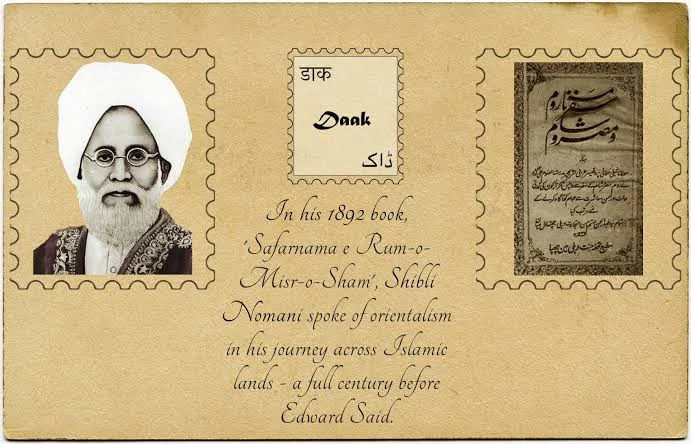
Shibli’s travelogue “Safarnama-e-Room-o-Misr-o-Sham [Travelogue of Rome and Egypt, Syria] is essentially an educational report. Shibli’s writings reflect the deep passion he had for education and the kind of education he envisioned. His interest was not confined to India; he also kept a keen eye on the educational landscape of the Islamic world. The core of Shibli’s educational mission was the openness and spread of thought. While he respected ancient academic traditions, he was not averse to embracing new knowledge and wisdom. This excerpt from his travelogue is a significant reflection on the integration of modern and ancient educational ideas:
“Education among the Turks began with the Empire, which is what we now remember as ancient education… But the current state of education has declined so much that, in comparison, our education in India seems deteriorated. The realisation of this in the travelogue shattered all my joy and satisfaction — the fallacy of this ancient teaching… The grief and sorrow expressed by the newly educated in our country over the old education is not genuine sorrow, but rather arrogance and disdain. Although I appreciate new education, I am a strong advocate of old education. I believe that old education is necessary and very important for the survival of Muslim nationality.” (Safarnama-e-Room-o-Misr-o-Sham p. 56)
Due to his constant stress on education, Shibli concluded that it would be beneficial to reduce the gap between ancient and modern education and educational institutions, fostering a mutual exchange of benefits. Shibli believed that English education alone cannot address our current challenges, nor can the old style of education fully support us in the present era. In his opinion:
“We have said this again and again, and now we say it once more: it is not enough for us Muslims to only have English madrasas or ancient Arabic madrasas. The remedy for our pain is a combination of Eastern and Western education.” (Maqalate Shibli, Vol. III, P 57)
In his reference to Constantinople, Shibli emphasises that freedom of thought cannot thrive under government control. He also mentions educational institutes in Europe, where the people, rather than the government, play a significant role. He writes:
“What’s even more regrettable is that all the colleges and darul ulooms in Constantinople that I have mentioned are run by the government. The nation has not paid any attention to this yet. That is, there is not a single national college in such a big capital. No government, no matter how powerful and wealthy, can support the educational needs of the entire country. Even if it could, it wouldn’t be useful. The mental and spiritual powers of a nation whose needs are fulfilled by the government become dead and useless.” (P 40)
Shibli writes in his report on the School of Harbiya in Constantinople, after mentioning the happiness of the students, the ethics of the teachers, and the many branches of education:
“In fact, there is no better college in all of Constantinople in terms of building, supply of equipment, knowledge, education, and good management. However, it is regrettable that most of the people studying in its classes are Christians and the number of Muslims is very small.” (P 59)
Shibli’s analysis needs no further comment after mentioning the academic condition of Turkey, its authors, libraries, newspapers, magazines, and the writings of the masters of various arts:
“The fact is that the method of education in the Islamic world has become so degraded that people are not interested in any kind of modern information except for a few textbooks. As a result, the spirit of innovation and invention is lost to the nation, and there is no hope for it as long as this situation remains.” (P 69)
Shibli writes about the ethics of the students of Al-Azhar University:
“Throughout my journey, I was not as disheartened by the plight of Muslims as I was by the conditions at Al-Azhar University… But sadly, it has destroyed millions of Muslims instead of benefiting them… The condition of the students is such that when they buy goods in the market, they swear by ‘Bras Sayyidina al-Husayn,’ meaning they swear by the price of Imam Hussain’s head. Can such trained people be expected to enhance the glory of Islam?” (P 70)
Regarding the curriculum, Shibli writes:
“There is a continuous and basic teaching of fiqh and syntax, each for eight years. Logic, philosophy, mathematics, astronomy, and other sciences are not included in the teachings. The principles of fiqh, tafsir, hadith, literature, semantics, and narration are taught, but it is done at such a low level that such a large Darul Uloom does not hold any honour in any way.” (P 85)
About the teachers, he writes:
“Sheikh Taban has recently passed away. One of his works has been considered so significant that its annotations and commentaries are included in the curriculum. It is considered a great achievement to understand and memorize this entire series. I asked the students if Sheikh Azhar, who is regarded as a teacher, had done any original work. They proudly said yes, the annotations on Saban’s work are written by him.” (90)
Shibli was constantly active in the educational development of Muslims and did whatever was necessary to achieve this goal. The year 1913 was particularly challenging for him. After Aligarh, Nadwatul Ulama was the only centre of his aspirations, but he had to resign from there. He then dedicated himself to writing biographies. Meanwhile, in the April 15, 1913 issue of the Daily Zamindar Lahore, a proposal by Allama Shibli Nomani regarding the establishment of an Islamic university in Makkah was published. This proposal received many reactions, but Maulana Abul Kalam Azad and some other scholars supported it. Allama Shibli wrote:
“For me, the most important proposal is to establish a university of Islam in Makkah with a high level of education in all religious and worldly sciences (including modern sciences). It is obvious that today all kinds of power are based on knowledge, and in fact, knowledge is the real power. Therefore, nowadays the survival of every nation depends on being proficient in the sciences and arts.” (Ma’arif: November 2013, P 384)
Shibli provided several reasons for the establishment of a university in Makkah. The holy city is a centre of Muslims worldwide, and every Muslim could study there with enthusiasm. He also argued that no other place has as much financial resources as Makkah. If the pilgrims who visit every year were to contribute ten rupees individually to this university, the total amount could reach millions. Shibli also mentioned the presence of a very good library in Makkah. Additionally, he highlighted its pleasant weather conditions; favorable for both teachers and students. Moreover, he pointed out that all the tribes of Arabia, who have been “ignorant for thousands of years,” would benefit from education, with branches of the university being established in their major regions. They would be drawn to knowledge through consistent effort. Shibli concluded by expressing his conviction:
“All I can do is travel all over India for this and then migrate to Makkah and serve this blessed university.” (Zamindar/ April 15, 1913)
Allama Shibli holds a prominent position as a great writer and scholar, with a well-established reputation in this regard. However, less attention has been given to his educational efforts. The reality is that Shibli led a highly active life dedicated to education and educational activities. From his journey from Aligarh to Nadwa, he endured numerous challenges solely for the cause of education. He also faced adverse life circumstances in pursuit of education. If his curriculum reforms had been accepted at that time, the educational landscape today would be completely different. If Nadwatul Ulama had embraced his curriculum a hundred years ago, the madrasas in India today would have a distinct history and glory.
— Dr. Omair Manzar is an Assistant Professor in the Department of Urdu at Maulana Azad National Urdu University.
This article has been translated from Urdu to English by Mohammad Alamullah with the author’s permission.
source: http://www.clarionindia.net / Clarion India / Home> Clarion Special / by Dr Omair Manzar / translated by Mohammad Alamullah / June 05th, 2024
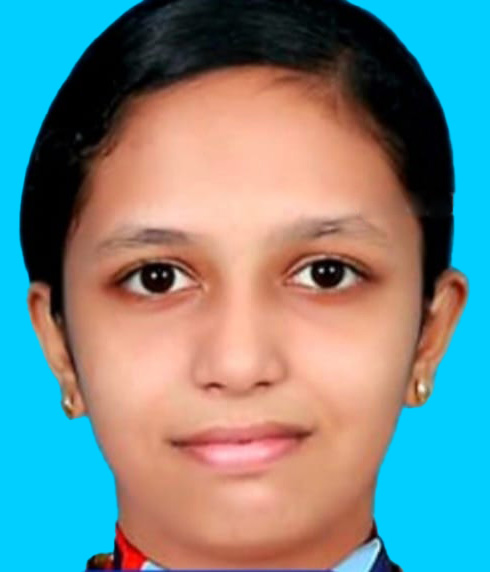
Tamanna Suman, an eighth-grade student from Government High School Vazhakad, has achieved a remarkable feat by being selected for the firing selection at the prestigious Thal Sainik Camp (TSC) 2024 in Delhi. Her selection comes through the National Cadet Corps (NCC) battalion at Calicut University.
Tamanna distinguished herself by securing the first position in the initial selection round held at her school. Demonstrating exceptional skill and dedication, she surpassed over a hundred students from various parts of the state to earn her place at the TSC. This achievement highlights her excellence not only in marksmanship but also in academics and extracurricular activities.
Tamanna is the daughter of T.K. Hameed, a mentor at Al Jamia Shantapuram, and Shahira, residents of Orkadavu in the Malappuram district. Her family’s support has been instrumental in her success, contributing to her balanced approach to both academic and extracurricular pursuits.
The selection of Tamanna Suman for the TSC 2024 has brought immense pride to GHS Vazhakad and its NCC unit. Her accomplishment serves as an inspiration to her peers and underscores the quality of training provided by the NCC battalion at Calicut University. The school community extends its best wishes to Tamanna as she prepares to represent her state and institution at the national level.
source: http://www.radiancenews.com / Radiance News / Home> Latest News> Markers of Excellence / by Radiance News Bureau / May 23rd, 2024
Zungalpura Village (Kulgam District, Kashmir), JAMMU & KASHMIR :
Kulgam, South Kashmir :
Muneeb Amin Bhatt, a talented techie from Zungalpora village in Kulgam district, has achieved a remarkable milestone by being inducted into the National Aeronautics and Space Administration (NASA)’s prestigious ‘Hall of Fame.’ This honor recognizes his outstanding contributions to identifying and addressing data breach vulnerabilities, a critical aspect of cybersecurity. Previously recognized by Apple’s ‘Hall of Fame’ in 2023, he reported his findings through NASA’s Vulnerability Disclosure Program.
Muneeb’s achievement not only brings pride to his hometown but also emphasizes the global significance of cybersecurity. In an era where safeguarding sensitive information is paramount, his work highlights the crucial role individuals play in protecting digital landscapes from potential threats.
Currently, Muneeb is pursuing a Bachelor’s in Computer Applications (BCA) through Indira Gandhi National Open University (IGNOU). His dedication to his studies, coupled with his exceptional skills in cybersecurity, has propelled him onto an international platform, showcasing his potential and determination.
Bhatt’s recognition by NASA serves as a powerful inspiration, demonstrating that with passion and commitment, individuals from any background can make significant contributions to global security. His journey from a small village in South Kashmir to receiving acclaim from one of the world’s leading space agencies is a testament to the potential that lies within every individual, regardless of their origins.
This accolade not only celebrates Muneeb’s technical prowess but also puts a spotlight on the importance of nurturing talent and providing growth opportunities, especially in fields as critical as cybersecurity. As the digital world continues to expand, the need for skilled professionals like Muneeb becomes ever more evident, ensuring a safer and more secure future for all.
source: http://www.radiancenews.com / Radiance News / Home> Focus / by Radiance News Bureau / May 27th, 2024