Category Archives: Amazing Feats

Telangana boxer Hussamuddin nominated for Arjuna Award

Nizamabad, TELANGANA:

Hussamuddin is a two-time bronze medal winner from Commonwealth Games from 2018 Gold Cost and 2022 Birmingham

Telangana boxer Hussamuddin nominated for Arjuna Award
Mohammad Hussamuddin

Hyderabad: 

Telangana boxer from Nizamabad Mohammed Hussamuddin on Wednesday has been nominated for the Arjuna Award while shuttlers Satwiksairaj Rankireddy and Chirag Shetty duo were selected for the Major Dhyan Chand Khel Ratna Award.

Hussamuddin is a two-time bronze medal winner from Commonwealth Games from 2018 Gold Cost and 2022 Birmingham. He also won bronze each at World Championships in 2023 and Asian Championships in 2022.

Other sportspersons to be nominated for the Arjuna Award include men’s hockey players Krishan Bahadur Pathak and Sushila Chanu, archers Ojas Pravin Deotale and Aditi Gopichand Swami, chess player R Vaishali, golfer Diksha Dagar, shooter Aishwary Pratap Singh Tomar, wrestler Antim Panghal, Asian Games silver medallist wushu player Naorem Roshibina Devi and paddler Ayhika Mukherjee among others.

source: http://www.telanganatoday.com / Telangana Today / Home> News / Telangana Today / December 13th, 2023

Indian cricketer Mohammed Shami receives Arjuna Award

Sahaspur Village , Amroha, UTTAR PRADESH / Kolkata, WEST BENGAL:

Mohammed Shami
 Mohammed Shami

New Delhi: 

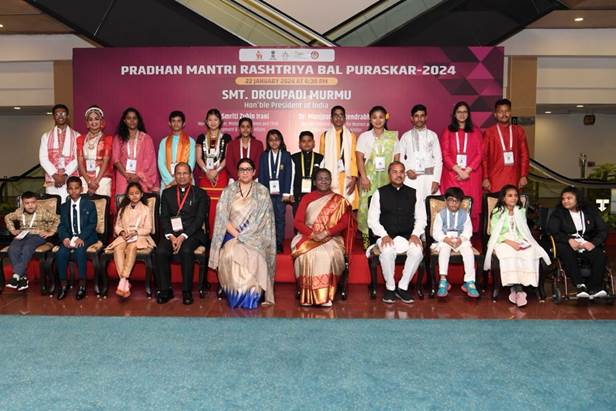
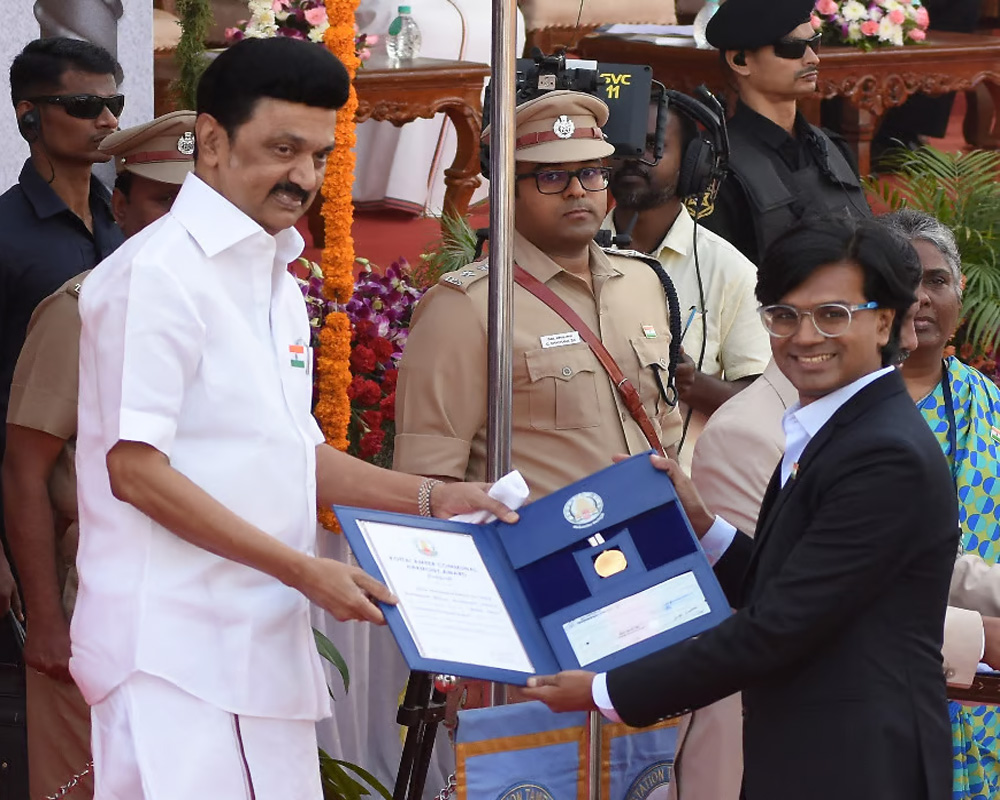
Indian cricketer Mohammed Shami was on Tuesday conferred with the Arjuna Award by President Droupadi Murmu in a regal ceremony. In the ceremony, other best-performing athletes were also conferred with the national sports awards by the President.

Shuttlers Chirag Shetty and Satwiksairaj Rankireddy were presented the coveted Major Dhyan Chand Khel Ratna award for a breakout 2023, during which they won their maiden Asian Games gold — a first for India in badminton –, while also clinching the Asian Championships title and the Indonesia Open Super 1000 title.

The awards ceremony, usually held on August 29 to commemorate the birth anniversary of hockey legend Major Dhyan Chand, was deferred because of the Hangzhou Asian Games from September 23 till October 8 last year.

An atmosphere of gaiety pervaded the Rashtrapati Bhawan as 26 athletes and para-athletes were conferred the Arjuna Awards.

Also receiving a huge round of applause was the newly-crowned chess Grandmaster R. Vaishali, the elder sister of precocious chess talent R. Praggnanandhaa.

Vaishali was honoured for becoming the third woman from the country after Koneru Humpy and Dronavalli Harika to turn GM.

Pistol shooting sensation, 19-year-old Esha Singh, was among the notable absentees as she is competing in the Asian Olympic Qualifiers in Jakarta.

Apart from Mohammed Shami, other sporting bigwigs who were chosen for the Arjuna award this year were wrestler Antim Panghal, a former junior world champion and bronze-winner at the senior event last year, boxer Mohammad Hussamuddin (bronze-winner at last year’s world championship), and para archer Sheetal Devi.

Among the notable Dronacharya awardees this year is chess coach RB Ramesh, who has groomed Praggnanandhaa.

While the Khel Ratna comes with a cash prize of Rs 25 lakh, the Arjuna and Dronacharya awards include a cash prize of Rs 15 lakh.

Recipients of 2023 awards

Major Dhyan Chand Khel Ratna Award for 2023: Chirag Shetty and Satwik Sairaj Rankireddy (badminton).

Arjuna Awards:

Ojas Pravin Deotale (archery), Aditi Gopichand Swami (archery), Murali Sreeshankar (athletics), Parul Chaudhary (athletics), Mohammad Hussamuddin (boxing), R Vaishali (chess), Mohammed Shami (cricket), Anush Agarwalla (equestrian), Divyakriti Singh (equestrian dressage), Diksha Dagar (golf), Krishan Bahadur Pathak (hockey), Sushila Chanu (hockey), Pawan Kumar (kabaddi), Ritu Negi (kabaddi), Nasreen (kho-kho), Pinki (lawn bowls), Aishwary Pratap Singh Tomar (shooting), Esha Singh (shooting), Harinder Pal Singh Sandhu (squash), Ayhika Mukherjee (table tennis), Sunil Kumar (wrestling), Antim Panghal (wrestling), Naorem Roshibina Devi (wushu), Sheetal Devi (para archery), Illuri Ajay Kumar Reddy (blind cricket), Prachi Yadav (para canoeing).

Dronacharya Award (regular category) for outstanding coaches: Lalit Kumar (wrestling), RB Ramesh (chess), Mahaveer Prasad Saini (para athletics), Shivendra Singh (hockey), Ganesh Prabhakar Devrukhkar (mallakhamb).

Dronacharya Award (life-time category) for outstanding coaches: Jaskirat Singh Grewal (golf), Bhaskaran E (kabaddi), Jayanta Kumar Pushilal (table tennis).

Dhyan Chand Award for lifetime achievement: Manjusha Kanwar (badminton), Vineet Kumar Sharma (hockey), Kavitha Selvaraj (kabaddi).

Maulana Abul Kalam Azad (MAKA) Trophy 2023: Guru Nanak Dev University, Amritsar (overall winner university); Lovely Professional University, Punjab (1st runner -up), Kurukshetra University, Kurukshetra (2nd runner-up).

Mohammed Shami may miss two Tests against England: Reports

Meanwhile, Mohammad Shami is likely to miss the first two matches of the upcoming five-Test series against England, set to commence on January 25, as the pacer is yet to resume bowling following an ankle injury, say reports.

He has not started bowling, and he will need to go to the National Cricket Academy (NCA) to demonstrate his fitness, according to Indian Express report.

Mohammed Shami was included in the Test squad against South Africa but his availability was subject to fitness. The BCCI later in a press release stated that Shami has not been cleared by the Medical Team and the fast bowler was ruled out of the two Tests.

With inputs from agencies

source: http://www.siasat.com / The Siasat Daily / Home> News> Sports / by Sameer Khan / January 09th, 2023

MA Mohammed Jamal, ‘beloved godfather of orphans’ passes away at 83

KERALA:

MA Mohammed Jamal, the revered godfather to thousands of orphans and general secretary of Wayanad Muslim Orphanage (WMO) in Kerala’s Wayanad district, passed away on Thursday, 21 December.

Having dedicated his life to the orphanage since 1967, Jamal transformed the lives of numerous orphans.

Initially a member of the Indian Union Muslim League, he assumed leadership of the orphanage in 1987 following the passing of veteran Muslim leader Abdul Rahman Bafaqui Thangal.

Over 400 students, with WMO’s financial support, pursue higher studies nationwide after leaving the orphanage, and many expressed their grief on social media following the death of “Jamaluppa,” the name they used to call him.

Jamal, also a Kerala state committee member of the Indian Union Muslim League, was 83.

His demise leaves a significant void at the helm of the 19 institutes providing religious and moral education to approximately 9000 students in Wayanad.

In recognition of his philanthropic endeavors, Jamal received prestigious awards, including the Kerala Mappila Kala Academy’s first Sharifa Fatima Award in 2006, the Indira Gandhi Sadbhavana Award for Best Education Worker in 2008, the KSTU’s first Shihab Thangal Award for Best Social Worker in 2011, and the Quaid-E-Millath Foundation’s Quaid-E-Millath Award.

source: http://www.maktoobmedia.com / Maktoob Media / Home> India / by Maktoob Staff / December 21st, 2023

A mahal called farangi: A story from another time, of another Lucknow almost forgotten

Lucknow, UTTAR PRADESH:

The Telegraph visits the haveli where the Khilafat and Non-Cooperation movements came to be mergedThe Telegraph visits the haveli where the Khilafat and Non-Cooperation movements came to be merged.

Farangi Mahal in Lucknow. / Photo courtesy: Adnan Abdul Wali

Stepping into Farangi Mahal in Lucknow after skirting rows of low-priced chikankari salwar kameez shops and their steady din is somewhat like stepping into the stillness of a forest after having left a busy city. Only, Farangi Mahal is anything but a forest. It is a cluster of buildings that hold within them a bit of history that has been almost forgotten, as the past often is in India, obscured by new settlements or construction, or billboards, if not demolished altogether.

In Farangi Mahal the past is difficult to see also because of the turn Indian politics has taken.

I am part of a group from Calcutta visiting Lucknow last October.

Inside Farangi Mahal, located in the old neighbourhood of Chowk, we enter its elegant and serene courtyard. The lime-and-mortar white exterior is tinged with a blue, peeling off in places. The afternoon sun slants down on the pillared arches and the exposed bricks but does not take away from the fragile beauty of the structure.

Adnan Abdul Wali, a member of the family that owns the house, the Farangi Mahalis, ushers us into the courtyard. His Urdu and Hindi are as impeccable as his courtesy. He is a direct descendant of Maulana Abdul Bari Farangi Mahali, who was a leader of the Khilafat Movement.

Farangi Mahal’s story, however, goes back beyond the nawabs and the British. It was occupied by French merchants during the rule of Mughal emperor Aurangzeb and that is how it got its name. The merchants, owing to some offence, lost the property and Aurangzeb gave it to Abdul Bari’s ancestors, who needed a safe haven.

The farman issued by Mughal emperor Aurangzeb decreeing that Bari’s ancestors could live here / Photo courtesy: Adnan Abdul Wali

“The Khilafat movement started from here,” says Wali. Farangi Mahal is where the idea of joining the Khilafat Movement and the Non-Cooperation Movement was born and Abdul Bari was the architect of the plan. It was a glorious moment of Hindu-Muslim unity in Indian history and Lucknow played its part in it.

Abdul Bari, an eminent religious scholar who belonged to the tradition of highly respected scholars from his family, was also an astute politician. He had travelled across many Muslim countries and was acutely aware of the impact of British imperialism on the Islamic world.

In March 1919 came the Rowlatt Act, which was to be followed by the horrors of the Jallianwala Bagh massacre in April 1919, one of the events that would lead Mahatma Gandhi to launch the Non-Cooperation Movement. Before that happened, a large number of Muslims in India were already disturbed by the threat of the dismemberment of the Ottoman Empire in Turkey following World War I and the jeopardised future of the Caliph, the Ottoman head of state, who is nominally the supreme religious and political leader of Sunni Muslims across the world. Turkey had been defeated by the Allied Forces, which included the British.

Adnan Abdul Wali, a direct descendant of Abdul Bari and the family that owns the house. / Photo courtesy: Adnan Abdul Wali

Abdul Bari was convinced that in India, Muslims needed to be made aware that the fate of the Ottoman Empire was their religious concern — and the articulation of the Khilafat (Caliphate) cause needed a larger, national platform.

From around 1919, Abdul Bari was raising support in the countryside, says Francis Robinson, a historian who specialises in Islam in South Asia. Abdul Bari had founded a newspaper for the purpose. But more importantly, he wanted to woo Gandhi to the Khilafat struggle.

Gandhi came to stay in Farangi Mahal for the first time in March 1919 and within six months, Abdul Bari had won him over, says Robinson. This also led to a period of a very special friendship between the two men, which was rooted not only in a common political cause but also shared spiritual beliefs and a love for mysticism, as embodied in Sufi philosophy.

Politically, the campaign for Khilafat and Gandhi’s stamp on it saw Abdul Bari reaching the height of his influence during 1919 and 1920.

Abdul Bari and his Farangi Mahal relatives, with the help of the lawyer Chaudhri Khaliquzzaman, drew up the constitution of the All-India Central Khilafat Committee, says Robinson. “He devoted enormous effort first to persuade the Khilafat Committee to adopt non-cooperation as a policy and second, at the Allahabad meetings in June (1920), in persuading the committee to accept Gandhi as chair of the group that was to put non-cooperation into action,” adds Robinson.

From then on till September 1920, Abdul Bari successfully campaigned to organise a significant Muslim presence at the Calcutta Special Congress, which was held from September 4 to 9, 1920. The session passed the resolution of the Non-Cooperation Movement with a demand for Swaraj. The Khilafat Committee and the Congress came together with non-cooperation as the common goal.

After March 1919, Gandhi stayed at Farangi Mahal three times, recounts Wali proudly. Other leaders such as Jawaharlal Nehru, Maulana Abul Kalam Azad and Sarojini Naidu stayed here as well. During Gandhi’s second visit, in September 1919, Muslims in the area abstained from cow slaughter during Bakrid as a mark of respect to Gandhi and appreciation for his support to the Khilafat cause. “Abdul Bari had requested Muslim families to make the gesture,” says Wali.

This was somewhat different from the recent celebration of November 25 as No Non-Veg Day by the BJP government in Uttar Pradesh. The announcement was made to honour the birth anniversary of Sadhu T.L. Vaswani and slaughterhouses and meat shops were required to remain closed that day. There is a world of difference between giving up meat voluntarily and being forced to do so, as there is between non-violence and violence. But such distinctions perhaps do not make much sense anymore in Lucknow, once the capital of nawab-ruled Oudh, now ruled by the BJP with Yogi Adityanath at its helm. Like the No Non-Veg Day, the city has several streets and institutions named after lesser-known Hindu saints.

Abdul Bari is said to have introduced Gandhi to the sufi saint Bakhtiyar Kaki, disciple and successor to Moinuddin Chishti. Three days before his death, Gandhi delivered his last public address at the shrine of Bakhtiyar Kaki in Mehrauli.

Abdul Bari had earlier invited Gandhi to Ajmer, where Chishti is enshrined. At Ajmer Sharif Dargah, Gandhi is said to have experienced his first qawwali on Chishti. It was there that he asked Abdul Bari about Bakhtiyar Kaki. He had first visited Ajmer Sharif in 1921 and would visit it again.

In 1922, after the Chauri Chaura incident, Gandhi withdrew the Non-Cooperation Movement. Abdul Bari did not relent; he was not sparing of Gandhi either, says Robinson, but one has to remember his politics was primarily religious in inspiration. His influence declined steadily from this time and he died in 1926, a disappointed man, according to Robinson.

His name is often seen missing now from the roll call of prominent Khilafat leaders.

And yet Abdul Bari was not only a politician but also an eminent educator, Wali reminds. His ancestors had established a madrasah that became well-known all over the Islamic world and had introduced a syllabus, Dars-e-Nazami, which became a much-respected system of learning.

As a revered teacher in his family tradition, Abdul Bari introduced major changes to the curriculum by stressing the learning of Western sciences and discouraging rote learning.

Wali breaks down. It is very difficult to reconcile the present with the past, he says. Lucknow was never a utopia; communal riots had broken out here around the time of Gandhi’s visits to Farangi Mahal. But now the very fabric of society has changed, he feels. He reads from an Urdu book, and though the meaning of the words remains elusive, the music lingers. Farangi Mahal, with Wali bent over his book, look almost unreal.

But Farangi Mahal still stands, held up by its ancient, sturdy, flat bricks, and memory. Some things stay.

source: http://www.telegraphindia.com / The Telegraph Online / Home> Culture / by Chandrima S Bhattacharya / January 07th, 2024

Dr. Syed Sehrish Gets Coveted PM’s Award for Excellence in Public Administration- 2022

JAMMU & KASHMIR:

Dr. Syed Sehrish Gets Coveted PM's Award for Excellence in Public  Administration- 2022 - The Global Kashmir

Award has been Conferred in Category of Aspirational Districts Prog; Becomes 1st DC of B’la to Win the Prestigious Title

Baramulla :

Bringing laurels for the UT of Jammu and Kashmir in general and for district Baramulla in particular, Deputy Commissioner Baramulla Dr Syed Sehrish Asgar has achieved the coveted Prime Minister’s Award for Excellence in Public Administration-2022, India’s highest award in civil services.

Dr Sehrish has been selected for this prestigious achievement in the category of Aspirational Districts programme as she has brought transformative changes in the identified parameters envisaged in the said programme.

As per reports, key aspects for Aspirational District Programme in Baramulla for which the Deputy Commissioner was awarded by the Prime Minister include establishment of Birth Waiting Wards in Primary Health Centres, Community Health Centres, Upgradation of diagnostic services at all delivery points and Poshan Tracker Tabs for all Anganwadi workers.

The Deputy Commissioner supported farmers through mechanism, plant protection, nursery strengthening, robust root stocks, quality planning material etc and organized marketing facility established at Sopore which is the second largest Fruit Mandi in Asia.

Severe Acute Malnutrition has been reduced in the district to 0.01 percent from 3 percent and Moderate Acute Malnutrition to 0.039 percent from 11.93 percent. A two-year paramedical diploma course has been introduced for 300 border area students to fill up the critical gap in the health sector.

Under financial inclusion, 56,215 PM Jan Dhan Yojana accounts have been opened in Baramulla district.Meanwhile, various stakeholders including Lieutenant Governor have extended their warm appreciations and felicitations to Dr. Syed Sehrish for this achievement besides earning accolades from several other quarters.

(Source: GNS)

source: http://www.globaltoday.in / Global Today / Home> English> Kashmir> News / April 18th, 2023

Khan Sadia Kawsar: A Beacon for the New Generation

Basti District, UTTAR PRADESH / Govindi, MAHARASHTRA:

Khan Sadia Kawsar: A Beacon for the New Generation

Govandi’s Daughter Makes the Country Proud by Pursuing MBBS

Mumbai:

In the heart of Govandi, an area grappling with challenges like limited access to education and rising crime, a remarkable tale of triumph emerges. Khan Sadia Kawsar, a resident of this humble locality, is defying odds by pursuing her dream of becoming a doctor, thus becoming a shining example for the aspiring youth of her community.

Despite the dearth of quality educational institutions in Govandi, Khan Sadia Kawsar’s journey stands out as an inspiration. A local official highlighted the prevalent issues, noting that the area often makes headlines for crime-related incidents, with little attention from politicians or concrete initiatives from religious leaders to address the root causes. The suggestion to uplift Govandi’s image centers around establishing better educational institutions and providing improved training for the younger generation.

Khan Sadia Kawsar, a second-year MBBS student, is the daughter of Hafiz Alauddin Sahib, a respected figure in the community and a dedicated honey trader. Despite the challenges, Hafiz Alauddin spared no effort in providing religious education to his children. An accomplished computer engineer himself, he played a pivotal role in guiding Sadia towards her academic pursuits.

Sadia’s academic prowess became evident early on, consistently scoring high marks in school. Her remarkable achievement of securing 98.5% in the twelfth examination from the Govt.Jr.College in B. Kothakota, Andhra Pradesh, paved the way for her current pursuit of a medical degree at the Fathima Institute of Medical Sciences in Kadapa.

Khan Sadia Kawsar’s journey symbolises the triumph of determination and hard work. Her success challenges societal stereotypes, proving that with determination, even the daughter of a humble businessman can achieve great heights. Hafiz Alauddin Khan, reflecting on the challenges he faced to support his children’s education, emphasised the importance of unwavering faith in God and the merit of one’s children.

Originally from Basti district, Uttar Pradesh, Hafiz Alauddin Khan is not only a devoted father but also a prominent scholar and supporter of religious institutions. Along with his contributions to organisations like Darul Uloom Deoband and Jamiat Ulema, he maintained a focus on his small honey business, always expressing gratitude for Almighty’sblessings.

Hafiz Alauddin’s advice to parents echoes a belief in the inherent merit of their children. He advocates trust in God and encouragement of the youths, emphasising that success is destined for those who persevere.

In the face of societal challenges and limited opportunities, Khan Sadia Kawsar’s journey serves as a guiding light, illuminating a path of hope and possibility for the new generation in Govandi and beyond.

source: http://www.clarionindia.net / Clarion India / Home> Editor’s Pick> Features> Indian Muslim / by Mohammad Alamullah, Clarion India / December 18th, 2023

Innovative equipment, approaches put Dr Gazala Habib’s air pollution research into top gear

Raipur, CHATTISGARH:

Her work pinpoints the sources of aerosols and their role in driving regional climate change in India, besides equipping the Ministry of Environment with the right knowledge regarding policymaking.

Dr Gazala Habib never imagined she would be a scientist one day. She recalls entertaining the idea of becoming one while watching the 1969 Bollywood spy thriller Yakeen at her home in Raipur, Chhattisgarh, but the moment was short-lived. 

In the movie, Dharmendra plays a swashbuckling scientist who battles everything from enemy agents to his own doppelganger as part of a secret mission to save the country. “As much as I wanted to be like him, I also knew that it was out of the question. I came from a small town and a very conservative background, and had not heard of any woman scientist growing up,” says Dr Habib, now 49. 

Eventually, Dr Habib did get to live her childhood dream. A professor at the Department of Civil Engineering of the Indian Institute of Technology Delhi (IIT Delhi), her work focuses on measuring air pollutants, particularly aerosols, in ambient air using innovative equipment and approaches.

Innovative equipment, approaches put Gazala Habib's air pollution research  into top gear - PUNE.NEWS
Dr Habib set up and heads the Aerosol Research and Characterization Laboratory at IIT Delhi

She also set up and heads the Aerosol Research and Characterization Laboratory at IIT Delhi, which undertakes cutting-edge research on sources of aerosols and their impacts on human health. “We strive to fill up the significant gaps in our understanding of personal exposure to particulate matter [PM] in urban areas. This will assist policymakers to better measure the impacts and inform policy initiatives,” she explains.

Dr Habib says only limited studies on PM have been conducted in India, and that too mostly at one or two locations. “None of them provide an overarching assessment of human exposure in an urban context — integrating a variety of typical exposures across a typical day, and being useful in comparing different types of exposures throughout a person’s daily activity,” she details.

Much of the work has been carried out as part of the Emissions Inventory Building Activity under the National Carbonaceous Aerosols Programme-Carbonaceous Aerosol Emissions, Source Apportionment and Climate Impacts (NCAP-COALESCE), a multi-institutional research and capacity building initiative funded by the Ministry of Environment, Forests and Climate Change. Dr Habib is the project incharge and coordinator in IIT Delhi for this programme.

“India does not have a uniform emissions inventory system [to measure total emissions from each pollutant from each sector]. The work under NCAP-COALESCE aims at equipping the Ministry of Environment with the right knowledge to aid sound decision-making on pollution policy,” she says.  

To that end, Dr Habib and a team of researchers have developed a Versatile Source Sampling System (VS3), which will measure emissions and help monitor pollutants. The compact unit allows air to be drawn through a preweighed filter at a known rate, thus collecting particles in the air on its surface. The filter is weighed again to determine the mass of particles collected, and by dividing the mass by the total volume of air, the particle concentrations can be measured.

In comparison with other air monitoring equipment, VS3 is more sophisticated, sensitive and capable of measuring emissions, particularly small particulate matter, from a variety of sources such as residential cooking stove, open biomass burning, brick kilns and vehicles. While the technology was developed in IIT Delhi, Dr Habib says it is being used across NCAP-COALESCE partner institutions to understand complexities related to carbonaceous aerosols.

Challenging the traditional mindset

By her own admission, Dr Habib’s journey into the scientific world was not easy. “My father was a telephone operator, and my mother a primary school teacher. I am one of the eight siblings. We did not have luxuries, but my parents, especially my father, prioritised our education,” she says.

Her parents were strict about school, but their expectations relaxed a bit when time for enrolling in college arrived. “There were people in my family who were like, ladkiyon ko zyada padhane ki zaroorat nai hai [there is no need to educate girls much]. At one point, my father also contemplated the idea of my marriage after BSc,” she says.

“They expected my brothers to do engineering, and thought I should do a science degree and start preparing for IAS. But I felt that my brother was more admired by my parents because he was inclined towards engineering. He is 10 minutes older than me, and I thought to myself, if he can do it, why not me?” she adds.  

With a little help from her brother, she managed to convince her parents to study engineering. Later, she gained admission to Bachelors of Engineering at the National Institute of Technology, Raipur. Subsequently, she pursued MTech in environmental engineering from Visvesvaraya National Institute of Technology, Nagpur. 

Dr Habib’s earliest memories revolve around working with a large group to identify carcinogenic compounds present in emissions generated from burning crop waste in rural India

Rigours of research

Dr Habib believes destiny defined the trajectory of her career. “I was contemplating about PhD, when a junior directed me to a vacancy at IIT Bombay. I managed to apply just in time,” she says.

There were only two vacancies, and on account of a particularly gruelling panel interview, she recalls putting down her chances of selection as next to nil. However, she got selected. Her PhD mentor was Chandra Venkatraman, a Professor of Chemical Engineering and Climate Studies at IIT Bombay, who Dr Habib says “changed her way of thinking”.

“I was very shy and conventional. I remember telling her that I had never travelled alone. I told her I am not the girl who can go out and measure pollution,” she recalls. Venkatraman laid her apprehensions to rest, and Dr Habib eventually joined her mentor to work on a project analysing emissions from residential fuel sources. 

The five years at IIT Bombay groomed Dr Habib to become the scientist she is today.

“I remember I started work in January and she immediately put my name up for speaking at an international conference in October. I was from a Hindi medium background, and did not even know English! She taught me to make my first PowerPoint presentation and my first Excel sheet. She taught me not only science, but also communication. Whatever I am today, it is because of her,” says Dr Habib. 

Dr Habib’s earliest memories revolve around working with a large group to identify carcinogenic compounds present in emissions generated from burning crop waste in rural India

Her earliest memories revolve around working with a large group to identify carcinogenic compounds present in emissions generated from burning crop waste in rural India. “I learnt a lot from this group about how to collect samples, what kind of machines to use and how to use them,” she says. This was soon followed by her first international trip to France, where she got to work with Olivier Boucher, Director of Research, French National Centre for Scientific Research. 

The coursework was demanding, and added to that was the pressure to get married. “I think the rush to get women married is also why a large number of them end up dropping out of PhDs or giving up their careers,” she adds. After consulting Prof Venkatraman, Dr Habib decided to get married only after finishing her PhD, a promise she ended up keeping. 

The rigours of research eventually got to her and she remembers a point in her PhD when she became depressed. Her time at the University of Illinois, and then University of San Diego, for postdoctoral work, worsened things. “I felt lonely during my US stint, but rediscovered myself after frequenting a mosque based on a colleague’s advice,” she says.

Entry into academic sphere

In June 2008, Dr Habib joined IIT Delhi as an assistant professor. In November the same year, she got married.She was regularised in her post in 2010, and promoted as an associate professor in 2018. In March this year, she became a professor.

In the last 15 years, she has provided valuable data that helps understand air pollution better. For example, her team measured the impact of PM 10 and 2.5 particle concentration on mortality rates to assess that the numbers attributable to PM 2.5 particle concentration in Ghaziabad was 70% higher than Delhi.

“Exposure to PM has been recognised as a well known human health risk factor, however, its quantification for various regions, including India, is still not well established. In the last few years, we have undertaken many studies to help quantify this data by studying the impact of pollutants on different organs, including heart and lungs, as well as different demographic populations,” she says.

With respect to Delhi’s pollution problem, she says, “In the winters, we cannot stop talking about stubble burning in Punjab and Haryana. If you read the source apportionment papers from Delhi, you will find that pollution due to stubble burning lasts only a few days. The long-term problem that we should be solving is suspension of dust from roads. From a personal exposure perspective, vehicles account for 20 to 30% of PM 2.5 concentration,” she says.

She believes having a policy on effectively managing crop waste is the need of the hour. “In a paper we recently submitted to Nature, we discovered that despite the Pradhan Mantri Ujjwala Yojana, a majority of rural households still use fuel dung for energy. If they use crop waste for biogas generation in addition to cow dung, there is no need of pushing LPG down their throats. It will cost less also,” she adds. 

Dr Habib thinks funding needs should be simplified and freed from the shackles of bureaucracy for the research to contribute more effectively to policy.  Also, India should follow an integrated approach and make the data publicly available. “What we need is a network programme that brings scientists under one umbrella, gives them standard equipment, procedure and a common goal,” she says. 

“Source apportionment studies are being done in India by state Pollution Control Pollution Boards (PCBs) and Central PCB in non-attainment cities,  but there is no  national network. Every state is following its own rules — so methodologies, data analysis and data curation methods are different. Therefore, you cannot compare data from two cities,” she adds.

At present, Dr Habib’s focus is on setting up a state-of-the-art laboratory where all kinds of devices related to air pollution safety and monitoring can be evaluated for their performance

State-of-the-art laboratory

At present, Dr Habib’s focus is on setting up a state-of-the-art laboratory where all kinds of devices related to air pollution safety (like air purifiers, masks) and monitoring can be evaluated for their performance. “We have just received a grant from the Department of Science and Technology under SATHI [Sophisticated Analytical and Technical Help Institutes]. The laboratory will be developed at IIT Delhi’s Sonipat campus. At present, gate number 3 of IIT Delhi has such a facility,” she says. 

Dr Habib swears by the support of her husband, her 13-year-old son and 11-year-old daughter. “There are creches and day care centres on campus now, but they were not available when I had children. I do not think I would have been able to manage it all without my husband,” she says.

She believes that for more girls to study sciences and mathematics in India, discrimination needs to end. “When you put differences in their minds from the beginning, they start believing they are weak,” she says, adding that true equality can be gauged from the representation women receive. “I am still the only woman in the room in most conferences. This needs to change.”

“I never thought I would be able to do this. I had this epiphany a couple of times that I wanted to be a scientist, but the guidance came from somewhere, somehow. It was all god’s plan I say, because I never planned this,” she sums up.

source: http://www.rukhmabai.com / Rukhmabai Initiatives / Home / by Shikha Sharma / August 28th, 2023

Shahina Khanam to get gold medal at RU convocation ceremony

Ramgarh, JHARKHAND:

Ramgarh :

Shahina Khanam, a resident of Hesla on Ramgarh-Argadda road, will be awarded a gold medal for being a topper for four years in BDS. 

The medal will be awarded by Governor CP Radhakrishnan at the convocation ceremony of Ranchi University on May 2.

Topper Shahina Khanam is the sister of Rinkle Khan, the town vice president of AJSU.  The family members are very happy with the news of getting the gold medal and there is an atmosphere of happiness in their house.

Shahina Khanam’s mother, father, brother, sister and other people distributed sweets. 

AJSU Nagar Vice President Rinkle Khan said that earlier education was neglected in Muslim society.  But now the Muslim society is also rapidly increasing its step towards education.

source: http://www.lagatar24.com / Lagatar / Home / by Manoj Sinha / April 26th, 2023

UAE Chapter of UAE-India Business Council established, Faizal Kottikollon appointed Chairman

INDIA / U.A.E :

Abu Dhabi (UAE): 

The UAE-Indian business council has been established on the first anniversary of the Comprehensive Economic Partnership Agreement (CEPA) deal signed by India and the United Arab Emirates. The formation of the council is aimed at increasing investment and bilateral trade between the two countries.

The UAE India Business Council – UAE Chapter (UIBC-UC) was launched in Dubai by Dr. Thani bin Ahmed Al Zeyoudi, UAE Minister of State for Foreign Trade, in the presence of Ambassador of India to the UAE Sunjay Sudhir, Consul General of India in Dubai Dr. Aman Puri and founding members of the UBIC-UC.

 (Faizal Kottikollon)

NRI businessman Faizal Kottikollon was appointed as the chairman of the council. Faizal Kottikollon said the main purpose of the council was to build trust.

“In the past, several UAE companies have taken some poor decisions while investing in India because they were not confident to invest large amount of money,” he said. “We will act as a channel partner and a bridge. The basis of any business is trust. When you develop trust, everything becomes easier.” He was quoted as saying by Khaleej Times.

With both countries growing rapidly, Faizal, who is the chairman of KEF Holdings, said this council was the need of the hour. “UAE has become the centre of the world after Covid,” he said. “India has got so much knowledge, but we need a lot of capital. UAE got a significant amount of capital. So, if you can marry these two things, it’s a powerhouse. What this council does is identifying projects in both the countries and bring investment through this channel.”

Faizal confirmed that there are several projects already in the pipeline. “We are very confident that there’ll be three large investments coming into India soon,” he said. “We will announce the details in due course of time, but I can assure you that it is indeed a very exciting time.”

“This is a very significant thing,” said Sunjay Sudhir. “We want to bring together their experience of doing business in both countries so as to further lubricate the investment and business corridor between both countries. They will discuss ideas on how to further generate trade and investment opportunities.”

The founding members of the UIBC-UC from the UAE side are Mubadala, Wizz Financial, DP World, Emaar, Emirates airline and Emirates NBD. From the Indian side, conglomerates such as Tata, Reliance, and Adani are represented, as well as tech innovators like OLA, Zerodha, Udaan, and EaseMyTrip, along with prominent Indian entrepreneur-led corporations based in the UAE such as KEF Holdings, Buimerc Corporation, Apparel Group, EFS and Lulu Financial.

Siddharth Balachandran, executive chairman and CEO of Buimerc Corporation Ltd said the UIBC-UC will further strengthen the growth of India-UAE relationship. “To channelise the various investments, we need channels like these,” he said. “It will add a layer of credibility and give investors a channel to verify investment opportunities.”

Rizwan Soomar, CEO & MD (India Subcontinent) at DP World, will serve as the Co-Chairman of UIBC-UC. Major General (Retd.) Sharafuddin Sharaf, who serves as the Chairman of the UIBC India Chapter, will also hold the position of Vice Chairman of UIBC-UC.

The council will have its office in Abu Dhabi and will be a pan-UAE body focusing on promoting trade and investment relations between the UAE and India. Membership to UIBC-UC will be by invitation only, and institutional members will be invited over time.

An India chapter of the business council was established in New Delhi in 2015 by Sheikh Abdullah bin Zayed Al Nahyan, UAE Minister for Foreign Affairs and International Cooperation, and the late Sushma Swaraj, who was then Minister of External Affairs of India, during the 11th Session of the India-UAE Joint Commission Meeting.

source: http://www.english.varthabharati.in / Vartha Bharati / Home> Gulf / by Vartha Bharati / February 18th, 2023

Zach Faizal’s Peec Mobility, BEEAH, SRTIP forge partnership for sustainable mobility in Sharjah

KERALA / Mangaluru, KARNATAKA / Dubai , U.A.E:

In a groundbreaking move toward sustainable transportation, BEEAH has officially entered into a strategic partnership with Peec Mobility and the Sharjah Research, Technology and Innovation Park (SRTIP).

The collaboration aims to revolutionize local electric vehicle production by repurposing end-of-life petrol vehicles, fostering recycling practices to support a circular economy, and driving research and skill development in the burgeoning field of sustainable mobility.

The partnership agreement, signed at the BEEAH Headquarters, saw the participation of key figures, including Her Excellency Sheikha Bodour bint Sultan Al Qasimi, President of the American University of Sharjah and Chairperson of SRTIP; Khaled Al Huraimel, Group CEO of BEEAH; Zach Faizal, Founder of Peec Mobility; and HE Hussain Al Mahmoudi, CEO of SRTIP.

Zach Faizal’s brainchild, Peec Mobility, has been at the forefront of innovation since its inception in 2022. The Dubai-based startup specializes in the repurposing of retired petrol vehicles, seamlessly transforming them into electric vehicles with a remarkable 30% cost reduction and an 80% decrease in manufacturing time compared to the production of new electric vehicles.

Faizal, a 24-year-old entrepreneur, envisions Peec Mobility’s technology as a game-changer for the region. He emphasizes that their re-engineering process offers a more cost-effective, quicker, and environmentally friendly transition to electric mobility than investing in entirely new electric vehicles.

“Today, re-engineering is quicker, smoother, and greener than buying new EVs, and proves cost-efficient,” Faizal stated during the announcement. “Peec’s vehicles are aimed to be priced at 30 per cent to 50 per cent lower with the volumes we’re looking at, thus solving the affordability challenge in the sector,” he added.

Peec Mobility’s focus extends beyond individual cars, with ambitious plans to repurpose entire fleets of ICE buses, cars, and trucks on UAE roads. Faizal believes in the efficacy of reusing existing vehicles, stating that “waste is minimized, and a new life cycle begins.”

The partnership seeks to support Sharjah’s transition to sustainable mobility while minimizing the environmental impact of the production and repurposing processes. The overarching goal is to contribute to national and global objectives for zero-waste, circularity, sustainable transport, and decarbonization.

Zach Faizal expressed his commitment to the cause, stating, “Conversion is the most pragmatic route to Net-Zero. Once we succeed with our business strategy here, we will take it to other countries to redefine the used-car market.”

As part of the collaboration, Peec Mobility and its partners plan to unveil the first lineup of repurposed mid-sized sedans and buses at the UN Climate Change Conference, showcasing the innovative technology and commitment to sustainable practices.

With the support of the government, Peec Mobility aims to implement the conversion at scale, creating a replicable model not only for the UAE but potentially for other countries. Faizal proposes a policy to repurpose 5.0% of existing vehicles on the road annually for the next seven years, aligning with the UAE’s Net Zero goal.

As of now, Peec Mobility is on track to introduce at least 500 repurposed EVs on Dubai roads by 2024, offering a tangible solution to the affordability challenge associated with electric vehicles.

Zach Faizal is the son of Faizal Kottikollon and Shabana Faizal, a well-known Indian entrepreneur couple based in the UAE. The couple is not only known for their business endeavors but also for their philanthropic contributions.

Shabana hails from Mangaluru in the Karnataka state of India. She is the only daughter of prominent businessman and socio-religious leader Late B Ahmed Haji Mohiudeen who founded the prestigious BA Group of Businesses in Thumbay near Mangaluru.

source: http://www.english.varthabharati.in / Vartha Bharati / Home> Gulf / by Vartha Bharati / December 13th, 2023