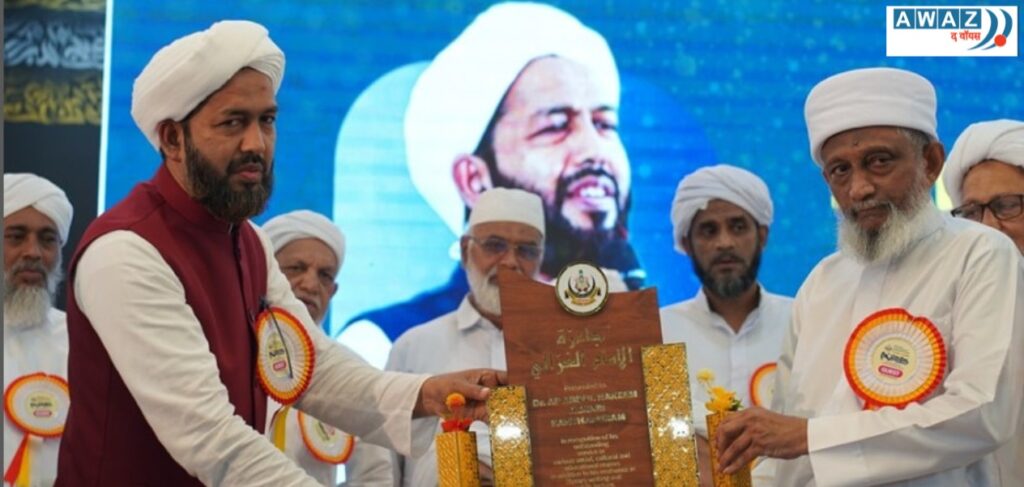
Dr. Muhammad Abdul Hakeem Azhary receiving the prestigious Imam Gazzali Award
New Delhi :
For his tireless endeavors to propel Islamic jurisprudence forward while spearheading transformative social initiatives, Dr. Muhammad Abdul Hakeem Azhary, the Managing Director of Markaz Knowledge City, has been bestowed with the Hujjathul Islam Imam Gazzali Award for the year 2023.
This prestigious honor is presented by the Darul Maarif Islamic Center under the esteemed leadership of Kodambuzha Bava Musliar. Award committee lauds Dr. Azhari’s innovative ideas that have significantly contributed to the resurgence of Ahle-Sunnah principles and played a pivotal role in societal reforms.
Dr. Azhary distinguishes himself as a dynamic force committed to more than replicating established norms, actively identifying and addressing gaps in social reforms, particularly in rural areas across the expanse of India. His visionary leadership has not only garnered global attention but has been instrumental in implementing impactful initiatives to bridge these social divides strategically.
Drawing from his extensive global experiences, Dr. Azhari has tailored his developmental approach for economically challenged communities in pan India. His initiatives transcend geographical boundaries, leaving a lasting imprint on diverse societal sectors, from the tribal regions of Wayanad in the south to Uthrakand in the north.
Under Dr. Azhary’s guidance, Markaz Garden, and its off-campuses scattered across India, alongside the monumental Markaz Knowledge City, have risen as bastions of knowledge and inclusivity. These institutions, underpinned by Islamic teachings, attract individuals from all walks of life, breaking down barriers of caste, sectarianism, and creed, truly embodying the essence of Islam.
Dr. Azhari’s organizational prowess, evident from a relatively young age, is underscored by his appointment as the General Secretary of the SYS. His leadership acumen shone particularly bright when faced with the challenge of Sheik Aboobaker Ahmed’s illness, where he seamlessly steered Markaz towards its mission, exemplifying unwavering commitment
In essence, the conferment of the Imam Hujjathul Islam Gazzali Award upon Dr. Abdul Hakeem Azhary is a testament to his steadfast dedication to the rejuvenation of Islamic religious sciences and his profound impact on societal development. His visionary approach and global perspective breathe new life into the traditional landscape, rendering him a truly deserving recipient of this esteemed accolade.
source: http://www.awazthevoice.in / Awaz, The Voice / Home> Story / by ATV / January 10th, 2024
Her hard work paid off and she eventually clinched success on her third attempt. She cleared both her Prelims and Mains and went on to top the interview round as well.
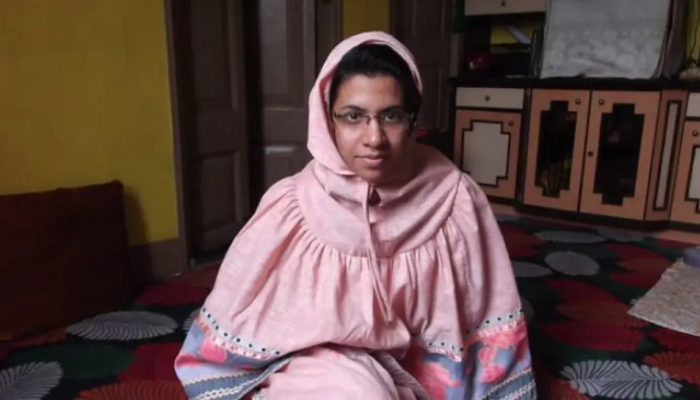
IAS Zainab Sayeed
New Delhi:
Do you happen to know who holds the prestigious title for achieving the highest marks in the interview round of the UPSC exam over the last decade? If you’re guessing it’s Tina Dabi, Srushti Deshmukh, Kanishka Kataria, or Shruti Sharma, you might be surprised.
It’s none other than Zainab Sayeed who stands as the record-holder for securing the highest marks in the UPSC interview round. This remarkable individual from Kolkata attained an outstanding score of 220 out of 275 marks in the interview segment. Her remarkable achievement took place in 2014 when she successfully navigated the UPSC Civil Services Exam, amassing 731 marks in the main examination.
Zainab clinched the All-India Rank (AIR-107) and to this day remains unparalleled in terms of interview performance. However, Zainab’s journey with UPSC wasn’t without its challenges. She encountered setbacks in her initial two attempts, failing to clear even the Prelims in her first endeavours.
Despite these early setbacks, Zainab refused to be deterred and remained steadfast in her belief in herself. Her relentless dedication and perseverance eventually paid dividends, culminating in her triumphant success on her third attempt. She not only cleared both her Prelims and Mains but also emerged as the top performer in the interview round.
According to Zainab’s account, the interview lasted for approximately 25 minutes and revolved around a diverse array of topics, including current affairs, international affairs, foreign direct investments, and discussions on the European Union.
It’s noteworthy that Zainab hails from Kolkata and completed her graduation in English literature from St. Xavier’s College. Subsequently, she pursued her MA in mass communication at Jamia University, Delhi, graduating in 2011.
Following her post-graduate studies, Zainab made the decision to embark on the rigorous journey of UPSC exam preparation. Despite facing disappointments in 2012 and 2013, she persisted and ultimately tasted success in 2014.
source: http://www.zeenews.india.com / Zee News / Home> India> UPSC Success Story / by Zee Media Bureau, edited by Mahi Mishra / February 13th, 2024
Several Muslim women were an active part of India’s freedom struggle, some of whom emerged from Hyderabad.
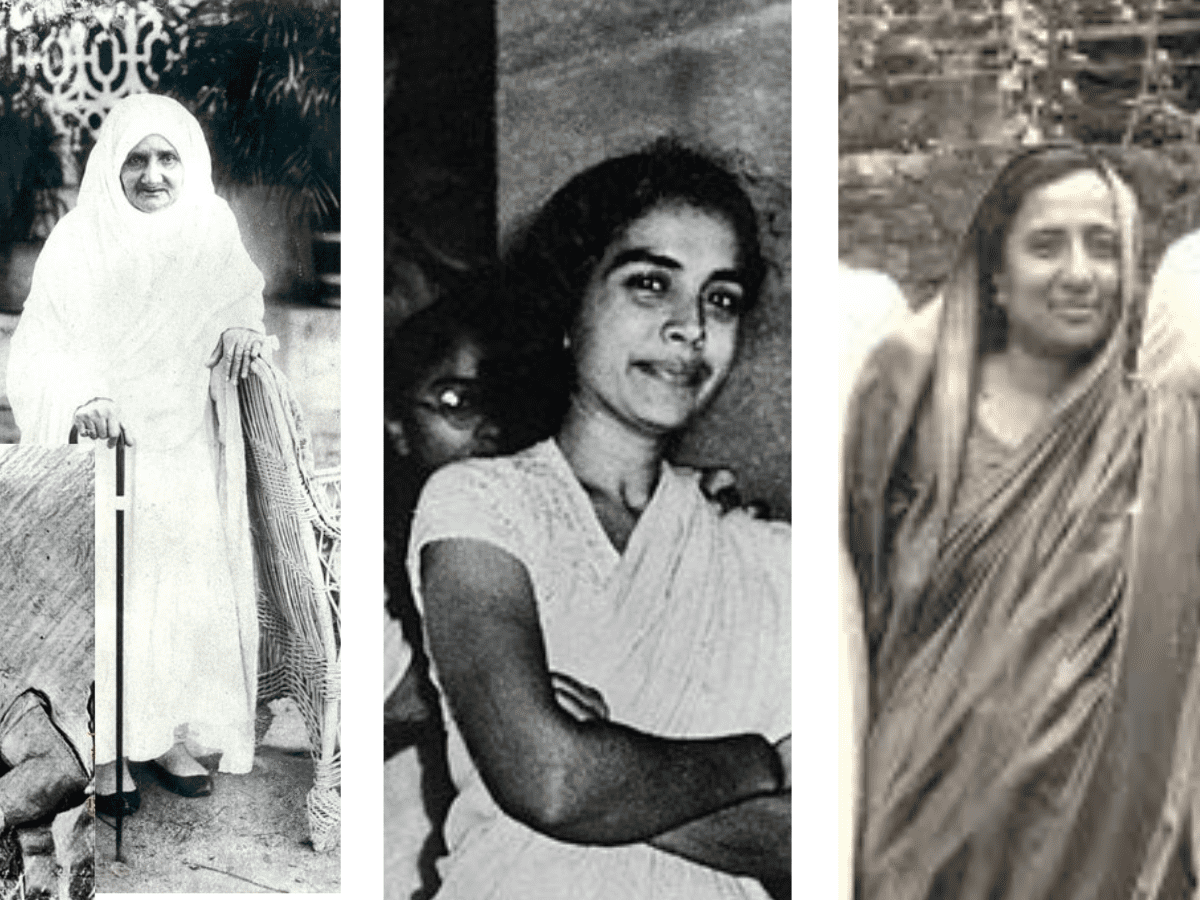
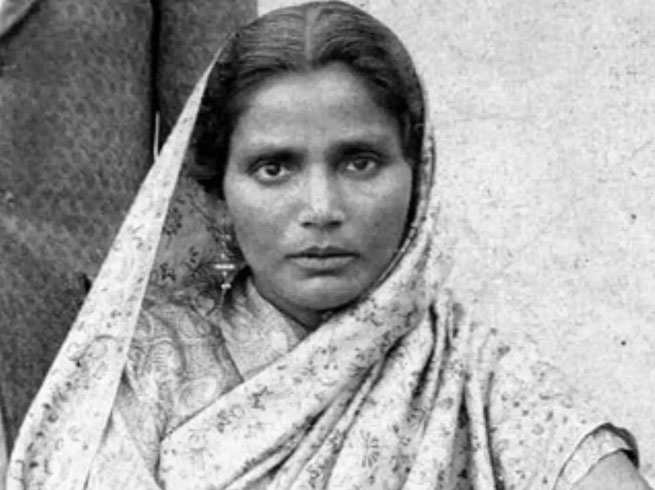
The list includes Abadi Bano Begum, Bibi Amtus Salam, Begum Anis Kidwai, Begum Nishatunnisa Mohani, Baji Jamalunnisa, Hajara Beebi Ismail, Kulsum Sayani, and Syed Fakrul Hajiya Hassan.
As India celebrates 75 years of Independence the country often recalls those that were instrumental in the country’s freedom struggle. But often those who aren’t talked about enough evanesce into the archives of history.
As men who took lead roles in the movement were put behind bars, the women ensured that the movement would not die down and the country attained the freedom a vast majority of it’s residents and citizens enjoy today.
The country’s Prime Minister Narendra Modi in his Independence Day speech, on Monday, hailed women and the part they played during the times including, Rani Laxmibai, Jhalkari Bai, Durga Bhabhi, Rani Gaidinliu and Begum Hazrat Mahal among others.
These are a few among the many names that are a part of the country’s Independence struggle. Apart from Begum Mahal, who made it to the list of the PM’s speech, today, Muslim women have made their mark in Indian history.
Abadi Bano Begum, Bibi Amtus Salam, Begum Anis Kidwai, Begum Nishatunnisa Mohani Baji Jamalunnisa, Hajara Beebi Ismail, Kulsum Sayani, and Syed Fakrul Hajiya Hassan are among those who are often forgotten or lost in public memory.
Abadi Bano Begum (Born 1852- Died 1924)
Abadi Bano Begum was the first Muslim woman who actively took part in politics and was also a part of the movement to free India from the British Raj. Abadi Bano Begum referred to by Gandhi as Bi Amma, was born in 1852, in Uttar Pradesh’s Amroha.
Bi Amman was married to a senior official in the Rampur State, Abdul Ali Khan.
After the death of her husband, Bano raised her children (two daughters and five sons) on her own. Her sons, Maulana Mohammad Ali Jouhar and Maulana Shaukat Ali become leading figures of the Khilafat Movement and the Indian Independence Movement. They played an important role during the non-cooperation movement against the British Raj.
Bi Amma, despite her poor financial condition, from 1917-1921, donated Rs 10 every month to protest against the British Defense Act, after Sarojini Naidu’s arrest.
In 1917, Bano also joined the agitation to release Annie Besant and her sons, who were arrested by the British after their failed attempts to silence her home rule movement in 1917, launched alongside, Bal Gangadhar Tilak.
Despite being a conservative Muslim for the most part of her life Bi Ammah was one of the most prominent faces of Muslim women in India’s freedom struggle.
To get the support of women, Mahatma Gandhi encouraged her to speak in a session of the all-Indian Muslim league, she gave a speech which left a lasting impression on the Muslims of British India.
Bano played an important role in fundraising for the khilafat movement and the Indian Independence movement.
Bibi Amtus Salam (Died 1985)
Mahatma Gandhi’s ‘adopted daughter’ from Patiala Bibi Amtus Salam was a social worker and his disciple who played an active role in combating communal violence in the wake of the partition and in the rehabilitation of refugees who came to India following the partition.
She has on several occasions risked her life by rushing to sensitive areas during the communal riots in Calcutta, Delhi and Deccan.
Bibi Salam was a Muslim inmate of the Gandhi ashram and had over time become an adopted daughter to Gandhi.
After the Noakhali riots, an article published in The Tribune on February 9, 1947, noted that Amtus Salam’s 25-day fast, which was intended to make offenders feel guilty, was one of the most significant outcomes of Gandhi and his disciples’ actions.
To protest the “negligence” of the state authorities in the effort to rescue kidnapped women and children, she sat on an indefinite fast at Dera Nawab in Bahawalpur.
Begum Hazrat Mahal (Born 1820-Died 1879)
An iconic figure of the 1857 uprising, Begum Hazrat Mahal fought against the British East India Company.
Begum, the wife of Nawab Wajid Ali Shah, the ruler of Awadh, refused to accept any favours or allowances from the British. Begum, with the aid of her commander Raja Jailal Singh, battled the British East India Company valiantly.
Muhammadi Khanum, the future Mahal, was born in Faizabad, Uttar Pradesh, in 1830. Gulam Hussain is her father. She had an early understanding of literature. The East India Company’s destruction of mosques and temples to make room for highways served as the catalyst for her uprising.
When the British East India Company invaded Awadh in 1856 and her husband, the last Nawab of Awadh, was exiled to Calcutta, the Begum made the decision to remain in Lucknow along with her son, Birjis Qadir.
On May 31, 1857, they convened in Lucknow’s Chavani neighbourhood to declare Independence and drive the British out of the city.
On July 7, 1857, Begum Hazrat Mahal proclaimed her son, Birjis Khadir, the Nawab of Awadh. She raised 1,80,000 soldiers and lavishly renovated the Lucknow fort as the Nawab’s mother.
She died there on 7 April 1879.
Begum Anis Kidwai (Born 1906- Died 1982)
A politician and activist from Uttar Pradesh (UP) named Anis Kidwai devoted most of her life to serving the newly Independent India, working for peace and the rehabilitation of the victims of the terrible partition of India.
She represented the Indian National Congress (INC) in the Rajya Sabha from 1956 to 1962, serving two terms as a Member of the Parliament.
Anis Begum Kidwai remained active during the Indian National Movement. Despite gaining independence in 1947, India suffered from country division.
By then, her husband Shafi Ahmed Kidwai had been murdered by communal forces for his efforts to promote amity between Muslims and Hindus and to prevent the split of the country. She was deeply devastated by her husband’s passing.
She visited Mahatma Gandhi in Delhi following her husband’s passing as a result of this unfortunate tragedy.
In order to support and assist the women who were suffering similarly to her as a result of the country’s separation, she began working with women leaders like Subhadra Joshi, Mridula Sarabhai, and others under the direction of Mahatma Gandhi.
She also started rescue camps for the victims and supported them in all respects. They affectionately called her ‘Anis Aapa’. She penned her experiences during the division of the Nation in her book ‘Azadi Ki Chaon Mein’.
Begum Nishatunnisa Mohani (Born 1884- Died 1937)
Begum Nishatunnisa Mohani was born in 1884 in Awadh, Uttar Pradesh, and her notion of ultimate freedom was adopted by Gandhiji.
Married to Moulana Hasrat Mohani, a tenacious independence warrior and the one who gave the phrase “Inquilab Zindabad” its origin. Begum, a fierce opponent of British authority, supported the then-hardliner of the liberation struggle, Bal Gangadhar Tilak.
After his imprisonment for publishing an anti-British piece, she wrote to her husband, Hasrat Mohani, encouraging him and raising his spirits by saying, “Face the risks imposed upon you boldly. Do not give me any thought. No sign of weakness should come from you. ‘Be careful’.”
Later, when her husband was in prison, she took over the publication of his daily, Urdu-e-Mualla, and engaged in various legal disputes with the government.
Baji Jamalunnisa, Hyderabad (Born 1915- Died 2016)
Baji Jamalunnisa, who actively participated in the Telangana armed conflict, passed away in this city on July 22 2016, at the age of 101.
Jamalunnisa Baji was born in Hyderabad in 1915 and was a prominent advocate for racial peace and the independence cause.
She began reading the banned journal “nigar” and progressive literature as a young child after being raised by her parents in a liberal/progressive environment.
Despite being raised in the traditional religious traditions of the Nizam regime, a component of the British Raj, she actively participated in the nationalist movement.
She continued to participate in the independence movement despite the oppressive rule of the Nizam and the British rule over her in-laws’ objections.
Later, she met Maulana Hazrat Mohani (the man who coined the phrase “Inquilab Zindabad” and was known as “Thunder Bolt” in the Freedom struggle), who inspired her to join the anti-imperialist movement in the nation.
She provided sanctuary to freedom fighters trying to avoid being arrested by the Imperial Government while being a communist.
Despite lacking basic higher education, she was fluent in Urdu and English and founded the literary society Bazme Ehabab, which held debates in groups on socialism, communism, and unreasonable customs.
She is buried at the Hazrath Syed Ahmed Bad-e-Pah dargah in First Lancer. She was the sister of Syed Akthar Hasan, a former MLA and the founder of Payam Daily, and was better known as “Baji”.
She was a close friend and member of the Communist Party of Maqdoom Mohiuddin. Baji was also a founding member of the Progressive Writers Association and the Women’s Cooperative Society.
Hajara Beebi Ismail, Andhra Pradesh (Died 1994)
Mohammed Ismail Saheb’s wife, Hajara Beebi Ismail, was a freedom warrior from Tenali in the Guntur district of Andhra Pradesh.
Mahatma Gandhi had a significant impact on the pair, who committed themselves to the Khadi campaign movement. In the Guntur district, her husband Mohammed Ismail opened the first Khaddar Store, earning him the moniker “Khaddar Ismail.”
Tenali served as the Muslim League’s headquarters during that time in the Andhra area, where it was particularly active.
Since Hajara and her husband supported Gandhi, they encountered fierce hostility from the Muslim League. Despite her husband’s repeated arrests for his involvement in the national movement, Hajara Beebi never lost spirit.
Kulsum Sayani (Born 1900- Died 1987)
On October 21, 1900, in Gujarat, Kulsum Sayani was born. She participated in the Indian National Movement and battled against social injustices.
Kulsum and her father met Mahatma Gandhi in 1917. Since then, she has travelled Gandhi’s path. Throughout the Indian National Movement, she advocated for social changes.
Dr. Jaan Mohamad Sayani, a well-known liberation fighter, was the man she wed. She participated actively in a number of events of the Indian Freedom Struggle, with her husband’s backing.
She began working with the illiterate and joined the Charkha Class. She also had a significant impact on the Indian National Congress’s “Jan Jagaran” campaigns, which raised public awareness of social ills.
Sayani’s operations included the suburbs and the metropolis of Mumbai.
Syed Fakrul Hajiya Hassan (Died 1970)
Syed Fakrul Hajiyan Hassan, who not only took part in the Indian freedom fight but also urged her children to do so. She was born into a family that immigrated to India from Iraq. She raised her kids to be freedom fighters who later gained notoriety as the “Hyderabad Hassan Brothers.”
Hajiya wed Amir Hassan, who had relocated to Hyderabad from Uttar Pradesh.
She adopted Hyderabadi culture as a result. Amir Hassan, her spouse, had a senior position in the Hyderabad government. He was required to travel to several locations as part of his employment.
She noticed the suffering of women in India while on her visits. She put a lot of effort into the growth of female children.
She lived in Hyderabad, which was governed by the British, yet she actively engaged in the National Freedom Movement since she was a lady with strong national emotions.
She burned foreign clothing at her Abid Manzil in Hyderabad’s Troop Bazaar in response to the demand of the Mahatma Gandhi. She took part in the non-cooperation and Khilafat movements.
She regarded each soldier in the Indian National Army as one of her children. Along with Smt. Sarojini Naidu, and Fhakrul Hajiya put a lot of effort into getting the heroes of Azad Hind Fouz released.
source: http://www.siasat.com / The Siasat Daily / Home> Featured News / by Marziya Sharif / August 17th, 2022
The first national flag hoisted in Demow after independence, 73 years ago has still been preserved well by the family of freedom fighter Commander Mohd. Maulobi Mohd. Hussain.
source: http://www.sentinelassam.com / The Sentinel / Home / by Sentinel Digital Desk / August 14th, 2019
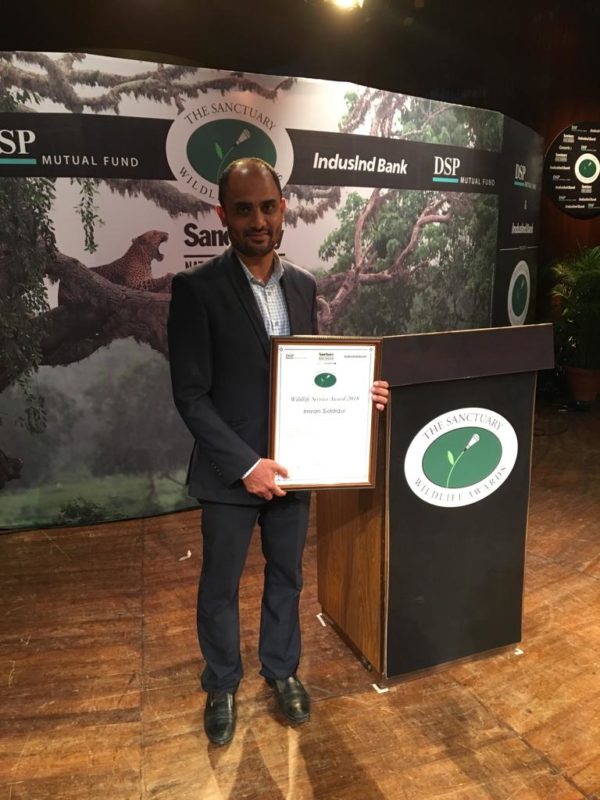
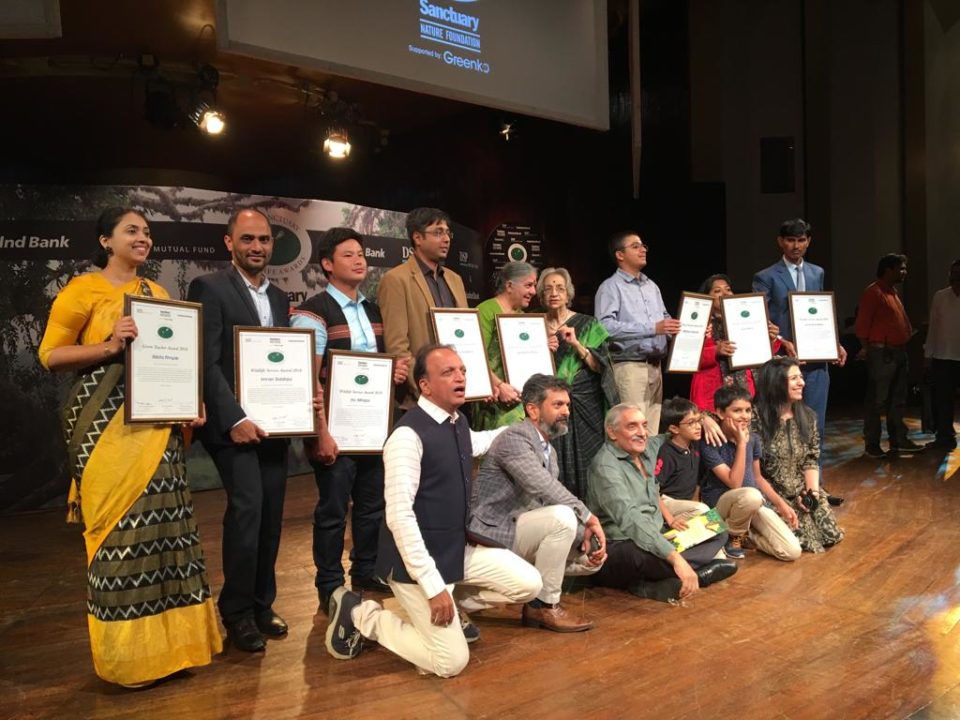
Imran Siddiqui of the Wildlife Conservation Society – India has been honoured with the prestigious Sanctuary Wildlife Service Award 2018.
Imran Siddiqui has come a long way from raising and selling poultry to fund his wildlife obsession.
He is now on the Telangana State Board for Wildlife and works as an external expert for tiger monitoring in Andhra Pradesh and Telangana. He is also the Assistant Director for Conservation Science at WCS-India, and the co-founder of the Hyderabad Tiger Conservation Society (HyTiCoS).
As his life and work reveal, Imran has no respect for man-made boundaries, much like the wildlife he’s so obsessed with. Traversing the rugged landscapes of Kawal, Amrabad and Nagarjunsagar-Srisailam Tiger Reserves and the Gundlabramheswaram Sanctuary, he works in tandem with state forest departments and local communities. His work covers 10,000 sq km of wilderness in Telangana and Andhra Pradesh, with his crew comprising over 35 field staff, 300 volunteers and hundreds of supporters.
Taking a cue from the success of WCS-India in Karnataka and extending it to the neighbouring states of Andhra Pradesh and Telangana, he leads scientific surveys on prey analysis and occupancy surveys on mammals.
He also helps in management planning, engages in snare removal drives, initiates voluntary relocation programmes for forest dwellers, facilitates capacity building workshops for the forest department and influences policy through public interest litigations, high-level committees, community engagement, strong advocacy and creating political will on wildlife.
His efforts have resulted in the speedy disbursal of compensation, besides the initiation of relocation of landless tribals who live within the two tiger reserves of Kawal and Amrabad.
Imran is also largely credited for the declaration of the Kawal Tiger Reserve (where he conducted the fieldwork for his Masters dissertation). For this he had to lobby relentlessly at the political level as well as work tirelessly on the ground to counter misinformation spread by vested interests, and finally win the support of local communities.
A tenacious man on the field and a convincing man in the boardroom, Imran Siddiqui is in no small way responsible for the revival of tigers in this vast but obscure landscape.
The Sanctuary Wildlife Service Award 2018 is a testimony of his untiring efforts to save wildlife and wild places.
source: http://www.india.wcs.org / WCS – Wildlife Conservation Society / Home>News> Current Articles>Archive / by WCS India / December 07th, 2018
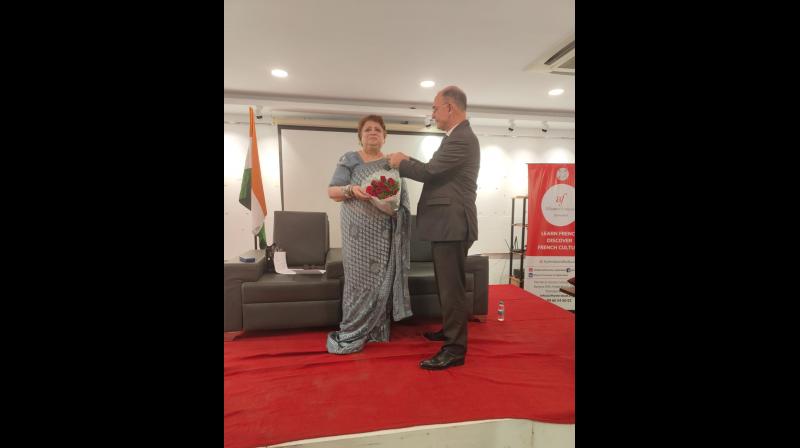
Dr Begum Fatima Shahnaz being conferred the Chevalier dans l’Ordre des Arts et des Lettres (Knight of the Order of Arts and Letters), the second highest French civilian honour by the French ministry of culture for her significant contribution to arts and literature, on Thursday. ( Photo: DC)
Hyderabad:
The multifaceted Dr Begum Fatima Shahnaz was conferred with Chevalier dans l’Ordre des Arts et des Lettres (Knight of the Order of Arts and Letters), the second highest French civilian honour by the French ministry of culture for her significant contribution to arts and literature, on Thursday.
The Jawaharlal Nehru gold medal winner for writing in her teens, Dr. Shahnaz was felicitated at a special investiture ceremony at Alliance Française by Consul General of France, Bangalore, Thierry Berthelot.
The teary-eyed Shahnaz broke into French as she thanked the distinguished guests and shifted to English after a minute or two.
“I didn’t realise I was speaking in French, it comes so naturally to me and I sometimes think in French too,” said the actor, writer, humanitarian, journalist, theatre & art director, professor and journalist.
Talking about the significance of the honour, she said, “France has supported me, and through me, it has supported the Indian people. A Hyderabadi being honoured is an honour to all my people. This places huge responsibility on me, as a citizen of India.”
She also spoke about France and its relationship with Hyderabad and recalled her college years there.
Hailing from royal Indian dynasties, Shahnaz is an actor from the Institut d’Arts Dramatiques Rene Simon in Paris, and is associated with Broadway in New York. She completed her education with a stint at the legendary French school of cuisine, the Cordon Bleu and hopes to bring a new dimension to ‘nouvelle cuisine’ through innovations in Indo-French culinary arts.
Her works include Golconda, Khaki-poems on Pulwama, Saraswati, Shards, Prince of Tears, The New York Poems, Kaleidoscope Eyes, Tiger in the twilight, among several others.
source: http://www.deccanchronicle.com / Deccan Chronicle / Home> Nation / by DC Correspondent / May 19th, 2023
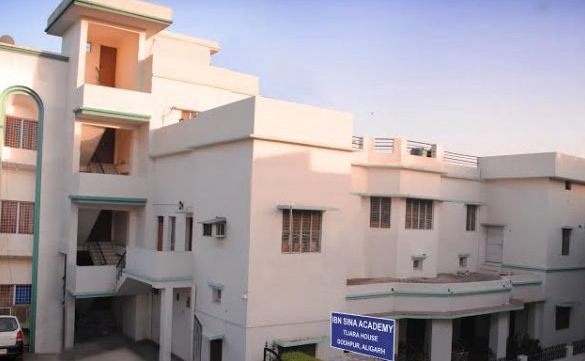
Professor Syed Zillur Rahman, founder,Ibn Sina Academy of Medieval Medicines and Sciences with the author
Known for its locks, Aligarh, a city in Uttar Pradesh, has also locked a legacy in its reserve – for generations to benefit from it. It houses a rare academy and museum called Ibn Sina Academy of Medieval Medicines and Sciences.
Located at Tijara House, amid a vibrant market place and residential area, Ibn Sina is hailed as the rarest house of legacies in arts and sciences combined under one roof. Named after the legendary scholar of philosophy and medicine Abu Ali Ibn Sina (980 -1037), this academy was accredited to the Ministry of Ayush in 2004 and promoted to Centre of Excellence in 2008.
The institution was established for encouraging and promoting research and studies in medieval sciences, especially Ibn-Sina’s as well as arts, culture, poetry, and other sciences.
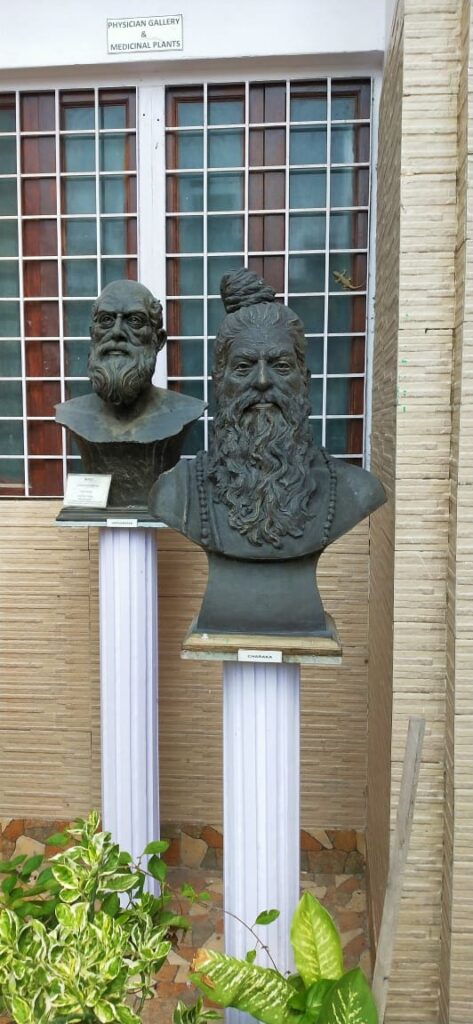
The bust of Ibn Sina with Charak inside the museum
Of Ibn Sina’s four stories, a major attraction is on its second floor which houses the Fazlur Rahman Museum of Orientalism, Art, and Culture.
It has four main galleries; the crockery gallery has a large collection of oriental and British Indian utensils, hammami plates, bowls, tea sets that belong to prominent personalities such as Hakim Ajmal Khan, Nawab Sultan Jahan, Nawab Shahjahan Begum of Bhopal, Nawab Yusuf Ali Khan of Rampur and many others.
The textile gallery is ornate with attires, garments with gold and silver calicos studded with precious stones, one of which has entire Quranic surah Yaseen embroiled in gold zardozi on it, turbans worn in battles, among many other oriental attires. The picture gallery has prominent personalities of AMU’s pictures, drawings, photography, prints, etc.
Its miscellaneous gallery has coins, postage stamps, clocks, busts, pens, memes, and relics of prominent personalities.
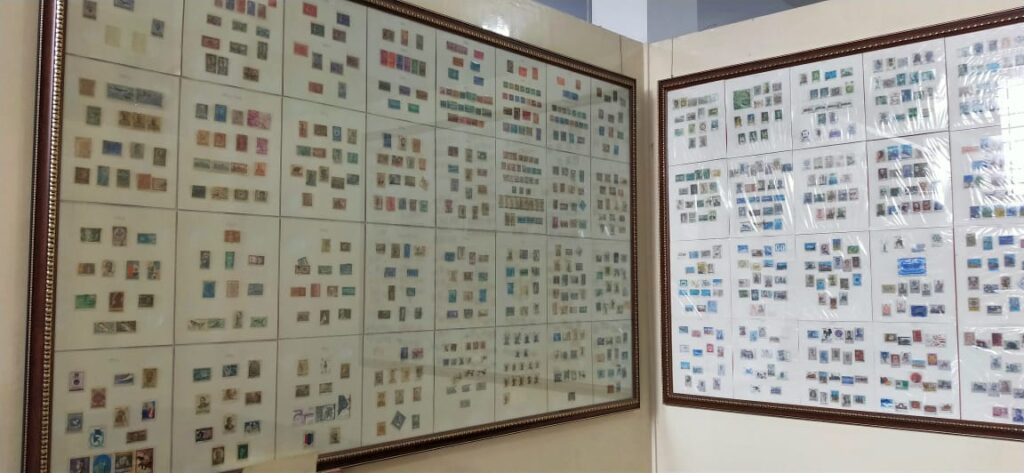
“We have over 2 Lakh stamps beginning from ever since the stamps started, from all countries and India. People who were pioneers in the world of arts and culture, education, and freedom fighters on whose names, and stamps were released, we have a collection of the same. shares Dr. Aftab who is a convenor at Ibn Sina.
In addition medical manuscripts, medical philately, medical souvenirs memories of physicians especially those of Nobel laureates are well preserved here.
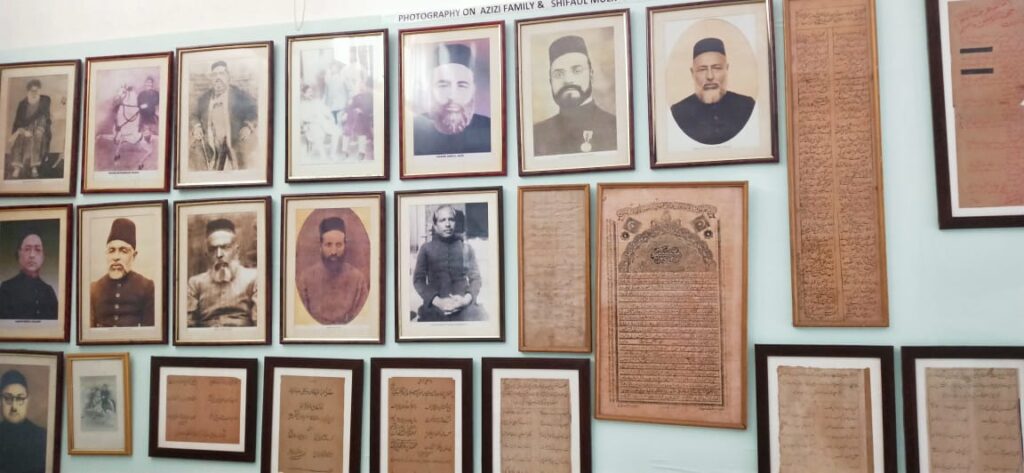
The wall of fame (Pictorial history of some important Muslim families)
The connecting rooms of the galleries welcome you with a sofa of Raja Jai Kishan, a mirror of the times when they were made of iron sheets. The iron sheets called ‘aaina’ were rubbed so many times that they would become sparkling clear and shining to become a mirror. That’s how the mirror got its name ‘aaina’ Later it got a new name –sheesha – with the change of the material..
The academy is rare for numerous reasons. For avid readers of medicine, science, Urdu, Persian, Arabic, literature, poetry, oriental studies, researchers, students preparing for competitions, and scholars IbnSina is a heaven. It boasts of a rare collection of 32000 books, 17000 magazines, 1100 manuscripts, (makhtootaat), 21 rare Qurans including one pocket size in gold, and much more is in store.
Built by professor Syed Zillur Rahman, a medical academic and passionate Urdu litterateur from Aligarh, Ibn Sina was an extension of his colossal library that he had established in 1960 which soon extended into the world’s rare academy and museum of its kind in the year 2000.
Collection of stamps
“Hamare yahn Aurangzeb ke hath ka likha, aur uske bete ke hath ka, likha hua Quran hai,” gleams the professor, sharing the information.
Apart from a separate collection of Muslim women achievers, Ibn Sina boasts of the world’s best collection of Islamic sciences, Islamic medicines, and Islamic philosophy being published across countries such as Iran, Central Asia, Syria, Iraq Turkey, etc. Scholars from across the globe come here to refer to books in this section.
For Ghalib devotees, the academy has a separate section called Ghalib Study Centre. It “Ghalibka collection joh mare paas hai vo duniya mein kisike paas nahi hai,” claims the professor.
Delhi finds a special place here boasting of 7500 books, some as old as 1893, dictionaries as old as 150 years, authentic diwaan on Ameer Khusrau, books on and by the last Mughal Bahadur Shah Zafar, British period –Victorian Era with pictures in Lithographs and much more.
Children using the library
The academy has a library for students especially those preparing for competitive exams. The 100-seater library has the best of books from literature, agriculture, science, math, medicine, etc.
“There is no fee to sit in this library. It opens every day from 10 to 10. This section has over 28000 books including 56 of Professor Rehman on Tibbi and Unnani medicines. there are separate sections for Unani medicine and Sir Syed Movement, biographies,” Dr Aftab Alam, the coordinator of Ghalib Study Centre informed.
There is a reason why the library has most books in Urdu and Persian on Indian history, culture, language, society, education, politics, medicine, etc. “Not much work in English has been done on Muslims. Most work has been done in Urdu and Persian. So this is our helplessness. Our focus is on India – the Hindustan. Indian scholars have done immense work in any domain, philosophy, travelogues, and medicines, especially in Islamic history, the Quran, and hadith that is comparable to anyone in the world, especially the Arabic and Persian world. The problem is we don’t read because we don’t read Urdu,” rues the professor.
Why Ibn Sina was built has an interesting story. As a young man, Professor Rahman used to watch a bird who had made a nest and would bring food for her newborn, just as the routine was with a cat who had given birth to kittens – at his home. After some months, the birds flew, and the kittens grew and went away with their mothers.
“I thought to myself, ‘Is this the life God has created mankind for? Just be born, eat, sleep, and die like animals? God has created a man to not only take care of his family but also society, language, culture, community, and world.”
Ibn Sina Academy of Medieval Medicines and Sciences
So, he decided to create a legacy that he says would be useful for a generation after 80 years! “We are away from civilization by 80 years. A standard time to develop any civilization is 150 years. So, now people are not able to understand the legacy I have created but the students who read it 80 years later will know what it is. By then we would be a civilization.”
People get worried that the graph of Muslim development is going down. But the Professor feels it is nothing to be worried about. “Every civilization has to go through it. Our graph has risen. We were 10 crores in 1947. After Partition, 7 crore left for Pakistan had 3 crore stayed in India. We were nothing in 1947 but our buzurgs worked very hard to study and became scholars. Now we are making educational institutions, universities, hospitals, media houses, and so on. Most important is that girls are getting higher education and they will change the face of the nation,” he says, satisfied while emphasizing reading Urdu to know a legacy called India and the contribution of Muslims to it.
Rana Siddiqui Zaman is a Delhi-based senior columnist and art reviewer
source: http://www.awazthevoice.in / Awaz, The Voice / Home> Stories / by Rana Siddiqui Zaman / January 10th, 2024
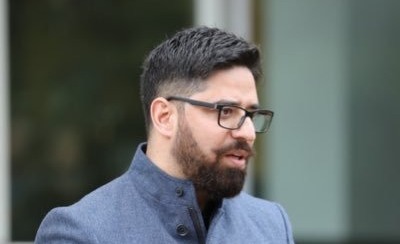
In a remarkable act of generosity, Danish Manzoor Bhat, named Media Person of the Year, has unveiled a groundbreaking plan to secure the future of two orphan girls, hailing from Kashmir and Jammu respectively.
Danish, showcasing profound empathy for the challenges faced by orphans, commits to matching his award money with a personal donation, amounting to ₹51,000 for each girl, totaling ₹1 Lakh 2 Thousand. These funds will be prudently placed in fixed deposit accounts, ensuring steady growth over time.
The visionary behind this benevolent act, Danish Manzoor, expressed his perspective, stating, “By securing a financial foundation for these young girls, we are not just providing them with monetary security; we are investing in their dreams, their education, and their future independence.”
The initiative signifies a beacon of hope, promising a better tomorrow for the recipients. Danish Manzoor’s dedication to societal responsibilities shines through, emphasizing the role of media professionals in contributing positively to society. This act sets a precedent for compassion and social responsibility, encouraging others to make a tangible difference in the lives of those in need.
“Deeply humbled at receiving the outstanding mediaperson of the year award, 2023 instituted by the government of Jammu and Kashmir. It means a lot, more over other recognitions especially because it comes from my birthplace. I pledge to donate the award money of ₹51,000 and match it totalling ₹1,02,000/ for two select orphan girl children one each from Srinagar and Jammu,” Danish posted on X.
source: http://www.dailygoodmorningkashmir.com / Good Morning Kashmir / Home> Latest / by GMK Staff / January 25th, 2024
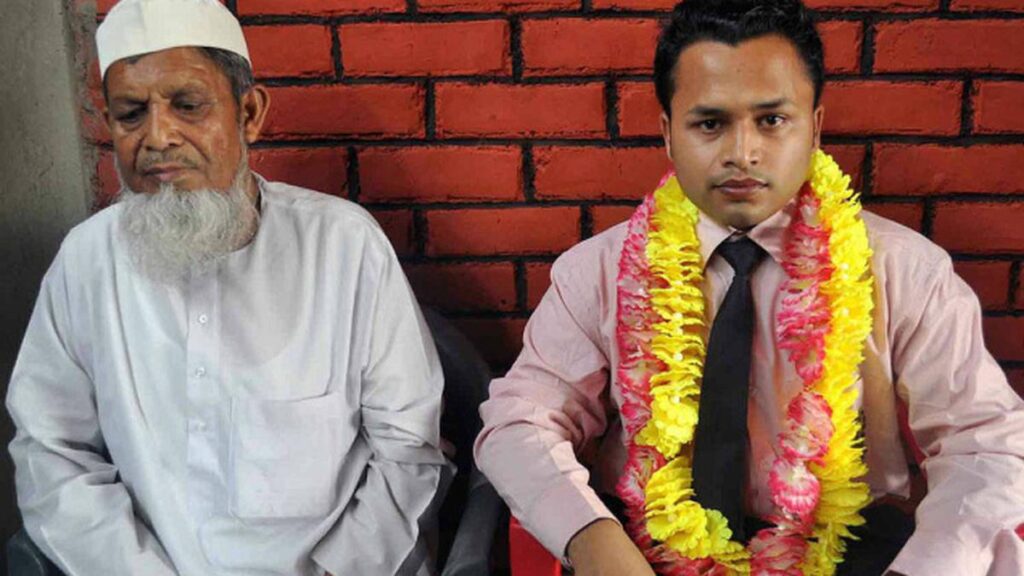
Manipuri boy Mohammad Ismat along with his father who scored the highest mark in the All -India Senior Secondary Certificate Examination.
Mohammad Ismat, the Manipuri boy who has topped the all-India CBSE Class XII Board examinations in the science stream, is nurturing a dream to top the Civil Services Examinations, too.
By way of preparation, he plans to join St. Stephen’s College, Delhi, to do B. Sc. (Honours).
Ismat hails from Lilong Haoreibi in Thoubal district, 15 km from Imphal. The village has very poor electricity supply and no internet connection.
“I also want to become a topper in the Civil Services Examinations conducted by the UPSC. I want to serve my country for peace and communal harmony. For now, I want to take admission to St. Stephen’s College to do B.Sc. (Honours) in Physics,” he told The Hindu .
He brought laurels to his school, Zenith Academy in Imphal, where he joined after completing Class X at Sainik School, also in Imphal. “I studied Class IX and X in Sainik School and passed the Class X board examinations with 92.4 per cent. I left Sainik School because of financial constraints,” he said.
Ismat’s mother died when he was only 18 months. His father, Maulana Bashirur Rahman, is a teacher in a primary school. He is the seventh child and only son of the family; six elder sisters are all graduates.
After school hours, Ismat had to study mostly in candlelight, as electricity is available for hardly three-four hours a day in the village. Ismat scored 495 out of 500 marks, securing centum in mathematics, chemistry, fine arts and home science and 98 in English and 97 in physics.
source: http://www.thehindu.com / The Hindu / Home> News> India> Other States / by Sushanta Talukdar / May 30th, 2012
Gantmulla Village (Kreeri, Baramulla District),JAMMU & KASHMIR:
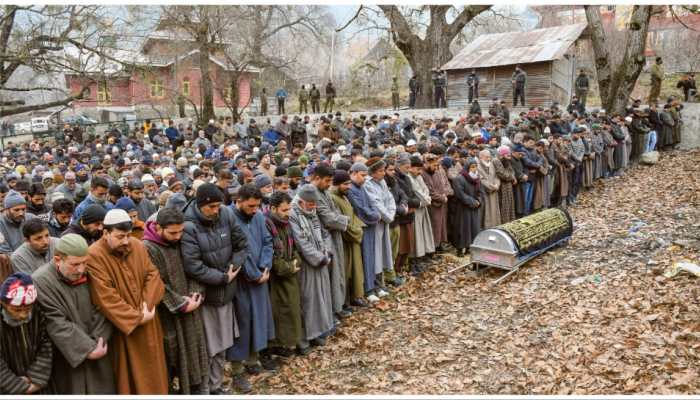
Villagers and family members of retired SSP Safi paid their last tribute to him by offering prayers.
Image credit: ANI
Baramulla:
Terrorists shot dead a retired Senior Superintendent of Jammu and Kashmir Police (SSP) Mohammad Shafi, at Gantmulla Village of Kreeri area in North Kashmir’s Baramulla district early today. The retired officer survived by his wife, two sons, and a daughter, was laid to rest amid huge public participation.
Jammu and Kashmir Police officials said that Mohammad Shafi had gone to the nearby mosque where he was offering Azaan ( Call for prayer) at the time of being shot by the terrorists.
Shafi a retired officer for the last 11 years used to offer Azan daily since he got retired. Today he was middle of Azan when he was shot. People around felt that Azan stopped halfway some people rushed to the mosque and found Shafi on the floor He was taken to a nearby hospital, but doctors declared him dead.
“Terrorists fired upon Shri Mohd Shafi, a retired police officer at Gantmulla, Sheeri #Baramulla, while praying Azan in the mosque and succumbed to injuries. Area has been #cordoned off. Further details awaited,” Jammu and Kashmir Police posted on X (formerly Twitter). (sic)
After the news of Mohammad Shafi’s killing spread in the Baramulla district, a large crowd began to assemble at his residence. The retired officer was laid to rest with significant local public participation in his funeral. Various segments of society, including politicians, expressed condemnation for Mir’s killing and called for decisive actions against those responsible.
The Jammu and Kashmir Police, in collaboration with other security agencies, have initiated an extensive cordon and search operation in the region. Security forces are exploring all aspects of the killing. According to officials, the ongoing investigation reveals that the deceased was shot with a 12-bore pellet gun, and the possibility of personal enmity is also under scrutiny. Police sources indicate that numerous suspects have been apprehended for questioning, and the police have gathered several 12-bore licensed guns from the area for further investigation. Authorities assure that they are diligently working to apprehend the perpetrators responsible for the officer’s death.
Intelligence inputs suggest that terrorists in Jammu Kashmir have changed their strategy, on one side they have chosen forests to hide and target the army and other security forces conveying vehicle or petrol movements who are seen in recent attacks in Poonch, Rajouri, Kulgam, and Kokernag while on other hand in towns they choose soft targets and attack them. There has been a rise in target killings in the Kashmir Valley in recent times. A police inspector was shot dead in Srinagar recently while a policeman was killed in the same Baramulla district recently too and a policeman was attacked in the Bemina area of Srinagar.
)
)