Nellihudikeri Village, Siddapur (Kodagu Distrct), KARNATAKA :
Madikeri:
A farmer and a vintage car collector died after a tree branch fell on him at Nellihudikeri village near Siddapura in Kodagu district yesterday.
The deceased, 67-year-old P.C. Ahmed Kutti Haji, was working in his Mubarak Estate along with his son Ashraf at around 11.30 am. Due to heavy rain and wind, a branch of a banyan tree fell on Ahmed Kutti. He was immediately rushed to a hospital. But he succumbed to his injuries in the hospital. Kodagu Deputy Commissioner P.I. Sreevidya has announced Rs.5 lakh compensation to his family. She sent the cheque through the Tahsildar.
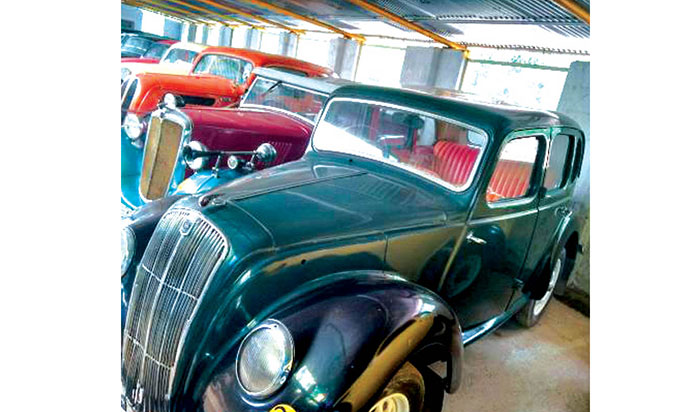
With his death, Kodagu has lost a collector of Vintage ‘beauties
Ahmed Kutti Haji is a coffee planter and also an industrialist. He has a huge collection of vintage cars which he threw open to public. Collecting vintage cars was a hobby for Ahmed who has 86 of them and over 15 vintage petrol jeeps. Not to stop there, he also has 20 old two-wheelers, a 125-year-old bicycle and a 200-year-old bullock cart. The oldest car in the collection is 1925 model.
Normally vintage car collectors eye Bengaluru to add cars to their collection. Changing the trend, Ahmed focussed on old workshops in Kodagu and surrounding areas to hunt vintage ‘beauties.’ After picking them, Ahmed gave old cars a fresh coat of paint and tuned them to working condition.
Almost all foreign cars owned by Ahmed were manufactured between 1925 and 1965. Barring Dharmasthala, no other place in the State has such a wide collection of vintage cars.
With his death, Kodagu has lost a vintage automobile enthusiast.
source: http://www.starofmysore.com / Star of Mysore / Home> News /June 10th, 2018
It is 8am on Saturday and big black cauldrons that will slowly simmer dal in them have been put up on burning embers with the help of two strong men. For the past 179 years, the ritual has been repeated every Ramzan in the bawarchikhana (kitchen) within the premises of the Chhota Imambara.
While it is dal and tandoori roti that is cooked for three days, an Awadhi delicacy called ‘taley hue aaloo ka salan’ (fried potato curry) with roti follows for the next three. The cycle continues for the entire month of Ramzan, feeding around 600 poor people as their dinner the the entire month of Ramzan.
In the same kitchen, a different set of snacks is also prepared for the specific purpose of serving rozedars coming to offer prayers in 15 mosques under Husainabad & Allied Trust (HAT).
Around 2,500 people will receive a plate of gujhiya, phulka, chana, suhaal, dates, a fruit (preferably banana) along with bread-butter and cake outsourced from a bakery, thanks to a king’s commitment to the poor.
The third King of Awadh, Muhammad Ali Shah, had created the Husainabad Endowment Deed in 1839 to feed the poor. Since then, the two massive community kitchens within the Chhota Imambara have been following the tradition of sending out iftari to the 15 mosques under its umbrella.
Every Ramzan, by the end of the day, this kitchen would have fed over 3,000 mouths.
“A sum of around Rs 16 lakh is passed for the iftar and dinner services every year. Two separate dedicated teams of chefs and their assistants are engaged for it. Everyday, activity in the kitchens begins at 8am. By 4.30pm, we send out the first batch of iftar food for the mosques,” said Habibul Hasan, an official from HAT.
The 179-year-old Nawabi tradition saw a break only in 2015. During Ramzan that year, a movement against alleged corruption in the UP Shia Central Waqf Board being spearheaded by Shia cleric Maulana Kalbe Jawad had brought the tradition to a halt. Protesters had locked the entrances to both the Bada Imambara and Chhota Imambara, restricting all entry. Even the kitchens could not function.
However, people from the neighbourhood of the 15 mosques came together to fund the food. HAT had also roped in private bakeries. Even during the mourning months of Muharram, food is served from the traditional kitchens of the Imambara.
source: http:///www.timesofindia.indiatimes.com / The Times of India / Home> News> City News> Lucknow News / by Yusra Husain / TNN / May 21st, 2018
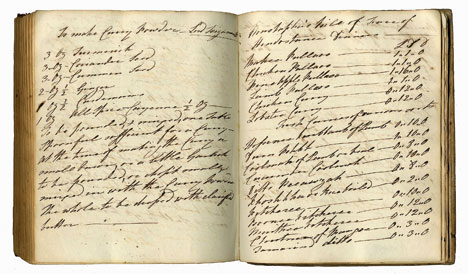
RICH DIET: A handwritten cookery manuscript containing a glimpse of the menu from England’s first Indian restaurant has sold for $11,344 (Rs 7.6 lakh) at a London book fair.
It refers to dishes like “pineapple pullaoo” and “chicken currey” from the Hindoostane Dinner and Hooka Smoking Club, opened in 1809 at Portman Square, London, by Sake Dean Mahomed, whose roots lay in Bihar.
“This is the first known record of a priced menu from Britain’s first Indian restaurant – at a time when printed menus were rarely available,” said Brian Lake of Jarndyce Antiquarian Booksellers in London, which sold the volume at the ABA Rare Book Fair to an American institution last month.
The manuscript, titled Receipt Book 1786 on the front, also contains handwritten recipes and receipts. It includes a two-page “bill of fare” from Hindoostane, listing 25 Indian dishes with prices.
These include makee pullaoo (1.1.0 pounds), pineapple pullaoo (1.16.0 pounds), chicken currey (0.12.0 pounds), lobster curry (0.12.0 pounds), coolmah of lamb or veal (0.8.0 pounds), together with breads, chutneys and other dishes.
It ends by noting that there are “various other dishes too numerous for insertion”.
Towards the end is a recipe “to make a curry powder”, attributed to Lord Teignmouth (1751-1834), who was governor-general of Bengal between 1793 and 1797 and later became a patron of Mahomed’s restaurant.
Mahomed went bankrupt in 1812, and the eatery struggled on as Hindostanee Coffee House under a new management before disappearing in 1833.
source: http://www.telegraphindia.com / The Telegraph,Calcutta,India / Home> India / PTI / June 04th, 2018
Nawabuddin, the oldest town crier of Delhi’s Walled City, roams the streets at night during Ramzan to wake devotees for the pre-dawn meal and to reconnect with his neighbours and the community
It’s 2:30 am in Old Delhi’s Sheesh Mahal area, a cricket match in being played to an audience looking out from their balconies. Further away, young men on motorbikes, a flea market and food stalls hum away. For Nawabuddin, 75, or ‘Peer ji’ to do his job as a town crier—of waking people up for sehri in the month of Ramzan— he must remain oblivious to the fact that the Walled City is actually awake. (Burhaan Kinu / HT Photo)
At 2.30 am, more than two dozen two-wheelers have been pushed aside to make space for a cricket match being played under halogen floodlights in a boundaried compound in Old Delhi’s Sheesh Mahal area. Its audience: women from balconies of cramped flats overlooking the compound. And some street dogs. The match will continue for the next one hour but break as the boys retreat for sehri (pre-dawn meal) followed by namaaz.
Nawabuddin, 75, or ‘Peer ji’ doesn’t intend to acknowledge the game, or the young men performing stunts on motorbikes in the next street, the overcrowded tea stalls, or the flea market that is still serving its last customers.
For him to do his job as a town crier— that of waking people up for sehri in the month of Ramzan— he has to indulge in a minor self-delusion, be oblivious to the fact that the Walled City is actually awake.
Wearing a white pathani suit, skull cap and a keffiyeh spread across his left shoulder, all Peer ji can see in the darkness is a maze of match-box like buildings. He limps to each structure, carrying a wooden stick which he lifts to bang on the doors. “Rozedarooo, uth jao (Those fasting, awake),” his hoarse, throaty call encircles the street.
Peer ji is perhaps the last generation of Old Delhi’s town criers. Intrinsic to Muslim culture around the world, people like him are known by various titles –– Nafar (in Morocco), Musarati ( Egypt), Hil hiwai (UAE) and Seher Khan (Srinagar). In most of these regions, they roam the neighbourhood donning traditional attire, blowing trumpets or beating drums to draw people’s attention. In Delhi’s Walled City, they don’t have any such name and they don’t carry musical instruments.
Peer ji knows the occupants of most houses by name or profession. “Doctor sahab”…“Master ji”… “Vakeel sahab,” he calls out. Standing beneath tenements in closed alleys, he positions himself in certain areas that are most likely to echo his call, rather than go to each house.
Who is awake at this hour? “The men are either in deep sleep or are idling away their time when I do the rounds. It is the women who usually pray at this time,” he says, making his way through the labyrinth of passages. Men hardly respond to his call, he says. But those who do, are usually not welcoming. “You don’t have to be so loud. Kids are sleeping,” shouts back a voice, leaving Peer ji despondent for a moment.
Around 3.30 am, when he is done with the rounds, Peer ji is back at his house for sehri. (Burhaan Kinu/HT PHOTO)
“That was Rameez tailor’s son. As a child, he used to be very fond of me. Now he is all grown up and talks back to me. Perhaps he didn’t get adequate sleep,” says Peer ji with a grimace, murmuring to himself. By 2:45 am, he breaks for a quick tea at a makeshift shop. He notices that someone is pulling his shirt. It’s a little boy. “Aap uthane waaley hain na? (You wake people up, don’t you?),” he inquires. “Yes, my son,” says Peer ji, happy with the recognition. “Everyone in the locality knows me. No other profession would have given me such popularity,” he says. Those who acknowledge his efforts, reward him with cash and delicacies on Eid.
Mahtab Rahi, Peer ji’s neighbour, greets him next. “I have seen him since my childhood. Every passing year, the job of people like him become irrelevant. Still, undeterred by such factors, he is offering his service in a selfless manner. It is unfortunate that we don’t value him as much as we should,” says Rahi.
Peer ji’s job begins at 2 am, but he hardly sleeps post dinner. He spends his time at a neighbourhood mobile recharge shop. After midnight, he goes home for tea, and collects his stick and torch before leaving.
BECOMING PEER JI
Peer ji faces no competition, compared to 40 years ago, when he first began to volunteer for the task. Every Muslim neighbourhood used to have one man designated for this duty. There are, at present, only three left in Old Delhi.
At night, Peer ji would encounter various groups of hymn singers carrying lanterns; each group visited a different locality each day. They are not found anymore. “While the neighbourhood people would tip me only on Eid, the singers were paid each time they ventured out. Now they are a rare sight. Most of them have died,” he says.
As a young lad, Peer ji would spend time with his uncle who was a peer or spiritual guide to many in the neighbourhood. (The family association got him the title, Peer Ji.) He was a 20-year-old vegetable vendor when Mohammad Umar, the town crier in his locality, died. People requested him to carry forward the responsibility because he would be awake early in the morning due to his trade. None of his three sons are inclined to take up the job after him.
“It is alright. Today, people want to invest their time and energy only when they see monetary returns. People of my generation did a lot of things simply for sawaab (spiritual reward),” he says. He says he never pushed his sons though. “This task has its own complexities. One may encounter thieves on the streets. One also has to be wary of households in which only women live and consider their privacy. I don’t want my sons to land in trouble,” he says. Although the job seems simple, the town crier does follow a protocol. For instance, Peer ji waits beneath the house of heavy sleepers, till they respond to his call. He has to ensure not to intrude into another town crier’s area. And he never calls out the names of those who are dead even if theirs was the name he would call out earlier. “You never know, family members may get emotional,” he explains.
To make sure that he does not miss his duty, he avoids consuming oily snacks and chilled water, during Ramzan. Around five years ago, during Ramzan, he had a sore throat, so he took his son-in-law with him for the rounds so that he could call out.
By 3.15 am, having covered multiple lanes on more than a 2- km-long stretch, Peer ji heads back home. His wife and sons await him with the sehri platter — buff curry, rusk and tea.
Peer ji is well aware that every passing year, with people using clocks and mobile phones to set alarms, his job is becoming obsolete. “They will realise my importance once I am gone. Yahi duniya ka dastoor hai (This is the way of the world),” he says. It is time for the morning prayers. From the neighbourhood mosque, the muezzin is calling.
source: http://www.hindustantimes.com / Hindustan Times / Home> Lifestyle> Art and Culture / by Danish Raza, Hindustan Times / June 04th, 2018
In the heart of Hazratganj, at the cut which turns into Lalbagh, stands a large bank. The cars and two-wheelers parked there spill onto the road. There are vendors, mechanics, and just people waiting to go back into the bank when the clerk beckons them. The atmosphere looks like any bland public sector office.
However, a few steps into the compound will lead you to a large colonial-era house. The exterior is yellowing, the plaster is coming off but the sheen of its wooden door frames is intact. The windows, too, retain the same glass, broken at several places but reflecting, literally, the charm of what the house must have seen through the years.
Called No. 2 Mall Road by the family that lived there and generations after it, the house did not belong to ordinary people. It was the abode of one of the finest writers Lucknow has produced.
Author Attia Hosain was born in that house in 1913 and lived there for the first 19 years of her life. Traces of the house are found in her only but much acclaimed novel, ‘Sunlight on a Broken Column’. It is also part of the Masters’ in English syllabus at Delhi University.
“The front part was my grandfather’s domain — a big study filled with books. Here he entertained visitors. The rear part of the house was my grandmother’s domain. Behind the house was a garden. There was a second house, called the small house, but in fact two stories high, and each of the children had their own rooms,” says Shama Habibullah, Attia’s daughter, now 75 years old. She is a filmmaker and lives in Mumbai. She spent a large part of her childhood there.
The house was sold to government in 1956. Attia’s older brother sold it because zamindari was abolished and no one had the means to maintain a house of that size. Besides, he was nominated for foreign service and had to leave India. “No matter how much we miss it, at that time, selling the house was the best solution and it was the right thing to do,” says Shama.
Eighty-six year-old Shahid Mushir Kidwai was born in No. 2 Mall Road in 1929. “I lived there for the first 10 years of his life. I used to go to La Martiniere College from there,” says Kidwai, the son of Attia’s eldest sister. Attia khala is special to him. “She loved me dearly. When my mother was carrying me, she felt it would be a daughter but Attia khala said she would have a son. When I was born, Attia khala was delighted.”
Kidwai vividly remembers Attia’s wedding in 1933. “Her husband Ali Bahadur Habibullah’s family lived across the street in Hazratganj. He was my aunt’s son. We used to have lot of fun running across both houses. It was a beautiful wedding.” Many characters in Attia’s stories are people Kidwai saw in his childhood. “From a servant we had to a pet dog, many have figured in her stories on some form or the other,” he says. Not only the family, but several homeless and destitute people lived in that house, that had exquisite Carrara marble floors. “After it was sold, whenever my mother, her siblings or their children passed by that side in Ganj, they never looked at the house. Such was the pain of losing it,” he says. “It is a period piece. It could have been a heritage building. Now, there is a garbage heap in front of it. People spit against the walls. It is sad,” says a family member.
Attia left India in 1947 when her husband was sent on an assignment to England. However, they never knew they wouldn’t come back. “The Partition of India was a major setback to her. She was distraught. She didn’t want to see the pain of partition in India. Hence, she stayed in Britain.
But Lucknow never left her,” says Shama. There is a poem, The City, by CP Cavafy. That best describes her bond with Lucknow, she says. The memories of Lucknow that Attia instilled in Shama are what brought Shama back to India. In the 1990s, when she was not in the best of heath, there were restrictions on her food. However, during a trip to Lucknow, she asked for kebabs and they did her no harm. Instead, she gained healthy weight and felt much better. “It wasn’t disease but the atmosphere that made her unwell. The atmosphere of Lucknow cured her,” says a member of the family.
Attia died in January 1998 in England.
In 2013, Shama and her brother filmmaker Waris Husein organized a small function to mark her centenary year. That was their last visit to Lucknow. There were films, book readings and recordings at the event. About the house, Shama says, “The house is a symbol of a Lucknow kept alive only in writings and memories. Attia took these memories to the world. She made the story of her displacement a story of everyone else.”
Attia’s works Phoenix Fled, 1953 Sunlight on a Broken Column, 1961 Cooking the Indian Way, 1967 Distant Traveller: New and Selected Fiction, 2013 (Chapters from an unfinished novel and unpublished stories)
The last work The last literary piece Attia created was not written but recorded by her. It was for a compilation called “Voices of the Crossing”. It was about the impact of Britain on writers from Asia. Due to ill-heath and failing eyesight, Attia recorded the chapter “Deep Roots” and it was transcribed and printed in big fonts for her to verify. She spoke of Partition in it. “This can be termed her last work,” says Shama
Shakespearean Urdu at BBC Attia was a born actor, Shama says. Working for the Urdu Service of BBC in England, Attia was once playing Lady Macbeth. The iconic dagger scene, Shama says, is one she can never forget. “Khoon, khoon”, she went. This was Shakespearean Urdu I was listening to on BBC.” She adds in the same breath that it was unfortunate that AIR, in 1995, could not record her when she visited Lucknow. “My mother and I went to AIR for a possible recording show but they said their tape recorder wasn’t working!”
source: http://www.timesofindia.indiatimes.com / The Times of India / Home> News> City News> Lucknow News / TNN / January 17th, 2016
Attia Hosain, writer: born Lucknow, India 20 October 1913; married Ali Bahadur Habibullah (one son, one daughter); died London 23 January 1998.
The people who came to see Attia Hosain honoured at a book launch a few weeks ago could have been forgiven for expecting a subdued and fragile old lady. After all, Hosain was 84, had had a long and turbulent life and for years had been in poor health. The launch demanded nothing of her but that she sit on stage as a sort of icon and accept the homage of her admirers, while her daughter – the film producer Shama Habibullah – read from one of her mother’s early World Service pieces.
But Hosain was not one to sit back passively letting encomiums wash over her. Despite her physical difficulties, she immediately engaged with her audience, vividly sharing her emotions and memories. Her indomitability and eloquence swept problems aside, with a degree of hauteur and a magnificent sense of style.
Those qualities must have stood her in good stead. She was born in 1913 into an aristocratic family in Lucknow – a city that is a byword for Muslim scholarship and culture. From her father she inherited a keen interest in politics and nationalism. From her mother’s family of poets and scholars she drew a rich knowledge of Urdu, Persian and Arabic. Her knowledge of English came from an English governess, and subsequently as one of the few Indian girls at an English medium school. She was the first woman from her background to take a degree at Lucknow University.
From early on she was a communicator, first through feature articles for Indian papers, the Pioneer and the Statesman, and membership of the radical Progressive Writers’ Movement. The fiction came later, as a result – she recently speculated – of politics and dislocation.
In 1947, when India was partitioned into India and Pakistan, Hosain was in London with her husband, who had been posted the year before to the High Commission. The division of the two countries and the separation of two religious communities caused her great pain. Immensely proud of her heritage as both a Muslim and an Indian, she chose to remain in England and bring up her daughter and son – now the film director Waris Hussein – on her own. The change brought her a career as a regular broadcaster with her own women’s programme on the BBC World Service and a new perspective.
But the sense of damaged cultural roots never fully died away. “Here I am, I have chosen to live in this country which has given me so much; but I cannot get out of my blood the fact that I had the blood of my ancestors for 800 years in another country.” It was that, she said in her last piece – to be published in an anthology later this year – that drove her to write.
In 1953, Chatto and Windus brought out her book of short stories Phoenix Fled. Eight years later came Sunlight on a Broken Column, an evocative and carefully detailed novel which traces, via the story of young Laila, a society in transition. It was over 20 years, however, before the book was widely recognised. Brought out of oblivion by Virago in their splendid Modern Classics in 1988, it re-established Attia Hosain in the public eye and gave her a platform which she embraced with zest.
– Naseem Khan
source: http://www.independent.co.uk / Independent / Home> News> Obituaries / by Naseem Khan / February 05th, 1998
Muslim women who were at the forefront of the nationalist and feminist discourse in the country, during and after the independence movement, were eventually overlooked or excluded from the mainstream narrative.
MWF exhibition featured 21 Muslim women who contributed to nation-building during and after the independence struggle. Credit: Khushboo Kumar
New Delhi:
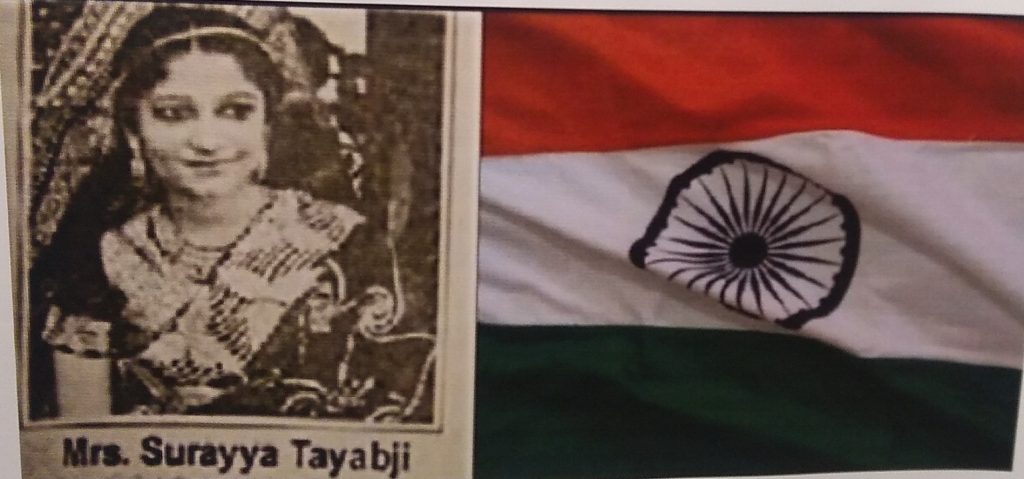
Most Indians today may not be aware that the national flag was designed by a Muslim woman, Surayya Tayabji, an active member of the Indian National Congress. Jawaharlal Nehru assigned this task to Tayabji, and it was her idea to replace the symbol of the charkha used and popularised by Mahatma Gandhi with that of Ashoka Chakra at the centre of the flag. Tayabji felt that the charkha, a symbol of the Congress party, might appear partisan.
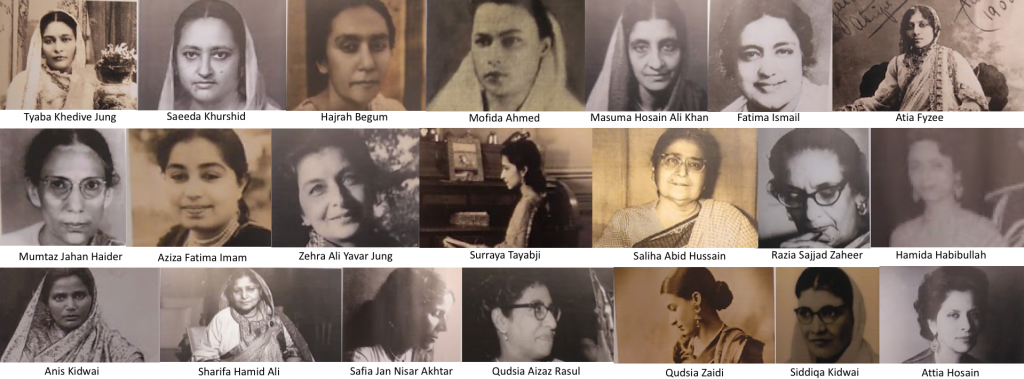
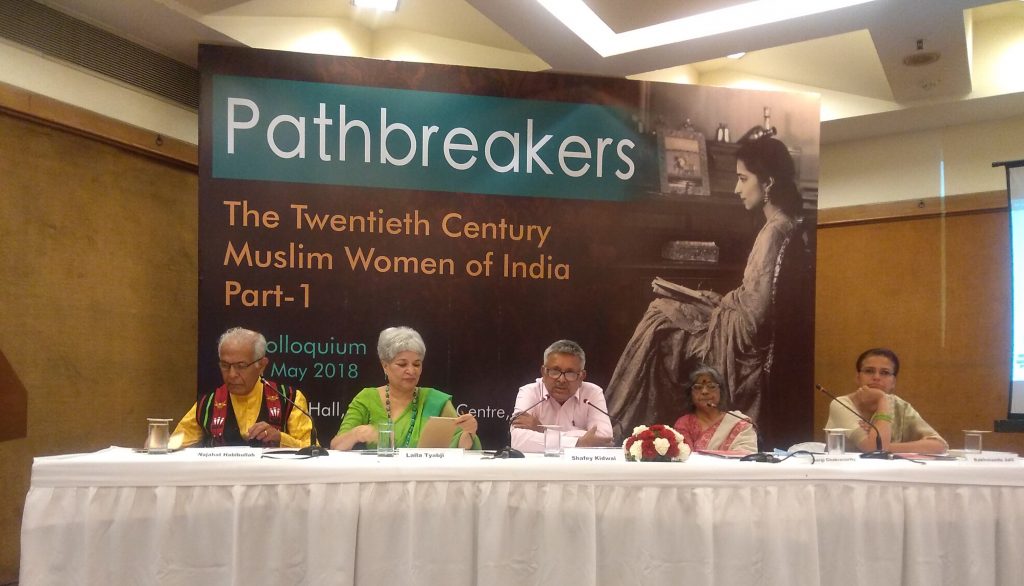
Narratives like this – often forgotten or lost in public memory – were the central theme of a colloquium that was organised by the Muslim Women’s Forum (MWF), an organisation engaged in the advocacy of Muslim women’s rights. Titled ‘Pathbreakers: The Twentieth Century Muslim Women of India’, the colloquium held in partnership with UN Women showcased the achievements of 21 Muslim women in various spheres of public life during and after the independence struggle.
Other women who featured in the exhibition included Saeeda Khurshid, Hamida Habibullah, Aziza Fatima Imam, Qudsia Zaidi, Mofida Ahmed, Zehra Ali Yavar Jung, Razia Sajjad Zaheer, Tyaba Khedive Jung, Atiya Fyzee, Sharifa Hamid Ali, Fathema Ismail, Masuma Hosain Ali Khan, Anis Kidwai, Hajrah Begum, Qudsia Aizaz Rasul, Mumtaz Jahan Haider, Siddiqa Kidwai, Attia Hosain, Saliha Abid Hussain and Safia Jan Nisar Akhtar.
The speakers participating in the discussion talked about the need to reclaim the lost narratives of Muslim women and take control of their representation.
Speaking on the occasion, Seema Mustafa, an Indian print and television journalist, pointed out that these women would not fit even the current stereotypical representation of hijab-clad, oppressed and orthodox Muslim women, who need a messiah to rescue them. Mustafa, in her keynote address, said that these women had broken barriers and challenged patriarchal order in their time; they followed Islam in its liberal spirit, refusing to be shackled by societal norms. Most of them abandoned the purdah system, she said.
Speakers panel for the session ‘Recognising and Nurturing Pathbreakers’ at Muslim Women’s Forum colloquium. Credit: Khushboo Kumari
Stereotypes in modern India
The speakers insisted that the reality was and still is that Muslim women, just like women belonging to any other socio-cultural group in India, do not constitute a monolithic, homogenous entity. They come from diverse backgrounds and subscribe to varying ideologies. Muslim women have been and still are writers, teachers, artists, scientists, lawyers, educators, political workers, legislators in parliament and in assemblies. The speakers said clubbing them under the generic rubric of backwardness was a misrepresentation.
As the regular use of terms like triple talaq, halala and purdah has come to demonstrate subjugation of Muslim women, Islam has acquired the status of the most oppressive religion for women, the speakers said. Muslim women have become an object of pity.
Commenting on Islam and feminism, Farida Khan, former dean of education at Jamia Millia Islamia and former member of the National Commission for Minorities, pointed out that gender oppression is common to all religions. “Why should Islam have the burden of taking on feminism?” asked Khan. She further explained that Islam should be perceived and understood in the social and historical context of the day. Every religion has to and does evolve with time.
Referring to the exhibition, Khan said, “It makes me sad to think that you need to have an exhibition and you need to project these women in a country where they should be well known, where they should be part of the mainstream, where everybody should know their names and know the work they have done.”
Gargi Chakravartty, former associate professor of history in Maitreyi College and author, said, “Muslim women’s political and social contributions in the pre-independence period during the major Gandhian movements or in the field of spreading education, or in the sphere of literary activities, cannot be erased from history.” She shared many anecdotes that came up in her own research about largely unknown Muslim women who have extensively worked among the poor throughout the 20th century and still continue to do so.
An eminent speaker at the colloquium, Rakshanda Jalil, recently wrote a book A Rebel and Her Cause on the life of Rashid Jahan. Jalil spoke of the inspiring life of Jahan, who was a doctor, writer, political activist and member of the Communist Party of India.
Farah Naqvi, member of the Post-Sachar Evaluation Committee (Kundu Committee) 2013-2014, summed up the purpose of the colloquium and the exhibition. “This colloquium is a response. There is a nostalgia about it. But it is not just about the nostalgic nawabi Muslim. It has a political purpose, the colloquium, which is that you cannot allow any one strand of history to be obliterated from this country. Any strand. It could be Muslim women today. It could be someone else tomorrow,” Naqvi said.
Questioning if Muslim women needed to be forced into a separate constituency, Naqvi said it was indeed a tragedy that these women’s contributions were not a part of mainstream knowledge – and that reflected failure on the part of Indian historiography.
Naqvi also pointed out that the undercurrent of the entire exhibition was nation-building because they were “also responding to a moment when Muslims are repeatedly being told that they are ‘anti-national’”. She further explained that against such a background, the Muslim community in general should not take the bait of proving that they are ‘good’ nationalists. Instead they should take pride in the achievements they have made in their respective spheres of work – especially for those who stayed on in India after the Partition.
Wajahat Habibullah, India’s first chief information commissioner and the son of Hamida Habibullah, one of the 21 women featured in the exhibition, talked about Partition and how it divided his family. He said, “It is necessary to remember and nurture the memories of all those Muslim women who then very consciously, despite family pressure and contradictions within the family, opted clearly to be a part of India”.
Contribution to literature, politics and education
The exhibition showed how extensively Muslim women have contributed in the spheres of politics, literature, education and social work.
Many like Saeeda Khurshid, founder of the Muslim Women’s Forum, actively campaigned for the Congress party. Hamida Habibullah was the the president of the Mahila Congress. Few like Aziza Fatima Imam, Fathom Ismail, Anis Kidwai, Siddiqa Kidwai and Qudsia Aizaz Rasul were members of the parliament and legislative assemblies for years.
Rasul was also the only Muslim woman member of the constituent assembly.
Sharifa Hamid Ali founded the All India Women’s Conference (AIWC), with the likes of Sarojini Naidu, Rani Rajwade and Kamaladevi Chattopadhyay, and was involved in its work alongside others like Masuma Hosain Ali Khan and Hajrah Begum – who also founded the National Federation of Indian Women.
These women actively worked with the poor and marginalised sections of society, trying to improve their access to health and education.
Zehra Ali Yavar Jung, who was awarded the Padma Bhushan in 1973, worked to improve the condition of women detainees in Hyderabad’s prisons and presided over a women’s workshop that trained and provided employment to destitute women. Fathom Ismail helped in opening rehabilitation clinics for children suffering from polio. Anis Kidwai worked tirelessly in refugee camps after Partition.
Surayya Tayabji and the Indian national flag displayed at the MWF exhibition. Credit: Khushboo Kumari/The Wire
Mumtaz Jahan Haider, who was appointed the principal of the Aligarh Women’s College in 1937, worked for women’s education her entire life.
Sharifa propagated legal reforms for Muslim women, including raising the age of marriage and drafting a model marriage contract ‘nikahnama‘.
In the field of literature and arts, these women won multiple awards. Razia Sajjad Zaheer, the recipient of the Nehru Award and Uttar Pradesh State Sahitya Academy Award, wrote novels like Sar-e-Sham, Kante and Suman. Anis Kidwai recieved the Sahitya Kala Parishad Award.
Attia Hossain used to write for Pioneer, Statesman and Atlantic monthly and wrote several novels, most notably Sunlight on a Broken Column and a short story collection Phoenix Fled. Aliya Fyzee wrote Indian Music (1914), The Music of India (1925) and Sangeet of India (1942) with her husband.
Qudsia Zaidi wrote and translated books for children, with Chacha Chakkan ke Draamae among the most loved ones. She also founded Hindustani Theatre in 1954, the first urban professional theatre company in independent India.
Khushboo Kumari has a BTech in information technology and is pursuing an MBA in marketing from MICA, Ahmedabad. She is an intern at The Wire.
source: http://www.thewire.in / The Wire / Home> History> Religion> Women / by Khushboo Kumari / May 30th, 2018
Back from the brink: The western wall of the Ashoorkhana shows off tiles with intricate inlays. | Photo Credit: K.V.S. Giri
Telangana government and Aga Khan Trust are working to restore the monument ahead of rains
It is a race against the monsoon as Hyderabad’s 17th century Badshahi Ashoorkhana, famed for its resplendent tile work, is restored to its original finery.
The sprawling structure, which turns into a house of mourning during Muharram, is located in a narrow bylane of the old city. On Sunday, workers were busy plastering a high wall with brownish lime mortar in the blistering sun, using the cover of a blue tarpaulin. .
On another side of the wall where the restoration is taking place, framed by an arched entrance, is the 400-year old Ashoorkhana. It was built sometime in 1611 by Hyderabad’s founder, Muhammad Quli Qutb Shah.
“We are consolidating the structure before the monsoon sets in. The documentation is also being done in parallel. Once that is over, we will decide on a conservation plan. The tile work has very fine detailing. At some points, the tiles have been painted over. This will require painstaking documentation,” says N. R. Visalatchy of the Telangana Department of Archaeology and Museums.
The documentation is being done by the Aga Khan Trust for Culture with which the State government has signed a Memorandum of Understanding. “We have to do the work before the monsoon, because there are points from which seepage might occur and that will affect the tiles,” says Prashant Banerjee of AKTC. The restoration is a challenge, because materials must be moved through a narrow lane.
Heritage recovered
The restorers are using a lime mortar mix for plastering, but that is not their only weapon. “Pulped and cured wood apple is injected into the gaps. It works like a silicone sealant that expands and contracts without letting the water in. Concrete sealants become rigid, and seepage happens,” says Mr. Banerjee.
The Ashoorkhana, turns into a pilgrimage site when alams (battle standards) are installed to commemorate the battle of Karbala in 680 A.D. Ashoora or 10th day of Muharram is when the battle took place. The monument was lost for several decades when Emperor Aurangzeb’s forces turned it into a bandikhanato keep wheeled vehicles. Much later, the September 1908 floods caused havoc, washing away some tiles. In a shocking turn of events, it was turned into a garage and parking space at one time. A legal battle waged by the Moosavi family made the monument accessible again, and conservation moves followed the eviction of squatters.
source: http://www.thehindu.com / The Hindu / Home> News> Cities> Hyderabad / by Serish Nanisetti / Hyderabad – June 03rd, 2018
Many participated actively in the agitation for Statehood
At a time when the Telangana sentiment was at its peak, several Muslims and Muslim organisations jumped into the movement. Be it the 1969 agitation or, for that matter, more recently, in 2008 and 2009. And with the anniversary of the formation of the State on Saturday, some of those involved in the movement share their experiences.
Jamaat-e-Islami Hind Telangana and Odisha president Hamid Mohammed Khan says that it was in 2008 that the socio-religious organisation jumped in to the fray.
The Jamaat, he says, was aware of the region’s backwardness and its causes which is why the decision was taken to join the movement.
“We formed an advisory committee to study these injustices. We analysed a lot of government released data, Planning Commission reports and the distribution of resources to Telangana region. We analysed government employment patterns too. In 2008 we decided to wholeheartedly support the movement,” Mr. Khan says.
Organised garjanas
The Jamaat, he says, was a part of the Telangana Joint Action Committee, and its organs supported the cause. “We organised Telangana garjanas in all districts and used our established units to further the cause of Telangana,” he says.
While the Jamaat formally took part movement in 2008, the All India Majlis-e-Tameer-e-Millat (AIMTM), another socio-religious organisation was active during the 1960s.
According to its vice-president Ziauddin Nayyar, it was in 1969 that the then general secretary Laiq Ali Khan was actively associated with the Telangana Praja Samithi, co-founded by the then chief minister of erstwhile Andhra Pradesh M. Chenna Reddy.
“Several of the Tameer-e-Millat’s leaders were even jailed for being a part of the agitation. Our ties were so close with the movement. Another member, Tahir Osmani, was well known for his renditions of poetry and slogans for Telangana statehood,” Mr. Nayyar recalled.
Observers said that with the passage of time and weakening of the organisation, the AIMTM could not be an active part of the later years of the Telangana movement.
“Apart from these two organisations, several individuals too took part in the movement. They were well aware of the injustice meted out to the people of the state,” an observer said.
source: http://www.thehindu.com / The Hindu / Home> News> Cities> Hyderabad / by Syed Mohammed / Hyderabad – June 04th, 2018
Shazia wanted a create a book where you feel like cooking what you see
Bengaluru’s Shazia Khan, runner-up at Masterchef 2, is out with her book What’s On The Menu
It may be easy to cook from a recipe off the Internet, or cook watching a YouTube video. But how do you know, for example, which biryani recipe to pick from the hundreds that pop up?
And therein lies the charm of a cookbook — you will go for the recipe that comes from a person you know, or whose food you are familiar with or are a fan of.
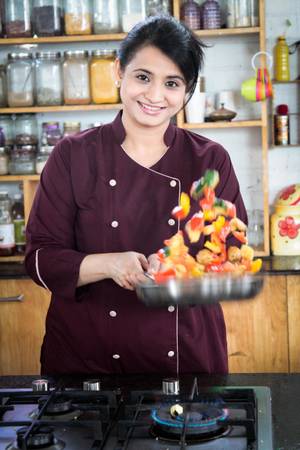
That is the logic that drove Bengaluru’s Shazia Khan, runner-up at the Masterchef India 2 series a few years ago to write What’s On The Menu? “When I started cooking, I was an amateur. I learnt from cookbooks. I wanted to write my own after Masterchef, which would feature cuisines of the world, and use easy ingredients — something that a beginner or an expert could cook from,” says Shazia smiling the smile that she was noted to flash, even under all the pressure of the TV show. “I also wanted generation-old recipes to be treasured. I wanted it to be a pictorial because it is only when you see good food that you feel like cooking.” Shazia’s food has been made more gorgeous looking by photographer Saina Jaipal.
She agrees the book is a “hotchpotch” of recipes. The book takes you through salads, soups, and sections dedicated to vegetarian, chicken, mutton, seafood, and desserts. An introductory section teaches you how to put together masalas and chilli oil and other such ingredients necessary for the dishes.
Food is something that always brought people together in her large joint family where Shazia grew up as one among seven siblings.
“Food was always a celebration and it spread a lot of happiness — something that rarely happens today among people.”
Shazia admits that food has taken on new avatars. “There is surely a food revolution. With the Masterchef craze, awareness is high. With everyone Instagram-ing food pictures, food has gone viral. People are more confident now to try new recipes. It has gone beyond being just a three-time meal. It is about being more creative and food presentation is gaining more importance.” Exposure is huge, as is availability. “When I started cooking, I didn’t even know what zucchini was. Today you will get three colours of bell peppers in your neighbourhood market.”
Having all along cooked for family and friends, it was her sons who egged her on to try for the Masterchef series. “It has almost been four years since, and I’ve done a couple of TV shows, YouTube videos and demos. I take private classes for individuals. I run summer camps,” she says, talking of the endless possibilities of what one can do these days in the food business. Shazia, who is also involved in the family-run education business, is a member of the board of management at Delhi Public School (Bengaluru/Mysuru). She hopes to start a culinary school, because “going abroad to study culinary arts is very expensive. I want to make it a finishing school for women, so they can get employment opportunities and placements as home cooks using their training. I mean who wouldn’t love to have a trained cook at home!” she says.
Kitchen talk
* Three things you will find in my kitchen: Cheese for sure! Cooking chocolate, and eggs.
* What I love eating: Thai, because it bursts with flavours.
* What I love cooking: Modern Indian food — not twisting its taste but presenting it in a different way. My tandoori chicken roulade is a good twist to the whole grilled chicken, using the French technique to make it more healthy. My grilled semolina with mushroom is nothing but the uppit presented to look like breadsticks, with mushrooms thrown in for a twist.
* When I eat out: My husband is not a big foodie. He loves Indian or Chinese. But when we are travelling, I love to experiment, try local cuisine, learn dishes and pick up recipes.
Pumpkin and peanut subzi
Shazia shares this recipe of a subzi from her book What’s On The Menu that her father-in-law enjoys, made in his village near Mandya, in Karnataka:
(Serves: 4 to 5 )
Ingredients
Vegetable oil – quarter cup
Onion – 2, (finely diced)
Ginger paste – 1 tsp
Garlic paste – 1 tsp
Tomato – 2,
( finely diced)
Red chilli powder – 1 tsp
Coriander powder – 1 tsp
Turmeric powder – half tsp
Fresh coriander leaves – 3 tbsp,
Pumpkin – 600 gms,
(peeled, chopped &
cubed)
Salt to taste
For the Peanut Masala
Peanuts – 100 gms, (dry roasted & skin removed)
Garlic – 10 cloves
Long, dry red chilli (Kashmiri) — 8 (dry roasted)
In a pan, heat oil. Add onions and fry till golden brown. Add ginger-garlic pastes and fry for a minute. Add tomatoes, chilli powder, coriander powder, turmeric powder, coriander leaves and fry till the tomatoes become so. Add the pumpkin cubes and sauté. Add salt and cook till the pumpkin is so and done. Coarsely grind the peanut masala ingredients and add to the cooked pumpkin. Garnish with coriander leaves and serve with hot akki rotis and ghee.
source: http://www.thehindu.com / The Hindu / Home> Food / by Bhumika K / Bengaluru – April 16th, 2016