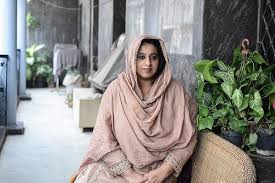
Shaista Yacoob, 43, is a writer, poet based in Bangalore. Born and brought up in Bangalore, she has been living in Benson Town since Childhood. She has done journalism in College. Recently, she started a small catering business called Shaista’s Little Kitchen.
“It has been a few years since I have been learning the Quran. It is very difficult to understand the true meaning of the Quran, unless you have someone to teach you. I have always read the Quran, but understanding it’s true meaning is very tough.”
“I really want to put in the effort of learning it. You have to understand the context of what was said and why it was said. There has been a reason, there has been a context, a moment in the prophet’s life when something has happened, and the revelations came on him. So we have to know the situation to understand what it is all about.”
I saw a friend of mine recently who is also learning the Quran. She found a few things in Quran which she thought were very demeaning to women. but then when she went and researched, she realised what she had been thinking is not what the Quran says. It was actually a very beautiful interpretation of a woman.”
Her earliest memory of Ramadan was of an old man who used to come to the locality to wake everyone up for Sehri. She says “I remember this old, frail man, so bent and concave, he used to come every morning with a duff. This year he did not come. I don’t know why, but he came every year without fail. It is a beautiful moment when you wake up in the morning for sehri. God has said that he is listening, and that there is no veil between you and him, at that moment.”
” It is a magical month, Ramadan. It leaves you with a new feeling. After it is over, it is a big turmoil, its very challenging. You are so much in the mode of this month. Your soul is peaceful and your desires limited that coming out of it is not easy.”
In a first, an IIT-Kanpur startup, in association with a Lucknow-based food delivery firm, successfully flown in flasks of freshly brewed tea on the doorsteps of its customers in the city of nawabs.
TechEagle Innovations, founded and run by IIT Kanpur graduate Vikram Singh Meena, pilot-tested delivery of two litres of hot tea with the help of battery-powered and GPS-fitted drones on May 23. It has developed the specialised drone to drop-ship a consignment up to 2 kg within a 10-km-radius of its take-off station with just a single click of a mouse. TechEagle has joined hands with OnlineKaka, a Lucknow-based food delivery startup, for these test flights.
“We have successfully delivered world’s first chai via drone. Now, we would provide these mean machines to other food delivery startups like Zomato, Swiggy and Foodpanda. To begin with, we plan to venture out in north India,” Meena told TOI.
Talking about the drone-delivery model, Bilal Arshad, who founded OnlineKaka, alongwith friend Ahad Arshad and Salman, said: “It’s not like the customer will directly receive the order from the whirring gadget. The drones would be flown and received by our executives at different points and because they would not be commuting through the busy streets, it would cut down the delivery time drastically.” Although the cost implications would be known only after a full-fledged launch of the service, both Bilal and Ahad said they would try to ensure that there was no extra burden for the customer as they would be saving on commuting. At present, they charge Rs 59 per delivery.
Although the trial was conducted with DGCA’s permission, the firs is yet to get a nod for the regular service. “The DGCA had said the norms for drone delivery would be specified in January but it hasn’t come through. It is now expected sometime in July. In sync with the Civil Aviation ministry, the DGCA would mark zones for the drone flights and assign altitude, etc, besides issuing licence for each gadget. The pilots hired for the drones would be another factor to determine cost of operation,” said Ahad.
Interestingly, there are no active drone-based food delivery services in the world. UberEats, the largest grub-delivery platform which has recently opened shop in India, has recently tested a similar drone-based delivery in San Diego, US.
In October last year, global e-tail giant Amazon had filed patent for delivery of products via drones in India.
In 2014, an unmanned drone was used to deliver a pizza to a flat in a high rise in Worli, Mumbai. Another drone startup, based out of Kanpur, called Aarav Unmanned Systems, raised a bridge round funding In April 2016.
However, many firms and startups, who are raring to begin unmanned aerial vehicles (UAV) or drone-based commercial operations (like door-to-door delivery, aerial mapping, infrastructure monitoring and product transport) across the country, have hit a regulatory roadblock as India’s sky watchdog, the Directorate General of Civil Aviation (DGCA), hasn’t yet formulated a final official policy for the same. Although, Goldman Sachs has estimated that drone industry will be worth $125 billion globally by 2020.
The founding members of TechEagle Innovations started designing and manufacturing since 2015 in the garage of IIT Kanpur hostel and formed the B2B tech startup only in January 2017.
“Our startup develops custom-made drones of both types — rotary wing and fixed wing — which can carry 500gm to 5kg payload. The wingspan ranges between 60cm and five-meter, flight time varies between 30 min and two hours,” added Meena.
“The drone-based delivery system came to our minds when we saw real-life problems like traffic jams affecting delivery services, especially food transportation. Then, we partnered with Online Kaka,” the TechEagle CEO said.
TechEagle plans to expand its services across the country based on need and resources. “We have analyzed that around 10-15 drones can be deployed in one city. Our drones can traverse 10 metres in one second and one single trip can last up to 20 minutes. So, it can fly up to 6km to deliver tea and come back to its take-off spot. We are doing research on batteries to increase the payload capacity and flight time,” Meena added.
On the likely cost of food or tea to be delivered via drones, Meena signed off by saying, “Quality and price of tea or any food items will be handled and decided by the food delivery firms, who will use our drones, instead of a bike or a motor van. We can’t disclose the exact selling prices of the drones at present. But when the service becomes fully functional, our drone delivery will definitely be cheaper than the current modes of transportation. We are in talks with quite a few food delivery startups.”
There was a time in the city when one could order little from home other than pizza. It was 2016 and while big names like food panda and zomato were foraying into the Lucknow market, a startup with just two delivery boys caught the fancy of locals, whose staple feast is the kabab-biryani fare. “Our shoestring budget did not allow a lavish ad campaign, so we relied more on word of mouth,” said Ahad Arshad, who founded OnlineKaka, along with friend Bilal Arshad, adding.
Founded in 2016, OnelineKaka is a popular service in Lucknow for delivery and is preferred for delivery from iconic joints from crowded Old City. “It saves people the trouble of commuting to the crowded, jammed areas and they could enjoy kabab-paratha, biryani, kulcha-nihari in the comfort of home,” Bilal says. Today, they have a 125-strong army of delivery boys and an equal number of vendors on their panel, with over 500 new joints in queue. From a turnover of Rs 20 lakh in their first year, they have notched Rs 5 crore and recorded a 15% growth per month, said the founders.
“There was a minimum-order rider in the beginning but now we deliver the smallest of orders,” said Ahad, adding that their latest offering was delivery of the city’s favourite chai and bun-makhan, anywhere. “The packing ensures you get your cuppa steaming hot but with a successful run of delivery by drone, we hope to pick up more orders in this segment,” he added.
source: http://www.timesofindia.indiatimes.com / The Times of India / Home> News> City News> Lucknow News / by Sovan Manna / TNN / June 01st, 2018
Hina Oomer of The Luxe Box has put together the perfect luxury gift boxes, exclusively for AD readers!
A Luxebox is a neat little box that is thoughtfully put together with an ensemble of gifts that look, smell, taste and feel good!
As much joy as searching for the perfect gift for our loved ones gives us, there’s an equal joy in finally getting it home and gift wrapping it! Some people like pretty-looking gifts and some prefer ones they can put to use, over and above other factors. The Luxe Box, a personalised luxury gifting service curated by stylist and image consultant Hina Oomer, offers all of this and more, in one gorgeously wrapped package. Essentially, a “luxebox” is a thoughtfully put together gift box that takes into account the likes, preferences, age, and interests of the receiver along with keeping in mind the occasion. The Luxe Box ensures that these personalised gift boxes can be presented across different occasions—Father’s Day, birth anniversaries, wedding anniversaries, farewell parties, bridal parties, graduation day parties, and more—as thoughtful and useful gifts.
Hina Oomer obliged us when we requested her to curate 5 exclusive design-meets-home decor inspired luxeboxes for our discerning readers. Here’s what she came up with:
Gift Guide: Rustic Home Box
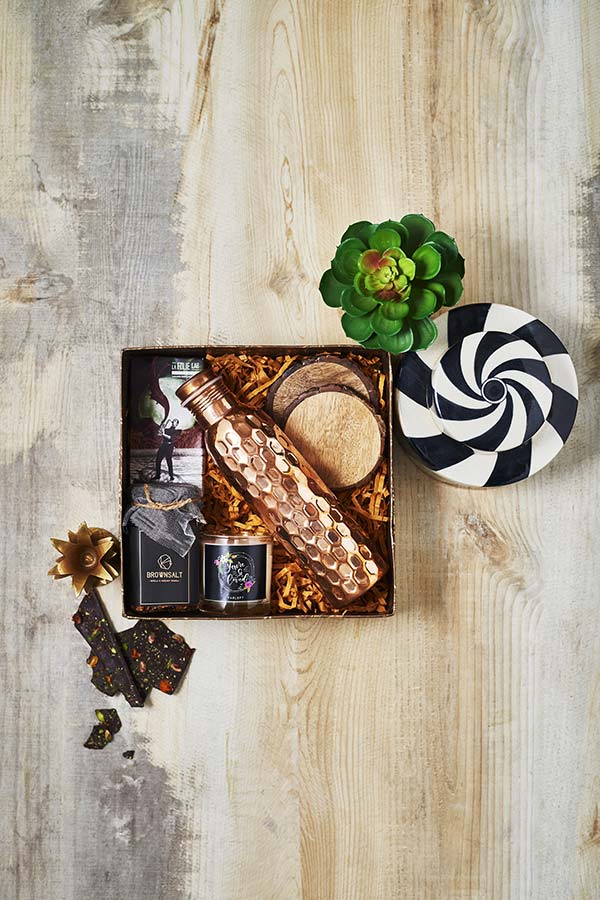
A copper bottle, set of wooden coasters, soy wax scented candle, jar of Brownsalt Nutella granola and a La Folie chocolate
The Rustic Home Luxebox
Guide Guide: Entertainment Box (Party Box)
A set of agate marble coasters, marble lotus bowl, Chado green tea, lavender honey, Shift soy wax scented candle and Nomad table napkins
The Entertainment Luxebox
Gift Guide: Sunday Brunch Box
Packets of Slurrp Farm healthy superfood pancake mix, soy wax scented candle, jar of Sprig coconut palm sugar and a packet of Black Baza coffee
The Sunday Brunch Luxebox
Gift Guide: Netflix and Chill Box
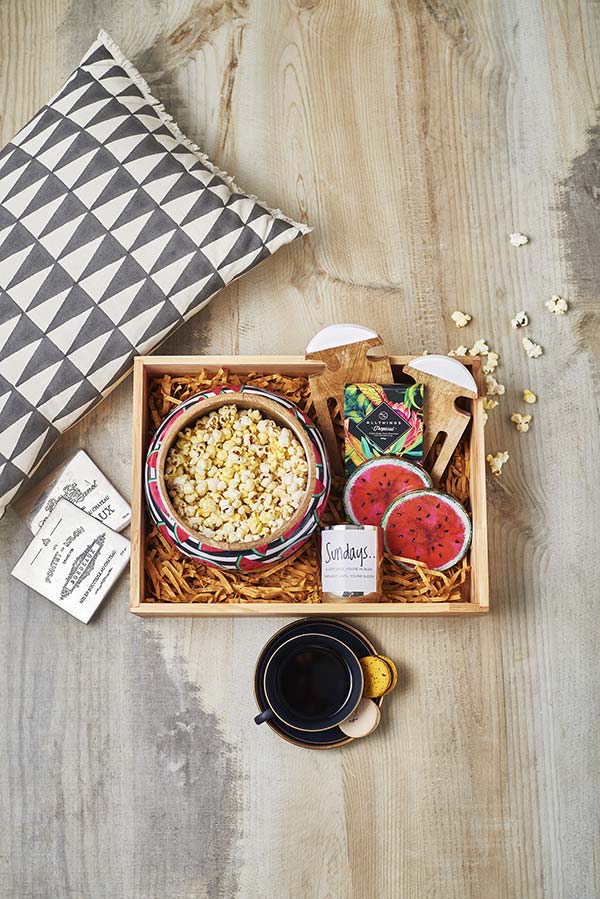
Faaya tropical themed wooden salad bowl with a set of salad mixers, a set of watermelon printed coasters, scented soy wax candle and an All Things Tropical chocolate
The Netflix and Chill Luxebox
Design Enthusiast Box
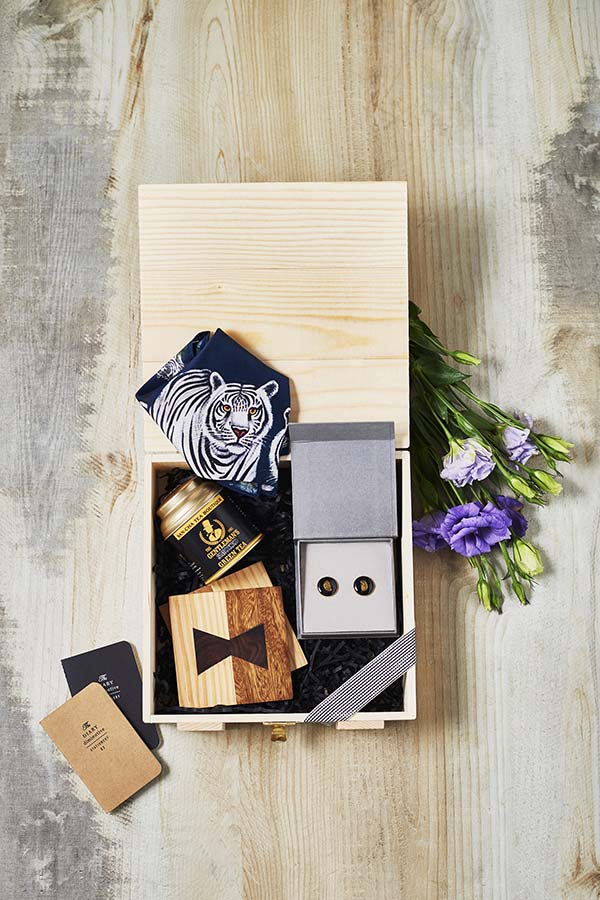
Meesha printed pocket square, Sancha tea, bow tie coasters and a set of Azga cufflinks
The Design Enthusiast Luxebox
source: http://www.architectural digest.in / Architectural Diges – AD / Home> Lifestyle> Style / by AD Staff / May 24th, 2018
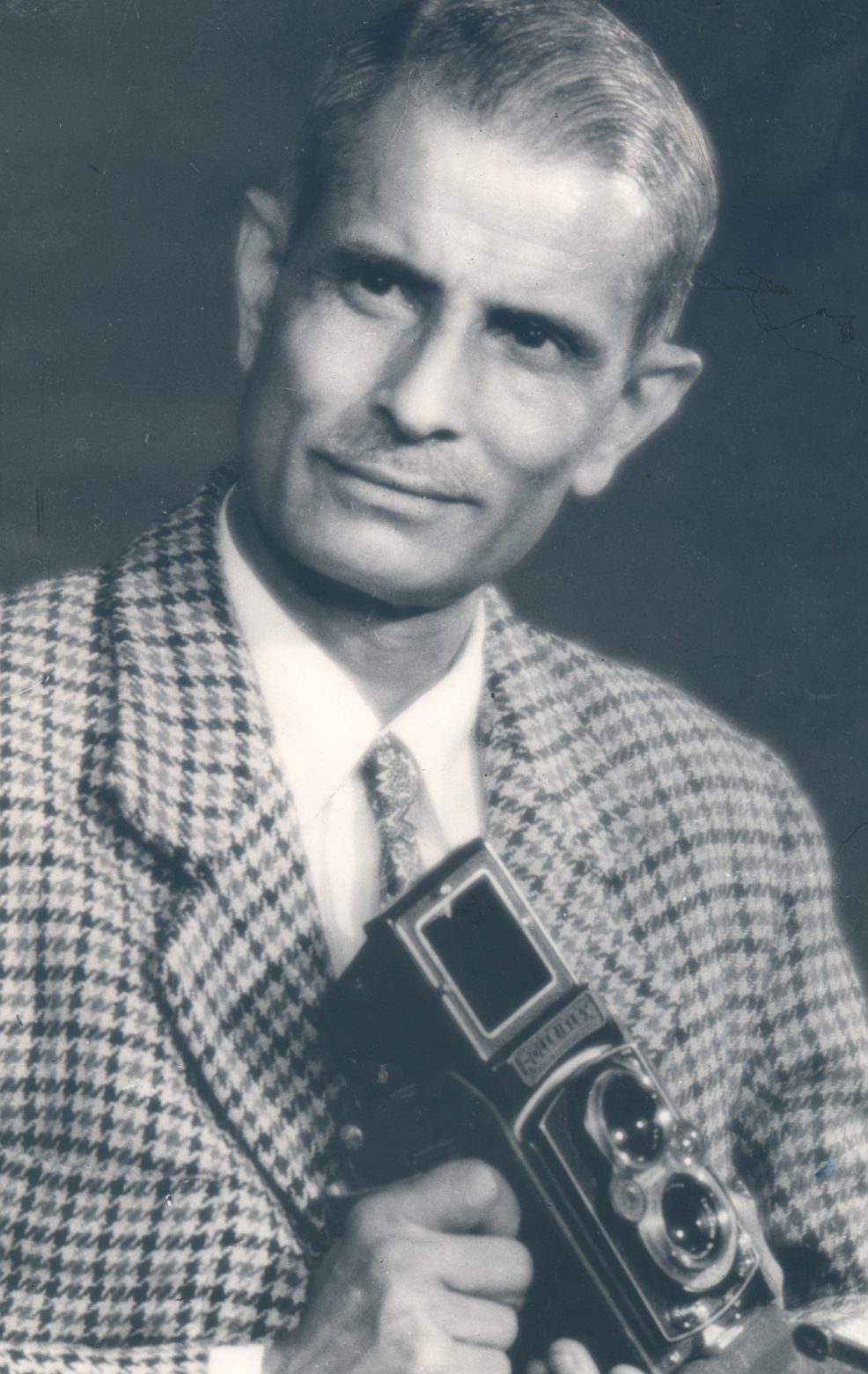
In a career spanning 70 years, A.L. Syed became one of the important figures of 20th-century Indian photography. Working in black and white, his apparently neutral stance conceals a deeply compassionate vision of human existence, says HAVOVI ANKLESARIA.
THIS collection of 93 masterly duotone photographs by Abid Mian Lal Mian Syed is a tribute to the man and a selection of his work. In a career that spanned 70 years, he was perhaps one of the most important figures in the world of 20th-century Indian photography. Born in 1904, Syed spent his childhood in Palanpur where he and his brother became the official photographers of Palanpur State and much of their professional work was done for the royal families of various North Indian States.
In 1923 Syed won first prize in The Illustrated Weekly of India Photo Contest for his photograph of the sunrise at Chowpatty, unfortunately not included in this selection. He began publishing his work in 1925 and towards the end of his life claimed to have been published in every Indian magazine. In 1935, he won the Popular Photography award for his photograph “Traveller of the East, Palanpur” and, with it, instant international recognition.
For generations of viewers overwhelmed by colour, the black and white image is the medium of the master-craftsman and Syed does not disappoint. His eye is impeccable. These are wonderfully evocative photographs sans colour but with varying intensities of light and shadow. O.P. Sharma’s Foreword is slightly overburdened with accolades, but he does a good job of introducing his subject. Syed’s range was vast — from portraits of the rich and powerful to day-to-day village scenes. Much of the attraction of the photographs is the strong emphasis on line and form, particularly the section on his historical buildings and religious monuments. Like many of his generation, he was a keen hunter, but in this collection there are no trophies, only living birds and animals.
The book begins with a series of portraits of the royal families of Northern India in their resplendent gear. Most of the portraits are taken in isolation. The fixed frontal alignment, the expression of supreme assurance from individuals who know their social and political identity, symbolise a way of life and attitudes that are somewhat diminished in contemporary India. The portraits are nonetheless important as a part of the national archive. The first photograph is a long shot of a very young Gayatri Devi of Jaipur seated in a dark room. Her freshness and youth contrasts sharply with the antique grandeur of her surroundings and accentuates the loneliness of her surroundings.
Syed was obsessed with the desert, which penetrated his consciousness almost totally. The desert as star recalls the haunting scenes in the film “Lawrence of Arabia”, though Syed’s photographs predate the film by several decades. Most of his outdoor photographs have a feel of desolation. Even relatively busy scenes evoke a sense of vastness. One of the great classics of this collection and possibly in the history of photography is “Different Climb, Jaisalmer” in which a camel is being drawn up a sand dune. The camel and the man are not in prominent focus. What is emphasised is the sharp angle of the dune’s gradient, evoking the terror and seductiveness of this featureless terrain.
In “Desert Child”, child and lamb pose in front of the camera unselfconsciously. Innocence declares itself without surrendering to the “cutesy bunny” manipulations traditionally associated with photographs of children and animals. Their vulnerability is brought into focus in the context of a remorseless desert existence.
Perhaps one of the most extraordinary photographs in this collection is “Risky Balance” showing a man perched on a rope on one leg with a donkey strapped to his back. The upward tilt of the camera captures the perfect equipoise of the acrobat featured against a dull grey sky. But it is not simply the showmanship that amazes. The image resonates with a sense of perilous uncertainty of living on the edge with no guarantees and of having to depend on skills whose rewards are irregular. Indeed the title is ironic in a way that Syed may not have intended.
In 1971 Syed developed Parkinson’s disease, but continued to work. He died in 1991. Towards the end of his life, he was critical of contemporary Indian photographers and photo-journalists for parading the spectacle of poverty and human misery to satisfy the international market. Syed’s camera was not an instrument of authorship. There is nothing of the vicarious or the gratuitous in these pictures. The frame is a medium of documentation whose artistry is concerned with the simple, direct act of viewing. His apparently neutral stance conceals a deeply compassionate vision of human existence as one of isolation, loneliness and incompatibility.
Visions from the Inner Eye: Photographic Art of A.L. Syed, Introduction by O.P. Sharma, Mapin Publishing Pvt. Ltd., p.111, Rs. 1000.
source: http://www.thehindu.com / The Hindu, Online Edition / Home> Literary Review / January 06th, 2002
Abidmian Lalmian Syed (1904-1991), more popularly known as A.L. Syed, is the Doyen of Indian photography. He is regarded as one of the key figures whose works have captured the glory and aura of the Princely States of pre-Independence India.
Born on February 2, 1904, in Vernawada, a village 16 kms from Palanpur, he spent his early childhood in the town where his father was hakim of the Royal family. It was a school tour of Mumbai in 1923 that played an important role in shaping his life. On that trip, a photograph he clicked of sunset at Chowpatty won him the First Prize in Illustrated Weekly of India’s snap shot competition. For the next five decades, his photographs were regularly featured on the pages of the Weekly.
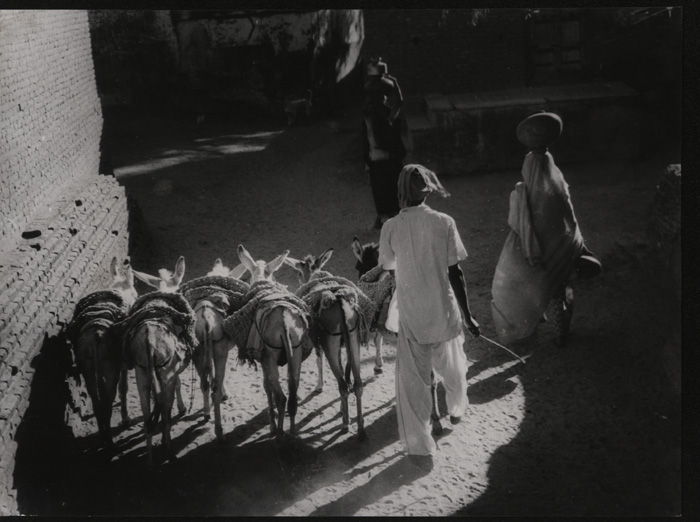
Morning Time In Dyara – 1938 – A. L. Syed
In 1925, his images first began appearing in Kumar, a Gujarati magazine, edited by well- known artist Ravi Shankar Raval, and he was a regular contributor, with photos and feature articles till the publication ceased in 1940.
At that time he was already working with his elder brother, K.L. Syed, a well known freelance and also official court photographer in Palanpur. But unlike his brother, A.L. went beyond portraits, and his famous photograph ‘Traveller of the East’ taken in 1934, won international recognition and was published as one of the world’s best photographs in Odhan Press Home Library series. Since then it has been a part of over 40 international exhibitions and winner of the annual Popular Photography award in 1935, and later became part of the famous Hutchinson Collection in the USA.
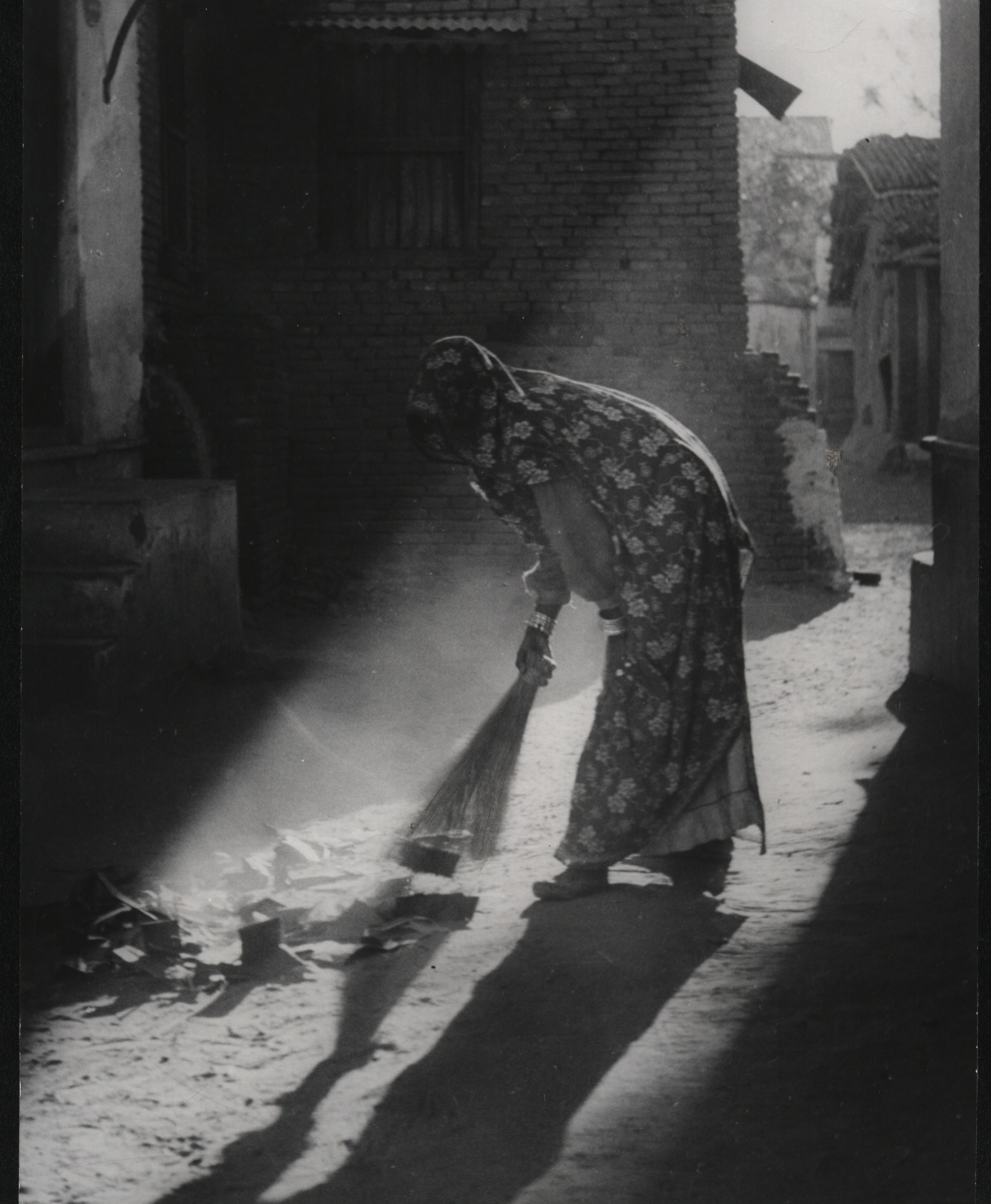
Street Sweeper – 1938 – A. L. Syed
One of his many one-man shows was inaugurated by the then President of India, V.V. Giri, on the occasion of the 6th Convention of the Federation of Indian Photography hosted by the Camera Society, Delhi.
Another of his photographs, ‘Difficult Ascent’ was chosen for an award from among the 2,500 received from 15 Asia Pacific countries in the Asia Pacific Cultural Center for the UNESCO (ACCU) Photo Contest in Tokyo in 1977, and in 1980 he was given the honour of inaugurating a photographic exhibition organized by Illustrated Weekly of India to commemorate its centenary. Later in 1983, he was one of the 10 eminent photographers of the world to receive the India International Photographic Council’s highest honour, the Honorary Fellowship for outstanding contribution and service to various branches of photography.
Mr. Syed was more than a photographer; he was a master artist, highly respected in Indiaand abroad, both professionally and personally. His skill in bringing alive remarkable images of day to day life around the country and crafting exquisite portraits have made his work live long after he passed away on August 30, 1991.
His was the hand behind the Arabic inscriptions on the Taj Mahal, which have captivated tourists from across the world.
But today, the mausoleum and the dwelling of Amanat Khan, the calligrapher of the Taj Mahal, lies in decay, neglect and encroachment.
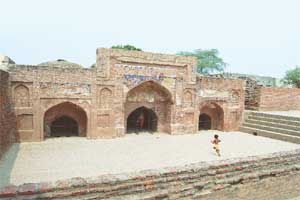
Sarai Amanat Khan, about 29 kilometres south-east of Amritsar on Tarn Taran Attari road, was built by Khan in 1640, where he lived a reclusive life following the death of his elder brother Afzal Khan, the prime minister of Shah Jahan.
But here too, Khan, who came to India from Iran in 1609 and whose real name was Abdul Haq before being conferred the title of “Amanat Khan” by Shah Jahan for his impressive calligraphy, has left the imprint of his craft — the sarai has beautiful Islamic calligraphy inscribed on its fading blue and yellow tiles.
Sarai Amanat Khan was also a guest house, where travellers on the Lahore-Agra route on the Grand Trunk Road would stop for rest in the middle of a long strenuous journey. They would live in the small rooms inside the sarai, and pray in the adjacent mosque and large courtyard.
Today, Sarai Amanat Khan is dilapidated — the Nanakshahi bricks are falling off, and the eastern gate is in disarray; some 800 feet below it is Khan’s ruined tomb.
The sarai is in the middle of a densely populated village, also named after Amanat Khan.
With several shops in its immediate vicinity, the Archaeological Survey of India-protected monument is a site of rampant encroachment. Several families live inside the rooms of the sarai illegally, and claim to have been doing so since Partition. “I was born here,” says 50-year-old Ranjit Singh. “People have been living here since 1947. There had been talks about giving us alternative land and compensation, but those have not materialised,” he adds.
source: http://www.archive.indianexpress.com / The Indian Express / Home> Archive / by Navjeevan Gopal, New Delhi / July 29th, 2012
In 2014, the Congress-led government had sanctioned Rs 10 crore for the construction of an Urdu Bhavan at Mumbai University’s Kalina campus to promote the language
The state govt’s proposal to set up a centre for the language outside of the university, where it even has an allocated space, has language lovers crying foul
In 2014, the Congress-led government had sanctioned Rs 10 crore for the construction of an Urdu Bhavan at Mumbai University’s Kalina campus to promote the language. Land was allocated and bhoomi poojan was performed. However, the project never saw the light of day.
Cut to present: The state government has proposed building the Urdu Bhavan in Byculla,. “The bhavan will come up on a 10,000 sqft area near the Agripada police station. And, if we get a larger FSI, we will be able to construct a four-storeyed structure with state-of-the-art facilities. We have asked the Centre to provide us with R50 crore for this,” says advocate Waris Pathan, All India Majlis-e-Ittehadul Muslimeen (AIMIM) legislator from Byculla, who has been at the forefront of getting approvals for this project. As per the proposal, the bhavan will have a library, convention centre, a girls’ hostel and will offer a range of new courses. “The Urdu readership in Byculla is high so it will see a lot of traction,” says Pathan
‘It’s not a Muslim language’
Yet, the news of the bhavan coming up at Byculla has lovers of the language divided. Members of Jai Ho Foundation, a charity organisation in Kurla, have written a letter to the Union Minority Affairs minister Mukhtar Abbas Naqvi, CM Devendra Fadnavis, Governor C Vidyasagar Rao, education minister Vinod Tawde and MU VC Suhas Pednekar, requesting them to reconsider the location. “We want the centre to be built inside the varsity because that will make it more accessible to students. By constructing it in a Byculla bylane, they are propagating the misguided notion that it’s a Muslim language,” says Jai Ho’s president Afroz Malik. Presently, the MU has a bhasha (language) bhavan dedicated to Marathi and Sanskrit.
There have been talks about building a Hindi bhasha bhavan as well. Malik says Kalina is a strategic location which makes it convenient for people commuting from both the suburbs as well as from South Mumbai. Moreover, setting it up in a healthy academic atmosphere will only help promote the language, he adds. “MU has people enrolling from all walks of life. It also has students from overseas. Urdu will get more exposure,” he states.
A matter of space
Meanwhile, the land allocated to the Urdu Bhavan at Kalina remains vacant. This is in stark contrast to the buzzing Urdu department, which has seen a sharp growth in the number of students as well as non-teaching staff. “The increasing curiosity around the language has translated into more people signing up for courses. The MA course sees more enrolments,” Dr Sahab Ali, head of Urdu department, says. Presently, the department has an overall strength of 200 students. While Dr Ali is happy to learn of a bhavan coming up in Byculla, he says it’s not enough. “I would want the centre to be built here because we are running out of space to accommodate students,” he says. The Urdu department at MU was established in 1982.
In 2013, Dr Ali had written to the Department of Minorities Affairs requesting the need for a bhasha bhavan to cater to the growing needs of the language. The request received the green light in 2014. The change in ruling parties resulted in the project languishing for years.
Farid Khan, convenor of Urdu Caravan, an NGO that promotes Urdu language and culture, says he sees merit in NGO Jai Ho’s stand. “I believe a language will thrive in an academic setting.”
source: http://www.mid-day.com / mid-day.com / Home> News> National News / by Anju Maskeri / May13th, 2018
A.K.Hussain of Ahamad Brothers of Tiruchy was unanimously elected as president.
Tiruchy:
Former students of Jamal Mohamed college (JMC) of Tiruchy formed an alumni association recently for which A.K.Hussain of Ahamad Brothers of Tiruchy was unanimously elected as president. In a release at Tiruchy on Tuesday, Hussain said while Abdul Aleem, founder of the Ant-Dowry Association of Koothanallur was elected as secretary, Riyaz of Tiruchy was elected as treasurer.
Basheer Ahamed and Dr. Gobinath of Tiruchy were elected as vice-presidents and Mohammed Ismail and Dhanraj of Tiruchy as joint secretaries. In addition to this, a seven member executive committee has been formed with auditor Murugan, Nazeer Ali, Padmanabhan, Senthilkumar, advocate Madhani, Akbar Ali and B.G. Naidu Balaji, he added.
Hussain said that old students working and settled abroad had already formed and were running the JMC alumni associations in various countries including at Malaysia, Singapore, Kuwait,Saudi Arabia and Chennai in TN and giving scholarships to poor students of JMC. They were also helping to improve infrastructure and construct new buildings for the college. The newly formed Tiruchy based alumni associati-on of the JMC also will follow the footprints of the existing alumni associations, he added. Secretary of the JMC Dr. Khaja Najummudeen, assistant secretary Jamal Mohamad Sahib and others greeted office bearers of the newly formed alumni association.
source: http://www.deccanchronicle.com / Deccan Chronicle / Home> Nation> In Other News / Deccan Chronicle / July 15th, 2015
Karim’s had transformed from a local purveyor of aloo gosht into a monument. It was visited by princes and prime ministers, eulogised by journalists, studied by historians, and patronised by tourists.
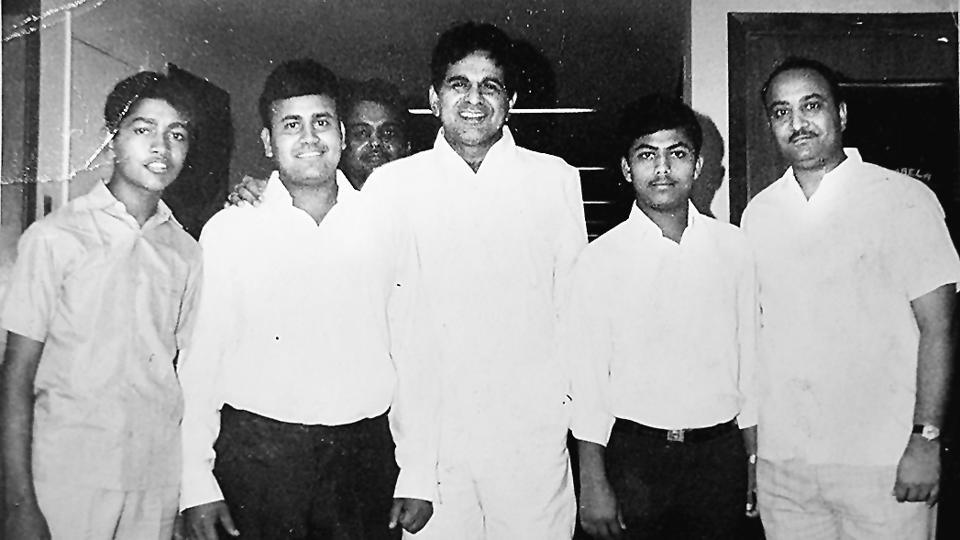
Haji Zahooruddin (extreme right) with Bollywood star Dilip Kumar.(Image courtesy Zain-al-Abedin,Zaeemuddin Ahmed and family))
When Haji Zahooruddin started working at Karim’s over 70 years ago, the business consisted of a single restaurant run by his father and grandfather. On January 27, when he died at the age of 85, Zahooruddin was the managing director of a small empire, with 26 outlets overseen by around a dozen other family members.
Karim’s had transformed from a local purveyor of aloo gosht into a monument. It was visited by princes and prime ministers, eulogised by journalists, studied by historians, and patronised by tourists.
Much though Karim’s success was the result of adaptation to changing times — with the addition of Punjabi butter chicken to the Mughlai menu, for example, and the establishment of small take-out joints throughout the city — Zahooruddin devoted himself to protecting Karim’s most valuable asset: its heritage.
“This is time-tested Mughlai food and we do it well,” he told an English daily in 2013, “so why should we change?”
Karim’s changed only as much as it had to. Striking this balance enabled Zahooruddin’s “number one contribution”, said Shahid Siddiqui, a regular at the restaurant who has written extensively about Old Delhi. “He introduced the food of the old city to New Delhi and to the public in general.”
The Karim’s family attributes their culinary lineage to Mohammad Awaiz, a chef in the royal court of the last Mughal emperor, Bahadur Shah Zafar. When the British sacked Delhi and expelled the king to Rangoon, Awaiz fled. He settled in Ghaziabad and found other work, but taught his son, Haji Karimuddin, everything he knew about Mughal cuisine. During the coronation of King George V in Delhi in 1911, Karimuddin returned to the imperial city and set up a food stall. In two years, he made enough money to open a restaurant.
Karimuddin’s son, Haji Nooruddin, had four sons of his own, including Zahooruddin, who was born around 1932. He started working at Karim’s at the age of 12. The young boy learned the power of belonging to the Karim’s family when a particularly strict teacher demanded Zahooruddin hand over the food in his tiffin box every day at lunchtime. Zahooruddin may have gone hungry, but he was spared the beatings inflicted on his classmates.
He spent his whole adult life working at the restaurant, learning its traditions zubaani (orally) and mixing spices with his male relatives — the only ones allowed to know Karim’s recipes. In the late 1940s, he married Samar Jahan, also a resident of Old Delhi, and had four children, two of them sons who have spent their careers working at Karim’s. Four of Zahooruddin’s grandchildren now manage branches of the restaurant.
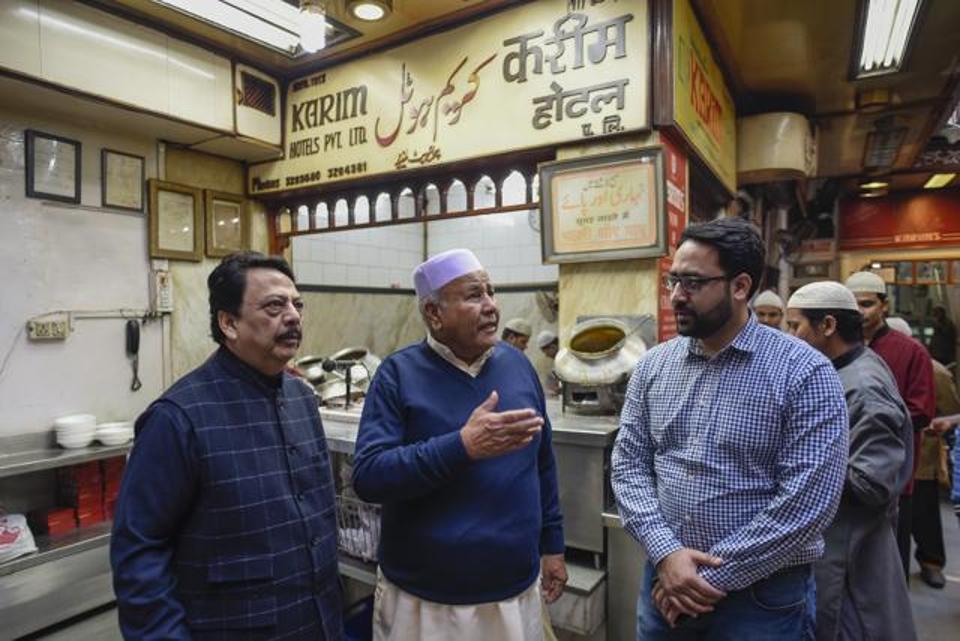
Zahooruddin’s son Zaid-ul-Abedin, his brother Salahuddin, and nephew Zaeemuddin, three of the current directors of Karim’s, say that his focus was always on Karim’s buniyaad, both in terms of values and dishes. (Burhaan Kinu/HT PHOTO)
Clients and business associates found Zahooruddin to be a commanding figure, and heeded his advice. For newlyweds, he recommended nahari; to the sick, thigh meat for its high degree of bone marrow; to one fat customer, Siddiqui remembered Zahooruddin making the suggestion, improbable for a restaurateur, that the man eat a little less. If a customer said something was wrong with their mutton or chicken, Zahooruddin would keep the piece of meat and show it to his butcher in disapproval. “Babu would scold me sometimes,” said Javed Qureshi, whose family has supplied Karim’s with meat for decades, “but he loved me like a son.” Qureshi is one of many people who refer to Zahooruddin as “Babu” (father).
As time went on, Karim’s business grew, and its legend along with it. The family opened a second branch in Nizamuddin in the years before the Emergency. The former Presidents Fakhruddin Ali Ahmed and Zakir Husain became devoted customers, the latter ordering his food to Rashtrapati Bhavan. Indira Gandhi was also fond of Karim’s, but had security guards oversee the meals cooked for her.
The obvious antiquity of Karim’s Jama Masjid alleyway, its family’s claims of royal patronage, their distinctive Old Delhi Urdu, their promotion of old-fashioned dishes such as mutton brains — all this was stimulus for myth-making and myth-debunking. Historians debate whether Karim’s famous ‘istoo’ is authentically Mughal or secretly British. Some trace the family’s origins to a Saudi Arabian soldier who became Babur’s personal cook, but Zaeemuddin Ahmed, Zahooruddin’s nephew, said the family does not know anything about their ancestors prior to Awaiz.
In 1988, when Karim’s registered itself as a company, Zahooruddin was made chairman. When his brother Alimuddin Ahmed died in 2007, Zahooruddin took over from him as managing director. A slim gentleman with a well-trimmed moustache, he became the public face of his venerable restaurant. He attended numerous award ceremonies and made an appearance on the NDTV show Foodistan. At such moments, Zahooruddin smiled with the discomfort of a dignified man in a flamboyant place.
The public image of him as an embodiment of Old Delhi customs was shared by those who knew him personally. When Faiz-ul-Islam, his friend of over 40 years, returned from Haj, Zahooruddin invited 200 of Islam’s friends for a free breakfast at Karim’s, in keeping with his sense of mehmannawazi (hospitality). “He did it without takalluf (hesitation) and without a single line on his forehead,” said Fazl-ul-Islam, Islam’s son.
Zahooruddin performed culinary experiments, sometimes inventing his own dishes, while also sampling the food from different outlets of Karim’s every week to ensure his standards were being upheld. He insisted that the core of the menu — qorma, nahari, mutton burra, kebab — remain untouched.
“Babu used to say, ‘If we let others own a franchise, will they give the same attention to the quality of spices we use?’” said Zain-ul-Abedin, Zahooruddin’s son. “For example, he would say that cloves are something most people don’t eat: they take it out and put it aside on the plate. So another restaurant owner may think, ‘What is the use of putting in the cloves or buying the best-quality cloves?’ But clove adds to the taste, its juices mix with the food and bring out the smell of meat.”
What he was selling, after all, was not just food. Visit Humayun’s Tomb, and you’ll find a silent testament to the dead. Visit Zahooruddin’s restaurant, and you’ll find traces of the past still alive.
source: http://www.hindustantimes.com / Hindustan Times / Home> Delhi / by Alex Traub and Zehra Kazmi, Hindustan Times / February 01st, 2018
In his quivering voice you could hear the rustle of silk and the muffled sound of a broken heart. Few singers could put the listener in a blue mood like Talat Mahmood, who passed away on May 9 exactly 10 years ago.
And thanks to a website created by his son Khalid that gets about 1,50,000 hits every week from Indians and Pakistanis all over the world – “and a few Israelis”, Khalid adds – his memory is fresh as ever.
“Talat saab came from Lucknow and his Urdu pronunciation was perfect. He could exactly reproduce a song the way a composer had conjured up in his mind. He was an original singer whose distinctive voice was near impossible to duplicate,” recalls masterclass music director Khayyam.
One of the veteran music composer’s memorable compositions – Shaam-e-gham ki kasam (film: Footpath) – was sung by Talat, also known as king of ghazals. Khayyam recalls that in that memorable song he had experimented with the orchestration by not using any rhythm instrument like tabla.
“We used a piano, guitar and solo vox, a basic version of the synthesizer used in those days. Recording the number took plenty of time. But Talat saab ke mathe pe shikan nahi aayee,” he says.
Senior lyricist Naqsh Lyallpuri remembers a recording with the singer. The song was Zindagi kis mod pe laayi mujhe, from the film “Diwali ki Raat”. Snehal Bhatkar was the music director. Says Lyallpuri, “We had only two musicians at the rehearsal. They were playing the tabla and the sitar. But the producer liked his singing so much that he said, there is no need for any other instrument. We recorded the song with just those two instruments.”
Lyallpuri remembers Talat as an extremely soft spoken man. Which Khayyam affirms. “He was a perfect gentleman. With him there was no loose talk. He was always well-dressed: his shoes shining and his trousers perfectly creased.”
To honour his father’s memory, Khalid Mahmood set up a website, talatmahmood.net, just a few months after the singer’s death in 1998 at the age of 74. Apart from the huge number hits every day, he also gets about 200-300 emails every week.
“The choice for me was between doing a book and setting up a website. I settled for the latter because it is more accessible,” says Khalid.
Talat recorded his first track way back in 1941 and sang around 750 songs in 12 languages. He also acted in over a dozen movies such as “Dil-e-Nadaan”, “Lala Rukh” and “Ek Gaon Ki Kahani”.
Few know that the singer-actor aroused mass hysteria when he arrived in Trinidad in West Indies on a concert tour in 1968. Fans thronged the roads from the airport to the city. The local group, West Indies Steel Band, composed a Calypso track in his honour. They sang, “Talat Mahmood we are proud and glad, to have a personality like you here in Trinidad.”
Talat is long gone. But as long as the human heart knows how to fall in love and emerge with ache, his velvet voice will live on.
(avijit.ghosh@timesgroup.com)
source: http://www.timesofindia.indiatimes.com / The Times of India / News> India News / May 09th, 2008