Tall marble pillars frame photos, automobiles and more, as the Bhopal royals open up their past at the Jehan Numa Palace Hotel
Over the years, the Jehan Numa Palace in Bhopal — built on the slopes of the Shyamla Hills in 1890 by General Obaidullah Khan, commander-in-chief of the Bhopal State Force, and the second son of Nawab Sultan Jehan Begum — has worn many garbs.
The white marble edifice, which melds British Colonial, Italian Renaissance and Classical Greek architectural styles with facets of Art Deco, was constructed as the general’s office, and then used as his sons’ secretariat. After Independence, it became a government hostel, and later, the offices of the Geological Survey of India.
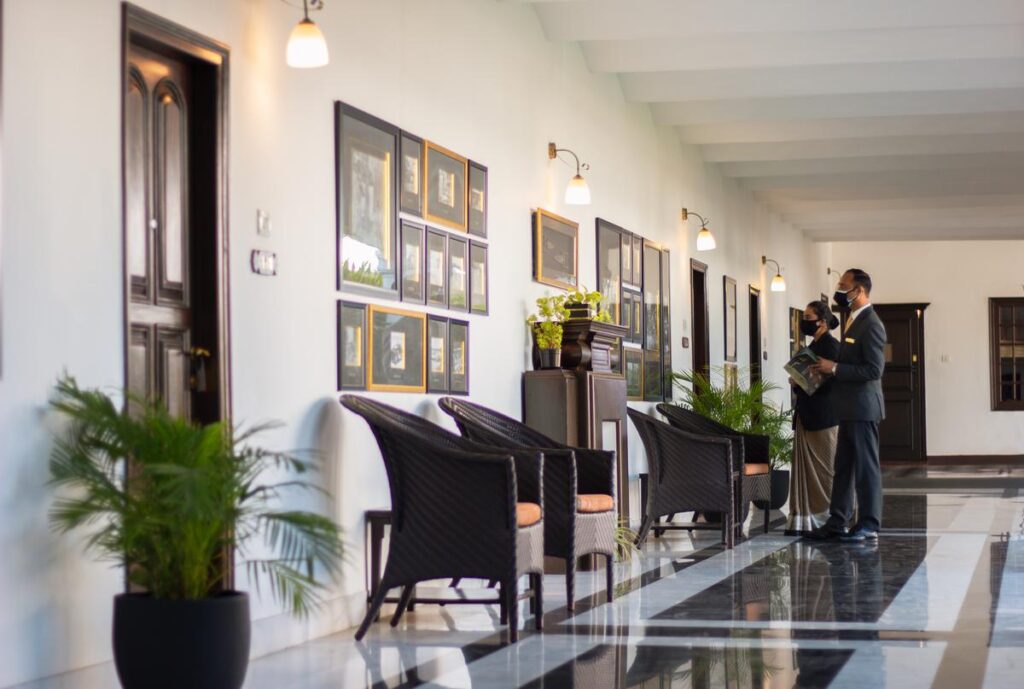
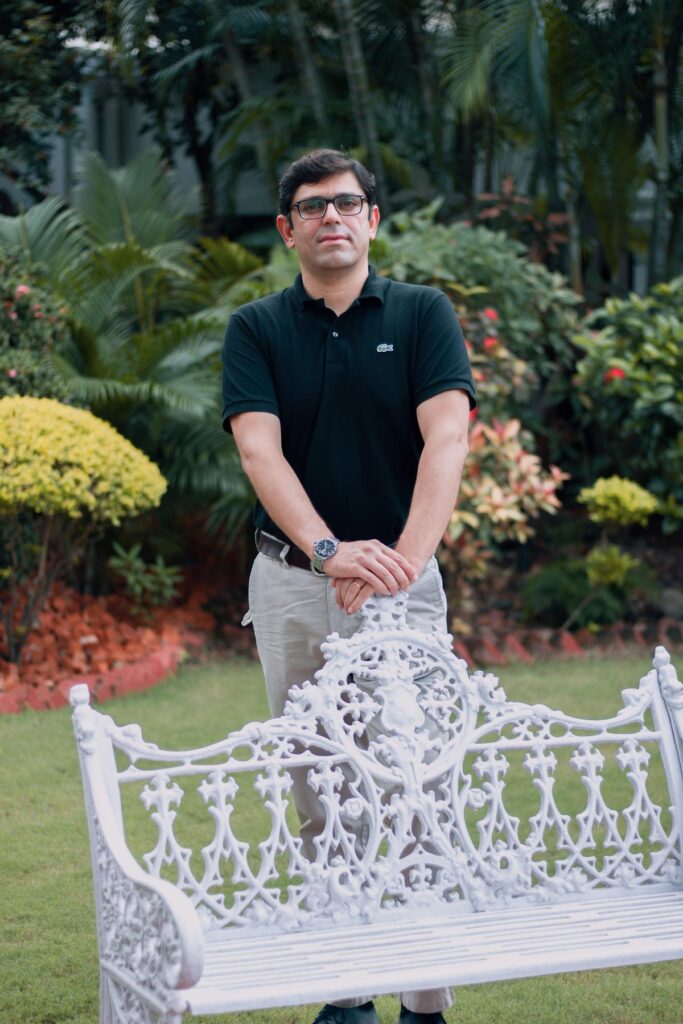
In 1983, after restoring the five-acre property, the general’s grandsons reopened it as a heritage hotel — its colonnaded corridors showcasing sepia-toned portraits, and the interiors housing rooms, four restaurants, two bars and a spa. Now, the pandemic has given it another facet: a museum, which came together almost like a “jigsaw puzzle”, says Faiz Rashid, director of the Jehan Numa Group of Hotels and a member of the Bhopal royal family.
Faiz Rashid
A colonnaded showcase
“[Over the last 20-odd months] we tried to come up with innovative ways to nurture hospitality. Because of the time on hand, we started looking at family archives and thought why not share the legacy with the world,” says Rashid. He tells me about putting together memorabilia: artefacts, attire, “lovely letters in Urdu” written to his great grandfather, documents, “invoices of the cars the royal family bought [like a Ford Phantom and a customised Bentley]” — all of which are now on show at the hotel.
“General Obaidullah Khan accompanied his mother, the last begum, on her foreign trips. He was inspired by different architectural styles, and the display is a pictorial history of the hotel’s evolution from the time it was built in the 19th century,” he says.
The corridors along the central courtyard, with its famed 100-year-old mango tree, were chosen as the ideal backdrop for the display. I take a virtual tour of the elegantly-framed archives, arranged in clusters on the walls of the chequered black-and-white marble and granite corridors, zooming into the photographs, and taking in glimpses of the life and times of a pre-Independence royalty that was progressive and involved, wealthy but not flamboyant, stylish but never garish.
From letters to thoroughbreds
The family took the help of Joe Alvarez, the well-known jazz singer who has written a coffee-table book on Bhopal, to curate the memorabilia.
“We divided them into nine subjects, starting with the four begums, the last nawab, dignitary visits, nawabi sports and the outdoors, and such,” says Alvarez, who has also generated a voice-over, and added a QR code to enable a Walk-In Museum audio guide.
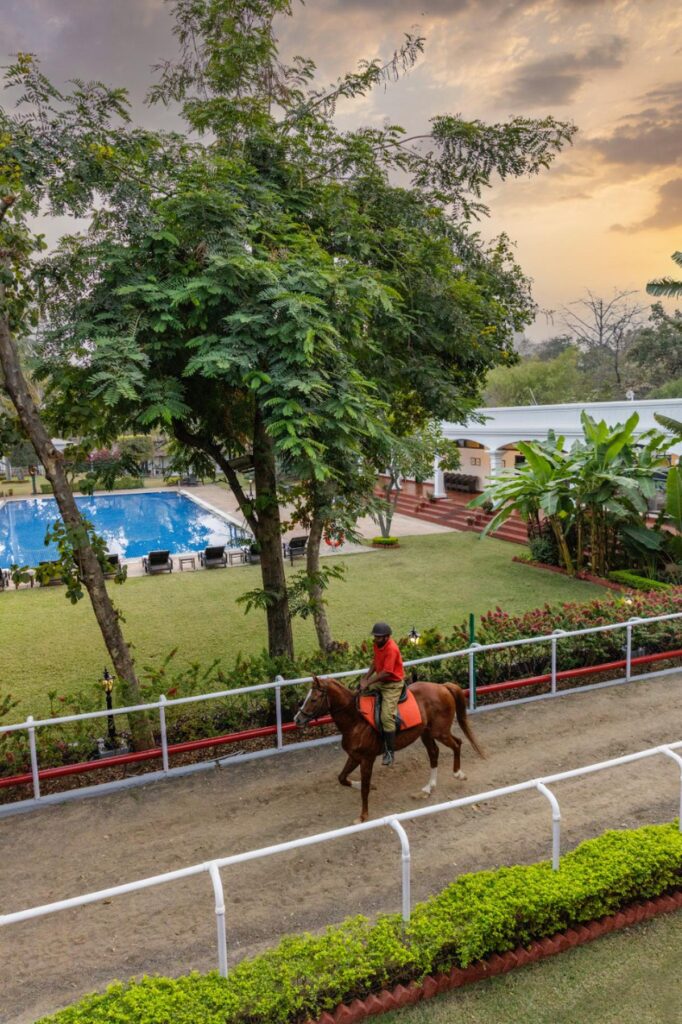
The track at the Jehan Numa Palace Hotel
He expounds about the images of a thriving stud farm, something that continues till date (a trotting track set up when the hotel opened gives visitors a peek into the royal family’s passion for breeding thoroughbreds), of custom-built automobiles, branded guns and weapons, and official visits by dignitaries.
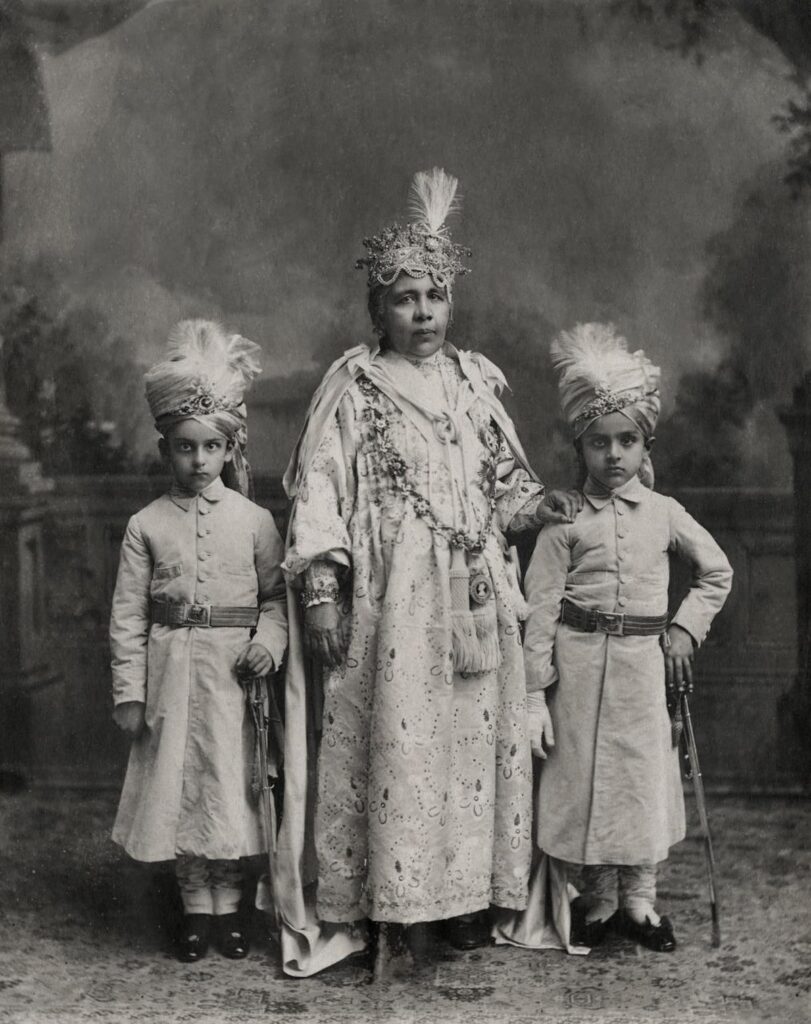
The begum’s photo from the archives
“The nawab begums of Bhopal were very dynamic and built the city differently from male rulers. They focussed on all areas, from education to women’s empowerment. We realised so much of their contribution — like building hospitals, enhancing the railways, opening schools — while putting this together,” shares Rashid, adding that, in 1889, Shah Jehan Begum funded the construction of Britain’s first purpose-built mosque at Woking. The collection is still evolving as more memorabilia makes its way to them slowly, from the extended family. A plan to restore and display the wedding dresses of the begums is also in the pipeline.
The museum is open to all. Rooms at the hotel are from ₹8,000 onwards. Details: jehannuma.com
Bori Safari Lodge
Spot the tiger at Bori Safari Lodge
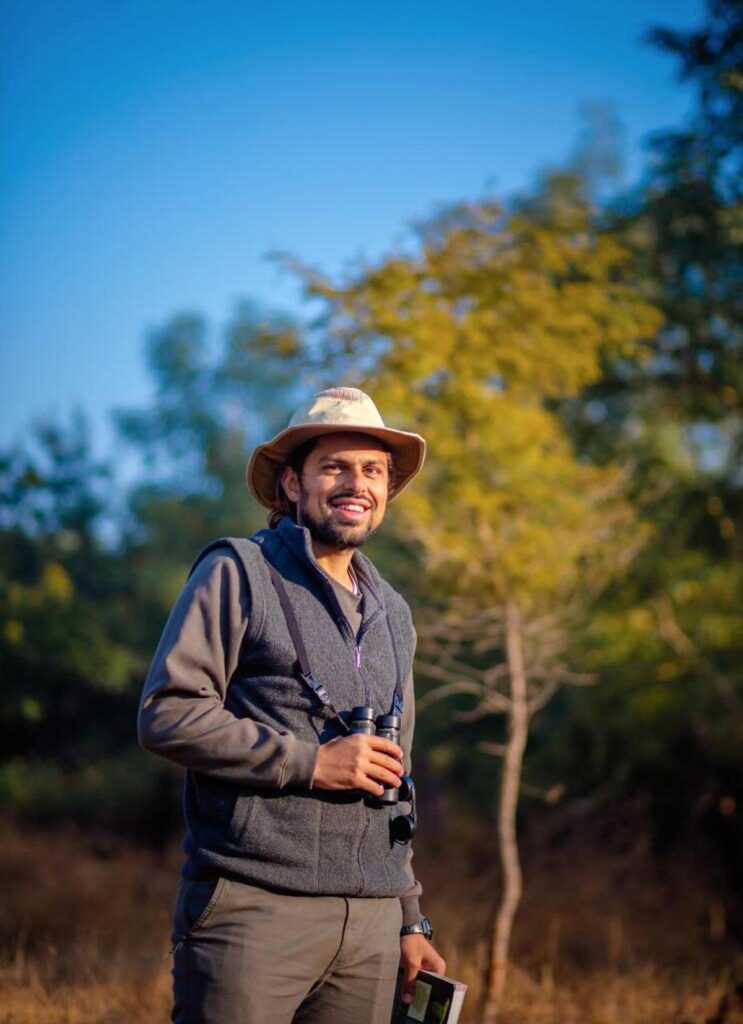
Another post-pandemic hospitality initiative is Bori Safari Lodge, an eight-room wildlife camp started by Rashid’s brother, Aly, in the Satpura Forest. “When we started the Reni Pani Jungle Lodge [a two-and-a-half hour drive away] in 2009, it was about experiencing the diversity of the forest, with river safaris, walking trails and birding. With the Bori, the tiger comes centre stage,” says the trained naturalist, who has partnered with the state tourism department.
Aly is a trained naturalist
A tiger relocation programme successfully initiated four years ago has revitalised the habitat and the local population. “The tigers have not only flourished, but have actively begun mating.” Aly — who has great memories of spending his childhood in the forests — also leads expeditions to spot snow leopards in Ladakh and seek out the red panda in the Northeast. “This [project] is a means to conserve the landscape. The alternate income for the locals will recharge the community, support conservation, and will help wildlife be seen as an asset.”
From ₹25,000 onwards (all inclusive)
source: http://www.thehindu.com / The Hindu / Home> Entertainment> Art> Weekend Travel Special 2022 / by Priyadershini S / April 15th, 2022
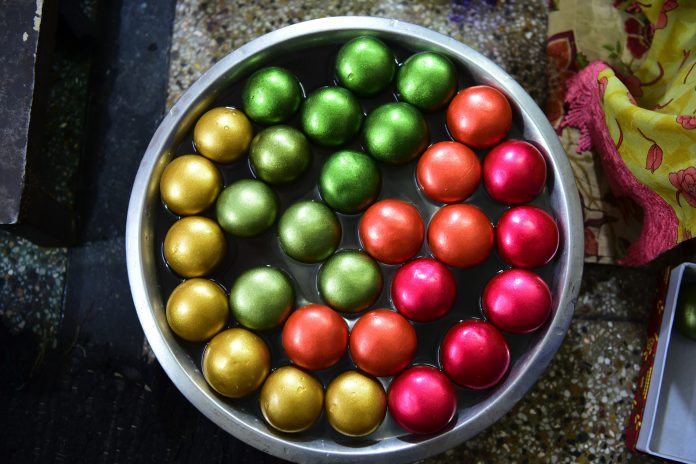
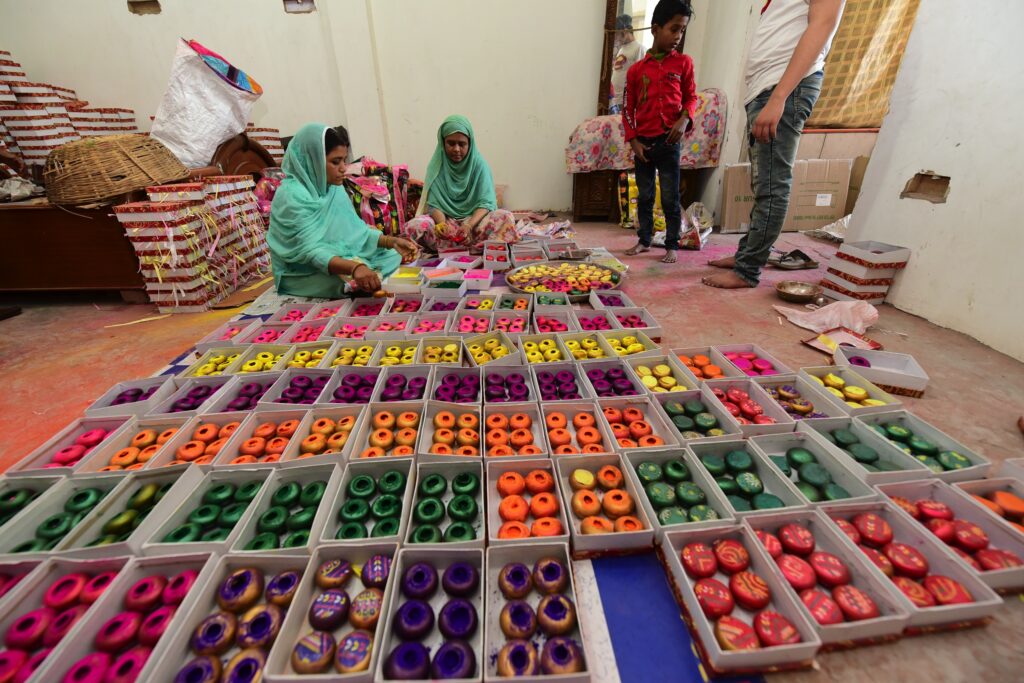
‘Gulal Gota’ is made with unique craftsmanship and compliments the festival of colours. | Picture by Tabeenah Anjum
Dozens of Muslim artisans in Jaipur have kept the 400-year-old traditional art form of Gulal Gota alive.
Jaipur :
The narrow lanes of Jaipur’s walled city are abuzz with festive fervour ahead of Holi, the festival of colours to be celebrated on March 17. Twenty-eight-year-old Amjad Khan, a seventh-generation lac bangle maker is busy selling Gulal Gotas (lac balls filled with colours) at his shop situated in the Maniharon-Ka-Raasta inside the Tripolia Bazar in the walled city of Jaipur.
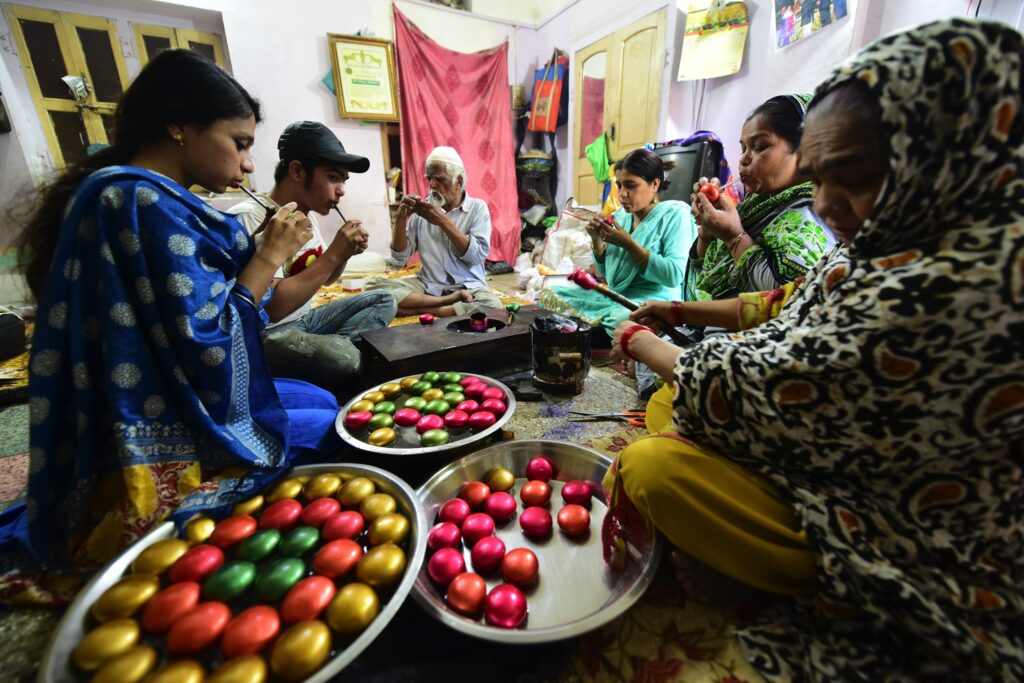
Every year, two months ahead of the Holi, Amjad along with his eight siblings starts making the lac balls and fills them with colours before packing them in boxes. Amjad is not alone. Dozens of artisans in Jaipur have kept this traditional art form alive, which is as old as 400 years.
Gulal Gota is made with unique craftsmanship and compliments the festival of colours. After completing his basic education, Amjad learnt this art from his father late Babbu Khan. The family does not earn much from the sale of Gulal Gota but they don’t want to give up on this traditional art form that they have inherited from their forefathers.
‘Gulal Gota’ is made with unique craftsmanship and compliments the festival of colours. | Picture by Tabeenah Anjum
“In the last two decades and especially from the last two years because of the pandemic, the demand for Gulal Gota has come down a bit but for the love of this art form, we want to keep it alive and pass this to our next generation irrespective of gender. My siblings, mother and late father used to participate. It brings families together,” Amjad shared.
“Every year for two months our entire family gets busy making Gulal Gotas. It is an art to add colours in the lac containers. It is again re-heated and then, with the help of a steel rod and the air is blown into the small balls. We fill it later with organic colours. We are not even earning 50 per cent of what we are spending to make these balls but we are only doing to make the Holi special,” Amjad said.
Each ball weighs from 10 to 20 grams and costs anywhere between Rs 100 to 150.
The Gulal Gotas are still popular with traditional families and are used at the famous Govind Dev Ji temple in Jaipur. According to the popular view of historians, Sawai Jai Singh II brought the artists from Amber to the walled city and developed the unique art of Gulal Gota. Even today during the annual Holi celebration at the city palace, revellers throw these balls at each other and get smeared with colours without hurting anyone.
Boxes of Gulal Gotas being prepared for sale. | Picture by Tabeenah Anjum
Apart from states such as Madhya Pradesh, national capital New Delhi and Uttar Pradesh, it is shipped to other parts of the world including Canada, Britain, Australia, Spain, France and Nepal. However, packaging the balls needs careful handling to avoid the risk of the balls bursting in their wrapping. The balls are sold in packs of 6 or 8.
Those involved in the production of these balls belong to the Muslim community. Awaz Mohammed, a national award-winning artist who has been in this field for seven generations said, “This is a beautiful gesture and brings two communities together. The only sad part is that for an artist the sale from Gulal Gotas is not enough to sustain their livelihood.”
Awaz’s daughter Gulrukh Sultana who is a trained lac artist not only learnt the art from her father but is also sharing the skill at national institutes across India such as NIID, JJ School of Arts, Pearl Academy etc.
“Making lac artifacts is an intricate and unsafe job, but I want to share this art and skill with the future generation. It is the passing of tradition and heritage Jaipur is proud of. Lac is delicate and it needs proper handling. I have trained so many artists in different cities and also given demonstrations internationally,” said 35-year-old Sultana, a recipient of the state award in 2009 and a UNESCO award in 2013.
Looking at the market and interest of the younger generation, Sultana is apprehensive about whether this art could be saved. “Since there is not much earning, it is less attractive for youngsters to learn this skill but at the same time the government should come up with lucrative initiatives and ensure the art is kept alive”, she added.
Tabeenah Anjum is a journalist based in Rajasthan reporting on politics, gender, human rights, and issues impacting marginalized communities. She tweets at @TabeenahAnjum
source: http://www.twocircles.net / TwoCircles.net / Home> Lead Story / by Tabeenah Anjum, TwoCircles.net / March 16th, 2022
Gulammohammed Sheikh: ‘What we need is an open climate within our institutions to allow artists to practise their art’
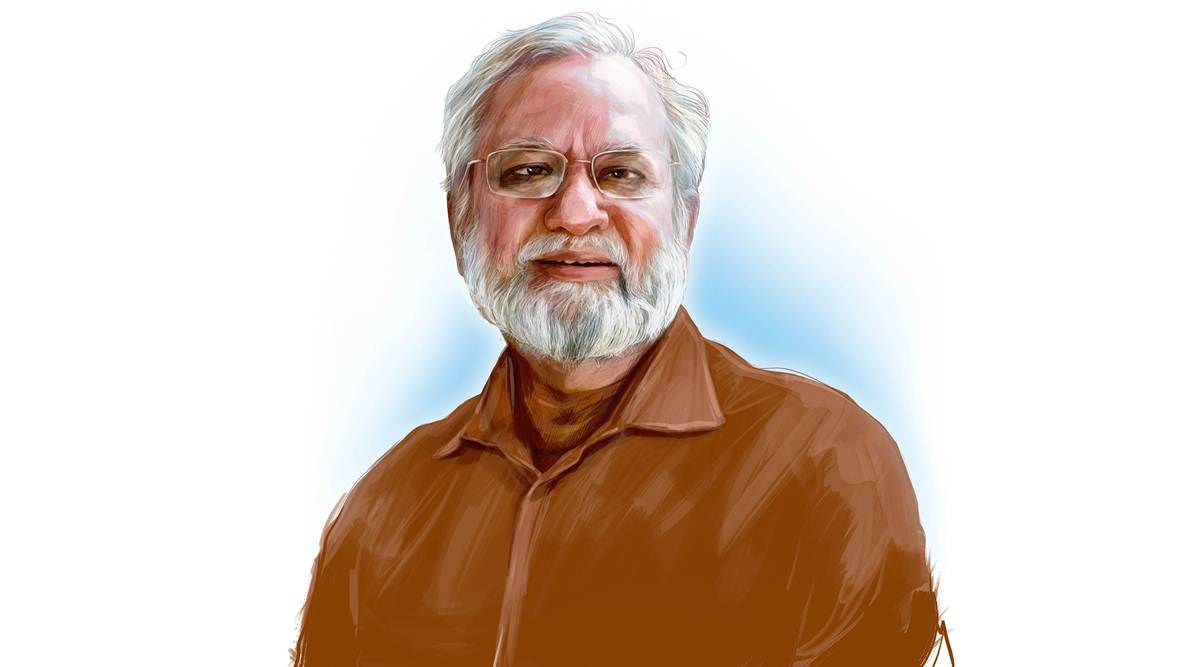
Gulammohammed Sheikh, artist (Illustration : Suvajit Dey)
Gulammohammed Sheikh speaks on the idea of multiplicity in life, art education in India, interference in institutions and how the world of art remains free of divides. This session was moderated by Vandana Kalra, Senior Assistant Editor, The Indian Express .
Vandana Kalra: In 1981, you had said that living in India means living simultaneously in several times and cultures. Do you think the relevance of your statement has only increased over time? Also, how do you look at the works that you made during that period, for example, City for Sale?
Among these works, the first one was About Waiting and Wandering, the other was Speaking Street, the third Revolving Routes and the fourth City for Sale. They relate to actual situations and are connected.
Speaking Street was a re-creation of the kind of street that I lived in during my childhood. Born in 1937, I spent about 18 years in Surendranagar, which was then a small town, before I came to Baroda to study. We lived in a little lane, which had a little mosque whose walls were painted green with enamel colours, but it didn’t have a dome. There would be people sitting on the street selling fish, or somebody pulling a little cart. In the lower half of the painting there are several events taking place simultaneously in different houses or rooms, as would happen with people living in chawls. Speaking Street also carries a personal portrait — a young boy looking out of a window. Thinking of the childhood spent in a street like that, I remember having learnt to recite the Quran in Arabic at a madarsa, while studying Sanskrit at school. It gave me the idea of multiplicity in life, connected by multiple belief systems.
This work connects with the much larger City for Sale, based in the city in which I continue to live; the city of Baroda, now Vadodara. I came to Baroda first in 1955 as a student, and after finishing my studies at the Faculty of Fine Arts, I taught there for three years. I was then in London on a scholarship for three years and returned home in 1966. When I first came to Baroda, it opened for me not just the world of art, but also the art of the world. But in 1969 this city produced another image. Some of the worst communal riots took place here between 1969 and 1970. People began to look at me with my name in mind. So, it gave me an identity which was different from the identity that I had acquired when I had reached Baroda, then — open, liberal, multifaceted. In 1969, suddenly the situation changed. These four paintings, in some ways, reflect upon the times that I had gone through. City for Sale is large and has multiple figures, so many characters. There are three men meeting on the pretext of lighting a matchstick. Would that provoke incendiary connotations? There is also a woman who has a big vegetable cart, which literally flows into the town. Then there is, in the centre, a film being shown called Silsila (1981). And on the top, the scene of a communal riot. It brought together multiple parts of a city, depicting how riots are raging in one part, but a film is being shown in another. In a way, it was confessional, it was also some kind of a release for me.
Yes, there are problems that beset our institutions. Government museums and academies are out of touch with what’s going on in the world of art, and directors are often appointed rather arbitrarily, often not from the art world at all
Vandana Kalra: In more recent years, you’ve taken this thought forward and you seem to have turned to Kabir and Mahatma Gandhi to call for peace, call for intermingling. If you could talk a bit about that.
Gandhi came to me right from the time I was in school. I read My Experiments with Truth (1927), in Gujarati it’s Satya Na Prayogo. It has remained with me ever since. During the years of 1969 and 1970, Gandhi kept coming to me, in different forms, different guises. But I didn’t know how to paint Gandhiji, I had never seen him in person. I saw lots of photographs. Then I devised something. The first painting that I made of him was of Gandhi in South Africa, in the image of a young lawyer. But the second one, which I have used twice or thrice since, was the image of Gandhi returning to India, quoted from a painting by Abanindranath Tagore.
Kabir came in a different way. I was familiar with his poetry from my school days but he began to become more and more relevant in the context of the conflicting situations that I saw around myself. I thought, perhaps, I should try to paint Kabir. But how to paint Kabir? My mentor KG Subramanyan’s mentor Benodebehari Mukherjee had painted a large mural in Santiniketan on the saint-poets of India, which included Kabir. Benode babu knew that Kabir was a weaver, so he went to the weavers’ colony to search for his image of a weaver and made his Kabir. I found a Kabir image in a late Mughal painting in the British Museum collection and devised a Kabir-like persona from that image. As Kabir began to recur in my mind, I began to read Kabir but it was difficult to find a visual equivalent. It was when I heard Kumar Gandharva singing Kabir that I thought, why can I not illustrate his poetry? Within histories of art, a great number of paintings illustrate poetry.
We have to think of a holistic way of devising a new art education system for our country. An art education system that is not standardised. It should leave room for each region, each culture in a diverse country like ours
Vandana Kalra: How do you look at the dialogue between your poetry and painting?
When I started writing poetry while I was in school, it was very traditional, using Sanskrit meters or in the form of songs. When I came to Baroda, I met a new mentor, Suresh Joshi, the writer who pioneered a modern idiom in Gujarati. He introduced us to Baudelaire, Rilke, Lorca, etc. After reading these great poets, I felt what I was writing was not worthwhile, so I threw away much of it, and began to write poetry without verse, without any meter. I felt I should use spoken language. I had to find my voice from within the spoken word. In some ways, I had to find something which was not only modern but also personal, which was mine. Similarly, in painting, I had to struggle hard. Every student feels that he is under the shadow of his teacher, so he wants to get out of that shadow. I started to look outside of Baroda. I looked at MF Husain and began using the image of a horse. But there was a difference between Husain’s horses and mine. Husain’s horses are to be regarded as timeless. Charged with energy, they were larger than life. My lonely creature came from my life experiences, perhaps it came from the tonga, the ghoda-gaadi that I knew from my childhood. This horse was harnessed and was trying to unshackle itself.
” The world of art in India is still free of divides… For us it was a mini India, a multiple India; it was not straitjacketed into the singular. Many of us found our life partners from within the Faculty we taught and studied at
Devyani Onial: What do you think about art education in India? Also, you started teaching when you were very young. Can you talk a bit about those days?
Art education should begin at school and children should be taken to art galleries and museums. I’ve seen not just in the West, but also in places like Indonesia, tiny tots are taken to museums, they have their little notebooks with them in which they write about the paintings that they see.
The Faculty of Fine Arts (MS University), set up around 1950, was the first institution in India where university education included fine arts. It offered not a diploma, but a degree.
What the pioneers visualised was an artist who was literate and educated, a new citizen of modern India, because it coincided with the independence of the country. It was a small institution, the teacher student ratio was one to 10, or one to 15. The studios were huge, they were like warehouses and were open throughout the day and night. For somebody like me, coming from a small town, it was a great experience to learn from your teachers who were working alongside you. We saw NS Bendre working, we saw our seniors like Jyoti Bhatt, Shanti Dave and GR Santosh working. Despite the fact that I had some financial difficulties, I managed to sail through those four years of under-graduation, and then even did my master’s. I got a job to teach while I was in my second-year master’s course and some of my classmates also became my students for a brief while. But art education, even to this day, is a neglected discipline. We have to think of a holistic way of devising a new art education system for our country. An art education system that is not standardised. It should leave room for each region, each culture in a diverse and multifarious country like ours.
Leena Misra: Vadodara was recently in the news because Chandra Mohan was not allowed to display his artwork. It was also in the news because they have booked the first case of interfaith marriage, which violates the freedom of religion. So what do you think went wrong in the city and why are people not speaking up? Has the space for expression, even for artists, shrunk?
It’s not that people were not speaking. Prof Shivaji Panikkar, the then in-charge Dean of the Faculty, stood firm defending the student against a controversy engineered by external elements. A spate of protests by students against the assault on the institution continued for almost a year. Several of us spoke. Ganesh Devy (literary critic) had also spoken up. But the issue that you’re talking about is larger. What we need is an open climate within our institutions of art and art education, to allow artists to practise their art. External issues have been brought to institutions, which then have been victims of unhealthy controversies and conflicts. I think artists should and would articulate their ideas through their art and there are artists who have done that. I will quote the German playwright and poet Bertolt Brecht: “Will there be singing in the dark times?” To which the answer is, “Yes, there will be singing about the dark times”.
External interferences are mostly politically motivated, we got to stand against them but while continuing to practise. If you stop practising, if you do not paint, that is more dangerous. Baroda had a liberal foundation and to an extent it still exists. The world of art and artists in India is still free of divides. Let me give you example of five of my teachers from the Faculty of Fine Arts. The first dean Markand Bhatt, a Gujarati, was married to Perin, a Parsi. NS Bendre, a Maharashtrian, married Mona, a Tamilian. Sankho Chaudhuri, a Bengali, married a Parsi fellow artist Ira, and K G Subramanyan married Sushila, a Punjabi, the last two couples had met in Santiniketan. For us it was a mini India, a multiple India; it was not straitjacketed into the singular. Many of us found our life partners from within the Faculty we taught and studied at. A Kashmiri Ratan Parimoo found Naina, a Gujarati; a Maharashtrian PD Dhumal, married Rini, who was a Bengali. So there was nothing unusual in a Gujarati like me marrying a Punjabi Nilima. That has been the culture of the Faculty of Fine Arts. We lived a life which was not just a life lived, but a life shared.
Shiny Varghese: What do you think are the values that we should support today that will determine what our future will be like tomorrow?
I would answer your question in a different way. Frankly, my own view is that contemporary Indian art is still very vibrant. We have three to four generations of artists working. We have 97-year-old Krishen Khanna, of the generation of Husain. You have my generation, and you have those that come after us, like Atul Dodiya, Sudarshan Shetty and several others. Then there is a still younger generation working. I’m not painting a rosy picture. What I am trying to say is that within art, among artists, there is still a dialogue, and they are working steadfastly. I’m also very happy that we have many women artists. We also have several couple-artists, doing different things in their own way. Like Manu and Madhvi Parekh, Arpita and Paramjit Singh, Reena and Jitish Kallat, Atul and Anju Dodiya, Bharti Kher and Subodh Gupta among others. I wonder if such a situation prevails in other countries. I am putting it in a somewhat simplistic manner but the values our artists seem to pursue are the values of a free and creative practice. Most of us are engaged in finding a visual language for contemporary issues, often referring to problematics of our times. Then, there are so many young artists. We have a young artist called BR Shailesh, who was trained in a gurukul, he speaks Sanskrit, he came to study painting, and he ventured into digital art, then into installation. He is using his gurukul background and devising a way where there is both critique as well as celebration.
Rinku Ghosh: On the one hand you say art is about hope, on the other you choose to stay away from rescuing institutions like the National Gallery of Modern Art and Lalit Kala Akademi from decay. How will young artists express themselves freely if greats like you don’t act?
It is not correct. Artists have always spoken out in one way or another. A long time back, in the 1960s, J Swaminathan published Contra (1966-67) to take on the Akademis, we (Bhupen Khakhar and I) brought out a journal called Vrishchik (1969-73) and through that, amongst other things, mounted a campaign to reform the Lalit Kala Akademi. We fought for three years, as a result of which the government appointed the Khosla Commission. Some of the reforms that we were fighting for were included. So, it’s not that artists have not driven change. Yes, there are problems that beset our institutions. Government museums and academies are out of touch with what’s going on in the wider world of art, and directors are often appointed rather arbitrarily, often not from the art world at all. Are we to become activists then? When KG Subramanyan was asked the question, he said tellingly that yes, he would, but as an artist activist, not as an activist artist. The younger generations of artists too have their own modes of articulating the need for change, their own activism.
Paromita Chakrabarti: Could you speak about the time when you met your wife? You mentioned how it was commonplace in the artistic community to find partners from other communities. In the larger city, for instance, was there the ghost of love jihad at that time, which has become so prominent now?
I have already made some remarks about the issues earlier. I have tried to answer these through the paintings that I have done, including City for Sale, which is about the city and which deals with the kind of conflicting situation you are talking about.
External interferences are mostly politically motivated, we got to stand against them but while continuing to practise. If you stop practising, if you do not paint, that is more dangerous. Baroda had a liberal foundation and to an extent it still exists. The world of art and artists in India is still free of divides. Let me give you example of five of my teachers from the Faculty of Fine Arts. The first dean Markand Bhatt, a Gujarati, was married to Perin, a Parsi. NS Bendre, a Maharashtrian, married Mona, a Tamilian. Sankho Chaudhuri, a Bengali, married a Parsi fellow artist Ira, and K G Subramanyan married Sushila, a Punjabi, the last two couples had met in Santiniketan. For us it was a mini India, a multiple India; it was not straitjacketed into the singular. Many of us found our life partners from within the Faculty we taught and studied at. A Kashmiri Ratan Parimoo found Naina, a Gujarati; a Maharashtrian PD Dhumal, married Rini, who was a Bengali. So there was nothing unusual in a Gujarati like me marrying a Punjabi Nilima. That has been the culture of the Faculty of Fine Arts. We lived a life which was not just a life lived, but a life shared.
Shiny Varghese: What do you think are the values that we should support today that will determine what our future will be like tomorrow?
I would answer your question in a different way. Frankly, my own view is that contemporary Indian art is still very vibrant. We have three to four generations of artists working. We have 97-year-old Krishen Khanna, of the generation of Husain. You have my generation, and you have those that come after us, like Atul Dodiya, Sudarshan Shetty and several others. Then there is a still younger generation working. I’m not painting a rosy picture. What I am trying to say is that within art, among artists, there is still a dialogue, and they are working steadfastly. I’m also very happy that we have many women artists. We also have several couple-artists, doing different things in their own way. Like Manu and Madhvi Parekh, Arpita and Paramjit Singh, Reena and Jitish Kallat, Atul and Anju Dodiya, Bharti Kher and Subodh Gupta among others. I wonder if such a situation prevails in other countries. I am putting it in a somewhat simplistic manner but the values our artists seem to pursue are the values of a free and creative practice. Most of us are engaged in finding a visual language for contemporary issues, often referring to problematics of our times. Then, there are so many young artists. We have a young artist called BR Shailesh, who was trained in a gurukul, he speaks Sanskrit, he came to study painting, and he ventured into digital art, then into installation. He is using his gurukul background and devising a way where there is both critique as well as celebration.
Rinku Ghosh: On the one hand you say art is about hope, on the other you choose to stay away from rescuing institutions like the National Gallery of Modern Art and Lalit Kala Akademi from decay. How will young artists express themselves freely if greats like you don’t act?
It is not correct. Artists have always spoken out in one way or another. A long time back, in the 1960s, J Swaminathan published Contra (1966-67) to take on the Akademis, we (Bhupen Khakhar and I) brought out a journal called Vrishchik (1969-73) and through that, amongst other things, mounted a campaign to reform the Lalit Kala Akademi. We fought for three years, as a result of which the government appointed the Khosla Commission. Some of the reforms that we were fighting for were included. So, it’s not that artists have not driven change. Yes, there are problems that beset our institutions. Government museums and academies are out of touch with what’s going on in the wider world of art, and directors are often appointed rather arbitrarily, often not from the art world at all. Are we to become activists then? When KG Subramanyan was asked the question, he said tellingly that yes, he would, but as an artist activist, not as an activist artist. The younger generations of artists too have their own modes of articulating the need for change, their own activism.
Paromita Chakrabarti: Could you speak about the time when you met your wife? You mentioned how it was commonplace in the artistic community to find partners from other communities. In the larger city, for instance, was there the ghost of love jihad at that time, which has become so prominent now?
I have already made some remarks about the issues earlier. I have tried to answer these through the paintings that I have done, including City for Sale, which is about the city and which deals with the kind of conflicting situation you are talking about.
It is difficult to tell you the personal story, but it was, and is not uncommon among artists to get acquainted with each other, and eventually to become not only friends but partners. The pursuit of our vocation brought us together. Several of my friends and students have married outside their communities. The kind of divide, that you belong to this belief system or you belong to that belief system, or that you come from Kerala or Bihar, is denounced in our community of artists. Art actually binds, art brings us together, art gives us a new world to live in. When I say that art spells hope, what I mean is that hope is the essence of the creative act. I still believe that a creative life also makes you a slightly better human being, because it allows you to keep the divide out, it allows you to share, it allows you to meet people, it allows you to connect with as many people as possible.
Suanshu Khurana: You mentioned Kumar Gandharva and the impact his Kabir bhajans had on your work. Are there any other musicians who’ve been a significant part of your consciousness while creating your art?
I listen to a lot of music. Even now, during the pandemic, we have a little bluetooth speaker and I listen to music every morning or while working. I listen to Mallikarjun Mansur, I love Bhimsen Joshi, I enjoy Kishori Amonkar’s singing. I have not known many musicians, but I had some connection with Kumar Gandharva because of the opportunities of meeting during the programmes at Bharat Bhavan in Bhopal during the 1980s, where I would listen to him. Among the series of Kabir paintings I made, two were companion pieces: a largish painting called Ek Achambha Dekha Re Bhai has the companion piece called Heerna. It is my tribute to Heerna sung by Kumar Gandharva.
source: http://www.indianexpress.com / The Indian Express / Home> Idea Exchange / by Premium, Express News Service / April 05th, 2022
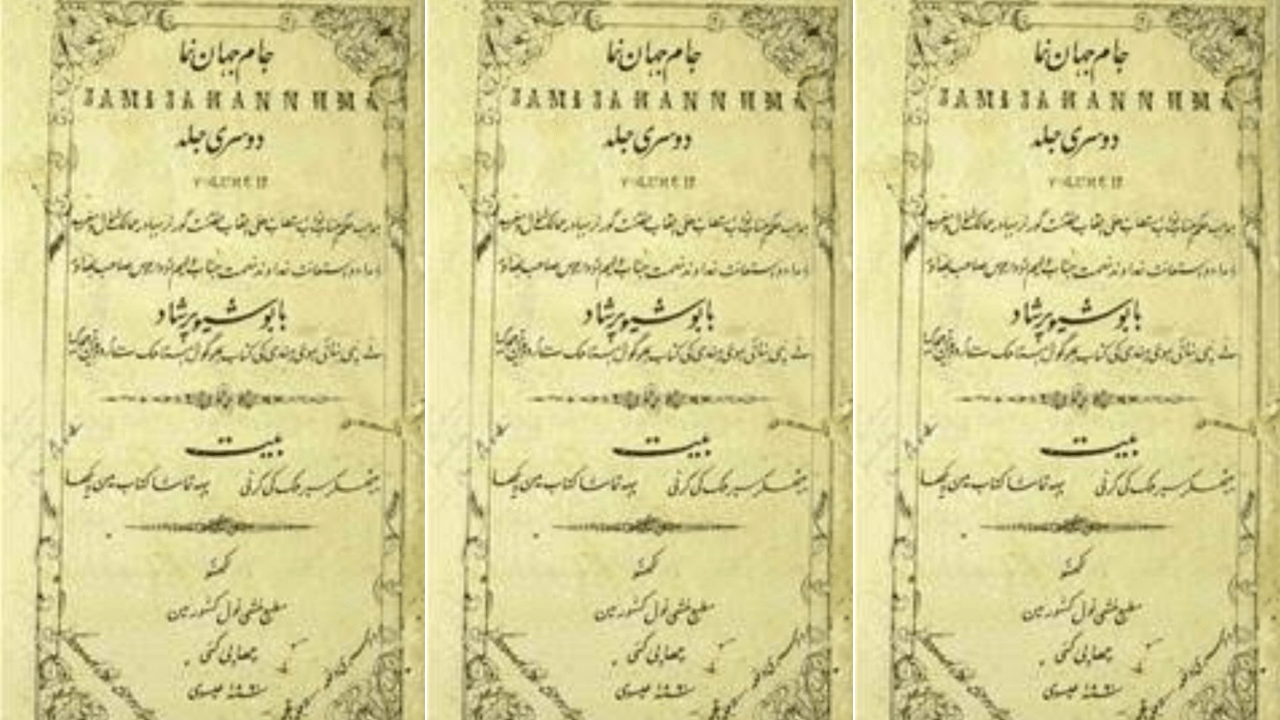
India’s first Urdu newspaper Jam-E-Jahan-Numa. Source: @indoislamicpage
Most people might be unaware, but 27th March is a historic day in the history of Urdu Journalism. On this date, the first-ever printed newspaper in the Urdu language was published exactly 200 years ago.
Urdu Journalism started in the Indian sub-continent from Calcutta with the launch of Jam-e-Jahan Numa on March 27, 2022.
In today’s India, Urdu is associated with Muslims and is considered the language of Muslims. In this context, when we look at the history of Urdu journalism, one may be surprised today to learn of its heritage and secular origins. Urdu, which has been on a decline in India over the years, and one which is much maligned by Hindutva groups, had a Hindu man who established the first journalistic publication.
Hari Hardat, a Bengali Brahmin Hindu, published the Jam-e-Jahan Numa from Calcutta on March 27, 1822. It was published under the editorship of Lala Sada Sukh Lal; a Punjabi. The printer was William Hopkins, a British national and an employee of the East India Company.
The composition of people under whom Urdu Journalism saw the light of day is really remarkable, as it truly reflects its secular characteristics. Non-Muslims had a huge contribution in the growth and development of Urdu journalism, as most of the editors in the 19th century were also not Muslims.
However, in post-independent India, Urdu language, which is widely spoken and read even today, came to be perceived as a Muslim language.
In 1822, with the publication of Jam-e-Jahan Numafrom Calcutta, the journey of Urdu journalism began. Soon it spread to other parts of the subcontinent covering what we study today as the history of the 19th and 20th centuries here. During its two hundred years, Urdu journalism has seen many ups and downs and has left a deep imprint on the history, politics, economics and sociology of the subcontinent.
The history of this entire subcontinent i.e, present-day India, Pakistan, Bangladesh, Burma and Afghanistan would be incomplete without Urdu journalism. The political, economic and cultural conditions of that time truly reflect on the pages of Urdu newspapers of that time.
Urdu journalism started even before Gujarati journalism took off. The latter’s first publication, the Bombay Samachar, appeared first on July 1, 1882. Similarly, Hindi Journalism had its first newspaper – Utand Martand – published on February 9, 1826. For Tamil Journalism, the Tamil Magazine, a journal, was published in 1831.
However, Bengali journalism had set in by that time and the first newspaper in the language was the ―Bengal Gazette appeared in 1816.
After Bengali newspapers, Jam-e-Jahan Numa was the second newspaper that came out in any Indian language from undivided India. At that time, two Bengali newspapers, the Sambad Kaumudi and the Samachar Chandrika were already in circulation. So it can rightly be said that Urdu journalism held the distinction of being the second vernacular which began journalism in India.
Technologically, Urdu journalism is also at par with other vernacular journalism. India has also witnessed the digitisation of Urdu newspapers in the 21st century. There are over three dozen Urdu newspapers that have launched their e-newspapers.
Urdu journalism in its 200-year-long chequered history has seen many ups and downs. It is the only language in the country that sadly also is facing step-motherly treatment in the birth of its place. Today, it is also treated with a suspicious eye in its own country. The integrity of its antecedent is doubted often too.
In spite of all this injustice, today Urdu journalism continues to shine. Its readers owe Harihar Dutt for his idea of starting an Urdu language newspaper.
It is worth mentioning here that when Harihar Dutt launched his newspaper, he had never imagined that he was going to sow the seed of Urdu journalism and that it would also galvanize others to do the same from across the nation.
Jam-E-Jahan-Numa: The Pioneer Urdu Weekly
Jam-e-Jahan Numa – the pioneer Urdu language newspaper was printed at Mission Press, 11, Circular Road, Calcutta and published from No. 2, Colootola – a commercial place of central Calcutta.
It was a 3-sheet (6 pages) weekly of quarter size and issued on every Chahar Stambah (Wednesday). Each page of the Jam-e-Jahan Numa was divided into two columns and there were normally 22 lines in each column. The size of the paper was 20×30/8 centimetre, and it was priced at Rs.2/ per month, and the word ―Chahar Shambah (Urdu word of Wednesday) was printed on each issue below the Masthead with the date.
Harihar Dutta brought out this pioneer Urdu weekly at such a time when the language was not popular in Bengal. Urdu was prevalent only for conversation and it had not been adopted in the field of Journalism. But it was the foresight of Harihar Dutta that he introduced Urdu language as a new field in the printed newspaper form.
But his experience could not succeed at once. Therefore, after 6 issues of Urdu edition of the Jam-e-Jahannuma, he converted it into a Persian weekly. The Jam-e-Jahan Numa which was launched as an Urdu paper ceased to exist in Urdu after its 6th issue and became a Persian newspaper on May 16, 1822.
The reason behind this change was that majority of the readership was illiterate and poor. And Persian was the official language of that period and the language of the elite too. Hence it made sense.
But it seems that this condition was confined only to Bengal. In other parts of the country, Urdu had become popular by that time. So, a few years later Urdu newspapers started publishing in north India. The popularity of Urdu increased rapidly and it compelled the then colonial government to change the official language from Persian to Urdu.
The interest of Harihar Dutta in Urdu did not subside. And after one year he introduced an Urdu supplement with the Persian edition of the Jam-e-Jahan Numa. This supplement was started on May 23, 1823. It consisted of 4 pages and the pages were divided into two columns.
All types of national and international news would publish in the Jam-e-Jahan Numa. Human interest stories and news of scientific inventions would get due coverage.
The Urdu Jam-e-Jahan Numa continued to be published for around four years and eight months; starting from 23rd May 1822 to 23rd January 1828. During this period, around 241 issues were published. Out of these 241 issues, almost 100 issues carried the historical events of Britain, Europe and the Mughal emperor Jahangir.
The Persian edition consisted of 8 pages and the Urdu supplement was of 4 pages. The government was extending some financial support to this newspaper then as well. But high postal charges were a burden on the proprietor of this newspaper.
To curtail the expenditure of the newspaper, Harihar Dutt stopped the Urdu edition once again in January 1828 and continued the Persian edition. The pages of the Urdu edition were also allotted to the Persian edition. However, it finally ceased to exist forever due to non-patronage of the government.
How long the Jam-e-Jahan Numa continued is not known but Abdus Sattar Siddique in his article entitled ―Hindustan Ke Purane Akhbar, wrote that the paper continued to publish till 1845.
Condition Of Urdu
When Harihar Dutt launched the first Urdu newspaper, Urdu was not the language of the elite and educated class. It was in its evolution phase. It was not developed as a reading and writing language among the educated class, and was only used as a means of communication among the people belonging to the lower strata of society.
The readers of Urdu were few. The educated class, be it Hindus, Muslims, Sikhs or others, was Persian reading. All official work was also carried out in Persian which was the official language of that time under the British.
In fact, reading and writing Urdu was considered demeaning during that period, and the educated class considered it an insult to use Urdu, as it was the language of the masses and ordinary people. All official communiqué was done in Persian only.
The nobility would consider the use of Urdu language as below the standard action. Moreover, newspaper reading habit was also not developed by that time. Even the elite did not have time to read newspapers or to know about society in general. Producing a newspaper in Urdu was also not an easy task at that time, hence.
Before the commencement of Jam-e-Jahan Numa, there were a few handwritten newspapers- not printed, which were basically written for the nobility and the rich. These handwritten newspapers were written by a band of writers who were called calligraphers. It was a tiresome and time-consuming act, so the number of copies of these papers that were sold was small.
Even the cost of producing these handwritten newspapers was very high, which was another reason which made it out of reach of the common people. These handwritten papers were the only source of information for the nobility and the rich class as well.
We have to keep this fact in mind while reading about Urdu journalism, when Harihar Dutt published the Jam-e-Jahan Numa, the concept of reading a newspaper had not turned into a habit. So, in a way, after Bengali, it was Urdu journalism that appeared on the horizon and changed things.
This article first appeared in The Siasat Daily. Published here with the author’s permission.
source: http://www.thecognate.com / The Cognate / Home> Culture / by Dr Md Zafar Iqbal / April 01st, 2022
A recent collection of his radio talks point to the stellar role birds play in preserving our environment
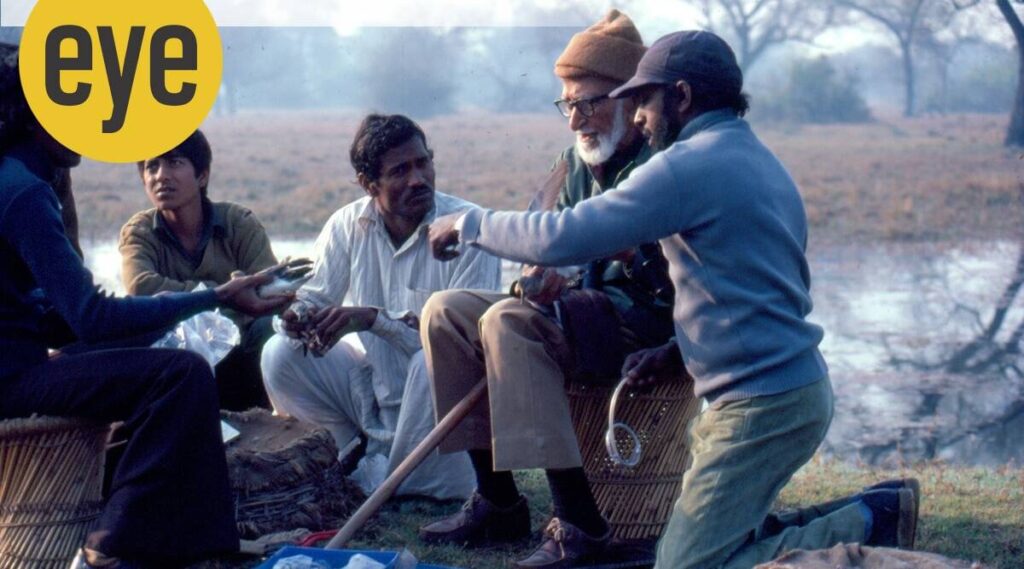
Sálim Ali could reach out to a cross-section of society, telling them about birds and the stellar role they play in preserving our environment. (Source: Black Kite)
From busting myths about fireflies lighting up the homes of weaver birds to explaining the whys and hows of the spectacular phenomenon of bird migrations, there has been, perhaps, no one better than Sálim Ali, India’s best-known ornithologist, to demystify the avian world. To Ali’s already formidable list of works, comes another: a collection of his radio talks. Edited by Tara Gandhi, Words for Birds (Black Kite), the book shows him doing what he did best — reaching out to a cross-section of society on birds and the stellar role they play in preserving our environment.
“He was an excellent communicator. He gave a number of lectures and he communicated to people of different professions. For instance, while speaking to mountaineers, he would say — ‘since you go to great heights, to places that ornithologists are not able to go to, look out for nesting sites, for Lammergeiers, the big vultures that are seen in high altitudes. Look around and if you see any birds, let us know, take down notes’. He would talk to people to get out of their own turf or specialisation and become interested in the wider picture,” says Gandhi, who was guided by Ali for her MSc. in field ornithology shortly before he passed away in 1987, at the age of 90.
India’s birdman, Sálim Ali. (Source: Black Kite)
He was, as she says, ahead of his times in understanding the importance of involving people in conservation. “You will come across one of his talks where he tells his listeners that if you see any unusual birds on the seashore, write to us. This struck me. Nowadays, we talk about citizen science, lay people’s involvement in scientific documentation. A number of bird watchers are specially involved in citizen science — doctors, teachers and people from many other disciplines are making bird lists and sending them to be compiled. A lot of important material comes out of analysing this data . Those days, nearly 60 to 70 years ago, Sálim Ali would urge his readers and listeners to write to the Bombay Natural History Society (BNHS) to record the information.”
Ali who took over the BNHS after Independence and remained with it for decades, was key in keeping the organisation going and in initiating a systematic study of birds. “He had a vision, which was much ahead of his time and very contemporary,” says Gandhi, who has previously edited A Bird’s Eye View: The Collected Essays and Shorter Writings of Sálim Ali (II Volumes, Permanent Black, 2018) and is the author of Birds, Wild Animals and Agriculture: Conflict and Coexistence in India (The Orient Blackswan; 2015).
Tara Gandhi, who has edited ‘Words for Birds’.(Source: Black Kite)
Delivered between 1941 and 1985, Ali’s talks were recorded mainly at the All India Radio (AIR) station in Mumbai and range from one on trends in bird study to talking about bird life for a school broadcast, in conversational Hindustani titled Chand Hairat Angez Parandon aur Janwaron ke Ghar, speaking to children who didn’t speak English. In his autobiography, The Fall of a Sparrow (Oxford University Press, 1985), he recounts his days as a guide lecturer in the Natural History Section of the Prince of Wales Museum in Mumbai, where he remembers particularly enjoying “talking to pupils from the School for the Blind, because of the lively interest they showed.” Gandhi says, “He made an effort to reach out to children to make them understand more about birds and nature in an easy way.”
After his stint at the Museum, Ali spent a year in Germany, training under Erwin Stresemann at the Berlin University Zoological Museum, returning to India in 1930 and launching on a series of bird surveys across the country. Beginning at a time when ornithology, in his own words, was the “Cinderella of Indian Zoology”, Ali can be credited for taking the discipline outside museums and collections and out in the natural habitat and widening its scope. “The kind of projects he undertook later on from the ’60s onwards were extremely important and absolutely pragmatic. He took on a project on birds in the aviation sector, that is bird hazards in aviation. It was a huge project and it was entirely for saving human lives, for preventing huge losses. The study tried to find methods to avoid bird hits on aircraft — observing the time of the day, the trajectory of the birds, which species were involved and how to prevent them from congregating in the airports. Earlier, his surveys were about collections which became a valuable and permanent resource , but later, he moved away completely from the whole idea of merely collecting specimens when he became the head of BNHS,” says Gandhi.
But being dubbed India’ birdman sometimes shadowed his role as a conservationist. “He would say repeatedly that everything is interlinked in nature. It is not just the birds themselves, it is the habitat of the birds and different ecosystems in India he wanted conserved for the sake of all the flora and fauna within them. He spoke about conservation of endangered species and regretted that so many species had died out. Ali was instrumental in getting a number of national parks and protected areas established. Through his communication skills he was even able to persuade royal families to set aside their hunting reserves for conserving the species within them,” says Gandhi.
source: http://www.indianexpress.com / Indian Express / Home> Books and Literature / by Devyani Onial, New Delhi / April 03rd, 2022
The women’s writings and paintings collected here pose fundamental questions about the relation between art and marginality
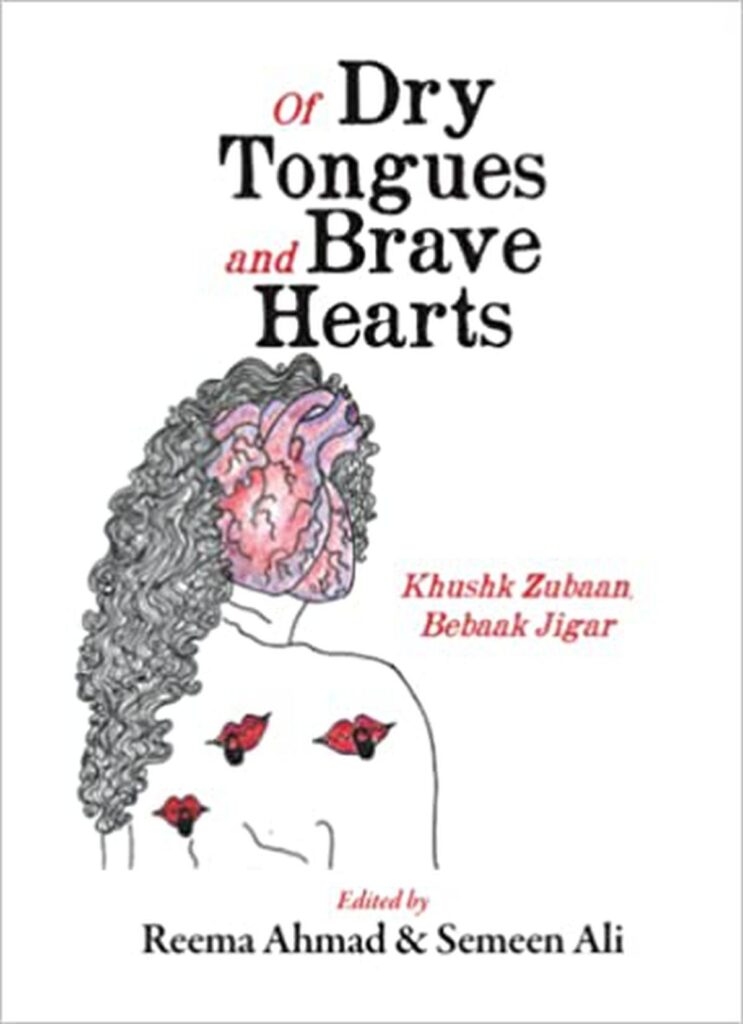
When tongues run dry but hearts remain fearless — can there be a plight direr than this tearing apart of body and mind? The drought on the tongue is the silence of fear, hiding a heart that rails against terror, pledging to shatter the quiet. Reema Ahmad and Semeen Ali have come up with a dream title for their edited collection of poetry, prose and painting by women, many of them newer voices, some unheard before, published by a daring and often-experimental publisher of poetry, Red River.
This jagged collection poses fundamental questions about the relation between art, passion, marginality, and the vagaries of everyday life. With close to 150 contributions combining verse, narrative, reflections and images, the heart of this book is filled with courage, and tongues remain dry no more — they spill rivulets of passion, anger, love, protest, and triumphant celebrations of the quotidian.
Hope is a lie
The sheer range reimagines the relation between creativity and passionate selfhood through a spectrum where the accomplishments of craft are uneven. But the honesty never is, and since in the end, honesty occupies the true heart of artistic craft, it also invites us to broaden our understanding of technical finesse beyond the usual and the expected.
Early in the collection, Debolina Dey confesses that “These poets have taught me/ to be a ruthless hunter of metaphors/ as if your body/ could be something else.” The body returns in its quotidian oppression in Sukla Singha’s story, ‘That ‘90’s Show: Blood, Shit and Other Things’, chronicling the daily humiliation, of body and labour, of a mother, experienced and narrated by a young daughter, but ending with the strange billowing of the heart: “A storm of jet-black hair in the air. A Meitei woman’s boisterous laughter. Nobody had the guts to ruin that magic.”
The vernacular is not only the name of reality here, but also of synergy between languages. Namita Bhatia’s Hindi poem, ‘Cactus’, opening with the eloquent grunt, “Mai cactus hun — cactus”, ends, in Reema Ahmad’s translation, with the “chaste hope” “That if my skin be peeled off/ I may bleed only milk”. But in her engrossing short story, ‘An Obscure Life’, Ketaki Datta reminds us that often hope is a lie — that her friend Swapna who claimed to a hotel singer had died without ever becoming one, after a life of prostitution known only to her mother.
In this dry-tongued world, poetry, as Sneha Roy knows, is a forever transgression: “Like a pillar of ‘shameless poetry’ standing tall/ in Plato’s failed and banished world.” Poetry lies in the humble and the mundane, not in flamboyance, as in Aratrika Das’s dream that her son grows up to cook in a kitchen of daily, soiled labour, not in the TV kitchen with glamorous aprons and hi-tech gadgets.
Haunted by sensation
Bodies are real and unruly in this collection. In her poem, ‘On Carving a Watermelon’, Yashasvi Vachhani voices a woman whose lover tells her: “you have a pretty face, if only you lost some of it/ some of the meat that calls your bones home”. As that “piece of art inedible”, she watches as “you hand me a knife/ and say begin”. Zehra Naqvi, in a poem of visual experimentation, reclaims the female body away from male desire and maternal nourishment: “Because our breasts belong to us. Not to the men who desire us. Not to the children who feed on us.” Dipali Taneja writes about the ageing body haunted by memories of sensation: “You hear that your uterus is senile!/ It may well be, but your skin is not.”
The lines face Teena Gill’s painting, Dancing Woman, and the meditative trance on her face strangely intensifies the bodily sensation in Taneja’s poem. Ikilily of Pink Lips, in Neha Chaturvedi’s ominous fairy tale of that name, nurses a curse — she can have sex, but if “so much as a thought of love entered her mind about the man or the woman she was with, the person would die.”
The myth contrasts sharply with the sculpted realism of Shamayita Sen’s poem, ‘Consent’, which states: “The birdcage in your chest/ will have to ask for consent/ for mine to respond.” Till the very end, the ineluctable violence of desire shapes the paradox of Khushk Zubaan, Bebaak Jigar.
Of Dry Tongues and Brave Hearts; Edited by Reema Ahmad & Semeen Ali, Red River,₹599
The reviewer’s most recent book is The Middle Finger, a campus novel about poetry, performance, and mentorship.
source: http://www.thehindu.com / The Hindu / Home> Books> Mixed Collection / by Saikar Majumdar / April 02nd, 2022
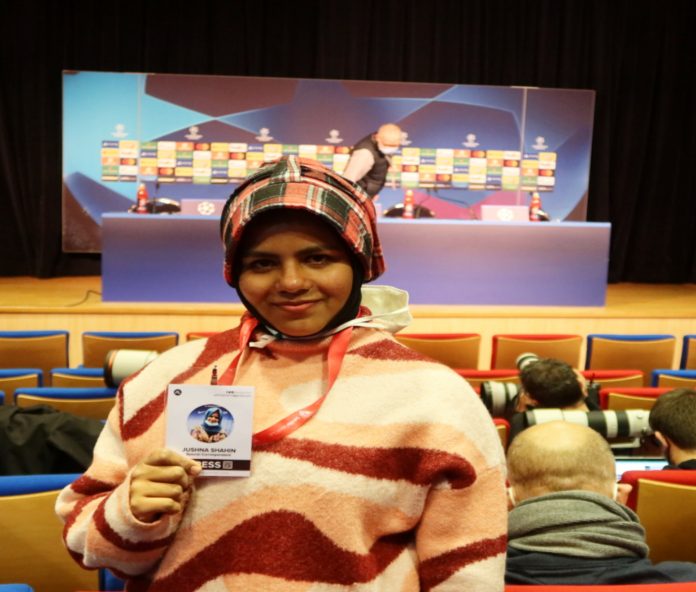
Jushna Shahin’s passion for the sport made her achieve the unthinkable.
Jushna at the conference room Spain. | Picture by arrangement
Kerala :
Jushna Shahin’s earliest memories are of watching football matches on TV with her family in Kerala’s Mangattuparamb village.
As a die-hard Lionel Messi fan, Shahin got her chance to do her bit for the game in 2009 when she was selected as one among the 70 students in JNU for the language assistant program in Spain by the Ministry of Education, Spain. “In our village, girls rarely went outside of their homes, other than going to school etc,” Shahin, a teaching assistant and football reporter in Spain, told TwoCircles.net. “Girls going out to play was out of the question, and that put an end to my dream of playing the sport.”
The Kendriya Vidyalaya high school where she studied encouraged sports, but Shahin was not comfortable with the usual sports uniform of shorts and t-shirt.
This did not keep the girl away from football. “I spent my time learning about the sport, and its laws and rules,” she said.
Love for Spanish and Messi Shahin said she wanted to study Spanish when she was in 10th grade so that she could talk to Messi.“I don’t know if it will materialize or not but I will make efforts,” she said.
In 2019 when she got her first salary working in Spain, Shain bought tickets for the UEFA Champions League in Barcelona to see her sports hero play live. “It was unreal and amazing,” she said.
The following day, she went over to the Barcelona club’s office and handed over a hand- letter meant for Messi, hoping that he would reply one day.
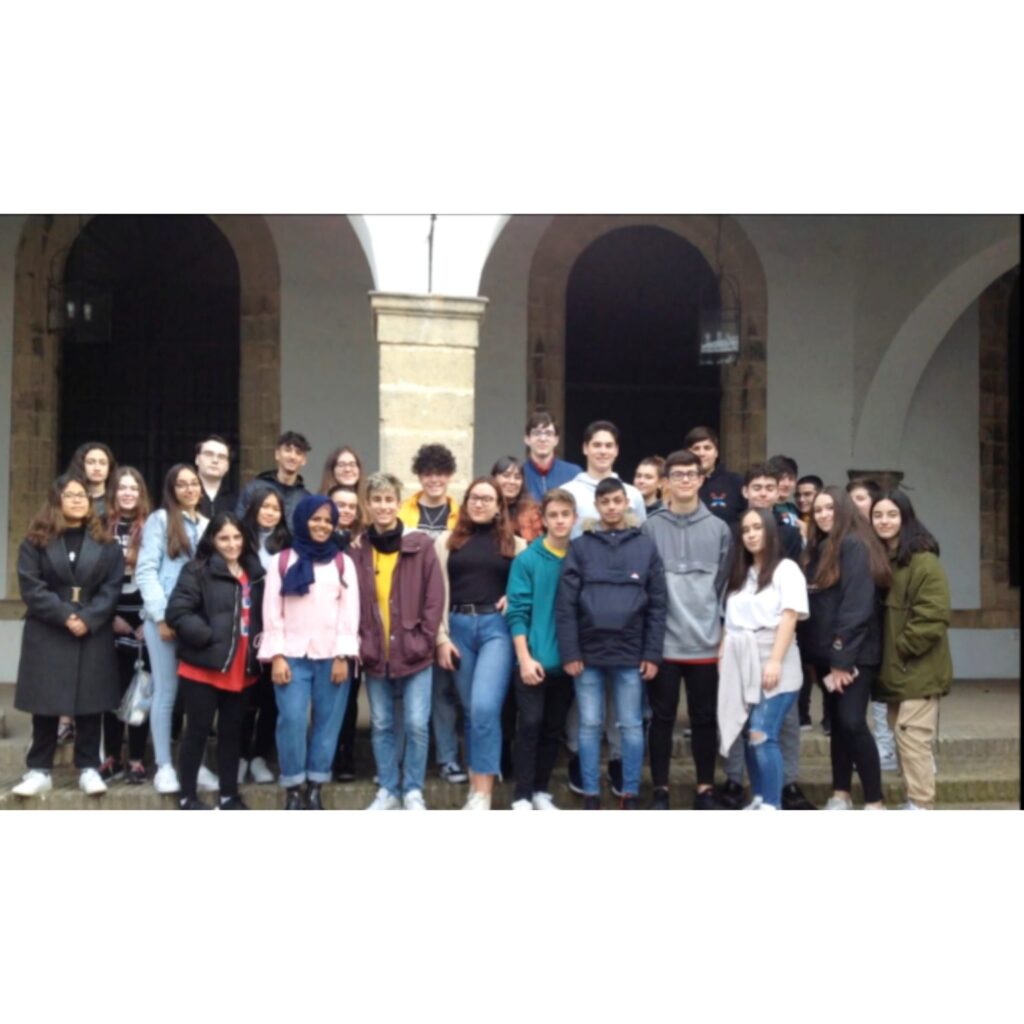
Jushna Shahin on a visit to a Vine Cathedral with her students at the IES Santa Isabel de Hungria, Spain. | Picture by arrangement
Last year when Messi moved to the Paris Saint Germain (PSJ) football club in France, Shahin flew to Paris and witnessed the team getting trained. “My heart-throbbing moment was when I watched Messi getting trained,” she said.
While in 11th grade, Shahin attended a camp organized by students of central universities to help those interested to pursue studies outside Kerala. Contacts she made from the camp helped her for the entrance exams. “Even after I cleared the exams, my parents were not convinced about pursuing Spanish as a graduation course. However, they gave in to my wishes,” she said.
In September 2019, Shahin traveled to Spain on her first international trip.
After landing in Spain she found that the Spanish she had learned from textbooks was not the same as spoken by people in Spain. “It was a challenge. Also, the other Indian student’s who had been selected were all placed in different cities of Spain. To travel to a new country was exciting but I felt tense and insecure initially,” she said.
Love for sports writing In 2014, when Shahin was at JNU, she started writing journalistic pieces for the Companion magazine. She would write short reports about the matches she watched. Her interest in sports writing led her to report for The Footy Times , which is an online magazine devoted to publishing football journalism. She started reporting for the magazine during the 2018 FIFA World Cup and has been writing for it since. She has also reported for Malayalam news channel MediaOne and online news website MaktoobMedia.
Shahin recalled two events as the most exciting during her work as a football reporter. In 2021 when the stadiums were closed to the public amid a global pandemic, she was one of the few media persons with accreditation pass reporting the semi-finals of the Copa del Rey in Spain. “I was seven months pregnant at the time,” she said
In February 2022, she got accreditation from the Paris Saint-Germain (PSG) Football Club to report the UEFA Champions League round 16 in Paris. She also attended a press conference at the home stadium of PSG club where hers was one among the ten questions asked to Karim Benzema (Real Madrid captain). “Now that stadiums are open for the public, I don’t think I will get the chance to go in with the media persons alone to watch a match in a closed stadium. That makes my reporting during the last year very special,” Shahin said.
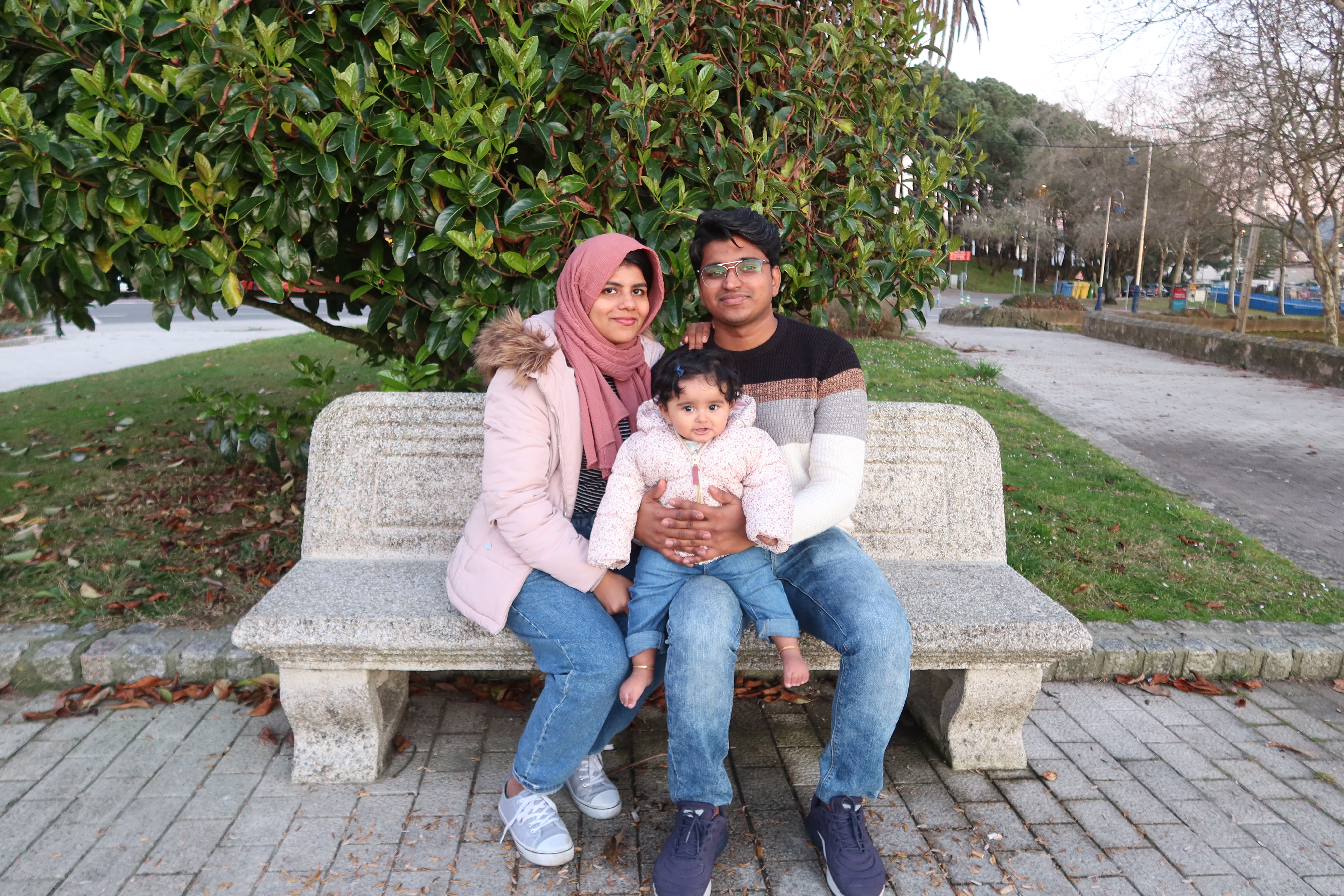
Jushna with her husband Awad and daughter Eva. | Picture by arrangement
Having been called crazy for her dreams and passion, Shahin shrugs it off and said, “What’s important and special for you might be very silly for the other person. It’s better not to see and look at your dreams in other people’s frameworks. Create your own dream and respect it, and be confident. Instead of just dreaming it, try to work on it. The only thing that matters is whether you are happy with it or not,” she added.
Shahin’s parents had seen her love for football only as a childhood interest and never knew she would pursue a career related to the game.
“More than her craze for football through Messi, I am happy that she is in the field of football journalism,” said her father CKA Jabbar, veteran journalist and associate editor of Malayalam news portal kvartha.com. “Love for football and writing have been in her since childhood, and she worked hard to follow her dream,” said her mother, Nazila CH, working in the Animal Husbandry Department under the Government of Kerala in Thiruvananthapuram.
Shahin now lives with her husband, Awad Ahmad, and eight 8-months-old daughter in the city of Vigo in north-western Spain.
Najiya O is a freelance journalist based in Calicut, Kerala. She tweets at @najiyao
source: http://www.twocircles.net / TwoCircles.net / Home> Lead Story / by Najiya O, TwoCircles.net / March 26th, 2022
The Thin Edge | Revisiting the restored, resplendent Humayun’s tomb
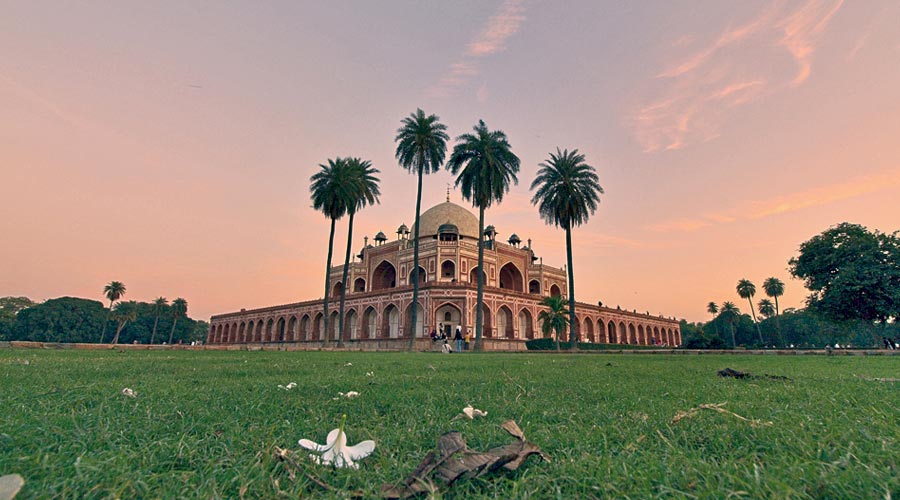
Humayun’s tomb / File picture
I have visited Humayun’s tomb several times, seeing it transform from its earlier decrepitude to the beautiful, sensitively restored monument-space it is today.
The tomb was one of my favourite old buildings even before the restoration — something about its clean lines, its proportions that manage to effortlessly mix intimacy with graceful grandeur, the restrained colour scheme of red sandstone interrupted by sparely deployed white marble, all of it has always nourished me more than the overwhelming, in-your-face beauty of many other Indian mausoleums and temples.
With the restoration now complete, the tomb itself and the ancillary buildings have also been given a context of green, well-tended gardens, which allow the other venerable monuments on the site — the trees and foliage — their own presence, their own visual Kabuki with the man-made masonry.
Recently, I went to see the tomb again, but this time with architect friends who were visiting the city. Like me, this couple had also visited earlier but they had not seen the finished restoration. Walking around the space with two pairs of somewhat differently-trained eyes was a lesson. Things I’d never noticed were pointed out: the exact alignment between the succeeding gateways; the ‘reveal’ as you cross the final threshold and can actually see the whole structure; and how different it was from what happens at, say, the Taj Mahal.
One of the friends spoke about how the white dome interacts with the sky, glowing sharply in the chiaroscuro of dawn and dusk, almost disappearing in muted top light, coming back into round vividity against dark clouds. Examined minutely were the almost invisible rain channels worked into the stone as well as the slope of the platform to coax away the monsoon water, none of which I’d noticed before. Explained was the way the sandstone slabs were placed with minimum mortar and the fact that they fronted a stuffing of lime and stone rubble.
To the east of the tomb stretched a tumult of trees, almost hiding the nearby gurdwara, with the railway line faint in the distance, while the north side had the view of the attendant water aqueducts and the lines of the water channels that must have inspired Louis Kahn and Luis Barragán in their design of the Salk Institute in California.
The spring morning light changed around us as groups of youngsters pranced up and down the stairs and sashayed across the flagstone, moving in unspoken group-selfie choreography, freezing from time to time without tangible signal into Instagram-mudras. Inside the shadowy central chamber, boisterous groups of young men yelled and blew klaxon whistles, bathing in the amazing acoustics before guards chased them away. On the grounds, on the benches under the quartet of pilkhan trees, a couple sat in chaste-canoodle mode while schoolgirls prowled around politely, looking for victims to interview for their class assignment. The austere beauty of the building, the lush, basant authority of the trees and the celebratory clusters of young people together made a whole that transcended architecture, arbour and holiday ardour.
The friends I accompanied are part of a loose movement of Indian architects drawing notice and accolades because of their alternative approach to building for our times.
This approach is defined by several things; a deep study of local grammar and traditions that inform any new design; a rigorous examination of the environmental impact of any new building, with innovative solutions to cooling and energy consumption becoming central to a project from the very beginning of conceptualization; an aim for genuine, non-grandiose beauty in the final design, all of this entirely subservient to who will use the building and how they will experience it in daily use. This movement is not confined just to India or to the subcontinent. A few days after my friends’ visit, came the welcome news that Diébédo Francis Kéré of Burkina Faso and Germany had won the Pritzker Prize, the most prestigious international recognition for architectural work.
This is not the place to detail Kéré’s work but what is important to note is that the architect has consistently built across some of the most deprived areas of Africa, working with local people, using the simplest local materials in the most inventive ways to produce buildings and projects which pair stunning design with amazing utility. Thus, a local school building may be made from compacted clay, with its ceiling and walls designed to cool the classrooms without any air-conditioning or glass cladding; a lighting scheme in another building may involve embedding into a ceiling traditional pots sliced into half; a Parliament building for Benin may echo a palaver tree under which people traditionally gather for meetings, while a proposed Parliament for Burkina Faso may be in the form of a ziggurat where the assembly is underground below a terraced public park, where the people are literally above the legislators. “I want people to take ownership over the parliament building,” Kéré has said and in that one sentence perhaps lies the core of his philosophy.
A few minutes drive from Humayun’s tomb brings you to the tin-sheet canyons that enclose the biggest heist of urban commons in the history of independent India. Here, at the Central Vista, the most pompously authoritarian, most ecologically damaging, most backward-looking glass and concrete office blocks, the prime minister’s mansion and the fortress-like new Parliament building are being constructed for a huge amount of public money at a time of grim scarcity. This area, for decades one of the few places where even the poorest of the city could walk in greenery, will now become a high-security showpiece for the bloated egos of those in power. In a city full of beautiful mausoleums, these future tombs for those ruling over us today will not stand any test or comparison. But meanwhile, whether in Kutch or Koudougou, in Dakar or Dhaka, human ingenuity, generosity and aesthetic grace will continue to produce architecture that re-affirms life and joy.
source: http://www.telegraphindia.com / The Telegraph Online / by Ruchir Joshi / March 22nd, 2022
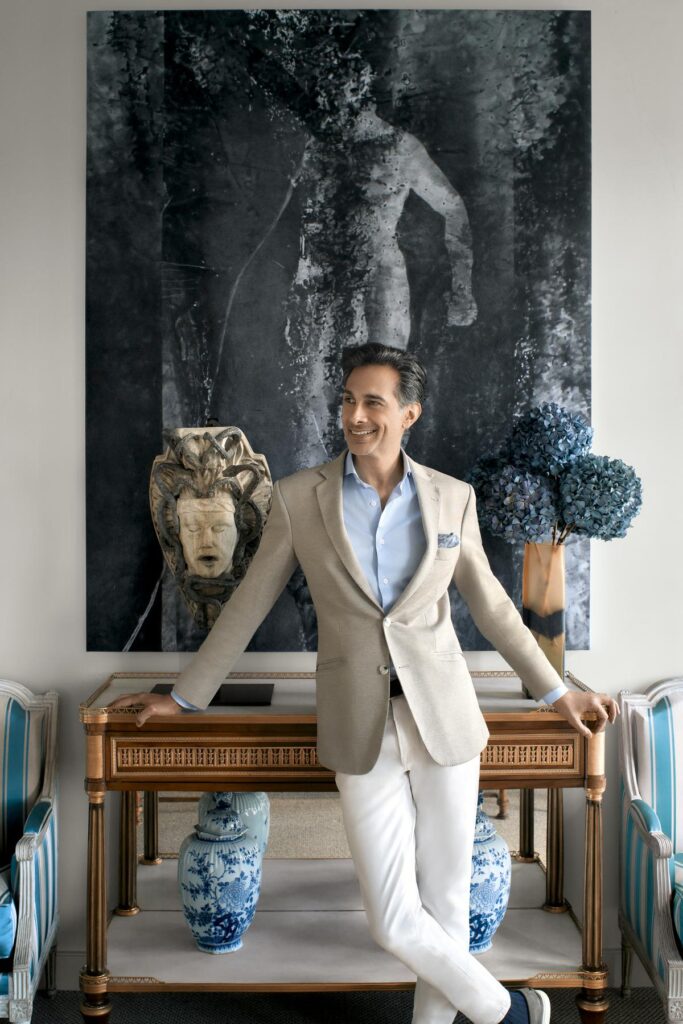
Amin Jaffer in his library dining room, standing in front of Yuntao Zhang’s painting of Cellini’s Medusa | Photo Credit: Architectural Digest / Antonio Martinelli
The Rwanda-born Indian curator, who has made the French capital his home, on the Al Thani collection’s first museum, his new book, and the importance of private collections
Writer, curator, collaborator, colonial furniture specialist: Amin Jaffer wears his titles effortlessly. And in the last couple of years, he’s added another one — that of Paris denizen — after he uprooted his English life of 25 years to move into a hôtel particulier (a grand townhouse) on Quai Voltaire along the Seine.
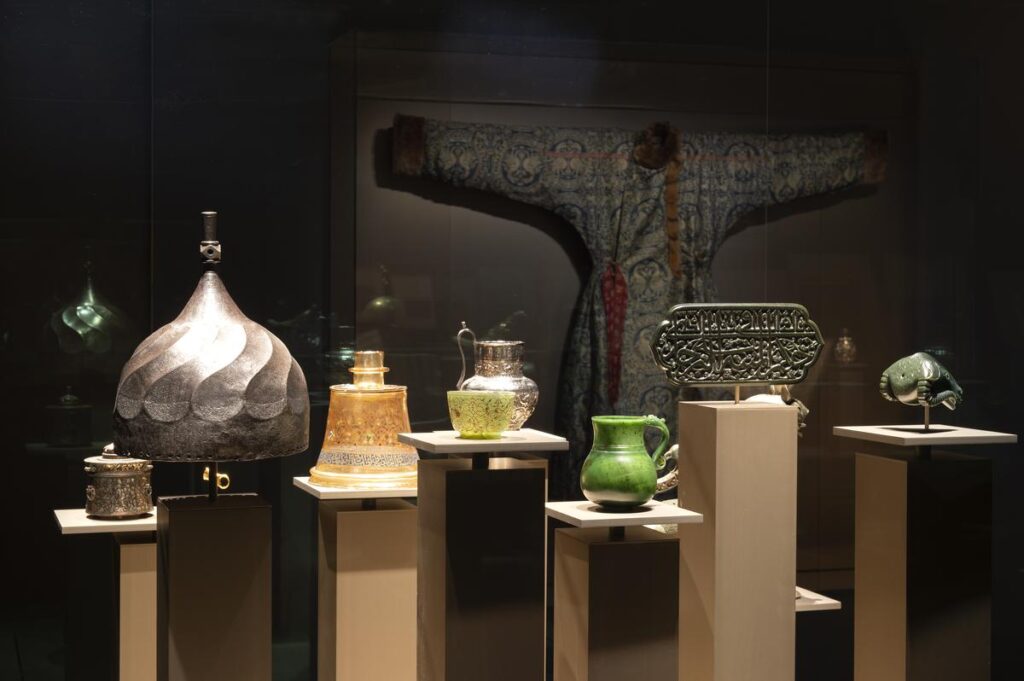
The move made sense. An “éminence grise of the international art world”, as an Architectural Digest article calls him (Jaffer is on the cover of the magazine’s 10th anniversary issue this month), he was “spending a lot of time in Venice, and the commute to London was becoming taxing”. But more importantly, his newest project, a private museum for the Al Thani Collection, is in the city, at Place de la Concorde’s Hôtel de la Marine.
“Sheikh Hamad bin Abdullah Al Thani was looking for a more permanent place to house the treasures of his collection,” says Jaffer, recalling how at the time, the French government body Centre des Monuments Nationaux was thinking of converting the former storage space for royal tapestries at the Hôtel — a four-year, €132 million restoration project. “They proposed that the Al Thani Collection could exhibit its masterpieces there.” With a 20-year agreement in place, acquiring a Parisian pin code thus gave him a twofold advantage, both with work and keeping up his continental way of life. (The last few weeks alone have seen Jaffer travel to Seville and Carmona in Spain and Parma and Venice in Italy.)
The Al Thani Collection at Hôtel de la Marine | Photo Credit: Marc Domage
Polaroid and a passion for art
The view of the Louvre from his third floor flat definitely tipped the scales in its favour. (The photos he shares on his Instagram, @aminjaffer_curator, are proof enough.) And the fact that Vivant Denon, the first director of the museum, had once been a resident in the 17th century building. Moreover, as he explains in an email that he squeezes in between flights, he’s always had a special connection with the Louvre. As a six-year-old, he had visited the museum with his mum, spending an entire day exploring its rooms, a Polaroid camera clutched tightly in his hands. He still has the photographs. “The adrenalin rush of seeing a great work of art inspired me then — as it does now,” he says, adding how by the time he turned 10 he had visited most of the major museums in Europe. “Other seminal moments include an early visit to the Musée des Beaux-Arts in Brussels and a trip to Rome to see the Vatican collections.”
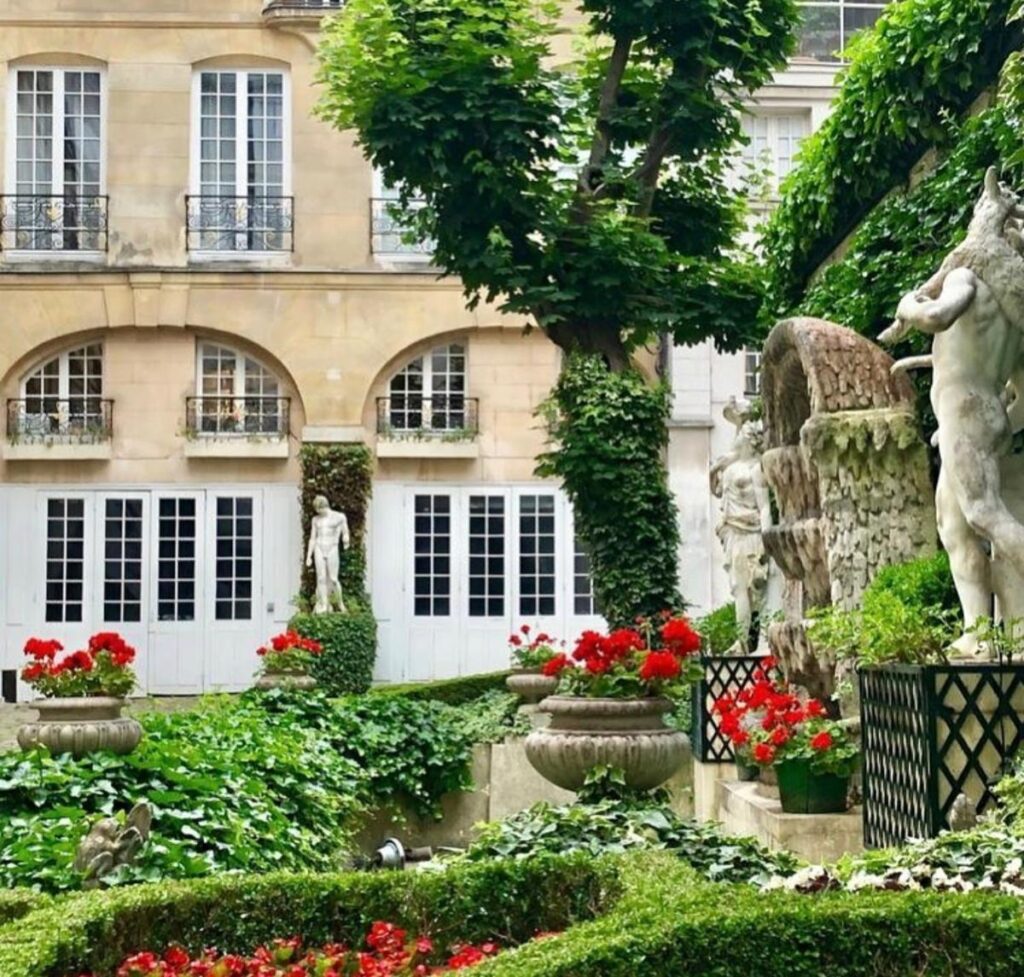
The courtyard at L’Hôtel de Beuvron with its Rococo fountain | Photo Credit: @aminjaffer_curato
But he nearly missed his calling. Born into an Indian business family in Kigali, Rwanda, a career in art wasn’t an option growing up. His subjects in university were economics and commerce! That is, until he chose the history of French opera and French Renaissance châteaux as his first year electives and reignited his love affair with the arts.
Today, Jaffer, who is in his early 50s, is not only the chief curator of the Al Thani Collection, but also works with leading museums around the world in a “curatorial role, focussed on public projects, exhibition programming and producing catalogues”. His resume includes long stints at the V&A Museum in London as curator and as the International Director of Asian Art at Christie’s.
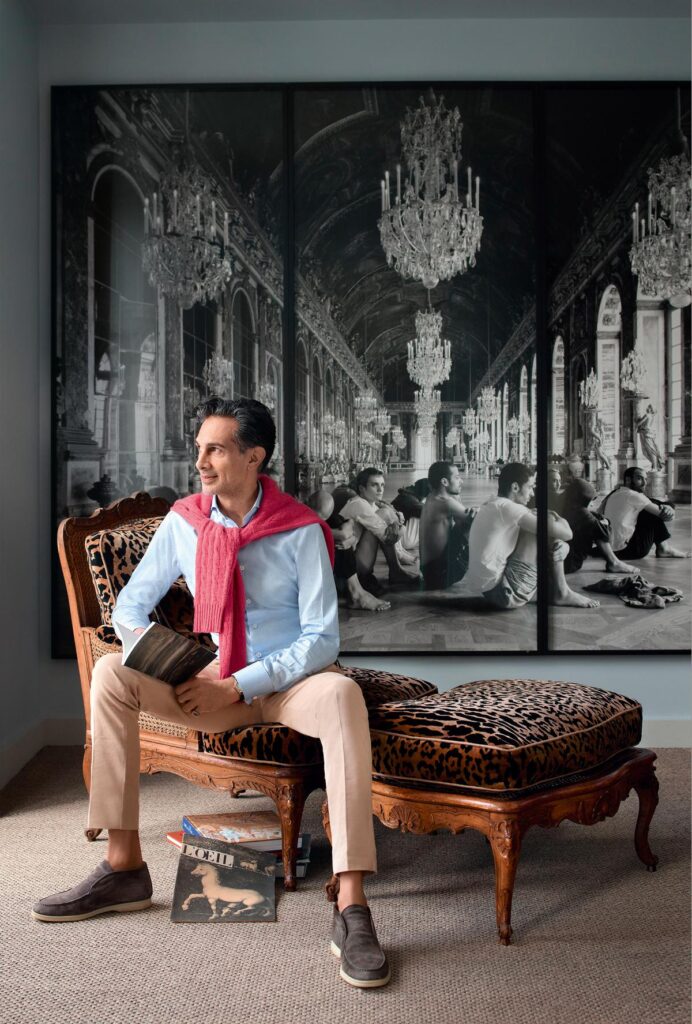
Amin Jaffer in his home office, sitting in front of a triptych by Reza Aramesh | Photo Credit: Architectural Digest / Antonio Martinelli
The perks of a private collection
“Born in central Africa, educated in Europe and America, I do feel something of a hybrid and I am drawn by works of art that are born from the encounter of two — or more — civilisations,” says Jaffer, who has recently “been fascinated by the fusion of Spanish and Amerindian culture, particularly in the domain of painting”. This ties in beautifully with the Al Thani Collection and its catalogue of more than 5,000 works of art drawn from across world civilisations.
It makes us wonder, how important are such private collections in the art world? “Pioneer collectors have vision and resources that compliment the public art offering,” he says, explaining how such collections play a significant role in the programming of national institutions. “Recent examples in Paris [besides the Al Thani Collection] includes the Bourse de Commerce and the Fondation Louis Vuitton. In India, Kiran Nadar has developed a programme of exhibitions around her collection that makes an essential contribution to the art scene,” adds the Indian art expert who played a key part in launching Christie’s first auction in Mumbai in 2013.
At Hôtel de la Marine | Photo Credit: Marc Domage
On board with digital
Jaffer’s personal collection is equally varied. A triptych by Iranian photographer Raza Aramesh, of Afghan refugees sitting in the Versailles’ Hall of Mirrors, takes pride of place in his home office, while a painting of Italian sculptor Benvenuto Cellini’s Medusa by Chinese contemporary artist Yuntao Zhang hangs in the library dining room. Elsewhere, Qing period armchairs, Louis XVI commodes, and Bouke De Vries’ Memory Jars are tucked into corners and under tables. “My most recent passions are French 18th century silver and hardstones from late Antiquity, especially objects in porphyry. I am learning more about Symbolist painting, too,” he says.
His days of confinement (as the French called the lockdown) helped broaden his base. When not watching life on the river, he was visiting digital museums and “researching parallel institutions” around the world. “What’s certain,” he says, “is that technology will play a greater role in the way we enjoy works of art — whether through the presence of more immersive, digitally-led exhibitions [such as the RMN Grand Palais’ immersive Venice show opening in autumn] or the sharing of information about works of art through digital platforms [like the one for the Palazzo Pilotta collection in Parma, which he experienced last weekend].” Does this mean he’s also on board with NFTs? “Of course, the phenomenon interests me,” he says, “but I do not yet have sufficient expertise to comment on anything in this new domain.”
The Al Thani Collection | Photo Credit: Marc Domage
Left Bank to the Concorde
For now, he’s back at his home at L’Hôtel de Beuvron, listening to Wagner and Mahler, and updating his Instagram. V&A’s new exhibition, Fashioning masculinities — on the male dress and its influences — has caught his eye, though he admits his personal wardrobe is rather formulaic. Tailored clothes in a limited palette of colours is the ‘uniform’, accented by pocket squares and ties that reflect the season or his mood. “Cufflinks are a weakness,” he shares, “and the best ones are by [Indian jeweller] Viren Bhagat, without doubt.”
Even as Jaffer immerses himself in life on the Left Bank, work at the museum is keeping up its momentum. “Some substantial pieces have been added to the collection in the past two years, which reflect the diversity of interests [of Sheikh Al Thani]. These will be shared with the public through displays at the Hôtel de la Marine,” he concludes.
source: http://www.thehindu.com / The Hindu / Home> Entertainment> Art / by Surya Praphulla Kumar / March 19th, 2022
At Falak in Bengaluru, a custodian of the old Urdu-speaking culture and culinary traditions brings storytelling to the table
While the lights of Dubai-esque skyscrapers speak of a new Bangalore and its ambition, the salubrious weather on the terrace is a testament to an old city — pleasant and genteel, never mind traffic, chaos or climate change!
This convergence of the old and the new is a theme, as I sit down to a meal at Falak, the new restaurant at Leela Bhartiya City. The meal is to flow like a quintessential 19th century Lucknowi dastaan (story), hyperbolic and stylised, to mimic the oral storytelling tradition, dastaan-e-goi.
In my bookcase, I have a copy of Tilism-i-Hoshruba, the truly first Indo-Islamic romance epic, an extension of the dastans of Amir Hamza, of the Persian tradition, albeit in translation. When it was first published, in a serialised form, between 1881-93, by the iconic Naval Kishore Press in Lucknow, it marked an important moment for the Urdu-speaking-and listening audience of northern India, long familiar with the Persian romance tradition — with fantasy, adventure and the implausible built in. But I turn to Hamza, to also dive into the inherent syncreticism on the pages, as the mores of a Persian world collide and merge with those of local Braj Bhasha-speaking cultures of the Indo-Gangetic plain.
Finding nuanced Avadhi in Bengaluru
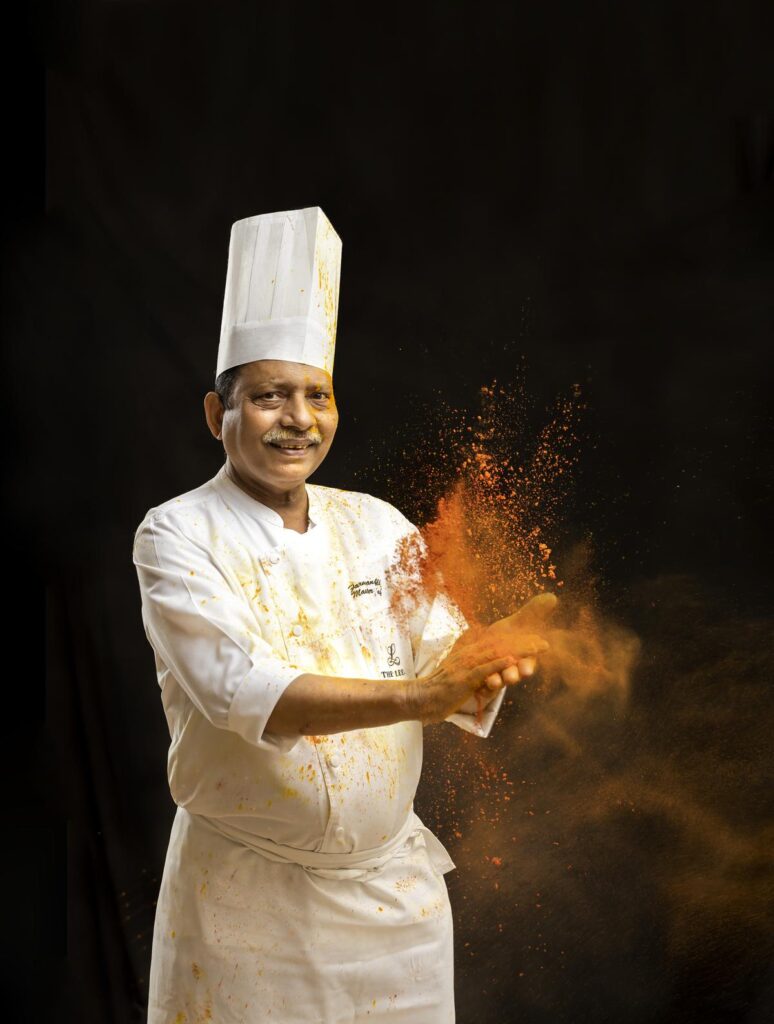
It’s a surprise to find a restaurant referencing this art form, to present Lucknowi (as also other Mughalai) dishes. Used to so much pastiche when it comes to Avadhi, the detailing in the menu is also unexpected. The food that arrives confirms that this perhaps is one of the most nuanced Avadhi/Mughalai restaurant opening in recent times — here in Bengaluru, rather implausibly, rather than Delhi, Mumbai or even London! Everything falls into place, however, when Farman Ali, all of 70, a chef who cooks behind the fiery range and sigri himself, and presides over the kitchens of Falak, makes his appearance.
When he hears about of my own Lucknowi antecedents, Ali abandons the idea of narrating food lore. With an extreme politeness that marks old Nawabi etiquette, he asks me, “ Ab aap ko kya dastan sunaye? [what possible tales can I tell you?].” And bursts into poetry, instead!
The rest of the evening goes by with the chef dropping verses from Daag or Ghalib or the other few who made 19th century Delhi one of the most literary cities in the world, even if we have forgotten that genre of poetry of lament created almost exactly at the time as Shelley, Wordsworth and the Romantics.
pix
Parts of an ancient story
For Ali, I realise, this is not performance — though it is quite in sync with modern chefs expected to be performative as they spend time building brands ‘front of the house’. Instead, this is a way of life, a culture that has all but completely faded. As the meal progresses — the nihari (pepper-laced stew of old Delhi’s spice market, concocted, according to lore, to ward off cold and flu thought to emanate from the Yamuna canal in Chandni Chowk) being replaced by the qorma ( nihari evolved into the subtle Avadhi qorma, catering to aristocrats who thought it ill-mannered to be smelling of spices after a meal) being replaced by the ‘ balai’ka tukda for dessert (not dubbed ‘ shahi’ royal bread pudding here; balai being the correct term for clotted cream) — we talk not food but art.
One of the dishes served at Falak | Photo Credit: Special arrangement
“After 1857, so many artisans and poets fled Delhi for the Deccan,” says Ali. “Culture spreads like this.” He is right, of course. But the ghazal or qasidas aside, it’s also the biryani that has diffused. Farman Ali’s is the old Delhi/Lucknowi style (he grew up in old Delhi and still has a house there) where rice is cooked in stock, and the ‘ pulao’ is not the layered and overtly spiced dish that its Hyderabadi cousin is. Old ‘Nakhlauwallas’ — such as yours truly — contend there was no Avadhi biryani at all, before the restaurants took over, just many fanciful and well-documented pulaos such as the ‘ moti’ (pearls) or the ‘cuckoo’, served with fried onions and thin yoghurt, no chutney or gravy.
The man behind Jamavar
Ali worked in restaurants in Delhi and Dubai before being handpicked by The Leela’s Capt CP Krishnan Nair to create the food of Jamavar nationally, to cook and serve pan-Indian food. Based in Bengaluru, he curiously escaped much national attention, retiring just before the pandemic, but was called back by the owners of Bhartiya City, foodies themselves, to cook food closer to his roots.
If cuisine is an expression of a culture, at a particular point in history, its custodians and storytellers are as important as the taste of dishes.
In India, at this moment in time, it is perhaps important to look back on the custodians of the old Urdu-speaking cultures and their culinary expressions. What kind of a society produced these stylised dishes? Farman Ali, in many ways, is the last of the great chefs, many of whom were feted much more and earlier in their careers than him — such as Imtiaz Qureshi of ITC Hotels (and his family, such as son-in-law Ghulam Qureshi of Dumpukht), and chef Ghulam Rasool of Taj Hotels.
source: http://www.thehindu.com / The Hindu / Home> Life & Style> Food / by Anoothi Vishal / March 19th, 2022