Category Archives: Community Involvement / Social Issues

The empowerment diaries

JAMMU & KASHMIR :

Do you know how it feels to stay cooped up inside your room for five months with shattered window panes reminding you of the constant presence of violence? Nousheen Baba, 21 Science student, Government College for Women, Nawakadal | Photo Credit: V. V. KRISHNAN

It is one step at a time for these Kashmiri women as they break away from traditional strangleholds and dare to dream differently, reports Peerzada Ashiq

Srinagar’s sprawling Eidgah ground is teeming with people. Despite the onset of Chillai Kalan, the harsh 40-day winter spell, there is a hubbub. Some are playing cricket, the rest looking on. Soldiers from the Central Reserve Police Force (CRPF) in mobile bunkers stand guard on the boundary wall; fingers locked on the trigger which, at the hint of any trouble, can spray pellets or tear gas. Three newly dug graves in the ‘Martyrs Graveyard’ bear testimony to the violent and troubled times of 2016.

Just metres away from the graveyard, Nousheen Baba and her sister Iqra Baba recall how they could not hold themselves back from watching the funeral procession of 12-year-old Junaid Ahmad on October 9. Security forces allegedly emptied an entire pellet cartridge from close range at Ahmad and the Valley exploded in anger and sadness at the loss of a young life. “Do you know how it feels to stay cooped up inside your room for five months with shattered window panes reminding you of the constant presence of violence,” asks Nousheen, a second-year science student of Government College for Women, Nawakadal and aspiring chartered accountant. The windows of the Baba household bore the brunt of the clashes which erupted between security forces and protesters.

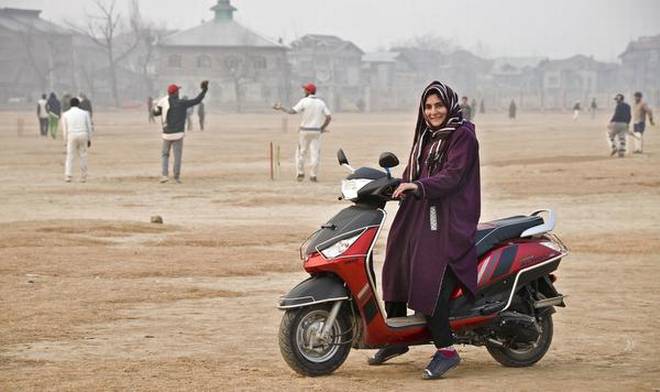
But Nousheen is eager to put the painful year behind her and even manages a shy smile. As a warren of houses in the highly congested Narwara locality in downtown Srinagar greets the eye, a tiny silhouette in a shiny grey cover makes its presence felt in the small courtyard of the Babas. Beneath the cover is the family’s first motor-driven two-wheeler. Courtesy Iqra, a Bachelor of Commerce student at the same college her elder sister goes to, who was rewarded by the State government for securing 85 per cent marks in her Class XII exam. “It’s our first scooter in the family. We are all learning to drive it,” says Iqra’s father Mushtaq Baba, a weaver. The Scooty is Nousheen’s constant companion too ever since Iqra brought it home nearly two months ago. From college to market, to visiting her friends, it is her lifeline to a future she dreams about.
KashmiriWomen02MPOs25sept2018

Dreams on wheels

In the first phase of the two-wheeler scheme, Chief Minister Mehbooba Mufti handed over the keys to 450 scooters to graduation-level students of Government College for Women, Nawakadal and Government Women’s College, Baramulla on November 6. Only meritorious students whose family income is under Rs.4 lakh per annum are eligible for the scheme, which is being extended to all degree colleges of the State. In Jammu, 300 scooters were handed over to eligible students.

Mufti sees the Scooty as a game changer in improving the education of girl children who come from economically weaker sections. “I have lived a common man’s life and gone to college on a bus. I know the difficulties women face while using public transport. You feel it is safe sitting next to an old man, till he starts nudging you in the elbow; the unwelcome attention can be harrowing for any woman,” says Mufti, explaining the rationale behind her scheme. She recalls a young woman she spotted riding a scooter in Srinagar earlier this year while on her way to the State Assembly. “This girl was short and slim but it was her confidence that was striking. The idea took shape right there. We took the decision to bear 50 per cent of the cost of the bike,” she says.

The government has dovetailed many Central schemes meant for women empowerment to provide these scooters. “I wish I had one and could ride it freely. A girl who owns a Scooty now will never have to request her brother or father to go places. The two-wheelers give women a sense of control of things,” says the Chief Minister, adding, “Women are the first casualty of violence. Investments must be made to empower women.”

Iqra, for one, feels empowered, never mind the taunts of the local boys as she drives past: “The two-wheeler has earned me azadi (freedom) enough to go to tuitions late in the evening.” Five km away from the Baba household, Nargis Rasool, the eldest of four sisters and a brother, borrowed money to avail the Scooty scheme. “My father treats me like my brother’s equal now since I started driving the Scooty. It is like taking part in a revolution. Though many elders did object to my driving saying ‘how can a girl ride a Scooty on the street?’, my parents supported me,” says Nargis, a final-year Arts student of Government College for Women, Maulana Azad Road. Her 90-plus percentage in the Class XII exam helped this civil services aspirant to bring the first-ever vehicle to the Rasool household, a family of shawl weavers. Nargis has become an inspiration for the extended family, including six female cousins. “Their parents are now forcing them to study hard to secure a Scooty on merit,” she says.
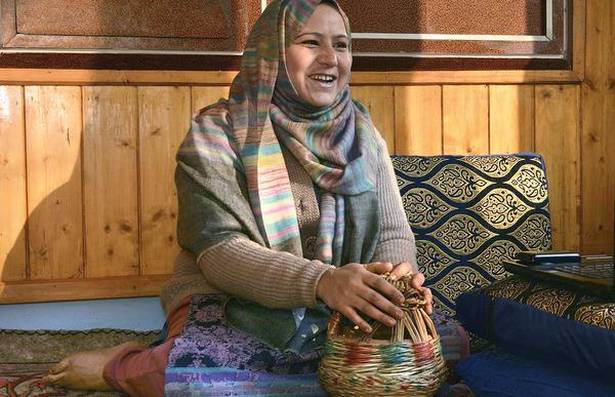
I am rooted in Kashmiri art and culture. I want wages and artworks of women to shift to a competitive level. Arifa Jan, 31 Owner, carpet manufacturing unit | Photo Credit: V. V. KRISHNAN

Reviving an old craft

Namda, a carpet made through the process of felting by hand, needs both muscle and money. For Arifa Jan, 31, who completed in 2010 her Craft Management Entrepreneurs’ Leadership Programme from the Craft Development Institute, Srinagar, the challenge was to turn around the fortune of this dying craft at a time when exports of the once-world-famous Kashmiri carpet had plummeted. According to a government survey, the total production of handicrafts rose to Rs.1,614.59 crore by 2008 against Rs.200 crore in 1990-91 but Namda exports had gone down 97 per cent and amounted to less than Rs.40 lakh annually.

“The use of cancer-causing dyes and poor cotton mix pushed Namda to the verge of extinction,” says Arifa. She infused science and healthy processes back into the craft to make it market-friendly. In 2010, she had to brave prolonged curfew spells to reach her unit to weave the first-ever assignment of 300 Namdas, meant for an exhibition in New Delhi by Dastkar, an NGO working with craftspeople across India.

“Eight-five per cent of my Namdas were sold. I still remember the taunts of a German buyer who kept saying we were producing fake Namdas,” says Arifa, who credits an unknown buyer from Delhi for her first brush with success. The buyer later turned out to be Gulshan Nanda of the Crafts Council of India. Nanda reposed faith in Arifa and the money flowed. “Ms. Nanda would come to me and ask serious questions about the craft,” says Arifa.

In 2013, the Crafts Council of India selected Arifa for a trip to Kyrgyzstan to study their processes of carpet-making. Back home, she scouted for an Australian merino sheep hybrid that was introduced in the Valley in the 1960s. “Its wool is what goes into exquisite Namdas,” she says.

For the first time, Arifa introduced pre-processes to weed out hazardous particulates from the wool and ensured no cancer-causing dyes make their way into it. “Even artisans who’d make chain stitches on the carpet used to complain of chest pain earlier due to the use of synthetic ingredients,” she says.

The daughter of a retired State Road Transport Corporation employee, Arifa is now eyeing business opportunities in the U.S. even as her stable has expanded to 27 artisans, 17 of them women. “I am rooted in Kashmiri art and culture. I want wages and artworks of women to shift to a competitive level. Artisans have suffered a lot in Kashmir — we have to bring them on a par with sellers,” she says.
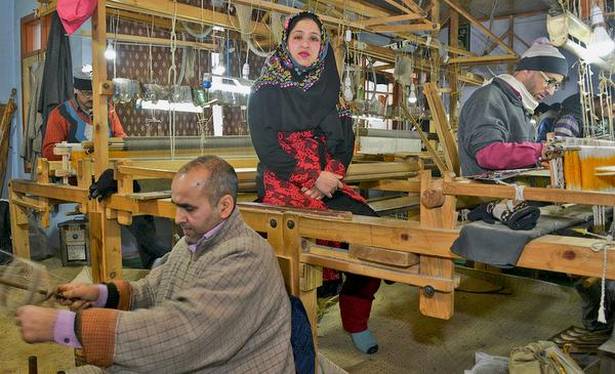
A girl from Kashmir, counting one lakh rupees and all the men around looking in awe at her... A strange feeling seeped in. Shaeena Akhtar, 31 Owner of a shawl loom | Photo Credit: V. V. KRISHNAN
A girl from Kashmir, counting one lakh rupees and all the men around looking in awe at her… A strange feeling seeped in. Shaeena Akhtar, 31 Owner of a shawl loom | Photo Credit: V. V. KRISHNAN

Weaving a new formula

It’s 4.30 p.m. The rolling wooden bobbins with multi-coloured fine threads and the neatly thrown over-and-under shuttles meant for woofs and warps are showing no signs of the day’s tiredness. Bollywood music from the 1980s breaks the monotony of the shuttles at work. It’s the first loom in Kashmir where a woman is at the helm, and an attempt is underway to replicate the famous floating garden on Dal lake, Char Chinari, as a design relief from traditional motifs in Kani shawls, a fine handwoven mix of pashmina and shahtoosh wools. “We have developed a new formula for shawls. No one can steal it. It’s original and a major departure from the past. My work drives my clients to my loom — I have requests pending from many exporters,” says Shaheena Akhtar, 31. Like Arifa, Shaheena, a resident of Srinagar’s Nowshera area, too comes from a humble weavers’ family, but in just five years, she is being credited with giving a new identity to the Kani shawl, picking up the State’s Best Entrepreneur award along the way three years ago.

Shaheena’s journey to finding acceptability in markets in Italy, Germany and Dubai has been anything but easy. “Not everyone treats you as a daughter or a sister when you start something like a shawl business. My character was questioned because I used to meet officials. I struggled to have bank guarantors because my father was just a small-time weaver. It was not easy to raise money,” she recalls.

Following a training stint at the Entrepreneurship Development Institute, Pampore, in 2011, Shaheena was able to start with an initial investment of Rs.8 lakh. In a year she counted her first one lakh rupees in earnings. “My father had never counted Rs.1 lakh at a time. I am good at counting money. But that Rs.1 lakh was something I could not count for a while. A girl from Kashmir, counting money, and all the men around looking in awe. A strange feeling seeped in,” she recalls. As business grew, she enlisted her brothers’ help. “Of the 18 workers at the loom, 12 are relatives. I am proud that in such a short span I have a turnover of Rs.1 crore,” she says.

Roh-i-Kashmir (Soul of Kashmir), Shaheena’s company, has tie-ups with six major exporters for the 60-70 shawls her loom produces annually. “My thrust is quality. My shawl sells for Rs.4.5 lakh in the international market for its intricate and exquisite work. It takes more than nine months and two labourers to finish one intricately woven Kani shawl,” Shaheena adds.
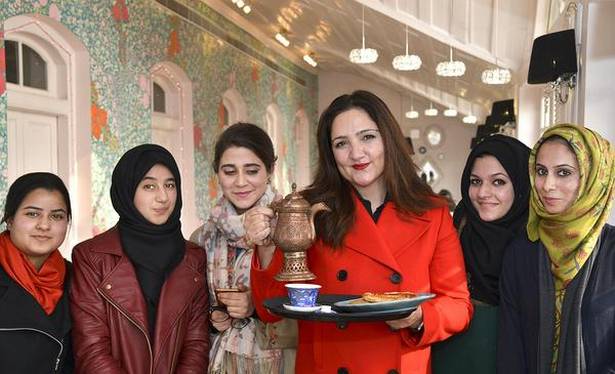
Every time I watch a fisherwoman of Srinagar, I can see her making her own rules as she negotiates her space and life. Roohi Nazki, around 40 Owner, Chai Jai | Photo Credit: V. V. KRISHNAN

An English tea room in Srinagar

Historically, Kashmir has drawn its taste buds from Central Asia, including the famous kahwah (a traditional green tea preparation) and multi-cuisine wazwan. Roohi Nazki, a former employee with Tata Interactive Systems, is trying to get Kashmiris hooked on something very different: the tea room. It’s been worth the effort, if increasing footfalls at her small joint, Chai Jai — modelled after tea rooms in England — are anything to go by.

It was a solo holiday trip to England in 2013 that changed Roohi’s life and introduced her to the niceties of tea rooms. In the Cotswolds villages of south-central England she saw mirror images of the Kashmir Valley. Moving back to the Valley after living in Mumbai for 22 years, Roohi’s parents initially persuaded her to stay on in a corporate job, but she just knew what she wanted to do next.

As one walks down the British-era manicured embankment of the Jhelum river in Srinagar’s Polo View area, Roohi’s ‘little England’, complete with castle-room interiors and cobblestone floors, is hard to miss in the age-old Mahatta Building.

Launched in July this year, Roohi is reviving teas from bygone times like Daam Tyooth (a herbal tea), Bunafshan tea (flower tea), Qadri tea (a herbal tea with sugar mix), Nettle tea and Gulkand kahwah (mix of saffron and sun-dried rose petals). “I have 28 varieties as of now and I am working on a collection of 200 varieties,” she says.

Small steps to giant strides

While it is too early to see these women as enduring successes, having a woman Chief Minister at the helm seems to have given a fresh impetus to a more inclusive society in a State which has primarily been in the news this year for its mind-numbing violence. A slew of measures initiated by Chief Minister Mufti — including reservation of 10 per cent land in industrial estates for women entrepreneurs, the Ladli Beti scheme aimed at the economically poor, an all-woman entrepreneurs’ market, all-woman buses and all-woman police stations — are aimed at women.

The opposition National Conference spokesperson Sarah Hayat Shah acknowledges that every step towards empowerment of women is always appreciable, but simultaneously points out the troubled ground reality in Kashmir where even young girls have been killed or blinded in the wave of protests since July. “I am afraid the scooters may not be able to heal the wounds,” she says.

Ultimately, beyond the overhang of violence, a lot of the contestations with patriarchy are essentially atomic. “Every time I watch a fisherwoman of Srinagar, I can see her making her own rules as she negotiates her space and life,” says Roohi, now in her 40s.

Just like she fights her own little everyday battles, such as taking trolls — who were ‘outraged’ at her bringing a feel of Christmas to Chai Jai with cakes and candies from Mumbai — off her Twitter feed, one resolute click at a time.

source: http://www.thehindu.com / The Hindu / Home> News> National> Ground Zero / by Peerzada Ashiq / December 31st, 2016
Doctor shares her journey in medicine in Canada by mentoring other immigrants

INDIA / CANADA :

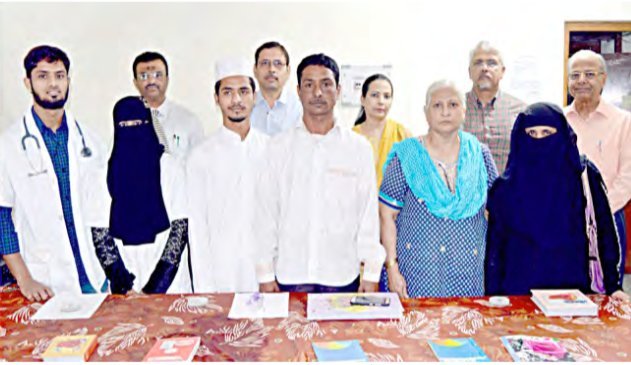
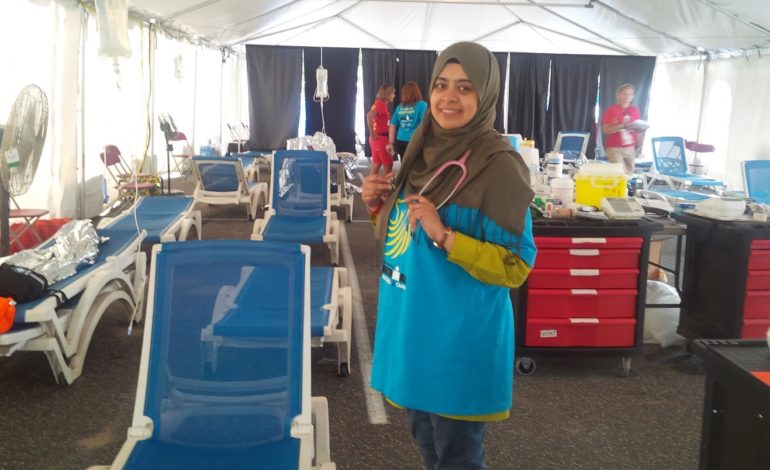
Dr. Nusrat Parveen shares her journey in medicine in Canada by mentoring other immigrant doctors.

Dr. Nusrat Parveen was an established gynecologist in the Middle East. A medical graduate from Aligarh Muslim University in India, she acquired post-graduate qualifications including membership of the Royal College of Obstetricians and Gynaecologists in London, U.K., and a diploma in the same field from the University of Dublin in Ireland. But this long list of educational achievements was not enough to get Parveen a job in Canada.

The process to become a doctor in Canada takes time, and now Parveen shares her own journey to medical licensure with fellow international medical graduates (IMGs) who aspire to practise medicine in Canada. For her efforts as a mentor to IMGs, she was recently recognized by Ontario Premier Kathleen Wynne with the Volunteer of the Year Award for community services. 

How did you come up with the idea of mentoring other IMGs?

My husband and I were volunteering with a food bank, when we came across an IMG who was lonely and felt lost as she did not have anybody to support or guide her. But she had the passion to practise medicine in Canada. Her situation had not dampened her spirit. It was her story that first inspired us. 

How did you find other IMGs to mentor?

The spark to help fellow IMGs and knowing that many are not aware of the process and are struggling, made us start the IDEAS program at Thorncliffe Neighbourhood Office (TNO) where the relevant support and resources are provided to IMGs. 

What has been your experience of supporting other IMGs?

Initially, it was scary. I had my commitments to my family and to bring up my two children. I was studying full time toward the physician’s assistant program at the University of Toronto, so my hands were full. But the fact that everything came together so nicely and the enthusiasm from the IMGs kept me going. 

Where exactly are you in your own professional journey?

I have cleared MCCEE, MCCQE1, NAC OSCE, IELTS and workplace culture and OSLT courses. The physician’s assistant program has prepared me for the supervised clinical practice and gave me an opportunity to refresh my clinical skills. In short, it has prepared me to integrate well into supervised clinical practice while building connections and references. 

You have not yet completed your own journey to practising medicine in Canada, so what gave you the confidence to mentor other IMGs?

I realized that there are many IMGs who need support, resources and peer mentoring. As I had prepared for my exams, I had a good idea of how things worked here and knew the process and where to look for resources. This knowledge of the system and process gave me courage and confidence to support fellow IMGs. I did have some doubts, which quickly vanished with my husband’s unflinching support. 

Why are you so committed to helping others through this mentoring program?

I have given so much of my time and dedication to the medical profession, as it has given me opportunities to serve people. Mentoring IMGs is yet another way of giving back to the community.

What is your advice to your fellow IMGs looking to get accredited in Canada?

Perseverance and extensive networking to build connections and references is the key to success in Canada. Try studying a program like the PA program, which helps to refresh your skills and connect to a practice.

source: http://www.canadianimmigrant.ca / Canadian Immigrant / by  Baisakhi Roy / November 20th, 2015

In a masjid during a mutiny

NEW DELHI :

MasjidMPOs21sept2018

In 1857, the mosque built by Shah Jahan’s wife was confiscated by the British

When the city of Shahjahanabad was being built by Mughal emperor Shah Jahan, his wives and daughter were also involved — they built mosques, markets and sarais to embellish the city.

The emperor’s daughter, Jahanara Begum, was the most prolific, and is best known for building the famous Chandni Chowk (moonlit square), a sarai or inn for travellers, and a beautiful garden known as Begum Ka Bagh.

The road to the mosque

Shah Jahan’s wives — Akbarabadi Begum, Sirhindi Begum and Fatehpuri Begum — built mosques in 1650 CE. The Fatehpuri mosque built by Fatehpuri Begum was aligned to the Red Fort — more specifically, to the Diwan-e-Am via the Naqqar khana (drum house) and Lahori Gate. Nobles who came to the court of the public audience had to dismount here and walk up to the court. As this was inconvenient for them, Aurangzeb had a barbican built in front of the Fort’s Lahori Darwaza so that they could dismount closer to it. Shah Jahan, who was then under house arrest in Agra Fort, sent a note to his son saying that the beautiful bride (Qila) had now been veiled.

The road from Fatehpuri mosque to the Fort passed through Chandni Chowk and Urdu Bazar (the original Urdu Bazar was located in front of the Lahori Gate till part of present day Chandi Chowk) and was lined with trees and flowers. These were cut in the beginning of the 20th century. Basheeruddin Ahmed, the writer of Waqeat e Dar ul Hukumat Dehli (1919), lamented that “the trees on both sides of the road provided solace to the inhabitants in the severe Delhi heat with its summer wind, the loo, in which the eagle abandons the eggs and deer become dark.” Today, when you go from the Red Fort to Fatehpuri mosque at the end of Chandni Chowk, you have to navigate your way through the nightmarish traffic, carts with goods, rickshaw-pullers, e-rickshaws, salesmen calling out to passers-by, and busy shoppers.

Crowded outside, peaceful inside

The mosque is next to the Khari Baoli, or spice market, so the entrance is always crowded. However, once inside the masjid, you realise that you’re in a different world — a world in which you feel a sense of peace and which is in stark contrast to the scenes outside.

Apart from the main entrance in the east, there are two other doorways — one in the north and the other in the south. With their arched entrances and parapets, these doorways have obviously seen better days. Shops outside flank them.

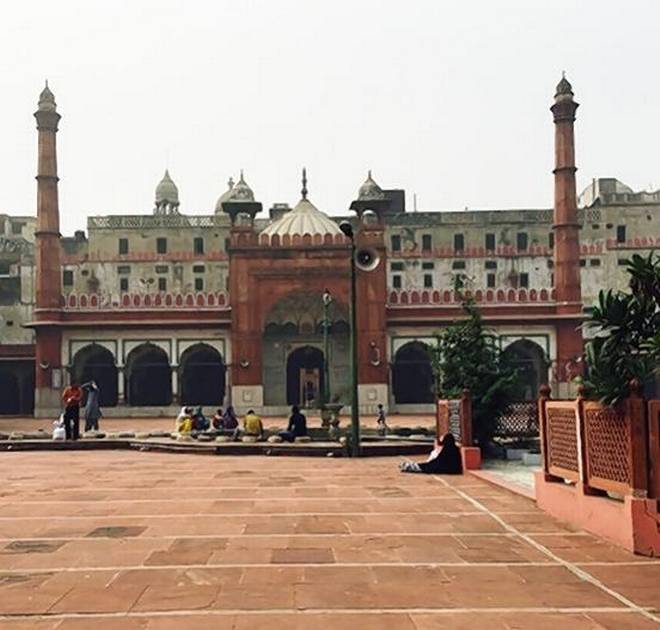
In the courtyard, the first thing that catches the eye is the lovely white dome with its longitudinal green stripes and green lotus finial. A masonry finial crowns it. Though the dome is made not of marble but red sandstone, it has been plastered so perfectly that it gives the impression of being made from marble when seen from afar. Red battlemented parapets run all along the roof in front of the dome.

The mosque, too, is built of red sandstone. Its unique feature is that it is the only medieval mosque with a single dome, flanked by two 80 ft tall minarets on both sides.

The mosque is built on a plinth of 3.5 ft. In the centre is a lofty archway with two wings which have three scalloped arches on each side. The central mihrab (in the direction of the qibla) is deep and high, and gives a beautiful appearance to the interior of the mosque. The pulpit next to the mihrab is the only piece of marble in the mosque. A mukabbir, or platform, was added in front of the main arch later, so that the imam’s words could be repeated from there and reach all those gathered in the courtyard.

There is a huge oblong tank for ablution in the courtyard that used to be fed by the famous Faiz Nahar (canal) in the Mughal era. A red sandstone enclosure next to it has graves of religious leaders who lived, prayed and taught in the mosque. There are galleries, with rooms on the ends on both sides.

From 1857 till today

The Indian sepoys, or ‘rebels’ as the British called them, who had risen up against the East India Company in 1857 had used this mosque. After the fall of Delhi in September that year, the mosque was confiscated by the British, and the courtyard, galleries and arcades on the three sides were put up for auction. As the dispossessed and displaced Muslims of Delhi post-1857 were in no position to buy it, Lala Chunnamal, a rich merchant of Delhi, bought it at the cost of ₹29,000.

In 1873, Anjuman Rashidin Sulah e Kul Islamia applied for return of the mosque. The British government agreed and tried to buy it back, but Lala Chunnamal refused. In 1877, the British offered an increased amount as well as four villages and bought it back from Lala Chunnamal’s son and restored it to the Muslims of the city. The masjid was brought back into use as a masjid, and remains so till today.

source: http://www.thehindu.com / The Hindu / Home> Opinion> Columns / by Rana Safvi / September 16th, 2018

The Paigah’s necropolis

Hyderabad, TELANGANA :

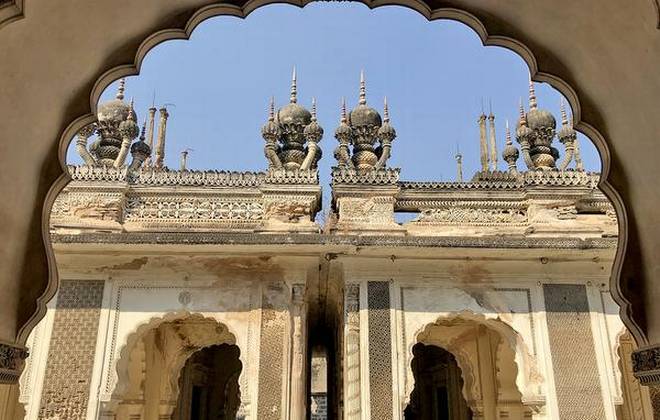
PaigahTombsMPOs20sept2018

A visit to what some call the Taj Mahal of the south

What comes to your mind when you think of Hyderabad? Sumptuous haleem and biryani, perhaps? Or the beautiful icon of the city, Charminar? Or maybe the unique khada dupatta and its accompanying necklaces, if you love clothes and handicrafts. All of these are understandable connections. Few would relate Hyderabad to an exquisite necropolis that is hidden away in the heart of the city, which I discovered recently thanks to a friend.

Dilapidated graves

At the entrance of the Pisal Banda suburb in Santosh Nagar, I stopped at a small café and asked for directions to this necropolis. No one seemed to have a clue. As I was following the GPS, I decided to trust it and ventured deeper into the crowded alley. Soon I saw a modern grave enclosure with the words ‘Paigah Tombs’ written on it there. I felt a little cheated, but then to my delight, just behind the grave enclosure was a white gateway which I entered.

On my right lay many dilapidated graves inside a rectangular enclosure. Some were as new as 2009, while some others were at least a century old and reminded me of verses on the dismaying finality of death and the futility of gathering wealth.

With my loud sighing at this state of disrepair, I managed to attract the attention of a caretaker of the Archaeological Survey of India (ASI), Rahmat, who then gave me a conducted tour.

In the courtyard were intricate work on the walls and small cupolas with Grecian horns on the roof, which were not only breathtaking but also striking in their originality. I had never seen work like this before. There were limestone trellises, ornamented pillars and roundels on the façade of the tombs. “You won’t find such work anywhere in the south or north,” Rahmat said proudly.

And how can it be that we speak of a tomb and someone hasn’t already compared it to the Taj Mahal? This is called the Taj of the south, Rahmat said, which I frankly think is gross injustice. There is no similarity in the architectural styles of the two tombs and this one is beautiful in its own right.

Origin of the name

The Maqbara Shams-ul-Umara, now better known as the Paigah Tombs, belongs to a family which was ranked only second to the Nizam of Hyderabad and to whom it was allied through matrimony. The family members were fierce loyalists of the Nizam and maintained an army to fight for the Nizam.

The word Paigah, which means pomp and rank in Persian, was a title given by the second Asaf Jahi Nizam of Hyderabad to the estate of Nawab Abul Fateh Taig Jung Bahadur in appreciation of the royal services rendered by him. The nawab was also conferred with the title of Shams-ul-Umra, which gives the tombs their name.

The first tomb, built in the 18th century and of Makrana marble, is that of Shams-ul-Umra, or the Sun of the Nobles, himself. It is delicate, with limestone and stuccowork on its enclosures. Twenty-seven members of the Paigah family, including the famous Nawab Sir Vicar-ul-Umra, are buried here.

The tombs all lie in a row under a foliated arched gallery with ornamented pillars and spectacular limestone jaalis on the façade of the buildings.

There are a number of open double storey enclosures that mostly hold several tombs inside. Each enclosure has limestone jaalis on the walls and exquisite carved teak doors as entrances. Each jaali is unique — some have motifs of fruits and flowers; others have drums, serpents, and vases.

The crypts are made of marble with intricately designed qalams (pen made of dried reed) or takhtis (slate) and headstones. A qalam or small raised mound on the cenotaph denotes that the grave belongs to a man, and a flat design of a slate denotes that a woman is buried here.

The architectural style inside the tombs and galleries is a mix of Rajasthani, Deccani and Persian, while the design on the roof is Moorish. The 30-acre compound also includes a mosque. Prayers are still held here. The sounds of the azaan and namaz waft over the graves. The Paigah family has handed over this architectural marvel to the ASI as part of our national heritage for safekeeping.

source: http://www.thehindu.com / The Hindu / Home> Opinion> Columns> Where Stones Speak / by Rana Safvi / January 21st, 2018

Beyond religion: Muslim cooperative society helps transform lives of Hindus, others

Patna, BIHAR :

Courtesy: Two Cirlce

Patna:

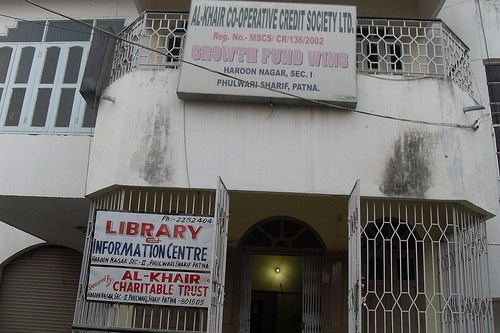
Kamla Devi, Pankaj Kumar, Geeta Devi and Sanjay Singh, all Hindus, share one thing in common. Their lives have been transformed through “interest-free” loans provided by a Muslim cooperative credit society in Bihar, yet another example how integrated Indian society has always been at the grassroot level.

They are four of nearly 9,000 Hindus — mostly vendors, small traders, roadside shopkeepers, marginal farmers and women — who got rid of exploitative moneylenders thanks to interest-free loans by the Al-Khair Cooperative Credit Society Ltd that is based here.

“I used to sell potatoes and onions in a small roadside shop. I was often exploited by moneylenders for a small amount of Rs 2,000 to Rs 5,000 that I needed for my business. But a few years ago, I was surprised when someone informed me of interest-free loans from Al-Khair Society,” Kamla, in her mid 40s, told IANS at her shop in Mirshikar Toli here.

She first took a Rs 10,000 loan to run her shop, followed by loans of Rs 20,000 to Rs 50, 000.

“It helped me expand my business from a vendor to a wholesale trader,” she said.

Now doing financially well, Kamla managed to fund the education of her two sons, with one getting admission in an engineering college and the other in a B.Ed. college.

Based on the Islamic principle of prohibiting interest, Al Khair Society has provided interest-free loans of more than Rs 50 crore to nearly 20,000 people, mostly those struggling for survival, in the last one decade of its existence.

About half of these beneficiaries are Hindus. Regardless of religion and any other considerations, Al Khair Society has opened new vistas for large sections of marginalised people, skilled and unskilled, from unorganised sectors.

Geeta Devi not only turned her small roadside vegetable shop into a big one; she has opened another vegetable shop for her son.

“Our life has changed after I came into contact with Al Khair Society. It helped us live a life of dignity. For poor people like us, interest-free loans are God’s gift and, unlike in regular banks, there are no uncertainties about getting the loan,” she said.

Manju Devi, another beneficiary, has been taking a loan of Rs 20,000 to pay the annual school fee of her children for the last five years. Her husband runs a roadside shop.

“I also deposit my daily earnings with Al-Khair Society and repay the loan amount without paying any interest,” Kamla said.

Sanjay Singh, another beneficiary of the interest-free loans, said banks have no time for vendors like him and they have no interest in giving out small loans.

“Banks charge interest and there is a lot of paper work involved that only discourages and frustrates the poor,” said Sanjay, who used to sell garments on a bicycle. He now owns a small garment shop run by his wife even as he continues to sell clothes on his bicycle.

What attracts people, many of whom are not literate, to Al Khair Society’s door is that it involves minimal paper work and a poor-friendly perspective.

“Interest-free loans may be a concept associated with Muslims as Islam prohibits interest as it terms it unjust, but it has a universal appeal and can benefit all, not just Muslims,” said Shamim Rizvi, a retired bank officer closely associated with Al Khair Society for nearly a decade.

Unable to get help from banks, these loans help people free themselves from the clutches of moneylenders who charge high interest rates.

Nayiar Fatmi, managing director of Al Khair Society, told IANS that interest-free loans are gaining popularity.

“Even a small amount of five to ten thousand is significant for people who don’t have access to banks. Nearly 50 percent of the beneficiaries of interest free loans are Hindus. Most of them use the money for earning livelihoods that empower them,” Fatmi said.

Al Khair Society has 13 branches spread across the states of Bihar, Jharkhand, Uttar Pradesh and Delhi.

“We are planning to open new branches in Kishanganj in Bihar and Ranchi in Jharkhand to reach out to more such people,” Fatmi said.

Al Khair Society is a successful example of interest-free microfinance that has brought smiles on faces of thousands of people. It started with merely a small fund and two employees at a small office in Patna. Today it has 100 employees.

The organisation charges a nominal service charge from those who take interest-free loans to pay salaries of its employees, rent of office and other expenditure.

Started by a group of educated Muslims in early 2000 as a small step to help ordinary people, the organisation has seen a tremendous response from all sections of society, irrespective of religion, caste or creed.

(The weekly feature series is part of a positive-journalism project of IANS and the Frank Islam Foundation. Imran Khan can be reached at imran.k@ians.in )

source: http://www.siasat.com / The Siasat Daily / Home> Breaking News> Featured News> News> Top Stories / by Imran Khan / April 18th, 2018

Shahrukh Khan Felicitated As The ‘Game Changer’ At India-UK Business Summit In London

NEW DELHI / Mumbai, MAHARASHTRA :

London :

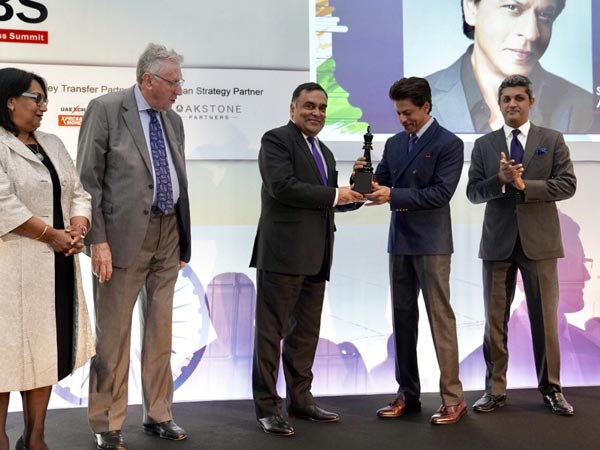
Here’s some good news for all Shahrukh Khan fans! The superstar was recently felicitated as a “Game Changer for his Unmatched Contribution to Globalizing Indian Cinema” at the business summit in London.

Time and again, King Khan has represented India at international events making the nation proud. The ET India – UK Strategic Conclave, a special business summit discussing the economic relations between India and UK was graced by the global icon in London.

Check out some of the pictures here-

SRK In Conversation

Representing the entertainment industry for a chat session on the ‘Growth of the business of entertainment across the globe and its impact on India”, Shah Rukh Khan said, “The growth for Indian films has been much smaller compared to the growth of television in India. The ratio of theatres to the audience area is still very small, we have very few theatres compared to the audience we can garner. In the Interiors of India, there are not many screens for people to go and I think there is a huge market here for entrepreneurs to get into making low-cost theatres.”

SRK Felicitated As The Game Changer

The actor, producer, activist was also felicitated with The Economic Times Game Changers of India” – Hall of Fame for “His Unmatched Contribution To Globalising Indian Cinema.”

ShahrukhKhanMPOs14sept2018

The Superstar Also Unveiled A Coffee Table Book

A coffee table book titled ‘Game Changers of India’ was also unveiled at the summit which features Shahrukh Khan along with other accomplished leaders.

SRK’s Award Acceptance Speech

Accepting this honour, the superstar said, “I take this opportunity to thank a lot of people, actors, actress, and audiences, for allowing me to continue unencumbered with any idea that I had, they gave me the ability to just go ahead and give it a shot, try and go wrong if I may, and more often than not they allowed me to go wrong”.

He further added, “Business is become about millions, targets and projections, though I fully respect the managerial capacity of business, but I like to think of it as the people who work with me allowed me the imaginarily capacity, they allowed me to imagine and they managed that imagination. So, when you become a game changer you cannot take it upon yourself, there are loads of people involved and the audience as well around the world accepts you doing the stuff you do and think it’s entertaining”.

On the work front, Shahrukh Khan will be next seen in Aanand L.Rai’s Zero co-starring Anushka Sharma and Katrina Kaif.

Salman Khan host Shahrukh Khan on Dus Ka Dum – Dumdaar Weekend

source: http://www.filmibeat.com / FilmiBeat / Home> Bollywood> News / by Madhuri V / September 12th, 2018

Siasat’s Millat Fund arranges burial of destitute Muslim dead bodies

Hyderabad, TELANGANA :

Hyderabad:

Mr. Amer Ali Khan, News Editor of Siasat Urdu Daily received a letter from six police stations including Bahadurpura and Langer Houz requesting him to arrange for the burials of nine destitute Muslim dead bodies.

In accordance with these requests, these dead bodies were procured from Osmania and Gandhi General Hospitals. They were buried in Tharthareshah Muslim graveyard, Secunderabad under the supervision of Mr. Syed Abdul Mannan, Mr. Samiullah Khan and Mr. Abdul Jaleel.

Mr. Syed Shah Inamul Haq, Imam of Jamia Masjid, Afzal Jung led the funeral prayer.

source: http://www.siasat.com / The Siasat Daily / Home / by Sameer / September 13th, 2018

Faiz-e-Aam Trust extends help of Rs. 2.99 cr to poor students, families – Siasat’s role applauded

Hyderabad, TELANGANA :

FaizeAzamTrustMPOs13sept2018

Hyderabad:

According to the report furnished by Mr. Iftekhar Husain, Secretary of Faiz-e-Aam Trust, a sum of Rs. 2.99 crore was spent on various schemes of financial assistance to poor students and families.

In 2016-17, the trust spent Rs. 59.81 lakh for primary education, Rs. 21.21 lakh for technical education, Rs. 29.5 lakh for relief and Rs. 7.85 lakh for treatment of patients.

In this manner, from April 2017 to January 2018, Rs. 40.46 lakh, Rs. 21.21 lakh, Rs. 18.68 lakh and Rs. 3.58 lakh were spent on the above mentioned works.

So far, the trust has help 625 students of primary education, 731 of SSC, 1237 of Intermediate, Degree, PG, Engineering, MBA, MBBS and Paramedical Courses.

He further told that the trust was established in 1983 by his brother-in-law, Mr. Zulfekhar Husain. It enjoys full support from Mr. Zahed Ali Khan, Editor of Siasat Urdu Daily. The trust is now helping 1456 students ranging from primary school to Engineering and Medical courses. It is also extending financial help to 1256 patients. It rehabilitated 2280 persons.

Faiz-e-Aam Trust helped Kareemunnisa whose husband, an autodriver had left her helpless. Her sons, Syed Hasan and Syed Yaseen and daughter, Saba Begum were adopted by the Trust for educating them. Syed Hasan completed MBBS whereas Saba Begum is doing the same course. Her eldest son, Syed Yaseen has completed Hifz-e-Quran.

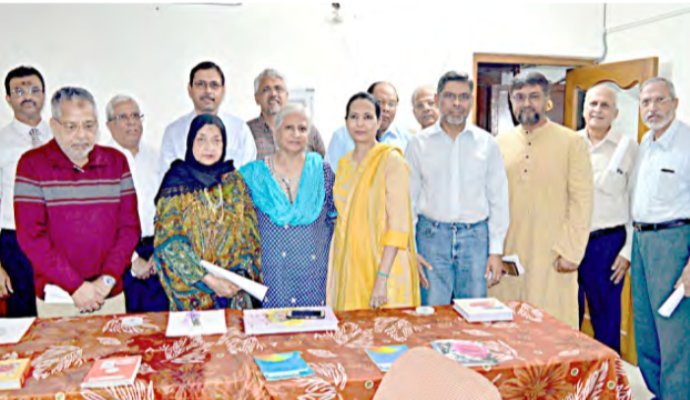
Ms. Farukh Parveen Jamal, Chairperson of Trust, Aurangabad and Mr. Siraj Tahir, Trustee of Faiz-e-Aam Trust attended the meeting and listened to the details of the poor families.

FaizeAzamTrust02MPOs13sept2018

In collaboration with Siasat Millat Fund (Clothes bank) it helped 1552 families. Destitute Muslims of Muzaffar Nagar received help through Siasat Millat Fund. It also helped Salwa Fatima and Sania Siddiqui for their ambitions to become pilots. For Old Age Home of Siasat, the trust gave a donation of Rs. 5 lakh.

The trust also helped Nuzhat Fatima, a student of MBBS, Shaik Nazeer Ahmed and Ayesha, students of MD.

During the past three years, the trust has spent Rs. 1.6 lakh for primary education, Rs. 43.33 lakh for technical education, Rs. 71.15 lakh for rehabilitation, Rs. 23.35 lakh for treatment of patients.

It may be mentioned that Syed Hasan had secured a free seat in MBBS. Mr. Ali Asghar played a key role in getting financial help for this family.

Hajera Begum is a second year MBBS student. Her father is a tailor and her mother manufactures beedis. She has two sisters. The expenses of her MBBS fees were paid by her parents by mortgaging ornaments. Dr. Makhdoom Mohiuddin’s wife, Dr. Shaista Mohammedi Husaini received a message on WhatsApp for helping Sabera Begum which she forwarded to Secretary of Faiz-e-Aam Trust who arranged Rs. 1.27 lakh for getting back the ornaments which were mortgaged.

Mr. Rizwan Haider, Trustee welcomed the guests. Ms. Amena Saher conducted the meeting.

These details were given in a special meeting held at Faiz-e-Aam Trust which was attended by Ms. Farhat Yasmeen and Mr. Siraj Tahir, Trustees.

The other persons who attended the meeting were Dr. Samiullah Khan (Director Shadan College and MESCO member), Dr. Saukat Ali Mirza (Chairman Helping Hand), Mr. Ali Abedi (Social worker, London), Mr. Mudasir Alam (US), Mr. Jameel Haider (US), Fakhri Saheb (US), Anees Iftekhar Ali (US), Ruqayya Begum (US), Syed Haider (member, Faiz-e-Aam Trust), Aijaz Husain (US), Jafar Ahmed (US), Syed Jafar Husain (Sada-e-Husaini), Hamid Ali, Prof. Shaukat Hayat and Mr. Ahmed Basheeruddin Farooqui (former Dy.DEO).

source: http://www.siasat.com / The Siasat Daily / Home / by  Sameer, The Siasat News / January 18th, 2018

Transforming healthcare for the better: Dr Shafi Mulk

ANDHRA PRADESH , INDIA / UNITED ARAB EMIRATES :

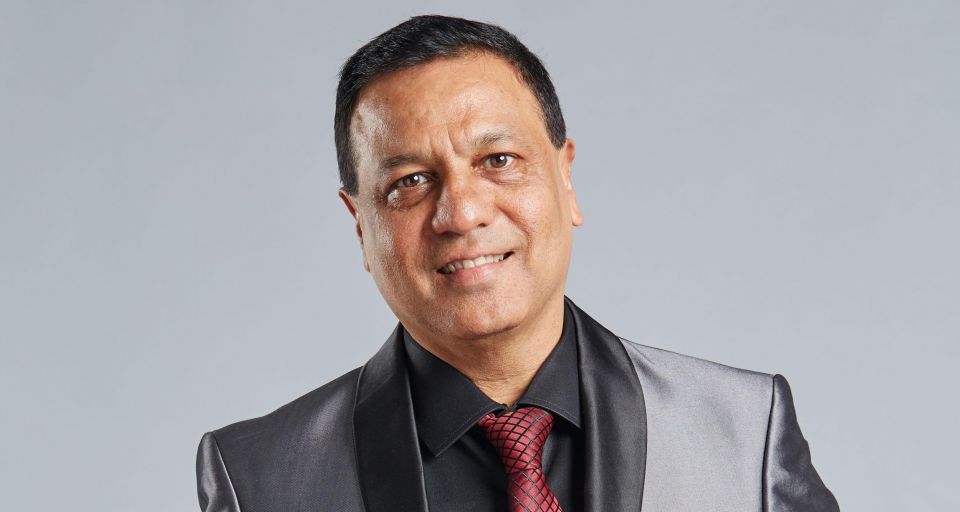
[SPONSORED CONTENT] Dr Shafi Ul Mulk had an idea that grew into a vision for change. Today, that vision is a reality, having grown his multiple dual concept diagnostic centres into a leading healthcare brand in the region

DrShafiUlMulkMPOs12sept2018

Through his healthcare services, Dr Mulk touches millions of people from around the world and has been celebrated on many prestigious forums. He has also added significant feathers to his illustrious cap, being honoured with Forbes magazine’s Top 100 Indian Entrepreneurs and Leaders in the Middle East two years in a row.

HUMBLE BEGINNINGS

The origins of Global Hawk were not unlike some world-renowned companies of today. Dr Mulk started with a personal staff of only two, working in Hamriya free zone, Sharjah. Dr Mulk created his company – the internationally acclaimed Global Hawk chain of diagnostic centres (that utilizes Global Hawk’s innovative technology in telemedicine and teleradiology).

THE START OF SUCCESS

The company grew quite rapidly, expanding across the globe and into a world-renowned healthcare empire worth more than US$200 million. The phenomenal success of the establishment can be directly attributed to the visionary leadership of Dr Mulk, who is widely considered the pioneer of teleradiology in the region.

His brainchild, Global Hawk Telemedicine/Teleradiology with IT solutions including RIS, Mulk Digitizers and Mulk Viewers products installed globally in major hospitals and medical centres have revolutionized the healthcare industry. In fact, the runaway success of Global Hawk Telemedicine encouraged him to start the chain of Global Hawk Imaging and diagnostic centres (GHID) which eventually led him to a number of accolades and international awards.

FAST RISE TO THE TOP

From a single branch in Deira, GHID has grown rapidly with many centres across multiple locations all with state of the art radiological technology, all the main imaging modalities – including open and closed MRI, CT scan, CBCT, 2D, 3D/4D Ultrasound, Digital Mammography, Bone Densitometer as well as top rated clinical laboratory diagnostic devices, all under one roof.

The centres are today considered as one of the best in terms of state-of-the-art, high-quality diagnostic imaging services and patient-centred care. With its goal of becoming a dedicated healthcare provider and imaging resource and research centre across the globe, GHID serves as a gateway to international expert standards diagnostic opinions – while also streamlining management and investigative recommendations.  Today, this is a vital requisite in the current medical environment.

THE NEXT STEP: MORE GROWTH

Dr Mulk’s company has spearheaded an AED250 million expansion plan, which includes a chain of Global Hawk Diagnostic Centres with dedicated PET-CT / MRI and Cyclotron unites across the GCC, India and Eastern Europe, and a chain of Global Hawk multi-speciality Polyclinics and Medical Centres. The group is also looking to start a 50 bed Mulk oncology charity hospital in India, as well as Mulk speciality hospitals in the UAE.

BACKGROUND IN EDUCATION

Dr Mulk’s passion for innovation and medical technology can trace its roots from his impressive educational experience. A prominent neurovascular radiologist in the UAE, his formative medical education began at Kurnool Medical College, Andhra. He also has completeld fellowships at Michigan, USA and Multon Keynes, UK.

Being a passionate teacher, he freely shares his knowledge by teaching university students and mentoring junior radiologists. Dr Mulk has been consistently invited to speak at major international forums of radiology and imaging, as well as healthcare entrepreneur platforms. He was honoured as a guest speaker by the Arab Health Committee and International Health Organisations for his overall contribution to the Healthcare Sector, resulting from his wealth of experience in Radiology for two decades.

THE MAN BEHIND THE BUSINESS

Dr Mulk’s zeal and enthusiasm for success doesn’t limit itself to the professional fields, but also in his love for sports. A former national Bandminton player, he was named a ‘young Hopeful of India’ by a leading Indian Sportstar magazine at the age of 13. An ardent supporter of Badminton Associations of the region and sponsor of major Badminton tournaments, he is one of the top ranked players in the UAE, with winning accolades in the Masters Men event of the UAE Open Championship of 2016 and 2017.

But one of the most essential characteristics of his personality is his compassionate outlook towards the community. Dr Mulk is a well-respected member of various social and Islamic organizations in India and the UAE, and he actively engages in various charitable activities focusing on building a better tomorrow.

A true believer in strenghth of the family unit, Dr Mulk candidly acknowledges that the support he receives from his soulmate, Dr Yasmeen Ul Mulk, and their sons Zoheb Ul Mulk and Zain Ul Mulk is what most encourages him to follow his passion.

INTERNATIONAL RECOGNITION

Dr Mulk scored a double win at the Annual Health Awards in the UAE this year, winning the Distinguished Achiever award in Healthcare and Innovative Technology. These accolades add to his illustrious list of accolades and awards in 2017 alone; including being honoured with the World Healthcare Innovative Entrepreneuier of the year 2017, by the Global Association of Physicians of Indian Origin and the Indian Business Exceppent Awards – IBPC 2016 and 2017 – from H.H. Sheikh Nahyan Bin Mubarak Al Nahyan.

He has also received the Star Quality Award in Geneva 2014, The World Inspirational Company USA awards in 2015, as well as the International Medical Quality Award May 2016, which was held in Monte Carlo, Monaco.

Dr Mulk and his company have also been honoured and lauded with the ‘World’s Greatest Brands’ and ‘World’s Greatest Leader’ awards in 2017.

source: http://www.arabianbusiness.com / Arabian Business / Home> CEO> Business / by Global Hawk / July 23rd, 2017

Lucknow: Tazia makers give finishing touches to their work as Moharram approaches

Lucknow, UTTAR PRADESH :

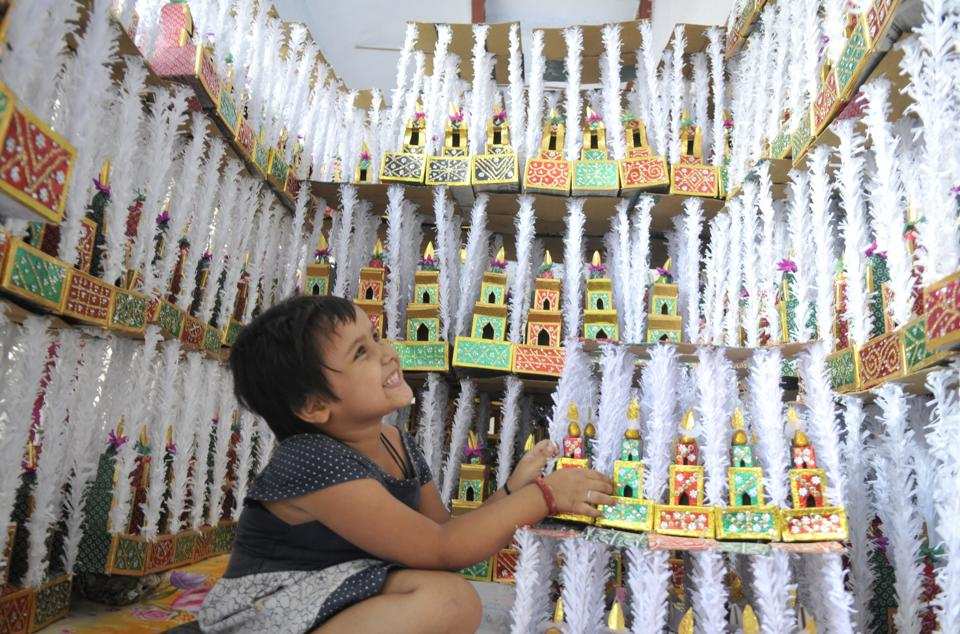
A fusion of solemnity, dedication and exquisite craftsmanship is on display as tazia-makers race against time to complete their work at Rauza-e-Kazmain in old Lucknow on Monday, two days before the Islamic month of Moharram beginning on September 12.

A fusion of solemnity, dedication and exquisite craftsmanship is on display as tazia-makers race against time to complete their work at Rauza-e-Kazmain in old Lucknow on Monday, two days before the Islamic month of Moharram beginning on September 12.

The grand, double-storey gateway that leads to the Nawabi era structure in the densely populated Saadatganj area is packed with makeshift shops displaying colourful ‘tazias’, a replica of Imam Hussain’s mausoleum in Iraq.

Inside, several people are busy erecting makeshift shops for the convenience of those who will arrive to buy the tazias, the prices of which range from Rs 500 to Rs 10,000 each.

Munni Begum, a traditional tazia maker and her family is at work at the rear of the 19th century structure, which is said to be a replica of the tomb of Imam Musa Kazim and his grandson, the ninth Imam Mohammad Taqui of Khorasan in Iran.

“We are running late this time. There are three more tazias left to be completed,” says Munni Begum, who is in her late forties, while placing glitter carefully on a semi-finished tazia made of bamboo shavings and cardboard.

She says making tazias is her ancestral trade and hers is perhaps the third generation carrying forward the family legacy.

“I still remember my mother and grandmother making tazias. In fact, I learnt the art from them. But its preparation is not as easy as it seems. Each one of these (tazias) is an outcome of relentless efforts by all my family members,” says Begum, pointing to around 70 finished tazias, their height ranging from 10 inches to 8 metres.

The preparations began months ahead of Muharram.

“All members in a family have a different role to play. The men make the frame using bamboo shavings,” says Mohammed Saeed, a family member of Munni Begum.

“Only a trained and knowledgeable craftsman can prepare a tazia as it has to look like the mausoleum of Imam Hussain. One has to be careful,” Saeed adds.

Once the frame, either of bamboo, cardboard or empty cigarette boxes, is ready, the other family members take up the remaining work.

“The women ensure the framework is well covered with rough paper, followed by a coating of colourful papers. Children make sure they use the glitter to decorate the tazia,” he says.

Taazia02MPOs11sept2018

Tazia-making this year got delayed due to a delay in procuring a loan from a local money lender, he says.

“We solely depend upon the income from selling tazias. We have to take loans from local money lenders to carry out the work every year. This year, the money lender delayed the funds. With the prices of raw material sky rocketing, it’s really becoming difficult for us to do our work,” he adds.

Like Saeed, there are around 150 families involved in tazia making in the state capital. “We believe it’s a dying art and the government is a mute spectator,” says Mohammed Shahansha, another traditional tazia maker from Kazmain.

“Until two decades back, many families in Faizabad, Kanpur, Agra, Moradabad and other districts were involved in tazia-making. But over the years, their income reduced and the prices of raw material increased drastically, forcing many to give up the ancestral craft,” Saeed says.

Meer Jafar Abdullah, member of a royal family of Awadh, says during Muharram, Shias keep tazias at their respective imambaras in their houses. The tazias have to brought a day before Muharram begins.

“Those who do not have enough space, often use a small portion of the house to keep tazias, commemorating the martyrdom of Imam Hussain in the battle of Karbala,” says Abdullah.

Exquisite craftsmanship is on display at Rauza -e-Kazmain in old Lucknow. (HT Photo)

“Mostly, the tazias are buried on the 10th day of Muharram. Some families bury them on Chehellum, the 40th day of the martyrdom of Imam Hussein. Some bury it on the last day of Muharram,” Abdullah says.

In Lucknow, Shias bury the tazias in Tal Katora Karbala, in Purana Najaf and Kala Imambada (opposite Ghantaghar in old Lucknow). The Sunnis bury tazias at Phool Katora in the Mahanagar area of Lucknow.

source: http://www.hindustantimes.com / Hindustan Times / Home> Lucknow / by Oliver Fredrick, Hindustan Times,Lucknow / September 11th, 2018