Category Archives: Education

How India’s 1st Muslim Woman Teacher Started a ‘Beti Padhao’ Movement in 19th Century

Pune, MAHARASHTRA :

Working in tandem with Savitribai Phule, Fatima had to not only take on high caste Hindus but also faced fierce opposition from orthodox Muslims who opposed the idea of equal education for all.

Are you in favour of education for girls? To even ask this question in today’s socio-political milieu seems ridiculous, considering that this is not only enshrined in our Constitution but supported by mainstream public discourse.

There are numerous government programmes and schemes dedicated to the education of the girl child, irrespective of class, caste or religion. Admittedly, there are parts of this country where this idea and subsequent socio-economic progress is actively discouraged. However, more than 150 years ago, it wasn’t even a part of the mainstream socio-political discourse, and in fact, those pushing for it were met with intense hostility and social boycott.

Those with even a cursory knowledge of the history behind education in India will have heard of Savitribai Phule, who valiantly fought against the oppressive hierarchies of caste and gender to challenge untouchability and educate girls, among other critical social interventions.

Along with her husband Jyotirao Phule, they fought against caste discrimination, the scourge of untouchability and worked towards the emancipation of women and reform of Hindu family life in present-day Maharashtra during the 19th century. They were among India’s first major social reformers.
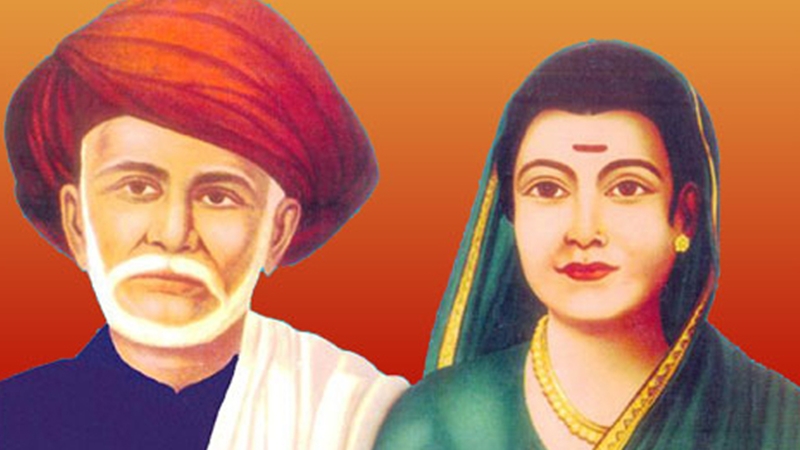
Jyotiba and Savitribai Phule (Source: Free Press Journal)

But how many people know about the Muslim woman who made Savitribai’s bid for girl education possible? Not many, one would argue, and that isn’t their fault considering little is known about her life history.

What we do know is her name was Fatima Sheikh, and she is widely recognised as the first woman Muslim teacher in India, who also worked with Savitribai to establish the first school for girls at her own house, alongside her brother Usman Sheikh in 1848.

The story begins with the Phule couple attempting to educate members of the lower caste communities, particularly their women, at their home in Pune.

Considering that education at the time was the preserve of only upper caste men, the very thought of educating women and lower castes was anathema, and the Phule couple were given the choice of either stopping work or leaving their home. They chose the latter but were offered refuge by Fatima and Usman at their home in the Ganj Peth area of Pune (then referred to as Poona).

At a time when everyone including their own kin abandoned these social reformers, Fatima and Usman not only gave them an opportunity to rekindle their ambition to uplift those on the margins but also sheltered them. At the Sheikh household, Fatima helped Savitribai to set up the first school for girls in Pune called the ‘Indigenous Library.’

According to archives from the era, it was Usman (inspired by the Phules) who encouraged his sister to not just educate herself but also spread its gospel to all members of society.
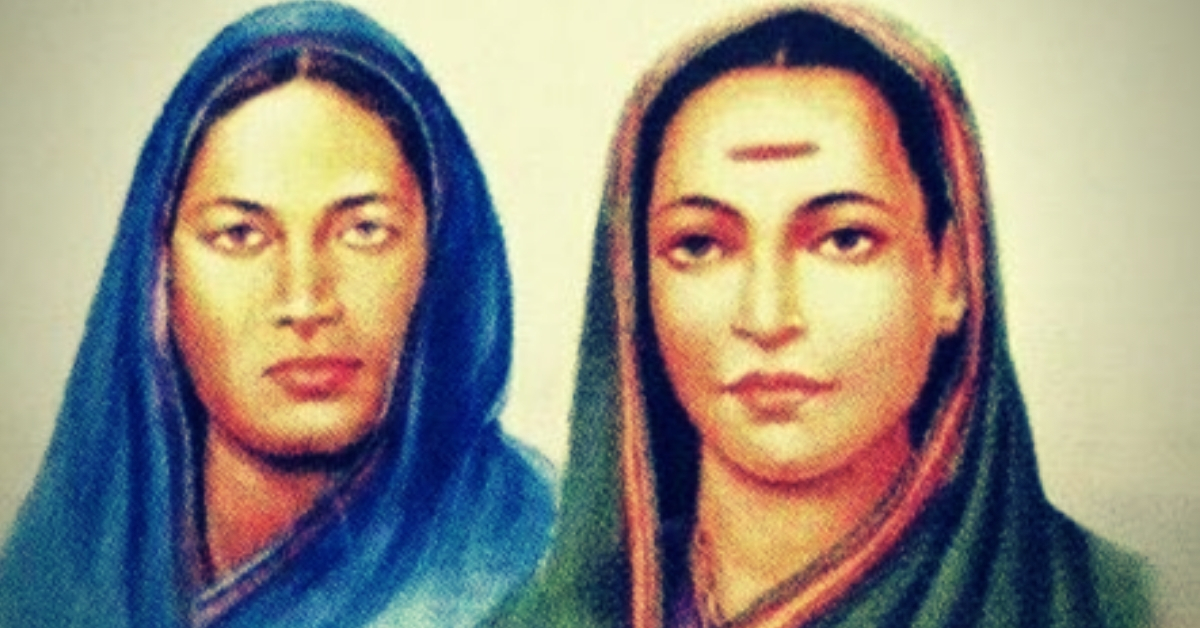
Fatima Sheikh (left) and Savitribai Phule. (Source: Twitter/Tanvir Salim)

Not only was Fatima risking the wrath of caste Hindus, but also orthodox Muslims, as both groups at the time were deeply opposed to the idea of equal access to education. Nonetheless, this didn’t deter Fatima, who not only undertook training alongside Savitribai but also soon after began teaching others.

“Defying all norms, Fatima and Savitribai set up the school and even went to a training institute, to become professional teachers,” says this account from Feminism in India. They were soon joined by social reformer Saguna Bai, who helped Savitribai open another school and would subsequently go onto chart her own education movement for the marginalised.

Through her time with Savitribai, Fatima had taught in all the five schools that the social reformer couple had opened, and continued to do so until 1856 when Savitribai was afflicted by illness and was compelled to move back to her mother’s house. We don’t know much about her life post-1856.

“When Fatima and Savitribai started going to schools which were established by Jyotiba, people from upper caste community used to harass and abuse them. They were stone pelted and sometimes cow dung was thrown at them as it was unimaginable for the upper-caste community to see lower castes of the society getting educated. Fatima Sheikh and Savitribai didn’t pay attention to these hindrances and continued their work,” writes Siddhant Mohan, editor of Two Circles. Aside from such hostility, there are even reports that some had attempted to take their lives.

Despite the challenges before Fatima, she maintained her pursuit of approaching every household in her neighbourhood and community, asking families and encouraging them to give their girls a shot at a decent education, irrespective of faith.

Having said that, there isn’t too much historical or archival material to ascertain what happened to Fatima after 1856, and even the question of when she was born remains up for debate although her birth anniversary is celebrated across social media forums on January 9. With no real male figure in Fatima’s life aside from her brother, there are indications that she went against the norm of marriage and subsequent patriarchy and orthodoxy she would have to endure. Nonetheless, her work with Savitribai isn’t disputed, and one can only imagine the kind of resistance she faced.

Last April, members of the depressed classes celebrated Dalit History month, and on that occasion an internet archive Dalit History said:

“The friendship between Fatima and Savitri was one of respect, compassion and synergy. Throughout their time together, Savitri would often mention her in her letters to Jyotirao with affection and concern. Their friendship lives today in the form of the work they have done in creating both foundation will and actual structures for the upliftment of the marginalised.”
Today, every educated Indian woman owes a debt of gratitude to Savitribai Phule and Fatima Sheikh.
Today, every educated Indian woman owes a debt of gratitude
to Savitribai Phule and Fatima Sheikh.

Fortunately, there have been attempts to recognise her work and contribution. Aside from her association with the Phules, the Maharashtra State Bureau of Textbook Production and Curriculum Research took cognisance of her contribution in their textbooks in 2014.

Fatima Sheikh played a crucial role in ensuring that children, irrespective of gender, caste or religion, had access to education, and the results are there for everyone to see.

(Edited by Gayatri Mishra)

source: http://www.thebetterindia.com / The Better India / Home> Education> History> Women / by Rinchen Norbuwangchuk / September 19th, 2018
Vizag girl wins Google doodle contest

Visakhapatnam, ANDHRA PRADESH :

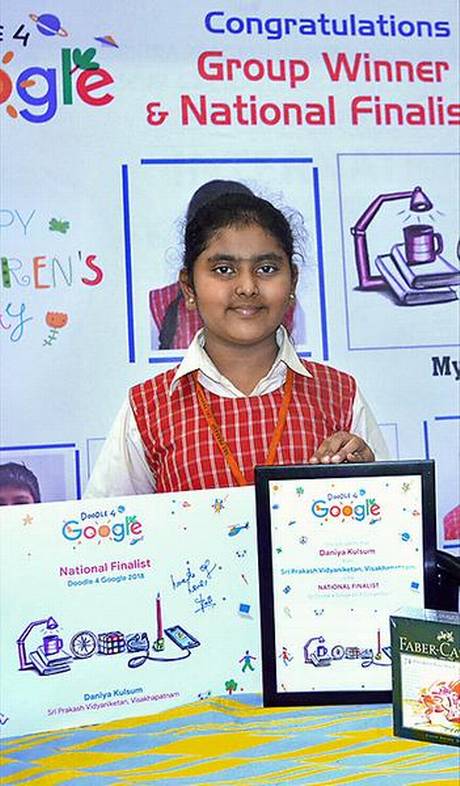
Daniya Kulsum, the winner of the Doodle 4 Google-2018 contest

3 Sri Prakash students among the finalists

Daniya Kulsum, a student of Sri Prakash Vidyaniketan, has won the Doodle 4 Google-2018 contest in the Group-3 category.

Twenty 20 doodles from the ones made by 70,000 participants were selected for the finals and among the finalists, three are from Sri Prakash Vidyaiketan. Daniya Kulsum, a fifth standard student, won the contest with the theme ‘What Inspires me’. The other two finalists were 2nd standard student C. Jayavant Kamesh and Bogaruapu Saathwik of sixth standard.

Felicitated

All the three finalists were felicitated at the Google office in New Delhi in presence of the noted artist Rob. Later, they were presented with a citation of recognition, a certificate of achievement, a Googley Swag and a Google Home, along with a stay at Taj Hotel with free air tickets.

School director Chitturi Vasu Prakash congratulated the students on the achievement.

source: http://www.thehindu.com / The Hindu / Home> News> Cities> Visakhapatnam / by Special Correspondent / Visakhapatnam – November 15th, 2018

Asloob Ahmad Ansari obituary

NEW DELHI / Aligarh, UTTAR PRADESH  :

 Asloob Ahmad Ansari knew Urdu and Persian, and learned Arabic in later years
Asloob Ahmad Ansari knew Urdu and Persian, and learned Arabic in later years

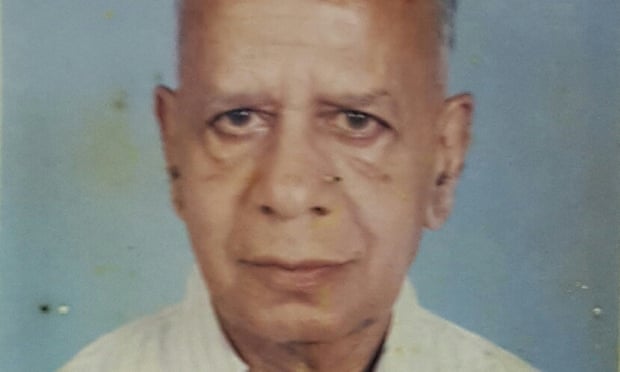
My former teacher Asloob Ahmad Ansari, who has died aged 91, was a professor of English at Aligarh Muslim University, northern India, and a distinguished literary critic and editor.

Born in Delhi and brought up in Saharanpur, a city in Uttar Pradesh, Asloob was the son of Sana Ahmad, a member of a land-owning family who worked in a post office, and his wife, Zarifa Khatoon; his four siblings were all to migrate to Pakistan after partition in 1947.

Asloob was educated at a government school in Delhi, and then at Aligarh Muslim University, where he joined the English department as a lecturer in 1946. He retired in 1985, having headed the department for some 20 years. Asloob also obtained a BA from Oxford University (1956-58), where he began a lifelong friendship with his tutor, FW Bateson.

Shakespeare and William Blake were Asloob’s lifelong passions: he regularly attended the World Shakespeare Conference at Stratford-upon-Avon, and launched and edited two journals in English specialising in Shakespeare and Blake scholarship. He persuaded critics including FR Leavis, Wilson Knight, Kenneth Muir and Laurence Lerner to write for the Aligarh Journal of English Studies, which he started in 1976. He continued his editorial work even after retirement, in 1987, when he launched the Aligarh Critical Miscellany.

Asloob knew Urdu and Persian and edited Naqd-o–Nazar, a journal in Urdu that paid special attention to the poets Ghalib and Iqbal. He won many prizes for his contribution to Urdu literature, including the Sahitya Akademi award from India’s National Academy of Letters, the President of Pakistan award, the Ghalib award and the Mir Taqi Mir award.

Asloob always spoke very softly in the classroom, but was disciplined and hard-working, and never very keen on socialising. A diabetic for most of his life, he followed a strict diet and walked many miles each morning and evening. He also played badminton to keep fit.

A devout Muslim, he recited the Qur’an daily and rarely missed his prayers. To understand the Qur’an better, he learnt Arabic in his old age by hiring a private tutor.

In 1951, Asloob married Talat Ara. She survives him, together with their two daughters, Iffat and Roshan, and three grandchildren.

source: http://www.theguardian.com / The Guardian / Home> Education> Other Lives> India / by Mohammad Asim Siddiqui / July 07th, 2016

The glorious contradictions of Qazi Abdus Sattar

Machreta (Sitapur) –  Aligarh,  UTTAR PRADESH   :

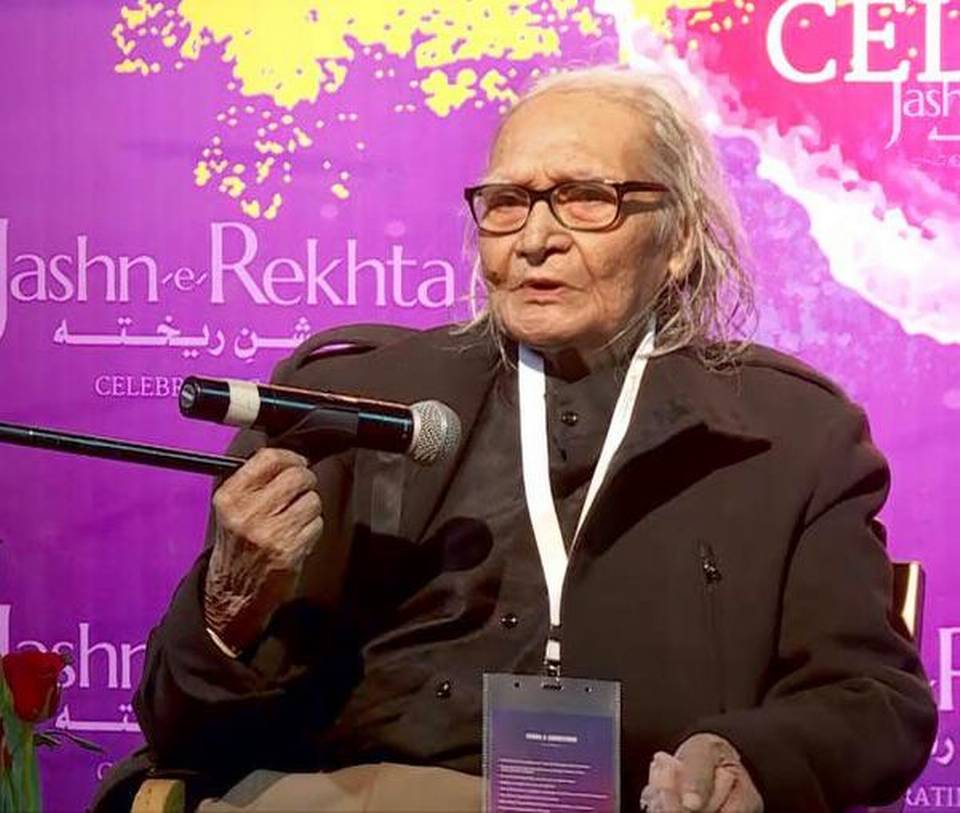
Master of brevity: Qazi Abdus Sattar at Jashn-e-Rekhta

A votary of India’s syncretic culture, the novelist will be remembered for his sketches of Awadh aristocracy and his prose style which has touches of grandeur

‘Do I contradict myself? Very well, then I contradict myself; I am large, I contain multitudes’, wrote Walt Whitman in his famous “Song of Myself”. Qazi Abdus Sattar (1933-2018), a novelist, a literary polemist and a master raconteur, who died last week after a long illness, contained multitudes in his fiction and conversation. If grand historical figures jostle with ordinary folks in his fiction, in his conversation he used his right to offend to the maximum. His fiction always touched crests and his conversation knew no troughs.

Beautiful metaphors

A proper assessment of a writer begins after his death, more so in the relatively limited circle of Urdu criticism where everyone knows everyone else. However, most critics and readers of Qazi Abdus Sattar credit him for writing remarkable historical novels, for his sketches of Awadh aristocracy, and above all for his prose style which has touches of grandeur. Among his historical novels “Dara Shikoh” (1968) gives an account of the war of succession among Emperor Shah Jahan’s four sons and Dara’s defeat at the hands of Aurangzeb, using beautiful metaphors and turn of phrases. His epic style characterises the novel. A votary of harmony and India’s syncretic culture, Qazi Abdus Sattar’s sympathies with Dara Shikoh are unmistakable. A scholar of Sanskrit texts, his Dara is often dressed in traditional Hindu attire and he prevails upon his father Emperor Shah Jahan to exempt the Hindu devotees from paying tax for taking bath in river Ganges.

Delineating the bard

His novel “Ghalib”(1976) captures not only the vignettes of Ghalib’s life – his devotion to poetry, his economic worries, his travels, his wit, his love life – but also the ethos and the milieu of the 19th Century.

Qazi Abdus Sattar is equally comfortable in delineating characters from distant Islamic history in novels like “Salahuddin Ayubi” (1968) and “Khalid Bin Waleed”. His novel “Salahuddin Ayubi” takes the reader into the 12th century period of the crusades in which Salahuddin Ayubi distinguished himself for his bravery, his excellent detective work and his love of human beings. Paradoxically the novel also shows that oppression of the weak and the marginalized groups has been an ugly fact of history.

Qazi is both an heir to and critic of landed aristocracy. The taluqdars of Awadh, who are also the concerns of Qurratul Ain Hyder and Attia Hosain, hold some inexplicable fascination for him. They represented a past that he kept living both in his fiction and life. He appeared to welcome the end of Zamindari but he refused to free himself from its sinister charm. He always aligned himself with progressive causes and was a key figure in Janvadi Lekhak Sangh, but he did not see any contradiction in his celebration of the lifestyle associated with an unjust system.

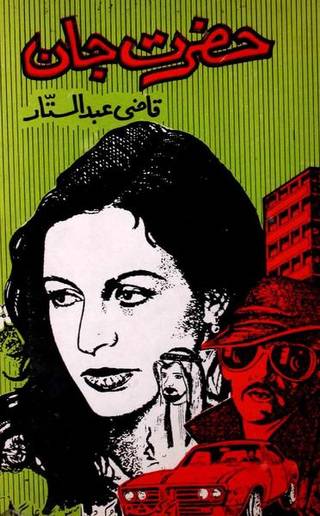
As a fiction writer he is spot on in his treatment of the landed gentry of Awadh. His novel “Shab Guzida”(1966) gives an inside view of the life of zamindars and taluqdars of Awadh. The unjust debauch Bade Sarkar and his virtuous son Jimmy represent different sets of values in the novel. His “Pahla aur Akhiri Khat” (1968) charts a life away from the framework provided by Progressive Writers’ Movement. Through the depiction of the life of Chaudhri Nemat Rasool of Lalpur, the novelist shows zamindars in the grip of economic and social problems after the end of Zamindari. “Hazrat Jaan” and “Tajam Sultan” are his other remarkable works. Unlike many other writers in the past who have made Awadh the subject matter of their work, Qazi’s distinction lies in focusing on the rural life in Awadh in his fiction.

He was equally successful in his novelettes and short stories with Awadh again very much providing the backdrop of many of his narratives. “Peetal ka Ghanta” , a collection of his short fiction, includes ‘Peetal ka Ghanta’, ‘Malkin’, ‘Azu Baji’, and ‘Majju Bhaiya’. “Ghubar-e-Shab”, also set in a village around the period of the Partition, treats the subject of communal disharmony and communal politics with irony.

A Padma Shri awardee, apart from numerous other prestigious awards, Qazi Abdus Sattar worked as professor of Urdu at Aligarh Muslim University and was great friends with scholars and critics of Hindi. He greatly valued his readers in Hindi and stressed the closeness of Hindi and Urdu (even Punjabi). But he was very strongly against changing the script of Urdu. He also strongly believed that literature should be ‘beautiful and wholesome’.

A great fan of Flaubert, he could achieve a lot in very little, thanks to his felicity with language. No wonder he has not written door stoppers and “Ghalib”, all of less than 300 pages, is his longest work.

A raconteur par excellence and not known for mincing his words, he was an interviewer’s dream and an event manager’s guarantee for the success of a literary gathering. Prem Kumar’s remarkable book of his interviews is a blessing for Hindi readers as is Rashid Anwar’s for Urdu readers. Possessed with Oscar Wilde like ability to produce witty (often gossipy) quotes, Qazi Abdus Sattar’s sentences, as Urdu poet Shahryar once said, drew the applause generally reserved for Urdu poets.

QaziAbdusSattar02MPOs14nov2018

The grace and grandeur of his prose style rubbed off on his life. Tariq Chatari, a prominent Urdu short story writer, who believes that Qazi took Urdu afsana to a different level, says that he carried himself very much like a character from his fiction. Qazi Afzal Husain (no relative) considers Qazi a master prose stylist in line with Muhammad Husain Azad and Abul Kalam Azad. Time will tell.

source: http://www.thehindu.com / The Hindu / Home> Books> Authors> Obituary / by Mohammad Asin Siddiqui / November 09th, 2018

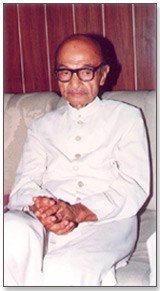
Begum Hamida Habibullah

Hyderabad, TELANGANA / Lucknow, UTTAR PRADESH :

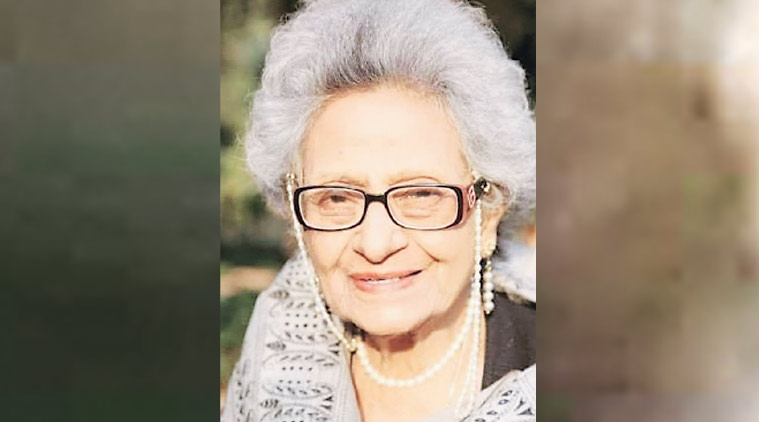
Begum Hamida Habibullah (1916-2018): Leader and enabler of women’s education in an eventful age

Born in 1916, she led a life and played a role that were not only unusual but also a testament to the times that made it possible.

Begum Hamida Habibullah

Begum Hamida Habibullah, who would have been 102 years old next November, died in Lucknow Tuesday. A woman with an unusual profile in an eventful period, she was a leading political figure and an enabler of education for women. Born in 1916, she led a life and played a role that were not only unusual but also a testament to the times that made it possible.

The daughter of Nawab Nazir Yar Jung Bahadur, once acting Chief Justice of Hyderabad High Court, Begum Hamida spent her childhood and early years in Hyderabad. A gold medallist from Osmania University, she also did a two-year teachers’ training course from Whitelands College (Putney), London.

Her marriage and work took her to Uttar Pradesh where she was among the founders of the Self Employed Women’s Association (SEWA); she worked hard to get it through the early years, long before it became a well-established brand.

She was married to Major General Enaith Habibullah, who fought in World War II, including in the battle of El Alamein in North Africa, and was also the founder commandant of the National Defence Academy, Khadakwasla.

Begum Hamida’s active political career began after her husband retired in 1965, when she was elected as an MLA from Haidergarh (Barabanki). She was minister for social and Harijan welfare, national integration and civil defence during 1971-73, and tourism minister during 1971-74.

These were times when the Uttar Pradesh Congress was among the most powerful committees in the country, and Begum Hamida served as a member, executive committee, of the UPCC until 1980. She was also elected to the All India Congress Committee from 1969. She headed the Mahila Congress in UP during 1972-76. Later, she went on to become a Rajya Sabha member from 1976 until 1982.

Furthering women’s education in the region is what is recognised as her true calling. She was the president of the Avadh Girls’ Degree College (AGDC), Lucknow’s first English degree college for girls, from 1975. She was also president, from 1975, of Talimgah-E-Niswan College, an institution of 3,500 catering to the education of Muslim girls and founded by her mother- in- law, the late Begum Inam Habibullah.

Her grand-nephew, writer Omair Ahmed, recalls how she represented an era when the Indian subcontinent was in the throes of the anti-colonial struggle but one could drive from “the military base in Rawalpindi to Srinagar”, where her husband was posted.

Omair Ahmed remembers how Begum Hamida casually mentioned the “beautiful drives” from Rawalpindi to Srinagar that she and “Bubbles” went on. “The ‘Bubbles’ she was referring to was her husband, Major General Enaith Habibullah. He was given the nickname because Habibullah sounds a bit like ‘hubble bubble’, the British slang for a hookah.”

Begum Hamida’s son, Wajahat Habibullah, is a former bureaucrat who served in Rajiv Gandhi’s PMO and retired as India’s Chief Information Commissioner.

source: http://www.indianexpress.com / The Indian Express / Home> India / by Seema Chisti, New Delhi / March 14th, 2018

12-year-old girl to appear in Class 10 Bengal board exam

Howrah District, WEST BENGAL :

MaadhyamikMPOs29oct2018

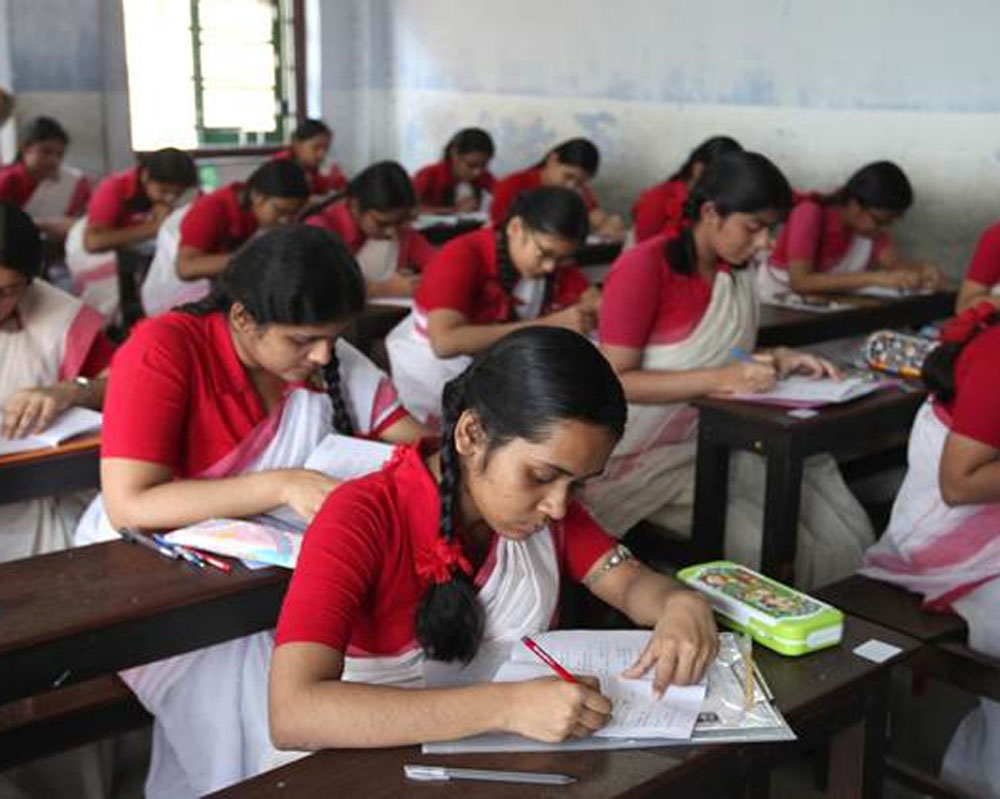
The West Bengal Board of Secondary Education (WBBSE) has allowed a 12-year-old girl — who never enrolled in school, and instead, studied at home — to sit for the Madhyamik Examination 2019 as an external candidate.

WBBSE president Kalyanmoy Ganguly said Saifa Khatun qualified the eligibility test conducted by the WBBSE for external candidates in August, and her case was “unprecedented” in the history of Madhyamik Examination (Class 10 board examination) in the past two decades.

The minimum age to appear in the examination is 14, Ganguly said.

Khatun, who hails from Howrah district, secured 52 per cent marks in the eligibility test, results of which were announced on October 11.

Another board official said the girl’s father Mohammed Ainul had moved the WBBSE to allow her to sit for the Madhyamik Examination 2019.

The last such instance of an external candidate appearing in the board examination before the minimum age was in the early 90s, the official said.

source: http://www.dailypioneer.com / The Pioneer / Home> Trending News / PTI / Kolkata, October 27th, 2018

Meet Shahnaz Habib, whose debut translation has won the Rs 25-lakh JCB Prize for Literature

KERALA / Brooklyn, New York, U.S.A :

Before and after: What translating Benyamin’s ‘Jasmine Days’ involved, and what it means after winning the prize

ShahnazMPOs27oct2018

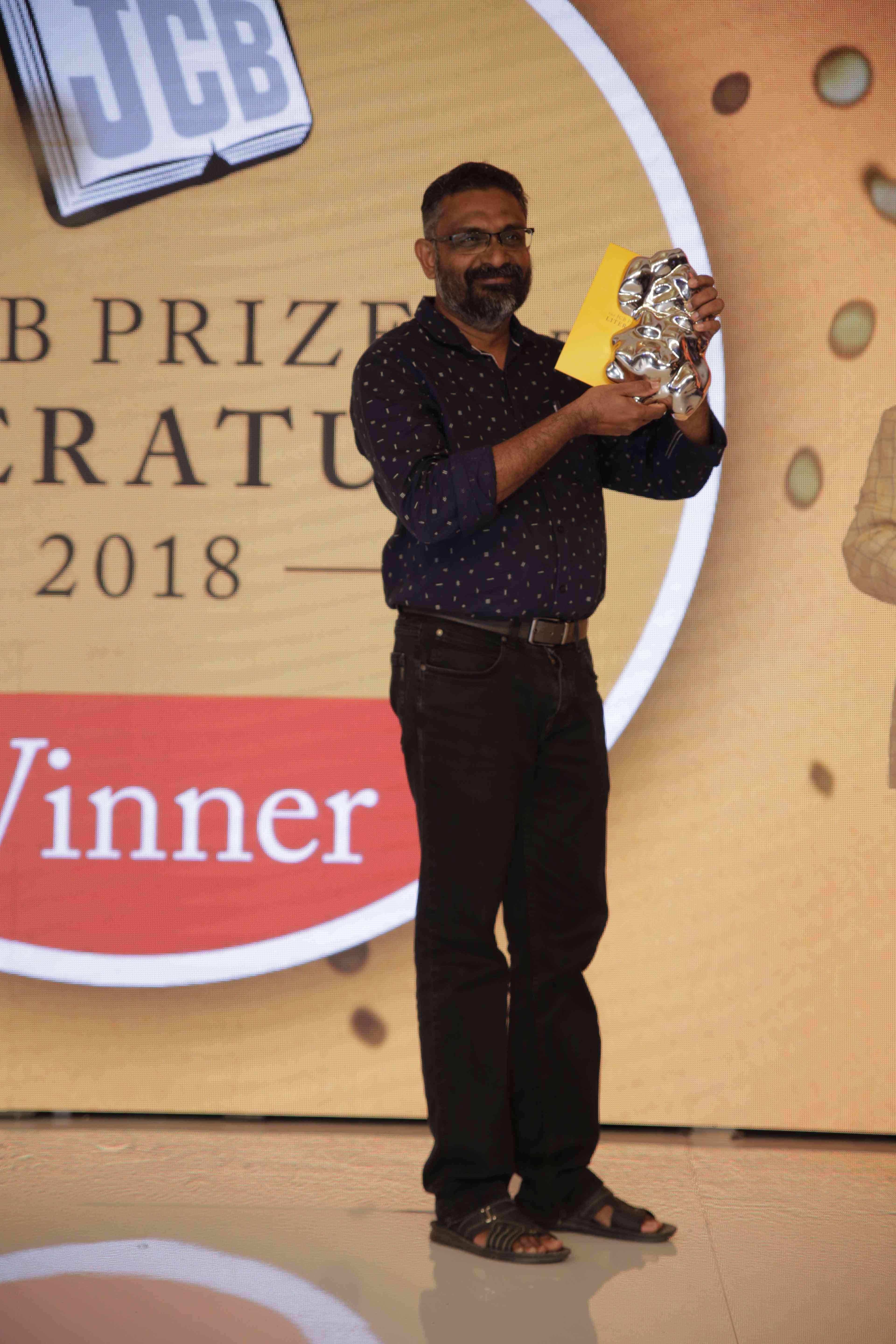
Shahnaz Habib has hit the proverbial jackpot at the very beginning of her career as a literary translator. Her debut translation, of Benyamin’s Jasmine Days, has won the Rs 25-lakh JCB Prize for Literature in its inaugural year. Habib, who has also translated Al-Arabian Novel Factory,the companion piece to Jasmine Days, has picked up Rs 5 lakh for the winning translation.

Habib wrote recently about the experience of being a first-time literary translator for a novelist whose previous work is highly respected – Benyamin’s Goat Days, for instance, shot to fame in 2012 – and about being a woman in what is still a male-dominated literary culture. She spoke to Scroll.in thereafter in two instalments – before and after winning the JCB Prize – about what drew her to the novel, her procrastinating habits, the differences between Malayalam and English, the migrations that aren’t covered enough, the fears of a first-time translator, and the Agatha Christie-inspired novel she’s currently writing. Excerpts from the interview:

What does Jasmine Days winning the JCB Prize mean to you?
So, to state the obvious, I am super thrilled. And I feel especially happy for Benyamin, who deserves this recognition so much. Jasmine Days is about a young woman who writes a book without knowing that she is writing a book and I feel a bit like she must have when she realised how much her words resonated with people outside her life.

But…there’s also this feeling of strangeness. I think most of us who work with words are so steeled for rejection and killing your darlings that it feels bizarre to win something! It’s also a win for translation in general and that makes me hopeful as a translator and excited as a reader of translations.

What would some of your suggestions be to other literary prizes when it comes to translations (and other forms of writing that they may be neglecting)?
Prizes are wonderful, but I wish we had more grants to encourage all kinds of writing and translation. By that, I mean support for writers and translators and poets so that they can set aside the time to work on projects before they are published. So much energy and struggle goes into the writing process itself and a writing grant can help a writer be more adventurous, take on a translation project that might be financially unfeasible, write essays that may not have mainstream appeal. And we need this now, more than ever.

In a recent essay for Scroll.in, you wrote about the distance between intended meanings and actual meanings – a father in Jasmine Days accidentally gifts his daughter a Christmas card on her birthday. Can you talk to us a little more about this distance? Particularly as it applies to translation within our daily lives?
In India, where many of us negotiate multiple languages daily – one language for work, another at home, a third on the street – we are much more involved in translation on a daily basis than in more linguistically homogeneous places. But even beyond that, at the risk of sounding esoteric, there’s a way in which translation is inherent in all communication. Even when there isn’t a language gap, there might be other gaps – the very different experiences of various generations, genders, sexual orientations, social classes, religions. Brothers and sisters growing up in the same family might need “translation” because their experiences are completely different. Sometimes the gaps come up suddenly in places where we don’t expect them and the friction between the intimacy of the relationship and the gap can be especially painful – that’s what the father and daughter in Jasmine Days find out.

What drew you to Jasmine Days?
I was very intrigued by the narrator – this feisty, funny, talkative young woman who manages to hold her own and even be subversive while living in a household ruled by men. I was also very drawn to the City, the unnamed West Asian city where the novel takes place. Like most Malayalis, I have family in the Gulf states and have always been curious about the many dimensions of migrant life there, how the different diasporas interact with each other, the question of how much you can belong. There is such a great body of American immigrant narratives, but I don’t think we have enough stories about these other migrations.

What are some of your first steps when you begin a translation project?
I light a white candle and wear all white clothes…just kidding! I begin by reading the book, usually way too close to the deadline, making margin notes on tricky passages or words that I don’t understand fully. I love reading the printed version but when I begin the page-by-page translation process, I also try to source a digital copy of the book manuscript because I find it easier to toggle between two documents on my laptop (as opposed to switching between book and laptop).

As a translator, how do you approach the cultural nuances in a story like Jasmine Days? Sunni and Shia Muslim identities, gender, the reality of being an immigrant in the Gulf. Did you draw on your own knowledge of friends and others in the Gulf when you went about choosing a specific word, phrase, dialogue in English?

I didn’t really encounter any dilemmas around the cultural nuances of Sunni and Shia Muslim identities, gender, the reality of being an immigrant in the Gulf – because I am following Benyamin’s lead with all that. I am not reinterpreting the story he wrote in any way. As for choosing specific words or pieces of dialogue, what helped me most was thinking of the young women I know and how they find their identity and power while surrounded by people who want to keep them sheltered.

Jasmine Days is your first foray into literary translation. Were you concerned about how it would be received?
Definitely. At some point during the translation, I was reading Helen Weinzweig’s Basic Black with Pearls, and the protagonist is on an airplane feeling claustrophobic and says, “I am prepared for disaster in two languages.” I felt an immediate recognition! In all fairness, I had very supportive and reassuring editors, so I didn’t worry too much. But if I know Malayalis, I am sure there are at least a few who have made notes in the margins and who will corner me next time I am in Kerala to tell me how I could have done a better job!

Benyamin with the JCB Prize for 'Jasmine Days'
Benyamin with the JCB Prize for ‘Jasmine Days’

Can you talk to us a little about the process of building a bridge between Malayalam and English? What is the relationship between the two languages like?
Beyond the power structures, there are also linguistic structures. Malayalam is agglutinative, so you can have long sentences packed with ideas, whereas in English those long sentences would be awkward and unwieldy. But English also has more words – it has had the opportunity to shop for words in a way that Malayalam has not. There were also some concepts that just didn’t travel well in a literal translation. I’ll give you an example – in Jasmine Days, during the protests, a Malayali man on social media says something that literally translates as “We are people who take care of ourselves, so we are safe.” In Malayalam, he is criticising his fellow Malayalis. The speaker is making a point about the innate selfishness of the Malayali who will look out for himself. The implication is that we take care of ourselves, instead of taking care of others. In English, what was a slightly melancholy, reproachful sentence actually ends up sounding like a compliment or a boast – we are an independent people, we are good at dealing with problems, we are safe. Ironically, this gap in the meaning indicates the community-centredness of a culture where taking care of ourselves first is a small crime. So, I translated it as: “We know how to look out for ourselves.”

Who are some of the translators whose work you admire?
Too many to name – especially since we read so many books without even realising they are translated. As someone who cannot write poetry but wishes she could, I am especially intrigued by Elizabeth Bishop, whose poetry owes much to her translation from multiple languages. Right now, I am loving reading Don’t Want Caste: Malayalam Stories by Dalit Writers, edited by MR Renukumar and translated by Abhirami Girija Sriram and N Ravi Shanker.

Are there texts on translation that have stayed with you?
My favourite text on translation right now is The Ben Vaughn Quintet’s Piece de Resistance song.

The translator Jessica Moore wrote about how she wrote a book of poems as she translated a poetic novel using “translated phrases as leaping-off points for my own pieces.” Does that happen to you, that as you translate you find yourself devising a new piece of writing?
Not yet. I am only two books deep into translation, so I don’t have that kind of bandwidth yet.

What are you currently working on?
A novel. There’s this Indian cook on an archaeological dig in Agatha Christie’s Murder in Mesopotamia. I have been thinking about how he got there, and it is turning into a novel.

source: http://www.scroll.in / Scroll.in / Home> Meet the Translator / by Urvashi Bahagunu / October 27th, 2018

Rich tributes paid to founder of Jamia Hamdard Hakeem Abdul Hameed

NEW DELHI :

HakeemAbdulHameedMPOs24oct2018

New Delhi:

Birth anniversary of noted Hakeem Padma Bhushan Hakeem Abdul Hameed was celebrated on September 14, 2018. Former Rajya Sabha MP and noted journalist Shahid Siddiqui delivered the lecture on ‘Hakeem Abdul Hamed, a great thinker, philosopher and his role in the construction of the nation’ as Chief Guest. The programme was presided over by Prof Syed Ihtesham Hasnain Vice Chancellor Jamia Hamdard. Prof Ihtesham Hasnain said late Hakeem Abdul Hameed was ‘Hamdard’ in the real sense.

Pro Vice-Chancellor Prof Ahmed Kamal, registrar Saud Akhtar, relatives of Hakeem Abdul Hameed from India and Pakistan, a large number of teachers, officers and students were present on the occasion.

Late Hakeem Abdul Hameed, a renowned physician, was the Founder-Chancellor of Jamia Hamdard, which he established with his own resources. A great philanthropist, thinker and visionary, he set up several institutions with the funds of Hamdard Wakf Laboratories. Some of the esteemed institutions established by him include Hamdard National Foundation, Hamdard Education Society, Hamdard Study Circle, Hamdard Public School, Hamdard Institute of Historical Research, Ghalib Academy, Centre for South Asian Studies and Business & Employment Bureau.

Hakeem Abdul Hameed was honoured by several national and international awards including the Avicenna Award presented by the erstwhile USSR in 1983. He was conferred with Padma Shri and Padma Bhushan by the Government of India. He was also an honorary member of the Academy of Medical Science of the Islamic Republic of Iran and Chancellor of Aligarh Muslim University, Aligarh. In October 2000, the Research Centre for Islamic History, Art and Culture (IRCICA) Istanbul, Turkey, presented IRCICA Award for Patronage in Preservation of Cultural Heritage & Promotion of Scholarship to Hakeem Saheb posthumously.

source: http://www.siasat.com / The Siasat Daily / Home> India> News  / by Rasia / September 15th, 2018

Junkyard innovators

Hyderabad, TELANGANA :

Five engineering students are building one-of-a-kind bikes from scrap materials.

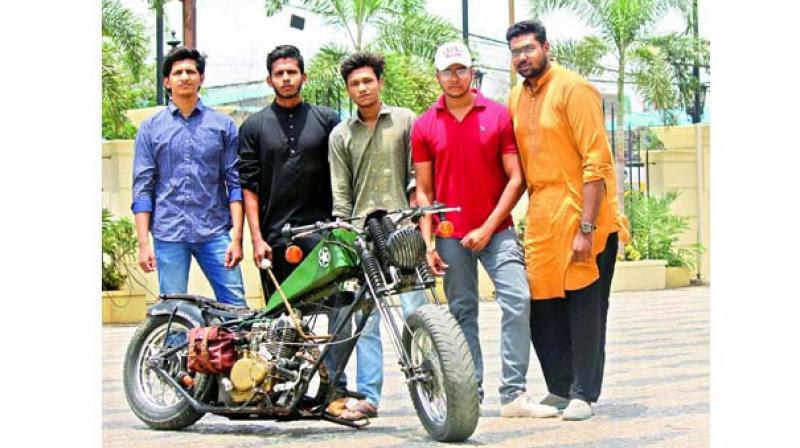
(Left to right) Wahaj Uddin, Ilyas khan, Amer Hassan, Osman Quadri and Awais Amjad

The woes of an engineering student are well known. Four years of lectures, classes, exams and backlogs are neither easily survived, nor forgotten. But five fourth-year students from the Lords Institute of Management and Technology are putting their theoretical knowledge to use in a way that not only helps the environment but also nurtures city-dwellers’ love for bikes. They’re custom-building bikes from scratch using scrap materials.

Talking about their prized projects, Ilyas Khan, the captain of the team, says, “The ‘Brat Bob’ and ‘Fury’ were built to show youngsters and students how they could enjoy custom-built bikes while doing something good for the environment. The engines of these bikes are specially tuned to reduce carbon emissions. Everything but the engine and the wheels have been custom-designed and built by our team. The ‘Brat Bob’ has a car-like gear shift, and its front suspension is unique both in terms of engineering and aesthetics. We started building it in August last year and it took us almost a month and a half to complete.”

Ilyas’ team consists of Awais Amjad, Wahaj Uddin, Osman Quadri and Amer Hassan. For Ilyas, Awais and Wahaj, this project is not their first build. In the past, the trio has built an electric skateboard and a dual-engine car, among other things. For newbies Amer Hassan and Osman Quadri, the experience has been thoroughly exhilarating.

The group initially started working on their bike-building project by themselves, until their work was noticed by their college, which led to an inflow of funding. Since then, the institute’s faculty members Mohammed Ahmed and Yousuf Ahmed have also guided and mentored the boys. As part of the process, the team goes out to collect raw materials like sheet metal, rods, and metal pipes, which they then fabricate into bike parts by hand. The few parts that they aren’t equipped to build by themselves, they acquire from second-hand bike markets and scrap shops. Each bike takes them a little over two months to build.

The question is, are these just passion-projects or do they plan on putting their creations up for sale? “These bikes are definitely for sale. Each bike will probably cost around Rs 80,000, and they can be used daily. We are also open to receiving customisation orders from people outside our college,” Ilyas says.

source: http://www.deccanchronicle.com / Deccan Chronicle / Home> Lifestyle> Viral & Trending / by Oishani Mojumder, Deccan Chronicle / August 06th, 2018

A Tribute to Badi Ammi: Educationist Mrs Fatima Anees

Sholapur / Mumbai , MAHARASHTRA  :

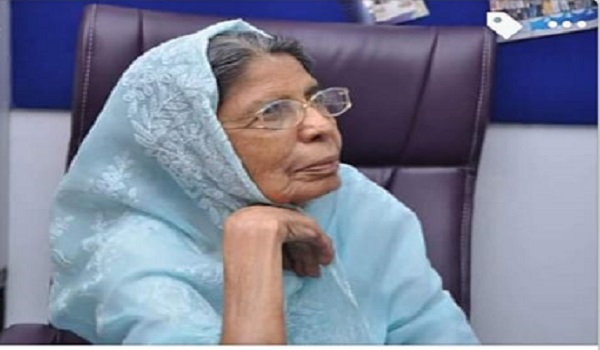
Mrs Fatima Anees.
Mrs Fatima Anees.

It seemed Badi Ammi was going to live forever. We were so used to her.

The shore that tells you to traipse along braving the storms, helps you comprehend your mess, allows you to walk over it, the rock you know is there to push you to learn to lean on your own shoulders and not anyone else’s, the proverbial friend philosopher and guide who shows you how to trudge along with your feet full of thorns, with a smile.

Meet Mrs Fatima Anees, educationist, columnist, Principal of Anjuman Khairul Islam Girls High School, Mumbai, who also happened to be the first Muslim woman to pass her matriculate from the city of Sholapur.

My Badi Ammi [Elder Mother]  sister to my mother Qamar, passed away on August 6, at the age of eighty-five.

She was a unique kind of a human being.  How many people do you find today, who literally can call out your bluff to your face? Would speak the bitterest of truth without mincing words and with extreme nonchalance? Would roll on burning coals whenever they saw injustice?

Mrs.Fatima Anees was all this and more.

Born in 1934, she was the eldest child. Her father Husain Sahab Josh, was a school headmaster,  called Congressi Janab, with the white curved cap over his small head. Wrote patriotic verses and of the love of Imam Husain, and sent his four daughters to school in the early 40s.

Sending girls to school?

In the late thirties it was treason. For this ‘crime’ Mr Hussain Sahab Josh and his family were boycotted, communication was banned with the rebel family. No wedding invitations came their way. But Mr Hussain was a tough guy, he declared, I have four sons and one daughter, I am sending all my sons to school, what is your problem? He was referring to his four girls and a son. The freedom fighter was drunk on Gandhism, he wore khadi and Gandhi cap became his trademark. Simple living was something that came naturally. They had little money to speak of anyway!

FatimaAnis02MPOs16oct2018

But little girl Fatima would be apprehensive on her way to school. There she would make it a point to walk along with her teachers to enter and leave the classroom, to avoid being jeered. Soon a day came when she became the first female Muslim matriculate. Today, her name is taken with much pride. Whenever I see hordes of girls in blue chequered uniforms and two tight pony tails, leaving schools in the evenings, almost choking the roads, I smile almost instinctively and send a prayer for my Badi Ammi.

She was I think literally the one and only woman whom I never saw making usual complaints on and about  in laws, and other relations. Never! She had faced hard times, a divorce and then widowhood at a rather young age. Despite this, have I ever seen her bickering about fate etc. No, absolutely no one heard her complain.

Oh, yes, but she would incessantly complain about how pot-holed the roads were, how injustice was being done to people and how one could better progress right and high, if one used one’s brain properly. Anyone commenting foolishly would be taken to task immediately.

She worked hard. Her daily rituals were quite elaborate. She would be up and about at 4 a.m. and washed sacks full of clothes. Her daughters pleaded her not to, but when it is Fatima Anees, it was hard to make her stray from the path, she had chosen for herself. She continued this 4.a.m. ritual until she fell down in her home, this March and got bedridden.

She was a damn interesting lady. The one quality that distinguished her from other ordinary mortals was her courage to speak the truth almost blatantly. She spared no excuses and no one to say what was necessary, to be said and which most of us shy away from uttering. It happened on a railway station, she is being asked to advise and welcome  the new daughter in law in our family. She promptly begins to grumble , why is it that only women need to be advised? Then she  turns around and tells the groom, her nephew, Be the best in your behaviour to your wife, repeating the Prophetic saying, “The best among you is the best to his wife”. The bewildered expression on the faces around still makes me giggle. The mother of the bride looked dumb struck for a prolonged minute.

When I lost my young daughter Sanaa’, she called me  after a month. Listening perhaps to my forlorn voice, she chided, “Don’t you know how many children are being killed in Iraq? Don’t you mourn for them? What about those mothers who don’t even have the luxury of mourning?”

That was my Badi Ammi, her personal was always political. She was not capable of thinking selfishly and her pain was all encompassing.

Towards the end, she spent most of her time at home. Punctual to the core she reached on time even at the weddings!  Last year, she decided to attend one and obviously was on time, the first to arrive at the empty hall. When the groom arrived, stopping his father, she gave an earful, on being ‘so’ late. Both looked sheepish but didn’t mind it.  Everyone knew she was Fatima aapa, always expressive of her mind and could never hold it inside. We all knew her to be this way and never ever regretted her chidings. In fact we enjoyed such encounters. Her ‘anecdotes of truth’ have become part of our family folklore, relished each time we meet, and we have a huge repository of them!

Almost everyone in our family owed to her big way for some help or the other. Despite hardships, personal losses she raised her three daughters perfectly well as a single mother.[Her husband Mr.Ghafoor Anees who worked for TOI,  had passed away when the kids were quite young.] she never had complaints on how she was doing it alone, no irritation, just a dedicated fervent desire to work and work some more. I have seen her writing her columns once she returned from school. Sitting on the sofa, with papers and books spread all over.  Writing a column every week, with a job, raising three girls single handedly, and all the household work she preferred doing herself; can you even imagine?

What an enigma! And she did all this, nonchalantly, without making a fuss, without a word on how good she was at doing things.

She has left behind a huge legacy of education, of compassion, of the good work, and of speaking the truth, least bothered about the consequences. In fact she didn’t even understand consequence in her own innocent way.

source: http://www.caravandaily.com / Caravan / Home> Community / by Asma Anjum Khan / October 13th, 2018