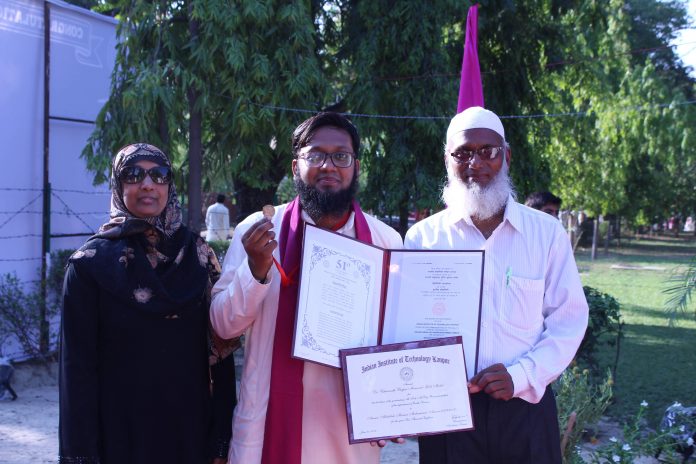
Ansari Abdullah, the boy from Malegaon who is not only an engineer but also hafiz- e- Quran had mentioned in his converstaion with TwoCircles in the year 2016 spoke about his challenges, dreams and doing research in Japan.
Abdullah skipped campus placement from IIT Kanpur as he was more interested in research and development. And his focus was so immense that his thesis was awarded the Gold Medal for ‘Best M.Tech Thesis at IIT Kanpur’. And now after his MTech, he appeared for the admission test to pursue his doctorate. And he was seleted by the top three IITs including IIT Roorkee, IIT Kanpur and IIT Delhi for PhD in Civil Engineering.
But Ansari Abdulah chose IIT Delhi, because IIT Delhi received “Institute of Eminence Award”, this year.
Abdullah is thankful to his parents, his sprirtual and religious guides, his guides in college who helped during his college days in graduation and post graduation to research write and submit his thesis Dr. Prashant B Daigavane and Dr. Javed Mallik. And Dr. Kenji Satake who guided him during his internship at the University of Tokyo.
With inputs from S N Ansari, asst editor, Urdu City, Malegaon
source: http://www.twocircles.net / TwoCircles. net / Home> Education> Indian Muslim> Lead Story> Youth / by TCN News / December 26th, 2018
Calligraphy is one of the many arts that has been on the decline in the modern age: with people not even using pen and paper these days, the art of calligraphy has few takers, or at least that is what the image around calligraphy has been. But in Bhiwandi, a city in Thane district, a medical practitioner is working hard to ensure that the future generations both treasure and learn the art of Urdu Calligraphy.
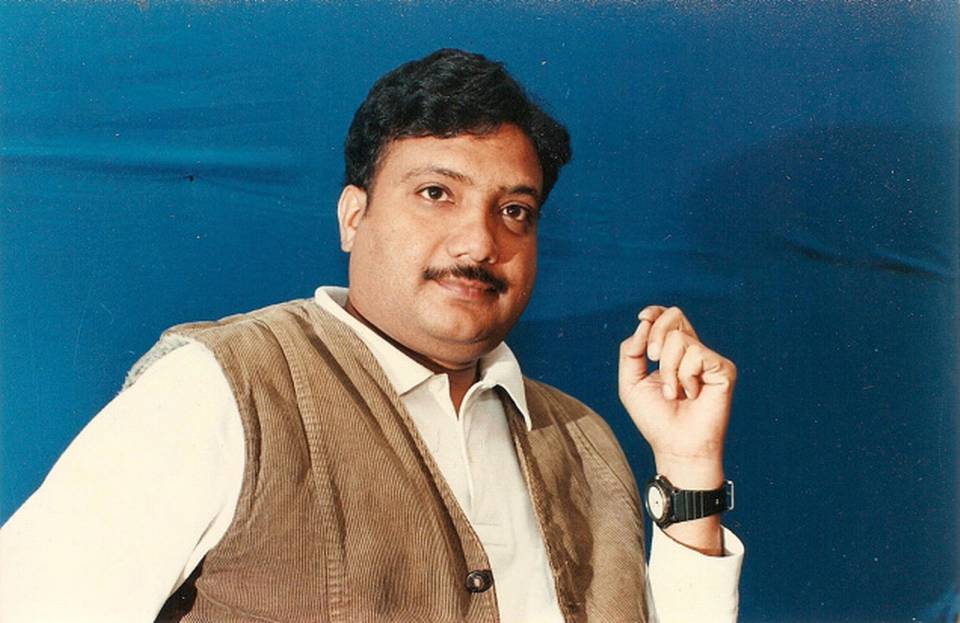
Dr.Rehan Ansari has been conducting weekend Urdu Calligraphy (Khattati) classes for the past many months at a local school for the benefit of all. Dr Ansari, who is a calligraphy expert and has been practising it since his school days, says that his classes have been met with an enthusiastic response from students of all age groups and professions.
In a conversation with TwoCircles.net, Dr Rehan says that these classes are at an attempt to save the script. In an interesting observation, he says, “This art has helped me a lot in being a doctor. Observing the words, the art of turning the hand and setting words in a proper shape is a unique art which is called calligraphy and it needs sincere efforts. I regularly use a blackboard as a teaching aid to draw letters and explain the various aspects of calligraphy.”
The one thing that sets Dr Rehan apart from other people is he disagrees to the statement that calligraphy is a dying art form. “In Bhiwandi, Hyderabad and other cities of India, calligraphers exist and extend their services. Nowadays, social media is also playing a favourable role in promoting this and expanding the market. It would be wrong to expect hundreds of calligraphers; one or two are enough for the amount of work that exists,” he says. To add to his point, He further told Twocircles.net that India will be hosting the International calligraphy conference of Urdu, Arabic and Persian on October 22 and 23 in Jaipur, which will see delegates of about 50 countries participate in the event.
Talking about his teaching methods, Dr Rehan says he provides beginners with the Reed Pen (Baru Qalam), which is a well-known tool in the world of Urdu and Arabic Calligraphy. Sajida Jamal, a teacher and an Urdu story writer, shared her experience with TwoCircles.net. “This is really a good opportunity for me to improve my writing skill…it is a skill that helps everyone and I believe it makes a person love the language a little more and appreciate the art of writing a lot better.”
Another student of Dr Rehan, Fahim Bari, who is a lecturer at the local commerce college, was full of praise for the classes. “This is our literary and cultural asset…it’s promotion and progress can only be possible when we protect it and reach more and more people. Dr Rehan is the creator of the famous Faiz Nastaliq font and his classes are doing a lot to help us fall in love with the language again.”
source: http://www.twocircles.net / TwoCircles.net / Home> Indian Muslim / by Imran Inamdar, TwoCircles.net / September 28th, 2018
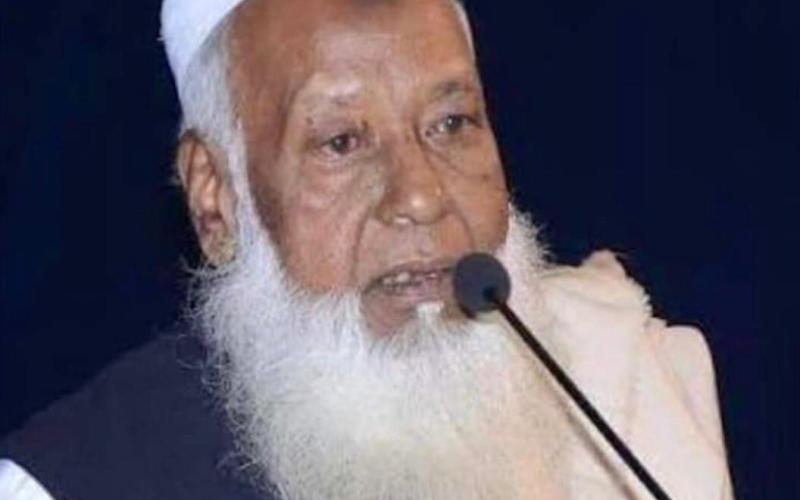
Noted Islamic scholar Maulana Mohammed Asrarul Haq Qasmi, who represented Kishanganj in Lok Sabha passed away today, i.e. on Friday, December 7, 2018 at 3:30 am. He suffered from heart attack. Earlier he was quite well. Yesterday evening he attended a programme at Darul Uloom Suffah founded by him at Kishanganj and addressed students and teachers.
Funeral prayer will be offered after Friday prayers at 3 pm at his home town Tarabari in Kishanganj, Bihar.
Maulana Qasmi is survived by 3 sons and 2 daughters.
He studied Fazil (M.A.) from Darul Uloom, Deoband, Uttar Pradesh.
Maulana set up 163 primary educational institutions and also established Milli girls schools in Kishanganj, Bihar which distributed relief material among the victims of Tsunami and flood in Bihar.
He was the secretary Jamiat Ulema-e-Hind, Member of All India Muslim personal law Board, Vice-President of All India Milli Council, President of All India Talimi wa Milli Foundation. He was also the state president of Jamiat Ulema-e-Hind.
source: http://www.siasat.com / The Siasat Daily / Home> India> News> Top Stories / by Rasia Hashmi / December 07th, 2018
Mustajab Malik’s short film “Sir Syed Ahmed Khan” is quite relevant at a time when media circles are abuzz about a possible Bharat Ratna for him.
Many times adverse conditions bring out the best in a human being. So was the case with Sir Syed Ahmed Khan, a visionary and educationist, whose single greatest contribution among others to the posterity stands in the form of Aligarh Muslim University (AMU), the renowned centre of learning.
The 30-minute documentary “Sir Syed Ahmed Khan” is a part of the series “Charagh-e-Hind” directed by Mustajab Malik that traces his life highlighting several important aspects of his personality. “The objective of the series is to inspire the Muslim youth and enable them to change their mindset from ‘we have got nothing’ to ‘we must contribute’,” explains Mustajab, a veteran theatre person. Virendra Vashistha essays the role of Sir Syed and the script is written by Dr. Mohammad Aleem. Born on October 17, 1817 in Mughal nobility, Sir Syed after education joined the civil services. The First War of Independence in 1857, when he was munsif in Bijnor, had a profound impact on his life. Despite suffering personally as many of his family members were either killed or missing, he ensured protection to the women and children left by the British for safekeeping.
“Sir Syed was aware that the 1857 events reflected dissent on the part of Indians and that they were not well prepared for it,” comments historian, Prof. S.M. Azizuddin in the film. “An Essay “On The Causes Of The Indian Revolt” in 1859, the English translation of his discourse, was widely debated in the English Parliament leading many members to demand action against him.
Instead mourning the death of his loved ones, the educationist was deeply hurt by the repercussions on his community and nation. He decided to serve and provide hope in the time of despair. “When Muslims were being targeted and their confidence was at the lowest ebb, he stepped in to guide them in tune with the changing international environment,” remarks Dr. Khwaja Ekramuddin, an Urdu scholar, in the documentary. For achieving that Sir Syed identified knowledge and science as the prime tools and promoted Western style scientific education. He founded a modern madarsa in Moradabad and Ghazipur and the Scientific Society of Aligarh to instil scientific temper apart from having several scientific papers translated into Urdu.
Sir Syed’s meeting with Mirza Ghalib to write the foreword of his edition of Abul Fazl’s Ain-e Akbari, proved a turning point for him. The poet asked him to forget the past and concentrate on current developments and take into account the galloping progress in the West thereby turning him towards social reform.
During his stay in England for nearly two years from 1869 he visited several educational establishments and learning centres inspiring him to replicate them in India. This led to setting up Muhammadan Anglo-Oriental College in 1875. “Educating Muslims meant taking India forward,” comments Pradeep Saxsena, a Hindi scholar. In this cause he was helped by several Hindus in cash and kind. Besides seeking funds, Sir Syed also staged plays to espouse the cause. In 1920, 22 years after his death, it became AMU. The institution enrolled a large number of Hindu students and Babu Iswhari Prasad is among the first batch of graduates.
Sir Syed was swayed by all the British did. “He wanted their help and at the same time criticised them as proved by his essay on events of 1857. Besides he also rebutted the allegations made by Sir William Muir in his book “Life of Mahomet” in writing,” says Mustajab adding “he did not take to the streets protesting or led agitations and instead adopted the civilised method.”
The film highlights Sir Syed’s scholarship by informing the viewers of his 1846 book “Athar-al-Sanadid” which documents the Delhi monuments. “It was a first- of-its-kind attempt. In fact this authoritative work which cannot be ignored by anyone studying Delhi monuments,” comments Syed Ali Nadeem Rezavi, a historian shown in the documentary.
source: http://www.thehindu.com / The Hindu / Home> Friday Review / by S. Ravi / January 08th, 2015
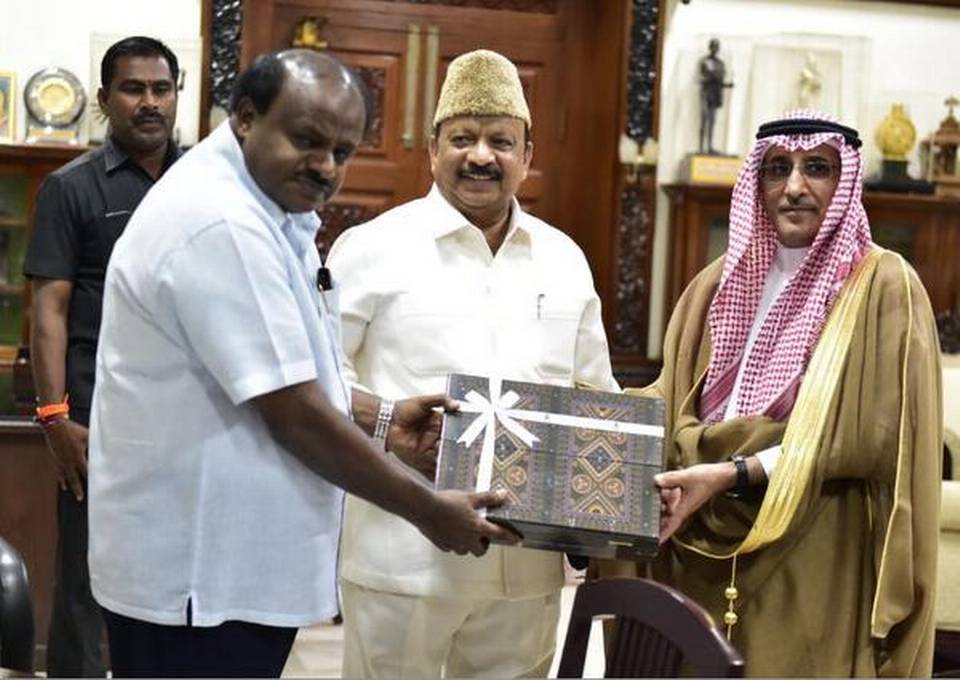
Saudi Arabia Ambassador to India Saud Mohammed Al-sati shared this information when he called on Chief Minister H.D. Kumaraswamy, along with Karnataka State Haj Committee Chairman and former Minister Roshan Baig, on Tuesday. | Photo Credit: the hindu
About a 100 years ago, a woman philanthropist from Bengaluru had set up a school for girls in Mecca, Saudi Arabia.
On Tuesday, many people in Bengaluru were in for a pleasant surprise when Saudi Arabia Ambassador to India Saud Mohammed Al-sati shared this information during a meeting with Chief Minister H.D. Kumaraswamy. The ambassador informed that they had all the records pertaining to the woman, named Saulath Unnisa, and expressed a desire to honour her family members if they could be located.
Karnataka State Haj Committee Chairman and former Minister Roshan Baig told The Hindu that they would try to trace the family. “These days, we take a five-and-a-half hours flight to Jeddah for Haj or Umra. But back then, pilgrims would have to take a ship from Bombay and sail for a fortnight to reach Mecca. It is a great contribution by the lady at that time,” he said.
Saudi consulate in city
Meanwhile, one of the long-standing demands of pilgrims and the large Kannadiga diaspora in Saudi Arabia for a consulate in Bengaluru could be fructifying shortly.
According to Mr. Baig, around 50,000 pilgrims travel from Karnataka annually for Haj and Umra. This is apart from a large number of people employed in Saudi Arabia.
The ambassador is learnt to have told Mr. Kumaraswamy that work on establishing the consulate is in progress, and it is waiting for approval from the Ministry of External Affairs. The ambassador said that the number of people seeking a visa to Saudi Arabia had doubled, and that it was the reason for opening a consulate. Currently, residents of Karnataka have to travel to Mumbai for the paperwork.
Mr. Kumaraswamy welcomed the move to open a consulate in Bengaluru, and also invited Saudi Arabian businessmen to invest in Bengaluru.
source: http://www.thehindu.com / The Hindu / Home> News> Cities> Bengaluru / by Special Correspondent / December 04th, 2018
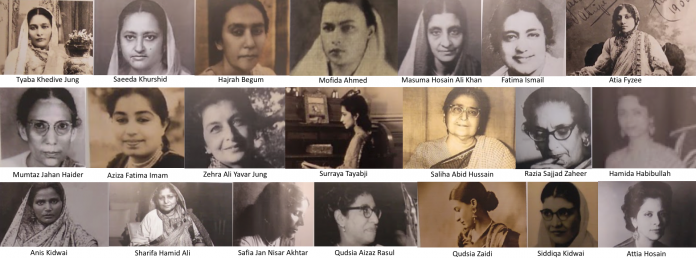
Stories of conviction and contribution of Indian Muslim women, who “gave up the purdah” and were at “the forefront of the nationalist and feminist discourse” in the past century are on display here.
The exhibition on 21 “pathbreakers” opened for public view on Saturday.
Organised by Muslim Women’s Forum at the India International Centre (IIC), the show “Pathbreakers: The Twentieth Century Muslim Women of India” features women who remain largely unheard of and unsung in the mainstream narrative.
During and after the freedom movement, a note on the exhibition said, many Muslim women shed the ‘purdah’ and became partners in the project to build a new India.
They went on to become writers, teachers, artists, scientists, lawyers, educators, political workers, trade unions, MPs, and MLAs.
“With a few exceptions, most of them have been forgotten in time.”
The show, inaugurated by author-filmmaker Syeda Imam (granddaughter of early 20th century writer-educator Tyaba Khedive Jung), embodies the spirit of the active contribution of these women, and as Imam said, “were not in the recesses of home and kitchen”.
Far from the commonly-held impression of silenced, cloistered and acquiescent women, ‘Pathbreakers’ narrates the stories of strong, determined and engaged women, the note said.
Some of these women include Qudsia Aizaz Rasul, the only Muslim woman member of the Constituent Assembly and author of “From Purdah to Parliament: A Muslim Woman in Indian Politics”; Assam’s first woman MP Mofida Ahmed, elected from Jorhat in 1957; and Aziza Fatima Imam, who served in the Rajya Sabha for 13 years starting 1973.
Why Muslim women?
The exhibition of photographs, text and video installations, points to their significant contribution towards the building of the nation, along with their sisters of other communities, through its freedom struggle, independence and beyond.
“A multiplicity of stereotypes are constructed by diverse actors regarding Muslim women. But the fact is there is no undifferentiated amass’ of Muslim women. Like women of all socio-cultural groups, they too are a divergent, shifting composition of individuals, often dumped in popular parlance into one single heap. This homogenisation has to be rejected,” the note read.
The show also projects video recordings of readings from writings of some of the featuring women.
The organisers, however, said while the participating women might seem elite, it is only the first step in identifying and recognising pathbreakers from all sections.
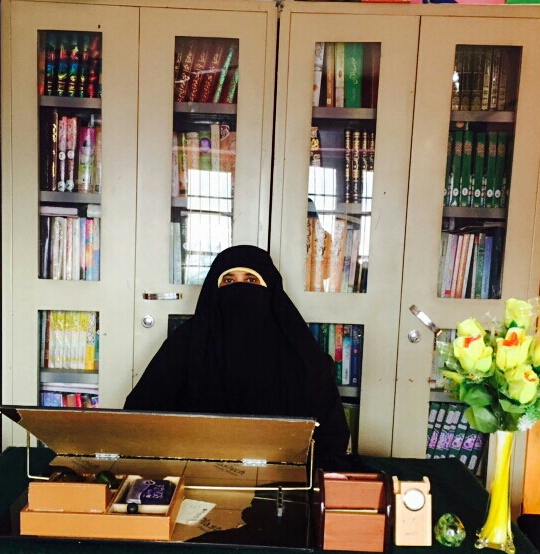
Dr Mubeena Ramza, head of Ansar-un-nissa’ a soio religious organisation (Photo: Auqib Javeed/ TwoCircles.net)
Dr Mubeena Ramzan of Kashmir created history earlier this month when she became the first Kashmiri woman to be enlisted among the 500 most influential personalities in the Muslim world. The list was released by The Royal Islamic Strategic Studies Centre, an independent research entity affiliated with the Royal Aal al-Bayt Institute for Islamic Thought.
The list named Dr. Mubeena from North Kashmir’s Sopore as one among the world’s most influential persons. Dr Mubeena heads the women-only socio-religious organization ‘Ansar-un-Nissa’ and is the Rector of ‘Jamia Islamia Mahdul Muslimat’, which has its branches in Sopore (Baramulla), Baghat (Srinagar) and Sumbal (Bandipora) under the aegis of a registered public trust namely ‘Mahdul Muslimat Educational Trust’ in Kashmir. Dr Mubeena travels extensively across the valley for women’s rights and ensure that women suffering from domestic violence are provided “a vent”. In an exclusive interview with TwoCircles.net, Dr Mubeena talks about her activism, journey and her views regarding role of women in conflict-torn state.
Here are the experts
Could you please tell us a little about yourself?
I was born in Sopore of District Baramulla and had my initial schooling from Islamia High School, Sopore where we were taught Islamiyat, Arabic and Hindi, which broadened our thought process.
Students of the madarsa run by Dr. Mubeena (Photo: Auqib Javeed/ TwoCircles.net)
After pursuing Bachelor’s degree in Islamic Studies, Education, Political Science and Philosophy from Islamia College, Sopore. After that, I completed my B.Ed, Masters degree and Research from University of Kashmir (KU). During my Research in Kashmir University, I had specialised in Islamic Law, Jurisprudence (Fiqh) and Orientalism.
Besides all this, I had learned Islamic Sciences from Hazrat Mufti Muzaffar Hussain Qasimi Sahab, Head Mufti, Darul-ul-Uloom Sopore.
When did the idea of setting up your own institute for women come to your mind and why?
As a scholar, my research on Kashmiri Society and its social evils had made me realise that I must play an active part in mitigating the crisis. The very idea motivated me to quit lectureship in a B.Ed college in Kupwara and started Jamia Islamia Mahdul Muslimat under the aegis of Mahdul Muslimat Educational Trust in 2002, from a rented building in Sopore and took us eight years to purchase a land and built a proper girls-only seminary-cum-skill school there.
The objective was to inculcate education with Islamic integration and impart skills among women. We started another branch in Baghat area of Srinagar city and recently, opened another campus at Sumbal-Hajin area of Bandipora district.
What do you teach to your students?
Jamia Islamia Mahdul Muslimat is a seminary-style girls only institute where besides teaching of religious text we impart worldly education also. But main thrust is on religious scriptures like Quranic exegesis, science of Hadith, Jurisprudence and History.
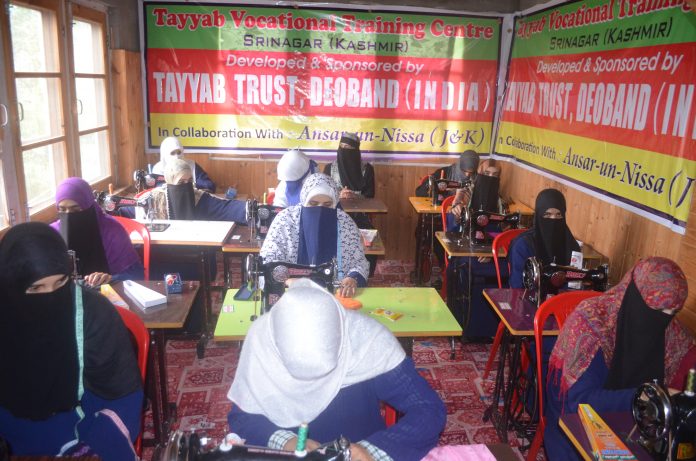
We also teach languages viz, Arabic, English, Urdu and train them in the field of Computers, Cutting & Designing skills to help them become competent and self-reliant.
Tell us about this institute and your journey with it?
We empower our students through education and skills, which boosts their confidence to face different realities of life. I believe that training a girl on these parameters was not possible by mere religious sermons, debates, seminars, etc.
We had to upgrade our religious syllabus on modern lines to make our girl students relevant to the contemporary society. We believe in natural upbringing of students, especially girl. We understand it well that apart from education and shelter, orphans also need motherly love and care. While we try to provide that, we also counsel and guide them regarding their future. This is what our Institute Jamia Islamia Mahdul Muslimat provides.
In 2013, we called a meet of women from different walks of the life-around 100 of them-in Sopore where we decided to have some welfare initiatives among women. And as a result, in March 2014, we floated “Ansar-un-Nissa”, a women welfare body which provides a helping hand to the needy, would-be brides, widows, orphans, and also establishes vocational training centres.
What challenges do you face during your activism in a society that can be patriarchal?
When it comes to a woman who observes Hijab, challenges are tremendous. Women now-a-days is sandwiched between two extremes – Religious and Western. A man is called qawwam in Quran, which means head / protector / sustainers of the family but this status has been misused by some by enslaving women.
I was opposed by so-called Moulvis for starting girls only seminary style institute (Madrassa) as it was in their mind how come a female run a Madrassa. But Alhamdulillah, now their perception has changed as we are successfully running three branches now.
The need of the hour is to have a very balanced approach where woman and man both would take care of their roles and responsibilities. Men and Women are equal, but not similar.
Reportedly, you were associated with Dukhtaran-e-Millat (DeM) of Aasiya Andrabi and later on due to some differences you left from the organisation. What were the differences?
Yes, I was associated with the organisation till 2004. Later on the differences grew with the organization for it being more into political spectrum. I left the organization as I wanted to do activism on academic parameters and started academic activism among women folk.
Do you think there are need for more Muslim women scholars in Kashmir?
Obviously, yes. In the rest of the Muslim world, we have good number of women Islamic Scholars but in Kashmir we are lacking them. We need more and more women scholars in Kashmir in order to educate common women-folk.
You must be knowing that in Ottomans Empire, 40% of contribution to Bait-al-Mal (House of money) was by the women and the oldest degree-granting university in the world i.e., Al-Qarawiyyin University was founded by Fatima al-Fihri, a women.
Women have been the pioneers of the education from the beginning of the Muslim society which is evident from the fact that a great major of Ahadiths (sayings of the Prophet, saws) are quoted by none other than his wife, Hazart Ayesha Siddiqa (r.a).
You have conducted various religious gatherings in different parts of the valley.
What draws you to that endeavour?
There are many issues related to women where she needs to be educated in right perspective. People often gossip about four wives, but no one thinks about having four daughters. Even a mother’s face turn pale now-a-days on the birth of a girl child.
The experiences which I gained after travelling throughout the Valley and beyond it for conduct of various religious gatherings are quite astonishing and still prevalent in this century. Most of the daughters and sisters are being debarred from the property / inheritance while Islam and Islamic law have given them a Right to Inheritance. Remarriage, Widow Marriage is still considered something evil in this Kashmir.
Daughters, Sisters, Wives are being forced to work outside for earnings and height of the things are that now-a-days it is difficult for an unemployed girl to get a suitable match as most mothers prefer to have employed daughter-in-law.
The hadiths of the Prophet (peace and blessing be upon him) about raising girls are beautiful and amazing. Girl children come with great rewards and blessings. If you offer care, love, support and education to your girl child, Paradise awaits you.
At a time when baby girls were deemed a source of shame, even buried alive, the Prophet (peace and blessing be upon him) came to rectify this grave wrong. The Prophet (peace and blessing be upon him) said: If anyone has a female child, and does not bury her alive, or slight her, or prefer his male children to her, Allah will bring him into Paradise. (Ahmad). On one other occasion, The Prophet (peace and blessing be upon him) said, “Whoever supports two girls till they attain maturity, he and I will come on the Day of Resurrection (close to each other) like this –The Messenger of Allah (peace and blessing be upon him) joined his fingers to illustrate closeness.” (Muslim)
These are just examples of how Islam cared for the girl children. The care mentioned in these hadiths and others is comprehensive. It covers the girls’ physical, emotional and mental needs. Such is the care and affection that our daughters deserve. The Prophet (peace and blessings be upon him) commands us to be loving, patient and supportive parents.
You were recently listed as one among the most influential 500 personalities in the Muslim world. Do you have any comments on your selection?
I came to know through my husband about it and I believe that real action and delight comes from helping your people grow. But yes, if your welfare activism is being recognised in any way, it does boost you.
Do you have any personal Muslim women heroes you would like to mention?
Not Hero, but inspiration. Maryam Jameela is one in this regard. She was brought up in a modern society but did not get getting influenced by it. On the contrary, she was able to influence and inspire people with her thought. Yvonne Ridley is other one.
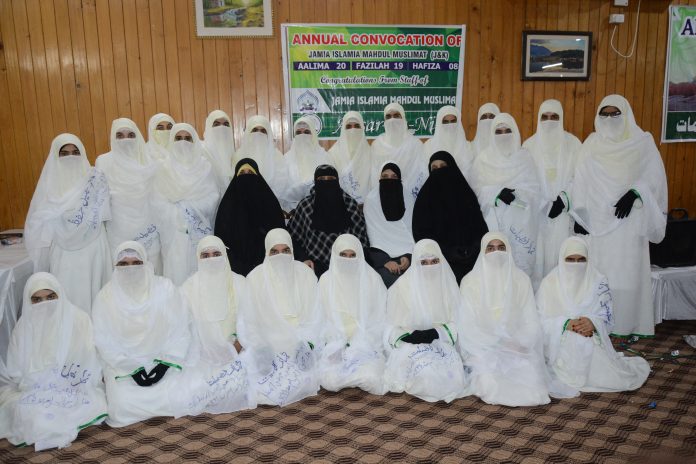
Dr. Mubeena Ramza with her students at the convocation in Srinnagar (Photo: Auqib Javeed/ TwoCircles.net)
Do you have any messages for young Kashmiri Women?
As Muslims, they should believe that their rights, duties and status are justified. They don’t need any westerner or any ragtag activist to tell them their rights as a woman. Those who are rallying behind it are knowingly and unknowingly attempting to overlook the dignified status and rights given to women by their religion.
Islam invites you to a mission based on obedience to Allah and Islam addresses person’s spirit, emotions, belief, etc. West is dragging women from homes, only to fulfil economic and materialistic objectives. It’s intended to commercialize things but Islam gives dignity and status while addressing the soul.
There are some jobs in the field of Education and Health and other suitable fields, where women have a primary role. However, in choosing any job, your home should be your preference. Your family should not suffer at the cost of earning. People in Kashmir nowadays prefer earnings over other things which need to be discouraged.
Almighty Allah says in the Qur’an …..“For Muslim men and women, for believing men and women, for devout men and women, for true men and women, for men and women who are patient and constant, for men and women who humble themselves, for men and women who give in charity, for men and women who fast, for men and women who guard their chastity, and for men and women who engage much in Allah’s praise, for them has Allah prepared forgiveness and great reward” (Al-Ahzab 33:35)
source: http://www.twocircles.net / TwoCircles.net / Home> Indian Muslim> Lead Story> Women / by Auqib Javeed, Twocircles.net / November 30th, 2018
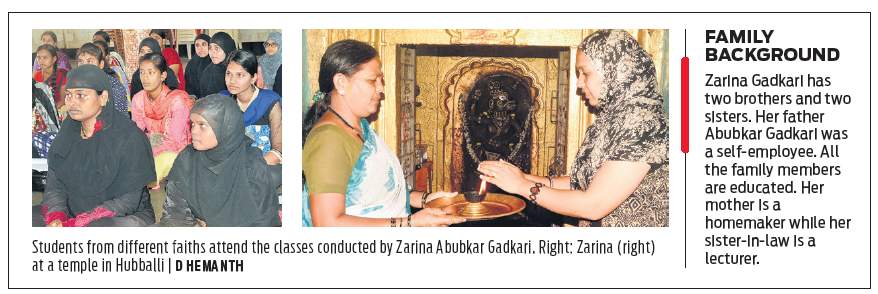
The 25-year-old crafts teacher, who follows the Muslim faith, conducts daily classes on Hindu epics and prayers for her students, many of whom hail from Muslim families, in Old Hubballi area.
Hubballi :
Zarina Abubkar Gadkari is quietly practising what most people only preach — spreading communal harmony. The 25-year-old crafts teacher, who follows the Muslim faith, conducts daily classes on Hindu epics and prayers for her students, many of whom hail from Muslim families, in Old Hubballi area.
Zarina, a teacher at Spoorthi Rural Skill Development Training Centre, which provides free training to women in craft-making and sewing, conducts her spirituality class on the premises every evening. She does not charge anything for the lessons, which include Sanskrit verses, songs and stories from the Ramayana and the Mahabharata, and hymns on gods such as Ganesha and Hanuman.
Hailing from Jamkhandi in Bagalkot district, Zarina started learning devotional songs and shlokas after getting inspired through the Ramayana and Mahabharata serials on television. When she joined the training centre as a craft teacher, she also started singing and teaching them to students.
”It’s a wonderful feeling to recite the shlokas,” she says. “Sanskrit words never seemed difficult to me while I was learning them, and my family members gave me big moral support,” adds Zarina, who performs namaz every day, and also visits the church and reads the Bible.
“When I go to Bengaluru, I visit St Mary’s Basilica in Shivaji Nagar. It is one of my favourite places, and my family members also visit it with me,” she says, adding that such gestures from her family lend her huge moral support.
“We live in a country where communal harmony is everything, and each of us must work hard to achieve it,” she says.
The number of students in her classes has only increased over time, and they love every minute of it.
“I have been attending the classes of Zarina madam for over six months and she is a role model for many,” says Nasereen Attar, a student. “We never faced any restrictions in our homes about attending classes related to Hinduism. In fact, our parents encourage us to learn new things,” she adds.
Most students hail her as a motivating figure. “Her way of teaching and her commitment to religious harmony, besides her reciting of Sanskrit verses, left me stunned,” Shynaz Nadaf, another student, says. “It’s surprising to see Zarina madam perform namaz and as well as have darshan at temples,” Shreya M pitches in.
Zarina’s endeavour is praised by her colleagues too. “Her work shows that attachment to a religion is no hindrance to good work. She is a good human being,” says Mukthambika Narebol, a co-worker at the institute.
Zarina was introduced to the Ramayana and Mahabharata through teleserials by her parents when she was a child. She got interested in reciting the mantras and shlokas when she started teaching at the Spoorthi centre, where daily prayers are conducted.
“I also practised other verses like the Hanuman Chalisa and Gayatri Mantra. Initially, I faced problems in pronunciation but within 2-3 months I was able to recite them well in Sanskrit,” says Zarina, who draws a lot of strength from her family.
While her father Abubkar Gadkari is self-employed, her two brothers and two sisters are well-educated too, and her sister-in-law is a lecturer.
Zarina feels that the task of uniting people of different faiths has assumed greater significance today. “We live in the world’s largest democratic and secular country where all religions exist together. But in recent times, society has seen changes after the social media took the front seat,” she says.
Greater onus rests on the youth to build a cohesive society, adds Zarina. “Several young lives are going waste by getting involved in violence triggered by communal hate. We must also educate women about the ill-effects of religious divide, and bring awareness about nation-building activities,” she says, admitting that the task, however, is far from being easy.
source: http://www.newindianexpress.com / The New Indian Express / Home> States> Karnataka / by Kiran Balannanavar / Express News Service / November 25th, 2018
Mariam Rauf urges schools to include personal safety education in syllabus
As an impressionable child, Mariam Rauf — a 22-year-old life skills and English language educator from Kottayam — never knew what paedophilia was. It took her many more years to realise that she herself had been one of its victims.
Abused on multiple occasions between the age of 3 and 14, the ordeals surely left an imprint on her.
Confused, ashamed, and lost for years on end, she eventually managed to pull herself up and is now busy training children and adults about personal safety.
Driven by her own experiences of abuse as a child, Mariam has now kick-started a campaign to include personal safety education in schools. She feels this is achievable as there is a strong intent on the part of the government to clamp down on child abuse. It is unlikely to affect academics either as it may need only a couple of sessions in a year.
Online petition
As part of the initiative, she has also chosen to shed her right to anonymity and launched an online petition on Change.org, which opens up on her ordeal and makes an appeal to the State government to introduce compulsory training in Personal Safety Education (PSE) for students, parents, teachers, and staff of all government schools.
The petition is addressed to Education Minister C. Ravindranath and the Kerala State Commission for Protection of Child Rights (KeSCPCR).
“About 38,200 people, who have endorsed my petition thus far, believe it is possible. By realising it, I can save at least one child from undergoing what I had to face,” she says.
According to Mariam, personal safety education for children is about making them aware of their body and empowering them to express their discomfort in case of physical transgressions.
“For most of us, personal safety of our children is limited to the ‘Stranger-Danger’ equation, while the actual threat can come from even inside the family. All people can do their part by recognising the physical and emotional signs shown by a child who is being abused and the signs that an adult is abusing a child,” she said.
source: http://www.thehindu.com / The Hindu / Home> News> States> Kerala / by U. Hiran / Kottayam – November 20th, 2018
Two decades after taking an initiative for promotion of girls’ education in his native town, a Mumbai-based entrepreneur is testing his fortunes in the Assembly election in the Sikar constituency in the Shekhawati region of Rajasthan .
The Excellence Knowledge City for Girls, established by Wahid Chowhan, has made the dusty district of Sikar one of the educationally advanced ones in the State.
Mr. Chowhan, 70, has been fielded here by the Rashtriya Loktantrik Party, which was floated by Hanuman Beniwal, Independent MLA, recently. Mr. Beniwal wants to create a third front in the State, where the BJP and the Congress have been elected alternately since 1993.
Mr. Chowhan’s college offers free tuition, books and uniforms to girls, and the curriculum is a mix of madrasa teaching and mainstream subjects.
It is probably the first institution which has introduced Sanskrit along with Urdu and Arabic as the languages taught.
While seeking votes, Mr. Chowhan speaks of the difficulties he had faced when he started the college. The local people had suspected that he wanted to corrupt the minds of innocent Muslims or he intended to set up a five-star hotel.
“From the earlier imbalance of girls being deprived of education, we have now reached the opposite extreme. Girls are now highly educated compared with boys,” he says.
The initiative has given an impetus to girls’ education in Sikar. “No girl, especially in the minority communities, stays at home. With higher education, they are all moving up the social ladder,” social activist Ashfaq Kayamkhani says.
Open to both Muslim and Hindu girls, the college offers education in mainstream subjects from science and humanities to business administration. Muslim girls can opt for the madrasa curriculum.
Mr. Chowhan is pitted against Ratan Jaldhari, MLA and BJP candidate, and Rajendra Pareek of the Congress, who was defeated in 2013.
source: http://www.thehindu.com / The Hindu / Home> Elections> Rajasthan / by Mohammed Iqbal / Sikar – November 24th, 2018