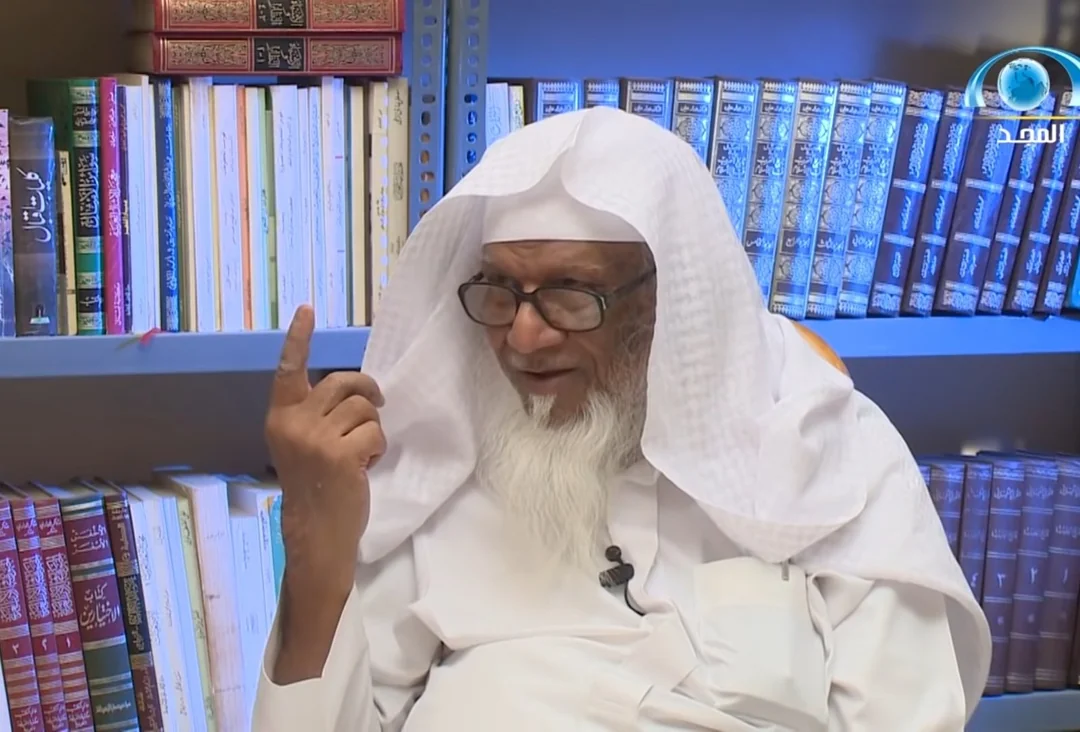
On Friday morning, author of the famous and most resourceful Madinah Arabic Book, Shaikh Dr. V Abdur Raheem, passed away in Madinah, Saudi Arabia at the age of 90.
A master of the Arabic language, a world renowned Islamic Scholar, multi-linguist, author, teacher and translator he dedicated his life to extraordinary contributions to Arabic literature by helping millions learn the Arabic language in his over 50 years of experience.
Born in 1933 in Vaniyambadi, Tamil Nadu, he obtained his B.A in English from the University of Madras and M.A in Arabic from the Aligarh Muslim University, India in 1962. He also held a M.Phil. and a Ph.D. in Arabic Philology from Al-Azhar University, Egypt.
A recipient of the National Award from the President of India in 1997 for his services in teaching, he was a self made man who learnt Arabic from the scarcest resources available to him in his little town. His three-volume series, Madinah Arabic Book, a one of a kind in its field, is the official curriculum of the Madinah University, Saudi Arabia, and is also used widely in schools and universities across the world to teach students the Arabic language.
Former Professor of Arabic Language for 30 years at the International Islamic University of Madinah, he has taught Arabic Language at Islamic Universities around the world including at Omdurman in Sudan, Germany, Washington D.C and British Guyana. An expert on European Languages and their etymology, phonetic change and semantic development he was a former Director of the ‘Institute of Teaching Arabic as a Foreign Language’, at the Islamic University of Madinah.
A close associate of the Islamic Foundation Trust (IFT), Chennai, majority of his books have been published by IFT.
Along with the Madinah Arabic Book series he has to his credit a host of other books too including ‘Let’s Begin to Read Arabic: A Beginners Guide to Learning the Arabic Language and the Qur’aan’, ‘AL-TIBYAAN – Easy way to Qur’aanic Reading’, ‘Arabic Course for Non-Native Speakers of Arabic: Originally Devised and Taught at Islaamic University, Madinah’, ‘From Esfahan To Madinah In Search of Truth: Salmaan al-Faarisi’s Hadiith’,‘Both These Lights Emanate from the Same Niche’ – Hadiith of Umm Salamah (raDiyAllaahu “anhaa).’ ‘Suurah al-Hujuraat – With Lexical and Grammatical Notes and DVDs’.
His passing is indeed a great loss to both the Muslim world and to Islamic literature.
source: http://www.thecognate.com / The Cognate / Home> News / by The Cognate News Desk / October 21st, 2023
Several girls from the Bakarwal community, a nomadic ethnic minority in India’s Jammu and Kashmir area, recently cleared the National Eligibility Cum Entrance Test, also known as NEET, for admission to undergraduate medical courses in all Indian medical institutions.
Aasiya Choudry, 20, of Jasrota village in Jammu’s Kathua district, is one of the Bakarwal girls who cleared the NEET exam on her second attempt, securing 430 points.
Education Remains A Distant Dream For Kashmir’s Tribal
“It was not a cakewalk for a student like me who belongs from a community where students did not have much resources and guidance,” Aasiya stated to Two Circles.
She said that no one in her community was aware of the NEET exam. This is not surprising given that schooling remains a faraway dream for Kashmiri tribal youth.
According to the 2011 census, just 17.8 percent of the people of the twin tribal settlements of Gujjar and Bakarwal can read and write.
Aasiya completed her basic education at a government school in her village before attending Jawahar Nagar Vidyala Basoli in Kathua.
Cleared NEET Without Coaching
“I didn’t always have enough money to buy textbooks, pens, and other supplies. I had to overcome hardships in order to achieve and qualify for NEET, but it was a dream that came true,” said Aasiya, who did not register in coaching to clear the entrance since her family could not afford the expenses.
Aasiya’s father Mubashir Hussain Khatana is a shepherd who tends to his livestock and provides a living for his family.
Aasiya says she was fortunate to have a supportive home environment that allowed her to prepare for this national-level competitive exam in a neighbourhood where options for education are limited, particularly for girls. “They [parents] motivated me to overcome my challenges and work towards achieving my goal,” she said.
Studied for NEET On YouTube
Aasiya had to care for her three younger sisters and a sixth-grade brother when her elder sister married two years ago, and she also had to help her mother with chores at home. Choudhry kept her studies going by watching free NEET videos on the online video sharing and social media platform YouTube.
Due to bad network connectivity and a limited data plan, she found it difficult to study for NEET on YouTube. To overcome these obstacles, Aasiya had to walk at least two kilometers every day to a location with WiFi in order to download videos.
Aasiya studied for approximately 10 hours each day. “Our village did not always have electricity. I used to watch saved videos on my phone at night under candlelight,” she explained.
Wishes To Become a Gynaecologist To Help Bakarwal Women
Aasiya aspires to be a gynaecologist — a physician who specialises in treating diseases of the female reproductive system — in order to help her community, which treks to green pastures with their animals for six months of the year. “During the seasonal migration, the Bakarwal people suffer [due] to the absence of basic health care facilities, especially pregnant women,” Aasiya stated to Two Circles.
Another Bakarwal Girl Cleared NEET
Ulfat Ismail, from the border village of Kandi Jarda in the Tehsil Karnah of North Kashmir’s Kupwara district, cleared the NEET exam on her second attempt, scoring 417 points.
Ulfat received her basic education at the village’s government middle school. She was accepted to the Government Medical College in Baramulla for a Bachelor of Medicine, Bachelor of Surgery (MBBS).
Ulfat used to study for almost 8 hours a day to clear NEET.
Mohammad Ismail, father of Ulfat stated that his dream is for his daughter to become a doctor since her accomplishments have the ability to positively impact their tribal community in the future.
“It was a proud moment for our family that our daughter had qualified the NEET exam and is going to become a doctor,” Ismail added.
Tauseef Ahmad is an independent reporter based in Kashmir.
source: http://www.twocircles.net / TwoCircles.net / Home> Education / by Tauseef Ahmad, TwoCircles.net / September 26th, 2023
In a significant milestone, Prestige International School has clinched the prestigious first position in the Education World India School Rankings 2023-24, under the esteemed ‘Co-ed Day School’ category.
The Education World India School Rankings (EWISR) serve as a global benchmark for evaluating educational establishments, acknowledging institutions that consistently demonstrate outstanding performance and educational standards.
The accolade was officially conferred upon Prestige International School during a grand ceremony held on October 13, 2023, at The JW Marriott, Aerocity, New Delhi. Hyder Ali, the Chairman of Prestige International School, was honored with this prestigious award.
“Securing the top spot in the ‘Co-ed Day School’ category in the EWISR 2023-24 is a testament to the school’s unwavering commitment to academic brilliance and its continuous efforts in nurturing well-rounded individuals,” a statement from the school added.
source: http://www.varthabharati.in / Vartha Bharati / Home> India / by Vartha Bharati / October 20th, 2023
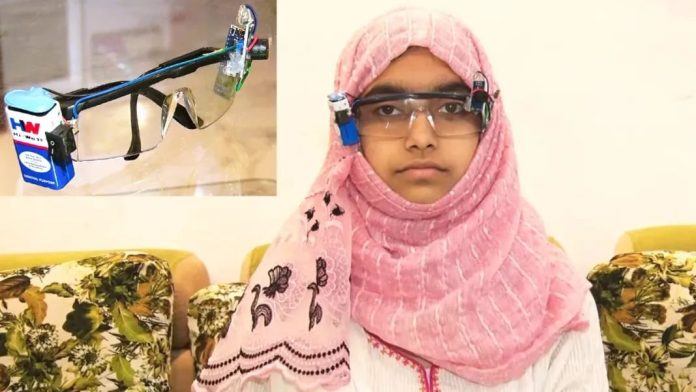
So many lives have been lost due to drivers falling asleep while driving. Rabia Farooqui, a student of Hubballi, has invented life-saving glasses to eliminate this.
The same anti-sleep drowsiness preventer machine warns students if they fall asleep while studying. The night shift workers are also alerted.
The transparent glasses are equipped with a rechargeable battery, an SIB buzzer, and an IR sensor. If the eyes are accidentally closed while driving, the nano Arduino buzzer will ring instantly and alert the driver.
Rabia Farooqui is currently studying in the first year of PUC at Vidyaniketan College. The glasses invented by Rubia have now been selected for the National Best Model Award at the Inspire Awards show held in Delhi.
Apart from this, the glasses invented by Rubia have also been selected for international-level science exhibitions.
source: http://www.thehindustangazette.com / The Hindustan Gazette / Home> News> Education / by Shifa / October 19th, 2023
Traveling is a major part of human life and it creates a major impact on the working class of society, especially working women’s face so many difficulties in travelling. Being independent is a point of pride for most people. The freedom to travel anywhere we want, regardless of access to public transit or close friends and family, is something that many of us take for granted. However, for those who are unable to drive, this independence can be limited, especially for women.
The founder and CEO of “Unicorn for women by women” Arma Sahar, who is a final year data science student, informed us about the story of the establishment and achievements of his startup.
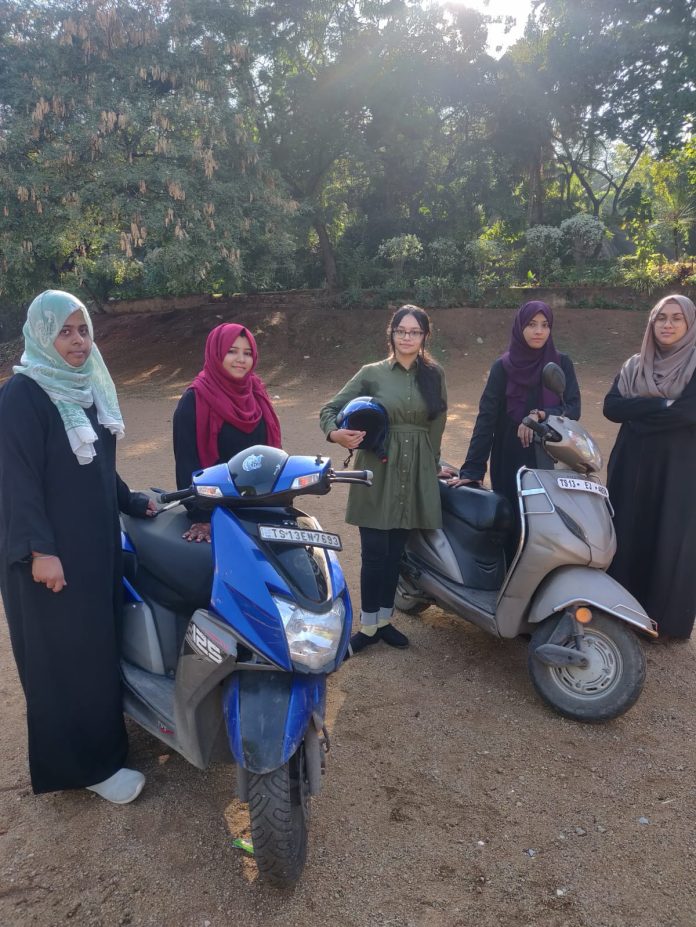
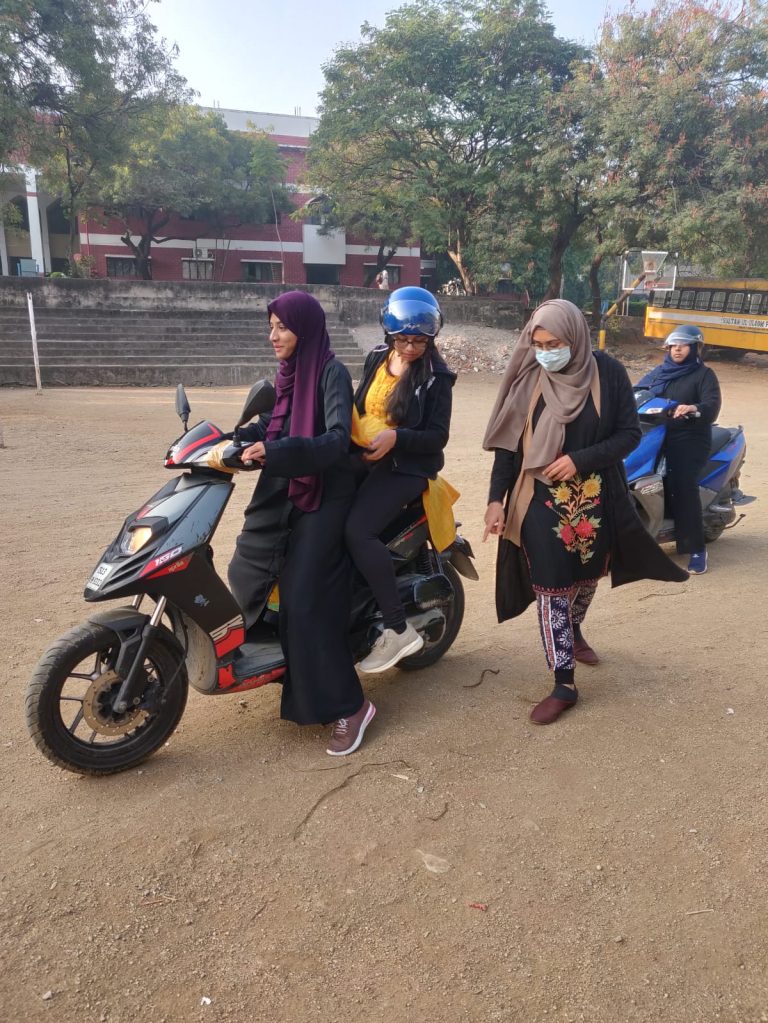
the challenges that women can face when it comes to transportation. When she moved from Adilabad to Hyderabad, Arma found herself reliant on her brothers for rides, which could be frustrating for both her and them due to their busy schedules. She also didn’t feel comfortable traveling alone, especially in autos which can be expensive. To address these issues, Arma founded Unicorn, a bike ride service run entirely by women. The service allows women to feel safe and comfortable while traveling and also gives them the independence and confidence to get around on their own. But after validating in the market Arma realised that more than 80% of the Women population didn’t know how to ride so they picked up the job opportunities offered by Unicorn and later they asked the girls if you are okay to learn and then drive later at Unicorn.
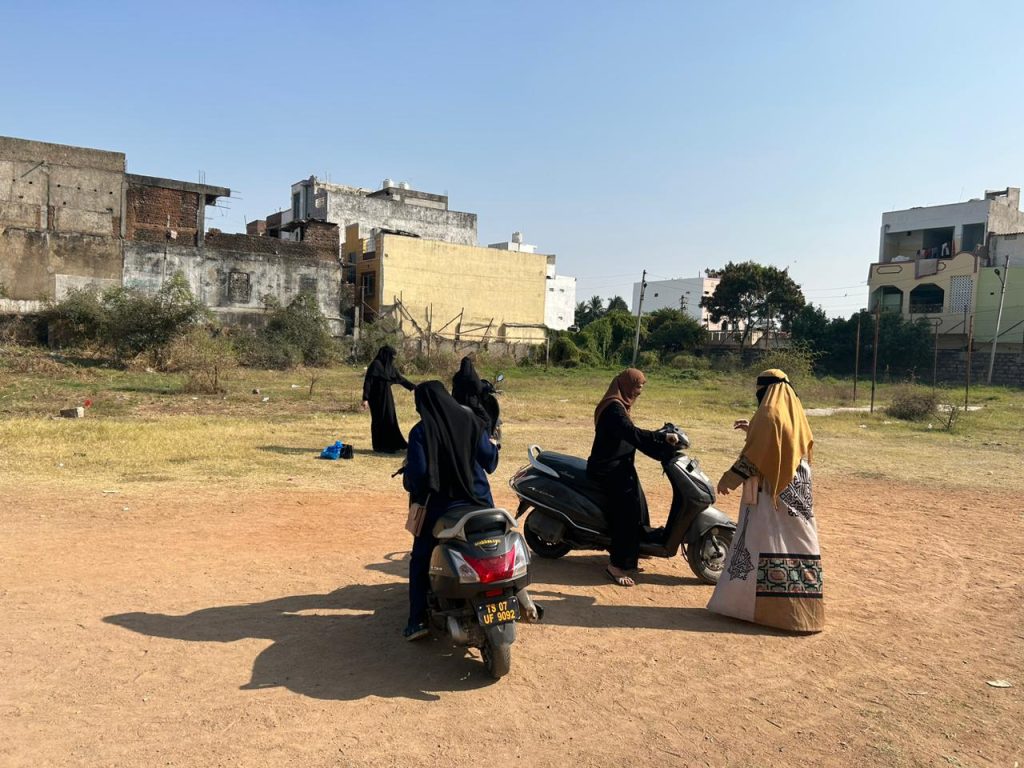
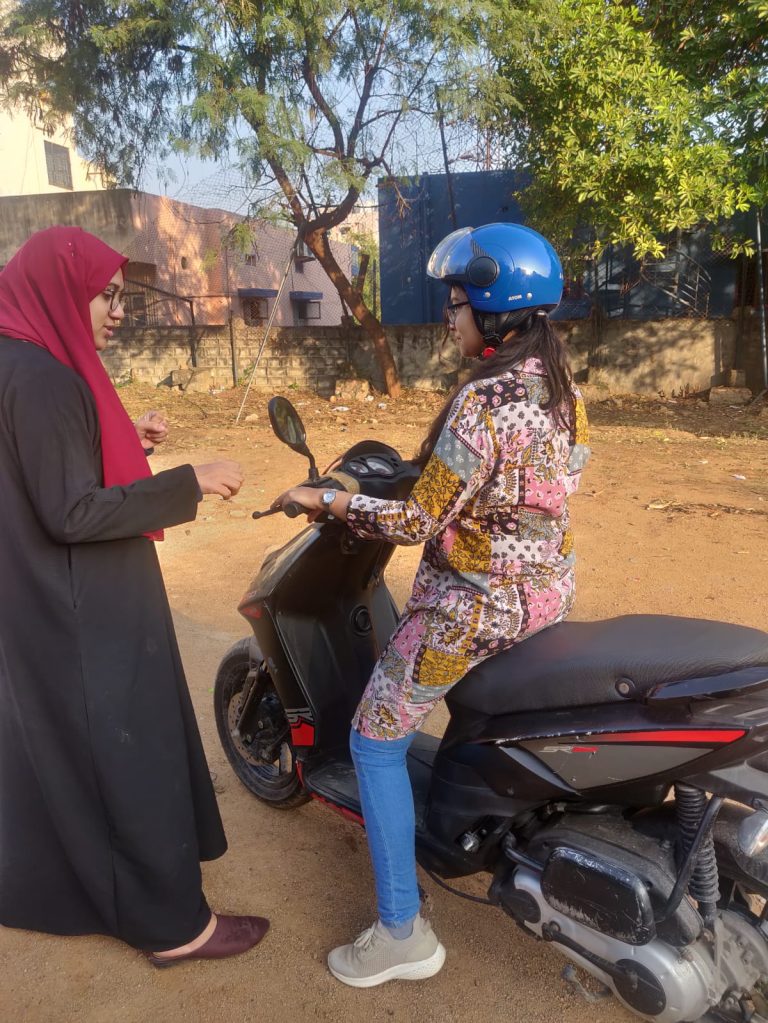
That’s when they thought to start and focus on training and many other girls started showing interest in the training program as it was offered by women instructors and that’s when we realised that this is the need of the hour. But Arma’s vision for Unicorn goes beyond just providing a transportation service. She also wants to empower women by teaching them how to ride two-wheelers. To this end, Unicorn offers training programs to teach women how to ride, with the goal of giving them more freedom and mobility. “After completing our first batch, we discovered that women are very eager to learn how to ride a vehicle, and as a result of this eagerness, they were able to pick it up within a few days,” Arma said. “This made us the fastest training option in India, where we started teaching women only in 5 Days, without any prerequisites.”
Unicorn has already conducted several training batches in Mehdipatnam, Santosh Nagar, and Yakutpura and is now expanding to the Old City to reach more women in need of safe transportation. The company’s innovative solution is filling a crucial gap in the market and helping to make travel safer and more accessible for women in Hyderabad. But what sets Unicorn apart from other driving schools? Arma explains that the company is focused on empowering women, not just training them for their own benefit. This unique approach has already gained praise from many women in the city, and the company plans to continue growing and helping more women gain independence and confidence through transportation. “We strive to empower women, not just train them for their own benefit,” Arma said. To participate in the Unicorn training program, interested individuals must first register on the company’s website (www.myunicorn.in) and await confirmation. The company currently operates through its website and WhatsApp and assigns each participant to a cohort with a confirmation letter. With its innovative transportation solution and commitment to empowering women, Unicorn is changing the way women in Hyderabad travel and helping them achieve greater independence. But Unicorn’s support for women doesn’t stop there.
Arma explained that the company’s website also creates connections between women who are capable drivers and those who are seeking transportation services. This allows women to make money while driving, Unicorn offers them the opportunity to find work and earn more than 25,000 per month. “We offer total support to women at every stage of their lives, from learning to drive to becoming a lady partner at our firm and partners,” Arma said. “We provide them with the choice of flexible driving hours so they can combine this career with their daily activities. Simply put, we act as their pillars of support.” Unicorn’s commitment to supporting women at every stage of their lives sets it apart from other driving schools and transportation services. By providing training, work opportunities, and flexible schedules, the company is helping women to achieve independence and empowering them to take control of their own lives.
Arma’s initiative is really appreciable for making women self-reliable in driving that creates a major impact on women’s independence over driving bikes. Moreover it also makes them financially strengthened, The advantages of having women as a part of the workforce are manifold. On a micro level, working women become financially independent and will have greater control over their own lives. This encourages women to stand against physical and emotional abuse, enabling them to handle social issues and pressures on their own. The families of working women are also able to enjoy a higher quality of living due to additional income. At the macro level, greater participation of women in the workforce is good for the overall economy.
source: http://www.thehindustangazette.com / The Hindustan Gazette / Home> News> Education / by Abdul Sami / October 14th, 2023
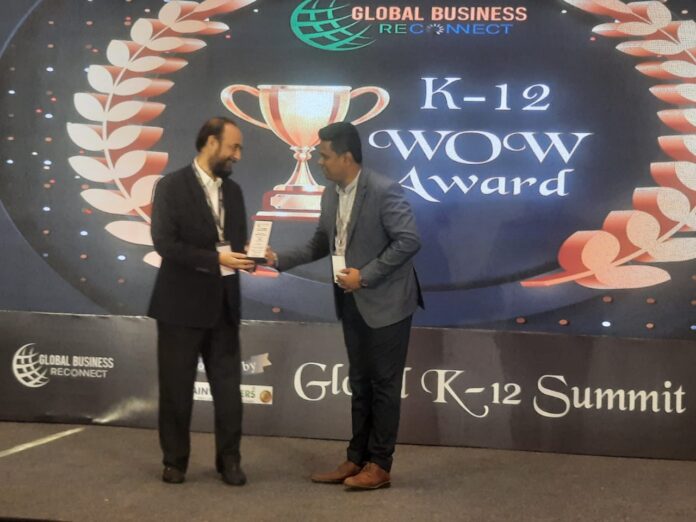
At the recently concluded Global K-12 Summit, organised by Business Reconnect in Hyderabad on 8th September 2023, Ashraful Madaris High School, an Urdu Medium High School of Hyderabad was awarded for “Excellence in imparting value education and spirituality”.
Global Business Reconnect, is an event management company based in New Delhi. Started in 2000, it has executed corporate events PAN India & throughout the Globe on several occasions for several industries.
The Global K-12 Summit is an event of Global Business Reconnect where one can network with top school Directors/Principals, business people in related industries, important educators, and some of the most well-known thought leaders, corporate executives, government officials, consultants and policy makers.
In 2023, they held the K-12 Summit in Hyderabad. They award schools that have added innovative features in the methodology of teaching whether in their day school, boarding schools, residential school, etc.
This year the award went to Ashraful Madaris High School of Hyderabad which has a unique feature of “day boarding”, where the students of Urdu medium come to school right from the morning prayers at 5:30 AM after which they do some physical exercises, study Islamic tenets and the Holy Quran, then join regular classes after a nutritious breakfast, then are provided lunch in the afternoon. In the evening after classes, they stay back and do their homework, offer the night prayer, have their dinner and go home.
“I had applied for the award and forgotten all about it. When I got the news that our school has been chosen for the award, I and my team were exhilarated. We have been struggling to keep the school functioning smoothly, which despite being aided by the government is running with hiccups because the government has stopped recruiting teachers in place of the retired ones. Hence, we are recruiting private teachers and are paying the teachers’ salaries from our pockets” explained Khalid Hasan, who is an Advocate and now the Academic Administrator & PRO of the school. He received the award on behalf of the school.
“We are managing the school with donations from generous donors and have started an English Medium school to cover at least some of the expenses.
This is the first award received by Ashraful Madaris High School in its 110-year history. “I am sure this school will witness many more glorious days ahead”, said Khalid Hasan who has been at the helm of the affairs of the school from the last one year and whose tenure has been extended till 2026 as the Academic Administrator of the School.
Ashraful Madaris standing on 2 acres, has a large playground with sports facilities, a well-equipped library, 30 classrooms, and qualified staff. Other highlights apart from the day boarding school, are its moral and Islamic education, Arabic language curriculum, Quran Nazerah and other subjects of Deeniyat.
This Urdu medium school has produced several successful students who have gone to achieve great laurels in their careers. Two of the alumni who stand out are Padma Bhushan awardee, late Syed Abid Hussain, who was Indian Ambassador to the USA and IAS bureaucrat late Syed Turabul Hassan.
source: http://www.twocircles.net / TwoCircles.net / Home> Indian Muslim> Lead Story> TCN News / September 25th, 2023
Three years older than Hakim Ajmal Khan, one was reminded of him when Ajmal Khan’s great-granddaughter came for admission to Hamdard University last week, accompanied by her father.
While Ajmal Khan’s name lives on beyond his ancestral haveli, Sharif Manzil in Ballimaran, Hakim Nabina had no fixed abode and believed to have been born in the Walled City too, got most of his fame in South Delhi where he was brought by some dealers in Unani medicine.
Born in the same year as Rabindranath Tagore, he was 105 when Dr. S. A. Ali of Hamdard met him in 1965 to seek medication for a digestive problem. The hakim, who had probably been born blind or had lost his vision in childhood, felt the patient’s pulse and diagnosed that his heart and liver were in good trim but not his digestive system. “Did you by any chance eat arbi (yams)?” he enquired. Dr Ali confessed that he had in fact had a piece of the vegetable though he was not fond of it. The hakim told him to have light food in future and prescribed some medicine which cured his ailment.’
Syed Ausaf Ali, himself an octogenarian now, says Nabina lived at Hazrat Pattey Shah’s dargah, behind Humayun’s Tomb. What he prescribed was dispensed by dealers in Unani drugs. When someone complained that the charges were very high, he advised them not to go to the dispensers but take medicine from him directly.
Pattey Shah or the saint amid tree leaves was actually named Shamsuddin Ataullah and died in AD 1300 during the reign of Alauddin Khilji. He got the nickname because whenever Hazrat Nizamuddin Auliya visited his khanqah or hospice, he would hide behind bushes and tree leaves, saying he was not worthy of coming face-to-face with the Auliya. This is what has been affirmed in Sadia Dehlvi’s book on the Dargahs of Delhi. It is said that the Shah belonged to the Chishti silsila or order of saints. “During the day he would light a fire and cover himself with its ashes, while at night he slept in a grave-like hollow (something emulated by the eccentric Spanish painter Salvador Dali, who spent his nights in a coffin). When he died Hazrat Nizamuddin led the funeral prayers as per the Shah’s last wish. Hakim Nabina seems to have developed a spiritual rapport with Pattey Shah and lived most of his long life at the latter’s shrine. When he died is not known but it was probably during Indira Gandhi’s first prime ministership, which would mean that he was nearly 110 years old at that time.
The hakim is not to be confused with Hafiz Nabina Doliwale, the blind mendicant who lived under a tree near the southern gate of the Jama Masjid. Nobody knew his real name also, except that he was one who could recite the Quran by heart (Hafiz), was blind (Nabina), wore no clothes and loved to travel free in a doli or palanquin. He and Hakim Nabina were both born in the same year (1860), when Bahadur Shah Zafar was passing his last days in Rangoon. But Hafiz Nabina died at the age of 87 much before the hakim sahib. Everybody in the city knew him and he also finds mention in Ahmed Ali’s “Twilight in Delhi” as he often visited the hero of the book, Mir Nihal. He was regarded as a majzoob (a man possessed), lost in himself and supposed to be in contact with the jinns, without much care for hygiene.
However Hakim Nabina, despite his mystical leanings, never gave the impression that he was a majzoob. His direct communion was with Pattey Shah and he passed his life in the service of those who came to him to be healed. That he could tell a patient what his illness was merely by touching him and pointing out, “Thou ailest here and here,” was a sign of his deep knowledge of human nature and anatomy and the Unani system of medication. Like Hafiz Nabina, he was a recluse but of a different sort who did not discard the ways of the world in matters of dress, behaviour and etiquette. Old-timers remember him as a worthy contemporary of Hakim Ajmal Khan, who had acquired the halo of Massiha (messiah) of the ailing populace!
source: http://www.thehindu.com / The Hindu / Home> Features> MetroPlus> /Down Memory Lane / June 22nd, 2014
Success comes to those who believe in hard work and this sentence fits the case of Dr Shaikh Muna Afroz, who is all set to join the All India Institute of Medical Sciences (AIIMS) and probably become the first Muslim female Gastroenterologist (GI) surgeon in India.
In a message to the youth, Dr Muna says, “Perseverance and determination are the keys to success. I have experienced that my consistent efforts have enabled me to surmount every obstacle on my path to success.” Intending to become an academic surgeon, she struck an optimum balance between patient care, teaching, and research. She has authored more than five indexed research publications.
Dr Muna has presented her research papers at numerous conferences and won many accolades. Her inspiration is her grandfather, who is a General Surgeon and has been serving the community since 1967.
Dr Afroz hails from Maharashtra’s Aurangabad and bagged the All India Rank (AIR) third in MCh GI-HPB Surgery in the INI-SS 2023 and she also secured an All India Rank (AIR) – 10 for the Minimal Invasive Surgery Fellowship in 2021.
Prior to it, she aced CET-UG by securing the 93rd rank and completed her MBBS in 2017 from GMC Aurangabad.
In 2022, she acquired the Membership of the Royal College of Surgeons (MRCS) in Edinburgh, UK. Having cleared the licensing examination from Dubai Health Authority (UAE) in 2022, Dr Muna is currently licensed to practice medicine in India, the United Arab Emirates, and the United Kingdom.
This report is filed by ANI news service.
source: http://www.thenewsmill.com / The News Mill / Home / by ANI / pix: edited / June 04th, 2023
We, The Indian Muslims are proud to be citizens of this great country. We have been an architect of this land all through centuries since the days of dynastic rule. Whether it was construction of world class network of transport facilities like Grand Trunk Road linking major cities, founding new cities of highest standards for that age, huge monumental structures to attract the world, development of living standards and maintain cordial relationships between groups belonging to various religions, languages, castes and cultures, we pioneered justice and maintained the system.
With the passage of years, decades and turn of events, the foreign forces got attracted to it and slowly took over the rein of rule.
We were first to challenge and fight for country’s independence valiantly. Even our clergymen took to streets and fought, thousands laid down their lives. Colonel Balwan Singh Nagial, a third-generation Indian Army officer who retired in 2019 wrote in Times of India (April 23, 2022), thus: “Muslim leadership contributed enormously to divergent phases of the Indian struggle for independence. They (Muslims) played a larger-than-life role and made significant sacrifices in this struggle for independence.
From the last Mughal ruler Bahadur Shah Zafar to nawabs, princes, landlords of all sizes, clergy, ulema and the ordinary people, they all stood for the cause and took on enormous challenges and made supreme sacrifices.
When the INC was formed in 1885, the Muslims responded enthusiastically and supported all its efforts throughout the freedom struggle until India became free. The most enthusiastic support for the INC was from the Muslims of the conservative Ulama of Deoband. Earlier, the Ulama had participated in the 1857 uprising with heart and soul.
They made great sacrifices, and hundreds of them were sent to Andaman-Nicobar and many to Malta, an island to the south of Italy.
Muslim leaders who contributed to India’s struggle for independence were:
Khan Abdul Ghaffar Khan, Maulana Abul Kalam Azad, Maulana Muhammad Ali, Maulana Shaukat Ali, Allama Iqbal, Muhammad Barkathulla, Bi Amma (mother of Ali brothers), Badarudeen Tyabji, Hakim Ajmal Khan, Mohammad Ali Jinnah, Dr M.A. Ansari, Dr Siafudeen Kichlu, Dr Basheer Ahmad, Syed Ameer Ali, Dr Syed Muhammad, Hasrat Mohani, Nawab Abdul Latheef, Altaf Hussain Hali, Syed Ahmad Sirhindi, Syed Ahmad Bareilly, Maulana Shibli Numani, Munshi Karamat Ali, Munshi Zakaullah.
Hindus and Muslims together fought the foreign forces shoulder to shoulder. A report by the ‘Milli Chronicle’ says that names of 95,300 freedom fighters are etched on the India Gate in Delhi, and remarkably, 61,945 of these names belong to Muslims, signifying that 65% of these brave individuals were Muslims. The significance of this statistic is eloquently captured by the renowned writer Mr. Kushwant Singh, who boldly declared that the story of Indian freedom is etched in the blood of Muslims, emphasizing their large contribution to the freedom struggle, considering their dis-proportionately smaller population percentage.
The annals of history are adorned with the stories of Muslim freedom fighters who put their lives on the line to liberate India from the shackles of British oppression. These individuals, driven by an unwavering determination to secure their homeland’s independence, demonstrated exceptional courage and resilience.
All through ages we find tall personalities like Sultan Haidar Ali, father of Tipu Sultan, (he pioneered the fight against British colonial forces); Tipu Sultan, son of Haider Ali; (he pioneered the use of iron-cased rockets); Ashfaqullah Khan,(noted for his daring attacks on British government trains); Maulana Abdul Kalam Azad, the youngest President of the Indian National Congress,(who rallied Hindus and Muslims alike against British oppression); Maulana Hasrat Mohani, Khan Abdul Ghaffar Khan, (a pivotal figure in the Khilafat movement); was jailed for 13 years by the British), Sirajud Daula, (the last Nawab of Bengal), Badruddin Tyabji (of Indian National Congress); his wife, Suraiya Tayabji, who designed the present Indian flag., Zain-ul-Abideen, an officer of the Indian National Army (INA), coined the iconic patriotic slogan “Jai Hind.”
While recounting the names of every Muslim freedom fighter may be an impossible feat, their contributions and sacrifices in the fight against British colonialism are immeasurable and undeniable. The fact that many chose to remain in India underscores their deep-rooted connection to the land. Despite attempts to distort history, India will forever be the cherished home of its Muslim citizens. We gave the independent India Maulana Abul Kalam Azad, the first Education Minister, Dr. Rafi Ahmed Qidwai, Dr.Zakir Hussain (an Educationist and Vice President), and numerous figures as servants to the country in the form of politicians, officers, industrialists, entrepreneurs, researchers, technocrats etc. in every field.
Our very recent contribution to the nation’s public service has been the world famous Scientist/Technocrat and President Dr.A.P.J. Kalam. He set the highest, un-believable standard of honesty, transparency and clean image in public life. A glimpse into the life he spent in the Rashtrapati Bhavan as President gives a shocking information. The same is as under: Mr. P M Nair, (retired IAS officer, then Secretary to Dr. Abdul Kalam, the President writes in his book “Kalam Effect” that Dr. Kalam used to receive costly gifts whenever he went abroad (as it is part of custom & protocol) used to ask the gifts to be photographed and then catalogued and handed over to the archives. Afterwards, he never even looked at them. He did not take even a pencil from the gifts received when he left Rashtrapathi Bhavan. It was a regular practice for every President to host an Iftar party, a routine. Upon being reminded about it Dr. Kalam asked Mr. Nair why he should host a party to people who are already well fed. Instead he estimated and donated Rs.22 lac being the cost to a few selected orphanages in the form of food, dresses and blankets besides a cheque for Rs.1.lakh from his personal funds. Though himself a devout Muslim, he never organized Iftar parties in President’s house at Public expense. Once Dr. Kalam invited 50 of his relatives to come to Delhi and they all stayed in Rashtrapathi Bhavan. He organized a bus for them to go around the city which was paid for by him.
No official car was used. Their lodging and food bill which came to Rs.2 laks was paid by him as per his instructions. Dr. Kalam’s elder brother stayed with him in his room for the entire one week as Dr Kalam wanted his brother to stay with him. When they left, Dr. Kalam wanted to pay rent for that room also. Imagine the President of a country paying rent for the room in which he is staying. This was any way not agreed to by the staff who thought the honesty was getting too much to handle. When he was to leave Rashtrapathi Bhavan at the end of his tenure, every staff member went and met him and paid their respects. Mr. Nair went to him alone as his wife couldn’t as she was confined to bed due to fracture. Upon noticing her absence and knowing the reason Dr. Kalam visited his house and chatted with her for some time. The following property was left behind by Dr.A.P.J.Abdul Kalam: 16 doctorates, 1 website, 1 twitter account, 1 email id, 2500 books, 1 Padmashri, 1 Padmabhushan, 1 Bharat Ratna, 1 flat (which he has donated), 6 pants & 4 shirts (DRDO uniforms), 3 suits (1 western, 2 Indian). He didn’t have any Car, jewelry, stocks, TV, AC, land or any bank balance. He had even donated the last 8 years’ pension towards the development of his village. He was a real patriot and true Indian Muslim. We are proud of him.
Our character building efforts continued even through the present 21st century in the country with unique results as records vouch. For example, the city of KAYALAPATTANAM (in Tamil Nadu) with 100% Muslim population goes. There is no Police Station, no cinema and no crime in the city because there had been no crime there for decades.
The present day situation in the country may appear to be disheartening and disappointing for some. The irresponsible attitude towards Muslims by some extremist groups in the country belonging to a certain ideology should be viewed as a momentary period. Their efforts to demoralize, degrade, deny civil rights are synonymous with their declared intentions. A great majority of country-men still believe and practice true Hinduism as had been for centuries in the past. True Hindus do not endorse hatred, support arson and distrust.
A long history of peaceful co-existence of Muslims and Hindus for centuries with mutual respect, rejoicing specially the occasion of festivals and long socio-economic ties in every nook and corner of the country is its evidence.
Our country has been an example of ‘Unity in diversity’ for the world for a long time. Nobody from either community can imagine a survival without another. The bond has been and will surely be strong as Steel. The ever increasing social evils like Corruption, nepotism, frauds, woman-bashing and vandalism like termites in the country have made the life of common man miserable.
Decline in the values like increased greediness, and wide spread of dishonesty, revenge, vindictiveness, and non-adherence to law need to be challenged and controlled. The ‘PLEDGE’ we used to read in our text books once in first page is long missing both from the book and in practice.
We the Indian Muslims, whether a common man, clergy, intellectual, and technocrat, worker or even those with any political group should realize that notwithstanding the company or area, we have a responsibility towards the country and duty-bound to work for our own community. We need to understand todays challenging scenario and strengthen its unity. We are the inheritors of a great legacy, and not followers of the ilk of this day. We Muslims should remember that we are ordained by the Almighty Allah to be united, behold his Commands; make efforts to spread virtuous deed and work eradicate evils. The entire country is looking forward for the honest.
As the phrase rightly goes, ‘Service to humanity is service to God’. Our population in the country according to 2011 census stands at about 200 million which constitutes 15%. We need to contain our extravagant life-style especially in matters of functions and festivals.
We should stop depending on politicians, their promises and focus on a self, collective effort. We need to move forward together in the fields of education, employment opportunities generating plans through mutual cooperation. For this purpose and as in the days of our Prophet, we should make our area Masjid a center for gathering, deliberation, planning, guidance and service as per law.Experts and experienced in relevant fields can be roped in for the purpose and the available resources can be put to work.
سبق پڑھ پھر صداقت کا، شجاعت کا، عدالت کا۔۔ لیا جائیگا تجھ سے کام، دنیا کی امامت کا۔۔
source: http://www.muslimmirror.com / Muslim Mirror / Home> Indian Muslim / by Syed Ilyas Basha / October 03rd, 2023
Salima Khan is seen with Dr Pratibha Sharma and her great-grand daughter-in-law
Salima Khan is a new Internet sensation who enrolled herself in Chawli Primary School in Bulandshahr at the age of 92, becoming an inspiration to many.
Bulandshahr (Uttar Pradesh):
Remember Swara Bhaskar’s much acclaimed film “Nil Battey Sannata” released in 2016 where the ace actress goes back to school, attending class right with her daughter much to her dismay?
The plot is “recreated” in real life in Bulandshahr, Uttar Pradesh though for a different reason where a Muslim woman in a video is seen sitting in a classroom with her great-grand daughter-in-law.
Salima Khan is a new Internet sensation who enrolled herself in Chawli Primary School in Bulandshahr at the age of 92, becoming an inspiration to many.
The immediate reason behind Salima Khan’s inspiring endeavour at this age is to receive pension given to elderly citizens under the Indira Gandhi National Old Age Pension Scheme (IGNOAPS).
The government under this scheme gives a monthly pension of Rs. 200 to elderly citizens of 60 to 79 years and Rs. 500 thereafter.
“Amma used to come to me with a request to help her in getting pension. I promised her help provided she come to school every day for at least half an hour and learn something”, the Headmistress told media.
Despite facing a number of age-related issues, including hearing loss and weak eyesight, Salima Khan started coming to school and attend classes.
“Salima is a regular student and is never absent. She is attending the school since the last ten months. In this period, she has learnt a lot of things”, Dr Sharma said.
“Even at this age the interest and dedication with which Salima Khan learns is motivatinf for other students”, she added.
Salima who was unable to recognise letters is now able to write her name with fare fluency and can also confidently count up to 100.
“Acha lagta hai padhna. School aana bahut badhiya lagta hai. (I like to study and attend school)”, 92-year-old Salima Khan said in the video now going viral.
Inspired by Salima Khan, as many as 25 other women of the village, including her daughter-in-laws, have decided to go to school.
source: http://www.ummid.com / Ummid.com / Home> Education & Career / by ummid.com news network / September 29th, 2023