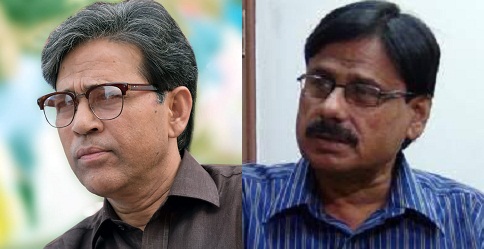
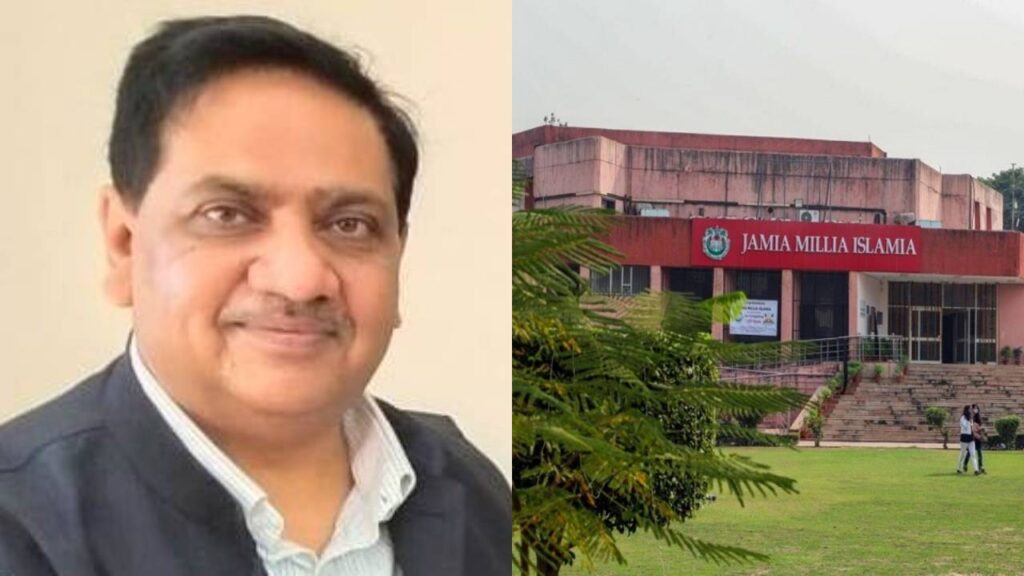
2 Jamia Professors, alumnus scoop Delhi Urdu Academy Award
It is a matter of pride for Jamia Millia Millia (JMI) that a current Professor, a retired Professor and an alumnus of the university received prestigious awards for their literary contributions by the Urdu Academy, Government of Delhi.
The award function was organised at the Auditorium of the Delhi Secretariat, IP Estate on 6th July, 2023.
Prof. Mohammad Asaduddin of the Department of English has received the Award for Translation for the year 2021-22 by the Urdu Academy, Government of Delhi.
Prof. Shamsul Haque Usmani, a retired Professor of the university received Pt. Brij Mohan Dattataria Kaifi award for the year 2021-22 .
JMI alumnus Dr. Aadil Hayat received award for Children Literature for the year 2019-20 by the Academy.
Prof. Najma Akhtar, Vice Chancellor, JMI congratulated the awardees and wished them good luck for their future endeavours.
It is worth mentioning that Dr. Abdul Naseeb Khan, Secretary to the Vice Chancellor, JMI and Prof. Anisur Rahman, a former Professor of English at JMI received Urdu academy, Delhi’s Award for Translation in the year 2018 and 2019 respectively.
source: http://www.theokhlatimes.com / The Okhla Times / Home> JMI-EDU/ by The Okhla Times / July 08th, 2023
It is a matter of great pride for the Jamia Millia Islamia (JMI) that Dr. Abdul Naseeb Khan and Dr Khalid Javed of the university have been conferred with Uttar Pradesh Urdu Academy Award (Rs.One Lakh and citation).
Vice Chancellor Prof. Najma Akhtar extended her heartiest congratulations to both the awardees.
Dr Abdul Naseeb Khan who is currently working as the Secretary to the Vice Chancellor, JMI has been given ‘Award for Translation’. He has to his credit translations of Ghalib’s Urdu poetry, Premchand’s stories, urdu novels, critical urdu writings and several modern urdu poets. He has also been a recipient of Delhi Urdu Academy award for translation in the year 2018. He holds PhD on translation of modern urdu poetry into english.
Dr Khalid Javed a Professor, Urdu Department, JMI received the award for Urdu Fiction. He has also been a recipient of Delhi Urdu Academy Award for Fiction in the year 2018. He has authored three very famous novels- ‘Maut Ki Kitab’, ‘Nematkhana’ and ‘Ek Khanjar Paani Me’. His story ‘Aakhri Dawat’ translated as ‘The Last Supper’ by Abdul Naseeb Khan is on the syllabus of Urdu in Princeton University, USA. His ‘Maut Ki Kitab’ has also been translated as the ‘Book of Death’ by Abdul Naseeb Khan.
Besides, Prof. Khalid Mahmood, a Retired Professor of the Dept. of Urdu, JMI has also bagged a prize for his book ‘ Nuqush-e-Mani’ .
source: http://www.eduadvice.in / Edu Advice / Home> News Details> Latest News / by Edu Advice / December 18th, 2021
Professor Shehzad Anjum, Department of Urdu, Jamia Millia Islamia (JMI) is a renowned critic, researcher and the senior most Professor of the department.
Parvez Shahidi Award:
Professor Shehzad Anjum, Department of Urdu, Jamia Millia Islamia (JMI) has been conferred the prestigious ‘Parvez Shahidi Award’ of the West Bengal Urdu Academy for his great work in Urdu language. He is a renowned critic, researcher and the senior most Professor of the department.
JMI Vice Chancellor Professor Najma Akhtar, faculty members and students congratulated Professor Anjum for their great achievement.
Professor Anjum is one of the few prominent writers of the present era whose writings are thought-provoking.
Some of his published books are Urdu Ke Ghair Muslim Shaura-o-Udaba, Ahad Saz Shaksiyat: Sir Syed Ahmed Khan, Deedawar Naqqad: Gopi Chand Narang, Azadi Ke Baad Urdu Shairi, Azhar Inayati: Ek Sukhanwar Shayar, Ehtisham Hussain Ki Takhliqi Nigarishat, Tanqeedi Jehaat, Urdu Aur Hindustan Ki Mushtarka Tahzeebi Virasat, Rabindranath Tagore: Fikr-o-Fan, have been published.
He successfully completed the “Tagore Research and Translation Scheme” started by the Ministry of Culture, Government of India as the Coordinator, Department of Urdu, JMI. It is a historic, exemplary and proud achievement in the field of Urdu literature.
Professor Anjum also authored several monographs including Muhammad Ali Johar, Syed Ehtisham Hussain and Syed Muhammad Hasnain for Sahitya Academy, Delhi, Altaf Hussain Hali for Urdu Academy, Delhi, West Bengal Urdu Academy, Mirza Ghalib for Kolkata and Urdu Directorate. The Kalam Hydari monograph for Patna is particularly noteworthy. Several books translated by him have also been published. He also wrote a literary column on non-Muslim Urdu poets and writers for the daily ‘Inqlab’, Delhi, for about two and a half years.
source: http://www.shiksha.com / Shiksha / Home> News> College / by Anum Ansari, Asst Mgr Content, New Delhi / September 09th, 2022
Prof Farah Ghaus, Department of Anatomy, J.N. Medical College, Aligarh Muslim University (AMU) has been recognized by The Knowledge Review magazine as ‘one of the Most Influential Women Leaders – Shaping India’s Future, 2023’, for delivering noteworthy pedagogical facilities for the last two decades and leveraging exceptional leadership qualities via extensive expertise, progressive ideas and unrelenting dedication, and thus have left an impact on the industry.
The inspiring story of Dr Ghaus has been featured in the magazine, and she has been presented with a certificate for the same.
Notably, Dr Ghaus holds a prominent position in the field of Anatomy, serving as a member of the advisory board for ‘Inderbir Singh’s Human Embryology 12th and 13th editions’.
She is a life member of various anatomical societies and her book ‘Development of Maxillary Sinus-A Morphological Study in Human Fetuses’ is a testament to her expertise in the subject.
source: http://www.amu.ac.in / Aligarh Muslim University, AMU / Home> AMU News / by Public Relations Office, Aligarh (headline edited) / June 28th, 2023
Bhandara Char Village No.4 (Bangagaon District), ASSAM:
Afruja Begum, a student of BH College, Barpeta, Assam, has secured first position in the Philosophy Department of the University of Guwahati. She scored 9.07 CGPA.
The University of Guwahati (GU) has announced the results of the Bachelor’s Degree Examination in Philosophy.
Afruja’s achievement comes at a time when Assam Chief Minister Himanta Biswa Sharma has openly praised the talent of the youth of the rural areas.
Afruja, daughter of Habel Ali, a resident of Bhandara Char village No. 4 in Bangagaon district, has brought joy to the underdeveloped area.
“It was very difficult for me to leave home and take classes in college because our area is very backward. During the rainy season, the roads are flooded. There is no way to get there. So I stayed in hostel.”
Afruja is grateful to the college authorities for allowing her to stay when the hostel should be otherwise closed.
She says her parents inspired her to dream big and now she wants to enroll for a postgraduate degree.
Afruja Begum’s father runs a small business. The village of Bhandara Char where he lives is very inaccessible. The roads are in poor condition.
Afruja Begum is happy that despite coming from a remote village topped in the Philosophy department of the University of Guwahati in the Bachelor’s Examination results.
Meanwhile, a delegation led by AMSU President Rezaul Karim Sarkar visited the house of Afruja and felicitated her and her parents with flowers, gomochas, sharai, pens and books.
“We are delighted with the performance of Afruja, a daughter from a very remote area like Bhandara Char village. She studied with great sacrifice and hard work. We wish her even better results in the coming days We hope he will be a good citizen who can serve the region,” said, Rezaul Karim Sarkar, AMSU President.
source: http://www.awazthevoice.in / Awaz, The Voice / Home> Story / July 18th, 2023
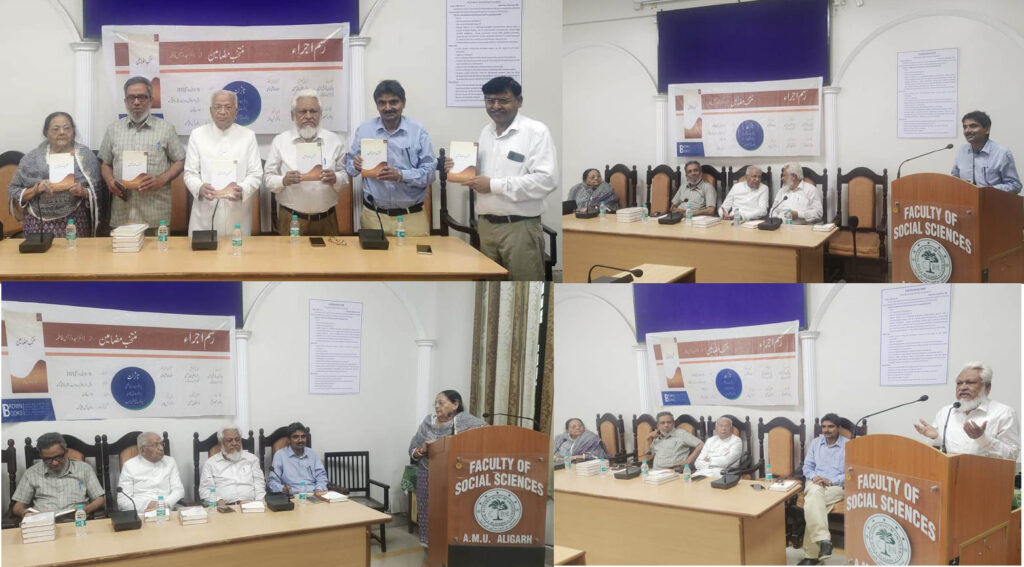
Faculty members and scholars of Aligarh Muslim University underscored the salient features of the writings of Dr Syeda Narjis Fatima, especially stressing the aesthetic and philosophical aspects of her work, during the release ceremony of her book, “Muntakhab Mazameen” (Selected Essays) in the conference hall of the Faculty of Social Science, Aligarh Muslim University.
In his presidential remarks, the founder and director of Ibn Sina Academy, Aligarh, Prof Hakeem Syed Zillur Rehman, congratulated Dr Narjis Fatima on the publication of the book and said that most of the articles included in the book bring forth the aesthetic aspects of Urdu literature, which is an important genre of literary criticism in Urdu. He said that her canvas of writing is vast and her articles introduce the Urdu readers to a new way of thinking.
The chief guest, Prof. Qazi Jamal Hussain, while underscoring the aesthetic aspect of various topics included in the book, said that studying Urdu literature from an aesthetic point of view is a difficult task because people generally do not differentiate between aesthetics and impressionistic criticism, while both are different things. He said that aesthetics covers all the genres of fine arts and Dr. Narjis Fatima has employed the aesthetic elements in her essays with great objectivity and dexterity.
He said that Dr. Fatima’s articles emanate from her philosophical concerns and this is another important quality of her writings.
The Guest of Honour, Prof Syed Siraj Ajmali, Department of Urdu said that the release of a book in an educational institution is an important event as it reflects its academic activities. Dr Narjis Fatima’s book is an embodiment of philosophical and aesthetic ideas with reference to her essays. He said that Dr Fatima belongs to a family of scholars and carries forward the scholarly tradition. She submitted her PhD thesis on Aesthetic Criticism in 2009, which was later published in the form of a book.
Former associate professor of the Department of Philosophy, Dr. Tasadduq Hussain said that although Dr Fatima is a housewife, her academic activities continued over a long span of time as she has a genuine aptitude for reading and writing and pondering over scholarly topics. He added that the book contains enough material for the students of literature and they can benefit from it in many ways.
While conducting the program, Prof Mohammad Asim Siddiqui, Chairman, Department of English, said that Dr Fatima’s book stimulates the thought process as the articles included in this book cover important subjects like the aesthetic dimensions of Iqbal’s and Faiz’s poetry and the aesthetics of progressive writers’ movement.
He said that the book is very helpful for students of English literature, especially comparative literature, as the it includes special studies on “Shakuntala and Shakespearean Heroines”, “Antigone and Greek Drama” and Manto’s “Toba Tek Singh: A Critical Review”.
Prof. Ashiq Ali, Chairman, Department of Hindi extended a vote of thanks.
Prof Mehtab Haider Naqvi, Prof Shahid Rizvi, Prof Madihar Rehman Suhaib, Prof Samina Khan, Prof Prem Kumar, Prof Sami Rafiq, Prof Shambhunath Tiwari, Mr. Ajay Basaria and a large number of teachers and students congratulated Dr Narjis Fatima for the publication of the book.
source: http://www.amu.ac.in / Aligarh Muslim University, AMU / Home> AMU News / by Public Relations Office, Aligarh / July 17th, 2023
Muhammad Saif, a student of St Aloysius College, has been selected as the International Service Team (IST) representative of India for the upcoming 25th International Scouts and Guides Jamboree, scheduled to be held in Saemangeum, South Korea.
The prestigious event is set to take place from August 1 to August 12.
Hailing from Karuvelu in Bantwal taluk, Saif is the son of Abdul Khader Haji and Sameena. His selection as the IST representative of India is a significant achievement and honor for him and his family.
The International Scouts and Guides Jamboree is a global gathering that brings together scouts and guides from various countries to promote international friendship, cultural exchange, and mutual understanding among young people.
Saif’s participation as the IST representative will not only showcase India’s presence at the Jamboree but also provide him with a unique opportunity to interact with scouts and guides from different parts of the world.
source: http://www.varthabharati.in / Vartha Bharati / Home> Karavali / by Vartha Bharati / July 26th, 2023
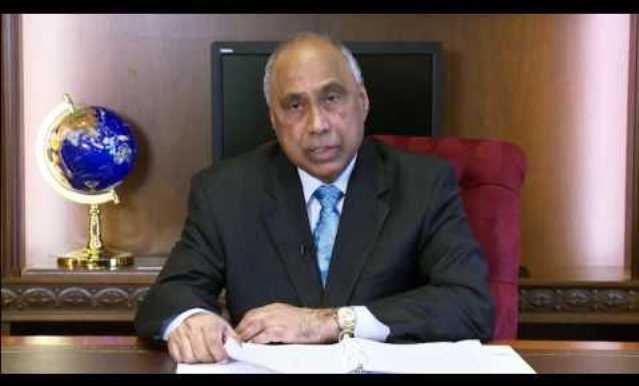
In the realm of Indian Muslims and the Indian Muslim diaspora, the name of Frank F. Islam commands instant recognition and reverence. An illustrious entrepreneur, philanthropist, and a prominent civic and intellectual figure, he has become an indomitable force for the advancement of Indian Muslims through his unwavering commitment to education. His influence extends far and wide, gracing numerous boards and councils at prestigious institutions such as Johns Hopkins University, American University, and George Mason University.
His philanthropic endeavors have left a mark of grandeur on his alma mater, Aligarh Muslim University, where he has erected the splendid Frank and Debbie Islam Management Complex. Not stopping there, his native village, Kaunra Gahni, bears witness to his magnanimity with the establishment of the Frank and Debbie Islam Health Clinic, a project dedicated to the betterment of its people.
As the visionary leader of FI Invest Group, a venture he founded after selling his information technology firm, QSS Group, in 2007, Mr. Frank Islam exudes a profound understanding of global economic affairs. His keen eyes closely monitor the economic activities of two colossal nations, the United States and India, while he remains deeply immersed in the intricacies of American politics and economy. His connections with former President Barack Obama and the current President Joe Biden stand testament to his prominence in political circles. An accomplished writer, he has penned two books, solidifying his intellectual prowess.
Undoubtedly, the economic condition of a country charts its future trajectory, and in this domain, Mr. Frank F. Islam emerges as a seasoned expert. In this exclusive interview with Alize Najaf, he graces us with invaluable insights into the economic dynamics of India and beyond.
AN: Your dedication to uplifting Indian Muslims through education and philanthropy is truly commendable. Could you share with us some of the impactful projects you’ve undertaken in this regard?
Mr. Islam: Certainly. I’ve had the privilege of contributing to the development of my alma mater, Aligarh Muslim University, by constructing the Frank and Debbie Islam Management Complex. Additionally, in my native village Kaunra Gahni, we’ve established the Frank and Debbie Islam Health Clinic, which aims to provide essential healthcare services to the community.
AN: Your journey as an entrepreneur is remarkable. How did you establish the FI Invest Group, and what advice would you give to aspiring young entrepreneurs?
Mr. Islam: Building a strong and talented team has been pivotal to my success in business. Aspiring entrepreneurs should surround themselves with like-minded individuals who share their vision and values. It’s essential to believe in oneself and the team while daring to dream big. Woody Allen once said, “90% of life is just showing up.” I believe in focusing on the remaining 10% and maximizing efforts to achieve one’s goals.
AN: Turning our focus to economics, the relationship between the United States and India is growing stronger. Is the strategy to counterbalance China a driving force behind this development?
Mr. Islam: While China’s influence is a factor in strengthening U.S.-India relations, it’s not the sole driving force. The convergence of India and the United States is based on shared interests and values as the world’s largest democracies. From artificial intelligence to climate change, there are numerous common areas of focus.
AN: Agriculture plays a significant role in the economy of developing countries. How important is agricultural production for a country’s economic development?
Mr. Islam: Agricultural self-sufficiency is vital for any nation to sustain its population without relying heavily on imports. The Covid-19 pandemic taught us the value of self-reliance during supply chain disruptions. While developed economies rely less on agriculture for employment, developing nations often have a larger population dependent on the sector.
AN: The economic reforms introduced by Dr. Manmohan Singh and Prime Minister Narasimha Rao are often credited with changing India’s economic trajectory. What is your view on their impact?
Mr. Islam: The economic reforms of the 1990s were transformative for India. They set the country on a path to becoming the fifth-largest economy and beyond. Prime Minister Rao and Dr. Singh’s vision played a pivotal role in this positive transformation.
AN: What are your predictions for India’s economic growth in the next five years?
Mr. Islam: All indications point to substantial economic growth for India in the coming years. According to the IMF, India is expected to contribute 15% to global growth this year. The organization further estimates a 6% growth rate for India in the current year, setting the stage for further progress.
AN: India’s economic growth still lags behind China’s. What factors do you think are responsible for this difference?
Mr. Islam: China had a head start in initiating economic reforms, while India opened its economy later. China’s unwavering focus on manufacturing and global investments played a significant role in its economic growth. However, India possesses the potential to surpass China with appropriate policies and continued reforms.
AN: It’s evident that your expertise in economics is vast. Do you have any plans to contribute to India’s economic progress?
Mr. Islam: After selling my company, my wife and I founded our family foundation to dedicate ourselves to philanthropy. We believe in giving back to society, primarily focusing on education and healthcare in Uttar Pradesh, my home state. By supporting institutions like Aligarh Muslim University, we aim to contribute to India’s progress from the grassroots level.
AN: Thank you, Mr. Frank F. Islam, for sharing your insights and expertise with us. It has been an enlightening conversation.
Mr. Islam: Thank you for having me, Alize. It was a pleasure discussing these critical economic matters.
source: http://www.muslimmirror.com / Muslim Mirror / Home> Interviews / by Alize Najaf / July 30th, 2023
Moumita Chaudhuri meets Mamoon Akhtar, the good samaritan of Howrah’s Tikiapara and gets to know a lot about his social moves and motives.
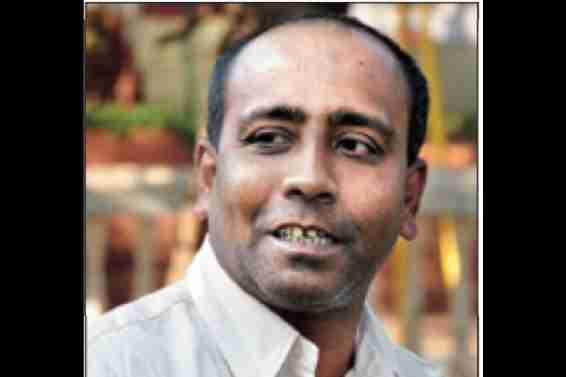
Mamoon Akhtar / Photos, courtesy Akhtar
Tikiapara is a downtown area in Bengal’s Howrah district, off NH22. Narrow lanes full of pedestrians and vans dangling dangerous iron rods and bars trundling through them, cars and bikes honking incessantly, piles of garbage and small iron manufacturing units. Amidst all of this stands Rebecca Belilious English Institution.
The English medium school is for the poor children of Tikiapara, Pilkhana and the neighbouring Bankra town.
Mamoon Akhtar is the principal and founder of the school. That day he is not in his office. He is attending to an elderly woman who is seeking a fee waiver for her ward. “The school fees are highly subsidised — Rs 100-150. Mamoon Sir believes that education should not be free. But if someone cannot pay, he will never turn a student down,” says Tapan Mandal, a member of the school staff.
The principal’s room has a single bed, a small sofa, a table and a chair. “Sir, spends his days and nights here,” says Mandal. “I have often spotted him sweeping the school premises at daybreak,” he adds.
Akhtar himself is a school dropout. After Class VII his father could not afford to pay the fees. However, he did not give up studying. “I started teaching primary students in my area and with that money completed my Class XII,” he tells The Telegraph.
Tikiapara in the 1990s and early 2000s was apparently a den of criminal activities.
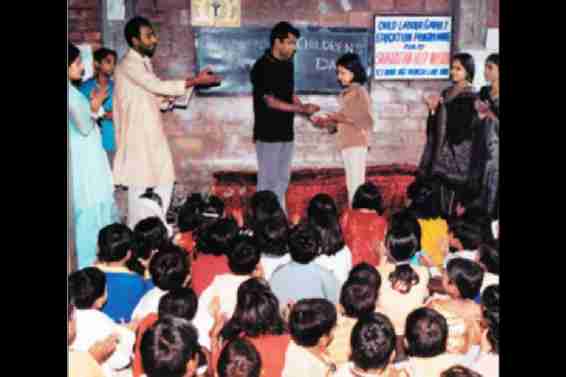
Akhtar started his school with six children in 1999. “A room in my house a few hundred metres away from here, that was it,” he says. The story goes thus. One day, Akhtar was passing a slum when he saw a man was beating up a woman; she was refusing to sell drugs and he was egging her on. A little boy stood watching. When the brawl ended, Akhtar went up to the boy and told him he shouldn’t idle away his time and the boy said he would have liked to go to school except that nobody seemed keen to send him to one.
Akhtar asked the little chap to come to his house and he became his first pupil. Akhtar says, “The next day he came back with his friend. The third day, two more; on the sixth day, there were six children who wanted to study. I felt God was saying something to me. I cleaned up the front room of my mud house and started a school.”
There were no funds. Akhtar asked his students to bring old newspapers, broken items and discarded things from their homes or their neighbours’. He says, “I would sell the rags to the kabadiwala and with the money buy books, notebooks and stationery. I also requested the educated youth in the area come and teach. I paid them a small salary — Rs 100 per month.” The first funding for the school came from Lee Alison Sibley, the wife of the then US Consul General George Sibley. “I had seen her photograph in the newspaper and wrote to her asking for help for the school. Initially, she refused but she sent me a note appreciating my efforts. I wrote to her again and asked if she could help with some notebooks and pencils.” A few days after that, Lee visited the school with a journalist. She gifted a cheque of Rs 10,000 with which the school got its first toilet for the girl students.
Akhtar continues, “The journalist reported my story and one day I got a call from a Mumbai-based man called Ramesh Kacholia. He sent Rs 12,000 for cement flooring and windows. On completion, Akhtar found that he had spent Rs 8,000. He returned the rest to Kacholia.
The school was formally registered in 2007 as Samaritan Mission School High. By then, many organisations had come forward with grants. The Kacholia family stood by and connected Akhtar to Vidya Shah of Edelweiss Capital, an international investment company. These two associations have stood by the school and Akhtar through all these years. Once the school was in place, Akhtar turned to improving the living conditions of the people of Tikiapara. The students were from the nearby slums, children of labourers from Bihar and Uttar Pradesh. Their parents were auto drivers, domestic help, property dealers and so on. Most of the children were first-generation learners.
LIGHT HOUSE: The first school started by Mamoon Akhtar
Once the school was in place, Akhtar turned to improving the living conditions of the people of Tikiapara. The students were from the nearby slums, children of labourers from Bihar and Uttar Pradesh. Their parents were auto drivers, domestic help, property dealers and so on. Most of the children were first-generation learners.
Akhtar started a vocational training programme for women. The Howrah police and the administration too supported his endeavours.
In 2014, the wheels turned for Akhtar. The Rebecca Belilious English Trust of Howrah handed over their school building and clinic to him. “It belonged to a Jewish family by the name of Rebecca Belilious,” he says.
The building was renovated with funds from corporates. Akhtar named the five floors of the school building after Savitribai Phule, C.V. Raman, Swami Vivekananda, Ishwarchandra Vidyasagar, B.R. Ambedkar and Baba Amte. The clinic at the Rebecca Institute has now been turned into a small hospital that caters to the people of Tikiapara. Soon there will be a hostel for girls; Akhtar feels the slums in the neighbouring area are not safe for girls. A galpo ghor or storytelling room will start for the children of the primary school as they still do not have a library.
Akhtar’s first school has also gotten better — smart classrooms, science and computer labs, sports such as archery, basketball, football are encouraged. Children can also opt for NCC training. In 2015, Akhtar opened a third school named Samaritan Public School in the slums of Bankra in Howrah.
Students from his first school cracked the 2022 NEET examinations and one student qualified in the WBJEE exams last year. From six students, the number of children attending these three schools is now 6,300.
source: http://www.telegraphindia.com / The Telegraph Online / Home> Culture / by Moumita Chaudhuri / July 23rd, 2023
Prof Faizan Mustafa was vice chancellor of NALSAR at Hyderabad before returning last year to Aligarh Muslim University’s law faculty.
Prof Faizan Mustafa was appointed on the recommendation of the search committee headed by former Chief Justice of India Dipak Misra
Patna:
Prof Faizan Mustafa of the law faculty at Aligarh Muslim University (AMU) was on Tuesday appointed vice chancellor of the Chanakya National Law University (CNLU) in Patna.
The appointment was made on the recommendation of the search committee headed by former Chief Justice of India Dipak Misra, said Prof SP Singh, social sciences dean and facilitator of the search committee.
Prof Mustafa returned to AMU last year after spending a decade at the National Academy of Legal Studies and Research (NALSAR) as its vice-chancellor. He was previously the founder vice chancellor of National Law University, Odisha.
He also served as dean and registrar at the AMU.
Mustafa is the recipient of both Commonwealth Scholarship as well as Fulbright Fellowship. He was conferred the SAARC’s ‘Best Law Teacher Award’ in 2014 and has delivered lectures in almost 32 countries of the world like USA, UK, Australia, Germany, China, Germany, Israel etc. He also runs a YouTube channel, Legal Awareness WebSeries, which has over 700,000 subscribers.
CNLU vice chancellor Justice (retd) Mridula Mishra congratulated Prof Mustafa for his appointment as vice chancellor of the university set up in 2006.
source: http://www.hindustantimes.com / Hindustan Times / Home> Education> Admissions / by Arun Kumar / July 18th, 2023