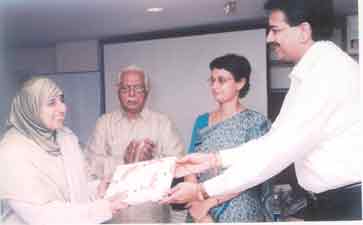
Uzma Naheed, a director of Iqra Education Foundation, Mumbai, has been awarded by Times Foundation in recognition of her exemplary work in the field of education and women’s economic development.
Naheed has conducted Teachers Training programmes in 18 cities in India and in two cities in Bangladesh. These programmes help teachers adopt modern teaching techniques being used in the West. These programmes were basically been designed by Iqra Education Foundation for Muslim children living in pluralistic societies.
Naheed has also conducted inter-faith dialogue seminars under the auspices of Times Foundation and World Conference for Religion & Peace, New York.
She has designed and developed 20 short-duration technical courses for economically poor Muslim women to set up their own home-based businesses.
Naheed, who is grand-daughter of Maulana Qari Taiyyib and daughter of Maulana Salim Qasimi of Deoband, is active in the Indian Muslim women issues and was intrumental in the passage of the model Nikahnama by the All India Muslim Personal Law Board. Her drafts were rejected or deferred many times but she did not give up. Finally the draft was accepted during the last conference at Bhopal.
source: http://www.milligazette.com / The Milli Gazette Online / Home> Awards / by The Milli Gazette Online / Print edition January 2004
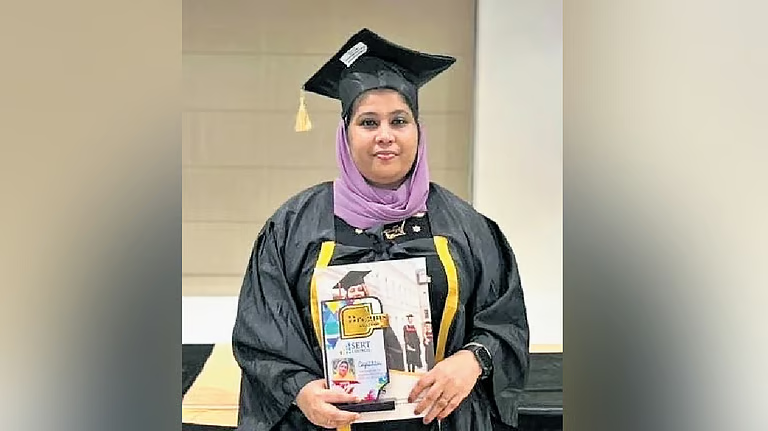
Binziya was forced to abandon her studies when her family arranged her marriage in 1997.
Malappuram :
Married off at 14, confined within domestic boundaries for decades, and once ashamed to admit she had studied only up to Class 9, a woman from Malappuram has now rewritten her destiny through education. After 29 years of marriage, Makkaraparambha native Binziya has emerged with a postgraduate degree in psychology, proving that dreams delayed are never dreams denied.
Binziya was forced to abandon her studies when her family arranged her marriage in 1997. One year later, she became a mother. As the eldest daughter-in-law in a large joint family, she was tasked with looking after her husband’s younger siblings and managing all household responsibilities.
“I was still a child. But I had to act like a grown woman because everyone expected me to be one,” she recalls. Education became a distant memory as cooking, cleaning and childcare took over her life. “There was no space for my wishes. My daughter and later my son became my world. But deep inside, I always missed learning.”
A turning point came when the family shifted to their own home. She came to know about the government’s literacy mission and decided to ask her husband if she could attempt the Class 10 equivalency examination. “My husband supported me without hesitation. When I passed with good marks, I cried. I felt alive again,” she says. She went on to complete her higher secondary education next before enrolling for a BA English programme through distance education in 2020.
But her heart was always set on psychology. “I have gone through many emotional struggles in life. Who understands pain better than a woman? I wanted to learn psychology so that I could help others like me,” she says.
The biggest driving force behind her educational pursuit was her own self-respect. “Whenever someone asked me how much I had studied, I felt ashamed to say Class 9. That shame pushed me to continue learning. I wanted to feel proud of myself,” she explains.
Her years of effort finally came to fruition as she completed her MA in psychology. Binziya says she hopes her story encourages other women who were denied opportunities. “There are many women like me in Malappuram who are married off too early and remain confined to their homes. I want them to know that education is still possible.”
She is also proud of the change within her own family. “My daughter completed her Plus-II before marriage. She has finished her degree and is preparing for postgraduate studies. It makes me happy that she will not have to carry the same regrets I once had.”
Binziya now dreams of becoming a practising psychologist and providing support to homemakers who struggle.
source: http://www.newindianexpress.com / The New Indian Express / Home> Kerala / by Lakshmi Athira / November 28th, 2025
The device includes a ‘Help Me’ button that alerts the teacher whenever a student needs intervention, improving classroom management.
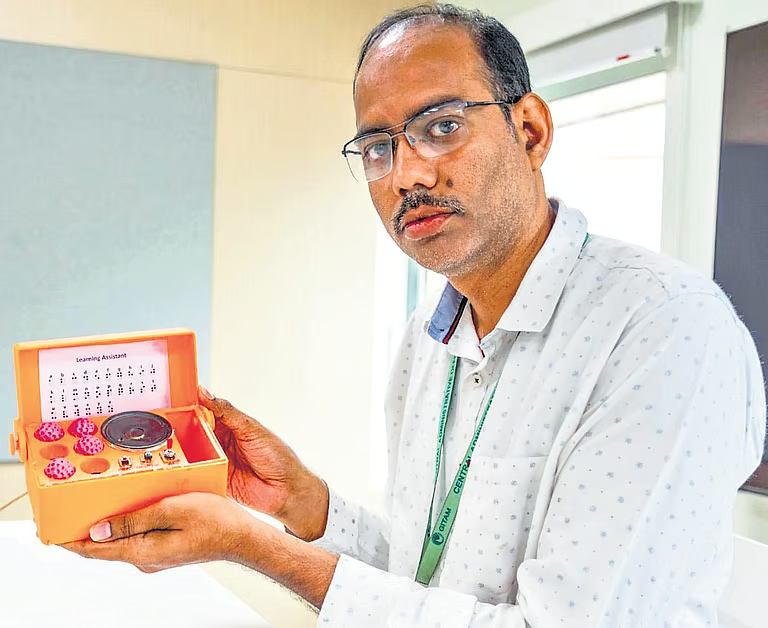
Mohammed Khwaja Muinuddin Chisti, Assistant Professor in the Department of EECE from GITAM Deemed to be University, has developed an embedded Braille Learning Assistant Embedded Kit (LAEK).Photo | G Satyanarayana
Visakhapatnam :
For many visually impaired children, the journey to literacy begins with the touch of a fingertip. But mastering Braille is often a slow and demanding process that requires constant one-on-one support from teachers, a challenge in schools where trained instructors are scarce and classrooms are full. For families living far from specialised schools, opportunities are even fewer, leaving children dependent on others for even the basics of reading and communication.
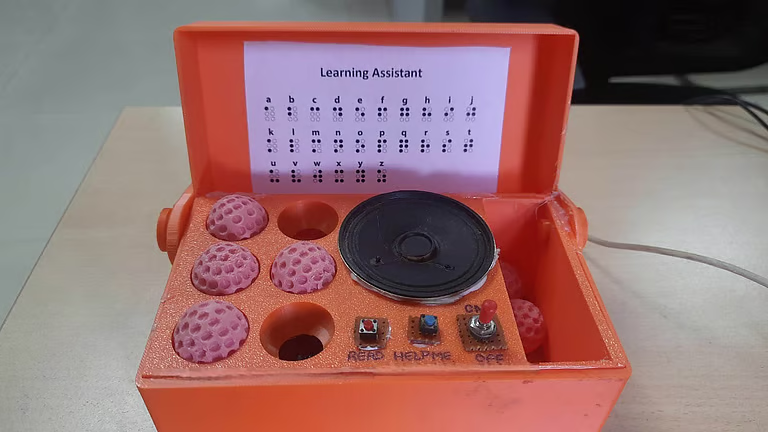
A faculty member at GITAM Deemed to be University, Visakhapatnam, is hoping to change that. Mohammed Khwaja Muinuddin Chisti, Assistant Professor in the Department of EECE, has developed an embedded Braille Learning Assistant Embedded Kit (LAEK), a simple, sensor-based device that allows visually impaired children to learn Braille independently, either at home or in school.
The device is a 3 × 2 hollow hemispherical Braille cell fitted with sensors that identify the dot patterns placed by the student. Once the pattern is detected, the system decodes it and provides audio feedback by announcing the corresponding letter, number or instruction. This makes it possible for students to practise and revise lessons without waiting for a teacher to guide every step. “In many schools, one teacher has to train 30 or 40 visually impaired children, and each child needs personal attention for Braille practice,” Chisti remarked, adding, “Many students hesitate to ask the same doubt again. I wanted to create something that lets them learn comfortably at their own pace.”
The device includes a ‘Help Me’ button that alerts the teacher whenever a student needs intervention, improving classroom management. The balls used to form patterns are designed to stay within reach even if dropped, and the device is chargeable, eliminating the difficulty of replacing batteries.
“The tool is also aimed at children who cannot attend blind schools due to distance or lack of accessibility. Parents can guide their child’s learning at home using the same pattern-based method followed in classrooms. Depending on the child’s learning ability, all basic Braille alphabets can be learnt within a few weeks,” Chisti stated.
Before developing this tool, Chisti created a ‘Walking Assistant’ device, a wearable tool that alerts visually impaired users about obstacles through vibrations and sound. His interactions with students and teachers during that project sparked the idea for a more focused educational device.
“When I visited blind schools to donate the walking aids, I saw the kind of effort teachers put in, and how much time it takes for each child to grasp Braille,” he said.
“I felt technology could ease that pressure and help children become confident, independent learners.”
The new learning assistant has been filed for patent registration. Chisti hopes to manufacture and distribute multiple units to blind schools using research grants and donor support.
Future upgrades may include computer vision and speech recognition to help students identify people around them and navigate with greater confidence.
source: http://www.newindianexpress.com / The New Indian Express / Home> Good News / by Usha Peri / November 30th, 2025
The Urdu literary world mourns the demise of one of its gentle giants, Azizuddin Aziz Belgaumi, the celebrated Na’at poet, ghazal writer, teacher, and literary guide, who returned to his Lord on the morning of Friday, November 28, shortly after the Fajr prayer in Bengaluru.
Azizuddin Aziz was not merely a poet; he was a custodian of spiritual emotion, a voice that blended devotion, beauty, and sincerity in every syllable.
He was renowned for his Na’ats – soulful, tender, and overflowing with love for Prophet Muhammad ﷺ. His unique style of recitation, coupled with his soothing voice, made his poetry beloved among Urdu lovers across the region and beyond.
His iconic Na’ats, including:
اہلِ ستم کے پتھر کھا کر گل برسانے والے ہم
دعوتِ ہدایت کی ایک حسیں شفق لے کر میرے مصطفیٰ آئے
had gone viral among Urdu audiences, each line steeped in deep reverence and spiritual longing.
On his final night in this world, he once again recited “Dawat-e-Hidayat ki ek haseen shafaq lekar mere Mustafa aaye” on special request at a mushaira organized by Idara-e-Adab-e-Islami Hind, Karnataka. The audience responded with extraordinary affection, as if witnessing a sacred farewell.
By the next morning, he left this world – a departure many lovingly regard as a sign of divine acceptance.
Azizuddin Aziz’s published works reflect his emotional depth and mastery of language. His poetry collections include:
حرف و صوت
سکون کے لمحوں کی تازگی
دل کے دامن پر
نقد و انتقاد
زنجیرِ دست و پا
ذکر میرے حبیب کا
These works capture the freshness of spiritual experience, the fragrance of emotion, and the honesty of a heart in constant remembrance.
Azizuddin Aziz worked with Doordarshan Bangalore Urdu, where he interviewed prominent literary personalities. His conversations reflected both scholarship and humility, making him a respected voice representing Urdu culture on national media.
He served for a time as a teacher and later as the Principal of Zubaida College, Shikaripur, shaping young minds with the same warmth and refinement that characterised his poetry.
As an educator, he was loved for his gentle discipline, cultured manner, and his ability to ignite a love for language among students.
He also served as editor of several literary magazines, contributing significantly to Karnataka’s Urdu literary landscape. His editorial vision was marked by sincerity, high standards, and a deep respect for classical tradition.
Early on November 28, he experienced severe chest pain at his residence in Bengaluru. Despite attempts to rush him to the hospital, he breathed his last at home. He leaves behind his wife, three sons, two daughters, and a large community of admirers, students, and peers.
May Allah accept every word of love he wrote for His Beloved Prophet ﷺ. May He grant Azizuddin Aziz a lofty place in Jannat-ul-Firdous, and grant patience, strength, and peace to his grieving family. His voice has returned to silence – but his Na’ats will continue to illuminate gatherings, his ghazals will continue to warm hearts, and his legacy will remain a torch of devotion and grace.
Inna lillahi wa inna ilayhi raji’un. Most certainly we belong to Allah, and most certainly we will return to Him.
source: http://www.radiancenews.com / Radiance News / Home> Focus> Obituary / by Radiance News Bureau / by Mohammed Talha Siddi Bapa / November 29th, 2025
Prof Saira Mehnaz with other participants during the AI-Based Medical Education Research at International Conference
Aligarh:
Prof Saira Mehnaz, Department of Community Medicine, Jawaharlal Nehru Medical College (JNMC), Aligarh Muslim University (AMU), presented an innovative research paper at the International Conference on Advancements in Data, Information, and Systems (ICADIS) 2025, hosted by Noida International University.
Dr. Mehnaz’s paper, titled “AI-Augmented Assessment of a Medical Foundation Course: A Mixed-Method Study,” attracted widespread attention for its pioneering application of AI in medical education. The study evaluated a week-long foundation course for 150 first-year MBBS students at JNMC, aimed at strengthening communication, teamwork, ethics, and academic preparedness among new medical learners.
Using a mixed-method approach, the research combined quantitative student feedback with qualitative reflections, analysed through Rolfe’s reflective model and NVivo software. The integration of AI tools enabled adaptive feedback, more precise evaluation of learning outcomes, and data-driven improvements in curriculum design.
The presentation stimulated engaging discussions among international delegates about the growing role of AI in competency-based and reflective medical education.
source: http://www.radiancenews.com / Radiance News / Home> Latest News> Report / by Radiance News Bureau / October 27th, 2025
For the first time in the history of Aligarh Muslim University Student politics, three women have won the student union elections. Ghazala Ahmad, Sadaf Rasool and Labiba Sherwani all contested the polls for the first time and all three won posts of cabinet members in the AMUSU.
The results of AMUSU elections sent a positive message about gender equality in an university that had gotten bad press for restricting library access for undergraduate women students.
Ms. Ahmad is final year student of Bachelors of Social Work, Ms. Rasool is in the final year of B.U.M.S. and Ms. Sherwani is in her first year of Bachelors of Social Work.
In 2015, one female student had won the union elections. But this is the first time in the history of AMU that three women have won the polls in their maiden attempt.
Kehkashan Khanam, a student of Ph. D. in Theology had won the post of cabinet in the last AMU student union elections. Ms. Khanam had contested this time for the post of vice-president in the AMUSU.
While talking to The Hindu on phone from Aligarh, Ghazala Ahmad said she held the victory of three girls in their first attempt to be a “sign that students of AMU want to see more girls presence and participation in overall student politics”.
When asked how she convinced a male-dominated electorate to vote for her, Ms. Ahmad said, “I told everybody on the campus that time has come to change outsiders’ perception of AMU. I told them, lets show the outside world that AMU campus is friendly and open to girls.”
The twenty-one-year old Ms. Ahmad said her inspiration was her working mother Nahid Fatima, Principal of a Government Primary School in Aligarh.
The job of a cabinet member is to ensure that the problems faced by the students at the departmental and faculty level, should be conveyed and taken up with the president, vice-president and secretary of the AMUSU. “It is a male-dominated campus but the results show that students on the campus want to more participation from girls. After all girls are also there on campus. Who will represent them. It was a tough competition so I had to work really very hard,” said Ms. Ahmad.
source: http://www.thehindu.com / The Hindu / Home> News> India> Other States / by The Hindu / November 01st, 2016
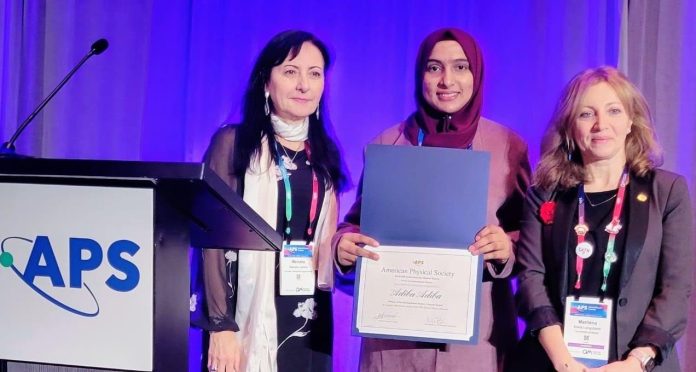
Adiba receiving the Prestigious APS Distinguished Student Award
Aligarh:
Adiba, a PhD student in Physics at Aligarh Muslim University (AMU), has been honoured with the Distinguished Student Award by the American Physical Society (APS) at the APS March Meeting 2025 in Anaheim, California.
Instituted in 2015, the award recognises exceptional early-career researchers from outside the U.S. and supports their participation in APS’s flagship meetings.
Adiba, working under the supervision of Prof Tufail Ahmad, is conducting cutting-edge research on Resistive Random Access Memory (ReRAM) devices for neuromorphic computing – an emerging frontier in physics and artificial intelligence. Her work earned her the prestigious award for outstanding contributions to the field.
Beyond research, she leads as President of the International Centre for Muslim Women in Sciences (ICMWS), championing science education among young women.
Expressing her gratitude to AMU for its role in her success, Adiba said, “Receiving this recognition from APS makes me feel incredibly proud and motivates me to strive even harder.”
source: http://www.radiancenews.com / Radiance News / Home> Latest News> Research> Science & Technology / by Radiance News Bureau / April 08th, 2025
Mecca, (Ottoman-SAUDI ARABIA / Kolkata, WEST BENGAL / DELHI :
Abul Kalam Ghulam Muhiyuddin (November 11, 1888-February 22, 1958), better known as Maulana Azad, was a writer-activist-statesman.
Historian S Irfan Habib speaks on Maulana Azad on his birth anniversary at an event organised by the Maulana Azad College alumni association in Calcutta on Tuesday / The Telegraph
Historian S. Irfan Habib, while delivering his Maulana Abul Kalam Azad memorial lecture titled “Revisiting Maulana Azad in Contemporary India” on Tuesday, rued how in today’s India, anytime he posts anything on social media on the freedom fighter, 80 per cent of the comments comprise hateful abuse.
“Full of abuse… 80 per cent of the comments. And from people who have no idea of who he was, what he stood for, and what he did for India,” said Habib, whose lecture on the Maulana on the icon’s 137th birth anniversary was organised by the Maulana Azad College alumni association to mark the college’s centennial.
Abul Kalam Ghulam Muhiyuddin (November 11, 1888-February 22, 1958), better known as Maulana Azad, was a writer-activist-statesman.
One of Mahatma Gandhi’s most trusted lieutenants and the youngest president of the Indian National Congress, he made crucial contributions to the freedom movement. He was also Independent India’s first education minister.
“I will speak about those issues relevant for today’s India. What he did for education, how he defined nationalism — today all those who have no idea of what nationalism is are nationalists — and how he defined Islam…. Islam too is in danger when we see what we believers have done to our own faith,” said Habib, former Maulana Azad Chair at the National University of Educational Planning and Administration, New Delhi.
Maulana Azad’s family moved from Mecca to Calcutta when he was two. He spent several decades of his life in this city, his residence on 5 Ashraf Mistry Lane of Ballygunge now a museum.
November 11 is celebrated as National Education Day to recognise his contribution in establishing the education foundations of India — from the Indian Institutes of Technology, the University Grants Commission, the All India Council for Technical Education, the Council of Scientific and Industrial Research, the Indian Institute of Science, and the Sahitya Akademi, the Sangeet Natak Akademi and the Lalit Kala Akademi, besides the Indian Council for Cultural Relations.
“Patriotism, nationalism and humanism, the difference between them Maulana tried to look at. In this (the belief in the culmination in humanism) he was very close to Gurudev Rabindranath Tagore, and he actually writes about it, that he believes in the idea of nationalism which was pitched by the idea of Tagore’s humanism and universalism,” said Habib.
“True relationship is only one, where the entire earth is one’s native land. This is necessary is today’s India, where we indulge in othering among own citizens, in the name of religion, caste, language, all sorts of issues, all sorts of divisive tools we use to divide Indians, while Maulana says mankind is one family and all humans are brothers, this is the idea of humanity of nationalism which Maulana left behind,” he added.
Habib underscored how the Maulana began as a pan-Islamist, speaking against the subjugation of Muslim nations by imperialist powers — a sentiment expressed strongly in his papers Al-Hilal and Al-Balagh, and it was because of his role as a fiercely upright journalist that the British Raj viewed him as one of the most dangerous persons in India.
Habib stated that after the Maulana was released from exile in Ranchi in 1920, he was torn between reading and writing in seclusion, or public life and the freedom struggle. It was soon after coming out of exile that the Maulana met Gandhi on January 18, 1920, for the first time.
“The meeting seemed to have had a profound impact on both… and they remained inseparable for the rest of his (Gandhi’s) life,” he said.
According to Habib, the Maulana fought on multiple fronts, not only against the British, but also Hindu and Muslim communalists.
“Maulana stressed on indivisible or composite nationalism, where he went back to early Islamic history, when the Prophet (Muhammad) created the first Muslim nation in Medina by aligning with the Yehudis (Jews). He saw no reason why Muslims could not join hands with Hindus and others in nation-forming…. He was appalled with communalists busy with sectarian campaigns when the need was to fight the British as a composite nationalist group,” Habib said.
“Maulana stood for a united India and remained steadfast in this resolve till the end. We are amid polarising politics where religion has become a distinct marker of identity…. The majoritarian nationalism being flaunted today runs contrary to the idea of composite nationalism espoused by Maulana all his life,” he added. “Maulana found the demand for Pakistan absurd as he was conscious of the fact that religion cannot be a binding factor for a nation.”
source: http://www.telegraphindia.com / The Telegraph Online / Home> West Bengal / by Meghdeep Bhattacharyya / November 12h, 2025
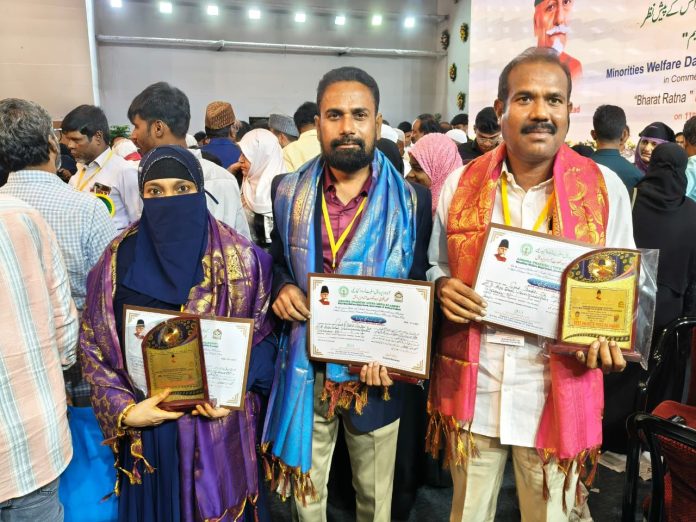
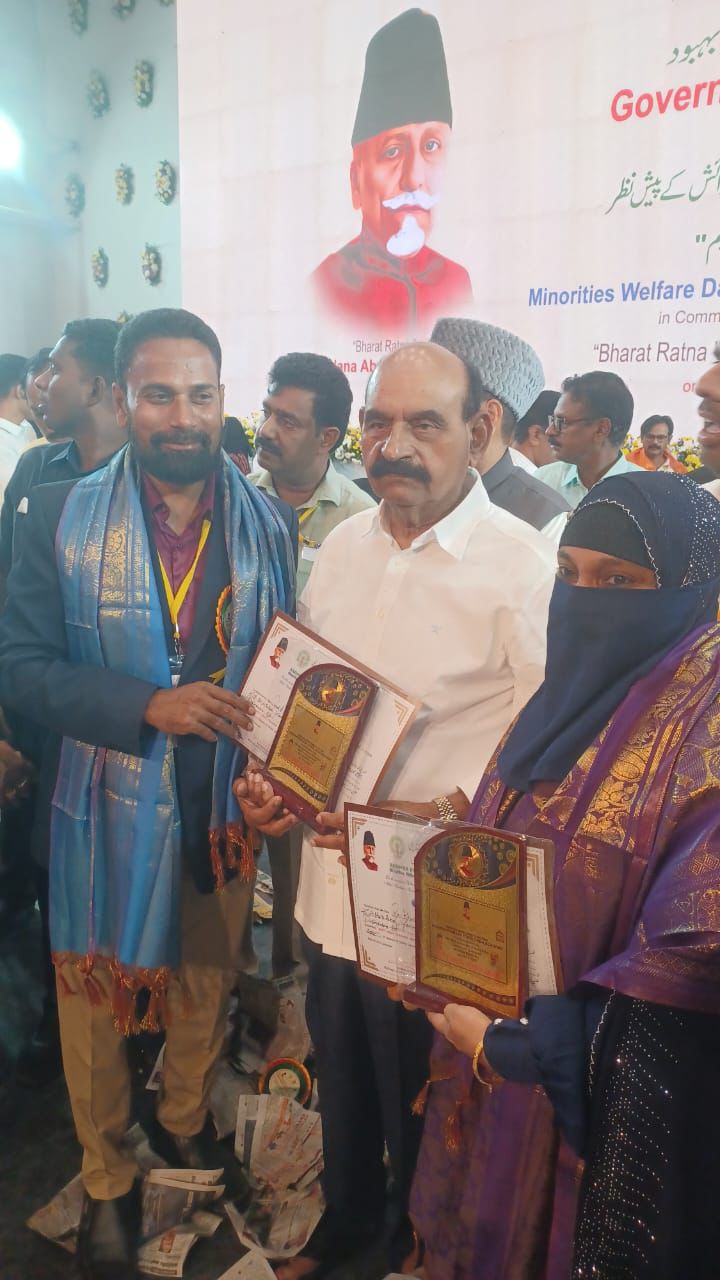
In celebration of National Education Day, the State Urdu Academy organised a special felicitation programme where teachers from ZPHS Urdu School, Yerragondapalem, a village in Prakasam district of Andhra Pradesh, were honoured with the State-Level Urdu Best Teacher Awards.
The awards were presented by the Minister for Minority Welfare, S.M.D. Farooq, to Syed Abdul Ghaffar (SGT Urdu), Shaik Khursheed Begum (SA SS), and Syed Shafi (SA Urdu) in recognition of their outstanding contributions to Urdu education.
Local residents, students, and parents extended their heartfelt congratulations to the award-winning teachers and expressed their hopes that they continue to bring more laurels in the future while nurturing many more bright students under their guidance.
source: http://www.radiancenews.com / Radiance News / Home> Awards> Pride of the Nation> Latest News> Report / by Radiance News Bureau / November 13th, 2025
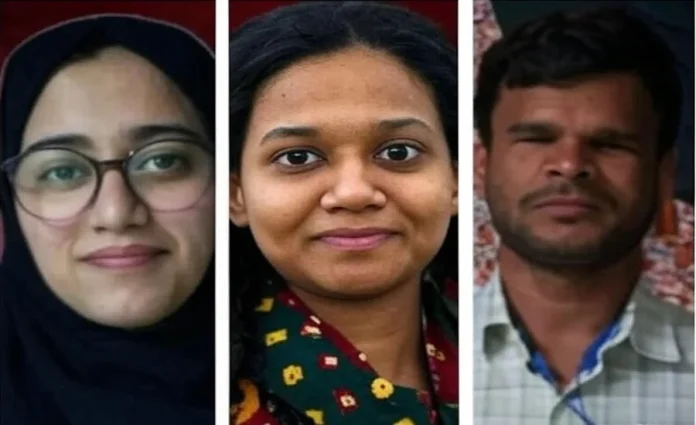
Muslim students have made a strong mark in this year’s Jawaharlal Nehru University (JNU) student union elections, with Danish Ali, Hafsa Bukhari, and Mohammad Aslam among the winners. The elections saw the Left alliance secure all four top posts, defeating the ABVP. Aditi Mishra was elected President, K Gopika Babu as Vice President, Sunil Yadav as General Secretary, and Danish Ali as Joint Secretary.
Danish Ali, a research scholar at the Centre for Historical Studies, defeated ABVP’s Anuj to win the Joint Secretary seat. Coming from Narsinghpur, Madhya Pradesh, Danish belongs to a family of educators. She was active in student mobilisations during the 2019 CAA protests and said her victory belongs to all students who value justice and democratic rights.
Hafsa Bukhari from Poonch, known for her hijab-wearing identity, also won a councilor seat. Her election is seen as a step forward for women’s representation and Muslim inclusion on campus. Alongside her, Mohammad Aslam, a visually impaired PhD scholar from Bihar, earned a councilor position. Despite his challenges, Aslam has consistently spoken up for equality, disability rights, and social justice.
Faculty members at JNU described their wins as a reflection of courage, resilience, and commitment to equality. Students across the university have welcomed the outcome, seeing it as a mandate for inclusivity and democratic engagement.
source: http://www.radiancenews.com / Radiance News / Home> Latest News> Report / by Radiance News Bureau / November 08th, 2025