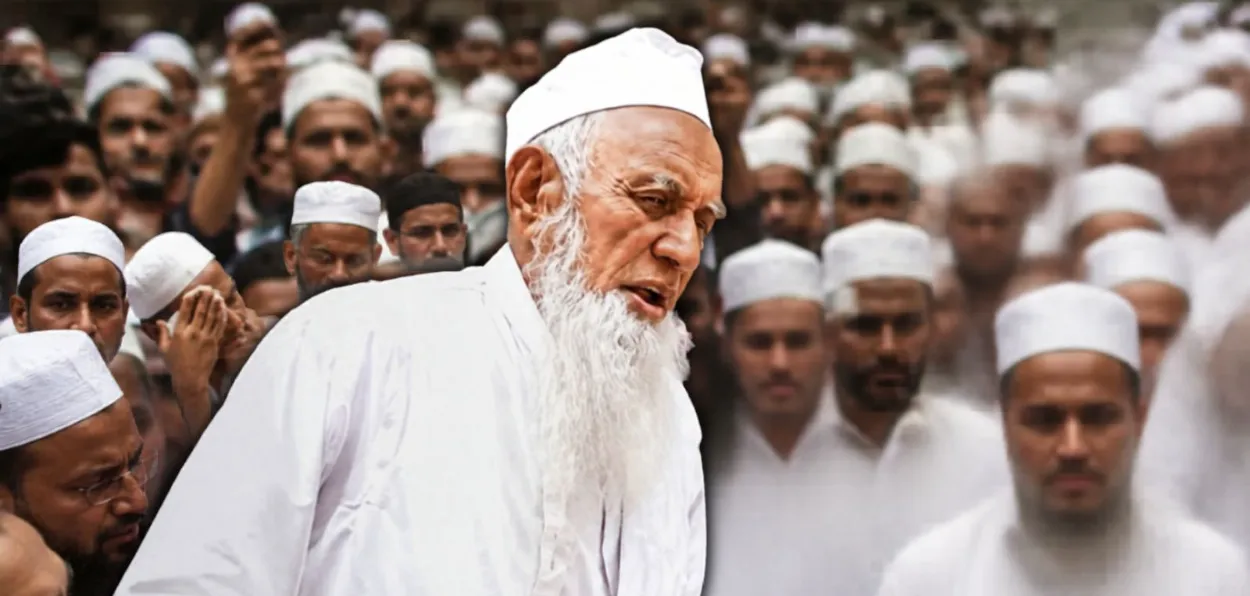
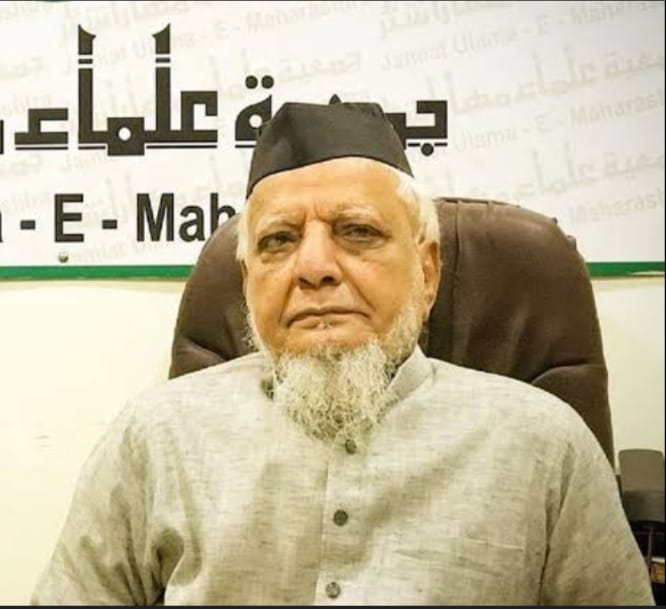
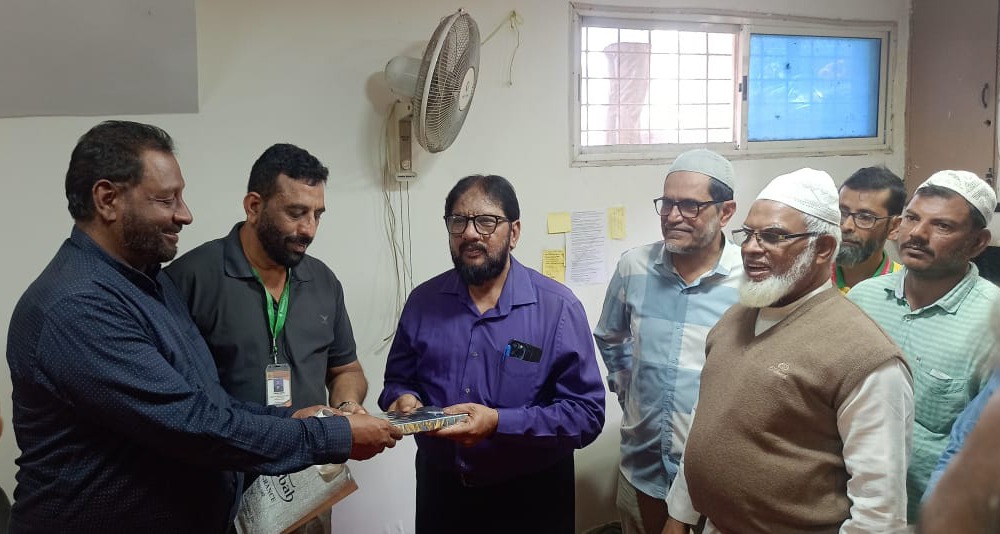
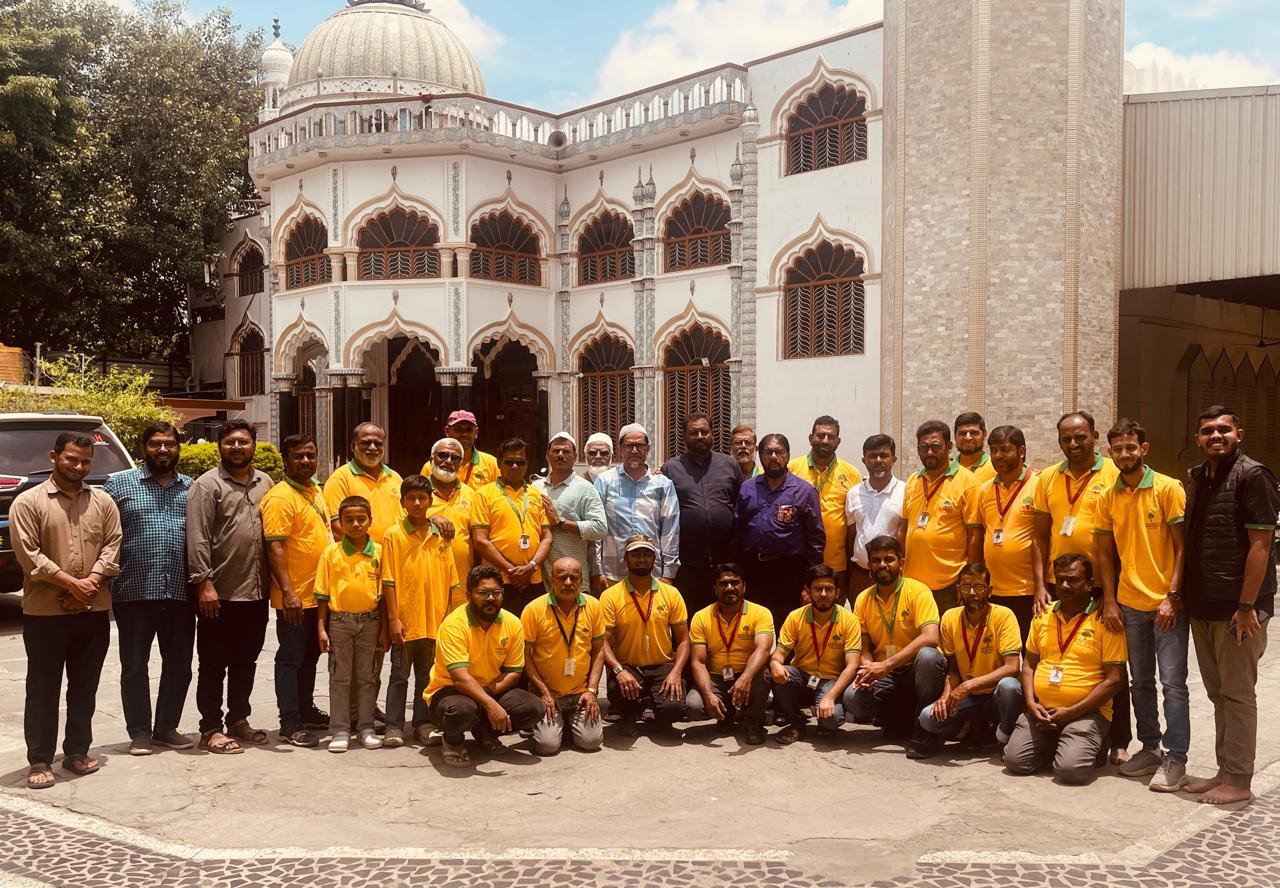
Hafiz Manzoor, the Maharashtra Amir (head), Tablighi Jamaat,
Mumbai :
The passing of Hafiz Manzoor, the Maharashtra Amir (head) of the global Islamic reformist movement Tablighi Jamaat, is being mourned as a profound loss for the entire Muslim community. He had dedicated his life to the service of the faith, for the betterment of society, and the service of humanity.
Hafiz Manzoor, who was in his nineties. was laid to rest at the Nigdi cemetery in Pimpri-Chinchwad with thousands of his followers attending the burial on Monday night.
Hafiz Manzoor was active till the very last. He had arrived in Pune on Sunday night and offered his pre-dawn Tahajjud and Fajr prayers.
Following the Fajr prayers, he suddenly felt dizzy inside the mosque where he lived.
He was rushed to the hospital for treatment, where the doctors declared him dead. but was declared dead upon arrival. According to his close associates, he fasted on Mondays and Thursdays, and he was fasting on the day of his death.
Hafiz Manzoor always inspired the youth to acquire a good education, cultivate excellent morals, and walk on the righteous path. His hard work, simplicity, concern for the Ummah, and his unique ability to connect people will always be remembered.
Maulana Saad, the Indian head of the Tablighi Jamaat, and his son specially attended the funeral to pay their last respects. Hafiz Manzoor, who was in his 90s, passed away yesterday (May 18) in Pune. His passing has sent a wave of mourning across the Muslim community in Maharashtra.
Staying away from fame and any kind of ostentation, he dedicated his entire life to social reform and religious service.
Thousands of his followers from all over the country arrived in Pune on Monday night. His mortal remains were kept at the Fatima Masjid for people to pay their final respects.
The mourners moved in complete discipline and peace from the mosque to the cemetery, a true way to pay tribute to a man of religion whose life was an epitome of simplicity.
Residing at the Fatima Masjid in Pune, he served the religion and society for several decades. He worked tirelessly throughout his life to keep the youth away from addiction and to raise awareness against the dowry system in society.
He always strongly advocated for marriages and other ceremonies to be conducted with utmost simplicity. His passing is seen as a massive loss to the community, with many expressing the sentiment of losing a true guiding light.
For the uninitiated, Tablighi Jamaat is a global Sunni Islamic reformist and spiritual movement. The movement was started in 1926 by Maulana Muhammad Ilyas Kandhlawi in the Mewat region of India.
The primary objective of this movement is to bring Muslims back to their fundamental religious values and teachings. They place heavy emphasis on offering regular prayers and living a simple life.
The group stays away from politics, social controversies, and publicity. Its members dedicate a specific number of days to travel from village to village and mosque to mosque, reminding their fellow Muslims to walk on the path of faith.
Within this movement, there is a head designated to guide a state or a country, who is referred to as the ‘Amir’. Hafiz Manzoor was the Amir of the Tablighi Jamaat for the state of Maharashtra.
source: http://www.awazthevoice.in / Awaz, The Voice / Home> Changemakers / by Aasha Khosa, ATV / May 21st, 2026
IPS Sultana in Spotlight Again After Viral Video at Bengal CM Swearing-In. She attracted national attention in February 2024 when she was part of the team constituted to investigate allegations of atrocities against women in Sandeshkhali.
Kolkata:
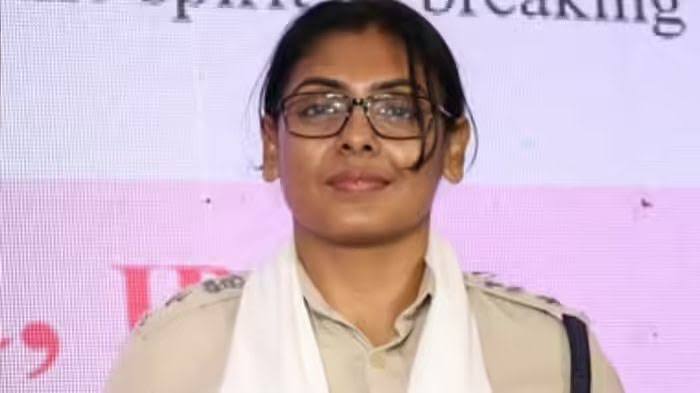
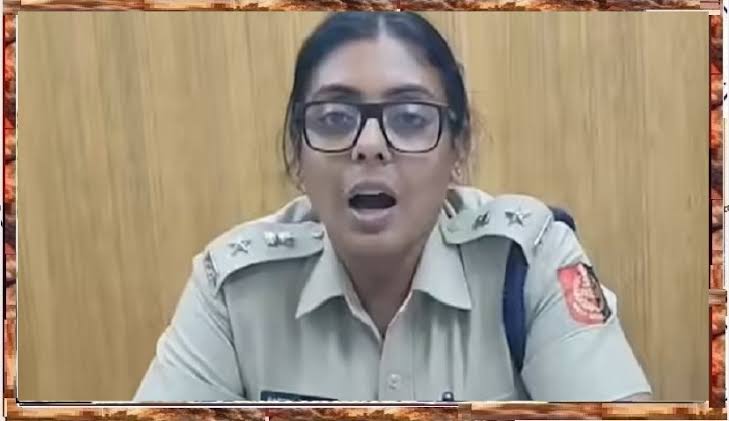
The 2015 batch IPS officer Papiya Sultana, the Superintendent of Police (SP) of Paschim Medinipur, is once again in the spotlight after a viral video from the swearing-in ceremony of Chief Minister Suvendu Adhikari sparked intense discussion on social media.
The senior police officer, who previously drew attention during the Sandeshkhali controversy, is widely recognized as West Bengal’s first Muslim woman IPS officer and has built a distinguished career marked by academic excellence and trailblazing achievements.
Why Papiya Sultana Is in the News
Papiya Sultana has come under scrutiny after a video from the recent swearing-in ceremony appeared to show her remaining seated when Prime Minister Narendra Modi arrived at the venue.
The footage has generated debate online, with critics questioning her conduct during the high-profile event. The incident has added to earlier controversies surrounding her role in the Sandeshkhali investigation.
Role in the Sandeshkhali Case
Papiya Sultana attracted national attention in February 2024 when she was part of the team constituted to investigate allegations of atrocities against women in Sandeshkhali.
During the inquiry, she faced criticism after reportedly asking complainants for documentary and medical evidence related to the allegations. Her handling of the case became a subject of political debate in West Bengal.
West Bengal’s First Muslim Woman IPS Officer
Papiya Sultana is regarded as the first Muslim woman from West Bengal to join the Indian Police Service.
She began her policing career by clearing the state police examination and later earned promotion to the IPS through the State Police Service quota.
IPS Batch and Current Posting
Name: Papiya Sultana
IPS Batch: 2015 (promoted from State Police Service)
Cadre: West Bengal
Current Posting: Superintendent of Police, Paschim Medinipur
Date of Birth: July 5, 1980
Early Life and Family Background
Born in Bauria in Howrah, Papiya Sultana grew up in a middle-class family that strongly supported education.
Father: Arjahan Haldar, an engineer
Mother: Salema Jehan, a teacher at a madrasa
Her parents encouraged her academic ambitions and career aspirations from an early age.
Impressive Academic Qualifications
Papiya Sultana is known for her exceptional educational achievements. Her qualifications reportedly include:
MBA
Master’s in Gender Development
LLB
LLM
Diplomas in Spanish and French
She has also pursued doctoral research in Women’s Studies at Jadavpur University.
Career Journey: From State Police (WBPS) to IPS
Papiya first joined the West Bengal Police Service in 2008 after clearing the examination on her first attempt. She began her career as a Deputy Superintendent of Police (DySP) in the West Bengal Police.
Her consistent performance led to her induction into the Indian Police Service as part of the 2015 select list.
Over the years, she has served in several important roles, including:
SP, Home Guard Organisation
Additional charge of Barrackpore 1st Battalion
Superintendent of Police, Paschim Medinipur
Personal Life
Papiya Sultana married software engineer Badrul Alam in 2006. She is a mother and has often spoken about drawing inspiration from Kiran Bedi, one of India’s most prominent police officers.
Her journey continues to inspire many young women, especially those aspiring to join the civil services.
Why Her Story Matters
From a small town in Howrah to becoming a pioneering IPS officer, Papiya Sultana’s journey reflects determination, academic excellence, and resilience. However, the criticism and controversies surrounding some of her actions have also kept her in the news for reasons that sparked public debate and dissatisfaction among sections of people.
Whether praised for her achievements or criticized for her handling of sensitive issues, she remains one of the most talked-about and influential women police officers in West Bengal.
source: http://www.indianmasterminds.com / Indian Masterminds / Home> Bureaucracy News> IPS> News / by Indian Masterminds Bureau / May 11th, 2026
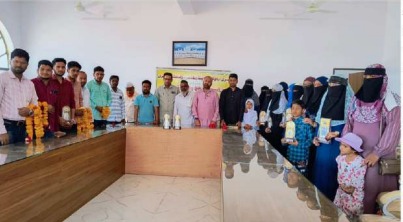
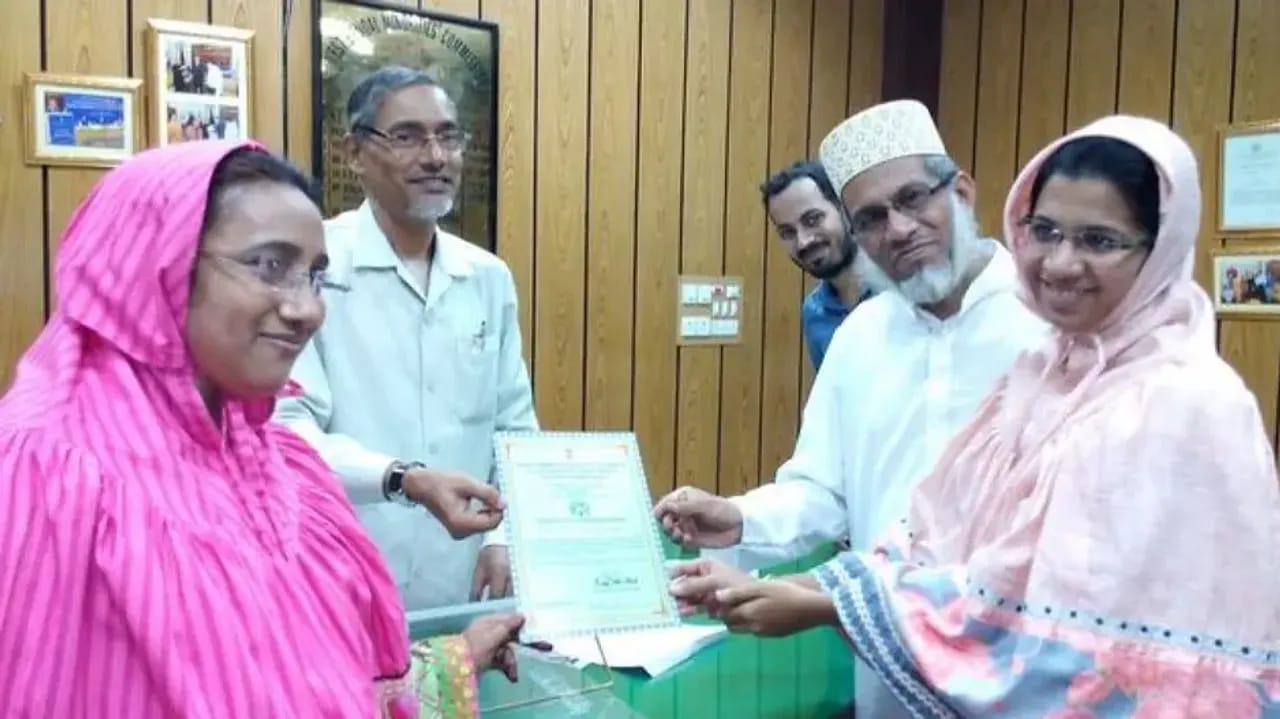
The Officers Education and Welfare Society, Pathri in Parbhani district of Maharashtra organized a program to honour the achievements of both teachers and students who excelled in the CTET examinations. The event, held at the Haj House, Eidgah Ground here Sunday, witnessed a gathering of distinguished guests, educators, and successful students.
Under the leadership of Society President Abdur Rahim Ansari and coordination of Society Secretary Sharin Parveen Mohammad Yusuf, the program commenced with a recitation of the Holy Quran by Abdul Jameel Iqbal Ansari, a student of Pathri Central School.
The highlight of the event was felicitation of nine teachers selected for government positions in Pathri city, municipal councils, and town councils. These educators were acknowledged for their dedication and contribution to the education sector.
Moreover, the program recognized the outstanding performance of fifteen students who successfully passed the CTET examination. These students, prepared through free online coaching classes and practice exams provided by the Society, were awarded for their hard work and determination.
Among the honored teachers were Sheikh Nadeem Ahmed Qadir Ahmed, Sheikh Naeem Ahmed Qadir, Abdul Aziz, Abdul Kabir, and others from Pathri.
Similarly, students like Sheikh Abdul Wahid Muhammad Majid and Muskan Fatima Abdul Ansari were among those celebrated for their academic achievements.
Guests, including Anwar Hussain Badi and Adil Ahmed Hashmi, expressed their appreciation for the efforts of both teachers and students. They emphasized the importance of continued guidance and support for the education community.
In his closing remarks, Advocate Muhammad Tariq Ansari conveyed gratitude to all participants and highlighted the successful collaboration between educators, students, and the Officers Education and Welfare Society. The event concluded on a high note, with hopes for a brighter future and continued success in the field of education.
source: http://www.radiancenews.com / Radiance News / Home> Latest News> Markers of Excellence / by Zaina Aman /March 06th, 2024
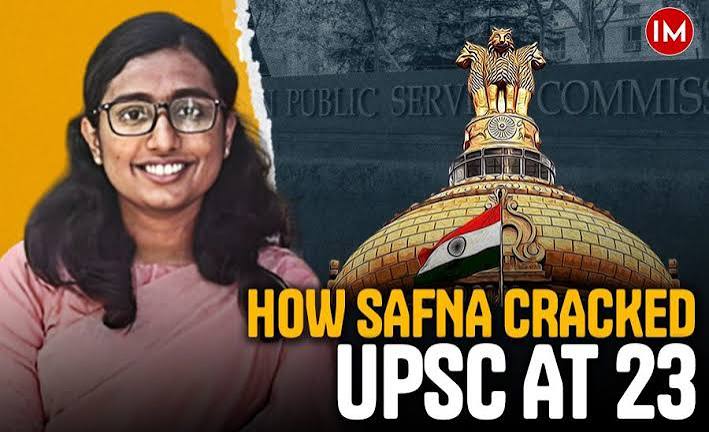
Safna Nazarudeen, youngest Muslim woman from Kerala to crack UPSC with All India Rank 45, now serves as Labour Commissioner. Her journey from a Kendriya Vidyalaya student to an IAS officer reveals the power of early focus, disciplined routines and a desire to serve.
Growing up in Valiyavila, Thiruvananthapuram, Safna Nazarudeen was surrounded by the world of public service. Her father rose from the ranks of the Kerala Police, eventually retiring as an inspector. Her mother worked as a typist in the state employment exchange. From an early age, Safna watched the values of discipline, dedication, and community service take shape in her household.
It was around class 8 when she first entertained the idea of joining the civil services, not because she knew the mechanics of the exam, but because she sensed that an IAS officer could do a lot for society.
She attended Kendriya Vidyalaya, excelling academically and choosing the social sciences stream, against her father’s wish for science. Undeterred, she pursued a BA in Economics at Mar Ivanios College, topping the Kerala University in her batch.
CRACKING THE UPSC IN HER FIRST ATTEMPT
In 2020, at the age of 23, Safna cleared the Union Public Service Commission exam in her first attempt, securing All India Rank 45. She became the youngest Muslim woman from Kerala to enter the IAS.
Her preparation followed a rigorous pattern: she turned off social media, spent two hours daily on newspapers, attended coaching classes, and devoted 7-10 hours to self-study every day. She also kept a dedicated notebook to jot down what she studied for weekend revision.
Public speaking was a challenge at first, so she practised by speaking on selected topics daily in front of a mirror, a method suggested by her mentors.
FROM ASSISTANT COLLECTOR TO LABOUR COMMISSIONER
Once she entered the Kerala cadre of the IAS (Batch 2020), Safna was posted in Malappuram district as Deputy or Assistant Collector. Over time, she rose to become the Labour Commissioner, heading the Labour Commissionerate, Government of Kerala (Thozhil Bhavan, Thiruvananthapuram).
Her role now involves dealing with migrant labour issues, irregular employment, unemployment and implementation of labour laws across multiple industries.
In a recent government order, she was also given an additional charge as Director of the Fisheries Department.
VALUES, APPROACH AND LEADERSHIP STYLE
While the public often assumes that bureaucrats are always under strong political pressure, Safna says the reality is more complex. Multiple stakeholders need to be consulted and aligned before solutions that benefit all can be implemented. She says that while busy days are inevitable, there are also comparatively lighter days and that the job offers a mix of responsibility and reasonable balance.
Her early life, seeing a working‐class household, understanding privilege and the importance of service, shaped her commitment. She has spoken of recognising during her school days that she was more privileged than many, and that propelled her to aspire to serve people who were less advantaged.
WHAT HER STORY OFFERS TO ASPIRANTS
Start early with your goal: Safna’s idea of joining IAS surfaced as a teenager, even without full clarity of the exam system.
Make your dream your own: It wasn’t family pressure; it was her personal choice, and she owned it.
Structure matters: A disciplined routine, self-study and regular revision helped build momentum.
Complement knowledge with skills: She recognised the importance of speaking and presentation early.
Service mindset: Her ambition was not just personal status but to bring change and fairness for others.
LOOKING FORWARD
At a still young age in her bureaucratic career, Safna’s journey is already remarkable. But there is room ahead for deeper policy initiatives, sectoral reforms in labour, and perhaps district- or state-wide programmes that shape livelihoods and rights. Her trajectory suggests that when the aspiration aligns with preparation and execution, leadership roles in public service open up, and they carry the potential to impact lives.
source: http://www.indianmasterminds.com / Indian Masterminds / Home> Features> UPSC Stories / by Bhakti Kothari / November 05th, 2025
Supreme Court Gives Relief to IPS Officer Abdur Rahman, Asks Centre to Revisit VRS Rejection.
New Delhi:
In a significant ruling, the Supreme Court has set aside the Union Home Ministry’s decision rejecting the voluntary retirement request of former Maharashtra cadre IPS officer Abdur Rahman and directed the Central Government to reconsider his application afresh within three months.
A Bench comprising Justice P.S. Narasimha and Justice Alok Aradhe held that the Centre had failed to adequately examine the complaints and disciplinary issues cited while rejecting Rahman’s Voluntary Retirement Scheme (VRS) application in 2019.
The court’s decision comes after a prolonged legal battle initiated by Rahman, who had sought voluntary retirement from the Indian Police Service in August 2019 but was denied permission by the government due to pending disciplinary proceedings and complaints against him.
Supreme Court Sets Aside 2019 Rejection Order
Abdur Rahman had submitted a notice seeking voluntary retirement under Rule 16(2A) of the All India Services (Death-cum-Retirement Benefits) Rules, 1958, in August 2019.
The Ministry of Home Affairs subsequently rejected the request on October 25, 2019, citing pending complaints and disciplinary matters.
Allowing Rahman’s plea, the Supreme Court observed that the Central Government had not undertaken a detailed examination of the complaints before rejecting the VRS application.
“In view of the above discussion and analysis, we are of the opinion that the Central Government has not examined the complaints in detail before taking the decision dated October 25, 2019, of not accepting the notice for voluntary retirement,” the Bench noted.
The Court directed the Centre to reconsider the request in light of all available material and take a fresh decision within three months.
Court Asks Centre to Consider Subsequent Charge Sheets
The Supreme Court also took note of developments that occurred after the original rejection order.
The Maharashtra Government subsequently issued charge sheets against Rahman in three separate matters, including a 2022 case linked to his participation in protests against the Citizenship Amendment Act (CAA).
However, the Court observed that despite the passage of several years, disciplinary proceedings in these cases had not reached a conclusion.
Taking this into account, the Bench directed the Central Government to evaluate both the original complaints and the subsequent disciplinary proceedings while reconsidering the VRS application.
The Court stated that the inability of the authorities to conclude disciplinary proceedings despite the passage of time was an important factor that warranted a fresh review of the matter.
Complaints Against the IPS Officer
According to records placed before the Court, Rahman faced multiple allegations during his service.
These included:
Allegations of torturing a person in 2014.
Contracting a second marriage in 2016 without obtaining the consent of his first wife.
Delivering a public speech in 2019 allegedly in violation of service conduct rules.
Subsequent disciplinary proceedings related to his participation in anti-CAA protests.
The Court did not examine the merits of these allegations but emphasized that the Centre must properly evaluate all relevant facts before arriving at a decision on his retirement request.
Who Is IPS Officer Abdur Rahman?
Abdur Rahman is a former 1997 batch Indian Police Service (IPS) officer of the Maharashtra cadre who served the state police force for more than two decades before emerging as a prominent public voice on issues related to governance, constitutional values, minority rights, and social justice.
Born on January 8, 1973, in West Champaran district of Bihar, Rahman comes from a farming family.
Educational Background
Rahman completed his schooling at Bipin High School in Bettiah and later pursued higher studies in Patna.
He graduated with a Bachelor of Technology (B.Tech) degree in Civil Engineering from the Indian Institute of Technology (IIT) Kanpur in 1995 before qualifying for the Civil Services Examination.
Career in the Indian Police Service
Rahman joined the Indian Police Service on September 7, 1997, and was allotted the Maharashtra cadre.
Over a policing career spanning more than 22 years, he held several important assignments across Maharashtra.
His major postings included:
Assistant Superintendent of Police, Latur
One of his earliest assignments after joining the service.
Superintendent of Police
He served in districts such as:
Dhule
Yavatmal
Chandrapur
During his tenure in Dhule, he reportedly led several anti-dacoity operations targeting criminal gangs operating along national highways.
Principal, Police Training School, Solapur
Rahman later headed the Police Training School in Solapur, contributing to police training and capacity building.
Additional Commissioner of Police, Pune
He served as Additional Commissioner of Police (Administration) in Pune City Police.
Inspector General of Police
His final posting in service was as Special Inspector General at the Maharashtra State Human Rights Commission (MSHRC).
Resignation During Citizenship Amendment Act Protests
Rahman gained national attention in December 2019 after publicly opposing the Citizenship Amendment Act (CAA).
On December 11, 2019, shortly after the Citizenship Amendment Bill was passed in Parliament, he announced his resignation from service, describing the legislation as unconstitutional and discriminatory.
He stated that his decision was an act of “civil disobedience” and a protest against what he viewed as a threat to India’s pluralistic and secular character.
However, by that time, his earlier request for voluntary retirement was already under consideration and later became the subject of legal disputes.
Long Legal Battle Over Retirement Status
Following the rejection of his VRS application, Rahman challenged the government’s decision before judicial forums.
The dispute continued for several years, creating uncertainty regarding his formal separation from government service.
The Supreme Court’s latest order does not automatically grant voluntary retirement but requires the Central Government to reassess the application and take a reasoned decision after examining all relevant facts and subsequent developments.
Author, Public Speaker and Social Activist
After stepping away from active policing, Rahman increasingly focused on public engagement, research, and writing.
He has authored several books examining issues related to governance, social inclusion, and political representation.
His notable works include:
Denial and Deprivation: Indian Muslims after the Sachar Committee and Ranganath Mishra Commission Reports
A study examining socio-economic challenges faced by Indian Muslims.
Absent in Politics and Power: Political Exclusion of Indian Muslims
An analysis of minority representation in political institutions.
Communal Crimes and National Integration
A work exploring governance, communal harmony, and national integration.
Brief Foray into Electoral Politics
Ahead of the 2024 Lok Sabha elections, Rahman briefly entered electoral politics.
He was announced as a candidate for the Dhule parliamentary constituency by the Vanchit Bahujan Aghadi (VBA), led by Prakash Ambedkar.
However, legal uncertainty surrounding his retirement status reportedly affected his candidature, and he did not emerge as a major electoral contender.
What Happens Next?
Following the Supreme Court’s ruling, the Ministry of Home Affairs will now be required to conduct a fresh examination of Abdur Rahman’s voluntary retirement application.
The Centre has been given three months to take a final decision after considering the original allegations, subsequent charge sheets, and the prolonged pendency of disciplinary proceedings.
The outcome of the review will determine whether Rahman’s long-pending request for voluntary retirement is finally accepted or rejected once again after detailed scrutiny.
source: http://www.indianmasterminds.com / Indian Masterminds / Home> News> IPS>News / by Indian Masterminds Bureau /June 03rd,2026
Maulana Gulzar Ahmed Azmi, a staunch fighter for the oppressed people, especially innocent Muslim youth, implicated in false terror and criminal cases, and a prominent figure of Jamiat Ulama-i-Hind in Maharashtra passed away in a hospital in Mumbai on August 20. He was 89. He was receiving treatment in hospital, but succumbed to his head injury after a slip-and-fall incident.
Heading a legal aid committee of the Jamiat-i-Ulama Maharashtra since its inception in 2007, Maulana Azmi was fearlessly offering legal aid to the people implicated in false cases by government agencies and the police.
Maulana Azmi was born in Mumbai on May 1, 1934. After getting primary education at a Urdu medium school, he went to Darul Uloom Deoband to complete higher education in Islamic studies. After joining Jamiat in 1954, Azmi held key positions from the local head to the state’s vice president. His journey in the quest for justice and civil rights started in the aftermath of the Bhiwandi and Jalgaon riots in 1970, when hundreds of Muslims were arrested, in spite of suffering heavy losses during the violence. The Jamiat came forward for the first time to get them released.
After 1992-1993 Mumbai riots, Maulana Azmi assisted the Srikrishna Commission, set up by the Government of Maharashtra to investigate the causes of the riots. Remarkably, the Commission in its findings, praised Jamiat-i-Ulama for helping it in collecting key evidence. Even Maulana Azmi himself translated the inquiry report into Urdu. Due to his resilient support, Jamiat has extended legal help to hundreds of accused in a number of cases, running across the country.
Maulana Azmi never cowed down the allegations or threats to his life while defending civil right cases. When asked about an imminent threat in defending the terror accused, he bravely replied that he did not fear for his life as he firmly believed that the time and place of his death were already decided. He was very active and remained involved in his routine legal aid activities even at the age of 90.
Azmi has been a member of the Maharashtra State Minority Commission from 2002-2005, and again in 2014. He is survived by six sons and three daughters. Expressing deep grief over his death, Jamiat Ulama-i-Hind President Maulana Arshad Madani said Gulzar Azmi was associated with Maulana Hussain Ahmad Madani and Jamiat at a very young age and spent his entire life serving the country and the community.
source: http://www.radiancenews.com / Radiance News / Home> Obituary / by Anwarulhaq Baig / August 25th, 2023
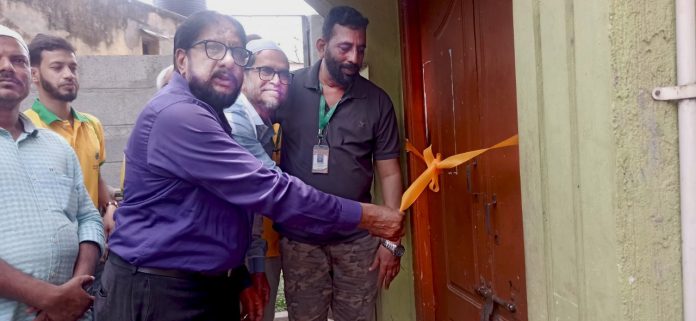
The Humanitarian Relief Society (H.R.S.), a Karnataka-based volunteer-driven organization known for its swift emergency and disaster relief work, inaugurated a new Rescue Equipment Room in the Yeshwanthpur area of Bengaluru.
The addition marks another milestone in the organization’s growing network of response facilities across the state, with similar units already operational in Mangalore, Hubli, and Gulbarga.
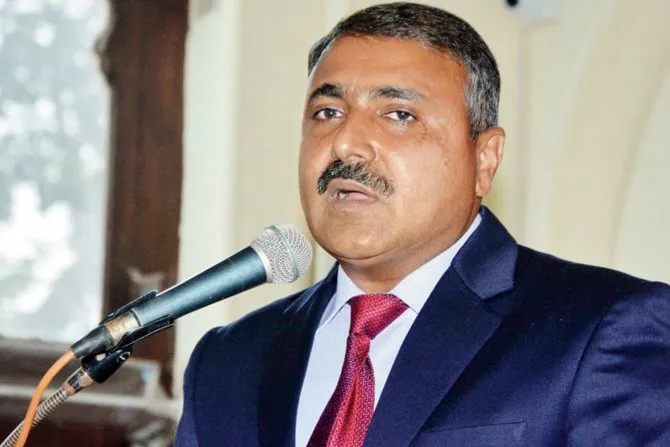
The inauguration ceremony, held at the Yeshwanthpur Islamic Center auditorium, was attended by key civil defence and community leaders, highlighting the increasing integration of civil society efforts with formal emergency infrastructure. Mr. Najeeb Ahmad, Civil Defence Officer and recipient of the Chief Minister’s Gold Medal, served as the chief guest. In his keynote address, he praised H.R.S. for its consistent and impactful humanitarian services:
“We saw during the COVID-19 pandemic how vital community organizations can be when working alongside government initiatives. H.R.S. has emerged as a model for such cooperation, with trained volunteers who are quick to respond in times of crisis.”
He stressed the importance of access to professional-grade rescue equipment, citing instances where the absence of proper tools had led to preventable loss of life or injury. Commending H.R.S. for identifying and addressing this critical gap, he added:
“This Rescue Equipment Room is not just a facility for H.R.S. but a resource for the entire community. Residents of Yeshwanthpur and neighboring areas should make full use of it.”
Mr. Ahmad also encouraged H.R.S. volunteers to consider formal registration with the Home Guards, which would enable them to expand their reach and gain official recognition in disaster response operations.
The event opened with a welcome address by Mr. Hyder Ali, Assistant Secretary of H.R.S., who outlined the organization’s mission and expanding capabilities.
He was followed by Mr. Suhail Ahmad, local President of Jamaat-e-Islami Hind, Yeshwanthpur, who provided an overview of H.R.S.’s recent relief and rescue initiatives across Karnataka.
The presence of General Secretary Mohammed Markada, who was seated on the dais, underscored the strategic importance of the Bengaluru expansion. He noted that the Yeshwanthpur facility would serve as a vital hub in the city’s western corridor, enhancing H.R.S.’s ability to respond rapidly within Bengaluru’s urban landscape.
Senior members and field operatives in attendance included: • Ameer Siddiqui, Commander, H.R.S. • Abrar Ahmad, Assistant Commander • Dr. Aftab Wasim, Zonal Leader • Mujeeburrahman, along with captains, assistant captains, group leaders, and trainers Veteran community leader Mr. Murad Saab also graced the occasion.
source: http://www.radiancenews.com / Radiance News / Home> Latest News / by Radiance News Bureau / August 04th, 2025
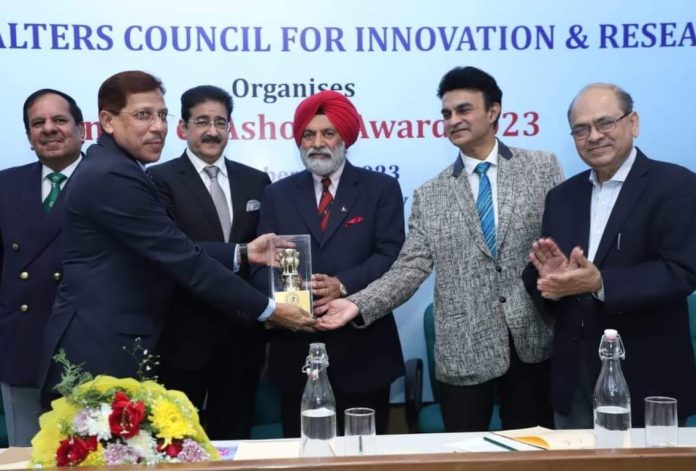
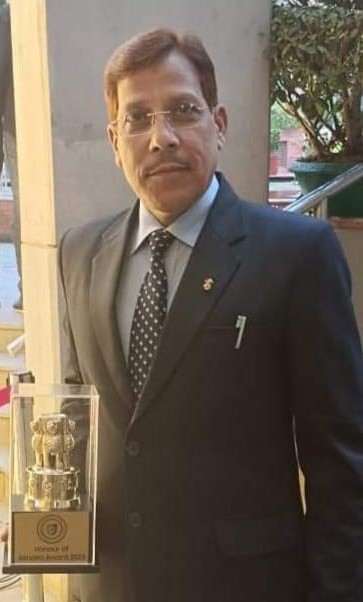
Namroz Ahmed Khan, Deputy Commissioner of Police 2 Central Division Kolkata, has received Carles Walter Council for Innovation and Research instituted Ashoka Award for commitment to innovation and research in policing, values crucial for addressing contemporary challenges recently at India Habitat Centre here on December 17.
Namroz Ahmed, while speaking to Radiance shared his feeling, “It is indeed an honor and I feel humbled by this recognition. The award signifies a commitment to innovation and research in policing, values crucial for addressing contemporary challenges.”
He further said, “I joined Kolkata Police in 1986 as Sub Inspector of Police. Today, I lead as Deputy Commissioner of Police 2 Central Division after serving various branches of Kolkata Police organisation and is at the verge of my retirement. During my illustrious career, besides several other rewards I was awarded Prashansa Medal in 2011 by West Bengal Chief Minister, Indian Police Medal on occasion of Independence Day 2014 by President of India, and President Police Medal for Distinguished Service on occasion of Independence Day 2022. On behalf of United Nations of Women Empowerment Coalition, I was honoured with Captain Sir Tom Moore Memorial Medal for the Covid 19 Hero Award also.
On the challenges before police force, he said, “Regarding the challenges faced by the police force today, it’s imperative to navigate issues like cybercrime, terrorism, and public safety concerns. Strengthening community ties, embracing technological advancements, and ensuring accountability are pivotal in overcoming these challenges.”
On the ideal role of police force today, the police officer said, “In the current atmosphere, the police force must strike a delicate balance between maintaining law and order while respecting individual rights. Transparency, training, and community-oriented policing can contribute to building trust and promoting a safer society.”
“It was indeed a memorable evening receiving the honor by Gen JJ Singh, Former Chief of Indian Army Staffs; Former Governor of Arunachal Pradesh, Shri Saurabh Tiwari; Joint Secretary Cabinet Secretariat of India, Dr. Sandeep Marwah; Chancellor, AAFT University and other dignitaries. Amongst other recipients were Special Commissioner Delhi Police, Ex DG UP Police OP Singh, Sri Sunil Kumar Under Secretary and many others from various fields,” said Namroz Ahmed.
source: http://www.radiancenews.com / Radiance News / Home> Pride of the Nation> Awards> Focus / by Radiance News Bureau / December 31st, 2023
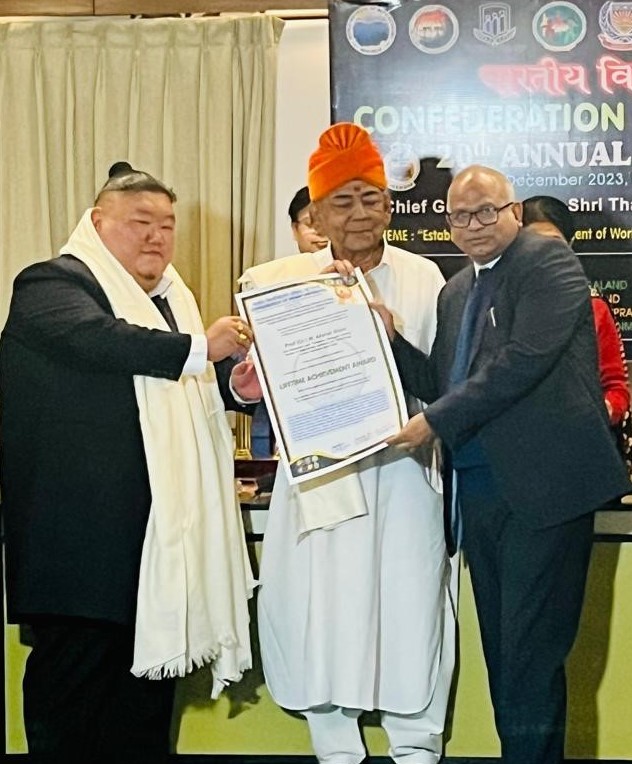
(R-L) Prof. M. Afshar Alam, Vice Chancellor, Jamia Hamdard receiving Lifetime Achievement Award at India International Centre, New Delhi on December 29 from Dr. Priyaranjan Trivedi, President, Confederation of Indian Universities and International Association of Educators for World Peace and Temjen Imna Along, Minister of Higher Education & Tourism, Nagaland
New Delhi :
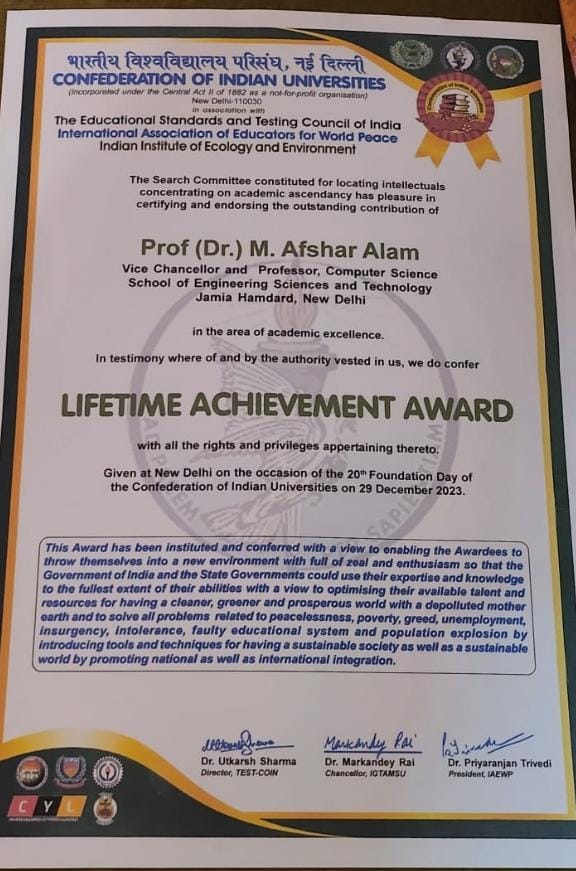
Prof. (Dr.) M. Afshar Alam, Vice Chancellor, Jamia Hamdard received the Lifetime Achievement Award in a function organised at India International Centre here on Friday from Temjen Imna Along, Minister of Higher Education and Tourism, Nagaland and Dr. Priyaranjan Trivedi, President, Confederation of Indian Universities and International Association of Educators for World Peace, said a statement of Jamia Hamdard on Saturday.
A search committee, constituted for locating intellectuals concentrating on academic ascendancy, certified and endorsed the outstanding contribution of Prof. Afshar Alam, Vice Chancellor, Jamia Hamdard and Professor, Computer Science, for this Lifetime Achievement Award.
The Confederation of Indian Universities in association with the Educational Standards and Testing Council of India, International Association of Educators for World Peace and Indian Institute of Ecology and Environment instituted this Award with a view to enabling the Awardees to throw themselves into a new environment with full of zeal and enthusiasm so that the Government of India and the State Governments could use their expertise and knowledge to the fullest extent of their abilities with a view to optimising their valuable talent and resources for having a cleaner, greener and prosperous world with a de-polluted earth and to solve all problems related to peacelessness, poverty, greed, unemployment, insurgency, intolerance, faulty educational system and population explosion by introducing tools and techniques for having a sustainable society as well as a sustainable world by promoting national as well as international integration.
source: http://www.radiancenews.com / Radiance News / Home> Pride of the Nation> Awards> Latest News / by Radiance News Bureau / December 30th, 2023
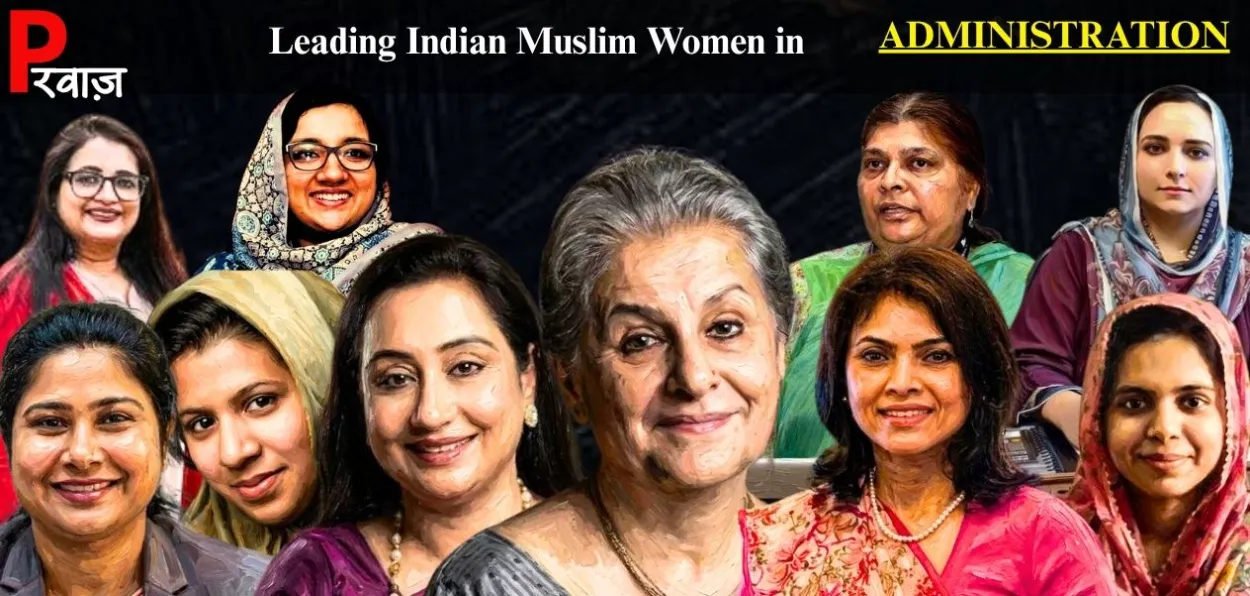
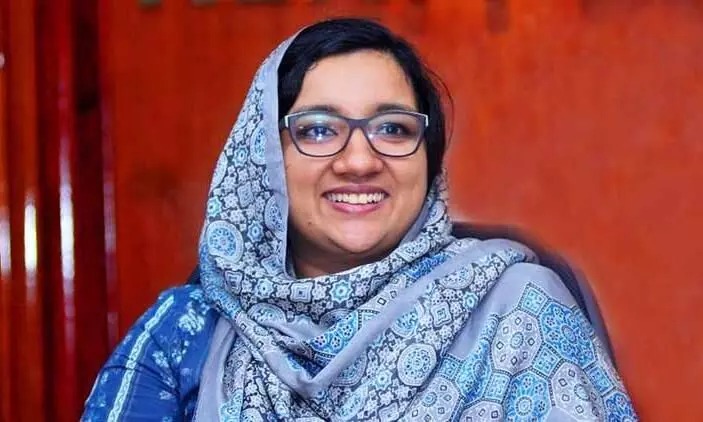
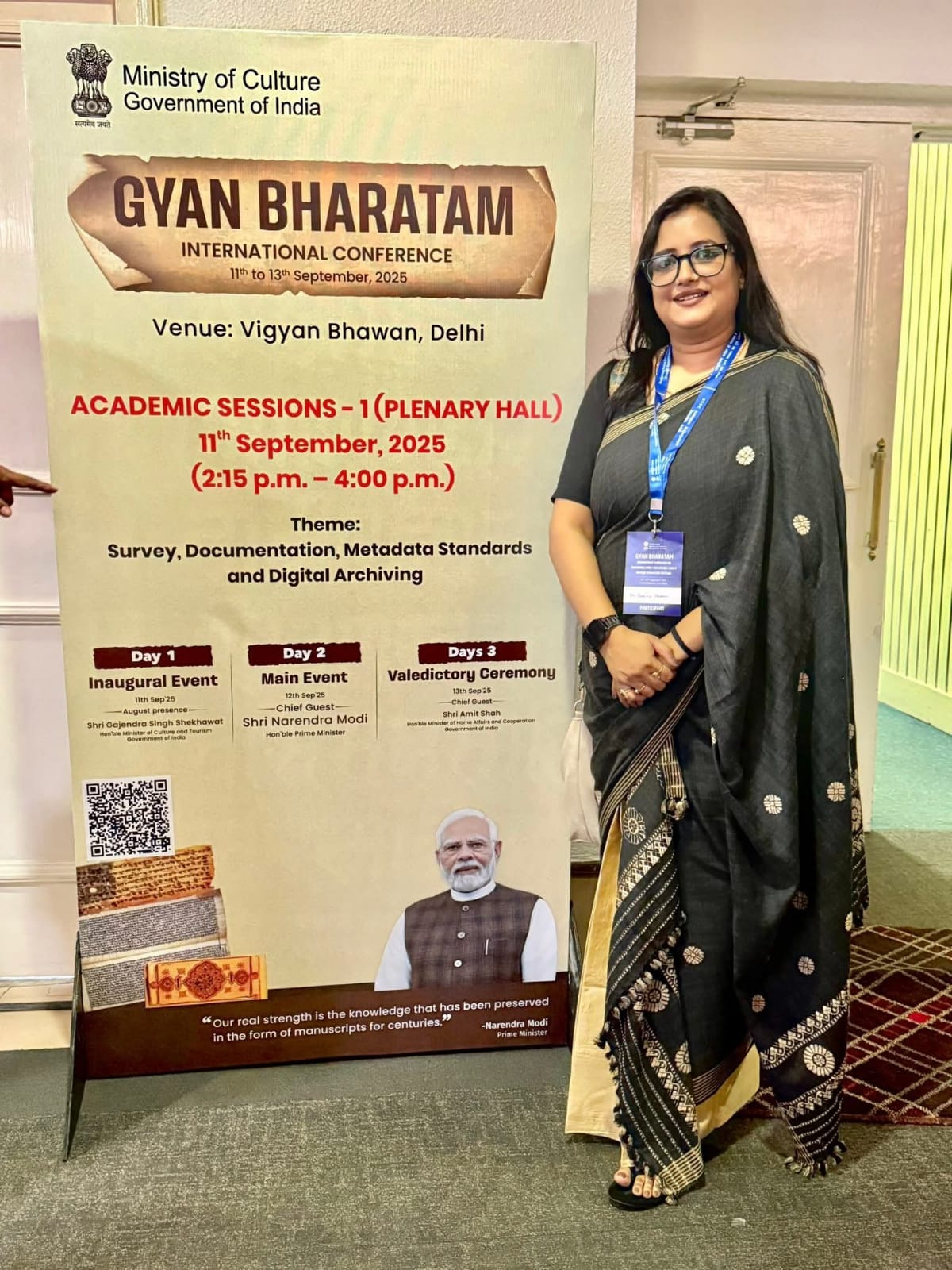
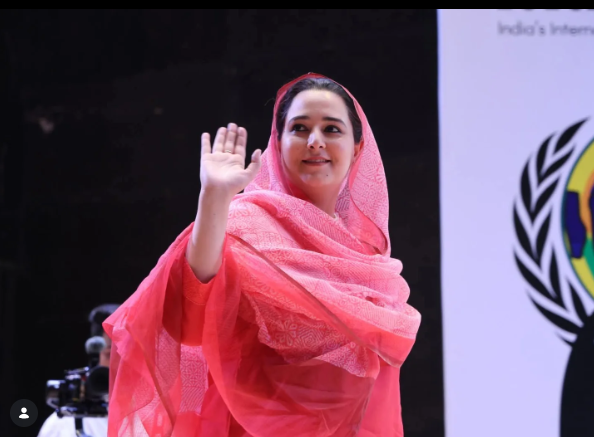
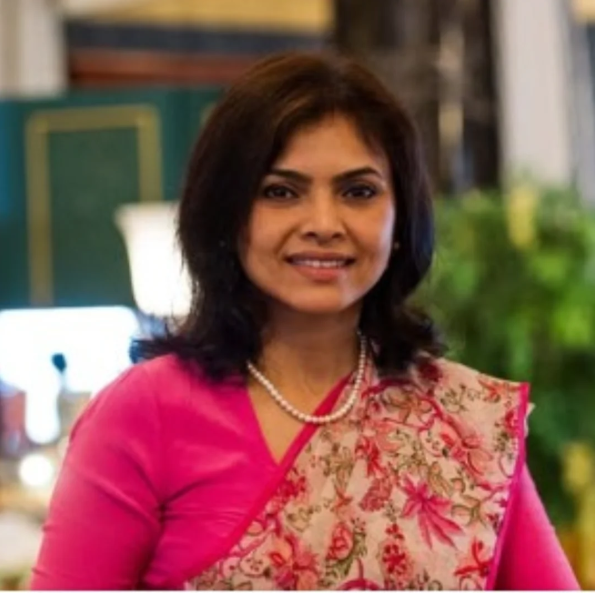
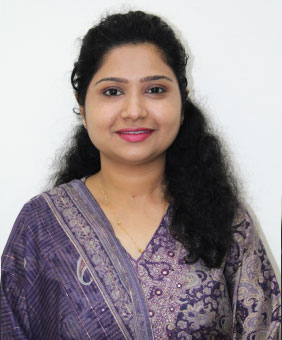
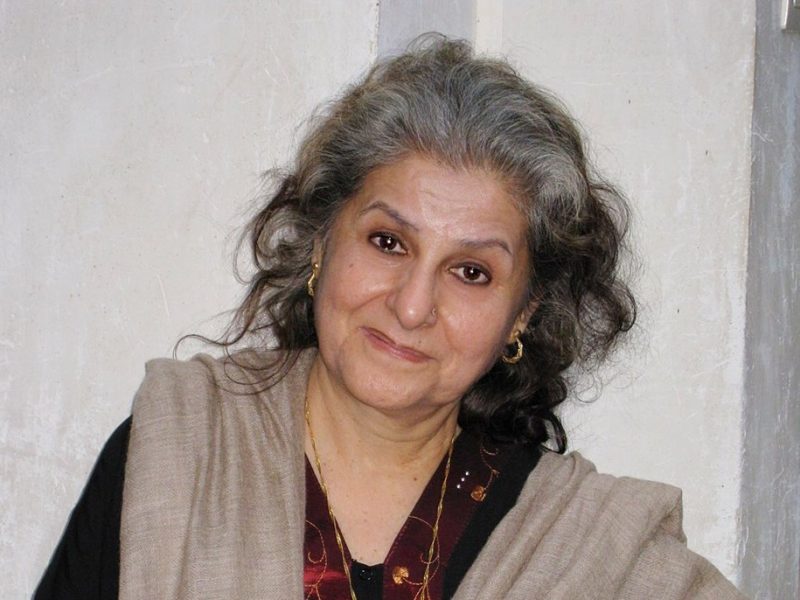
Across India’s administrative corridors, diplomatic missions, universities, welfare departments, and heritage institutions, a generation of Muslim women is redefining leadership through intellect, perseverance, and public service. Their journeys are rooted in struggle, shaped by education, and driven by a deep commitment to society.
Under the Parvaz series, Awaz-the Voice brings you the stories of ten such Muslim women, whose lives and work should become an inspiration for all women in India.
Adeeba Anam Ashfaq Ahmed Shaikh
Adeeba Anam Ashfaq Ahmed Shaikh
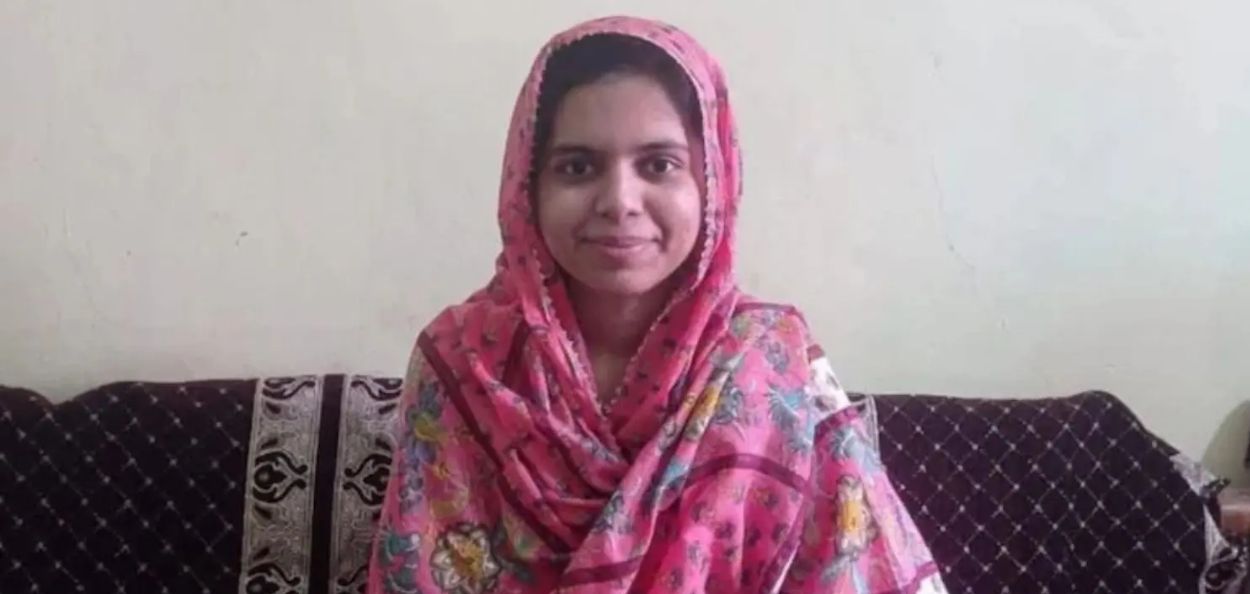
Adeeba Anam Ashfaq Ahmed Shaikh’s journey from a modest home in Yavatmal to becoming Maharashtra’s first Muslim woman IAS officer is a story of determination overcoming adversity.
The daughter of an auto-rickshaw driver, she rose above financial hardship, repeated failures, and social prejudice to secure All India Rank 142 in UPSC 2024. Her success stands as a beacon of hope for countless girls from rural and marginalised communities who dream of changing their destinies through education and hard work.
Dr Adeela Abdulla
Dr Adeela Abdulla
Dr Adeela Abdulla represents a compassionate and thoughtful face of governance in Kerala. One of the early Muslim women from Malabar to join the IAS, she has played a vital role in strengthening social welfare systems and urban governance.
Whether through her work in Kerala’s Solid Waste Management Project or as Special Secretary in the Social Justice Department, her leadership reflects empathy, accountability, and a deep commitment to human dignity, particularly for vulnerable sections of society.
Dr Chabina Hassan
Dr Chabina Hassan
In Assam, Dr Chabina Hassan has emerged as a powerful force in heritage conservation and archaeology. As Deputy Director at the Directorate of Archaeology, Assam, she played a key role in securing UNESCO World Heritage recognition for Charaideo Maidam and made groundbreaking discoveries in Dima Hasao.
Balancing motherhood, academics, and fieldwork, she has transformed archaeology into a bridge connecting communities with their cultural roots while inspiring younger generations to value history and preservation.
Dr Syed Sehrish Asgar
Dr Syed Sehrish Asgar
Dr Syed Sehrish Asgar’s career reflects excellence, resilience, and transformative public service. A doctor by training, she topped the J&K Administrative Services examination in 2010 and later secured AIR 118 in UPSC.
From becoming Budgam’s first woman Deputy Commissioner to spearheading initiatives like the SAATH programme that empowered over five lakh rural women through Self Help Groups, her administrative journey has been marked by innovation and social impact.
Her recognition with the Prime Minister’s Award for Excellence in Civil Services further highlights her contributions to governance and public welfare.
Naghath Tabassum Abroo
Naghath Tabassum Abroo
Naghath Tabassum Abroo’s life story is deeply rooted in the strength of family values, education, and perseverance. After a decade-long break from academics due to marriage and motherhood, she returned to secure third rank in the KPSC examination and later rose to become one of Karnataka’s pioneering Muslim women IAS officers
Through initiatives in women’s welfare, sanitation, healthcare, and e-governance, including Bengaluru One and Khajane II, she demonstrated how compassionate leadership and administrative innovation can improve public systems and people’s lives.
Nagma Mohammad Mallick
Nagma Mohammad Mallick
Nagma Mohammad Mallick carved history as India’s first Muslim woman IFS officer and built a distinguished diplomatic career through quiet yet impactful service. Currently serving as India’s Ambassador to Japan and the Marshall Islands, she has represented India in several countries while strengthening international partnerships in diplomacy, technology, and economic cooperation.
Through her thoughtful articulation of democracy, dialogue, and non-violence, Mallick has projected India’s values on the global stage with dignity and restraint.
Nahida Zam Zam
Nahida Zam Zam
Nahida Zam Zam has become known as a fearless and people-centric administrator in Karnataka. Through her public speeches and grassroots engagement, she consistently advocates for women’s empowerment, education, and freedom of thought.Her dedicated fieldwork during the COVID-19 pandemic, even while pregnant, earned her admiration as a compassionate officer deeply connected with ordinary people.
Whether speaking to students, women, or marginalised communities, she challenges restrictive social norms and encourages self-reliance and awareness.
Syeda Saiyidain Hameed
Syeda Saiyidain Hameed
Syeda Saiyidain Hameed stands as one of the most influential voices for women’s rights, peace, and social justice in India. An acclaimed author, educationist, former member of the Planning Commission, and member of the National Commission for Women, she has devoted her life to defending human rights and promoting dialogue across communities.
As a founder of the Muslim Women’s Forum and Women’s Initiative for Peace in South Asia, she worked tirelessly for peace-building efforts between India and Pakistan, proving that courage and compassion can coexist in public life.
Professor Shabina Nishat Omar
Professor Shabina Nishat Omar
Professor Shabina Nishat Omarhas emerged as a dynamic symbol of academic leadership and women’s empowerment in West Bengal. With over twenty-five years in education and administration, she has transformed institutions through her leadership while advocating inclusive education, digital literacy, and gender awareness.
As an educator, speaker, and administrator, she continues to inspire young people to view education not merely as a profession, but as a powerful tool for social transformation and self-reliance.
Zaynab Syed
Zaynab Syed
Zaynab Syed’s journey reflects perseverance, discipline, and dedication to public service. From overcoming repeated failures in the civil services examination to securing an All India Rank 107, she proved the power of resilience and self-belief. Today, through her role at TRIFED, she works to strengthen tribal livelihoods and expand economic opportunities for artisans and self-help groups across eastern India.
Her story demonstrates how determination and commitment can turn setbacks into opportunities to serve society meaningfully.
By breaking barriers and creating spaces for future generations, they are not only shaping institutions but also redefining what leadership looks like in contemporary India.
source: http://www.awazthevoice.in / Awaz, The Voice / Home> The Changemakers / by Vidushi Gaur /May 30th, 2026