Category Archives: Travel & Tourism

Temper that enthusiasm

Hyderabad, TELANGANA :

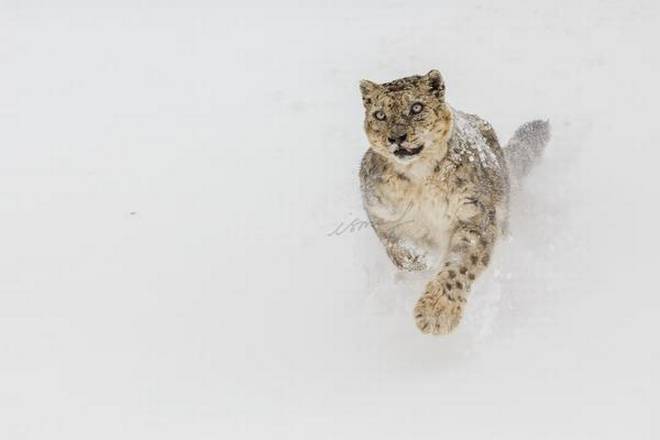
A female snow leopard photographed by Ismail Shariff

Hyderabad-based wildlife photographer Ismail Shariff on how the lens-totting tribe can exercise restraint in wilderness

The photograph of a snow leopard occupies a pride of place in Ismail Shariff’s edgily-designed studio. The Hyderabad-based wildlife photographer says he was blessed, not plain lucky, to have been able to capture the leopard from barely 15 feet distance in Spiti, Himachal Pradesh, this year.

Shariff has been a part of three snow leopard expeditions. Earlier, he had to be content with images where the leopard was a speck in the frame. “Animals in regions like Spiti or Leh are shy. They sense human presence a mile away,” he says.

A cartload of patience helps photographers get the right shot. They wait for minutes or hours, anticipating the animal’s next move. Shariff’s experience was no different, “From where we were staying, we could spot the leopard sleeping and ran out with our cameras. The villagers were also keen to have a glimpse. We felt that when the leopard wakes up, it will walk away from the noise and make its way to a clearing. We positioned ourselves such that we can get images but not be in its line of sight.”

He’s elated to have captured these images, but he mulls over and says, “If the snow leopards could come this close to humans, either they were short of food or they’ve gotten used to human presence.”

Ismail02MPOs06jun2017

Shariff has been an avid wildlife photographer since 2008 and has observed the rise in numbers in his tribe. “There were fewer people exploring wildlife photography back then since not everyone could afford the flamboyant lenses,” he says.

In July, Shariff plans to visit Ladakh to photograph the Pallas’ cat (named after German naturalist Pyotr Simon Pallas). Besides these niche expeditions, he’s also frequented Tadoba National Park (92 times), Kabini and Jim Corbett National Park that are popular among tourists.

The observations while on these trips make him wonder if aspiring photographers compromise on the ethics of wildlife photography for instant gratification on social media.

It isn’t a case of sour grapes or a cry for exclusivity, Shariff clarifies, “There isn’t much money to be made out of photography in India. A few established photographers work with forest departments and voluntary organisations. Their work helps in documentation and conservation activities. For most others, it’s a hobby. There’s nothing wrong with more people exploring this line. The trouble begins when ego kicks in and you want to bend rules.”

There have been instances of photographers getting too close for the comfort of animals and birds — from attempting to veer off course during safaris to getting closer to bird nests. This isn’t limited to India, says Shariff, sharing instances where he spotted photographers getting off a safari vehicle in Yellowstone National Park in the US or crowding to take shots of a Broadbill’s nest in Malaysia.

Dos and don’ts

* The enthusiasm for a great shot needs to be tempered with restraint and respect for wildlife habitats. While on safaris in places like Tadoba, Kabini or Corbett, drive slowly, don’t talk loudly and never get off the vehicle. By irritating or threatening the animal, you also put yourself at danger. “I’ve seen people trying to bribe guides and drivers to take a different route or allow them to get off the vehicle, setting a wrong precedence to others,” Shariff points out.

* Don’t underestimate nature. Respect weather conditions. Shariff recalls being blown five feet high when a gust of wind changed director in Chopta, Uttarakhand.

* Steer clear of mothers with cubs. “Mothers, be it a tigress, lioness, deer, peafowl or a bear, will do anything to safeguard its offspring.”

* Don’t try to film animals in nocturnal situations unless permitted by forest department. Animal movement is pronounced and unpredictable at night. There have been cases of road-kills where vehicles have knocked down animals.

* If one is truly interested in turning their passion for wildlife photography into something meaningful, collaborate with forest departments or organisations that document wildlife and living conditions of people living close to these zones. A niche category that’s emerging, called conservation photography, helps initiate a dialogue.

Factoid: Collaborate for conservation

Dharmendra Khandal is a conservation biologist, researcher, botanist and photographer associated with Tiger Watch in Ranthambore. His efforts have led to capture of several poachers in Rajasthan. Khandal also helped identify several species of spiders.

source: http://www.thehindu.com / The Hindu / Home> LifeStyle> World Environment Day / by Sangeetha Devi Dundoo / June 03rd, 2017

Sarah Cohen and kindred spirits

Mattancherry, KERALA :

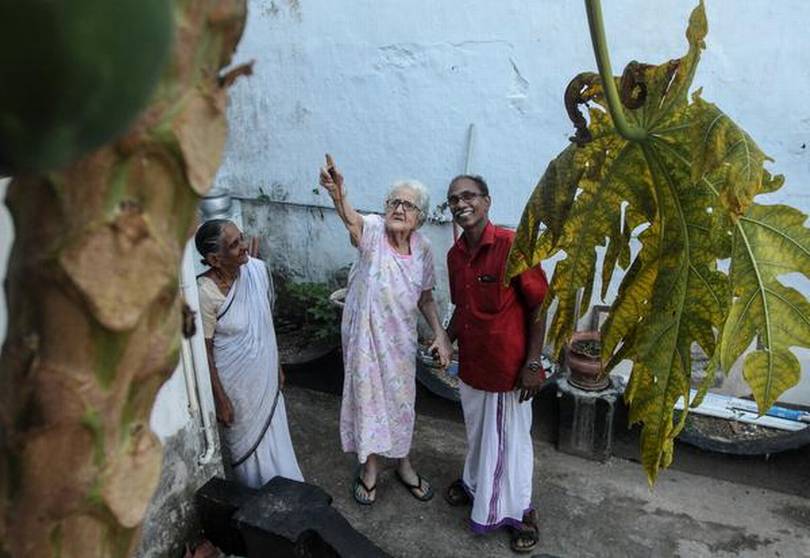
House of lore: Sara Cohen with Thaha Ibrahim in her backyard. PHOTO: THULASI KAKKAT
House of lore: Sara Cohen with Thaha Ibrahim in her backyard.
PHOTO: THULASI KAKKAT

A nonagenarian Jewish woman in Mattancherry in west Kochi finds a pillar of support in a Muslim couple and a Christian maid.

Thaha Ibrahim is as keen on maintaining the sanctity of shabbat as he is of his Friday namaz. The devout Muslim spends almost all day taking care of a nonagenarian Jewish woman, Sarah Cohen, whom he calls aunt.

A strong bond of love binds them together in the sunset years of the Jewish community in Mattancherry in west Kochi, where Jews lived in the thousands in the past, contributing substantially to the city’s growth. The strength of the community waned over the years, with a large number of them migrating to Israel. A few like the Cohens stayed put, determined to live in the land of their birth that gave them the identity of Cochin Jews.

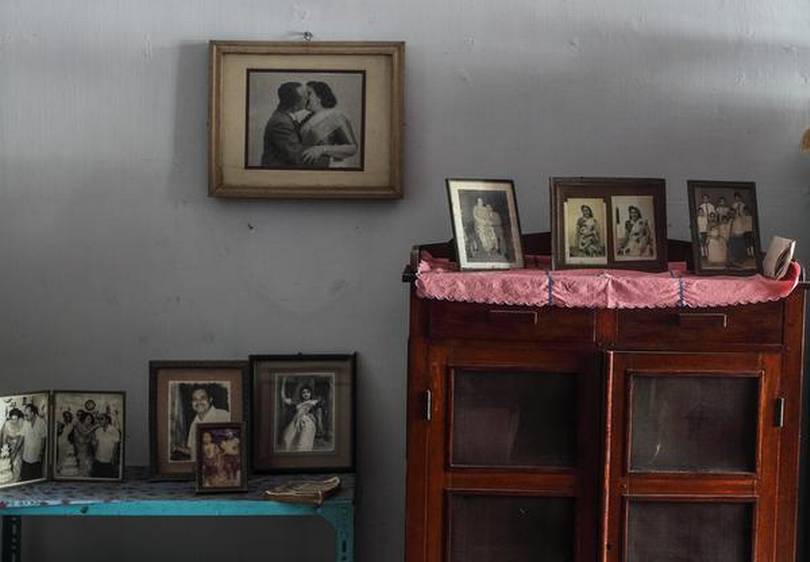
Sepia-tinted memories: A corner of the home dedicated to the past. PHOTO: THULASI KAKKAT
Sepia-tinted memories: A corner of the home dedicated to the past.
PHOTO: THULASI KAKKAT


Mr. Ibrahim found a place in the hearts of the Cohens and the Jewish community as a whole. The middle-school dropout used to earn a few rupees selling souvenir postcards to tourists arriving by ship at the nearby port a quarter century ago. One day, a ship docked and Mr. Ibrahim discovered he had no cards to sell as the place where he had stacked them had been locked by its owner. An inconsolable Mr. Ibrahim found a mentor in Ms. Cohen’s husband, Jacob, who allowed him to store the cards at his place. It soon developed into a familial tie, which got Mr. Ibrahim to take care of Ms. Cohen after Jacob’s death some 15 years ago.

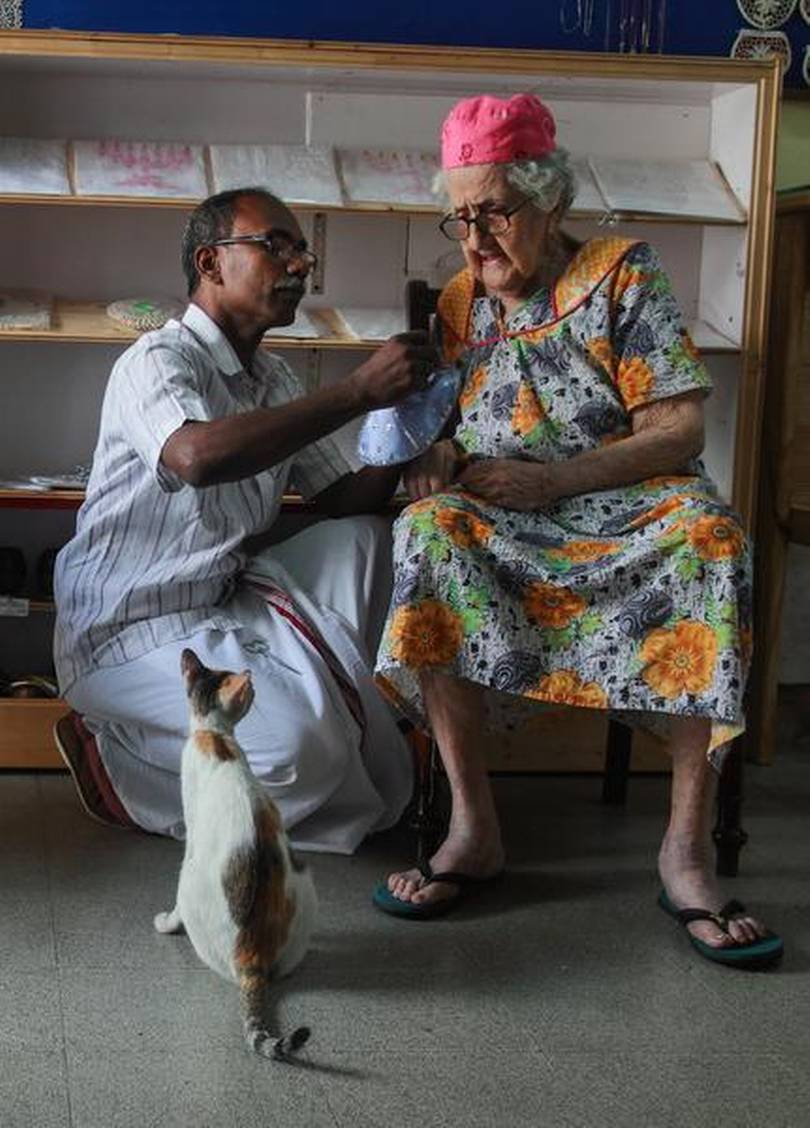
A job shared: Thaha helps Sarah embroider a Kippa, the Jewish skullcap. PHOTO: THULASI KAKKAT
A job shared: Thaha helps Sarah embroider a Kippa, the Jewish skullcap.
PHOTO: THULASI KAKKAT

Mr. Ibrahim and his wife have been a pillar of support for Ms. Cohen, who runs an embroidery shop at the mouth of the narrow alley leading up to Pardesi Synagogue. They take care of the household and run errands for her.

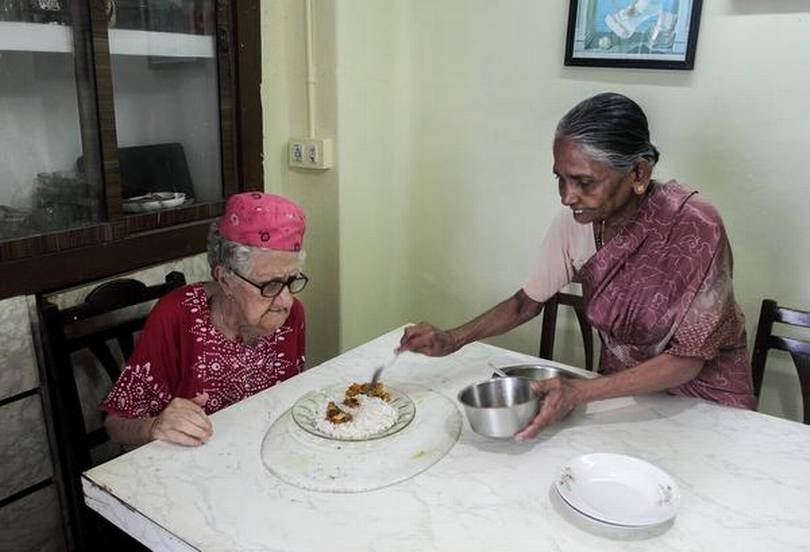
Simple repast: Seli serving lunch to Sarah. PHOTO: THULASI KAKKAT
Simple repast: Seli serving lunch to Sarah.
PHOTO: THULASI KAKKAT

They are like children to the childless matriarch, who is as much a Jew as she is part of the multicultural mosaic of west Kochi. Seli, Ms. Cohen’s Christian maid, who has been by her side for over a decade, adds to the mix.

Text and images by Thulasi Kakkat

source: http://www.thehindu.com / The Hindu / Home> News> States> Kerala / by Thulasi Kakkat / May 28th, 2017

Memorial for Hyder Ali, Tipu Sultan to be opened by CM

Dindigul , TAMIL NADU :

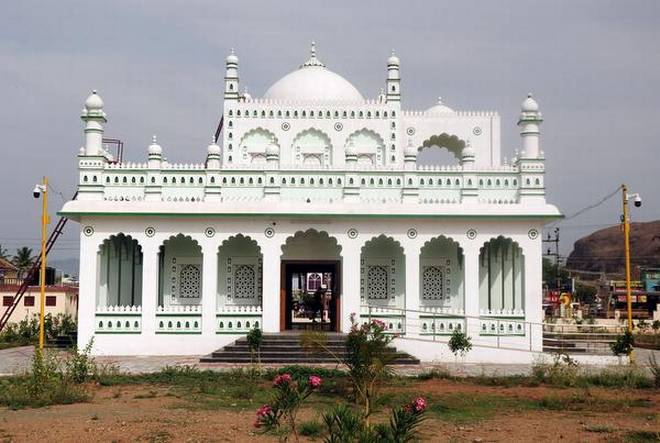
The Tipu Sultan memorial in Dindigul.

A manimandapam meant for Hyder Ali and Tipu Sultan, constructed near Aranmanaikulam at Anguvilas Irakkam here, would be inaugurated by Chief Minister Edappadi K Palaniswami shortly, said Minister for Information and Publicity Kadambur Raju.

Inspecting the manimandapam here on Saturday, he said the late Chief Minister J. Jayalalithaa had announced a manimandapam for Tipu Sultan under 110 Rule in the Assembly and also sanctioned funds to the tune of for ₹1.30 crore for the construction.

Now, the construction was over and manimandapam was ready for inauguration, he said.

While inspecting the Gopal Naickar Manimandapam at Virupatchi near Palani, the Minister said this manimandapam was constructed at a cost of ₹69 lakh to enable the public to know valour of this great warrior during the freedom struggle.

He asked Collector T.G. Vinay to display signboards on both sides of the Palani-Dindigul Highway to enable people to identify the place easily. Additional funds would be sanctioned for improving infrastructure and creating basic amenities for the public in the manimandapam.

source: http://www.thehindu.com / The Hindu / Home> News> Cities> Madurai / by Staff Reporter / May 27th, 2017

High five to 555

Hyderabad, TELANGANA :

Cafe555MPOs03apr2017


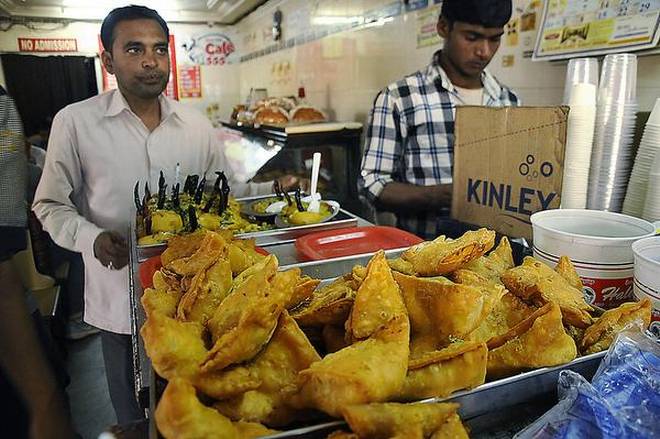
Cafe 555’s Irani chai and haleem draws crowds from most parts of Hyderabad

In a steep lane dominated by biryani joints and residential blocks at Masab Tank, Café 555 is just a few metres away from one of the busiest roads in the city that connects one to Jubilee Hills, Panjagutta and Khairatabad. Their chai is so well known that you’re not amused by their tagline that reads, ‘Don’t drink and drive, Drink only Café 555 ki chai and drive.’ The café that enters its silver jubilee year in 2017 is now owned by Ali Raza Jowker and draws most of its crowds from the nearby Ahmed Nagar apart from other parts of the city.

Their chai was first sold at Rs 1.50. Now priced at Rs 10, nothing betters the warmth that their cup of Irani chai to begin your day or energise you on a tired evening. Most customers prefer to savour it with the crisp irani samosa. If you with to indulge in something sweet to go with it, there is the popular ‘bun butter’ option.

The cafe is frequented by a number of actors from Telugu film fraternity. Sania Mirza too makes it a point to visit Cafe 555 when in town. It not just their chai that’s popular — the manager Mohammed Ali proudly shows us the award the café won for its haleem.

The sight of Cafe 555 during the Ramzan season is a delight to your senses with its multi-coloured lights during the night adding to the festive aura. The haleem prepared by Ali Raza’s grandfather was a hit with the Nizams too, says the manager.

A cafe has other options as well; their quintessential dal rice and poori are sought out items during breakfast and lunch times. No full-course meal feels complete without the Lassi here. What makes Cafe 555 ideal is also their ability to cater to foodies with diverse choices over the years.

Employees from the nearby Telugu Samkshema Bhavan, Tribal Musuem, tailoring and stationery shops continue to see the cafe as a companion that has transformed itself and evolved with changing customer tastes without losing its charming nativity.

source: http://www.thehindu.com / The Hindu / Home> Life & Style> Food / by Srivathsan Nadadhur / April 03rd, 2017

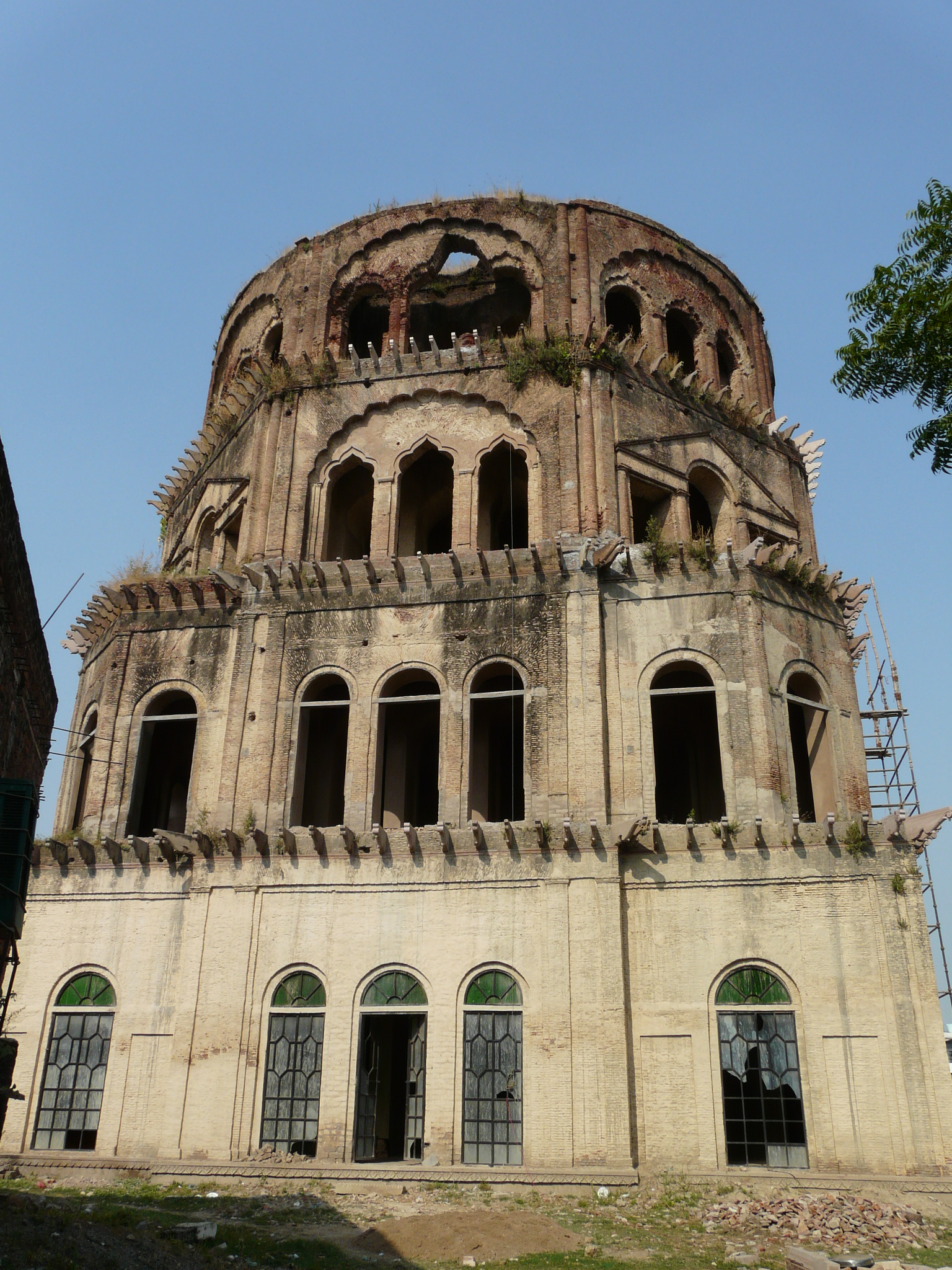
After years of neglect, glass top to complete Satkhanda.

Lucknow, UTTAR PRADESH :

Wikimedia Commons
Wikimedia Commons

Lucknow :

The 177-year-old iconic Satkhanda in Husainabad area of old Lucknow is finally going to live up to its name, of ‘seven storeys’, with the proposed glass roof to the monument taking shape, completing the unfinished Nawabi era structure. The iron storeys which will hold the glass have already come up. Part of the Husainabad beautification project, it is likely to be completed in six months.

Conserving the interiors of the monument along with keeping its circular staircase intact, the building will now provide people with an aerial view of the beautified area through the 360-degree glass facade. With a roof on top now, the monument won’t be subjected to rain water either.

“The plan is to conserve the monument and let people experience the building in its original form. Even though the glass roof covering will be on the uppermost storey, it will give the viewer the experience of being on the seventh floor because of the elevated height. The roof on top of this will be flat,” said Tracy, who is part of the Noida-based architecture firm working on the plan.

The Satkhanda, originally meant to be seven-storey-high was built in 1837 by Mohammad Ali Shah, the third King of Awadh, for moon-sighting by clerics. However, with his death, the monument was left incomplete at just four storeys. Considering it a bad omen, no other ruler bothered to complete it.

In the initial phase of the beautification work in 2014, only the park around then dilapidated monument was part of the plan. Converting the empty ground into a park with light fixtures, fountains, swings and a bridge was completed around November, 2014. Between 2011-13, restoration work on Satkhanda started. An approximate Rs 50 lakh was spent on the initial restoration that included getting rid of encroachment, grouting cracks, restoring parapet brackets, construction of a new roof and a Chhota Imambara-inspired dome. However, apart from removal of encroachment, nothing else was done then.

source: http://www.timesofindia.indiatimes.com / The Times of India / News> City News> Lucknow news / TNN / February 28th, 2017

Bengaluru had its first date with air show a century ago

Bengaluru, KARNATAKA :

HIGHLIGHTS

  • Bengaluru had its first date with an air show 106 years ago
  • In 1911, Jules Wyck and Belgian adventurer Baron Pierre De Caters were the two pilots who brought their aircraft to Bengaluru

__________________________________

Bengaluru :

As the curtains were drawn on the 11th edition of Aero India on Saturday, thousands who thronged the Yelahanka Air Force Station need to know that they are not the first patrons of such a show. In fact, they are not even the first generation.

Bengaluru, India’s aviation capital, had its first date with an air show 106 years ago. February 3, 1911. Cricket hadn’t become the religion it is today in India. The Chinnaswamy Stadium was a barren land, and parts of Bengaluru were still a functional cantonment.

While people from districts neighbouring Bengaluru had made their way back then to catch what the organizers had called a “miracle in the skies,” Bengaluru’s quest for the flying machines remained intact in 2017 with at least three lakh people reported to have visited the aero show.

In 1911, Jules Wyck and Belgian adventurer Baron Pierre De Caters were the two pilots who brought their aircraft to Bengaluru, for a show that garnered a huge response. “But police had been prepared to handle the crowd here, after things had gotten slightly out of hand in Kolkata,” historian Vemagal Somashekar said.

If the elaborate preparations of the organizers a century ago are any indication then it only shows that a lacklustre event, like the 2017 edition of Aero India — just 53 aircraft on display and four aerobatic display teams — may fail to garner similar response in the coming years.

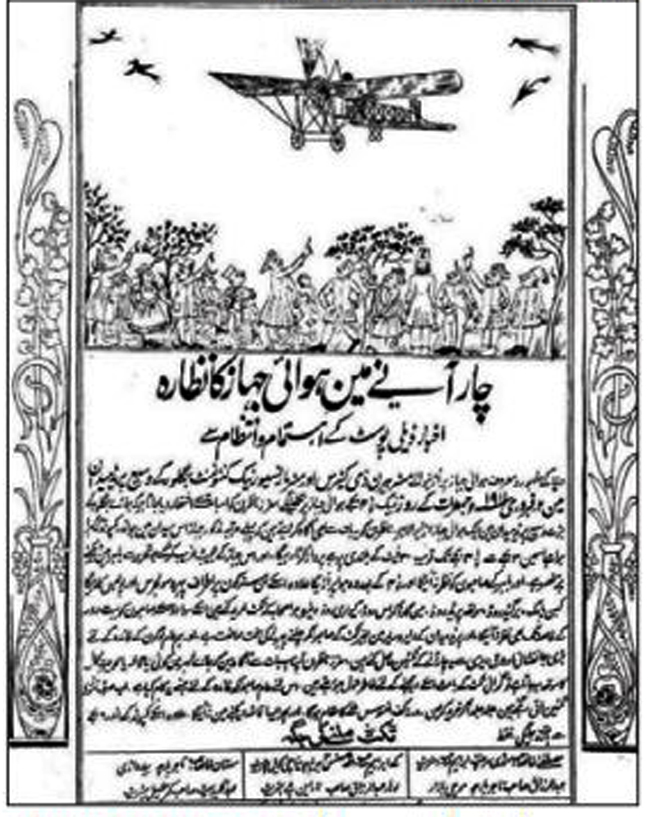
(The poster in Urdu, issued by merchants and businessmen from the Baidwadi (present day Shivajinagar) area. Photo Credit: fly.historicwings.com)

The fact that organizers did not reveal the right number of aircraft at Aero India 2017 is an indication that even they know it. When TOI enquired about the details of the show and the preparations in the run-up to the show, Mayaskar Deo Singh, director, Defence Exhibition Organisation, the nodal government agency organizing the show said: “An official release with final numbers on participation and other details will be issued so that there is no confusion.”

The official release days before the show had claimed that the number of aircraft participating would be 72, as many as the 2015 show, rated much better, had seen. Answering a specific question, defence minister Manohar Parrikar, however, had said on February 14: “There are 53 aircraft participating…”

Also, there are ways to watch the show for free, hundreds of citizens who stood with their cameras on terraces, the highway, some even got hospitality at villages around the air base.

But organizers in 1911 had figured out a plan for such free viewers. A poster in Urdu, issued by merchants and businessmen from the Baidwadi (present day Shivajinagar) area, reveals that the organizers, who had learnt that people would not buy tickets as they thought planes could be spotted even otherwise, had organized the show in such a way that only those with tickets (worth 25 paise each) had a one-hour exclusive.

“…Between 3.30pm and 4.30pm the planes will fly at a height of just 30 metre which only the ticket holders can see. For a few minutes after 4.30pm, the planes will fly a little higher,” reads a translation of the poster documented by the state archives department.

Mustafa Khan (mandi merchants, Ibrahim Sahib Street); Abdul Razak (businessman, Modi Road); Ibrahim Sahib (Meenakshi Kovil Street), Abdul Razak Sahib (steel merchant, Narayan Pillai Street) and Mastan Khan from Baidwadi (present day Shivajinagar) were the men who had signed off on the poster —they are an indication of how Bengaluru had a good trade set-up.
While TOI got a look at the poster, permission to take a photograph was denied. The poster, which has been sourced from fly.historicwings.com, further reveals as Somashekar had pointed out.

Police had been ordered to patrol major roads leading to the venue such as South Parade Road (now MG Road), Brigade Road and Church Street and even in Cubbon Park.

source: http://www.timesofindia.indiatimes.com / The Times of India / Home> News> City News> Bangalore News / Chethan Kumar, TNN / February 20th, 2017

History repeats itself

Chennai, TAMIL NADU :

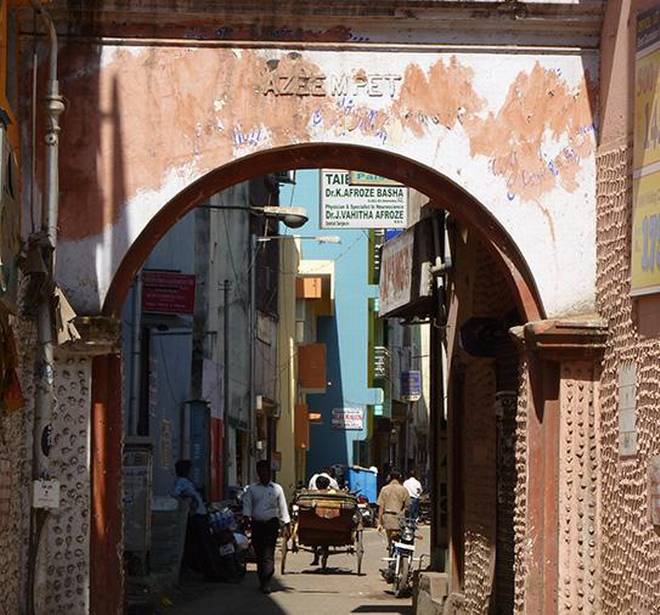
Kaman Darwaza in Chennai | Photo Credit: Kombai Anwar

Madras was in the eye of a power storm, 200 years ago

An ailing or aged ruler triggering a political crisis is not something new in Indian history, but what is interesting about the recent drama that unfolded in Chennai has its parallels to a power struggle that Madras was witness to a little more than 200 years ago. The drama then too had an ailing ruler, various aspirants including a ‘sister’ scheming to take over power upon his death, and a Governor keenly assessing the situation.

The only visible token of the dramatic events that unfolded in 1801 when Umdatu’l-Umara, the Nawab of Arcot, died, is a nondescript arch with the name ‘Azeempet’ chiselled on it, that still stands on Chennai’s Triplicane High Road, a few yards away from the Walajah Mosque. It is a reminder of sibling love that turned bitter and ultimately led to the dramatic fall of the House of Arcot, paving the way for the East India Company to establish itself firmly in the saddle and change the course of Indian history. Old timers remember this arch as the gateway, ‘Kaman-Darwaza,’ to the palace of Sultanu’n-nisa Begam, the daughter of Nawab Muhammad Ali Walajah and sister to Nawab Umdatu’l-Umara.

Nawab Umdatu’l-Umara, who succeeded Muhammad Ali Walajah upon the latter’s death in 1795, was very fond of his sisters, especially his senior sister (meaning the eldest of his younger sisters) Sultanun’n-nisa, also known as Buddi Begum. Sultanu’n-nisa was equally fond of her brother so much so that, out of concern for his safety, and to ward off evil, she used to send everyday a rupee coin to the Nawab, which he would dutifully tie it on his upper arm.The Nawab very often spent his evenings at the palace of his senior sister, listening to musicians, watching a dance recital or just having dinner. He had a room in her house, where the Nawab met with his officers and others. It was widely believed that Sultanu’n-nisa was the actual power behind the throne. Somewhere down the line, Sultanu’n-nisa had assumed that her son Raisul Umara would succeed her brother to the throne. But she was not the only one eyeing the throne, as the Nawab himself would lament – “I intend my son for the throne; Sayful Mulk (the Nawab’s younger brother) intends that the throne is for him; my senior sister has in mind that her son is meant for the throne after me; and the firangs (foreigners – the East India Company) are waiting for their opportunity. But it shall be as the Supreme Ruler wills.” The Nawab wrote a will on his deathbed, making his son Tajul Umara his successor, a move that enraged his sister, who felt betrayed. It was an opportunity too good to miss for the firangs, who were looking for an excuse to take over the Carnatic entirely.The English used the simmering anger of Sultanu’n-nisa and spread the rumour that a coup against the Nawab was in the offing. With the connivance of Nawab’s Diwan, Col. Barret, they surrounded the ailing Nawab with the Company’s troops.

When Nawab Umdatu’l-Umara died in 1801, a bitter Sultanu’n-nisa would not forgive her brother. She refused to let the coffin pass through the Kaman-Darwaza. It had to be left the whole night with guards in a hall opposite the arch. After failing to persuade his aunt to let the coffin through, Tajul Umara, son of the deceased Nawab, decided to break the wall behind Nusrat-mahall and send the coffin to Trichy, to be buried next to the tomb of his grandfather Nawab Walajah.

This power struggle enabled Governor Edward Clive to make a man of Company’s choice as the next Nawab, a man who was willing to sign away the Kingdom, which the young Tajul Umara, the rightful successor, refused to do. Umara’s cousin Azim-Ud-Daula was anointed as the next Nawab. Tajul Umara died within a few months. Sultanu’n-nisa and her son left for a Hajj pilgrimage and chose to settle down in the holy city of Karbala in Iraq, where she eventually died.

Two hundred years later, the arch still stands, a mute witness to the bitter power struggle that not just led to the tragic fall of the House of Arcot .

Kombai Anwar is a writer, photographer and film maker.

source: http://www.thehindu.com // Th Hindu / Home> Society> History & Culture / by Kombai S. Anwar / February 17th, 2017

Dance ballet to help Lucknow find connect with Wajid Ali Shah

Lucknow, UTTAR PRADESH :

Lucknow :

A tribute to Nawab Wajid Ali Shah, a patron of classical dance and music, is set to come in the form of a dance ballet with the city witnessing its first Kathak on sufi qawwali. ‘Rang’, the hour-long dance ballet is directed by Muzaffar Ali and would feature at the fourth edition of the Annual Nawab Wajid Ali Shah Festival to be performed at Dilkusha Garden on February 14.

This year’s edition of the festival that is organised by the Rumi Foundation and supported by UP tourism department happens to fall on UP Tourism Day too. The ballet would be performed by Anuj Mishra of the Lucknow gharaana. It would depict the Nawab’s emotional conflict while he left his motherland for Matiaburj along with ten thousand followers.

The dance ballet is inspired by the compositions of the nawab. Other attractions of the evening would be Kathak performances from the Lucknow and Delhi gharanaas and Oddissi on sufi qawwali.

Speaking about the event, Ali said, “Wajid Ali Shah was perhaps the only Avadh ruler who promoted Lakhnawi culture. He was a learned man himself and was well versed in dance and poetry. Thus, this event is a tribute to the Nawab. It’s just a small effort to showcase the talent of the person. And also to make people aware of their rich heritage and carry the legacy forward through the festival.

“The youth today believes in taking life easy. They believe in instant gratification. Unko azaadi ki pehli jung aur Wajid Ali Shah ki baatein kahaaniyan lagti hain. So, the focus of the youth has to be put in the right place first,” said a member of the Young Rumi Forum.

source: http://www.timesofindia.indiatimes.com / The Times of India / News> City News> Lucknow News / TNN / February 12th, 2017

Mahboob Ali Pasha: Legend with a lavish lifestyle

Hyderabad . ANDHRA PRADESH :

Mahboob Ali Pasha
Mahboob Ali Pasha

The sixth Nizam Mahboob Ali Pasha is remembered for combining tradition with modernity

Among the rulers of all the native states in British India, Mahboob Ali Pasha, the sixth Nizam of Hyderabad is reputed to have had the most lavish court. Born in August, 1866, Mahboob came to the throne at the age of three after the death of his father, Afzal ud Daulah. Mahboob Ali, thus knew no day when he was not the King.

A Regency under Sir Salar Jung I was set up for the young Nizam till he came of age. The Viceroy, Lord Ripon came to Hyderabad for the investiture ceremony held on February 5, 1884 and presented the Nizam a diamond-studded gold sword on the occasion.

Mahboob Ali was a perfect example of a Victorian Prince. He had a great taste for western culture and modern ways of life.

His English tutor, Major John Clark (who had earlier tutored the Duke of Edinburgh) had instilled in young Mahboob the customs and manners of high English society. As a result he imbibed great taste for all that was western. His western etiquette was so perfect that there was a rumour among the courtiers that the Nizam visited European countries incognito without the knowledge of any one!

His obsession for clothes and cars was legendary. His collection of garments was one of the most extensive in the world of his time.

The best English tailors were brought to Hyderabad to stitch the Royal robes combining tradition with modernity. There was a new dress for every day and he never wore the same dress for the second time.

It is no wonder that Mahboob Ali had a huge wardrobe in his palace that ran for more than hundred feet in length, considered to be the longest in the world. As his wardrobe was on the first floor of the palace, a lift was fitted for the Nizam to access his wardrobe every day with ease.

It is interesting to note that this hand-operated wooden lift at the Purani Haveli palace, in its shining best is still in perfect working condition.

His passion for cars was unparalleled and owned a good fleet of them. A Rolls Royce Silver Ghost that was made to order but delivered after he died in 1911, is now on display in the Chowmahalla palace fully restored, due to the efforts of Princess Esra Jah wife of the present Mukharam Jah.

The resources of the Nizam as well as the spirit of the times to which he belonged never discouraged lavish spending of money. Hyderabad came to be known for Mahboob Ali’s extravagant entertainments and lavish hunting expeditions.

Interest in medicine

It was under Mahboob Ali’s patronage, that Hyderabad Chloroform Commission was set up in 1889 and Chloroform as a safe anesthesia agent in surgeries was proved by Dr. Edward Lawrie, Principal of Hyderabad Medical School. The Nizam was personally interested in the work of the Commission. Two Hyderabadi doctors, Dr. M.G. Naidu (husband of Sarojini Naidu) and Dr. S. Mallanna (father of the future Gen. S.M. Srinagesh) were sent to England with funds provided by the Nizam to prove the efficacy of Chloroform in surgeries.

The British Medical Association journal, Lancet, hailed the work of this Commission. Mahaboob Ali, personally being interested in healing was famously known to administer a herb-based medicine to cure snake bite. During his reign, the first Hyderabad- Nagpur Railway line was laid in 1874. The advent of telegraph, telephone and electricity opened up Hyderabad towards economic growth.

Chirag Ali, a well known educationalist from Aligarh was invited by Mahboob Ali to spread English education in the Nizam’s dominions. Mahboob College in Secunderabad and Nizam College in Hyderabad stand testimony to the development of higher education initiated by Mahaboob Ali Khan. Aghornath Chattoadhyay, the father of Sarojini Naidu, the first Indian to have obtained Ph.D in Biology from Edinburgh University, was the first principal of the Nizam College.

Mahboob Ali Khan was a good polo player and an excellent marksman. He was probably the first Indian prince to have a court photographer, Deen Dayal. With his wonderful skills in photography, Deen Dayal, on whom the Nizam conferred the title, Raja, immortalised the Nizam and his times. Raja Deen Dayal employed in his studio an English lady to help him in taking the photos of the women members in the Nizam’s Palace.

Mahaboob Ali passed away on August 29, 1911 when he was hardly 45 years and was succeeded by his son, Mir Osman Ali Khan, regarded as the world’s richest man but the most frugal of all the Nizams, an antithesis to his flamboyant father.

Among the numerous expensive jewels that Mahboob possessed during his reign was the famous Jacob Diamond weighing 162 Carats, bought from the reputed London jeweller, Jacob.

Years later, Osman Ali Khan used this fabulous diamond, said to be next only to Kohinoor, as paper weight, the purpose for which Mahaboob Ali bought it.

Mahboob Ali also ever lives in the minds of the gastronomists, be the natives or visitors to this city for the aroma and the taste of the distinct Hyderabadi dhum biryani, the perfection for which the Nizam, Mahboob Ali Pasha justifiably took pride.

source: http://www.thehindu.com / The Hindu / Home> Society> History & Culture / by K.S.S.Seshan / February 02nd, 2017

Mobile museum of rocks, minerals

Pune, MAHARASHTRA :

RockMPOs30jan2017

 Makki has rare collection of stones: Makki owns over 1,000 exhibits worth several crores

Huge claws of a T-Rex dinosaur that would take you to the world of Steven Spielberg’s Jurassic Park, massive amethyst crystals and a meteorite that fell in Siberia in Russia that remind of Carl Sagan’s Cosmos are part of his collection. Besides them, he owns hundreds of small precious stones, which would hold visitors in awe and expose them to a new world of stones.

Interestingly, all these are held by one man and he answers to the name of Makki. He is virtually a mobile museum. Whether it is something extra-terrestrial or buried in mounds or deep inside the earth, he has almost everything. He has ruby, agate, amethyst and many more.

“You need to touch them, feel them and experience them,” says 68-year-old Muhammad Fasihuddin Makki about his exhibits. He is not touchy about anyone touching specimens and insists that students need to be brought closer to them to change their perspective about stones.

Collecting and selling stones are his hobby as well as profession. “It’s my passion and I love it… my bread and butter are minerals,” he said. “I am taking stones to the doorstep of people for them to develop love for them,” said Makki, who has no formal training in geology. In fact, Makki is a Master’s in English and calls himself a “pujari of Laxmi and Saraswati”.

The Pune-based Makki is the founder of Matrix India and also runs a touring museum. His personal collection is displayed in exhibitions across India. He has participated in several exhibitions, conferences and auctions abroad. He has been supplying rocks and minerals to schools and colleges. He also runs one of the biggest agencies in the world involved in exporting and importing rocks and minerals.

“We offer a variety of minerals from spectacular specimens for collectors to large stock of supplies to wholesale buyers. We have a ready stock of different rough materials from India and we regularly add to our inventory freshly mined new specimens from the Deccan Traps,” said Makki. They also supply boulders and large colourful rocks for landscaping and interior decoration.

Makki is a member of various associations, including Minerological Society of India, Minerological Society of America, Collectors Society of India, Volcanological Society of India, Euromineral France and Mineralientage Germany.

The family of Makki hails from Karnataka and his father was into collecting minerals. “I picked it up from him,” he said. It has been close to five decades into this profession and hobby. “I love this and it keeps me going,” he said. He takes over 1,000 specimens for exhibitions and their value will be several crores.

“I do not charge any money or take remuneration.The institutions where I arrange these mineral and fossil exhibitions arrange for my accommodation and for my two or three assistants. The organisers bear the cost of transporting exhibits like stones from Pune. Some of the exhibits are quite heavy and many of them weigh more than 100 kg,” he said.

His son Sami has started helping him in the business and in arranging these educational earth science exhibitions.

The most precious among the specimens in his collection is a meteorite. It looks small but it is over 8 kg, he smiles. “It fell in 1947 in Sikhote-Alin in Siberia. In 1994, I visited an exhibition in the United States, where this was auctioned…. I did not hesitate, bid for it and bought it… it was quite a sum, but it is a rare collection,” he says.

He recently held “Exhibition of Rocks, Minerals & Archaeological Antiques” and it was hosted by the Centre for Extra-Mural Studies (CEMS) of the University of Mumbai in collaboration with the INSTUCEN (India Study Centre) Trust, and the Deccan College of Pune. “I want people to touch them, photograph them… it is a kind of a bond…it is a rock. Minerals do not have life, but once you touch and feel it, you are in a totally different world,” he says passionately.

He said, “The trilobites are over 400 million years old. These are the oldest fossils with me. Dinosaurs became extinct 60 million years ago. I have dinosaur fossils with me and in fact children love to see them. They often want to touch and see and I do not object. Today one can see dinosaurs in films or on television. When children see a live claw or egg or remains they get excited,” points out Makki.

Explaining how he goes about his collection, he said: “I do mining and collection from all parts of India. I have set aside a lot of large exotic colourful mineral specimens as my personal collection and in addition to that I also acquire many different kinds of colourful and interesting mineral specimens found in other countries. I buy from other dealers or exchange with my specimens and in this way over the years I have accumulated a huge collection of colourful crystalline mineral specimens from all over the world.”

India, he says, is a treasure house of minerals and the Geological Society of India and Geological Survey of India have been doing a great job. “Collection and exhibition of rocks and minerals offer good careers,” he claims.

source: http://www.deccanherald.com / Deccan Herald / Home> Special Features / by Mrityunjay Bose  in Mumbai / DHNS – January 29th, 2017