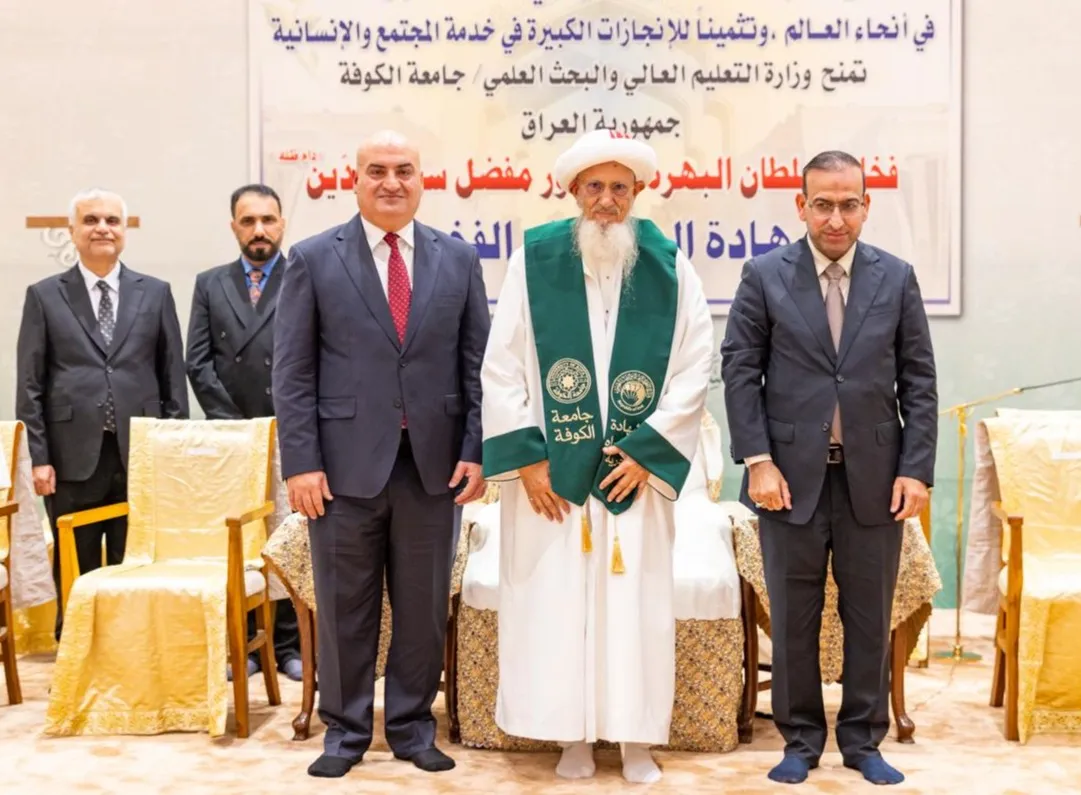
In recognition of his global contributions toward academic excellence, cultural preservation, and social welfare, the University of Kufa has conferred an Honorary Doctorate upon His Holiness Syedna Mufaddal Saifuddin, the 53rd al-Dai al-Mutlaq and leader of the worldwide Dawoodi Bohra community.
A distinguished Iraqi delegation, led by Prof. Dr Hayder Abed Dhahad, Senior Undersecretary of the Ministry of Higher Education and Scientific Research, and Prof. Dr Alaa Naji Almawla, President of the University of Kufa, conferred the degree upon Syedna Mufaddal Saifuddin at a ceremony held in Surat.
“The Diamond City of Surat serves as a fitting venue to honour His Holiness,” stated Prof. Dr Haider Abed Dhahad. “As his ancestral home and the principal seat of Aljamea-tus-Saifiyah, which for centuries has stood as the premier educational hub of the Dawoodi Bohra community, Surat embodies a rich legacy of scholarly excellence. Conferring this honorary doctorate here underscores our shared dedication to knowledge, culture, and humanitarian values.”
Echoing these sentiments, Prof. Dr Alaa Naji Almawla said, “His Holiness Syedna Mufaddal Saifuddin has demonstrated an unwavering commitment to education, heritage preservation, and global social upliftment. This doctorate honours his efforts in connecting higher learning with selfless social service, offering an inspiring model of compassionate and visionary leadership to our institution and academic communities worldwide.”
He added, “By presenting this honour to His Holiness, the University of Kufa recognises the enduring bond between classical scholarship and global humanitarian action.”
A Legacy of Academic and Social Leadership
Syedna Mufaddal Saifuddin has consistently emphasised the role of education as the cornerstone of societal development. He has served as Chancellor of Aligarh Muslim University and is the present Chancellor of Jamia Millia Islamia and the patron of Aljamea-tus-Saifiyah, the community’s premier Arabic academy; he champions a holistic educational framework integrating classical humanities with modern science.
Beyond academia, Syedna’s leadership spans extensive environmental stewardship, healthcare access, and community development initiatives across the globe.
Located in the Najaf Governorate of Iraq, the University of Kufa is a prominent seat of higher learning and academic research operating under the Ministry of Higher Education and Scientific Research, Republic of Iraq. The university, with 40,000 students, encompasses diverse faculties across medicine, humanities, jurisprudence, and natural sciences.
source: http://www.muslimmirror.com / Muslim Mirror / Home> Positive Story / by Muslim Mirror / September 21st, 2026
Muslim Mirror’s 100 Most Influential Muslims of 2025
New Delhi:
Muslim Mirror has released its much-anticipated annual list of the “100 Most Influential Indian Muslims of 2025,” spotlighting individuals who have made significant contributions to India’s public life across a wide spectrum of fields including politics, culture, education, business, media, religion, sports, and social service. Now in its second edition, the list aims to document influence not merely as power or popularity, but as sustained impact, leadership, and the ability to shape public discourse.
A defining feature of the 2025 edition is the growing prominence of younger achievers, signalling a visible generational shift within Indian Muslim leadership. Alongside established national figures, the list includes emerging voices who have built influence through grassroots activism, professional excellence, digital platforms, legal advocacy, education, and community engagement. Editors associated with the project said this was a deliberate attempt to recognise new centres of influence beyond traditional hierarchies.
The list reflects the diversity and plural character of Indian Muslim society, cutting across geography, ideology, profession, and language. From seasoned politicians and religious scholars to artists, entrepreneurs, academics, and social reformers, the compilation offers a broad snapshot of leadership trends at a time when issues of representation, constitutional values, and social justice remain central to national debate.
Representation Across Sectors
The 2025 list features several eminent academicians and intellectuals who have shaped higher education, policy discourse, and social research. Among them are Abul Qasim Nomani, Ameerullah Khan, Furqan Qamar, Shahid Jamil, and Ubaid-ur-Rahman, recognised for their contributions to education, public policy, and academic leadership.
In the business and entrepreneurship category, the list includes influential names such as Azad Moopan, Azim Hashim Premji, Farah Malik, Irfan Razack, M. P. Ahammed, Mecca Rafiq Ahmed, Meraj Manal, Syed Mohamed Beary, P. Mohammed Ali, Shahnaz Hussain, Tausif Ahmad Mirza, Yusuff Ali, and Ziaullah Sharif. Their inclusion underlines the growing economic footprint of Indian Muslim entrepreneurs, both domestically and globally, spanning sectors from retail and healthcare to infrastructure and consumer goods.
Community leadership remains a strong pillar of the list, with figures such as Arshad Madani, Mahmood Madani, Malik Motasim Khan, Mehmood Pracha, Syedna Mufaddal Saifuddin, Navaid Hamid, Pirzada Md Abbas Siddiqui, Qasim Rasool Ilyas, Sadatullah Husaini, Umer Ahmed Ilyasi, and Yusuf Mohamed Abrahani recognised for their roles in religious guidance, legal advocacy, social mobilisation, and institutional leadership.
Culture, Media, and Public Discourse
In arts and entertainment, globally recognised names such as A. R. Rahman, Aamir Khan, Mammootty, Munawar Faruqui, and Shah Rukh Khan continue to command immense cultural influence, shaping narratives that extend well beyond cinema and music into social consciousness.
The list also acknowledges the growing importance of media and journalism in shaping opinion and challenging dominant narratives. Journalists and commentators such as Arfa Khanam, Irfan Meraj, and Seema Mustafa are recognised for their consistent engagement with issues of democracy, minority rights, and constitutional values.
Religious and Intellectual Scholarship
A significant section of the list is devoted to Islamic scholars and religious thinkers, reflecting their continued influence on moral leadership and intellectual discourse. Names such as A. P. Aboobacker Musliyar, Qasim Nomani, Prof. Akhtarul Wase, Asghar Ali Imam Mahdi Salafi, Asjad Raza Khan, Ibraheem Khaleel Al-Bukhari, Javed Jamil, Khalid Saifullah Rahmani, Khaleelur Rahman Sajjad Nomani, Qamaruzzaman Azmi, Rashid Shaz, Shakir Ali Noori, Shamail Nadvi, and Yasoob Abbas find place for their scholarly work, writings, and public engagement.
Politics and Governance
The political category features leaders cutting across party lines and regions, including Asaduddin Owaisi, Ghulam Nabi Azad, Hamid Ansari, Mehbooba Mufti, Omar Abdullah, Salman Khurshid, Najeeb Jung, Syed Naseer Hussain, Engineer Rashid, Akhtarul Iman, Iqra Hasan, Zameer Ahmed Khan, Rakibul Hasan, K. Rahman Khan, Kadir Mohideen, Mohibullah Nadvi, Md Shafi, Agha Mahadi, Asim Waqar, and Sadiq Ali Shihab Thangal. Their inclusion reflects influence exercised through electoral politics, governance, diplomacy, and legislative advocacy.
Changemakers and Social Reformers
One of the most dynamic sections of the 2025 list is that of changemakers and social reformers, featuring individuals such as Safeena Husain, Shahabuddin Yaqoob Quraishi, Syeda Hameed, Zameer Uddin Shah, Mahbubul Hoque, Sabahat S. Azim, Mehmood Pracha, Faiz Syed, and Zahir Ishaq Kazi, among others. Many of these figures have earned recognition through long-term grassroots work rather than formal authority.
International Booker Prize 2025 winner Banu Mushtaq for Heart Lamp, along with renowned poet Wasim Barelvi, has been placed in the category of Literary Figures.
In sports, iconic names Sania Mirza and Irfan Pathan continue to inspire younger generations through excellence and public engagement beyond the playing field.
Beyond Rankings
The editors emphasised that the list does not claim to be exhaustive, nor does it measure influence solely through fame, wealth, or official position. Instead, it seeks to capture real-world impact, moral authority, intellectual contribution, and the ability to shape conversations within and outside the community.
The annual list has increasingly become a reference point for understanding evolving leadership patterns among Indian Muslims. By foregrounding both established figures and rising talents, the 2025 edition reflects continuity as well as change, underscoring how Indian Muslims continue to contribute meaningfully to India’s democratic, cultural, and social field.
source: http://www.muslimmirror.com / Muslim Mirror / Home> Indian Muslim / by Muslim Mirror / January 15th, 2026
Volleyball match at Malindi to celebrate the birthday of Syedna Mufaddal Saifuddin
New Delhi :
The Dawoodi Bohra community living in Nairobi, Mombasa, Eldoret, Nakuru, Tanga, Morogoro, and Arusha in East Africa celebrated the birthday of their spiritual leader, Syedna Mufaddal Saifuddin, in a unique and inspiring way.
A grand volleyball tournament was held in the coastal city of Malindi to mark the occasion, uniting community members in an atmosphere of enthusiasm, sportsmanship, and unity.
Held in mid-October at the recently inaugurated Kutubi Sports Complex, the two-day tournament featured teams from various cities across East Africa. Hundreds of community members travelled to Malindi to participate. The event was not just a sporting competition, but a celebration of the community’s energy, cooperation, and positivity.
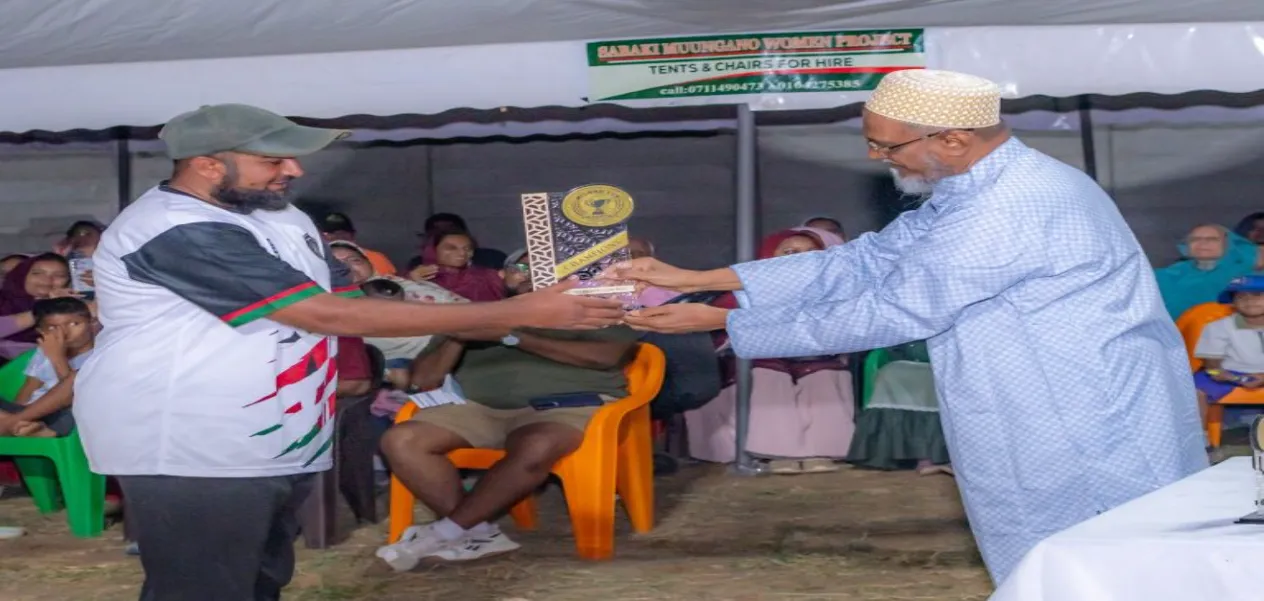
A Bohra leader gives away the trophy to the Captain of the Winning team
“There is no better way to celebate His Holiness Syedna’s birthday than by embracing one of his key teachings, to be physically active, in our lives,” said community member Huzaifa Hunaid.
Although Malindi has a small Dawoodi Bohra community, hosting the tournament filled the locals with pride and confidence. A local member beamed, “It was a proud moment to see our small team successfully organise such a large-scale event. The enthusiasm and positivity on and off the court reflected the true spirit of the event—building new relationships and strengthening old ones.”
The entire community joined in the sports festival. Locals were also present in large numbers in the audience. One spectator said, “We usually come to watch football, but this volleyball tournament brought a new wave of excitement and joy to the city.”
A match of Volleyball to mark the birthday of Bohra Community’s spiritual leader Syedna Mufaddal Saifuddin
The atmosphere at the Qutbi Sports Complex was festive throughout. Community members set up food stalls, serving delicious dishes, and everyone shared in the joy. After the matches, players were seen congratulating each other and exchanging pleasantries—a sight that exemplified brotherhood and affinity.
After the final match, when the winning team’s captain lifted the trophy, the entire arena erupted in applause and chants. Encouraged by the success of this event, the Qutubi Sports Club is now planning to hold a football tournament soon to further this spirit of enthusiasm and unity. The club’s objective is clear: to promote unity, health, and brotherhood through sport among East African communities.
The tournament in Malindi was not only a celebration of Syedna Mufaddal Saifuddin’s birthday but also a reflection of the community’s vibrancy, cooperation, and shared values.
The community feels the event has transformed sport into a bridge of humanity and unity.
source: http://www.awazthevoice.in / Awaz, The Voice / Home> Stories / by Aasha Khosa (edited) / November 06th, 2025