Tag Archives: Muslim Singers of India

‘Talat Mahmood: The Definitive Biography’ is a befitting introduction to a singing genius

Lucknow, UTTAR PRADESH / Mumbai, MAHARASHTRA :

The book reads more like a collection of anecdotes
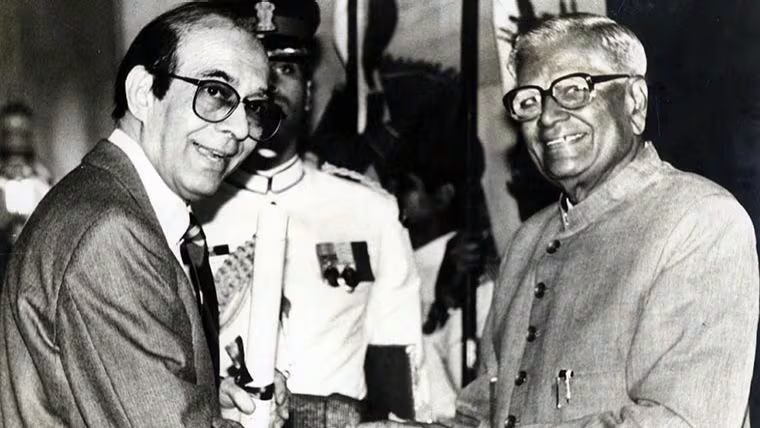
Nation’s pride: Talat Mahmood receiving Padma Bhushan from president R. Venkataraman in 1992 | P. Musthafa

To encapsulate the life of a man often described the ‘King of Ghazals’, though he was much more than that, is no easy task. Just for attempting that, Sahar Zaman deserves applause.

” Mahmood’s musical life was a rich amalgamation of traditions and languages “

Talat Mahmood, born in Lucknow and trained at what was then the Marris College of Music (now Bhatkhande Sanskriti Vishwavidyalaya) was a singer unlike any other. His natural velvet voice bore a slight quiver. It is a quiver which singers take years to cultivate. Musically termed vibrato, this quick and subtle change of voice between notes which are pitched very closely conveys emotions more powerfully than lyrics. When used without dedicated cultivation, a vibrato sounds contrived and the unevenness of breath can be made out by the trained ear; but when it comes naturally, it is as smooth as the wax and wane of emotion. Yet, in his early years in Mumbai, Mahmood strove to hide this unique quality, attempting often to sing in the nasal tones of his idol K.L. Saigal. This would not last long as Anil Biswas, a composer he had worked with for long, angrily walked out of a recording studio asking Mahmood to return only when the real Talat was found.

Ghazals came first to Mahmood because of his affinity with Urdu, and also because of the cultural bearings at home. His father, Manzoor Mahmood, who was a member of the Indian Medical Mission to Ottoman, would often sing to pep up his fellow travellers, while his sisters were flawless renderers of the nath (songs in praise of the Prophet), and his elder brother, Kamal, too, had a rich singing voice. While everyone in the family had strong voices with good throws, Mahmood’s was tuned differently. It was far gentler, almost like a dewdrop caressing a rosebud. It was the kind of voice that could dull the impact of the unkindest of blows. In the 2022 release Gangubai Kathiawadi, for instance, when the lead character learns of being sold to a brothel by her boyfriend, there is a snippet of a song that plays in the background. Mahmood’s voice is like a gentle nuzzle that softens the harsh truth.

Pathos was the most marked emotion of Mahmood’s voice. It was the embodiment of a disembodied, deep sadness. No wonder then that ‘Tragedy King’Dilip Kumar spoke of him as the ‘true musical speaker of my soul’.

Mahmood’s musical life was a rich amalgamation of traditions and languages. Under the name Tapan Kumar, he was a leading voice of the modern Bengal Music movement in which lyrics became as important as the music. He sang in 16 languages including Malayalam, Tamil and Kannada. And while you can close your eyes and imagine him most readily as a dejected Dilip Kumar pictured behind gauzy, fluttering curtains singing ‘Shaam-e-Gham ki qasam’ (On the promise of this sadness soaked evening), close them for some more time and you will just as easily picture him as a boyish Raj Kapoor singing ‘Main dil hun ek armaan bhara’ (I am a heart full of desires), a song that lends itself most readily to the waltz.

As a singer he had many firsts to his name, including being the pioneer of world tours. His pleasant face (which incidentally is also the meaning of Talat) made him a singing-actor and he also dabbled in composition. To audiences in the USA, he was introduced as the Frank Sinatra of India. He became a recognised voice, courtesy All India Radio, at just the age of 16. The book records a delightful incident in which the young Mahmood was accosted by a group of girls in Lucknow to sing as he cycled his way to his music college. Among that gaggle of fans was Qurratulain Hyder, who would go on to become a famed Urdu writer.

He was also a man deeply devoted to the larger cause of his art. He raised his voice for the payment of royalties to singers and also became a part of programmes to raise funds for senior, out-of-work artists. He joyfully gave away songs to Mukesh when he was going through a rough patch. His delight in singing for troops and in encouraging new talent all made him a perfect gentleman, a word often used in the book to describe him.

Biographies can never be divorced from the times that their subjects lived in. Thus, we read in bits about the decline of the film industry in Kolkata after the partition of Bengal, the government’s press for the Bhoodan movement, for which Mahmood sang; the start of recordings in sound-proof rooms; the introduction of multi-instrument orchestra for playback singing; and the rise of version songs. We also read of how the Partition tore apart Mahmood’s family. In a particularly poignant recollection, his father asked his elder son who would water the plants in the courtyard if he left for Pakistan (he did anyway).

The book at places digresses from a linear telling of Mahmood’s story and moves to talking about other stars of the time. This could appear jarring to some, but it is perhaps inevitable given that Mahmood’s journey was intertwined with those of others. One example being that of the actor Shyam, whose death resulting from an accident on a film set is talked about in some detail, to later merge it with the fact that his last three songs, sung by Mahmood, became ‘locked’in his voice.

If you are looking for a book which offers an undeviating narrative of Mahmood’s life, this perhaps is not it. This book reads more like a collection of anecdotes―some known, some not so well known. His gentleness is a quality emphasised throughout the book. He earned it perhaps from spending his formative years with his paternal aunt Mahlaqa Begum. We also come to know that he was a keeper of his words―both to friends and the girlfriend he left in Kolkata.

To those who have known the music of Mahmood, this book is a ready reckoner of his songs and will send you to listen to those you have loved and search for those you have forgotten. To those who do not know the music of Mahmood, take this as a befitting introduction to a singing genius. To do both in under 500 pages, in easy language, peppered with countless photos of the handsome Mahmood, is Zaman’s biggest achievement.
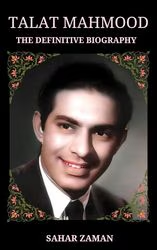
TALAT MAHMOOD: THE DEFINITIVE BIOGRAPHY / Author: Sahar Zaman / Pages: 480

source: http://www.theweek.in / The Week / Home> TheWeek / by Puja Awasthi / February 11th, 2024

She was the love song

Bilgi Town (Bijapur District), KARNATAKA :

Amirbai Karnataki is one of the earliest Kannada singer-actress who made it big in Hindi cinema. She went to Bombay when women artistes were labelled ‘fallen’, but with grit and passion Amirbai became a star and sang 380 songs in 150 Kannada and Hindi films.

Amirbai’s tale is one of inspiration

For someone who didn’t belong to the gramophone generation but the golden period of radio, Lata Mangeshkar, Asha Bhonsle, Mukesh, and Rafi ruled our hearts and constituted our imagination of a film song. The same AIR, during a light music programme, had played “Ninnane Neneyuta Ratriya Kalede”. This, was a carbon copy of Lata’s memorable “Saari Saari Raat Teri Yaad Sataye”, but the voice was starkly different. It had a heavy nasal tone, and the flawless rendition had a simplicity to it. The charming song left an indelible mark and I felt I had to recover her voice from pages that were unknown to me.

Amirbai Karnataki was an unheard voice for the Seventies: she was long gone, and had faded into the archives of black and white era of early films. She was someone who lived on in personal memories of people who had known and heard her.

Amirbai Karnataki (1912-65), who sang 380 songs in 150 films, was an early singer and actress of Hindi cinema. This singer who sang the unforgettable “Main to pavan chali hoon bole papiha” and “Bairan Nindiya Kyon Nahi Aaye”, was born in Bijapur in Karnataka. During the 1930s Amirbai was a prominent name along with stars like Suraiyya, Shamshad Begum, Noor Jahan and Zohrabai Ambalewali.

When Lata Mangeshkar came on to the scene, many of these singers moved into the background and for the later generations they remained unknown.

Born into a family of artistes, Amirbai’s parents Ameenabi and Husensaab worked for a theatre company and even ran one for many years. Growing up years for Amirbai and her five siblings was filled with music and theatre, what with many of her uncles and aunts being top musicians and actors in theatre. She lost her father early and her uncle, Hatel Saheb took care of all the children.

During those years, Bijapur was part of Mumbai Presidency and the sangeet natak tradition in these parts was flourishing. The famous Balagandharva’s company and several other theatre companies camped at Bijapur; Amirbai and her sister Goharbai, trained as they were in classical music, impressed these companies with their singing and they began to not only sing for several of them, but also act.

As Rahmat Tarikere writes in his biography of Amirbai Karnataki, Amirbai moved from Bijapur to Mumbai, from theatre to films. But the exact date and nature of these movements and transitions are hard to tell. The story of Amirbai is a sum total of several happenings in a historical period as there are few definitive documents to lead us to any accurate picture. Painstakingly put together by the biographer, Tarikere says that when Amirbai reached Mumbai (it was perhaps the year of Alam Ara’s release, 1931), women who worked in films, theatre and music were still seen as “fallen”.

Women artistes were often ridiculed as “free women” and among the several women performers, Amirbai and her sister Goharbai too, tried to free women of this stigma. In fact, families not only disowned such women, but there were instances of women being killed for choosing the arts.

In fact, Rahmat Tarikere says that the kind of fight these women put up with the social circumstances of those days is no less significant than the freedom struggle itself. If women artistes, in the later years, earned fame and reputation, it was because of the sacrifices these women made. Ironically, two very popular films “Basant” and “Kismet” in which Amirbai acted deals with the plight of actresses.

Amirbai became a very reputed singer and actress of her times. She was highly paid, and even built a theatre Amir Talkies in Bijapur. She travelled the length and breadth of North Karnataka giving programmes related to theatre and cinema.

A singer who sang some of the finest love songs, had a very unhappy love life though. Tarikere writes how her husband, a Parsi actor who played villain in those days, Himalayavala, abused her physically and emotionally. She had to suffer several assaults from him and even separation became a painful affair. Unable to recover from the trauma, she went into oblivion for several years, and later Badri Kanchawala, with his love and care brought back peace into her life.

At the age of 55, Amirbai passed away; Karnataka had been unified by then and the rest of Karnataka hardly knew of her. Even the newspapers reported her death four days later. It was only later that people have slowly learnt of Amirbai’s greatness and how Gandhiji was immensely fond of her rendition of “Vaishnava Janato”.

source: http://www.thehindu.com / The Hindu / Home> Features> MetroPlus / by Deepa Ganesh / February 27th, 2015

14-year-old Mohammad Faiz from Jodhpur wins Superstar Singer 2, takes home Rs 15 lakh

Jodhpur, RAJASTHAN:

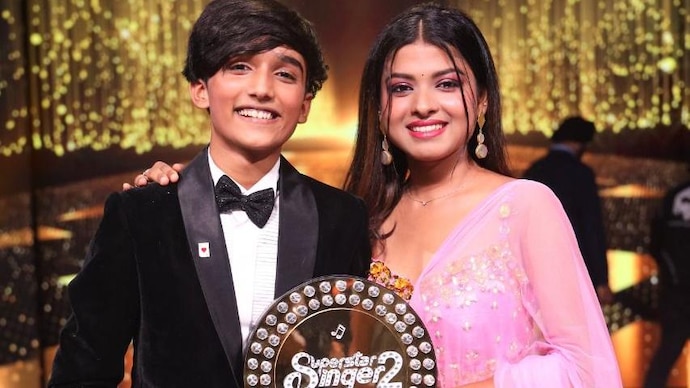
Mohammad Faiz from Jodhpur won the second season of Superstar Singer. He took home Rs 15 lakh.

14-year-old Mohammad Faiz from Jodhpur wins Superstar Singer 2, takes home Rs 15 lakh
Mohammad Faiz with captain Arunita Kinjal.

 Sony Entertainment Television’s kids singing reality show, Superstar Singer 2 has finally found this season’s winner! With judges Himesh Reshammiya, Alka Yagnik and Javed Ali, the contestants truly came a long way. Making it to the top six were Mohammad Faiz, Mani, Pranjal Biswas, Aryananda R Babu, Rituraj and Sayisha Gupta.

Mohammad Faiz from Jodhpur was declared as the season winner and lifted the coveted Superstar Singer 2 trophy. Along with the trophy, the 14-year-old was also awarded with a cheque of Rs 15 lakh.

Mohammad Faiz Wins SuperStar Singer 2

Aptly titled as the Future Voice of Romance by Akshay Kumar and other B-town celebrities, Mohammad Faiz brought alive his passion for music on stage through his mesmerising performances. With his first performance on the song Khamoshiyan in the audition round, Faiz found a special place in the hearts of the judges and audience alike. From there on, there was no looking back for Faiz as he wowed the judges, audience and all the celebrity guest with his magical voice. He was given the title of India’s young singing sensation by judge Himesh Reshammiya who also gave him an opportunity with his first ever singing break – Merre Liye. Not only this, but memorable moments were when eminent personalities expressed their wish of getting Faiz to sing and work for them one day as a playback singer.

What did Mohammad Faiz Say ?

Mohammad Faiz said, “Being on Superstar Singer 2 is an achievement by itself. When I gave the auditions, never in my wildest dreams did I ever imagine that I will not only be in the TOP 6 but also win the coveted trophy. I am unable to describe this feeling in words, it’s so surreal. It still feels like a dream to me. I would like to thank all the viewers and my fans i.e., Faizians who have showered me with so much of love and votes. I also want to extend my gratitude to everyone who has made my journey on Superstar Singer 2 truly special, especially all the judges and my captain Arunita di, who has been my pillar of strength, believed in me and guided me to make this dream of mine come true. The show has been an enriching experience throughout and has given me friendships that I will treasure forever. I am extremely delighted to have received this opportunity to showcase my talent.”

Arunita Kanjilal, Captain on the Show reacts

Arunita Kanjilal, captain on Superstar Singer 2 said, “Superstar Singer 2 has been the most wonderful experiences of my life that I will cherish forever. Not only did I get to guide some of the most talented young kids as a captain but also got to learn so much from them. I am truly grateful for this journey. Also, I am extremely elated to see our Rockstar Faiz lift the trophy and be crowned as the winner of Superstar Singer 2. This is a huge honour for both of us. I am also very grateful to everyone who has supported and showered their love on Faiz; making him win the coveted title of this season’s ‘Singing Ka Kal.’ I am super proud of Faiz and all the other contestants who have amazed everybody with their melodious voices. I wish all of them lots of love, luck and prosperity for a brighter future.”

What do the Judges say ?

Judge Alka Yagnik said, “Superstar Singer 2 brought forth some of the most bright and young extraordinary singing talent. Seeing them mature, grow and flourish throughout the season has been an experience. Everyone from the top 6 contestants have been outstanding. Faiz is a well-deserved winner, his graph on the show has been so good. He has been one of the best singers the stage has witnessed, and his determination towards music and zeal to win has made him win the coveted title of Superstar Singer. This is just a beautiful beginning of his career and I believe he will go a long way. My wishes and prayers are always with him. May he soar high always in his future endeavors.”

Judge Himesh Reshammiya added, “Extraordinary this is exactly how I would like to describe Superstar Singer 2! All the contestants on the show have marvelled us with such outstanding performances week on week, making it a tough decision for us and the audience to choose the next ‘Singing Ka Kal’. Faiz has been a complete rockstar right from the beginning and has consistently given his best. I am very proud of Faiz, he has always had this spark in him, and his incredible journey on this show speaks for it. My heartiest congratulations to Faiz who has emerged as the winner of Superstar Singer 2. I personally cannot wait to see the success that will follow his way.”

Judge Javed Ali concluded, “Superstar Singer 2 has been a show that has made a special place in the hearts of the audience with the extraordinary singing talent of the ‘Best Bache Ever’. Watching them perform week after week was so heart-warming; Their magical voices deeply touched all of us. And, I am sure all of them will go a long way. I have personally received so many messages and calls praising the kids of the show. The stage of Superstar Singer 2 has given birth to some of the most impeccable talents and has also given some of the most iconic performances that will forever be cherished in the reality show’s hall of fame. I am extremely proud of all the contestants, especially Faiz who is a very well-deserved winner, and I wish him all the luck for a brighter and successful future. Kudos to the whole team of Superstar Singer 2.”

source: http://www.indiatoday.in / India Today / Home> News> Television> Reality TV / by Grace Cyril / Mumbai, September 04th, 2022

Interaction with author of ‘Talat Mahmood – The Velvet Voice’

It will be held at 4.30 p.m. on Saturday

The Manipal University Press will hold the ‘Author Meets Readers’ event ‘From the Horse’s Mouth’ with Manek Premchand — author of the book ‘Talat Mahmood – The Velvet Voice’ — at the AC Seminar Hall on the MIT campus here at 4.30 p.m. on Saturday.

According to a press release issued by Manipal University here on Thursday, Mr. Premchand will share his thoughts and feelings in a conversation with Manipal Centre for Philosophy and Humanities faculty member Gayathri Prabhu.

A film will be screened and that will be followed by a music programme with Premchand and a few others singing Talat Mahmood’s songs.

source: http://www.thehindu.com / The Hindu / Home> National> Karnataka / by Special Correspondent / Manipal – September 25th, 2015