Pakalpara Village (Murshidabad District), WEST BENGAL :
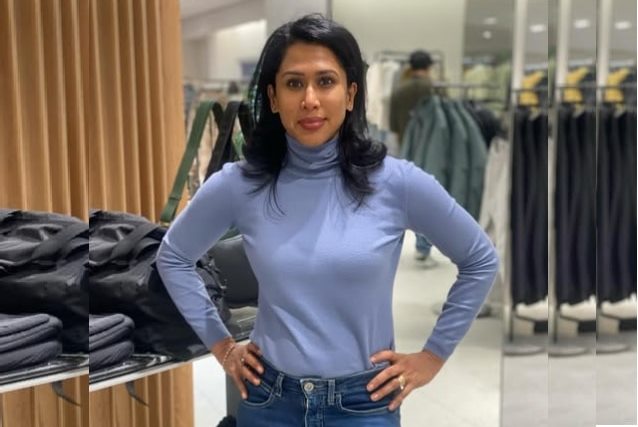
A resident of Pakalpara village, Sana secured an All-India Rank of 764 among 958 candidates recommended in the final list of the 2025 examination, making her eligible for the Indian Revenue Service and other Group-A central government services.
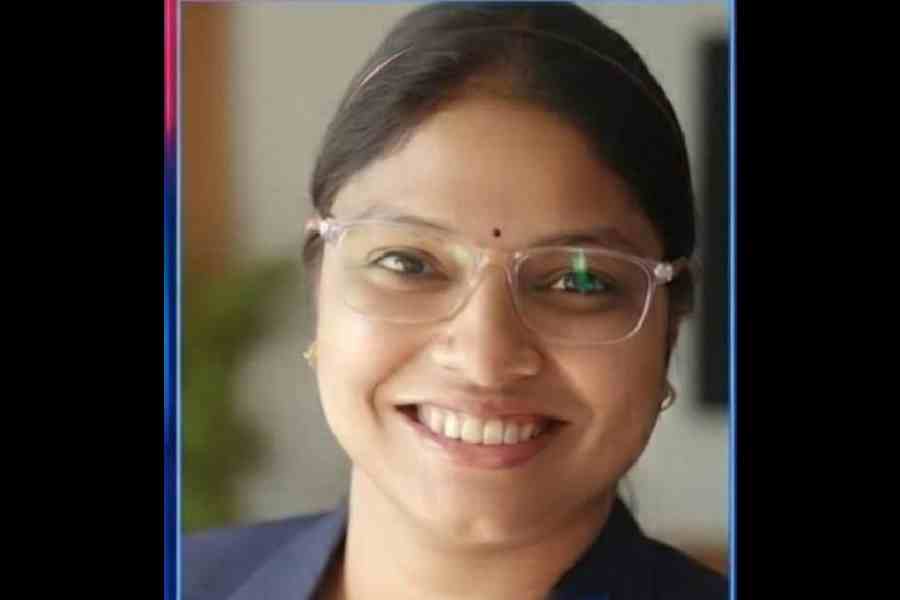
Sana Azmi, a 25-year-old Muslim woman from a modest farming family in Murshidabad’s Sagardighi, brought pride and joy to the region this month by qualifying in the prestigious Civil Services Examination conducted by the Union Public Service Commission (UPSC).
A resident of Pakalpara village, Sana secured an All-India Rank of 764 among 958 candidates recommended in the final list of the 2025 examination, making her eligible for the Indian Revenue Service and other Group-A central government services.
The results of the Civil Services Examination 2025 were declared on March 6.
Though the achievement has been widely celebrated in her village and across Murshidabad district, Sana is dissatisfied with her present rank and has already started preparations to attempt the exam again for a better rank that would enable her to become an Indian Administrative Service (IAS) officer.
The Civil Services Examination, conducted annually by the UPSC, is regarded as one of the toughest in the country with three stages — the preliminary, Main and the personality test/interview. Successful candidates are recommended for appointment to the country’s elite administrative services such as the Indian Foreign Service, Indian Administrative Service, Indian Police Service and Indian Revenue Service.
Born into a large family with limited means, Sana’s UPSC journey has been remarkable on many fronts. Youngest among 10 siblings, Sana grew up in a family focused on education.
That was largely because of her father, Maijuddin Sheikh. A poor farmer with a small patch of land, he had to discontinue his education after Class IX. But he struggled to ensure that all his children, including his seven daughters, received a proper education.
The results of that commitment are now visible.
Two of Sana’s sisters chose to study medicine — one of them, Beauty Khatun, is a doctor at the Burdwan Medical College and Hospital, while another sister is studying MBBS at the North Bengal Medical College and Hospital in Siliguri.
Sana’s success in the UPSC exam has added another feather to the family’s cap.
Sana began her schooling in her native village.
She studied up to Class VIII at Kabilpur High School in a neighbouring village. She later moved to a residential institution run by the Al-Amin Mission, where she completed her Class X and Class XII. She appeared for the Class XII board exams through a high madarsa in Howrah district and stood first in the district.
Then came the big leap.
Encouraged by her family and her own grades, she took admission to the Jamia Millia Islamia in New Delhi, where she graduated in English Honours and completed her MA as well.
During her time in Delhi, she also joined the university’s residential coaching academy for civil services aspirants, where she began a systematic preparation for the UPSC exam.
Remarkably, she cleared the Civil Services Examination in her very first attempt in 2025.
“I had strived hard to crack UPSC, and I thank my family members for their support. I am happy to have done it on my first attempt, but I would not have achieved it without the support of my sister Beauty Khatun. She sent me to Delhi to fulfil my dream. I will take up the job, but ultimately will try to fulfil my dream to become an IAS officer,” said a reclusive Sana, who spoke to the media through her elder brother Md Imran.
Beauty recalled how the family collectively nurtured Sana’s ambition.
“I became a doctor, and another of our sisters is studying MBBS,” she said.
“But we always felt that one of us should become a top civil servant. Sana had that dream. We encouraged her and planned her academic path accordingly. Her admission to Jamia Millia University in Delhi was also part of that plan,” she added.
As congratulations poured in, her mother, homemaker Fulbanu Bibi, couldn’t stop beaming.
“It is a dream come true,” Fulbanu said. “But Sana is not satisfied with the rank she has obtained. Her goal is to become an IAS officer. So she has begun her studies again.”
source: http://www.telegraphindia.com / The Telegraph / Home> West Bengal / by Alamgir Hossain / March 03rd, 2026
From Alwar in Rajasthan to the Mewat belt stretching across Nuh–Palwal, Faridabad in Haryana and the Mathura–Kosi region of Uttar Pradesh, Zahida Khan’s name is a source of inspiration for Mewat.
The first woman MLA from Mewat, Zahida, left her legal practice to enter politics. Today, she is not only a political leader but also a prominent face of Muslim politics in Rajasthan. Her political journey spans from courtrooms to the legislative assembly and the cabinet, and her influence is now clearly felt in the corridors of power.
Zahida Khan carried forward a rich social and political legacy. Her family has a long and distinguished history in Mewat’s politics. From her family, a few names —Chaudhary Mohammad Yasin Khan, Chaudhary Tayyab Hussain – are well known for their contribution to the region’s social and political life. Zahida Khan is the youngest of her four siblings, yet her work has set a new benchmark across the region.
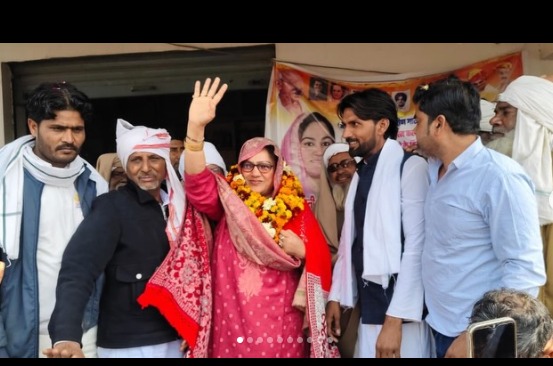
Zahida Khan at a public rally
Zahida Khan, 58, has inherited public life from her family. Her grandfather, Chaudhary Mohammad Yasin Khan—revered in Mewat as Baba-e-Qaum—launched a campaign for education in 1921. He founded the Brain Mew High School, which later became Yasin Mew Degree College.
He dreamed of bringing the Mew community into the national mainstream through education. Yasin Khan was a member of the United Punjab Legislative Council and later a member of the Punjab Legislative Assembly. He also holds the record of being elected unopposed as an MLA in 1957.
During Partition, he opposed the migration of the Mew community to Pakistan and invited Mahatma Gandhi to boost their morale. This is why the Mew community today stands confidently in India.
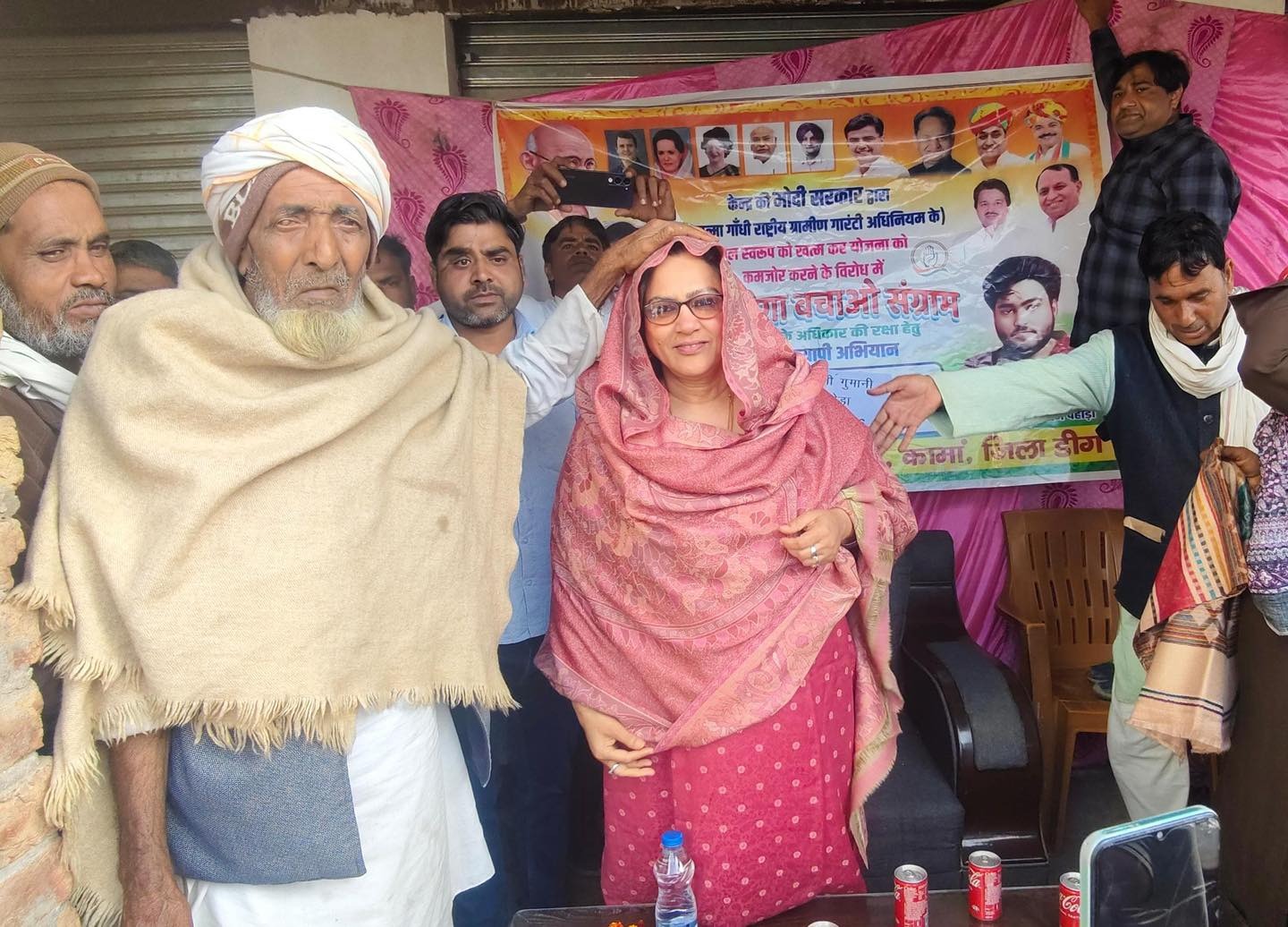
Zahida Khan being blessed by an elderly person
Zahida’s father, Chaudhary Tayyab Hussain, was among the rare Indian politicians who served as a minister in three states—Punjab, Haryana, and Rajasthan. He was an MLA from the Nuh and Taoru regions, served as Chairman of the Waqf Board, and was a strong advocate of education, minority rights, and social justice. His vision and leadership played a key role in organising and developing Mewat.
Zahida’s brother, Zakir Hussain, is the Administrator of the Haryana Waqf Board and has earlier served three terms as MLA from Nuh and Taoru.
Her younger brother, Fazal Hussain, has contested assembly elections from the Tijara region in Rajasthan. Her elder sister is a gynaecologist, and her brother-in-law is an ENT specialist.
Zahida received her early education at JMC School in Delhi and completed her graduation from MDU Rohtak. She earned her LLB degree from Delhi University and practised law at the Delhi High Court before entering Rajasthan politics.
In 2000, when her father, Chaudhary Tayyab Hussain, was a minister in the Gehlot government, panchayat elections were held. The Kama Panchayat Samiti seat was reserved for women. With unanimous support from the local community, Zahida was chosen as the most suitable candidate. She was elected unopposed as Chairperson of the Kama Panchayat Samiti—an achievement that remains a record to this day.
Zahida Khan standing in front of her father’s image
From the outset of her political career, Zahida prioritised social development and education, with a special focus on girls’ education. After her father died in 2008, she contested the state assembly elections on a Congress ticket and won, and became Mewat’s first woman MLA. She was again elected in the 2018 assembly elections. During this period, she served as Rajasthan’s Education Minister and handled portfolios including Education, Science and Technology, Art and Culture, and Printing and Stationery.
Zahida Khan has prioritised education and social justice. She has served as an AICC member, a Rajasthan PCC office-bearer, and General Secretary of the All India Women’s Congress. Her brother Zakir Hussain has furthered the family’s political tradition by serving three terms as MLA in Haryana and Mewat.
Zahida Khan’s husband, Jalees Khan, an electrical engineer by training, chose entrepreneurship over a job. He supports her political work and also manages family responsibilities. He says, “After Chaudhary Tayyab Hussain’s demise, there was consensus in both families—ours and the entire Chaudhary family—that Zahida Khan should enter politics from Kama.”
Zahida’s daughter is a doctor, and her son Sajid Khan is a law graduate. Sajid was elected unopposed as Pradhan of the Pahari Panchayat Samiti. He also manages the family business while fulfilling political responsibilities.
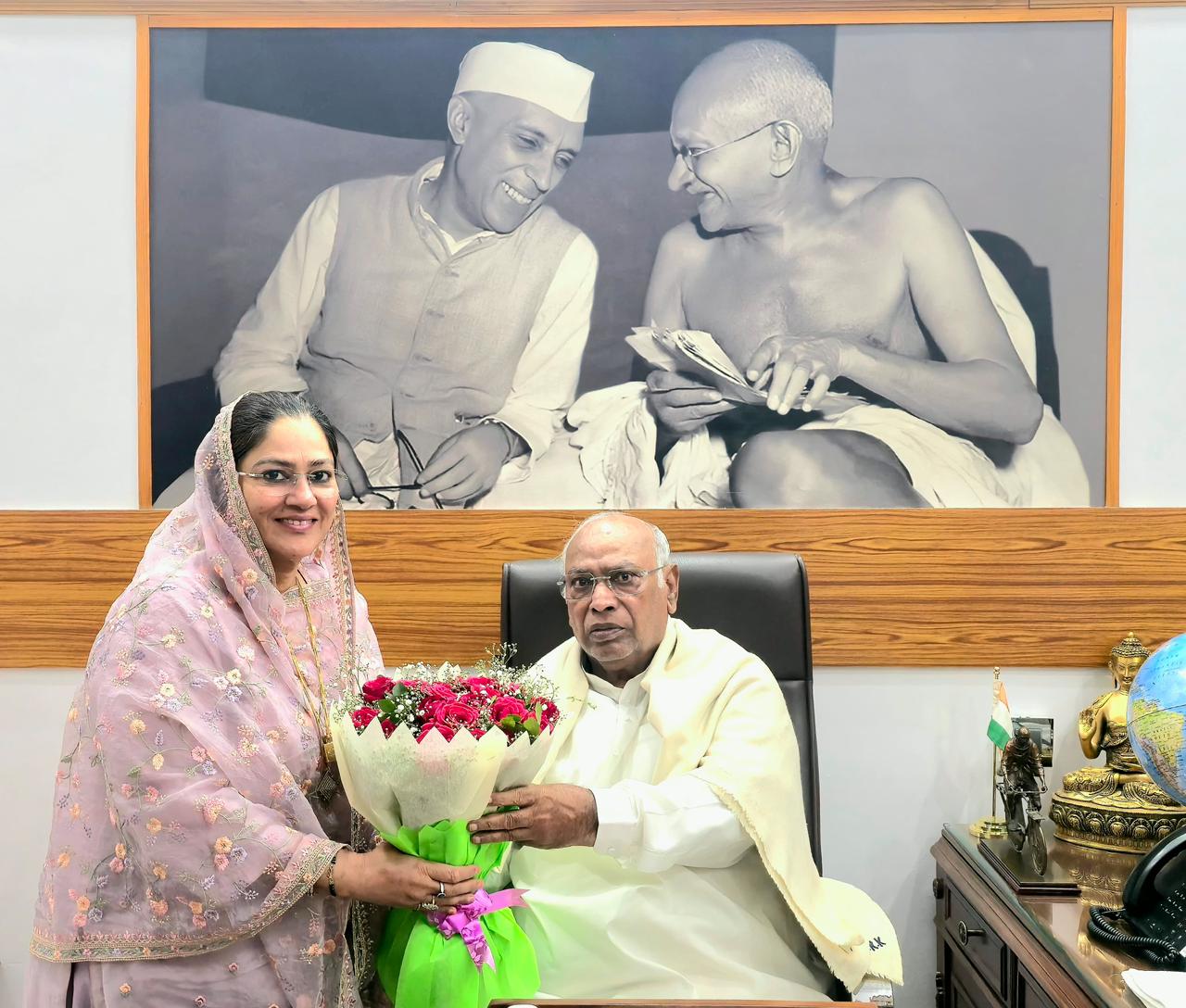
Zahida Khan with Congress President Malikarjun Kharge
The family has given Zahida a complete “free hand,” enabling her to carve out a distinct identity in politics. Because of her work style, assertiveness, clarity, and integrity, people often see a reflection of her father in her.
Former minister Zahida Khan says, “In today’s times, it has become extremely difficult to work in politics with clarity and fairness. Over the past 15–20 years, the political environment has changed significantly, and good people are hesitant to enter politics. Politics is no longer just a medium of service; it has also become linked to business. People now view it from a commercial perspective, which is deeply distressing and worrying for democracy.”
In the history of Mewat’s social and political consciousness, the contribution of a few families has been immensely significant. Without them, the region’s history would be incomplete. Yasin Khan’s emphasis on education, Tayyab Hussain’s political leadership, and Zahida Khan’s women-led politics—this three-generation legacy has become Mewat’s identity.
Zahida Khan’s political journey conveys the message that dedication to service and society is the essence of true politics. Under her leadership, the people of Mewat are moving forward on the path of education and development. This family exemplifies placing service above power, principles above position, and society above politics.
Mewat’s identity—education, politics, and women’s leadership—is the result of three generations of effort and struggle. This is not just the story of one family, but the story of an entire region’s social and political awakening that has fought for education, rights, and self-respect for decades. By carrying forward this legacy, Zahida Khan has opened new paths for women and society in modern politics.
While a lack of clarity and fairness is often felt in today’s politics, leaders like Zahida Khan prove that principles and service to society must remain politics’ core purpose. Her contribution and leadership for Mewat are truly inspiring. Yasin Khan’s educational vision, Tayyab Hussain’s foresight, and Zahida Khan’s women-led leadership together tell the story of making Mewat socially and politically empowered.
source: http://www.awazthevoice.in / Awaz, The Voice / Home> Stories> Leading Muslim Women / by Younus Alvi, Alwar, Rajasthan / March 11th, 2026
Dariyapur Jaka Village (Bulandshahr District), UTTAR PRADESH :
Jamia Millia Islamia’s Nabiya Parvez Secures AIR 29 in UPSC Civil Services Examination 2025.
The Union Public Service Commission (UPSC) has announced the results of the Civil Services Examination 2025, one of the toughest competitive examinations in the world.
According to the official statement, a total of 958 candidates have been selected for appointment to India’s top civil services. These include the Indian Administrative Service (IAS), Indian Foreign Service (IFS), Indian Police Service (IPS), along with several Group A and Group B central services.
Among the successful candidates is Nabiya Parvez, who secured an impressive All India Rank (AIR) 29 in the UPSC CSE 2025. She hails from Dariyapur Jaka village in Bulandshahr district of Uttar Pradesh. Nabiya pursued a Bachelor of Architecture (B.Arch) from Jamia Millia Islamia in New Delhi.
She was also a student of the Residential Coaching Academy (RCA) at Jamia Millia Islamia, which provides guidance to aspirants preparing for civil services examinations.
According to information available on her LinkedIn profile, Nabiya successfully cleared the UPSC Civil Services Examination with AIR 29, placing her among the top 30 candidates in the country.
The UPSC CSE is conducted in three stages: the Preliminary Examination, the Main Examination, and the Interview (Personality Test). The preliminary exam for 2025 was held on May 25, followed by the mains from August 22 to August 31.
The interview process took place in two phases between December 2025 and January 2026. The final merit list was released on March 6, 2026.
The top 10 rank holders of UPSC CSE 2025 include Anuj Agnihotri, Rajeshwari Suve M, Akansh Dhull, Raghav Jhunjhunwala, Ishan Bhatnagar, Zinnia Aurora, A R Rajah Mohaideen, Pakshal Secretry, Astha Jain, and Ujjwal Priyank.
source: http://www.muslimmirror.com / Muslim Mirror / Home> Indian Muslim / by Muslim Mirror Desk / March 08th, 2026
An interview with Nazia Akhtar, the author of ‘Bibi’s Room: Hyderabadi Women and Twentieth-Century Urdu Prose.’
Translator Nazia Akhtar.
‘Bibi’s room’ refers to the space of a woman which purportedly belongs to her but is never hers. Bibi (an affectionate form of address for a woman in Urdu) represents all women whose identity is often ignored in lieu of her duties to her home.
A new book, Bibi’s Room : Hyderabadi Women and Twentieth-Century Urdu Prose studies the lives and works of three Hyderabad Urdu writers, Zeenath Sajida (1924-2009), Najma Nikhat (1936-1997), and Jeelani Bano (b. 1936). The title of the book emerges from an essay by Sajida and is an insightful giveaway into the tone and tenor of the book.
Nazia Akhtar, an Assistant Professor of Literature at the Indian Institute of Information Technology, Hyderabad had no formal education in Urdu or substantial training in literary translation. She learnt Urdu by reading Nikhat’s work and gradually acquired the confidence to expand the scope of her project. Over three years, she delved into the writings and lives of these three writers and studied their milieu and read and wrote about them. The narrative style is informative and educative: it outlines the writer’s personal lives, provides translation of some of their works, and an assessment of what they wrote about.
Akhtar manages to bring to life the stories in all their complexities. Sajida wrote on themes as diverse as gender, the follies and foibles of the Indian middle-class, the literary culture of Urdu circles, and the urban and natural landscapes of her beloved Hyderabad. Nikhat wrote short stories, and Akhtar says she was struck by her poignant depictions of the lives of both working-class and upper-class women in deodis, the urban mansions of the feudal elite of Hyderabad. Meanwhile, Bano, is critically acclaimed and is the recipient of many awards, including the Padma Shri in 2001. Apart from the versatility and longevity of her career as a writer of short stories on gender, class, and communalism, Bano has also written two novels.
Expertly weaving in the lives and stories of these oft neglected writers, Akhtar’s writing is seamless and observes, interprets and reports the cultural practices, status of women and socio-economic conditions of Hyderabad in a newly Independent India. In a conversation with Scroll.in, Akhtar discusses the writers and their expansive oeuvre.
Excerpts from the conversation:
When and why did you start working on the book? What was the idea behind writing a book on Urdu women writers of Hyderabad? The idea for this book came to me in around 2015. I had been working on literary texts in the context of Hyderabad for some time already. Over the years, I had noticed that there were many texts in Urdu that were written by women. As I began to read them and learn more about the writers and the world they lived in, I realised that there was a long tradition of women’s writing in Urdu in Hyderabad that we did not seem to know much about. I started working on this book in earnest when I received a New India Foundation fellowship in 2017. The fellowship made it possible for me to devote all my time to this project.
What made you zero in on these three Urdu writers, what was it about their work that drew them to you? I simply stumbled across two of these writers. The writings of Zeenath Sajida and Najma Nikhat were gifted to me by their respective children, who knew that I was interested in Hyderabad and the literature that was created here in the 20th century. I chose Jeelani Bano because of the longevity of her literary career, and the currency and relevance of her work to the present day.
I also came across other writers, of course, and many books can be written about them too. I chose these three in particular because, first and foremost, I liked them and wanted to write about them. Secondly, I wanted to represent a range of women’s Urdu prose from Hyderabad. These three writers wrote on a variety of themes across different genres but yet had enough in common between them to justify inclusion in one book.
You use the phrase, “thrice marginalised” which I found striking to describe these women writers. What do you mean by this? There is a triple neglect at work behind our forgetting of these Hyderabadi women writers of Urdu. First, they are neglected in the canonical literary historiography of Urdu, which gives short shrift to women’s writing. Apart from the excellent work of Nasiruddin Hashmi and Amena Tahseen, there is little engagement with this hundred-and-fifty-year-old tradition of women’s writing in Hyderabad.
Second, Urdu literary historiography (in both Urdu- and English-language texts) also overlooks Urdu literary traditions in the south, which is ironic given the crucial role the Deccan played in the development of Urdu as a literary language.
Finally, colonial attitudes have persisted in research, so that until recently, the assumption was that princely states were static, medieval entities, where nothing much happened by way of social and cultural progress. Recent research by scholars such as Siobhan Lambert-Hurley, Janaki Nair, and Razak Khan proves otherwise. Bibi’s Room is a part of this shift in perspective.
The themes and characters employed by these writers are inherently plural. They celebrate Hindu festivals, some have written in Telugu and use local character. This syncretic pluralism is fast vanishing today. Do you think that such thinking and writing has space in today’s India? There are still women writers and scholars of Urdu in Hyderabad and other parts of the country who hold on to plural and inclusive values in their journalism and scholarship. But yes, as a country, we are rapidly forgetting the shared, inclusive pasts on which our civilisation is based.
All these writers dispel the notion of a meek submissive Muslim women. You write how Zeenat Sajida’s classes were much sought after and celebrated by students. So in a way these women defy stereotypes. While reading, translating, and writing about them, what is the sense you get of them?
It is not necessary that a piece of writing will demonstrate a writer’s personality. Of course, literature depicts the worldview and priorities of writers, and that is visible in the writings of the three women profiled in this book. All three wrote about women’s lives and concerns, their specific gendered experiences and problems. They wrote about mothers and daughters and about the relationships between women and men, and certainly, they drew from their lived experiences to write about these. They wrote about their city and their country and the politics, society, history, and culture of these places. The context of their lives and location is implicit in their work.
But to find easy equivalences between their lives and writings is difficult. There are a couple of short stories by Nikhat which are clearly drawn from her life. We know this from the diary entries she left behind and from other sources of her life. Scholars have also pointed out that the witty and endearing narrator of Zeenath Sajida’s essays is clearly modelled on her own vivacious and irrepressible self.
All three writers were women with distinct and different personalities. While Sajida was outgoing and vivacious, Bano kept more to herself and was part of a close personal and social circle. Nikhat was a mother who gave up everything to raise her step-daughters. All three writers had to struggle with social and financial circumstances and restrictions and fought hard to achieve what they did, while at the same time, attempting to protect and care for their families and maintain their social and professional relationships and networks.
What has been the influence of these writers on Urdu writing and Hyderabad? Each of these writers has shaped Urdu literary culture in distinct ways. Zeenath Sajida is a prominent figure in a long history of women’s humorous writing, which has received some institutional support in Hyderabad but has been mostly ignored by scholars and translators of the wider world of Urdu literature.
Najma Nikhat held firmly to her Progressive ideals and continued to write in this idiom long after the Progressive Writers’ Movement had waned. She remained an important figure in the Progressive Writers’ Association of Hyderabad till the day she died in 1997.
Jeelani Bano’s skillful deployment of the ideals and principles of at least three schools of literature – Progressive writing, modernism, and abstractism (tajreediyat) – is an education in itself, both for other writers as well as literary scholars. Her two novels take on momentous and difficult chapters of Hyderabad’s history and depict the lives of people and the way these collective and public histories affect their individual and private lives.
How are these stories relevant in today’s India and Hyderabad? Thematically, these stories, essays, and novels deal with many issues associated with identity that are relevant to our country today. They remind us that there are old historical precedents for many of the questions and issues that are being raised today by women – all women in general, and Muslim women in particular. These texts give us an insight into how this generation of women thought and approached these things in the mid-twentieth century and what the environment – that is, the literary circles and socio-cultural networks of their time – were like.
They are also part of a long tradition of women’s writing in Urdu from Hyderabad that fictionally documents the history, landscapes, society, and culture of Hyderabad. These texts give us a sense of the specific history and identity of Urdu in the Deccan and help us to trace the history of specific modes of writing, thought, and engagement in Urdu in this region. The literary essays of Zeenath Sajida, for instance, are an example of a rich but relatively neglected tradition of non-fiction writing by Hyderabadi women on a diverse range of topics that also demonstrates experimentation and skilful use of existing or new literary genres.
source: http://www.scroll.in / Scroll.in / Home> Meet the Translators / by Mallik Thatipalli / November 26th, 2022
Some victories are seen with the eyes, but Jaseela’s is one that truly fills the heart. Defying all odds and turning her personal challenge into an inspiration for differently-abled UPSC aspirants, visually impaired 30-year-old Jaseela Jannath P from Vadakara, Calicut, has secured the 397th rank in the UPSC Civil Services Examination.
This marks Jaseela’s fourth attempt at the exam. Her optional subject, Sociology, reflects her deep passion for social issues, honed through her M.A. in Social Work with a Women-Centred Practice specialisation from the Tata Institute of Social Sciences (TISS), Mumbai. Prior to focusing on her UPSC preparation, Jaseela worked as a Project Associate at Prajaahita Foundation in Kozhikode from July 2021 to March 2022, contributing to community development initiatives.
Jaseela credits much of her success to the one-year UPSC preparation journey covering Prelims, Mains, and interview guidance at Xylem IAS, where she joined the civil services batch in March 2025. Speaking about her learning approach, Jaseela relied on audio-based learning methods, voice-to-text tools, and peer-led discussions to navigate and master the vast syllabus.
“Blindness tested me, but it never defined me. With the right support, including personalised mentorship, innovative tech-aided learning modules, and a supportive community, I was able to crack it,” she said. Looking ahead, Jaseela aspires to serve and empower people facing challenges similar to her own.
Apart from her academic pursuits, she has also established herself as an eloquent public speaker and secured A grades in Mimicry, Vanchippattu (boat song), Folk Song, and Malayalam Recitation at school youth festivals.
Jaseela is the daughter of the late Kunhabdulla P and homemaker Sainaba.
Including Jaseela, a total of 29 students from Xylem IAS have secured ranks in the examination.
source: http://www.businessnewsthisweek.com / Business News This Week / Home> Education / by Neel Achary / March 06th, 2026
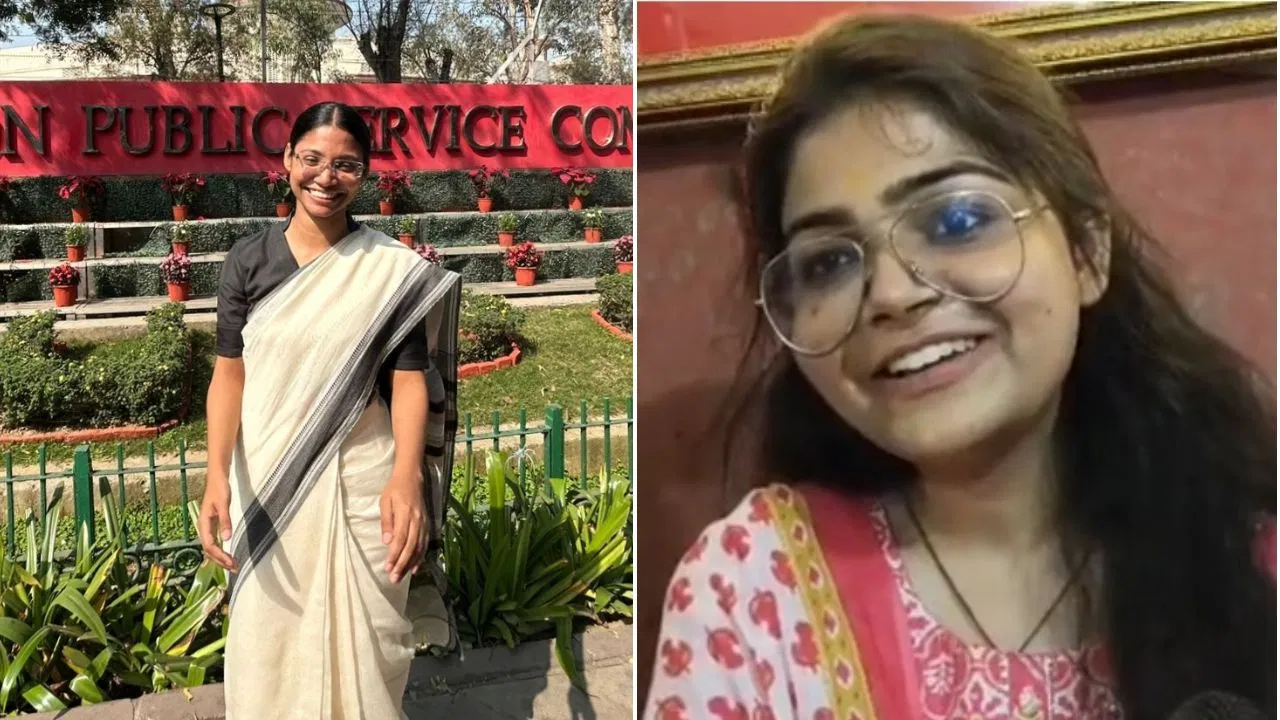
Ishita Sharma (right) and Ifra Shams Ansari (right)
The daughters of Uttar Pradesh achieved remarkable success in the UPSC 2025. Ifrah Shams Ansari of Bhadohi and Ishita Sharma of Gorakhpur brought honor to their state and families by securing high ranks. Their achievement has brought joy to their families.
Daughters from Bhadohi and Gorakhpur districts of Uttar Pradesh have brought glory to the state by passing the UPSC-2025 examination. Bhadohi’s daughter Ifra Shams Ansari achieved All India Rank (AIR) 24, while Gorakhpur’s daughter Ishita Sharma achieved AIR 26. Their success has brought joy to the entire district and family. Ifra Shams Ansari is set to become the district’s first IAS officer.
Ifra Shams Ansari, a resident of Rotahan village in the Chauri Bazaar area of Bhadohi city, has created history by securing an All India Rank of 24 in the prestigious Union Public Service Commission (UPSC-2025) examination. Her father, Shams Ansari, said he could not be happier during this holy month of Ramadan. He said the Indian Administrative Service (IAS) is one of the most prestigious and influential civil services in the country, and his daughter’s selection is a matter of pride for the entire family.
Ifra completed her primary education from Lucknow.
Her father, Shams Ansari, is in the carpet business. He said Ifra completed her primary education at La Martiniere Girls’ College in Lucknow. She then earned a Bachelor of Arts (Honors) in Economics from Lady Shri Ram College for Women in Delhi. She furthered her education by earning a Masters (M.A.) in Economics from the Delhi School of Economics.
Took coaching from RCA
To prepare for the Civil Services Examination, she took coaching from the Residential Coaching Academy (RCA) of Jamia Millia Islamia, after which she successfully cleared the UPSC Civil Services Examination. Her father, Shams Ansari, said that his daughter was inspired to take the exam by her classmate, Shruti Sharma, who had passed the UPSC Civil Services Examination two years earlier and is currently an IAS officer.
Learn where Ifra got her inspiration from.
Shruti Sharma’s success gave Ifra the confidence and inspiration that she too could reach this level. After discussions with her family, she began preparing for the Civil Services Examination. She secured a rank in her first attempt, but due to her relatively low rank, she re-took the exam and secured 24th rank in her second attempt. Shams Ansari further stated that his family always provides full support to children.
Gorakhpur’s daughter created history
Ifrah is the second of their children and is no less important to the family than a son. They said that their daughter has brought them the greatest joy during this holy month of Ramadan. The family wishes that she continues to serve the nation and society with excellence, and that Allah grants her continued success. Ishita Sharma, a resident of Raptinagar, Gorakhpur, is no less. She secured the 26th rank in the UPSC 2025 results in her fourth attempt.
Completed studies from Delhi University
After completing her B.Com and M.Com from Delhi University, Ishita chose commerce as her optional subject. She began preparing for the Civil Services exam while living at home. She made it to the interview stage on her third attempt, but was unsuccessful. However, Ishita secured the 26th rank in the UPSC exam on her fourth attempt. Ishita’s father, DK Sharma, is a bank manager, and her mother, Archana Sharma, is a homemaker.
Passed NET-JRF in the first attempt
Ishita passed the NET-JRF in her first attempt. It was only after that that she began preparing for the civil services. Ishita attributes her success to dedication, hard work, and commitment. She emphasized that choosing an optional subject for the civil services should be thoughtful. She gave full credit for her success to her elder brother. She stated that she would work to improve education while holding this position.
source: http://www.tv9hindi.com / TV9 Bharatvarsh / Home> Hindi News> State> Uttar Pradesh / by Rohit Gupta (Bhadohi) / Pradeep Tiwari (Gorakhpur) / translated from Hindi to English / March 07th, 2026
Angadipuram Village (Perinthalmann Taluk, Malappuram District), KERALA :
Fathima Shehza K has topped the ICAI CA Intermediate January 2026 exam the result of which has been declared on Sunday March 08, 2026.
CA Inter Topper January 2026:
Fathima Shehza K has topped the ICAI CA Intermediate January 2026 exam the result of which has been declared on Sunday March 08, 2026.
As per the results announced by Institute of Chartered Accountants of India (ICAI), Fathima Shehza K secured the All India Rank 2 (AIR 2) in the Chartered Accountancy (CA) Intermediate examination held in January 2026.
Fathima Shehza scored a percentage of 84 per cent with a score of 504 out of the total 600 marks. Fathima Shehza missed the Top Rank by just 4 marks which went to Kanhiya Lal.
Kanhiya Lal bagged 508 out of the total 600 marks and secured the All India Rank 1 (AIR 1) in CA Inter January 2026 exam.
Fathima Shehza is a resident of Perintalmann, Kerala whereas Kanhiya Lal hails from Ellenabad, Haryana.
Faridabad’s Vanya Bansal has secured the 3rd rank with 83 per cent and 498 marks.
Who is Fathima Shehza?
The CA Inter January 2026 Topper, Fathima Shehza is a resident of Angadipuram – a small village of Perintalmann Talka in the Muslim dominated Malappuram district of Kerala.
Fathima had earlier also topped the ICAI CA Foundation exam in January 2025. She had scored 356 marks in CA Foundation exam held for January 2025 session, and had emerged All Kerala Topper.
Talking to media after topping the CA Foundation Exam last year, Fathima had said her target was even higher. “Topping Kerala state is not my target. My dream is to secure the top rank at all India level”, she had said last year.
She is a student of Profinz College – also called Profinz Perinthalmanna, a prominent Commerce (CA, CMA, ACCA, CS) coaching institute in Perinthalmanna, Malappuram district.
After clearing CA Foundation and Intermediate exams, Fathima is is now eligible to start her articleship (practical training) while preparing for CA Final.
ICAI CA Intermediate Result January 2026
Institute of Chartered Accountants of India (ICAI) declared the CA Inter Jan 2026 result on Sunday March 8, 2026.
A total of 1,05,526 candidates had appeared in the CA Inter Jan 2026 Group 1 exams. Out of them, 14,733 candidates cleared the exam, registering a pass percentage of 13.96. CA Inter Group II exam saw a pass percentage of 15.54, with 10,798 candidates clearing the exam out of 69,477 who appeared.
ICAI conducts these exams twice a year, in January and July.
The CA Intermediate January 2026 examinations were conducted in multiple shifts across centres in India and abroad. As per the official schedule, Group I exams were held on January 6, 8 and 10, while Group II exams were conducted on January 15, 17 and 19, 2026.
Candidates who appeared for the exam can check their results on the official websites at icai.nic.in and icai.org.
source: http://www.ummid.com / Ummid.com / Home> Education & Career / by ummid.com news network / March 09th, 2026
As many as 38 candidates from the Residential Coaching Academy (RCA), Centre for Coaching and Career Planning, Jamia Millia Islamia (JMI) have cracked the UPSC Civil Services Examination 2025 the result of which was declared today i.e. Friday March 06, 2026.
UPSC CSE Result 2025:
As many as 38 candidates from the Residential Coaching Academy (RCA), Centre for Coaching and Career Planning, Jamia Millia Islamia (JMI) have cracked the UPSC Civil Services Examination 2025 the result of which was declared today i.e. Friday March 06, 2026.
Significantly, 04 candidates have secured positions within the top 50 ranks and shine at All India Ranks 7, 14, 24, and 29, becoming top performers from the Jamia Millia Islamia, New Delhi.
Among the 38 candidates from the Jamia RCA UPSC Coaching Centre who have successfully qualified in the examination, securing positions in various All India and Central Services, 15 are women candidates.
“This highlights the important role played by Jamia Millia Islamia in promoting equity and inclusivity within the ‘steel frame of India'”, the university said.
List of JMI RCA UPSC CSE 2025 Toppers
A R Rajah Mohaideen (7)
Surabhi Yadav (14)
Ifra Shams Ansari (24)
Nabiya Parvez (29)
Hassan Khan (95)
Navneet Kaur (111)
Sakshi Saxena (151)
Towseef Ahmad Ganai (254)
Anupriya Rai (258)
Ishita Sharma (268)
Md Ishteyaque Rahman (354)
Shadab Ali Khan (415)
Manmohan Tongaria (425)
Muhammed Swalah T A (429)
Abhishek Jayant (441)
Nazia Parween (478)
Kaali Prasad (516)
Gulfiza (535)
Namita Soni (547)
Hashmi Mohammad Umar (549)
Sharukh Khan (575)
Azeem Ahmad (588)
Saista Parwin (614)
Mohd Irfan Kayamkhani (646)
Mohsina Bano (648)
Ghulam Maya Din (663)
Danish Rabbani Khan (665)
Mohd Abuzar Ansari (671)
Muskan Verma (771)
Sneha Yadav (782)
Eslavath Sri Ram Harsha (823)
Ghulam Haider (832)
Pardhuman Seth (853)
Anshul Singh (873)
Vivek Kumar (882)
Lavanya Sp (891)
Borkar Suresh Liladharrao (912)
Md Shahid Raza Khan (955)
About JMI RCA
The Jamia Residential Coaching Academy is renowned in the field of coaching students for Civil Services exams. The academy provides free coaching and training to candidates from SC, ST, Women, and Minority communities who are preparing for the Civil Services Exams and other competitive examinations.
The Jamia RCA provides free coaching and training to the students with a structured learning environment, including a 24×7 library facility and an ecosystem that is one of the best in the country for aspirants of the Civil Services and other competitive examinations.
The academy has consistently given good results in the past, including the UPSC topper in the Civil Services Examination and other Central and State Services toppers. Since its inception, RCA has given more than 600 selections in Civil Services and other Central and State Services.
UPSC Civil Services Result 2025
The Union Public Service Commission or UPSC announced the Civil Services Final Results Friday March 06, 2026. The UPSC declared the list of the UPSC CSE Toppers 2025 based on the result of the written part of Civil Services Examination, 2025 held by the Union Public Service Commission in August, 2025 and the interviews for Personality Test held in December, 2025 – February, 2026.
As many as 53 Muslims have figured in the list of 958 candidates who emerged toppers in the Civil Services 2025 exams.
Anuj Agnihotri has secured All India Rank 1 (AIR 1), and is UPSC Civil Services 2025 All India Topper. Rajeshwari Suve M has bagged the All India Rank 2 (AIR2) and Akansh Dhull has secured the 3rd position (AIR3).
The toppers have been recommended for various Civil Services posts including Indian Administrative Service (IAS), Indian Foreign Service (IFS), Indian Police Service (IPS) and Central Services, Group ‘A’ and Group ‘B’.
Of the total 958 CSE Toppers 2025, 317 are General candidates, 104 EWS, 306 OBC, 158 SC, and 73 ST.
source: http://www.ummid.com / Ummid.com / Home> Education & Career / by ummid.com news network / March 06th, 2026
As many as 53 Muslims figured in the list of 958 candidates who emerged toppers in the Civil Services 2025 exams results of which was declared by the UPSC Friday March 06, 2026.
UPSC Civil Services Result 2025:
As many as 53 Muslims figured in the list of 958 candidates who emerged toppers in the Civil Services 2025 exams results of which was declared by the UPSC Friday March 06, 2026.
As many as 04 Muslims – A R Rajah Mohaideen, Ifra Shams Ansari, Nabiya Parvez and Hassan Khan, figured in the coveted list of Top 100.
The result of Muslims in the Civil Services 2025 exams has improved as compared to the last year when only 26 Muslims had made to the final list.
List of Muslim Toppers with Ranks
1. 7 – 0818306 – A R Rajah Mohaideen 2. 24 – 6409132 – Ifra Shams Ansari 3. 29 – 0806993 – Nabiya Parvez 4. 95 – 0807895 – Hassan Khan 5. 124 – 0323682 – Arfa Usmani 6. 135 – 0607625 – Khan Saima Seraj Ahmed 7. 157 – 0851961 – Wasim Ur Rahman 8. 253 – 0413785 – Sophia Siddiqui 9. 254 – 1801309 – Towseef Ahmad Ganaie 10. 307 – 0830255 – Mantasha 11. 321 – 5811575 – Asad Aqeel 12. 354 – 4116180 – Md Ishteyaque Rahman 13. 382 – 6315003 – Mohammed Ashmil Shah 14. 411 – 1201049 – Shahida Begum S 15. 415 – 0841896 – Shadab Ali Khan 16. 429 – 1412531 – Muhammed Swalah T A 17. 455 – 6303619 – Shoiab 18. 478 – 6408494 – Nazia Parween 19. 485 – 1210110 – Sheik Mohamed Habisudeen S 20. 497 – 1912530 – Sheik Mohamed Nishath M 21. 513 – 5404215 – Minhaj Shakeel 22. 535 – 2105608 – Gulfiza 23. 549 – 6418492 – Hashmi Mohammad Umar 24. 575 – 0864413 – Sharukh Khan 25. 576 – 1907730 – Asna Anwar 26. 581 – 1804448 – Muneeb Afzal Parrah 27. 588 – 6405397 – Azeem Ahmad 28. 614 – 6421470 – Saista Parwin 29. 625 – 8003085 – Noor Alam 30. 646 – 6408831 – Mohd Irfan Kayamkhani 31. 648 – 2602406 – Mohsina Bano 32. 663 – 3402501 – Ghulam Maya Din 33. 665 – 2626864 – Danish Rabbani Khan 34. 668 – 5803808 – Md Nayab Anjum 35. 671 – 6407027 – Mohd Abuzar Ansari 36. 678 – 1139935 – Insa Khan 37. 695 – 5703524 – Abdul Sufiyan K 38. 708 – 2402117 – Fairuz Fathima M 39. 713 – 1904976 – Mohamed Hashim K 40. 718 – 1902416 – Muhammed Suhail 41. 741 – 0328051 – Thousif Ulla Khan 42. 763 – 3403061 – Koh E Safa 43. 764 – 0619109 – Sana Azmi 44. 773 – 4002952 – Reshma M 45. 811 – 3409679 – Yassar Ahmed Bhatti 46. 832 – 3401291 – Ghulam Haider 47. 860 – 1913151 – Mohamed Shezin C P 48. 869 – 3402386 – Mohd Ajaz Ul Rehman 49. 886 – 1804050 – Azhar Asif Khan 50. 936 – 3409886 – Mohd Sarfraz Choudhary 51. 942 – 1224289 – Abdulla Afridh A 52. 955 – 8001862 – Md Shahid Raza Khan 53. 957 – 0869957 – Irfan Ahmed Lone 54 and 55. It now turned out that there are also “Jahana Sareen V P” – having roll number 5702338 and All India Rank 511, and Shiyad, having roll number 1907064 and rank 743, should also be included in the list.
(Disclaimer: The UPSC does not reveal the religious identity of candidates. The above list has been compiled based on the names of candidates as mentioned in the UPSC Main result released by the Commission. Few names are Muslim sounding but are also used by people belonging to more than one religion. Accrodingly, this list is not final. Also some names might have been missing from the list, or if included, they might not be necessarily a Muslim.
UPSC Civil Services Toppers
The UPSC declared the list of UPSC CSE Toppers based on the result of the written part of Civil Services Examination, 2025 held by the Union Public Service Commission in August, 2025 and the interviews for Personality Test held in December, 2025 – February, 2026.
Anuj Agnihotri has secured All India Rank 1 (AIR 1), and is UPSC Civil Services 2025 All India Topper. Rajeshwari Suve M has bagged the All India Rank 2 (AIR2) and Akansh Dhull has secured the 3rd position (AIR3).
The toppers have been recommended for various Civil Services posts including Indian Administrative Service (IAS), Indian Foreign Service (IFS), Indian Police Service (IPS) and Central Services, Group ‘A’ and Group ‘B’.
Of the total 958 CSE Toppers 2025, 317 are General candidates, 104 EWS, 306 OBC, 158 SC, and 73 ST.
Performance of Muslims in Civil Services Since 2009
In 2024, a total of 26 Muslims figured in the list of 1,009 candidates who emerged toppers in the Civil Services 2024 exams result of which was declared by the UPSC on April 22, 2025.
In 2023, a total of 1,016 candidates were recommended by the Union Public Service Commission for different Civil Services posts. Of them 51 were Muslims.
In 2022, a total number of 933 candidates were recommended for IAS, IPS, IFS, IRS and other civil services posts. Of them 30 were Muslims.
In 2021, a total of 685 were recommended in the UPSC Civil Services 2021 Merit List. Of them, 21 were Muslims. This was the worst performance of Muslim candidates in a decade.
On ther hand, a total of 31 Muslims had cracked the Civil Services Exam (CSE), also known as IAS exam, in 2020 when UPSC had recommended 761 candidates for the top CS posts.
In 2019, 42 Muslims had cracked the exam whereas in 2018 just 27 Muslims had made it to the final result.
The years 2016 and 2017 were the brightest period for Muslim candidates. In 2016, 52 Muslims figured in the list of successful candidates whereas in 2017 their tally was 50.
In 2015, 34 Muslims were among the 1,078 candidates recommended by the Union Public Service Commission (UPSC) whereas 38 Muslims were in the list of total 1,236 candidates in 2014.
In 2013, a total of 34 Muslims had cleared the exam, whereas in 2012, 30 Muslims were among the successful candidates, four of them were among top 100.
Similarly in 2012, 30 Muslims were among the successful candidates and in 2011, 31 Muslims were among the 920 selected for the civil services.
Likewise, in 2010 among the 875 successful candidates 21 were Muslims with Dr. Shah Faisal of Kashmir topping the exam at the national level.
In 2009, a total of 31 Muslims were in the list of 791 successful candidates.
source: http://www.ummid.com / Ummid.com / Home> Education & Career / by ummid.com news network / March 09th, 2026
Shama Mohammad, AICC spokesperson and now over a decade in politics, knows all too well the obstacles women face in Indian politics. The numbers speak for themselves: despite the passage of the Women’s Reservation Bill, no Muslim woman from Congress was given a Lok Sabha ticket in 2024, and only two serve as MLAs nationally.
“The biggest obstacles for a woman to progress or survive in politics, especially in Kerala, are men,” she says bluntly. “When I started my journey in Kerala district politics, men in the party felt I can’t make it. And when I started making it, they didn’t like it.”
Shama lists three roadblocks on her way: “First, I am not a dynast, second, I am a woman, and third, I’m a Muslim.”
Unlike Congress, Muslim women like Sofia Firdous in Odisha or Kaneez Fatima in Karnataka, both backed by political families, Shama has no dynastic support. “You won’t find a single Muslim woman in politics who is fighting her way ahead on her own,” she says.
While a party like the Trinamul Congress has actively promoted women — with three out of its five MPs in West Bengal being women — Congress continues to lag,” she adds. (Trinamul Congress has the highest representation of women in Lok Sabha at 38 per cent compared to 13 per cent women by Congress and BJP.)
Her journey into politics didn’t happen overnight. A dentist and then a reporter with ZEE News, Shama grew up in Kuwait, watching debates on BBC, Al Jazeera and other channels with her father, who was passionate about world affairs. “The interest I have today is inherent, as politics is ingrained in my family,” she says.
Known today as a feisty and articulate spokesperson, she developed her political voice over years of actively taking an interest in national and international news, watching and then taking part in media debates, and later, hands-on work in Kerala district politics.
Her media career eventually brought her closer to politics. “I remember watching Manish Sharma, Abhishek Manu Singhvi — my colleagues in AICC now — fighting it out in a war of words on TV evening after evening,” she recalls.
While her job at ZEE News didn’t give her much chance to cover politics, her colleagues recognised her passion, and one of them sent her to meet Randeep Surjewala in the Congress media department. She was soon working for the party, travelling between Pune, where her husband and children were, and Delhi for television debates. “There was no Zoom or Skype then; one had to be physically present for the debates,” she says.
Amidst her work in the media department, she also decided to start working at the district level for the party in her home state of Kerala. But that came with its own challenges. “All this took a huge toll on my children,” she admits. Her elder son was just 14, and her younger was 11 at the time. “But work meant leaving them even as my husband was away in Abu Dhabi again.” Balancing family and political ambitions was a struggle, yet she persisted.
Despite the hurdles, Shama’s commitment to change pushed her on. “I came to politics because I saw rapists, extortionists, and other anti-social elements in Parliament, and we only complain without doing anything about it. So, I wanted to be part of the change,” she says. As a Muslim, she has faced criticism for her faith and assumptions about her patriotism. But this has only made her more resilient: “Because I’m a Muslim, I have to go to Pakistan, I’m a jihadi, I’m anti-national… and I have to take all this,” she adds.
While her progress within the party remains limited due to patriarchy, Shama has turned her energy to grassroots work in Kannur, Kerala, through her Zoya Charitable Trust. “Why I came to politics was to help people, and my trust is in doing precisely that,” she says.
The trust, started in 2018, initially focused on renovating schools, especially following the floods of 2019. It has recently launched a sports school in the district, best known for athlete PT Usha, and another sports school is coming up with funding from the Panchsheel Group, a real estate group. Beyond sports, the trust works on healthcare, education, and women’s empowerment.
Asked what she would like to change about Congress, Shama doesn’t hold back: “Give more tickets to women. Give capable and hardworking women representation as the TMC does.” She knows change is slow, but remains undeterred. “Kerala has 51 per cent women, and if I’m sidelined, I take it as a challenge,” she says. For Shama, being a Muslim and a woman in politics is not just a struggle; it’s a motivation for her to keep pushing, both within her party and through her work at the grassroots.
With Kerala heading once again into election mode, the left-led coalition and the Congress-led coalition will be pitted against each other. Whether her words and vision for women’s representation in politics will become reality remains to be seen, but Shama Mohammad continues her journey, determined to make a difference.
#WATCH | Delhi | On 'Jai Hind Yatra' in all Pradesh Congress Committee (PCC) units today, Congress leader Shama Mohamed says, "We are standing with the army. We are with the country and supporting whatever the government and the army decide. We are showing our support for the… pic.twitter.com/t83hjLe2PG