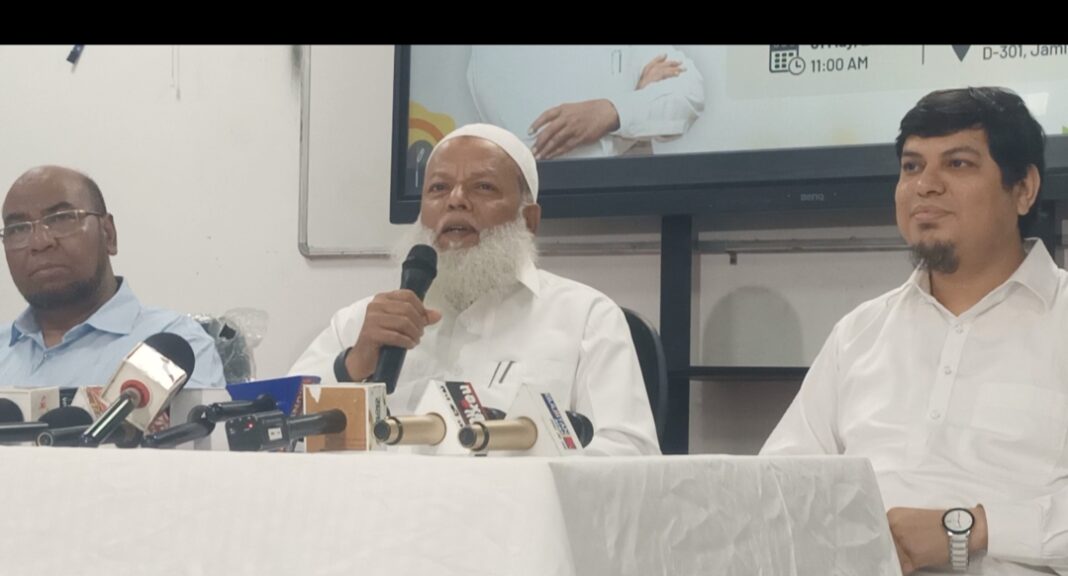
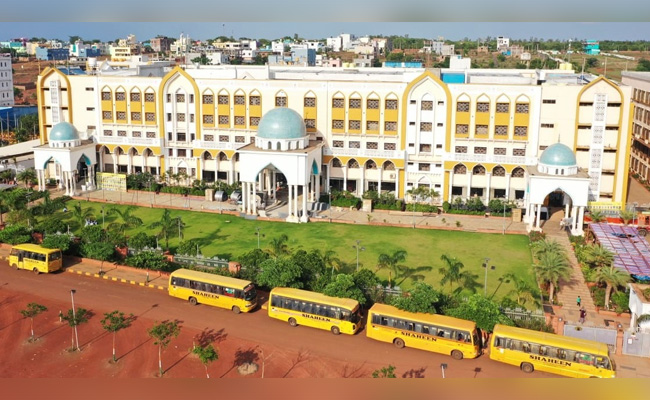
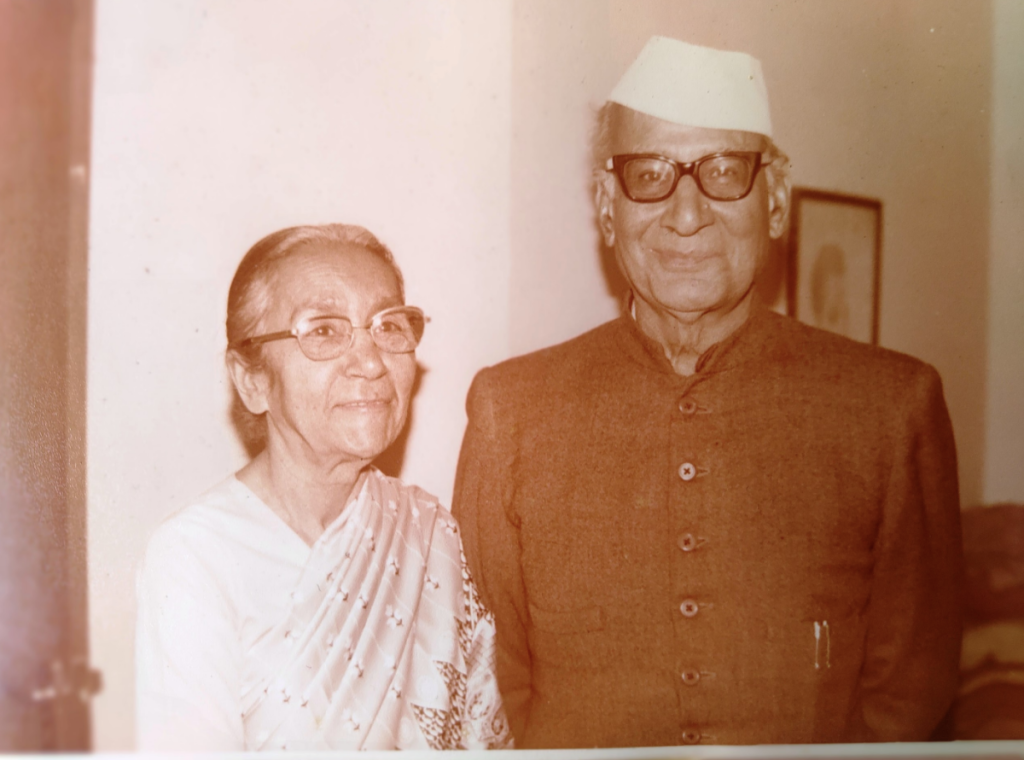
Chairman of Shaheen Group of Institutions Dr Abdul Qadeer (Centre) speaking to mediapersons at Shaheen Grouop’s office in Delhi on Friday(May 1, 2026).
New Delhi :
Dr Abdul Qadeer, founder and chairman of Shaheen Group of Institutions, on Friday announced a series of academic initiatives aimed at promoting inclusive, affordable, and future-oriented education for students from diverse social and economic backgrounds.
Addressing media persons at the Delhi branch of the institution, he said the organisation remains committed to combining academic excellence with social transformation and global educational opportunities.
He formally introduced its flagship programmes covering mainstream education, professional coaching, international schooling, and overseas medical education.
Dr. Qadeer highlighted the role of education in empowering underprivileged communities and integrating students into the mainstream educational system. He said the institution’s programmes are designed to provide personalised learning, mentorship, and structured academic support to help students compete at national and international levels.
One of the major initiatives discussed during the press conference was the “Madrasa Plus” programme. The programme seeks to integrate Madrasa students into formal education through a specialised teaching model featuring a 1:6 teacher-student ratio. According to the institution, the programme has achieved nearly 80 percent success in Class X examinations. It is currently being implemented in more than 100 Madrasas in collaboration with the Government of Karnataka. Officials said the initiative has enabled thousands of students to continue their education within the mainstream system while preserving their religious and cultural identity.
The institution also introduced its “5-Year Integrated Graduation Programme”, which combines higher secondary education with undergraduate studies and Islamic learning. Under the programme, students can pursue undergraduate courses such as BA, BCom, and BCA alongside Alimiyath studies. The programme also includes Hifz support, structured residential facilities, and personalised mentoring aimed at ensuring balanced academic and personal development.
Another major academic initiative announced was the “Pre Plus Two”, a three-year pre-NEET and JEE foundation programme designed for students who have either passed or failed Class X examinations. The programme begins with an Academic Intensive Care Unit (AICU), which focuses on strengthening students’ fundamentals in Mathematics, Science, and Languages through personalised instruction. This is followed by a comprehensive NCERT-based curriculum integrated with NEET and JEE coaching, continuous testing, and mentoring support.
Dr. Qadeer said the programme is intended to help students rebuild confidence and prepare systematically for competitive examinations. He added that many students from disadvantaged educational backgrounds often require individual attention and conceptual clarity, which the programme seeks to provide.
The institution also highlighted its “MBBS Abroad Programme”, aimed at students aspiring to pursue medical education overseas at affordable costs. Under the programme, students can study medicine in countries such as Kyrgyzstan and Tajikistan at an estimated cost of around Rs 28.8 lakh. The institution stated that the programme provides hostel accommodation, food, hospital facilities within the same campus, separate residential arrangements for boys and girls, and complete academic guidance to ensure a secure and supportive environment for students studying abroad.
Another key announcement was related to the Shaheen Australian International School, which offers education through the globally recognised WACE curriculum. The school focuses on inquiry-based learning, critical thinking, and student-centric teaching methods. According to the institution, the school aims to prepare students for international academic and professional opportunities through globally aligned educational practices and value-based learning.
Dr. Qadeer also spoke about the expansion of the institution in the national capital through Shaheen Academy Delhi. He said the Delhi centre will focus particularly on NEET preparation and will follow Shaheen’s established academic model based on discipline, conceptual understanding, and continuous mentorship.
He added that the academy aims to support students from diverse backgrounds and provide them with structured guidance, holistic development, and opportunities to excel in competitive examinations. The expansion, he said, is part of the institution’s broader mission to make quality education accessible across different parts of the country.
The press conference concluded with an interaction between the management and media representatives, during which officials reiterated the institution’s commitment to educational inclusion, skill development, and creating opportunities for socially and economically marginalised students.
source: http://www.indiatomorrow.net / India Tomorrow / Home> Education / by India Tomorrow / May 01st, 2026
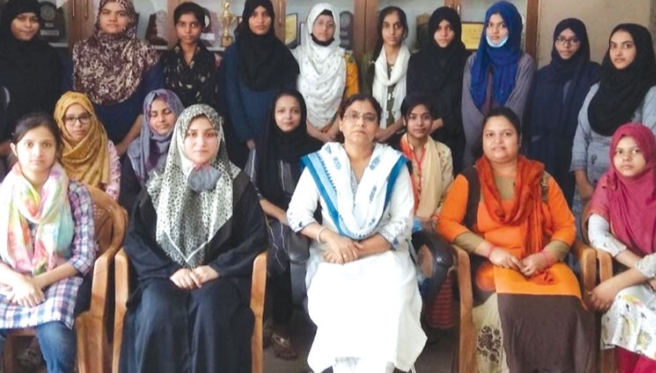
As many as 23 female students of a government school in Jamia Nagar had qualified NEET exam but 22 out of them were not fortunate enough to take admission in any medical institute.
The students told Muslim Mirror that they were not eligible to take admission in any government college as their scores were lower than cut-off ranks issued by the institutes.
However, they were eligible to take admission in private medical colleges but they couldn’t do so because they could not afford education fees mandated by them.
“We are from middle-class family. We cannot afford their fees,” said Madiha, one of the 22 students.
The students were enrolled in Sarvodaya Kanya Vidyalaya, Noor Nagar, Okhla, New Delhi. They are among 569 students of government schools in Delhi who have cleared NEET exam this year.
In October, Delhi ministers had praised the efforts of the NEET qualifiers. Deputy Chief Minister Manish Sisodia had categorically mentioned the Noor Nagar school for the remarkable performance of its students.
After 99% results, Delhi Govt School students set another performance benchmark –
569 students cleared NEET Exam this year.
29 NEET pass outs are from a single Delhi govt school Molarband. 24 from another one in Yamuna vihar and 23 are from one in Noor nagar.
Tasneem Parween, one of the students from the aforementioned school, has managed to take admission in B. Pharma at Meera Bai Polytechnic, a government college in South Delhi. However, the remaining 22 students failed to take admission in any college this year but their efforts have gone in-vain totally.
Jamia Cooperative Bank has come out to help these students get proper coaching and perform better in the next exam. The bank has selected top 10 students and paid their fees [Rs. 40,000 per student] to help them take admission in Aakash Institute. Adiba Ali, Shiza Ali, Bushra Midhat and Ariba are some of the lucky students who has got admission in Aakash with the support of the cooperative bank.
Moreover, Dr Shabana Nadim, former principal of the aforementioned school, has provided financial help to two more students to get coaching from Aakash.
Speaking to Muslim Mirror, the school’s vice principal Mudassir Jahan lauded the efforts of Jamia Cooperative Bank and Mrs Nadim.
The remaining students have also started preparation to appear for the next NEET exam. They are considering to take admissions in various coaching centres at their own, said Ms Sadaf Rais, one of the school teachers.
source: http://www.muslimmirror.com / Muslim Mirror / Home> Indian Muslim / by Hasan Akram / December 29th, 2020
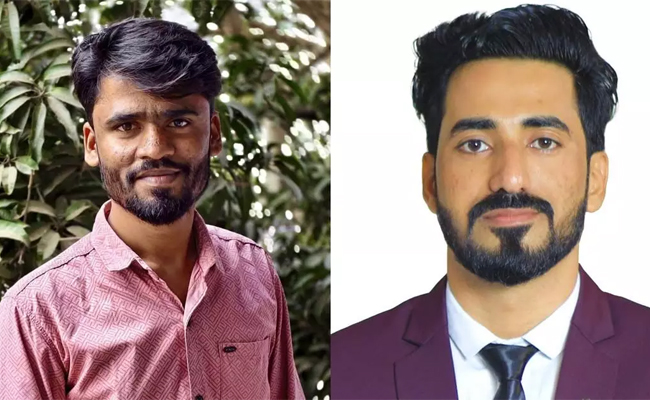
VB scribes Yogesh Malluru, Abdul Rahiman Talapady among awardees
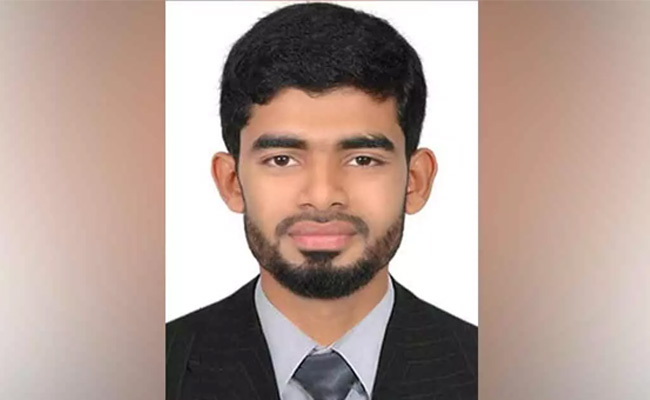
Yogesh Mallur, Abdul Rahiman
Bengaluru:
The Karnataka Union of Working Journalists (KUWJ) has announced its annual awards for the year 2024, recognising journalists across various categories.
Vartha Bharati journalists Yogesh Malluru and Abdul Rahiman Talapady are among the awardees. Yogesh Mallur has been selected for the G. Narayanaswamy Award for Best Rural Reporting, while Abdul Rahiman Talapady has been honoured under the Tagadoor Kamalamma Veeregowda Award for reporting on farmers’ livelihoods and distress.
The awards will be presented at the 40th State Journalists’ Conference to be held in Bidar on April 11 and 12, KUWJ state president Shivanand Tagadur and general secretary G.C. Lokesh said in a release.
Details of the awards:
1. G. Narayanaswamy Award (Best Rural Report) Yogesh Malluru, Vartha Bharati, Bengaluru K.A. Ismail, Shakti, Kodagu
12. Mandibele Shamanna Memorial Award (Rural People’s Life Report) Shankar Katte Malalawadi, Janamitra, Hunsur Shivaraj Sunkada, Mudgal, Lingasugur, Raichur Prashant Pade, Udayavani, Kundapura, Udupi
13. Nadaprabhu Kempegowda Memorial Award (Bengaluru Urban and Rural) H.P. Praveen Prashanth Rippanpet V.S. Honnachar, Leaders Weekly Zukriya, Times of Karnataka
14. Yajaman T. Narayanappa Memorial Award (Best Agricultural Report at District Level)
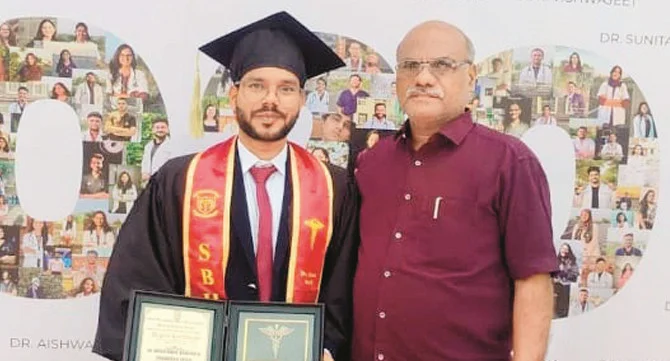
From a cramped one-room chawl in Azmi Nagar to becoming a qualified doctor, Dr Adnan Shahabuddin Ansari’s journey is a powerful example of determination, sacrifice and steady effort under difficult conditions.
Born into a modest family, Adnan grew up in a small home where space and money were both limited. His father, Shahabuddin Ansari, worked in the scrap business. Despite having a low income, the family placed a strong emphasis on education and supported their children with whatever they could afford.
Adnan’s father said, “We always wanted our children to study and move forward in life. Even when it was difficult, we did not give up on their education.”
Adnan’s academic journey was not without its challenges. While studying in class eight, he was diagnosed with tuberculosis and had to undergo long-term treatment at Sion Somaiya Hospital. The illness weakened him physically, but it strengthened his resolve.
Instead of breaking his confidence, the experience made him more focused on becoming a doctor.
He completed his SSC in 2017 from Al-Hamd High School with 84 per cent marks. In 2019, he passed his HSC from KMES Junior College with 88 per cent marks.
After this, he aimed to clear the NEET and enter a medical college.
Adnan moved to Kota for coaching, but his preparation was interrupted due to a serious heart-related health problem. He had to leave coaching and return home for treatment and hospital care.
Even during hospitalisation, he continued studying daily. “I used to study from morning till night, even in the hospital. I could not afford to stop,” Adnan said.
During the COVID-19 lockdown, conditions became even more difficult. Coaching centres were closed and study material was limited. His father supported him by writing question papers by hand so that his preparation could continue.
Despite all challenges, Adnan cleared NEET in 2020 in his first attempt, scoring 585 out of 720 marks. He secured admission in a government medical college and completed his MBBS from Shree Bhausaheb Hire Medical College in Dhule.
His convocation ceremony was recently held, marking the completion of his medical degree.
Adnan and his father expressed gratitude towards the newspaper they regularly read, which played a role in encouraging their educational awareness.
Shahabuddin Ansari said, “For the last 25 years, we have been reading this newspaper regularly. Its education section, interviews and reports always inspired my son. He used to read them with interest.”
He added, “We thank this newspaper for its support and motivation.”
Dr Adnan Ansari now aims to pursue NEET PG and become an MD physician. He hopes to serve society through medical practice and continue his journey in healthcare.
His story reflects how consistent effort, parental support and determination can help overcome even the most difficult circumstances.
source: http://www.clarionindia.net / Clarion India / Home> Editor’s Pick> India> Indian Muslims / by Team Clarion / April 25th, 2026
Shaheen Group of Institutions has announced free education for students across Karnataka who have secured 95 per cent and above marks in the SSLC examinations.
The announcement was made by Dr. Abdul Qadeer, Chairman of the institution, as part of an initiative aimed at encouraging academic excellence and supporting deserving students.
According to the institution, eligible students from across the state will be provided free education for both First Year and Second Year PUC at Shaheen institutions.
The initiative is expected to benefit a large number of meritorious students by helping them continue higher education without financial burden.
In addition, Dr. Abdul Qadeer announced special scholarships for Kannada medium students and those studying in government schools, recognising their efforts and encouraging them to pursue further studies.
Speaking on the occasion, he said the initiative reflects Shaheen’s continued commitment to inclusive education and merit-based support, ensuring that talented students from all backgrounds receive opportunities to progress.
source: http://www.english.varthabharati.in / Vartha Bharati / Home> Karnataka / by Vartha Bharati / April 25th, 2026
Bhatkal (Uttara Kannada District / Karavali) / Benglauru, KARNATAKA :
Bengaluru:
Bhatkal Muslim Jamaat Bangalore (BMJB), in collaboration with HHS HMS Bangalore, will organise a blood donation camp in the city on May 2 and 3.
The camp will be held from 9:30 am to 4:30 pm at HHS HMS Blood Bank, located on Cubbonpet Main Road.
Organisers said the initiative aims to support the blood bank and serve the community by encouraging voluntary blood donation. They have appealed to people to take part in the camp and contribute towards saving lives.
source: http://www.english.varthabharati.in / Vartha Bharati / Home> Karnataka / by Vartha Bharati / May 01st, 2026
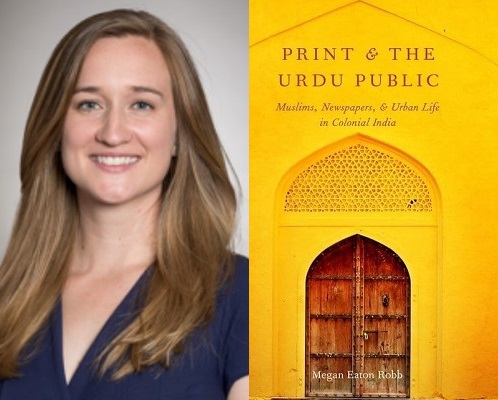
Megan Eaton Robb’s book Print & the Urdu Public chronicles the history of Muslims, newspapers and urban life in colonial India
ONE of my friends, Afroz Alam Saahil, who works on such varied topics like Muhammad Ali Jauhar, Palestine, and Hamdard, recently rang me up from Turkey and asked me if I could recommend a book that would give him an understanding of the current work being done in relation to Urdu. His question put me in a dilemma: which book should I recommend? Eventually, I turned to Google and came across a remarkable book. After a cursory glance, I realised that it was truly a valuable book. It evoked a lot of interest in me and I started reading it thoroughly. I was so enchanted that I could not put it down until I had consumed all of it.
It is surprising that the book’s author did not come from any of the South Asian countries; Megan Eaton Robb was, in fact, raised in Europe and received her entire education in the United States. Urdu has not been her mother tongue, nor did she grow up in the streets and alleys of Bijnor, Lucknow, Delhi, Lahore or Karachi. Yet she took on a subject that our own historians, writers, and journalists had either overlooked or only addressed superficially. Megan, however, approached it with such depth, scholarly rigour, and logical precision that while reading her book, I repeatedly felt that this was not an external voice but one that spoke from within. Failing to acknowledge her work would certainly be an injustice. She deserves the gratitude of the entire Urdu-speaking world for this monumental work.
The book’s contents include: Preface; Introduction, “A Public Is a Place and Time: Dimensions of an Urdu Public Sphere”; Chapter 1: “Putting the Public House of Madīnah on the Muslim Map”; Chapter 2: “Back to the Future Qasbah: The Timescape of Bijnor”; Chapter 3: “Urdu Lithography as a Muslim Technology”; Chapter 4: “Viewing the Map of Europe through the Lens of Islam”; Chapter 5: “Provincialising Policies through the Urdu Public”; Conclusion: “The Public as a Timescape”; Transliteration and Citation Method; Appendix I: General Glossary; Appendix II: Proposal for Qualifications for Electors in Bijnor, 1913; Appendix III: Editors and Journalists of Madīnah, 1912–1948; Appendix IV: Spring Season; Bibliography; and Index.
All of this is based on a study of more than a thousand issues of Madīnah newspaper, local records from Bijnor, English reports, and a comparative analysis of other Urdu newspapers. In brief, if one were to sum up this book, it can be said that Megan Eaton Robb’s Print & The Urdu Public: Muslims, Newspapers, and Urban Life in Colonial India (Oxford University Press, 2021) is a milestone in the study of modern South Asian history, media studies, Muslim politics, and print culture.
This book does not merely recount the history of Bijnor’s famous newspaper Madīnah, but also demonstrates that the collective consciousness, political awareness, and global Islamic imagination that emerged among Indian Muslims in the early 20th century were rooted more deeply in the printing presses of small towns rather than in the major cities of Delhi, Lucknow, Aligarh, or Lahore. These towns included Bijnor, Mau, Azamgarh, Gaya, Patna, and others.
Challenging the Stereotype
The book challenges the assumption that modern Muslim political consciousness and public debate were shaped solely by large cities and the elite. Instead, it shows that the small-town elite, owing to their geographical isolation and historical continuity, created a narrative that was not only local but also global in scope, grounded in the past while looking towards the future.
The author’s central argument is that to understand the Urdu public, we must move beyond the conventional notion of geographical centrality and recognise that real power often lay at the margins. Why did a newspaper originating in a remote town gain such widespread popularity across North India and Punjab? In answering this question, Megan Robb presents not only an outstanding historical study but also a new theoretical framework, which she calls the “timescape”, the interrelation of time and space.
The book opens with an intriguing story. In 1912, Muhammad Majid Hasan, belonging to a middle-class family of Bijnor, sold his wife’s jewellery to establish the newspaper Madīnah. He was neither from a prominent family nor an alumnus of well-known institutions such as Aligarh or Deoband. Yet, within just a few years, his newspaper reached every corner of North India and Punjab. No one could have imagined that Madīnah would one day become the most widely read Urdu newspaper in North India, eagerly awaited even by readers in Lahore, Delhi, and Lucknow. The extraordinary success of Madīnah was a sign that, in colonial India, public understanding was no longer confined to major cities but had extended to towns and villages as well. Megan Robb takes this trend as her subject and demonstrates how small-town print media provincialised national and global politics while also bringing provincial issues to national and international attention.
Among the editors of Madīnah were some of the most renowned and distinguished personalities of the Indian subcontinent, including Maulvi Syed Nūr ul-Ḥasan Żahīn Karatpūrī, Syed Muḥammad Lā’iq Ḥussain Qavī “Zamurrud-raqam” Amrohavī, M. Āghā Rafīq Bulandshahrī, Maulānā Maz̤har ud-Dīn Sherkoṭī, Maulānā Amīn Aḥsan Iṣlāḥī, Maulānā Badrul Ḥasan “Jalālī”, Maulvi Nūr ul-Raḥmān (BA), Muḥammad Aḥsan Morādābādī, Maulānā Naṣrullah Khān “Āzīz”, Ḥamīd Ḥasan “Fak̲h̲r” Bijnorī, M. Shabbīr Beg, Maulānā Ḥāmidul Anṣārī “Ghāzī”, and Abū Sa‘īd “Bazmī”. Other prominent contributors included such towering figures as Maulānā Syed Abū al-A‘lā Maudūdī, Qāżī Muḥammad ‘Adīl “Abāṣī”, Maulānā Muḥammad Uṣmān Fāreqleet, Maulvi Shabīr ul-Raḥmān Chāndpūrī, “Māhir” ul-Qādrī, Qādūs Ṣāḥibā’ī, and Maulānā Shaukat ‘Alī. Upon closer examination, these names do not merely represent the leading writers and journalists of their time; rather, they played an extraordinarily prominent role in the overall intellectual and academic awakening of the 20th-century subcontinent, and their influence can still be felt today in the intellectual history of Muslims. This book also presents a brief introduction to each of them.
The first chapter of the book serves as its foundation, detailing the birth of Madīnah, the history of its owners and editors, and how Urdu became part of the public sphere within a small-town context. This chapter focuses on the book’s central theme: giving precedence to towns rather than cities. Here, the author presents Bijnor as a place that, rather than the urban elite, played a key role in the construction of Muslim identity.
The author’s most significant and original concept is that of time and space. She argues that it is not merely a place but also a period. Historically, the town of Bijnor was close to Mughal Delhi, and its elite families traced their lineage to the Mughal court. Yet, in the early 20th century, due to the lack of railways and modern roads, it had become relatively isolated and secluded. This duality, proximity to the past and distance in the present, granted Madīnah a degree of independence unavailable to the major institutions of Aligarh, Deoband, or Lucknow. Consequently, Madīnah was neither subject to governmental pressure nor entangled in sectarian politics, nor was it captive to the splendour of the nobility. It produced an independent voice that preserved elite traditions while directly engaging with modern political questions.
Treating the Time
The most important part of the book is the second chapter: here the author demonstrates that Bijnor was not a town confined by the past but rather a space that did not perceive time linearly; instead, it treated time as cyclical, flowing, and creatively intertwined, a dynamic perspective. The townspeople considered themselves heirs to the declining elite of Delhi, yet they were not afraid of modernity. As a result, their experience of time encompassed past, present, and future simultaneously. This concept challenges the theoretical frameworks of European thinkers such as Habermas, Anderson, and Warner, who view public spheres in a linear progression of time. In contrast, the Urdu public sphere demonstrates a fusion of time and space: a reader of Madīnah, sitting in Bijnor, would contemplate the fate of the caliphate in Istanbul, mourn the decline of Delhi, and perceive past battles as a continuous part of the present.
The clearest illustration of this worldview is that the Balkan War of 1912 was described as a “Crusade,” the British attack of 1915 was linked to “Karbala,” and the abolition of the caliphate in 1924 was interpreted as a repetition of the fall of Baghdad. It was as if the pen of Bijnor was engaging in a direct dialogue with Jerusalem 700 years earlier and centuries of Islamic history. This insight leads the author to conclude that the true Urdu public sphere was not formed in major cities but in seemingly insignificant yet historically conscious towns like Bijnor, where there were neither railways nor great institutions, but where history itself was the real source of power. It was this historical consciousness that gave the small town a voice, which eventually became the intellectual heartbeat of the 20th-century Muslim India.
The third chapter is perhaps the most unique and captivating part of the book, where the author designates “Urdu lithography” as a “Muslim technology.” Printing is generally considered a neutral technique, but Megan Robb demonstrates that for Urdu speakers, particularly Muslims, lithography was not merely a method of printing but a cultural and political act. Since lithography allowed the Nastaʿlīq script to be printed in all its beauty and fluidity, it was seen as a means of preserving Islamic calligraphy. Madīnah perfected this technique to such an extent that by the 1930s it was regarded as the most beautifully printed newspaper in North India. This beauty was not merely aesthetic but also an expression of identity; it reflected the recognition, culture, and temperament of the elite. Through the lens of material history, the author demonstrates that technology is never neutral but always carries with it an element of identity.
Global Community
The fourth chapter covers the journey from the Balkan Wars to the Khilafat Movement and demonstrates how a small-town newspaper brought Indian Muslims into the broader global Muslim community. During the Balkan Wars of 1912–13, Madīnah presented the defeat of Turkey as an Islamic tragedy, and even in a small town like Bijnor, millions of rupees were collected in support of the caliphate. This was not a mere coincidence; it was rooted in the newspaper’s sustained efforts to teach its readers to view the map of Europe from an Islamic perspective. It was during this period that Indian Muslims for the first time began to perceive themselves as part of a larger unity with Turkey, Iran, the Arab World, and Central Asia. Madīnah nurtured this consciousness so deeply at the small-town level that the Khilafat Movement ceased to be the preserve of urban elites and spread effectively to villages and towns.
The most striking revelation of the book concerns the period after 1937. As the Muslim League was rapidly emerging and the demand for Pakistan was gaining momentum, Madīnah strongly opposed the League. It not only rejected the Lahore Resolution of 1940 but also described the demand for Pakistan as an “elite conspiracy,” consistently supporting figures such as Maulana Abul Kalam Azad, Dr Mukhtar Ahmed Ansari, Hussain Ahmed Madani, and Congress-aligned Muslims. This stance was completely at odds with the major newspapers of Aligarh, Lahore, and Delhi. Megan Robb demonstrates that in the 1940s, not all Muslims supported the idea of Pakistan; a significant number preferred to remain in a united India, representing the small-town elite. Madīnah was the most prominent voice of this alternative perspective.
Past, Present and Future
The author’s most significant theoretical contribution is the concept of the “timescape,” which she elaborates in detail in the final chapter of the book. According to her, to understand the Urdu public, one must view three layers of time together: the past, reflecting historical proximity to Mughal Delhi; the present, representing the geographical isolation of the colonial period; and the future, embodying the dreams of independence and the possibility of partition. Madīnah combined these three temporal dimensions to create a new Islamic, small-town perspective that was neither entirely colonial, nor nationalist, nor sectarian. It constituted an intellectual and cultural framework that preserved tradition while remaining in dialogue with the modern world, a form of identity connected to the veins of the past and in harmony with the horizon of the future, uniting the historical, social, and cultural dimensions of the Urdu public into a novel intellectual landscape.
Non-sectarian Elite Muslim Voice
One of the book’s greatest strengths is that the author meticulously studied nearly every issue of Madīnah and consulted rare material from the British Library, the National Archives of India, the Uttar Pradesh State Archives, the Rampur Raza Library, and private collections in Bijnor. Another remarkable feature is her detailed and outstanding discussion of lithography and the material history of print, which highlights the artistic, cultural, and historical dimensions of printing. The third strength lies in presenting the town not merely as a nostalgic centre of a declining elite but as an active site of political and intellectual engagement. The fourth and most significant strength is that, beyond the binary divide of the Muslim League and the Congress, the book foregrounds a third, small-town, non-sectarian elite Muslim voice, which not only illuminates historical realities but also captures the complex social and cultural dimensions of the Urdu public.
The book also throws up some critical questions. For example, very little attention is given to Madīnah’s relations with Deoband, Nadwatul Ulama, the Farangi Mahal, or the Ahmadiyya; was Madīnah truly as independent as the author claims? Furthermore, the role of women is almost entirely absent from the book; was the small-town public sphere really limited to men? Thirdly, only a few lines are devoted to Madīnah’s history after 1947, was this omission deliberate? And fourthly, at times, the concept of the “timescape” becomes so abstract that it is difficult for the general reader to fully grasp.
Nevertheless, these few critical questions do not diminish the book’s greatness or importance. It helps us to reconsider the political, intellectual, and cultural history of 20th-century Indian Muslims. The book demonstrates that to properly understand the Khilafat Movement, the formation of Muslim identity, opposition to Pakistan, and the aesthetics of Urdu print, one must turn attention to the towns, and newspapers like Madīnah clearly show that the margins often act as the centre.
Megan Eaton Robb deserves the gratitude of the Urdu-speaking world. This book should be read by every student, researcher, and reader who wishes to understand how modern Indian Muslims emerged, where their voices originated, and how they navigated the tension between tradition and modernity. A prompt Urdu translation is essential so that Urdu readers can directly benefit from this remarkable work.
——–
Mohammad Alamullah is an author and journalist, writing columns, poems, travelogues, and stories. He received his education from Jamia Millia Islamia, Delhi, and Swansea University, UK. He has to his credit several books including Muslim Majlis Mushawarat: Aik Mukhtasar Tareekh, Kaghaz Se Screen Tak, andIran Mein Kuch Din.
source: http://www.clarionindia.net / Clarion India / Home> Opinio / by Mohammad Alamullah / December 04th, 2025
Kasaragod District Kannada Journalists Welfare Association has selected Vartha Bharati journalist Samshuddeen Yenmoor for its annual ‘Dattinidhi Award’.
The association, which has been working for nearly two decades to promote the Kannada language, culture and the welfare of journalists in Kerala, presents this award with sponsorship from Dubai-based entrepreneur James Mendonca.
The award includes a cash prize, citation and memento. It will be presented at a function scheduled on May 16, 2026, at 9:00 am at the Hall of Subbayyakatte Aided Higher Primary School in Kasaragod district.
The programme will be held under the chairmanship of Shivananda Tagadur, State President of Karnataka Union of Working Journalists.
Among those expected to attend are Karnataka Legislative Assembly Deputy Speaker Rudrappa Lamani, Minister N.S. Boseraju, Manjeshwar MLA A.K.M. Ashraf, Chief Minister’s Media Advisor K.V. Prabhakar and Karnataka Border Area Development Authority Chairman Somanna Bevinamarad, among others.
The details were shared in a statement issued by association president Ravi Naikap.
source: http://www.english.varthabharati.in / Vartha Bharati / Home>Karavali / by Vartha Bharati / April 30th, 2026
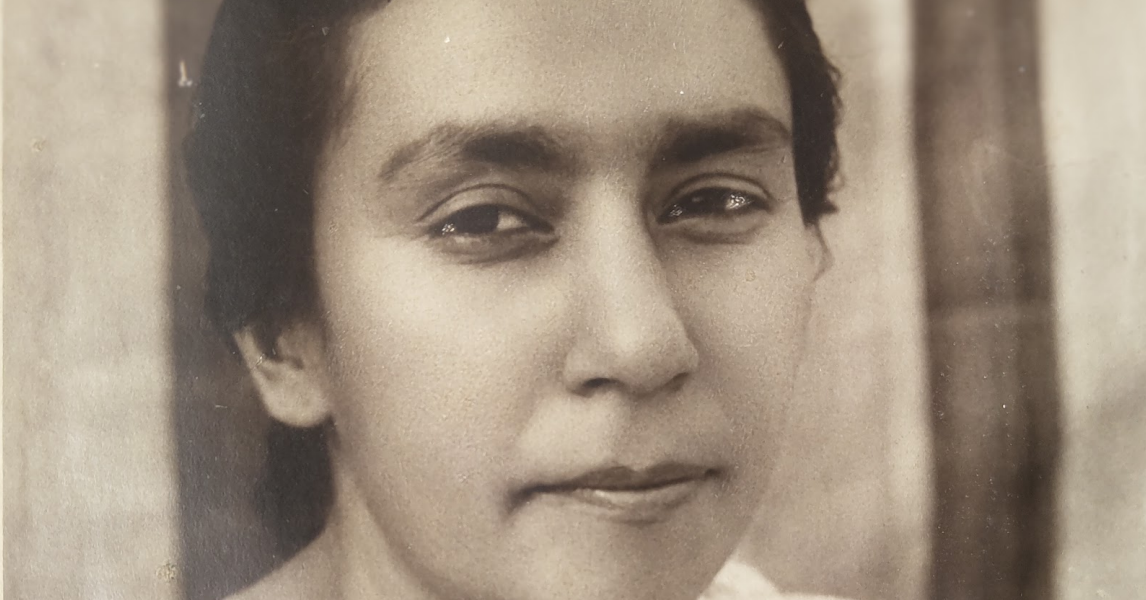
A person of immense courage, resilience, simplicity and sacrifice, this communist leader is a beacon in the movement for women’s rights in India.
Hajrah Begum. Photo: By arrangement.
I sometimes feel that when future generations remember all of you, will they ever think of Alys (Faiz Ahmad Faiz’ wife) or me. We have always walked with you, although you were a step ahead of us. Sometimes you would look back to perhaps make sure that we were still there, following behind you. And we would reassuringly smile back although our hearts would cry out in pain.
– Excerpt from a letter by Razia Sajjad Zaheer, wife of Sajjad Zaheer, to Faiz Ahmad Faiz in June 1951 when Faiz and Zaheer had been imprisoned in the Rawalpindi conspiracy case.
In the opening pages of her novel, Aakhir e Shab ke Humsafar, the writer Qurratulain Hyder depicts a scene in a crumbling old house in the early 1940s in the old city of Dhaka where the protagonist (a young Bengali Muslim woman, Deepali) and her Christian friend (Rosie Banerjee) are welcomed by a young man called Mahmood ul Haque. In the conversation that follows, Rosie (a reverend’s daughter), is shown as possessing progressive ideals yet holds biases regarding Muslims; she thought of them as fanatics, toadies of the British and womanisers, not always in that order. So, while speaking to the mostly young Muslim men in this gathering Rosie is surprised to notice that many among them had Left leaning political views.
A back and forth ensues while Rosie’s hosts share a list of names of Muslim revolutionaries and radicals in India and elsewhere, like the Indian student Mirza Abbas who had been taught how to make bombs by the Russians, and of the great Indian revolutionary who died penniless in the US, Maulana Barkatullah. The Muhajareen, which included people like Shaukat Usmani, Fazal Ilahi Qurban and Ferozzuddin Mansoor, who had traveled to the Soviet Union in the early 1920s to study at the University of Eastern Toilers, were mentioned. Finally, Dada Amir Haider’s (the seaman/lashkar who became the member of the communist party in the US) name was added.
Hyder may have emphasised this history to situate herself as a Muslim in post-colonial India – in a post Nehruvian era – and to re-remember why Indian Muslims also had a right to be proud of their nationalist pasts; hidden and obscure histories of those Muslims who were part of India’s freedom movement and who followed radical nationalist politics. I present a glimpse from a more complex and important piece of writing to suggest that even in Hyder’s sympathetic treatment of the Muslim Left (at least in the earlier part of the novel) she forgets to mention radical Muslim women like Hajrah Begum, Razia Sajjad Zaheer and Rashid Jahan in her recounting of names. It may be possible that these women (and many more) had not become part of the national imagination by the early 1940s, the period in which the novel is situated. By the end of the novel, we also see Haider providing an implicit critique of the Left, where class positions may have trumped radical politics.
To be sure, Dr. Rashid Jahan has lately received much attention in print (Rakshanda Jalil 2014), and Razia Sajjad Zaheer’s daughter (Noor Zaheer) has recently published her mother’s biography (Alys Faiz and Tahera Mazhar Ali should be added to this list). In contrast, Hajrah Begum, the protagonist of this essay, a pioneer of the women’s movement in late colonial India and the first South Asian woman to become the member of the Communist Party of Great Britain (CPGB), has received negligible attention by historians and archivists alike. My preliminary effort here is to remember a person of utmost conviction and generosity of spirit as she navigated decades of politics in the communist movement in colonial and post-colonial India. To write about her, I delved into multiple forms of archives; the interviews she gave, her writings, the writings and experiences of her contemporaries, oral history with family members, memoirs, scraps of evidence available in “discarded” letters and more.
Hajrah Mumtazullah Khan was born in 1910 to Mumtazullah Khan and Natiqa Begum, in Sahranpur, (western Uttar Pradesh) where Mumtazullah Khan was then a tehsildar. She was second of six siblings, the eldest being Zakaullah Khan (the famous Pakistani architect, Kamil Khan Mumtaz’ father). There was another son Ikramullah Khan, between her and her sister, Zohra Sehgal (the famous performer and actor), and then Uzra Butt (another famous actor and performer), Amina Begum (founded Happy Dale School in Karachi) and Sabra Begum. The family traced its lineage to the Rohilla Pathans who had settled during the 18th century in Western UP in the areas of Najibabad, Moradabad Bedayun, Bareilly, Saharanpur and Rampur. Both parents, who were first cousins, were closely related to the ruling nawabs of Rampur.
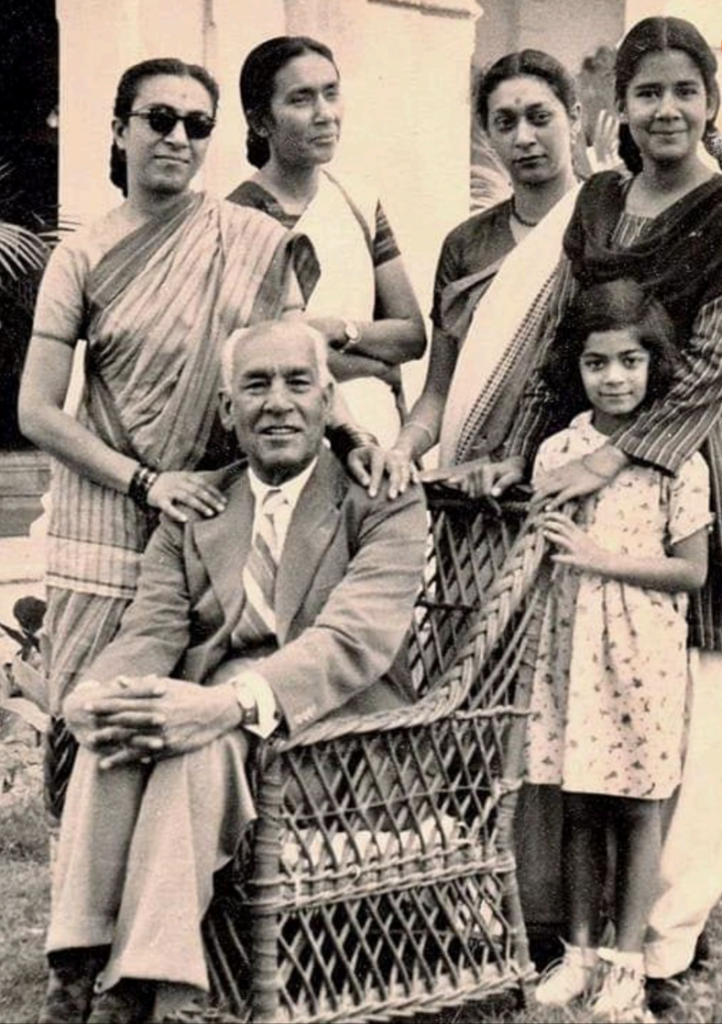
Hajrah Begum with her father, sisters and niece. Photo: By arrangement with her family.
Hajrah begum at the age of 10 was sent to the Queen Mary College in Lahore, where she was followed by her younger sisters. This was a segregated school for girls from elite households and although Mumtazullah Khan, their father, was a senior government servant the sisters may have been admitted due to their relations with the princely state of Rampur. While the girls were in school, their mother passed away. Until she completed her matriculation at the age of 17, the school’s close political atmosphere was partially balanced by her interaction with her elder brother Zakaullah Khan who was at Aligarh by the mid 1920s and would talk to young Hajrah during school holidays about how she should not stand up when ‘God Save the King’ was sung at her school as the British were not their real masters. A confusing time for Hajrah indeed, as at school, the Prince of Wales was portrayed as the most charming person in the world, while at home the brother was speaking about freedom from the British. In college and in his work life, Zakaullah Khan (who received an engineering degree from UK) was not perceived as politically active, but for a purdah observing Hajrah Begum, he was a godsend, bringing into her life ideas about a future freedom and struggles, the anti-colonial struggle, the struggle for economic and social justice. In contrast, while at school with a strict and segregated English medium education, the little that came from the outside was what the day scholars would share, songs related to the stage of the nationalist movement in the 1920s.
Charkha kaato to beda paar hai
Charkha swadeshi talwar hai.
Boli amma Mohammad Ali ki
Jaan beta Khilafat main de do.
In her interview (from the early 1990s) archived at the Nehru Memorial Library, Hajrah Begum speaks about her brother and K M Ashraf (who deserves a major biography of his own), who were close friends from Aligarh days and had gone to study together to UK in the late 1920s, as major influences in her emerging understanding of anti-British Nationalism, if not her eventual tilt toward communism.
Soon after she passed her matriculation exams, Hajrah Begum was married to her paternal aunt’s son, Abdul Jamil Khan who was a DSP in the police service. In her interviews she suggests that she resented that she was not asked about whether she wanted to get married or not and this feeling persisted throughout the very short marriage of three to four years. Being unhappy in her marriage (she could not adjust to the spousal life of an officer in the elite police service), she started spending time in Meerut where her father was now posted as a magistrate. This was the time (1929-1933) when the Meerut conspiracy case was ongoing against Indian trade unionists and three Englishmen for organising an Indian railway strike. At the culmination of the trial, 27 trade union leaders were convicted under a lawsuit based on the charge that in 1921, the leftist trade unionists, S.A. Dange, Shaukat Usmani and Muzaffar Ahmad with the help of several others had conspired to establish a branch of the Communist International in India.
In Meerut, her father’s house was frequented by people like Mahmud uz Zafar (of Angarey fame. He was her maternal uncle’s son and a future member of the Communist Party of India. He later married Rashid Jahan) who would discuss the case with her brother, Zakaullah Khan. It is during this period in the early 1930s that she told her husband that she wanted to end the marriage as she had become more interested in the people who were being tried in the conspiracy case and their cause. She did not see herself in a world where she would be entertaining wives of high British officials.
Her brother Zakaullah Khan also understood the situation and suggested that if she wanted to opt out of the marriage, then she needed to be economically independent. After her separation, rather than stay with her father, she went to live with her brother in Aligarh where K.M. Ashraf was a frequent visitor and would offer her books to read, like the Intelligent Woman’s Guide to Socialism and Capitalism by Bernard Shaw. Both, her brother and Ashraf, persuaded her to get advance training as a montessori teacher from England. She sold some of her jewellery and with partial financial support from her family, left for the UK with her son.
Her arrival in London in 1933 meant a lot of adjustments, including the care of little Sami (later, Lt. General Sami Khan, a much-decorated officer in the Indian Army) who was about a year-and-a-half-old at that time. While in London, she met with Sajjad Zaheer (a family friend, one of the founders of the Progressive Writers Movement and the future secretary general of the Communist Party of Pakistan), then a student and the leader of the underground group of left oriented students in London, Cambridge and Oxford. Through Sajjad Zaheer she reconnected with K.M. Ashraf, who had returned to the UK to complete his PhD. Others in the group were Shaukat Omar (the father of the late Pakistani journalist, Kaleem Omar, also the eldest son of Zafar Omar of the Indian Police Service and the writer of the Urdu detective novels, Neeli Chattri) and Z.A. Ahmad (later the secretary general of Communist Party of India of UP and member of the Upper House of the Indian parliament).
Hajrah Begum was the only woman member of this small group of Indian students. There were weekly study groups and conversations along with attempts to bring out newsletters to influence the Indian student population then residing in UK. Hajrah Begum, young and inexperienced at the time, was initially a quiet participant during these meetings. This changed when she visited the Soviet Union after answering an ad in the journal, DailyWorker. Her two weeks in the Soviet Union in the mid-1930s gave her first-hand knowledge of the transformations that the country was going through. According to her, it was not a paradise, but she was impressed by the spirit of the people who were not colonised, like India. People were striving to attain a modicum of economic and social emancipation. On her return, she became more confident in participating in group discussions and people started deferring to her in terms of her views and experience. Around this time, according to Z.A. Ahmad’s memoirs, Hajrah Begum along with Sajjad Zaheer and Ahmad were inducted as members of the Communist Party of Great Britain (CPGB). This was of course kept as a secret as the Communist Party in India was banned and there was strict surveillance of communist party members and supporters.
There is an incident that is worth sharing from her presence in London. In her interviews Hajrah Begum mentions how on May 1, 1934, she attended a worker’s event in Hyde Park, while there she was photographed with a red flag in her hand, and the image was published in the international Kodak magazine. The magazine captioned her photo as how South Asian women were being radicalised. The magazine also circulated in India and when it was seen by relatives and by her father there was much apprehension about what she was doing in Britain – studying or taking part in subversive politics.
During her time in London, she met Ben Bradlee, who was one of the defendants in the Meerut conspiracy case and a member of the CPGB and Shapurji Saklatwala (the famous Indian communist leader who was related to the Tata family and had given up his wealth to pursue communist politics in Britain). She also traveled to Brussels with Sajjad Zaheer as part of the delegation of students to the conference on the struggle against war and fascism. Ishaat Habibullah (father of the writer Muneeza Shamsie and grandfather of the novelist Kamila Shamsie) was the leader of this group. In the conference, the Indian student’s delegation took the position that there should be a broad front to fight not only against the approaching war and fascism in Europe, but also against imperialism and colonialism. This position was rejected by the conference, dominated by European attendees. As a protest, the Indian group walked out of the final sessions.
In 1935, the Seventh International Congress of the Communist International in the Soviet Union among other issues decided that the anti-colonial policy for communist parties and movements was to work with national anti-imperial forces against the rising threat of imperialism and fascism. Within the Indian context, the Indian National Congress was considered a bourgeois and nationalist party, the directive to Indian communists was to work in a broad front; a unity of all progressive forces in which the communist would collaborate and work with all who were anti-imperialist while retaining their distinct identity and work among workers and peasants.
With this understanding which was conveyed to the group by the then secretary general of CPGB, Harry Pollit, most members of the student group returned to India after completing their studies. A few months after reaching India, Sajjad Zaheer called a meeting of the “London Group”, and each one was asked about how they would like to proceed in their anti-imperialist politics. On her return, Hajrah Begum had taken a job in Karamat Hussain Girls College’s junior section in Lucknow. According to Z.A. Ahmad’s memoir, Sajjad Zaheer had started to practice law in Lucknow and was committed to the still underground communist party, K.M. Ashraf had started teaching, but was committed to the party’s directive, Mahmuduzzafar (Hajrah Begum’s cousin) was teaching at Islamia College in Amritsar, and he opted to be a party whole timer. Z.A. Ahmad left his job as the principal of a college in Hyderabad (Sindh) and decided to work for the party. Other members like Shaukat Omar, who was working for the Saigol Tea Company, for personal reasons did not want to leave his position but was willing to contribute to the party fund and provide other support. After this meeting, Hajrah Begum like her cousin Mahmud uz Zafar also became a whole timer. Hajrah Begum was recruited to work in the party office in Lucknow (typing, preparing notes, and documentation) under the directed supervision of the party’s secretary general, P.C. Joshi, whose identity was not known to her.
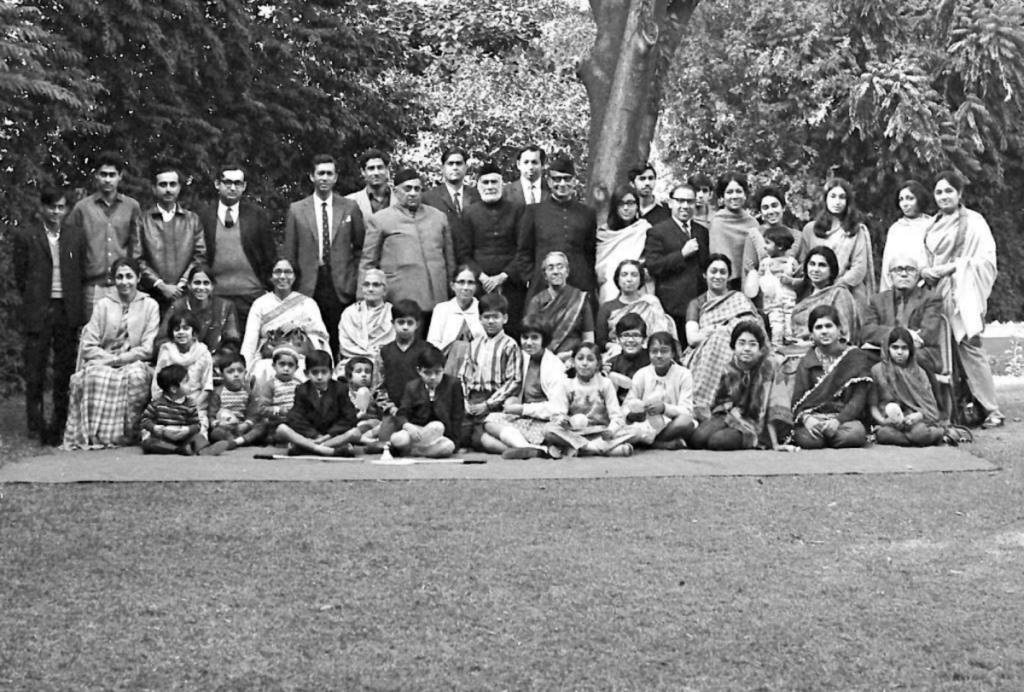
The entire extended clan in India around the late 1970s in Z.A. Ahmad’s official residence in Delhi. He was member of the Rajya Sabha in those days. Photo: Radha Khan.
Hajrah Begum and Z.A. Ahmad had known each other in London and eventually returned on the same ship from Britain with her son Sami. A growing understanding and common political commitments eventually led to their marriage on May 20, 1936. The marriage was solemnised by K.M. Ashraf (who had completed his PhD in Islamic history) and took place in Sajjad Zaheer’s home in Lucknow. The famous poet, Raghupati Sai Firagh Gorakhpuri was one of the witnesses. Soon the couple moved to Allahabad, as Ashraf and Z.A. Ahmad, along with other progressives like Rammanohar Lohia were given positions in Nehru’s kitchen cabinet when he was the president of the All-India Congress Committee. This was in keeping with the political line that members of the communist party (underground as it was) should work with anti-colonial forces. While Hajrah Begum continued her work with the underground communist party, she along with Rashid Jehan was also involved in organising the first All India Conference of the Progressive Writers’ Movement (Lucknow, 1936) where the famous writer Munshi Prem Chand gave the presidential address.
In Allahabad, she was part of a core group of young leaders who were working with the Congress Socialist Party (which was not banned), along with Z.A. Ahmed, K.M. Ashraf and Rammanohar Lohia; all of whom except Lohia were also members of the underground CPI. In this respect she had become one of the few early female members of the CPI. In Allahabad, she became active in organising railway coolies and press workers. By the late 1930s, she was working with the biri union, hawkers’ union, shop workers union, tin workers union and in eastern Uttar Pradesh (Azamgarh), and used this experience to organise tannery and textile workers in Kanpur. She was one of the first women from the communist party to work among farmers. She narrates in her interviews how she would walk miles in rural areas, travel the lowest class on trains, and sleep in mud huts on the floor with a single sheet. She always wore khadi (handloom) saris and lived and experienced the life of the people she was politically linked to, the underclass of towns and villages of British India. Speaking about women working on looms in villages of eastern UP (belonging to the Muslim julaha or weaver caste), she mentions how these women made the best saris, they were the bread earners of the family. Yet, like any other woman, the workers had to cook, take care of the children, attend to the demands of their husbands and in-laws and suffer all kinds of social oppression. It is these women she would organise for domestic rights, for better compensation of their products and for linking them with other women workers (industrial and rural) across the province.
In 1940, she became the organising secretary of the All-India Women’s Conference (AIWC), an organisation founded by educated and elite women committed to educational reform for women and children and to struggle for women’s rights. This was due to Hajrah Begum’s commitment to the cause of equal rights for men and women, rights for women in marriage and divorce, and equal compensation for women, especially in the industrial sector. In public forums, she raised issues related to the vagaries of housework and demanded the provision for creches in workspaces, along with maternity benefits for women workers. It is during this time that a debate also ensued within the now legal Communist Party (the ban on the party was lifted in 1942) on forming a women’s organisation. Although CPI’s all-male leadership would argue for women’s rights, they did not see a need for a separate group or women’s organisation. Even when senior leaders (like E.M.S. Nambroodripad, later the first elected chief minister of Kerala on a CPI ticket) circulated a paper within the party, advocating for women organisations and for the provision of lavatories and baths in rural areas, it was sarcastically referred as the “latrine document”. In contrast, Hajrah Begum in her writings in CPI outlets like People’sWar (QuamiJang) would argue for an all-India organisation for women that necessarily may not be a communist women’s organisation, but consist of women from the working classes, the peasantry, the lower middle classes, the teachers and ordinary people.
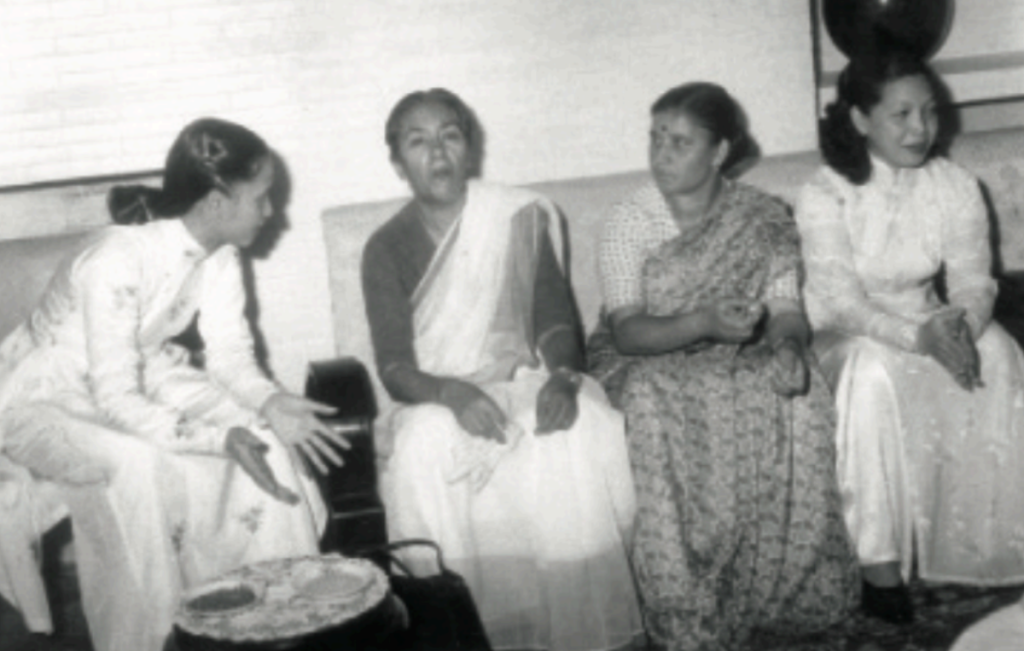
Hajrah Begum with Chinese delegates. Photo: Public domain.
Such an organisation was formed during the Bengal famine in the shape of the Mahila Atma Rakhsha Samiti (MARS) in Bengal. She travelled to Bengal during this time and reported first hand on the relief work done by the MARS, incorporating all classes of women, housewives, aunts, unmarried girls, the Calcutta elite and the peasant women from Barisal and Noakhali (both districts in East Bengal). While their men were at war, these women were committed to provide relief work and join the anti-colonial struggle. The famine and ensuing death and destruction in Bengal in the mid 1940s had opened the question of social justice and equality for all these women and they were ready to participate in their patriotic duty for justice and rights. This was not a unique case, Hajrah Begum had also witnessed and supported similar organisations, such as the Punjab Women’s Defence League based in Lahore which had similar aims as that of MARS.
It is during this time that she also edited the Urdu-Hindi Language organ of AIWC, Roshni. It is inspiring to read the fresh tone of editorials even almost 80 years after its publication. During the Partition violence, her editorials in Roshni were in solidarity with the plight of women, especially in Punjab. Her writings also made people aware of the need to unite against those who were dividing the people of the land. She emphasised that despite the violence and the division of the country, our commitment to the service for women will be the same and that we will continue to struggle against oppression of women on either side of the border.
After the division of British India, she and her husband did not migrate to Pakistan. It was a very difficult period for her as many close friends and family members (along with her elder brother whom she was very close to) did. Comrades like Syed Sajjad Zaheer were sent by the Party to Pakistan (he then returned in the 1950s after the decision on the Rawalpindi conspiracy case). K.M. Ashraf also came to Pakistan in 1948 and then left for the UK. But Z.A. Ahmad and Hajrah Begum continued to work with the CPI. Ahmad became the secretary general of the UP CPI and later represented the Party in the Indian parliament from the 1950s onwards for many years. Hajrah Begum herself continued to work within the Party and in the mid-fifties she ran for a position in the central committee of CPI. She eventually served as a member of the Central Control Commission of the Party; it was the top committee that deliberated on all complaints of anti-party behaviour. As a member of the Party, she was a participant at the World Peace Conference in Vienna in 1952 and became one of the founders of the National Federation of Indian Women (the women’s wing of CPI, as finally the Party had come around to the idea) and served as its general secretary from 1954 to 1962. Post-Independence in the 1950s and 60s she had several international travels representing the Party and continued to struggle against inflation and for women’s right to work.
§
The life of a revolutionary couple is never easy. Throughout the late 1930s and the 1940s (even after Independence) both Hajrah Begum and Z.A. Ahmad were either organising peasants and workers, doing Party work or were being persecuted by the authorities. Their daughter Salima Raza (radio artist, theatre director, performer, writer, who lives in Mumbai) was born in 1939. In her interviews with me, she narrated how, till they moved to Delhi, in the mid 1950s, when her father became a parliamentarian, the family could only afford a one-room (not one bedroom) apartment. The storage room would at times serve as a kitchen. Further, due to her parent’s political activity she hardly lived in her own home until she completed her matriculation in the mid 1950s, studying in at least 14 schools and staying with dozens of family members, family friends and strangers. In the early 1940s she lived in Lahore with her paternal grandparents. This was a time when Z.A. Ahmad was imprisoned in the Deoli Camp and Hajrah Begum was working on other political fronts.
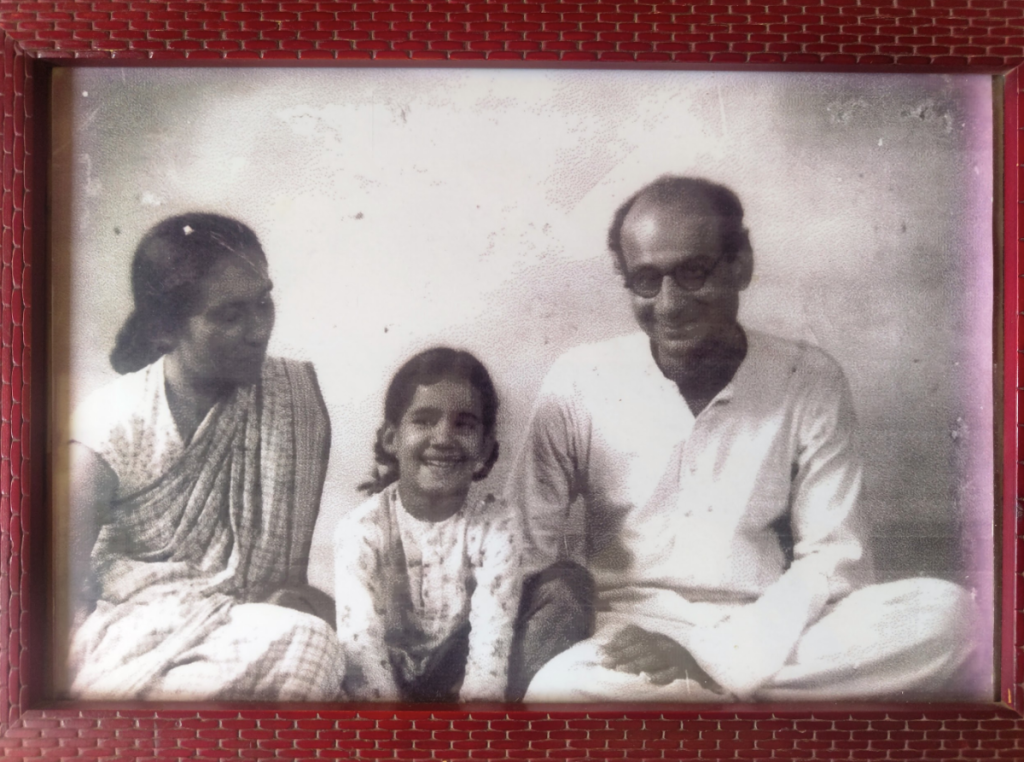
Hajrah, Salima and Ahmad. Photo: By arrangement with her family.
Salima Raza shared a story of when Hajrah Begum was arrested in 1949 (Nehru had decided to crack down on all communist activities) – she was a young girl of 10. Z.A. Ahmad was also underground and due to the radical leftward shift in CPI politics (under the influence of the then secretary general B.T. Ranadive) he had been suspended from party membership. One morning, Hajrah Begum, while living in Lucknow, asked her daughter to serve tea to the gentleman who was waiting for her to change. Soon Hajrah Begum emerged, gave the child Rs 5 and instructed the cycle rickshaw driver standing outside to take her daughter to Yashpal’s house (the famous Hindi writer). She instructed Salima Raza not to cry when she saw her mother leave in the parked car and told her that she should keep on raising the slogan “inquilab zindabad”. Hajrah Begum then got into a car that was waiting for her. She was in jail for the next five months and her daughter lived with family friends. Salima Raza remembers tears running down her cheeks, yet she continued to raise the slogan as long as she could see her mother’s car.
Despite hardships and the absences, there remained a deep bond of affection and care within the family and between Hajrah Begum and Z.A. Ahmad. In the late 1940s, when Ahmad was suspended from the party and was living underground in Lucknow, a friend arranged for the couple to meet. When they met, Hajrah Begum (who was still under the Party discipline) told Ahmad that the Party leader, Ranadive had ordered her to divorce Ahmad as he was not considered a true communist, but a revisionist. When Ahmad asked what Hajrah Begum had decided to do, she answered, “Marrying you was my own decision, the Party did not dictate me to marry you, and it cannot force me to divorce you either.” Ahmad writes in his memoirs how today this seems like a trivial issue, but in those days, it was unthinkable to not follow the Party directive.
Hajrah and Ahmad. Photo: By arrangement with her family.
This long-lasting relationship of political commitment, care and companionship ended with Ahmad’s passing in 1999. Salima Raza, while talking to me, mentioned an anecdote about her mother that exemplifies her deep affection for her husband. Once after the death of her father, Salima Raza asked her mother (who was slowly losing her memory), what her name was. She answered, “Hajrah Begum.”
Salima Raza said, “But your name is Hajrah Begum Ahmad.
“No my name is Hajra Begum,” the answer came back.
“Where is Dr. Ahmad?” her daughter asked. The reply was, “He may have gone to the parliament, or perhaps he may have gone to a meeting.”
Her daughter persisted, “But there is no meeting. People say that he has passed away, but what do you say?”
Hajrah Begum replied, “No, this has not happened, if it was so, he would have told me… If nothing else, he would have sent me a post card.”
Hajrah Begum, a person of immense courage, resilience, simplicity and sacrifice, passed away on January 20, 2003, after a prolonged period of illness. These few lines from a longer poem, My Nani Amma, by her grandson Aamer Raza, captures her beautifully.
But how many nanis risked their lives for freedom and justice
And walked till the blood ran all over their feet?
How many nanis defied all tradition
With utmost respect for all those around them.
How many nanis have lived their lives with absolute belief in the correctness of their convictions, yet never indoctrinated their children?
And how many nanis have done really cool stuff, like conquering the British Empire,
And leading women’s movements.
Not many, I imagine. I wouldn’t have known of those things,
For you wouldn’t give the game away
All I knew was that I was lucky to have you.
Kamran Asdar Ali teaches anthropology at the University of Texas, Austin.
Note: An earlier version of the piece had misidentified Abdul Jamil Khan. The error has been corrected.
source: http://www.thewire.in / The Wire / Home> English> Analysis> History / by Kamran Asdar Ali / August 16th, 2025
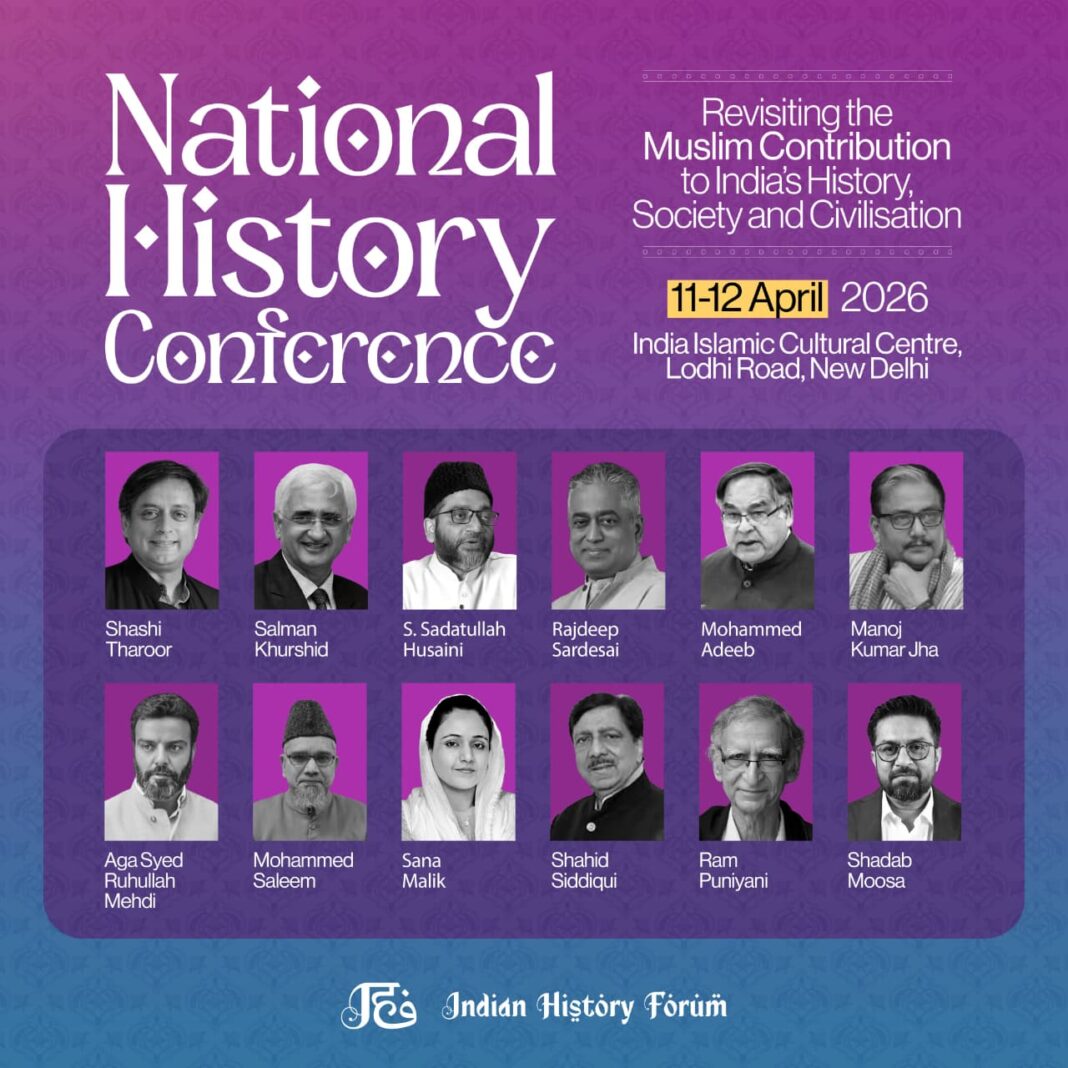
Bringing together scholars, political leaders, and community representatives, a two-day conference at the India Islamic Cultural Centre focused on deliberations surrounding the historical contributions of Muslims to India’s development. The event was organised by the Indian History Forum under the theme “Revisiting the Muslim Contribution to India’s History, Society and Civilization.”
The speakers underscored the importance of presenting an accurate and authentic understanding of history at a time when growing concerns are being raised over the distortion of historical narratives. Member of Parliament Shashi Tharoor stated that it is essential to clearly distinguish between verified history and narratives that lack any factual basis. He further called for sustained efforts to ensure that society engages with history rooted in truth.
Delivering his address on “Who Writes Our Past? Reclaiming History, Interpretation, and India’s Plural Identity,” Shashi Tharoor said that he had been invited to speak on the question of who writes our past and described his presence at the annual National History Conference as a matter of great satisfaction. He observed that discussions on history are no longer confined to academia but have become part of public discourse in visible and consequential ways, unfolding not only in seminars, conferences, and classrooms but also in legislatures, courtrooms, television debates, and across social media platforms.
He said that the question of who writes our past is as relevant outside the classroom as within it, as it raises fundamental concerns about who has the authority to interpret the past, whose voices are heard, and how those interpretations shape the way a nation understands itself. He emphasised that history is not a settled body of knowledge but a field of ongoing research and interpretation, where each generation revisits, re-examines, and reshapes it.
Explaining the distinction between history and historiography, he noted that history refers to what happened, while historiography concerns the way those events are recorded, interpreted, and presented. He said that such interpretation is never entirely neutral and is shaped by perspective, by the questions asked, the sources used, and by power. He added that the struggle over history is, in many ways, a struggle over identity and belonging.
Referring to colonial historiography, he pointed out that British accounts interpreted India through the lens of empire, emphasising divisions and stagnation to justify colonial rule. He said such narratives legitimised conquest and shaped how Indians saw themselves. He further noted that nationalist leaders resisted not only political domination but also intellectual domination by reclaiming historical selfhood.
He said that in contemporary times, history continues to be revisited and contested, often shaped by present-day political purposes. He emphasised that history is not a fixed inheritance but an ongoing conversation, and the way that conversation is conducted has deep implications for national identity. Referring to India’s civilisational nature, he said it is not a single linear narrative but a layered and evolving story shaped by interaction and exchange, invoking Jawaharlal Nehru’s idea of a palimpsest and Rabindranath Tagore’s idea of India rooted in plurality.
Syed Sadatullah Husaini, President of Jamaat-e-Islami Hind, delivered his keynote address, emphasising that the real purpose of the conference is to understand the history of India from the right perspective. He said that history is very important for any nation and that every nation lives twice, once in reality and once in memory, with reality following memory. He stressed that nations are defined not only by achievements but also by what they remember and what they forget, making it essential that memory remains accurate.
He said that history is not merely nostalgia or information but a source of guidance and civilisational wisdom. He emphasised that history should be understood with neutrality and realism and should not be interpreted based on personal likes and dislikes or reduced to binaries of hero and villain, as such approaches harm collective memory.
He noted that the present global situation reflects a post-truth condition where the difference between truth and falsehood has become minimal, and history is increasingly curated, amplified, and weaponised through digital platforms. He warned that such distorted history misguides society, promotes polarisation, and weakens the nation.
He identified three ways in which history is distorted: deletion, distortion, and generalisation. He pointed out that large parts of Muslim history are being erased, misrepresented, or generalised into stereotypes. He said that revisiting history is not about glorifying any community but about restoring truth and presenting facts accurately.
He emphasised that Muslims are not marginal to Indian history but are co-authors of its civilisational journey, contributing to economic, cultural, and intellectual development. He highlighted contributions in trade, knowledge exchange, institutions, languages like Urdu, and social development, stating that these connections enriched Indian civilisation and connected it with the wider world.
He further said that the most significant contribution lies in the principles of Islam, particularly the message of unity of humanity, which fostered social cohesion. Quoting Maulana Abul Kalam Azad, he emphasised the shared civilisational journey and called the conference the beginning of a movement to bring truth back into public discourse.
Dr. Shadab Moosa, Convener of the Conference, in his inaugural address, highlighted key challenges in the study and dissemination of history. He said that across universities, professors, and research scholars, three major problems have emerged. The first is the spread of superficial, misinformed, and propagandist narratives through digital platforms and social media.
He pointed out that alongside this, changes in educational curricula, including NCERT and university syllabi, are altering the pattern of study and research. He stressed that this is a critical issue that needs correction through objective narratives.
He further noted that historical representation in museums, archives, and public spaces also reflects bias and marginalisation. Citing examples, he said that key figures are often excluded from representation, leading to incomplete public understanding of history.
He identified the second major challenge as the gap between academic research and public understanding. He said that historians have produced extensive scholarly work, but it remains confined to academic circles and does not reach the masses. Bridging this gap and making history accessible is essential.
The third challenge, he said, is interpretation. Writing history is one thing, but interpreting it correctly is equally important. He pointed out that colonial frameworks and communal narratives continue to influence historical understanding. He called for a balanced, centrist approach that avoids ideological extremes and presents history objectively.
Senior Congress leader and party’s national spokesperson, Gurdeep Singh Sappal, said that despite misinformation and attempts to rewrite history, awareness of figures like Jyotiba Phule is increasing. He said history has always been shaped by those in power, but today’s challenge is different due to the role of social media algorithms in shaping perceptions.
He described the emergence of a “false memory infrastructure,” where algorithms create echo chambers and influence emotions, shaping public opinion. He pointed out that global political trends, including leaders like Donald Trump and Boris Johnson, reflect similar patterns. He emphasised that ordinary citizens must actively participate in creating and sharing factual content to counter misinformation.
Rajya Sabha MP Manoj Jha reflected on society, history, and democracy through personal anecdotes and literary references. He warned that electoral victories alone cannot ensure the survival of a nation if the social fabric is weakened by distorted history and divisions.
He emphasised the importance of preserving inclusive history and recalled figures like Mahatma Gandhi and Jawaharlal Nehru. He cautioned that present conditions resemble the period of Partition and urged society to remain vigilant and reflective.
Former MP Mohammad Adeeb criticised the distorted writing of history, warning that it misguides future generations and harms social harmony. He stressed the need to protect authentic history and raised concerns about growing prejudice and attempts to erase certain historical periods, including Mughal history, which he said could also impact understanding of other communities’ histories.
Author and journalist Ashok Kumar Pandey discussed the relationship between media and history, highlighting how selective representation shapes public memory. He explained that media narratives often create distorted images, citing the example of Kashmir, where coverage focuses on conflict while ignoring everyday life.
He also criticised the use of unverified social media content as research and pointed out that debates on television often lack informed perspectives. He emphasised that repeated exposure to selective narratives leads people to accept them as truth, especially when they align with existing beliefs. He called for critical thinking and responsible engagement with history.
The conference concluded with a call for collective responsibility in preserving truth and promoting an objective understanding of history. Speakers urged students and citizens to engage critically with historical narratives and ensure that truth prevails in public discourse. They described the conference as the beginning of a broader movement to reclaim history and strengthen India’s plural identity.
source: http://www.indiatomorrow.net / India Tomorrow / Home> Education / by India Tomorrow / April 12th, 2026