Amidst the busy roads of Gujarat that have thousands of cars passing by every day, there lies a neglected divider that holds reverence for many. A petal-strewn corner on a broken divider signifies the tomb of an Amdavadi poet credited for the advent of Urdu poetry that gave rise to a league of poets like Zauq, Mir, and Mirza Ghalib.
The poet in question is none other than the father of Urdu poetry, Wali Muhammad Wali, whose contribution towards uplifting Urdu poetry to being at par with its Persian counterpart is considered indispensable.
Challenging the notion that elite poetry can only be Persian, Wali opened up a world of poetic possibilities for Urdu poets and his influence can be seen in a piece penned by the Poet Meer Taqi Meer as a tribute to the Urdu Chaucer.
Khugar nahin kuch yun hi hum Rikhta-goi kay/ Mashooq jo apna tha, bashinda-e-Dakhan tha”
(It isn’t casually that I began dabbling in Urdu/I picked it from my lover, a native of the Deccan).
The poetic legend who died 300 years ago was buried in his family graveyard in Ahmedabad after his demise. Post Independence, Wali’s grave was separated from the graveyard and found itself situated in the middle of the road.
While the death and origins of Wani might be disputed, the razing of his grave has been linked to the communal past of Gujarat. Destroyed during the Gujarat violence of 2002, Wali’s grave was part of the riot that saw thousands murdered and the demolition of many significant Muslim shrines and Dargahs. Eliminating any and all signs of the Dargah, roads were built overnight and the atrocities of communal violence were swept under the layers of tar and repairs that ensued.
A Twitter user recently went searching for the shrine and impressively remarked on the presence of the Urdu poet’s legacy that remains etched in the mind of locals. Street vendors, shoemakers, and locals seem happy to guide and give precise directions to the grave for those looking to visit the shrine. Once an ornate shrine, the grave now portrays a sad picture of desolation and jarring neglect that can be blamed on the political powerplay as well as the ‘divide and rule’ ideologies that plague the nation.
One cannot miss the imprint of Wali’s work on Urdu poetry. It remains immortal in the hearts of people and keeps the light of consciousness alive.
source: http://www.homegrown.co.in / Homegrown / Home> #HGExplore / by Riya Sharma / August 08th, 2022
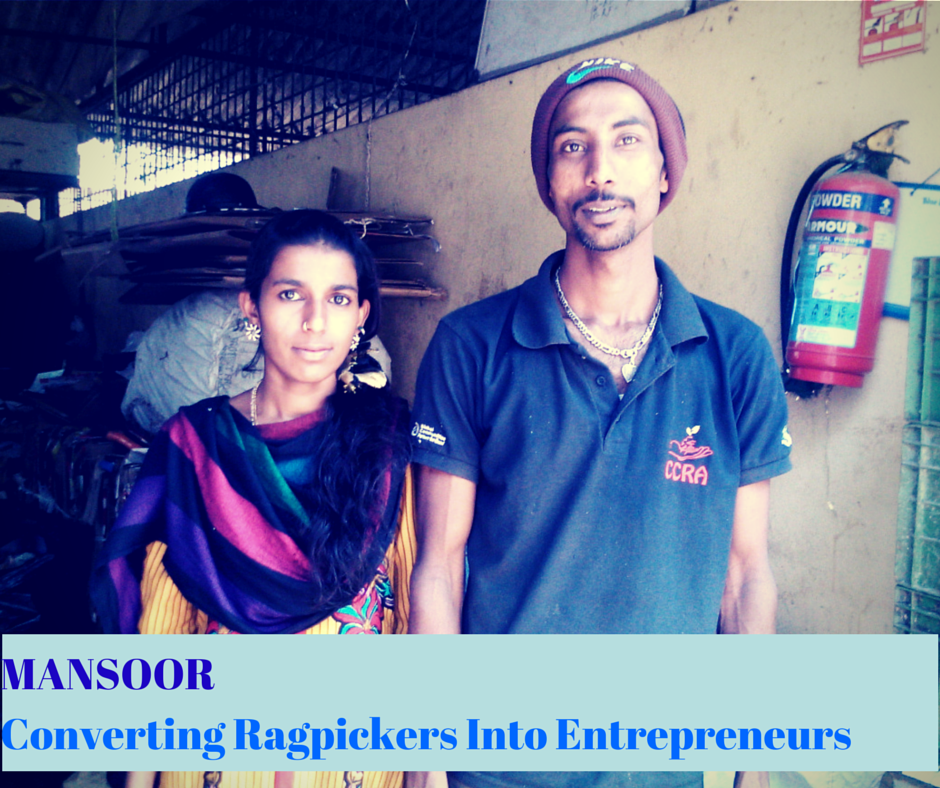
Using technology and people management skills, read how Mansoor is making waste collection a well organized profession. Thanks to his efforts, Bengaluru now sees ragpickers with ID cards, fresh uniforms and better incomes.
Using technology and people management skills, read how Mansoor Ahmed is making waste collection a well organized profession. Thanks to his efforts, Bengaluru now sees ragpickers with ID cards, fresh uniforms and better incomes.
“The waste pickers’ community is very enterprising. If their entrepreneurial skills are channelized and steered in the right direction, they can work wonders,” says Mansoor . “Not only will this put fellow waste pickers on the right path of hard work and integrity, but it will also be an opportunity to include them in the mainstream economy.”
He believes that one man can only do so much to solve the garbage crises of the city. The idea is to involve the entire community in problem solving. On the one hand, Bengaluru citizens are keenly looking for a solution to the garbage menace, while on the other hand there is tremendous energy to be unlocked in the waste picker community who can come to their rescue.
“My father started as a scrap dealer around 30 years ago. ‘Segregation’ was an alien word then. However, he used to promote the practice like we do today. He is no more but I am inspired by him and want to do the same,” he says.
Mansoor, who operates the Dry Waste Collection Centre in ward 168 of Jayanagar in Bengaluru, is not just another somebody who manages the city’s waste, but a trained scrap dealer trying to bring about change much beyond his job description.
Thanks to Mansoor, ward number 168 is now emerging as a systematic waste collection system, with a team of collectors and sorters who ensure that the waste is responsibly recycled and not dumped in a land-fill.
“When I was a kid, I would help my parents in waste collection and sorting. We used to manage around 500 kgs of waste every month,” he remembers. Today, his vision is beyond just numbers.
Mansoor’s dream of better waste management and giving a better life to waste pickers went one step forward when he got associated with HasiruDala, a Bangalore-based NGO that works with the city waste pickers. They not only gave him the initial support but also helped him scale up with financial aid, when required.
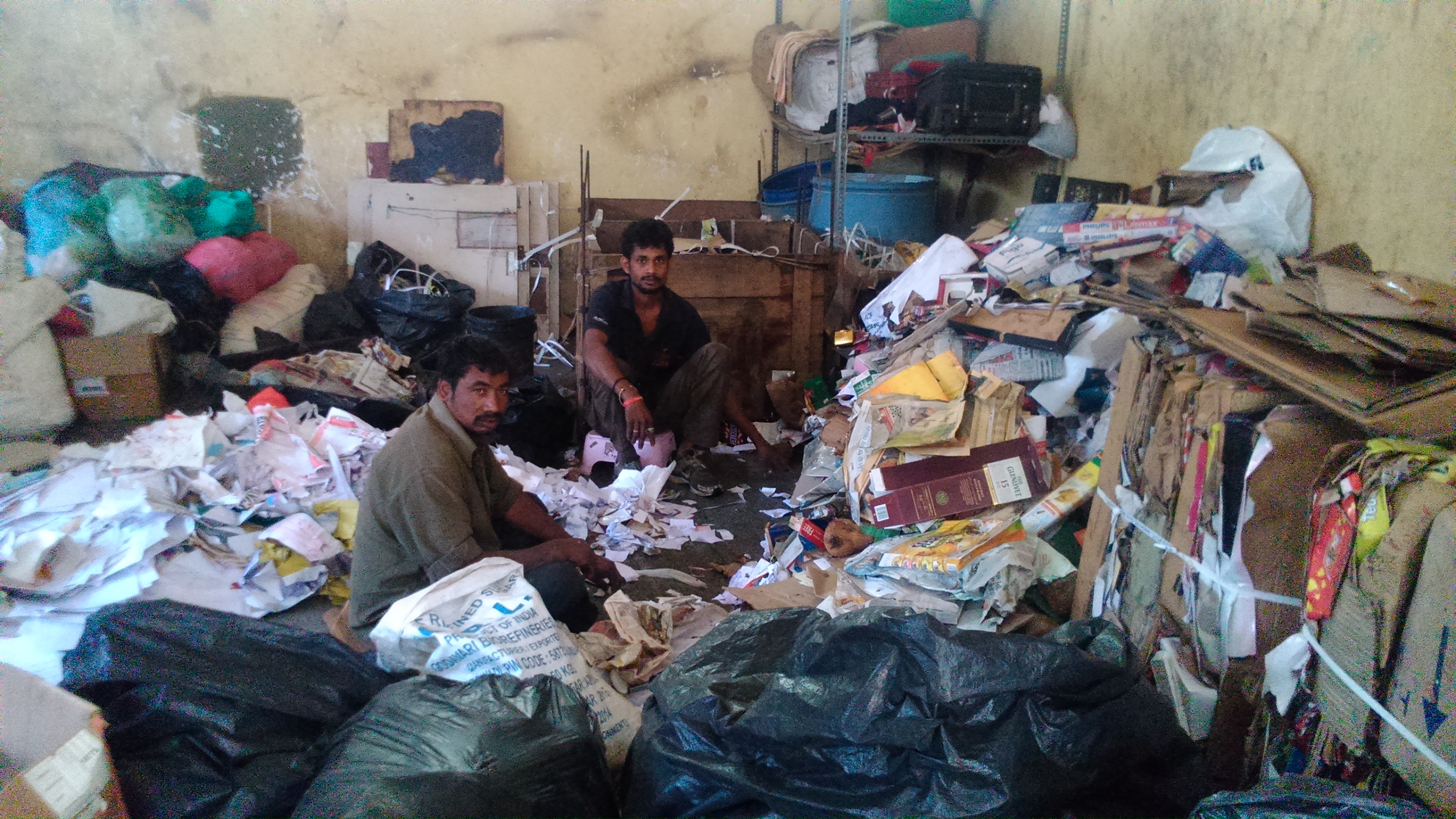
Today, Mansoor has a team of 10 sorters & collectors at the Jayanagar Dry Waste Collection Centre. He manages the inventory of 10-12 tons of dry waste every month and sorts the same in 72 different categories before it goes for recycling.
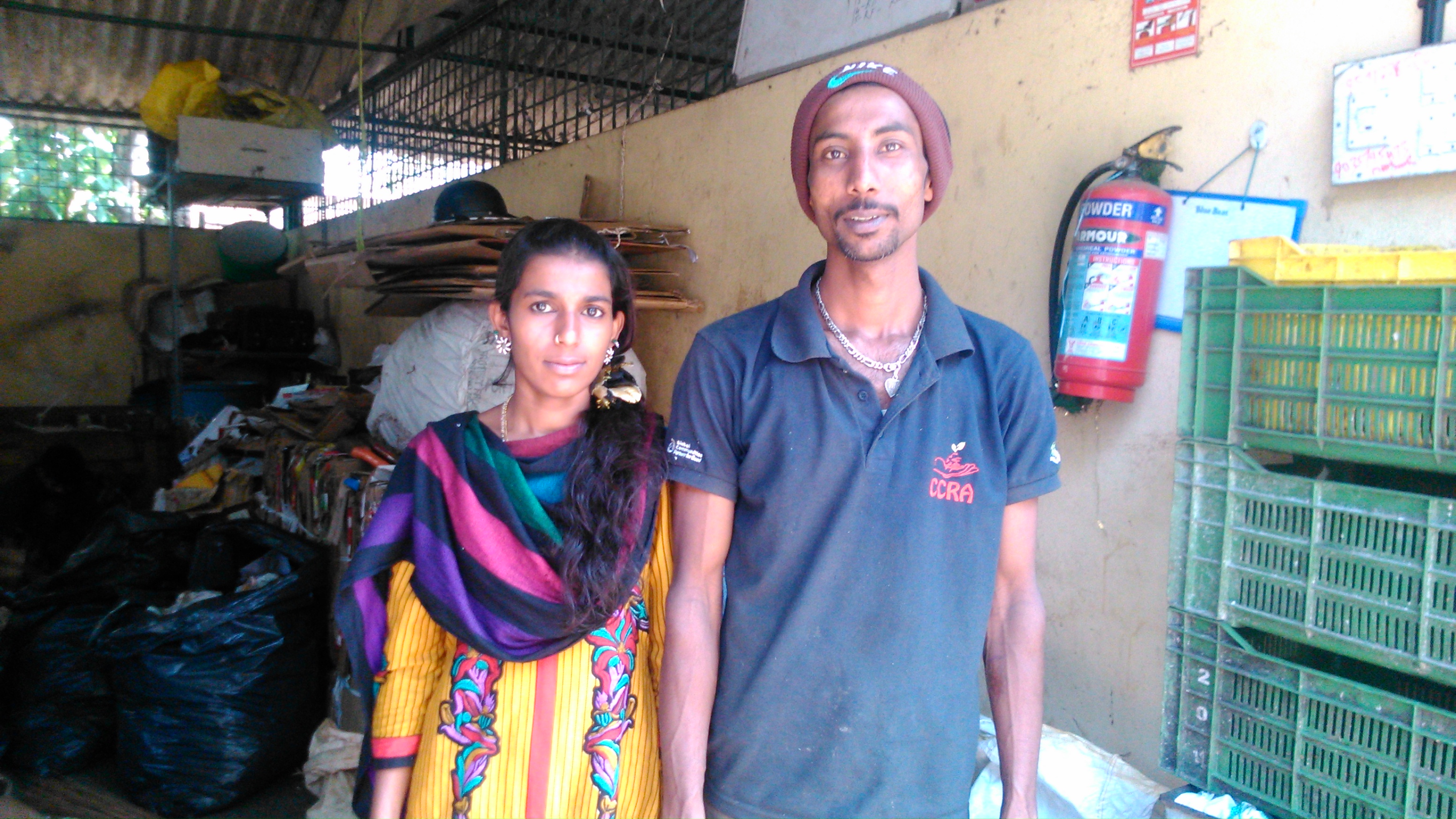
Mansoor with his wife.
But Mansoor does not stop just by adding value to waste. He also aims to make a scrap dealers’ cooperative which will play a role in creating a fair price marketplace, provide access to transparent data and geo-tag scrap dealers as the first point of sale for household waste.
He coined the brand name Clean City Recyclers Association (CCRA), and has MBA graduates assisting him in implementing his plans.
Reaching to this scale wasn’t easy for him. He had no stable source of income to support the operations or pay salary to the workers he had hired. HasiruDala came to the rescue and helped him stabilize operations. “Gradually, I got hold of things and today this centre is self-sustainable,” he says.
“Waste collection should not be considered as petty work. Thanks to HasiruDala, people don’t look down upon my work & have respect for what I do. HasiruDala has also provided ID cards to fellow waste pickers and a good uniform. It feels like we are all a part of something good.” he says.
Talking about the impact of his work, he has seen a tremendous positive change in the lives of the sorters and his team mates.
“People would sometimes be very careless while disposing the waste. They would mix wet and reject waste also in the dry category. This made our centre an unhygienic place to work. We later stopped collecting waste if it wasn’t segregated properly”.
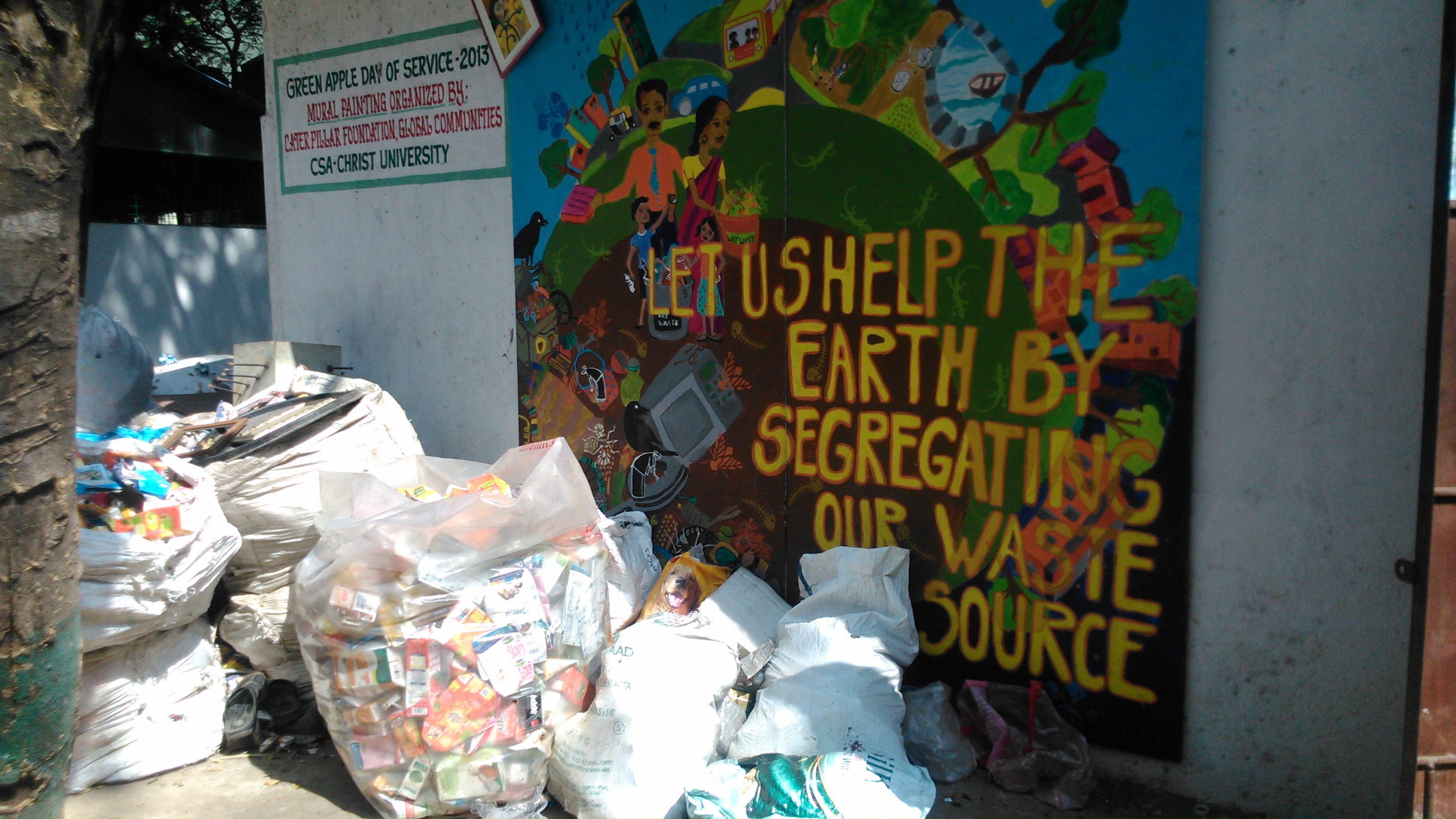
Thanks to his hard work in spreading awareness, 75 percent of his customers are now segregating at source.
Dry waste collection centre.
Apart from altering people’s mindset towards waste, Mansoor has made an impact in his work force as well. We learned that one of his new recruits, Arunachalam, who was a waste picker and an alcoholic, also had an unattended serious leg injury. From the day he has started working with the team, his condition has improved significantly, he earns more than what he used to and is now on a healthier diet towards recovery.
“Though I am still learning, I have realized that technology has a role to play. I Got Garbage team has developed android apps for managing our daily operations making it much easier than ever before. It helps us keep track of waste pick-ups, waste inventory and more,” says Mansoor.
Satyam Gambhir, client partner – Social Inclusion at Mindtree Ltd. adds, “At I Got Garbage, our focus is on waste picker livelihood and building solutions on the cloud platform that are repeatable and scalable. In Mansoor we see a long-term strategic partner, his unrelenting dedication and expertise has been instrumental.”
Mansoor is the chosen partner with I Got Garbage, a Mindtree initiative that positions waste pickers as recycling managers. I Got Garbage, along with Mansoor, is piloting a project ‘Donate Dry Waste’ in some parts of Bengaluru.
As Mansoor describes it, “Every waste picker will have a well-branded Rickshaw, a uniform and a smart phone, and will be put on-route to collect segregated dry waste from households and apartments.”
Mansoor segregates the waste in over 72 different categories.
“Currently, waste pickers are at the end of the chain, scavenging for waste on the street. They venture out on roads during odd hours of the day in hope of getting sufficient waste to make ends meet. We intend to place them at the beginning of the waste supply chain, i.e. at the source, like your house and mine,” says Gambhir.
He envisions a day when waste pickers will turn into waste managers, collect segregated waste from households on a weekly basis in a uniform, and wants to formalize the same; and Mansoor plays an important role in making this happen.
Mansoor and his unique people management skills have enabled waste pickers to earn Rs. 9,000 to Rs. 12,000 per month, which is far more that what they do while working informally and scavenging on the street for recyclables.
With Mansoor’s amazing enthusiasm and willingness to see change in the society, we definitely hope to see the much ignored sector getting its due credit.
source: http://www.thebetterindia.com / The Better India / Home> English> Bengaluru> Changemakers – Waste Management / by Shreya Pareek / February 19th, 2015
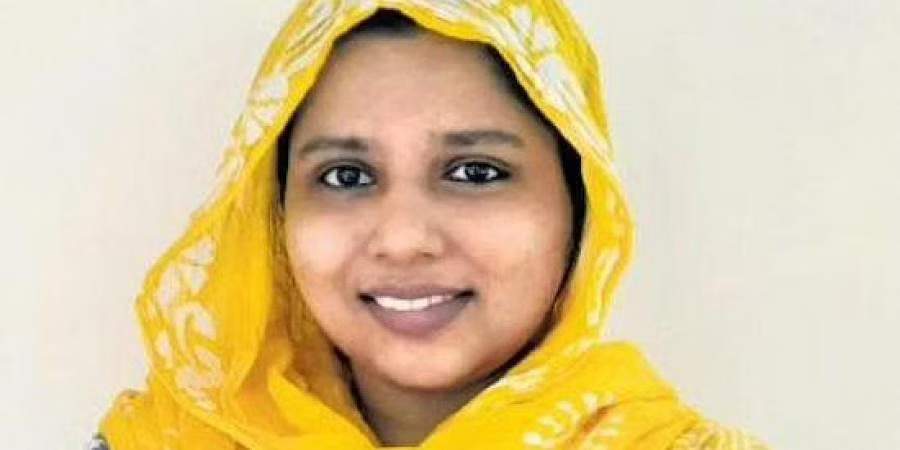
Nasreen Anshad’s brand SAWB makes beautiful garments specially created for Namaz with dreamy designs.
Nasreen Anshad
Picture this. The next time you offer Namaz, you are in a single, free-flowing, comfortable garment adorned with flowers or stars and sometimes even polka prints. The prayer dresses or Jilbabs may not be that familiar to people in Kerala . However, 28-year-old Nasreen Anshad is bringing Jilbab into vogue among the women here through her venture SAWB.
The whole idea is to offer dresses for Muslim women that they could wear with elegance during prayers. An MCA graduate, Nasreen’s foray into garment designing happened by chance. It all started last year when Nasreen was just searching for modest wear on the web. “I came across the prayer dresses on my search. But these weren’t available here. So I thought of making one for myself. I designed a Jilbab and my mother stitched it. After a few trials, we eventually got the attire right,” says Nasreen.
Nasreen started getting some customers for this specially designed prayer garment. And soon it turned into a huge business with over 1,000 pieces of Jilbabs getting sold every two weeks. Usually, women wear an Abaya and a Makhana while praying. The Jilbab comes as a single piece, making it a convenient garment for the prayers. It is also easy to carry as well. “A lot of people prefer buying Jilbab because it is comfortable and convenient. It is also beautiful and elegant to wear and is travel friendly,” says Nasreen.
The prayer dresses that Nasreen makes are modelled after the kinds available in Dubai. Nasreen says the style of these dresses changes according to the country. “The prayer dresses made in London or Indonesia are completely different. The reason Jilbab isn’t available here is since it is very pricey to even import. I wanted to make them and offer them to everyone at an affordable price,” says Nasreen.
The main challenge the novice designer faced was to convince people of the faith that wearing a colourful dress while praying was okay. “There is a misconception that you should wear only white. But this is nowhere mentioned in the Quran. What the Quran says is that one should wear the best dress while offering prayers,” says Nasreen.
So, Nasreen’s Jilbabs come in a grand array of colours and patterns, all designed by her. When she started out, it was her mother who used to stitch the garments. Now she has employed a women’s collective to stitch the garments. The Jilbabs are available in three sizes — for kids, teens and adults. The garment is made out of soft crepe and will last for three to four years, she says. “I feel so happy and proud now. This is a venture that happened by chance and people have embraced it. I want to incorporate more styles into the Jilbab, like the different versions available in various countries,” Nasreen says.
source: http://www.indulgexpress.com / The Indian Express – INDULGE / Home> Fashion / by Aathira Haridas / April 13th, 2022
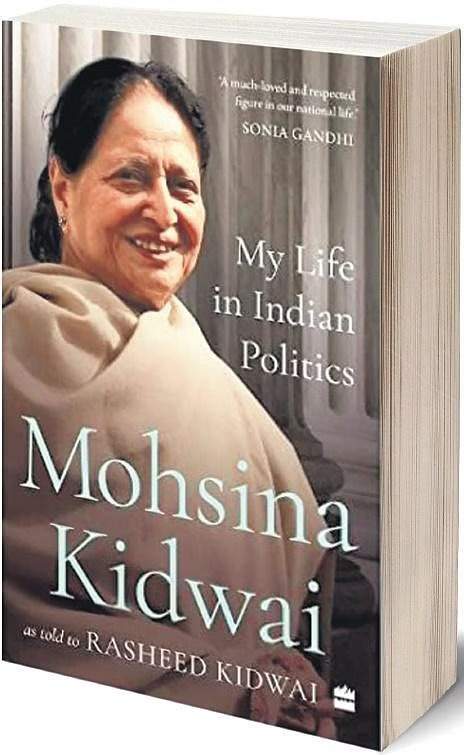
My Life in Indian Politics is co-authored by Mohsina and journalist Rasheed Kidwai.
Mohsina Kidwai
Mohsina Kidwai calls herself a reluctant writer. Despite that, the 90-year-old politician, who has been one of the leading figures of the Indian National Congress (INC), felt it was time to pen her memoir after observing certain shifts in the political climate of the country. “Everyone has a book in them and perhaps I am no exception. I was a reluctant writer, often wondering, weighing over a range of political, ethical, and personal issues. But as I became less active in public life and saw various trends and shades in our country’s polity, I firmed up my mind to write my memoir.
This book is a story of my life but in many ways, it is also a journey of our post-Independence beloved country. As a political worker, it is clear to me that challenges have always been multiple and intricate but not unsurmountable,” says the former politician.
My Life in Indian Politics, the book in question, is co-authored by Mohsina and journalist Rasheed Kidwai. Rasheed took up the project to co-write the memoir because he felt Mohsina’s story is an interesting one to share. “Normally there are various ways that books of eminent political personalities are written. I have authored a few independent autobiographies of political figures. This was the first time I was dabbling in a joint venture. Mohsina spoke to me at length about her life and her career. Essentially, the book is the narration of her life carved by a wordsmith, which was my role. She has been a participant in Indian politics for over six decades, I felt this was a fascinating project to be a part of,” says Rasheed, who ensured that Mohsina approved every word in the book.
Throughout her career, she always believed that Muslims can live harmoniously in a multicultural, independent, and secular Indian society. During Rasheed’s days spent in close proximity with Mohsina, he noticed her being disturbed at the present political and social situation our country finds itself in. “She has greatly exercised her critique of the current political identity because this is not the idea of India that she cherishes. In her career in Uttar Pradesh (UP), she won elections from Azamgarh (Eastern UP) and Meerut (Western UP).
Anyone remotely connected with the socio-economic condition of UP and the caste matrix would vouch that finding acceptability in these two diverse regions is a rather insurmountable task. But today, it is difficult for a Muslim politician to do that. We can see that the number of Muslim candidates has been on a steady decline and you don’t see such examples anymore. Mohsina was never looked at as a Muslim candidate even though she is an ardent practitioner of Islam,” Rasheed says, adding that she had always preferred being judged as an Indian, and her core electoral team always had a mix of people from different communities.
Mohsina is known for her assessment of the INC. Rasheed believes that if at certain times the political leadership had heard her out, then perhaps the history of the party might have been different. “She had opposed former PM PV Narasimha Rao’s politics, not just about his handling of the Babri Masjid case but several other things. She also had a different view on the Shah Bano case. She stood firm with what she thought was right even if her party didn’t agree,” says Rasheed.
Hailing from a conservative, aristocratic Muslim family of Awadh, Mohsina holds the distinction of winning Lok Sabha thrice — in 1978, 1980, and 1984. According to noted French scholar Christophe Jaffrelot, Muslim women face discrimination in a double bind: for their religion as well as their gender.
Data suggests that barely 20 Muslim women have made it to the Lok Sabha among nearly 9,000 MPs voted since 1951. The grounds for discriminating Muslim women are still a prevalent reality. Rasheed feels Mohsina’s memoir can come as a comforting account of hope for fellow Muslim women thinking about venturing into politics.
“The representation of Muslim women in politics is still marginal. Even though some might argue against it, democracy is all about numbers. With the meagre numbers at hand, how can you justify the representation? Her story is about courage, conviction, and integrity. For example, when she retired from politics in 2016, she did not have a house in Delhi. There are so many examples of people with much shorter duration in politics having houses everywhere. She never did despite being the Housing Minister for the country. That’s how a political leader should be,” concludes Rasheed.
source: http://www.indulgexpress.com / The New Indian Express – INDULGE / Home> Society / by Tunir Biswas / November 08th, 2022
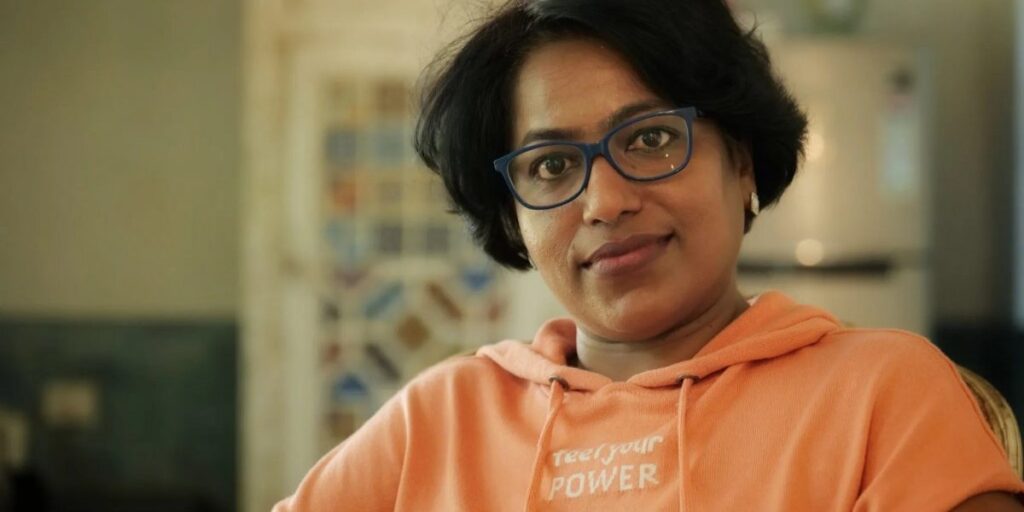
Shahina was one of the first Indian journalists to be charged under the draconian Unlawful Activities (Prevention) Act for her work in Tehelka magazine.
Indian journalist and senior editor of Outlook magazine Shahina K.K. is one of the journalists honoured in this year’s International Press Freedom Awards given by the Committee to Protect Journalists.
Shahina, the CPJ points out, was one of the first Indian journalists to be charged under the draconian Unlawful Activities (Prevention) Act for her work in Tehelka magazine. The CPJ note continues:
“She has continued her reporting in various posts despite awaiting trial for a case opened in 2010, when local government officials in Karnataka state sought to criminalize her reporting published in Tehelka, a prominent investigative magazine where she worked at the time. Her report cast doubt on a police investigation into 2008 bomb blasts in Bengaluru, alleging that the police had fabricated witness statements to arrest a local Muslim cleric.
She faces three charges under the penal code, including criminal intimidation, intent to commit a criminal act, and criminal conspiracy, and one count under UAPA pertaining to threatening witnesses. As of June 2023, Shahina is out on bail pending trial. If convicted, she faces a maximum of three years in prison and a fine.
A Muslim by birth, Shahina has also been subjected to extensive harassment by Indian right-wing groups seeking to silence her reporting on religious minorities and vulnerable caste groups. She has faced persistent online harassment and lewd threats, and in 2020, several right-wing publications falsely implicated her in that Bengaluru bombing.
Based in Kochi, in the southern state of Kerala, Shahina has worked as a reporter, production associate, and news anchor with well-known news outlets including Asianet News, Janayugom, Open, and The Federal. She also has contributed to The Washington Post.”
The CPJ has said in its note announcing Shahina’s win that this also highlights “India’s increasingly repressive environment for press freedom, with the targeting of journalists under draconian security laws, and toxic online campaigns particularly aimed at vilifying women journalists and ethnic or religious minorities.”
Other awardees for this year include Nika Gvaramia from Georgia (founder and director of independent broadcaster, Mtavari Arkhi), María Teresa Montaño from Mexico (investigative reporter and founder and editor of The Observer, a fact-checking and investigative website) and Ferdinand Ayité from Togo (head of L’Alternative, one of Togo’s top investigative outlets).
This year’s Gwen Ifill Press Freedom Award from CPJ, which goes to “an individual who has shown extraordinary and sustained achievement in the cause of press freedom”, has been awarded to Alberto Ibargüen, who recently announced he is stepping down as president of the Knight Foundation after 18 years at its helm. “Under his leadership, the foundation invested over $2.3 billion in journalism, arts, economic development, and research. Ibargüen is the former publisher of the Miami Herald and El Nuevo Herald. During his tenure, the Miami Herald won three Pulitzer Prizes and El Nuevo Herald won Spain’s Ortega y Gasset Prize for excellence in journalism. He served on the board of CPJ from 1993 to 2005,” CPJ has said.
source: http://www.thewire.in / The Wire / Home> Media / by The Wire Staff / November 20th, 2023
I can only write about a country that is dead and gone, Zeyad’s book is about living in the corpse of a body politic that has abandoned even the desire to be fair and just to all its citizens.
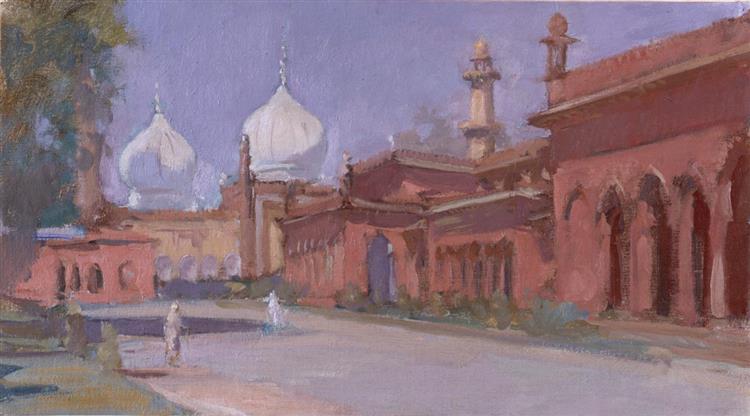
Jami Masjid, Aligarh. Artwork: Martin Yeoman/Public domain
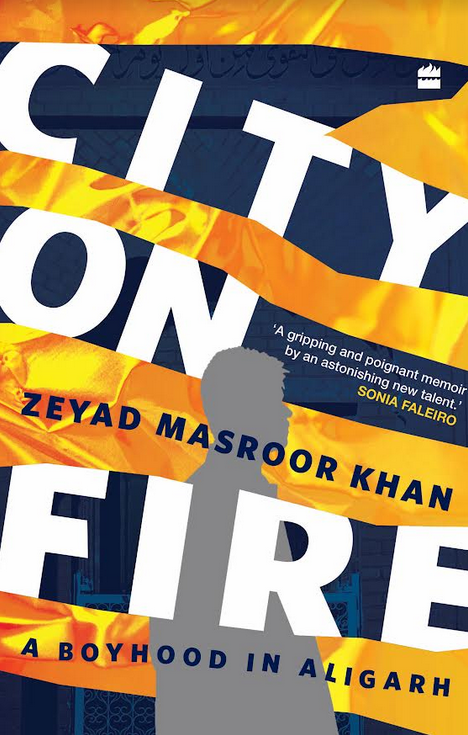
It is impossible for me to dispassionately review Zeyad Masroor Khan’s evocative memoir, City on Fire: A Boyhood in Aligarh. Both of us were born in Aligarh, my first novel and his memoir are both set in the city, and the earliest of our memories are those of Hindu-Muslim riots. In my case, it was a riot in Ahmedabad, Gujarat, where a policeman had called my father’s colleague to tell him that the police cold not guarantee our safety. We were the only Muslims in the ONGC colony, and my father was on the oil rig. A Muslim boy and a Hindu girl had eloped. Men and boys with something to prove were out with swords, so Khan uncle smuggled my mother, my elder sister, and me in the dead of the night.
Zeyad Masroor Khan / City on Fire /Harper Collins, 2023
These similarities, however, are swamped by the differences. We were both born in houses our grandfathers built – in my case it was on the Civil Lines part of the city, where my grandfather served as the chief medical officer –and was one of the set of houses my grandfather bequeathed to his sons. Muslims in this area – except for some university students – were those whose families might have a member in the bureaucracy. And as the Sachar Committee Report highlighted in 2005, Muslims accounted for only 2.5% of the bureaucracy.
In Zeyad’s case, his house was built by, “Ashfaq Ahmed Khan, and his brother, Aashiq Ahmed Khan… from a nearby village” that was shared by his progeny. Khan’s house, where Zeyad grew up, was grandly named Farsh Manzil, with Farsh referring to the ground between heaven and earth. But it was also in Upar Kot in the commercial city or sheher.
Civil Lines is mostly known for Aligarh Muslim University, a somewhat elitist institution, while the sheher is known for locks crafted by hard-working labourers. Very few of those in the sheher, particularly the Muslims who were largely part of an underclass, received a good education, fewer still made it to the university. The small bridge, memorably named the Kathpula or half-bridge, is a border as real as that between different countries. One could cross it, but only reside in one part.
The difference was stark. When I was at the university in the early 90s, I did not attend classes, beat up my seniors, and eventually flunked out; Zeyad was a topper. Riots meant that the university was swamped by hundreds from the Rapid Action Force in their blue camouflage uniforms meant to make them visible. In Upar Kot, it was hand-to-hand combat, painfully illustrated by the chapter titled “The Button” in Zeyad’s book. There was a button in Zeyad’s house – which abutted the Hindu areas – that he once pressed as a child after climbing a chair. Unknown to him, it was linked to a lightbulb that alerted the neighbours against rampaging mobs coming to attack and kill them. The police, much less security forces like the RAF, were never there to protect the people (although, to be fair, even in the university they were seen more as a tool of repression). Instead, for Upar Kot residents, the police were often seen as part of the mob, firing on the Muslim areas.
Throughout the nearly 300 pages of the memoir there is only one mention of a policeman actually doing his duty. And that was from a childhood prank his mother and her friends pulled to get Zeyad to report that he was “lost” at the Numaish (something like an annual circus fair) so that they could see his cute face on the newly installed TV screens.
It is hard to overstate how real and important this is. For the vast majority of Indians, and the overwhelming majority of Muslims – let’s not even talk about Kashmiris or Dalits and those we call “tribals” – the state is absent, or sometimes overtly hostile. “We, the people of India” might be the first words of the constitution, but that “we” has hardly any power over, and any (good) expectation from the state in which they find themselves.
Nonetheless, the power of people “just doing their jobs” cannot be overstated. They are the one and only source of hope in the long journey from riot to riot that Zeyad maps. There are two outstanding heroes in the book. One, Bablu, is the rather slow-witted but intensely brave bus conductor on their school bus. Surrounded by a stone-pelting crowd after the bus has dropped off the Hindu children, Bablu single-handedly staves off the mob baying for blood, keeping the door closed, and showing off his Hanuman locket to show he is Hindu, and claiming that all the people inside are as well. Much, much later, a Hindu Ola taxi driver in Delhi during the 2020 pogrom drives Zeyad and his friend from a Hindu majority area to Jamia, unwilling to fall prey to the binaries and the hatred being pumped out on social media. Bablu is never recognised or rewarded for the amazing courage he shows, except maybe the grateful love of other bus passengers like Zeyad who carry a portrait of his valour in their hearts. The Ola driver would probably be attacked if identified.
Along the way, there are also others just doing their job that sustain Zeyad and open the world to him. This includes the storeowners who rent out comic books that open up a world of imagination to him; Father Joseph, the vice-principal at his school who promptly orders the removal of an article on display depicting the Prophet since some of the Muslim children found it disturbing; and Usha Aunty who rents him and his friends a flat in Delhi allowing them to live a “normal” life. There is also his teacher, Sara Job, who counsels him after he writes a provocative essay on Osama bin Laden in school, setting off an intense debate about his suitability among the schoolteachers.
What is entirely missing though, is politicians or leaders carrying out their constitutional duties. The only politician that appears is one filled with hatred towards Muslims. This is the other difference between Zeyad’s vision and mine, and it is a matter of age. I turned eighteen a few weeks after the demolition of the Babri Masjid, Zeyad was only four. In my novel set in Aligarh, the celebration of hate was an anomaly, a breakdown and a source of confusion even if communal violence was well known (my father had gone to assist people after the first major anti-Muslim riot after independence, in Jabalpur in 1961). In Zeyad’s time hate against Muslims has become a national passion. I can only write about a country that is dead and gone, Zeyad’s book is about living in the corpse of a body politic that has abandoned even the desire to be fair and just to all its citizens.
It is remarkable, then, that the book is as compulsively readable as it is. The bleakness of the terrain that Zeyad inhabits is undercut by his own humanity and humour – quite often about his own failures as well as the foibles and problems of those among whom he lives. Resilience is too often used as a word with little content. Talking recently to a friend – a Hindu, I might add – who worried whether it was even possible to just do her job, to honestly work in an atmosphere of constant baiting and attacks, I found I had little advice to offer her except to say that oppression is expensive. In Zeyad’s moving memoir, in which he returns repeatedly to how people emerge after rounds of communal violence to buy and sell to each other, to just live, even among people they have seen call for their deaths, there is an almost superhuman quality to this “resilience”. We ask much of Indians living in burning cities, demand more than humanity should bear. They shame us by giving more.
Omair Ahmad is an author and journalist.
source: http://www.thewire.in / The Wire / Home> Books / by Omair Ahmad / November 29th, 2023
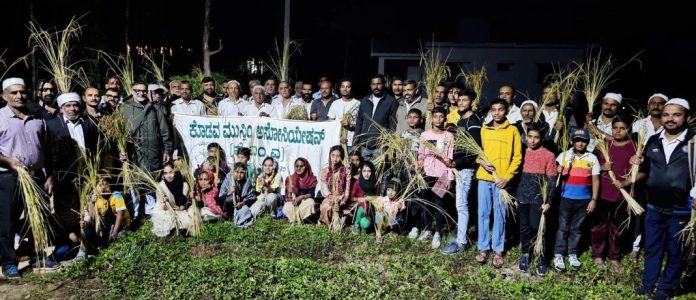
The Kodava Muslim Association (KMA) illuminated the night with joy as they celebrated the ancient custom of removing the traditional Kadiru (New Rice Crop) on the auspicious occasion of Puttari festival. The festivities took place on Monday night, drawing the spirited participation of hundreds of members from the Kodava Muslim community, marking the Harvest Festival of Kodavas.
At the striking hour of 8:30 PM, the Kadiru removal ceremony unfolded in the Jamma Gadde of the Kolumanda family in Aimangal village, Gonikoppa. Led by KMA President Duddiyanda H. and Sufi Haji, the event saw elders from Aimangala village, KMA members, and Kootambattira Hussain coming together to share in the holy Swalat. Boiled rice milk, a symbol of abundance, was distributed to all attendees, fostering a sense of unity and community spirit.
Key figures in the program included KMA Vice President Akkalatanda S. Moidu, General Secretary Italathanda Rafiq Tuchamakeri, Treasurer Harishchandra A. Hamsa, Joint Secretary Karatorera K Mustafa, Organizing Secretary Meetalathanda M. Ismail, and Senior Director Chimmichira K. Ibrahim (Ummani).
The presence of local Jamaat presidents, such as the head of Kondangeri Jamaat and K.M.A. Director Kuppandir K. Yusuf Haji, and the President of Katrakolli Jamaat, Alira M., added a distinguished touch to the celebration.
Residents from various areas, including Kottamudi, Cheriyaparambu, Kunjila, Kolakeri, Kondangeri, Chamiyala, Gundikere, Nalvathoklu, Ambatti Kandangala, Katrakolli, Halligattu, and Begur, joined the festivities alongside children from Aimangal.
The program, hosted by Kolumanda Rafeek, extended its warmth with a traditional Tambittu-Puttari sweet potato breakfast and dinner, showcasing the rich cultural heritage of the Kodava Muslim community.
The Kadiru, symbolizing the new rice crop, was then respectfully taken to households, marking the culmination of a joyous and culturally significant event.
source: http://www.thehindustangazette.com / The Hindustan Gazette / Home> News> Latest News / by The Hindustan Gazette / November 28th, 2023
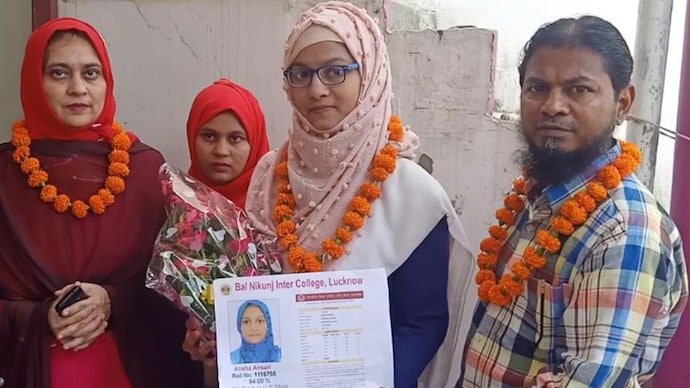
Lucknow topper Alisha Ansari has remained distant from social media sites to score 94% in board exams.
Class 10 student Alisha Ansari has secured the first rank in Lucknow and ninth in Uttar Pradesh with a score of 94 per cent. Apart from sheer hard work and support from parents, Alisha has had remained distant from social media websites, including Facebook, Twitter, and Instagram to attain this position.
Alisha, who comes from a middle-class family, has a younger brother and an elder sister. Her father, Mohammad Rizwan Fazli, is a teacher in a private engineering college and her mother, Shabana Ansari, is a housewife.
Kanti Mishra, Principal, Bal Nikunj Inter College, said, “Alisha has been a hardworking student. Also whenever she had a doubt in the subject, she would immediately ask school teachers.”
Appreciating her hard work and talent, her mother, Shabana Ansair, told, “We have always given our daughters equal opportunities to study.”
Moreover, she shared that she would want her daughter to become a doctor and it is just the beginning of her journey of success.
Also, her father, Mohd. Rizwan Fazli, expressed his happiness, saying that he is extremely proud of her daughter.
source: http://www.indiatoday.in / India Today / Home> News> Education Today> News / by Ashish Srivastava, Lucknow (UP) / June 27th, 2020
A total of 33 students from various districts of Uttar Pradesh have found their place in the Class Xth 2020 list of top ten.
Uttar Pradesh 10th Result 2020:
Three Muslim students – Alisha Ansari, Arshad Iqbal and Arshima Sheikh, have cracked the 2020 UP Matric High School Class 10 exam 2020 and have been included in the list of Top Ten.
A total of 33 students have found their place in the 2020 list of top ten. While Alisha Ansari secured 9th rank, Arshad Iqbal and Arshima Sheikh have bagged the 10th rank in Uttar Pradesh Class 10 Merit List 2020.
Alisha Ansari Mohd Rizwan Fazli of Bal Nikunj Inter College Lucknow has got 564 marks (94%) out of the total 600 marks and jointly shared the 9th rank with five other students
Arshad Iqbal Iqbal Hussain of PT RN MHSS Shahjahanpur and Arshima Sheikh Aftab Ahmad of St Xaviers School Kanpur have got 563 marks (93.83%) and secured the 10th rank with 02 other students.
Uttar Pradesh Class 10 result was Uttar Pradesh Madhyamik Shiksha Parishad (UPMSP) Saturday at 12:30 pm by Dy CM and UP Education Minister Dinesh Sharma.
The overall pass percentage of Uttar Pradesh board Class 10 this year is 83.31 percent – an improvement by more than 3% as compared to last year. In 2019, the overall pass percentage was 80.07%.
Riya Jain Bharat Bhushan of Shri Ram SM Inter College Bagpat has topped the Uttar Pradesh board in 2020 High School or Class 10 (UPMSP Class X) exam result of which is declared today.
Ria Jain has secured 96.67 percent marks to secure the 1st position in the 2020 Merit List.
Abhimanyu Verma Ramhut Verma of Shri Sai Inter College Barabanki came 2nd with 95.83% marks and Yogesh Rajendra Pratap Singh of Sadhbhavna Inter College Barabanki came 3rd with 95.33%.
“All toppers will get laptops and cash rewards”, Dy CM Dinesh Sharma and UP Education Minister said while declaring the result.
source: http://www.ummid.com / Ummid.com / Home> Education & Career / by Ummid.com News Network / June 27th, 2023
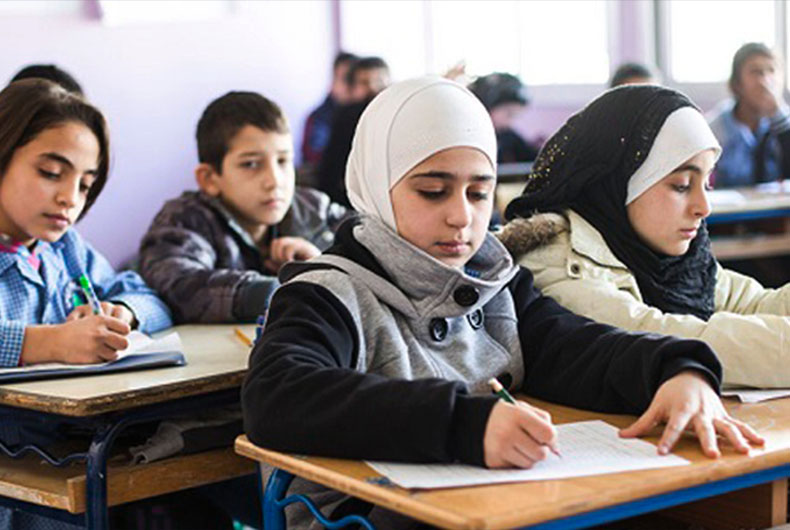
Long before India became the first country to introduce mid-day meals to children in government schools to supplement their nutritional needs and to encourage poor families to send their children to school, Anjuman-e-Islam, a Muslim institution had started the scheme in Mumbai.
Ajmunan-e-Islam ursu school was established some 150 years ago. It was the brainchild of a group of progressive Muslim intellectuals of Mumbai.
The initiative for this was taken by Badruddin Tyabji, the first Indian barrister of the Bombay High Court, Qamaruddin Tyabji, the third president of the Indian National Congress, his elder brother and lawyer Nakhuda Mohammad, Ali Roge, businessman and social activist, Ghulam Mohammad Munshi, The school came up at Babula Tank near Umarkhadi in the then Bombay province and started as a small place.
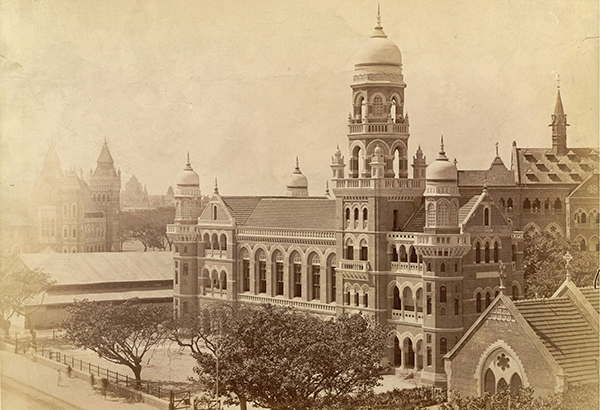
An old picture of the Anjuman-e-Islam in Bombay
In 1893, ‘Anjuman-e-Islam’ was shifted to a building opposite Victoria Terminals (presently ‘Chhatrapati Shivaji Maharaj Terminus’) from where it continues to operate.
At that time many facilities were provided to the students coming to study in ‘Anjuman’. The facilities included a mid-day meal comprising boiled eggs, bread, and bananas.
It was established a year before the establishment of ‘Aligarh Muslim University’ (AMU) in Aligarh by Sir Syed Ahmed with the sole motive of providing modern education to Muslims.
‘Anjuman’ school initially ‘only admitted boys and it was much later that it opened the doors to girl students. In 1936, a separate school for girls was also started by the name ‘Saif Tayyabji Girls High School’ on Bellasis Road.
The students of Anjuman e islam taking part in a cultural programme
This school, which started on 21 February 1874 with three teachers and 120 students, has now transformed into 97 institutions. Today more than 1.1 lakh students are studying right from nursery classes to PhD – are enrolled in its educational institutions. Interestingly, 70 percent of students enrolled are the first ones from their families to receive education.
Anjuman-e-Islam played a major role in India’s freedom struggle. Many people including Moinuddin Harris and Mustafa Fakih of ‘Anjuman’ were sentenced to imprisonment during the freedom struggle. Many policy meetings for the freedom struggle were held on its premises.
‘Anjuman’ has a long history in nation-building.
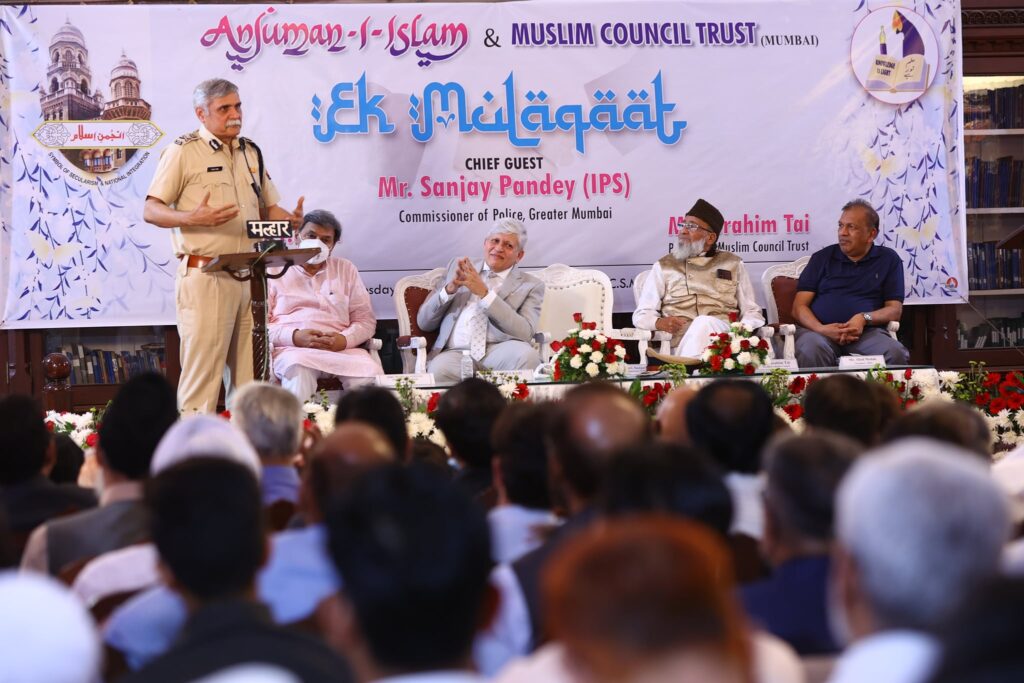
Mumbai police commissioner Dr Sanjay Pandey addressing the students of Anjuman-e-Islam
Today the main administrative office of the organization is located at the same place where the seed of ‘Anjuman’ was sown. Five colleges – two catering colleges, a business-management college, a home science college, and a law college – have been established on the institute’s three-acre campus. In addition, there is a polytechnic, a junior college for women, and two schools in both English and Urdu medium.
The campus also has a large library and a research center.
Sir Karimbhoy Ibrahim, Haji Yusuf Haji Ismail Sobani, Justice A. M. Qazi, Justice Faiz B. Tayyabji, Sardar Sir Suleman Kulsoom Mitha, Hussain B. Tayyabji, Usman Sobani, Mohammad Haji Ahmed, A. I. Maskati, Hadi C. Tayyabji, Saif F. B. Tayyabji, Akbar A. Pirbhoy, A. K. Hafeez, A. R. Persons like Antulay, Moinuddin Harris, Dr. M. Ishaq Jamkhanwala, Sami Khatib made special efforts. Presently Dr. Zaheer Kazi is its President.
`Anjuman’ has two main objectives, first – ‘to provide quality education at minimum cost’ and second – ‘to prevent any student from being deprived of education due to lack of funds’
More than 50 percent of the students in ‘Anjuman’ come from economically weaker sections. Anjuman has created a ‘Special Zakat Fund’ to enable these students to complete their education. The economically weaker students are given a 50 to 100 percent discount in education fees.
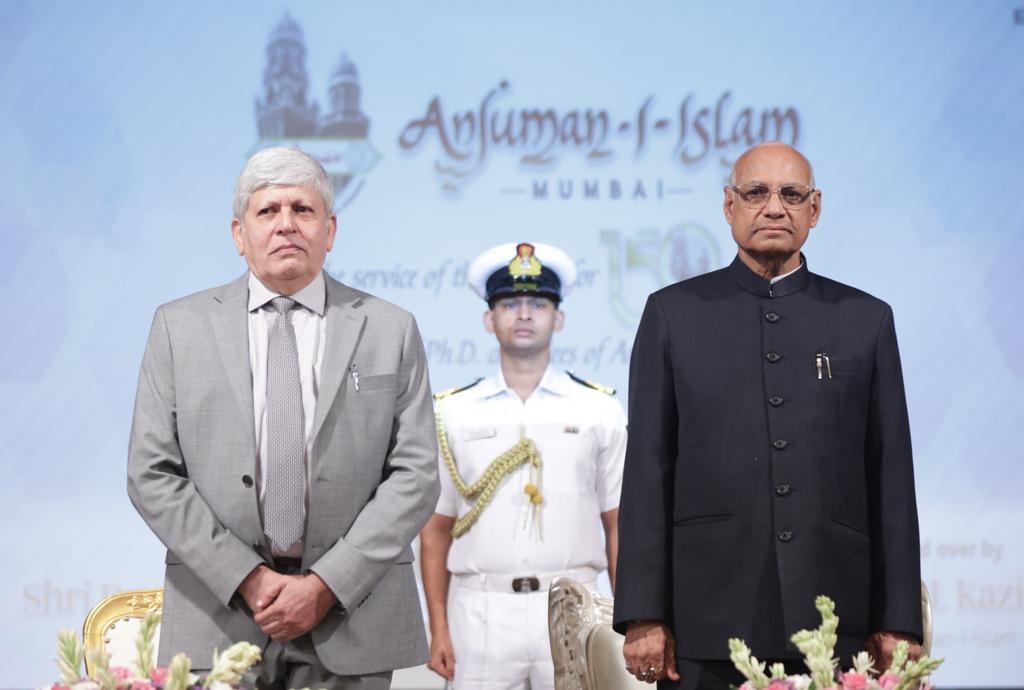
Vice Chancellor of the Amjuman-e-islam Dr Sahir Qazi and Governor of Maharashtra
The Anjuman is inspired by Maulana Abul Kalam Azad’s message that ‘Education given from the heart can bring revolution in the society’, the organization has been doing this work. The ‘Anjuman’ has more than 40 percent girls on roll.
Today the institution offers courses like Engineering, Medicine, Architecture, Pharmacy, Hospitality, Catering and Hotel Management, Law, Business Administration, Home Science, and Teacher’s Training.
Some, 3000 employees work in the Anjuman institutions. In the year 2000, `Anjuman’ was awarded the ‘Best Educational and Social Institution in Maharashtra’ by the State government. Recently the institution has been awarded the ‘Sir Syed Award of Excellence’ of AMU, Aligarh University.
The alumni of `Anjuman’ are today working in high positions in various fields like business, technology, arts, sports, media, medical science, and politics in many countries. Former Chairman of Fortune Company and Indian Oil Corporation, M.A. Pathan, former Chief Minister of Maharashtra A. R. Antulay, famous actor Dilip Kumar, Ismail Merchant of `Merchant of Merchant Ivory Productions’, former Deputy Editor of `Illustrated Weekly’ Fatima Zakaria, former editor of `Mumbai Mirror’ and `Sunday Times’ Farida Naik and famous cricketer Salim Durrani. Celebrities have been alumni of ‘Anjuman’.
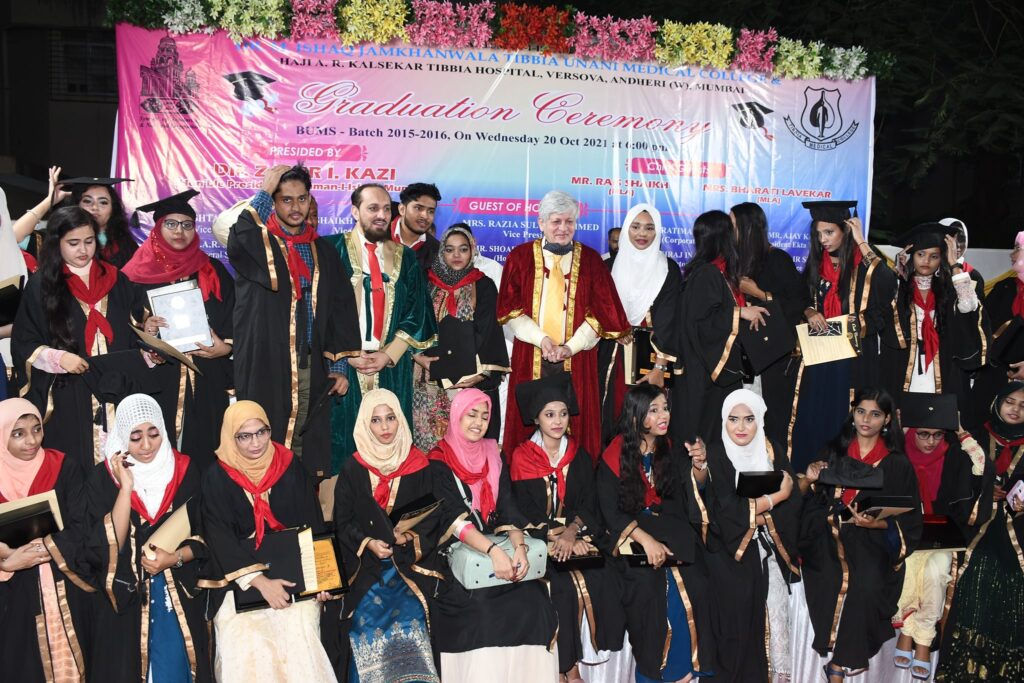
Students at the Convocation of Anjuman-e-Islam
Dr. Zaheer Kazi, current president of ‘Anjuman’, says, “We are constructing a state-of-the-art building in the Sabu Siddiqui College campus in Byculla. There will be an incubation center as well as post-graduation and PhD courses taught there. “Besides, there will also be an integrated center.”
Apart from this, a health education campus will be built in Kalyan-Bhiwandi or Panchgani, in which MBBS courses, Dental College, College of Nursing, Physiotherapy, and Homeopathy will be started. Pharmacy, law college, degree college, and high school for girls will be started in the Solapur campus. Also, land acquisition for catering, pharmacy, and high school-cum-college in Panaji, Goa is in the final stages.
He said, “’Anjuman-e-Islam’ has partnered with MIT University in Cambridge, England, and its five Faculties of Engineering, Master of Business Administration (MBA), Pharmacy and Elementary Education. In addition, ‘The Kalsekar School of Pharmacy’ (Panvel), and The Maryland School of Pharmacy’, Baltimore, (Washington DC) have been approached for collaboration with Anjuman-e-Islam. Philadelphia’s ‘Temple University’ asked ‘A. of Anjuman-e-Islam’ for cooperation. R. Antulay College of Law has also been contacted.”
‘Anjuman’ has 97 educational institutions including schools and colleges. These include pre-primary schools (15), primary schools (15), secondary schools (20), junior colleges (10), polytechnics (4), degree colleges (15), other institutions (10), proposed institutions (2), Consists of hostels, auditorium (3), support units (2) and orphanage (2).
source: http://www.awazthevoice.in / Awaz, The Voice / Home> Story / by Chaya Kavire, Pune / November 22nd, 2023
.webp)
.webp)