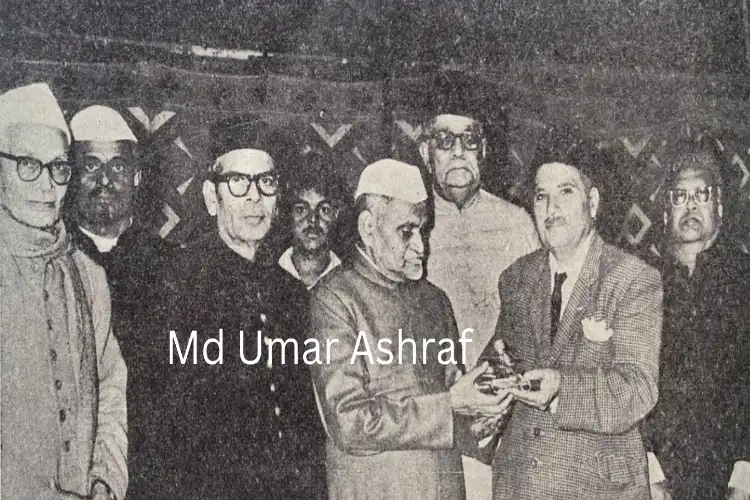
Administrator of Ajmer Sharif Aley Mohammad Shah donating gold to the minister (Courtesy: Md Umar Ashraf)
If I tell you that the Dargah of Khwaja Moinuddin Chishti at Ajmer, Rajasthan, played a role in the war against China when India was invaded in 1962, will you believe it?
In October 1962, the Chinese Army invaded India which had gained freedom 5 years ago. Such national crises test the character of a country. Indians of all creeds, castes, races, and social groups joined hands to fight the mighty enemy.
After 200 years of British colonialism, the Indian economy was in shambles when the colonial rulers left in 1947. When China invaded, India was not as big an economy as it is now. Prime Minister Jawaharlal Nehru appealed to his compatriots to donate gold and money to the defence funds.
Responding to the call, Dargah at Ajmer opened its vaults for the country’s defence forces. The management of the shrine of Hazrat Khwaja Moinuddin Chishti believed that national service comes before any other service. The administrator of the committee handed over 2 kilograms of gold and invested Rupees one lakh in Defence Saving Certificates to the Union Minister of Irrigation and Power at a meeting held at the Dargah. It also announced holding special prayers for the success of the Indian Army daily.
The administrator who handed over the gold, to the minister was Aley Mohammad Shah. His elder son Zameruddin Shah rose to become the Deputy Chief of Army Staff in India while his other son Naseeruddin Shah is a popular film actor.
The episode is a testimony to the fact that for Indian Muslims following Islam and serving the nation are not contradictory.
source: http://www.awazthevoice.in / Awaz, The Voice / Home> Culture / by Saquib Salim / December 14th, 2022
Abbas said he wrote the memoir to enable his children to know their father better.
Saulat Abbas.
In a letter to his friend Thomas Poole, Coleridge wrote that any life, however insignificant, would if truthfully told, be of interest. There are two important points in Coleridge’s observation. One, that it is not important whether the subject of a memoir, biography or autobiography has lived a very eventful life and achieved great success, as any life can be a good enough subject for a book. Two, truthfulness in reporting events of life is an essential feature of a book chronicling a life. And because a memoir lies somewhere between history and literature, the element of selection, omission, foregrounding, and downplaying of events of life can all be part of a memoir.
An ordinary life
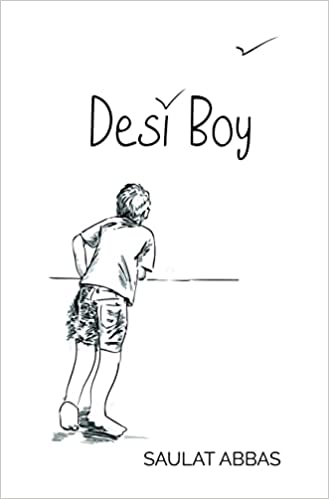
Saulat Abbas’s memoir Desi Boy starts with his modest admission about his ordinariness. He states that his purpose in writing his memoir is to let his children know him if ever they decide to know about their father. “Given all the uncertainties of life, if god decides to take me away before my kids are mature enough to care about who their father is, this book, I believe, will satisfy their curiosity.” While Abbas, whose two marriages did not last long, lives in Saudi Arabia alone, alternating between the gulf countries and his motherland India, his teen-aged son lives in Taiwan with his mother, and his daughter in Malaysia with her mother.
Abbas’s truthfulness in reporting various events of his childhood, adolescence and youth, some even projecting him in a very bad light if seen from some established ethical principles, is the most important feature of his memoir. It certainly must have been an important decision for him to decide which incidents should or should not be included in his memoir. Thus indoctrinated to believe that the punishment for theft is chopping off hands, he almost chopped off the hand of Khajya, his young playmate, with an axe for stealing marbles, injuring him badly enough to leave a cut on his hand.
There is certainly interesting material in his ordinary life: a Muslim boy living in an eastern UP village in a patriarchal set-up struggling with his education; his family moving to western UP town of Bulandshahr where his anglophile father taught English in a postgraduate college; his student days at Aligarh Muslim University; his dreams and his aimlessness finally taking him to Saudi Arabia and Europe where he feels that he has made it. More than the external events, it is his intellectual and spiritual development and his struggle with some ethical principles that make the book eminently readable.
Undoubtedly the most authentic portion of the book is his account of his early childhood in his mother’s village where he was exposed to village superstitions, rural-agricultural practices, Tom Sawyer-like antics of stealing hens and the rigidity of caste structure where, contrary to their religion, Muslim landowners maintained caste hierarchy very ruthlessly. The author narrates how he and his cousins caused a big scandal in his family when they attended a Dalit wedding to watch a nautanki. “As far as I can remember, perhaps, it was the first time that the Sayeds were going to attend a Dalit marriage ceremony, and all because of the fun of the nautanki.” The punishment for this transgression from the elders in the family was fierce: “we could not sit after the caning.”
The villagers believed in black magic, witchcraft and often consulted a mulla, rather than a doctor, when taken ill. Formal education in this set-up was a rarity, often available in a madrasa, and was the prerogative of landowners’ sons as the poor villagers were kept away from learning. “If they became literate, who would do the farming?,” Abbas wryly asks. Writing was done on a wooden board, a takhti, which needed the application of a film of fine clay called multani mitti. For the author the whole process of preparing his wooden board for writing and making reed pens with a sharp tip “was more interesting than writing or learning so we did it as slowly as possible,” till his teacher lost his temper.
Life in the village
Many characters in his account of village life stick in memory. The foul-mouthed, amoral, “ever-giggly-jiggly” Okida, who gives many “arse-spreading ideas” to the author, is also a woman full of practical wisdom. Harcharan, a farm worker in his sixties, not only narrates tales of his sexual exploits, he also gave the author lessons in little thefts like stealing milk right from “the cows’ udders.” The lower caste, good looking Sudhua, who was probably fathered by a zamindar for whom his mother worked, taught him lessons in farming and agriculture as also in the exploitative and unjust social order in his village.
“If any member of Sudhua’s community ever combed his hair or wore sandals or slippers, he would be castigated. In physical care and style they were not supposed to “emulate’ the zamindar.” Shammu Khan, the private tutor known for his strictness, also taught the author lessons in morality and power structure in the family. Granny Iqfa who came from Calcutta not only has many tales behind her but her writing of poems in Urdu and Persian when women hardly had any education, makes her even more interesting.
The break in his idyllic existence and a brief experience of uprootedness informs his description of his life in Bulandshahr, where his family moves. Up to his High School days, he describes, how his lack of interest in studies and attending school made him one of the slowest learners in his class. His teachers had unshaken belief in corporal punishment which he learnt the hard way and his classmates smelled of curry, putting him off from studies further. “In my mind, school had become synonymous with the Nazi concentration camps…teachers looked like demons.” The ruins of houses left behind by people who migrated to Pakistan after the partition became his hideouts where he would spend time with city urchins, learning bad language, playing marbles and smoking bidi. He also specialised in committing petty thefts with friends to finance his passionate love for Hindi films.
An important part of his growing-up years in the college premises where his father worked was his mingling with his Hindu neighbours. Religion was never an issue in his friendships, rather “we learned about one another’s faith, and learned stories that were at the foundation of our religious beliefs.”
One particular incident about hierarchical system of education stands out. As he became more serious about his career, he thought of exploring the possibility of getting admission in St Stephen’s College, New Delhi. However, so mesmerised and scared was he to see the dress, language and confidence of students and staff in the College, that he could not even gather courage to even talk to anyone in the College: “I returned to the bus station, got back home, and never told anyone how heroically the villager was defeated on his first trip to a real city.”
There are a plenty of interesting, funny, and humorous situations in the book which are enlivened by the author’s self-deprecating humour. Thus in watching Hindi films he and his friends felt aroused by Helen, Aruna Irani, or Jayshree, but “respected our heroines…and never cast a lascivious look at them. We thought our heroes had exclusive rights on those women.” He relates how his father’s application for a job in a university in Saudi Arabia and his own application for admission to a course were mixed up by the person handling them in Saudi Arabia because he had learnt to copy his father’s handwriting perfectly. When his father received a letter that he could not get admission to the said course he did not know “that his job prospects in Saudi Arabia were screwed up by his brilliant son.”
There appears a little bit of drama in the narrative when a boy from a lower-class family in his village who had left for Lucknow and later Bombay comes back to his village in style after making it big. It turns out that Rasheed, who made people believe that he was part of the author’s family, to gain respectability and social status, was an underworld don on the run, and the author’s house was the safest place to hide. Obviously the elders in his family had to do a lot of explaining to the police officers who followed Rasheed in the village.
Reproduction of village life, especially some rural Hindi slangs and swear words entailed problems of their translation in English. He uses expressions like “arse spreading remedy” to translate a familiar swear word in Hindi. The author’s wit makes the book very readable. The common practice in his village of keeping the heads of children shaved meant that “five or six little neo-Nazis of similar age, size, and shape often roamed the orchard. Abbas’s style of writing includes allusions to many literary works, often reflecting his study of English literature. Thus nights are dark “like Iago”, and a deserted house, called Chhaouni in the village, reminds him of the atmosphere in The Duchess of Malfi and The Fall of the House of Usher. His uses similes very liberally all through his texts, many of them are very original.
Memory has a very important role in a memoir. It can sometimes play tricks and at other times it can be put to selective uses. The author does not always mention dates or years in reporting many incidents of his life. An aware Indian reader can draw an inference about the time of the incidents but for others the author leaves a lot of work to do. Thus if the author saw Sholay 25 times, one can make out that he is talking about the year 1975. It would also have helped if he had used the names of schools he attended. His account of Aligarh Muslim University could have been longer. The elaborate rituals attending a death in the family and various forms of the expression of griefs are rites of passage for him. However, the description of Moharram, its significance in his formative years and description of many events in Islamic history take something away from the main narrative of the memoir.
All through the memoir the narrator uses a royal “we” to narrate events and experiences which, since it is a plural subject, sometimes feels awkward in the narrative, that is, “We brought a two-page long essay back to my father. He made millions of corrections and trimmed it well, and we memorised it by writing it many times to make sure we were not going to make a mistake on our exam.” In the same way the author uses a common Indianism “beef” to refer to buffalo meat, which in the present context is a very problematic expression. It should have been replaced either by buff or simply buffalo meat, the common Hindi expression for which is “bade ka ghosht.”
In all, Desi Boy is truly an authentic and interesting account of a life because it is truthfully rendered by Saulat Abbas.
Desi Boy, Saulat Abbas, StoryMirror.
source: http://www.scroll.in / Scroll.in / Home> Book Review / by Mohammad Asim Siddiqui / December 10th, 2022
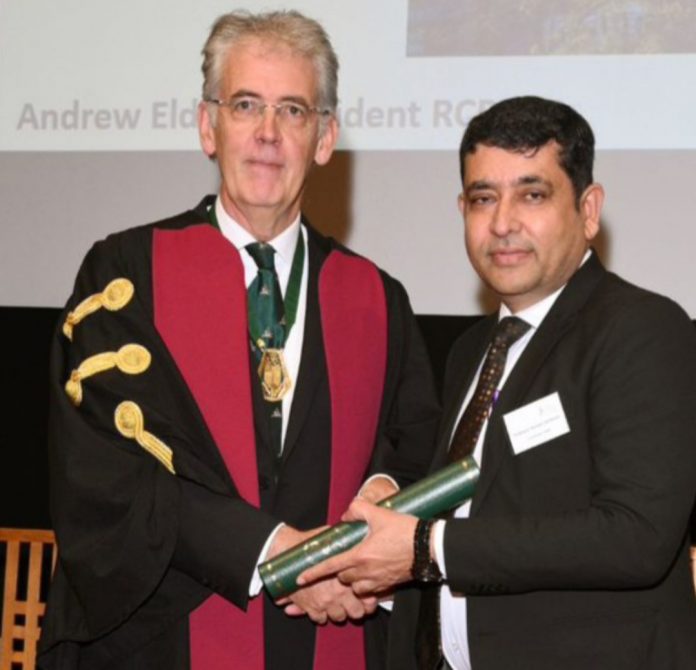
At a meeting of the Urdu Scientific Society, attended by prominent Doctors of Lucknow, Dr. Kausar Usman of King George Medical University, Lucknow was felicitated for the honor he received as a Fellow of the Royal College of Physicians, Edinburgh.
Presently working as a Professor of Internal Medicine at one of the prestigious medical institutions of India King George’s medical university, Dr. Usman is known for his expertise in the field of Medicine in general and Diabetes in particular. In 2016, Dr. Usman became the first Muslim Professor in the medicine department of King George’s Medical University, Lucknow.
Dr. Usman has participated actively in several national and international investigations and has a very solid foundation in research. Numerous national and international publications have published his work. He has more than 70 Publications to his name.
Prior to joining King George’s Medical University as a teaching faculty member, he worked in reputable medical institutions like Indraprasth Apollo Hospital in New Delhi.
In 2017, Dr. Usman had received a Fellowship Award FACP (Fellow of American College of Physicians) in San Diego, California.
Senior Urdu Scientific Society office bearers Padma Shri Dr. Mansoor Hasan, Maulana Khalid Rasheed, Dr. Iqtedar Farooqi, and Dr. Shakir Hashmi congratulated Dr. Usman for his extraordinary achievements.
source: http://www.muslimmirror.com / Muslim Mirror / Home> Indian Muslim> Positive Story / by Muslim Mirror Network / December 13th, 2022
Nusrat Noor from Jamshedpur not only cleared the Jharkhand Public Service Commission (JPSC) examination but also secured the highest rank in the list of successful candidates
Ranchi:
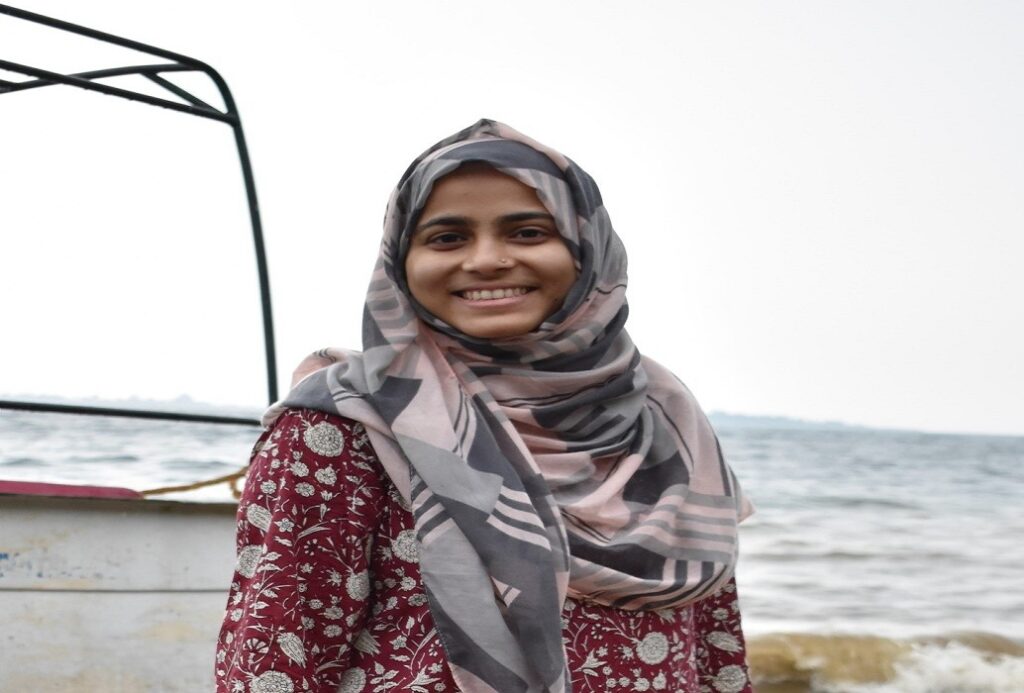
Nusrat Noor has become the first Muslim woman to top the Jharkhand Public Service Commission examination 2022 securing the first rank. She not only cleared the Jharkhand Public Service Commission (JPSC) examination but also secured the highest rank in the list of successful candidates who cleared the coveted examination the result of which was declared two days ago.
Nusrat Noor, 27, applied for the examination a year ago under the medical category soon after application forms were made available on the website. She prepared for the exams with due diligence, appeared for an interview last month, performed brilliantly in the exam and eventually came out with flying colours to become the first Muslim woman to ever top the JPSC examination.
On the empowerment of Muslim women, Nusrat Noor said, “Participation and initiative are key to increasing women’s representation. It doesn’t matter what the result might be, Muslim women should come forward to get into civil services. This is how we can increase our representation and benefit our community and the nation at large.”
The Jharkhand Public Service Commission conducts the state-level civil services examinations to make recruitment for top governmental posts in various departments, including teaching, medical, and healthcare, in the state. It is also responsible to conduct written and verbal examinations to appoint candidates for these prestigious government positions.
On being asked what motivated her to go for civil services, she said, “I noticed that the representation of Muslim women in the government workforce is negligible. It’s high time Muslims got highly educated. Especially our women should be in the forefront when it comes to grabbing the opportunities that come our way from every sector.”
Born and brought up in the Jamshedpur city of Jharkhand, Noor, a mother of one is a medical practitioner with a specialisation in neurology.
After completing her primary education at Sacred Heart Convent School in Jamshedpur, she moved to Ranchi to pursue her degree in medical sciences from the Rajendra Institute of Medical Science.
She completed her degree of MBBS in the year 2020, and consequent to this, she was posted in the same medical college to practice what she refers to as a junior residentship.
During her residentship, she got married. But her marriage has not come in the way of her studies and her dedication to pursue her goals. She lives in a joint family where, she says, everyone is very supportive. Her in-laws never discouraged her from pursuing her dream and goals.
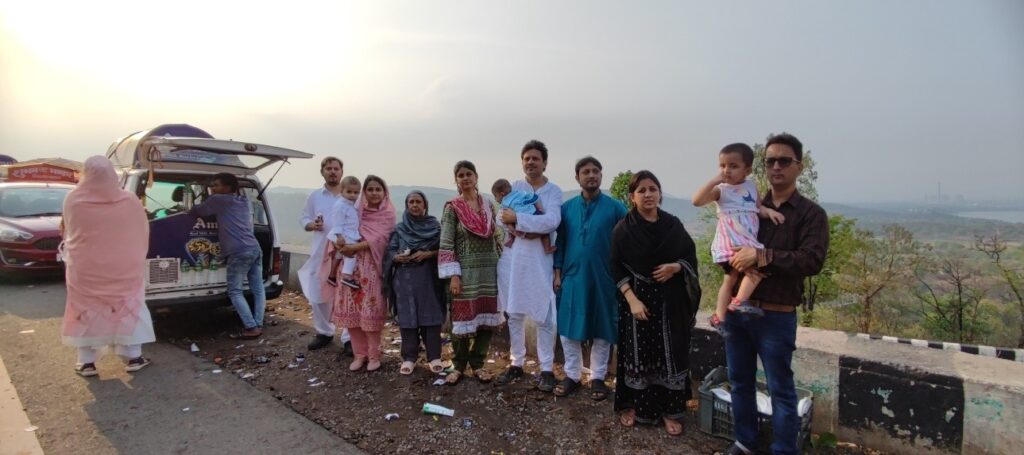
During an outing with her in-laws
She says, “My husband and in-laws are very encouraging and supportive, I am lucky in a way, but this is how it should be in every household. I would say my family is a role model for every other family which treats its daughter-in-law as someone who is no more than a person whose job it is to do all the household chores.”
She looks at her family of more than 10 members as her strength and backbone. “I have a very big family, but it never has been a setback in doing whatever I wanted to do”.
Her husband, Mohammad Umar, is also a doctor and a consultant surgeon. He has always been by her side during her entire journey.
“My husband has always motivated me; he switched roles and helped me in my household chores. He did everything possible to make me achieve my goal, from setting up the timetable for me to study to taking care of our two-year-old child,” she recounts with a sense of gratitude.
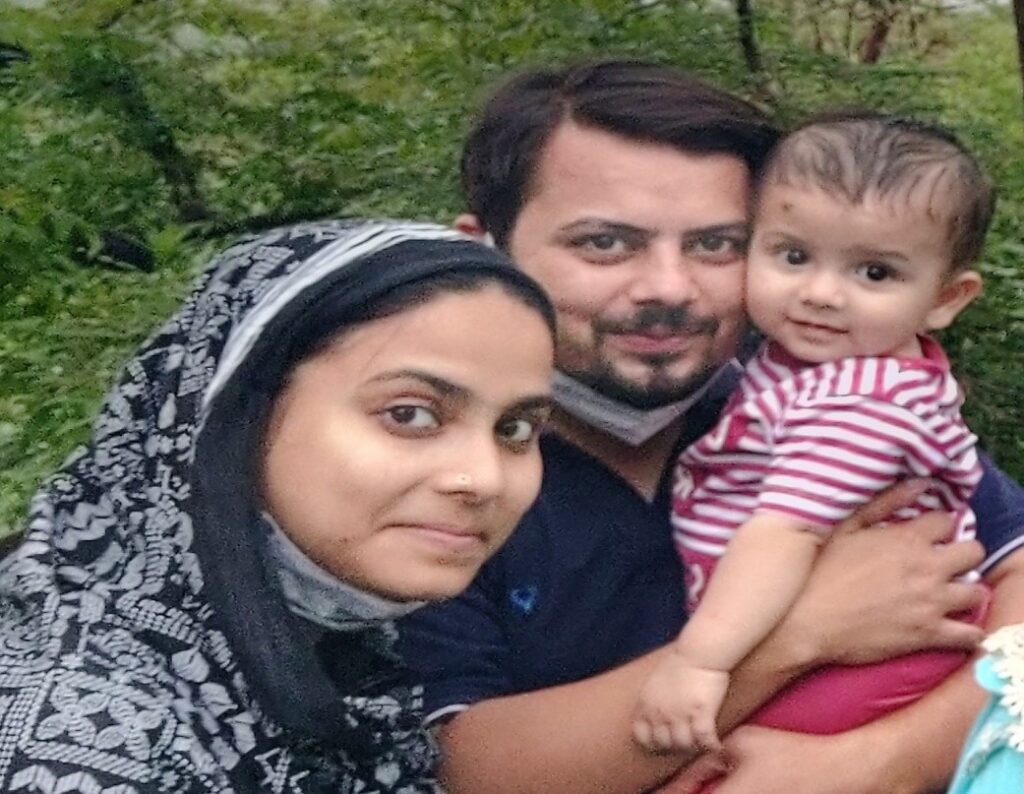
With husband Dr. Mohd Umar and son Mohd Saad
Noor’s father, Md. Noor Alam, is in a managerial post at Tata Steel, Jamshedpur while mother Seerat Fatima is a homemaker. She is the youngest in her family. The news of her becoming the first Muslim woman in the entire state to top the JPSC examination makes them proud.
Her elder brother, Mohammad Faisal Noor, is pursuing his research in industrial engineering at the National Institute of Technology, Jamshedpur.
He says, “We were quite confident about her selection, but the news of that she got the first rank was, Alhamdulillah, a pleasant surprise.”
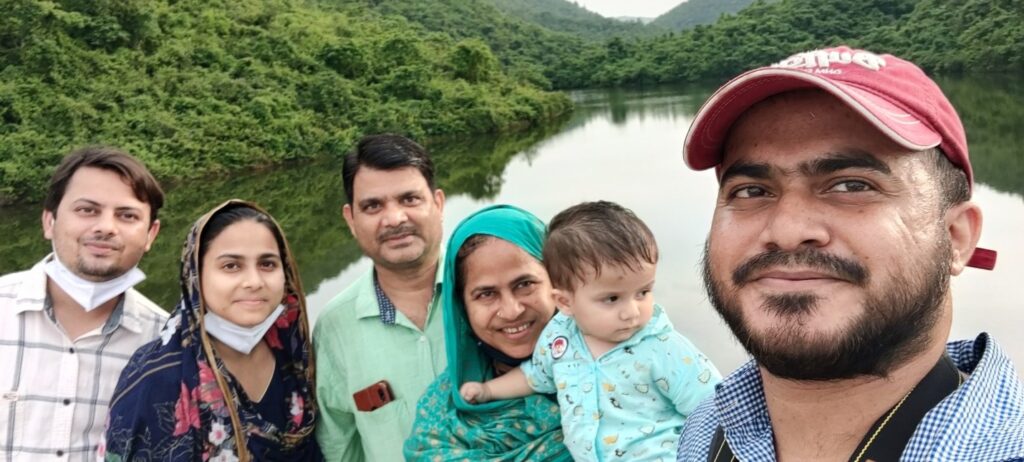
With her elder siblings
The one thing that she will never forget about in her entire journey, right from her school days to becoming a doctor to now cracking the JPSC, is that people and society even in the 21st century don’t consider a woman’s approach to her career as a personal achievement. Society still believes that a woman’s well-being lies in her traditional role as a homemaker.
She recalled the moment she got married, she was told by a friend that getting married ‘on time is an achievement in life and she has achieved it.
She said, “Personal life can be an aspect to achieve the ‘progress’, but there is much more to it. For me, apart from my personal life, achieving goals set by myself counts as progress. Society still needs to evolve to address the needs of today’s generation. My husband’s family, which is mine too, present an example of a ‘just’ and ‘progressive’ society which looks at the woman more than someone whose responsibility is confined to looking after the household.”
Nusrat now aims to start preparing for her post-graduation while taking charge as a medical officer in one of the government hospitals as appointed by the administration. She also looks forward to encouraging and facilitating other women to take up professional and administrative positions.
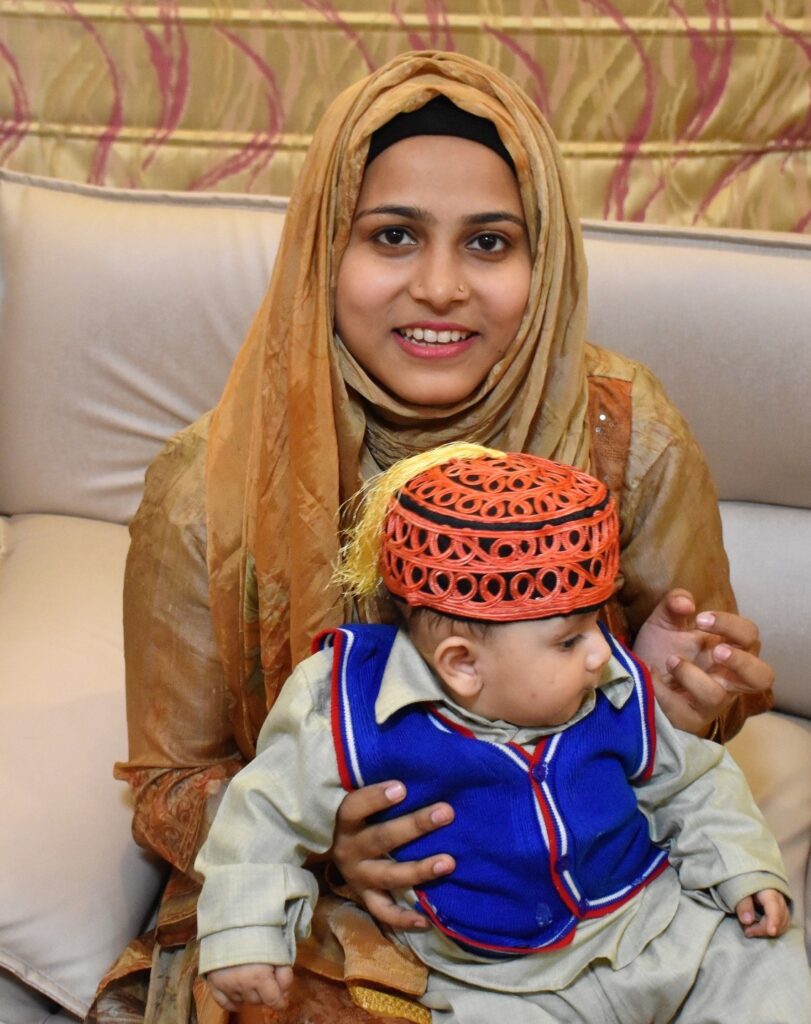
Proud mother of a two-year-old Mohd Saad
“Women should participate more to come into the mainstream. I also make an appeal to families to encourage their daughters to educate themselves as much as possible, as this is the only way to make them economically independent and socially self-sufficient.”
source: http://www.clarionindia.net / Clarion India / Home / by Ghazala Ahmad, Clarion India / December 11th, 2022
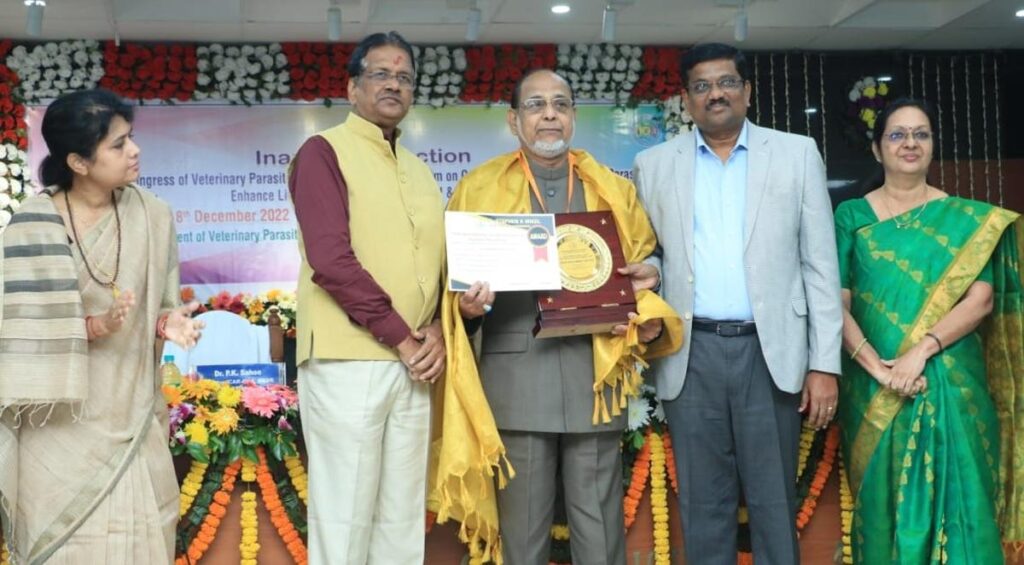
Mohammad Hafeez, veteran veterinarian and retired professor at Sri Venkateswara Veterinary University receiving ‘Lifetime Achievement Award’ from Vice-Chancellors S.C. Parija (Sri Balaji Vijayepeeth, Pondicherry) and P.K. Roul (Odisha University of Agriculture and Technology) at the National Congress of Veterinary Parasitology in Bhubaneshwar on Tuesday. | Photo Credit: SPECIAL ARRANGEMENT
Sri Venkateswara Veterinary University (SVVU) former Vice-Chancellor in-charge and a retired professor of veterinary parasitology Mohammad Hafeez received the ‘Stephen K. Wikel IAAVP Lifetime Achievement Award’ at the 3 rd National Congress of Veterinary Parasitology held at Bhubaneshwar on Tuesday.
He received the award from Vice-Chancellors S.C. Parija (Sri Balaji Vidyapeeth, Pondicherry) and P.K. Roul (Odisha University of Agriculture and Technology) at the event organised by Indian Association for Advancement of Veterinary Parasitology (IAAVP). The award was presented in recognition of his path-breaking research undertaken in the field of parasitology.
Prof. Hafeez is currently a research advisory member of ICAR’s National Research Centre on Equines (Hissar, Haryana) and Maulana Azad Education Foundation’s inspecting authority.
source: http://www.thehindu.com / The Hindu / Home> News> India> Andhra Pradesh / by A.D. Rangarajan / December 07th, 2022
In a glittering ceremony, two books on Muslims’ contribution in India’s Freedom movement were launched here in Patna on 17th December. The function was presided over by Harsh Mandar, former IAS officer and human rights defender in the country.
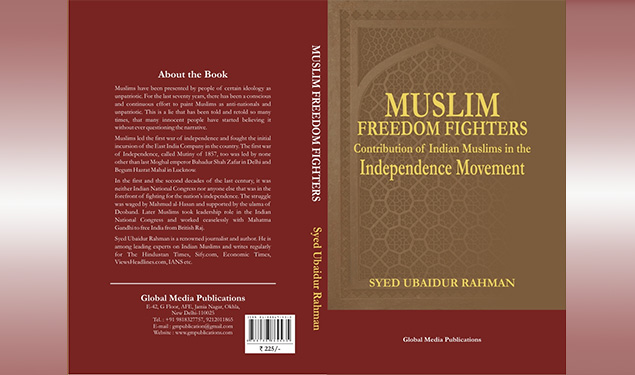
The books ‘Muslim Freedom Fighters: Contribution of Indian Muslims in the Independence Movement’ and its Urdu version ‘Muslim Mujahideen-e-Azadi aur Tehrik-e-Azadi Mein Unki Khidmat’ have been authored by Delhi based author and journalist Syed Ubaidur Rahman.
The two books try to fight the oft-repeated allegations that Muslims are anti-national and have not contributed for the freedom of the nation. The books nail the lie and prove that Muslims not just participated in the freedom movement, they went on to lead the freedom struggle for a long time. The first war of Independence or Mutiny of 1857 was led by Mughal emperor Bahadur Shah Zafar in Delhi and Begum Hazrat Mahal in Lucknow. The Independence Movement in the first two decades of the twentieth century was led by Mahmud Hasan and ulama of Deoband and they had respect and support of everyone including Hindus and Muslims.
If anyone has any doubt about the Muslim contribution in the freedom movement, the fact that the Indian National Congress had as many as nine Muslims as its president till the year 1947 will remove such doubts.
While speaking on the occasion, Harsh Mandar said that the divisive forces in the country are trying to divide the nation on the basis of religion and faith. He said that the danger from such forces for the national fabric and its unity has become grave.
Harsh Mandar added that the threat to the communal amity in the country was never so high as is today as divisive forces are doing every thing to pit one community against the other and create a fear psychosis among the majority community prompting it to turn it against minorities.
Khursheed Mallick, a Chicago based urologist, philanthropist and director of IMEFNA said that the book is a timely reminder to the nation that Muslims and Hindus both sacrificed for the nation and this fact must be clearly told to our young generation. He said Muslims sacrificed heavily for the cause of the freedom of the nation and efforts must be made to tell the history.
Syed Ubaidur Rahman, the author of the two books, while speaking on the occasion said Muslims have been rather loath to write about the sacrifices they have made for the cause of the Independence and freedom. He said Muslims suffered badly throughout the freedom movement. They were the worst suffers in the wake of the mutiny of 1857 and its aftermath when Muslims were hounded across North India and beyond. Tens of thousands of Muslims lost their lives for the freedom.
Syed added that ulama of Deoband played a stellar role in the freedom movement. Unlike the common perception, they were secular to the core and when they established a government in exile in Kabul in 1915, they appointed Raja Mahendra Pratap as its President and Maulana Barkatullah Bhopali as its Prime Minister.
The book documents the lives of forty renowned Muslim freedom fighters including, Shaikhul Hind Maulana Mahmud al-Hasan, Maulana Barkatullah Bhopali, Hakim Ajmal Khan, Maulana Ubaidullah Sindhi, Maulana Abul Kalam Azad, Maulana Mohammad Ali Jauhar, Dr Maghfoor Ahmad Ajazi, Dr Mukhtar Ahmad Ansari, Ashfaqulla Khan, Maulana Hasrat Mohani, Maulana Muhammad Mian Mansoor Ansari, Asaf Ali, Husain Ahmad Madani, Aruna Asaf Ali (Kulsum Zamani), Peer Ali Khan, Saifuddin Kitchlew, Mohammed Abdur Rahiman, Captain Abbas Ali, Abdul Qaiyum Ansari, Prof. Abdul Bari, Moulvi Abdul Rasul, Nawab Syed Mohammed Bahadur, Rahimtulla Mahomed Sayani, Syed Hasan Imam, Sir Syed Ali Imam, M.C. Chagla, Yusuf Meherally, Justice Fazal Ali, General Shah Nawaz Khan, Allama Fazle Haq Khairabadi, Maulana Shaukat Ali, Syed Mahmud, Maulana Mazharul Haque, Badruddin Tyabji, Col Mehboob Ahmed, Begum Hazrat Mahal, Maulana Shafi Daudi, Rafi Ahmed Kidwai, Syed Mohammad Sharfuddin Quadri, Batak Mian
The book launch function was organized at Anjuman Taraqqi Urdu and was presided over by Abdul Qaiyum Ansari, chairman of Anjuman Taraqqi Urdu Bihar.
Name of the Book: Muslim Freedom Fighters: Contribution of Indian Muslims in the Independence Movement Author: Syed Ubaidur Rahman ISBN: 81-88869-43-0 Price Rs 225/- Global Media Publications E-42, G. Floor, AFE, Jamia nagar, Okhla, New Delhi-110025
source: http://www.ummid.com / Ummid.com / Home> India / by ummid.com News Network / December 12th, 2017
The Haider Aziz Safwi Career Development Centre aims to create awareness, and make books and resources accessible
Hamed Aziz Safwi hopes to take the youth of Uluberia closer to their career dreams All pictures by Arijit Sen
Less than 40km away from Kolkata, Uluberia lacked a library for students and most Class XII passouts seemed at a loss about the road ahead. Haider Aziz Safwi Career Development Centre — the initiative of La Martiniere boy and son of former IPS officer and MLA from the area — aims to fill that gap and take the youth closer to their dreams.
The Haider Aziz Safwi Career Development Centre in Uluberia will be inaugurated on December 12, the death anniversary of Haider Aziz Safwi, the late IPS officer and MLA.
My Kolkata caught up with his son and founder of the centre, Hamed Aziz Safwi, to know more about his plans
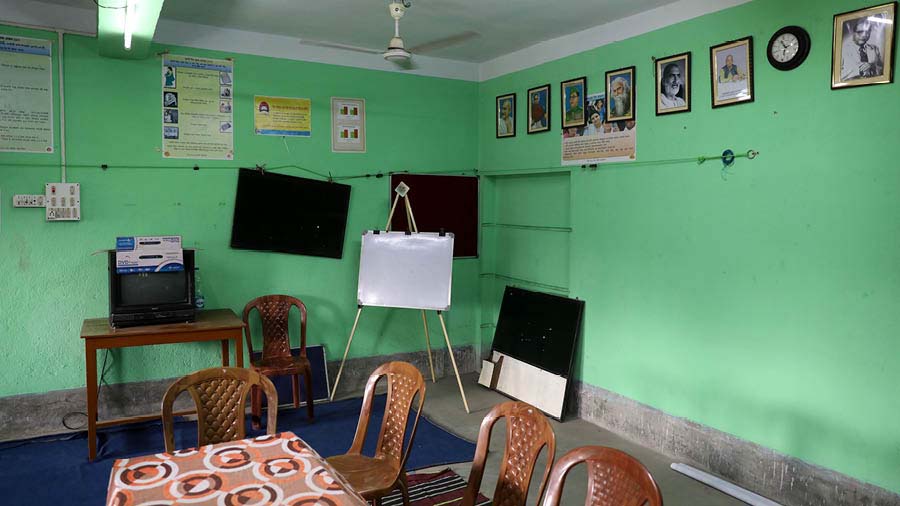
Hamed chose to set up the career development centre at Taj Mahal Library, a subsidiary of the Taj Mahal Gram Vikas Kendra, as the place itself has some reputation locally
The infrastructure
The Haider Aziz Safwi Career Development Centre is housed inside the Taj Mahal Library, a subsidiary of the Taj Mahal Gram Vikas Kendra that has earned quite a reputation in the area over the years. The original library was set up in 1952 by the late Ahmed Hossain Mullick, late Atibar Rahman Mullick, late Yacub Ali Khan and late Mohhammad Moinuddin.
“The Taj Mahal Gram Vikas Kendra has an established reputation here and has been involved in a lot of activities, including the Taj Mahal Library. It was decided that since there is space available, we can convert it into a career development centre. Since it’s a place of repute, I will not have to worry about the day-to-day functioning and local student outreach,” said Hamed, who completed his post-graduation in Economics in 2022 from St Xavier’s University after graduating in 2020 from St Xavier’s College in the same subject.
“We have spoken to the head teachers of the high schools of the three blocks and teachers’ groups. The local administration will also go school to school and interact,” he said.
The library is open to all students from 10am to 6pm, Mondays to Saturday for book lending
The library and centre
The library caters to around 600 students of about 45 schools from three blocks — Uluberia, Santrail and Panchla. It has a stock of over 1,000 books for students of Class XI and upwards.
“We will basically have Chhhaya Prakasani books for West Bengal board students of Classes XI and XII — maths, physics, chemistry, biology and other subjects. There will also be competitive exams-oriented books in English,” Hamed said.
The library is open to all students from 10am to 6pm, Mondays to Saturday for book lending; however during examination the hours can be stretched for solo or group studies with prior intimation to the administration.
Career guidance
The career development centre will have books for CAT, CLAT, CA preparations. “Uluberia doesn’t have any good coaching centres. Parents are not always willing to send their children all the way to Kolkata. Also, these books are very expensive. What we are trying to do is to make sure that the students have access to books when they need it,” said Hamed, talking about the gaps he wants to fill to make knowledge accessible to the youth of Uluberia.
“When we interacted with the students, there seemed to be a complete lack of awareness about any sort of career goal. For example, somebody who wanted to be an engineer or doctor had taken up Humanities in Plus II. They also had no idea about which exams to appear for,” Hamed said. “Later, we will get some people who can offer career guidance to them. We will also establish an online class setup later with a laptop. We can also do group studies.”
“We have already spoken about a paramedic course and computer training. Once this is up and running we will try to get them into some ITIs. We will be getting some coaching institutes and some teachers, if possible weekly once or twice a month to come and sit with the students,” Hamed said.
To encourage and motivate the students and take them ahead on their career path, Hamed has also instituted the Haider Aziz Safwi Scholarship Distribution.
Managing funds
The library has mostly been funded by Hamed along with crucial administration and infrastructure inputs from the local community and the kendra.
‘’For book donations one can get in touch at haiderazizsafwi@gmail.com . We have a zero cash transaction policy,’’ said Hamed.
Hamed Aziz Safwi , founder; Zahir Azad Mollick, teacher and treasurer of Taj Mahal Gram Vikas Kendra; Abdul Malek Mollick, retired headmaster, president Taj Mahal Gram Vikas Kendra and Taj Mahal Library; Rejwan Ali Mullick, secretary, Taj Mahal Library; Sk. Farukh, social worker; Sk. Amarullah , social worker; Sk. Samim Parvez, homeopathic practitioner; Arabinda Bhowmick, teacher and other executive committee members of Taj Mahal Gram Vikas Kendra team.
Dream and objective
The La Martiniere boy from Kolkata shared why Uluberia has always been so close to his heart. ‘’My father was an IPS officer and was an MLA from here. What shocked me was that despite him being an IPS and MLA, we failed to provide a library that caters to students. That for me was a big dilemma, which is why I focused on this. And we will establish more of these.’’
“The first objective is to create awareness and secondly try to create an environment where people are able to excel. It is not possible overnight. But we are creating a process which will set up an environment of competitive exams,” Hamed signed off.
source: http://www.telegraphindia.com / The Telegraph / Home> My Kolkata> Resource Centre / by Subhadrika Sen / December 11th, 2022
Allah Bakshu coordinated with most of the catering services and function hall members and convinced the organisers to hand over the leftover food to needy people.
Guntur Covid Fighters Charitable Trust members distribute leftover food, which was collected from weddings and functions, to over 300 needy people everyday
Guntur :
When the world fell into chaos, when thousands of people are looking for hope during the times of pandemic, there appeared a 33-year-old man who extended his arms and has been feeding the destitute every single day for the past two years.
Pattan Allah Bakshu, founder of Guntur Covid Fighters, is a sales executive by profession with the help of his three brothers, Pattan Hussain Khan, Pattan Muzeeb Basha and Pattan Fayaz Khan collects the leftover food at functions and weddings and serves them to over 300 needy people a day.
Not just providing food to the needy, these brothers provided free ambulance services and also lent their shoulders to carry over 1,000 unclaimed bodies whose families were in no condition to perform last rites during Covid-19, despite getting resistance from their own families.
What started as a group of four now has as many as 25 volunteers including people from all walks of life contributing their little efforts for a major cause, in fact for their voluntary services, they were awarded with ‘Manavathva Dheeras’ (Warriors of Humanity) tag from AP Police department.
Explaining about the food distribution, he said, “After the pandemic, while we were thinking to expand our services, we observed how many poor people are suffering without sufficient food as they lost their livelihood. We also observed how much food is being wasted at weddings and several functions which are held almost every day at some place or the other in the city.’’
Allah Bakshu coordinated with most of the catering services and function hall members and convinced the organisers to hand over the leftover food to needy people. Seeing their noble work during the pandemic, not only function organisers, but also temple priests are contacting Allah Bakshu and the team if they have any leftover food.
“As soon as we get a phone call, we go to the place and collect the food and distribute them directly to the needy people. We have set up a food court at Guntur GGH also,’’ he added. Along with this they also help old people who are abandoned by their families and take them to old age homes giving them a new family and people to look after.
“This charitable trust is moving forward with the collective efforts of several people from college students to retired employees. Seeing our work, several kind-hearted people came forward to help and join our cause, donated ambulances, and provided financial assistance,” Allah Bakshu said.
People can call 8143222456, 9397602553 to contact Guntur Covid Fighters Charitable Trust and handover leftover food to feed hungry people.
source: http://www.newindianexpress.com / The New Indian Express / Home> Good News / by Bandhavi Annam / Express News Service / December 11th, 2022
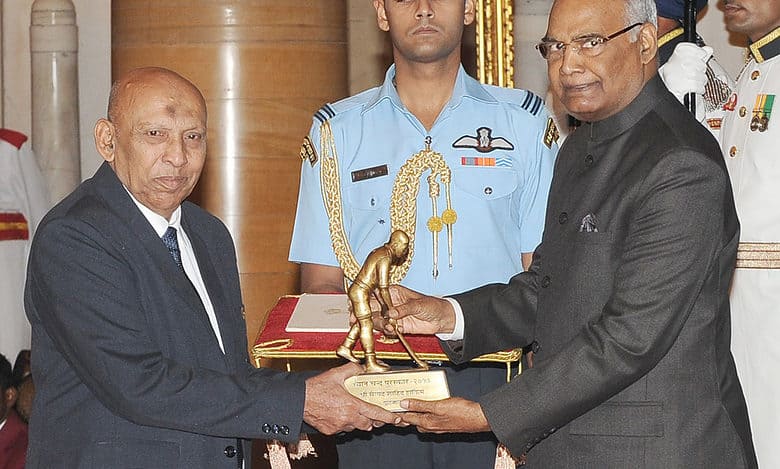
The President, Shri Ram Nath Kovind presenting the Dhyan Chand Award, 2017 to Shri Syed Shahid Hakim for Football, in a glittering ceremony, at Rashtrapati Bhavan, in New Delhi on August 29, 2017. Photo: Wikipedia
The name of Syed Shahid Hakim is familiar to the entire football fraternity of India. He was one of the most accomplished personalities who graced Hyderabad and Indian football as a player, referee and coach. Indeed it would not be wrong to say that there were few people in India who could match his knowledge and acumen about the different aspects of football. Besides being a well known personality in football, he also served as an officer in the Indian Air Force.
Being one of the sons of the great coach S.A. Rahim, he grew up in a football related environment. Hakim belonged to that period when Hyderabad was at the zenith of Indian football. He played with the illustrious players of India. Among his teammates were the famous goalkeeper Peter Thangaraj, D. Kannan, S.A. Latif, Yousuf Khan, S. Narayanan, H H Hamed and others. All these players were from the twin cities of Hyderabad and Secunderabad.
As a player, Hakim’s talent bloomed at an early age. He was at his peak in the late 1950s. He was a member of the Hyderabad state team which won the Santosh Trophy in 1957. Due to his prodigious talent and his rising status in Indian football, he was selected to represent India in the Pre-Olympic tournaments in Jakarta, Singapore and Malaysia.
It was not a surprise when he was also selected in the Indian team for the 1960 Olympic Games in Rome. That was the last time that India qualified for the Olympic Games. Although India narrowly failed to enter the knockout stage of the tournament, the Games were a great learning opportunity for Hakim.
The close interaction that Hakim had with the world’s best players and coaches gave his keen intelligence some valuable insights into the tactics and training of European and South American players. These he later put into use when guiding his own trainees. This is where his education and learning proved to be a big asset. Having studied at All Saints HS, Nizam College and then Osmania University, his level of education was above many other footballers. This enabled him to interact easily with foreigners and learn from everything that he observed.
Later, after he joined the Indian Air Force, he played for the defence services team and went on to be appointed captain of the All India Services team.
After retiring from the game as a player, he continued to serve Indian football in various capacities. He became a well known referee who was among the best in India. Starting from 1970 he continued to serve as a referee for many years. In 1974 he was selected to be a member of the FIFA Referees panel which was a great honour for an Indian referee.
Thereafter, he officiated in 33 international matches and it is a record which is still not broken. No other Indian referee has officiated in 33 international matches.
But that was not the end of his distinguished career. Thereafter, Hakim became a reputed coach and coached the Indian team from 1980 to 1982 for the Merdeka Cup and Delhi Asian Games along with other coaches.
When he was 80, he fell prey to the rampaging COVID pandemic but recovered. However, despite winning the battle against the dreaded virus, his life did not last long thereafter. He suffered two strokes in rapid succession and passed away in Gulbarga where he had been admitted to a hospital in August 2021. His death left a void in Indian football which will perhaps never be fulfilled.
source: http://www.siasat.com / The Siasat Daily / Home> News> Hyderabad / by Abhijit Sen Gupta / December 09th, 2022
The words like ‘bandobast’ and ‘decko’, apart from many other Hindustani words are now loved by the British dictionary.
Mumbai:
If you are born in India, and that means any part of India, Urdu is the language that you must have come across in its purest or hybrid form. The language is even liked by the Oxford English Dictionary, which has words listed throughout its collection. On Wednesday, November 9, Urdu is being celebrated all around the world on the occasion of “World Urdu Day.”
The words that belong to Urdu and are now in the OED include “bandobast”and, after literally “deckoing” the arrangements, “Abba” (father), “Accha” (okay, good), “Gulab Jamun,” “Mirch Masala,” “Keema,” “Chowkidar,” “Funda,” and “Chamcha.”
Urdu, along with Hindi and Sanskrit, is the oldest language and, literally speaking, a display of Indian culture. Though the most real and oldest words are not frequently in used today, there are rhetoric, which belong to Urdu and which the Oxford English Dictionary has included in its collection.
Urdu, before being replaced by the East India Company against Persian, was earlier known as the “Hindustani” language, and its basic roots can be traced to the “Daur (reign)” of Moghul King Shah Jahan. Though the language was in its infancy at the time, there are numerous documentary evidences that prove that the language was used by locals.
The 400-year-old language has maintained its charm in the 21st century. Everything has become online, and for that, English is a must. However, there are some Urdu words that “English” enjoys as well. And these words are included in the Oxford English Dictionary.
Shahid Latif, editor (Madeer in Urdu), explains that the process is entirely dependent on the OED’s meticulous research and analysis. Latif said, “Urdu has major influence from Persian and Arabic.” The words derived from Urdu are being included in the OED with a proper announcement. For example, “Bandobast,” in which band means protection and bast means tightly wrapping, is part of the OED. Apart from it, “decko” is also a word that was included in the English language long before independence, bought from the Urdu word “dekho” and used by the British police to “check out” anything suspicious.
source: http://www.freepressjournal.in / The Free Press Journal / Home> Mumbai / by Nooruddin Inamdar / November 09th, 2022