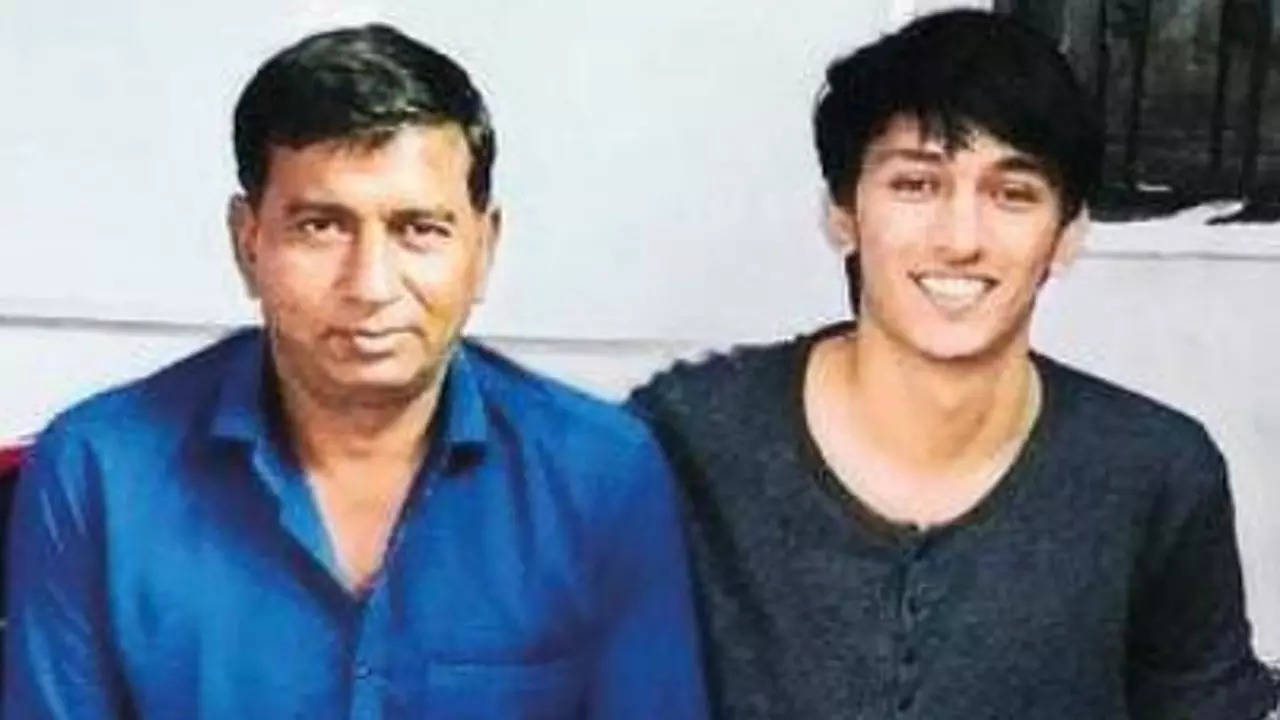
Despite the financial difficulties, Rasheed’s father, Shaik Balisha Vali, also a cricket-lover, left no stone unturned for Rasheed’s coaching.
Guntur :
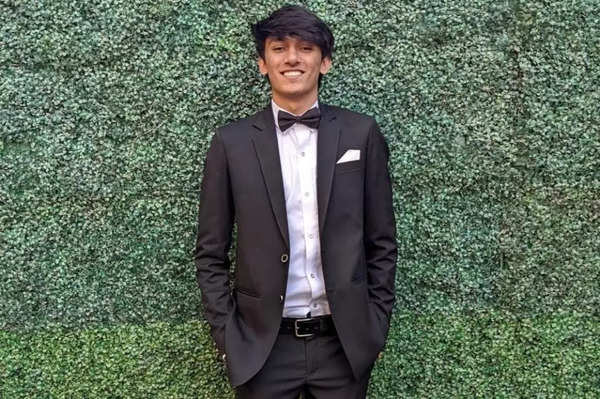
For the first time, a cricketer from Guntur has been chosen to be a part of the Indian Premier League (IPL). As soon as the mini-auction of 405 players concluded in Kerala’s Kochi, the citizens rejoiced and basked in the glory of Shaik Rasheed, who made it to the player pool of Chennai Super Kings (CSK).
Born in Guntur on September 24, 2004, Rasheed’s claim to fame was his impressive performance in the Andhra Premiere League 2022. Perhaps, his crucial role in India winning the Under-19 World Cup and as vice-captain of the team caught attention of the CSK franchise.
Currently playing the Ranji Trophy in Tamil Nadu, the 18-year-old has been signed for a base price of Rs 20 lakh.The all-rounder also happens to be an ardent fan of MS Dhoni. Only after the team of 15 cricketers is finalised, will we know whether or not Rasheed will get to play alongside his role model.
Despite the financial difficulties, Rasheed’s father, Shaik Balisha Vali, also a cricket-lover, left no stone unturned for Rasheed’s coaching.“We are so elated that he is living his dream. When I watched him play with such zeal, I decided to support him and send him for professional training. We had no second thoughts. He also worked very hard to reach the position he is at now,” an elated Balisha expressed.
When he accompanied Rasheed for training in Hyderabad, he had to pick up odd jobs to support the family. “My son has admired Dhoni since the time he started playing gully cricket when he was just six years old. Now, getting an opportunity to play alongside him will be his dream come true,” Balisha said.
Dad picks cue, extends support Balisha Vali, was the first to identify his son’s passion. His first cue was when neighbours’ complaints against the young cricketer for shattering their windows with his ‘sixes’ had become the order of the day
Guntur celebrates As soon as news spread, Guntur lit up with joy as friends and relatives burst firecrackers and distributed sweets. Several people, following Rasheed since his nascent stage, expressed happiness and wished him luck.
source:http://www.newindianexpress.com / The New Indian Express / Home> States> Andhra Pradesh / by Bandhavi Annam / Express News Service / December 26th, 2022
Contrary to the popular notion that wars are fought by the armies alone, the whole nation including Bollywood personalities and leading artists get involved in the national efforts to fight the enemy.
The Chinese invasion in October 1962 was a shocking moment for India. Traditionally, India had supported China at every international forum for at least half a century. The invasion was the least expected from China and India was not at all prepared for it. Prime Minister Jawaharlal Nehru urged the nation to stand united in that hour of emergency and in response Indians donated generously to the National Defence Fund.
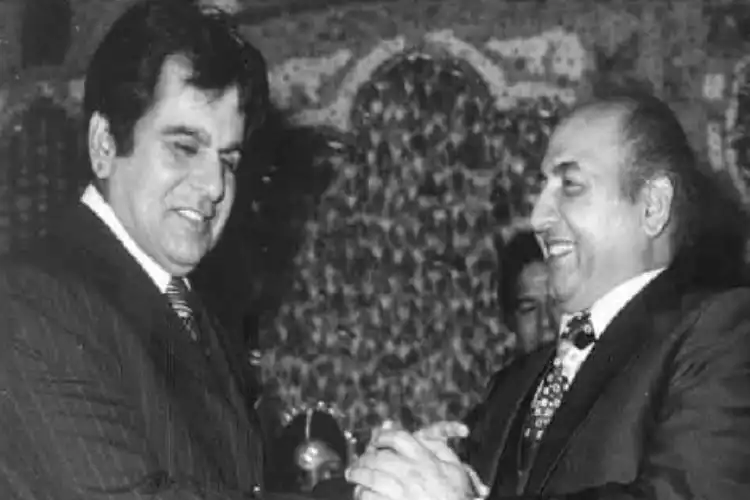
The film industry did not lag. Film Industry’s war efforts were led by legendary filmmaker Mehboob, singer Mohammed Rafi and music composer Mohammed Zahur Khayyam Hashmi (Khayyam).
In less than a week they collaborated to produce two music videos, which were to be played in film theaters, on the radio, and on the roadsides to raise funds for the war.
One of those two songs, “Awaz do hum ek hain…”, by Jaan Nisar Akhtar is now a popular political slogan in India. On Nehru’s call to the nation, Jaan Nissar Akhtar wrote the song to which music was given by Khayyam and the voice by Mohammad Rafi. The song is an invocation to Indians to unite in the face of an invader became a national passion and remains so till today.
The song starts with:
ek hai apni zameen, ek hai apna gagan
ek hai apna jahaan, ek hai apna watan
apne sabhi sukh ek hai, apne sabhi gham ek hai
Aawaz do ham ek hai
(We have a common earth, we have a common sky
We have a common world, we have a common motherland
All our joys are common, all our sorrows are common
Say it aloud that we are one!)
The powerful lyrics were turned into a national rage by the soulful singing of Rafi. Jago watan khatre me hai, sara chaman khatre me hai (wake up our motherland is under threat, whole garden is under siege) and dushman se nafrat farz hau, ghar ki hifazat farz hai (hating your enemy is a duty, to guard your home is a duty), aroused patriotic emotions among millions of Indians. The song asks the youth to join the army and fight the aggressor.
The song was picturized on Rajendra Kumar, Sunil Dutt, Raj Kumar, and Kamal Jeet.
Another song produced along with this was written by Sahir Ludhianvi, “watan ki abroo khatre main hai…” (dignity of the nation is under threat). It was also produced by Mehboob and sung by Mohammed Rafi. The song specifically points to the Panchsheel pact and other friendly gestures made by India towards China. It says,
Wo jinko saadgi mein hamne
Aankhon par bithhaaya thha
Wo jinko bhai kehkar
Hamne seene se lagaaya thha
Wo jinki gardanon mein haar
Baahon ka pehnaaya thha
Ab unki gardanon ke waaste
Talwaar ho jaao
(The people we honoured because of our innocence
The people we embraced and called brothers
The people we received with love
Now, do become swords for their throats)
The song also points toward the internal threats at the time of war.
Khabar rakhna koi gaddaar
Saazish kar nahin paaye ae
Nazar rakhna koi zaalim
Tijori bhar nahin paaye ae
(Be vigilant that no traitor conspires against the nation
Be vigilant that nobody makes money out of our war efforts)
The song was picturized on Dilip Kumar, Rajendra Kumar, Raj Kumar, and Kamal Jeet in a video produced by Mehboob.
Lorries with speakers would roam around playing these songs and prompting people to donate generously. It is said that when one such procession reached the house of Shammi Kapoor his wife actor Geeta Bali started crying. She rushed inside her house and told Shammi that she needed to do something for the nation. Geeta took all her jewelry, even the pieces she wore, and gave it away for war.
Rafi felt that singing in the safety of Mumbai was a disgrace in the line of his national duty. He discussed with Dilip Kumar and urged PM Nehru to send them to the border. What would they do there? Rafi felt that his songs could boost the morale of Indian soldiers and the presence of Dilip Kumar would assure the troops that the whole nation is standing behind them.
It was a dangerous mission. It was unprecedented for the artists to perform at the war front. In the cold, Rafi and Dilip reached the war frontier. He sang songs, interacted with soldiers, and boosted their morale. Dilip Kumar later recalled, “needless to say he was the star attraction with the jawans and the young newly commissioned officers”.
After the war ended with a ceasefire the collected funds were used to recover the economy and modernizing the Army.
On 27 January 1963, Mehboob organized an event in Delhi where he invited.all the prominent film stars to perform in the presence of President S Radhakrishnan and PM Jawaharlal Nehru. The event is often remembered for the rendition of “Aey mere watan ke logo…” by Lata Mangeshkar and Mohammad Rafi sang two songs. One was written by Shakeel Badayuni and its music was composed by Naushad, “Apni azadi ko hum hargiz mita sakte nahi.” The song was later adapted into the film Leader and the other was “Kar chale hum fida….” written by Kaifi Azmi and composed by Madan Mohan, which was later adopted in Haqeeqat, a movie based on the India-China war.
The fact that Rafi went to the war frontier and stayed there for a few days to play what turned out to be a big morale booster for the troops remains an unprecedented manifestation of one’s sense of responsibility towards his country.
source: http://www.awazthevoice.in / Awaz, The Voice / Home> Culture / by Saquib Salim / December 24th, 2022
Two candidates, one each from Maharashtra and Uttar Pradesh, secured 100 percentile and emerged as all India toppers.
Eight students from Karnataka, the highest for any State, have emerged as top scorers in Common Law Admission Test (CLAT-2023) results for undergraduate and postgraduate streams declared by the Consortium of National Law Universities on December 23, Friday.
Two candidates, one each from Maharashtra and Uttar Pradesh, secured 100 percentile and emerged as all India toppers. One candidate from Karnataka secured a percentile of 99.97, two secured 99.96 and one each secured a percentile of 99.95, 99.94, 99.93 and 99.92 in CLAT UG from Karnataka.
Kshitika Tyagi
Kshitika Tyagi of Bengaluru got an All India Rank (AIR) of 12 with 106.75 score and a percentile of 99.97 in CLAT-2023 UG. Speaking to The Hindu, she said she started preparing for the exam and found the subject very interesting. “I want to join the National Law School of India University, Bengaluru,” she said.
Ayesha Khan
Another topper from Karnataka, Ayesha Khan, AIR 17 with 105.75 score and 99.96 percentile, said her dream had come true. “From a very young age, I always wanted to be a lawyer, and I will be one now,” she said.
The CLAT-2023 was conducted at 127 centres in 23 States and two Union Territories. A total of 94.87% of the candidates who enrolled appeared for the examination, of which 56% are females 44% are males and 2 are transgenders.
The duration of the CLAT 2023 UG test was 120 minutes. The test had five sections, with a total of 150 questions. One question was withdrawn in the final answer key. The highest mark secured in CLAT 2023 UG is 116.75. CLAT 2023 PG had one section comprising 120 questions and the highest mark secured is 95.25.
source: http://www.thehindu.com / The Hindu / Home> News> India> Karnataka / by The Hindu Bureau / December 23rd, 2022
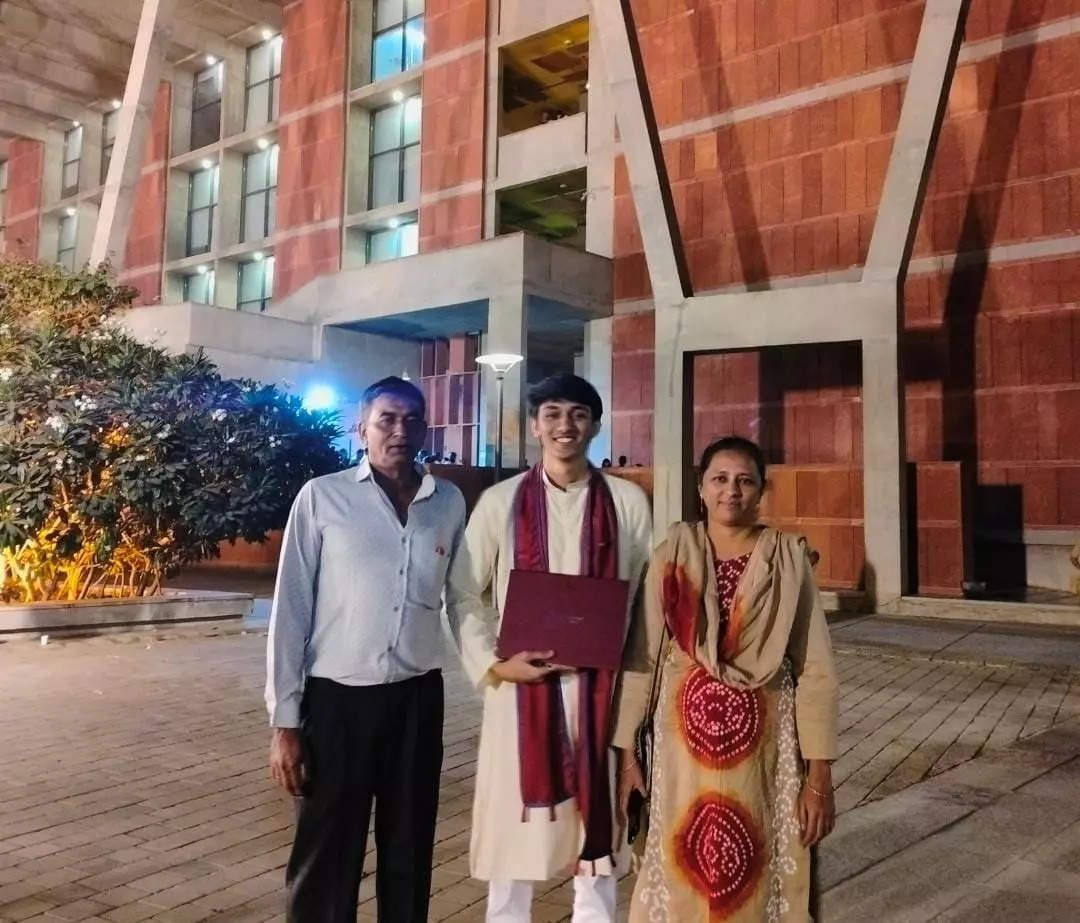
Razin Mansuri, 22, son of an air conditioner repairman and a resident of Ahmedabad, had scored 96.2 percentile in the Common Admission Test ((CAT) 2021 and was eligible for admission in IIM-Udaipur.
But Mansuri was not satisfied with his results so he decided to give it another shot and his efforts paid off as Mansuri scored 99.78 percentile making his chances for an admission in IIM-Ahmedabad or IIM-Bangalore quite high.
Mansuri completed his engineering in IT from Ahmedabad University in May this year. His father earns about 25,000 per month. Razin, his father Irfan Mansuri, mother Sabiha, and his younger brother Rehan live in a one-bedroom house in Juhapura.
Razin Mansuri
As my family’s economic condition is weak, right from high school I have mostly studied on scholarships. After completing high school from CN Vidyalaya, I took admission in Ahmedabad University and completed engineering in IT. I again got a scholarship in AU as my performance was good,” Mansuri told TOI. He said that after he completed engineering he was offered jobs with a Rs 6 lakh annual salary. “I did not take the offer as my dream was to get admission in IIM, preferably in IIM-A or IIM-B.
I started preparing for CAT and took the test in 2021. However, as I did not take any coaching I got 96.20 percentile. I was not satisfied with the result and decided to take the exam again in 2022,” Mansuri said.
He added that he enrolled for a coaching class for CAT 2022 as it charged him only half the fees. “It is an exceptional achievement given his family background and financial struggles. I am sure he will be a great student for any top IIM,” said Satish Kumar, head of the coaching class where Mansuri trained.
Once I pass out from IIM, I want to give back to society what I received from it. I want to help as many students as I can in their education,” Mansuri said.
source: http://www.timesofindia.indiatimes.com / The Times of India / Home> News> City News> Ahmedabad News / by Bharat Yagnik / TNN / December 22nd, 2022
Jasovar Village (Mirzapur District), UTTAR PRADESH :
Sania Mirza of Uttar Pradesh’s Mirzapur district earned this position by passing the National Defense Academy 2022 examination (NDA) exam.
On December 27, Sania Mirza will join NDA Khadakwasla in Pune.(ANI)
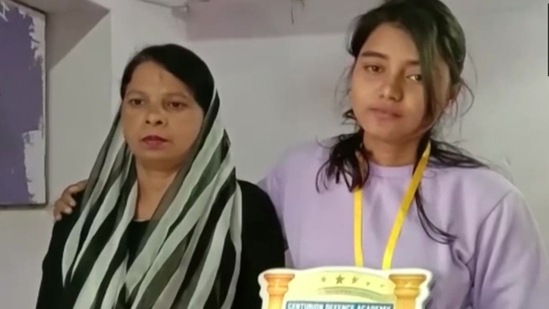
Sania Mirza, daughter of a TV mechanic from Mirzapur, has been selected to become a fighter pilot in the Indian Air Force and would be the country’s first Muslim girl and the state’s first IAF pilot.
Sania Mirza is a resident of Jasovar village under the Mirzapur Dehat Kotwali police station area. She secured this position by passing the NDA exam. She has brought laurels not only to the district but also to the state and the country.
Sania, who studied in a Hindi medium school, said that Hindi medium students too can achieve success if they are determined. On December 27, she will join NDA Khadakwasla in Pune.
The parents as well as the villagers are feeling proud at her.
Sania’s father Shahid Ali said, “Sania Mirza considers the country’s first fighter pilot Avni Chaturvedi as her role model. From the beginning, she wanted to be like her. Sania is the second girl in the country who has been selected as a fighter pilot.”
She studied from primary to Class 10 at Pandit Chintamani Dubey Inter College in the village itself. After that, she went to Guru Nanak Girls Inter College in the city. She was the district topper in the 12th UP Board. She started her preparations at Centurion Defense Academy.
She gives the credit for success to her parents as well as to the Centurion Defense Academy.
She said that only two seats were reserved for women in fighter pilot in National Defense Academy 2022 exam . “I could not grab a seat in the first attempt but I have found a place in my second attempt.”
Sania’s mother Tabassum Mirza said, “Our daughter has made us and the entire village proud. She fulfils the dream of becoming the first fighter pilot. She inspired every girl in the village to follow their dreams.”
In the National Defense Academy 2022 examination, there were a total of 400 seats including male and female. In which there were 19 seats for women, and two seats were reserved for fighter pilots. In these two seats, Sania managed to get a place on the strength of her talent.
source: http://www.hindustantimes.com / Hindustan Times / Home> India News / by ANI / posted by Lingamgunta Nirmitha Rao / December 23rd, 2022
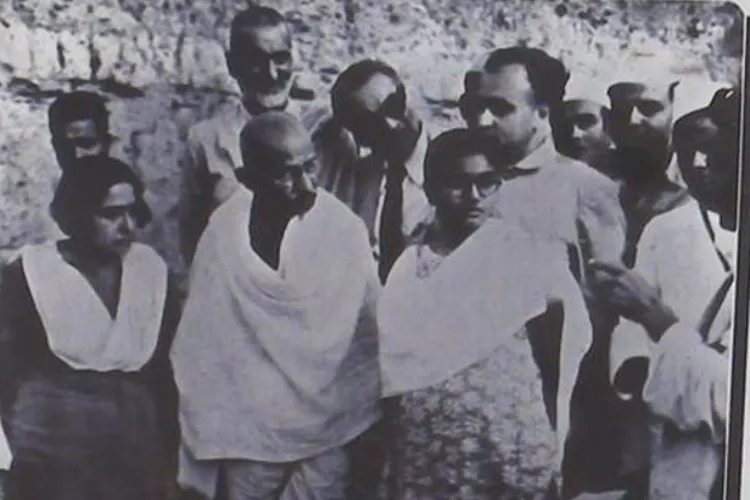
December 19 is celebrated as ‘Mewat Day’, for it was on this day in 1947, soon after the partition of India, that Mahatma Gandhi’s appeal to the Meo Muslims living in what is today the border areas of Haryana, UP, and Rajasthan, made them shun their desperation to move to Pakistan.
The community members were all packed with some belongings after facing harassment and violence at the hands of officials in the post-partition mayhem that had gripped both India and Pakistan. Lakhs of Mewatis got together and declared they would go to Pakistan when Mahatma Gandhi came on the scene. He assured to protect the life and property of Mewatis and give them full respect.
At the time of the partition of India, Mewat, Gurgaon, and Faridabad of Haryana were ruled by the British, and Alwar, Bharatpur of Rajasthan by the kings. At the time of partition, like other parts of the country, Mewat also saw communal violence.
At this stage freedom fighters Abdul Hai, Himmat Khan, and a few other Muslim leaders came to know of a conspiracy to force Mewati Muslims to leave India for Pakistan and they met Mahatma Gandhi and invited him to visit Mewat.
Mahatma Gandhi reached Ghaseda village of Mewat on 19 December 1947. He was accompanied by many leaders including the then Chief Minister of Punjab Gopi Chand Bhargava, Ranbir Singh Hooda, father of former Chief Minister Bhupinder Singh Hooda.
Mahatma Gandhi’s speech on 19th December 1947 in the village of Ghaseda before lakhs of Mewatis is historic. He said, “Today my sayings do not have the same power as it would have earlier.
“But what I say any as much impact as it would have earlier, today not a single Muslim would need to leave the Indian Union, nor would any Hindu-Sikh be required to leave their homes in Pakistan and seek refuge in the Indian Union.
A sorrowful Bapu said: “My heart is filled with sorrow after hearing what is happening here. All around arson, looting, killing, coercive religious conversion and kidnapping of women, and demolishing temples, mosques and gurudwaras is madness. If this is not stopped, both communities will be annihilated.”
Historian Siddiq Ahmed Meo, who has 10 books on the history of Mewat to his credit, says, “Gandhiji also read out the complaints sent to him by Mewati Muslim representatives to the assembled crowd.”
He assured the Mewatis that they would be given full respect. If any government official commits any atrocity with the Mewatis, then the government will take strict action against him. Gandhiji said, “I will be happy if my words can console you a little.”
He expressed grief over the Muslims who were expelled from the princely states of Alwar and Bharatpur.
Gandhiji said in his speech, “A time will come in India when all hatred will be buried in the ground and both societies will be able to live in peace.”
Mewat’s social worker Fajruddin Besar says, after Gandhiji’s assurances, the Muslims reversed their decision. “If they were not stopped at that time, there would be not a single Muslim in Haryana and Rajasthan today.” He says Gandhiji did a big favour to the Muslims by stopping them from going to Pakistan. “Today, Muslims in India are living a life of more peace and respect than in Pakistan. In Pakistan, there is always fighting among Muslims.”
In 2007, chief minister Bhupinder Singh Hooda declared Ghaseda an ideal village and renamed it Gandhi Gram Ghaseda. He also released about Rs 10 crore for development works in the village.
This year Congress leader Rahul Gandhi will also reach the village on December 22 and celebrate Mahatama Gandhi’s visit to the village on that day.
source: http://www.awazthevoice.in / Awaz, The Voice / Home> India / by Yunus Alvi, Nuh (Haryana) / December 19th, 2022
Dr. P.G. Halakatti Research Centre of Vijayapura in north Karnataka has spearheaded the project that is historically significant.
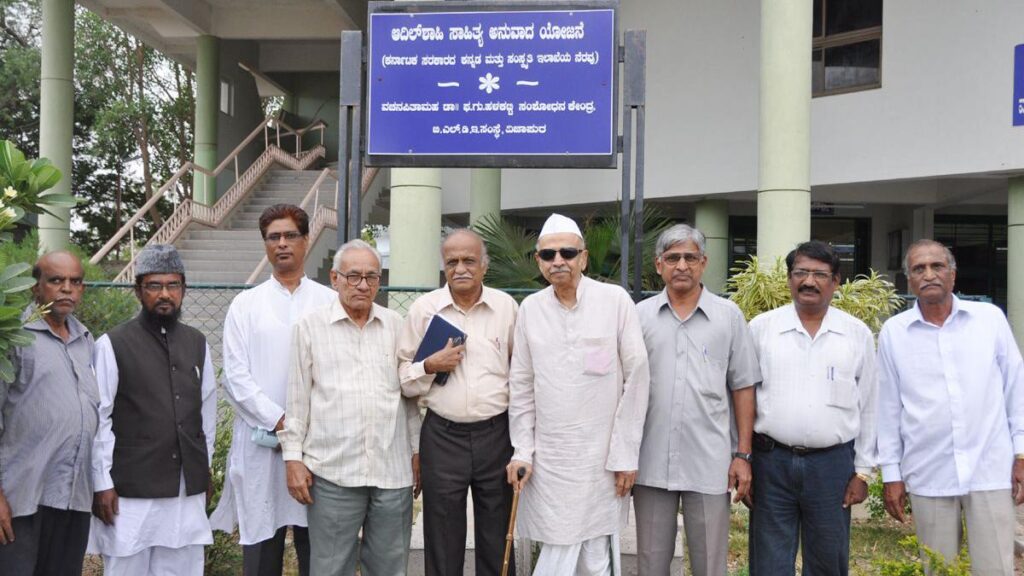
Members of the Adil Shahi Literature Translation Committee at Dr. P.G. Halakatti Research Centre in Vijayapura. | Photo Credit: File photo
Vijayapura-based BLDE Society’s Dr. P. G. Halakatti Research Centre has just completed the ambitious task of translating literature and documents pertaining to the reign of Adil Shahi kings in the 15th and 16th century. The work was carried out in association with the government of Karnataka.
Books in Persian, Arabic and Dakhani have been translated to Kannada. The project generated around 4,500 pages in 19 volumes.
The translated books include epics like Tareekh-e-Farishta, a history of the kingdom by Mohammad Kasim ‘Farishta’, Basateen-e-Salateen by Ibrahim Zuberi, Ibrahim Nama by Ibrahim Dehelvi in Dakhani, Guldasta-e-Bijapur by Mir Ahmed Ali Khan, Hafta Kursi by Fitur Khan Lari, and Futuhat-e-Alamgeer by Eshwar Das Nagar.
Challenge of finding experts in Persian language as well as Kannada
“This is a milestone in the cultural history of Karnataka,” says Krishna Kolhar Kulkarni, director of the centre. “It has been completed after painstaking work by scholars and translators who are good in both the original language and the target language. It was not easy to find them, as there are few persons who are well-versed in Persian or Dakhani. It also took us a lot of time to visit libraries and research centres to gather the books and documents.”
Procuring the books was not easy. Committee members visited Hyderabad, Delhi and Kolkata, to get copies of various books. The books were collected from the Salar Jung Museum in Hyderabad, the archives of Andhra Pradesh, and the Archaeological Survey of India (ASI) headquarters in New Delhi, and some individuals.
“It was tough work, but we persisted. For example, we got one of the only two copies of ‘Mohammad Nama’ by Kazi Nurallah. Even these copies are reproductions, and not originals,” he said.
Important historical project
“Though there have been a few books in English and Kannada about the history of medieval Karnataka, a lot of work needs to be done. The translation project hopes to fill that void. It will tell us not only about the history of Karnataka and the Deccan region, but also about India in those times,” he said. “Apart from documenting the life and times of medieval India, the translation project will help us drop our prejudices and dispel misconceptions about this phase of history.”
The project has been in the works for several years, says Dr. Kulkarni who is also the director of Adil Shahi Literature Translation Committee set up by the Ministry of Kannada and Culture. He worked for several years with M.M. Kalburgi who was vice-chancellor of Kannada University in Hampi.
M.B. Patil, BLDE Society chairman and founder of the research centre, recalls the contribution of Irrigation Minister Govind Karjol, who supported the project during his tenure as the minister for Kannada and Culture Minister.
The volumes were released in Bengaluru on December 18 in the presence of former Union Minister Salman Khurshid, writer Sudheendra Kulkarni, former Minister M.B. Patil, literary critic Devu Pattar, Mansoor Ali Khan of Centre for Research and Communication, G.K. Patil, president of Dr. P. G. Halakatti Research Centre.
source: http://www.thehindu.com / The Hindu / Home> News> India> Karnatkaka / by B. Rishikesh Bahadurdesai / December 19th, 2022
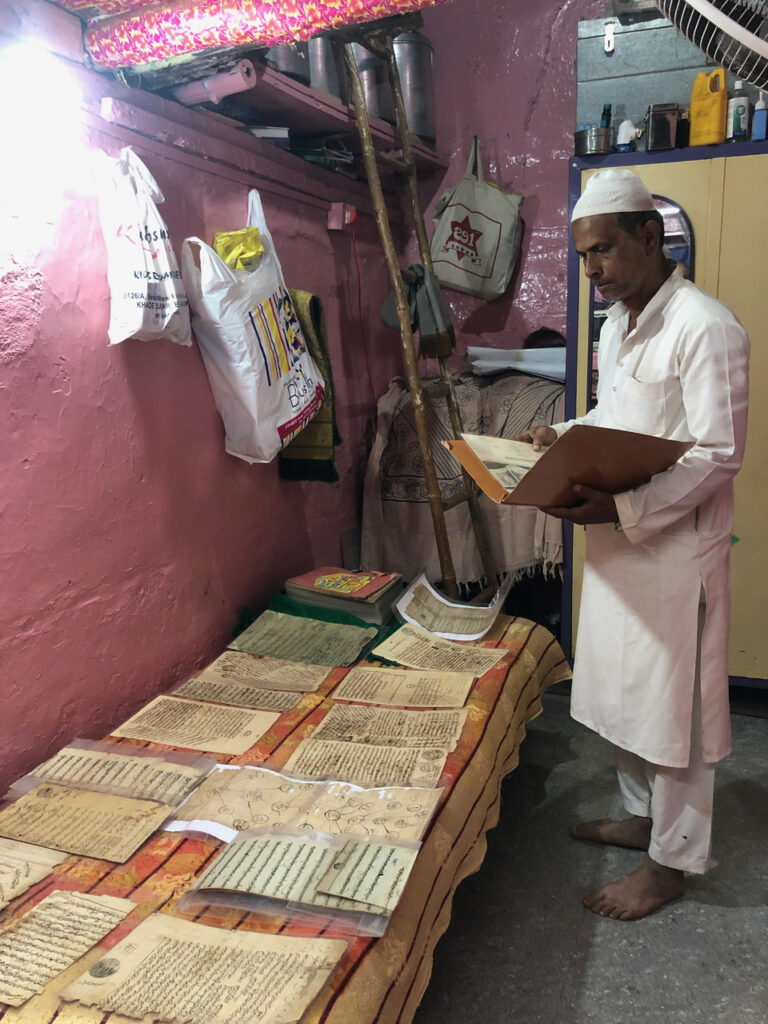
The dargah Hazrat Syedina Shaikh Badruddin Shah Arif Chishti is in possession of several archival records, but its real claim to fame is a copy of the Holy Quran calligraphed by Mughal Emperor Aurangzeb Alamgir.
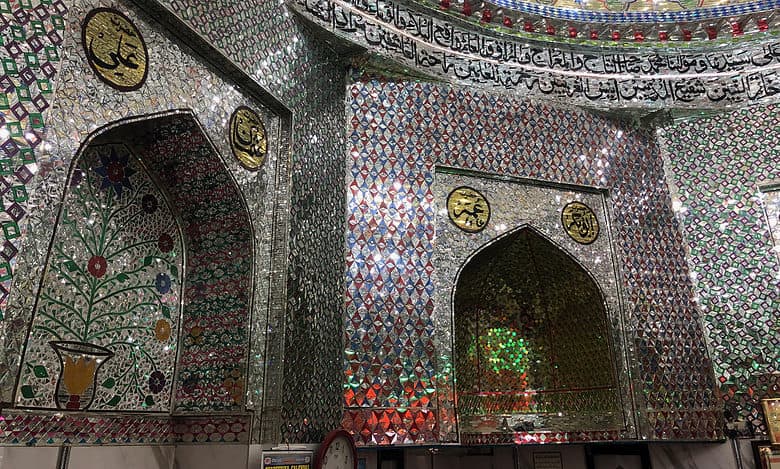
The shrine of Shaikh Badruddin Chishti in Belgaum recently underwent renovation with some scintillating Persian glass work. (Image: Shafaat Shahbandari).
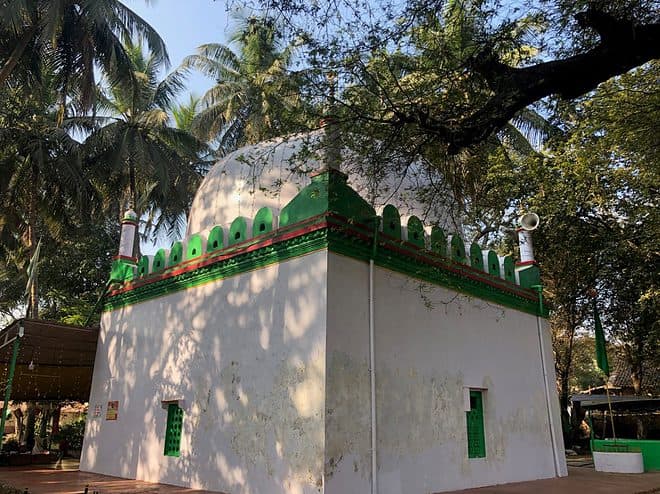
The historic town of Belgaum is home one of Karnataka’s oldest Dargahs. Located within the ancient fort of Belgaum, the dargah Hazrat Syedina Shaikh Badruddin Shah Arif Chishti is believed to be more than eight centuries of old.
Among the first sufi saints to settle in the region, Shaikh Badruddin travelled across south India spreading the message of peace and harmony. The historic tomb in Belgaum is still a great symbol of harmony in the city.
“Hazrat Syedina Shaikh Badruddin Shah Arif Chishti arrived in Deccan more than 800 years ago. He travelled extensively across southern India to spread the message of peace and love. He was among the first sufi saints to settle down in this region,” said Rafeeq Ahmed Ghawwas, caretaker of the Dargah in Belgaum.
Located in the historic Belgaum Fort, the mausoleum of Shaikh Badruddin Chishti was revered by rulers from various dynasties irrespective of their faith. (Shafaat Shahbandari)
Origins
Originally from Delhi, Shaikh Badruddin he was a disciple of Hazrat Shaikh Qutubuddin Bakhtiyar Kaki, who was a 12th century saint and scholar based in Delhi. According to Ghawwas, Shaikh Badruddin migrated to the Deccan in Belgaum on the advice of his spiritual master. He was the one who introduced the Chishti order of the revered saint Khwaja Muinuddin Chishti in the south.
“Our ancestors were the disciples of Shaikh Badruddin and we have been in the service of this place since the earliest times. I took over as the caretaker of this dargah from my uncle Khattal Ahmed, who had taken over from my father Abdur Raheem Mujawar. Before him our grandfather Ebrahim Ahmed was the caretaker, who took over from his father Shaikh Jangu Mian,” said Ghawwas, who has been the caretaker of the dargah for more than 30 years.
Venerated by kings, ministers and commanders of all faiths, the dargah and the saints of this order have had close ties with several dynasties across its history of almost 800 years.
Ghawwas with some prized remnants of Maratha, Mughal and Adil Shahi heritage. (Shafaat Shahbandari)
The Aurangzeb connection and the Quran
More interestingly, the dargah Hazrat Syedina Shaikh Badruddin Shah Arif Chishti is in possession of several archival records that reflect its rich and vibrant history. And among its biggest inheritances is a 16th century copy of the Holy Quran that was calligraphed and gifted by the sixth Mughal Emperor Aurangzeb Alamgir.
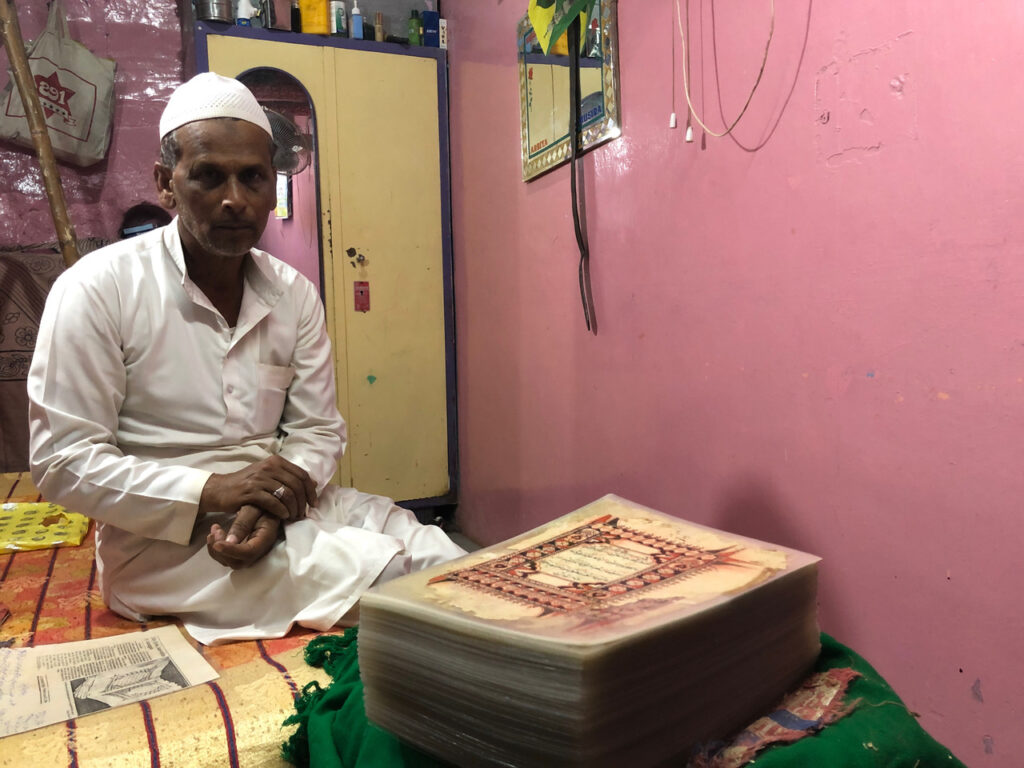
Rafeeq Ahmed Ghawwas with his prized possession – a 17th century calligraphed copy of Quran. (image: Shafaat Shahbandari)
“The emperor had actually gifted the copy to the dargah of Khwaja Muinuddin Chishti in Ajmer, but we are not sure how and when it reached into the possession of our ancestors. We feel fortunate to have this blessed copy and we are doing our best to preserve it for posterity,” added Ghawwas, who has preserved the copy with great care.
According to local history, after his travels across South India, Shaikh Badruddin arrived in Belgaum and settled within the premises of the then newly built fort. The fort was originally built in 1204 AD by Raja Jaya Raya of the Ratta Dynasty and Shaikh Badruddin lived here until his death in 1251 AD.
This mausoleum was built in the early 16th century by the Adil Shahi general and the then governor of Belgaum Asad Khan Lari. The structure has been preserved with some renovation and restoration. Recently, the interiors of the dargah went through a facelift with Iranian glasswork adorning the walls, the dome and the ceilings.
Throughout its long history in Belgaum, the has received patronage from the rulers irrespective of their faith. The caretaker is in possession of several firmans and sanads issued by the Maratha rulers who venerated Shaikh Badruddin and offered their patronage.
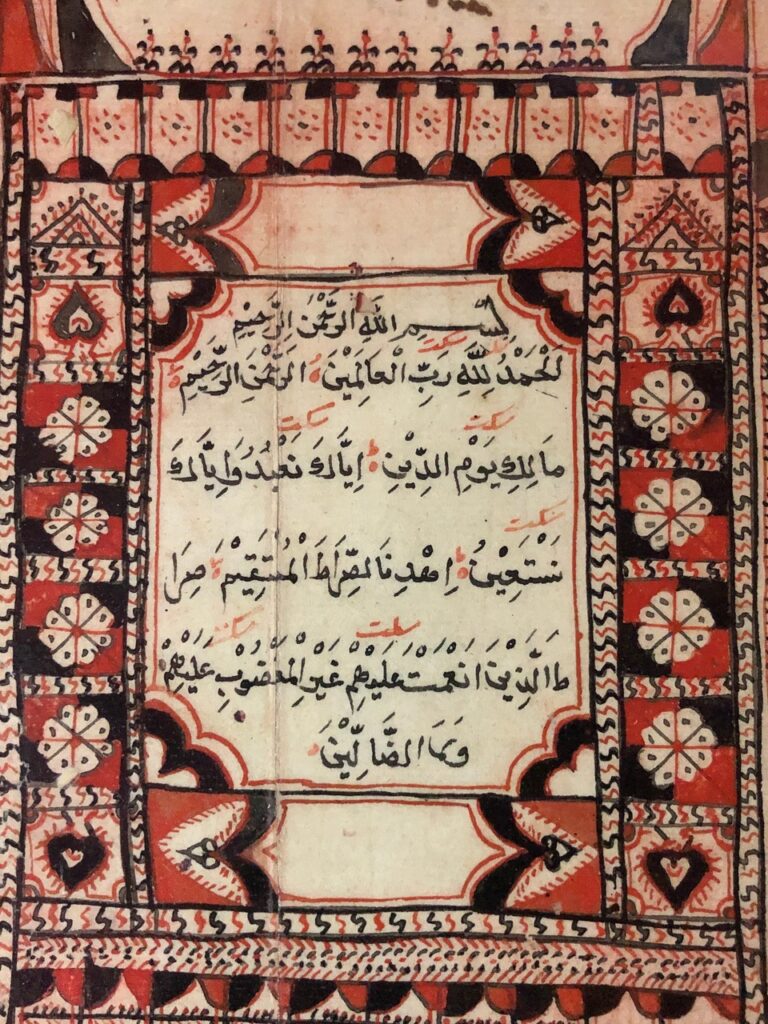
The ornamented page of the calligraphed work representing the first chapter of the Holy Quran. (Image: Shafaat Shahbandari)
“This dargah has always been the abode of peace and harmony and we are continuing with our age-old motto of love for all,” added Ghawwas.
source: http://www.siasat.com / The Siasat Daily / Home> News> Bangalore / by Shafaat Shahbandari / December 13th, 2022
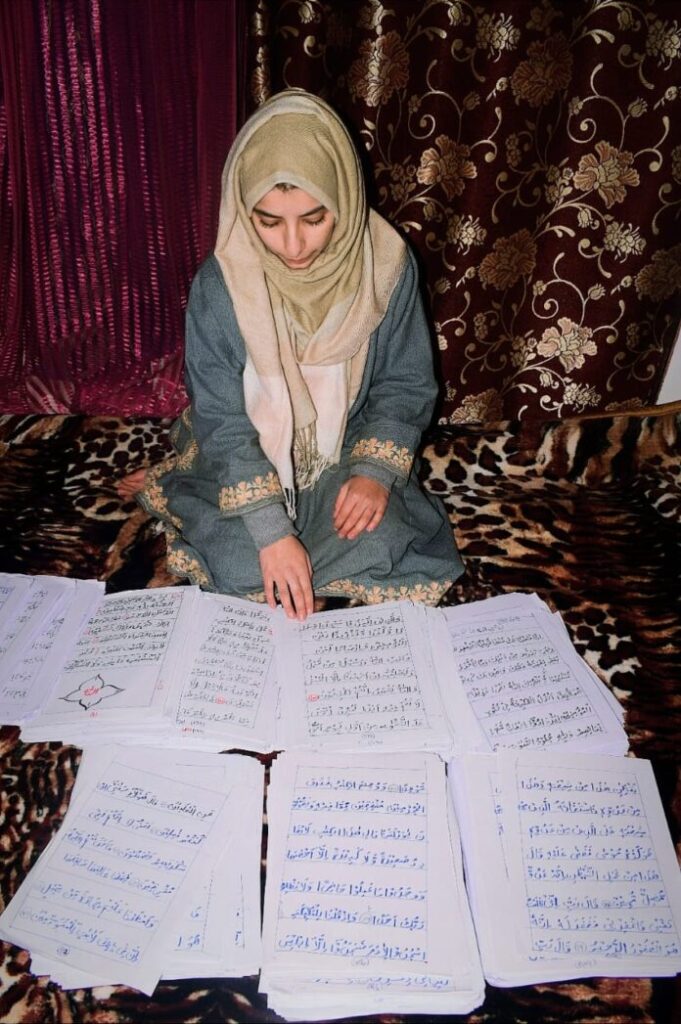
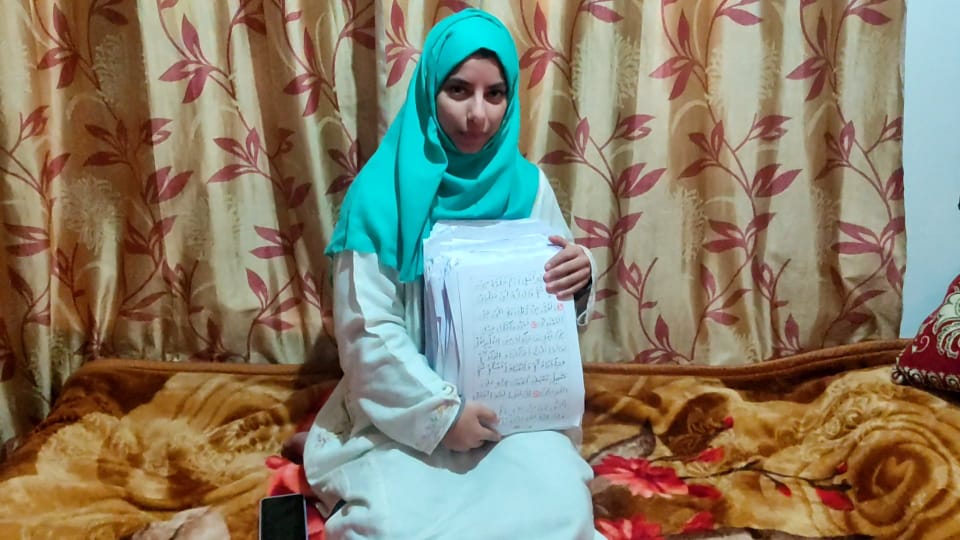
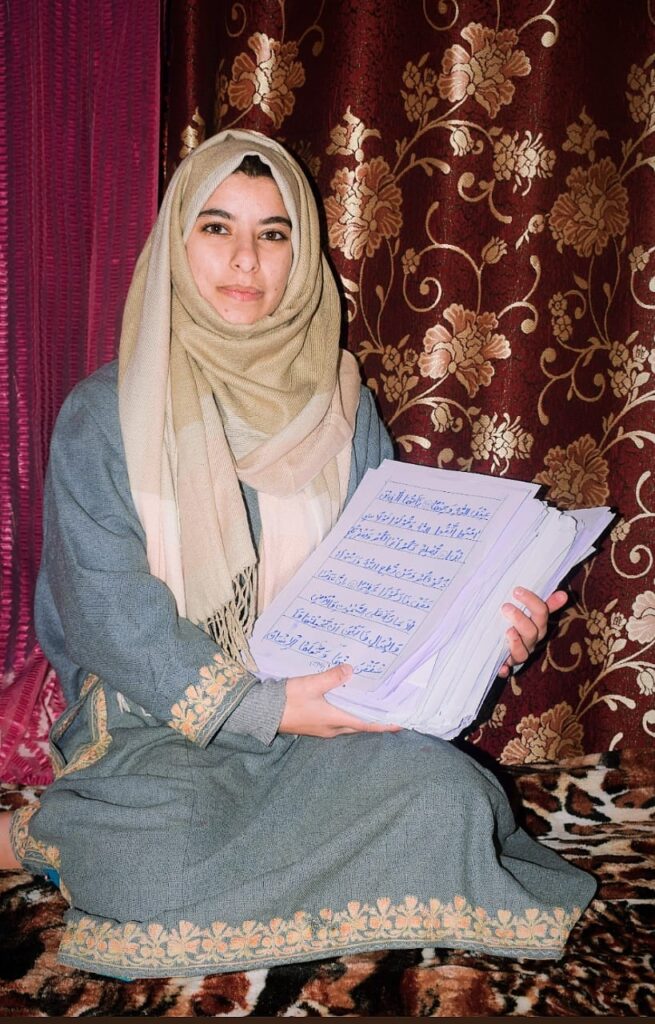
Phones have not stopped ringing at Tahir Ahmed Parray’s home in North Kashmir Hajin after his daughter Arbeen Tahir completed handwriting Holy Quran.
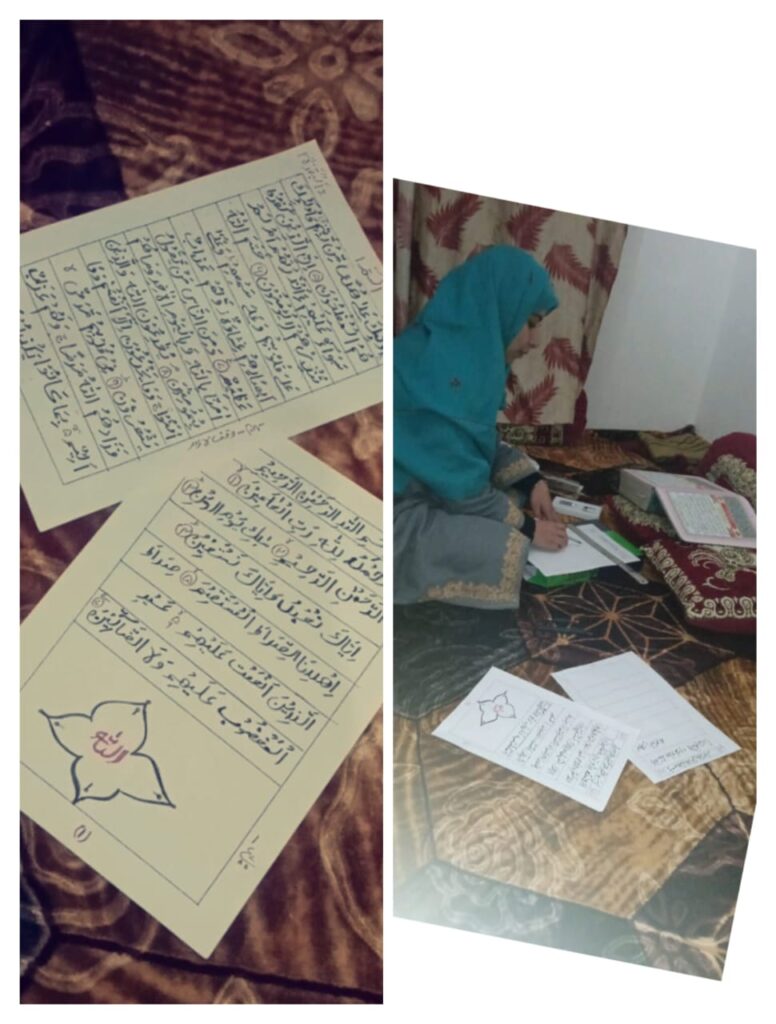
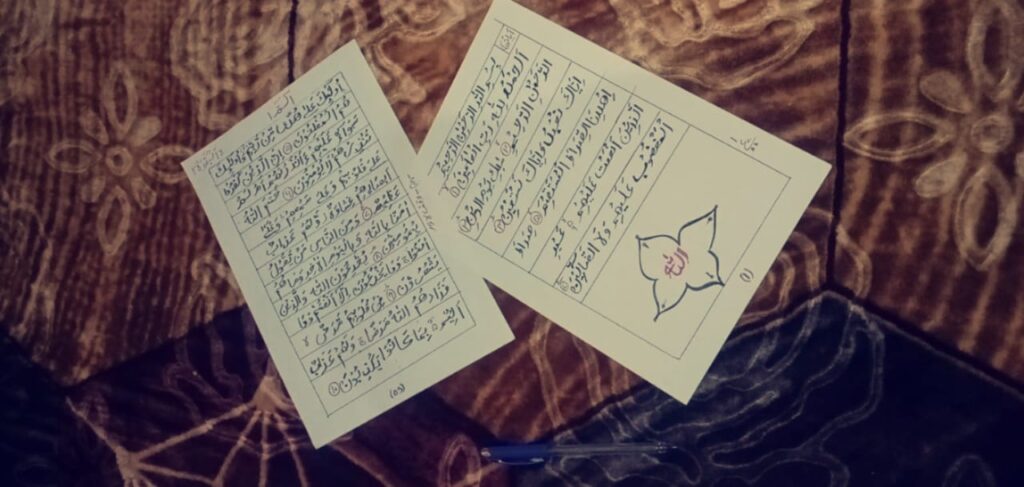
It took Arbeen six months to write the Quran using her calligraphic pen. With no formal training, she learnt calligraphy by watching YouTube videos before she tried her hand at writing the Quran.
“It was my childhood dream to write the holy Quran. I had no experience or training in calligraphy. I started watching videos and trying scribbling on paper before I learnt the art. I started writing the holy Quran in June and completed it in November. I was regularly showing manuscripts to my cousin for any correction,” she said.
Coming from a religious family, Arbeen’s father is a businessman dealing with fruits. She has a younger brother who studies in Class 10. Arbeen is living in a big joint family with all her uncles and cousins under one roof.
Arbeen received religious education from her childhood. Well versed in different languages, she developed an interest in reading theology and religious scriptures.
“I have written the manuscript on 900 pages. Now I plan to preserve this copy for posterity. I plan to bind it and keep it in my study. It is the prized possession,” she said.
Arbeen has become a role model for her clan and society. A student of class XII, she is now preparing for NEET and wants to become a doctor to serve humanity.
“I am working hard to crack NEET. My cousin is a doctor and she is my inspiration. I too want to become a doctor to serve mankind. I am preparing hard to achieve my goal,” she said.
The 18-year-old is also working on her debut book. “I am writing a book. `Tragedy of Innocence’ will soon hit the stands,” she said.
Arbeen is not the first student who has handwritten the Quran in Kashmir. Last year, Adil Nabi Mir of Srinagar completed writing the Holy Book in 58 days. Mir said he wrote the Quran in his handwriting purely for the ‘sake of Allah’ and to inspire the youth to follow Islamic teachings.
Coming from a humble background, Mir’s father is a mason. Mir said he received a lot of encouragement from his father and other family members.
He started writing on January 27, 2021, and it took him 58 days to complete the work. He used to write in his free time and spend 6-7 hours doing this. His fingers would ache a lot, but he persisted. Mir would rarely move out of the house barring visits to the mosque so that he could finish his task.
source: http://www.indiatomorrow.net / India Tomorrow / Home> Religion / by Ishfaq-ul-Hassan (headline edited) / December 13th, 2022