The group is looking to tap the fast-expanding air traffic between India and the Gulf.
Kerala-based travel service operator Alhind Group with a strong presence in the United Arab Emirates (UAE) is set to launch its airline, aiming to provide economical air travel options for residents.
The group, which has been a significant player in the travel industry for over three decades, has received the Civil Aviation Ministry’s initial nod to start an airline — Alhind Air.
The chairman, Mohammad Haris announced that the Group is in the final stages of obtaining the required approvals.
“Last week, we had a meeting with officials at the Cochin International Airport Limited (CIAL); we submitted all documents required for landing permission at the airport,” he said. “We had earlier received the no objection certificate (NOC) to start the airline. We are hoping to begin operations by January 2025, if not earlier,” said Haris as quoted by Khaleej Times.
Initial operations and fleet
According to the reports, Alhind Air will start its initial operations with three Atr-72 turboprop aircraft, focusing on regional routes in southern India, including connections between Cochin, Bengaluru, Thiruvananthapuram and Chennai with an initial investment of ₹200 crores to ₹500 crores as it adds more planes into the fleet.
“We will have five ATR planes in total to fly on regional routes. We have secured all support from Cochin International Airport for our operations. Once this process is completed, the exercise for hiring pilots, cabin crew, engineers and other ground staff will start, a top official of the group told CNBC-TV18.
The group’s promoter revealed that the Alhind Group offers services including air ticketing, holiday packages, Haj-Umrah services, visas, and money exchange. The group already boasts a turnover of ₹20,000 crore and has a robust sales network that could facilitate the successful launch of the airline.
Pertinently, Alhind Group is one of the leading players in the travel and tourism industry in India and abroad.
The strategic launch into the aviation sector is anticipated to enhance completion, potentially lowering airfares and improving service quality for travellers.
Mohammad Haris stated that the group which is also the General Sales Agent (GSA) for many airlines is looking to tap the fast-expanding air traffic between India and the Gulf.
source: http://www.siasat.com / The Siasat Daily / Home> News> India / by Sayima Ahmad , (Headline edited) / August 22nd, 2024
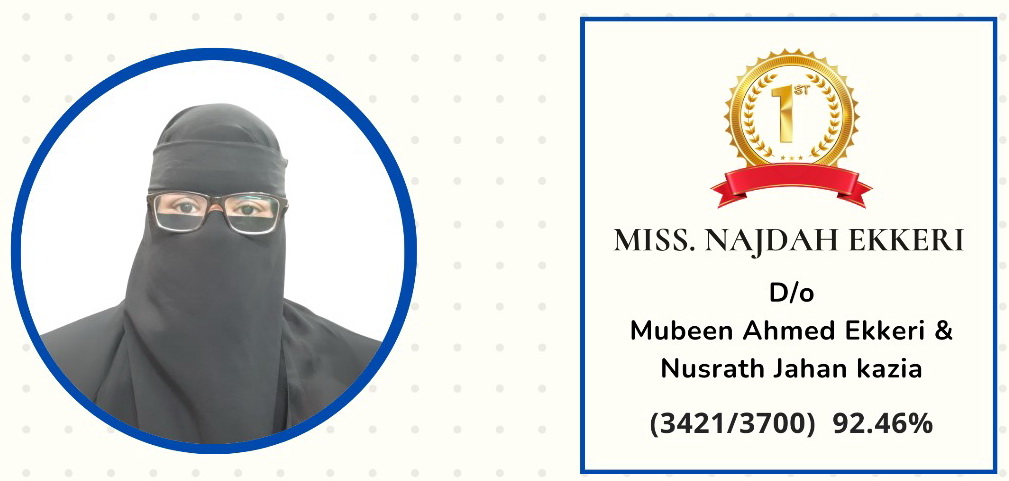
Students of the colleges run under Anjuman Hamai Muslim Bhatkal continue to get ranks at the university level and this time Najda Ekiri, a student of Anjuman Institute of Management and Computer Applications (AIMCA). Anjuman College has made the name of Anjuman College bright in the entire state by securing first rank in Bachelor of Computer Applications (BCA) at Karnataka University, Dharwad.
AIMCA Principal Muhammad Mohsin has said in a press release that Najda Ekiri, of Mubeen Ahmed Ekiri and Nusrat Jahan, has also achieved a remarkable feat by memorizing the Holy Quran during her three-year BCA course. According to the press release, Najda secured 3421 marks out of 3700 marks, resulting in a pass rate of 92.46%. The BCA exams were held in August-September 2023.
It has been found that while Najda, a student of Bhatkal Anjuman, secured the first rank in Dharwad University, Dekshanagappa Kharvi, a student of Bhatkal Sri Gurusdhiendra BCA College, secured the third rank at the university level, with an average success rate of 91.73%. has been done.
The university’s second rank went to Shantala Raibagh, a student of Global College of Computer Applications, Hubli, who registered a pass rate of 92.27 percent.
It should be noted that more than fifty BCA colleges are affiliated to Karnataka University, Dharwad, and among the students of all these colleges, a student of Bhatkal Anjuman getting the first rank is a great achievement. In such a situation, memorizing the Holy Quran with modern education is also a big challenge.
The management of Anjuman Hamai Muslimin, the principal and other staff of the college have congratulated Najda for this wonderful achievement and wished her all the best for her future.
source: http://www.sahilonline.net / Sahil Online / Home> Coastal News / by IG Bhatkali, SO News Agency / August 23rd, 2024
Wahdina Village / Sringar, KASHMIR / JAMMU & KASHMIR :
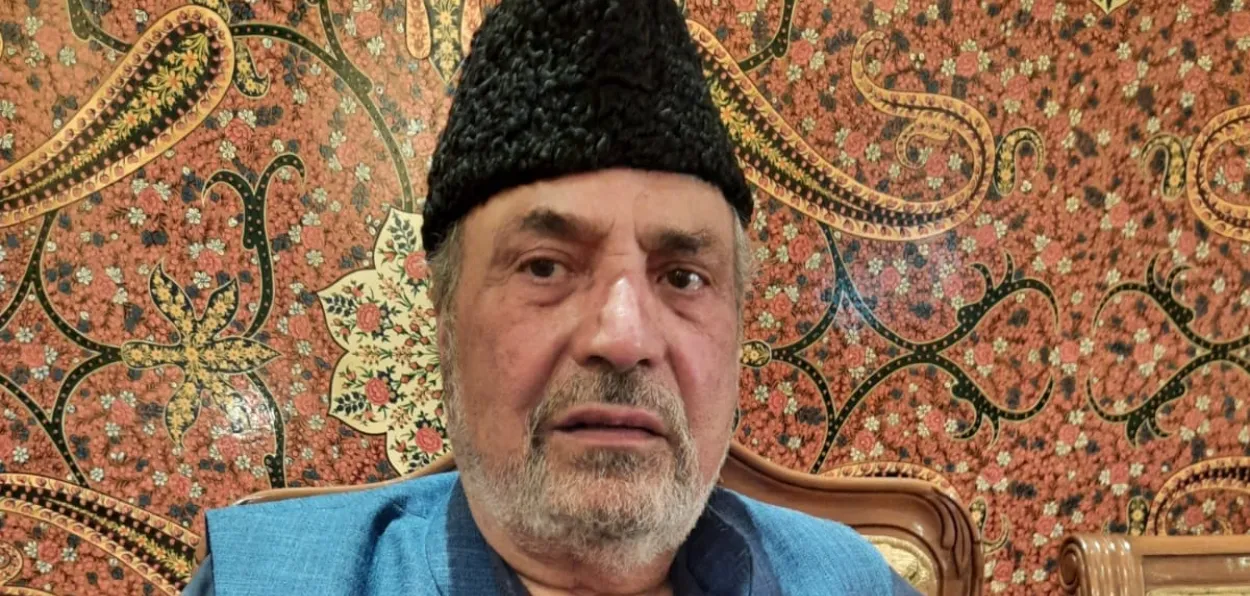
Muzaffar Hussain Baig at his home
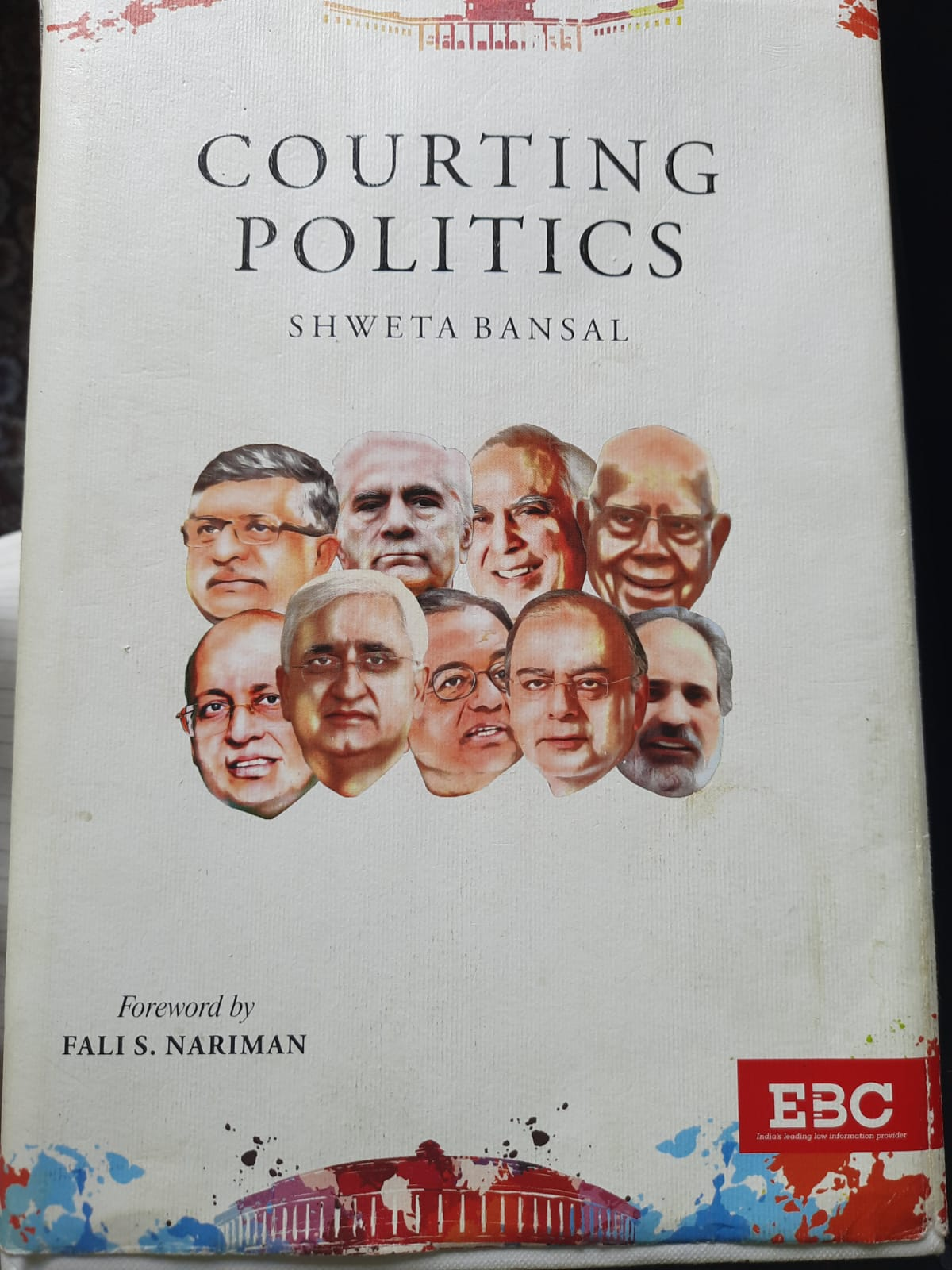
Muzaffar Hussain Baig is among nine top Indian legal luminaries who also took to politics. He figures in the book Courting Politics by Shweta Bansal, along with other well-known legal bigwigs like Ram Jethmalani, Shanti Bhushan, P Chidambaram, Kapil Sibal, Arun Jaitley, Salman Khurshid, Ravi Shankar Prasad, and Abhishek Manu Singhvi.
Baig, a recipient of Padma Bhushan (2020), who held several top positions in the government – Advocate General of J&K, Deputy Chief Minister, Law Minister, a member of Lok sabha – has risen in life wading through extremely difficult circumstances and yet never allowed anything do diminish his thirst for knowledge and limit his genius.
Having studied Law at the Harvard in the USA after graduating from the Delhi University’s School of Law, he also practiced in the US and Supreme Court of India before shifting to Kashmir. He was keen to make a difference to society and contested Lok Sabha elections as an independent candidate. However, with the onset of the Pakistan-backed insurgency in Kashmir in the summer of 1989, Baig jettisoned his dream of pursuing a political career.
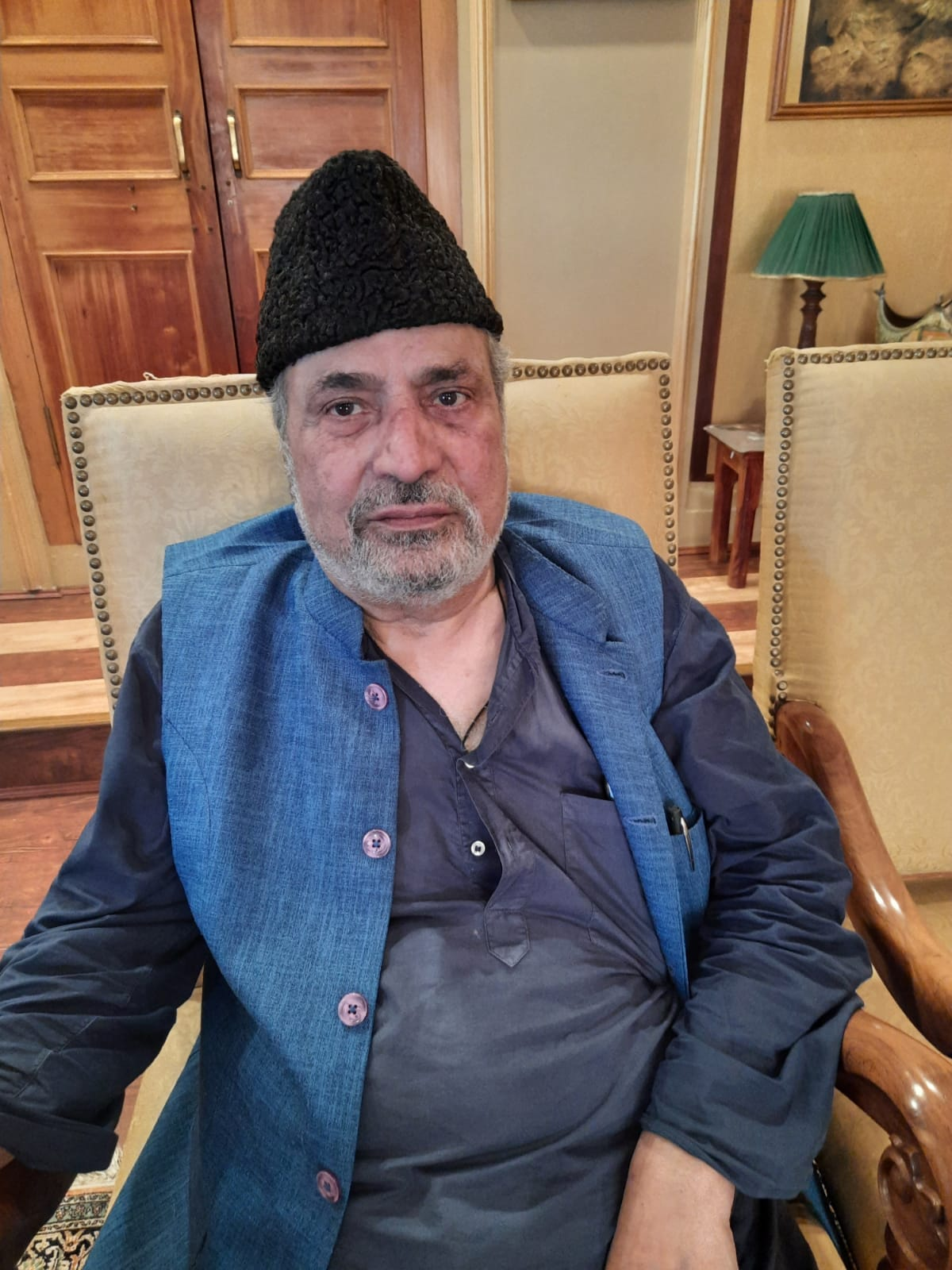
Muzaffar Hussain Baig
Baig is credited with drafting the anti-defection law of the J&K and his legal genius is reflected through the important cases he won in the Supreme Court of India and the J&K High Court.
Baig, 78, was born as the second of eight siblings in Wahdina village near Baramulla in North Kashmir. Though the family had a rich and royal legacy, he lived a life of penury. Baig speaks of he footing two km distance to school barefoot.
At the school, he was seen as a determined and hard-working student. One of his teachers Mohammad Maqbool Shah encouraged him to participate in activities like drama and speech making. Baig also taught to younger students in the school.
He learned the English alphabet in his 6th standard as was the norm those days. Soon, he started speaking in the English language with a “thick Kashmiri accent”. He topped the Board examination of the State in the 8th standard (Middle).
He shifted to Baramulla town,15 km away from home, to study further.
There was no stopping for this genius from then onwards till he joined Delhi University for his LLB and topped the examination. He then joined Harvard, USA, for higher studies and again topped the examination.
“You will find all over the world that there is an inbuilt desire in the minds of people to join politics, not to become Government functionaries but to secure some change for the society”, Muzaffar Hussain Baig told Awaz-The Voice at his residence, overlooking Dal Lake in Srinagar.
The Cover of the Book Courting Politics
He said, “I wanted to see the welfare of people…. had this desire to represent society. I did not even charge anything from my clients for whom it was unaffordable”, he said. “Politics, for me, was not just a profession but a mission to represent my society”.
Baig’s maiden attempt in politics, and as a distinguished lawyer having practiced in the US and Supreme Court of India, brought him to the notice of several political leaders including the then Congress leader and a former Minister, Abdul Ghani Lone, and the National Conference leader and former Chief Minister Farooq Abdullah and also former union Minister Mufti Mohammad Sayeed.
Lone had later constituted the Peoples Conference in the 1970’s, after quitting Congress. “Abdul Ghani Lone, with the idea of some change in Jammu and Kashmir, had become important as a political leader”, with mass support in Kupwara. North Kashmir. Lone extended his support to Baig in a couple of subsequent Lok Sabha elections. Baramulla constituency, then comprising Baramulla district of the entire North Kashmir, now comprises three districts, Kupwara carved out in 1979 and Bandipore carved out in 2007.
Describing Abdul Ghani Lone a rebel, who was among several others after having been educated at the Aligarh Muslim University (AMU), Baig said that he (Lone) enquired “about my interest in politics. I was already contesting as an independent candidate, he assured me of his support in Kupwara”, he said.
Muzaffar Hussain Baig as a student in Harvard
Baig added that both of them almost belonged to a similar “deprived background”, and had to suffer together for many years. Abdul Ghani Lone represented his home constituency of Handwara in 1967, 1971 (Cong), 1977 (JP), and Karnah, 1983 (Peoples Conference) both constituencies in the Kupwara district. Things changed with the eruption of militancy late in 1989, leading to a political vacuum.
Having been at the forefront of political activities in Jammu and Kashmir since the Peoples Democratic Party (PDP) was launched by the former Chief Minister, Mufti Mohammad Sayeed in 1999, Baig had “good relations” with top political figures including former PMs, Atal Behari Vajpayee and Dr Manmohan Singh. He opines that Vajpayee was “extraordinarily intelligent” and Dr. Manmohan Singh was the most “humble and efficient person”.
Baig equally holds the Prime Minister Narendra Modi in high esteem for his sincerity and clarity of approach. “A Statesman thinks about the next generation and a politician thinks for next elections.’ he said.
On his experiences in the Lok Sabha as a PDP MP from Baramulla between 2014 and 2019, Baig lays importance on the “substance and sincerity in speech” adding that one has to say “things openly for the (welfare of) people”. He hailed the high political qualities of former union Ministers, Ms Sushma Swaraj and Arun Jaitley.
Muzaffar Hussain Baig in his younger days
Given his distinguished legal background, Baig’s association was sought by Mufti Mohammad Sayeed to frame the Constitution of a new political party, which later took the shape of the Peoples Democratic Party (PDP) in 1999. There was a need to float a new party while the Congress and National Conference were the only two national and regional level active political parties in the erstwhile State of Jammu and Kashmir. Mehbooba Mufti, elected from the home constituency of Beijbehara in Anantnag district in 1996, was the CLP leader in the State Assembly.
Apart from practicing in the US after his post-graduation in the Law, Baig, being a senior counsel practiced extensively in J&K High Court, Delhi High Court, and Supreme Court of India Some of the important cases he had dealt with include the case of Reliance Petrochemicals in the SC, while he was associated with Shardul and Pallavi Shroff & Co in Bombay.
The case about Compulsory Convertible Debentures was being opposed by the senior Advocate, Ram Jethmalani. Quoting a ruling from the House of Lords, London, Baig, appearing for Ambanis asserted on the plea that no person should appear in public in any case while it is sub-juidice. The verdict was in favor of his plea, while the senior lawyer, Ram Jethmalani withdrew from the case. The legal luminaries present included N A Palkivala, Fali S Nariman, and Soli Sorabji.
He soon returned to Kashmir and decided to contest the elections as an independent to “work for the welfare” of the people. In J&K he is known for the Anti-Defection Law, following the new government formation by G M Shah in July 1984. A close associate of Sheikh Mohammad Abdullah and his son-in-law, G M Shah formed the Government after some of the NC MLAs defected to him from the Chief Minister, Farooq Abdullah. Shah was the J&K Chief Minister from 1984 to November 1986, before Farooq Abdullah again took over after the Rajiv-Farooq Accord.
On the personal front, Baig got married to Safina in 2007, who is the first elected woman Chairperson of the J&K Haj Committee and also the DDC Chairperson of Baramulla.
source: http://www.awazthevoice.in / Awaz, The Voice / Home> Story / by Ehsan Fazili, Srinagar / August 23rd, 2024
Creates world record of doing Indian Bridal makeup in less than 9 minutes’*
Budgam :
A youth from Budgam district of Kashmir has made it to the International Book of records for doing the fastest Indian bridal makeup.
Younis Ahmad Sheikh (22) known by the name Afnan, a resident of Bugam district area in Chadoora hamlet of Budgam district has created a record for making Indian bridal makeup in less than 9 minutes.
Younis said that he was interested in calligraphy since childhood which later turned to designing and make up art as well.
“Despite facing taunts from the society as makeup artists being a female dominant area during the initial stage as there was no make up artist in Kashmir, I continued my passion and joined training programmes online,” he said.
Younis first used to do make-up of his customers at his residence as he wasn’t in a position to start his saloon due to financial issues.
“As my mother left this world in my childhood and father was old and not in a position to earn anything. After struggling hard, somehow I managed to start a saloon at my own village and slowly society has started becoming supportive as well,” he said.
After starting a salon titled YAS professional beauty salon, the number of customers started increasing and currently three girls are working as helpers at his salon.
“Three girls have got a job at my salon as currently makeup is available for ladies only and I am planning to start making up for male folk as well,” Younis said.
He said that earning livelihood for himself and providing jobs to others is a big achievement at a time when youth are getting involved in anti-social activities.
Younis claims that he had first made it to the Indian book of records followed by the Asia book of records and now the International book of records. He made to international book of records by breaking the previous record of Indian bridal make up of Assam girl in 13 minutes 46 seconds to just 8 minutes and 58 seconds
“I made it to the International book of records for making the fastest Indian bridal makeup and creating a world record,” he said. He said that people shouldn’t be judgemental as every art is a gift of Allah and everyone must respect it.
“Many people don’t show their arts just out of the fear that how society will react to it and if there are equal rights, then men can go in the field of women and vice versa,” he said—(KNO)
source: http://www.thedispatch.in / The Dispatch / Home> The Lead> The News Feed / by The Dispatch Staff / May 08th, 2023
Mumbai, MAHARASHTRA / Chennai, TAMIL NADU / INDIA :
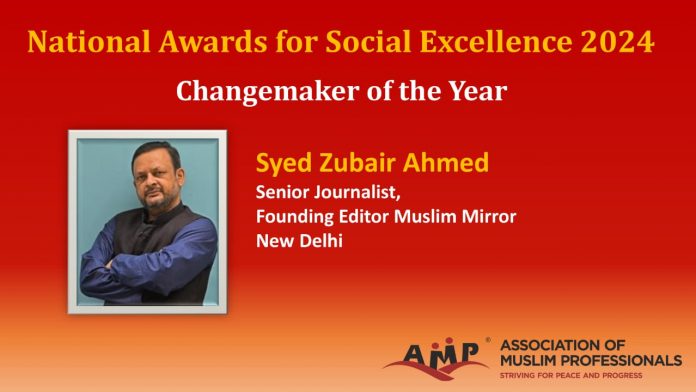
Syed Zubair Ahmad, the founding editor of Muslim Mirror, has added another feather to his cap by being declared one of the prominent Changemakers of 2024 by the Association of Muslim Professionals (AMP). The prestigious recognition was announced during a grand event held at the B.S. Abdur Rahman Crescent Institute of Science & Technology, a deemed university in Chennai, Tamil Nadu. The event was graced by honorable guests and attended by a large gathering of participants from across India.
Ahmad, a distinguished journalist, is known for his powerful advocacy for the rights and representation of marginalized communities, particularly Muslims, in India. Over the course of his career, spanning more than two decades, he has built a reputation for his unwavering commitment to truth, justice, and journalistic integrity.
The Association of Muslim Professionals (AMP) is Mumbai based pan India non-profit organization dedicated to the socio-economic empowerment of the Muslim community in India. Through initiatives in education, employment, and community development, AMP works to foster leadership, skill-building, and social welfare, connecting professionals and organizations nationwide for collective progress.
“In a memorable ceremony, 100 inspiring individuals were honored with Changemaker Awards, and 100 state-level NGOs were recognized in the Best and Jury categories. Additionally, 10 organizations were celebrated in prestigious national categories,” said a press statement issued by AMP.
Notable national NGO awardees include;
ALTNEWS
APCR (Association for Protection of Civil Rights)
IMRC (Indian Muslim Relief & Charities??)
Institute of Objective Studies (IOS),
Allana CSR
Pataka CSR and
Seethakathi Trust
Some of the prominent Changemaker awardees included;
Syed Zubair Ahmad (Muslim Mirror)
Mohammed Wajihuddin (Times of India)
Aslayah Kallakath (Maktoob Media)
Abdur Rahman IPS (Retd.)
Akramul Jabbar IRS (Retd.)
Hammad Rahman
Adil Meraj and
Syeda Ruksheda.
The Lifetime Achievement Award was posthumously bestowed upon the Late Moosa Raza, IAS (Retd.), which was received by his family.
The Omar Khatani Memorial Award was presented to the Tarraqi I Foundation, while BSA Crescent Institute of Science & Technology received the Partner of the Year Award.
Mrs. Mariam Habib, Trustee of B.S. Abdur Rahman Crescent Institute of Science & Technology, served as the Chief Guest and commended AMP’s efforts in education, employment, and empowerment. She emphasized the role of NGOs in bringing about significant societal change in collaboration with policymakers, and she noted that the legacy of the late B.S. Abdur Rahman is being continued with great dedication by the current leadership.
Dr. N. Raja Hussain, Registrar of B.S. Abdur Rahman Crescent Institute of Science & Technology and Guest of Honour, praised AMP’s work in recognizing and motivating various organizations and individuals. He highlighted the ongoing collaboration between the university and AMP in developing students and faculty through guest programs. The event was presided over by University Vice-Chancellor Prof. Dr. T. Murugesan.
Motahar Hosain, Chief Executive and Guest of Honour, congratulated AMP for instituting these much-needed awards to acknowledge the contributions of individuals in the development sector. He remarked that despite the sacrifices made by these individuals in service to others, they seldom receive the appreciation they deserve, making these awards a significant recognition of their efforts.
Mr. Farooq Siddiqui, Head of the AMP National Coordination Team and the driving force behind these awards, stated, “AMP believes in collaboration and has been working alongside multiple organizations since its inception. Through the AMP NGO Connect project, we are connected with over 7,000 social organizations across nearly all districts of India, helping them with capacity building and implementing AMP’s social welfare projects in their regions. These awards are our way of appreciating their efforts and motivating them to continue their impactful work.” He also thanked the AMP Chapter and state teams for mobilizing massive nominations and captivated the audience at the packed Crescent Convention Center Hall with his superb and engaging awards announcement.
Ms. Shereen Sultana, State Head – AMP Tamil Nadu, in her address, shared details about AMP’s initiatives and invited everyone to join hands for the betterment of society and nation-building. She expressed her gratitude to the management and staff of B.S. Abdur Rahman Crescent Institute of Science & Technology for their cooperation in hosting the event and mentioned how she took up the challenge of organizing the awards ceremony in Chennai.
AMP Tamil Nadu State Executive Team member Mr. Yahya Rasheed welcomed the guests and successfully hosted the event with the support of Prof. Ansar.
The awards process for the NASE was multi-layered, with state, central, and a 9-member distinguished jury led by A.R. Khan, IAS (Retd.), President of A.R. Welfare Foundation, Dr. Syed Zafar Mahmood, Founder & President of Zakat Foundation of India, Dr. Farah Usmani, Founder & Chairperson of Rising Beyond The Ceiling, Prof. Zubair Meenai, Professor & Former Head of the Dept. of Social Work, JMI, Prof. Naseem Ahmed Khan, Chairman of the Dept. of Social Work, AMU, Dr. Shazia Manzoor, Head of DSW, University of Kashmir, Sherin Ali, Global Lead – Corporate Social Responsibility, WNS, Sajid Ali, COO of Tech Mahindra Foundation, and Gulzar Hussain, Head of Government Partnerships, UN World Food Program (India).
The success of the 4th edition of the awards was attributed to the collaborative efforts of key AMP team members, including Sajjad Parvez, AMP Zonal Head – South India; Dr. B. Raja Hussain, State Secretary; Syed Faheem, Chennai Chapter Head; and Syed Deen, Chennai Chapter Secretary. Their contributions, along with the support from the back-office teams at the Central Offices in Mumbai and Vaniyambadi, were instrumental in making the event a success.
source: http://www.muslimmirror.com / Muslim Mirror / Home> Indian Muslim> Media> Positive Story / by Muslim Mirror Desk / August 22nd, 2024
A diorama of Mahatma Gandhi leading satyagrahis in burning British clothes at Gandhi Smriti, New Delhi
Shaikh Mohammed Elias, son of Shaikh Mohammed Younus Fakhre Quaum often heard the story of his great-grandfather’s sacrifice for freedom.
Fazal e Elahi Gorey Fakhre Quaum was a wealthy dealer of foreign goods in the 1940s when the British Empire had reached its zenith in glory and power.
In that pre-Independence era, all rich Indian merchants did well by shipping exorbitant British products from Britain and selling them in India. Because of his buoyant import-export business, Fazal e Elahi and his family lived in the lap of luxury. In those days, when no one had big branded cars, he was driving his grand Impala car around!
He and his family lived in Delhi. However, due to the exponential trade with Kolkata as the British capital, he moved there for business prospects. Since he was dealing with the British, he was given the moniker of Gorey Wale by the local people for a person who traded with the ‘whites’.
Rukhshi Kadiri Elias, entrepreneur and founder of Taajira-The Businesswoman, is the great grand-daughter-in-law of Fazal e Elahi. She told Awaz-The Voice that her great grand-father-in-law’s nickname Gorey Wale stuck on with him until an incident happened that elevated his name to a title awarded to him by the community, “Fakhre Quaum (Pride of the community).
Her father-in-law Shaikh Mohammed Younus Fakhre Quaum told her that even Mahatma Gandhi who fought vigilantly for the freedom of India would visit Kolkata and stay with him in his home during his visits. The family shares that Fazal e Elahi was a grand, gracious, and dignified man who lived by ethics.
Fazal e Elahi Gorey Fakhre Quaum
The Swadeshi movement was gaining momentum with passions running high, and at this time, the boycott of British goods started to take on a fresh vigour. Ruskshi’s husband, Elias Mohammad Shaikh shares with the family how his great-grandfather, Fazal-e-Elahi in a defining moment took a bold step to join the Swadeshi movement.
Not thinking about himself, his family, or his future, he gathered the massive pile of British products from his warehouse, transported them to the Kolutolla crossing near the Mohammed Ali Library, and stacked them into a mountainous heap before the gaping crowds, he set the entire lot of goods ablaze in a roaring fire. His business days with the British were over and the Gorey Wale sealed all doors shut for any future trade with the British. Impressed, the crowds gave him the grand title of Fakhre Quaum, meaning “pride of the community.”
It only takes a spark to set a fire blazing. The locals watching him inspired by his sacrifice rushed back to their homes and gathered all the British products they were using, started to make little piles on that road and burn them up and soon the road was aflame with British merchandise. This was the start of the boycott movement in the Muslim community as well as all over Kolkata
Fazal-e-Elahi as a freedom fighter turned all his words into actions by bringing his entire warehouse of goods onto the streets to burn them. Setting an example to the others who never expected him to take this step, losing most of his business overnight, they perceived this act as going beyond mere words or loud speeches. It was a big turning point for himself as well as his family which would negatively impact his children bringing them financially down from this point forward.
He also used the remaining parts of his wealth to give make monetary contributions to the freedom struggle. To survive, he diversified into different Indian products and started making handmade candles, ink and other products and trading in the same. His son, Mohammad Younis also started on a small scale at a time when Bangladesh and West Bengal were one big state. During the Partition, while they had to shift from Bangladesh to Kolkata, they went through pain and struggle. Properties were confiscated and there was a great loss all around.
During the partition, many families of the freedom fighters split. Shaikh Mohammed Younus FakhreQuaum had nine brothers and two sisters with most of the family living in Pakistan, while four remained in India.
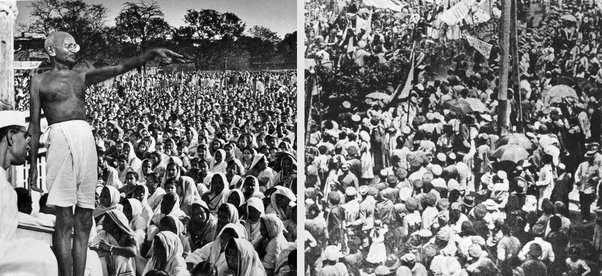
Gandhi addressing Satyagrahis
Fazal-e-Elahi’s family was from Sargodha located in Punjab province of Pakistan. In the 1900s, looking for better prospects in trade, they traveled by caravan to the courts of the Mughal emperor of Delhi. The emperor encouraged people to come and settle down in the new city of Delhi. Learning about this, the family embarked on a journey to Delhi. During their travels on the way, the Hindu Punjabi traders met a seer by the name of Hazrat Shams Tabrez.
Highly influenced by his inspiring speeches and extraordinary demeanor, the entire party in the caravan converted to Islam. When they came and settled in Delhi, they became Delhi wallas known as Delhiwal meaning they were Punjabis settled in Delhi. They adopted Urdu, the court language of Delhi. Even today, while settled all over the world, they are known as Delhiwal and these groups of people are mostly concentrated in Kolkata and Delhi and all called Delhiwal.
While propagating the Quit India Movement, Fazal-e-Elahi rose quickly to become the president of the Baradari (brotherhood) of the Delhiwal community in Kolkata. When travelling down narrow lanes to build up the movement of Quit India, he abandoned driving his Impala car and started to use a horse.
Quoting her father-in-law, Rukshi says that India saw amazing unity during the Freedom Movement. Those days, one could make friends so easily, and it was the most normal thing to build bonding friendships with anyone across different communities. The freedom movement drew Indians into close ties where Indians forgot all their differences and only had the motive to defeat the Enemy.
Fazal-e-Elahi Gorey Fakhre Quaum sacrificed his flourishing business without thinking twice about it towards establishing the freedom of India setting patriotism waves over the community. Rukhshi says, “How many people will do that today is the question in this materialistically attached generation that we live in today. It was pure selflessness because Fazal-e-Elahi Gorey Fakhre Quaum considered India his own country. Such people will revive the spirit of India, sacrifice, and unity.” With a laugh she adds, “I could never think of throwing away my lovely tea set I bought in Britain, but he did it so easily.”
Rita Farhat Mukand is an independent writer and author
source: http://www.awazthevoice.in / Awaz, The Voice / Home> Story / by Rita Farhat Mukand / August 12th, 2024
Wing Commander (retd) Mushtaq Ahmed Afraz lives up to the saying that a soldier is always on duty. Having served in the armed forces, Afraz has taken up the responsibility of documenting the stories of the martyrs and keeping their spirit of valour alive in the mind of public.
So far, he has collected 26,000 stories which are posted on his portal honourpoint.in. These are the soldiers and officers who laid down their lives in wars post-independence.
The Bengaluru-based Afraz says, “During my college days and job, I visited many memorials in the country. There are more than 200 memorials and almost half of them are inside the military cantonments. I would collect details of the martyrs from there.”
Afraz belongs to a Military family and he was brought up in Cantonments across the country. His father was in the Army; like him, his wife was in the Indian Air Force. His brother-in-law and many close relatives were in the Armed Forces.
He narrated a few stories about the martyrs, who would be forgotten and he made their memories come alive. Wing Commander Afraz talks about Flying Officer Farokh Dara Bunsha.
A post on the Facebook page of honourpoint.in commemorarting martyrs
Bunsha was martyred in the 1965 war. Soon his name was relegated to the pages of military history. Not many knew the poignant story of a young woman to whom Farokh Bunsha was betrothed.
After his story was posted on honourpoint.in it came up that this young woman had decided to live with his memory and never married.
Today, Farokh Bunsha’s fiancée is about 75 years old. She had no connection with the family of her martyred fiancé. However, when Wing Commander MA Afraz wrote the story, their families met and befriended each other.
He says, “When the Kargil war broke out, I was in the Air Force. I closely monitored the media coverage of soldiers who sacrificed their lives for the nation.
“I noticed within two or three days, that the stories of martyrs would be shoved into inside pages and gradually people lost interest in them and even forgot their names. It made me realize there is a dire need to commemorate our martyrs.”
A poster announcement prize winners of the competition held by honourpoint.in
After he retired from the IAF in 2008, he decided to turn his dream of commemorating the martyrs’ memories into a reality.
He started working on his project in 2015 and launched his portal within two years.
“Collecting data was a major challenge for us. These forgotten soldiers had fought in the wars of 1947, 1962, 1965, 1971, and 1999. I focused on those who didn’t receive awards or commendations.
Back then there was no internet or a single source for us to collect information. Most of their families lived in far-flung villages.
Afraz says, “I realised that while the countrymen have expectations from our soldiers, nobody has any idea of the martyrs’ expectations from their countrymen.”
Kargil War memorial at Drass, Ladakh
Besides maintaining the portal, Afraz organises gatherings of the families of martyrs with civil society members. “It’s difficult to describe in words the feelings of martyrs’ families when people talk about their sons. Pride and honour are important for these families and no medal or financial help can match it,” he says.
Wing Commander Afraz says, “It is the moral responsibility of every citizen to contribute to the country; the contribution can be of any kind.”
The portal team posts the stories of martyrs on social media platforms like Facebook and Instagram almost daily.
He says, “We are also spreading awareness offline. For example, we are continuously working on making people and students aware with the help of our association with the CSR partners from companies.
“We also organize marathons, radio, and print in memory of the martyrs.
Wg Cdr (Retd) M A Afraz
We are also connecting with people through print media and television.”
Afraz’s team has been organising ‘Rang De Veer‘ events all over India level for six years. These events held on Republic Day, Independence Day, and Kargil Divas (26 July), are attended by schools from India and abroad.
Afraz says, “Civil society should get in touch with these families. The government can only provide them with pensions and schemes. When the stories of the martyrs come to light, I have noticed that common people tend to stand up for their families who need help. For example, lawyers fight their cases for free; doctors provide free treatment.”
Another story that Afraz narrates is of Flight Lieutenant Akash Yadav of Kosli village in Rewari, Haryana. He was martyred in November 2010 at the age of 26 years.
Flight Lieutenant Akash Yadav and Flying Officer Farokh Dara Bunsha
Aakash was a helicopter pilot and his chopper crashed on the India-China border. He was the only child of his parents and they fell into mental depression after his death. Both parents felt there was nothing left for them to live for; they cut themselves off from everyone and lived like a recluse.
In 2017, M.A. Afraz’s portal invited the family of Flight Lieutenant Akash Yadav to a program where the families of martyrs and members of civil society interacted.
After the function, the Yadav’s father said he would now onwards live the his life positively.
He set up an organization named ‘Flight Lieutenant Akash Yadav Yuva Prerana Samiti’ in their village. Under its aegis, the founder moves to the villages around Kosli and motivates the youth to join the armed forces.
He adopted children from slums and is educating them. Today he is fully involved in social service.
source: http://www.awazthevoice.in / Awaz, The Voice / Home> Story/ by Rajeev Kumar Singh, New Delhi / August 14th, 2024
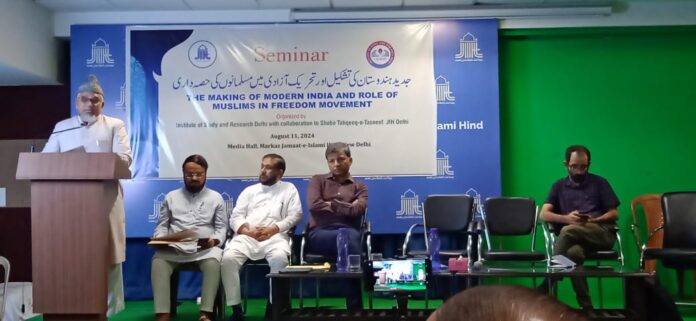
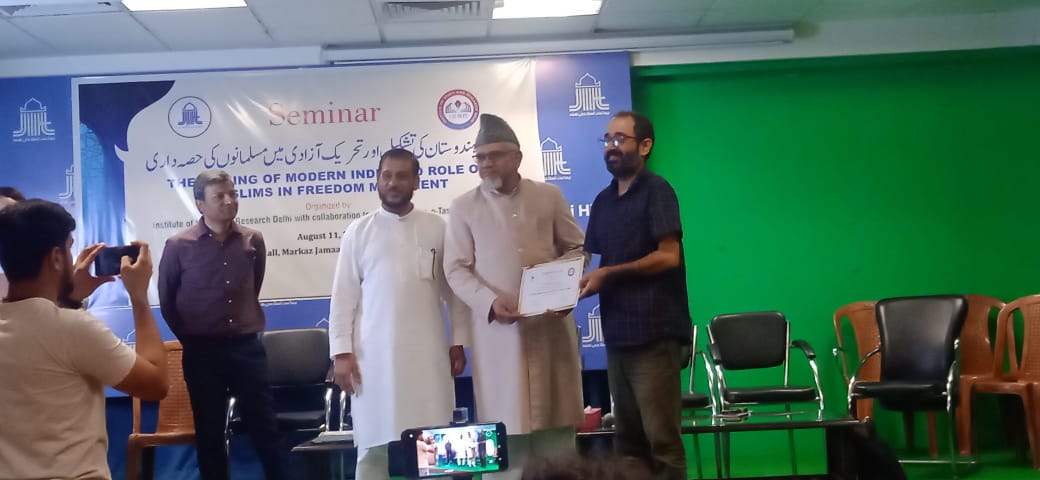
JIH vice-president Prof. Salim Engineer speaks at the history seminar organized by the Delhi unit of the Jamaat-e-Islami Hind.
New Delhi :
Various speakers at a seminar here on Sunday said that the Muslim role in India’s independence and making of modern India was being overlooked by most of the historians.
The seminar titled “Making of Modern India and Role of Muslims in Freedom Movement” was part of a year-long campaign of the Jamaat-e-Islami Hind (JIH), Delhi unit, to create awareness about the role Muslims played in India’s struggle for freedom from Britishers.
In his inaugural speech, JIH Delhi state president Salimullah Khan emphasizing the importance of compiling and presenting historical facts from various sources across the country.
He expressed concern over the current trend of rewriting history by omitting the Muslim contribution to serve vested interests, which he believes, is creating misunderstandings and communal hatred in the country.
“We are making efforts to collect historical facts, heritage, and monument information that exists in Delhi and will present it to the people,” Salimullah Khan stated.
He quoted Ayash Khan, former director of the renowned Khuda Bakhsh Oriental Public Library in Patna, who highlighted the discrepancy between historical reality and its presentation by historians, often influenced by personal interests and inclinations.
The JIH state chief also cited renowned Islamic scholar Maulana Sadruddin Islahi, who emphasized the importance of genuine history writing and deplored the modification of historical narratives to suit personal agendas. He stressed that writing genuine history in the current climate is a significant service to humanity.
JIH Vice President Prof. Salim Engineer, in his presidential address, praised the seminar’s theme as timely and appropriate amid rising Islamophobia and propaganda against Muslims worldwide and rising hatred in the country. He urged scholars and academicians to counter these narratives by presenting the overlooked contributions of Muslims and Islam to the nation.
“This government is not just a government of a political party but an ideological one,” Prof. Salim stated.
“Their agenda includes creating hatred and division in society against Muslims and Islam.” Prof. Salim reiterated this point, highlighting the ongoing attempts by the ruling government to rewrite history in a biased manner.
He emphasized that history should serve as a lesson for the future, advocating for collective action across communities to promote unity, reminiscent of the collaborative spirit against British colonialism. He emphasized the need for more conferences and seminars throughout the country to counter rising propaganda and hatred against Muslims.
The JIH Vice President asserted that Muslim participation in the freedom struggle was inspired by Islamic teachings, which fundamentally oppose injustice and oppression. He criticized both the British colonial distortion of history and current efforts by the ruling dispensation to rewrite history with bias against Muslims and Islam. Calling for more such events throughout the country, he emphasized the need for rigorous research, documentation, and public education to ensure historical accuracy in shaping national discourse and identity.
Unsung Heroes of the Freedom Struggle
Syed Ubaidur Rahman, a prominent who has authored several books on the history of Muslims in India, provided a comprehensive account of Muslim contributions to the freedom struggle. He highlighted the Faraizi Movement of 1819 as the first freedom movement, predating the widely acknowledged 1857 uprising.
“The Faraizi Movement, launched by Haji Shariatullah in 1819, was not just a religious reform movement but a revolt against oppressive landlords patronized by British colonizers,” Syed Ubaid explained. He emphasized that this movement, which lasted for 50 to 60 years, offered significant sacrifices and impact.
Syed Ubaid also shed light on the role of the last Mughal emperor, Bahadur Shah Zafar, in the 1857 revolt. “Zafar had nothing to lose, as Mughal rule had already deteriorated to the lowest level before he took charge,” he clarified. “But for the sake of freedom, he revolted against the British Raj, leaving his luxurious life and power behind,” he pointed out.
The writer listed numerous prominent freedom fighters who made great sacrifices, including Imam Bakhsh Sahbai, Mufti Sadroddin Azoorda, Maulana Azad Subhani, and Maulvi Abdullah Shah.
Syed Ubaidur Rahman drew attention to many unsung heroes, including Maulvi Abdullah Shah and Azeemullah Khan, who played pivotal roles in the freedom movement. He enumerated the sacrifices of various freedom fighters, such as Imam Bakhsh Sahbai, Maulana Jafar Thaneswi, and Maulvi Liaquat Ali, all of whom displayed unwavering commitment to India’s independence, often at the cost of their lives and liberty.
Syed Ubaid also highlighted the pivotal role of the Reshmi Rumal Movement, led by the esteemed Deobandi scholar Shaikhul Hind Maulana Mahmoodul Hasan. This revolutionary movement, noted by the British Rowlatt Committee as a significant threat to British rule, garnered substantial support from the Ottoman Empire, Germany, Russia, and Afghanistan in its quest to destabilize British India. Maulana Hasan even travelled to Mecca seeking military assistance against the British government. However, the outbreak of World War I led to the unravelling of their plans, resulting in the imprisonment of many Indian revolutionaries, including Maulana Hasan, who was later released from Malta jail due to ill health.
Ubaid also remembered key figures like Haji Sahib of Turangzai, who bravely fought against British forces during the 1897 Frontier Revolt, and Maulana Barkatullah Bhopali, who served as the Prime Minister of India’s first Provisional Government in Afghanistan in 1915. He further shed light on Mohammad Iqbal Shedai, who established the Azad Hind Government in exile in Rome in 1941, and the tragic fate of Imam Bakhsh Sehbai, a scholar and poet executed by the British after the 1857 uprising, alongside his family members.
Syed Ubaid stressed the need to document and raise awareness about these unsung heroes of the freedom struggle, many of whom remain unknown to the general public.
Highlighting Women’s Contributions
Mrs. Syedah Swaleha Jabeen, a freelance journalist, focused on the contributions of Muslim women to India’s freedom struggle. She asserted that while their role was strong and leading, it has not been adequately documented. “Thousands of Indian Muslim women joined the freedom war, sacrificing their lives or facing acute suffering,”Swaleha Jabeen stated. She mentioned prominent figures such as Begum Hazrat Mahal, Abidi Bano Begum, and Aruna Asif Ali, among others. Jabeen recounted how Begum Hazrat Mahal, dressed as a soldier, led a group of fighters during the 1857 uprising, demonstrating the active involvement of women in the struggle for independence.
Swaleha Jabeen highlighted the significant contributions of Abadi Bano Begum, affectionately known as Bi Amma, during the Indian freedom struggle. As the mother of prominent freedom fighters Maulana Mohammad Ali Johar and Maulana Shaukat Ali, Bi Amma played an active role in the movement for independence. Her sons became key figures in both the Khilafat Movement and the broader Indian independence movement, significantly impacting the non-cooperation movement against British rule. Notably, they were also founders of the esteemed Jamia Millia Islamia, furthering their commitment to education and social reform.
She quoted Mahatma Gandhi, who wrote in Young India newspaper that “without mentioning the contributions of Muslim women, the history of the Indian freedom movement is absolutely incomplete.”
Political Leadership and Community Contributions
Dr. Abdullah Chishti, Assistant Professor at Jamia Millia Islamia, discussed Muslim political leadership in shaping the discourse of India’s freedom movement. He emphasized the need to focus on the role of the masses across all communities, rather than just leaders or religious groups.
“We talk much about the leaders and religious groups but less discuss the role of masses cutting across casts, sects, race, and religious divides,” Chishti noted. He pointed out that figures like Bhagat Singh and Subhash Chandra Bose had a significant following among Muslim masses.
Chishti also addressed the issue of communal periodization of Indian history, tracing it back to British scholar James Mill’s division of Indian history into Hindu and Muslim periods in 1817. He argued that this division paved the way for the two-nation theory during the British colonial period.
However, Chishti emphasized that not all Muslims favoured a separate homeland. He cited examples of prominent figures like Maulana Abul Kalam Azad, Khan Abdul Ghaffar Khan, and Allama Mashriqi, who were strong opponents of partition.
Dr. Abhay Kumar, a former History Scholar from JNU, spoke about the enduring impact of Muslim heritage on modern India’s cultural fabric. He stressed the importance of understanding and communicating history to counter ongoing efforts to distort it.
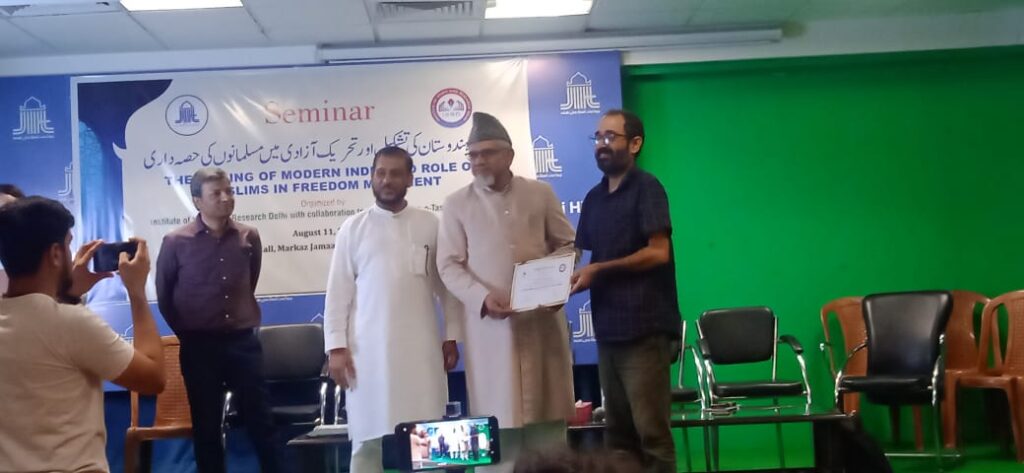
Prof. Salim Engineer presenting a memento to former JNU scholar Dr. Abhay Kumar.
“If you want to save India, you have to first understand the history of the country and then tell it to the common people in popular language,” Kumar asserted. He criticized the common approach of memorizing history in chronological order without understanding the ‘why’ and ‘how’ behind historical events. He emphasized the importance of understanding the ‘why’ and ‘how’ behind historical events, rather than merely memorizing dates and facts.
Kumar traced the roots of historical distortion back to the colonial period, criticizing early European writers for their biased portrayals of Indian history. He pointed out that many colonial historians, such as James Mill, wrote about India without ever visiting the country.
“To understand the distortion of history, we have to trace it back to the colonial period,” Kumar explained. “When the British came to India, they started writing history as a systematic institution, even colonial historians who wrote Indian history often never visited India.”
Kumar also addressed the visible bias and prejudice against Muslims in the writings of European scholars like Max Muller. He argued that these prejudices were partly because Muslim rulers were in power when the British arrived in India, and Muslims were among the first to resist foreign rule.
He also addressed the need for genuine history writing, urging efforts to preserve public-level history rather than relying solely on government or agency accounts.
JIH Delhi state secretary and organizer of the seminar Asif Iqbal provided an overview of the event’s objectives. He explained that the seminar aimed to highlight the contributions of Muslims in the freedom struggle and the reconstruction of the country, facts that a vast majority of the country is not well aware of or has overlooked.
Asif Iqbal announced that this seminar is a precursor to an upcoming grand history conference to be held in February next year in Delhi. He also revealed plans for about 10 similar history conferences to be held across different major cities in India, covering various themes including architecture, art and culture, spirituality, social reforms, textiles and craftsmanship, environmental contributions, cultural syncretic festivals, struggle heritage, mass movements, and Muslim personalities and their contributions.
source: http://www.indiatomorrow.net / India Tomorrow/ Home> National Interest / by Anwarulhaq Baig / August 14th, 2024
Khan is a professional bodybuilder from Hyderabad and has earned many national and international titles including a silver medal in Mr World Body Building Championship, in the heavyweight category.
Internationally acclaimed Bodybuilder Mir Mohtesham
Hyderabad:
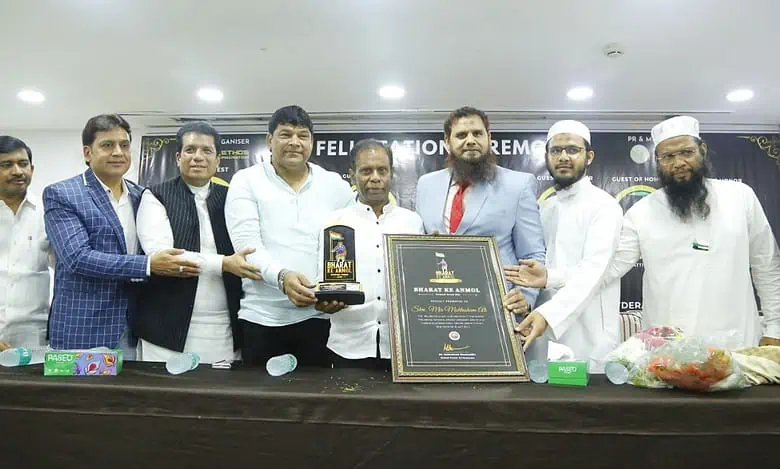
A celebration was held in Hyderabad’s Media Plus Auditorium to celebrate Mohtesham Ali Khan, who received the prestigious national award ‘Bharat Ke Anmol’ for his journey of determination, perseverance, and excellence in the realm of bodybuilding and fitness.
Khan is a professional bodybuilder from Hyderabad and has earned many national and international titles including a silver medal in Mr World Body Building Championship, in the heavyweight category.
The event which was held on Sunday, August 14, witnessed the presence of dignitaries and supporters who gathered to honour Khan’s accomplishments.
The chief guest Abdul Khayyum Khan, minority affairs advisor for the government lauded Khan’s unwavering commitment to his craft.
Other prominent figures including AIMIM leader Ather Farooqui, BRS leader Khaleequr Rahman, Pathergatti Corporator, Syed Sohail Quadri and chairman of Vandhe Bharat, Ramesh Eppalapalli were also present at the event.
The felicitation ceremony was organised by the founder and CEO of Ethos Imagination, Varaprasad who emphasised that the evening was not merely a tribute to Mir Mohtesham Ali Khan’s individual accomplishments but also a testament to the power of dedication and hard work.
At the event, Khan expressed his heartfelt gratitude to everyone who contributed to his journey and stood by him both during challenges and triumphs.
source: http://www.siasat.com / The Siasat Daily / Home> News> Hyderabad / by Sayma Ahmed / August 13th, 2023
On February 16, 2024, 36-year-old Sajida, a mother of six, received the most devastating news of her life. Her husband, Mohammad Junaid, the sole breadwinner of the family, along with his cousin, Nasir, had tragically passed away. They were brutally killed in a premeditated attack by cow vigilante goons. She was horrified to learn that her husband had been taken from them in such a cruel manner. She struggled with disbelief and fury, trying to grasp that the father of her children was gone.
The accused had meticulously planned the murders, discussing Junaid and Nasir extensively in the weeks leading up to the incident, ultimately agreeing on their killings.
“It was devastating news for all of us. I can never forget that day. At first, I could not believe it. Junaid was the most humble person in our locality. He always helped everyone and was so full of life. Everyone liked him, and I was so proud of him. He never fought with anyone. How could someone take his life? How can their conscience allow it? Don’t they fear the wrath of God?” she asked in disbelief, surrounded by her small children.
Over the past decade, incidents of lynchings targeting Muslims in India have seen a significant increase, accompanied by a normalization of hate speeches. In 2023, the country witnessed 668 hate speeches directed at Muslims, according to the India Hate Lab, a Washington DC-based group. Their report titled ‘Hate Speech Events in India’ revealed a rise from 255 events in the first half of the year to 413 in the latter half, marking a 62% increase.
Approximately 75% of these incidents occurred in states and Union Territories governed by the Bharatiya Janata Party (BJP), including Delhi. Among them, 36% involved direct calls for violence against Muslims, 63% referenced conspiracy theories like love jihad and population jihad, and 25% called for targeting Muslim places of worship.
Amnesty International’s report titled ‘Bulldozer Injustice in India and JCB’s Role and Responsibility in Bulldozer Injustice in India’ documented the demolition of at least 128 properties between April and June 2022. These demolitions have left at least 617 people homeless or deprived of their livelihoods.
The report underscores that, authorities in Assam, Gujarat, Madhya Pradesh, Uttar Pradesh and Delhi utilized demolitions as a form of punitive action following instances of religious violence or Muslim protests against discriminatory government policies. The BJP, led by Prime Minister Narendra Modi and accused of anti-Muslim rhetoric, governs four of these states.
Amidst the demolitions and suppressions, most of the NGOs working for public welfare are hesitant to assist Muslims due to fear of repercussions and opposition from the government.
Junaid’s wife Sajida (in blue). Photo: The Quint
Recognizing the disparities in NGO assistance towards Muslims and their hesitance to aid those oppressed by the state, Aasif Mujtaba, a 35-year-old IIT alumnus, took initiative and established his own organization, Miles2Smile. His goal is to rehabilitate and support Muslims affected by violence.
“Following the communal in northeast Delhi in 2020, my colleagues and I felt compelled to aid the survivors. Initially, our focus was on providing essentials like clothing, medical care and food. In Babu Nagar, we established our first command centre, which evolved into a relief hub. It was our first experience supporting victimized survivors, and despite lacking a formal name initially, our determination to assist remained unwavering,” Aasif told TwoCircles.net.
On February 23, 2020, violence erupted in Delhi’s trans-Yamuna region, spanning several days and resulting in the deaths of 53 people, predominantly Muslims, with 250 others injured. Despite government and media characterizations of the incident as a “riot”, a fact-finding committee from the Delhi Minorities Commission concluded it was a “pogrom”. This independent body, dedicated to safeguarding minority rights, based its assessment on victim testimonies and legal sources, affirming that the events of February 2020 constituted a pogrom.
Aasif recalled that while Miles2Smile was officially established in June 2020, its origins can be traced back to providing relief to survivors of the violence in northeast Delhi earlier that year. Since then, the organization has remained steadfast in its mission.
During the COVID lockdown, Aasif and his team began compiling a list of students affected by the violence, many of whom had dropped out of school due to lost income or the absence of a breadwinner. This list grew to include over 200 students. His organisation took on the task of reintegrating these children into schools and subsequently, in September 2020, launched its sister organization, Shaagird, which means “student”.
However, admitting the students was relatively straightforward compared to the challenge of keeping them enrolled and motivated. Many had witnessed the violence firsthand, and some had tragically lost family members in front of them at a young age. Therefore, the approach to enrolling and sustaining their engagement in formal education had to be tailored and sensitive to their unique circumstances.
Haris with violence affected kids is below
Mohammad Haris, chief operations officer at Shaagird, who works closely with students affected by violence, expressed, “These children are deeply traumatized. Many have lost their enthusiasm for education, especially those approaching adolescence who feel compelled to contribute to their families financially. Keeping them engaged in formal education is an immense challenge.”
A study published in the journal Review of Behavioral Economics titled ‘Child Abuse, Sexual Assault, Community Violence and High School Graduation’ found that girls who had experienced childhood violence were 24% more likely to drop out, while boys who had experienced violence were 26% more likely to drop out compared to their peers.
Recognizing the impact of trauma on students’ educational motivation, Shaagird developed a curriculum specifically designed to provide emotional support and solace. Initially, students focus on co-curricular activities such as sports and painting rather than academic subjects. As they gradually become more engaged with the school environment, core subjects are reintroduced, all while closely monitoring their mental health needs.
“It’s incredibly challenging to keep children affected by violence in school. Due to their trauma, we don’t initially focus on academic subjects like math, science, or English, which can overwhelm them. Instead, we have developed a specialized curriculum that identifies each student’s unique talents and keeps them engaged through these interests. This approach helps them form a stronger connection to the school. Only once they are fully engaged and comfortable do we gradually introduce academic subjects,” explained Haris.
An illustrative case at Shaagird is Anas (name changed), who tragically lost his father in the pogrom and has a deep passion for drawing and art. The Shaagird team actively encourages Anas to explore and express his creativity through drawing, with Haris expressing confidence in Anas’s promising future in painting.
According to Aasif, beyond immediate rehabilitation efforts for families affected by communal violence, ensuring their long-term welfare is crucial. Families endure immense suffering after such violence, losing sources of income, breadwinners and leaving children traumatized. Therefore, empowering them to become self-reliant is essential, as they are often overlooked by relief organizations or volunteers over time. This goal is achieved through educating the children of affected families and involving them in small businesses that provide sustainable livelihoods.
“What families endure during the pogrom is only a fraction of their challenges afterward. It’s imperative to support these families in becoming self-reliant. At Miles2Smile, we consistently engage families affected by pogroms and other forms of state oppression in small businesses, such as setting up kirana shops, to help them earn a livelihood,” explained Aasif.
(Anas name changed)
In addition to assisting over 10,000 individuals affected by violence last year through rehabilitation and relief efforts, and enrolling hundreds of violence-affected students for free education, Miles2Smile also responded to the 2023 Turkey earthquake by sending 2,365 metric tonnes of emergency relief. This included tents, thermal mattresses, blankets, clothing, sanitary napkins, baby diapers, baby food, overcoats, snow boots, chairs, sleeping bags, towels, and inflatable pillows.
Inspiring Rehabilitation Stories
Among the many rehabilitations, some stories stand out where families affected by lynchings or pogroms displayed exceptional courage and began new lives with determination. One such story is that of Sajida, the wife of Junaid. Despite being illiterate and a young mother of six, she showed remarkable bravery by starting a small cosmetics shop set up by Miles2Smile in one of the rooms of her home. Although initially in disbelief over Junaid’s death, she quickly accepted her fate and forged ahead courageously.
“Sajida is one of the bravest women I’ve encountered in this journey. Young widows often struggle to accept their circumstances, but Sajida embraced hers and began anew with courage. We often wondered how a young woman with six children would manage, but her resilience is beyond words. Women like Sajida continue to inspire and motivate us,” remarked Aasif.
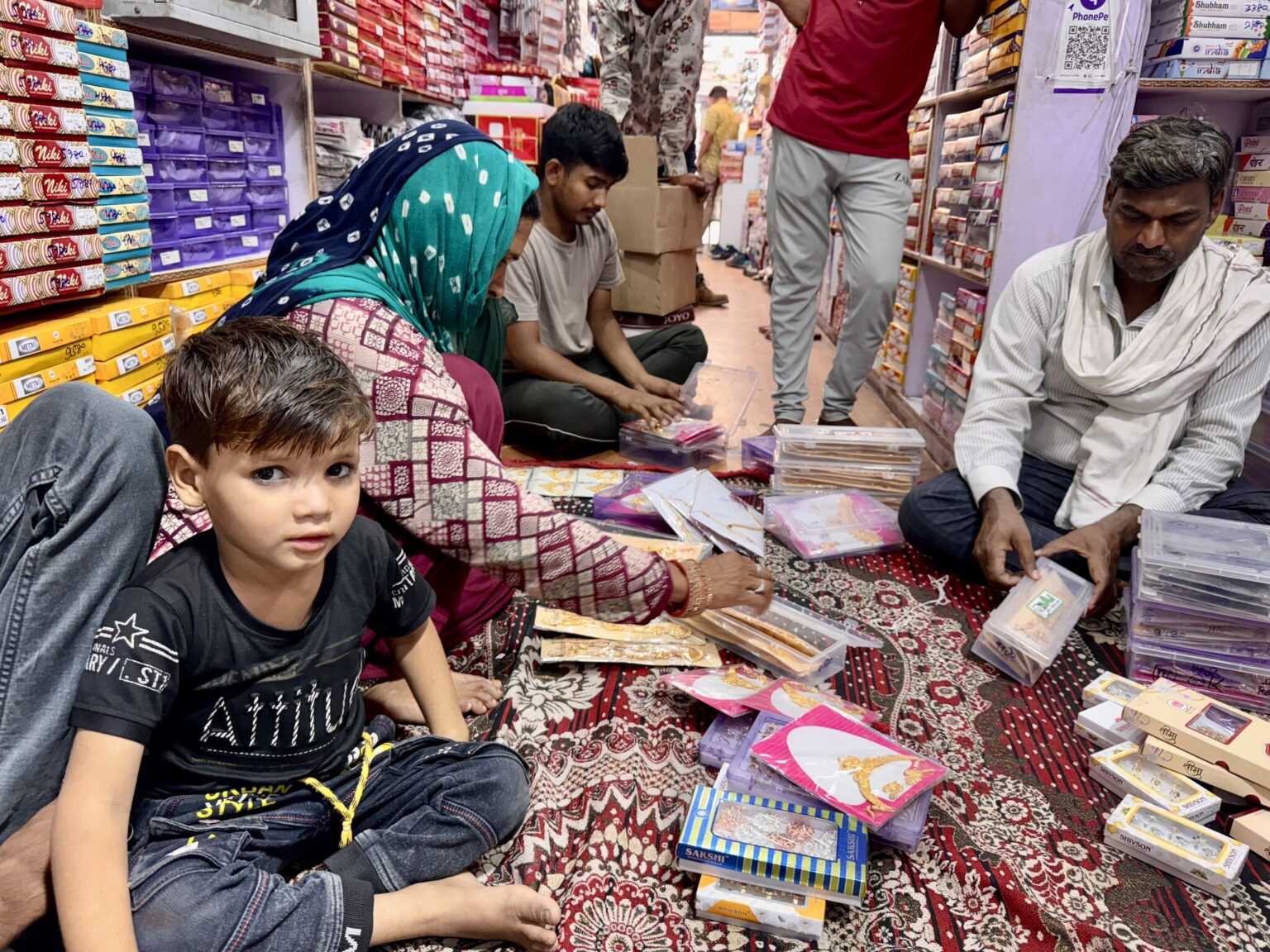
Sajida, along with her brother and son, at Sadar Bazar, Delhi shopping cosmetics and other women’s items for her shop. Photo: Miles2Smile
“I faced two choices: either break down or muster the courage to start anew for my children, and I chose the latter. I knew that if I lost hope, my children would suffer greatly. I had to do it for them. Aasif Bhai provided me with immense emotional and financial support. His team set up the entire shop and supplied the items. Now, the shop is running well, thanks to Allah first and then Aasif Bhai, who did so much for me,” shared Sajida.
Another poignant and inspiring story is that of Rukhsana, the wife of Feroz Ahmed, who owned a dupatta house and tragically lost his life during the Northeast Delhi pogrom. His body was later discovered in a nearby drain. Rukhsana was two months pregnant at the time of Feroz’s death.
Throughout her pregnancy, Miles2Smile covered all her medical expenses and provided support by accompanying her to regular checkups. Meanwhile, the organization enrolled her children in school at no cost, taking care of their educational expenses. After giving birth to a baby girl, whom she named Feroza after her father, Rukhsana successfully revived and managed the shop. Within a year or two, she began employing more young women, and now nearly ten girls work under her at her dupatta house.
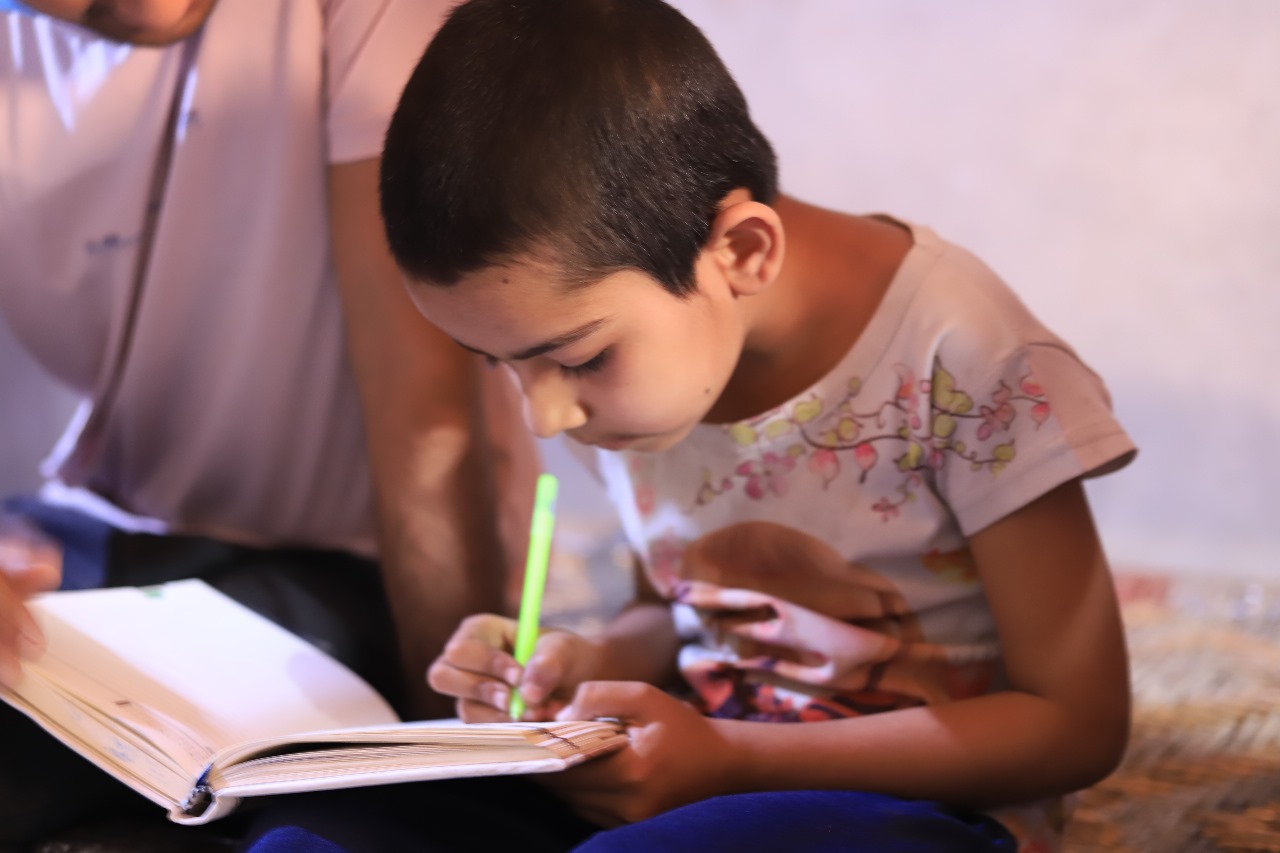
Rukhsana’s daughter at Miles2Smiles owned Sunrise Public school. Photo: Miles2smile
“I was moved to tears when Rukhsana brought me small polythene bags filled with cash. She explained that since Miles2Smile had supported her children for years by covering their school fees, this was her way of expressing gratitude. It brought me immense joy. These are the stories that inspire and drive us to persist in our mission,” said Aasif.
source: http://www.twocircles.net / Two Circles.net / Home> India News> Lead Story / by Mohammad Aatif Ammad Kanth, TwoCircles.net / July 14th, 2024