Category Archives: Arts, Culture & Entertainment

Remembering what was

Chennai, KARNATAKA / Bengaluru, KARNATAKA :

ShabbeerAhmedMPOs05oct2018

RJ and entrepreneur Shabbeer Ahmed turns back the pages to simpler times in a smaller city

I first moved Bengaluru in the year 1995. Back then, all the roads were lined with trees, which looked wonderful when they bloomed, and the traffic situation was not so bad. My favourite road in fact was Bannerghatta road, which in those days was considered the fringe of the city, where people came for a relaxing drive. I actually used to stay near the Meenakshi temple in Hulimavu, areas which were barren a few years back. There used to be a water theme park near Bannerghatta which is no more, and now the area is just like any other part of the city. We spent many days on motorcycle rides in this area, stopping to buy egg puffs from the lovely bakeries that dotted the route.

There are fewer migratory birds these days as well. Until a while back the areas surrounding Madiwala Lake had a lot of birds come around, which has lessened and now you see birds on terraces instead. We even saw water snakes on the banks of the lake, and we’d give them names, like Ka from Rudyard Kipling’s The Jungle Book.

Personally, since I’m a massive food lover, I like to go to Fanoos to grab a roll and then head to Makkah cafe in Johnson Market, where I can sit with a suleimani tea and chat with people. Being a nature lover, I also enjoy trips to Bannerghatta National Park when I can. And there’s nothing like a trip to South Bengaluru for some authentic idli, vada, and dosa.

It is true that Bengaluru has become very commercial and industrial, but that has also led to it gaining in infrastructure and opportunity. There are so many options for youngsters here.

As told to Sooraj Rajmohan

source: http://www.thehindu.com / The Hindu / Home> Life & Style – Insider / by Sooraj Rajmohan / October 03rd, 2018

Mosques in Dravidian-Islamic style: About the Islamic architecture in Tamil Nadu

TAMIL NADU :

The 17th Century Kilakarai Jumma Mosque

The kallupallis are reminders of the region’s cultural and architectural traditions

Among the many inscriptions at the Vaishnavite shrine of Adhi Jagannatha Swamy at Thirupullani, about 10 km from Ramanathapuram in southern Tamil Nadu, there is one about a grant for a mosque. This particular inscription of the late 13th Century by the Pandya King Thirubuvana Chakravarthy Koneri Mei Kondan, describes the grant made to the Muslim Sonagar, to build a mosque at Pavithramanikka Pattinam. While no one today has a clue as to the exact location of Pavithramanikka Pattinam, the region has many ancient mosques like the rest of Tamil Nadu. What is unique about these mosques is that they were all built of stone, in the Dravidian architectural style with Islamic sensibilities.

Unlike north India, Islam came to the south through maritime spice trade even as it was spreading across Arabia in the 7th Century. The Muslims who were traders enriched the country with precious foreign exchange, and hence were accorded a special place by the Tamil rulers of the day, and often received grants to build mosques, like the one at the Adhi Jagannatha Swamy temple.

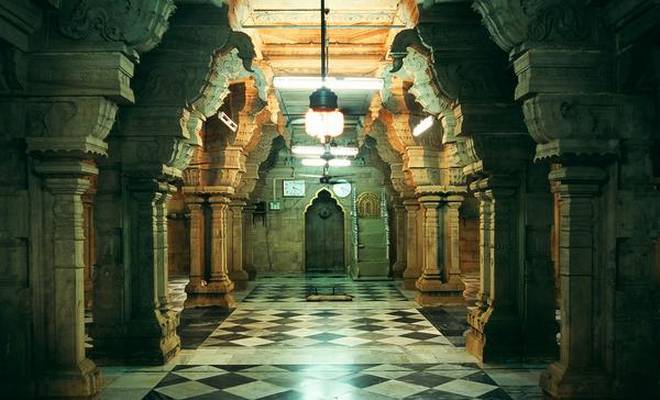
As mosques are called Palli Vaasal in Tamil, and they were built of kal, the Tamil word for stone, they came to be locally known as kallupallis. These kallupalliswere essentially built more like mandapams, better suited to Islamic requirement for the congregation to assemble and stand together in prayer.

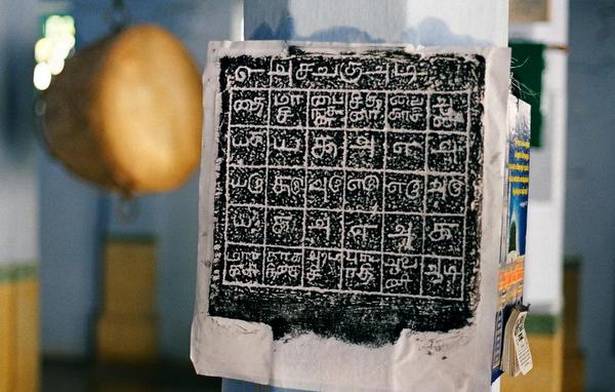
Engraving of Tamil calendar for prayer found inside the mosque

With guidelines for the construction of mosques being simple – such as prayer facing Mecca, no idol worship and clean surroundings, the masons who worked on these mosques under the supervision of religious heads restricted themselves to carving floral and geometrical motifs instead of human figures as in a temple. “While the raised ‘Adisthana’ of the Hindu temple was retained, there were no ‘Garbha Grahas’ and no figurines carved on any of the pillars” says Dr.Raja Mohammad, author of Islamic Architecture in Tamil Nadu.

For more than a millennium, hundreds of such mosques built in the Dravidian Islamic architectural style came up across Tamil Nadu, often with the help of grants from the rulers of the day, ranging from the Cheras, the Pandyas, the Venad kings and the Nayaks to the Sethupathis of Ramanathapuram. Across Tamil Nadu, wherever Tamil Muslims lived in large numbers, from Pulicat near Chennai to Kilakarai, Kayalpatnam, Kadayanallur, Kottar, Tiruvithancode, Madurai, etc., one finds these beautiful kallupallis.

Amongst these kallupallis, though not the oldest, the most beautiful mosque is to be found at Kilakarai, near Ramanathapuram. A medieval port town with a predominant Tamil Muslim population, Kilakarai has many mosques built during different eras spanning many centuries. The one built towards the end of 17th Century is the most beautiful of them all. It is believed to have been built by the great merchant and philanthropist Periathambi Marakkayar, also known as Seethakkathi, whom the Dutch records speak of as a great trader having considerable influence with the Sethupathis, the then rulers of Ramanathapuram.

The mosque built in the Dravidian architectural style of the late Vijayanagara period, has elements that are specific to native traditions. Like many other kallupallis, this mosque too has Podhigai, the floral bud detailing on the pillar corbels, which represent positivity and auspiciousness, an essential part of the cultural beliefs of the land. An interesting engraving found in this mosque is the Tamil calendar for prayer.

What is unusual about this calendar is that, timings for prayers in the various Tamil months are marked in Tamil numerals, a rarity, found in just a few other mosques in southern Tamil Nadu.

These mosques, deeply embedded in the Tamil culture, were also places where Tamil flowered. Further down south, at the Kottar mosque in Nagercoil, an early Tamil Islamic literary work, Mikuraasu Malai, was presented to the assembled congregation by Aali Pulavar in the late 16th Century.

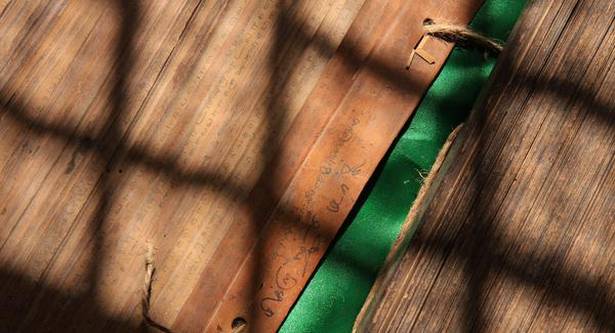
Mikuraasu Malai, a palm leaf work

Mikuraasu is a Tamilised form of Mihraj, and narrates a significant event in the life of Prophet Muhammad (Pbuh), his ascension to the heaven. Even after 400 odd years, the tradition of singing Mikurasu Malai on the eve of Mihraj continues to this day at the Kottar mosque. Other literary works such as Seera Puranam, a Tamil epic on the history of the Prophet, are also recited across mosques in Tamil Nadu.

The Kallupallis in Tamil Nadu stand as proud reminders of not just an architectural tradition but also of cultural traditions, where Islam effortlessly adapted itself to the native customs.

source: http://www.thehindu.com / The Hindu / Home> Society> History & Culture – Anwar’s Trail / by Kombai S. Anwar / November 23rd, 2017

The walls have years

Kutch, GUJARAT :

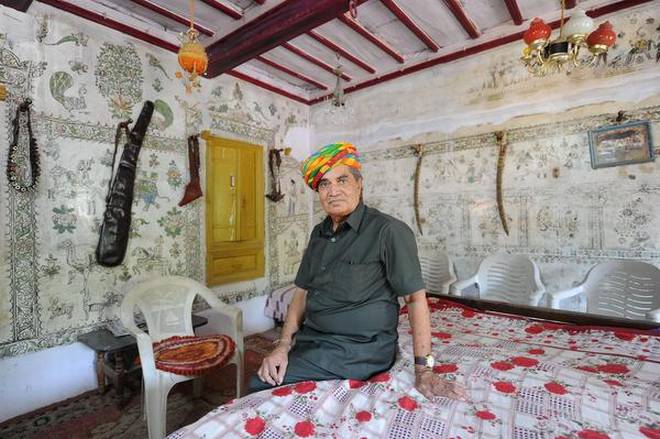
Kalubhai Vaghela in his ancestral house in Mundra. Photo: Vijay Soneji

In 18th century Kutch, walls were painted with stories. They survive today in only three places

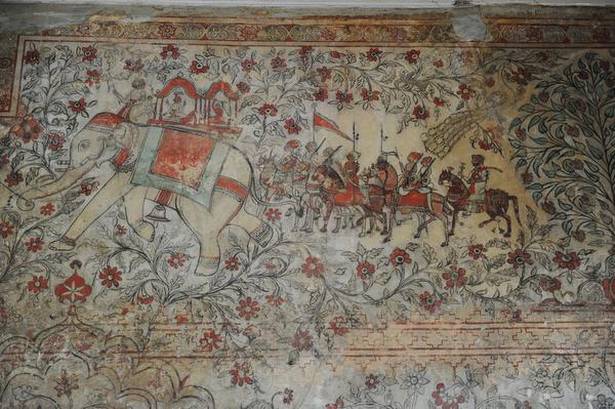
On the fissured walls of the magnificent Tera fort in Gujarat’s Kutch district the story of the Ramayana springs to life in vivid colour: there is Sita on a pyre, Ram raining arrows on Ravana.

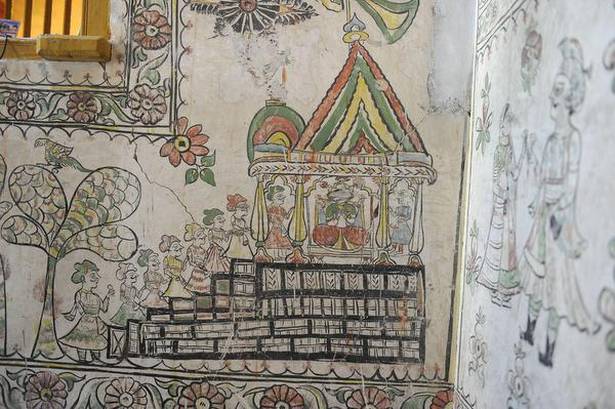
Kamangari bhint chitro or wall paintings was once a thriving art form in Kutch, used to embellish the palaces and homes of the affluent. The themes were as diverse as the patron’s tastes, but were predominantly mythological, with scenes from the Ramayana or Krishna Leela. Royal processions was another favourite. The landscape was another rich source of material, and date palms and peacocks and scenes from everyday life were common.

Kamanagiri01MPOs04oct2018

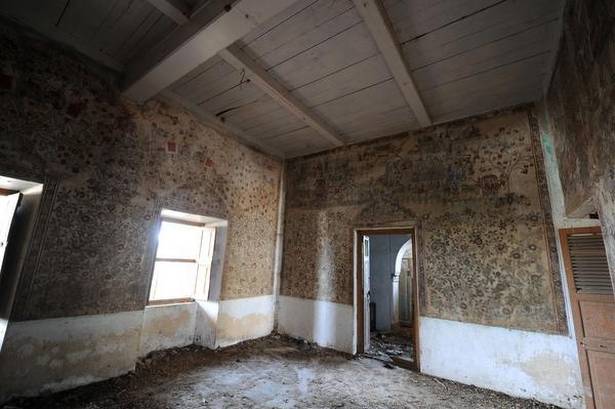
Today, only bits and pieces of this rich art are preserved in a few homes, temples, and on Tera fort. But if you were to string these together chronologically, history would come alive in a lyrical manner.

Back to its origin

Kamangari art originated in the 18th century. “It was a relatively peaceful time; there were no battles, and it was a conducive environment for travel and trade,” says Pradip Zaveri, a Vadodara-based businessman, known for documenting Kamangari. During this time, the Kamangars, a Muslim community from northern Kutch who traditionally made bows and arrows (kaman means bow) and painted shields, travelled to the rest of the region.

Soon the affluent Bhatia and Jain communities commissioned the Kamangars to paint their homes, giving birth to the art form. Such artistic embellishment on walls was traditionally seen as auspicious in Kutch.

A folk art

One of the finest examples of Kamangari art is in Aina Mahal, an 18th century palace in Bhuj. Here, the corridor is painted with a 47 feet scroll titled Nagpanchami Ashwari, by Kamangar artist Juma Ebrahim. The scroll begins with a royal procession with a mounted Arab cavalier, Arab soldiers, a cannon drawn by a pair of bullocks, a chariot of the family deity, and a group of camel riders. In the middle of the scroll is Maharao Shri Pragmalji II on a caparisoned elephant. The ethnicity of every individual is represented by their costume.

The paintbrushes were made from the bark of the local date palm, and the colours sourced from tree bark, flowers and stones. The artists would paint on wet plaster to ensure permanence.

For all its beauty, says Zaveri, Kamangari does not appear to have a consistent style. “If you look at two paintings, you will see the difference in the treatment and rendering. For example, the lines on wall paintings are thicker than those in the scrolls. In some places, flowers are used to fill gaps — like in a temple in Anjar — but in other places this is missing.”

Kamangari artwork at MacMurdo’s bungalow in Anjar. Photo: Vijay Soneji

Artists essentially followed their patron’s instructions. As the rich traders who commissioned this art travelled abroad, the art saw changes too. “The artists were given postcards from these places, and they would then draw characters inspired from the West but wearing a Kutchi pagdi, or the women would have long skirts,” Zaveri says.

In a Jain temple in the Abdasa taluka of Kutch, a man is shown wearing a hat but in a dhoti and long coat. Some later paintings depict British soldiers in uniform. Others have aeroplanes, rail engines, and even a game of cricket.

MacMurdo’s bungalow in Anjar. Photo: Vijay Soneji

At the bungalow of James MacMurdo in Anjar, the first political resident of the East Indian Company in Kutch, you can see Krishna and the Gopis dressed in the traditional attire of the Rabari community, complete with the nath (nose-ring). Much of the work also showed influences of the Mughal and Rajasthani styles.

The decline

According to Zaveri, Kamangari was popular until the early 20th century. Then, around the time of the Great Depression, its patrons began to migrate out of Kutch, and homes were locked up or abandoned. The murals degenerated and new occupants painted over them. The Kamangari artists turned to other livelihoods.

“The 2001 Kutch earthquake dealt another severe blow; many houses that had the last few paintings came down,” says Zaveri. Now there are only three places in Kutch with well-preserved Kamangari — the fort in Tera, MacMurdo’s bungalow in Anjar, and an ancestral home in Mundra, belonging to Kalubhai Vaghela.

There have been some feeble attempts by the government to revive the art, but more promising is a new project. Dalpat Danidharia, a librarian at Bhuj’s Prag Mahal, a 19th century palace, says: “Some of us who are passionate about saving Kamangari from disappearing from public memory are working on commissioning artists to create replicas.” The aim, he says, is to let everyone experience this vibrant Kutchi heritage before it’s lost forever.

When not researching new stories, the Gujarat-based freelance journalist likes spinning tales for her toddler.

source: http://www.thehindu.com / The Hindu / Home> Society> History & Culture / by Azera Parveen Rahman / September 29th, 2018

Revisiting Sheikh Salim Chisti’s tomb

Fatehpur Sikri (Agra District), UTTAR PRADESH :

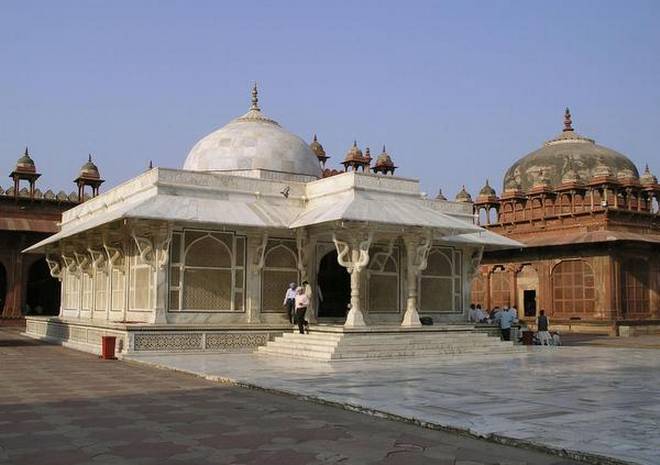
Soothing experience: Sheikh Salim Chisti’s tomb in Fatehpur Sikri | Photo Credit: V_V_Krishnan

Reminiscing a slow but stimulating journey to Akbar’s capital city

When Marion and Sally, two English teachers of St Thomas’ School, Mandir Marg, set out on a trip to Fatehpur Sikri in 1978, they boarded the last train from Delhi. “It sounds ominous, like the last plane from Da Nang, when South Vietnam was overrun by the Viet Minh,” remarked Sally, “Yes,” recalled Marion. “Many struggled to board the plane. Some were left behind but in the melee an enterprising Western reporter was not only able to capture the heart-wrenching scene, but also played the hero by helping a hysterical woman and her kid take his seat on the plane as he jumped down to shoot what later turned out to be award-winning pictures of the airport scramble.”

The last train from Old Delhi station did not cause any such frenzied commotion. Over 40 years ago it was the one that was supposed to leave just before midnight, but the departure was invariably delayed. From Delhi Main station it ran up to Agra Cantt, its destination, and took seven hours to do so, usually even more. The passenger train had a whole lot of policemen travelling in it. As a matter of fact, right from the ticket window they made their presence felt when they pulled suspicious-looking youths out of the queue and slapped and punched them before asking questions like, “Where are you going? Where did you get the money to buy the ticket? Are you drunk? Who else is travelling along with you? Where do you live?” before searching them with their shirts off and pants down,” the two teachers recalled.

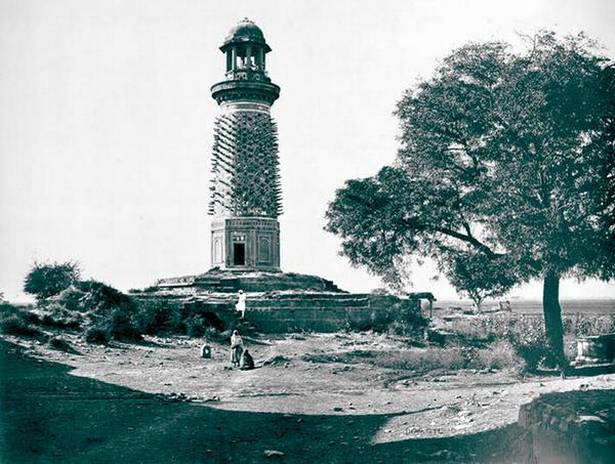
A view of Hiran Minar

When they caught the train they didn’t see those young men again. The train made three false starts, provoking someone to remark that the driver was shaking the compartments to fit in more passengers. Finally it started rolling, with several urchins rushing to catch it. By the time the train reached New Delhi station it was nearly 1 a.m. After that the Passenger stopped at every station big or small and as people got down, many were detained and searched by policemen on the platform. But the two girls reached Agra Cantt station safely. From there they were escorted by friends Sam, Lewis and this scribe by car to Sikri.

The shrine at Fatehpur Sikri is one of the most venerated places. Where wild animals once roamed a gem of a monument now greets the eye,” disclosed Sam. “It was here on a hill that Sheikh Salim Chisti dwelt and thither came Akbar the Great to seek his help for the birth of a son and heir apparent. He came on foot, leaving his camels, elephants and horses behind. The hermit sat with a rosary (tasbi) reciting the 99 names of Allah. The emperor’s prayers were heard and his Rajput queen bore a son, Salim, whom Akbar always called Sheikhu Baba, after the saint. Not only that, he built this magnificent city to commemorate the event and dwelt here with his Nine Jewels, like the Nine Worthies of the ancient world. “I have heard about the Nine Jewels,” said Marion, “but who were the Nine Worthies?” “Hector, Alexander the Great, Julius Caesar, Joshua, David, Judas Maccabaeus, King Arthur, Charlemagne and Godfrey of Bouillon,” replied Sam without batting an eyelid.

Akbar’s legacy

Sam related his tale standing by Sally’s side. She listened, her doe eyes thoughtful. As they approached the trellis of the shrine where people who seek favours tie a thread, she tied one too, making Sam wonder what she had sought. They next went to the Buland Darwaza and saw the town of Sikri spread out before them. Nearby is the water works set up by Akbar and from above the ramparts a man dived 80 feet into the baoli or step-well. They looked aghast. “Just you wait and see,” said Sam as Lewis nodded in approval. Soon a dare-devil emerged and salaam-ed them. They tipped him and he walked away to prepare for another demonstration. “These divers have been continuing the tradition for several centuries. VIPs and common people alike tip them. Perhaps, it will continue so long as there is water in the baoli. But it is a paradox that Akbar, who built a new capital here, had to desert it because of water scarcity.” Sam informed the party. They went down the steps of Buland Darwaza, Sam pointing out the Hiran Minar from where the shikar was shot in Mughal times, though some think that Akbar’s famous elephant was buried there and perhaps that’s why it is also called Elephant Tower.

At Sikri town they had the fabulous 24-layer Mughalia parantha. “Why is this parantha so thick?” enquired Marion. “It could feed one whole family.” “Quite right,” said Sam. “Ask Sally, when we were last here she had to take half the parantha to Delhi where we had it for breakfast the next day and the remainder for lunch.”

“Did Akbar really play with women as chess pieces? “enquired Sally.” Off course he did,” replied Sam. “Don’t talk rubbish. Listening to you one would imagine the great Akbar had nothing else to do but seduce maids of honour”, admonished Lewis. From there the party went to the Taj Mahal and then caught the Taj Express back to Delhi after a memorable day. Marion and Sally are now back in England and Sam works in Bangalore, where Lewis keeps reminding him of the visit whenever he rings up from Kolkata.

source: http://www.thehindu.com / The Hindu / Home> Society> History & Culture – Down Memory Lane / by R.V. Smith / October 01st, 2018

Muslims in Kolkata find a place to call home

Kolkata, WEST BENGAL :

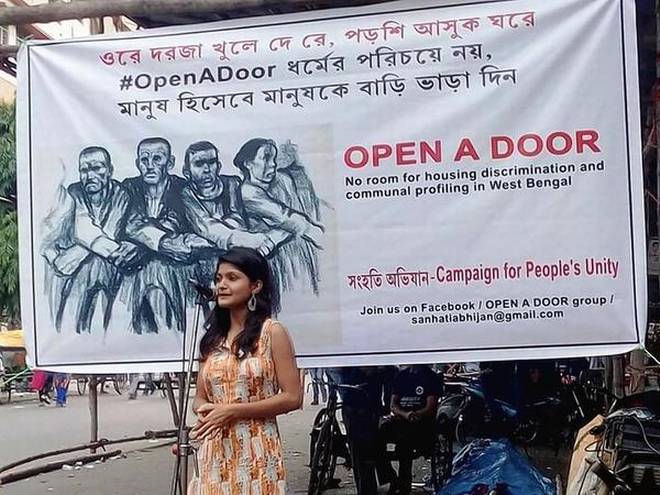
Tanvi Sultana speaks at a gathering organised by Sanghati Abhijan at Jadavpur. Photo: Special Arrangement

Two voluntary groups enable Hindus and Muslims to interact and look beyond communal misconceptions.

After being turned away by several landlords for months, Aftab Alam and his three friends, all of them doctors, finally found a place to rent in south KolkataTheir elation, however, was short-lived. Soon after moving in, a neighbour told their landlord that they ought to be evicted, arguing, “Four Muslim men staying in a predominantly Hindu neighbourhood is problematic.”

Dr. Alam recalls, “It was disheartening. I rented the flat to the rest after strenuous night shifts. Suddenly, the peace was disrupted…[we had] huge expectations from Kolkata.”

His predicament was unexpectedly addressed. When he spoke of it on social media, Dr. Alam was contacted by Sanghati Abhijan (SA), a voluntary group that recently initiated its ‘Open-a-Door’ campaign to stop discrimination against potential Muslim tenants. SA’s volunteers resolved the situation by engaging peacefully with the neighbours, the landlord and the tenants themselves.

“We thank them for their support at a critical time,” says Dr. Alam. The intervention helped him and his friends stay on instead of relocating, as they had first planned.

‘Communal remarks’

In another instance, Tanvi Sultana, an undergraduate student, was allegedly targeted with “communal remarks” while looking for a flat in south Kolkata, at times being instructed not to bring beef to her residence. As with Dr. Alam and his friends, SA helped her live in the same apartment. “I thank them and wish for the initiative to grow,” Ms. Sultana says.

Since February, SA has helped about 30 such home-seekers in dire need via its social media group, ‘People’s Unity’. The platform provides a database of houses, apartments and guest houses, with information such on the location of the property, contact details of owners, and rent. The group’s meetings are eye-openers on the communal tensions between property owners and tenants.

“We only enlist property owners who are keen on letting out accommodation without discriminating against a particular faith or on the basis of marital status,” said Dwaipayan Banerjee, one of SA’s co-founders. However, Mr. Banerjee admits that while “hundreds” of tenants approach them, the property owners are “far fewer” in numbers.

SA’s members say they want to “break the culture of silence” which, in turn, could “curb rising Islamophobia.” Anindya Ray Ahmed, a student, was told openly by brokers, “Muslims are dirty and potential terrorists.”

He was ‘rejected’ by 16 landlords before he could find a place to live, but after accepting a deposit, the landlady telephoned him to say, “My husband has a problem with Muslims, so you cannot stay.” Mr. Ahmed alleges that she lowered his deposit down in a bag from her floor above, declining to “stand near a Muslim.”

SA’s members favour direct mediation, but their Facebook page has witnessed about 150 such disagreements and their resolution through virtual owner-tenant interaction on the social media platform.

In another incident, SA informed the Jadavpur University Teachers’ Association and authorities when two students faced misbehaviour from the superintendent and boarders at their hostel “for being Muslim.” An enquiry committee is looking into this case.

SA member Deborshi Chakraborty calls this “exponential ghettoisation” because, often, Muslim tenants seek proximity to their religious peers so that they will not be judged.

Alongside, SA has been prey to moral policing and expressions of paranoia by potential lessors.

The campaign has apparently irked Tripura’s former Governor Tathagata Roy, now Governor of Meghalaya. On August 11, he re-posted a newspaper article on SA and remarked on social media that the paper was trying to “teach Hindu house-owners of Kolkata that they must rent out their premises to Muslims. Otherwise, they are not sufficiently ‘secular’.”

Along similar lines, the Know Your Neighbour (KYN) campaign aimed at reducing communal tensions between Hindus and Muslims is gaining momentum in Kolkata and several districts, too. On a shoestring budget, KYN has organised meetings, sponsored heritage walks, staged plays, and focussed on food to find common ground.

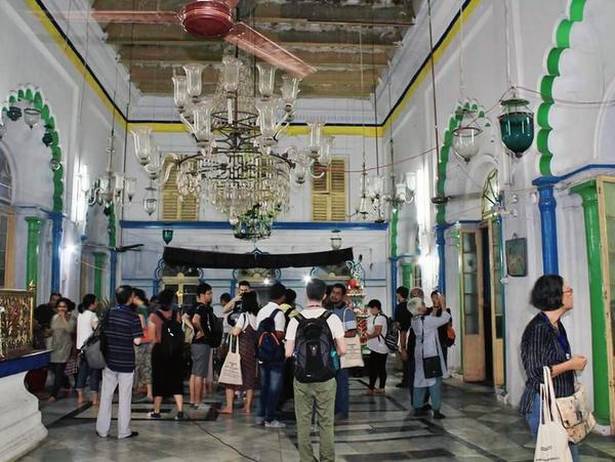
Participants of the Know Your Neighbour campaign visit to Metiabruz in Kolkata. Photo: Anirban Kar | Photo Credit: Anirban Kar

Food walks

“We arrange food walks as the city has a massive culinary culture developed over centuries,” said Sabir Ahamed, a KYN organiser. “Cultural ignorance brews fear. Financial constraints coupled with little-known practices like the Dastarkhān, a traditional space for meals kept on a yellow cloth featuring Urdu couplets, became the basis for speculation over why Muslims ‘eat in bed’. Such ‘myths’ must be broken, which is why we translate the Muslim ‘jargon’ that often dictates daily routine,” says Mr. Ahamed. His intends to delve deeper into this in his forthcoming Masjidi Kolkata project.

KYN’s walks journey into quintessential ‘Muslim pockets’ of Kolkata — Metiabruz, Khidderpore and parts of central Kolkata around the mosques set up by Muslims from Kutch — are followed by interactions with locals.

“Although I am a resident of Kolkata, I had never been to Khidderpore. I took this opportunity to know more about Bengal’s Islamic culture, and to redeem myself of the guilt of assuming that it is a crime-prone area,” says Sanjukta Choudhury, who participated in a KYN walk.

Novelist, academic and foodie Samim Ahmed, an expert on both the Mahabharata and Nawab Wajid Ali Shah’s Bengal, says visits to areas like the Sibtainabad Imambara, a less ornate grave of the last King of Oudh, Wajid Ali Shah, “adds more excitement to the walk.”

Often, visitors discuss food traditions with locals and learn, for instance, about the German bread distributed in Kolkata during the Second World War, dry fruits, and recipes for delicious haleem and biryani.

Non-Muslims are invited to break bread with their Muslim counterparts in KYN’s ‘Dosti ki Iftari’ get-together.

Linguistic explorations, such as tracing the etymological roots of ‘azaan’ (the Islamic call for worship) ringing within the old architecture of the Nakhoda Masjid, are also encouraged.

“Hindus barely visit these pockets of Kolkata, whereas such paranoia is less intense in the rural areas. We aim to eradicate cultural misconceptions by spreading knowledge on prevalent Islamic practices,” Mr. Ahmed says, adding, “Such walks provide an opportunity for communities to know each other in an atmosphere of unmitigated fun.”

source: http://www.thehindu.com / The Hindu / Home> News> Cities> Kolkata / by Tannistha Sinha / Kolkata – August 25th, 2018

Second Lucknow ‘fixed’ in sepia

WEST BENGAL :

Liveried servants of the Nawab of Oudh wait with a palanquin in one of the rare photographs of Metiabruz, during Wajid Ali Shah’s time. The royal insignia is embroidered on the back of one of them. Copied from the original by Rashbehari Das

A portfolio of fast-fading photographs that provides possibly the only pictorial document of the second Lucknow that Wajid Ali Shah had created in Metiabruz, after he was exiled there, is urgently in need of preservation. The photographs are, moreover, some of the earliest examples of the art as practised the world over.

Amjad Ali Mirza of Garden Reach Road, in his 60s, who is a great-great-grandson of the ruler of Oudh, possesses the photographs. But he doesn’t know how to preserve these friable prints whose sepia has, in some cases, turned a ghostly shadow of its former self. Says Mirza: “I have no doubt about the authenticity of the photographs. The portfolio is ancestral property. It was handed down to me by my uncle, Yaqub Ali Mirza, who died in 1973.” Some of the photographs are captioned in Urdu. But the identity of the photographer shall always remain a mystery. Oscar Mallitte, a French commercial photographer, we know, had captured a view of the village at Garden Reach, circa 1864, but there is no evidence he did this assignment.

Abdul Halim Sharar (1860-1926) tells the story of Oudh in his book Lucknow: The Last Phase of an Oriental Culture. In it, he has also documented the last days of Wajid Ali Shah in Metiabruz, where he set up a city whose splendour surpassed Lucknow’s glory in the pre-Mutiny days. The palaces, pleasure gardens and zoo that the Nawab had created on the banks of the Hooghly come alive in these photographs, not much larger than postcards. It is as if chemicals and light had “fixed” the scenes that Sharar’s readers conjure up in their mind’s eye.

Soon after the Mutiny had fizzled out, the Nawab was released from confinement in Fort William and he returned to Metiabruz. There, while turning abstemious, he developed a passion for animals and for building beautiful houses. Before the Zoological Gardens was established in Alipore in 1876, the Nawab had already acquired a large menagerie that included rare birds, deer, horses and an open-air snake-pit that left visitors awestruck. But after Wajid Ali Shah’s death in 1887, Metiabruz became a hell-hole almost overnight.

The photographs prove that Sharar, when he described Metiabruz, never deviated from reality. Unlike the Lucknow architecture, with its embarrassment of stucco ornaments, the buildings of Metiabruz are constructed on the lines of European bungalows. The lines are simple but no less grand than the palaces of Lucknow.

Overlooking the river or surrounded by expanses of water, they are connected by bridges. Flags flutter on their tiled roofs. There is hardly any Islamic influence in their architecture, save a low-rise with triple minarets. Ostriches, deer, sheep and horses were the showpieces of the Metiabruz parkland. The snake-pit resembles a giant termite hill. One can almost hear the harsh calls of the clumsy pelicans and cranes strutting around the aviary. The liveried servants wait outside the palace gate with a palanquin. The piscine insignia of the royal family of Oudh is stitched on to the back of one man’s coat. There are two significant photographs. In one, the gang of smiling labourers carry construction material on their heads as they create the new Metiabruz. Another shows the buildings of Metiabruz being demolished. An exquisite way of life being wiped away forever.

source: http://www.telegraphindia.com / The Telegraph / Home> West Bengal / by Soumitra Das in Mirza / July 14th, 2003

A Place for Us a ‘quintessentially American’ tale? Fatima Farheen Mirza answers

Hyderabad, INDIA / California, U.S.A :

Writing about an immigrant Muslim family in America, A Place for Us author Fatima Farheen Mirza says she wanted to place their lives and concerns at the centre of the narrative.

Visiting India for the first time five years ago, author Fatima Farheen Mirza visited the masjid (mosque) where her parents had her nikkah (wedding), in the city of Hyderabad. Fatima was then the same age that her mother was the same number of years ago.

“A man was sitting outside in the courtyard, threading flowers that would decorate one of the shrines. I asked if I could have one flower, because I wanted a souvenir of the place, and he denied me. I remember telling him, ‘But my mother got married here’. And he looked at me, asked me to wait for a minute, and then threaded an elaborate string of flowers that I could tie to wear in my hair. I’ll never forget it.”

This is how Fatima describes that moment. It is almost as if this passage has filtered out of the consciousness of one of the characters of her famous debut, A Place for Us. As a family gathers for the nikkah of their eldest child, the obedient, precocious doctor Hadia, their youngest, the delinquent, the errant Amar, cannot be found for the family photograph. This is a family, but the discord is unbelievable, and the silhouette of the elephant in the room grows darker and darker.

“I wanted to do my best [for] this family. I wanted to do justice to their lives, I wanted to understand their experience with as much complexity and care as I possibly could. I loved them, and it was a privilege to be able to write about them,” says Fatima about the book’s keenly felt impulses, its ability to pick up life’s mundane moments lying unnoticed in our midst and light them up with meaning. A Place for Us was recently chosen by Sarah Jessica Parker — Carrie Bradshaw of the hit American sitcom Sex and the City — for her publishing debut with her imprint for Hogarth Press. And while Parker has called it a “book about a quintessentially American family”, Pulitzer Prize-winner novelist Paul Harding has exalted it as “a work of extraordinary and enthralling beauty”.

Born and raised in California, it is natural to assume that Fatima not only spoke and wrote English for the majority of her life, but wrote about characters that belonged to a certain place, a certain way of life. How did the book come about? “Writing has always been a part of my life. Recently, I was surprised to find a story from when I was maybe seven or eight, because it was written in both Urdu and English—an impulse that returned when I was working on the novel. But throughout high school, I wrote about characters with names like Corrie, and now I wonder if my imagination had internalized the belief that stories belonged only to the kind of characters I’d grown up consuming. I remember pausing when I first wrote the name Hadia, how I not sure if I could proceed, but once I started writing about this family, I was committed,” says Fatima.

But conceptualising Hadia — which means the ‘guided one’, and is the ideal daughter, freethinking but also committed and devoted, and thinking for her — surely must have come somewhere from inside Fatima, who was once pursuing medicine, and has similar beliefs about religion and autonomy?

“Once seeds from one’s own life are planted into the novel, they are altered by the personality of the characters, and begin to take on their own significance. I might relate to the pressure Hadia feels to pursue a medical career path in order to make her parents proud, or Amar, keeping journals and looking to lines of poetry as a way to make sense of his own life — but the way these pursuits and pressures manifest in Hadia and Amar’s life is theirs alone,” Fatima shares.

At a moment in the novel, Hadia, soon to turn nine, contemplates intensely on the looming prospect of wearing the hijab, which her faith requires of her. With religious symbols coming under a lot of fire lately throughout the world, how does choosing or rejecting the hijab empower Hadia or her mother Layla? “Each character is aware of what the world wants from them. They have to navigate what their community, family, and faith want from them. It can be difficult, in the face of all of this, to know what they want for themselves. Figuring out their desires and attempting to make choices is what each of the characters contends with,” she says.

“[So], they are empowered when they make a choice that is aligned with their inner voice. This also applies to religious practices — Layla is empowered when she wears the hijab, and Hadia, when she decides not to.” And indeed, when not touching your deepest impulses about life and relationships, A Place for Us is a work about the significance of choices: An otherwise patriarchal father passes on a watch meant for a son, to his daughter. A deeply conservative mother gathers the courage to roll up her shalwar to meet her little son in the river. A young couple in love chooses to continue to meet in private, risking everything at stake for their families.

In this book about a quintessentially American family, white characters make short appearances as the immigrant minority dominates the focus, and their customs and sensibility — Sunday school, the significance of prayer, community gatherings — comes to the forefront of an American consciousness. Can one interpret this novel, then, as an attempt to envision a new America?

“This is rather [my way] of presenting the experience of living in America that is true to these characters. I wanted to place their lives, their concerns, at the centre of the narrative. If what results is a version of America that seems new, then what that speaks to is the lack of adequate representation in literature — because these lives are here, they have been here, and they have stories to tell,” Fatima says.

Modest though she may be — Fatima has undeniably mastered the art of sticking to describing life through memory. From the first scene, the narrative shifts into a series of flashbacks, in no particular sequence, from the collective consciousness of this family. From the parents’ wedding in India, their relocation to the US, the birth of their kids, the little moments as they grow up — the childhood stories, picnics, crushes, school, their rivalries and revelries — the narrative reveals itself both all at once and in parts.

And she explains the systematic revelation and withholding of information that take place through such a technique. “The [flashbacks] appear the way memories rise in a mind trying to understand something about one’s past — seemingly at random, skirting around a conflict, until enough context is understood that the centre of the conflict can be tunneled towards.”

Most of A Place for Us is poetry, and poetry is what moves its author. “I loved and returned to The Lover by Marguirite Duras and The Great Fire by Shirley Hazzard. I listened endlessly to Samuel Barber’s Adagio for Strings, trying to pay attention to the mood and movement in it, and how that could translate into the way I thought about the structure for the sections within the novel. I wrote and rewrote quotes by Muhammad Ali into my journal to stay focused,” says Fatima, who is learning boxing these days.

Interact with the author @Prannay13

source: http://www.hindustantimes.com / Hindustan Times / Home> Books / by Prannay, Hindustan Times / September 19th, 2018

Get the taste of a culinary story

KERALA :

UmmiAbdullaMPOs01oct2018

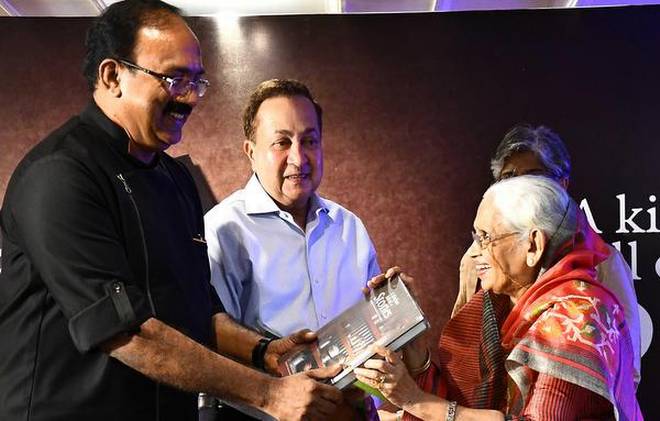
A Kitchen Full of Stories, a coffee table book on Mappila cuisine, released

Every ingredient has a story to tell, and the dishes are like a great story, as chef Regi Mathew described cooking in a nutshell.

Similar is A Kitchen Full of Stories, a coffee table book released on Saturday. The book, in a mix of stories and recipes of traditional Mappila cuisine, documents the culinary journey of its writer, Ummi Abdulla.

Alongside are anecdotes from her growing years and tips from her own kitchen. The book that has evolved over seven years was conceptualised by her grand-daughter, Nazaneen Jalaludheen.

Releasing the book, N. Ram, chairman, The Hindu Publishing Group, said, “It goes without saying that this book is indispensable to anyone interested in Mappila cuisine. At one level, it is a cookbook — a practical guide to and celebration of Mappila kitchen treasures. But it is more than that. It introduces us to the culture and tradition of a community.”

“In a wider sense, it is a celebration of the idea of India, the rich diversity and plurality and the secular spirit of its historical civilisation that has come under stress and challenge today. It is the celebration of the greatness of our historical civilisation, which has welcomed influences from anywhere in the world,” he said.

Nandini Rao, chairman and managing director, Orient Blackswan, said coconut, coconut oil and rice formed the foundation of all food from Kerala.

“But Arab influences in Mappila cuisine are clearly evident and provide an element of surprise. A Kitchen Full of Stories evokes not just the food of the community but also the customs and traditions of the community that has contributed to the richness and diversity of India,” she said.

Ms. Jalaludheen said being a self-published book, they used crowdfunding as a way for people to book in advance. S. Muthiah, historian, Geeta Doctor, author and S.R. Madhu, writer-editor were present.

source: http://www.thehindu.com / The Hindu / Home> News> Cities> Chennai / by Staff Reporter / Chennai – September 29th, 2018

The vinyl man of Kitab Mahal

Mumbai, MAHARASHTRA :

From Marathi to Tamil, and classical to rock, Razzak has it all.

A little corner of analog music on a Mumbai pavement

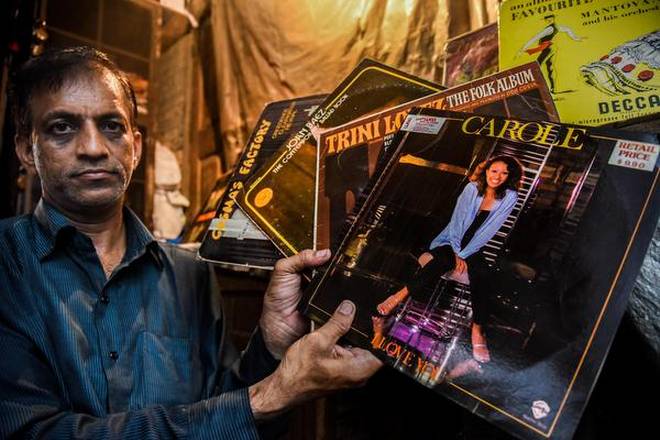
As I walk down the cobbled pavement under the famous blue-and-white arches of Kitab Mahal, I almost walk past ‘Royal Music Collection’ without noticing it. But Lata Mangeshkar crooning ‘Chhod De Saari Duniya Kisi Ke Liye’ lures me to the shop tucked away between others selling helmets and mobile phone covers. I am immediately struck by the hundreds and hundreds of vinyls and cassettes that are immaculately organised in the tiny space.

The shop’s owner is Abdul Razzak, a man of few words. It is difficult to tease answers out of him; he prefers to reply in lists: genres, artists, languages, types, sizes, speeds of vinyl. He has facts about his collection of LPs and EPs and LDs at his fingertips.

“There’s Hindi, English, Gujarati,” he intones, “Marathi, Punjabi, Tamil, Bengali, Indian classical, Western classical, pop, rock jazz, blues, hard rock, soft rock, soft instrumental,” barely pausing to take a breath. If I slip in a word edgeways, he chides me gently, like a parent frustrated their child isn’t solving a math problem right.

A special bond

He pulls out stacks of vinyls, neatly arranged by genre in plastic bags, from a small, almost hidden, cupboard that holds his more expensive collections. He then lists out artiste names in another rapid-fire burst: “Boney M., ABBA, The Beatles, The Doors, Pink Floyd, Jimi Hendrix, Led Zeppelin, The Who.” “I don’t really relate to them or understand them,” he says, but he clearly knows what to stock.

As the conversation progresses, the 54-year-old slowly begins to warm up. He tells me why vinyls are special to him. “When you play it, it feels like someone is sitting in front of you and singing,” he says. Razzak’s father worked at a printing press, and no one in his family was particularly interested in music. As one of five siblings growing up in Mumbai,  Razzak would inevitably watch as many films as he could in theatres and religiously listen to their songs on cassette tapes. That is how his love for music began.

“I listened to old Hindi songs,” he reminisces. “I loved Rafi saab’s music. I’d listen to mix collections of Mangeshkar and Talat Mahmood.” Then, as a teenager, Razzak discovered a friend’s collection of vinyl records. There was no turning back. “Once I realised the quality of records, I would only listen to them. The sound is so sweet to the ear.”

One day, the friend gave Razzak his entire collection of 300 records. This was the impetus that kick-started Razzak’s vinyl business in 1980. The collection had songs and dialogues from classics like Raj Kapoor’s Barsaat (1949) and Shree 420 (1955), and Sholay (1975). With these classics, Razzak began to expand his collection and also his network of collectors.

Razzak had gone into business with his uncle, who sold old stamps and coins at the same spot in Kitab Mahal where Razzak now sells vinyl. Uncle and nephew still work together and, in fact, the shopfront abutting the pavement sells coins and stamps during the day, and in the evening after his uncle closes shop, Razzak moves in from the alley at the back where he sits during the day.

Gandhi on 78 rpm

The oldest record in Razzak’s possession is Ashok Kumar’s Jhoola (1941). He also has Mahatma Gandhi’s voice on a 78 rpm. Kanan Devi, Suraiya, Noor Jehan, they all feature strongly in the mix.

The shop has changed little in the 37 years of its existence. A store in Chor Bazaar is offering competition, but that doesn’t appear to worry Razzak. “A lot of the stuff in Chor Bazaar is from scrap dealers, from posters to antique furniture,” he explains, “but they sell at high prices.” Why doesn’t he do the same, I ask. “I don’t want to. I want to run this place as it has always been run,” making enough to cover his family’s expenses.

Kala Ghoda’s famous Rhythm House shut down last year because music downloads proved too big a competition. But online streaming doesn’t affect Razzak whose customers seek him out for a different era, a different sound, for an experience that digital cannot give.

The demand for his wares has slowly grown, as vintage becomes hip and electronic vinyl players buttressed the market. From DJs to interior designers to Bollywood stars, Razzak attracts a tony crowd. He proudly shows me a picture of director Madhur Bhandarkar visiting his shop. Nobody in his family has shown any interest in continuing the shop, but Razzak is unfazed. “I’ll sell them for as long as I can. I can definitely run the shop for another 10 years.”

Anahita Panicker is a Mumbai-based freelance journalist who is as obsessed with cinema as she is with gender rights.

source: http://www.thehindu.com / The Hindu / Home> Entertainment> Music / by Anahita Panicker / September 30th, 2017

NRI becomes first Muslim Lord Mayor of UK town

KENYA / Leicester, UNITED KINGDOM:

Leicester previously had Hindu and Sikh Lord Mayors,but Abdul Osman is first Muslim to hold the office.

Indian-origin councillor Abdul Razak Osman has become the first Lord Mayor of the Islamic faith to hold the high office in the multi-cultural town of Leicester,which has a large minority of Indian origin people.

Osman was born in Kenya and arrived in the UK in 1971.

His late father Yousuf Razak worked on the East African Railway,and worked for a local engineering firm after moving to Leicester.

The Lord Mayor is Leicester’s first Citizen and has a high profile role maintaining and promoting the interests of the city and its citizens, by attending a variety of civic engagements during the year.

Leicester previously had Hindu and Sikh Lord Mayors,but Osman is the first Muslim to hold the high office.

Incidentally,the office of the Deputy Lord Mayor of Leicester is also held by an Indian-origin councillor,Mustafa Kamal,who hails from Ferozepur,Punjab.

Osman has worked with several charity organisations and was instrumental in fundraising to build two villages and a school in Kutch,Gujarat for orphaned children,following an earthquake in 2011.

Osman,who joined the city council in 1996,takes over from Councillor Rob Wann.

Osman said after being sworn in at the Town Hall last night: “It’s an important year,with the Diamond Jubilee and the Olympics,so it’s a privilege for me to hold office with everything that’s going on”.

He added: “I want to focus on visiting the communities and raising the profile of the office of Lord Mayor.

I’m proud to be the first Muslim councillor to hold the position – we’ve had Christian,Hindu,Sikh and now I’m able to bring the Islamic faith to the office which is a great honour”.

Osman,who previously held the office of High Bailiff and Deputy Lord Mayor,is married to Shaina,who will serve as the Lady Mayoress.

The couple have two children.

The term of Leicester’s Lord Mayor is one year,and runs from May to May. Each year the longest serving City Councillor is offered the role. Leicester has had a Mayor since the year 1209. From 1928,the Mayor became a Lord Mayor.

The town also has a separately elected Mayor,currently Peter Soulsby (Labour).

source: http://www.indianexpress.com / The Indian Express / Home> News Archive> Print / by Agencies, London / May 18th, 2012