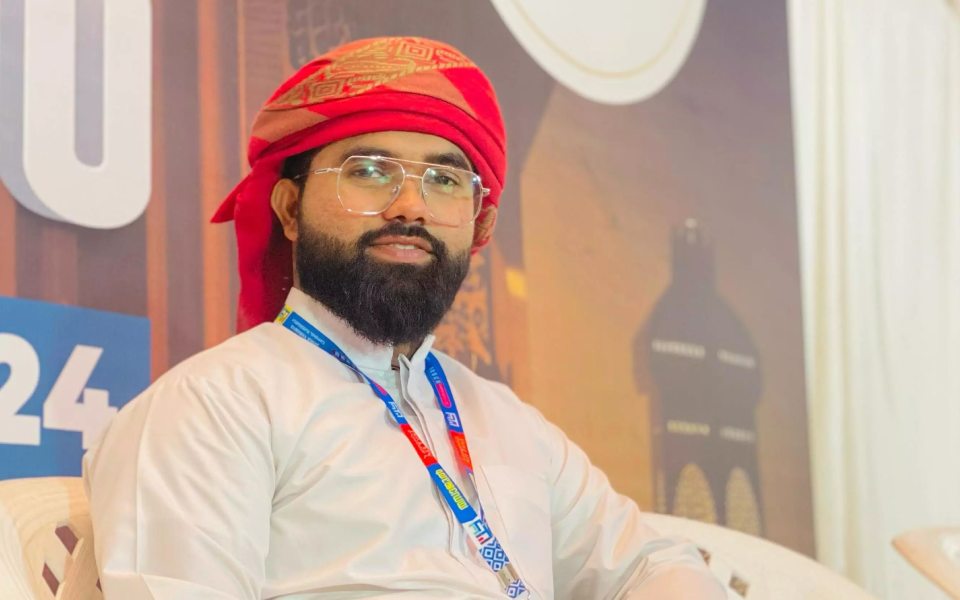
Founder of the Rekhta Foundation Sanjeev Saraf (left) with Dr Umair Manzar
“Umair Manzar was the first to join me in my journey of Rekhta,” said Sanjeev Saraf, the founder of the Rekhta Foundation. He said this before a smaller audience at the launch of the first Jashn-e-Rekhta, the festival of literature and performing arts in 2012.
The festival has become a major annual cultural event in Delhi, and the Rekhta Foundation portal is a key resource for Urdu language and literature and a peg for the online and offline community of Urdu literature lovers.
This year the three-day Jashn-e-Rekhta is being held in Delhi from December 13.
Saraf said Umair was his first Urdu teacher. He was the one who proposed the name Rekhta for the website and became the first member of the online community of Urdu aficionados on Rekhta Foundation.
Stage for artists to perform in Jashn-e-Rekhta
Today, Dr. Umair Manzar is an Assistant Professor in the Urdu Department of Maulana Azad National Urdu University, Lucknow Campus When Awaz-the Voice contacted him, he was surprised at his name being mentioned by Safar.
Awaz-The Voice contacted Umair Mazhar on the phone. He came across as a simple and humble person not too keen to take credit for his key role in setting up Rekhta.
After initial reluctance, Umair Manzar agreed to share his interaction with Sanjeev Saraf.
Manzar’s version of the initial days of Rekhta threw up many more characters in this journey. He says many other people also played their part in helping Sanjeev Saraf concretize what was his passion for the language.
Umair Manzar said that he met Saraf during the 2010 spring.”Summer had not started.”
One day Vice Chancellor Jamia Millia Islamia Najeeb Jung called Urdu’s Head of Department Professor Khalid Mahmood and asked him to send a tutor to a particular person to teach Urdu. At that time, Umair was teaching at the university. His HOD gave him a piece of paper with a name and a telephone number scribbled on it and asked him to contact him.
“The name was Sanjeev Saraf. I called that number, we fixed a time for the tuition class.”
Jashn-e-Rekhta festival
“The first time I met him at his home. I had no idea who he was. Yet I found him a serious person; there was a certain calm in his way of speaking.”
“I liked him instantly as he spoke candidly. After a few meetings, he told me that he was very fond of Urdu and wanted to learn it.
“He especially wanted to understand poetry. In a few meetings, I realized that apart from learning the language, he was also interested in creating an Urdu website. He has nursed a dream of starting an Urdu website for many years,” Manzar said
Sanjeev Saraf seemed to be learning the language out of love for it. He also thought Urdu could become a bridge among diverse people of India who loved the language.
He thought the website of this idea could increase their love for Urdu. Thousands of people want to learn the language because of its poetry. However, there is no one to help them. Sanjeev Saraf had faced this problem and therefore empathized with others. He had the resources, including time to learn Urdu. However, everyone could not do it.
Manzar told Awaz that he soon realized Sanjeev Saraf wanted to do something beyond learning Urdu.
After a few days, he said, “Every person needs a teacher; my website can fulfill the needs of all such people.”
Manzar said, “This got me thinking seriously about this issue. By now I was visiting the Noida office of Mr Saraf. One day he said that we can start Urdu work in a part of that office.”
Umair Manzar also did not realize that he had become a part of the initiative to establish a website that would help Urdu lovers all over the world and bind them in a community.”
He also realized that he was dealing with a passionate lover of Urdu and not a mere learner.
A bookshop in Jashn-e-rekhta
One day Safar spoke formally to him. We decided to discuss it in detail.
And finally one day Sanjeev Saraf asked him to start work on the website,
The first name for the website he suggested was Kavita. This was already bought by someone. The same was the case with many other titles. “I also felt if we had to buy the already registered name for the website, the prices were ridiculously high.”
He suggested ‘Rekhta’ to Sanjeev Saraf. ”He asked me its meaning. When I explained it to him he was happy. Soon we registered rekhta.org as the domain name. I remember he liked the harmony of the words. He was sitting with us during the entire process of registration online.”
Thereafter the work on the website started and many targets were achieved before the scheduled time. This was the journey of paper preparation for the Rekhta Foundation.”
Umair Manzar says he had met Sanjeev Saraf with the sole purpose of teaching him the language but he got involved in his mission.
When asked about the preparations after naming, Umair Manzar said, “After the name was decided, work on the website started. In the summer of 2011, I officially launched the website. The first step was to choose poems of classical poets and the unanimous choice was Mirza Ghalib.”
The selection of contemporary poets started from Jamia Millia Islamia and other libraries. Their compositions were recorded. Saraf hired composers and they worked out of the Noida office. It started slowly and then it gained momentum.”
Umair Manzar said, he also contacted Professor Ahmed Mahfooz and Professor Abdul Rashid for their suggestions and advice.”I also arranged a meeting of both gentlemen with Sanjeev Saraf and this meeting lasted for several hours.”
Saraf expressed his intentions and ambitions; the professors also gave their input and suggestions. “Sanjeev Saraf noted every suggestion and tip the two learned professors offered.”
Prof. Rashid suggested that the way to preserve old books was to scan them and upload them on the website.
Umair Manzar says,” One day when I went to the office, Sanjeev Saraf announced the (scanning) machine had arrived. “Now you people bring the books. The scanning process will begin.”
This was a challenge to all of us. Initially, we tried to upload only selected and important books on the website. Later this also opened a new possibility.
A poster of Jashn-e-Rekhta
Umair Manzar says that initially, people like Rehman Farooqi, Prof. Shamim Hanafi, and Prof. Walwasa ignored the website as another wannabe.
Probably the first column about Rekhta was written by Professor Vasa, Vice President of the Urdu Academy. He also gave Rekhta an award for the promotion of Urdu.
Umair Manzar joined Maulana Abul Kalam Azad Urdu University as an assistant in the early days of Rekhta.
Initially, the Rekhta Foundation was recruited only on the recommendation of a group of like-minded people like Professor Ahmed Mahfooz, Professor Abdul Rashid, and Umair Manzar.
Abdul Rashid, who is from Delhi, had done his research on dictionaries. This year the Ghalib Institute is giving him its prestigious literary and research award. Professor Ahmed Mahfooz is the HOD Urdu Department of Jamia Milia Islamia. He is an expert on poetry.
Professor Abdul Rashid and Dr. Amir Manzar are among the people who have been actively associated with the Rekhta Foundation since its inception.
Dr. Umair Manzar and Prof. Abdul Rashid were included in this team to scan books from Raja Mahmoodabad library and make them part of e-books.
Similarly, access to some private libraries and some important books was very active. Along with them, Professor Abdul Rashid and Dr. Umair Manzar have played a role.
source: http://www.awazthevoice.in / Awaz, The Voice / Home> Stories / by Mansooruddin Faridi, New Delhi / December 12th, 2024
Zillur Rahman, a professor, poet and hakim, has established a museum-cum-library in Aligarh to preserve books and artefacts that tell the story of Delhi of yore.
PIONEER: A bust of Ibn Sina, a physician and philosopher, who lived over a thousand years ago, at the Ibn Sina Academy in Aligarh
Nestled in the heart of the city of Aligarh, Uttar Pradesh, is Ibn Sina Academy of Medieval Medicine and Sciences, named after famous scholar of philosophy and medicine Abu Ali Ibn Sina (980 -1037), who lived over a thousand years ago.
Located at Tijara House, the non-profit, non-government and non-political academy was established in the year 2000 by Professor Syed Hakim Zillur Rahman, an academic and a litterateur from Aligarh.
A one of its kind museum and library, it was aimed at encouraging and promoting researches and studies in medieval sciences, especially Ibn-Sina’s, as well as arts, culture, poetry among other subjects.
Notably, Ministry of Ayush, Government of India gave accreditation to the academy in 2004 and promoted it as a Centre of Excellence in 2008. The professor had a mammoth personal library that he had established in 1960s. After Ibn Sina Academy was born, the library became a part of it.
The specialty of this museum lies in its varied collection that includes sofas, crockery, jewels, armours, stamps, mirrors, outfits of princesses, queens and kings as well as turbans worn during battles by historical legends.
The Zillur Rahman Library houses 32,000 rare books and magazines, 1,100 manuscripts apart from paintings, sketches, citations, artefacts and much more.
RARE: A collection of books on Delhi
The Delhi connection
There are 7,500 books on Delhi of yore in the library, including on poet Iqbal, dictionaries as old as 150 years, authentic diwaan on Ameer Khusrau, books dating back to 1893, on and by the last Mughal emperor Bahadur Shah Zafar, British Raj–Victorian Era with pictures in lithographs and more.
But considering Delhi is dry without the ‘zikr’ (mention) of the poetic legacy of Asadullah Khan ‘Ghalib’, the library has dedicated a special space for the poet: “Ghalib Study Centre”.
A galaxy in itself, this part has 1,350 rare books in Urdu, Persian, English and Hindi on Ghalib apart from several special issues in different magazines (called risala in Urdu) which are now available only in this museum.
For instance, an important old publication called Sooraj (meaning sun) had special Ghalib edition.
One of the books has illustrations of most of the ghazals he had penned, while in his own Deewan (collection of his authentic shayri) there, Ghalib’s original ghazals had no pictures or illustrations.
MASTERPIECE: The translation of the book written by Hakim Zillur Rahman
One of the most important collections here is a book by renowned author Shakeel ur Rahman called Mirza Ghalib aur Mughaliyaat, which has illustrations from Muraqqa-i-Chughtai, an illustrated selection of Ghalib’s work by AR Chughtai, a renowned artist of early last century. The illustrations are based on an important topic or issue that the poet raised in his couplet (sher).
Rare books with names like Jihad-e-Ghalib, Ghalib Satrung, Soz-e-Ghalib, his letters in Persian and many more ornate the archive.
Additionally, a book called Naqsh-e-Rung from Pakistan which was brought to India by scholar Urdu litterateur and poet professor (late) Shamsur Rehman Farooqui enriches the book shelves.
Tehqeeq-nama Ghalib, Ghalib’s ghazal in Persian called Ghazaliayat-e-Farsi, Ghalib, few rare and special issues of magazines like Shama, Nuqoosh, Hunoon, Taar-e-Nau, film magazines, Al-Ilm, Shayar, Kaarvaan with special edition on Ghalib are the other charms.
A rare pocket-sized edition on Ghalib is a popular one.
Travels to Delhi
Another section on Delhi consists of travels and trips done in Delhi by the authors, travellers and poets of old times. Rare books like Safarnama Dehli and Sair-ul-Manazir provide an inside view of Delhi in the 18th century.
LEGEND: Bust of a renowned Indian physician Charaka at the academy in a section dedicated to physicians and medicinal plants
Also, over 200 rare books on Delhi’s poets (shayars) in Urdu and important personalities form another gallery here. For instance, there is Aslam Parvez’s award-winning book on Bahadur Shah Zafar, and his another one called Meri Dilli. There is also a book on Hamare Zamane Ki Dehli, Charagh-e-Dilli, Dilli Wale by famous author Salauddin, Aalam mein intekhab-e-Delhi among others.
Rare and significant books on personalities include those on Hakim Ajmal Khan, Sir Ross Masood, former India President Zakir Hussain, Sir Syed Ahmad Khan, Raja Mahendra Pratap and many more.
An entire unit is also devoted to all the journals that came out of Delhi during the War for Independence “and those from late 17th century to beginning of 19th century. The Delhi College was established in 1824, with it, all these journals rose to a great height. These form an enticing collection in the museum,” apprises Aftab Najmi, the coordinator and convener at Ibn Sina Academy.
On enquiring why such a large collection in Urdu finds space here, Professor Rahman adds, “Our own language and culture is much better described only in Urdu and Persian. So, it was very important to have a different section on Urdu to give a peep into what Delhi was in olden times.”
However, countless notable oldest books in English and Hindi on Delhi also enrich the collection on the Capital.
A legacy himself
Professor Zillur Rahman has 56 books to his credit. The subjects are related to Tib (Unani medicine) and Urdu literature. His books on medical sciences with oldest references (100 to 200 years old) are immensely popular. He is also a poet and an ardent admirer of Urdu poets of yore. He has also edited Diwan-e-Ghalib and many books on Urdu shayri. So far, 11 books have been written on him by students from different parts of India and globe in Arabic, Urdu and English. There are two academies, in Meerut and Bhopal, named in his honour. A part of the library has books on Zillur Rahman’s own family and their contribution to academics, medicine, poetry and culture.
For the next generation
On why he decided to make such a rare museum and library under one roof, Rahman says, “I was just a teacher at AMU. I had no money like businessmen to construct roads and hospitals so I decided to build this museum and library to help those who want to study but have neither books nor a place for the same. I want the current generation to know that books on all our glorious histories and personalities were penned in Urdu before 1947.
ICONIC: A portrait of Mirza Ghalib at the library, which boasts of rare works on the Delhi-based poet
“So, our generation has to know Urdu to understand their buzurgs (elders) and what charismatic works they had done. Our current generation, which doesn’t know Urdu, is like a blackboard. Anyone can write anything on it and it doesn’t impact them because they are so ignorant of legacies of their own language.”
Professor Rahman has travelled abroad 44 times. He visited Greece, including its capital Athens, Samarkand and Bukhara in Uzbekistan, Spain, Turkey, Germany and other countries.
“I went to Iran 11 times to gather books and study how it has preserved its arts and culture, literature, medicine and environment,” he says adding that children of every country know their mother tongue and can read and write in it.
“India’s children, especially the new Muslim community, is ignorant of its own legacy in Urdu.”
The Ibn Sina Academy has a tremendous collection of Islamic sciences and Islamic medicines. The professor has procured them from across the globe.
“Some are bought, some gifted and some requested and begged for. Hamaare 3,200 hazaar kitaabon mein, Ghalib ka collection jo hamaare paas hai vo duniya mein kisi ke paas nahi hai (No one in the world has the rare collection on Ghalib that we have among our 32,000 books). Even Delhi’s own Ghalib Institute and Ghalib Academy visit us and take photocopies of the rare material they require. We have made our academy work on Delhi’s poets, littérateurs, historical buildings and monuments,” he adds.
Most books, he adds, are from Iran, Samarkand and Bukhara.
“The richest in education, philosophy, medicine and culture is Uzbekistan but it could not present it to the world, the way Iran did.”
Why Delhi in Aligarh?
Why Delhi forms a special section at his library, has its reasons.
“Delhi was always the capital of India, be it during the Mughal, British eras or post-Independence period. So, it has always been not only a melting pot of cultures but also an abode for the best of poets, authors and travellers. The number of academics, authors, sufis, litterateurs, shayars (poets), lovers of arts and music and academic institutions that Delhi had, no other capital in the world has it till date,” he reasons with pride.
To know Delhi better, he suggests books penned by the renowned Dehlvi family.
For instance, there is Dilli jo aik shahar thaa by Shahid Ahmad Dehlvi, who was born in Delhi in 1902.
He wrote extensively on vanishing culture of Delhi which was a symbol of Indo-Muslim culture ruined by violence and blood of the War of Independence. Post Independence, he went to Pakistan and died in 1967.
Waqyaat-e-Darool Hukoomat in three volumes by Bashiruddin Ahmad Dehlvi published from Urdu Academy, Delhi in 1990, and books on 1857 revolution are also there in the academy.
Delhi just got richer by another book by Zillur Rahman — Dilli aur Tibbi Unani which has just come out in Urdu. It is translated in English by Toronto-based Zakaria Virk, titled ‘History of Unani Medicine in Delhi – 17th Century to 20th Century – Biographies of 261 physicians’.
source: http://www.thepatriot.in / The Patriot / Home> Delhi NCR / by Rana Siddiqui Zaman, Delhi NCR / November 15th, 2023
Dr. Thumbay Moideen, Founder President of Thumbay Group and Patron of Bearys Cultural Forum (BCF), has been conferred the distinguished “Global Visionary NRI Award” by Bearys Cultural Forum (BCF) – UAE. The award was presented by Naseer Ahmed, Member of the Legislative Council and Political Secretary to the Chief Minister of Karnataka, India, during a grand event held at Thumbay Medicity, Ajman.
The “Global Visionary NRI Award” is a recognition of Dr. Moideen’s unparalleled contributions to global healthcare, education, and innovation. A celebrated entrepreneur and philanthropist, Dr. Moideen has successfully transformed Thumbay Group into a global brand, driving growth through innovation and serving as a beacon of inspiration for Non-Resident Indians worldwide, a press statement from Thumbay Group added.
Speaking at the ceremony, Naseer Ahmed commended Dr. Moideen’s visionary leadership and his efforts in building Thumbay Medicity as a hub of excellence in healthcare, education, and research. The event also featured a visit by Naseesr Ahmed to Thumbay Medicity, where he witnessed the state-of-the-art facilities and cutting-edge advancements that have placed it on the global map.
Dr. Thumbay Moideen, upon receiving the award, expressed his gratitude to Bearys Cultural Forum (BCF) for this recognition and reaffirmed his commitment to fostering innovation, global citizenship, and community welfare.
“This award is a testament to our collective efforts in making a positive impact globally. I dedicate this honor to my incredible team, whose unwavering dedication has been the cornerstone of our success,” said Dr. Moideen during his acceptance speech.
source: http://www.english.varthabharati.in / Vartha Bharati / Home> Gulf / by Press Release / January 20th, 2025
The Islamic scholar and former Dean, Faculty of Theology, Aligarh Muslim University (AMU), Professor M Saud Alam Qasmi, has been conferred with the Lifetime Achievement Award by Jamitul Hidayah, Jaipur.
While conferring the award, the Rector of Jamia, Maulana Fazlur Raheem Mujaddidi, praised Professor Qasmi as a distinguished scholar and lauded his books as a “treasury of India.” He urged young scholars to draw inspiration from Professor Qasmi’s academic legacy.
Editor of Tahzeebul Akhlaq, Professor Qasmi has authored 40 books and 400 articles in English, Urdu, and Arabic.
A celebrated orator, he has held several prestigious roles at AMU and is associated with numerous academic institutions and editorial boards.
source: http://www.radiancenews.com / Radiance News / Home> Pride of the Nation> Awards>Latest News / by Radiance News Bureau / January 28th, 2025
Students from the Department of Foreign Languages at Aligarh Muslim University (AMU) secured top prizes in a national competition organised by the Department of German, University of Mumbai, under the theme “100 Years of Kafka.”
Ramsha Afzal, a Master’s student in German Studies, won first place in the Comic Strip category for her creative take on Kafka’s novella Die Verwandlung (The Metamorphosis), highlighting themes of alienation and transformation. Azhar Zia, a final-year undergraduate, clinched first prize in the Short Films category for his cinematic interpretation of Kafka’s narrative Gibs auf! (Give it Up!), reflecting a nuanced grasp of existential themes.
Professor Muhammad Azhar, Chairman of the Department, commended the students, stating, “These achievements showcase the academic excellence and creativity nurtured at AMU, reaffirming the importance of foreign language studies.”
Assistant Professor Syed Salman Abbas applauded the winners, emphasising their engagement with German literature and culture.
source: http://www.radiancenews.com / Radiance News / Home> Education> Latest News / by Radiance News Bureau / January 23rd, 2025
Till recently whenever the 45-year-old Muslim Ansari drove his autorickshaw through the officers’ colony of the city, he was overawed by the luxurious bungalows. He visualized living in one of these houses with his family.
His dream is about to come true as his daughter is on the verge of becoming a Deputy Collector and being entitled to such an official accommodation in the Officers’ colony.
In the recent result of the Madhya Pradesh Public Service Commission examination, Ayesha Ansari of Rewa district has secured 12th rank in the state.
Ayesha Ansari being being congratulated by visitors at her house
She has been selected for the post of Deputy Collector. Her success is being celebrated across the district. Although she is yet to get orders for her posting, her family is already looking at good days.
Ayesha Ansari was born in a middle-class Muslim family. Her father, Muslim Ansari put in all his efforts to make his daughter’s dream come true. Ayesha credits her parents for her success. She says that her father used to walk every morning through the Police Line Colony and read the nameplates of officers living in the bungalows.
Her father manifested and visualized a big future for her daughter and his dream has come true.
Ansari often told his daughter, “I wish someone in our family had a big bungalow to his name.”
Ayesha with relatives
Wanting to make her father proud, Ayesha focused on her education and decided to make his dream come true.
Ayesha Ansari believes success comes only with dedication and hard work. She never joined any coaching class.For the preparations, Ayesha used her mobile phone to access study material and did a home study.
He said he worked hard to provide for his family and ensure that Ayesha got everything she needed for her important examinations and education.
Muslim Ansari says, “I had no idea about the civil services, but always dreamt of my daughter getting a good position.”
Ansari says he drove his auto rickshaw even when he was ill so that his daughter’s studies were not affected.
Ayesha Ansari’s success has sent a wave of joy in her family and neighbourhood. There is a beeline of people outside their house with everyone wanting to meet and congratulate Ayesha.
Ayesha believes that the youth should leave no stone unturned in their hard work and keep trying to secure their goals. She asks them to stay away from social media and distractions.
Muslim Ansari said, he never thought that his daughter would reach such high a high point in her life.
“Our life was full of struggle, but now we can proudly say that our daughter has achieved this feat with her hard work.”
Ayesha who belongs to the marginalised Pasmanda community has thus become a sources of inspiration for many who otherwise believed that lack of resources was an impediment to their drowth and realisation of their dreams.
source: http://www.awazthevoice.in / Awaz, The Voice / Home> Story / by Abdul Wasim Ansari, Rewa, MP / January 23rd, 2025
The valedictory function of the 4th Asian Congress for Alternatives to Animal Experiments held at Jamia Hamdard Convention Centre where Prof. (Dr.) M. Afshar Alam, Vice-Chancellor, Jamia Hamdard was the Chief Guest of the programme.
Organizing secretary Prof. S. Raisuddin informed that this congress is being held for the first time in India. During this congress the founding members of the society and representatives from India, China, Japan, and South Korea signed a joint declaration to establish the Asian Federation of Societies for Alternatives to Animal Experiments (AFSAAE).
Well-wishers from societies working for alternatives from America, Europe, and Sri Lanka also wished good link to the foundation. All the representatives were felicitated by the Organizing Secretary. Prof. Y.K. Gupta and Dr. M. A. Akbarsha graced the occasion as Guest of Honour.
Prof. Y. K. Gupta urged the scientists to understand the pain of Animals while using them for scientific experiments.
Dr. Akbarsha announced the next meeting to be held at Hyderabad. Prof. Raisuddin presented a detailed report of 3 days deliberations during the conference. He also announced various awards for best presentations by young scientists. Dr. Christian Pellevoisin, Scientific Director, MatTek & CEO Urbilateria France sponsored best poster presentation awards and cash prizes to the budding scientists. Dr. Kristie Sullivan, Vice President, Education and Outreach, Institute for In Vitro Sciences, USA and Prof Winfried Neuhaus, member of the Austrian Commission for Animal Experimentation also appreciated the successful organization of the Congress.
Prof. (Dr.) M. Afshar Alam, Vice Chancellor congratulated the Organising committee members for the successful organisation of the conference. He appreciated the patronage of Janab Hammad Ahmed, Chancellor, Jamia Hamdard and financial support of Hamdard National Foundation along with other funding agencies for enabling Jamia Hamdard to develop alternative models of animal experiments.
Programme ended with vote of thanks by the Organising Secretary and National Anthem.
source: http://www.taasir.com / Taasir.com / Home> Education / by Taasir News Network / December 15th, 2024
Medical College and Hospital (PIMC) , a project under the University of Science and Technology Meghalaya (USTM),
The University of Science and Technology Meghalaya (USTM) has been awarded the prestigious title of “University of the Year 2024” at the Academic Insights Education Excellence Awards & Summit 2024, held in Bengaluru.
The honor was received by USTM’s Vice Chancellor, Prof. GD Sharma, a former President of the Association of Indian Universities. The event witnessed the presence of over 200 dignitaries, including Vice Chancellors, Deans, Principals, Directors, and leading educational thought leaders.
Renowned for its commitment to innovation, research, and holistic education, USTM outshone a competitive pool of institutions nationwide to secure this esteemed accolade. Organized at the Courtyard by Marriott, Hebbal, Bengaluru, the Academic Insights Education Excellence Awards recognize exceptional contributions in education. USTM was presented with a Certificate of Excellence and mementos in the “University of the Year 2024” category.
This recognition underscores USTM’s remarkable contributions to quality higher education and impactful social initiatives. The university has consistently demonstrated excellence through its unique policies and achievements. Notably, it ranks 52nd in India according to the globally acclaimed Nature Index, which measures scientific contributions and high-impact research. Accredited with an ‘A’ grade by NAAC and recognized by NIRF, USTM is celebrated for providing transformative opportunities to the youth of Northeast India, fostering skill development, and contributing to nation-building.
Prof. GD Sharma, while accepting the award, expressed his gratitude and pride. He remarked, “This recognition is a testament to the collective efforts of our faculty, staff, students, and alumni. Each has played a vital role in shaping USTM’s success story. We extend our heartfelt thanks to everyone who has been part of this extraordinary journey.”
Mahbubul Hoque, the Founder and Chancellor of USTM, shared his joy, stating, “This is a moment of immense pride for the entire USTM family. Being named ‘University of the Year’ acknowledges our steadfast dedication to quality education and creating an environment of continuous learning and growth.”
USTM’s achievements have attracted significant attention from institutions across India, many of which have expressed interest in collaborations to advance shared goals of educational excellence and societal development. This milestone reinforces USTM’s standing as a leader in higher education, inspiring others to prioritize innovation and community impact.
source: http://www.muslimmirror.com / Muslim Mirror / Home> Education> Indian Muslim> Positive Story / by Muslim Mirror Desk / January 21st, 2025
It is ironical that, just in the year of its centenary, the historic Madrasa Islamiya of Ranchi, founded by Maulana Azad (1888-1958) in 1917, is facing extinction. The BJP government of Jharkhand is reportedly contemplating to strangulate it to death by withdrawing its affiliation/recognition as well as fund. Much of the land of the institution has either been encroached upon or been sold out, by the self-serving Muslims, influential in the management of the Anjuman-e-Islamiya, which runs almost 12 subsidiary institutions, including the Madrasa Islamiya. In 1987, it formed a subsidiary called, “Muslim Higher Education Society”, which added a degree college named after Maulana Azad. This Muslim minority college is recognised and funded by the government of Jharkhand. It has got around 500 students.
The management of the Anjuman-e-Islamiya stands divided between two warring factions, respectively by Haji Ibrar and Haji Nesar. The latter is supposed to be making too much of interferences into the functioning of the Anjuman-e-Islamiya. Sections of local population admire Haji Ibrar for having done a lot for the Anjuman; they are supposed to have recently purchased a land few kilometres away from Ranchi, where the Azad College is likely to be shifted.
Because of this dispute, mainly around composition of the electoral college of the Anjuman, election for the managing committee of the Anjuman has not been held since last November. According to the bye-laws of the Anjuman, every three years elections are supposed to be held. Convenor for the election from the provincial government is the Chairman, Jharkhand Waqf Board. The government has not appointed any Chairman since 2014. In its place, an ad hoc CEO is there for the Waqf Board. He has not shown much interest in resolving the dispute, and convening elections, as per the bye-laws of the Anjuman-e-Islamiya. There are various petitions lying before the CEO regarding the composition of the electoral college. The factionalism is also around caste (Biradri). Haji Ibrar is supposed to be representing the Ashrafiya Muslims, whereas Haji Nesar is supposed to be representing Pasmanda (mainly the community of Kalaal) Muslims.
The property (including the buildings) of the Anjuman-e-Islamiya, located in the commercially significant, prime location of the city of Ranchi, has got around 200 shops. Because of self-serving factionalism within the Anjuman-e-Islamiya, the rent of the shops is kept so very nominal and unrealistic that the Anjuman deprives itself of huge revenue. The Anjuman-e-Islamiya also runs a 60 bed, relatively better-furnished, hospital, besides the RahmaniyaMusafirkhana, existing since the days of Maulana Azad. This is a separate (now a four-storey) building. Few years ago, with some fund from the Local Area Development Scheme of the local Parliamentarian, this building has been renovated. It has added a library, a study circle, etc.
There has been some efforts towards getting the main building of the Anjuman-e-Islamiya declared as National Monument, but to no avail, as yet.
The Madrasa Islamiya, at present, has got 900 students, some of them are boarders too. This is an educational institution recognised and funded by the government of Jharkhand’s body, the Jharkhand Academic Council (JAC). Before the creation of the province of Jharkhand in 2000, this was recognised and funded by the Bihar State Madrasa Education Board (BSMEB, Patna), a statutory body of the government of Bihar. There were 126 such madrasas falling in what became Jharkhand. All the 126 madrasas continue to get fund from the Jharkhand government.
After the creation of the province of Jharkhand in 2000, the Anjuman-e-Islamiya, with its ‘autonomy’, has been functioning under the administrative supervision of the Jharkhand Waqf Board.
A Proud History of Anti-colonial Assertion
It is worth re-visiting the historical context in which the Madrasa Islamiya was founded and the ideal objectives its founder envisioned. For this, let us benefit from some historians, such as S. Irfan Habib and Rizwan Qaiser.
For his revolutionary activities, he was into, right since his early ages, Azad was externed from Calcutta in March 1916 under the Defence of India Regulation. In April 1916 he was sent to Ranchi. Influenced with Shyam Sundar Chakravarty (1869-1932) and Aurobindo Ghosh (1872-1950), the Maulana was involved in revolutionary struggle and was preparing for a violent overthrow of British rule. His “continuous exhortation of the Muslims towards education including political education which essentially meant building up self-confidence to resist British rule”, was inviting anxious watch of the colonial regime on him, says Qaiser.
During his internment at Ranchi, for nearly four years (1 April 1916-31 December 1919), Azad established an organization Anjuman-e-Islamiya in August 1917 which started the Madrasa Islamiya. In a list of thirty one donors, headed by Rai Saheb Thakur Das, Rais-i- Ranchi and Babu Jagatpal Sahai, vakil, were also there, among other people, from all walks of life, including Sheikh safdar Ali of Milki (Gaya), informs Prof. Rizwan Qaiser, in his research on the subject. He says that behind all these activities of Azad, the guiding motive was to spread the Islamic education among the less fortunate co-religionists at Ranchi and to mobilise his co-religionists towards the freedom movement. According to Qaiser, Maulana Azad had been thinking around the issues of education in sciences, and also on the medium of instruction, since as early as in 1902, as it comes out of some of the correspondences of Azad.
For the Madrasa Islamiya, a 200 page long document of curricula was prepared by the Maulana Azad; the subjects such as English, mathematics, Indian geography, Indian history, history of Islam and sciences had to be introduced to bring it at par with the government run schools. Azad was very clear about the fact that no system of education could be complete unless the elements of Government University system were also to be introduced. Maulana Azad highlighted the importance of producing more educationists (Mutallemeen), rather than teachers (Muallemeen) alone. The education had to inculcate mazhabi ham-aahangi (mutual religious understanding) and rawadari (tolerance). He addressed from the Jama Masjid on every Friday, teaching them in Hubb-ul-Watani (patriotism), qaumi yekjahti (integration of nationalities), and Mushtareka Wataniyat (composite nationalism). The curricula were actually a part of the one prepared by Maulana Azad for the Madrasa Aliya of Calcutta (established in 1780 by Warren Hastings, mainly to study Arabic, Persian and Muslim Law; during 1826-36, it also taught medical sciences till the Calcutta Medical College was established in 1836; in 2007 it was upgraded as University)
S. Irfan Habib tells us that under Ibn Khaldun’s influence, unquestioning acceptance of theology was something Azad wanted to rectify. Azad found the curricula in the pre-existing Islamic madrasas fundamentally narrow. Its significant omission was mathematics, which is the basis of science and technology. Azad agreed with Rousseau in his advocacy of the children’s necessity and ability to grasp the truth through their own insight.
Another significant influence on Maulana Azad, in the context of science and education was Sir Syed Ahmad Khan Bahadur (1817-98), which attracted Azad towards modern education and modern science for the Muslims, as admitted by Azad, in his very eloquent convocation speech (February 1949) in the Aligarh Muslim University. This is another matter that on political questions, Azad had sharp differences against Sir Syed.
By way of recollection and re-dissemination, Azad’s profound contributions were put together when the National University of Education Planning and Administration (NUEPA), New Delhi, convened a seminar in 2009, and the essays were published in 2010. In the seminar, the then Speaker, Lok Sabha, Somnath Chatterjee, had described that Maulana Azad had re-emphasized the fivefold programme for the expansion of education in the country: These were (a) Universal compulsory basic education for all children of school age, (b) Social education for our adult illiterates, (c) Measures for improvement in the quality of and expansion of facilities for secondary and higher education, (d) Technical and scientific education on a scale adequate to the nation’s needs, and (e) Measures for the enrichment of the cultural life of the community by encouraging the arts and providing facilities for recreation and other amenities.
It is not without any reason that Nehru preferred to take Azad along, as his Education Minister, where he served with great distinction till his death in 1958. It is a lesser known fact that ever since Gokhale proposed in 1910 for right to compulsory free education, it was Azad who pursued it in the Constituent Assembly. Though, it was only as late as in 2009-10, that such a legislation (RTE) could actually be enacted.
During the colonial period unlike Uttar Pradesh, in Bihar, essentially speaking, there was not much of a difference between the votaries of modern education and those of the traditional learning. The Muslim elites of both the streams in Bihar cooperated with each other in imparting both kinds of education. Thus, a modern educated elite, a judge, Nur-ul-Hoda (1854-1935; son of Shams-ul-Hoda) set up the Madrasa Shams-ul-Hoda, at Patna in 1912. It endures till date with buildings constructed in colonial architectural styles, and have got good hostels too. It was recognised by the Government of Bihar in 1919, which affiliated Madrasas across the province, in the capacity of serving as the Bihar State Madrasa Education Board, BSMEB, Patna; the Board was made a statutory body by the Karpuri Thakur led government during 1977-79 ). In 1927, it affiliated the Madrasa Islamiya, Ranchi as well. Ever since then, this Madrasa remains a government recognised and funded institution.
Its syllabi, till Fauqaniya (class X), has all the modern subjects of Natural Sciences, Mathematics, Social Sciences and Literatures of Indian and English language. It has board examination at Middle (Wastania) level as well, which is class VIII. After Independence, this Board became a statutory body.
Interestingly, both the Madrasas (of Patna and of Ranchi) had one person in common, in preparing the curriculum—-Syed Sulaiman Nadvi (1884-1953). The Madrasa Shams-ul-Hoda of Patna produced many students and teachers who participated in the Quit India Movement; after independence some of its students joined the Indian Administrative Services and Indian Police Services.
Another Gift of Maulana Azad’s Stay at Ranchi
Besides the Madrasa Islamiya, another enduring gift of Azad’s stay at Ranchi is the foundation of Imarat-e-Shariah (in 1921, at Phulwari Sharif, Patna) in collaboration with Maulana Sajjad (1880-1940), and the Anjuman-e-Ulema-e-Bihar (founded in June 1917), a precursor of the Jamiat-ul-Ulema-e-Hind. The Sufi shrines—Khanqah-e-Rahmaniya (Monghyr) and Khanqah-e-Mujibiya (Phulwari Sharif, Patna) extended its support.
Maulana Azad elaborated upon this scheme of mobilizing Muslims against the anti- colonial struggle in his Urdu weekly, Paighaam (November 25, 1921).
The Imarat-e-Shariah went on to unwaveringly resist the communal-territorial separatism of the Muslim League. Azad’s protégé, Maulana Sajjad, also talked of confining religion into private spaces, and wrote many letters to Jinnah raising serious questions against his divisive [Pakistan] Resolution of Lahore, 23 March 1940.
He consistently remained in touch with the masses and also edited an Urdu weekly, Naqeeb, (after its fortnightly Imarat was gagged by the colonial state during the Civil Disobedience Movement 1930-34). On 14 April 1940, he wrote in Naqeeb against Jinnah’s scheme of dividing India, Muslim India aur Hindu India Ki Scheme par Ek Aham Tabserah (reprinted in the Naqeeb, 10 January 1946). The Patna historian, Papiya Ghosh (1953-2006), wrote an elaborate academic essay (1997) on the history of Imarat-e-Shariah, 1921-47.
Maulana Sajjad wrote letters to Jinnah asking pertinent questions. Jinnah never responded back. Sajjad, therefore, brought the letters in public circulation, specifically of 26 December 1938 and of 23 January 1939.
Maulana Sajjad also advocated the idea of confining the religious processions and rituals into private spaces rather than a public display of it causing disharmony and group violence. His pamphlet to this effect was captioned, Firqa Warana Ma’amlaat Ka Faisla Kin UsuloN Par Hona Chahiye? (Naqeeb, 20 February 1940)
He launched a political outfit, Muslim Independent Party (MIP) in 1936, with agrarian issues being its chief concern. In 1937, in collaboration with the Congress it contested the provincial elections and emerged second largest party. As the Congress, the largest party refused to form ministry on certain issues of discretionary powers vested in the Governor according to the Act of 1935, it was MIP which formed a provisional ministry, which ran for four months (April-July 1937). Barrister Md. Yunus (1884-1952) was the premier. In its short tenure, it performed very well on all counts, including its agrarian concerns such as irrigation facilities, soft loans, river embankments, etc.
Today, the Imarat-e-Shariah runs charitable institutions of education and health. In its self-proclamation, its jurisdiction extends to Jharkhand and Orissa as well. Should not it look upon the Madrasa Islamiya, Ranchi, in order to resuscitate and revitalise it?
However, this is also a puzzle for the local population that ever since Maulana Azad left Ranchi in 1920, he never looked back towards it. It is something like Gandhiji’s visit to Champaran in 1917. Even though he did re-visit, yet, the three schools established by Gandhiji in Champaran could not survive. As against this, the Madrasa at Ranchi did survive and endures till date.
The Maulana Azad Educational Foundation (MAEF) of the Union government in its existence of about three decades (founded in 1988 to commemorate Azad’s birth centenary) is doing a lot in the stated direction of education. Should not it make an intervention into it to rescuing this wonderful legacy facing extinction? Recognizing the historical significance of Azad’s stay at Ranchi, the then Prime Minister, Rajiv Gandhi, had inaugurated Maulana Azad Research Centre, on the Tagore Hills, Ranchi. It subsequently disappeared with no traces even of the stone plaque testifying the inauguration by Rajiv Gandhi. In January 2015, however, the then Chancellor (of the Ranchi University) cum Governor of Jharkhand, took note of it and persuaded the Ranchi University to establish Maulana Azad Research Centre. Its incumbent Director, Prof. Manzar Husain, has now made it functional, with a library in its building. Besides, the Senate Hall of the University is also named after Maulana Azad, as a token of gratitude.
In 2009-10, Qaiser had also highlighted the sorry state of the institution and gross negligence of the Madrasa by the Muslim dominated management. Yet, it continues to languish in disarray. Qaiser concluded, “There are people who swear by Maulana Azad and his association with Ranchi but have not been able to accord the level of respect that an institution such as Madrasa-i-Islamia deserves”.
Mention may be made specifically of Najma Heptullah, claiming to be a descendant of Azad. Till very recently she was the Union Ministry of Minority Affairs in the cabinet of Narendra Modi. Shall she really make a meaningful intervention to draw attention of the provincial and the Union governments to rescue this dying institution? The then Chairman, Jharkhand State Minority Commission, had approached the minister, Najma Heptullah. She sent her emissary to obtain first-hand knowledge about the state of affairs and requirements of the institution. Nobody knows what really happened to this. Then she no longer remained the minister. People have also been approaching Najma Heptullah’s successor, Mukhtar Abbas Naqvi.
The problem afflicting the Anjuman-e-Islamiya is not convening election of its management committee. The government of Jharkhand and its ad hoc functionary, Hasib Akhtar (CEO, Jharkhand Waqf Board, who is by rules, Convenor of election for the Anjuman-e-Islamiya), rather than convening election, is now contemplating to just withdraw the funding (and recognition) of the historic educational institution, Madrasa Islamiya, sources in the ministry of education, confide.
It is worthwhile recalling that delay in granting affiliation by the government of Jharkhand had compelled the Muslim minority managed Kabir Women’s Degree College (Jamshedpur) to close down. It had more than sufficient infrastructure in comparison to most of the other constituent colleges in the state. But it was forced to pull its shutter down, after having functioned for over two decades.
The local Muslims feel helpless at this attitude of the BJP government of Jharkhand. With a sense of hopeless-ness, they say, ‘this is the kind of era we are living in’. Local media, particularly, ETV Urdu, has been exposing all these details, which fall on the deaf ears of the government of Jharkhand. Let it be said that even the Union government of BJP is keeping such bodies head-less. For instance, the National Commission for Minorities, had become defunct, owing to vacancies. It is only few weeks ago that the Chairman and its members have been appointed. The National Commission for minority Educational Institutions (NCMEI) has got no Chairman, with vacancy of one member too. Yet another testimony that the dominant political wisdom of the day believes in peripheralising the minorities!
(This article was first published in August 2017. It is being republished because of PM Modi’s Madrasa modernisation push)
source: http://www.beyoundheadlines.in / Beyond Headlines / Home> History / by Mohammad Sajjad / June 19th, 2019
Asma Memorial Trust felicitates 80 educators including retired ones and specially-abled who served without recognition.
(Clockwise) Noor alam with Afaf Jameel, Junaid Kamal, Sangita Gurang (red sari) and the felicitated ones
Kolkata:
When the name of Junaid Kamal was announced, a 32-year-old man, with the help of two crutches, tried to stand up from his seat and began moving towards the stage to be felicitated at Asma Memorial Trust’s function. Soon, the fine art teacher was assisted in walking to receive a memento, a plant, and a set of notebooks and pens.
It was the first time in his 13-year teaching career that the art teacher, who is associated with four different organizations in Kolkata and serves the community, was recognized as a specially-abled person (left leg and right paralysed).
“I am thankful for the felicitation. For someone like me, it is not only difficult to study, but getting a respectable job is another challenge. Even when you succeed, it is rare that people appreciate it in this fast-paced life,” the Academy of Fine Arts graduate told eNewsroom.
Junaid was not alone; at least 15 retired educators, from both government and private schools, were also felicitated at the event.
Dr Umar Khyyam (70) of Maulana Azad College, Mobark Ali Mobarak (65) from Bankura district Urdu School, Nurul Hoda (62) of Kankinara Himayatul Ghurba High School (underprivileged), and Ashraf Ahmad Jafri (65) of Karaya School, Kolkata, were among them.
There were also current teachers, such as Afaf Jameel of Frank Anthony Public School, Sangita Gurung of Assembly of God Church School, Michael A Panja of GD Goenka Public School, Dr Khalid Hossain of Monu Memorial Institution (Kolkata), Debashish from Well and Gold, Md. Shahnawaz of Noble Mission School, Mubashshreen Shakil of KS Consultancy & Academy, Shaguta Adnan, who teaches French, and Manwar Sultana of Sir Syed English Medium School, among the total 80 teachers who were felicitated.
The felicitated and the felicitetors together after Asma Memorial Trust’s event
Teachers from South Point, East West, Goenka, Albani Hall, Islamia, Mohammed Jan, Flair International, and Izma International schools were also honored.
Noor Alam, the founder of NEET Basket, who also established the Asma Trust in memory of his wife to promote value-based education and encourage those involved in it, told eNewsroom, “We used to celebrate Education Day on the birthday of India’s first education minister, Maulana Abul Kalam Azad. But this year, we started the celebration earlier and began by felicitating educators who have served society but have not received any recognition for it.”
Alam, the Rashtriya Shiksha Ratan Award winner also pointed out that during the felicitation, a plant was given to each honoree to symbolize how educators nurture children. Just as trees benefit society in many ways, a well-nurtured child can positively impact the community.
The chief guest, Indian Revenue Service (IRS) officer Shamsher Ahmad, who took voluntary retirement and started Crescent School in one of Kolkata’s ghettos—Topsia—shared his journey as an educator. “When I started the school in Topsia (in 2002), I decorated the building very well. People asked me why I was doing so. I told them that to build confidence in the Topsia students, they must study in a place that is not inferior to other major schools in the city.”
“In later years, to boost their confidence to appear for the Union Public Service Examinations, I used my contacts and made my school a center for the UPSC exam, which produces IAS and IPS officers. As a result, today our school produces doctors and students who pursue higher education after graduating from Crescent,” Ahmad said to the gathering.
Sangita Gurung of Assembly of God said a one liner for the teachers, “Teach what your preach and preach what you teach, is the motto remained in my career and it should be with every teacher.”
Dr Sarfaraz Adil, founder of Izma International School , reminded attendees of the importance of education in Islam and how it has been emphasized. “Getting an education is one of the fundamentals of Islam. It not only includes religious education but also opens doors to physics, astronomy, and chemistry. Before Islam, there was no scientific temperament in religion. Only the rich could study, but Islam made education accessible to everyone. Prophet Muhammad announced that any slave who learned and became educated would be freed. Later, a slave named Hazrat Barira became educated and declared that she should be freed, according to the Prophet’s word. And she was freed. Although it was difficult because she was married to an uneducated slave, she wanted her freedom and to be separated from her husband, so she was granted it.”
Dr Adil also had a message for today’s teachers: “Information is easily shared among students. So, what is important for teachers is to teach students skills and show them
source: http://www.enewsroom.in / E Newsroom India / Home> Bengal> Education / by Shahnawaz Akhtar / September 16th, 2024