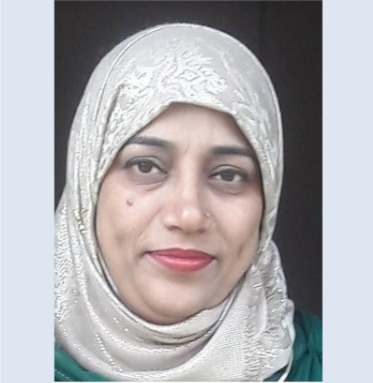
Prof. Rubi Anjum, Department of Tahaffuzi Wa Samaji Tib, Faculty of Unani Medicine, Aligarh Muslim University has been appointed as the Chairperson of the concerned department, for a period of three years, with effect from July 1, 2024.
Prof Anjum, engaged in teaching and research for over the last 16 years, has authored two books and published more than 70 research papers in journals of national and international repute. Besides this, she has attended more than 70 national and international conferences and seminars and presented papers on myriad topics.
She received an Award of Appreciation at a World Health Day event held at Jawahar Lal Nehru Stadium, New Delhi on April 3, 2016, for her role in creating awareness about diabetes.
source: http://www.radiancenews.com / Radiance News / Home> Latest News> Report / by Radiance News Bureau / June 30th, 2024
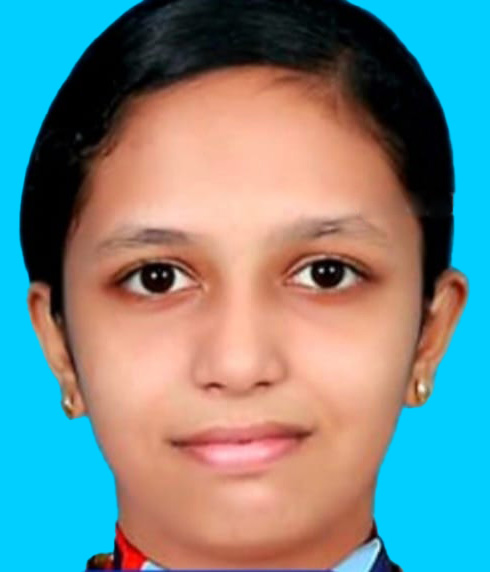
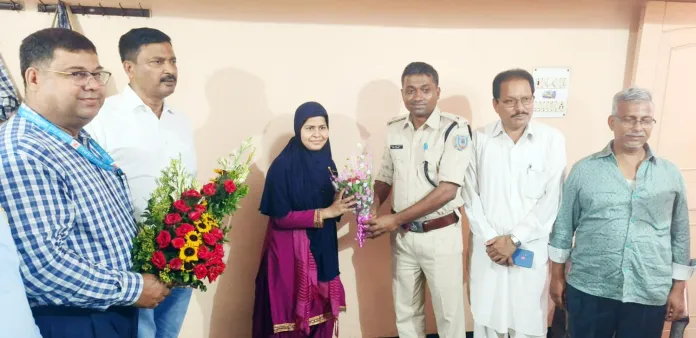
Shaheen Tadipatri, who secured 90% marks in Civil Engineering, was felicitated in a programme jointly organized by Karnataka Dalit Sanghrash Samiti, Adi Jambav High School and Dr. Ambedkar Multi-Purpose Cooperative Society.
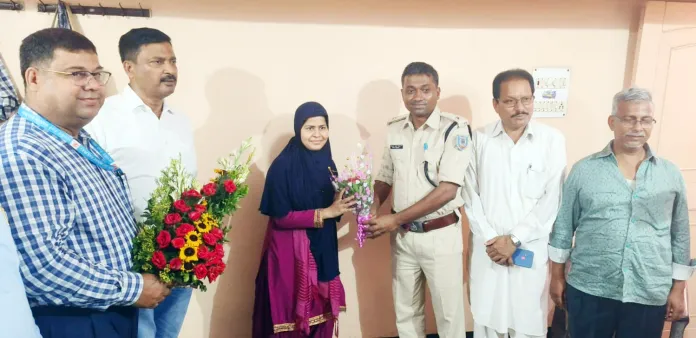
While inaugurating the program, Police Sub-Inspector Parshuram Mirjigi appreciated Shaheen Tadipatri for brightening the name of this small town by securing a distinction in engineering. Her future is bright and she will occupy higher positions in life, he expressed.
The SI advised the students to burn the midnight oil in their studies with keen interest. Get up early in the morning at 4 to 5 am and make it a habit to study.
A reception was held for the 8th class students of 2024-25 batch and a meeting was organized to commemorate the performance of the Maher soldiers in the British Army on 18th June.
On this occasion, the founder president of Adi Jambav High School Faqir Appa felicitating Shaheen Tadipatri presented a cheque of Rs.5 thousand on behalf of the society. Office bearers of the society and school staff were present in the program.
source: http://www.radiancenews.com / Radiance News / Home> Focus> Markers of Excellence / by Mohammed Atherulla Shariff (headline edited) / June 22nd, 2024
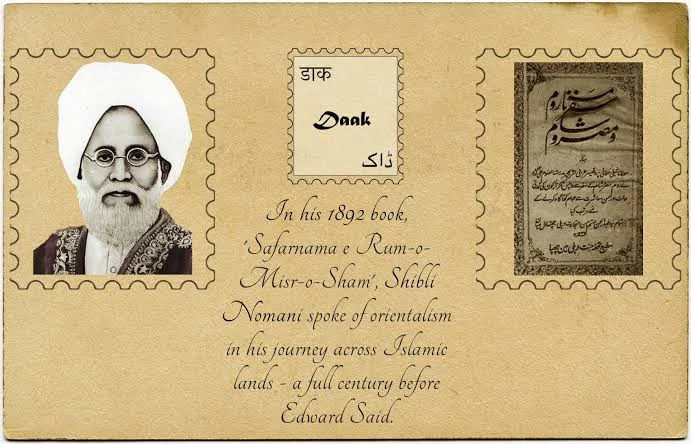
Allama Shibli Nomani was born in Bindol Azamgarh village on June 4, 1857, and passed away on November 18, 1914. He possessed a multifaceted personality and held an esteemed position in various fields. Considering his contributions to knowledge and literature from different perspectives, it is hard to believe that it was the work of a single individual. Besides his contributions to poetry and literature, Allama Shibli Nomani put his indelible mark on history and biography, research and criticism, and education and preaching.
The main focus of Shibli’s academic endeavours was education and religion showing a deep interest in education and educational philosophies. His life was dedicated to the educational activities of his time. From Aligarh Muslim University to Nadwatul Ulama, his sacrifices in the field of education were immense. His vision extended beyond India, encompassing the educational activities and needs of the Islamic world as well.
While he valued traditional education, he was also a proponent of modern sciences. At Nadwatul Ulama, when he was entrusted with educational responsibilities, he included “Al-Durus al-Awliyyah fi al-Falsafah al-Tabi’ah” in the curriculum. This book, written by Christian scholar Allen Jackson and published in Beirut in 1882, was an illustrated text on the basic sciences of its time, covering practical topics such as matter, motion, gravity, liquids, optics, heat, and electricity. Shibli appointed Allama Muhammad Hameed-ud-Deen Farahi and Mirza Muhammad Hadi Ruswa to teach it. This information is derived from Shibli’s letters.
Additionally, in 1901, Shibli hired an English teacher at Nadwatul Ulama with a monthly salary of 15 rupees. This decision led Maulana Abdul Bari Nadvi to translate several modern books on philosophy. The inclusion of English and modern philosophy in the curriculum was a revolutionary step by Shibli. However, after Shibli stepped down in 1913, these subjects were dropped from the curriculum.
Shibli spent his entire life cultivating knowledge and literature. He wrote books, encouraged others to study, and was devoted to the national spirit. Not only did he inspire the youth of the nation towards education, but also guided them in their educational pursuits. The openness of Shibli’s educational ideas is evident from his belief in higher education for women and his support for a curriculum that was equal for both boys and girls. In a letter to Atiya Faizi, he expressed his wish for her to become a speaker and lecturer like other famous women.
In a letter to Maulana Habib-ur-Rehman Khan Sharvani, he wrote about the impressive patterns of women’s education he observed in Bombay. Similarly, during his visits to Italy, Egypt, and Syria, he admired the women’s education and training system in Turkey, spontaneously writing words of praise for the Turks. Shibli tirelessly worked for the education and social awareness of Muslim women.
In 1908, when Nawab Bahawalpur’s grandmother donated 50,000 rupees for the construction of Nadwa, Allama Shibli wrote an enthusiastic article in Al-Nadwa. He referred to her as a “Living Zubaida Khatun,” comparing her generosity to that of Zubaida Khatun, Baramakka, and Taimoor. He wrote:
“The generosity of this lady has not only strengthened the foundation of Darul Uloom Nadwatul Ulama but has also paved the way for its future advancements.”
Extraordinary Passion
“O Subah Allahabad, O Oudh, you are a vast and distinguished region, but the truth is that now you must admit that it is not Punjab, but a part of it, that has earned your enduring respect through one of its revered women. You may have produced Burhan-ul-Mulk and Asif-ud-Daulah, but you cannot claim a Zubeda among your ranks.” (Maqalate Shibli, Vol. 8, p. 80)
Shibli’s travelogue “Safarnama-e-Room-o-Misr-o-Sham [Travelogue of Rome and Egypt, Syria] is essentially an educational report. Shibli’s writings reflect the deep passion he had for education and the kind of education he envisioned. His interest was not confined to India; he also kept a keen eye on the educational landscape of the Islamic world. The core of Shibli’s educational mission was the openness and spread of thought. While he respected ancient academic traditions, he was not averse to embracing new knowledge and wisdom. This excerpt from his travelogue is a significant reflection on the integration of modern and ancient educational ideas:
“Education among the Turks began with the Empire, which is what we now remember as ancient education… But the current state of education has declined so much that, in comparison, our education in India seems deteriorated. The realisation of this in the travelogue shattered all my joy and satisfaction — the fallacy of this ancient teaching… The grief and sorrow expressed by the newly educated in our country over the old education is not genuine sorrow, but rather arrogance and disdain. Although I appreciate new education, I am a strong advocate of old education. I believe that old education is necessary and very important for the survival of Muslim nationality.” (Safarnama-e-Room-o-Misr-o-Sham p. 56)
Due to his constant stress on education, Shibli concluded that it would be beneficial to reduce the gap between ancient and modern education and educational institutions, fostering a mutual exchange of benefits. Shibli believed that English education alone cannot address our current challenges, nor can the old style of education fully support us in the present era. In his opinion:
“We have said this again and again, and now we say it once more: it is not enough for us Muslims to only have English madrasas or ancient Arabic madrasas. The remedy for our pain is a combination of Eastern and Western education.” (Maqalate Shibli, Vol. III, P 57)
In his reference to Constantinople, Shibli emphasises that freedom of thought cannot thrive under government control. He also mentions educational institutes in Europe, where the people, rather than the government, play a significant role. He writes:
“What’s even more regrettable is that all the colleges and darul ulooms in Constantinople that I have mentioned are run by the government. The nation has not paid any attention to this yet. That is, there is not a single national college in such a big capital. No government, no matter how powerful and wealthy, can support the educational needs of the entire country. Even if it could, it wouldn’t be useful. The mental and spiritual powers of a nation whose needs are fulfilled by the government become dead and useless.” (P 40)
Shibli writes in his report on the School of Harbiya in Constantinople, after mentioning the happiness of the students, the ethics of the teachers, and the many branches of education:
“In fact, there is no better college in all of Constantinople in terms of building, supply of equipment, knowledge, education, and good management. However, it is regrettable that most of the people studying in its classes are Christians and the number of Muslims is very small.” (P 59)
Shibli’s analysis needs no further comment after mentioning the academic condition of Turkey, its authors, libraries, newspapers, magazines, and the writings of the masters of various arts:
“The fact is that the method of education in the Islamic world has become so degraded that people are not interested in any kind of modern information except for a few textbooks. As a result, the spirit of innovation and invention is lost to the nation, and there is no hope for it as long as this situation remains.” (P 69)
Shibli writes about the ethics of the students of Al-Azhar University:
“Throughout my journey, I was not as disheartened by the plight of Muslims as I was by the conditions at Al-Azhar University… But sadly, it has destroyed millions of Muslims instead of benefiting them… The condition of the students is such that when they buy goods in the market, they swear by ‘Bras Sayyidina al-Husayn,’ meaning they swear by the price of Imam Hussain’s head. Can such trained people be expected to enhance the glory of Islam?” (P 70)
Regarding the curriculum, Shibli writes:
“There is a continuous and basic teaching of fiqh and syntax, each for eight years. Logic, philosophy, mathematics, astronomy, and other sciences are not included in the teachings. The principles of fiqh, tafsir, hadith, literature, semantics, and narration are taught, but it is done at such a low level that such a large Darul Uloom does not hold any honour in any way.” (P 85)
About the teachers, he writes:
“Sheikh Taban has recently passed away. One of his works has been considered so significant that its annotations and commentaries are included in the curriculum. It is considered a great achievement to understand and memorize this entire series. I asked the students if Sheikh Azhar, who is regarded as a teacher, had done any original work. They proudly said yes, the annotations on Saban’s work are written by him.” (90)
Shibli was constantly active in the educational development of Muslims and did whatever was necessary to achieve this goal. The year 1913 was particularly challenging for him. After Aligarh, Nadwatul Ulama was the only centre of his aspirations, but he had to resign from there. He then dedicated himself to writing biographies. Meanwhile, in the April 15, 1913 issue of the Daily Zamindar Lahore, a proposal by Allama Shibli Nomani regarding the establishment of an Islamic university in Makkah was published. This proposal received many reactions, but Maulana Abul Kalam Azad and some other scholars supported it. Allama Shibli wrote:
“For me, the most important proposal is to establish a university of Islam in Makkah with a high level of education in all religious and worldly sciences (including modern sciences). It is obvious that today all kinds of power are based on knowledge, and in fact, knowledge is the real power. Therefore, nowadays the survival of every nation depends on being proficient in the sciences and arts.” (Ma’arif: November 2013, P 384)
Shibli provided several reasons for the establishment of a university in Makkah. The holy city is a centre of Muslims worldwide, and every Muslim could study there with enthusiasm. He also argued that no other place has as much financial resources as Makkah. If the pilgrims who visit every year were to contribute ten rupees individually to this university, the total amount could reach millions. Shibli also mentioned the presence of a very good library in Makkah. Additionally, he highlighted its pleasant weather conditions; favorable for both teachers and students. Moreover, he pointed out that all the tribes of Arabia, who have been “ignorant for thousands of years,” would benefit from education, with branches of the university being established in their major regions. They would be drawn to knowledge through consistent effort. Shibli concluded by expressing his conviction:
“All I can do is travel all over India for this and then migrate to Makkah and serve this blessed university.” (Zamindar/ April 15, 1913)
Allama Shibli holds a prominent position as a great writer and scholar, with a well-established reputation in this regard. However, less attention has been given to his educational efforts. The reality is that Shibli led a highly active life dedicated to education and educational activities. From his journey from Aligarh to Nadwa, he endured numerous challenges solely for the cause of education. He also faced adverse life circumstances in pursuit of education. If his curriculum reforms had been accepted at that time, the educational landscape today would be completely different. If Nadwatul Ulama had embraced his curriculum a hundred years ago, the madrasas in India today would have a distinct history and glory.
— Dr. Omair Manzar is an Assistant Professor in the Department of Urdu at Maulana Azad National Urdu University.
This article has been translated from Urdu to English by Mohammad Alamullah with the author’s permission.
source: http://www.clarionindia.net / Clarion India / Home> Clarion Special / by Dr Omair Manzar / translated by Mohammad Alamullah / June 05th, 2024
Tamanna Suman, an eighth-grade student from Government High School Vazhakad, has achieved a remarkable feat by being selected for the firing selection at the prestigious Thal Sainik Camp (TSC) 2024 in Delhi. Her selection comes through the National Cadet Corps (NCC) battalion at Calicut University.
Tamanna distinguished herself by securing the first position in the initial selection round held at her school. Demonstrating exceptional skill and dedication, she surpassed over a hundred students from various parts of the state to earn her place at the TSC. This achievement highlights her excellence not only in marksmanship but also in academics and extracurricular activities.
Tamanna is the daughter of T.K. Hameed, a mentor at Al Jamia Shantapuram, and Shahira, residents of Orkadavu in the Malappuram district. Her family’s support has been instrumental in her success, contributing to her balanced approach to both academic and extracurricular pursuits.
The selection of Tamanna Suman for the TSC 2024 has brought immense pride to GHS Vazhakad and its NCC unit. Her accomplishment serves as an inspiration to her peers and underscores the quality of training provided by the NCC battalion at Calicut University. The school community extends its best wishes to Tamanna as she prepares to represent her state and institution at the national level.
source: http://www.radiancenews.com / Radiance News / Home> Latest News> Markers of Excellence / by Radiance News Bureau / May 23rd, 2024
Students of Telangana Minorities Residential Educational Institutions Society (TGMREIS) have excelled in the TGLAWCET-2024 exam.
Telangana Law Common Entrance Test-2024 (TGLAWCET-2024) was conducted for admission into LLB course in the Colleges of Law in Telangana.
The test was conducted by Convenor, TGLAWCET/TGPGLCET-2024 Osmania University on behalf of the Telangana State Council of Higher Education.
According to TGMREIS Secretary Aisha Masarath Khanam, out of 57 TGMREIS students who appeared in the exam, 40 have qualified. They include 28 girls and 12 boys.
Amatul Waheed of Telangana Minority Residential Junior College (TGMRJC) Secunderabad Girls has secured state ninth rank. She has made TGMREIS proud, said Ayesha Khanam.
Out of 38 students from TGMRJC Secunderabad Girls, 28 have qualified. Seven students from TGMRJC Balapur Boys have qualified. A total of 13 students from this Junior College had written the exam. Out of six students of TGMRJC Barkas Boys who appeared in the exam, five have qualified.
Shahnawaz Qasim, Secretary to Chief Minister, Tafseer Iqbal, Special Secretary, Minorities Welfare Department and Aisha Khanam have congratulated students and teachers on their achievement.
Meanwhile, Mohammed Faheemuddin Qureshi, Vice-Chairman and President, TGMREIS has conducted a meeting with all the Principals of TGMR Schools and Junior Colleges and district minority welfare officers.
The meeting reviewed admission status for the academic year 2024-2025 and results of SSC and Intermediate Board Examinations, 2024. Instructions were given to the Principals to take necessary action for reopening of Schools and also emphasized the retention of newly admitted students.
Faheemuddin Qureshi congratulated the Principals for achieving good results in public examinations and felicitated 10 Principals for achievement of 100% results in SSC, IPE Board Examination results, 2024.
Faheemuddin Qureshi said that the Government of Telangana is fully committed to provide facilities to minorities specially TGMR Schools. He asked the Principals to inculcate discipline among the students and ensure that TGMR Schools should be top in all respects. He instructed the Principals to provide good hygienic food to the students. He informed the Principals that he will be visiting the schools shortly and take the feedback from the stakeholders and give the reward to the good institutions and will not tolerate any adverse remarks noticed.
Shahnawaz Qasim, Faheemuddin Qureshi, and Aisha Khanam congratulated the students, teachers and principals on their achievement.
source: http://www.radiancenews.com / Radiance News / Home> Education / by Radiance News Bureau / June 15th, 2024
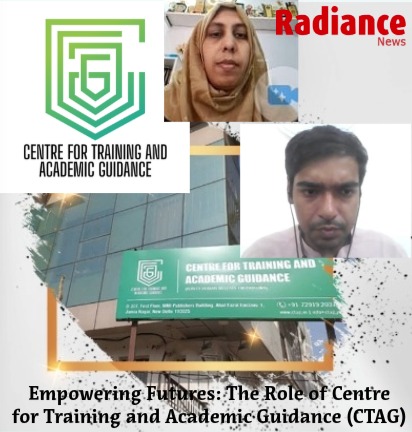
Through its dedication, sensitivity, and comprehensive approach, CTAG empowers individuals from socio-economically weaker backgrounds to pursue their dreams and aspirations.
In the pursuit of a brighter future for all, particularly those from socio-economically weaker backgrounds, initiatives like the Centre for Training and Academic Guidance (CTAG) play a pivotal role. CTAG, a non-profit organization under the auspices of the Human Welfare Foundation, is dedicated to providing career counseling and guidance to students hailing from such backgrounds.
In this exclusive interview, Ayesha Sultana, Assistant Editor of Radiance and an educator and academician by profession, engages in a conversation with Faizy Rahman, a dynamic individual with a diverse educational background, holding a BTECH in Mechanical Engineering from DTU and an MA in Psychology from DU. Currently serving as the Centre In-Charge of CTAG, Mr. Rahman brings a unique blend of technical expertise and psychological insight to his role. With her keen interest in initiatives aimed at empowering individuals from diverse backgrounds, Ayesha delves into CTAG’s mission and impact through her insightful questions.
Q: Could you provide an overview of CTAG’s mission and objectives?
A: CTAG’s mission is to provide career counseling and guidance to students from socio-economically weaker sections of society. We aim to empower individuals with the knowledge and tools to make informed career decisions, thereby opening doors to brighter futures.
Q: What inspired the establishment of CTAG, and how does it aim to make a difference in the lives of its beneficiaries?
A: CTAG was established to address the barriers faced by students from disadvantaged backgrounds in accessing career guidance. By providing personalized guidance and support, we strive to empower our beneficiaries to pursue fulfilling career paths aligned with their interests and aptitudes.
Q: Can you elaborate on the services and programs offered by CTAG to achieve its objectives?
A: Certainly. CTAG offers a range of services including psychometric assessments, individual counseling sessions, group workshops, career awareness workshops, and scholarship support. Additionally, we provide training programs for teachers and counseling professionals to enhance their skills in guiding students effectively.
Q: How does CTAG ensure its guidance and assessments are culturally sensitive, particularly in states across North India?
A: Cultural sensitivity is integral to our approach at CTAG. We tailor our assessments and guidance to suit the cultural backgrounds of our students, ensuring that our services are relevant and effective. By understanding and respecting cultural nuances, we aim to build trust and rapport with our beneficiaries.
Q: What initiatives does CTAG undertake to engage with the community and raise awareness about career guidance?
A: CTAG actively engages with communities through outreach programs, workshops, and seminars to raise awareness about the importance of career guidance. We collaborate with local organizations, schools, and colleges to reach a wider audience and provide valuable insights into career options and opportunities.
Q: As CTAG expands its reach, what are some future goals and aspirations for the organization?
A: Our future goals include expanding our reach to underserved communities across India and enhancing the quality and accessibility of our services. We aim to leverage technology and innovation to reach more individuals and provide them with the guidance and support they need to pursue their aspirations.
Q: How does CTAG measure its impact and success in empowering individuals from socio-economically weaker backgrounds?
A: CTAG evaluates its impact through various metrics including the number of beneficiaries served, feedback from beneficiaries and their success stories, partnerships formed with educational institutions and community organizations, and post-counselling tracking of students. We continuously assess and refine our programs to ensure they effectively meet the needs of our beneficiaries.
Q: What kind of help do you provide after career guidance for placements?
A: We offer an Employability Enhancement Program which includes assistance on how to face an interview and writing CVs.
Q: What else does CTAG offer besides career guidance?
A: CTAG also provides training for teachers and mentors, as well as one-day career guidance counselor workshops. Additionally, we offer a Career Guide Training Program for individuals interested in becoming professional career counselors. We also conduct a 5-day program for comprehensive guidance, annually.
Q: How can individuals access all the information provided by CTAG?
A: We have a career library and an updated website which provide information on various courses, admissions, university notifications, etc.
Individuals can access information through our website, www.ctag.in and/or contact us via WhatsApp at 72919 20374.
In a world where opportunities are often scarce, organizations like CTAG serve as beacons of hope, guiding individuals towards brighter futures. Through its dedication, sensitivity, and comprehensive approach, CTAG empowers individuals from socio-economically weaker backgrounds to pursue their dreams and aspirations. As it continues to expand its reach and impact, CTAG remains committed to shaping careers and transforming lives for the better.
source: http://www.radiancenews.com / Radiance News / Home> Face to Face / by Ayesha Sultana, Radiance News Bureau / May 05th, 2024
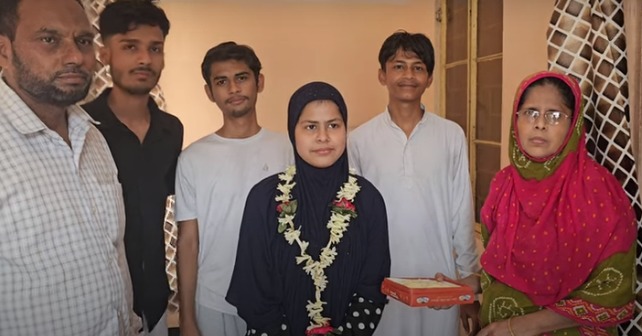
Kahkasha Parveen, a resident of Baganshahi Road No. 7 under Azadnagar Police Station in Mango, has been felicitated for achieving a perfect score of 720 out of 720 in the NEET examination. The accolades poured in at a prestigious ceremony organized by Jamaat-e-Islami Hind Jamshedpur in Azadnagar’s conference hall.
The event, graced by Dr. Arifa Khursheed, a distinguished specialist in women’s health, saw Kahkasha Parveen lauded for her remarkable dedication and perseverance in pursuing a career in medicine. Dr. Khursheed emphasized the challenges Kahkasha overcame, noting that her achievement reflects both her academic excellence and personal resilience.
Kahkasha, a source of immense pride for her community in Baganshahi, was joined by others including Tasneem, Kulsum Anwar, Mahrukh Parveen, and Rimsha Ara, who were also recognized for their contributions to society.
Prof. Anjum Ara, representing the Women’s Wing of Jamaat-e-Islami Hind Jharkhand, highlighted the solidarity and support extended to Kahkasha during her academic journey, underscoring the community’s unwavering unity in difficult times.
The ceremony, overseen by Amaan Sadiq, included expressions of gratitude by Shahnavaz Qamar on behalf of the gathering.
Notable figures such as Master Ashfaq Anwar, Tanveer Akhtar Romani, and Khursheed Akram Ansari extended their heartfelt congratulations to Kahkasha and her family.
Kahkasha Parveen, with aspirations to serve as a doctor, has pledged to provide free medical care to the underprivileged, underscoring her commitment to community service and welfare.
In another gesture of felicitation, various community leaders and well-wishers visited Kahkasha’s residence. They included Azadnagar Police Station in-charge Rakesh Kumar Singh, Sidhgora Police Station in-charge Ghulam Rabbani Khan, Syed Naushad of Tatanagar Railway Station, and Azadnagar Police Station Peace Committee Secretary Mukhtar Alam Khan. Haji Mohammad Ilyas, Rizwanuj Jama, Syed Asif Akhtar of Al Kabir Polytechnic College, Syed Saifuddin Asdak, Imam of Hussaini Masjid and Founder Chairman of Paigam-e-Islam, Master of Dawat-e-Islami Jamil Ansari all presented bouquets, shared sweets, and conveyed their immense pride and congratulations to Kahkasha Parveen and her family.
Kahkasha’s father, Mohammad Abbas, a fruit seller, and her mother were specifically acknowledged for their unwavering support that played a pivotal role in their daughter’s grand success.
source: http://www.radiancenews.com / Radiance News / Home> Education / by Radiance News Bureau / June 13th, 2024
Aysha Merchant, a student of Indian Design School, has secured the 3rd rank in the Interior Design course at Mangalore University. This achievement highlights her hard work, creativity, and commitment to excellence in the field of interior design.
Aysha’s journey in interior design began with a passion for creating aesthetically pleasing and functional spaces.
‘Throughout her course, she consistently demonstrated an exceptional eye for detail and a deep understanding of design principles. Her projects, which often blended innovation with practicality, earned her high praise from both peers and faculty members,’ a press release from the institution stated.
‘During her time at Indian Design School, Aysha participated in numerous design competitions and workshops, further honing her skills and expanding her knowledge. Her ability to think outside the box and her keen sense of style set her apart, making her a standout student in her class,’ the release added.
The 3rd rank at Mangalore University opens up numerous opportunities for her future in the interior design industry.
Aysha expressed her gratitude to her family, friends, and mentors who supported her throughout her academic journey. She said, “This achievement wouldn’t have been possible without the unwavering support of my loved ones and the guidance of my professors. I’m excited to embark on the next chapter of my career and to continue exploring the limitless possibilities in interior design .”
‘As she moves forward, Aysha aims to contribute to the field of interior design by combining her academic knowledge with practical experience. She is enthusiastic about creating unique, sustainable, and innovative designs that can transform spaces and enhance the quality of life for individuals and communities,’ it added.
Aysha Merchant’s accomplishment is a proud moment for Indian Design School and Mangalore University. It shows the quality of education and training provided by the institution and serves as an inspiration to other students pursuing their dreams in the creative arts.
Three students of Dr. G Shankar Government Women’s First Grade College and Post Graduate Study Centre scored high ranks in the post-graduate exams conducted by Mangalore University for the academic year 2022-23.
Sayyed Reha Qadri, one of the students, has been awarded a gold medal for scoring 8.65 CGPA in MSc Chemistry.
M Preethi Acharya and Nidhi N Pai have scored second and fifth ranks, respectively, in M. Com., a press release from the college stated.
source: http://www.english.varthabharati.in / Vartha Bharati / Home> Karavali / by Vartha Bharati / June 08th, 2024
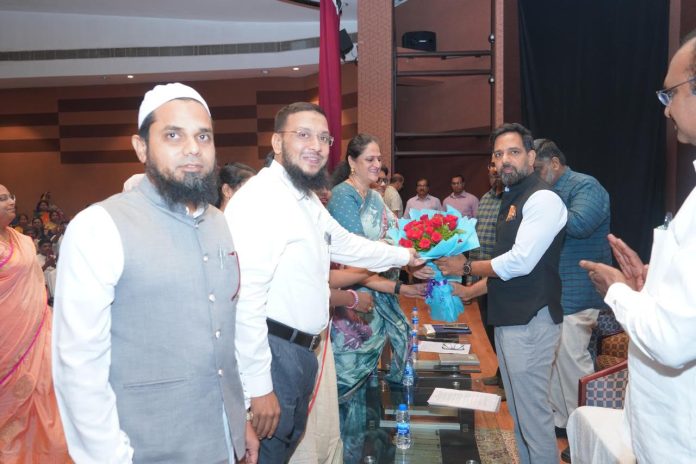
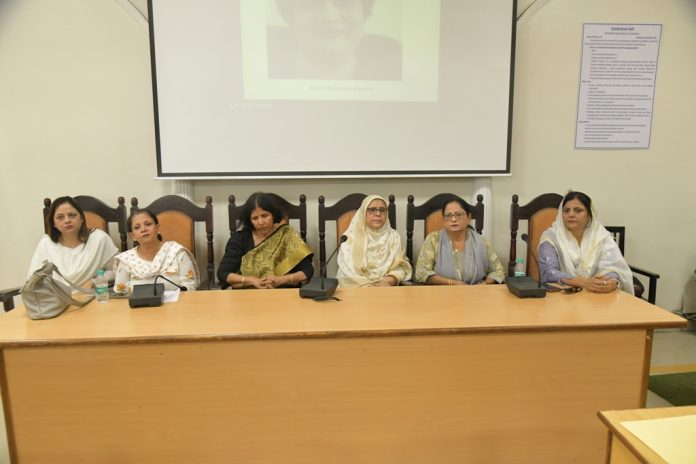
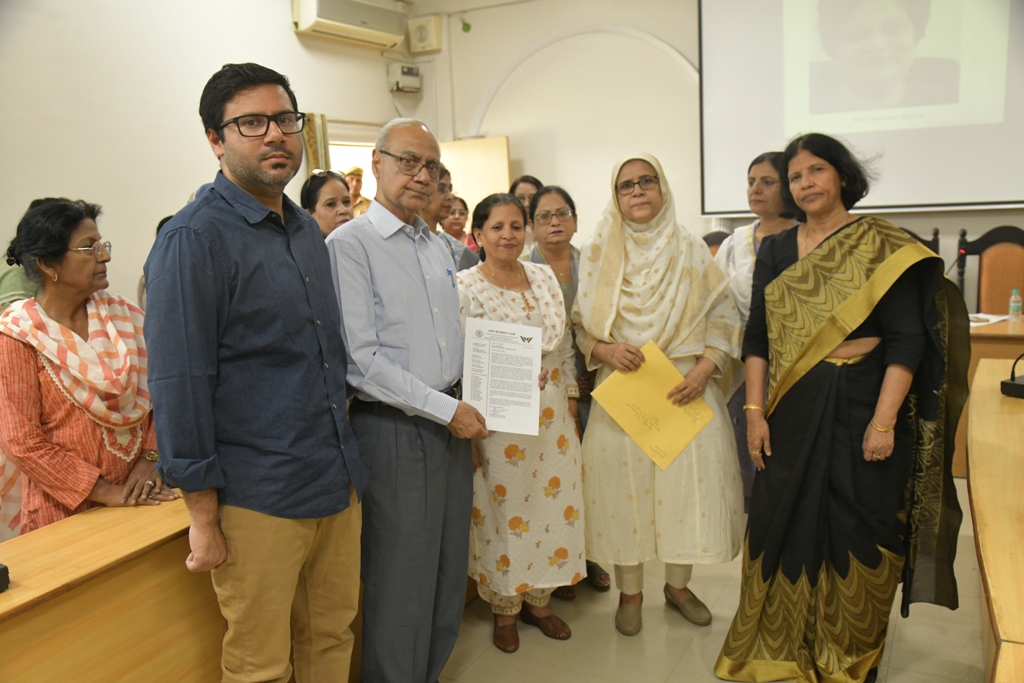
Prof Naima Khatoon, Dr Hamida Tariq, Prof Subuhi Khan and others during the condolence meeting of Seemin Hasan
Aligarh :
The Aligarh Muslim University (AMU) community gathered to honor the memory of the late Prof Seemin Hasan, who passed away on May 23.
During a heartfelt condolence meeting organized by the AMU Women’s Club, Vice Chancellor Prof Naima Khatoon paid rich tributes to Prof Hasan, reminiscing about their days together in Abdullah Hall. She prayed for Prof Hasan’s soul to find peace in Jannah and offered solace to her family and friends.
Prof Hasan, a senior faculty member in the Department of English and a valued member of the AMU Women’s Club, was remembered fondly by her colleagues and friends.
Dr. Hameeda Tariq, the founding Patron of the Club, highlighted Prof Hasan’s exceptional abilities as a professional, a friend, and her remarkable culinary skills.
Prof Azarmi Dukh Safavi, former President of the Club and former Dean of the Faculty of Arts, spoke of Prof Hasan’s caring and generous nature. Prof Syeda Nuzhat Zeba, current President of the AMU Women’s Club, praised Prof Hasan’s exemplary character and recounted their long-standing professional and personal relationship.
Prof Subuhi Khan, Secretary of the AMU Women’s Club, expressed the profound sense of loss felt by the community, describing Prof Hasan as a great source of inspiration. Dr. Faiza Abbasi, Director of the UGC MMTTC and founding Joint Secretary of the Club, lauded Prof Hasan as an outstanding English scholar and gracious teacher, emphasizing her role as a diligent role model.
On behalf of the family, Prof Hasan’s son, Dr. Saif, paid rich tributes to his mother and thanked the club members for their support during this difficult time. He mentioned that AMU was integral to her identity and announced the family’s intention to establish an endowment in her name. This endowment will fund commemorative lectures, literary and scholastic events, and quality publications at the university.
The condolence message was handed over to Prof Abrar Hasan, Prof Seemin Hasan’s husband and former Dean of the Faculty of Medicine, by Vice Chancellor Prof Naima Khatoon, Secretary Prof Subuhi Khan, and other club members.
A two-minute silence was observed in memory of Prof Hasan.
Prof Seemin Hasan is survived by her husband, Prof Abrar Hasan, and her sons, Dr. Saif and Dr. Shabih.
source: http://www.radiancenews.com / Radiance News / Home> Latest News / by Radiance News Bureau / June 10th, 2024