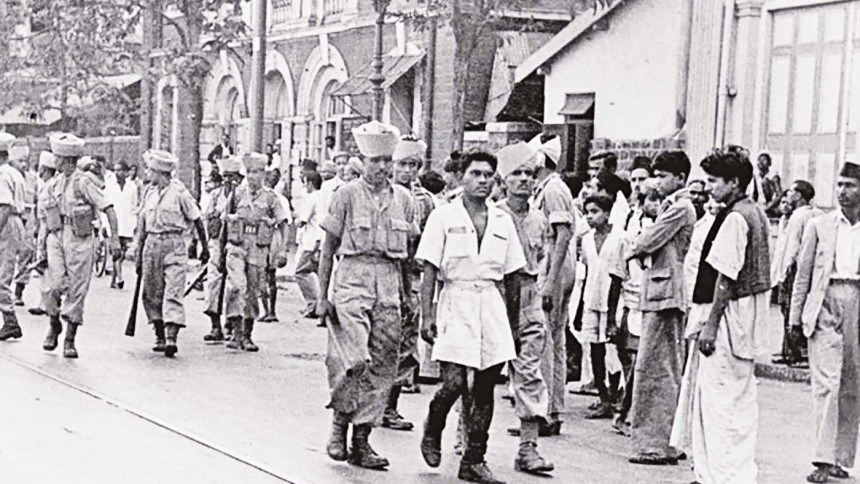
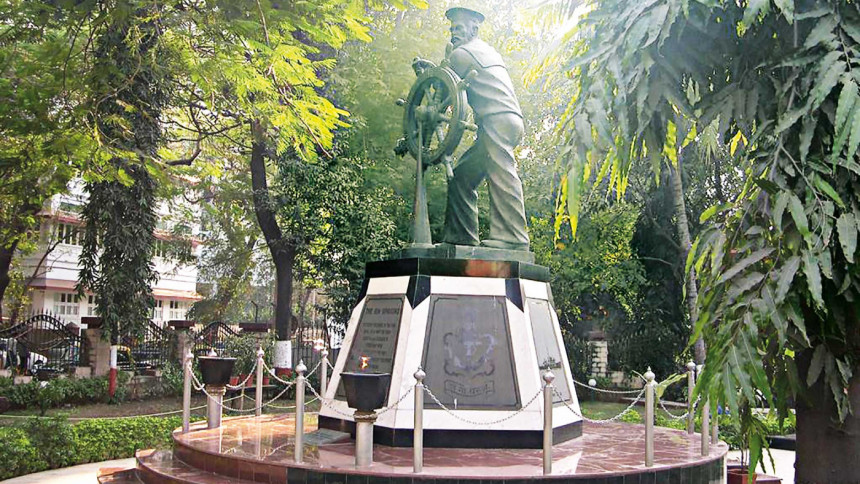
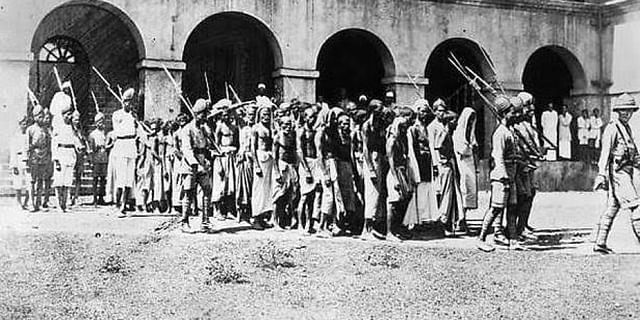
One of the most important but undervalued events of India’s independence movement was the naval revolt of 1946, about which Indian historian Sumit Sarker wrote, “Had this insurrection succeeded, India’s struggle for freedom might have taken a different turn.” From February 18 to 23 that year, more than 20,000 ordinary sailors, known as ratings, and low-ranking officers of 74 warships and 20 installations took part in a strike, which was termed as a mutiny or rebellion.
After Bengal lost its independence at Palashi’s Mango grove in 1757, the British Raj in India faced two major armed revolts: the first one was exactly after one hundred years, the military revolt of 1857, and the second one was 189 years later, the naval mutiny. Both in 1757 and 1857, the freedom fighters were defeated by the arms and tactics of the British rulers, but the naval mutiny failed because of the politicians in India then. It was not only the ratings’ mutiny that the political leadership had decided not to support – the civilian uprising triggered by the naval mutiny, too, was condemned by them. The scale of the civilian uprising, if it happened in a post-colonial era, would have created a revolution or at least caused the fall of the government of the day.
Three days after the mutiny ended and the civilian uprising was crushed with brutal force, the then British Prime Minister Clement Atlee told the House of Commons on February 26, 1946, “I regret to inform the House that grievous loss of life, injury and destruction of property have resulted from all these disturbances. In Bombay, there have been 223 deaths and 1,037 persons have been injured. The total damage includes the looting or destruction of nine banks, 32 government grain and cloth shops which the public can ill-afford to lose, 30 other shops, 10 post offices, 10 police stations and 1,200 street lamps. The number of vehicles destroyed is not yet estimated. In Karachi, there have been seven deaths and 21 cases of injury. In Madras, up to last night, one person has been killed and another seriously injured” (Source: Hansard).
Mr Atlee in his statement said, “Both Congress and Muslim League leaders cooperated in condemning and attempting to stop the disturbances, but the Communist Party issued a manifesto at midnight on Thursday thanking the public for its support.” It perhaps explains why, to this day, the political classes of the three countries born from the partition of India are not willing to admit their failure and give those mutineers and civilian martyrs their due credit. Therefore, in 2021, there was no big event in the subcontinent to mark the 75th anniversary of the naval revolt.
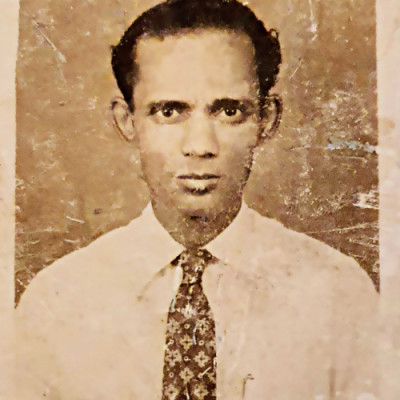
Mohammad Dewan Ali Nazir, Royal Indian Navy, Index no: 34499.
On a personal level, it’s ironic that, despite studying history at the country’s two top universities, I, too, did not take much interest in it during my student life. When I first heard of the rebellion from a mutineer, I had already taken a job and started my professional journey devoid of in-depth history. The mutineer I am talking about was my father, who spoke about his role and feelings about the lost cause during one of my short home visits. My father, Mohammad Dewan Ali Nazir (Royal Indian Navy, RIN, Index no: 34499) was one of the last 3,500 sailors and 300 sepoys who refused to surrender until the last on board of HMIS Akbar.
They were detained after surrendering and were released in August of that year. The mediation and the assurances given by the leaders of both Congress and Muslim League turned out to be nothing but betrayal. Though the uprising was a challenge to the Empire, shaking up the British imperial order, the leaders of the nationalist movement waiting to form an interim government through negotiations were not ready to derail that prospect.
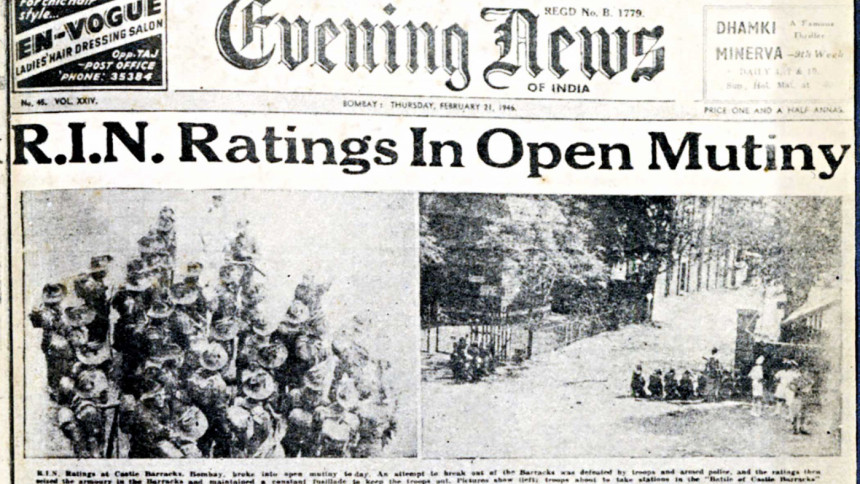
Newspaper clipping of the Evening News.
The leaders of the Congress and the Muslim League did not want a revolution – they wanted a peaceful transfer of power. Among the leading politicians, only Congress leader Aruna Asaf Ali extended her support to the ratings’ strike and tried to persuade her party leaders to take a stand in favour of the strikers, but failed in the face of opposition from Vallabhbhai Patel. On February 22, Vallabhbhai Patel sent a message to the rebels to surrender. Only the Communist Party of India came forward in support of the naval revolt and called a general strike. Reading the memoir of one of the key figures of the revolt, Balai Chand Dutt (BC Dutt), and a few other publications, one can easily imagine how much frustration and pain those mutineers felt because of the national leaders’ silence, which they saw as a betrayal. Perhaps it explains why my father, too, lost interest in politics and didn’t speak much about the heroic uprising that ended in a tragedy.
Those nationalist leaders, including Gandhi, Jawaharlal Nehru and Muhammad Ali Jinnah, advised them “not to mix up ‘political demands along with service demands’; to ‘remain calm’ and to formulate to the naval authorities their service demands.”
But from the very beginning, those naval ratings were raising political demands – particularly, the Quit India slogan.
Their Charter of Demands asked for: 1. Release of all Indian political prisoners; 2. Release of all Indian National Army personnel unconditionally; 3. Withdrawal of all Indian troops from Indonesia and Egypt; 4. British nationals to leave India; 5. Actions against the commanding officer and signal bosonshead for rough treatment of the crew; 6. Release of all detainees (naval ratings); 7. Speedy demobilisation of the RIN ratings and officers; 8. Equal status with the British navy regarding pay, family allowances and other facilities; 9. Best class of Indian food; 10. No return of clothing kit after discharge from service; 11. Better treatment from officers to subordinates; and 12. Installation of Indian officers and supervisors. (Source: Meanings of Failed Action: A reassessment of the 1946 Royal Indian Navy uprising by Dr Valentina Vitali, University of East London, UK.)
Autobiographies of two rebels – BC Dutt and Biswanath Bose – suggest that the then (undivided) India could have been a different place if the revolt of that day had succeeded. The rise of communal politics, the division and instability that is spreading in the states and society, would not have happened.
BC Dutt was one of the organisers of the HMIS Talwar, the ship where the mutiny started. He was arrested and tried for writing a new slogan on a ship on February 1, three weeks before the start of the February 18 mutiny. His book, The Mutiny of the Innocents, contains details of how political literature and pro-independence activities were organised much before their strike.
Biswanath Bose’s RIN Mutiny, 1946 also gives detailed descriptions of how the revolt unfolded. But politicians argued that the revolt was mostly due to the resentment among Indian ratings over low wages, poor quality of food and housing, which was lower than that of the Whites, and racial discrimination.
After the mutiny of 1857, the British rulers banned the entry and discussion of political leaflets in all forces, but BC Dutt used to secretly discuss political documents in the ship HMIS Talwar. Two months before the mutiny, on the Naval Day on December 1, when it was open for public visit, they wrote various slogans, including “Quit India” and “Jai Hind” on the ship. Explaining the reason why the mutiny failed, BC Dutt wrote that while all Europeans and Indians were stunned by the course of events and wondering if it was a revolt, unfortunately the political parties had nothing to say. When it was time to lower the British Union Jack and fly the Indian flag, they felt unprepared.
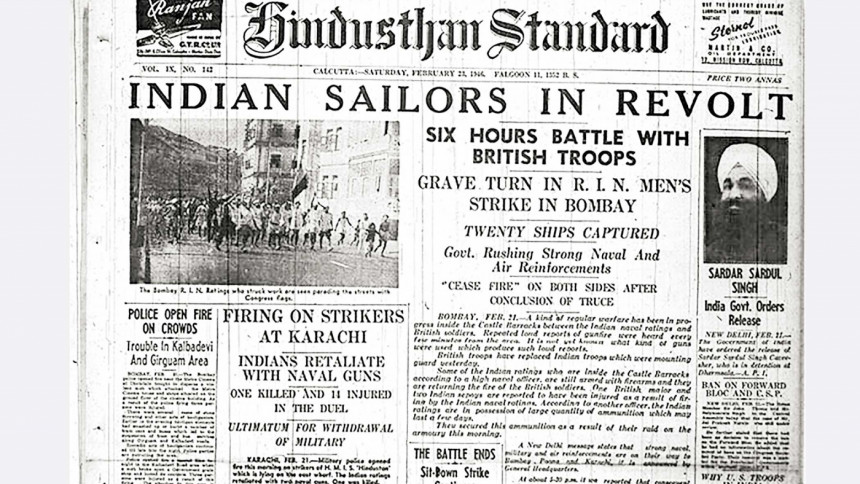
Newspaper clipping of the Hindusthan Standard
On February 22, 1946, when the nationalist leaders were busy arranging the ratings’ surrender, Prime Minister Clement Attlee told the parliament that the sailors had given political slogans and demanded that a political leader be given a chance to speak. He also said in the statement that Congress had nothing to do with the insurgency, but the communists and leftists could try to exploit sympathy.
William Richardson, a British researcher, writes in The Society for Nautical Research that the political movement for India’s independence was at the root of the revolt (The Mutiny of the Royal Indian Navy at Bombay in February 1946, May 1993).
Author of the book 1946: The Unknown Mutiny, Promod Kapoor wrote that the navies fell between the two aspirations of the two rulers. One side wanted their impending departure not to be tarnished by the stigma of rebellion. On the other hand, when power was imminent, the other rulers were anxious to see if there were any signs of chaos in the armed forces. Because in the future, they would have to manage these forces.
Politicians assured that no one would be punished, no compensation would be paid, and steps would be taken to meet the demands. In reality, the opposite had happened. Rebel leaders were arrested, tried and punished. Other rebels were told to grab third-class train tickets to return home and to never return to Bombay again. Showing various excuses, deductions were made from salary arrears even for minor damages in their uniforms.
Biswanath Bose’s book gives a glimpse of how frustrated and angry these rebels became with the behaviour of the government and the breach of promises by the political leaders. He wrote, “If patriotism is a crime, then we must be criminals.” Expressing his frustration for not being reemployed in the Indian Navy, he wrote a letter to Prime Minister Nehru asking if there was any law banning his return to the force due to dismissal for taking part in the freedom movement, and how, as a leader of the Congress, Nehru could be the prime minister.
Nationalist leaders were so reluctant to give the mutineers their due credit, that the Indian government banned the Bangla play Kallol (Sound of the Wave), based on the mutiny, by playwright Utpal Dutt, and he was imprisoned. The play was first performed in 1965 in Calcutta at the Minerva Theatre and it drew large crowds.
At the beginning of the naval strike, a Central Strike Committee (NCSC) was formed by the representatives of the ships stationed in Bombay. The committee renamed the Royal Indian Navy as The Indian National Navy. The committee was chaired by Signalman MS Khan, and Madan Singh was the vice-president. One remarkable element of the naval rebellion was the unity of various faiths among both the naval force and the civilians who took to the street. They raised slogans “Hindu-Muslim unite” and “Inquilab Zindabad” on the streets of Bombay.
BC Dutt’s book also speaks of this communal harmony. He wrote, “We are from different regions, and from families of Hindu, Muslim, Christian and Buddhist, but after spending years in the Navy, we sailors have become Indians. The irony is that the politics of communal division and hatred is now intensifying across the subcontinent.
(After leaving the job of a naval instructor, my father joined the office of Indian Civil Supply, and after a short stay in Kolkata, he was transferred to East Bengal. He retired as a magistrate and died on August 29, 2001.)
Kamal Ahmed is an independent journalist and writes from London, UK. His Twitter handle is @ahmedka1
source: http://www.thedailystar.net / The Daily Star / Home> In Focus / by Kamal Ahmed / July 25th, 2022
Over the past few years, and particularly after their recent tussle with the government over the statue of Bangabandhu Sheikh Mujibur Rahman, the Ulama’s involvement in politics has come back under scrutiny in Bangladesh. Since the 10th century, the Ulama have been exercising strong authority over religious issues; yet they have been accused of failing to respond to modernity and to the changes in society.
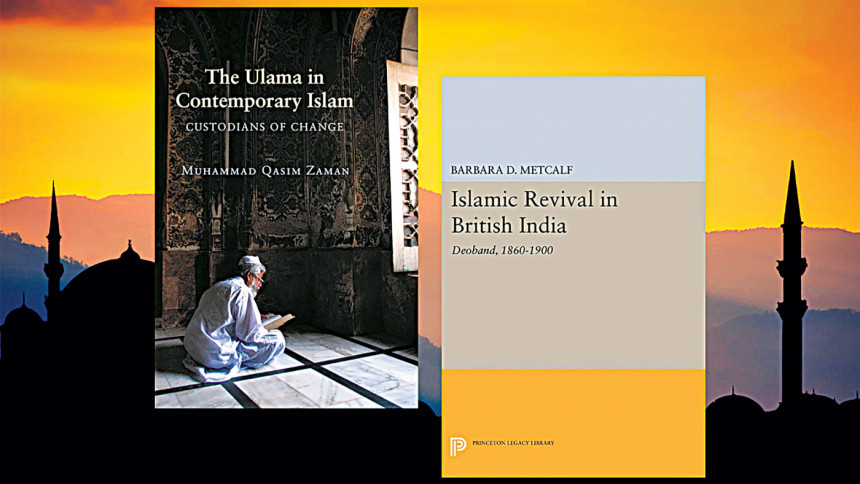
Against this backdrop, the actions, discourses, and history of the Ulama are well worth looking into. Muhammad Qasim Zaman’s The Ulama in Contemporary Islam: Custodian of Change (2002) and Barbara D Metcalf’s Islamic Revival in British India: Deoband, 1860-1900 (2016), both published by the Princeton University Press, are two outstanding studies in this regard. While Metcalf looks into the emergence, proliferation, and responses of the Deobandi Ulama to “modernity” when Muslim power in India was declining, Zaman looks at their strategy to establish authority in British India and Pakistan.
Shifting sands of influence
In pre-British India, religious education was a private enterprise and individual tutelage was the usual mode of the dissemination of religious knowledge. This tradition was to change with the emergence of the Farangi Mahall Ulama as custodians of Muslim intellectual traditions.
The Lucknow-based Farangi Mahall Ulama were known by the family of Mulla Hafiz, who received a land grant from Mughal Emperor Akbar sometime in the sixteenth century. He was the ascendant of Qutbu’d – Din (d. 1691), a Mughal courtier who participated in the collection of Fatawa-yi ‘Alamgiri’. The latter is a collection of Fatwa to be used in the Mughal courts. The family and students who took lessons from this family were known by the name of Farangi Mahall. The activities of the Ulama of Farangi Mahall, however, were confined to producing graduates for princely services. Their most significant contribution was their systemisation of the curriculum—dars-i-Nizami—for religious education. As Metcalf informs us, this curriculum came to Bengal when a Farangi Mahall graduate was appointed as the first principal of the madrasa yi ‘Aliyah’, Calcutta in 1780.
Farangi Mahall’s dominance declined and the centre for religious studies shifted from Lucknow to Delhi by the late 18th century. The person who played a key role in this shift was Shah Waliyu’llah, who advocated for more social and political responsibilities for the Ulama as opposed to those of the Farangi Mahall. Waliyu’llah’s successors had studied legal codes and written fatwa for the Muslim community, which had once become the main tool to disseminate religious instructions when the British were about to establish political authority over India. Besides claiming centrality of the hadith in the interpretation of the sharia, Shah Waliyu’llah discouraged blindly following the rulings of the earlier generations (taqlid). He suggested going back to the Quran or Sunnah for legal solutions.
The 1857 revolution landed heavily upon the revivalist movement initiated by Shah Waliyu’llah. Suspecting the Ulama’s involvement, British colonisers took all religious institutions in Delhi under their control. Fourteen hundred people were shot by British soldiers in Kuchah Chelan, where Shah Abdul Aziz (son of late Shah Waliyu’llah) used to preach, according to Metcalf. The Delhi-based Ulama were forced to move to the countryside and establish a madrasa at Deoband in 1867.
After the revolution, Deoband became the centre for Muslim intellectuals. They introduced formal religious education for Muslims in British India. Students had separate classrooms and a library, and the curricula were organised according to departments, such as Arabic, Persian, and others. A formal examination system was introduced and successful students were issued certificates of award. Graduates came from different corners of India. Most significantly, these graduates went back home and set up madrasas in their respective localities. By the end of the 18th century, nearly every town held the presence of the Deobandi Ulama.
One well known Deobandi Ulama was Muhammad Ashraf Ali Thanawi (1863-1943), who authored Bahishti Zewar (1981)—among the most popular books for Muslims of India, and masterminded the Dissolution of Muslim Marriages Act 1939—the first reformist legislation for Muslims of British India.
In the late 19th century, the Ulama played a crucial role in upholding the pride of their religion and their community through publications and public debate on religious issues. Their intellectual exercise peaked with the invention of print technology, multiplying the scale of the transmission of knowledge all over India. Publishing in local languages such as Urdu, instead of Arabic, was one of their effective strategies to establish authority. This also served as a medium of communication between common Muslims and the Ulama, and helped renew Muslim traditions against local customs. Following the birth of Pakistan on August 14, 1947, the Ulama consolidated their authority and forced the then government not to pass a law against sharia. Over the next few years, their continuous efforts would force the Pakistani government to establish a Supreme Sharia Board to oversee any inconsistencies between sharia and laws passed by the parliament.
The historiography of these two books may be compared with Geoffrey G Field’s Blood, Sweat and Toil: Remaking the British Working Class, 1939-1945 (Oxford University Press, 2011), in which Field understands “class” from multi-dimensional approaches including its relationship with the state, society, and family. Similarly, Barbara Metcalf and Qasim Zaman define the Ulama as a class by providing a social and intellectual history of their presence in South Asia. Metcalf highlights their hardships in the post-1857 revolution and the silent “intellectual” revolution of the Deobandi Ulama. Hers is an excellent cultural history. Despite being published earlier, Zaman fills in what Metcalf’s study left to be addressed: it focuses on how the Ulama have played an active role in different social and political contexts, particularly in post-colonial Pakistan. He disapproves of the allegation that the Ulama are against changes. The common mistake that most studies make, says Zaman, is not to consider the social and political context within which the Ulama work. To him, the flexibility of sharia depends on a socio-political context. Zaman suggested that the Ulama do not respond to changes as not because they do not like it but because of their fear of losing authority over religious issues in a modern state.
None of the above-mentioned studies, however, concerns the Ulama of Bangladesh. The growing presence of the Bangladeshi Ulama in the public sphere, particularly their increasing involvement in the political issues, merits investigation into—in Zaman’s words—their “transformation, their discourses, and their religio-political activism.” Could the Ulama in Bangladesh inherit the wind of the Islamic intellectual traditions? The question deserves to be addressed amongst others.
Dr Md Anisur Rahman is a legal historian at Asian University for Women. His research interests include Islam in Asia and South Asian Islamic Law and Society.
source: http://www.thedailystar.net / The Daily Star / Home> Reviews / by Md. Anisur Rahman / January 28th, 2021
Maulana Muhammed Manzoor Nomani (1905-1997), most arguably was one of the five prime most Muslims of the Indian sub-continent in the last century. He was the founding member of Jamaat-e-Islami and later got associated with Tablighi Jamaat and was also the member of founding committee of Muslim World League.
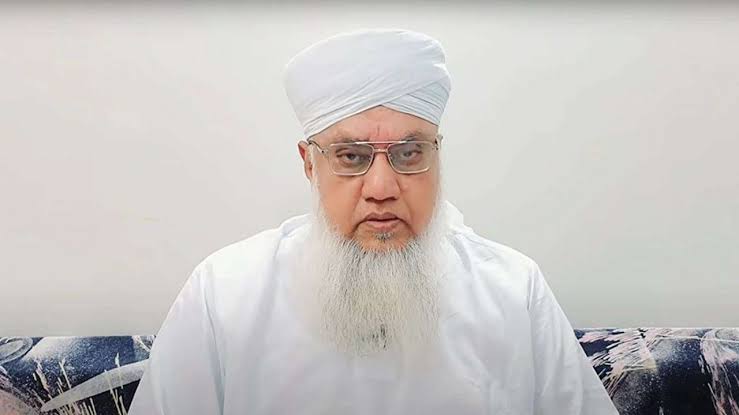
Maulana Khalil-ur-Rehman Sajjad Nomani is his son who gives every credence to his father, as that is what has made him, potentially what he is today; the most potent Muslim voice in the nation.
Sajjad Nomani’s command on Arabic, Quran, Hadith, Urdu, Hindi and English, in the same verve, depth and gravitas, apart from being an eloquent speaker, an indefatigable champion of Muslim cause, a voracious reader and a writer with an unquestionable command on the intricacies of linguistic theory and cultural praxis, are all the qualities he has embodied and imbibed from his late father.
Yours truly also did once saw Manzoor Nomani Sahab, at his Nazeerabad residence, Lucknow, as he sat on his wheel chair engrossed in an Urdu newspaper and also attended to his funeral at Aishbagh, Lucknow in 1997.
It would be worthy to recollect some of the anecdotes Sajjad Sahab shared about his late father, which all are a treasure trove to understand the ‘times’ about seventy-five years back.
He reminisced that Pakistan first Prime Minister Liaquat Ali Khan was very insistent that Manzoor Sahab visit Pakistan and become a part of Pakistan Constituent Assembly to ‘pave for the ingredients’ for Islamic Jurisprudence for the state of Pakistan, and ultimately even officially sought for it, as Manzoor Sahab was one of the most outstanding figures of Islamic Law and Jurisprudence at those times.
When India’s PM Jawahar Lal Nehru came to know of it, he communicated that though he does not want Maulana to volunteer it, yet if Maulana wanted then government of India was to facilitate it. But, there was no question of Manzoor Sahab even entertaining the idea as he was an unwavering Indian by his heart, not out of any chance but primarily for his choice, as Muslims after 1947 were to choose between India or Pakistan and Manzoor Sahab stood for India.
Maulana Khalilur Rahman Sajjad Nomani
Sajjad Sahab would also reflect that it was in 1976, when he was studying in Medina University, and had come to India on his vacations, that Manzoor Sahab kidneys collapsed all of a sudden and he went into coma. That was the time when emergency was in place. He informed that ‘intelligence inputs’ were given to PM Indira Gandhi that unless Maulana Ali Mian Nadwi, Maulana Manzoor Nomani and Qari Siddeeq Baandvi were to be arrested, Muslims were not relent to ‘vasectomy-sterilization’ and Indira Gandhi went to India’s President Fakhrudin Ali Ahmed, for his counsel on it, to which she was answered that all hell will break loose in the country in case of such an eventuality.
In the meantime, Indira Gandhi was also informed about the medical situation of Manzoor Sahab, and a chartered place to carry Maulana to Delhi was sent to Lucknow. The family members could not fathom for it, for they knew, that Maulana was be very angry once after the coma was to subside, the gesture of Indira Gandhi was hence refused, and fortunately by the midnight Maulana regained his senses, but then the next morning Indira Gandhi herself came down to Maulana’s residence. She would insist that Maulana may be flown to Delhi for his medical treatment, but all what Maulana sought from her was that she should implement justice as there was ‘tyranny’ all across the nation. He would address Indira Gandhi as his daughter and that when she played in her father’s courtyard, Maulana was to advice her father JL Nehru on critical issues.
Such has been the sense of belonging of Muslims for Manzoor Sahab , inherited too well by his son, is that while Jamshedpur raged under riots of 1979, Maulana went on to sit in a mosque for 21 days, draw into people and disbursed charity amongst the hapless Muslims, which continued for months. Maulana had an impeccable memory as Sajjad Sahab, relates, that shortly before his death, while he was searching for a Hadith, his ailing father, who was almost comatose, made him look for it on the exact page of Tirmezi- a great compendium of Hadith. Maulana Manzoor Sahab was a living authority and a luminary of Hadith-the sayings of Prophet of Islam.
Manzoor Nomani Sahab surely has left an indelible mark on Muslim civilization not across only in India but throughout the whole Muslim world. The best part however is that, it has all been very well innately translated into a relentless campaign for Muslim rights in India, by his son Sajjad Nomani, an activist always on his heels and one of the most credible voice of Muslims in the nation today. He is right now articulating the cause of Peace and Justice, a desperate call of the nation today. Sajjad Sahab is also the spokesperson of All India Muslim Personal Law Board, the Apex of Muslims in the country.
***
The writer is a former UP State Information Commissioner and writes on political issues.
source: http://www.mulimmirror.com / Muslim Mirror / Home> Muslim Scholars / by Haider Abbas / June 20th, 2022
When bullock carts were the prime mode of transport, an Arab businessman was pained to see the beasts carry loads up the steep, rough climb.
In the 1930s, when bullock carts were the prime mode of transport, an Arab businessman was pained to see the beasts carry loads up the steep, rough climb from Hebbal Tank. Their hoofs wore thin very soon. So, he levelled the path, spending Rs 10,000 out of his pocket. When this came to the notice of Sir Mirza Ismail, the then diwan of Mysore, he promptly informed Krishnaraja Wadiyar. A private citizen spending for public good, the king thought, reflected badly on his administration. He made good the businessman’s expenses and named the area at the junction of Bellary Road, Jayamahal Road and CV Raman Avenue in his honour. Today , we call it Mekhri Circle.
The selfless businessman was M Enayathulla Mehkri (not ‘Mekhri’ as it is spelt today). The Enayathulla Mehkri Square was inaugurated by Sir John Hope, governor of the Madras Presidency , in April 1935.The space had a lamp post with five lights. A garden around it was maintained by ward officers. Later, in 1965, RM Patil, minister of home and municipal administration, notified it as Enayathulla Mekhri Circle through a notification in the state gazette.
Mehkri’s story , however, goes beyond the one philanthropic initiative he is most known by.
Mehkris were originally based near Medina in Arabia and migrated to India after the Turkish invasion. The family’s legacy dates back to more than 600 years. “While people believe that our name is derived from a place called ‘Mehkr’ in Syria, documents suggest that we were named after Mekhar in Maharashtra,” said Fazal Mehkri, nephew of Enayathulla Mehkri.
In India, the family held key posts under the Mughals and the Mysore maharajas.
Enayathulla Mehkri, born in 1898, went on to become a freedom fighter. At 17, he joined the Indian National Congress.
A contractor by profession, he participated in the freedom struggle, and was jailed for six months at Madras Central Jail along with C Rajagopalachari and EV Ramaswamy Naicker.
Mehkri was the municipal commissioner (between 1947 and 1948) and a councilor of the City Corporation for 16 years before that. He was not only the only member from Karnataka to be on the Advisory Council of the Freedom Fighters Cell of the AICC, he also headed the Karnataka Freedom Fighters’ Association till his death on November 28, 1990.
source: http://www.economictimes.indiatimes.com / The Economic Times / Home> Panache> ET Magazine> Travel> Business News> Magazine / by Divya Shekhar, ET Bureau / April 28th, 2016
Hyder Ally (Anglicised version of Haidar Ali) was a popular exotic name in the 1770s when the fledgling United States of America was fighting for its independence from Britain. There were racehorses named after this ruler of the Mysore Kingdom in South Asia as well as his warrior son Tipu Sultan.
In the early 1780s, Haidar Ali’s bravery was invoked in one of the earliest documented recruitment for the US Navy. A ship named after him gave the USA one of its greatest naval victories during the same time. His name was chanted on the streets of America, in 1781. Let’s travel back in time to understand this.
In 1775, a great upheaval shook thirteen British colonies on the east coast of North America as its residents rose against the Government of Great Britain, declared independence and flew their own flag (1, 2). Apparently, the first flag of the Union, now the US national flag- the Stars and Stripes, sent to the state of Maryland was hosted on a sailboat by teenager Joshua Barney at Baltimore in October 1775. Barney had just started his service with the US Navy.
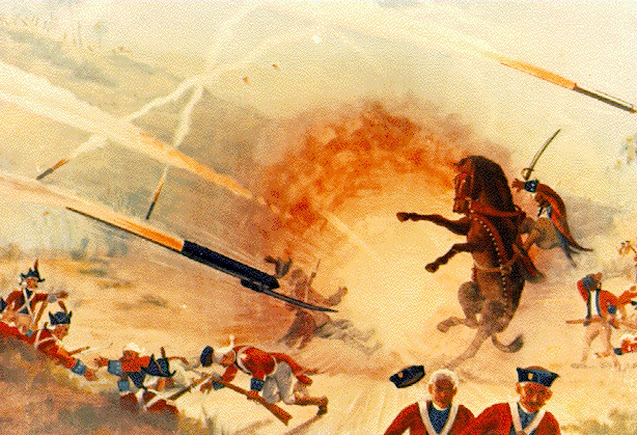
Rocket Warfare, by Charles H. Hubbell (1898–1971) captures the humiliation of the British at the Battle of Pollilur (Sep. 1780) by Mysorean war rockets.
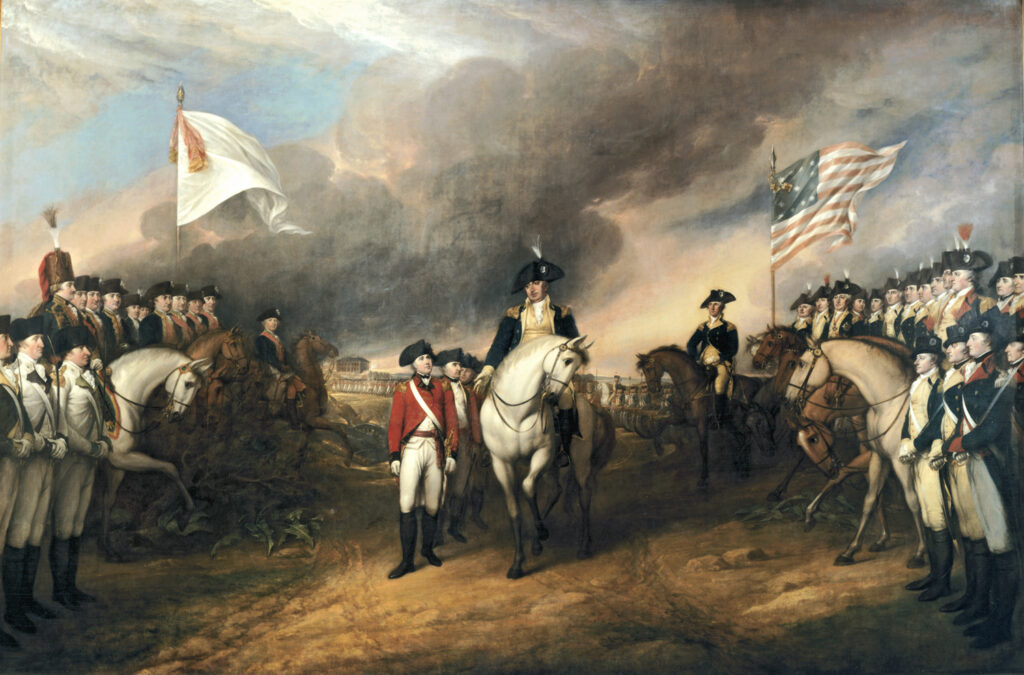
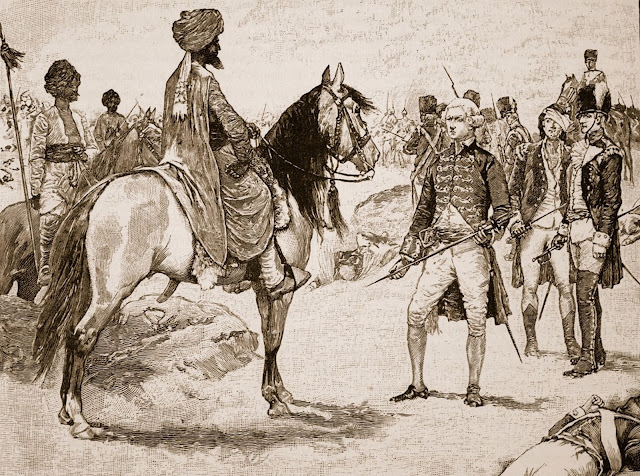
A few years later- in 1780, in the far-away Mysore Kingdom, the East India Company was suffering one of the worst reverses in its military history. This was at the hands of Haidar Ali and his son Tipu Sultan who were supported by the French, an ally of America. The humiliation of the British at the Battle of Pollilur in September 1780 reverberated in America where the news reached the country (3). On 19 October 1781, the British land force led by Charles Cornwallis surrendered to the Americans led by George Washington (incidentally a decade later in India, Cornwallis gave EI Company and its Indian allies victory over Haidar Ali’s son Tipu Sultan in the 3rd Anglo Mysore War). Nine days later Cornwallis’ surrender, along with that of Haidar Ali’s victories in India, was celebrated at Trenton, New Jersey. The town on that day was decorated with American colours. Inhabitants including the Who’s Who attended a service at the Presbyterian Church, where a discourse highlighting the occasion was delivered by a Reverend. In the afternoon the gathering drank 13 toasts accompanied with a discharge of artillery, number eleven of which was for ‘The great and heroic Hyder Ali, raised up by Providence to avenge the numberless cruelties perpetrated by the English on his unoffending countrymen, and to check the insolence and reduce the power of Britain in the East Indies‘ (ibid., ref. 3).
The other toasts were raised and artillery was discharged for the below. Quote: 1. The United States of America; 2. The Congress; 3. The king of France; 4. General Washington and the American army; 5. The Count de Rochambeau and the French army; 6. The Count de Grasse and the French fleet; 7. General Greene and the Southern army; 8. The friends of liberty throughout the world; 9. The memory of Generals Warren, Montgomery, and all the other heroes who have fallen in the defence of the liberties of America; 10. Peace on honorable terms, or war forever; 12. The governor and State of New Jersey; 13. The glorious 19th of October, 1781. At seven in the evening the company retired, and the rejoicings were concluded by a brilliant illumination. Unquote. (ibid., ref. 3).
Hyder Ally and America’s struggle to reclaim its seas from the British
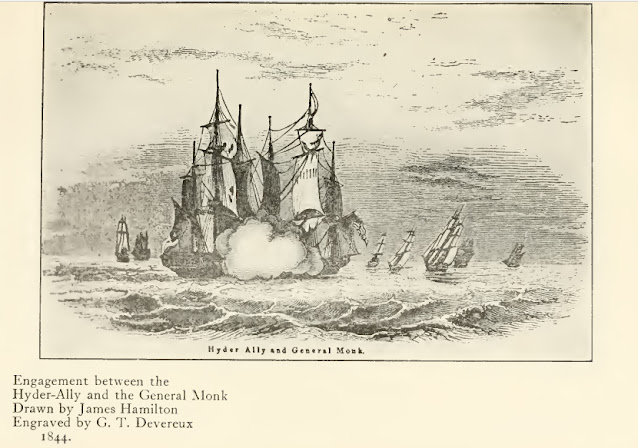
Sketch of action between American naval ship USS Hyder Ally and English warship General Monk in 1782. Source: Life of Commodore Joshua Barney, Hero of the US Navy (1776-1812), 1912.
Despite this, America was far from being an independent nation. The British still ruled the seas. They kept a keen watch on the ships entering and exiting the ports of northeast USA, often capturing the vessels and looting goods. General Washington an American sloop-of-war was captured by Admiral Arbuthnot, and placed in the king’s service under a new name The General Monk, which was then used to pirate American ships. By 1782 the commerce of Philadelphia City, as well as the ordinary life of the residents of the coast and nearby streams, was deteriorating. The fledgling American Union was not in a position to protect the affected vessels. Therefore the State of Pennsylvania, at its own expense, fitted a number of armed vessels that operated in waters leading to Philadelphia. The state purchased Hyder Ally, a small sloop (single mast ship) equipped with sixteen six-pounder guns to help protect the American vessels. 23-year old Lieutenant Joshua Barney, now in the US navy, arrived at Philadelphia where he was honoured with the command of Hyder Ally (4). Assigned with recruiting men, Barney used a poem penned by Philip Morin Freneau to attract young American men to the ship. The poem exalted Haidar Ali’s bravery against the British with the following lines (5):
Come, all ye lads who know no fear,
To wealth and honour with me steer
In the Hyder Ali privateer,
Commanded by brave Barney.
From an eastern prince she takes her name,
Who, smit with freedom’s sacred flame,
Usurping Britons brought to shame,
His country’s wrongs avenging;
Come, all ye lads that know no fear.
With hand and heart united all
Prepared to conqueror to fall.
Attend, my lads! to honor’s call —
Embark in our Hyder-Ally!
And soon Barney led a force of a hundred and ten men. On April 8, 1782, he received instructions to protect a fleet of merchantmen to the Capes just before the sea, at the entrance of Delaware Bay. Dropping the convoy at Cape May road he was awaiting a fair wind to take the merchant ship to sea when he saw three ships (6) which he realised were waiting to plunder the convoy. Barney immediately turned the convoy back into the bay, using Hyder Ally to cover the retreat. Soon the bigger General Monk under the command of Captain Rogers of the Royal Navy nearly doubled his own force of metal, and nearly one-fourth superior in number of men caught up with Hyder Ally. Despite being fired upon, Barney held Hyder Ally’s fire till within pistol shot when both the two vessels got entangled. A short but desperate fight ensued. Lasting 26 minutes, it resulted in the lowering of flags by General Monk indicating her surrender. Both vessels arrived at Philadelphia a few hours after the action bearing their respective dead. The Hyder Ally had four men killed and eleven wounded. The General Monk lost twenty men killed and had thirty-three wounded including Captain Rogers himself, and every officer on board, except one midshipman ! (7)
‘Surrender of Baillie to Hyder Ali, 1780’, illustration from Cassell’s Illustrated History of England (20th century), 1780.
A hero is celebrated
Philadelphia burst in celebrations. Ballads were made upon this brilliant victory and sung through the streets of the city! And echoing with Barney’s name was that of Hyder Ally (ibid., ref. 1).Here are some lines:
And fortune still, that crowns the brave
Shall guard us over the gloomy wave —
A fearful heart betrays a knave!
Success to the Hyder-Ally!
While the roaring Hyder-Ally
Covered over his decks with dead!
When from their tops, their dead men tumbled
And the streams of blood did flow,
Then their proudest hopes were humbled
By their brave inferior foe.
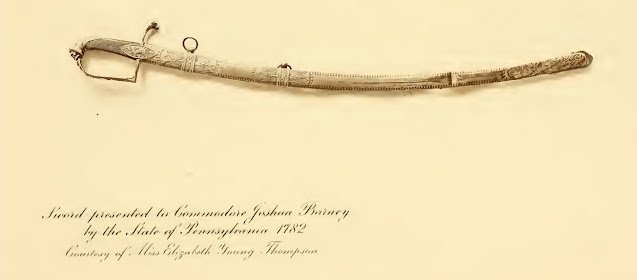
A small sword with mountings of chased gold- the guard of which on the one side had a representation of the Hyder Ally, and on the other the General Monk was ordered by the Legislature of Pennsylvania and a vote of thanks was passed for Captain Barney in 1782. This gold-hilted sword was presented to him in the name of the state by Governor Dickinson. Source: Life of Commodore Joshua Barney, Hero of the US Navy (1776-1812), 1912
In 1782 the Legislature of Pennsylvania passed a vote of thanks to Captain Barney and ordered a gold-hilted sword to be prepared, which was afterwards presented to him in the name of the state by Governor Dickinson. It was a small sword with mountings of chased gold- the guard of which on the one side had a representation of the Hyder Ally, and on the other the General Monk (ibid., ref. 1). Barney was the last officer to quit the Union’s service, in July 1784, having been for many months before the only officer retained by the United States.
Barney was sent by the American Government to Paris. A reception was given in France him as a hero of dashing naval exploits during the Revolutionary War (8). A painting representing the action between the two ships was executed in 1802 by L. P. Crepin in Paris by order of Barney, while in the service of the French Republic. The same was presented by him on his return to the United States, to Robert Smith, Esquire, then secretary of the navy (9). The painting is now in the United States Naval Academy, Annapolis, Maryland (ibid., ref. 1). Barney was an intimate friend of Count Bertrand, one of Napoleon’s generals (ibid., ref. 2). Napolean incidentally had an alliance against the British with Haidar Ali’s son Tipu Sultan, during the latter’s lifetime (10).
Barney was appointed a Captain in the Flotilla Service, US Navy on 1814 April 25 (11). He took part in seventeen battles during the Revolutionary War and in nine battles during the War of 1812. A British Musket-ball lodged inside his body in battle at Bladensburg, Maryland in August 1814 (12). He passed away on December 1, 1818, aged 60.
The world today is considered a global village thanks to the scaling down of boundaries between nation-states and individuals alike. But it may surprise us even in the 18th century seemingly local political events and humans made an impact on lands and societies far away. The name Haidar Ali, after an adventurer from an obscure place in the erstwhile Kingdom of Mysore who gave many a lesson in military and political strategies to global colonial powers of England and France, echoing across the proverbial seven seas in distant North America for nearly a century is a testament of this (13, 14).
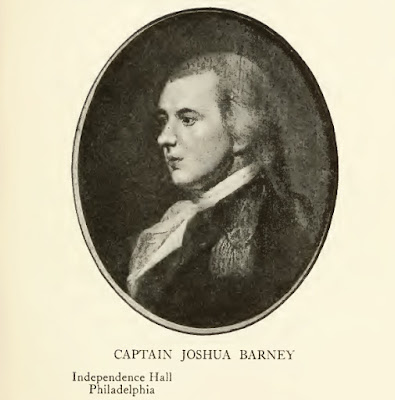
Painting of Commodore Joshua Barney at Independence Hall, Philadelphia, Life of Commodore Joshua Barney, Hero of the US Navy (1776-1812), 1912.
70 years after Hyder Ally’s victory over General Monk, James Cooper wrote “This action has been justly deemed one of the most brilliant that ever occurred under the American Flag. It was fought in the presence of a vastly superior force that was not engaged, and the ship taken was in every essential respect superior to her conqueror.” (ibid., ref. 4)
Sources/ Notes:
1. Barney, Mary., A biographical memoir of the late Commodore Joshua Barney, 1832, Mary was a sister of Joshua Barney. Her book provides in-depth information about the latter’s personal and military life. Born on July 6, 1759, 13-year old young Philadelphia Joshua Barney set sail on his maiden merchant ship journey to Ireland in 1771 with his brother in law Captain Thomas Drysdale. He sailed back home the following year and made trips to ports in Europe again. He set sail for Nice, France in December 1774 during which journey Captain Drysdale died. He took control of the ship which needed urgent repairs and therefore docked at Gibraltar, Spain instead. In a few months, he sailed to Algiers, Algeria from Alicant, Spain to deliver Spanish troops during which he witnessed the annihilation of these troops by the Algerians which made him return to Alicant soon. He immediately set sail across the vast Atlantic Ocean for Baltimore, USA. As he entered the Chesapeake Bay on 1st October he was surprised by the British Sloop of war Kingfisher. An officer searched his ship and informed him that Americans had rebelled and that battles were being fought. He was fortunate enough to escape detention. Returning to Philadelphia he was determined to serve the Americans fight against the British. At that time a couple of small vessels were under at Baltimore ready to join the small squadron of ships stationed then at Philadelphia and commanded by Commodore Hopkins. Barney offered his services to the commander of the sloop Hornet, one of these vessels. He was made the master’s-mate, the sloop’s second in command. A new American Flag, the first ‘Star-spangled Banner’ in the State of Maryland, sent by Commodore Hopkins for the service of the ten gun Hornet, arrived from Philadelphia. At the next sunrise, Barney unfurled it in all pomp and glory. In 1776, Robert Morris, President of the Marine Committee of the Congress offered him a letter of Appointment as a Lieutenant in the Navy of the United States in recognition of his efforts during a naval battle engagement in Delaware. 2. Adams, William Frederick., Commodore Joshua Barney: many interesting facts connected with the life of Commodore Joshua Barney, hero of the United States navy, 1776-1812, 1912. Adams provides a good summary of Mary Barney’s book in this book. 3. Moore, Frank., Diary of the American Revolution, Volume 2, 1860. 4. Cooper, James Fenimore., History of the Navy of the United States of America, 1853. 5. Freneau., Poems written and published during the American Revolutionary War, 1809. 6. Two ships and a brig- a sailing vessel with two masts. 7. As explained by Barney himself in his painting of this war commissioned later. 8. Bowen, A., The Naval Monument,1815, Concord, MA. This book gives an account of the reception received by Barney in France. 9. The painting was accompanied by a description, in the handwriting of Commodore Barney, which is reproduced in Mary Barney’s book. 10. Ahmed, Nazeer., https://historyofislam.com/tippu-sultan/ (downloaded October 13, 2017). 11. Record of Service, Bureau of Navigation, Navy Department, United States Navy. 12. The conduct of Commodore Barney, at the Battle of Bladensburgh, was appreciated by his military opponents as well. He was wounded in the engagement and was taken prisoner by General Ross and Admiral Cockburn but paroled on the spot. At the time of his death in 1818, the ball was extracted and given to his eldest son. For the valuable services of her husband, Congress granted Mrs. Barney a pension for life. 13. Goold, William., Portland in the past, 1886. This book has information on at least one more well-known ship named Hyder Ally built in the US in the 1800s after the one described in this story. This ship, like many other US ships, resorted to pirating British ships in the Indian Ocean all the way up to the island of Sumatra and around the Cape of Good Hope in South Africa in the run-up to the British-American War of 1812. 14. Corbett’s Annual register (1802) documents the ship ‘Tippoo Saib’ registered in Savannah, Georgia, the southernmost of the 13 colonies that declared independence from the British in 1776 and formed the original ‘United States of America’.
source: http://www.thecognate.com / The Cognate / Home> History / by Ameen Ahmed / December 27th, 2021
This year marks the 100th anniversary of the eventful Malabar Uprising of 1921.
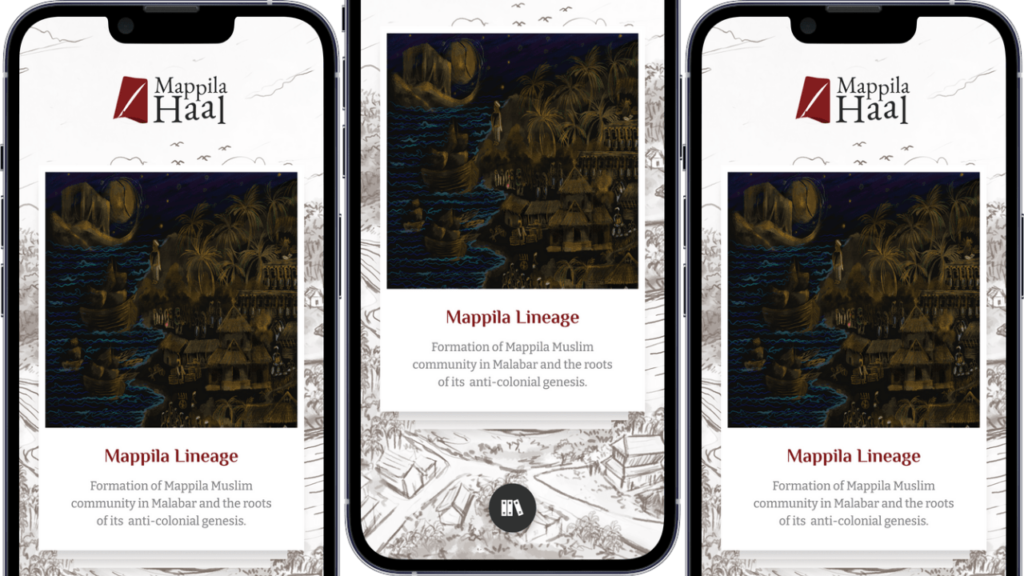
In this historic context, SIO Kerala has come up with a new venture: an interactive virtual exhibition titled ‘Mappila Haal’.
‘Mappila Haal’ is a comprehensive creative expression of the Malabar Uprising enabling the viewer to travel through the revolutionary days and nights.
SIO acknowledges the memories, discussions on various factors and celebration of the Malabar Uprising as a crucial socio-political engagement.
History is not merely a record of the past. For any community, history is a decisive factor in their present life. That is why history is said to be a never-ending dialogue between the past and the present. Historical narratives play a major role in shaping contemporary socio-political perspectives and imaginations.
Every community should have a deep understanding of their history, and they should record and promote it. Failure to do so will result in the tragedy of having to live in a history written by others. That condition will adversely affect their future. Because their history written by the mainstream-dominant ideologies will be understood as the real one. If the dominant powers decide to marginalize or annihilate any community forever, they will use history as an easy tool. For that, they will do injustice to history in two ways. One is to hide and erase the rich history of that community, and the other – to present a distorted narration of it.
How Islam and Muslims were treated in colonial historiography is an apt example of this. The colonial powers hid the prestigious and glorious history of Muslims all over the world. Later, colonialism defined Islam and Muslims in their own way, based on which the history of Muslims was written – Islam is primitive, it was spread in the world by sword, Islam is utter terror, Muslims are savage, bloodthirsty, war-loving, violent and dangerous. Based on this definition, they presented a distorted version of world Muslim history. In doing so, they sought to create a public perception that the very presence of Muslims would be dangerous to any nation and all forms of social and political expression based on Islam reflects extremism and terrorism. The aim was to make people believe that they were the ones who needed to be eliminated. Thus, this narrative became a justification for all violence, injustice and genocide against Muslims. This is how history itself becomes the greatest instrument of oppression. It is in this colonial narrative that the roots of present-day Islamophobia too lie, be it global, national or in Kerala.
Here comes the relevance of the remembrance and celebration of the Malabar Uprising. This is a time when Hindutva politics is gaining strength and the Sangh Parivar is working on the genocide of Muslims. Hindutva forces use the history of Muslims in two ways to facilitate ethnic cleansing: One is the attempt to erase the history of Muslims in India and to uproot the glorious roots of Muslims in this country. Second, to distort the history of Muslims in India into an anti-Hindu history. Through these two forms of violence against history, Hindutva quickly finds pace for its racist propaganda. In other words, the Hindutva forces are trying to create a public conscience that the Muslims are a group that came from somewhere, that they have no roots in this country, that the history since their arrival here is one of violence, that their presence is a danger to the country and therefore they should be eradicated. The question of how one’s mind allows Muslims to be lynched to death in broad daylight turns irrelevant there. When a person believes that Muslims deserve to be killed, he will not feel any remorse for killing them.
In this particular political context, there is a special significance for popularizing and celebrating the memories of the Malabar Uprising. By remembering the Malabar Uprising and the fighters involved within, we are also positioning ourselves against the Hindutva ideology. The British colonial powers portrayed the Malabar Uprising as fanatic aggression. Such a propagation was quite natural because it was a battle against them. However, the Sangh Parivar is also propagating the Malabar Uprising as a brutal anti-Hindu massacre, inciting hatred against Muslims in its name and using the history of the Malabar Uprising as fuel to accelerate the aforesaid process of genocide. In 1921 itself, the Hindutva forces propagated the Malabar Movement as a Hindu genocide and used it as a fertilizer for the formation of the RSS.
Moreover, the historical point of the Malabar Uprising is constantly disturbing Hindutva politics in many ways. One of them is that the Malabar Uprising reminds us of the crucial role of Muslims in the anti-colonial struggles that led to the formation of the nation of India. Another is that the Malabar Uprising was also a struggle against the upper caste hegemony which is the foundation of Hindutva politics. That is why the Sangh regime’s dictionary of martyrs cannot include the names of the Mappila fighters. Therefore, remembering and celebrating the Malabar struggle is a strong statement against Hindutva politics.
The memory of the Malabar Struggle is also a memory of our own glorious tradition. It also gives us an idea of how strong and deep our roots are in this land. It shows the pivotal role played by our ancestors in the freedom struggle of this country, social renaissance and civilizational development. For the Muslim community in India, this memory and realization will provide the energy to move forward with self-respect in the face of several crises.
The Malabar Uprising had two main stages. One was the struggle against the colonial British forces. Second, the struggle against the feudal and caste lords who oppressed and exploited the peasants and lower castes like slaves. The extraordinary struggle led by Ali Musliyar and Variamkunnath Kunhahammad Haji shook the foundations of the colonial powers and the caste leaders. It instilled a new dream of liberation in the oppressed masses. It was these two brave leaders who gave direction to the Malabar Uprising in which thousands of agricultural workers and labourers rallied. Many non-Muslims too took part in the Malabar Uprising along with the Mappilas.
We also need to think about the theological factor that motivated the Mappilas to fight. The Islamic faith was the basic factor that inspired the Mappila warriors to take their own lives and go to battlefield. It is a part of the Islamic faith to stand for justice and to fight against injustice, discrimination, slavery and exploitation. The Qur’an and the Sunnah teach us to fight for the victims of injustice. It is part of Tawheed (monotheism) that slavery and obedience are permissible only to Allah. Believers do not accept slavery or obedience before another. And they believe that the struggle for truth and justice is Jihad in the way of Allah. The scholars of Malabar passed on these divine lessons of justice and liberation taught by Islam to the common Mappilas. That is how the struggles against the occupying forces and caste lords took place in Malabar from the sixteenth century onwards.
Indeed, a cosmopolitan component was involved in the Malabar Uprising. After a short gap, the anti-colonial struggle in Malabar gained momentum again in 1921, with the advent of the Khilafat Movement. Even the national movement became popular as a result of the influence of the Khilafat movement. The Khilafat movement and the political ideology of the Khilafat acted as a new force in the anti-colonial anti-caste struggle. Globally, western modernity strengthened its political power by overthrowing the Ottoman caliphate. It was on the basis of these political convictions that the Mappila community, having global perceptions, embraced the Khilafat movement.
The historical narratives formed by the dominant ideologies can be defended and overcome only when studies are carried out in the light of such different elements involved in the Malabar Uprising. In particular, it is imperative in modern times to enable a critical reading focusing on the agency of the warriors, theological thought, social position, and decolonization. The SIO came up with the idea of a virtual exhibition based on the conviction that such alternative narratives and analyzes focused on these considerations should be brought to the fore.
In the context of the 100th anniversary of the Malabar Uprising, SIO’s main objective through this virtual exhibition is to look at the history of Kerala’s Muslim intellectual and struggle history through an alternative perspective, to enable the production of knowledge about it, and to celebrate it politically and culturally. This can only be comprehensive when the various narratives that have been formed post rebellion are critiqued and analyzed from a realistic perspective. This is a continuation of the knowledge politics that SIO has been raising from time to time. We mark this interactive virtual exhibition as a continuation of the knowledge politics that SIO promotes through its rejection of hegemonic ideas and its critical reading of knowledge such as history, politics, theology and aesthetics.
The virtual exhibition will be available on a mobile application with a feast of video contents, paintings, calligraphy, digital art, rare archives, exclusive photos, the timeline of the uprisings of Kerala Muslims, different narratives on the Malabar Uprising, articles, profiles, events and graphical maps of the places of rebellion.
‘Mappila Haal’ will also be marked as a critical alternative to the colonial and savarna narratives which portrayed the long intellectual and revolutionary tradition of Malabar against the colonial and caste powers as fanatic and barbaric.
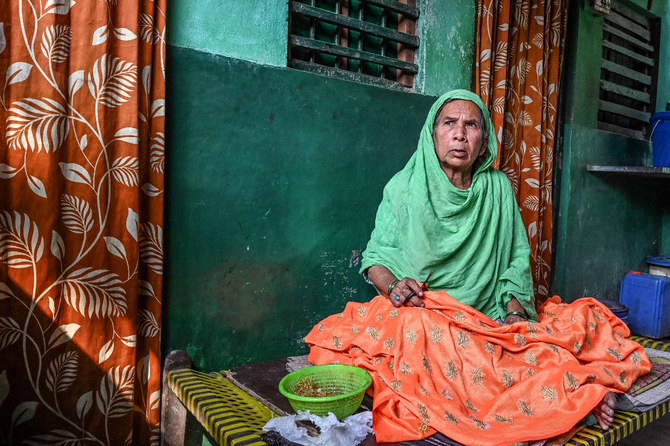
Sultana Begum works on a garment inside her house in Kolkata. (Photo by Dibyangshu Sarkar / AFP)
Sultana Begum’s case rests on her claim that her late husband’s lineage can be traced to Bahadur Shah Zafar, the last emperor to reign
After a massive rebellion blamed on an already frail Zafar in the 1850s, British forces executed 10 of the ruler’s surviving sons despite the royal family’s surrender
Kolkata :
A destitute Indian woman who claims she is heir to the dynasty that built the Taj Mahal has demanded ownership of an imposing palace once home to the Mughal emperors.
Sultana Begum lives in a cramped two-room hut nestled within a slum on the outskirts of Kolkata, surviving on a meagre pension. Among her modest possessions are records of her marriage to Mirza Mohammad Bedar Bakht, purported to be the great-grandson of India’s last Mughal ruler.
His death in 1980 left her struggling to survive, and she has spent the past decade petitioning authorities to recognize her royal status and compensate her accordingly.
“Can you imagine that the descendant of the emperors who built Taj Mahal now lives in desperate poverty?” the 68-year-old asked AFP.
Begum has lodged a court case seeking recognition that she is rightful owner of the imposing 17th-century Red Fort, a sprawling and pockmarked castle in New Delhi that was once the seat of Mughal power. “I hope the government will definitely give me justice,” she said. “When something belongs to someone, it should be returned.”
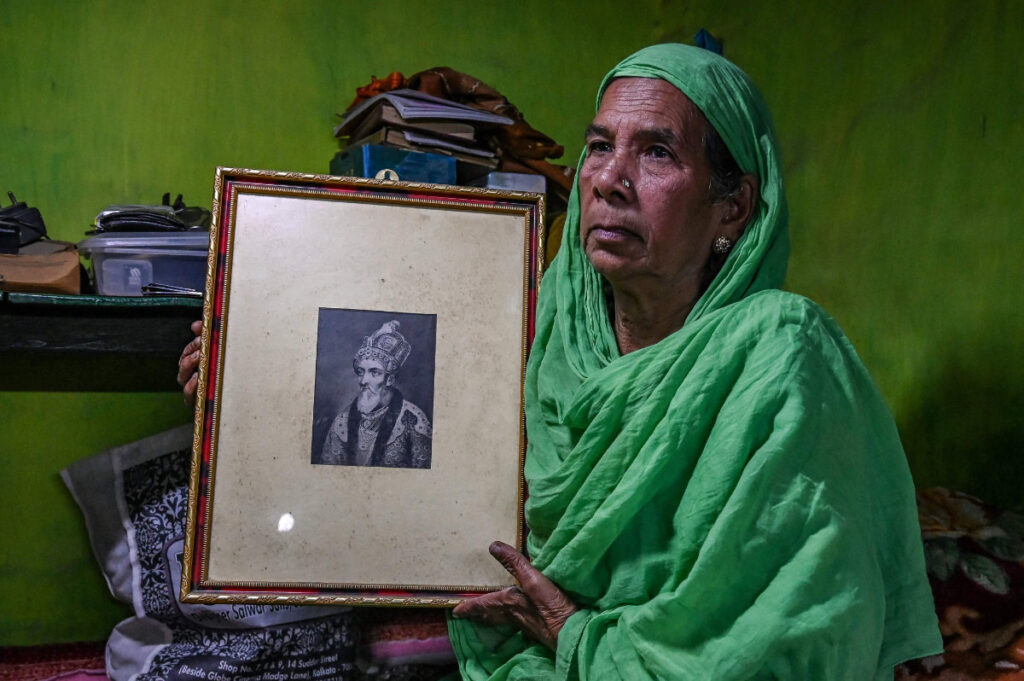
Sultana Begum reacts while holding a picture of last Mughal Emperor of India Bahadur Shah Zafar in her house in Kolkata. (Photo by Dibyangshu Sarkar / AFP)
Her case, supported by sympathetic campaigners, rests on her claim that her late husband’s lineage can be traced to Bahadur Shah Zafar, the last emperor to reign.
By the time of Zafar’s coronation in 1837, the Mughal empire had shrunk to the capital’s boundaries, after the conquest of India by the commercial venture of British merchants known as the East India Company.
A massive rebellion two decades later — now hailed as India’s first war of independence — saw mutinous soldiers declare the now frail 82-year-old as the leader of their insurrection. The emperor, who preferred penning poetry to waging war, knew the chaotic uprising was doomed and was a reluctant leader.
British forces surrounded Delhi within a month and ruthlessly crushed the revolt, executing all 10 of Zafar’s surviving sons despite the royal family’s surrender.
Zafar himself was exiled to neighboring Myanmar, traveling under guard in a bullock cart, and died penniless in captivity five years later.
Many of the Red Fort’s buildings were demolished in the years after the uprising and the complex fell into disrepair before colonial authorities ordered its renovation at the turn of the 20th century. It has since become a potent symbol of freedom from British rule.
India’s first Prime Minister Jawaharlal Nehru hoisted the national flag from the fort’s main gate to mark the first day of independence in August 1947, a solemn ritual now repeated annually by his successors.
Begum’s court case hinges on the argument that India’s government are the illegal occupants of the property, which she says should have been passed down to her.
The Delhi High Court rejected her petition last week as a “gross waste of time” — but did not rule on whether her claim to imperial ancestry was legitimate. Instead the court said her legal team had failed to justify why a similar case had not been brought by Zafar’s descendants in the 150 years since his exile.
Her lawyer Vivek More said the case would continue. “She has decided to file a plea before a higher bench of the court challenging the order,” he told AFP by phone.
Begum has endured a precarious life, even before she was widowed and forced to move into the slum she now calls home.
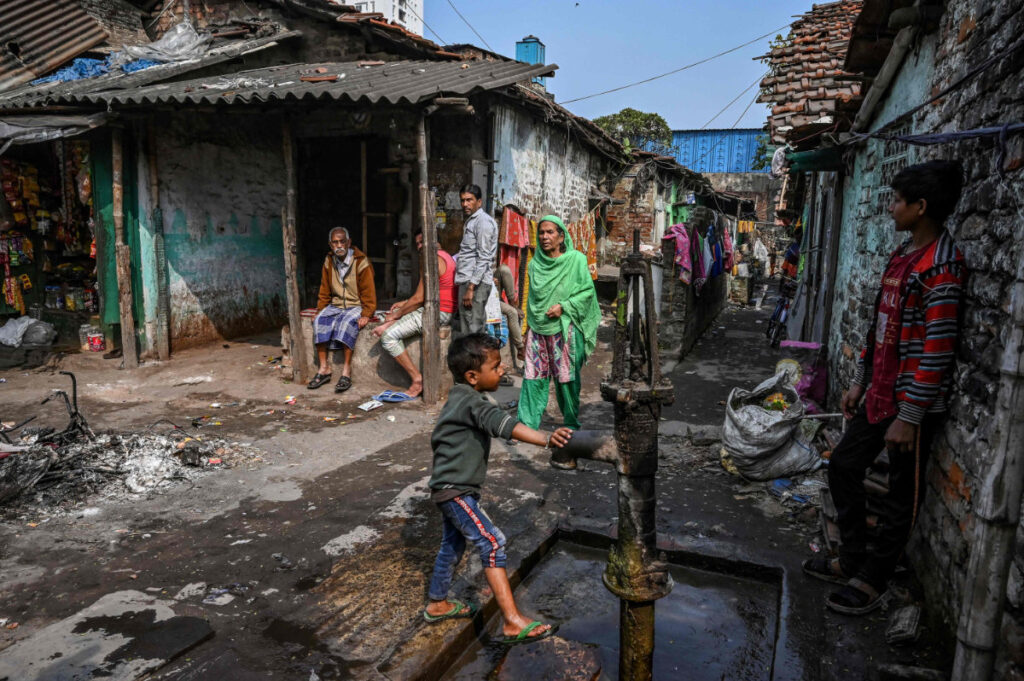
In this picture taken on December 22, 2201, Sultana Begun walks by an alley in the locality she lives in Kolkata. (Photo by Dibyangshu Sarkar / AFP)
Her husband — who she married in 1965 when she was just 14 — was 32 years her senior and earned some money as a soothsayer, but was unable to provide for their family. “Poverty, fear and lack of resources pushed him to the brink,” she added.
Begum lives with one of her grandchildren in a small shack, sharing a kitchen with neighbors and washing at a communal tap down the street.
For some years she ran a small tea shop near her home but it was demolished to allow the widening of a road, and she now survives on a pension of 6,000 rupees ($80) per month.
But she has not given up hope that authorities will recognize her as the rightful beneficiary of India’s imperial legacy, and of the Red Fort.
“I hope that today, tomorrow or in 10 years, I will get what I’m entitled to,” she said. “God willing, I will get it back… I’m certain justice will happen.”
source: http://www.arabnews.com /Arab News / Home> News / by AFP / December 30th, 2021
Peter Gottschalk in his book Beyond Hindu and Muslim: Multiple identity in Narratives from Village India (2000) took a methodological leap to understand the multiple identities people carry in everyday lives. He carefully listened to the people talking about their local narratives regarding a fort; a temple dedicated to the ghost of a local Brahmin and a tomb that was probably associated with Bakhtiyar Khilji. While gathering the narratives of villagers of former Shahabad district of Western Bihar (during his fieldwork conducted in 1994-95) he tried to understand the significance of temporality and contextuality in assertion of identities.
Far beyond the monolithic religious binary of Hindus and Muslims, the identities get complicated with the presence of intertwined factors like class, caste, language, region, gender and nation. Not only that, the memory, context and existing narratives also shape the contemporary identities. For example, Gottschalk found lower caste Chamars claiming Hindu identity to establish their indigeneity against the Muslims, mostly considered as outsiders. But, similarly in the context of their exclusion from the upper caste village rituals, they assert their Chamar identity as opposed to both the religious groups.
Such assertion of identity becomes politically loaded through different means- mostly with the struggles for legitimate rights and in a few instances for establishing empathetic connection with the broader community. While working on Muslims’ presence in Jharkhand Andolon, what we encountered with is the assertion of a separate ‘Jharkhandi Muslim’ identity- sometimes it came as ‘Adivasi Muslim’, sometimes as ‘Moolvasi Muslims’. Whatever the lingual expressions be, the base of this identity assertion veers around their claims of being different from their North Indian coreligionists. Through the narratives and life sketch of different Andolonkaris, we learnt how this identity has shaped the presence of Muslims in Jharkhand Andolon. Jharkhandi Muslims in this context becomes both a constitutive and a derivative component of the broader statehood movement. To look into one without the other amounts to deliberate silencing of a politically effective assertion that had set forth the routes of the movement. This essay is thus an effort to find out the impact of this identity assertion in the Jharkhand statehood movement.
Muslims Kahan hai Jharkhand pe? – Story of A Composite Identity
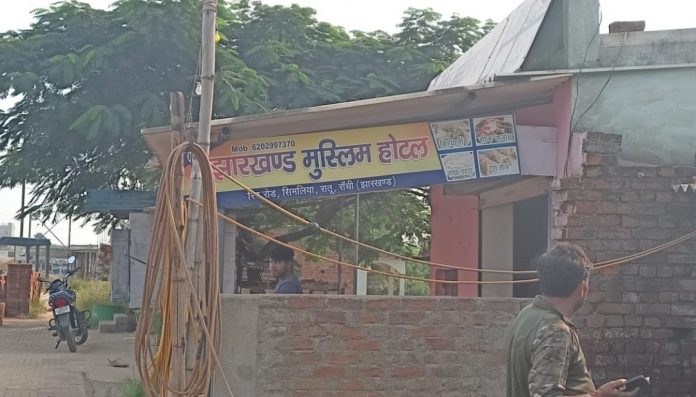
Jharkhand Muslim Hotel, Simlia village, near Ranchi
Around 20 kms west from Ranchi, as we reached Simalia to meet Padmashree awardee folk singer and poet Madhu Mansoori Hasmukh, we found a place named, “Jharkhandi Muslim Hotel”. Though it didn’t come as a surprise as the complexities of Muslim identities in Jharkhand have been our companion throughout, what unfolded gradually made us literally silent. Barely we entered Madhu Mansoori’s house, we met Masi Zama, a social activist who use to come to his place for mundane cordial visits. On being asked what my research focuses on, I casually said, “It’s mostly on the Muslims in Ranchi, their silencing… participation…and…”. I was immediately stopped. His displeasure was though not reflected through his voice, the words he chose were enough to make us understand that we made a statement that we were ought not to. “Muslims? Muslims kahan hai Jharkhand pe? (Where are Muslims in Jharkhand?)”- for a moment I felt my whole research purpose, its objectives are dismantled to the core. “Ye aap logo ke tarah jo log hai uske liye yahan pe Muslims ka aaj ye haal hai (It is the people like you who are responsible for the conditions of Muslims in Jharkhand). When constituent assembly debates were going on why nobody spoke of giving Adivasi status to the Muslims of this region? Yahan pe Muslims nahi hai (There is no Muslim in this region) We are Jharkhandi Muslims, Adivasi Muslims… Moolvasi Muslims”, we were told.
Understanding the gravity of the mistake as we were about to apologize, Madhu Mansoori, in his mid-70s entered the room. Without any ‘Salam-dua’ (Islamic ways of greetings like Assalam Aleikum Wa Rahamatullahi Wa Berakatahu) what he welcomed us with was a humble ‘Namaskar’. Already ashamed enough of our misconceptions, we greeted him back with a ‘Namaste’ and our conversation started. Madhu Mansoori claims himself as an Oraon Muslim. His ancestors, as he says perhaps got converted generations back. But it is the Oraon culture that drives his everyday lives. Throughout the interview whenever he referred to Muslims, he spoke off how the Munda-Oraon culture is intact within them. Islam has no conflict and doesn’t contradict their existing way of lives- rather it is a spiritual addition to the everyday beliefs and faiths.
These fundamental similarities rather embeddedness of faiths and practices into one another were explained to us later by Dr. Eliyas Majid, a Professor of History in Maulana Azad College, Ranchi. Explaining the Jharkhandi culture, he told us, “We have a ritual namely Madeikki Byebastha. It means helping one another in different things.” While in a capitalist set up, hiring laborers for mundane works is the norm, in Jharkhandi culture, as Dr. Majid said people come together to do neighbors’ works – whatever the nature of the work may be.
Another significant concept that Jharkhandi culture entails is of ‘Sahiya’ (friendship between any being or thing). “Koi bhi kisika Sahiya ho sakta hai. Ye zaroori nahi ke usko Insaan hona hai. Bachpan se jo aam, jamun ke paer pe hum khelte the wo bhi humara sahiya ho sakta hai. Hum logo me bahut sara ladki paer ke niche ghanto beithe rehte hai aur pooche to bolte hai Sahiya pass thi. (Anybody can become friend in our culture. It needs not to be human being. The mango, Jamun trees that we played underneath in our childhood could be our Sahiya. In our culture, women sometimes are found sitting beneath the tree for hours and on being asked where they have been- they respond- I was with my Sahiya)”, Dr. Majid continued.
The third and most interesting cultural attribute that he told us is called Gotiya’ (means brotherhood). For being brother in Jharkhandi culture, people need not to have blood relations. Any Oraon, Munda, Santhal can be Gotiya of a Muslim. All these three ideas explained to us by Dr. Majid significantly goes with the fundamentals of Islam. Helping others whereas is considered as Sunnat (Prophet’s (SWAS) way of life), the idea of recognizing every living being is in consonance with the belief of Islam that each and every being is created by Allah (SWT) and humans must behave with them in compassionate and empathetic manner. The idea of universal brotherhood (Gotiya) is also part and parcel of Islamic scriptures and commands. This comparison though is not intended to portray the similarities between Jharkhandi culture and Islamic fundamentals, rather it is just to show how Islamic fundamentals got melted into the Jharkhandi culture and paved the way for the construction of the identity known as ‘Jharkhandi Muslims’.
The cultural assertion of Jharkhandi Muslim identity whereas is rooted into the cultures of the land, the political assertion got its shape and voice through Jharkhand Andolon. Our encounter with Mohd. Faizi, a readymade garment seller near Upper Baazar took us through the terrains of this identity formation. Faizi made us walk in the roads where ‘Jharkhandi Manasikata (Jharkhandi Mentality)’ of Muslim foot-soldiers had to cross the paths of external political efforts and influences that were gathered to dismantle the ‘ekta’ (unity) of Jharkhandi Muslims.
Asghar Ali Engineer in his 1991 EPW paper ‘Remaking Indian Muslim Identity’ pointed out how ‘the assertion of religious identity’ could be a method for the ‘deprived communities in a backward society to obtain a greater share of power, government jobs and economic resources’. Similarly, assertion of Jharkhandi Muslim identity in the context of Jharkhand Andolon became a path to achieve the desired goals of statehood, to secure the rights of Minorities in the newly formed state and to ensure that ‘pehchan’ (recognition) of Jharkhandi Muslims remain intact without the imposition of homogenizing laws and regulations.
Personal is Political- Jharkhandi Manashikata & Instilled Mijaj
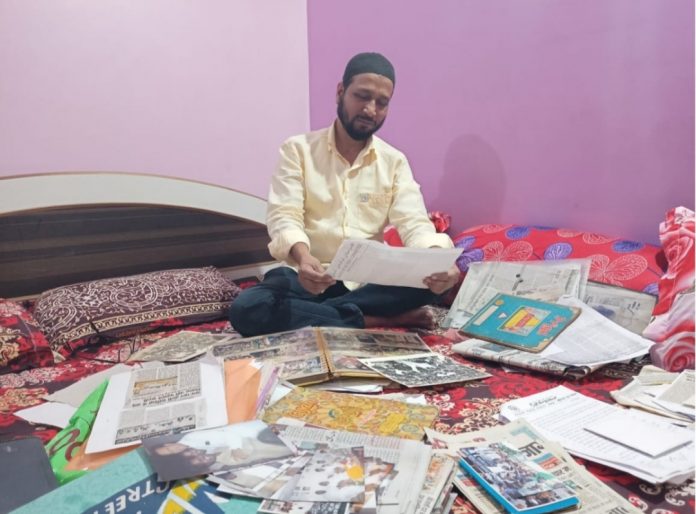
Mohd. Faizi looking back through the pages of own Archives
Mohd. Faizi was born in March, 1966 at Rain Mohalla, Tewari Street near Ranchi Main Road. Since childhood besides poverty another constant feature of Faizi’s life has been instilled ‘Jharkhandi Manasikta’ (Jharkhandi Mentality). Faizi’s father had a small (5ft/10ft) ‘Kapde ka gumti’ (an apparel stall) at footpath near Urdu Library. His childhood was filled with the stories of Jharkhand Andolon. Shared by his uncles, these stories instilled the dreams of separate Jharkhand in little Faizi’s mind. One of the stories was of an old woman who used to stay behind the Gel church (Evangelical) during the British Raj. Every day, ignoring the scorching heat, unbearable rain and all other obstacles she marched through the main road alone with a flag raising the slogan of ‘Jai Jharkhand, Jharkhand Prant Alag Karo’. The flag was nothing but a stick wrapped in a green cloth that became the bearer of Jharkhandi identity. She marched up to the Commissioner’s office and spending some time used to come back. Though there was no crowd behind her, the visual of her intermittent desire to have a separate state got reverberated through all those like Faizi’s uncles who later joined the movement in numbers.As people mocked at her, Faizi’s grandfather told them- “Yaad rakho ye mang jayes hai, aur ye aaj akeli nazar aarahai hai lekin ek waqt ayega jab iske peeche jan sailab hoge” (Keep it in mind that her claims her legit. Today, she is alone but day will come when hundreds will join her for the demands). Faizi not only witnessed the ‘Jan Sailab’ (Public uprising), rather he led it from the front and embraced it as a ‘farz’ (duty, mostly used for religious obligations) against all the odds coming in between him and his pledge to the separate state.
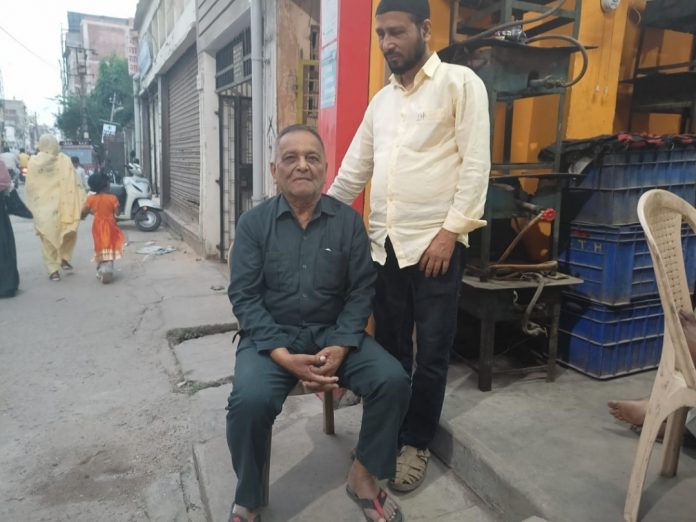
Mohd. Faizi with his uncle and undisputed Muslim leader of Jharkhand Andolon Tako Ansari (Sitting on the Chair)
In his early age only, Faizi saw his uncles Tako Ansari, Mohd. Farooq joining the statehood struggle through N E Horo’s Jharkhand Party. In Faizi’s words, ‘Mijaj to thaa hi (Mood was always there). Along with that the devotion of family members to the cause of Jharkhand made these aspirations grow”.
Faizi had few friends like Shamim and Saajid with whom he started attending the meetings of Sadan Vikas Parishad (SVP). At that time, Prof. Shahid Hasan was the general secretary of SVP. It was very early stage of his engagement into the movement. However, two specific incidents changed the way he looked into the world thereafter. Due to his father’s deteriorating health condition he had to leave his education at an early stage. Still, in 1985, he appeared for the board exam. Though he scored good numbers in subjects like English, Arabi and Farsi, his marks in science and mathematics didn’t let him qualify the boards. He got only 2 marks less than required to pass the exams. There were other students as well with whom similar things happened and they decided to go to Patna Examination Board office.
The reality of blatant discrimination had hit him in an inexplicable way. While he and his ‘Jharkhandi saathis’ (friends from Jharkhand) were told that nothing could be done and they started preparing for the next year, students from Bihar started filling the forms of colleges. Faizi then got to know that his ‘Bihari Saathis’ (Friends from Bihar) were told by the officials to apply for reviewing their copies and got the required grace marks whereas they were told, “Yahan pe kuch nahi ho sakta (Nothing can be done here)’. This instance not only made huge impact on Faizi’s mind rather it made him further believe that ‘Ye maang Jaees hai, aur inse in Bihario se chutkara milna chahiye’ (The claims of statehood are legitimate and we must get rid of Bihari officials).
While referring to the second incident Faizi was red in rage. Sipping a bit of water from the glass that was kept near his bed, he continued- “It was 1987. For the first time, anti-encroachment drive was going on in Ranchi. Police forces and officers came to our small Gumti and asked us to immediately vacate it. They threatened us that if we don’t move, they would trample it on and would even charge fine. We didn’t have money- so we started dismantling out only source of earning. And as I was putting down the asbestos, a small piece of brick fell near an Officer’s feet. It didn’t touch him at all but he started abusing me with ‘Maa ki gaali’ (Slangs referring to mother). I felt like immediately hitting them. But no, I couldn’t. My ailing father was standing there along with my little brothers. I silently listened to them but pledged that I would take revenge. If not from them at least from their viradari (their kind). It was our time to get rid of all these brutal Bihari officers and polices- We had to achieve statehood- We must- for the sake of our existence- for the sake of having a dignified life”- Faizi was trembling- silence clouded the moment- tears were visible with the determination that led him to become one of the most committed soldiers of Jharkhand Andolon.
During this phase, he led a group of 10-15 youths who participated in different social works. Meanwhile All Jharkhand Students’ Union (AJSU) had already been formed and movement got its required momentum. One day, when they were sitting near Urdu library, Ranchi Main Road, Zubair Ahmed (then the Ranchi town secretary of AJSU) came and asked them to join AJSU. Zubair even brought the founder president Prabhakar Tirkey and arranged a meeting with Faizi and his friends.
Within days, for his oratory skills and determination, he became very close to Tirkey and other CC members of the party. “Kyun ki itne sare adviasio me ek Muslim chehra, upar se accha bakta (Among so many Adivasis, a Muslim figure with good oratory skills)” made people like him and Zubair stand apart. Along with Zubair and other Muslim leaders/members they started gathering Muslim support for the movement. Though Muslims’ presence had always been there since the very early days of Jharkhand Andolon, its further expansion and visibility became their objective.
Political Assertion of Identity- Jharkhandi Muslims and Foundation of JMC
Since then, what drive Faizi throughout was his desire to achieve statehood and the recognition of ‘Jharkhandi Muslim’ identity. The assertion of this ‘Jharkhandi Muslim Identity’ led people like Faizi or Zubair to invest their lives for the cause of separate statehood where they would be considered in same manner as their ‘Adivasi saathis’, instead of their religious brethren of the other states.
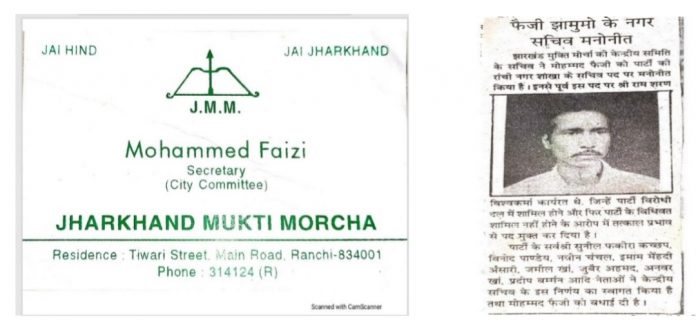
The JMM Visiting card of Faizi and News Cutout of Faizi inducted as Town Secretary, JMM
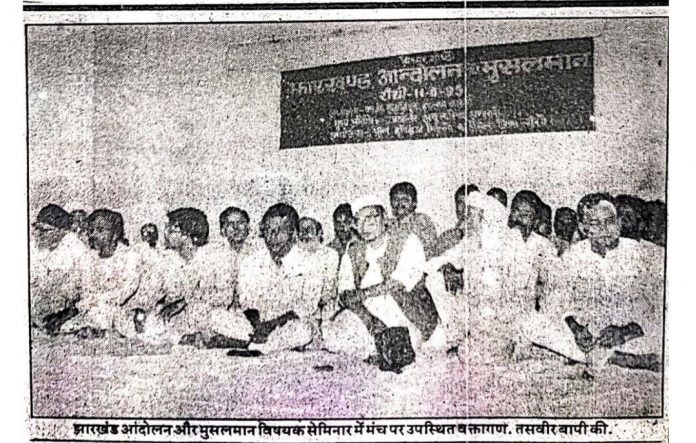
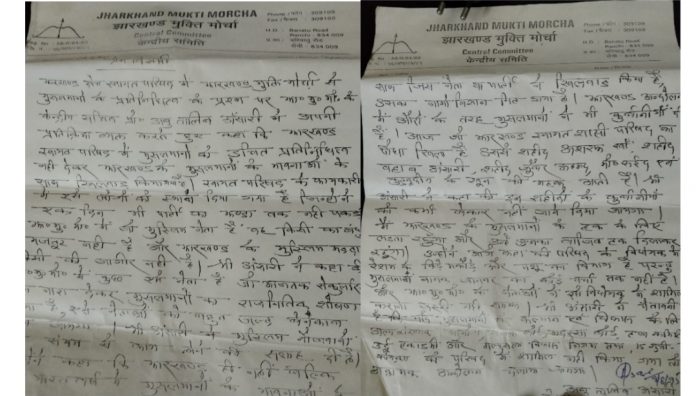
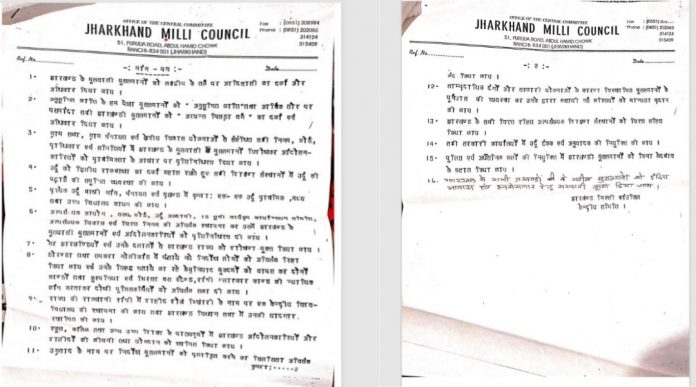
As soon as Faizi joined Jharkhand Mukti Morcha (JMM) in 1992 after a meeting with Prabhakar Tirkey and other leaders of AJSU (Tirkey faction) at Suleiman hotel, Lake Road, Ranchi, he got the chance to further work both for the statehood movement and the cause of separate Jharkhandi Muslim identity. The very next year in 1993, with the objectives of working for the social causes he founded Muslim Youth Forum. The organization though was not politically active, it could be called a social reform wing of the broader struggles for the Muslims in the state.Already Jharkhand Minority Front of Jharkhand Party was formed in 1988 and consequently in the next year Jharkhand Quami Tehrique (JQT) was founded. The founder president of All Jharkhand Students’ Union Prabhakar Tirkey in one of his articles in Prabhat Khabar titled ‘Jharkhandi Pehchan KeL iye Sanjida Rahe Musalman’ talked about the enormous participations of Muslims in the statehood struggle. His article even reflects what Mohd. Faizi has to say- “Jaise aapko pata hai Musalman bahut pehle se ye andolon me hai. lekin Musalman jo jude, kisi na kisi party se jude, aapna identity le kar ken ahi aye…Ab musalman ye tahriue ko aapne haat me bhi lenge aur tehrique chalayenge. (As you know Muslims have been part of this movement since very initial days. However, Muslims joined different parties and never came with their own identity. Now, it was the time for Muslims to lead the movement, to play the role of leaders not only the participants).On being questioned that why the Muslim identity became important at that stage, Faizi was more clear and vocal- “We have seen what has been the role of Muslims in Indian Independence. Even after that today Muslims are called ‘Gaddar’. Our histories have been deliberately eliminated. If we don’t create our own identity in this statehood struggle, people in coming days would definitely say that we had no role in the movement. We apprehended that in very early stage”. This was the reason why they not only fought rather as Faizi said, “We kept the documents as the evidence to prove that Muslims were no less in this movement and we made ‘barabar ki qurbani’ (equivalent sacrifices) like other communities”. Referring to ‘shahadat’ (martyrdom) of several Muslim leaders who died for the movement including Abdul Wahab Ansari, Qutubuddin Ansari, Murtuza Ansari, Mohd Zubair, Mohd Sayeed and Ashraf Khan, he implied, “Ye cheese Tarikh me jaana chahiye. Logo ko pata hona chahiye ki Musalman ye alag rajya ke liye kya kiye hai (It must be written in pages of histories. People must know what Muslims have done for the separate state).A Dr. Eliyas Majid had even mentioned in his book “Jharkhand Andolon aur Jharkhand Gomke Horo Saheb” that Muslims in the late 80’s needed their identities to be reflected on the grounds of the movements. On May 25, 1988 while presenting the working paper in the foundational Conference of Jharkhand Muslim Front (JMF), Dr. Majid said despite their participation and martyrdom, “Muslims utna hi cchipa hua hai, jitna Jharkhand Andolon ubhra hua hai” (Muslims are as much silenced as much the movement is vocal). His address majorly focused on two parts- firstly, the individual identity of Muslims and the political indifference toward their demands and secondly, the separate identity of Jharkhandi Muslims that share more cultural values with the Adivasi ‘saathis’ than their North Indian coreligionists. In words of Dr. Majid, “Jharkhand humara andolon hai, Jharkhand humare wajood se jura sawala hai” (Jharkhand is our movement, it is connected to our Entirety- our Entity).Even after this eternal connection with the movement, as Faizi says that Muslims were denied proper position in the histories of the struggle. “While writing the history of AJSU, people would talk about Suraj Singh Besra, Prabhakar Tirkey, Lalit Mahato, Mangal Singh Bobonga but nobody would mention Nazm Ansari, Farooq Azam, Zubair Ahmed or Mohd. Faizi. When JMM’s history would be drafted people would remember Shibu Soren, Suraj Mandal and Sailander Mahato but Prof. Abu Talib Ansari or Hazi Hussain Ansari would not be named”. His concerns later proved to be right as most of the accounts of Jharkhand movement hardly spoke of Muslim participation. They understood the fact that if only they would come up with separate organizations for Jharkhandi Muslims, it would be recorded in the pages of history.It was in early 1995 that the decision regarding the formation of Jharkhand Area Autonomous Council (JAAC) was taken. On the eve of it, Muslims of different Jharkhand ‘naamdhari’ (Jharkhand-named) parties came together to plan the formation of a specifically Jharkhandi Muslim platform that would talk about the condition of Muslims- that would ensure the constitutional rights of the community in the newly proposed state. During this period Qazi Mujahidul Islam of Imrat-e-Shariya was about to come to Ranchi. Hussain Qasim Kacchi, who used to be a keen patron of the movement asked Mohd. Faizi and his friends to meet Mujahidul Sahab. They planned a seminar on June 11, 1995 at Anjuman Plaza Hall, Ranchi Main Road to welcome Qazi Sahab. As there was no properly functioning Muslim front, they decided to use the banner of Qazi Sahab’s organization All India Milli Council.In Faizi’s words, “Banner didn’t matter to us, we had to do something to bring Jharkhandi Muslims together”. The title of the seminar was ‘Jharkhand Andolon aur Musalman’ (Jharkhand Movement and Muslims). Qazi Sahab while was the chief guest of the seminar, Prof. Abu Talib Ansari had presided over it. It was for the first time in the history of Jharkhand andolon that discussions happened in a public forum on participation of Muslims. Qazi Mujahidul Islam referred to the anti-racial movement in South Africa where Muslims stood by the colored people. This anecdote further worked as a spark as it not only echoes the ideals of Jharkhandi Muslims, rather it speaks directly to the fundamental tenets of Islam that commands its followers to join hands with the oppressed people of the world. He also called for an ‘umbrella’ organization that would accommodate all Jharkhandi Muslims.
Seminar at Anjuman Hall Plaza on Jharkhand Andolon aur Musalman
Following Qazi Sahab’s advice Muslim leaders of different Jharkhandi Parties called for a meeting on June 27, 1995 at Mohd. Faizi’s place. Around 252 representatives of different panchayats, social organizations and political parties attended the meeting and formed the Jharkhand Milli Council (JMC). As per the reports of Prabhat Khabar June 28, 1995, most of the leaders agreed to the contention that despite huge presence of Muslims in different Jharkhandi parties, they were not given due importance in decision making amounting to political silencing of Jharkhandi Muslims. So, the major objectives of JMC were to gain the recognition of Jharkhandi Muslim Identity (Moolvasi Muslim) along with claiming the legitimate political, economic, social and educational rights. To avoid the risk of catapulting another cult figure that the Jharkhandi parties had been the overwhelmed with, JMC decided to form a presidential council. Prof. Abu Talib Ansari whereas was declared the chief of the council, Farooq Alam, Mumtaz Khan, Prof. Khalik Ahmed and Salik Ahmed were the elected members. Nazm Ansari was projected as the Chief Secretary of the party and Mohd. Faizi, Sarfaraz Ahmed, Rafat Hussain, Abdul Moin Rizvi, Jameel Khan, Samnur Ansari, Mustaq Alam and Prof. Amin Ahmed became members of the secretariat. JMC pledged to not have any relation with the All India Milli Council, rather it decided to become a frontal organization for the Jharkhandi Muslims. Formation of JAAC- ‘Yahan Pe Muslim naam ka janwaar ka koi zikr nahi hai’Meanwhile, on July 30, 1995, Jharkhand Area Autonomous Council (JAAC) was formed and Shibu Soren became the chairman of the council. As anticipated earlier, almost negligible representations of Muslims in JAAC clearly made the fears of elimination legitimate. Protesting against the deliberate omissions of both Muslims and their causes Prof. Abu Talib Ansari wrote a press release on August 9, 1995. The release, however, could not see the light of the publication as Mohd. Faizi and other comrades restrained him from sending it to the press. As per Faizi, this declaration would have been considered as resignation of Prof. Ansari from JAAC leaving not even a single member in the council to voice the concerns of the Muslims. In the press release (collected from Mohd. Faizi) what we found was acute disgruntlement of Jharkhandi Muslims regarding the formation of JAAC. Prof. Ansari (then the Central Committee Secretary, JMM & Chief of Presidential Council, JMC) in the release said, “JAAC has played with the emotions of Jharkhandi Muslims by not giving them proportionate representations. There are few people in the council who didn’t even hold the party flag ever”.
Unpublished Press release of Prof. Abu Talib Ansari after the formation of JAAC in 1995
Mentioning that the Muslim leaders of JMM are not ‘kisi ka bandhua mazdoor’ (bonded laborers), he continued, “Jharkhand is nobody’s paternal property. There are leaders in JMM who have used the slogans of secularism to undermine the cause of Muslims. JAAC is the by-products of martyrdoms of leaders like Ashraf Khan, Wahab Ansari, Zubair Ahmed, Mohd. Sayeed and Qutubuddin. These ‘shahadat’ should not be forgotten if an inclusive Jharkhand state is to be imagined.
Though there were references to Silk, Animal Husbandry and other departments in the JAAC bill, there was no mention of Muslims (Yahan pe Muslim naam ka janwaar ka koi zikr nahi hai). Prof. Ansari categorically warned that if Minority Welfare & Development Council, Minority Commission, Waqf Board, Haj Committee, Madrassa Board, Urdu Academy and implementation of 15 points program are not considered in the council, there would be parallel movement of Jharkhandi Muslims across the territories of JAAC.
Claiming Adivasi Status- Kohl Jolha Bhai Bhai
While JMC’s movements, processions and meetings across the territory of the proposed state continued with vigor, the major step of claiming their separate identity of Jharkhandi Muslims came on October 24, 1998 when the party leaders reached Delhi to submit petition to the then Prime Minister Atal Vihari Bajpayee. At Tal Katora stadium, New Delhi, JMC gave a protest call and was presided by Prof. Abu Talib Ansari. After the demonstrations, they submitted the petition containing the following key points-
First Draft of JMC Petition submitted to then the Prime Minister Atal Behari Bajpayee in 1998
1. The Moolvasi Muslims of Jharkhand must be given the Adivasi status and rights as available in Lakshadweep (As per Article 342 of Indian Constitution)
2. Like the Scheduled Caste and Scheduled Tribes, Pasmanda Jharkhandi Muslims must be given Economic and Political Rights
3. Jharkhandi/ Moolvasi Muslims and specifically those who have been part of Jharkhand Andolon must be given priorities in Gram Sabha, Gram Panchayats and any other developmental commissions and boards
4. Urdu must be retained as the second language and all of the educational institutions must have Urdu in its curriculum
5. In villages and towns Urdu schools must be opened for the development and retention of the language
6. Minority Welfare Commission, Waqf Board, Madrassa board, Haj committee, Urdu Academy need to be formed and Andolonkaris should be prioritized in these committees
7. Jharkhand should be free from the coercion of Non-Jharkhandis
8. A University under the name of revolutionary Sheikh Bhikhari must be founded in Ranchi. Jharkhand Legislative assembly also must have memorials of Bhikhari
9. In school curriculum, the lives and sacrifices of Jharkhand Andolonaris must be included
10. The trials of Muslim youths in the name of terrorism must be stopped
11. Places where the Muslim families had to resettle due to communal disturbances and riots must be given residential legitimacy
12. All the Government offices must recruit Urdu translators
13. Jharkhandi Muslims must be recruited in Security and Police forces without any discrimination
14. All the poor Jharkhandi Muslims should be given residential facilities through Indira Awas Yojana.
These claims clearly indicate the significance of ‘Moolvasi Muslim identity’. On one hand, it claims the status of Adivasis, on the other it demands to secure the rights of Minorities enshrined in the constitution. During our conversation, several times we found Faizi referring to incidents that show how Jharkhandi Muslims had been treated by Muslims of the other states. While being asked what was the positions of Muslims of other states (Northern India) vis-à-vis their struggles, Faizi lamented, “Koi samarthan nahi- birodh, birodh. Ye log nafrat kiya karte thee. Ye log yehi bat failaya karte the ki sara jo ye log Kohl ho geya hai. Ye log bolte the ki ye julus jalsa karke hariya daru kha ke so jaya karte hai. In logo ka hukumat karne ka mijaj ban gaya thaa. Aaj bhi ye log Jahan pe basenge chahenge ki wahan ki hakim hum ban jaye. (They never supported us. They told us that we have become Kohls. They have the perception that after Processions and meetings, we take hariya [a specific form of alcoholic drink made out of rice] and sleep. They got used to rule over us. Even now wherever they settle in, they want to become the owner of the place)”.
‘Arab ke sarjameen pe jaye toh hum jaye humari Jharkhandi Pehchan se’
Such emotion was reflected in actions of JMC even after the state of Jharkhand was formed. The demand of separate Haj Committee as mentioned earlier though was there since the formation of different Muslim Forums during Jharkhand Andolon, several Ulemas from Bihar said that for the first year (i.e. 2001) let the Jharkhandis be sent through Bihar Haj committee. Faizi and his comrades were not ready under any circumstances to have some compromises. “Itne jaddo-jehad ke baad jab alag rajya mila tabhi bhi hum jaye Haj karne Bihari pehchan se? Nahi! Hum chahte hai ki hum jab Arab ke sarjameen pe jaye toh hum jaye humara Jharkhandi Pehchan se (After so many struggles and fights we have got the separate state and still are we expected to go for Haj with Bihari identity? No! Never! We want when we will touch the land of Arab, we will have our Jharkhandi identity)”, Faizi’s words were reverberating in the room- the only thing that we could hear was the aspiration for separate Jharkhandi Muslim identity- even in the holy land of Islam where all other identities are subsumed by the broader identity of ‘ummat’.
On April 28, 2001, JMC submitted memorandum to then Minority Welfare Minister of Jharkhand Arjun Munda and asked him to form separate Haj Committee immediately. Under pressure the newly formed Jharkhand Government on July 2 declared the formation of separate Haj Committee in Jharkhand and Arjun Munda was made the president of 14 members’ council.
Faizi referred to another meeting of Momin Conference in late 90s in Irba where he further understood how Muslims of other states looked down upon them. The chief guest was from Bihar who not only continued comparing Jharkhandi Muslims with Kohl tribes rather he continued saying that Muslims in this state didn’t have manners of clothing and speaking. Only after the ‘Yalgar’ (attack) from the people of Bihar that they started learning the Islamic ethos. This savior complex of North Indian Muslims is what the Jharkhandi Muslims fought against.
Their opposition to the Ulemas from Bihar and Uttar Pradesh got reflected in the meeting of JMC on October 11, 2001. Under the chairmanship of Haji Akhtar Ansari, district president, JMC, this meeting unanimously took the decision of not letting the Muslim leaders of North to divide the unified Jharkhandi Muslim community. Such idea of united Jharkhandi Muslim identity though stands in contrast to the caste panchayats working at the mohalla level, it came several times in the words of Mohd. Faizi, Zubair Ahmed and other leaders as well that without the external interventions such ‘firqahs (sects and divisions)’ wouldn’t have much fodder to grow.
JMC continued its struggle for the rights of Jharkhandi Muslims and emphasized on the proper upholding of Article 29 & 30 of the Indian constitution. On one hand, the fight was against any sort of discrimination, on the other it was for gaining the recognition of a separate identity. Considering the backwardness of Muslims in terms of economic and educational qualifications, JMC submitted its petition to Arjun Munda, then the Minority Welfare Commission, on June 5, 2001 to provide the Jharkhandi Muslims with 20% reservation. JMC used the analogy of Karnataka’s Muslims as in late 90s they used to have 6% reservation within the cap of OBCs. However, the reservation of Muslims in Karnataka has different historical trajectories. Qazi Arshad Ali in his book ‘Karnataka Muslims & Electoral Politics’ mentioned that Muslims were given reservation as backward class back in 1921, according to the recommendations of Justice Miller committee that was appointed by Maharaja of Mysore. The context of Jharkhand was though totally different, the analogy of Karnataka was a point for them to show the possibility of using Other Backward Classes quota for overall development of Jharkhandi Muslims.
Against the Grains of Homogeneity
Till the date, though in an overwhelmingly communally polarizing situation, JMC is still working for the rights of the Jharkhandi Muslims. The lynching of Tabrez Ansari was the latest that made them sit together further to contemplate for what actually they devoted their lives- Is it the Jharkhand they hoped for? While we were about to wrap up the interview, Faizi asked his daughters to meet us. At a glance, we recognized Shireen Faizi who was one of the leading women faces during Anti-CAA movement in Ranchi. Faizi smiled at us- “Humara pura khandan hi Andolon se juda hua hai… Abhi bhi Jharkhandi Muslims ka koi bhi issue me pehla insaan jo raste pe ayega wo mere ghar se hi niklega…(My whole family is connected to movements. Still now, whenever Jharkhandi Muslims will fight for anything, the first person to come out of the house will be from our place)”- there was reflection of just pride that still helps him to sustain the struggles for existence.
At a time when Hinduization of Adivasis has become one of the major propagandas of the ruling Hindu rights, the nuanced ‘Adivasi Muslim’ identity must be further interrogated. Against the grain of religious homogenization where Muslims and Hindus, Muslims and Adivasis, Muslims and Dalits are pitted against each other as singular blocks, the assertion of ‘Jharkhandi Muslim’ identity becomes imperative at least to reclaim the Adivasi-Muslim unity in Jharkhand. For the survival of Indian democracy perhaps what we need the most is the recognition of heterogenous identities that have not been products of some decade-old propagated conflicts, rather have history of century old collaborations and bonhomie.
Authors:
Abhik Bhattacharya is a Doctoral Research Fellow, School of Liberal Studies, Ambedkar University, Delhi. He works on Silencing and Spatial segregation of Muslims in Ranchi
Arshad Raza Khan is the admin of Facebook page Muslims of Ranchi. He is also currently pursuing his M. Tech from Central University of Jharkhand
Ayan Tanweer is a Freelance photographer based in Ranchi. He is pursuing his M.B.A from ISB&M, Pune
source: http://www.muslimmirror.com / Muslim Mirror / Home> Must Read / by Abhik Bhattacharya, Arshad Raza Khan & Ayan Tasveer / October 28th, 2021
While the origin of Mygurudu is unknown, it is believed that the word originated from ‘Mozhi Kurudu’, which means misleading with words.
The 1921 revolt grew as an agitation against the feudal lords who aided the British. (Photo | Special Arrangement)
Kozhikode :
The centenary observations of the Malabar rebellion of 1921 are also becoming an occasion to retrieve many forgotten things part of local history. Mygurudu, the secret language that was prevalent in some parts of Malabar, is among them. For the coded language was used widely by the rebels to hoodwink the British during the rebellion.
While the origin of Mygurudu is unknown, it is believed that the word originated from ‘Mozhi Kurudu’, which means misleading with words. The language was developed by swapping Malayalam alphabets. For example, Malayalam alphabet ‘Aa’ is replaced by ‘Sa’ and ‘Eee’ by ‘See’.
In his book ‘Anglo-Mappila War 1921’, historian A K Kodoor recorded that the rebel leaders had instructed that all messages should be communicated through Mygurudu. He added that rebels’ meeting at Vellinezhi had decided to teach all group members the language, and that the Mappilas of Malabar used the secret language from 15th century AD when they were battling the Portuguese.
The Students Islamic Organisation (SIO) recently organised an exhibition ‘Al Jamia Mygurudu’ at the Al Jamia Al Islamia at Santhapuram near here. “The exhibition was part of a protest against the move from the Indian Council of Historical Research (ICHR) to delete the name of those who participated in the 1921 rebellion from the list of freedom fighters,” said Ayman M A, convener of the exhibition.
Dr Pramod Irumbuzhi, who has done extensive research on the language, said he first came to know about it when he was studying at the Calicut University. “I realised that some people can still speak the language. There will be around 500 people who can fluently speak Mygurudu in the seven districts of Malabar,” said Pramod, whose book on the subject has run into the fourth edition.
source: http://www.newindianexpress.com / The New Indian Express / Home> States> Kerala / by Express News Service / October 24th, 2021
Sabu Dastagir, or Selar Sabu, might be an overlooked name in Indian Cinema’s vibrant history but many wouldn’t be aware that he was perhaps the first actor to find bonafide success in Hollywood. These are the early 1930s that we refer to, much before the likes of Om Puri, Saeed Jaffrey, Irffan Khan or even Priyanka Chopra made their mark on the foreign shores.
Born in the Mysuru kingdom of the pre-independent India to the then king’s official mahout, Sabu was spotted at the age of 13 by director Robert Flaherty (or his wife, some sources claim) who would later cast him in the screen adaptation of Rudyard Kipling’s Toomai and the Elephants (from the Jungle Book). While portions of the film were shot in Mysuru, the rest of the film was shot in London which meant that Sabu was flown over, along with his brother, to England where he is said to have attended school for a brief period.
But this was only the beginning for Sabu Dastagir as he chanced upon more such golden opportunities with projects like ‘The Drum (1938), wherein he played prince Azim, or Zoltan Korda’s ‘The Thief of Baghdad’ in 1940 in which he played Abu, the outwitter who ultimately saves the princess. ‘The Thief of Baghdad’ won the Oscars for Cinematography, Art, and Special Effects while ‘The Drum’ ended up causing riots in Mumbai for its subservient attitude towards the British in the film.
Around the time of ‘The Thief of Baghdad’s release, the second World War was looming large over the entire world, and Sabu, during its peak, had just completed shooting for ‘Jungle Book’ in Hollywood.
He would go on to serve the American military and become an integral member of more than 40 air missions across the pacific as their tail or machine gunner. Along with the acting accolades he had received till then, Sabu also became a decorated military officer after being awarded the Flying Cross.
Sabu would then continue residing in the United States of American and become the face of the “Empire Movies” with several hits like ‘White Savage (1942)’, ‘Cobra Woman (1944)’, ‘Man-Eater of Kumaon (1948), and many more to his name.
It was on the sets of ‘Song of India’ in 1949 that he met actor and future wife Marilyn Cooper for the first time.
Sabu Dastagir breathed his last on 2nd December, 1963 in California, despite being in the pink of his health at the time.
source: http://www.timesofindia.indiatimes.com / TimesofIndia.com / Home> Entertainment> Kannada> Movies / by Swaroop Kodur / September 07th, 2021