Prominent Kannadiga businessman SM Syed Khalil passed away after brief illness in Dubai in the wee hours of Thursday.
Syed Khalil SM was also the Chairman of Madhyama Communications Ltd., Mangalore and was known across Coastal Karnataka for his social services and contributions in the fields of Kannada, Konkani languages and their culture.
Syed Khalil, affectionately known as ‘C A Khalil’ among the general public, hailed from the Nawayat community of Bhatkal. His journey to prominence and distinction had not only brought pride to the Nawayat community but also to Kannadigas and Indians at large. He was renowned for his remarkable achievements and dedication to international trade, social service, and the education of underprivileged children.
Having ventured to the Gulf in 1978, Khalil’s faith and dedication to the Galadari family propelled the Galadari Company to unparalleled success over three decades. He was serving as the Founder Chairman of K&K Enterprises General Trading Company in Sharjah. Khalil also held positions in numerous educational and social service organizations in Karnataka and beyond.
Syed Khalil stood as one of the town’s first chartered accountants, renowned for his financial expertise. He was also a respected leader in social service, religious, and educational circles. His leadership roles have included the presidency of prominent organizations such as Anjuman Hami-e-Muslimeen and Rabita Society. Khalil was an advocate for girls’ education and has played a pivotal role in establishing extensive educational institutions.
An adaptation of Benyamin’s 2008 best-selling Malayalam novel, ‘Aadujeevitham: The Goat Life’, starring Prithviraj Sukumaran, follows the real-life story of Najeeb, a Malayali immigrant labourer in Saudi Arabia.
Music composer A R Rahman. | Photo Credit: Velankanni Raj B
A.R Rahman has won the prestigious Hollywood Music in Media Awards 2024 for the background score of Aadujeevitham: The Goat Life in the Independent Film (Foreign Language) category.
Director Blessy who received the award on Rahman’s behalf at the gala ceremony in Los Angeles shared the news with The Hindu.
The HMMA Awards are considered the bellwether award for the Oscars. Earlier this week, Blessy told The Hindu that he was holding screenings in the US to make a bid for the Academy Awards in the general category.
“I truly believe Rahman has woven magic with both the songs and the background score. The BGM alone captures the character’s struggle, the raw emotion of their fight for survival in the desert. In a way, the score itself tells its own story, mirroring the depth of the character’s emotions,” he had said.
In a strong field, Rahman was competing against Segun Akinola for Girl You Know It’s True, Arli Liberman and Tiki Taane for Ka Wahawhai Tonu, Hao-Ting Shih and Tae-Young Yu for Mongrels, Karzan Mahmood for The Seed of the Sacred Fig and Sandro Morales-Santoro for The Shadow of The Sun for the jury’s nod.
An adaptation of Benyamin’s 2008 best-selling Malayalam novel, the Malayalam film follows the real-life story of Najeeb, a Malayali immigrant labourer in Saudi Arabia. The film stars Prithviraj Sukumaran and Jimmy Jean Louis, K.R. Gokul and Amala Paul.
source: http://www.thehindu.com / The Hindu / Home> Entertainment> News / by The Hindu Bureau (headline edited) / November 21st, 2024
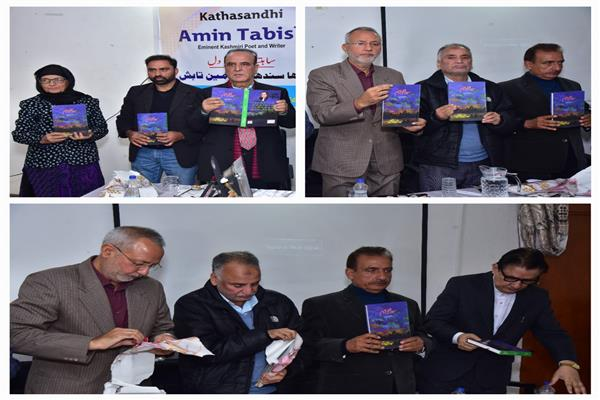
Sahitya Akademi New Delhi organised Grand Literary Function today (19 Nov 2024) at Muslim Eduational Trust Baghat Barzulla Srinagar about Dr. Syed Amin Tabish, his journey of life including his contributions to Literature, Health care and Research.
Prof Mushtaq Sidiqi fr VC IUST was the Chief Guest and Mohammad Rafi Fr District Development Commissioner was the Guest of Honour. Prof Farooq Fayaz, Prof Shad Ramzan, Abdal Mehjoor and Mohammad Amin Bhat were also in the presidium.
Aafiya Geelani, Principal Muslim Educational Trust welcomed the Guests.
Prof. Shad Ramzan presented the key note address. Among other things he praised the wisdom, scientific acumen and poetic excellence of Dr Tabish.
Prof.Tabish in his address spoke at length about his journey of life, from childhood till date.
He said “a tough life needs a language – that is what literature offers – a language powerful enough to say how it is. It is not a hiding place. It is a finding place.” He also spoke about poetry in digital age – creativity, innovation, professional practice and intellectual progress.
He emphasized the need of providing students innovative web- based solutions to literature.
He spoke about most crucial issues confronting the society like drug addiction, misuse of mobile phones by children and limits of screen time, increasing gaps between parents and children, road traffic accidents of teenagers.
He said that the Universe has 200 billion stars, two trillion galaxies and 13 lac creations. Human being is just one out of them. He said that everyone has to qualify to another world of heaven.
Dr. Tabish stressed the need of promoting our mother tongue. Out of 7000 languages in the world, 230 are spoken in Europe, 2200 in Asia including 415 in India. 3000 languages are in danger of vanishing. Languages are living and dynamic. When a language dies, a world dies with it, he said.
Dr. Tabish also responded to various questions asked by some intellectuals in audience.
Prof. Mushtaq Sidiqi appreciated the contributions of Dr Tabish to literature and Healthcare in general and as an Author of 16 books in particular. He hailed the administrative skills and integrity of Prof Tabish. He also said that science has limitations while God doesn’t.
Dr Amin Tabish’s latest book “Sourmali Shaam” a collection of poems was released/launched on the occasion.
Among others who were present, included the reputed authors, writers and poets Abdal Mehjoor, Rukhsana Jabeen, Shamshad Kralwari, Ahmad Ali Fayaz, Wali Waheed, Shakeelu Rahman, Shaukat Shafi, Saududin Saadi, Mohiudin Andrabi, Prof Nelofer Nehvi, Mohamad Yousuf Shaheen Shaheen, Arshad Sauleh, Dr Shahnwaz Hamid of SKIMS, Dr Wahid Raza, Imtiaz Bogami, Sarim Iqbal, Shahi Mumtaz, Rehana Kouser, Gulal Kasmiri, Sahil Dar, etc. Dr. Rouf Adil conducted the programme.(KNS).
source: http://www.knskashmir.com / Kashmir News Service / Home> J & K / by KNS Desk, Srinagar / November 19th, 2024
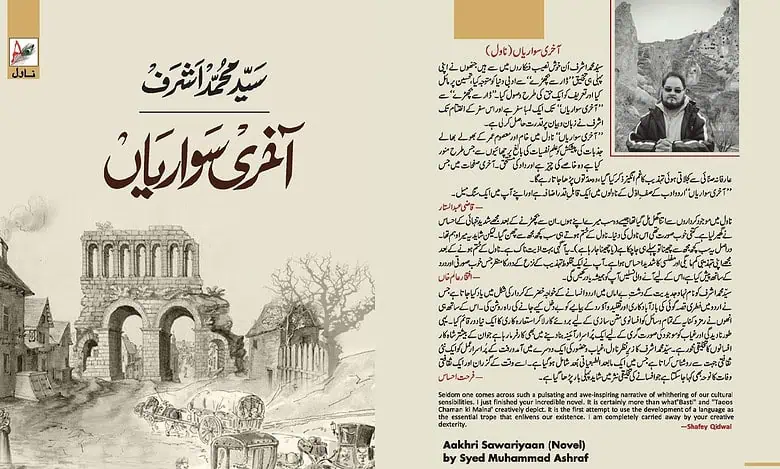
The novel, Akhri Sawarian (The Last Rides), by Syed Mohammed Ashraf woven around a well-knit plot, captures the reader’s attention at its outset. Written in first person, it begins with the anguish and curiosity carefully embedded in the structure of the narrative through introducing an enigmatic ancestral memoir comprising a travelogue which constantly keeps us on tenterhooks till its magical mystery is unraveled at the end.
In the course of the illusive journey of the protagonist who is glued to the chariot of time is seen passing through, and rejoicing the tremendous hues associated with the blossoming of socio-cultural life of the vast Indian society. The narrator, a master craftsman, despite being aware of the futility to remain entangled to his ancestor’s fascination to Central Asia’s mighty ruler Emir Timur, cannot abruptly circumvent from this central trope as it is the only peg to hang on to the storyline. However, his full attention is diverted to main predilections i.e., the celebration of the confluence of ethnicity and the portrayal of cultural bonds of fraternity between individuals of different creeds and diverse identities. The stunning visual effects of a vast thriving society characterized by its homogeneity, valor and wisdom promises a prominent place in the annals of India’s multi-cultural history.
Ardent lover of Nature
The narrator is an ardent lover of Nature and its splendid ethereal beauty especially in rustic environment. He is always found in its realm freely mingling with simple human beings, birds and animals and enjoying the fragrance of the wild fruits and flowers.
Jammu, an innocent charming girl from a destitute family being kept in the landlord’s family and the protagonist nursing a clandestine liaison with her despite his tender age, seems to be natural, especially when the girl herself appears to be smitten with his innocent gestures.
Nevertheless, forced by the destiny when she is married to an old man with two grown up siblings from the previous marriage, she doesn’t bemoan her fate. She rather keeps her spirit high and does everything for the children except succumbing to her husband’s libidos. Her bold stand in the face of repression and her desire to a dignified existence is remarkable. Noting its poignant narration, it is reminiscent to a story by Tagore though in a different situation, depicting the absurdity of child marriage in ancient times.
Here he is looked after by the innocent girl in a spirit which only a mother or sister can afford to display. Akhri Sawarian is neither a didactic novel nor has any edifying quality. However, keeping in view, the protagonist’s own code of conduct, self esteem and ethical parameters though much less than Premchand, he is definitely a critical insider who despite having amorous tendencies never ventures to trespass a certain moral barrier in his relationship. Here the narrator unlike any other feminists seems to be more realistic, conscious and sympathetic to the cause of women empowerment.
Enriched with inter-textual references, frequent flashbacks, tropes and motifs, this novel, a fine example of cultivated aesthetic and literary taste, never deviates from its path and primary aim of retrieving and showcasing the glimpses of a culturally fascinating and vibrating Indian society.
Strategies are many
There are several strategies converged in the plot and the texture right from the time of conception to structuring the narrative to justify the projection of a particular view of life in the novel. One of them is to ensure the protagonist growing up and not attaining abrupt maturity so as to be able to witness and be a part in his childhood of the generally pastoral serenity, its soothing ambiance and the panoramic view.
The nuanced and incisive description of abject impoverishment, onslaught of maladies, the convergence of the people on mass scale at special occasions, empathy, quarrels on ordinary things, yearnings, deprivations, simplicity in attires and imaginations and a firm belief in rituals and sacraments bring forth the clear picture of a society.
Now in the last stage of the fast changing scenario, we come across a stage where we see the protagonist albeit in a new Avatar. Sitting in the carriage drawn by the galloping horses in the dust of time, surmounting hurdles, passing through rough terrain, lesser known places and locations. Through this arduous journey, we are transported to a completely different and highly perturbing level of existence where the protagonist is now capable to comprehend the purpose of life. Though distraught and shattered, he is seen in this mist, conversing with his better half who is helping her husband to navigate through the ravaging river of time. This phase is marked by the presence of sharpening intelligence and probing glances of our hero’s life companion. She becomes instrumental in decoding the mystery surrounding the small purse and the great grandfather’s travelogue. It is a great redeeming factor in settling an intriguing paradox. It also opens the possibility of a plethora of other wounds to be inflicted by the arrows of time in the days to come. Now as the story proceeds on the predictable lines, a depressingly brooding protagonist seated as usual in his moving coach, now in familiar locations, though initially reluctant, relents willy-nilly to his equally subdued and stressed wife’s persuasions to shed some light and unfold the long held mystery around the ancestral box, being the life threatening crux of the problem.
She exclaims: Your great grandfather’s old wallet has become the tormenting scabbard of Timur. It has kept you since your childhood on the tenterhooks.
This leads to the opening of a Pandora’s Box of hazardous historical events, fancies and hallucinations spread over a long period of time. During recounting the chain of events, one is struck with disbelief to see the pathetic scenes of the fettered skeleton of the last Mughal emperor; Bahadur Shah Zafar perched in a bullock cart passing through the rugged surface all the way to be incarcerated in Rangoon. In the meanwhile the wheel of chariot moves forward to the delight of the chronicler to a tempestuous journey undertaken by the protagonist’s great grandfather in his younger days to Samarkand, in murky past and his illusory encounter with a bed ridden and mutilated legendary despot Emir Timur.
In the technique of sub-plot along with the main story there is also a rare moment when the narrator to his utter bewilderment, suddenly discovers that his great grandfather is being gifted with the snippet of the royal sword’s scabbard and a relic by the mighty hands of none other than Timur himself. After revealing this secret to his wailing and sobbing wife, he seems to be all the more desperate to be under the spell of lunacy that needs immediate medical attention. This part of the narrative culminating to the final closure becomes more interesting because of the protagonist’s realization of the social polarization, simmering discontent and unintelligible contradictions in the society at large. He, who had never envisaged such dreadful lurking images earlier, gets traumatized.
By way of ensuring tranquility and spiritual solace, he is led during a frosty winter night to a secluded corner in Mehrauli at Delhi. However, owing to mental inconsistency, delusion, persisting gloominess and strange feelings, lying in his beloved wife’s lap he looks around with his eyes wide open as a shudder runs down his spine with the constantly blowing freezing gusty winds.
The narrator in order to epitomize his idea of a synthetic national identity has frequently employed the analogy of “Assorted Fragrance” which signifies India’s century’s old multi-cultural and ethnic diversities.
The hanging clouds of haze and fog appeared to him like gigantic civilizational legacies being snatched and driven away by the thugs on the wings of time. With little hope to see them again, shivering with high fever in the freezing atmosphere, he is weeping profusely and bemoaning as he is fully disillusioned with the new found realities of time and feels himself completely misfit to reconcile with the changed vocabulary of social etiquette replaced with tardiness of behaviors and degrading moral bonding. Sitting beside the citadel of a vast and magnificent cultural repository, he murmurs to himself in utter chaos and suffocation, the couplet of Mirza Ghalib.
Mauj-e-Khoon, Neelay Samandar Ka Safar Karti Hui,
Dajla Roshan Kabhi Is Rang say Ganga Roshan
Blood laden waves passing through the blue oceans
It’s colour, blazing Tigris often Ganges
Notwithstanding the fact that the narrator is fully aware of the implicit subversion of our ethos and a perceptible indiscretion in people to people relations, he doesn’t necessarily commit himself to pinning down the obvious reasons or casting aspersion on anyone for wrecking-havoc in the society. He prefers instead to deal with the effects rather than the reasons of the turmoil, thereby restricting himself to merely lamenting and bemoaning the loss of the mosaic of cultural identity.
Even against the backdrop of the shifting sands of the historic realities in the subcontinent, the narrator riding high on the back of the unbridled horse of the time, though in pensive, mood is still ready in bardic fashion to go extra miles to see a new sun rising from the dusty horizon. Worries and tensions writ large on his countenance, an anguished protagonist with an indomitable flickering spirit, at times appears engrossed in the futile act of thwarting the course of the tidal waves and the next moment sitting on the threshold of humanity awaiting a miraculous return of the caravan lost in the wilderness. Contemplating in melancholic mood, he mutters in a state of soliloquy wondering about a formidable humanity vanishing with little hope to emerge again from the whirl pool .of the ravaging river of time. It’s reflective of his amazingly unwavering resilience to cope with the harsh reality of the moment with fortitude but with little hope.
However, it is not to be forgotten that the awe inspiring picturisation of mental images, enormous capacity to traverse through the wide spectrum of human emotions and tantalizing depiction of the fictional realities of life are definitely the outcome of a highly skilled, sharply focused and a calibrated mind of the artist which has found full expressions in this novel in terms of its unconventional craftsmanship, terrific sense of impish humor, irresistible quest for wit and irony taking precedence over many other devices and attributes of linguistic and literary manifestations.
Akhri Sawarian is another post-partition trail blazer of Syed Mohammed Ashraf though tragic at the core shall stay in our thought and imagination.
Qazi Obaidur Rahman Hashmi is a distinguished Adjunct Professor of Urdu at Jamia Millia Islamia in Delhi. His dedication to Urdu literature and education is highly appreciated.
source: http://www.siasat.com / The Siasat Daily / Home> Featured News> Books / by Qazi Obaidur Rahman Hashmi / June 27th, 2024
Professor Jawaid Iqbal, an eminent academic from the Department of West Asian Studies and North African Studies, Aligarh Muslim University (AMU), has been appointed as Vice-Chancellor of Baba Ghulam Shah Badshah University (BGSBU) in Rajouri, Jammu. He has taken over the charge of his office. His appointment was made by Lieutenant Governor Manoj Sinha on October 15, 2024, for tenure of three years.
Prior to this appointment, Professor Iqbal held several key administrative roles at AMU. He served as the Dean of the Faculty of International Studies and Chairman of the Department of West Asian and North African Studies. He also held the position of acting Vice Chancellor of AMU.
The AMU fraternity feels immense pride in his elevation to this prestigious role, said Professor Naima Khatoon, Vice Chancellor, AMU, adding that it is a testament to the high standards of scholarship and leadership cultivated at AMU.
Prof Mohammad Gulrez, and Prof. Mohammad Azher, Chairman of the Department of West Asian and North African Studies at AMU, also congratulated Prof Iqbal on his new role.
source: http://www.radiancenews.com / Radiance News / Home> Uncategorized / by Radiance News Bureau (headline edited) / November 19th, 2024
The sudden demise of veteran bureaucrat and author Shehzad Mohammad Khan, widely known as S.M. Khan, has left many in shock and grief. Social media is flooded with tributes, with admirers remembering him as a person of “utmost humility and generosity,” reports the ATV.
S.M. Khan passed away on Sunday at the age of 67 after a brief illness. He is survived by his wife and three children. His last rites took place today in his hometown of Khurja in Uttar Pradesh’s Bulandshahr district, according to family sources.
Khan’s passing marks the end of an era in the Indian Information Service (IIS) and public relations field, where he set benchmarks for loyalty and dedication throughout his illustrious career.
Born on June 15, 1957, in Khurja, S.M. Khan completed his education at Aligarh Muslim University and the University of Wales, England. Joining the IIS in 1982, he held several critical roles over the years.
One of his most prominent assignments was serving as the spokesperson for the Central Bureau of Investigation (CBI) between 1989 and 2002. During this time, he skilfully handled media communications for high-profile cases such as the Harshad Mehta financial scandal, Bofors scandal, and Rajiv Gandhi assassination case.
From 2002 to 2007, Khan served as Press Secretary to President Dr. A.P.J. Abdul Kalam. His tenure included managing the President’s media relations and accompanying him on national and international tours. Inspired by Dr. Kalam, Khan authored Awami Sadar (The People’s President), which shed light on lesser-known aspects of the former president’s life.
Khan also played a pivotal role in shaping Indian media through his work as the Director General (News) of Doordarshan, where he oversaw coverage of significant events such as National Film Awards and Dada Saheb Phalke Award. Additionally, he served as Director of the Directorate of Film Festivals (DFF), representing India at prestigious platforms like the Cannes and Berlin Film Festivals.
Beyond his professional achievements, Khan was deeply involved in fostering interfaith harmony as a trustee of India Islamic Cultural Centre (IICC). Elected Vice President of the IICC in 2019, he dedicated himself to promoting mutual understanding across communities.
S.M. Khan maintained a strong bond with his alma mater, Aligarh Muslim University, serving as a member of its Court and the Executive Council. His efforts in promoting education and cultural understanding continue to inspire many.
His passing is a significant loss to the nation, leaving behind a legacy of excellence, humility, and dedication.
source: http://www.radiancenews.com / Radiance News / Home> Obiturary / by Radiance News Bureau / November 19th, 2024
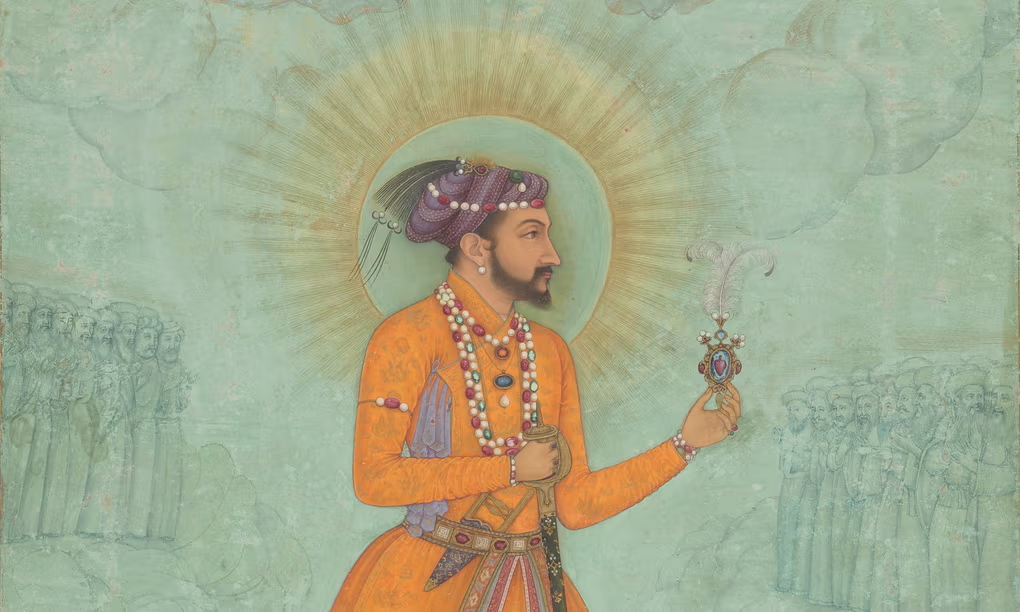
Shah Jahan, the fifth Mughal emperor, who built the Taj Mahal to commemorate his favourite wife. Photograph: The Trustees of the Chester Beatty Library, Dublin
V&A, London Romance, bloodshed and religious curiosity is distilled in these lovely artefacts from the mighty military reign with a love of beauty and culture
This exhibition wafts you to the paradise that Shah Jahan, fifth of the Muslim emperors of much of modern India and Pakistan, wanted to create on Earth. A floor-covering decorated with red poppies sets the scene for this idyll of calmness. A rippled stone panel with myriad water spouts had me dreaming of fruit trees and pavilions while I was cooled by a stone jali screen that once filtered air through one of his buildings. These lovely objects help to fill in for his masterpiece, which for obvious reasons can’t be here: the Taj Mahal.
It is shown on a big screen above the portable delights, twinkling white in the hazy Agra sky. Shah Jahan famously built it as a mausoleum for his favourite wife, Mumtaz Mahal, who died in childbirth in 1631; his tomb is there beside hers. It may be familiar but this piece of architectural heaven captivatingly distils the extraordinary civilisation that a warlike dynasty from Central Asia bequeathed to the world.
The original founder of Mughal power led his armies from Kabul into northern India. When this first empire collapsed it was resurrected by Akbar, first of the exhibition’s “great” Mughal rulers, who combined military might with a love of culture and beauty that his successors would share.
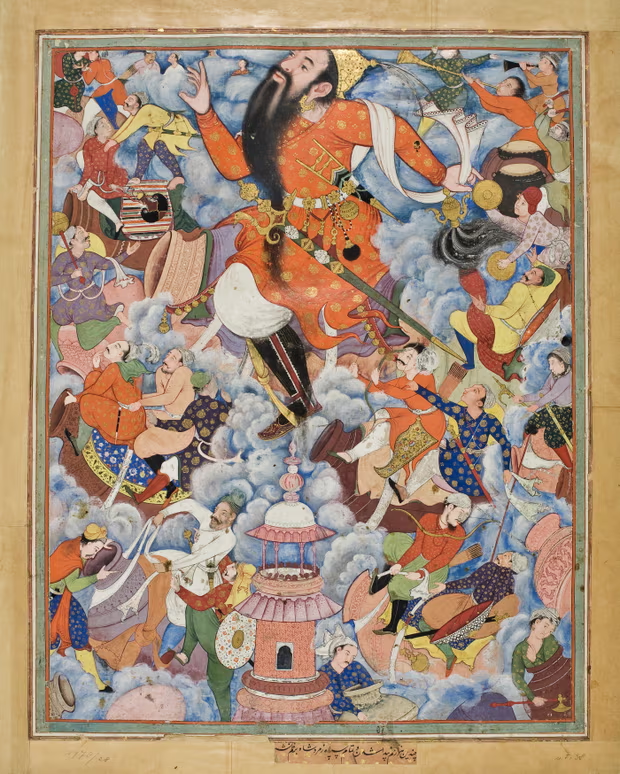
The giant Zumurrud Shah flees with his army, from the Hamzanama, circa 1562-1577. Photograph: MAK/Georg Mayer
Akbar was illiterate but that didn’t stop him employing Hindu and Muslim artists to create a library of illuminated manuscripts. He had readers to tell him what the words said; anyway you can follow the epics he favoured from the ravishing illustrations. In a scene from one of his favourite story cycles, the Hamzanama, a giant with a long beard and bright red coat is chased away through the clouds by Hamza’s army.
The court painting style started by Akbar combines closely observed reality with transporting fantasy. A princess of Kabul lowers her hair for a lover to climb up against a brilliantly realistic garden where ducks swim in a rectangular pool, while above rises a dreamlike mountain landscape and a palace floating in the sky.
In the reign of Akbar’s successor, Jahangir, who came to the throne a couple of years after James I was crowned in England, a natural historical and scientific curiosity sharpens the paintings. In about 1612, a North American turkey cock reached the court and the renowned artist Mansur painted it. The bird – with its orange head, long drooping beak and fan tail – seems to pose as patiently for its portrait as Jahangir himself does in a painting of him studying a globe.
The Great Mughals were interested not just in globes but the globe. They embraced religious complexity and did not expect the Hindu population to convert to Islam. In fact, these curious rulers were attracted to Hindu mythology and mystics. In a painting entitled A Muslim Pilgrim Learns a Lesson in Piety from a Brahman, the pilgrim walks through a rolling north Indian landscape where he encounters a Hindu mystic lying in the road in true spiritual humility. The Mughals were also attracted to the mystic Islamic Sufi movement. That is represented here by a Sufi dervish’s drinking horn and Sufi-inscribed tiles from a now-vanished mosque in Lahore.
Their art absorbed influences from Persia to Renaissance Europe. Portuguese merchants are depicted visiting the Mughal court and, more mysteriously, speaking with angels as the court artists try to make sense of their strange Christian religion.
The exchange went both ways. A Mughal round shield, covered in lustrous mother of pearl patterns and pictures, has been lent by the Bargello Museum in Florence. This dazzling luxury object entered the collection of the Medici family in the 1590s.
This shield never saw battle, plainly, but the Mughals didn’t create their gorgeous world without bloodshed. Many weapons here are opulent and lethal: curved daggers with jewel-encrusted hilts and scabbards, “punch daggers” with floral decoration.
Art itself could be a fantasy of killing. There’s a portrait of Jahangir standing on a globe, shooting an arrow at close range at the severed head of his enemy Malik Ambar. This never happened, but the painting may have eased the emperor’s desire for revenge against this formerly enslaved Ethiopian who rose to be regent of a sultanate and a thorn in Jahangir’s flesh.
When the battles are won and the day’s hunting is over, you drink wine from a jade cup poured from a slender-necked ewer and walk in the gardens to be soothed by the pitter patter of fountains. Where is paradise? A Mughal court poet offered an answer you might agree with by the end of this show: “It is here, it is here, it is here.”
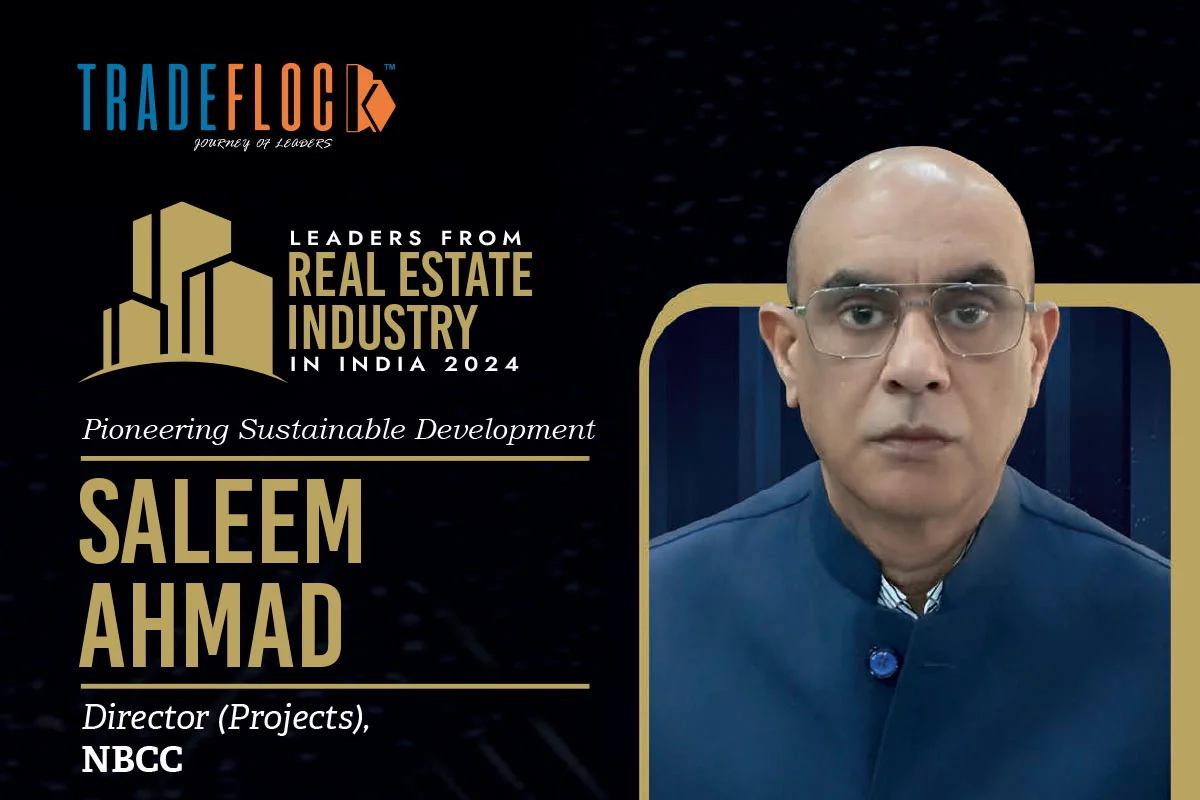
Sustainable development is at the crux of modern real estate and infrastructure projects, shaping how we build and live. In this landscape, leaders who can seamlessly integrate sustainability into their operations are invaluable. Saleem Ahmad, with his strategic vision for sustainable development, exemplifies this leadership. As the newly appointed Director (Projects) at NBCC (India) Limited, Saleem’s expertise is instrumental in advancing sustainable practices within the industry.
The Journey – Then and Now
Saleem’s journey in civil engineering began with his graduation from Jamia Millia Islamia University in 1990. His extensive career spans over 33 years, during which he has held significant roles at the Delhi Metro Rail Corporation (DMRC) and the Mumbai Port Trust.
At DMRC, where he served as Executive Director (Civil), Saleem played a pivotal role in implementing last-mile connectivity solutions, greatly enhancing urban mobility in Delhi. This experience laid a solid foundation for his current role at NBCC, where he continues to drive innovative and sustainable projects.
Today, in his role as Director (Projects) at NBCC, Saleem oversees some of the most ambitious and complex projects across the nation. His leadership is marked by a commitment to quality and sustainability, ensuring that projects are not only completed on time but also adhere to the highest standards. He has successfully led diverse projects, from hospitals and educational institutions to critical infrastructure like Indo-Pak border fencing and the Gosikhurd irrigation project. Saleem’s strategic vision and meticulous attention to detail have made him an invaluable asset to NBCC.
Handling project challenges is an integral part of Saleem Ahmad’s role at NBCC. He approaches these challenges with a blend of strategic planning, effective communication, and adaptive problem-solving. His methodology includes risk assessment and mitigation, stakeholder communication, adaptive problem-solving, resource allocation, and quality assurance. Saleem’s ability to navigate unforeseen challenges and deliver successful outcomes underscores his expertise and resilience in the construction industry.
Saleem Ahmad’s approach to project management extends beyond technical execution to include community engagement and sustainable practices. During projects like the redevelopment of 7 GPRA colonies, he ensured active participation from residents and local authorities, maintaining transparent communication and minimising disruptions. His focus on enhancing social infrastructure, such as parks, schools, and healthcare centres, reflects his commitment to improving the quality of life for communities. His advocacy for sustainable practices is also evident in his promotion of energy-efficient designs. Saleem emphasises the use of eco-friendly materials, passive design techniques, energy modelling, and the integration of renewable energy sources. His efforts contribute to the creation of sustainable and energy-efficient buildings, aligning with global standards of responsible urban development.
His approach to project management emphasises sustainable growth and people-centric execution. By fostering collaboration and innovation, Saleem has significantly contributed to NBCC’s reputation for delivering high-quality and environmentally responsible projects.
Awards and Recognition
Saleem’s contributions to the construction and real estate sectors have earned him widespread recognition. He was honoured with the “Realty Person of the Year Award” at the EPC World Awards in New Delhi, a testament to his exceptional work and dedication.
Additionally, his transformative leadership at Hindustan Steelworks Construction Ltd. (HSCL) turned a loss-making PSU into a profitable Mini-Ratna entity, earning him the “CEO with HR Orientation Award” by the World HRD Congress and Times Ascent.
These accolades highlight Saleem’s ability to inspire and lead teams towards success. His recognition in the industry underscores his commitment to excellence and his strategic vision for sustainable development.
Advocacy and Work Ethics
Saleem is a staunch advocate for sustainable growth and people-centric project execution. His work ethic emphasises client satisfaction, excellence, and environmental responsibility. He has presented numerous papers on sustainable infrastructure and urban mobility at national and international forums, sharing his insights and advocating for environmentally responsible construction practices.
His commitment to sustainable development ensures that the projects he leads contribute positively to the environment and society. Saleem’s advocacy for sustainable infrastructure is evident in his efforts to promote energy-efficient designs and the use of eco-friendly materials.
Saleem’s extensive experience, leadership qualities, and people-centric approach make him a distinguished figure in the real estate and construction sectors. His journey from a passionate civil engineering graduate to the Director (Projects) at NBCC is marked by significant achievements, a commitment to sustainability, and a vision for the future of urban development. Saleem continues to inspire and lead with empathy, strategic foresight, and an unwavering dedication to excellence, significantly contributing to the success and growth of NBCC.
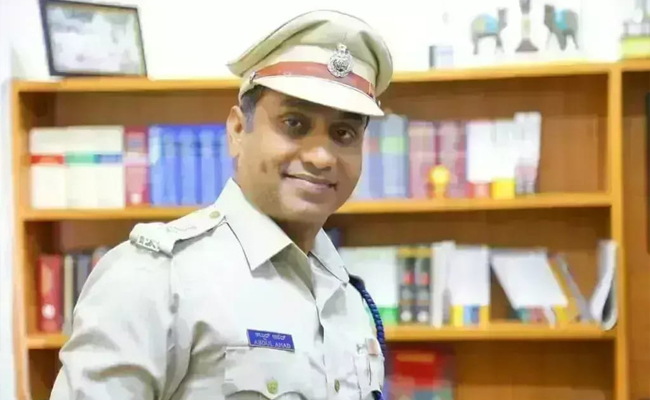
Senior IPS officer Abdul Ahad, who was serving as the Deputy Commissioner of Police (DCP) of the Bengaluru City Crime Branch (CCB), has been transferred as the Director of Security and Vigilance for BMTC.
Earlier, the senior officer from Mangaluru’s Moodbidri served as the Superintendent of Police (SP) of the Coastal Security Police. In September last year, he was appointed as the DCP of the CCB.
Abdul Ahad has also held several key positions, including DCP of Bengaluru’s Whitefield division, SP of the Anti-Corruption Bureau (ACB) Bengaluru, SP of the Economic Offences Wing at CID, and Commandant at KSRP.
It’s said you get one life to live it all. Believing this completely justice Syed Haider Abbas Raza (retd) has lived his life to the brim and accomplished all that he once dreamt of.
At 81, he continues to walk daily, come hail or high water, is an avid television watcher and also actively counsels young lawyers if and when they seek his guidance. Television-viewing though is strictly restricted to political programmes.
It is not often that you see an octogenarian look dapper in a dark-coloured, three-piece suit and matching tie. Raza carried it off with aplomb, the attire also demonstrating the formality that came with his chosen profession.
Early days
“I was born on December 7, 1939, in Faizabad and we are from the family of Kichouchha Sharif, a known Dargah of the famous Chisti Sufi saint Makhdoom Syed Ashraf Jahangir Semnani.
My father, Mehdi Hasan, was a postmaster and education was the most important trait of my family and all six siblings were given the best education available in those times. We were told to focus on studies and rest will follow. Till Class VIII, I studied in Faizabad and then my father decided to settle in Lucknow as he too had received his early education here and also, he liked the city more than any other place. It was in Lucknow that I was enrolled in Government Jubilee Inter College and I began my new innings in a new town,” Raza reminisced fondly.
Part of students’ movement
“I was in Class IX when I took part in a number of debate competitions and won a number of contests. It was then that I met a lot of new people and also developed public speaking skills. The early 50s gave my life a new turn as it was during these years I also got associated with the students’ movement. In 1952, I became the general secretary of the association known as Self Governing Consulate of Jubilee College and thereafter, I joined the Students’ Federation of India and remained an active member of the communist party. Soon, these movements become an essential part of my life when I enrolled in Lucknow University in 1956,” he said.
Finding his calling
Talking about his days of youth, he said, “Those were the days when I learnt how important it is for all to understand his or her rights and to fight for them too. When you are young the energy is different, the understanding of situations is so different than what the reality is. And when you meet people who have been deprived of their rights, it hurt me more. Thankfully, I was studying law and got to learn a lot during that phase. I had a dream to make a career either in politics or in judiciary and I got to live the best of both worlds but soon realised my calling was law practice.”
A lawyer is born
“After graduating as Bachelor of Arts and Law, I joined the Bar in 1962. And I specialised in Service Labour, Civil and Constitutional law. Also, it was in that same decade I joined the Congress and became general secretary and president of Congress committee, Lucknow. Also because of my specialisation, I got associated with various trade unions and got actively involved in meetings, rallies, demonstrations and repressive policies of the then Janta Party government.”
It was in the late 70s he started taking up legal cases associated with the political party, “Yes, I appeared as a lawyer in cases against the late Sanjay Gandhi, leader of Congress Party, launched in Lucknow court. Also, I appeared as a lawyer before Aligarh Enquiry Commission to defend former Prime Minister Indira Gandhi. I was completely involved with my political stint and took part in party tours and meetings. Then when Indiraji came to power, I decided to quit active politics and concentrate on my legal practice more in Lucknow Bench of the Allahabad High court.”
Elevation as judge
“My elevation as judge did not happen overnight. Once my name did go for the process in 1978-79 but the then chief minister succumbed to the pressure from people who did not want my name to go ahead. And again after almost a decade the then chief justice Amitabh Banerjee considered my name and did send it forward and recommended my name to the high court after seeing the kind of law practice I was undertaking at that time. Then finally, I was elevated in the year 1988-89 and become judge of the Lucknow Bench of the Allahabad High Court. During the same time, I was nominated by the Governor as an executive council member of the Aligarh Muslim University.
My tenure as judge was of 13 years in conservative estimate and I disposed of about one lakh cases. Also, I still feel proud that my judgements in Service Labour, Civil and Constitutional matters were acclaimed by the Supreme Court. It was in 2001 that I retired as senior judge of the Lucknow Bench of the Allahabad High Court.”
Talking about the cases he presided over, he said, “As we all know, India’s judicial system allows any individual or group of people to initiate litigation by merely addressing a letter to a judge that is called a PIL (public interest litigation) and in my career, I tried taking them to the highest peak. In the ‘Jhande wala Park, Aminabad PIL’, I stopped the construction of a shopping complex there as the park had historical significance: it would all have got destroyed. Then political rallies at Begum Hazrat Mahal Park used to create chaos in Hazratganj. I presided over the hearing on that PIL too and stopped the organisation of such rallies there. Also, the old clothes’ market around that place was relocated after that. Also, Hazratganj and six other linked roads were made no-diesel tempo zoned after I pronounced a judgement over another PIL in that matter.”
These judgements earned him a lot of praise. “Yes, this came as a surprise that people actually did come up to me lauding those judgements. And till date, they remain most talked about cases in the state’s judicial history.”
First Lokayukta
After retirement too, justice Raza refused to slow down. “It was in September 2001, the governor of Uttarakhand along with the then chief minister, chief justice and leader of opposition, appointed me the first Lokayukta of Uttarakhand. It was again a big honour for me and overwhelmed me. I also felt so proud and happy when I convened and organised the All India Lokpal, Lokayukta and UP Lokayukta Conference in Dehradun which was inaugurated by former president APJ Abdul Kalam and former prime minister Manmohan Singh. Later, in 2006-07, I was awarded ‘The Pride of Uttarakhand Award’ and ‘Uttarakhand Ratna,’ respectively.”
source: http://www.hindustantimes.com / Hindustan Times / Home / by S Farah Rizvi / January 20th, 2020