Category Archives: Travel & Tourism

Now, learn about Hyderabad’s Hayat Bakshi Begum through virtual reality experience

Hyderabad, TELANGANA :

The HDW, which has been organized by the Telangana government in partnership with India Design Forum (IDF) and the World Design Organisation (WDO), is being held parallelly with the World Design Assembly
  • A trailer titled, ‘Ma Saheba – The queen of Hyderabad’, explores 360-degree VR animation as the latest technology of film
  • The technology enables the viewer to visit the Qutb Shahi tombs (necropolis) from the comfort of their own location, interacting with the landscape as if almost they were physically present there

Hyderabad:

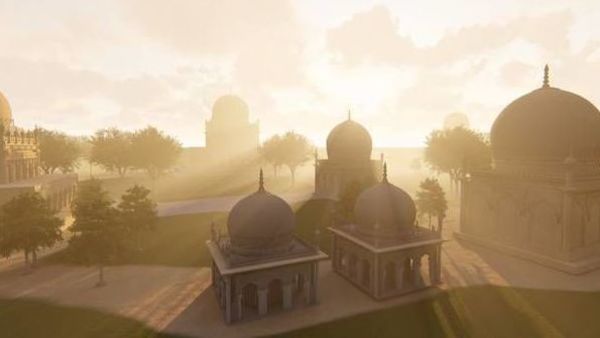
A team from the Indian Institute of Technology-Hyderabad’s (IIT-H) department of design has created a Virtual Reality (VR) experience for an oral historical narrative of Begum Hayat Bakshi, one of the most influential historical figures of the Qutb Shahi dynasty (1518-1687), which founded Hyderabad (in 1591).

The story of Hayat Bakshi Begum is considered to be of women empowerment, given that she lived through the rule of three kings of the Qutb Shahi dynasty. A trailer titled, ‘Ma Saheba – The queen of Hyderabad’, explores 360-degree VR animation as the latest technology of film. Begum was the daughter of Mohammed Quli Qutb Shah (1580-1611), the founder of Hyderabad.

She was married to Mohammed Qutb Shah (1612-26), the nephew of (and king after) Mohammed Quli Shah. After the death of her husband, though her son Abdullah Qutb Shah (1626-71) became king, Hayat Bakshi Begum had a considerable influence over the affairs of the Golconda (or Qutb Shahi) kingdom, which was founded in 1518. The VR oral history narrative will be available for the public on 11 and 12 October in Hyderabad, as part of the ongoing (9 to 13 October) Hyderabad Design week (HDW).

The HDW, which has been organized by the Telangana government in partnership with India Design Forum (IDF) and the World Design Organisation (WDO), is being held parallelly with the World Design Assembly, which will be held in Hyderabad on 11 and 12 October.

“Using the premier technology in immersion, IIT-H developed a virtual exploratory landscape which lets the user experience the historical monuments (tombs, where the founders of Hyderabad and others from the kingdom are buried) of Qutb Shahi like never before. The use of virtual reality-based technology to preserve and explore history is a method that provides results with almost lifelike experiences,” said a press release from IIT-H on Wednesday.

Speaking about the initiative, Prof. Deepak John Mathew, head, department of design, IIT-H said, “This project is initiated with the support of the Design Innovation Centre at IIT Hyderabad. The objective is to create a Visual Model of the monuments in India. This is the first attempt in this series. This will be exhibited at the airport as well as HICC during the WDO Conference. This is a fusion of art and technology.”

The technology enables the viewer to visit the Qutb Shahi tombs (necropolis) from the comfort of their own location, interacting with the landscape as if almost they were physically present there. The installation aims at raising awareness about the intricate history of Hyderabad. The IIT-H’s department of design undertook a high-resolution scan of the tomb complex for the project.

source: http://www.livemint.com / Live Mint / Home> Explore / by Yunus Y. Lasania / October 09th, 2019

COVER STORY : Travelling in tandem

Bengaluru, KARNATAKA :

Anjum is a self-confessed foodie, and loves cooking. In fact, she recalls, it was this love and talent that led to her meeting Omer at the restaurant: “I used to bake a lot, and market my cakes and pastries to earn my pocket money, to spend on music and clothes”

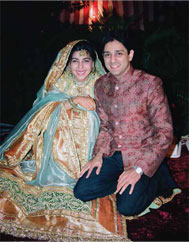
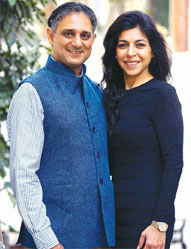
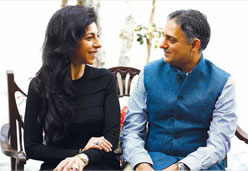
He is a descendant of the royal families of Bhopal, Pataudi and the Paigahs of Hyderabad, she is the sister of the tycoons who run one of Bengaluru’s biggest realty companies. They have now joined hands to raise the level of living in the Prestige Group’s apartments and resorts-she designs and executes the interiors, while he has set up and runs the group’s hospitality vertical
Prestige01MPOs07oct2019

Nawabzada Omer Bin Jung and Anjum Razack met on a blind date. Well, not exactly a blind date, they say: “Actually, we were set up!” says Anjum, and Omer agrees. “But she picked me up!” he adds, with a twinkle in his eye. He is being literal: “I had no car, and used to roam around in buses and auto-rickshaws when I was working with Wipro.” So this young woman whom he had never met came to his office and gave him a lift.

Recalling the incidents of more than a decade ago, husband and wife keep bickering good-naturedly and correcting each other over details. The story that emerges is that a friend of Anjum’s said she wanted to meet her-at Casa Piccola, a restaurant to which Anjum used to supply cakes she baked. “And will you please pick up this guy Omer on the way? I want to meet him too,” she said. So an unsuspecting Anjum drove an equally unsuspecting Omer to the restaurant, where they sat and waited for the friend. When some time passed and she didn’t appear, they realised what had happened.

Was it love at first sight? “I don’t know if it was love, but I knew immediately that this was the guy I was going to marry!” she says. “My mother had always told me: ‘You should know what kind of boy you should bring home to meet me!’-and that afternoon I told her I had met the right man.”

Omer, for his part, “Enjoyed being the hunted, for a change”. They didn’t meet, or talk, for a month; but one day-just before Valentine’s Day, Anjum remembers-she and her friend were driving somewhere, when they spotted Omer walking. “We stopped, said ‘Hi!’ and gave him a lift.”

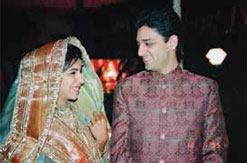
Things didn’t take very long after that. “My family doesn’t have the time for trivia!” Anjum explains. “I told my mother as soon as I got home that I had met the boy I was going to marry. I mean, we were two eligible young people in the same town. He was not of our caste of traditional business people, which was actually a plus point in his favour! Our families met, and I went through the various shredders his family put me through, then picked up the pieces-and we got engaged, then married in the next eight months.”

“We were two eligible young people in the same town. He was not of our caste of traditional business people, which was actually a plus point in his favour! Our families met, and I went through the various shredders his family put me through, then picked up the pieces−and we got engaged, then married in the next eight months.” − Anjum
Prestige02MPOs07oct2019

A few months before the marriage, they went to see Omer’s grandmother: “That was the first time I took a break from work,” she says. “Morph was still a one-person company, with only a set of carpenters to supervise. When we came back, I was broke, and went straight back to work. Side by side, I set up home and pottered around there, too.”

Anjum, the sister of the Razack brothers who run Bengaluru-based construction major Prestige group, is an entrepreneur in her own right: she set up Morph Design Company (MDC), which she runs as its Managing Director. Omer, who heads Prestige’s recent diversification into the hospitality business, comes from a long line of rulers-from the Paigahs of Hyderabad on his father’s side to a royal pedigree on his mother’s. “I have an interesting and diverse lineage. My maternal grandmother was the ruler of Bhopal with its matriarchal system. She married the Nawab of Pataudi, which was a much smaller kingdom, but both became our family’s houses. My father’s people were Prime Ministers to the Nizam of Hyderabad.” The Paigahs are a family of the senior aristocracy of the erstwhile Hyderabad State, with each of them maintaining his own court, individual palaces and a standing army of 3,000 or 4,000 soldiers.

Anjum, on the other hand, was what she calls ‘a one-woman army’ in a male-dominated business when she joined her brothers in 1993 and set up MDC. That ‘one-woman army’ has grown in 23 years to a Rs. 200-crore, 30-member team; but she continues to work hands-on with every project. “They are a bunch of kids-we are a young, growing office,” she says. “Besides, I love what I do-and I always put in 100 per cent into any assignment, because you always get only what you put in. I am also an obsessive perfectionist and would never deliver to a client what I wouldn’t live in myself.”

She had found, when she finished school, that she was in a ‘strange situation’ with not too many career options for a girl of her background-a Kutchi Memon in a typical business family, but one whose father had believed in education for his daughter as well as his three sons. “My parents have always been very aspirational for all their four children,” she explains. “We were all given education, encouraged to travel and grow-all against the norm in our community.” So after her B Com, she did a course in interiors with paint manufacturer Jenson & Nicholson. She then got a job with an interior designer in the early 1990s before joining the family business. “I jumped into the ocean headlong, without even knowing how to swim!” she says. “It was only the challenge that kept me
Prestige03MPOs07oct2019

MDC, which she established soon after that plunge, not only creates all the interiors in the Prestige Group’s developments, but also offers consultation, comprehensive planning and end-to-end design solutions for a range of other select clients for both their existing structures and new projects. She is also rightfully proud of the fact that her brothers Irfan Razack, Chairman and Managing Director of the Rs. 4,700-crore Prestige Group, and Rezwan Razack, who is Joint MD, never gave her any special privileges in business. “Even though we are a very close-knit family,” she says. “Morph is my very own, Prestige is my client. I charge design and project management fees, and for the furniture and other material I supply from either my own manufacturing units or those from whom I source them.” She does, however, describe working with family as putting her ‘between a rock and a hard place’ very often.

“My big idea was to reach out to the discerning interior design market, be it luxury or aspirational, and provide my clients with a lifestyle that they would enjoy,” is how Anjum how explains the way she approaches her work. “I wanted to introduce discerning customers to living spaces that represent and reflect their individual taste and stay relevant through changing times.” Designing an interior space, she points out, presupposes that “A design metaphor will reveal itself in every object, colour, finish and patina”. Obviously, when the idea finds expression and rhythm in such detail, the natural outcome would be a space made distinctive by its very uniqueness. “That,” she adds, “is why I do not just stop at designing the experience of an interior space, but also construct or create most of the objects that shape the design.”

“I went to boarding school at Sanawar, then Hindu College in Delhi and the London School of Economics. When I came back to India, I decided to move to Bengaluru instead of Hyderabad−it was a new city as compared to Hyderabad, and I could do anything here with its own level of decadence! Besides, my elder brother was here too” − Omer

“Good taste in interiors has come of age. The challenge lies in the fact that often, the notion of interior design stops at the placement of attractive objects in a well-designed room. While that is a mandate we can serve with ease, we challenge ourselves to give our customers much more. This we do by shaping their experience of interior space, through manipulation of spatial volume, as well as surface treatment. So, while apartments today are predicated on the optimal use of space and uniformity, our challenge is to create a unique interior space in a structurally similar landscape,” she says.

“We have also integrated backward to create a super-large vertical, with project management, sourcing and a trading company-and now even furniture manufacturing. We create 90 per cent of all the furniture that is provided in any Prestige construction.”
Prestige04MPOs07oct2019

From its beginnings as an in-house interior design subdivision, Morph has morphed into a fully integrated interior design firm that executes and handles projects for external clientele, too. It provides a one-point solution from design, creating a portfolio of work across apartments, villas, clubhouses, spas, resorts and hotels. Hotels, resorts or serviced apartments. “All of these need to be addressed very differently from one another,” Anjum explains. Along the way, the company has worked with globally renowned architecture firms like Dileonardo, Woods Bagot, HBA, MAP and SRSS, and executed projects as large as 2.5 million sq ft (nearly a quarter million sq m). “We have also won a lot of awards, in different areas of our work. My brothers look at me differently now!” she adds.

Describing herself as an entrepreneur at heart, not satisfied with interior design alone, Anjum says this is why she vertically integrated the manufacturing process by setting up state-of-the-art in-house factories over two decades ago, to cater to the different design sensibilities of customers, from traditional, classic to the more contemporary, experimental and eclectic. “Our products are also designed to give our clients great value for money across the entire product spectrum,” she adds.

“From a process perspective, everything from concept, drawings, prototyping, to the final production of each and every piece of furniture that we use in our projects is backward integrated,” she explains. “Our external dependence is minimal and allows us to achieve unmatched quality giving us the ability to create truly bespoke interiors, where each detail is created by us. Having control over customisation and production, we ensure that our design process is a constantly evolving and dynamic one”

“The journey has been tough-but a good tough!” Anjum smiles. “The biggest chip on my shoulder is that I didn’t go to design school. But I love working, and I have been loyal to my work.” She did, however, take a course in designing at Cornell University. “I firmly believe that you must always start from the back operations to be strong. There was a sad lack of originality and quality in the market-that’s why I started my furniture business with visits to China, Italy, Germany, Austria and Burma, getting the best rates at which I could import what I needed for each project.”

With this bottom-up organisational design approach, Anjum has been responsible for business development, strategic planning, diversification, and project management along with all other key executive functions. Her work is inspired by a diverse set of influences, both traditional and contemporary, and she references the Deco and Nouveau period styles as being particularly impactful. Firmly believing in the importance of constant evolution for prolonged success, she doesn’t hesitate to incorporate innovative materials into her projects, work with young artists and experiment with all aspects of execution.

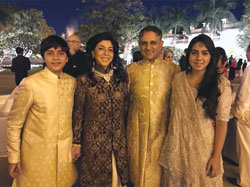
“Some things are non-negotiable! For instance, no phones are allowed at meal time. The kids get a platform to talk to each other and us, about things that would otherwise get buried in their busy lives. There are some ground rules, and they stick to them” – Omer
Prestige05MPOs07oct2019

“My two new factories involve a huge investment, which means I will probably be able to break even only two or three years,” says the businesswoman, now 49. “The state-of-the-art factories have been conceived with a lot of mechanisation-manufacturing wooden joineries, handcrafted furniture, modular furniture, wardrobes, windows and kitchen assemblies. MDC also has a unit which specialises in developing soft furnishings.” Today, Anjum can proudly claim that she has nurtured MDC into one of the country’s most respected décor studios with globally recognised clientele and numerous national and international awards to its credit.

Talking of challenges, Anjum says the biggest one has always been the debate between functionality and design and how to marry them: “The aspirational customers have a relatively limited budget and want products that are aesthetically pleasing, have longevity and are easy to maintain. We have strived to address the needs of this particular segment and are happy to say that we have managed to achieve it to a very large extent.”

The other challenge, she says, is to provide aesthetic designs to any area. “Everyone deserves appealing spaces, regardless of its size,” she says. “We, at Morph Design Company, excel in providing just that.” Pointing out that the business also involves effectively executing two opposing areas of demand: the high-volume kitchen and wardrobe assemblies on one side, and the need for personalised and exclusive products that cater to the individual versus the mainstream on the other, she credits the nature of these challenges is what keeps her and her team striving for excellence.

Anjum is a self-confessed foodie, and loves cooking. In fact, it was this love and talent that led to her meeting Omer at the restaurant: “I used to bake a lot, and market my cakes and pastries to earn my pocket money, to spend on music and clothes,” she says. “Casa Piccola was one of my biggest customers. And so, when my friend Goga suggested meeting her there, I didn’t think it was at all strange.”

She also reads voraciously and loves to travel-collecting art and antiques from the places she visits. Her husband shares her interests-and so they pack their bags and heads off to different locales in India and abroad. The couple began with a two-week honeymoon in Africa; and because he loves surprising her, he recently took her on a road trip from Budapest to Prague via Vienna-“He made me drive!” she mock-complains- so that he could treat her to a four-hour meal at a three-star Michelin restaurant on the way.
Prestige05MPOs06oct2019

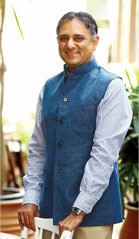
Nawabzada Omer Bin Jung, formally designated Executive Director, Hospitality-Prestige Group, is also the Founding Managing Director of Prestige Leisure Resorts (P) Ltd. With three decades of experience in hospitality, he is currently spearheading the Group’s foray into hospitality. “I went to boarding school at Sanawar, then Hindu College in Delhi (where he was a gold medallist in his BA, Anjum intercedes) and the London School of Economics,” he says. “When I came back to India, I decided to move to Bengaluru instead of Hyderabad-it was a new city as compared to Hyderabad, and I could do anything here with its own level of decadence! Besides, my elder brother was here too.”

After a couple of years in the finance department of Wipro, he joined his brother who has a resort in Bandipur. “Actually, it was a just a Club House; now it has been converted into the Northwest County resort,” he explains. In 1997, three years after he married Anjum, he floated the idea of helping his brothers-in-law take their construction business into resorts. “There has been no looking back since then,” he says. “We also have food courts in malls, we run franchises for Subway, Falafel and others… it’s a good mix.”

Adds his Begum: “It wasn’t an asset class at all – it was Omer’s brainchild.” He explains that because the business was totally in real estate, it had no assets on its balance sheet because all its projects were sold. “Assets are always good to have,” he says. “That’s where the discussion started. And we began to become more asset heavy.”

And so, having established Prestige Leisure Resorts, Omer now aims to set up international spas, city hotels, resorts and food courts all over India in the coming years. He is amply qualified: besides his gold-medal BA and his post-graduate Diploma in Business Studies from LSE, he also has a post-graduate Master’s Degree in Business Administration with a specialisation in Marketing, as well as a Certification in Strategic Management by Cornell University School of Hotel Administration, US.

“To excel in any field, one needs to be a team player. Managing people and ensuring employee and customer satisfaction is an integral part of being a success. We are a service-oriented industry and it is our team’s talent that decides the success of our work” – Anjum

Prestige07MPOs07oct2019

At Prestige, Omer has been instrumental in conceptualising and tying up with Banyan Tree Hotels and Resorts, Singapore, for one of Bengaluru’s most beautiful spa resorts the world-class Angsana Oasis Spa & Resort; the Angsana Oasis City Spas at UB City; Hilton International for the Conrad, Bengaluru; Oakwood Asia Pacific for the Oakwood Premier Serviced Residences at UB City and the Oakwood Residences-Forum Value Mall, Whitefield as well as the 3.4-hectare Sheraton Grand Whitefield Hotel and Convention Center in the group’s Shantiniketan project; the JW Marriott Hotel in Prestige Golfshire below the Nandi Hills and the 23-storey Conrad Hotel overlooking the Ulsoor Lake. He is also the brain behind the Transit food lounge at The Forum, Koramangala.

“We have introduced some of the most reputed international brands in the world to South India, such as the Hilton Group and Marriott International for hotels; the Banyan Tree for resorts: our Angsana Oasis Spa & Resort is managed by Banyan Tree Hotel & Resorts, Singapore. We also have the Oakwood Premier Prestige Serviced Residences in our landmark development, UB City, as well as in Whitefield,” he points out. We launched our hotel, ‘The Aloft’, in Prestige Cessna Business Park in 2014 in association with Starwood Hotels & Resorts Worldwide.”

Anjum also shares some of the secrets for her success: “To excel in any field, one needs to be a team player. Managing people and ensuring employee and customer satisfaction is an integral part of being a success. We are a service-oriented industry and it is our team’s talent that decides the success of our work. Therefore, it is very important to ensure that your team is motivated and happy. Finally, it is crucial to have in depth knowledge of both the industry and the products, which is only possible if you have a genuine passion for your work, as only then will you constantly strive towards perfecting your art.” Apart from this, it is paramount to believe in yourself, your abilities and objectives and have the right conviction. Life is full of complexities. Keeping things simple and using a straightforward approach helps unravel intricacies.

Her role models are her father Razack Sattar, an enterprising entrepreneur who started Prestige Fashions way back in 1956; and after his passing, her three elder brothers Irfan, Rezwan and Noaman have been her mentors, propelling her to success. “They have inspired me to keep pushing myself to achieve greater heights and are a source of constant motivation for me,” she explains. She too wants to carry on this culture of helping others: “I want to create a platform for young interior, product and furniture designers whom I will launch and mentor, to help hone their skills and realise their dreams,” she concludes.

The Jungs’ daughter Zara was born in 1999, and their son Ayaan five years later. “Kids never worried me, I enjoy them at all ages,” Omer says. And Anjum gives him ‘100 per cent for being an outstanding father’, saying: “He handles the children so well. Till date, he puts Ayaan to bed every night. He also takes his just-into-his-teens son on a fishing and hunting trip for two weeks every year.”

How did they manage everything: work, which is often 24×7, parenting- which is 24×7-and getting away for holidays? “We have a very good support system in the family,” Anjum says. “My mother has always been a big help, even though she was looking after my father who fell sick in 1995 soon after our marriage, and never recovered till he passed away in 2004. But I too never thought of multi-tasking-handling work, kids and home-as a problem. Of course, we had good staff: our maid and driver are very devoted to the family.”

Both of them are religious, and practise their faith: “We pray, fast, and go for Haj,” Omer says. Adds Anjum: “My mother was very pragmatic in her approach to Islam, though my father was more ritualistic.” According to Omer, their prayers are more for thankfulness than to ask for something. “We are so blessed,” he points out. “We have been to Arabia few times. So yes, we practise-but at the same time, we question.” Says Anjum, simply: “I like the balance.”

And the children are, fortunately, not yet growing away from their parents: Zara has her own life, but is at the same time totally plugged into the concept of family. “Some things are non-negotiable!” says Omer. “For instance, no phones are allowed at meal time. The kids get a platform to talk to each other and us, about things that would otherwise get buried in their busy lives. There are some ground rules, and they stick to them.” They are not totally happy going away on their own, but can still manage independently all over the place. Zara, for example, went to Oxford on her own for a summer course, Anjum points out. “She organised her own travel, and did very well there too-she came first in her class.”

All four of them spend a lot of time together as a family, even on holidays. “We don’t need to go out and mingle, we are very content by ourselves,” she says. “Three holidays every year are a must. We go away for the summer, Dussehra and Christmas vacations.”
Prestige08MPOs07oct2019

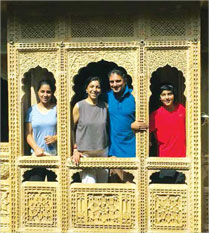
Last year, Ayaan came up with a surprising question: “Why must we always fly abroad? Why don’t we take a holiday in India?” Says Omer: “Both of us had found it very difficult earlier to wrap ourselves around a holiday in India. But after my son asked this question, we decided to go to Rajasthan-it was fun. We like our luxuries-but besides the Michelin restaurants, we also like to eat local food in different places. For example, we had a great meal of daal-bhaat at a truck stop in Rajasthan.” They didn’t of course, exactly rough it out in the desert: his royal connections ensured that they had the best hospitality in the local palaces. “India is brilliant!” Anjum says.

“Even though both of us are busy, we like to invest time in the kids as well as for ourselves together,” Omer says. “Of course, there is always a trade-off, in terms of earning less than we could if we concentrated only on our work or business. The question of what has priority in our lives keeps changing. But health, time with the children, family time, religion-they all take precedence.”

In addition to all this, Omer manages to find time to play cricket-coming as he does from a cricketing family-and golf, besides his angling and hunting which again is a throwback to his family’s traditions. “He is a ‘renowned shot’!” Anjum says with obvious pride. That, he explains, is a qualification that enables him to participate in national shooting championships. He is also interested in football, and took his son to watch Manchester United play a home match on Boxing Day last year: “There must always be an element of surprise in what I do,” he grins. “I had planned the itinerary for that trip with a gap of one day, which the rest of the family were clued in that they didn’t even notice! That was the day I just took off with Ayaan for the match.”

“We have introduced some of the most reputed international brands in the world to South India, such as the Hilton Group and Marriott International for hotels; the Banyan Tree for resorts: our Angsana Oasis Spa & Resort is managed by Banyan Tree Hotel & Resorts, Singapore” — Omer

How have they found the much-vaunted “entrepreneur-friendly” systems introduced by the government, especially that of Karnataka where they operate? “Well,” starts Omer, “When we started the hospitality business, we needed a total of 29 licenses… But today,” he pauses dramatically, and adds: “We need 29 licenses, still. The license raj has not gone away, it is only that we have learned to handle it more gracefully. The pain is still there. But we had the luxury of assets like easy access to loans and, our families.”

Anjum’s story is slightly different. “I started as a woman entrepreneur,” she explains. “That angle worked for me.” She still loves to cook; and, Omer says, “People love to be invited to our home for a meal.”

“We never have the time to get bored,” Anjum says. “We’ve practically grown up together, through our 23-year marriage. Both of us are the same age, so that’s almost half our lives. We have so many things in common; like, we were reading the same translation of the Quran, or The Little Prince, at the same time-but we are still as different as chalk and cheese. Of course, his stupid sense of humour sometimes irritates me, but…” To which her husband grins. And she adds: “I promise you, I wouldn’t want to grow older with anyone else but Omer.”

source: http://www.corporatecitizen.in / Corporate Citizen / Home> Cover Story / by Sekhar Seshan / Vol.3, Issue No. 2 / April 15th, 2017
Deccan’s heritage on display

Kalaburagi (formerly Gulbarga), KARNATAKA :

Ayaz01MPOs27sept2019

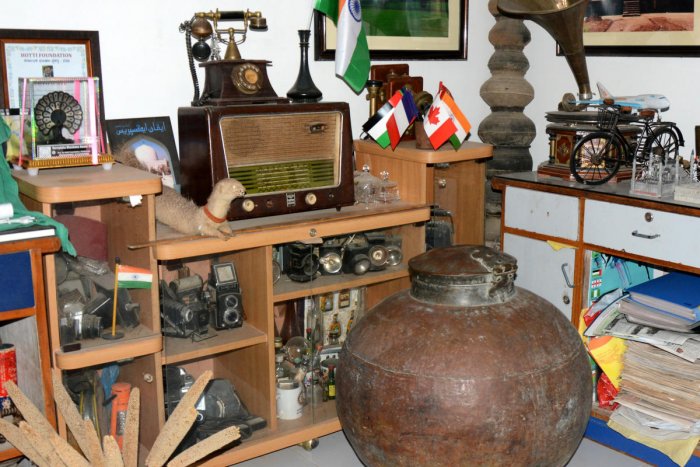
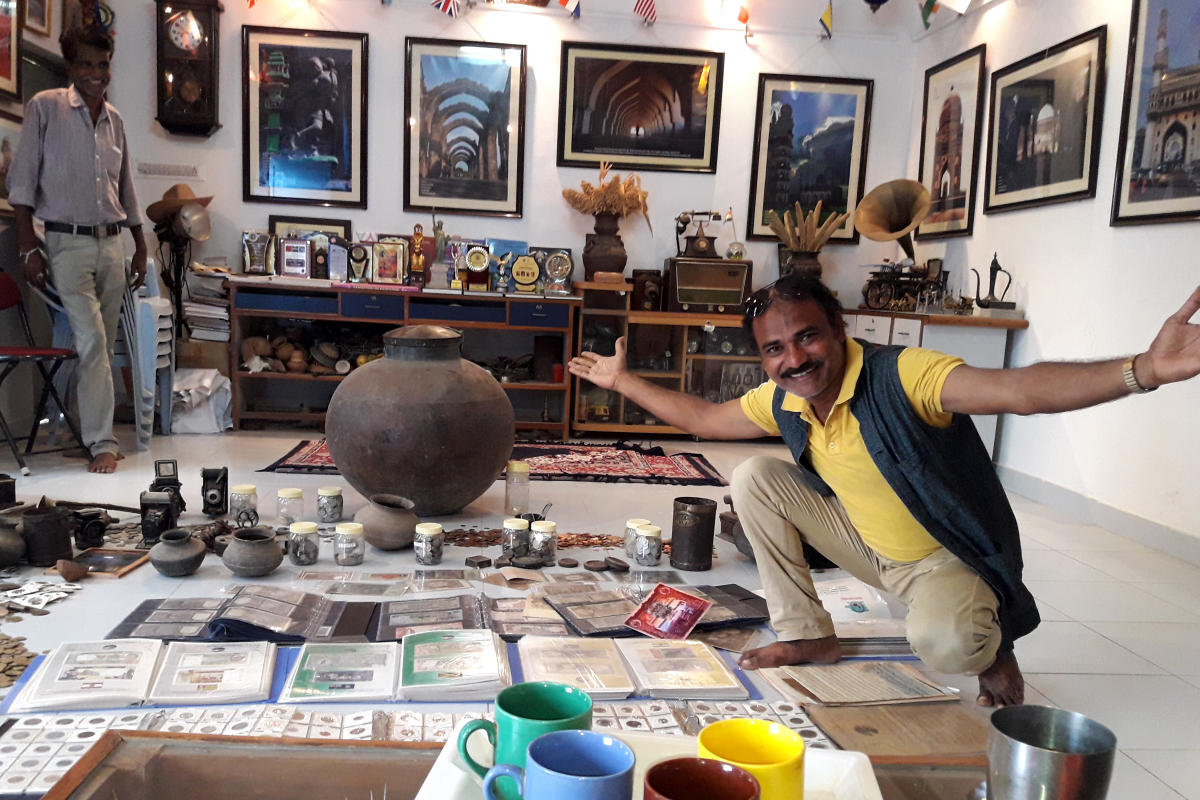
From coins to paper currency, books, radio, telephone, gramophone and old cameras, one can find a wide variety of antiquities at Ayaz Art Gallery in Kalaburagi. Detailed information about each item exhibited here makes this collection a heritage enthusiasts’ favourite. The credit for developing this intriguing collection goes to Mohammed Ayazuddin Patel, who is a photographer by profession.

After the completion of his education, Patel worked abroad for six years. In the meantime, he developed an interest in Deccan’s heritage. As a professional photographer, he has extensively documented the region’s ruined monuments.

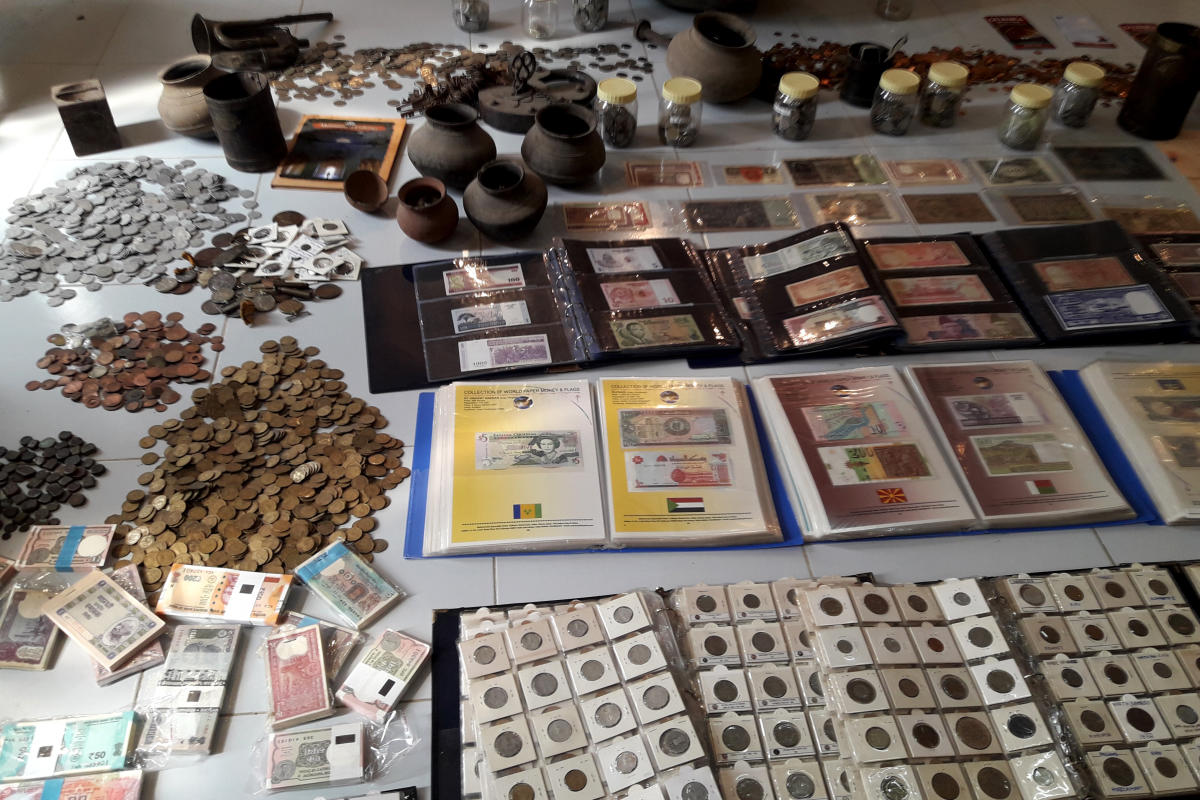
Collection of coins and currency at Ayaz Art Gallery in Kalaburagi.

Patel has collected the antiquities from various places, urban and rural. There are instances of him finding value in an item that others would discard as scrap. Apart from objects, he also has a good collection of rare books published during the British and Nizam rule. Some of them are printed at Oxford Press.

Coins and currency form a major part of the collection. The coins from Satavahana, Rashtrakuta, Chalukya, Hoysala, Nagas, Gandhara, Khilji, Lodhi, Tughluq, Mughals, Bahmani, Wadiyar, Kalachuri, Tipu, Qutb Shahi, Nizam Shahi, Adil Shahi, Barid Shahi,  Imad Shahi, Malwa, Kashmiri, British, and present coins and notes of Indian government are available with him.

Being an artist, he has exhibited the collection aesthetically, with all the details like the currency name, country, capital of country and country’s population on display. Presently, he is having about 275 countries currency notes in his collection which can be treated as the largest collection in Karnataka.

Many research scholars visit his art gallery to get information about the region’s history and heritage.

He has travelled to 26 countries to present the cultural beauty of the Hyderabad Karnataka region. While returning, he picks each country’s flag. Such flags are displayed neatly at the gallery.

Apart from this, he has exhibited his work of digital art, attended seminars, art camps and got honours for the same. Some of the unique pieces found in the gallery include an old lantern used in the ship; an ink bottle of 1855 AD used for fountain pens ; metal locks from Bahmani to Nizam period and terracotta plates and bowls of Nizam period.

Property and other agreement bonds written in Arabic, Parsi, Halegannada, Sanskrit and other languages find a place in his collection. The stamp papers of Jodhpur State and Bikaner State, Jaora State under the of Iftikhar Ali Khan Bahadur, Bhopal and Burma Government both, British India, Travancore and Dewas State, Rajgarh State, Government of Madras, Government of Mysore and Indian non judicial paper are in his collection.

After practicing photography for many years, he started digital art using his photos that portray the heritage of Hyderabad Karnataka.

Mohammed Ayazuddin Patel

He acknowledges the support extended by his parents. His mother used to collect coins and antiquities as a hobby. And his father, Mohammed Khaja Naveed Patel, was a Munsi and was an expert of history. “Kalaburagi has a rich history and heritage.  It is everyone’s responsibility to collect and preserve these objects,” Ayazuddin says.

source: http://www.deccanherald.com / Deccan Herald / Home> Spectrum> Spectrum Statescan / by Rehaman Patel / August 17th, 2019

How this vlogger travels the world, free of cost

Utraula, UTTAR PRADESH / Charummoodu, KERALA :

JinshaVlogger01MPOs26sept2019

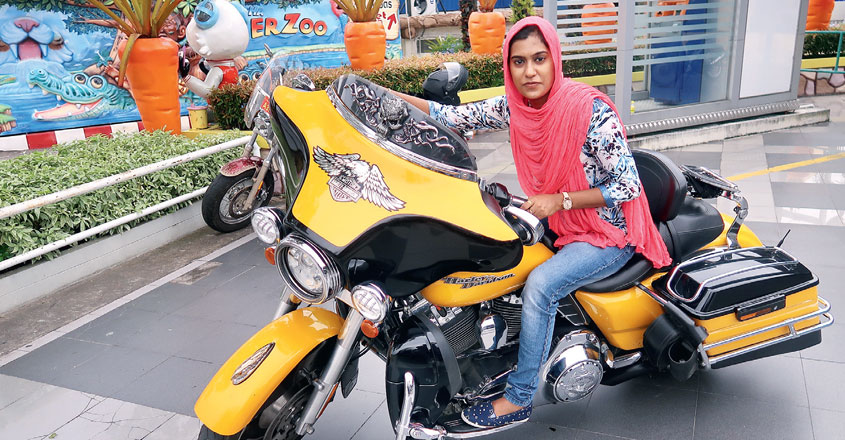
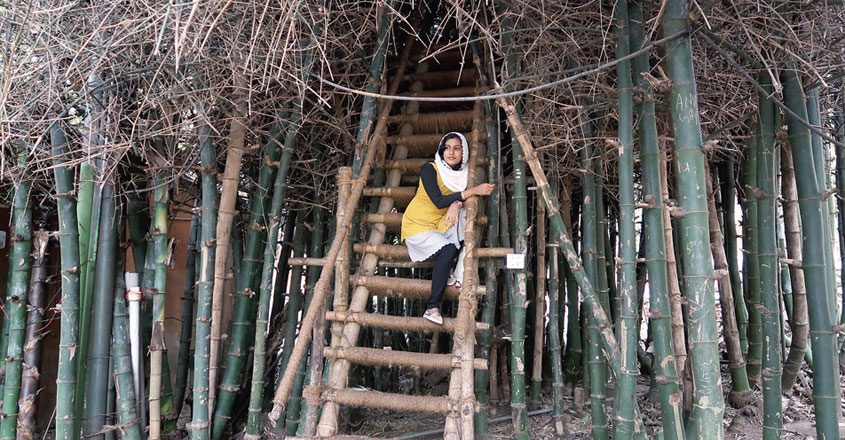
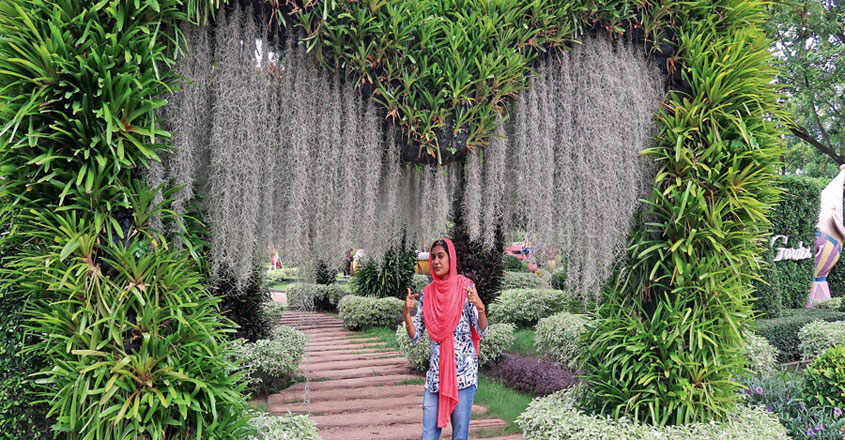
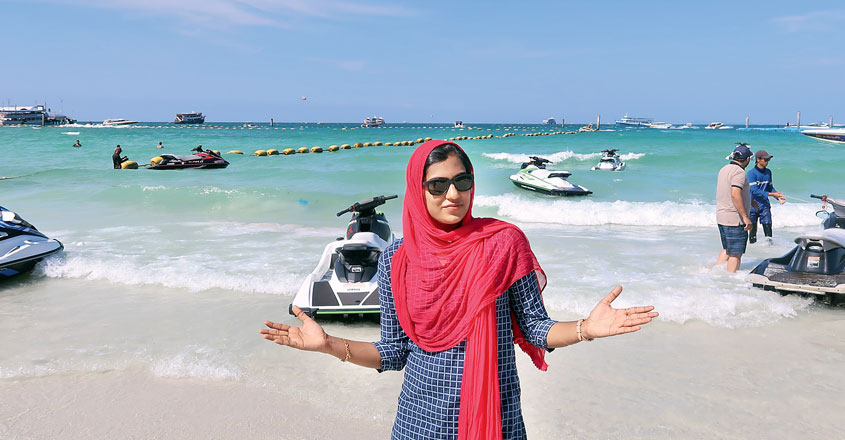
While most of us here find it difficult to save money for an annual vacation tour, vlogger Jinsha Basheer is earning money for every trip she takes. The crossroad of her life was her decision to publish photographs and videos of her own journeys online. When her posts on Facebook crossed 8000  likes, Jinsha was assured. Vlogging is more remunerative than the job of an engineer.”

Jinsha Basheer, who grew up in village of Charummoodu near Thiruvalla has only 11 months of experience in vlogging.  But this 28-year-old has more following than those who had been dabbling on Facebook Facebook for over 10 years. Jinsha became a vlogger by chance soon after landing a job with an IT  firm after completing her engineering. The story goes like this:

JinshaVlogger02MPOs26sept2019

Jinsha and Faisal when refuelling at a petrol bunk near Adoor, happened to witness an altercation involving one of the petrol bunk employees and a biker. The biker claimed that he was given less petrol for the money he had paid. The employee argued that every customer should check the counter to ascertain the quantity of petrol received.

Faisal, deciding to get to the bottom of the issue, enquired with another employee of the petrol bunk who revealed a big secret: Fill petrol for 5 or 10 rupees more than the required quantity.  For example, fill petrol for 110, 220, or 1015 rupees. In such cases petrol will be filled as per the exact amount. He talked about those petrol bunks which manipulated the software and delivered less quantity of petrol for the money paid. To make this event public, Jinsha recorded a video and posted it in Facebook with an advice to fill petrol for 5 or 10 rupees more  than the usual exact amounts like 100, 200, 1000 etc. Their Facebook page, which till then had only Jinsha and Faisal as members, received 5000 likes within a day.

A reply to trolls

JinshaVlogger03MPOs26sept2019

Jinsha was born in Utraula in Uttar Pradesh to Basheer, a military man and Barisha, a nurse, as the  youngest of the three sisters. When she was 8 years old, the family resettled in Charummoodu.  Jinsha loved travelling since her childhood. During her studies, she travelled to Mysore and Madurai. Taj Mahal, Agra and Qutub Minar remained her dream destinations. On the first weekend of getting married to Faisal, they travelled to Vagamon and her passion for travelling was rekindled.

While she was working in an IT firm owned by Faisal (which was also a period of many journeys), she  got an offer for taking up a job of a teacher in Qatar. The school management asked her to send a video depicting a simulation of her teaching the pupils. By the time the school management intimated her of their satisfaction of her teaching video, the ‘petrol bunk’ video had become  ‘viral’ in the Facebook. Jinsha decided to focus on volgging instead of taking up the teaching assignment in Qatar. Faisal, too, supported that decision. The first vlog.trip was made from Masinagudi to Ooty via the Kallatti pass. Another vlog on a journey through the Bandipur forests followed. These videos highlighting the beauty of the forests, too, became viral.

JinshaVlogger04MPOs26sept2019

Attempts were made by some elements to hurl abuses at Jinsha and her father through adverse and offensive comments. Jinsha was appalled but decided not to quit. But both Basheer and Faisal supported her cause. “If you bow down now, it will be akin to accepting total surrender.”

Jinsha took a screenshot of the Facebook page of the person who was vitriolic on her which also had that person’s photograph and posted it on her own Facebook page. Within minutes, the children and nephews/nieces of the person apologized. Soon after that, the Facebook page of the person disappeared.

Making money for and from travelling

JinshaVlogger05MPOs26sept2019

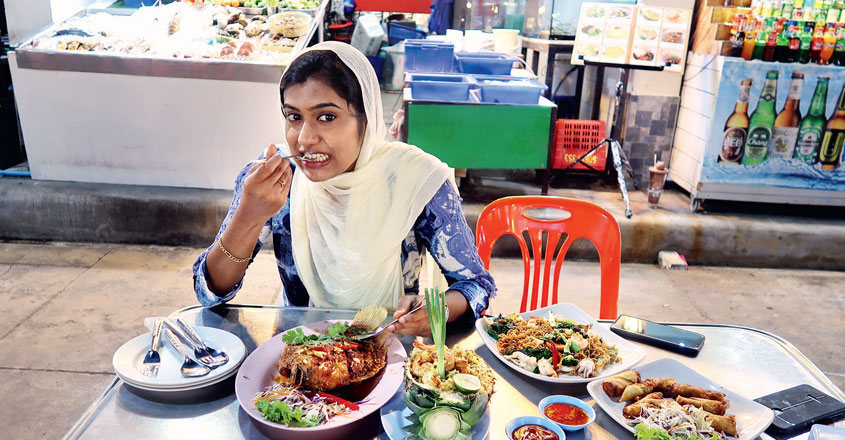
One of the first international vlogs Jinsha Basheer did was in Singapore. Dubai and Thailand followed.  The followers were introduced to the facts that in Singapore, a bottle of water costs Rs 350 and that in Thailand, one could take selfies with tigers, all through her vlogs.

“Rains round the year, gentle sunshine, towering buildings, beautiful landscape…Singapore is a place that must be visited at least once in a lifetime. At the same time, Dubai is a place of Guinness Book of world records. There is a village in Dubai with a rivulet and farming. This village is known as Al Barari Farm.” More than one lakh likes were received for this vlog alone.

JinshaVlogger06MPOs26sept2019

“Thailand is a country of individual freedom. The issue is how that freedom is utilized. There is a zoo housing 200 tigers in Thailand. In the elephant rearing centre, one could play with the elephant calves. Photos can be captured with one riding a crocodile in a lake of about 1000 crocodiles.” These facts were included in Jinsha’s vlog on Thailand.

‘Mariner of the Seas,’ a royal Caribbean cruise liner which berthed in Kochi was visited with special permission. “The vlog relating to this visit to the ship with an interior bigger than the LuLu Mall got instant popularity,” Jinsha explained how she started getting remuneration from Facebook.

The vlogging technique

JinshaVlogger07MPOs26sept2019

Jinsha and Faisal discovered ‘The Earth Lounge’ in Kochi international airport while on their way to Dubai. They entered the lounge to avoid the boredom of waiting for their flight. Two hours in there costs Rs 2000. But if you are holding Visa Platinum, Master Card etc it will cost only Rs 2. With that unlimited food and drinks, bathing area, relaxing area etc are made available to you.  ‘The Earth Lounge’ which the airport runs with the promotion of banks, was immediately videoed by Jinsha. Similar videos with little known facts were released on Jinsha’s Facebook page.  Likes and comments started piling up on such posts. Remuneration flowed from Facebook and You Tube.

“Tour operators approach us. They invite us to film the package tours they conduct. The tour and accommodation facilities would be arranged by the operator. The vlog that is made on the tour should reflect the services provided by the tour operators. The tour operator which took us on their package tour to Thailand saw more number of tourists opting for its services. The income comes through the Facebook posts. If 1000 readers read it, some small amount will come in the account.  You Tube is the best paymaster. If there are 1000 subscribers and 4000 minutes of viewing, an account for transferring remuneration can be created. The more the number of viewers, more is the remuneration. Jinsha explains after going through the statistics after turning a professional vlogger she has 87,000 followers on You Tube.

Offers for international tours are waiting her attention. There is some indecision on where to fly next among the options available. Faisal loves Switzerland. Jinsha has decided that as soon as her Dubai trip is over, she would fly out to Europe.

source: http://www.travel.manoramaonline.com / OnManorama / Home> Travel> Celebrity Travel / by Baiju Govind / May 16th, 2019

This Bengaluru Ola cab driver’s heartwarming gesture is going viral on the internet

Bengaluru, KARNATAKA :

When it comes to taking cab rides, there have always been many bad experiences for the commuters compared to the good ones.

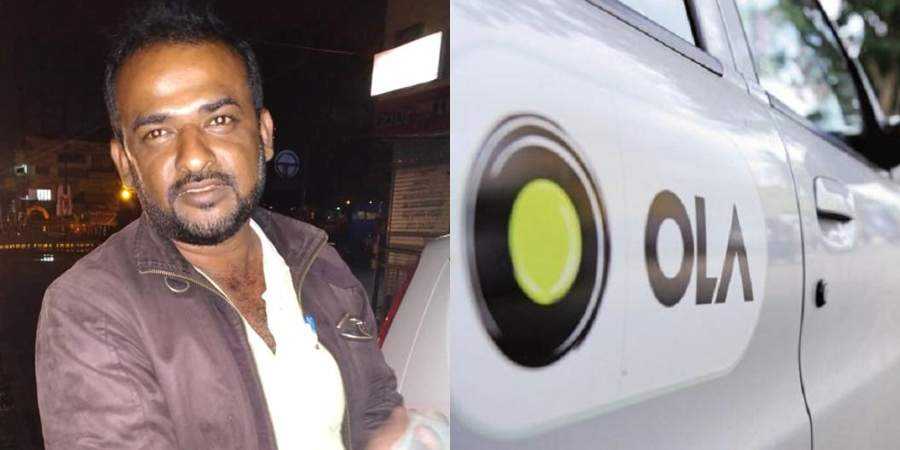
Bengaluru Ola cabbie Khateeb UR Rahman (Photo | Facebook and PTI)

When it comes to taking cab rides, there have always been many bad experiences for the commuters compared to the good ones.

Two of the dominant cab aggregators Uber and Ola are no different as they have also been in the wrong side of the news in the past.

But this time around it was an Ola cab driver who is in the news for all the good reasons. On September 17th, a Bengaluru based man took to Facebook and shared a heartwarming story of an Ola cab driver.

The commuter, Sayuj Ravindran, said that the cab driver returned valuables and gadgets worth Rs 2.5 lakh to him after he had left them behind in the cab.

He wrote, “Returning after my cousins wedding, I took an Ola cab (with my family) from KR Puram railway station to home at around 3:30 am. Halfway down, the car tyre got punctured. The driver requested me to book another cab since it will take some time for him to replace the tyre. I got another one in 10 mins and I was about to reach home when I got a call from the first cab driver informing that I left a handbag in the car. I then realized it was my laptop bag which also had some valuables in it. He said he will wait for me right there. I took my car from home and rushed back. He was kind enough to come a little further towards my home. We met at the Marathahalli bridge and he gave me the laptop bag.”

Sayuj also mentioned that the cabbie refused to take money from him as a favour.

“Meet Mr Khateeb UR Rahman, who returned my bag (with stuff worth Rs 2.5 lakhs approx). He refused to take any money from me in return of the favour and got back into his cab. But I did manage to slip in the money to his jacket pocket forcefully. Please reward this gentleman for what he has done, ” he said.

The post had gone viral with over 10,000 people liking the post and over 2,600 people sharing it.

The RT Nagar Old office (SGP Group), who came across the heartwarming act of the Khateeb UR Rahman rewarded him with a cheque of Rs 25,000.

This heartwarming gesture once again proves to be an example of how one will be rewarded according to his/her act.

source: http://www.newindianexpress.com / The New Indian Express / Home> Good News / by Online Desk / September 25th, 2019

The last Nizam’s indelible imprint on Kalaburagi

Hyderabad / Kalaburagi (formerly Gulbarga) , KARNATAKA :

AiyaneShahiMPOs17sept2019

The city has many structures built during the time of Nizam Mir Osman Ali Khan Bahadur

A kilometre away from Kalaburagi railway station is Aiwan-e-Shahi, a magnificent stone structure built in early 19th Century. For political leaders and bureaucrats visiting the city, it’s the most preferred accommodation.

Kalaburagi has several such architectural remnants of the times of the Nizam rule, uniquely Indo-Islamic in style, and still in use. Nizam Mir Osman Ali Khan Bahadur, the last monarch, who ruled the province between 1911 and 1948, stayed in Aiwan-e-Shahi when he visited the city and is today a government guest house. The Nizam used to travel in his own train from Hyderabad to reach the palace in Kalaburagi and a special railway track was laid up to the entrance of the complex for the purpose.

Like most buildings constructed during the Nizam’s rule, the Aiwan-e-Shahi portrays a rich and imposing architecture synthesising medieval and modern styles. It is constructed using local white stones, popularly known as Shahabad stones, abundantly available in the surrounding area. The front view of the palace was greatly inspired by Gothic style architecture.

Kalaburagi-based heritage collector and artiste Mohammed Ayazuddin Patel has copies of some rare photograph of Nizam. In one of them, he is the Nizam is seen playing tennis outside the Aiwan-e-Shahi palace complex. His train is also visible in the background. The picture was said to have been taken by Raja Deen Dayal, the official photographer at the Nizam’s court.

The Nizam, known as the architect of modern Hyderabad, left an impression on Kalaburagi too. The building now houses the tahsildar office, zilla panchayat and central library. The entrance arch gate of Vikas Bhavan, the mini Vidhana Soudha that has the district administrative complex and one of the entrances of Mahbub Gushan Garden in the heart of the city were built during his time. There are several private houses across the city that were built for the families of Deshpande, Deshmukh, Mali Patil, Police Patil, Jamadar, Mansafdar, Pattedar, Inamdar, Jagirdar, Kulkarni, Hawaldar – the official and administrative titles given by the Nizam.

“At least, the Aiwan-e-Shahi should be included in the protected monuments and converted into a museum to showcase the region’s cultural past,” says Rehaman Patel, Kalaburagi-based researcher and artiste. According to him, the Nizam had expanded public spaces such as parks, lakes, town hall, and gardens in the city engaging several engineers. Mahbub Sagar (now called Sharnbasweshwar lake) and Mahbub Gulshan Garden continued to be used by the public. The town hall is used by the Kalaburagi City Municipal Corporation as a conference hall.

The Filter Bed built for providing pure water to the residents continues to supply drinking water to parts of the city. The Mahbub Shahi Kapda Mill that produced high-quality cloth and supplied it not just to various cities across India, but to other countries as well, was in operation till the 1980s. The Nizam had also established Asif Gunj School and MPHS school, the oldest educational institutions of the city.

“In the early 1930s, he formed the Hyderabad Aero Club and built Begumpet Airport for his Deccan Airways, one of the earliest airlines in British India. He had the distinction of employing, perhaps, the world’s first woman commercial pilot, Captain Prema Mathur, during the late 1940s. The other airport built in Bidar in 1942 is now used by the Indian Air Force to train its pilots. The Nizam was also credited for renovating several monuments belong to Buddhists, Jains, Chalukyas, and Bahmanis. The renovation and excavation of the caves of Ajanta and Ellora was undertaken with the funds of the Nizam government and supervised by then archaeology director Ghulam Yazdani,” Mr. Rehaman said.

source: http://www.thehindu.com / The Hindu / Home> News> States> Karnataka / by Kumar Buradikatti / Kalaburagi – September 16th, 2019

Feroz Shah Kotla or Firozabad – The 5th city of Delhi

NEW DELHI :

Feroz Shah Tughlaq (Reign 1351 – 88), the third ruler of the Tughlaq Dynasty  was embarked on a vigorous campaign of construction activity, consisting mainly of public buildings of utilitarian nature.

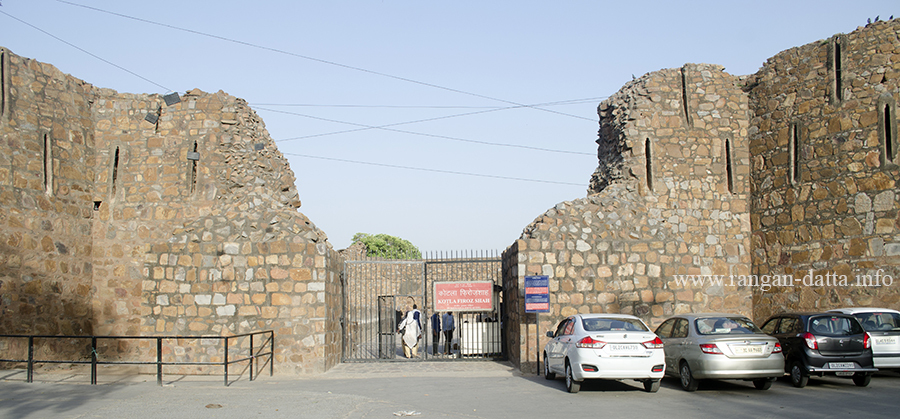
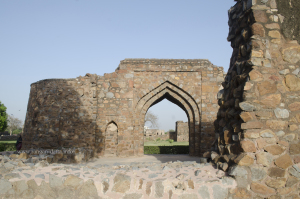
Gate of the citadel of Feroz Shah Kotla or Firozabad, Delhi

He made 1200 garden around Delhi and is credited with the erection of 200 towns, 40 mosque, 30 villages, 30 reserviors, 50 dams, 100 hospitals, 100 public baths and 150 bridges

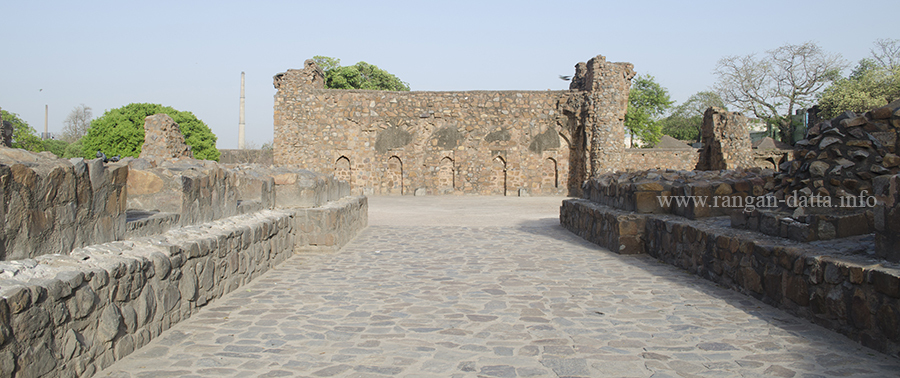
Passageway leading to the interiors of Feroz Shah Kotla or Firozabad, Delhi

In 1354 Feroze Shah Tughlaq built Feroz Shah Kotla or Firozabad, the fifth citadel of Delhi. His predecessors Ghiyasuddin Tughlaq (Reign: 1321 -25) and Muhammad bin Tughluq (Reign: 1324 – 51) has the credit of erecting the third and fourth citadel of Delhi.

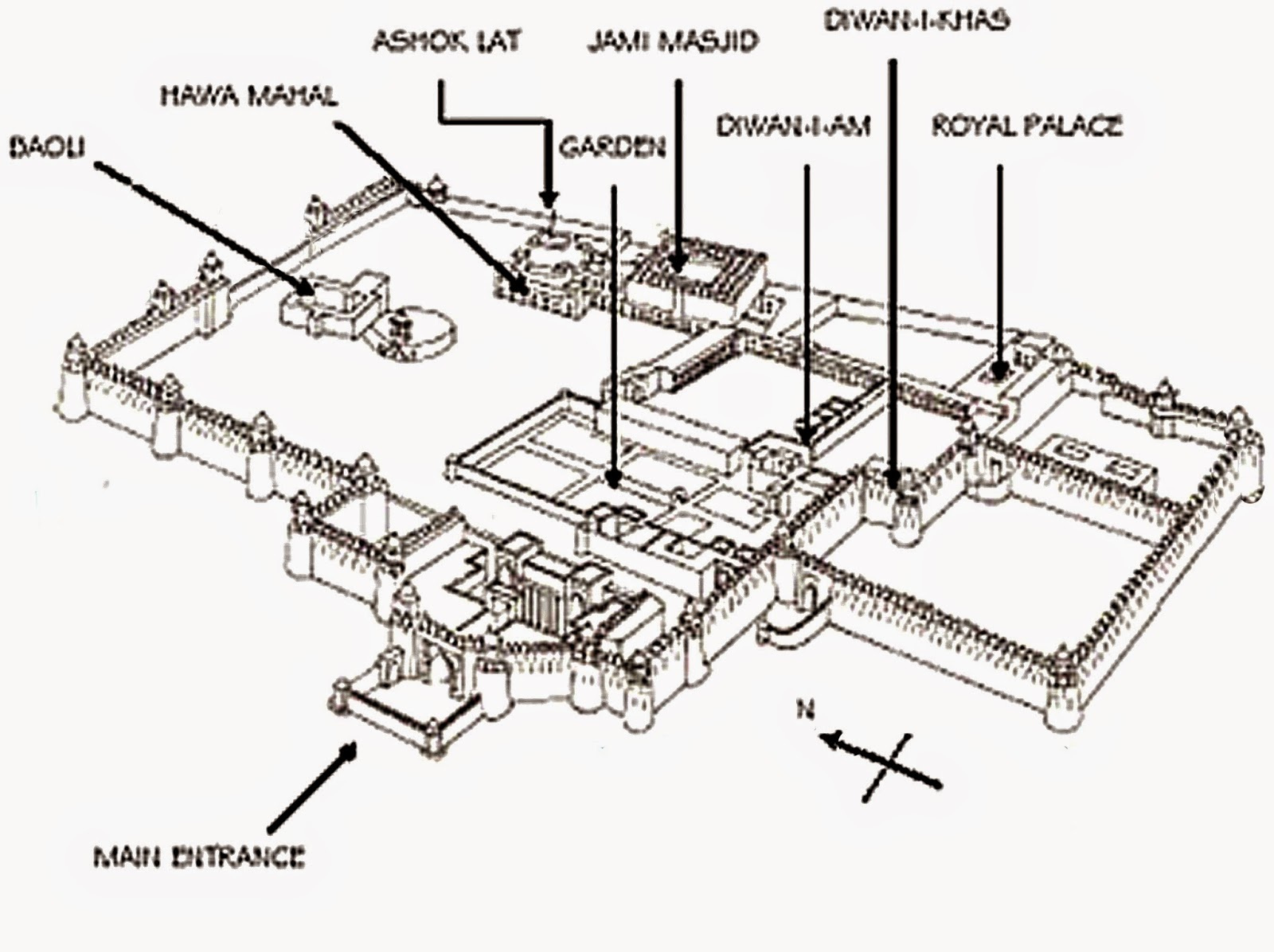
Plan of Feroz Shah Kotla or Firozabad (Source: http://www.pixels-memories.blogspot.in)

Tughlaqbad, the third citadel of Delhi, along with Jahanpanah, the fourth citadel of Delhi were abandoned  because of acute water shortage. This lead Feroze Shah Tughlaq to move further north and to construct its citadel along the west bank of Yamuna River.

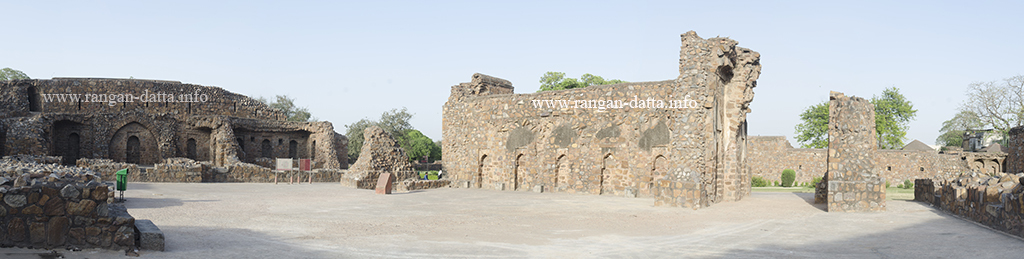
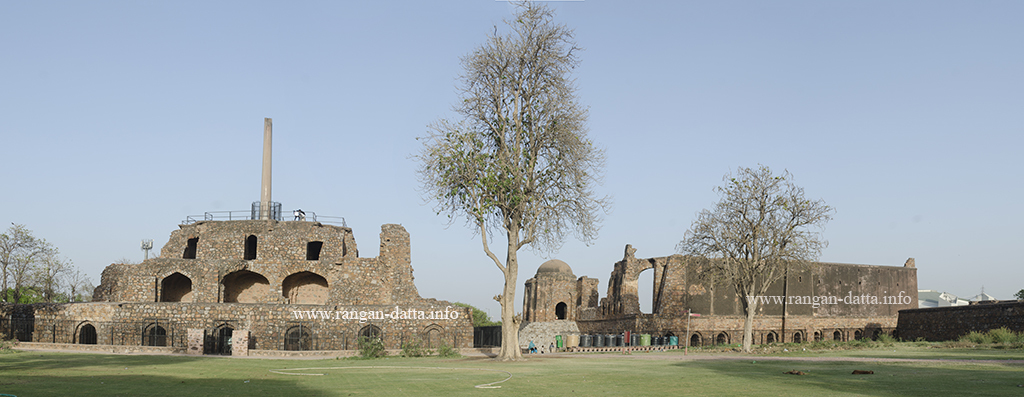
Panoramic view of the ruins of Feroz Shah Kotla or Firozabad, Delhi

Unlike Tuglaqabad, Feroz Shah Kotla lacked the defensive construction and after the collapse of the Tuglaq empire the Mongol invader Timur found it an easy target. In 1398 Timur gladly carried out all the riches of the citadel leaving behind the ruined rubble structures, which was again plundered and reused by Shahjahan (Reign AD 1627-57) for the construction of Shahjanabad, the seventh and last ancient citadel of Delhi.

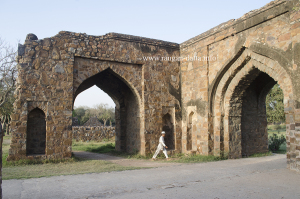
An arched gateway, Feroz Shah Kotla, Delhi

Despite being plundered by several rulers in the past and with centuries of neglect Feroz Shah Kotla still houses several interesting ruins, although minimalistic in nature, they still reveal the former glory and splendor of the ancient citadel.

Today the ruins of Feroz Shah Kotla nestles between the cricket stadium, of the same name, and the Ring Road. Every Thursday thousand of visitors visit the ruins of the ancient citadel.

Strangely these visitors are not history or heritage enthusiasts but are devotees looking for the blessings of Djinns, who according to legend are residents of the ruins of Feroz Shah Kotla. No wonder Delhi has always been a “City of Djinns.

Djinns live in the heart of Delhi: they are spirits tending to the faithful seeking help. On Thursdays, they are busy when thousands turn up with letters for them.

A kid makes his way through the arched gateways of Feroz Shah Kotla, Delhi

Every Thursday hordes of devotees, irrespective of religion, visit the ruins of Feroz Shah Kotla with photocopies of letters, citing there problems. They stick the letters on different strategic spots of the citadel and offer prayers to the Djinns.

Strangely the concept of letters to the Djinns has only been an recent concept in the ancient citadel, which dates back to the 14th century.

The first records of people coming to Firoz Shah Kotla in large numbers began shortly after the emergency of 1977.

It was only in 1977, a few months after the end of the Emergency, that we have the first record of people starting to come to Firoz Shah Kotla in large numbers. This seems significant, given how destructive the Emergency was for the Old City and how many poor and working class people were displaced from the Old City to resettlement colonies across the river

Anand Vivek Taneja, Anthropologist

Ruined structures of Feroz Shah Kotla, Delhi

Even on other days large groups of Muslim devotes visit Feroz Shah Kotla to offer their Namaz at the Jami Masjid, one of the few structures of the citadel that have remained, more or less, intact to this day.

Designed by Feroz Shah Tughlaq’s state architects Malik Ghazi Samana and Abdul Haq the citadel of Feroz Shah Kotla follows a rectangular plan with dimensions 800 m by 400 m, with the longer side along the north – south axis.

The entire citadel is encased  within a high stone wall. Although the walls look solid but it lacks the massive bastions of Tuglaqabad. The entrance is through a small and simple gateway on the eastern side and a broad passageway leads to the scattered ruins of Feroz Shah Kotla or Ferozabad

Circular Baoli (Stepwell) at Feroz Shah Kotla

Most of the buildings within the citadel are made of rubble masonry covered with heavy plaster and without any surface ornamentation.

The passages leads to series of scattered ruins, which was once part of the citadel’s garden.

It leads further to the Diwan – i – Am (hall of audience) and Diwan – i – Khas (hall of private audience).

A few pavilions and archways are all that remains today of the famed halls of audience of Feroz Shah Tughlaq. The Royal Palace located at the far end of the citadel lies in similar ruined condition.

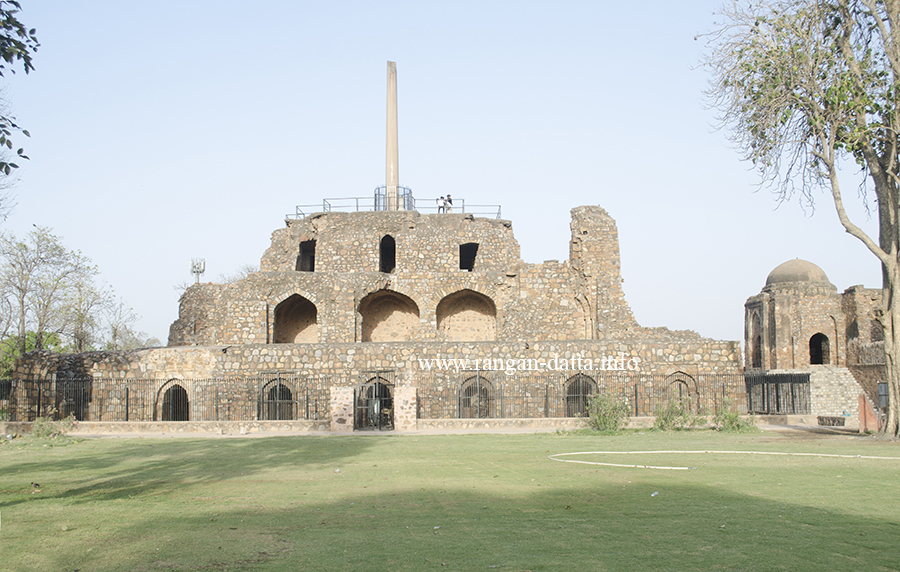
Stepped pyramidal structure, crowned with the Ashokan Pillar, Feroz Shah Kotla, Delhi

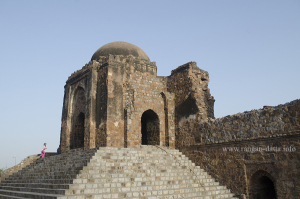
The more intact and interesting structures of Feroz Shah Kotla are located on its northern side. Towering above the lawns is the massive Jami Masjid and towards its left is the stepped pyramidal structure, known as the Hawa Mahal or Kushk-i-Shikar. It is crowned with the Ashokan Pillar, also referred as the Minar-e-Zarreen.

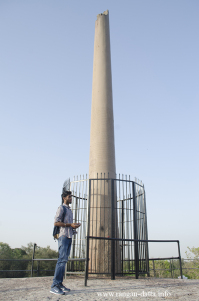
Ashokan Pillar, Feroz Shah Kotla

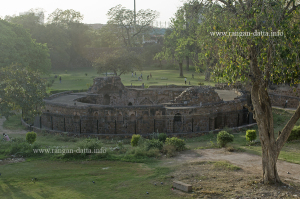
Just in front of the stepped pyramidal structure is a baoli (stepwell).

Delhi is no stranger to Baolis and even a century ago more than a hundred of them existed in Delhi.

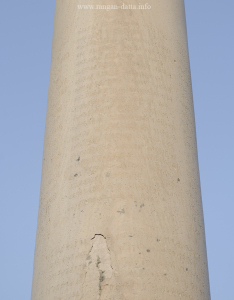
Inscription on Ashokan Pillar

Today more than a dozen remains (Also see: Baolis of Delhi) but what makes the Feroz Shah Kotla baoli unique is its circular shape. It is the only circular baoli in Delhi. Sadly the baoli is kept under lock and key and the interiors are out of reach for the common tourist. But the baoli is best viewed from the differnt levels of the nearby stepped pyramid.

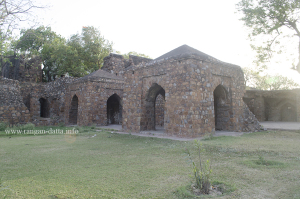
Domed Pavilion at the entrance of Jami Masjid

The Hawa Mahal is a three tired stepped pyramid with diminishing floors. Built with a central solid core and vaulted cells around it. Stairs at the comers lead to the uppermost terrace where the Ashokan pillar is planted.

The Ashokan Pillar was shifted from Topar in Ambala by Feroz Shah Tughlaq and placed atop the Hawa Mahal.

The 13 m high 27 ton pillar was shifted on a custom built 42 wheel carriage operated by 8400 men, which transported it to the banks of Yamuna River. From where it was transported by boat to Feroz Shah Kotla in Delhi

Incidentally Delhi contains another Ashokan Pillar, which was also shifted by Feroz Shah Tughlaq and placed near his hunting lodge on Delhi’s North Ridge, also known as the Kamala Nehru Ridge. (Also see: Historical Trail along Delhi’s North Ridge)

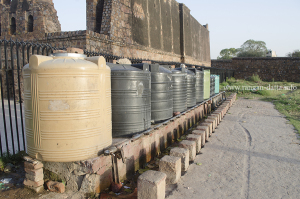
Tanks, along Jami Masjid, for ritual wash

The structure is open to public and one can take the stairs all the way to the base of the pillar. The pillar still maintains its shining police and the inscriptions in Prakrit are clearly visible.

According to popular belief  Laat (pillar) Waale Baba, the chief of the Kotla djinns, dwells in the Ashokan Pillar, which is also referred to as the Minar-e-Zarreen. Every Thursdaay devotees ties up their wish letters on the railing surmounting the Ashokan Pillar.

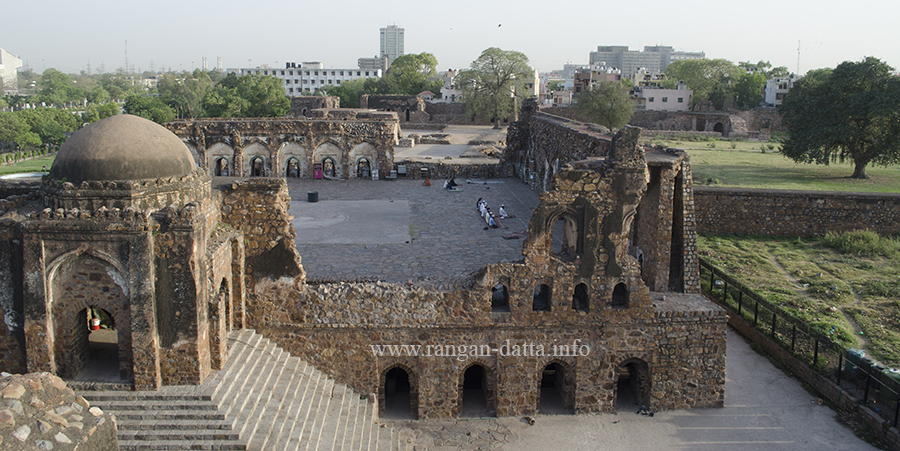
The top story of the Hawa Mahal offers grand bird eye view of the circular baoli (stepwell) and also the Jami Masjid, which lies on its southern side.

Namaz being offered at the Jami Masjid, Feroz Shah Kotla, Delhi

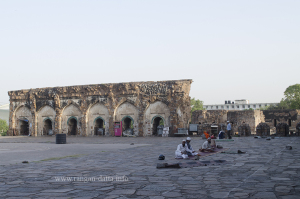
South of the Hawa Mahal lies the gigantic mosqque of Feroz Shah Kotla, the Jami Masjid. Built of Delhi quartzite stone. During the time of its construction it was the largest mosque in India.

The mosque rests on a series of cells on the ground floor and is approachable by a long flight of stairs leading to a domed pavilion gateway on the northern side. The grand dome pavilion, which once stood at the centre of courtyard has long vanished.

Even Taimur, who plundered Feroz  Shah Kotla, was so impressed with the mosque that he commissioned a similar one in his capital Samarkhand. Even Shah Jahan constructed a underground tunnel connecting the Jami Masjid to his newly constructed citadel of Shahjanabad. The tunnel still exist but is sealed for obvious reasons.

Grand view of the Jami Masjid, from Hawa Mahal, Feroz Shah Kotla or Firozabad, Delhi

Strangely the Jami Masjid is still an active mosque and attracts thousand of devotees during the time of eid. Even on normal days large groups of local Muslims along with Muslim office staff from nearby offices drop in for there daily namaz.

Panoramic view of Stepped Pyramid Structure and Jami Masjid, Feroz Shah Kotla or Firozabad

Colourfull plastic tanks, along the eastern wall of the ancient mosque, serve as a makeshift ritual wash (wudu) area for the devotees, who drop in to offer namaz.

Just outside the citadel of Firozabad or Feroz Shah Kotla, on a road divider lies the notorious gateway of Khooni Darwaza.

source: http://www.rangandatta.wordpress.com / Rangan Datta – Travel Writer & Photographer / September 30th, 2017
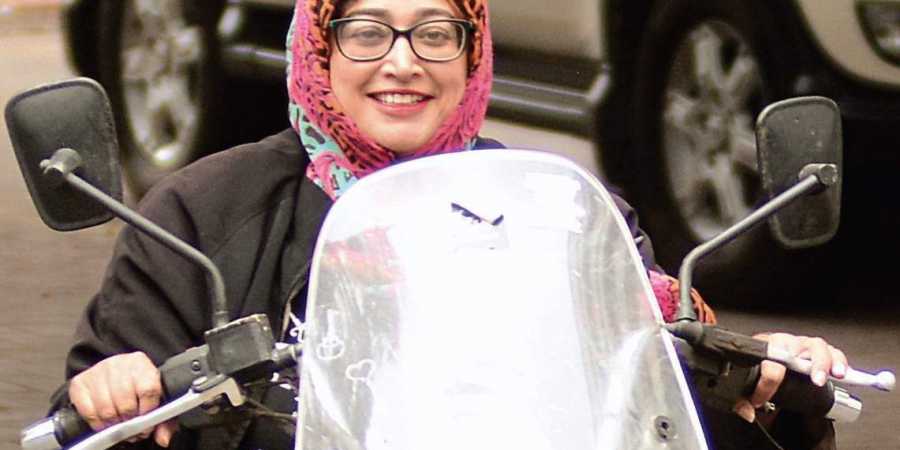
Women can have fun too, says solo biker Mehdia Fathima

Bengaluru, KARNATAKA :

In order to pursue her dream of bike riding, Mehdia Fathima took up the hobby after 20 years of managing career and family; plans to take a trip from Kanyakumari to Kashmir next.

Mehdia Fathima
Mehdia Fathima

Bengaluru :

Mehdia Fathima had been keeping herself busy with her life, career and children’s studies. But almost four years ago, she took a break from her mundane daily routine and started exploring her true self as a solo bike rider. “During my college days, I was interested in bike riding and learned to ride one from a friend. It took me almost 20 years to get back to my hobby. All this time, I didn’t get time to think about pursuing this. I had to build my career, look after my kids and family,” said Fathima.

Today, the 48-year-old solo biker has been on two trips – Golden Quadrilateral Ride and Indian Coastline Ride – covering around 15,500 km. “I always prefer two-wheeler to four-wheeler, thanks to the horrible traffic in Bengaluru,” she smiled, adding, “But my interest in bikes bloomed again when a colleague gave a chance to ride his bike three-and-a-half years ago. I bought a Bajaj Avenger 220 Cruise and started taking part in group rides with my colleagues and Avenger club. Once I participated in a group ride with another club and they were riding at a speed of almost 120 km/hour on highways, which made me feel uncomfortable. We have to consider others’ speed and comfort when we travel in a group. I desperately wanted me-time and that’s how I started solo rides.”

In her Golden Quadrilateral Ride, she rode across 16 Indian states in three weeks and took more than four weeks for Indian Coastline Ride. “My preparations for each trip start two months ahead of the trip. They are self-funded and done out of passion and hobby.” Fathima, who is a mother of two teenagers, also shared that she had to face a lot of criticism from others when she took the decision of riding solo. “Many asked what I want to prove at this age. My question is, why should a woman always have to prove herself for everything? We have to prove we are equal or better than men at the workplace, home, and so on,” she said. Not just gender stereotypes, she questions generalisations about women riders. “I always wear hijab. In fact, while riding, hijab gives more protection from dust and sun exposure. I don’t think solo driving is unsafe for women in the country. There are differences in the attitude of people in different places. But if you are a normal traveller and avoid night rides, I think our highways are safe for all riders,” she added.
Fathima, an IBM employee who lives in RT Nagar with her family – her husband works with an FMCG company – completed her last solo ride in January.

“During my coastline trip, I interacted with a lot of fishermen communities across the country and realised how privileged I am as a city dweller. I learned self-confidence, patience and tolerance towards other cultures and people. I wanted to give back some values to the bike riding community and started teaching bike riding free of cost,” said Fathima, who finished a course with her first batch and is planning to do another soon.

Her dreams don’t stop there.

“Kanyakumari to Kashmir is my next trip that I’m planning in December. I also want to upgrade my bike. Triumph Tiger 800 is my dream bike. Since bike riding has always been a male-dominated field, women rarely find good bikes as per their height and size. There should be more bikes produced for women.”

source: http://www.newindianexpress.com / The New Indian Express / Home> Cities> Bengaluru / by Lesly Joseph / Express News Service / September 03rd, 2019

How Shah Jahan connects Bhopal, Delhi, and England

DELHI / Bhopal, MADHYA PRADESH :

How two rulers with a common name left a rich history and culture for its people but one is more renowned than the other.

Taj-ul-Masajid, Bhopal (Photo: SNS/Aena Thakur)

In the heart of Madhya Pradesh’s capital city, Bhopal, resides Taj-ul-Masajid which literally translates to the ‘crown of mosques’. The mosque was intended to be the largest mosque in the country and was based on the design of Delhi’s Jama Masjid. In a town called Woking in England stands a mosque called Shah Jahan.

The common denominator between these three mosques is the name Shah Jahan. The fifth Mughal emperor Shah Jahan built the Jama Masjid in Delhi and the third female ruler of Bhopal, Shah Jahan Begum built Taj-ul-Masajid of Bhopal. The Bhopal’s matriarch went a step ahead as she also funded the construction of England’s first Mosque in 1889.

Taj-ul-Masajid (Image: SNS/Aena Thakur)

In the 19th century when India was a British colony, the princely state of Bhopal had a string of female rulers for roughly 107 years. The city was founded in 1707 by Afghan ruler Dost Muhammad Khan. Surrounded by Rajputs in Rajasthan and Marathas in Maharashtra, Bhopal was a vulnerable state yet the female rulers with their loyal allegiance to the British rule survived the turbulent times.

The female dynasty of Bhopal started with the death of young Nawab Nazar Muhammad Khan. His 18-year-old wife Qudsia Begum decided that the legacy of her family shall continue and declared her 15-month-old daughter Sikandar as the rightful heir of the state. In 1819, Qudsia Begum became the first Muslim female who defied the veil and became the ruler of Bhopal. Her rule was legitimised by the British and the clergy.

Both Qudsia (1819-37) and Sikandar (1847-68) were known to be tough rulers who strengthened Bhopal’s military and trained themselves to fight. However, it was the third matriarch of Bhopal, Shah Jahan Begum who brought in the period of flourishing art and culture just like her male Mughal namesake.

Unlike Qudsia and Sikandar, Shah Jahan was not known for her tough training for battles. Shah Jahan followed the system of veil and was more interested in literature, poetry, and arts.

Shah Jahan Begam of Bhopal (Image: Wikimedia Commons)

Interested in Urdu and Persian poetry, Shah Jahan Begum also offered state pensions to poets like Amir Minai, a contemporary of Mirza Ghalib.

Shah Jahan Begum ordered that a dictionary of select terms in Hindustani, Persian, Arabic, Sanskrit, English, and Turkish was compiled to facilitate translation of literature between these languages. A poet herself, Shah Jahan Begum also patronized a group of female poets. According to Siobhan Lambert-Hurley’s book Muslim women, Reform and Princely Patronage, these gifted women included “Hasanara Begam ‘Namkeen,’ author of a diwan and two prose publications, Munawwar Jahan Begam and Musharraf Jahan Begam, the daughters of Nawab Mustafa Khan ‘Shefta,’ and several others.”

In her book, Siobhan Lambert-Hurley also mentions, “Shah Jahan’s interest in this area was so great that she charged a male poet at her court, Abul Qasim ‘Muhtasham’, to devote himself to collecting an anthology of female poets writing in Persian. Entitled Akhtar-i-taban, it publicized the work of 81 poetesses when it was printed in Bhopal in 1881 in dedication to the ruling Begam.”

Her ambitions for grand architecture is evident from the fact that her daughter Sultan Begum in her biography mentioned that she has lost count of the number of palaces and buildings, her mother made. Some of the prominent buildings that still remain are Taj-ul-Masajid, Taj Mahal, Ali Manzil, and Benazir.

Taj Mahal, Bhopal (Image: Wikimedia Commons)

Unlike Mughal emperor, Shah Jahan’s Taj Mahal which is a tomb, Bhopal’s Taj Mahal was a palace for the Begum. Shah Jahan Begum also helped orientalist and scholar Dr Gottlieb Wilhelm Leitner in constructing England’s first mosque which is also called the Shah Jahan mosque.

The similarities do not stop here. Just like the Mughal emperor built a planned city named Shahjahanabad, the Begum too built a neighbourhood with the same name. Hurley mentions in her book, “Shah Jahan was also responsible for building an entirely new neighbourhood of homes and offices within her capital that was predictably named Shahjahanabad. Unlike the version at Delhi, however, it was laid out on a uniform plan in-keeping with the latest ideas of town planning in Britain.”

Taj-ul-Masajid, Bhopal (Image: SNS/Aena Thakur)

Shah Jahan Begum of Bhopal encouraged female participation in education, religion, and culture. She was responsible for setting up institutions for female education, she reserved areas in mosques for veiled women to pray on special occasions, she also constructed a Pakka bazaar exclusively for women.

Shah Jahan Begum’s daughter Sultan Jahan Begum was the last Begum of Bhopal whose reign ended in 1926. The reign of female rulers in Bhopal broke stereotypes and brought in various reforms in the princely state. Even though women still continue to fight for their rights it should not be forgotten that the Begums did assert their authority in the 19th century and it can be done again.

source: http://www.thestatesman.com / The Statesman / Home> Features / by Aena Thakur, New Delhi / August 20th, 2019

Tomb of Kashmir’s last Muslim ruler lies in ruins at Nalanda

Biswak Village – Nalanda, BIHAR  :

Yusuf Shah Chak, the last independent Muslim Ruler of Kashmir Valley, is buried in Nalanda and his tomb is in disrepair and unprotected.

Yasir Iqbal, a descendant of Yusuf Shah Chak, at the tomb of Kashmir’s last Muslim ruler’s grave in Nalanda. (HT Photo )

With the Centre revoking Article 370 which gave special status to J&K, the Kashmir Valley is once again in focus. But Yusuf Shah Chak. the last independent Muslim ruler of the Valley, has remained obscured and unknown for a long time.

Chak is buried in Nalanda and his tomb is in disrepair and unprotected.

Chak was exiled to Bihar by the Mughal emperor Akbar. The area where he had settled along with his family and relatives in Biswak village in Nalanda and also maintained a cavalry force of 500 horses, was later known as Kashmiri Chak. Though the exiled Kashmiri ruler died in Odisha in 1592, his body was brought to Bihar and has been lying buried along with the tombs of his wife, sons and other relatives at the graveyard at Biswak near Kashmiri Chak.

Though his Mazaar is encircled with boundary wall, the land outside this wall at the cemetery is open and has remained prone to encroachments in the past. Some concrete structures and thatched roof hutments too have come up around its periphery.

Earlier, some locals erected a boundary wall around his Mazaar, but the entire area of the cemetery outside this wall is open to encroachment.

A view of the ‘mazar’ of Yusuf Shah Chak, the last Muslim ruler of Kashmir Valley. ( HT Photo )

Recently, Yasir Iqbal, a descendant of the Chak ruler’s relative, wrote a letter to the Minority Welfare Department, Bihar, drawing the attention towards the increasing threats of encroachments at the site of the cemetery .

He has made an appeal to take steps to stop encroachment and has also requested for the boundary wall at the cemetery. In the letter, Iqbal also made requests to preserve this piece of history and to take initiatives to tap tourism potential of the site.

“The minority welfare department has forwarded the request letter to the department concerned which is responsible for creating the boundary walls at graveyards and has directed to take actions as necessary,” SI Faisal, special secretary cum director, minority welfare department, said.

The site has a great tourism potential and it can be tapped. “But it’s the domain of the tourism department. They should take initiatives in this direction and should develop it,” he said.

Yasir Iqbal said many Kashmiris have been eager to come here to pay tribute to their last ruler. “Many intellectuals have also been coming here, but the place lack even basic infrastructure. Even the road to Kashmiri Chak village was developed in 1977 when Sheikh Abdulla, the prominent leader of Kashmir had arrived to witness Yusuf Shah’s tomb” he said. There is also no place at the village to stay. “You have to find the accommodation whether at Islampur or at Rajgir,” he said.

However, the biggest concern has been encroachment of the land. “The cemetery is spread over five acre land area at Biswak and over one acre land at Kashmiri Chak. But the tombs of Yusuf Shah, his wife and sons for decades remained unknown. There was almost a jungle around it and the tombs were hardly visible. Then we got it constructed a few years ago. But the area outside is still open and is being encroached inch by inch. Some concrete structures and thatched roof hutments have also come up on its border areas,” he said.

Yusuf Shah Chak ruled Kashmir from 1579 to 1586. In 1579 he was deceitfully imprisoned by the Mughal emperor Akbar, but was later released and was exiled to Biswak area of Bihar.

“He had a Mansabdaari of 500 horses. In fact, his love and knowledge of art and literature had impressed Mughal Badshaah and that became the reason for his release. He had married Habba Khatoon, the legendary poetess whose verses are still sung by the locals in Kashmir,” he said.

source: http://www.hindustantimes.com / Hindustan Times / Home> India> Cities> Patna / by Reena Sipan, Hindustan Times, Patna / August 07th, 2019