In his new role, Jamal will be responsible for the hotel’s operations in Western India
Mumbai :
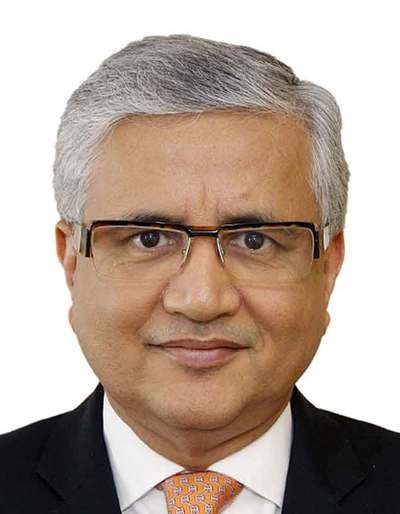
Seasoned hotelier Farhat Jamal returns to the Taj chain after eight years and this time, as its senior vice-president (operations).
In his new role, Jamal will be responsible for the hotel’s operations in Western India and Africa. Jamal had left Taj in November 2007 after being with the Tata Group-owned chain for nearly three decades.
Between November 2007 and until now, Jamal was with Lalit Hotels as its chief operating officer and Shangri-La Hotels as head of India operations.
source: http://www.timesofindia.indiatimes.com / The Times of India / News Home> City> Mumbai / by Reeba Zachariah / TNN / July 21st, 2015
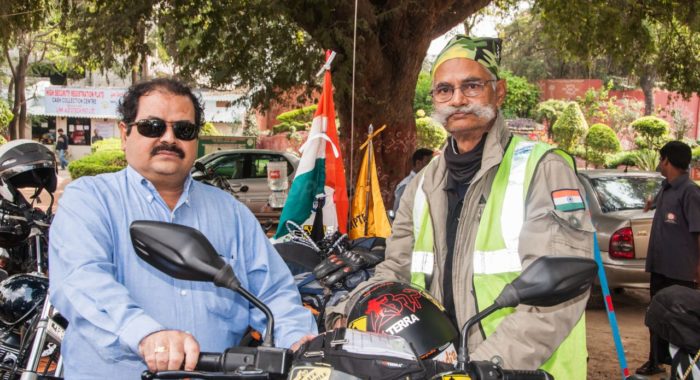
Col. MA Kaleem, a veteran motorcyclist, young at 68 years, begins a solo ride around India, riding a total distance of 35,000 km. He is attempting to break the existing world record for longest distance traveled within a country without retracting on same route. He’ll be travelling to all the states in the country touching their capital cities. Some of the cities he will be visiting are Chennai, Trivandrum, Kochi, Mangalore, Panaji, Bangalore, Pune, Mumbai, Nagpur, Lucknow, Allahabad, Jaipur, Delhi, Chandigarh, Ludhiana, Agra, Gwalior, Siliguri, Calcutta, Ahmedabad, Bhopal, Indore, Guwahati. He intends to travel this Distance in a time of 90 days.
He has done innumerable solo rides in India and is affectionately called Moonchwala in Biker circles. He was part of the Hyderabad – Kashmir – Hyderabad ride done last year. He was flagged off in Hyderabad By the Joint Transport Commisioner and Secretary, RTA, HYDERABAD Mr T. Raghunath.
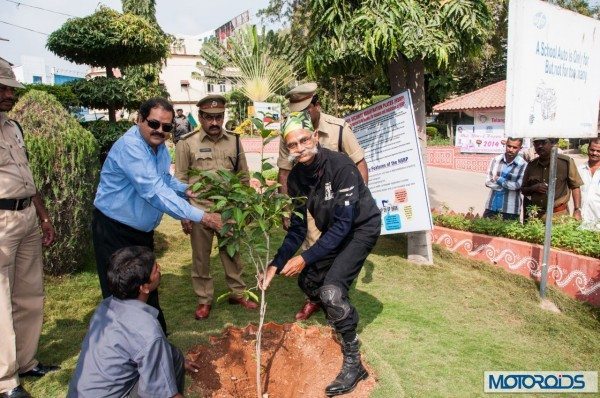
Mr. Kaleem Planted a tree at the RTA Khairatabad in Hyderabad to commemorate the occasion. Speaking on the occasion he thanked his Sponsors HP for the Petrol, CEAT Tires for 2 Sets of Brand new tires, ViaTerra for the Claw and GT customized luggage systems, HV Kumar & Forum for Live Online Support, Xbhp members for support and MapMyIndia for the GPS Device. He also mentioned that he is dedicated to protect environment and plants trees whenever he sets out for a ride. He wanted everyone in the society to pledge for their own as well as others safety while on the road.
Mr.T. Raghunath explained all the innovative ways they are using to make life of citizens on the roads in Hyderabad better. The safety measures and implementations of different policies were explained to the gathering.
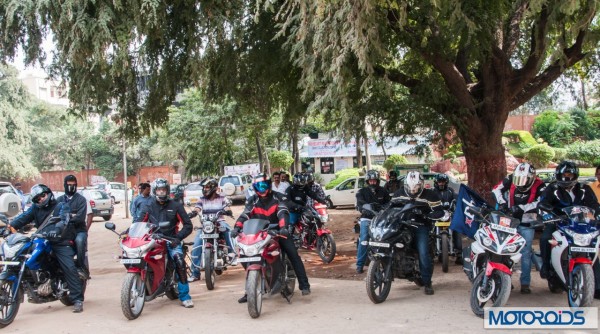
Members from the online community will also be greeting and supporting him at every major town. We wish the young-at-heart colonel all the best in his record attempt.
source: http://www.motoroids.com / Motoroids.com / Home> Features / 2014
`Masjid-e-Meraj Bada Makan’ is tucked away in a nondescript lane on Lalbagh Main Road. Nothing about the structure or its adjoining dargah (now under renovation) seems `historic’. But then, first impressions can be misleading.
The story goes back to 1753, says the mosque’s secretary Abdul Shukur. Hyder Ali decided to take the blessings of a fakir in Salem before the battle of Tiruchinapally against the British. It is said he was shocked when the saint Attaullah Shah Shuttari forbade him from fighting. The commander went ahead nevertheless, a move that resulted in defeat, grave physical injury and loss of lives.
Hyder Ali then requested Shuttari to become his pir (spiritual guide). Pointing to a brickwalled home opposite the mosque, Shukur says, “Hyder Ali built this bada makan (large home) for the fakir and it continues to be occupied by his descendants.“ Local residents and historians believe Shuttari had a greater role to play.
Syed Suleiman Ali Shuttari, the eighth-generation descendent of Attaullah Shah Shuttari, says people from far and wide visited his illustrious ancestor. They travelled in bullock-carts and stayed put in the grounds next to the mosque, waiting for the saint to finish his prayers. During one of his visits, Hyder Ali was pained to see people wait in the blistering heat. So, he commissioned the making of Lalbagh in 1760.
“Lalbagh was originally planned over 30 acres of land here, before Tipu Sultan and the British planned it across the 240 acres that we see today ,“ says Mansoor Ali, founder, Bengaluru By Foot. Mosque members go a step further to claim that Lalbagh was named after Haider Ali’s mother Lal Bi.
Popular narratives of history , however, say Hyder Ali was inspired by the Mughal gardens in Delhi and so had Lalbagh built. The horticulture department website suggests that Lalbagh derives its name from the red roses that bloom year-round in the botanical garden. After Shuttari’s death in the the 1770s, a dargah was built on his grave. Hyder Ali himself passed away in 1782.
The place also has an old well, said to be 30feet deep. Popularly known as Bada Makan Ki Boudi, it was apparently built by Haji Nasiruddin, a district commissioner and a follower of Shuttari. His great-grandson Shabaz Shariff said that Nasiruddin spent `200 to build the well. “It never dries out. In fact, it was among the only sources of water during the famine of 1876,“ he says. Though the well is locked, it continues to supply water to the mosque and the local community .
source: http://www.economictimes.indiatimes.com / The Economic Times / ET Home> Magazines> Panache / by Divya Shekhar, ET Bureau / July 13th, 2017
Ichhapur (Barrackpore subdivision of North 24 Parganas District), WEST BENGAL :
Kuntal and Sahabuddin during the Everest expedition
KOLKATA:
Forty eight hours after they had scaled Mount Everest on Sunday, Shaikh Sahabuddin and Kuntal Karar were flown off to Kathmandu. Families of both of them are now praying hard for the speedy recovery of Karar whose tryst with the mountains has left him battling serious frostbite. However, Karar has assured his family that all is well and he would be back soon to savour home-cooked ‘doi chicken’ with naan.
Sahabuddin, who works in the Metal & Steel Factory of Ichhapur, has become a big hero for his colleagues. “Having scaled many mountains, my husband was always a hero in office. But with the Everest mission, he has become a bigger hero. His office colleagues and bosses are in Kathmandu to receive and congratulate him. Even my father is hoping to come down on May 28 from Kashmir to wish him,” said Sahabuddin’s wife Ruksana, who hails from Kashmir.
His younger brother, Shaikh Salauddin, works as a heating ventilation air conditioning engineer and is proud of his sibling’s achievement. Apparently, two months before the expedition, Sahabuddin underwent a surgery. Yet, nothing could stop him from wanting to reach the Everest. Salauddin is waiting to begin the celebrations back home once he returns. “Whatever happens, we were always sure that he would make the summit,” said Salauddin, who also dreams of scaling the Everest one day.
The family has been told that Sahabuddin is perhaps the first Indian Muslim mountaineerto have scaled the Everest. “We have been living in Ichhapur for 30 years. For us, divisions based on religion, caste or creed don’t matter,” he said.
Sahabuddin’s two-and-a-half-year-old son Shaikh Uzair is excited. He keeps on telling everyone he meets about his father having reached the top of the world. “On Tuesday morning, my husband made a video call at 8.30am. Both of us started crying. There were tears of happiness. He kept on saying that it was our collective good wishes that had helped him reach the Everest. My son was asleep when the first call came. When he later called at 11 am from Kathmandu, the entire family spoke to him,” Ruksana added.
Initial euphoria of having reached the summit died down when the Karar family heard about Kuntal’s frostbite. On Monday evening, the family got tense after news trickled in about Kuntal being seriously ill. “We couldn’t sleep the whole of Monday night. In the morning, we were thinking of organising funds so that we could reach Kathamandu. But thankfully, he called up at 8.30 in the morning and assured us that he is fine. He even sent us photos from the hospital,” said Kuntal’s sister-in-law Mamomi from their Howrah residence.
Mountaineering has been an addiction for Kuntal. After completing his diploma in engineering, he took up a job before shifting to his own business. “Kuntal’s teacher Anol Das had died in the mountains. A year later, Kuntal had rescued his body. However no amount of persuasion could dissuade him from being smitten by the mountaineering bug,” said his brother, Kanchan.
While at the summit, Kuntal had wanted to use a satellite phone to speak to his family. “But a fellow-mountaineer who had the phone was too exhausted. Kuntal couldn’t ask him to lend the satellite phone so that he could speak to us from there. That’s his only regret,” she said.
source: http://www.timesofindia.indiatimes.com / The Times of India / News> City News> Kolkata News / by Priyanka Dasgupta / TNN / May 23rd, 2017
A 100-member team of archivists is digitising over 10 crore documents to prevent further loss. The first phase of the project is expected to be completed in two years.
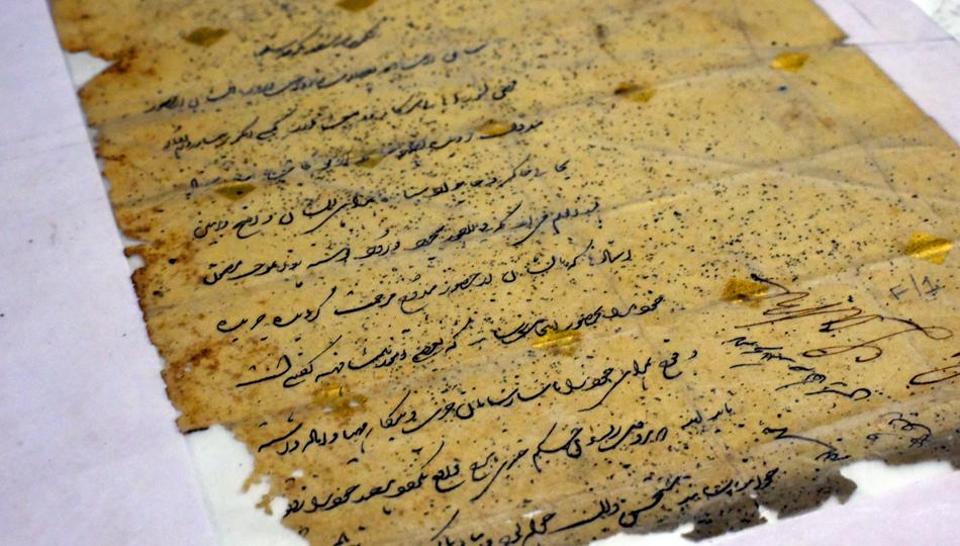
A letter from General Lake Sahib to Zaibun Nisa Baigum dated 8 October 1802 at Delhi archives.(Vipin Kumar/HT PHOTO)
On March 9, 1858, a British court declared Delhi’s last king, Bahadur Shah Zafar, guilty of rebellion, treason and murder before exiling him to Rangoon in the then British-controlled Burma. The trial was approved and confirmed a month later by N Penny, major general commanding, Meerut division.
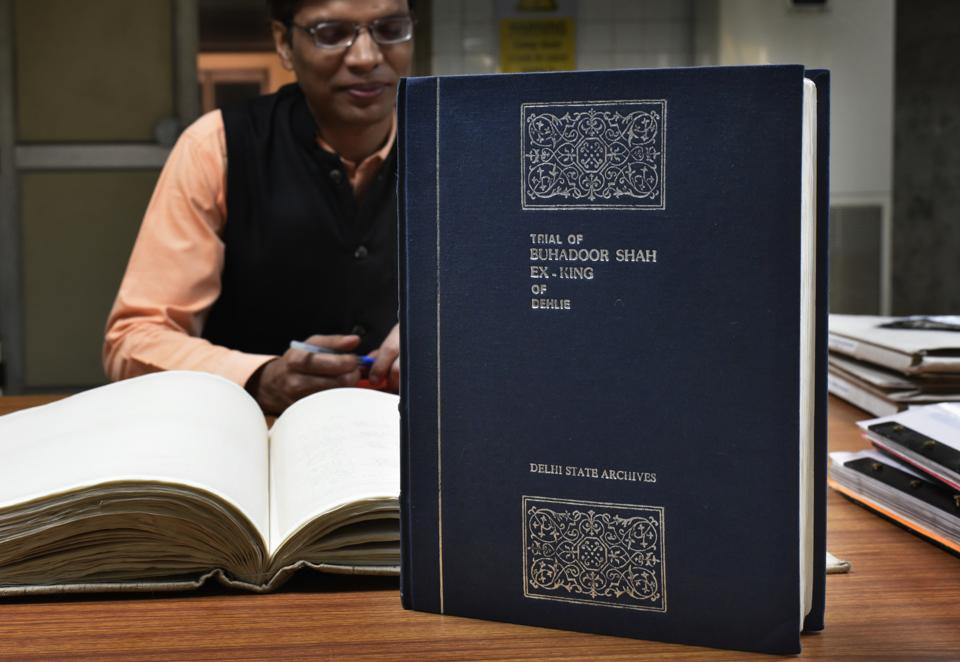
One hundred and fifty nine years later, the 42-day trial conducted at Diwan-e-Khaas of the Red Fort by British prosecutor Major F Harriott lies preserved word for word at the Delhi archives in the form of a hardbound book comprising 262-pages.
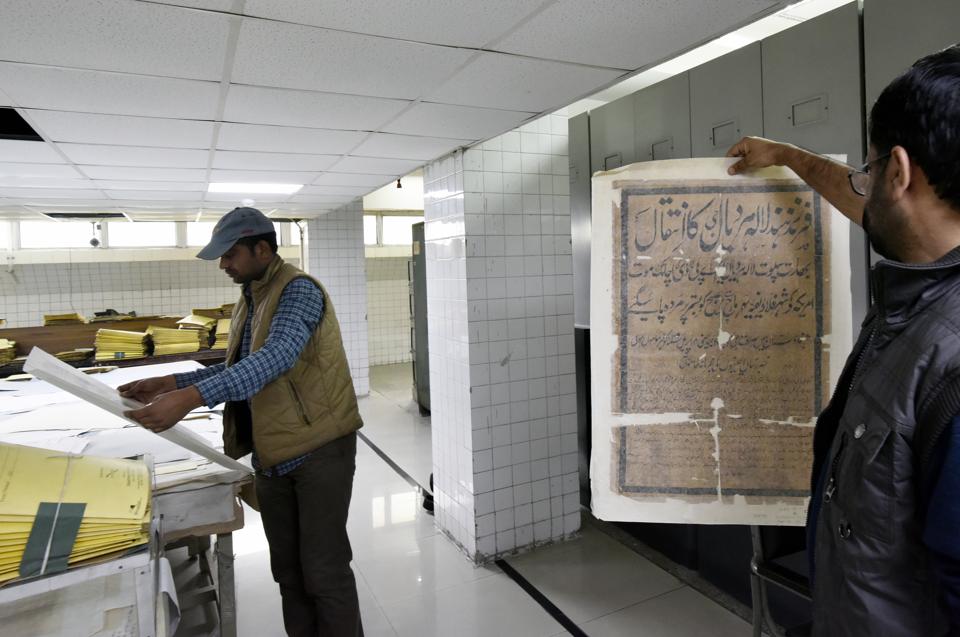
Apart from the handwritten trial papers, the Delhi archives is a repository of over 10 crore rare documents comprising Mughal firmans (imperial orders), maps, land acquisition award statements, jail records, manuscripts and government orders narrating the historical and political journey of Delhi since 1803.
So far accessible to only researchers, the treasure trove will soon be just a click away for those interested in the history of the national capital. An ambitious ‘digitisation and microfilming of archival records’ project started by Delhi government is underway with the target of converting 4 crore documents in the first phase by 2020.
An official with a copy of the trial of Bahadur Shah Zafar. (Vipin Kumar/HT PHOTO)
“Some of the records are so old that they might get damaged. So, it is required to preserve them in digital and microfilm formats for posterity,” said Sanjay Garg, the chief archivist of the archives. The Delhi Archives is city’s second repository of records from early 19th century after the National Archives of India.
Mughal firmans to land acquisition for Lutyens Delhi
In September 1803 East India Company’s forces under general Gerard Lake fought the Marathas in what is popular as Battle of Delhi, or Battle of Patparganj — named after the area now in east Delhi.The earliest documents at the Delhi Archives relate to this battle. Thought the British emerged victorious, they allowed Shah Alam II — the blind emperor of Delhi — to issue firmans in Persian language, many of which are also preserved at the archives.
“There are different sizes of royal seals in Persian language depending on the hierarchy in the Mughal courts on the firman with gold marks,” said Ashutosh Kumar Jha, assistant archivist pointing at ‘A letter from General Lake Sahib to Zaib-un-Nisa Baigum’ dating October 8, 1802.
The transfer of power to the British crown in 1958 followed setting up of a new administration and eventually the construction of the new capital, Delhi, in 1912. The Archives also have records of land acquisition during this historic shift of the national capital from Kolkata to Delhi.
“From photographs to award statements of land acquired from the owners, we have rare documents that bear testimony to how the present day Delhi came up,” said Sandeep Singh, assistant archivist. In one of the records dating March 1913, an individual named Ram Das was awarded a compensation of Rs 172, two paisa and nine annas for his 285.38 acre of land acquired by the government in Khanpur. The deal was signed by Kamruddin, revenue assistant, Delhi province.
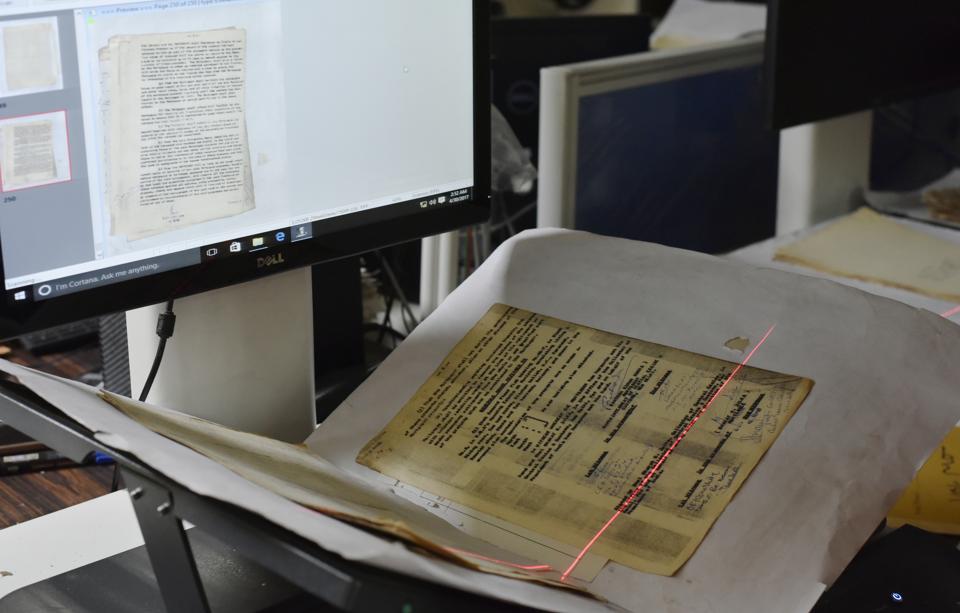
Documents being scanned for digitisation at Delhi archives. (Vipin Kumar/HT PHOTO)
The repository at the archives includes pictures of construction of historical buildings housing Parliament and Rashtrapati House in early 20th century. Originally called House of Parliament, the Sansad Bhawan was designed by the British architect Edwin Lutyens and Herbert Baker in 1912-1913 and was constructed between 1921 and 1927.
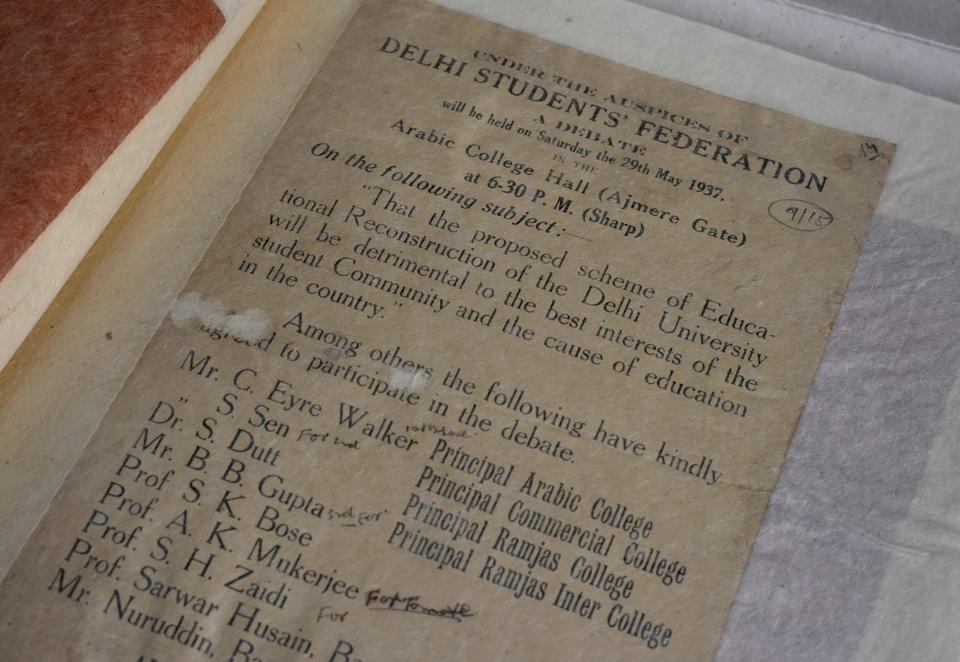
A poster of a debate being organised by Delhi Students’ Federation on May 29, 1937 at Arabic College Hall (Ajmeri Gate) is in the section of rare documents showing how teachers would support students’ concerns. The debate on why “the proposed scheme of educational reconstruction of Delhi University will be detrimental to the best interest of the students’ community and the cause of education in the country”, had C Eyre Walker, principal Arabic college, S Dutt, principal Ramjas College, and BB Gupta, principal Ramjas inter college among speakers.
A rare document dated April 7, 1912 is testimony to how ‘Khan Bahadur’ title was awarded to one Chaudhari Nabi Ahmed on the occasion of ‘His Majesty, the King- Emperor’s Birthday’.
The Delhi archives is a repository of over 10 crore rare documents comprising Mughal firmans, maps land acquisition statements, jail records, manuscripts and government orders. (Vipin Kumar/HT PHOTO)
Digitising 10 crore rare documents
The project, billed as the largest in Asia, envisages digitisation of 10 crore records stored in the four specially constructed floors of the Delhi Archives building in Qutub Institutional Area. In the first phase, four crore records are expected to be ready and uploaded on the website of the Delhi archives over a span of 30 months at a cost of Rs 25.4 crore.
The project was fist conceived in 2011 but was taken up by the incumbent government on August 31 this year. Led by Garg, a 100-member team of archivists, scholars and employers are busy with the digitisation task using computers and high-end German-made scanners.
“We have got eight scanners for now. We digitise about 50,000 pages each day,” Garg said
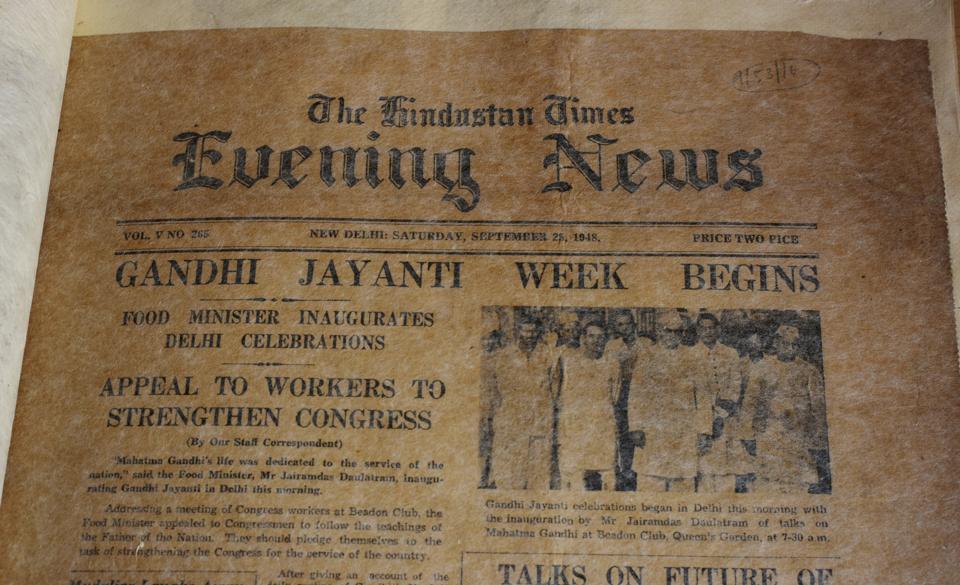
A collection of old newspapers at the archives includes a copy of Hindustan Times, Evening News, published on September 25, 1948. (Vipin Kumar/HT PHOTO)
Once digitised, the records would be transformed into microfilms.
“The thumbnails of the records with some information would be available on the website. For higher resolutions, one has to pay,” Garg said
A welcome move
“It’s a welcome move to preserve and digitise records particularly Bahadur Shah Zafar’s trial. The public will know who sided with British and who was with revolutionaries in the first war if Independence,” said historian Rana Safvi, who has translated Zahir Dehlvi’s Dastan-e-Ghadar which comprises eyewitness account of the 1857 uprising against the British
An old invite of Delhi Student Federation, now DUSU (Delhi University Student Union), at Delhi archives. (Vipin Kumar/HT PHOTO)
Established in 1972, the Delhi archives is a repository of non-current records of Delhi government under the department of art and culture. It is responsible for preservation of the archives and making them available research and references.
“We are committed to make knowledge more accessible to the common people. This is an important step towards preserving our precious heritage. While digitisation will ensure preservation of documents, making them available to a larger audience through a website and outreach events will play a key role in dissemination,” said Manish Sisodia, the minister of Art, Culture and Languages.
source: http://www.hindustantimes.com / Hindustan Times / Home> Cities / by Gulam Jeelani, Hindustan Times / December 14th, 2017
For 320 years, Delhi was the city of sultans. Here is the list of the 32 rulers and where they rest now.
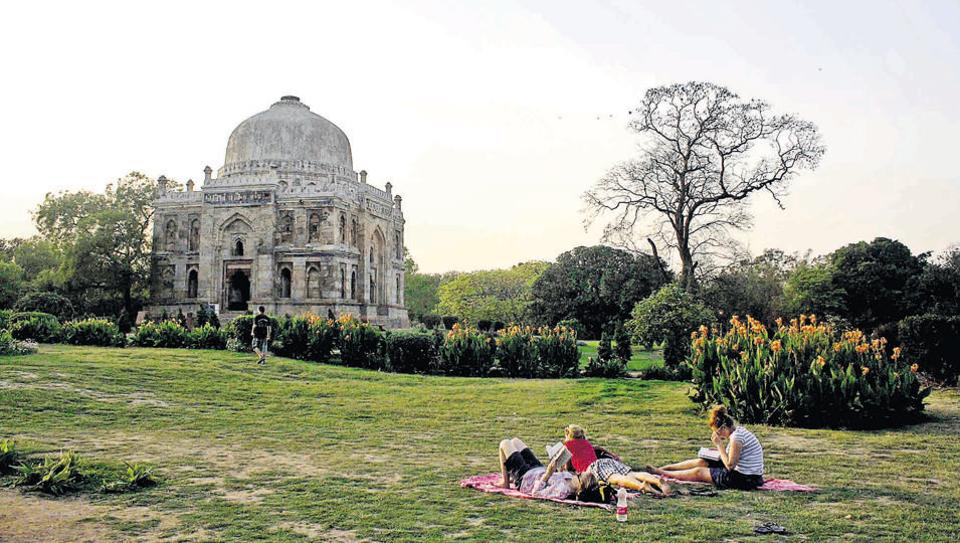
Sheesh Gumbad in Lodhi Gardens.(Mayank Austen Soofi / HT Photo)
The other day, while driving past an obscure monument, a friend demanded to know its name. We had no idea so we bluffed, “Ah, that’s a Lodhi-era tomb!”
The truth is we can’t even list all the Lodhi kings.
In any case, the Lodhi dynasty was part of the more elaborate Delhi Sultanate (not to be confused with ‘Delhi Sultanate’, a so-named member of The Sky Vengers music band). The Delhi Sultanate we are talking about spanned five dynasties, 32 rulers and 320 years. It lasted from 1206 to 1526. Today we give you the names of all the rulers of the Sultanate — one of whom was India’s first woman ruler, while the last was vanquished by Babur, the founder of the Mughal dynasty.
We also used this list to hunt the graves of these Sultanate royals — right here in our city. Of course, it’s not possible to access every king’s tombstone. Quite a few of them were killed in small and big wars, at times far from Delhi. Frustratingly, history books leave no solid evidence of their burial spots.
Some others of these important men turned out to be so insignificant in the long run that their graves have been forgotten, making it impossible to trace them today. Here’s a list of all the rulers, and the graves of those we were able to locate.
SLAVE DYNASTY
Qutbuddin Aibak (1206–1210), buried in Lahore, Pakistan
Aram Shah (1210–1211), killed near Delhi, grave not known
Shams ud din Iltutmish (1211–1236), buried in Qutub Minar Complex, Mehrauli
Illtutmish’s tomb in Qutub Minar complex. (Mayank Austen Soofi)
Rukn uddin Firuz (1236), believed to be buried in Sultan Ghari, near Mehrauli
Raziyat ud din Sultana (1236–1240), buried in Bulbuli Khana, Old Delhi
Raziya Sultan’s tomb in Bulbuli Khana, Old Delhi. (Mayank Austen Soofi)
Muiz uddin Bahram (1240–1242), grave not known
Ala uddin Masud (1242–1246), grave not known
Nasir uddin Mahmud (1246–1266), grave not known
Ghiyas uddin Balban (1266–1286), Buried in Mehrauli Archaeological Complex, near Jamali Kamali mosque
A tomb outside Jamali Kamali complex in Mehrauli. (Mayank Austen Soofi)
Muiz uddin Qaiqabad (1286–1290), grave not known
Kayumars (1290), grave not known
KHILJI DYNASTY
Jalal ud din Firuz Khilji (1290–1296), buried in Delhi but “disappeared “according to HC Fanshaw’e book Delhi, Past and Present
Alauddin Khilji (1296–1316), buried in Qutub Minar Complex, Mehrauli
Qutb uddin Mubarak Shah (1316–1320), grave not known
TUGHLAQ DYNASTY
Ghiyath al-Din Tughluq (1321–1325), buried in Tughlakabad
Muhammad bin Tughluq (1325–1351), buried in Tughlakabad
Mahmud Ibn Muhammad (1351), buried in Tughlakabad
Firuz Shah Tughlaq (1351–1388), buried in Hauz Khas Village
Ghiyas-ud-Din Tughluq II (1388–1389), grave not known
Abu Bakr Shah (1389–1390), grave not known
Nasir uddin Muhammad Shah III (1390–1393), grave not known
Ala-ud-Din Sikandar Shah I (1393), grave not known
Mahmud Nasir uddin (1393–1394), grave not known
Nusrat Shah (1394–1399), grave not known
Nasiruddin Mahmud Shah (1399–1413), not known, Timur invade Delhi in his reign
SAYYID DYNASTY
Khizr Khan (1414–1421), grave not known
Mubarak Shah (1421–1434), buried in Kotla Mubarakpur village
Muhammad Shah (1434–1445), buried in Lodhi Garden
The plaque at Mohammed Shah’s tomb in Lodhi Garden. (Mayank Austen Soofi)
Alam Shah (1445–1451), grave not known, perhaps in Badayun where he died
LODHI DYNASTY
Bahlol Lodhi (1451–1489), Chirag Dilli
Sikander Lodhi (1489–1517), Lodhi Gardens
Ibrahim Lodhi (1517–1526), buried in Panipat, Haryana
source: http://www.hindustantimes.com / Hindustan Times / Home> Cities> Delhi / by Mayank Austen Soofi, Hindustan Times / December 02nd, 2017
Old timers in Kolkata swear that a kathi roll from Nizam’s doubled the thrill of a cricket match at Eden Gardens
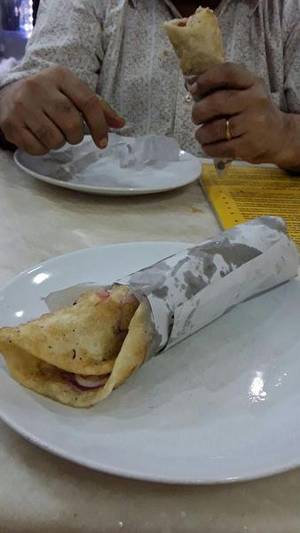
If you have feasted on hot, succulent double-egg kathi rolls wrapped around chunky pieces of mutton or chicken instead of home-packed cold jam sandwiches and boiled eggs at Eden Gardens, Kolkata, chances are that you managed to scoot across to Nizam’s, near New Market (24, Hogg Street, New Market) to pick up a few rolls, just as the batsmen pulled off their gloves and play broke for lunch.
Nizam’s rolls and cricket matches at Eden Gardens enjoy a long and deep relationship.
Back in the early 1950s, during an exciting Test match between the MCC and India, a group of enterprising young men hopped across the Maidan — the lungs of Kolkata (Calcutta those days) — crossed over to Chowringhee Road, and dived into the narrow and deep-set bylanes around New Market, to pick up sizzling hot kathi rolls from a then-hole-in-the-wall shop called Nizam’s.
The walls were black with soot and grime, collected over the years from wood and charcoal fire, and greasy from the fumes hissing out of fiery hot tawas and iron seekhs. The young men galloped back to the stadium with the warm newspaper-wrapped kathi rolls where other friends eagerly reached out. As they unwrapped the newspaper, the aroma wafted through the stands, turning heads and inviting a volley of queries about the source of this unique snack.
Deep-fried inspirations
One of those young men happened to be my father — a fresh graduate from Scottish Church College — taking a break from dreary balance sheets at his chartered accountancy classes and articleship.
The now 86-year-old remembers with obvious pleasure that it was his older siblings and friends who first discovered Nizam’s, at a time when the average Calcutta Bengali was still unaware or wary of eating out at these cheap eateries.
Nizam’s sold kebabs and rotis or parathas, and the ‘sahibs’ of colonial Calcutta often drove up for a late-night kebab-paratha meal. Eventually, the shop devised a way to package the meat into the paratha and wrap it up neatly in newspaper so that the sahibs wouldn’t have to soil their fingers. And thus the ‘Nizam’s roll’ was born.
Apart from occasional labour unrest followed by shut-downs, the forerunner of the Kolkata kathi rolls had a relatively steady career till recently, when there was a fire scare. A neighbouring shop went up in flames dangerously close to the walls of Nizam’s. Social media erupted in panic as someone reported that Nizam’s was gutted. “Oh no! Had the loveliest mutton rolls just recently!” wrote Maria Bhattacharya of Indian Oil Corporation on WhatsApp, while Dr Saswati Das exclaimed, “Oh dear! Can’t believe this! One of our childhood joints gone up in flames.” They were both vastly relieved to learn that Nizam’s was in fact unharmed.
“Nizam’s would invariably be our dinner destination after a night show. Thereafter, we’d walk back to the hostel. The police ticked us off so many times because of all the noise we made,” Dr Das laughs, as she recalls her student days at the Calcutta Medical College in the 1980s.
A hangout for many
Night birds flock to Nizam’s to savour its chicken, mutton, egg, aloo and beef kathi rolls, besides juicy kebabs and other Mughlai dishes, not available at home. My father remembers dropping in at Nizam’s for beef rolls well past midnight, and sitting on the benches outside munching on crisp hot rolls, with some of the prettiest and best crooners of the Park Street pubs and restaurants of the 1950s and 1960s.
Devarati Mukherjee remembers being there for late-night snacks even as a kid in the 1960s. “In winter, it was a given that on late nights we would end up at Nizam’s,” she says.
Medical Officer at IOC, Haldia, Dr Sutapa Pal’s memories of night duty at Calcutta Medical College and Nizam’s are forever married. “We’d walk to Nizam’s for a good hot meal. We were always hungry those days. Seems like another age.”
In this weekly column, we take a peek at some of the country’s most iconic restaurants.
sourcce: http://www.thehindu.com / The Hindu / Home> Life & Style> Food / by Mohua Mitra / November 30th, 2017
Housed in the Ibn Sina Academy, Aligarh, the museum is one man’s effort to preserve articles of Muslim lifestyle or tehzeeb that include textiles, crockery, manuscripts, and musical instruments among other things.
While Taj Mahal may be the edifice of the moment, caught in the eye of a political storm and being showered with both barbs and bouquets, not very far from it is a museum of Muslim ‘tehzeeb’ that brims with tales of nobility and sophistication. Housed in the Ibn Sina Academy, Aligarh, the museum is one man’s effort to preserve articles of Muslim lifestyle or tehzeeb that include textiles, crockery, manuscripts, and musical instruments among other things.
The academy is primarily a museum of Medieval Medicine and Sciences, founded by Padma Shri Hakim Syed Zillur Rehman in the year 2000, but soon it diversified into chronicling Muslim lifestyle and tehzeeb of the past. People wonder why a science museum would be generous enough to grow into accommodating the articles of Muslim lifestyle. And he answers all of the queries with a note of hope and love for future, “I have the articles of Muslim houses preserved in the cupboards of my museum, from the royal families of Bhopal, Hyderabad, and Rampur etc.”
He said that he is preserving all this for posterity – “After acquiring education, prosperity and wealth there will be a time when they would want to know their civilizational facts, culture and past and at that time my museum will give the future generation a glimpse into their tehzeeb and lifestyle. It will respond to their search for roots.”
There are almost 4,500 articles of Muslim tehzeeb showcased in his museum – which include crockery that keeps the food warm till the last bite because of the vacuum that takes hot water, there are dupattas three meter long that were tied differently in different Muslim societies of Hyderabad and Bhopal etc., there is a fruit tray from the dining table of Begum Sultan Jahan of Bhopal, her brooch made of precious stones, with her name inscribed in gold, a chogha that belonged to the Qazi Shamsuddin of Rewari, dating back to 1830, a paandaan weighing over 5 kg and a betel stand to name a few.
There are other items that chronicle Muslim culture through objects like: gramophones, harmoniums, costumes for weddings and trays for biryanis designed keeping the sense of style and comfort of those times. There are heavy paandaan (a box for preserving items used to make paan), ugaldaan (spittoon for the pan user), fancy haath ka pankha (a hand fan), and pretty batua (wallet), gem-studded gharara (a dress item), there are also silver-lined razais (quilts). The museum grew out of his fondness for all things with rich history, some of which were also priceless – coins from ancient times, stamps, pens and other artefacts. He makes sure to mention the source of the specimens he gets from Muslim families and pin them in the cupboard with the name of the person donating it or belonging to.
Times for Muslims have also changed in many ways, he said, “Somehow they are not able to think beyond maqbara, masjid and madarsa. They are always ready to contribute in the growth of masjid and madarsa but don’t understand the values of museum of heritage and culture of Muslim families. In this time of collective ignorance about out past I designing this for the future generation that will come in search for roots,” he added. Some of the objects on display were inherited by him. Some were gifted by people who saw that he had the wherewithal to preserve priceless items for posterity.
He takes pride in showing the guests original royal orders of Mughal emperors that have come to Rehman from his father, and a paper weight made of shells that was used by Sir Syed Ahmad Khan. These orders come from Aurangzeb, Babur and calligraphy by Bahadur Shah Zafar. When asked how he continues to enrich the museum of Muslim past in times of attack on Taj Mahal, he said, “The attacks on Taj Mahal or anything associated with our past are just seasonal things, it is more to do with politics than our society and its commitment to celebrate history.”
In his view these attacks don’t mean anything in the larger picture of history, “Taj Mahal and Qutub Minar are part of our pride, we cannot be attacking them because they were made in medieval times. By that logic Connaught Place and Parliament should also be broken down because they were made angrez (British),” he added.
Rahman served as a professor and chairman, department of Ilmul Advia at the Ajmal Khan Tibbiya College, Aligarh Muslim University. After serving as a dean, faculty of Unani medicine, he retired after 40 years. He is the author of 45 books and several papers on different aspects of Unani and boasts of being the possessor of the largest collection of books on Unani medicine. Conferred the Padma Shri in 2006 for his contribution in the field of Unani medicine he is now expanding his museums to start taking items like animal skin, which formed an important part of households of the past.
Also, unsure of who will take it forward after him, Rahman has given this endeavor to a Trust to take charge of it. There is huge collection of Ghalib’s work, which he claims to be one of the largest in South Asia and attracts scholars from other parts of the country to study. In his library lined with thousands of books, manuscripts and dedicated works of Ibn Sina and medieval medicine, sciences, youngsters from all backgrounds especially economically weaker come to study in the quiet atmosphere.
source: http://www.news18.com / News18.com / Home> News18> India> Sunday Feature / by Eram Agha, News18.c0m / November 05th, 2017
In Delhi’s Qutb Complex, Catherine B. Asher goes beyond Mehrauli and Delhi to look at the afterlife of the iconic tower that is the Qutb Minar.
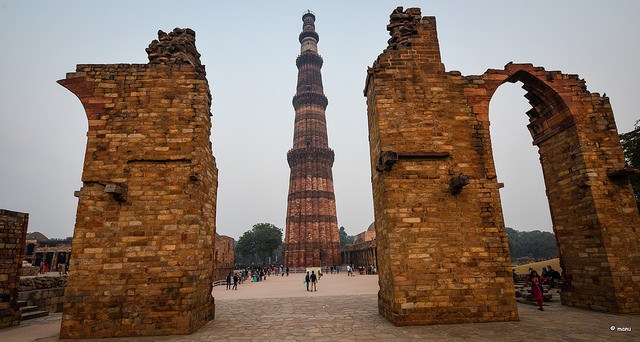
Qutb Minar. Credit: lensnmatter/Flickr (CC BY 2.0)
Mehrauli is truly a magical place. The average visitor skims but the surface, marvelling at the towering Qutb Minar and taking a cursory stroll through the other buildings that lie within the popular UNESCO World Heritage Site known as the Qutb complex. Those who go beyond, into the neighbouring village, may visit the shrine of the Sufi saint Qutbuddin Bakhtiyar Kaki, or a restaurant. There is now, of course, a smaller group of more adventurous explorers who are discovering the treasures of Mehrauli – particularly in the village and the Mehrauli Archaeological Park, mainly through the medium of increasingly popular ‘heritage walks’.
But though one may visit these monuments and learn the stories that lie in this locality’s long and eventful history, there are many layers that lie awaiting a more rigorous and meaningful analysis. A scholarly study by a leading art historian is, therefore, a very valuable addition to what is admittedly the rather sparse literature on the subject.
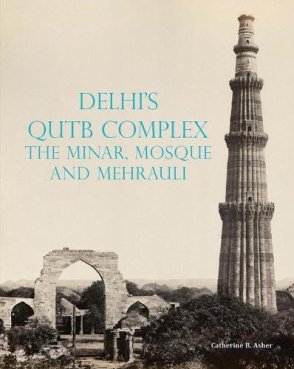
Catherine B. Asher Delhi’s Qutb Complex: the Minaret, Mosque and Mehrauli Marg Publications, 2017
Catherine B. Asher’s Delhi’s Qutb Complex: The Minar, Mosque and Mehrauli starts by setting the monuments of the Qutb Complex within the physical space and history of Mehrauli, and in the context of its many historic structures. Construction on the oldest congregational mosque of Delhi and its attached monumental tower began in the late 12th century, and was commissioned by a newly-arrived political power, the Turks – under Muizzuddin Muhammad bin Sam, also known as Muhammad Ghori – as part of a capital complex that comprised fortifications, palaces and water works. Many structures had of course already been standing there, the legacy of the earlier regimes – those of the Chauhan and Tomar rulers.
Some of these relics of the earlier period were appropriated and modified, such as the city wall. Others were cleared away and their materials reused. Notable here are a number of temples, destroyed during the conquest, whose stones were used to build the congregational mosque. Asher relies on recent research to analyse the complex nature of this appropriation and reuse, and its cultural ramifications. The systematic way in which the various elements were placed in the newly constructed mosque suggests that they were not treated as random spolia. For instance, the largest and most elaborately carved pillars were used in the western arcade, the part of the mosque closest to Mecca, and therefore the direction in which the congregation faced.
While the tower, the mosque, royal tombs and some waterworks were commissioned by the rulers, significant construction in Mehrauli in that period is attributable to the many other inhabitants of the capital city. Important remnants include mosques, tombs and shrines of Sufi saints, which added a layer of Islamic sacred spaces, in addition to the pre-existing Yogmaya Temple, an ancient site dedicated to a revered goddess, and the 11th century Dadabari Jain temple.
Over the succeeding centuries, as the centre of power shifted and the capital moved to newer sites in Delhi, the character of Mehrauli shifted in favour of its spiritual significance, as the site of important shrines. The book describes many of the religious structures – dargahs, tombs, mosques, temples, a church and a Buddhist centre, that have been constructed here right up to modern times. It also details the many secular structures that were built as Mehrauli became a popular resort for those fleeing the crowded conditions of urban life in the capital city. These structures included mansions, gardens, the 19th-century palace of the last two Mughal emperors, and British ornamental ‘follies’. The overwhelming impression is one of the continuing importance of the site. This importance was reinforced through longstanding traditions, not only of religious observances such as the Urs of the Sufi saint, but of festivals like the Phool Walon ki Sair. The latter was instituted by the later Mughals in the early 19th century, and involved veneration of both the dargah of Qutbuddin Bakhtiar Kaki and the Yogmaya Temple.
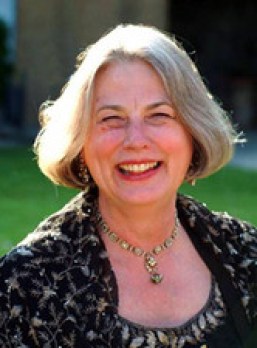
Catherine B. Asher. Credit: University of Minnesota website
Asher has gone beyond Mehrauli and Delhi to look at the afterlife of the iconic tower that is the Qutb Minar. She shows us how strong its impact was on later structures, which mimicked its form in miniature, either as freestanding towers or engaged columns. Examples of such appropriation range from structures as far flung as the Qutbuddin Mubarak Khalji’s mosque in Daultabad, to several in Delhi itself, for instance the 16th century mosque in Lodi Garden.
And yet the meaning of the original tower and its attached mosque is not uncontested. There have been suggestions, expressed first by Sir Syed Ahmad Khan, that the Qutb Minar was built by the Chauhans. While this is an opinion that is not generally espoused, at least by an educated readership, more common is the interpretation of both mosque and tower primarily as signifying the triumphalism of Islam. This is done on the one hand through an emphasis on the temple destruction associated with the site. On the other, it is fostered by the ASI signage and publications calling the mosque Quwwat al-Islam, literally, ‘strength of Islam’. This name, in fact, was not used for the mosque before the 19th century.
Asher questions many of these popular ideas, which often have their roots in colonial scholarship. She follows recent scholars such as Finbarr Flood, whom she refers to several times, in asking for a more nuanced reading of the site and what it signified in the past. Yet she does not break free of some of the more well-entrenched notions. Dichotomous ‘Islamic’ and ‘Indic’ traditions are treated as a given, without going into details of the motifs that are seen on the early Sultanate architecture to analyse their roots. The problem of the discipline of history becomes very apparent in such cases. A scholar of ‘Islamic’ art and architecture is trained to see the Qutub complex as Islamic architecture. The author, while she makes detailed comment on the calligraphy that adorned the early Sultanate structures, has no comment on the use of motifs like the lotus and the kalash, Indian motifs which also feature in the surface decoration. These motifs, in fact, persisted as an integral part of the ornamentation of mosques and tombs in Mehrauli and elsewhere, through the centuries, till the end of the Mughals.
Moreover, while it is important to study the architectural creations of the Ghurids in Afghanistan, as Asher has done, to understand their buildings in Delhi, it may not be enough to trace the roots of Ghurid architecture in Afghanistan merely to the previous ‘Islamic’ dynasty – the Ghaznavids. There were examples of pre-Ghaznavi art and architecture that abounded in the landscape – notably the great Gandhara tradition. It is time that its significance for later developments is also studied.
On the whole, however, the book is a valuable resource and informative read on a very important archaeological site. The inclusion of a large number of contemporary photographs and also archival images, match the scholarship, and live up to the standards set by the Marg series of scholarly volumes.
Swapna Liddle wrote her PhD thesis on the cultural and intellectual history of 19th-century Delhi. She is the author of Delhi: 14 Historic Walks and Chandni Chowk: The Mughal City of Old Delhi.
source: http://www.thewire.in / The Wire / Home> Books / by Swapna Liddle / November 30th, 2017
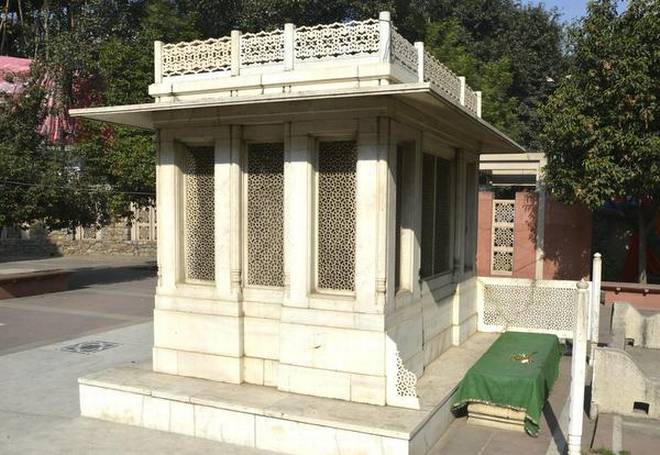
RAVE CONCERN Umrao Begum’s grave, covered in green cloth in Nizamuddin | Photo Credit: V. Sudershan
The unmarked resting place of Miza Ghalib’s wife deserves an epitaph
The grave of Mirza Ghalib’s wife, Umrao Begum, in Basti Nizamuddin, just at the side of her husband’s tomb, lacks an epitaph, probably because nobody tried to inscribe one on it in 1955 (when the poet’s memorial was built) or because she preferred anonymity as per the strictest tenets of Islam. Even so she deserves one for posterity’s sake. Umrao Begum was a pre-teenager when she married Ghalib, who himself was just 13 at that time, and the two shared conjugal bliss for nearly 57 years.
Umrao Begum was a kinswoman of the Nawab of Loharu, an erstwhile State now merged with Rajasthan, and her cousin was Bunyadi Begum, Ghalib’s sister-in-law. The begum, who was the Nawab’s sister, gave her haveli in Gali Mir Qasim Jan to Ghalib when he was in need of accommodation.
Umrao Begum bore seven children, all of whom died in infancy, leaving her and the poet heart-broken all their lives. Even the nephew, Nawab Zainul-abadin Khan Arif, whom they adopted, died young at the age of 18, though he had made his mark in Urdu poetry by then.
Strict lady
Umrao Begum was a strict Muslim lady, whereas Ghalib was not at all orthodox. After the First War of Independence of 1857, the poet was accosted by an English officer who asked him if he was a Muslim (as most members of the community were suspects in the eyes of the British). Ghalib replied “Half”. The officer sought an explanation to which Ghalib said that though he drank, he did not eat pork. The amused officer, marvelling at his wit, left him in peace.
Once Ghalib came home with a man carrying a basket full of wine bottles, bought with his first pay. Umrao Begum asked him why he had spent all the money on liquor, to which his reply was that God had promised to feed everyone but had not made any provision for drink, for which one had to make one’s own arrangements.
At another time he entered the courtyard of the house with his shoes on his head. To the Begum’s query, he replied that as she had made the whole haveli a masjid by her piety he had no other option. Umrao Begum died in 1870, a year after Ghalib, when Mahatma Gandhi was only a few months old and was buried according to her wish next to the poet.
Unfortunately, the Ghalib memorial built 85 years later became a barrier between the two graves, both of which should have come within its ambit. But it’s never too late to make amends for an oversight — if need be with Government help.
Her love for Ghalib was intense or he wouldn’t have been able to lead the carefree life he did. She was the one who took care of the house despite the poet’s love for gambling and dance girls, one of whom took undue advantage of him. Despite mischievous gossip by mohalla women, Umrao Begum was unruffled because she was convinced of her husband’s goodness of heart. Even when there was paucity of funds, she managed to see it to that Ghalib and nephew Arif got three square meals a day.
After the death of her children, she was the one who comforted her Mian Nausha so that the misfortune did not affect his mental equilibrium, without which his wit would not have continued to flow like the sparkling Thames.
Facing the music
Ghalib spent most of his time outside the haveli, except when he was writing poetry, having his meals or resting. So it was Umrao Begum who faced the creditors as she was the one who responded to the knock on the door in the absence of a regular maid. When the fat Kotwal of Delhi tried to bully Ghalib, as he disliked the poet because of their love for the same tawwaif and considered him a potential rival (as he always stole the limelight at the kotha), his wife was the one who confronted the Kotwal’s importunate minions at the haveli’s entrance and sent them away with the proverbial flea in the ear.
When Arif was grooming Alexander Heatherley “Azad” as a shair, despite his Anglo-Indian antecedents, Umrao Begum took it upon herself to see to it that they were not disturbed and had some refreshments too during the long hours of coaching. Ghalib who had earlier imbibed the love for shairi in Arif, also fawned on him and when he died an untimely death, poured out his grief in a heartfelt elegy (quoted from memory) that is among his best poems: “Jatey huey kehtey ho qayamat ko milenge kya khoob, qayamat ka goya din hai koi aur!” (While departing you say will meet on the Last Day of Judgement, what an excuse on the pretext of a reunion on a vague day in Eternity).
Reading the elegy Umrao Begum burst into tears and told Ghalib not to rub salt into her raw wounds, according to Arif’s pupil, Alexander Heatherley’s descendant, George Heatherley who died in Perth a few years ago. Umrao Begum’s grave close to Ghalib’s is testimony enough, if one were needed indeed, of the emotional link between the two. Then why deny her the courtesy of an epitaph to seal the bond for the benefit of future generations? No matter how distant may be Arif’s final place of repose.
source: http://www.thehindu.com / The Hindu / Home> Society> Down Memory Lane – History & Culture / by R.V. Smith / November 27th, 2017