Tag Archives: Iqbal Ahmad Ansari

“Kashmir: A Journey Beyond Time”: Book Launch Triggers Debate on History, Article 370

NEW DELHI :

New Delhi :

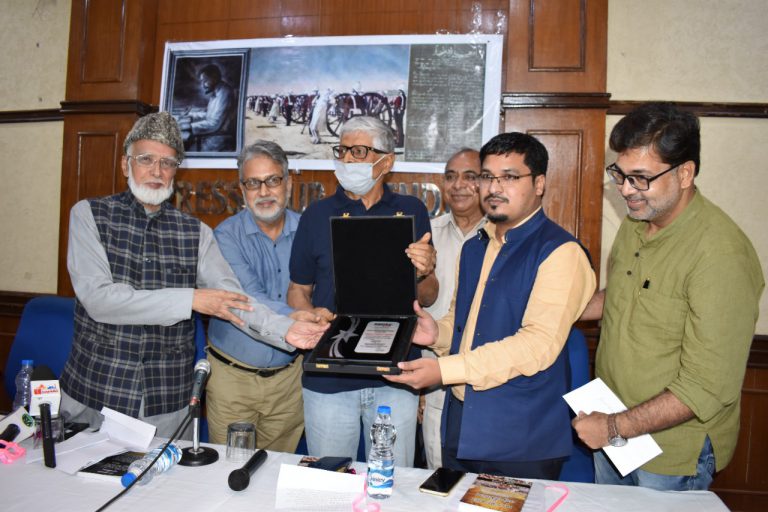
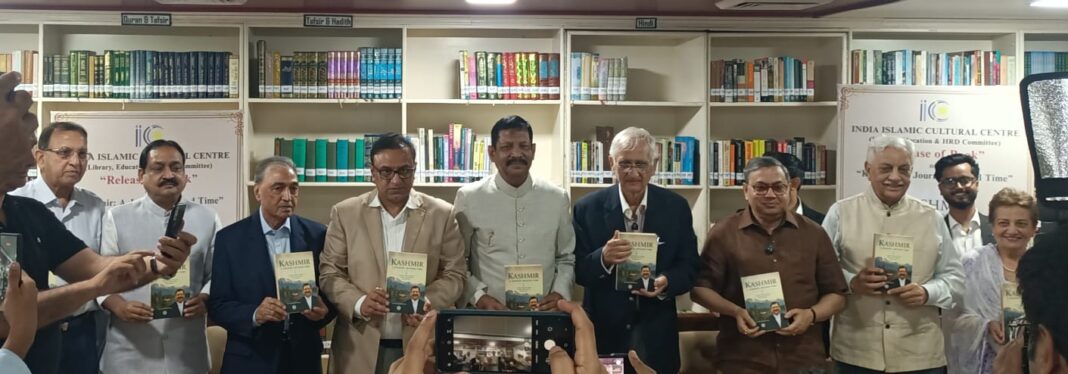
Advocate Irshad Ahmad’s book titled “Kashmir – A Journey Beyond Time” was released at the India Islamic Cultural Centre (IICC) on Wednesday, bringing together former judges, political leaders, legal professionals and public figures who reflected on Kashmir’s history, natural beauty, political developments and the experiences of its people.

Speaking at the book release, Justice Iqbal Ansari, former Chief Justice of the Patna High Court, congratulated Ahmad and urged people to read the book to develop a deeper understanding of Kashmir. Recalling his own visits to the region, Justice Ansari said that Kashmir’s extraordinary natural beauty stood in sharp contrast to the difficult circumstances he witnessed there.

Describing Kashmir as a “tragic place”, he said its people were good and hospitable but had experienced difficult lives. He recalled seeing restrictions and challenging conditions during his visits and said these experiences left him deeply saddened.

Justice Ansari also discussed the historical circumstances surrounding Jammu and Kashmir’s accession to India. Recalling the events following the end of British rule, he said Jammu and Kashmir was a princely state whose ruler, Maharaja Hari Singh, initially sought to maintain an independent position. According to Ansari, the situation changed following the entry of forces from Pakistan into the region, after which the Maharaja sought India’s assistance and signed the Instrument of Accession.

He emphasised that the accession initially related to three subjects, defence, foreign affairs and communications, while Jammu and Kashmir retained substantial autonomy in other areas.

Justice Ansari subsequently turned to the history and constitutional significance of Article 370. He questioned the popular narrative that Sardar Vallabhbhai Patel was unaware of, or opposed to, the provision. According to him, discussions concerning Article 370 took place at Patel’s residence, while a draft letter concerning Sheikh Abdullah was also sent to Patel for approval.

He said Patel subsequently played a role in securing support for the provision within the Congress Working Committee. Justice Ansari argued that Article 370 was conceived as a constitutional mechanism through which the applicability of provisions of the Indian Constitution to Jammu and Kashmir could be determined while preserving the state’s special constitutional position.

He stressed that claims concerning Article 370 and Patel’s role should be assessed in light of historical records rather than simply repeated as established facts. Referring to the subsequent abrogation of Article 370, Justice Ansari said there had been limited opportunity for a dispassionate public discussion about its constitutional and political implications.

He expressed appreciation for Ahmad’s effort to document his journey through Kashmir and said the book could encourage readers to engage more deeply with the region’s history, people and contemporary realities.

Former Union Minister Salman Khurshid also congratulated Ahmad on the publication. He said the book on Kashmir should perhaps have been written much earlier and suggested that greater engagement with the region could have contributed to addressing some of the problems associated with it.

Khurshid referred to the Supreme Court’s judgment concerning Article 370 and noted that Justice Iqbal Ansari had articulated his views on Kashmir and the constitutional provision. He also suggested that a separate book should be written on the Central Bureau of Investigation (CBI) and its significance in India’s constitutional and institutional framework.

Addressing the question of Kashmir’s relationship with the rest of the country, Khurshid said that even if some people believed the situation had improved, sustained efforts were necessary to ensure that the people of Jammu and Kashmir never felt separated from the rest of India.

He emphasised the importance of strengthening relationships with the people of the region and avoiding actions or approaches that could deepen feelings of alienation.

Recalling former Prime Minister Atal Bihari Vajpayee’s formulation of “Kashmiriyat, Insaniyat and Jamhooriyat”, Khurshid described the phrase as an important message associated with Kashmir. He said India should work towards an era in which Kashmir makes a significant contribution to the country’s future and receives the attention and care appropriate to its place as the “crown of India”.

The author, Advocate Irshad Ahmad, described the occasion as a deeply emotional moment, saying he had never imagined that he would become the author of a book. Recalling his journey to Kashmir, he said he had initially travelled there as an ordinary visitor but returned with experiences and impressions that eventually inspired him to write.

Ahmad said the beauty of Dal Lake, mountains, valleys, shikaras and gardens, along with the warmth and hospitality of Kashmir’s people, left a lasting impression on him. These experiences, he said, became the foundation of his book.

He said the central theme of his journey was “Sangharsh”, or struggle, which he described as an integral part of human life and an important source of inspiration and strength. Referring to Winston Churchill’s well-known exhortation to “never give in”, Ahmad said the spirit of perseverance had remained an important part of his own journey through different phases of life, including engineering, politics and public service.

Ahmad said he had already published around 650–700 books and credited the encouragement of friends and well-wishers for motivating him to continue writing. He particularly addressed young people, saying that determination and sustained struggle could help them achieve their objectives irrespective of the profession or field they chose.

He clarified that Kashmir – A Journey Beyond Time was not intended to be a conventional historical work. Instead, he said, it was based on what he personally saw, experienced and felt during his journey through Kashmir. He also indicated that he planned to write another book dealing with Islamic culture and animal cultural history.

Sirajuddin Qureshi, former President of the India Islamic Cultural Centre, congratulated Ahmad for completing the book, particularly because the project had been undertaken quietly and without much public attention. He said the author deserved appreciation for presenting Kashmir in what he considered its proper context rather than attempting to write about the region without experiencing it firsthand.

Qureshi highlighted Kashmir’s natural beauty and recalled its longstanding reputation as a destination comparable to Switzerland. While acknowledging that numerous books had already been written about Kashmir, he said Ahmad’s effort to present the region through his own journey and observations added significance to the work.

Pradeep Rai, President of the Supreme Court Bar Association, also congratulated Ahmad and reflected on the enduring significance of books. He said societies had undergone enormous changes over thousands of years, with rulers, communities and social structures changing, while Kashmir’s mountains, rivers and natural landscape had remained enduring features of the region.

Rai said books had the power to make writers’ names live on through generations because readers continued to remember authors through their works. Referring to his interest in Amir Khusro and writings in which Kashmir has been mentioned, he said successive dynasties and historical developments had shaped the region and its society.

He praised Ahmad for travelling through Kashmir and documenting what he personally witnessed. Rai observed that understanding contemporary Kashmir required a willingness to see the region directly and engage with its people and society.

The book release thus became not merely a literary occasion but a wider discussion about Kashmir’s history, constitutional evolution, social experience, natural beauty and relationship with the wider Indian society. Across their remarks, the speakers emphasised the value of documenting personal experiences and engaging with Kashmir through history, literature and direct human interaction.

source: http://www.indiatomorrow.net / India Tomorrow / Home> News> Society / by India Tomorrow / October 01st, 2026
Zafarul-Islam Khan Honoured with Shah Waliullah Award

NEW DELHI :

It is a great privilege for me to accept this honour from the Shah Waliullah Institute. Honestly, I was reluctant at first and had declined this recognition multiple times.

New Delhi :

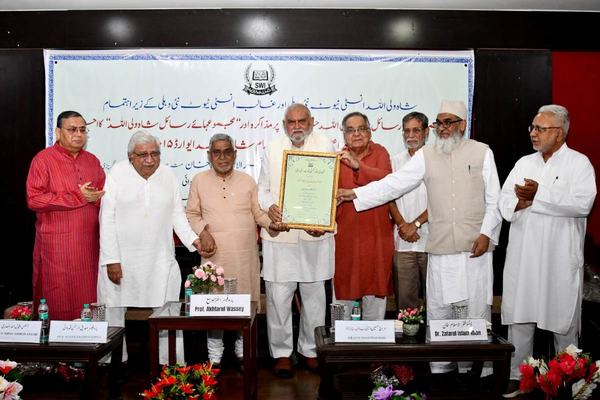
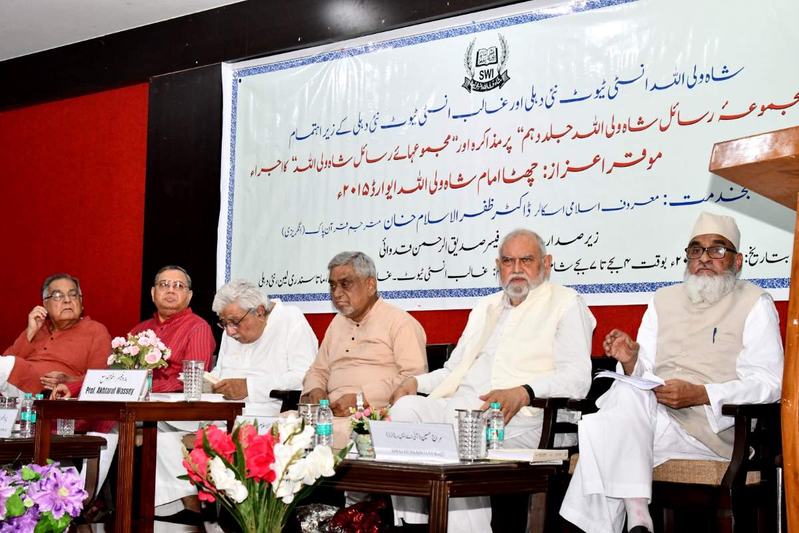
In a momentous event, renowned Islamic scholar, author, senior journalist, and former Chairman of the Delhi Minorities Commission, Dr. Zafarul-Islam Khan, was awarded the prestigious Sixth Imam Shah Waliullah Award here on Monday. The ceremony took place amidst a distinguished seminar on the theme of ‘Epistles of Shah Waliullah’ at the Ghalib Institute here.

Jointly organized by the Shah Waliullah Institute and the Ghalib Institute, the seminar sought to celebrate and highlight the scholarly and intellectual legacy of Imam Shah Waliullah. A special highlight of the event was the launch of the tenth volume of his acclaimed series of epistles, offering attendees an intimate glimpse into his teachings and enduring contributions to Islamic sciences.

A diverse assembly of eminent scholars, intellectuals, and thinkers from across the country participated in the event, engaging in profound discussions about the contemporary relevance of Shah Waliullah’s message, writings and teachings.

Senior journalist Suhail Anjum introduced the Shah Waliullah Institute and provided an overview of the newly launched the tenth volume of Shah Waliullah’s epistles, sharing insights into the publication process, ongoing scholarly discussions and past and future programmes of the Shah Waliullah Institute.

Anjum also felicitated Mufti Ataur Rahman Qasmi highlighting his unwavering dedication to research and publish the scholarly legacy of Shah Waliullah. He highlighted Mufti Saheb’s long-standing scholarly pursuits, first as a teacher for fourteen years at the Dargah Shah Waliullah madrasah near Shah Waliullah’s shrine in Delhi’s Mehdiyan area.

During this period, Mufti Saheb developed a deep spiritual and intellectual bond with the great scholar, gaining profound insights into his contributions to Quranic sciences and other fields. Inspired by this connection, Mufti Saheb established the institute to make Shah Waliullah’s invaluable legacy accessible to all. Some of these writings were published long ago or still lie as manuscripts in libraries. Under this initiative, Mufti saheb has already published ten volumes of Shah Waliullah’s writings. The tenth volume of this series was released during the event.

Expressing humility and honour, Dr Zafarul-Islam Khan said, “It is a great privilege for me to accept this honour from the Shah Waliullah Institute. Honestly, I was reluctant at first and had declined this recognition multiple times. However, I succumbed in the face of Mufti saheb’s insistence for a number of reasons. Paramount among these is my nearly forty-year-long association with Mufti Saheb, dating back to 1984 when I returned from abroad.

At that time I visited Mehdiyan and made a spiritual bond with Shah Waliullah and with Mufti saheb who at the time taught at the madrasah there. He said that another reason is that this award is associated with Shah Waliullah, the greatest Islamic scholar produced by India. In fact, he may be regarded as the greatest non-Arab Islamic scholar of all ages. He said that long ago he wrote a modest book in Arabic on Shah Waliullah trying to attract people’s attention to the ocean of knowledge which he was and remains till this day. He said that Shah Waliullah’s monumental work Hujjatullah al-Balighah stands out as an unparalleled masterpiece in the Islamic literature. It is printed, reprinted and studied in the Arab World till this day. Dr. Khan underscored the importance of Hujjatullah al-Balighah as a treasure trove that provides a deep, balanced and comprehensive understanding of Islamic sciences.

Dr Khan commended Mufti Saheb’s tireless efforts in unearthing and publishing many of Shah Waliullah’s manuscripts and texts that were hidden and forgotten. The current tenth volume stands as a testament to this scholarly dedication. He stated that his personal and scholarly bonds with Mufti Saheb and Shah Waliullah motivated him to accept this award. He added that there is a third reason for accepting the award and that is the fact that the award is given in recognition of the Glorious Quran, his translation of the Islamic holy text which tries to offer an authentic version of the Quran based on most authentic Arabic sources.

Dr Khan said there is a great responsibility on our shoulders: to try to understand and disseminate Shah Waliullah’s teachings and present them in modern language and style. Reflecting on Shah Waliullah’s revolutionary impact, Dr. Khan highlighted his translation of the Quran into Persian—a daring act at the time, which many scholars at the time considered a blasphemy. Even today, some argue that the Quran cannot be translated into any language. But if that was true, how would the 85% of Muslims outside the Arab world understand the divine message? Therefore, it is imperative that the Quran be translated into all languages—be it Assamese, Burmese, Chinese, or any other so that the common Muslim and non-Muslim could read and understand Allah’s last message to humanity. He pointed out that Western scholars, despite their scholarly rigour, often distorted the meanings of the Quran in their translations. Therefore, it is the duty of Islamic scholars to offer correct and accurate rendering of the divine text. Dr. Khan said he dedicated eleven years to accomplish his translation of the holy Islamic text. He said he fully devoted the three years during the COVID19 pandemic to complete this work. He regarded the award as a motivation to himself and all scholars to continue scholarly pursuits.

Mufti Ataur Rahman, chairman of the Shah Waliullah Institute, addressed the gathering sharing insights into how the idea of an institute dedicated to Shah Waliullah was conceived and narrated the journey since founding the institute. He took a moment to acknowledge the previous recipients of the Shah Waliullah Award: the first was given to Maulana Abdul Karim Parekh from Nagpur in 2007; the second and third to Maulana Akhlaq Hussain Qasmi and Maulana Faqihud-Din in 2010; the fourth to Maulana Muhammad Salim Qasmi in 2013; and the fifth to Maulana Qamaruz-Zaman Ilahabadi in 2014.

The event was enriched by the presence of distinguished speakers including Muhammad Adeeb, former Member of Parliament, Mr. Siraj Hussain, former vice chancellor of Jamia Hamdard, Justice Iqbal Ahmad Ansari, former Chief Justice of Patna High Court, Prof. Khalid Mahmood and Khwaja Muhammad Shahid among others.

The proceedings were presided over by the chairman of the Ghalib Institute Prof. Siddiqur Rahman Kidwai who lauded Mufti Ataur-Rahman’s exemplary work and extended warm felicitations to Dr. Zafarul-Islam Khan for his well-earned recognition.

source: http://www.milligazette.com / The Milli Gazette / Home> News> Community News / by Zillur-Rahman Haider / June 30th, 2026

Shams Tabrez Qasmi is Felicitated with Amar Shaheed Molvi Baqar Award 2021

NEW DELHI :

Shams Tabrez Qasmi, the CEO and the chief editor of Millattimes, has been honoured with “Amar Shaheed Molvi Baqar Award 2021”.

The award is in the memory of the martyr and celebrated Urdu journalist Molvi Muhammad Baqar (1780-1857). The award was conferred upon him on 16th September 2021 in a programme held at the premises of the Press Club of India (PCI), 1 Raisina Road, Near Kirshi Bhawan, New Delhi-1 in the presence of the office bearers of the PCI and a good number of the journalists.

The award was presented to Mr. Qasmi in the recognition and appreciation of his commitment, dedication and continuous efforts in the field of journalism.

Millattimes, from its day one, had been covering the issues ignored by the mainstream media, specially the issues of the minority communities and the other weaker sections of the society.

The Award was sponsored by Media 24×7 and Abdul Sattar Memorial Educational Society.

The programme, wherein the award was presented, was held from the Press Club of India (PCI) to commemorate the 164th death anniversary of the Martyr of the first War of Independence 1857 and the famous Urdu journalist Maulvi Muhammad Baqar.

It was addressed by a galaxy of journalists like Mr. Jai Shankar Gupta, Member of Press Club of India, Satish Jacob, former BBC journalist, Meem Afzal, ex-MP, Ismail Zafar Khan, SK Pande, Arvind Kumar Singh, Qurban Ali, Maroof Raza, Masoom Moradabadi and others, besides chief guest Prof. Azra Mosavi, a direct descendant of Maulvi Muhammad Baqar’s grand family from AMU, Aligarh.

The Press Club of India resolved in its meeting held on 6th September 2021, in the presence of its President, Mr. Umakant Lakhera, Secretary General Mr. Vinay Kumar and other members, like Mr. A. U. Asif, Press Club of India’s executive member, to commemorate the death anniversary of the Martyr of the first War of Independence 1857 and the famous Urdu journalist Maulvi Muhammad Baqar.

It was also decided that an award after his name will be presented to two journalists every year along with an amount of 21,000-00 Indian Rupees.

According to the resolution, this programme was held on 16th September 2021 and two dynamic, youth, budding and promising journalists: Maulvi Shams Tabrez Qasmi, a Darul Uloom Deoband Alumnus and the Chief Editor of Millattimes and Swati Mathur, a JNU Alumnus and a reporter with The Times of India were felicitated with the award named after him.

The Press Club of India (PCI), as stated at its website, is basically a meeting point for the journalists. The idea to set up the Press Club of India was first conceived by eminent journalist and editor Mr Durga Das in the early 1930s. When he had visited London as the editor of the Associated Press of India, he had chance to visit the London Press Club as well. It became a motivator for him to replicate the model in Delhi.

Eventually the Press Club of India was founded on December 20, 1957 and incorporated as a company on March 10, 1958. Mr Durga  Dass, the then Editor of The Hindustan Times was elected its first president and Mr D R Mankekar, a veteran journalist, became the first secretary general of the Club.

Now, it is an important and oldest body of the Indian journalists which is run by the elected President, Secretary general and members.

Moulvi Muhammad Baqar, a scholar, a journalist and an Indian independence activist, was born in 1780 in Delhi. He received his basic education from his father. For further studies, he got admission in Delhi College. Following his graduation, he was appointed as a teacher in Delhi College in 1828. He served as a teacher for six years.

Along with being one of the best editors, he was a successful reporter as well.

He launched a weekly newspaper namely “Dehli Urdu Akhbar” in 1835. It survived for almost 21 years and proved to be a milestone in the field of the Urdu Journalism. With the help of this weekly, he played a significant role in social issues. The weekly brought political awakening in masses and united them against the tyrant British rulers.

It is a fact that Maulavi Muhammad Baqar always advocated for the unity among the Muslims and Hindus as he thought that it is necessary to get rid of British rule.

He was arrested on 14th September 1857 for revolt. On 16th September 1857, he was tied to the mouth of a cannon. Then he was fired mercilessly by Major William SR Hudson.

Thus he became the first journalist to be executed following rebellion in 1857 by the then tyrant British government ruling over India.

Mr. Qasmi, who was felicitated with Amar Shaheed Molvi Baqar Award, is fond of learning, reading and writing from his early age. He has penned more than one thousand articles and essays on religious, social and political issues. He is one amongst the few journalist of the new generation taken seriously in India. He is known as a courageous, bold and fearless journalist.

Being a student in the DUD, he wrote columns for Weekly “Aalmi Sahara” and Daily “Azizul Hind”. It was an honour for him that on 6th December 2014, Dr. Aziz Burney published his article on Babri Masjid in his daily newspaper Azizul Hind as editorial.

When he reached capital city Delhi, he started his career as the editor of known New Agency: “INS”. In 2015, he was offered to write a column for the daily newspaper “Khabren”, New Delhi.

Mr. Qasmi launched a News Portal namely “Millattimes.com” in January 2016.

Officially it was inaugurated by Maulana Sayyid Muhammad Rabey Hasani Nadavi, President: All India Muslim Personal Law Board in Mumbai. Currently it is most read and visited Urdu news portal from India. Along with Urdu language, Millat Times is also providing its services in English and Hindi languages. Its YouTube Channel is also available, where the ignored issues by mainstream media are discussed.

He has interviewed several towering personalities like Mr. Iqbal Ahmad Ansari, ex-Chief Justice of Patna High Court and General Zamiruddin Shah, ex-VC of Aligarh Muslim University to let the viewers know their lives, services and views on several topics.

The area of his main interest is issues of Indian Muslims, current affairs of the Muslim World and the Middle East.

On this auspicious occasion, I congratulate Mr. Qasmi from the bottom of my heart! Congratulations! I hope Millattimes, as a media house, will continue offering its services and covering the issues, under Mr. Qasmi’s able leadership, which are commonly ignored by the mainstream media houses. ****

Email: qasmikhursheed@yahoo.co.in

source: http://www.millattimes.com / Millat Times / Home> Opinion / by Khursheed Alam Dawood Qasmi / Millat Times Staff / September 19th, 2021