Purkazi, a small town in the Muzaffarnagar district of Uttar Pradesh, would soon have its first higher secondary School, and students would no longer have to travel to neighbouring towns to pursue studies after the 10th class.
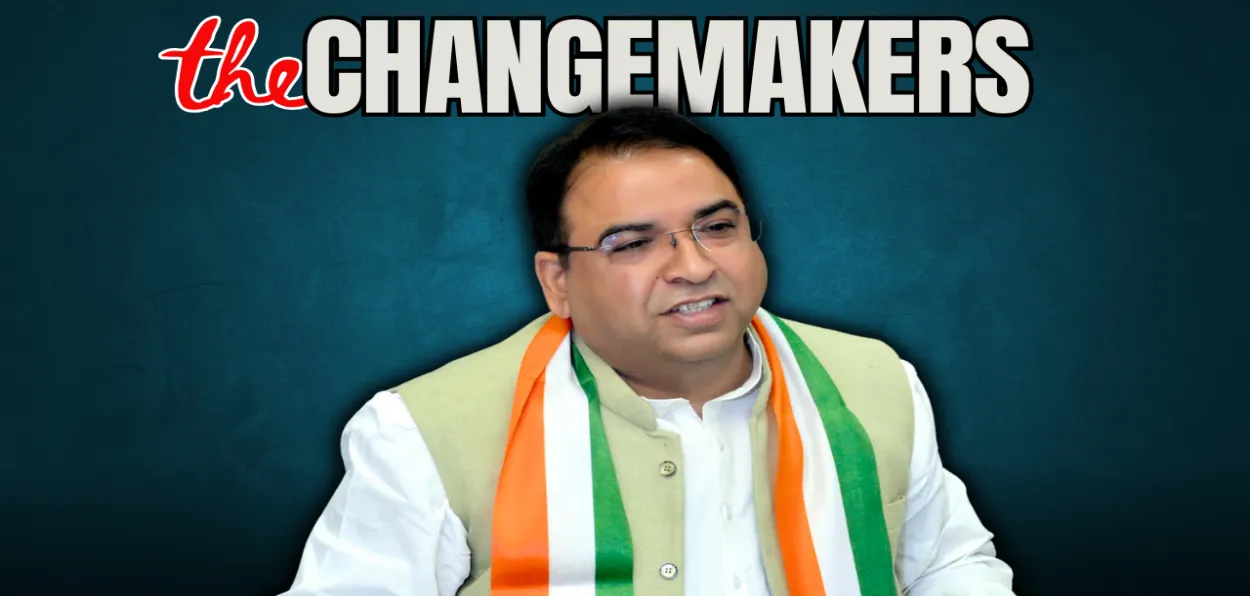
This happened due to the generosity of Zaheer Farooqui, Chairperson of the Nagar Panchayat, who donated his land valued at 1.5 crore for the project.
Farooqui, a peasant leader, and a lawyer, was dismayed to see the young girls and boys traveling in local buses and rickety three-wheelers to higher secondary schools in other towns and he chose to do something about it.
Following the adage Charity begins at home, he gave away his land which is otherwise a prized possession of any farmer or realtor.
Though he always championed the change to improve the lives of people living in this Muslim-dominated town, Farooqui was elected as Chairperson of the Nagar Panchayat in 2017.
As an elected head of the local body, his priority was to improve educational facilities since this is the surest way to improve the lives of common people. He initiated the change in schools; and equipped primary classes in the local government schools with an adequate number of chairs and tables for students and internet-linked smart boards.
His efforts were recognized as the local government school was covered under the Prime Minister Shri School scheme of Narendra Modi under which chosen schools are turned into model schools.
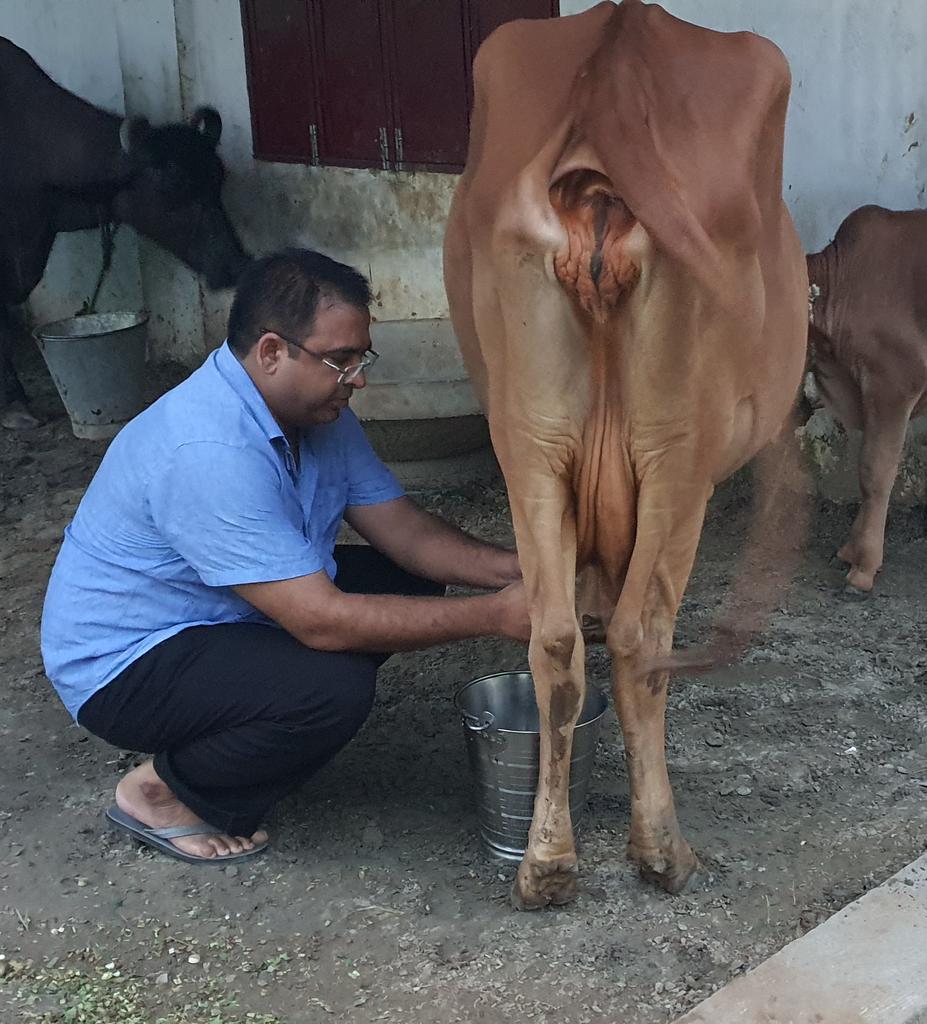
Debunking the common image of a Muslim, he showed keen interest in the upkeep of gaushalas (cow shelters). Till his initiative, the government funds for the establishment of gaushalas often remained unused by most of the Panchayats.
Farooqui-led Panchayat set up what is purported to be the first double-storey government-owned gaushala in India.
The gaushala has separate spaces for calves, pregnant cows, injured, and elderly cows. Its fodder-chopping machine runs on solar power. A veterinary doctor conducts daily health checkups of the animals.
Additionally, the dung produced is converted into manure, and sold to generate income to make gaushala financially viable.
In 2018, Farooqui-led Purkazi Panchayat installed Internet Processing Closed Circuit Television (IP-CCTV) cameras at various locations in the town to combat crime and make locals, especially women, feel safe.
The cameras of the circuit have powerful lenses that can read vehicle license plates. This circuit helped the Muzaffarnagar Police apprehend a man from Uttarakhand, who was identified as rapist of a local six-year-old child.
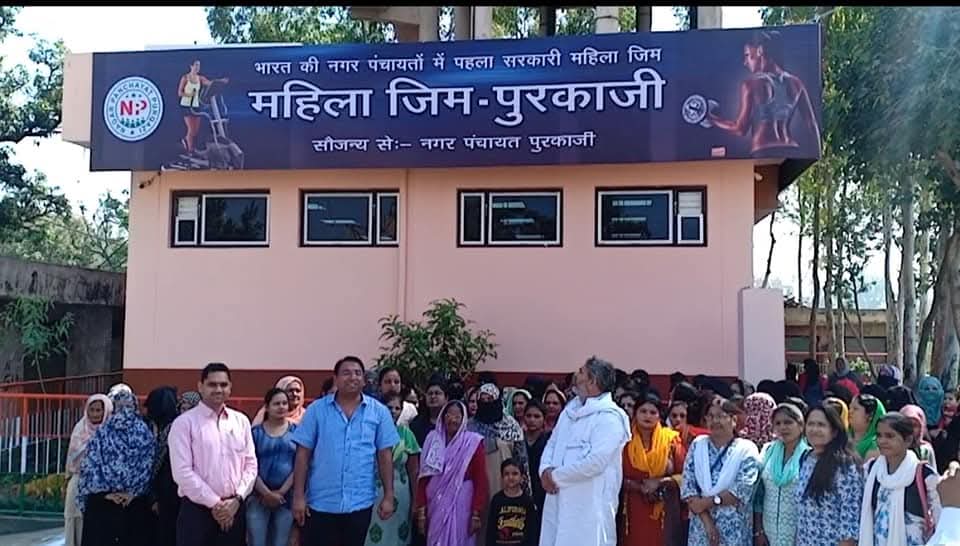
Zaheer Farooqui (In Blue shirt) with locals at the Women’s Gymnasium at Purkazi
Each camera is equipped with loudspeakers which are used to announce fresh government initiatives, raise alarms in an emergency, and community-related messages.
The Purkazi Panchayat was the first one to open a women-exclusive gymnasium to raise health and fitness awareness among women.
The gymnasium was opened in 2019, and its popularity has proven critics and skeptics, who wondered if the burqa-wearing Muslim women would even venture out there of their homes, wrong.
The gymnasium trainer Shaheen Usmani arrives early morning for work. Once in the woman-only space, she removes her burqa. Usmani says, ‘I cannot explain why, but the gym has significantly enhanced the reproductive health of women in the town.’
Independence Day procession at Suliwala Bagh, Purkazi
The gymnasium has nearly one hundred member
The residents of Purkazi led by Farooqui have transformed Suliwala Bagh (garden of the gallows) into a pilgrimage site. This place was used by the British Army to hand Indian revolutionaries during the First War of Independence in 1857.
On the Independence Day and Republic day, thousands of people congregate in this iconic place and take out a rally in memory of freedom fighters. The locals have been carrying out a procession in which the youth carry the longest-ever tricolour as part of the national commemoration of freedom fighters of India.
source: http://www.awazthevoice.in / Awaz, The Voice / Home> Stories> The Changemakers / by Saquib Salim / June 01st, 2025
Dr Irfan Ali, a faculty member in the Department of Statistics and Operations Research at Aligarh Muslim University (AMU), has been ranked among the world’s top 0.5% of scholars in the fields of Mathematical Optimization and Environmental Statistics by ScholarGPS, a globally recognized academic analytics platform.
A distinguished researcher in applied statistics, mathematical optimization, estimation theory, and artificial intelligence, Dr Ali has made significant contributions to his field. He has authored over 105 research papers indexed in the Scopus database and 71 in the Web of Science, and edited eight books published by renowned publishers such as Taylor & Francis and Springer Nature, all indexed in Elsevier’s Scopus database.
He has also His textbook, Optimization with LINGO 18: Problems and Applications, is widely regarded as a valuable resource for academicians, researchers, and students in the field of Operations Research.
His work has garnered more than 2,250 citations on Google Scholar, where he holds an h-index of 26 and an i10-index of 63.
In addition to his prolific research output, Dr Ali is a Lifetime Member of several prestigious professional societies including the Operational Research Society of India, Indian Society for Probability and Statistics, Indian Mathematical Society, and The Indian Science Congress Association. He is currently serving as an Associate Executive Council Member of the Indian Society for Probability and Statistics (ISPS) since 2021.
He is actively involved with over ten international journals in editorial capacities, including roles as associate editor and editorial board member.
source: http://www.indiaeducationdiary.com / IndiaEducationDiary.com / Home> Academics> University News / June 02nd, 2025
Sadaravan Village (Sitapur District), UTTAR PRADESH :
Girls outperform boys in Jamia Millia Islamia’s internal examinations, and Umaima’s performance has emerged as a shining example
New Delhi :
Reflecting dedication and discipline, Umaima Bano, a student from a small village in Sitapur, Uttar Pradesh, has made her mark in the results declared by Jamia Millia Islamia. Scoring 96.4 per cent in the Class 10 board examinations, Umaima becomes one of the top 10 rank holders this year.
The Class 12 and 10 results were released on 14 and 15 May, respectively. This year, girls have notably outperformed boys in Jamia’s internal examinations, and Umaima’s performance has emerged as a shining example.
Umaima hails from Sadaravan, a remote village in Sitapur district. Her father, Kamal Ahmed, is the principal of a private intercollege, and her achievement has brought pride not only to her family but also to her entire village.
Despite her modest background, Umaima demonstrated excellence across all subjects. According to the official marksheet, she scored 97% in Hindi, 98% in English, 99% in Mathematics, 93% in Science, 95% in Social Science, 96% in Urdu, and 95% in Islamiyat.
Her performance reflects a well-rounded grasp of both academic and language-based subjects. Speaking to local media, her father expressed pride in her efforts:
“Umaima has always been a disciplined and hardworking child. We had faith in her, but her achievement has exceeded our expectations,” Kamal Ahmed said.
Umaima’s academic journey has been marked by determination. She completed her primary education from New Vision Public Inter College in Muhammadabad, Uttar Pradesh. She then appeared for Jamia Millia Islamia’s national-level entrance test, securing an impressive 45th rank.
This feat earned her a place in the prestigious university, where she now lives in a student hostel to pursue her studies with greater focus.
“I want to become an IAS officer and serve my country,” Umaima shared when asked about her future goals. “My parents’ sacrifices inspire me every day to work harder.”
The news of Umaima’s success spread quickly across her village, where neighbours and well-wishers gathered to congratulate the family. Local teachers and community leaders praised her for being a role model for rural students.
“Umaima’s success has shown that even students from small villages can reach great heights with sincerity and support,” said Feroz Khan, a teacher from her former school.
Jamia officials also acknowledged the importance of recognising merit from all backgrounds.
“At Jamia Millia Islamia, we are committed to nurturing talent from every corner of the country. Umaima’s story is a testament to the power of equal opportunity and hard work,” said an official from the university’s examination board.
This year’s results have also highlighted the consistent rise of girl students at Jamia. University records indicate that in both Class 10 and 12 results, girls have performed better than boys in average marks and top positions.
With her academic brilliance and strong moral foundation, Umaima Bano has not only brought laurels to her family and community but has also become a symbol of hope and empowerment for girls in rural India.
As celebrations continue in Sitapur, many hope that Umaima’s journey will inspire others to dream big, work hard, and break through social and geographic barriers.
source: http://www.clarionindia.com / Clarion India / Home> Editor’s Pick> Indian Muslims / by Mohammad Bin Ismail / May 18th, 2025
AMU Alumnus Yusuf Farooqi Joins Ontario Geological Survey, Canada
Aligarh:
Mr. Yusuf Farooqi, an alumnus of the Department of Geology, Aligarh Muslim University (AMU), has been selected to join the prestigious Ontario Geological Survey, Canada, as a Geological Assistant.
In his new role, Mr. Farooqi will contribute to geological research, conduct fieldwork, collect and analyse geological data, and support technical and administrative aspects of mapping and exploration projects. He completed his B.Sc. and M.Sc. in Geology from AMU in 2019 and 2021, respectively.
Prof. Rashid Umar, Chairperson, Department of Geology, congratulated Mr. Farooqi and expressed pride in his achievement, noting that it reflects AMU’s global impact and the academic rigour of its Earth Sciences programme.
source: http://www.radiancenews.com / Radiance News / Home> Latest News> Markers of Excellence / by Radiance News Bureau / May 15th, 2025
Prof. Zakia Siddiqi Honoured with Dr. B R Ambedkar International Award
Aligarh:
Prof. Zakia Ather Siddiqi, a celebrated educationist and former Principal of Women’s College, Aligarh Muslim University (AMU), has been conferred with the Dr. B R Ambedkar International Award (Certificate of Excellence) by the Tirupati Balaji Educational Foundation, honouring her lifelong service to education and social upliftment.
Renowned for her unwavering commitment to women’s empowerment through education, Prof. Siddiqi transformed academic standards and inspired generations of female students. As the OSD of Aligarh Public School, she introduced dynamic pedagogical reforms and steered the institution to national recognition.
Under her leadership, the Aligarh Public School secured the prestigious Digital India Competition Award four times – in 2017, 2018, 2023, and 2024 – reflecting her vision of merging education with technological advancement.
Even after retirement, her dedication remains undiminished. This award not only celebrates her legacy but also serves as a beacon of inspiration for educators and students alike.
source: http://www.radiancenews.com / Radiance News / Home> Pride of the Nation> Awards> Latest News / by Radiance News Bureau / May 09th, 2025
Prof. Nizamuddin Khan, a retired faculty member from the Department of Geography, Aligarh Muslim University
Aligarh:
Prof. Nizamuddin Khan, a retired faculty member from the Department of Geography, Aligarh Muslim University, has been conferred with the Best Presentation Award at the International Conference on Asian and Pacific Studies (ICOAAPS-25), held in Abu Dhabi, UAE.
Prof. Khan presented a research paper titled “Impact of Urbanisation on Dairy Farming and Sustainable Rural Development in Peri-Urban Area in India: A Case Study of Aligarh City”.
His work was lauded for its scholarly depth and relevance to contemporary urban-rural dynamics in developing regions.
Organised by the Association for Scientific and Academic Research (ASAR) with support from Google Scholar, the conference attracted researchers and academicians from around the world, providing a platform to exchange ideas and findings on pressing regional issues.
source: http://www.radiancenews.com / Radiance News / Home> Pride of the Nation> Awards / by Radiance News Bureau / May 09th, 2025
The Sarojini Naidu Centre for Women’s Studies in collaboration with the Dr Zakir Hussain Institute of Islamic Studies, Jamia Millia Islamia, hosted a special extension Lecture titled, “Unpacking the Myths: Separating Fact from Fiction about Women in Islam” on April 24, 2025, at Mir Anis Hall of Jamia Millia Islamia.
The lecture was delivered by noted British Islamic Scholar Dr Shiekh Mohammad Akram Nadwi. Formerly the Dean of Cambridge Islamic College and currently the Principal of the Al-Salam Institute and famous for his multi volume book Al-Muhaddithat, which documents female scholars in Islamic history, he is a leading authority on Islamic jurisprudence and Hadith, inspiring global audiences with his teachings.
The event opened with a soulful recitation of the Holy Quran, followed by a warm welcome from the honorary director of SNCWS Prof Nishat Zaidi.
The introduction of the speaker was given by Prof. Habibullah Khan, Honorary Director of the Dr Zakir Hussain Institute of Islamic Studies. Prof Habibullah praised Dr Nadwi’s globally recognised contributions to Islamic scholarship, particularly his work on gender and Hadith.
Dr Nadwi’s lecture captivated the large audience present in the hall as the urging open dialogue to dismantle stereotypes about women in Islam.
Referencing his monumental 40-volume work, Al-Muhaddi that: the Women Scholars of Islam that chronicles the contributions of female Islamic scholars.
The speaker presented a compelling case for re-evaluating historical narratives, generalisations, myths and patriarchal notions through rigorous scholarship and proper understanding of Islam. His call for mutual respect and understanding across cultures sparked vibrant discussions among attendees, reinforcing the lecture’s relevance in today’s diverse world.
The lecture was followed by the presidential remarks by the Vice-Chancellor, Prof. MazharAsif, who emphasised Jamia’s commitment to inclusive discourse and highlighted the pivotal role of women in shaping Muslim society.
He urged audience to practice equality of women in their lives and shape a society that respects women.
Among the attendees were Prof Mohammad Muslim Khan (Dean, Faculty of Social Sciences), Prof Iqtidar Khan (Dean, Faculty of Humanities and Languages),Prof Kausar Mazhari , faculties and staff of SNCWS and Dr Zakir Hussain Institute of Islamic studies besides teachers, researchers and students from across the faculties of the Social Sciences, Humanities and Languages and from various Centers of the University.
Dr Tarannum Siddiqui of the Sarojini Naidu Centre for Women’s Studies convened and moderated the program. Dedicated volunteers, including Vaibhav, Zoyba, Gargi Mishra, Shubhangi, RaiyahQamar, and Fatima Zohra from MA Gender Studies of SNCWS ensured a seamless experience.
“Dr Nadwi’s lecture is a clarion call to challenge misconceptions and embrace informed dialogue,” said Prof Nishat Zaidi while thanking the speaker. She further said: “His scholarship inspires us to bridge tradition and modernity in pursuit of equity and understanding.”
The session concluded with pertinent Q&A session in which students satisfied their curiosities by asking relevant questions to the speaker.
A formal vote of thanks was presented by Gargi Mishra, student of MA Gender studies. Students and particularly girls who attended the talk were well impressed to know about the historical contributions of women in shaping society and their contributions in nation building.
source: http://www.theokhlatimes.com / The Okhla Times / Home> JMI-EDU / by theokhlatimes / April 29th, 2025
The Rampur Nawabi family with former Prime Minister Dr. Manmohan Singh
In December 2021, I came across a report in a newspaper that said, “After almost 50 years of legal battle, the Rampur District Court has ruled in the Rampur Nawab family’s property dispute. The property will now be divided among 16 legal heirs. Raza Ali Khan, the last Nawab of Rampur, died in 1966. After a long legal battle, the court has announced the division of his property worth Rs 2,664 crore.”
The Nawab family of Rampur with its glorious history is still important played in Rampur and its surrounding districts. While the family ruled the state for a long time, its members joined the institutions of independent India like Parliament and legislative Assembly. Former Members of Parliament Mickey Mian and Noor Begum belong to the family. Many members of this Royal family have played an important role not only in politics but also in promoting the culture, patronizing poets, writers, musicians, and other creative artists.
Khandaan
The Nawabi family of Rampur State
Before the independence, India was dotted with small states and one of them happened to be the state of Rampur, located in today’s state of Uttar Pradesh. It was founded by Nawab Ali Mohammad Khan, a Pushtun leader on 7 October 1774. There have been 11 Nawabs in the state including Nawab Faizullah Khan, Nawab Hafiz Rehmat Khan Barish, Nawab Muhammad Ali Khan, Nawab Ghulam Muhammad Khan, Nawab Ahmad Ali Khan, Nawab Muhammad Saeed Khan, Nawab Yusuf Ali Khan, Nawab Club Ali Khan. Nawab Muhammad Mushtaq Ali Khan, Nawab Hamid Ali Khan.
Raza Ali Khan was the last Nawab of Rampur. Rampur was one of the important States of the British in India as its rulers were plaint and supported the Raj even during the 1857 revolt. It was a 15 cannons gun salute State and its rulers owned a lot of wealth.
Before the independence, the Nawabs of Rampur used to have their own railway station with two special coaches always in readiness in the service of the Royal family. Whenever the Nawab family had to travel by train to Delhi, Lucknow, or elsewhere, they would board their coach and that was added to the passenger train. During the tenure of the ninth Nawab, Hamid Ali Khan the railway line was laid in the district. At that time, he had built a separate railway station for his use. It was close to the main railway station.
The Royal Coach full of Luxuries and modern appliance
Interestingly the two railway coaches that have immense historic and antique value today are among the assets sought to be distributed among the progeny of the Raza Ali Khan. These were originally valued at Rs. 117.42 million. However, due to almost no maintenance, the price was halved.
Interestingly, these coaches had so many modern conveniences that even the heads of the state today can’t dream of. The coaches were equipped with 33mm and 16mm cinema projectors, cameras, imported radio transistors, and tape recorders. These provided all the luxuries like Bedding, chair, carburetor pillow, seat, silverware, glass, whiskey, beer bottles, English crockery, large cigarette and cigar box, silver footstep, eagle, silver canteen set, silver hooka, silver bed, sword, and various kinds of guns, etc.
The Nawab family’s properties include 1073 acres of land, mansions, palaces like Khas Bagh, Kothi Benazir, Lakhi Bagh, Kanda, and Nawab Railway Station, and immovable assets like arms, jewelry, etc. The valuables include silverware like six silver beds, 20 silver pandans, six khasdans, and 20 cigar boxes, and four hookas. Former Member of Parliament Begum Nurbano says that when she came to Khas Bagh in 1956 as a bride she slept on a silver bed. Khas Bagh was India’s first air-conditioned palace.
Khas Bagh Palace was the first air-conditioned palace in India.
Khas Bagh Palace, Rampur
The state of Rampur was not only a political state but also a great patron of education, art, and culture. Nawab Yusuf Ali Khan was a friend of knowledge and also gave scholarships to scholars and students. He made Mirza Ghalib his consultant on literary matters and he became a student of Ghalib. He used to send a reasonable amount of money to Mirza as a stipend. In addition, hundreds of poets, including Mirzadagh Dehlavi, were patronized by the Nawabs of Rampur.
The Library
The Nawab of Rampur was a friend of knowledge. The symbol of his friendliness of knowledge is Raza Library which was once the largest library in India and it is still very important today. Thousands of rare books and manuscripts in Urdu, Persian and Turkish languages are available here.
The Nawab of Rampur was also an epicurean. He had a whole army of cooks and chefs. These chefs would spend the whole day preparing high-quality food and experimenting with new flavors. Elders were invited to the Nawabi Dastkhwan. After the dissolution of the state, it became difficult for the Nawab to continue the Dasthar Khan.
The Nawabs of Rampur patronized traditional music at their court. Mehboob Khan was one of the greatest thinkers of the royal court of Rampur state. This tradition was followed by his sons Inayat Hussain Khan and Inayat’s brother-in-law Haider Khan and Mushtaq Hussain. It was here that the Rampur-Sahswan family of Indian classical music was born. Sahswan is in the present Badaun district.
One of the Palaces of rampur Nawab family
After independence, the Nawab family took an active part in politics and Major Nawab Syed Zulfiqar Ali Khan Bahadur was the first from the family to be elected to the Lok Sabha. He was known as Mickey Mian. He was the second son of Nawab Sir Syed Raza Ali Khan Bahadur. In 1984 and 1989, he was elected to the Rampur Lok Sabha seat on a Congress ticket. It is also interesting to note that Mickey Mian represented Rampur in Lok Sabha for a long time but never spoke in the House.
After Mickey Mian, his wife Begum Noor Bano served as Member of Parliament in the 11th and 13th Lok Sabha. She was elected from Rampur on a Congress party ticket. Begum Noor Bano alias Mehtab Zamani Begum was born to Nawab Aminuddin Ahmed Khan who was the last ruling Nawab of Loharo (Bhiwani-Haryana). She was educated at Maharani Gayatri Devi Girls Public School, Jaipur.
She joined the All India Congress Committee in 1992 and was elected to the Lok Sabha in 1996. In the next election, she lost to BJP’s Mukhtar Abbas Naqvi. An aficionado of music and dance, Noor Banu is the patron of the Devi Foundation and the Rampur family. Bano is interested in historical and cultural Persian and Arabic books and research on environment and forest protection. She enjoys reading, painting, gardening, and music and is a member of several sports clubs across the country.
Micky Mian and Noor Bano with their children
Micky Mian and Begum Noor Bano have three children. One of them is Nawabzada Syed Muhammad Kazim Ali Khan Bahadur. He was elected MLA several times and is also a Congress candidate in the current Assembly elections. His son Nawabzada Syed Haider Ali Khan Bahadur is also contesting the Assembly elections 2022.
In the current elections in Uttar Pradesh, the reputation and honour of the Royal family is also at stake. Samajwadi Party veteran Azam Khan, who has been elected an MLA from Rampur city nine times is contesting from inside the jail against his traditional rival from the Royal family Mohammad Kazim Ali Khan. Kazim Khan popularly known by his nickname of Navid Miyan is contesting as a candidate of Congress Party and is hoping to defeat the ‘tainted’ Azam Khan.
Besides, Azam Khan’s son Abdullah Azam is contesting from the Suar constituency where he is pitted against Naveed Mian’s son Hamza Mian.
The Nawab of Rampur
Azam Khan has dominated the politics of Rampur for 42 years. He has also held ministerial positions in the Samajwadi government four times. He has also been Leader of the Opposition and Member of Rajya Sabha. On the other hand, the Nawab family has also a great influence on Rampur. Naveed Mian Sawar has been MLA four times from the Tanda seat. Once he was also elected to Legislative Assembly from Bilaspur and was a minister too.
His father Nawab Zulfiqar Ali Khan alias Miki Mian has been a Member of Parliament five times and his mother Begum Noor Bano has been a Member of Parliament twice. Both the Congress and the SP have given tickets to the members of the Rampur Royal family. This time, Congress has given tickets to former MLA Naveed Mian as well as his son Haider Ali Khan alias Hamza Mian.
source: http://www.awazthevoice.in / Awaz, The Voice / Home> Stories / by Ghaus Siwani / February 04th, 2022
“My father died of cancer when I was in the 9th grade. My family was in deep grief and faced a mountain of difficulties. My mother worked as a household help to ensure my younger brother continued his studies.
“My conditions inspired me as I took difficulties as an opportunity. I expressed myself through my paintings, which were appreciated.
Today, my paintings and portraits are appreciated in America, Europe, and Gulf countries,” Adnan Ansari, a student pursuing an M.Com degree from Aligarh Muslim University, told Awaz- Voice over the phone.
Adnan had been fond of drawing since his school days, and to support his family, he took up his hobby as a profession. After his father passed away, his mother had to take care of the family all by herself. During the COVID-induced lockdown, I worked on my drawing skills at home using a pencil and paper.
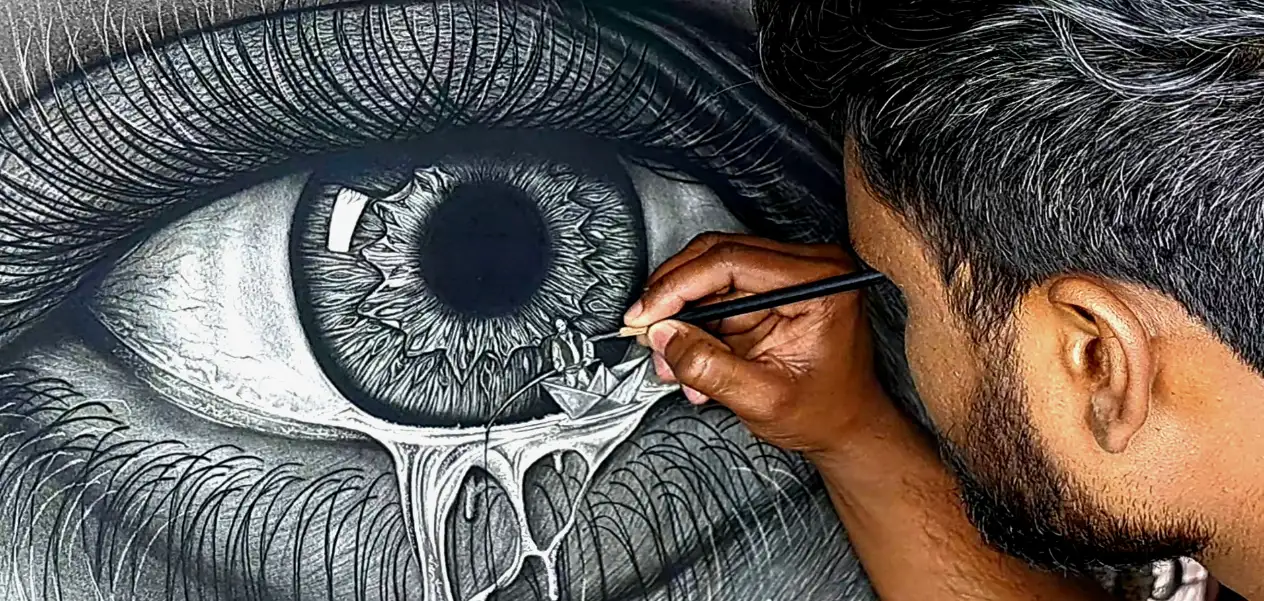
Adnan Ansari at work
After this, Adnan created his Instagram page and uploaded his paintings on it. He received appreciation for his art. “Appreciation for one’s work is fine, but I cannot fill stomachs or run the family,” he said.
Soon after, Adnan completed his schooling at Aligarh Public School, one of his juniors placed an order over the phone for his portrait.
“That was my first earning. I received Rs 200 as remuneration. I never looked back. I was encouraged to make better paintings as I realised that I would start earning. My hard work and dedication have paid off, and today I am at a stage where my paintings are in demand even abroad.”
Today his Instagram page is doing well. “My followers are increasing, and I upload all my works for sale on it.”
He receives all his orders through Instagram. “I currently have orders for paintings from America, UK, Canada, and Saudi Arabia,” said Adnan. So far, his most expensive painting has been for Rs 40,000.
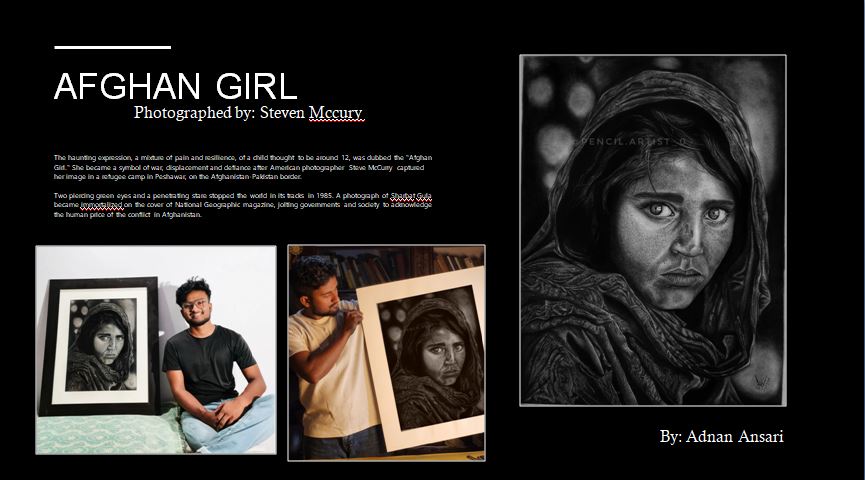
Adnan Ansari with some of his works
Adnan said that he has been trying to understand life from his perspective and process his feelings on canvas. That process makes him serve people through his art. His paintings reflect the maturity of his imagination.
According to him, copying something and making it exactly like it is not the definition of art.
Adnan said that he could make a painting of any kind, even from the oldest torn photographs. “For example, if you give me a colour or black and white photograph, I will make it exactly like the original, which will make you feel that this one is better, no matter how old the photograph is, if there is even 10 to 15 percent imagination in it, then I can make it.”
Adnan told Awaz-The Voice that his mother, Rashida Begum, is not educated and has a small income through doing small household work, which is not enough for the family. His younger brother Bilal Ansari is in school.
Adnan Ansari’s art
Adnan Ansari told Awaz-The Voice that he was thankful to former Aligarh MP Jamal Khwaja for providing him with a place to live. “We do not have a house and a Jamal Khwaja for whom my mother works, has kindly given a portion of his bungalow for my family to live.”
Adnan told Awaz-The Voice that I am currently doing post-graduation from Aligarh Muslim University. Along with this, I am improving my art through social media. However, my work is more understood and liked abroad. But I hope that one day I will get a big honor at the national and international level, and I am working hard for that.
Adnan said, “I started with pencil and sheet, so till now whatever paintings I have made, I have used only charcoal pencil, charcoal powder, eraser, cutter scale, knife. Now that I have money, I am also using canvas, light, computer, camera.”
Adnan said that the youth should bring out the talent hidden within them and try to move forward using whatever facilities are available to them. It is not necessary to have big things to make it big, one should bring out the hidden talent and work hard honestly. One day, success is inevitable.
Adnan Ansari’s works
Adnan said, “I mostly like to make a painting which has a story behind it. I keep looking at the paintings of some international-level artists and photographers to get inspired to do my work.”
Adnan Ansari is also a state-level under-19 football champion; he also edits videos on a freelance basis. Adnan wants to build his studio where he can showcase his art and video editing skills and create digital artwork.
Adnan Ansari says that first he prepares a digital layout and sends it to his clients. He does all this through Touchbook software. After approval, he draws it on canvas with a pencil.
Adnan says the price he prices his paintings as per his assessment of the hard work that has gone into each one. “I earn enough to run my household. I am now buying modern tools for my work. I see myself as a big artist of India in the next 5 years.”
Adnan has received many awards for his art. His works were also on display at the National Art Exhibition, where he received a lot of appreciation. Adnan also actively participates in youth fests and other competitions.
source: http://www.awazthevoice.in / Awaz, The Voice / Home> Stories / by Onika Maheshwari, New Delhi / April 09th, 2025
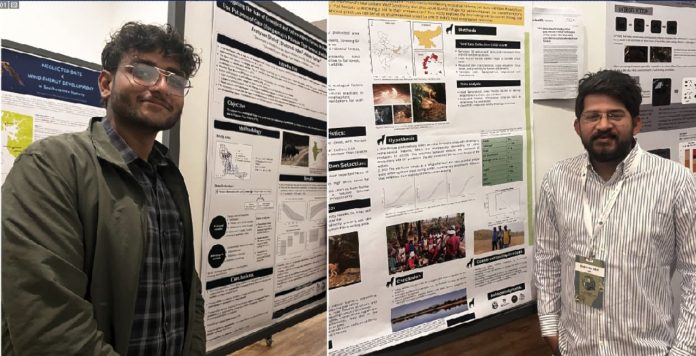
Two AMU research scholars, Arshyaan Shahid and Shahzada Iqbal, brought laurels to India by presenting their innovative research at the 9th European Congress on Mammalogy held in Patras, Greece
Aligarh:
Two research scholars from the Department of Wildlife Sciences, Aligarh Muslim University (AMU), Arshyaan Shahid and Shahzada Iqbal, brought laurels to India by presenting their innovative research at the 9th European Congress on Mammalogy held in Patras, Greece. Guided by Prof. Orus Ilyas, the students were the sole representatives from India and the broader subcontinent at this premier international event, which convenes once every four years and draws the world’s leading mammalogists.
The European Congress on Mammalogy is a renowned platform for sharing advancements in mammalian science, conservation strategies, and ecological research.
Among hundreds of global participants, Shahzada Iqbal presented two posters on wolf conservation in Central India, addressing ecological challenges and species threats. Arshyaan Shahid presented a poster on the behavioural ecology of the Gaur (Indian bison) and also delivered an oral presentation on human-elephant interactions in Jharkhand’s Palamau Tiger Reserve.
Their research received commendation from international experts, who appreciated their scientific rigor and conservation-oriented approach.
“It was an incredible opportunity to share our work with leading mammalogists,” said Shahzada Iqbal. Arshyaan Shahid remarked, “The insights and feedback we gained were invaluable. Representing India on such a platform was truly an honour.”
Prof. Orus Ilyas lauded the students’ accomplishments, noting, “Their success at EUROTHERIUM reflects the research excellence at AMU and signals India’s growing presence in global wildlife science.”
source: http://www.radiancenews.com / Radiance News / Home> Focus> Markers of Excellence> Research / by Radiance News Bureau / April 15th, 2025