From humble beginnings in Moradabad to restoring historic monuments, manuscripts, and paintings, Maimunah Nargis blends traditional techniques with eco-friendly materials
New Delhi :
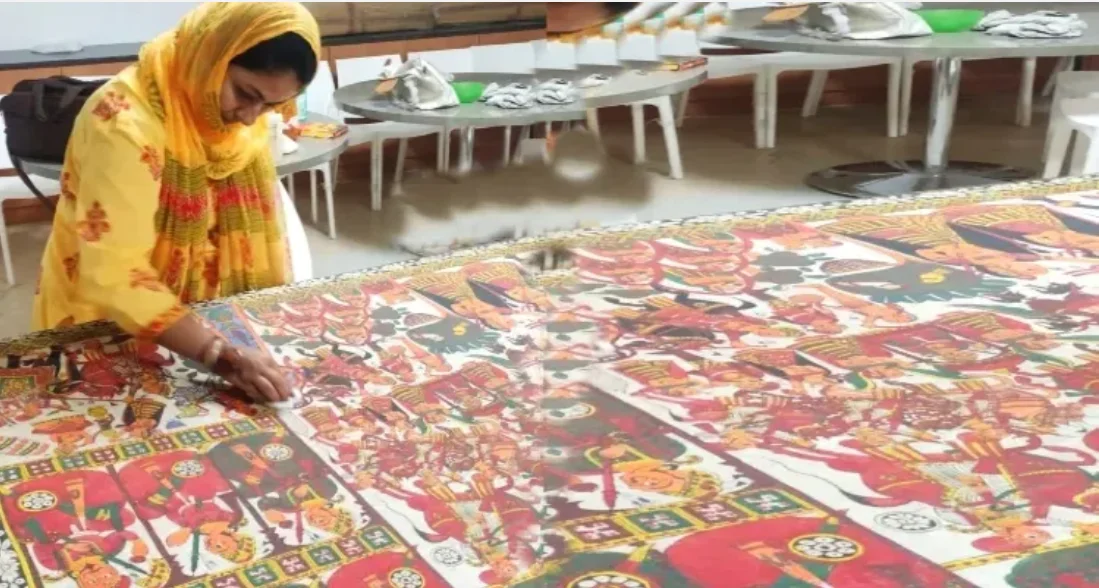
Art conservation is a field that not only preserves history but also connects generations to their cultural roots. Among the pioneers in this domain is Maimunah Nargis, India’s first Muslim woman art conservator. Her journey is a testament to passion, determination, and resilience, transforming scattered fragments of history into living heritage.
From childhood, Maimunah nurtured an interest in fine arts, which later became both her profession and life’s calling. After completing her schooling, she enrolled in Fine Arts at Aligarh Muslim University (AMU), but facing challenges in gaining admission to the MFA programme, she opted for a one-year diploma in Museology, a decision that became a turning point in her life. This course took her to New Delhi’s National Museum, where a three-month internship allowed her to experience history beyond books, touching and restoring priceless artefacts firsthand.
In 2002, Maimunah began her career as a curator at Jaigarh Fort in Jaipur, gradually establishing herself in the field of art conservation despite societal and professional hurdles. Wearing a hijab, she often faced doubts from clients, who would sometimes withdraw projects even after they had been approved. Reflecting on these challenges, she said, “This was a lesson for me, not a loss.”
Despite taunts when she left AMU for Delhi, her parents’ unwavering support gave her the courage to pursue her dreams, and her mother even accompanied her to the exam centre, demonstrating faith in her daughter’s ambitions.
Over the years, Maimunah has undertaken numerous landmark projects. She rebuilt the 400-year-old wooden chariot of the Lodwar Jain temple in Jaisalmer, which had been destroyed by termites, using traditional materials without the help of a carpenter. She reassembled broken statues from the 6th to 13th centuries in Akbar’s Fort, Ajmer, ensuring the joints remained invisible. She restored a 400-year-old Sanskrit manuscript in gold and ink at Kota Museum, and meticulously conserved the painted ceilings of 11 rooms in Garh Palace, Jhalawar, preserving three of them without removing a single piece or causing any damage.
Her work has also reached modern spaces such as Jaipur and Mumbai airports, where she restored a 5,000-square-foot canvas painting on Maratha history, and at Rashtrapati Bhavan, she preserved historic pictures on wooden doors. At the National Museum, she safeguarded historical books including Baburnama, Akbarnama, Shahjahanama, and Jahangirnama, and brought decayed artworks and royal garments back to life.
Maimunah’s approach to conservation goes hand in hand with her respect for the environment. She has often highlighted that cement lasts only 30 years, whereas traditional Indian plaster made of red clay and lime, being both eco-friendly and cost-effective, could endure for thousands of years. She applied these methods while constructing a building in Dehradun on the site of a 400-year-old mansion and a modern farmhouse in Gurgaon.
Her dedication has earned her three national and 28 state awards, as well as recognition from institutions such as Kurukshetra and Jammu University. Her dreams include building a heritage resort in Madhya Pradesh using traditional materials and restoring a 500-year-old temple in Mathura, aiming to help India rediscover its cultural roots and architectural heritage.
Hailing from Bhajoi in Moradabad, Uttar Pradesh, Maimunah grew up in a simple household but with ambitious dreams. Her father, a UP Police officer, always encouraged her, fostering the confidence to pursue an unconventional career path. Today, she resides in Jaipur, remaining hands-on in her work, kneading lime and plastering walls herself. She proudly states, “I am the only Shia Muslim woman art conservator in the country, and this is my identity.” Maimunah Nargis’s life story demonstrates that with passion, courage, and perseverance, a woman can overcome societal barriers, make history, and inspire generations. She has become more than a name; she is a symbol of culture, dedication, and empowerment.
source: http://www.clarionindia.net / Clarion India / Home> Editor’s Pick> Indian Muslim / by Clarion India / September 21st, 2025
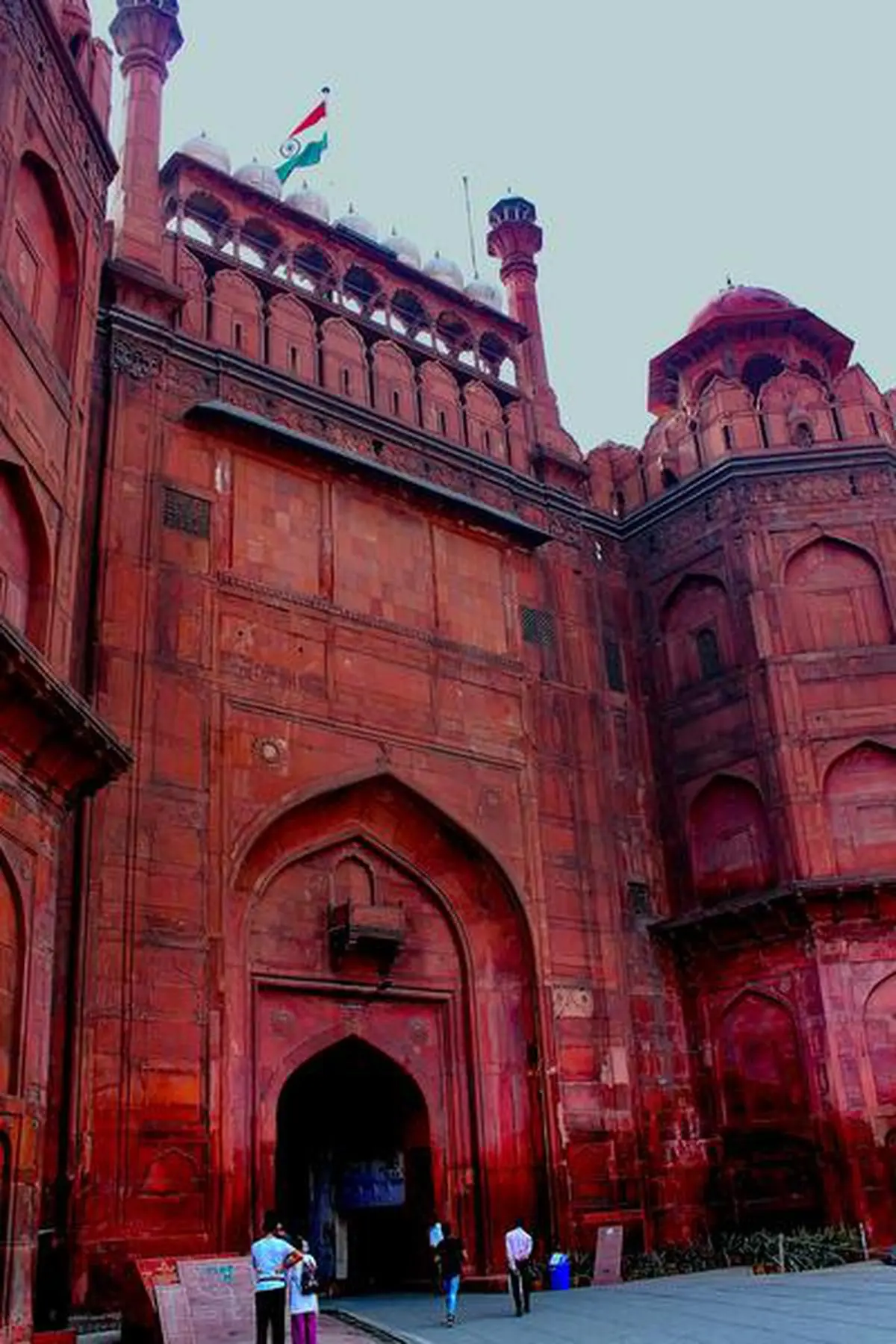
The Lahori Gate of the Red Fort that the Mughal emperor Shah Jahan built in Shahjahanabad, the new capital city he moved to from Agra in 1638, which is now know as Old Delhi.
ON the eastern edge of Delhi along the banks of the Yamuna river, which has shifted its course considerably today, and adjacent to the older Salimgarh Fort is situated the Lal Qila, or the Red Fort, one of the most iconic representations of India’s Independence Day celebrations. Declared a World Heritage Site in 2007, it was built by the fifth Mughal emperor Shah Jahan (regnal years 1628-1658) as the citadel of his new capital city, Shahjahanabad (literally the abode of Shah Jahan). Known by different names at different points of time such as Qila-i-Mubarak (the Fortunate Citadel), Qila-i-Shahjahanabad or Qila-i-Mualla (the Exalted Fort), the Red Fort represents the pinnacle of Mughal palace-fort building activity.
Shah Jahan constructed Shahjahanabad after he changed his capital from Agra to Delhi in 1638. The French traveller Francois Bernier said the scorching heat of Agra forced the emperor to look for a new capital. But there were clearly other deeper reasons. Delhi’s geographical location was more strategic for the control of the empire. Further, as the author of the 19th century biographical work Maasir al-Umara said: “Exalted sultans always had it in mind to cause the world to remember [them] by a permanent monument.” Agra had by then become a little too small for Shah Jahan’s grand and ambitious building plans. Overbuilding and encroachments had led to huge congestion in a city getting progressively eroded by the Yamuna. There had also been incidents of people getting killed/injured during processions/festivals. In 1639, Shah Jahan instructed his architects, engineers and astrologers to select a new site in a mild climate somewhere between Agra and Lahore.
The choice of Delhi was facilitated by many factors. It had been the capital and a centre of Muslim rule since the times of Qutbuddin Aibak until around 1506 when the Afghan ruler Sikandar Lodi (regnal years 1489-1517) shifted his capital to Agra. Later, Shah Jahan’s grandfather, the Mughal emperor Humayun, laid the foundations for a new capital called Dinpanah in the modern Purana Qila /Old Fort area. Delhi had also been an important religious-spiritual and pilgrimage centre housing tombs and graves of several holy men, including Nizamuddin Auliya, Qutbuddin Bakhtiyar Kaki and Nasiruddin Chirag Dehlavi. Hakim Maharat Khan Isfahani, writing in the early 18th century, says: “It was always the dar al mulk [seat of empire] of the great sultans and the centre of the circle of Islam [ markaz-i dairah Islam ].” The historian Swapna Liddle argues that the specific spot—the right bank of the Yamuna and south of the Salimgarh Fort, which Islam Shah Suri built in 1546—is regarded as auspicious in Hindu mythology. It was believed to have been blessed by Vishnu as a place where knowledge of the Vedas could be had by just taking a dip in the waters. It was called Nigambodhak , meaning that which makes known the knowledge of the Vedas. Nigambodh Ghat continues to be regarded as a holy site by Hindus.
Scholars have suggested various models to comprehend the city. The historian Stephen Blake argues that like many other capital cities, such as Istanbul, Isfahan (Persia), Tokyo and Peking, Shahjahanabad was also the “exemplar” of the sovereign city model—the “capital of the patrimonial-bureaucratic empire”, a type of state that characterised Asian empires from about 1400 to 1750. Others, such as E. Ehlers and Thomas Krafft, have characterised Shahjahanabad as an “imperial Islamic city”. An important factor to bear in mind is the way the Mughals, or for that matter even Hindus, viewed capital cities. The capital was an axis mundi —or the centre of the earth where the celestial and the mundane intersected. In the words of Muhammad Salih, an official historian of Shah Jahan’s reign: “Its four walls… enclosed the centre of the earth [ markaz-i khak ].” While the nature of the city continues to be debated, there is no doubt that it was one of the finest imperial capitals of the time. It had all the features of a great Mughal city: a palace-fort, enclosure walls, streets with squares, bazaars, mosques, gardens, imperial buildings, commercial neighbourhoods and industrial establishments, some within the palace-fort complex and some outside it.
On April 29, 1639, at a time determined by imperial astrologers, the subahdar (governor) of Delhi ordered the architects Ustad Ahmad and Ustad Hamid to begin the excavations for the new capital. After nine years, on April 19, 1648, Shah Jahan entered the Daulatkhana-i-Khas / Diwan-i-Khas (Hall of Special Audience) through the gate fronting the river.
The palace-fort was built at a cost of around one crore rupees, half of which was spent on the construction of the palaces within. It occupied the north-eastern edge of the new imperial city. Later, Shah Jahan also constructed a wall around the city, which Bernier found to be inadequate. The wall was punctuated by towers, bastions, gates and entryways. Of its 14 major gates, the important ones are the Mori, Lahori, Ajmeri, Turkomani, Kashmiri and Akbarabadi (later known as the Delhi Gate) Gates.
Fort wall and entrances The palace-fort complex together with the Salimgarh Fort occupies an area of 121 acres (one acre is 0.4 hectare). It is an irregular octagon with its two longer sides in the east and west. According to the art historian Percy Brown, most of it was laid out in squares and there was hardly an oblique line or curve in the entire scheme. The riverfront section contained important royal buildings. A water channel, called Nahar-i-behisht (Stream of Paradise), ran through these buildings. The fort complex was surrounded on three sides by a moat and by the Yamuna on the eastern side. The wall on the north-eastern side borders the Salimgarh Fort, which served as a prison during Mughal times. The wall of the palace-fort covers a perimeter of 2.41 kilometres. Along the river, it is 18 metres high and on the other sides it is 33.5 m high. The wall was built of red sandstone (hence the name Red Fort) brought upstream on the Yamuna from Fatehpur Sikri.
The archaeologist Y.D. Sharma pointed out that there were five grand entrance gates to the fort, only two of which are still in use: the imposing three-storey Lahori (facing the direction of Lahore) Gate and the Delhi Gate (facing Delhi). The latter, which Shah Jahan used to go to Jama Masjid, is similar in layout and appearance to the Lahori but is notable for the two life-sized stone elephants on either side of it. Aurangzeb, Shah Jahan’s son and successor, demolished the elephants, but the British Viceroy Lord Curzon had them restored in 1903. Lying under the Musamman Burj , the riverfronting octagonal tower, was a third gate that the emperor used as a private entrance.
The bazaars The fort was characterised by rectangular buildings laid out in a symmetrical arrangement with intersecting thoroughfares. There were two principal streets/thoroughfares, which also served as bazaars. They emanated from within the fort-palace but went beyond to the city. They intersected at right angles in the courtyard outside the Naqqar Khana (Drum House). The principal imperial street, running from east to west, began at the Rang Mahal (Palace of Colour) and ran through the Lahori Gate of the fort to Fatehpuri Masjid. This street was divided into three bazaars separated by two squares. The first, lying between the Lahori Gate and the chowk (square) of the Kotwali Chabutra (City Magistrate’s Platform), was called Urdu Bazar (Bazaar of the Royal Camp). The second part, commissioned by Shah Jahan’s daughter Jahanara Begum, extended from Kotwali Chabutra to the octagonal Chandni Chowk (Silver Square) and was called Ashrafi Bazar (Moneychangers’ Market) or Jauhari Bazar (Jewellers’ Bazaar). It had a hammam (bathhouse), a sarai (inn) and a garden (Bagh Sahibabad) near it. The final section, from Chandni Chowk to Fatehpuri Masjid, was called Fatehpuri Bazar . The Nahar-i-behisht , bordered by trees, ran down the middle of the bazaars.
The second street, in the north-south direction, stretched from the Akbarabadi Gate of the fort to the Akbarabadi Gate of the city and had a market that later came to be known as the Faiz Bazar (Bazaar of Plenty). As in the case of the first street, a stream from the Nahar-i-behisht ran down the middle of this bazaar. There was also a bazaar, a small one, that connected Jama Masjid and the palace-fort and it was inhabited by dancing girls, medicine men, jugglers, storytellers and astrologers.
The Lahori Gate remains the main public entrance to the palace-fort. The pointed arched entrance has kangura s (ornamental merlons) on the parapet and a row of dwarf chhatri s (canopy), each with a small marble dome. It is flanked by octagonal towers with sandstone domes and marble finials. Since 1947, Prime Ministers have made Independence Day speeches from the ramparts adjacent to this gate. Aurangzeb added barbicans to the Delhi and Lahori Gates and made the former the headquarters of the qiladar (fort commander). When Shah Jahan was imprisoned by Aurangzeb, he apparently wrote to his son from Agra saying: “You have made the fort a bride, and set a veil before her face.” The historian Percival Spear points out that Aurangzeb built the great wall in front of the Lahori Gate to save nobles the trouble of having to bow constantly as they walked the length of Chandni Chowk , which court etiquette required them to do when they were in the view of the emperor. Blake, however, says the wall was built to strengthen the outworks of the structure.
After entering the Lahori Gate, one comes to a vaulted arcade, or a covered bazaar ( Bazaar-i-Mussaqaf ). Blake says that establishing roofed bazaars was a common practice in Iran and West Asia but was unusual in India. This was a double-storey structure with arcaded shops at both levels, and there were shops on sides of the street too. Here, merchants of Delhi sold their goods to the nobles. In the middle of the bazaar is an octagonal court known as Chhatta Chowk with an open roof to allow in air and light. Going past the covered bazaar, one reaches the three-storey sandstone pavilion Naubat Khana (Music Gallery), or Naqqar Khana , where once ceremonial music was played five times a day and from where the arrival of the emperor and other dignitaries was announced. The Indian War Memorial Museum now occupies its upper storey. Between Naqqar Khana and Chhatta Chowk is an open square forecourt ( Jilau Khana ) on the sides of which were small rooms for officials connected with the daily guard. It is in the Jilau Khana that the people attending daily audience, ministers, bureaucrats, amirs and others waited. Only the princes could go beyond this point on their horses; all others had to dismount here.
The Naqqar Khana led to the rectangular Diwan-i-Aam (Hall of Public Audience) open on three sides with a courtyard in front. It is an arcaded structure consisting of nine engrailed arches supported by double columns made of sandstone. It has 27 bays, and the ceiling and the columns were originally decorated with gilded stucco work and hung with heavy curtains. Set against the centre of the eastern wall is a marble canopy known as the Nashiman-i-Zill-i-Ilahi (Seat of the Shadow of God). This canopy with fluted/baluster columns, inlays of precious stones and a Bengal-styled roof once stood over the emperor’s throne. Here he sat and listened to complaints and suggestions from the general populace and deliberated upon routine military, administrative and financial matters. A railing separated him and the common people. Below the throne was a marble dais decorated with semi-precious stones to be used by the wazir (prime minister). The wall behind the throne was ornamented with beautiful panels of pietra dura work, said to have been executed by the Florentine artist Austin de Bordeaux. The panel has beautiful flowers along with birds and animals. It also has a representation of the Greek god Orpheus playing the flute to animals, including a hare, a leopard and a lion. The art historian Ebba Koch says this symbolised the ideal rule of Shah Jahan “whose justice would make the lion lie down with the lamb and, in the human world, free the oppressed from their oppressors”.
The Diwan-i-Aam was sometimes used for state functions, and the courtyard behind it leads to the imperial apartments. In order from north to south, they are Mumtaz Mahal , Rang Mahal , Khas Mahal , Diwan-i-Khas , the hammam and Hira Mahal . Built along the Yamuna, these palaces now overlook the traffic-heavy Mahatma Gandhi Road. The eastern ramparts are flanked by two towers, Asad Burj (Lion Tower) and Shah Burj (Emperor’s Tower) respectively, on the south and north ends. Raised on a common marble platform, these were mostly open marble pavilions with perforated screens, inlaid with precious stones and decorated with moulded plaster and paintings. They had walled courtyards on the western side to give them privacy from the rest of the palace. The Nahar-i-behisht brought water from the river by way of a marble ramp that led into a lotus-shaped pool in the north-eastern building. From here, it filled the royal baths, ran through the Diwan-i-Khas and the emperor’s private chambers and beneath the marble trellis screen that carried the carving of the Mizan-i-Insaf (Scales of Justice), through the section reserved for the royal women.
Behind the Diwan-i-Aam and separated by a court is the Rang Mahal , a huge hall whose name is derived from its painted interior. It had a facade of five engrailed arches set on piers. The ceiling was originally built of silver and, in the words of Muhammad Salih, was “gilded and ornamented with golden flowers”. The central hall was divided into 15 bays formed by intersecting arches. The structure had two vaulted chambers on either end that were adorned with wedges of mirrors embedded in the ceiling. These apartments are popularly called Shish Mahal (House of Mirrors) because of the effect they produced.
Beyond this is the Mumtaz Mahal (Distinguished Palace), a building that now houses the Fort Archaeological Museum. It had a brightly coloured ceiling inlaid with gold and at four corners were reed houses ( khas khanas ). There was a large garden with a pool and a marble basin between this palace and the Diwan-i-Aam . Between the Mumtaz Mahal and the Asad Burj were living quarters for women of the imperial household. Small gardens laid around central pools dotted the courtyard.
Emperor’s living quarters Immediately north of the RangMahal were the emperor’s living quarters called the Khas Mahal (Special Palace). This composite palace consisted of three segments: a beautifully carved marble building inlaid with precious stones called the Aramgah or Khwabgah (Place of Sleep) flanked by the Tasbih Khana (Chamber for counting beads for private prayers) and the Tosha Khana (Robe Chamber). The Tasbih Khana was a set of three rooms facing the Diwan-i-Khas . This was separated from the central Khwabgah by a marble screen containing a representation of the Mizan-i-Insaf suspended over a crescent amidst stars and clouds. The Tosha Khana , also known as the Baithak (Meeting Hall), faced the Rang Mahal and had painted walls and ceiling and a perforated screen. The Musamman Burj , with its beautifully painted interior, protruded from the eastern wall of the Aramgah . It served as a place for the Jharoka Darshan (Balcony of Audience)—a practice borrowed from Hindus whereby the emperor appeared before his subjects every morning. In 1808, Akbar Shah II added a small balcony to this burj . It was from this balcony that King George V and Queen Mary appeared before the people of Delhi during the Durbar of 1911.
To the east of the Diwan-i-Aam and along the riverfront is the Diwan-i-Khas . The location of this hall, deep within the living quarters of the imperial family, indicated its special, private character. This rectangular chamber was a place for exclusive and private audience. Built of pure white marble, it was one of the most elegant buildings in the palace-fort. Its roof has pillared umbrellas at the corners. The chamber has engrailed or scalloped arches resting on a set of 32 piers with square shafts. The lower walls were studded with agate, pearl and other precious stones while the upper portion had fruits and flowers painted in colourful and intricate designs. Takht-i-Taus , the famous peacock throne with the Koh-i-Noor diamond embedded in its canopy once stood in the centre of the room on a wide marble platform. The Nahar-i-behisht flowed right through the middle of the hall, adding to the beauty of the place. The Diwan-i-Khas inspired the poet Amir Khusrau (1235-1325) so much that he left a quote in the building wall: “If there be a paradise on the earth, it is this, it is this, it is this.”
North of the Diwan-i-Khas lay the hammam , which was a three-storey structure built of marble. While one storey was used as a dressing room, the other two were for hot and cold water baths respectively. It was decorated with mosaic and pieces of glass and nicely painted. At the north-eastern corner of the palace-fort and along the riverfront, lay the Shah Burj .
North of the Diwan-i-Khas was the marble Moti Masjid (Pearl Mosque) built around 1659 for exclusive private use. This is the only building that Aurangzeb erected within the palace-fort and is now closed to the public. The northern sector of the imperial quarters was occupied by the gardens, primarily the Hayat Baksh Bagh (Life Bestowing Garden) and Mahtab Bagh (Moonlight Garden). The Hayat Baksh Bagh was a paradise garden with tanks, fountains, tunnels, pavilions and all the other structures typical of such gardens in the West Asian countries. It had a rectangular pool in the centre beside which stood an open summerhouse ( barahdari ). At the north and south ends of this garden stood two identical pavilions named after the monsoon months of the Hindu calendar: Sawan (fourth month) and Bhadaun (fifth month).
After Shah Jahan The fortunes of the fort started disintegrating after the death of Aurangzeb, a period that witnessed battles for succession, dissensions within the royalty, the rise of ambitious nobles, invasions from abroad and natural calamities. The palace-fort was a centre for artistic and cultural performances during some periods. Muhammad Shah, one of the later Mughals, patronised Urdu, Qawwali and music, particularly khyal . Paintings of Holi celebrations during his period are well known.
In 1739, Nadir Shah, the Turk ruler of Iran, crossed over Afghanistan and Punjab and defeated the Mughals at Karnal. In the subsequent display of power, his name was proclaimed as the sovereign in the khutba read in the mosques in Shahjahanabad. He also got Muhammad Shah to receive him at the fort where he symbolically returned the throne to the defeated emperor. On March 22, 1739, infuriated by attacks on his army, Nadir Shah ordered a massacre of citizens of Delhi and witnessed the barbarity sitting on the roof of Sunehri Masjid near Chandni Chowk . He also plundered the fort and the city and carried away a booty with an estimated value of 700 million rupees, including the Peacock Throne and the Koh-i-Noor .
The destroyed city and plundered empire was further weakened by the raids of the Marathas, the Sikhs, the Jats, the Gurjars, the Rohillas and the Afghans around the mid to later 19th century.
The historians Percival Spear and Amar Farooqui argue that the Mughal Empire as an imperial raj or a political entity ceased to exist in the 1750s. But the “imperial” aspect of the emperor and his distinctive social status as the foremost resident of Delhi ensured that his position remained central to the identity of the city even after British occupation. In 1803, Lord Lake defeated the Marathas near Patparganj and gained control of the Ganga-Yamuna plains and the Delhi-Agra region. The city became a part of the North-Western Provinces and was governed from Agra. A British Resident was stationed in Delhi. He started functioning from an office at Dara Shukoh’s Library on the right bank of the Yamuna close to the imperial palace.
Rebellion of 1857 The early decades of the 20th century, sometimes described as the “English Peace”, were also the period of the “Delhi Renaissance”, which was characterised by literary greats such as Ghalib, Momim, and Zauq; the intellectual endeavours of the faculty at the Delhi College and its English institute; and the coming of printing presses and newspapers. This was disrupted by one of the most serious challenges to the British colonial rule, the Rebellion of 1857.
The year 1857 witnessed armed revolts in parts of central and northern India, leading to a loss of British control over these regions. It began with a mutiny of sepoys but acquired a civil and popular character in parts of Upper India. The historian Eric Stokes says that the rebel sepoys showed a “centripetal impulse to congregate at Delhi”. The Red Fort thus emerged as a focus centre for the rebellion. Under pressure from the rebels and princes, the reluctant 82-year-old Mughal emperor, Bahadur Shah Zafar, became the titular leader of the rebellion, while Prince Mirza Mughal (commander-in-chief) and Jiwan Bakht ( wazir ), along with other princes and nobles, exercised the real power.
The palace-fort soon became the seat of new power and Bahadur Shah a symbol of the rebellion. There were attacks on Europeans, Christians and those connected with the British government. The British army waited for reinforcements from Ambala. Once the army started gaining control of the city, it went on an offensive against both Hindus and Muslims. The population of the city was driven out and took shelter around the Qutb and the Nizamuddin and could only re-enter the city the following year. Mosques were taken over. After September, the British forces unleashed a reign of terror that saw indiscriminate shootings, courts martial and summary hangings.
Bahadur Shah had escaped via the Yamuna and taken refuge in Humayun’s tomb. He was arrested along with three princes who were killed on the way back near the Delhi Gate by Major William Hodson. Bahadur Shah returned to the Red Fort as a prisoner of the British, was tried in the Diwan-i-Khas in 1858 and exiled to Rangoon, Burma (now Yangon, Myanmar), on October 7.
The fort complex also incurred the wrath of British officials. More than two-thirds of the inner structures were destroyed. Henceforth, the palace was to be used as quarters for the British garrison and the famed Diwan-i-Aam as a hospital. The buildings south of the Diwan-i-Khas were found to be “of little architectural interest” and were declared suitable for troops. Most of the jewels, precious stones and artworks of the Red Fort had been looted and stolen during Nadir Shah’s invasion and after the “Great Indian Rebellion” was suppressed. Several existing Mughal structures were demolished, including the harem courts and gardens to the west of Rang Mahal and the royal storerooms and kitchen to the north of Diwan-i-Aam and the Mahtab Bagh . British buildings such as army barracks, hospitals, bungalows, administrative buildings, sheds and godowns became a part of the palace-fort complex.
The rebellion ended the rule of the East India Company, and an Act passed in the British Parliament in August 1858 made Queen Victoria the sovereign head of British India. The office of Secretary of State was created to rule India. The new power dynamics were sought be cemented through imperial durbars held in 1877, 1903 and 1911. The author Pran Nevile says this was in keeping with the Indian tradition of the durbar, which celebrated the coronation of a new ruler to mark his/her sovereignty over his/her subjects. The third durbar also saw a surprise announcement from King George V of the transfer of the capital from Calcutta (now Kolkata) to Delhi. The next few decades were spent on building the last imperial city, New Delhi, also known as Lutyen’s Delhi.
The Red Fort became visible again in the years preceding Independence. The chambers within the baoli , or stepwell, believed to predate the Red Fort, were converted into a prison. It housed Colonel Shah Nawaz Khan, Colonel Prem Kumar Sahgal, and Colonel Gurbaksh Singh Dhillon during the Indian National Army (INA), or Azad Hind Fauj, trials in 1945-46. The massive nationwide campaign for their release reinforced the public perception of the former Mughal palace as the symbol of anti-colonial resistance. On August 16, 1947, Jawaharlal Nehru, the first Prime Minister of India, raised the Indian national flag above the Lahori Gate. Farooqui says that the act of replacing the British flag with India’s national flag—a day after the swearing-in of the first Cabinet—amounted to reclaiming this contested site for the nation.
After Independence, the Red Fort witnessed a few changes but continued to be used as a military cantonment. A large part of the palace-fort remained under the control of the Indian Army until 2004 when it was handed over to the Archaeological Survey of India for restoration.
Shashank Shekhar Sinha has taught history in undergraduate colleges at the University of Delhi. He does independent research on tribes, gender, violence, culture and heritage .
source: http://www.frontline.thehindu.com / Frontline / Home> Arts & Culture> Heritage> Agra Fort / by Shashank Shekhar Sinha / January 30th, 2019
The Agra Fort, a World Heritage Site, is the only fort in India to have been inhabited by all the early Mughal emperors.
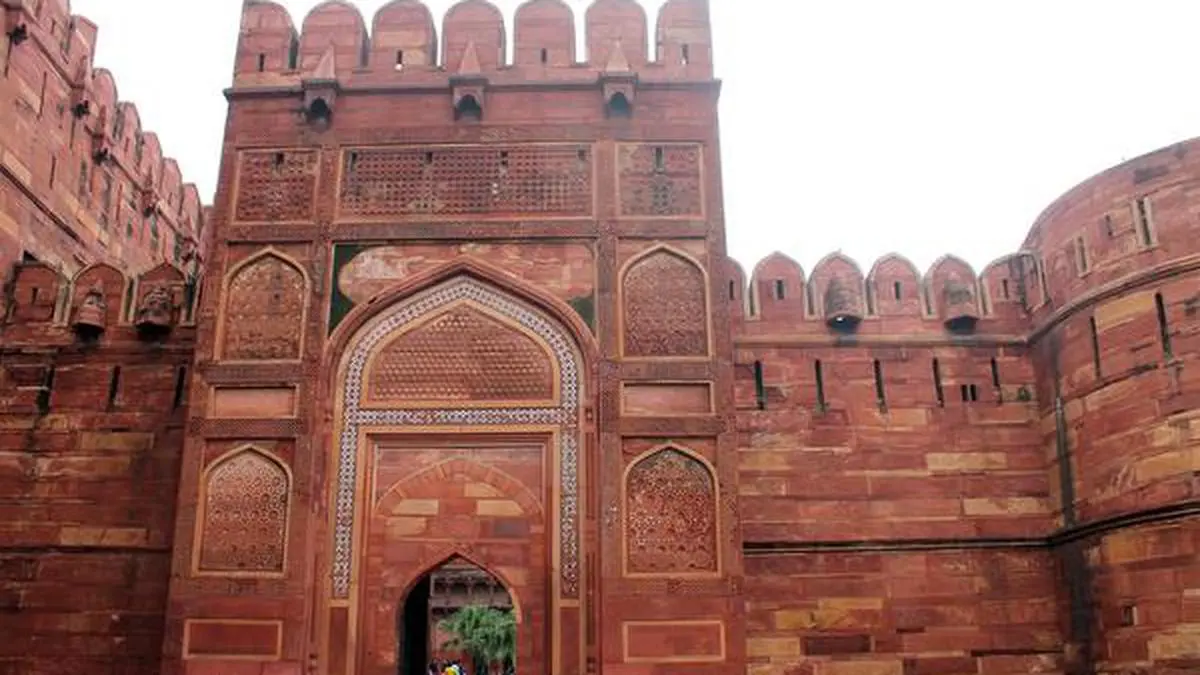
The Amar Singh Gate of the Agra Fort is on the southern side of the fort complex and is its public entrance.
SITUATED on the right bank of the Yamuna river, very close to the iconic Taj Mahal, is the Agra Fort, also known as the Red Fort. Declared a World Heritage Site in 1983, it is the only fort in India that was inhabited by all the early Mughal emperors. The fort, therefore, provides a useful template not only for the development of Mughal and Indo-Islamic architecture but also the evolution of Mughal palace forts, polity and ideas of kingship. The fort’s palaces and pavilions inspired the Red Fort (Lal Qila) in Delhi and buildings in Fatehpur Sikri and Lahore. However, the history of the Agra Fort is not just connected with the Mughals—who held sway over the fort, certainly between Akbar and Aurangzeb—but also with Mahmud of Ghazni, the Rajputs, the Lodis, the Surs, the Marathas, the Jats, the Durranis and finally, the British, before the greater part of the complex was handed over to the Indian Army in 1947.
The fort complex
A poem written in 1134 C.E. by Masud ibn Saad Salman, a Persian poet, mentions that the fort of Agra was captured by Mahmud of Ghazni. Later, towards the second half of the 15th century, a Rajput king called Badal Singh constructed a brick fort at the site and called it Badalgarh fort. The fort gained prominence when the Sultan of Delhi Sikandar Lodi (regnal years 1489-1517) decided to shift his capital from Delhi to Agra. Thereafter, the Badalgarh fort became the residence for the Lodi sultans.
From the Lodis, the fort passed into the hands of the Mughals. After defeating Ibrahim Lodi at the First Battle of Panipat (1526), Babur (regnal years 1526-30), the first Mughal emperor, ordered his son Humayun to take charge of Agra and the fort’s treasures. Babur built some paradise gardens in Agra and a baoli (stepwell) within the fort complex. Humayun (regnal years 1530-40 and 1555-56) was crowned at the fort in 1530 but preferred to rule from Delhi. The Afghan chieftain Sher Shah defeated him at Bilgram in 1540, occupied the Agra Fort, and garrisoned it thoroughly. An exiled Humayun could recapture his throne only in 1555 but died soon afterwards.
With the arrival of Akbar (regnal years 1556-1605) in 1558, Agra’s and the fort’s fortunes changed completely. After staying in the Badalgarh fort for a few years, he decided to rebuild it as the site of his government, and the old brick fort gave way to a new one in red sandstone. Approximately 4,000 builders are said to have worked every day for eight years (1565-73) to complete this renovation task. The historian Michael Fisher points out that Akbar created his court complex within the existing fort, demonstrating his early architectural aesthetic—uniform red sandstone surfaces highlighted with white marble. A new citadel-city came into being. The Jesuit missionary Antonio Monserrate, who saw the fort complex in 1580, recorded that besides the emperor’s palace there were “mansions of his nobles, the magazines, the treasury, the arsenal, the stables of the cavalry, the shops and huts of drug-sellers, barbers, and all manner of common workmen”. Abul Fazl, Akbar’s court historian, records that 500 buildings were built there in the Bengali and Gujarati styles.
Akbar’s successor, Jahangir (regnal years 1605-27), used to visit Agra at regular intervals and even stayed in this fort. However, he focussed his efforts more on building forts and palaces in Lahore and Kashmir. The Agra Fort was modified considerably during the reign of Shah Jahan (regnal years 1628-58). Between 1628 and 1637, he destroyed many existing buildings, renovating some and constructing three new marble palace courtyards (alongside three mosques) according to his own architectural taste. Aurangzeb (regnal years 1658-1707) deposed Shah Jahan, his father, to take control of the fort and built two barbicans around the gates and on the riverside to strengthen its defences. When the British took over the fort in 1803, they destroyed many buildings to make way for military structures. The complex now has only around two dozen monuments left, mostly those built by Akbar and Shah Jahan.
Gates, palaces and courtyards
The fort has a semicircular shape and is surrounded by a broad deep moat. Its eastern side, some 725 metres long, faces the bank of the Yamuna. Spread over 94 acres (38 hectares) of land, the fort complex is enclosed by a double-battlemented wall of red sandstone punctuated at regular intervals by massive circular bastions. It has a circumference of almost 2.5 kilometres and its walls are around 21 m high. The fort has four gates, one on each side. Of these, the Delhi Gate (in the north) and the Amar Singh Gate (in the south, now the public entrance to the fort) are the most prominent ones. The other two gates are the Elephant Gate (Hathi Pol Gate) and the Khizri Gate (also known as the water gate because it opened on the eastern riverfront side where the ghats were located). R. Nath, a historian of Mughal architecture, points out that the Delhi and Amar Singh Gates are architecturally similar: both have a drawbridge, a crooked entrance with dangerous trap points and a steep rise.
Most buildings are concentrated in the south-eastern corner of the fort complex in a band-like succession of courtyards along the riverfront. Shah Jahan did not alter Akbar’s riverfront alignment in his building programme. The Yamuna, Nath says, provided a river frontage, a pleasing landscape and fresh air and a constant supply of water. After ascending the ramp through the Amar Singh Gate, one can see, on the eastern side, two courtyards of Akbar’s time: Jahangiri Mahal and Akbari Mahal. In the south to north direction, there are three courtyards that Shah Jahan rebuilt along the riverfront: the Anguri Bagh (Grape Garden), the Machli Bhawan (Fish House) and the Diwan-i-Aam (Hall of Public Audience). The overall symmetrical planning of imperial residences, the art historian Ebba Koch argues, became mandatory only during Shah Jahan’s reign. In Akbar’s time, the regular planning of large-scale residential architecture was deployed only in temporary Mughal camps. In the Agra Fort, she clarifies, the residential axis was met at an angle by the (broken) public axis formed by an open bazaar street stretching from the Hathi Pol Gate to the Diwan-i-Aam courtyard.
Nath says both Akbari Mahal and Jahangiri Mahal were built in the mid 1560s and formed a part of the original Bengali Mahal , which according to Abul Fazl was the newly constructed palace where Akbar seemingly moved in on May 11, 1569. Nath opines that the two palaces probably got separated and acquired their respective nomenclature through guidebooks written in the 19th century. The oldest red stone palace in the southern part of the fort complex became known as Akbari Mahal, and the stone palace in the northern part, where a monolithic granite bowl (7.62 m × 1.42 m) built by Jahangir in 1611 was discovered, became known as Jahangiri Mahal.
Both palaces have a crooked entrance and enclosing walls to ensure privacy and security. While Akbari Mahal is in a partly preserved state, Jahangiri Mahal is in reasonably good shape. Faced with finely carved red sandstone, Jahangiri Mahal, Nath tells us, presents a complex arrangement of verandas, courtyards, galleries and rooms and halls around a quadrangle. While historians agree that the palace represents an amalgamation of various architectural styles and techniques, they differ on the exact nature of these influences. Ebba Koch contends that it combines (a later altered) symmetrical Timurid ground plan patterned on the mausoleum of Khwaja Ahmad Yasawi, a famous Sufi poet and teacher, in Turkestan, which was built between 1394 and 1399 and has the elevation of an open courtyard building. Further, the building brings together various Transoxanian features, such as the veranda of the east front with its high slender columns, along with courtyard halls styled in the broader Gujarat-Malwa-Rajasthan tradition, which the Mughals learned from the early 16th century architecture of Raja Man Singh (a noble at Akbar’s court) of Gwalior. Nath maintains that the multi-storey arrangement of palaces around inner courts reflects the catuhsala (four-sided) plan of the elevation of the chowk (quadrangle), a part of ancient Indian residential architectural tradition.
The indigenous component, according to Nath, further manifests in the duchhati (double ceiling, one above the other) composition with a central, three-openings dalan ; double floor apartments on the sides; a whispering gallery around a hall; and a portal composition with jharokha (balcony) windows. Ebba Koch and Nath have different opinions on the architecture of the rooms, halls and ceiling inside the complex. Ebba Koch feels that most of the rooms are not trabeate (a form of architecture that uses horizontal beams, or lintels, as distinct from the arcuate style, which uses arches and vaults/domes) but are a veritable pattern book of the vaulting of the time: stucco domes with geometrical patterns and/or arch netting, ribbed domes, lotus domes carved in sandstone, pyramidal vaults with a cut top, coved ceilings, etc. To Nath, the dominant architecture is trabeate as evidenced by the pillars, beams and lintels, flat ceilings (sometimes ladao ceiling consisting of ribs and panels), chajja s (eaves) and chattri s (pavilions).
The historian William G. Klingelhofer says the striking architectural elements of Jahangiri Mahal include the innovative use of Timurid geometric designs, creative adaptations of Indian art forms such as makara (crocodile) and peacock brackets and various vault designs, and the inclusion of creatures from indigenous art tradition such as the hamsa (swan), the parrot and the elephant.
As far as the functionality of the palace is concerned, most scholars, including Ebba Koch and Nath, hold that it was primarily meant for imperial women and served as Akbar’s harem and residence. Klingelhofer, however, argues: “Architectural space and design seem to have been a flexible commodity in early Mughal building, adaptable to many and diverse purposes.” It is therefore not really important to understand the exact function of each space or for that matter which rooms were provided for the palace harem, the library, temple and audiences. The palace, he elaborates, served a much broader purpose; it “was constructed at the conceptual centre of a larger Agra scheme and was intended to serve as the primary architectural embodiment of the imperial seat”. Between the red sandstone Jahangiri Mahal and the white marble Khas Mahal (Special Palace) lies a palace called Shahjahani Mahal, though there is not enough evidence to claim that Shah Jahan built it. It has a hall, side rooms and an octagonal riverside pavilion. The brick mason and red sandstone construction was plastered in white stucco and painted in colourful floral designs. The so-called Somnath Gate is kept here in one of the rooms on the western side. The subterranean three-storey chambers below Jahangiri Mahal and the area lying to the north contain the phansighar (gallows) and Babur’s baoli.
Anguri Bagh
The Anguri Bagh complex is a three-layered architectural zone set in the harem complex: the upper riverfront terrace is occupied by the Khas Mahal flanked by two identical oblong pavilions; the intermediate layer is occupied by a scalloped, trefoiled tank; and the lower zone is occupied by the Anguri Bagh (one can see a grapevine on the lawns). The Khas Mahal is built along the lines of what Ebba Koch says is the favourite Mughal pavilion theme: the combination of an enclosed inner hall (now called tanabi khana or tambi khana ) with a pillared porch or veranda (the Mughal iwan ). The court historian Lahauri calls it Aramgah (bedchamber). The spacious inner hall has beautiful Yamuna-facing marble screens with glasswork while the white marble surface is beautifully painted in floral and stylised patterns. It also has a number of oblong niches in its wall meant possibly to hold portraits of emperors and princes. The exterior porch is made up of five nine-cusped arches (popularly known as the Shahjahani arches) supported on square piers and is three-aisles deep. It has a chajja , supported by beautifully carved and moulded brackets, projecting from all sides. There are two chattri s on the parapet on the riverside but not on the Anguri Bagh side. The marble building is secured on the north and south by thin marble curtains ( sarapada ) to ensure purdah, or seclusion.
The Khas Mahal is flanked by two identical buildings with gilded bangladar/bangla roofs (a curved circular roof and a chajja ): on the left (north) is the Bangla-i-Darshan (Imperial Viewing Pavilion), and on the right (south) lies the bangla of Jahanara, a pavilion that belonged to Shah Jahan’s daughter Jahanara. Bangladar was an architectural device used in buildings in the Bengal region. After Akbar annexed the Gaur kingdom, Nath says, many Bengali craftsmen dispersed to other regions, and some naturally sought patronage at the Mughal court. Both these pavilions were originally made in red sandstone but stuccoed with white shell-plaster later to give them the semblance of white marble. There are square rooms towards the side of the pavilions.
In the Bangla-i-Darshan, which has pillar brackets and lintel openings, the emperor made an appearance every morning to his subjects gathered below the fort. Ebba Koch points out that the bangla of Jahanara, with its multi-cusped Shahjahani arches, had no ceremonial function but indicated her status at the court and provided imperial symmetry. It formed a part of Jahanara’s apartments located towards the end of the southern wing, and the three courtyard wings and northern rooms of Jahangiri Mahal were adopted for her and other women.
The Anguri Bagh happens to be the only garden in the main palace complex. It is laid out in the form of a rectangular charbagh (fourfold garden) divided by marble walkways intersecting at the centre in a marble pool. Each quarter has geometrically drawn parterres. The garden is enclosed by two-storey living apartments formed of a modular sequence of open, pillared verandas and small enclosed rooms ( hujra s). Nath underscores that the water devices at the Anguri Bagh—tanks, fountains, waterfalls, candle niches and water channels—demonstrate how running and splashing water had become an integral part of Shahjahani architecture. Akbar, on the other hand, was more fond of hammam s (bathhouses). Water was supplied to the fort through well-laid-out water systems from the Khizri Gate and the overhead tanks in the Jahangiri Mahal complex.
‘Chain of justice’
Located between the Anguri Bagh and the adjoining Machli Bhawan is a spacious octagonal tower called the Muthamman Burj or Shah Burj (imperial/king’s tower). This housed the original jharokha from where Akbar and Jahangir appeared before the people every morning ( jharokha darshan ). The burj was also where Jahangir instituted his famous “chain of justice” in 1605 to redress the grievances of the people. The tower was rebuilt by Shah Jahan in white marble, profusely inlaid and roofed with a gilded copper dome. Five of its sides project outward towards the river and are rotated by a chajja supported by brackets. Pillars, brackets, and a railing/balustrade with jali work decorate the structure. On the western side, the tower leads to a dalan /hall with three alcoves and a shallow water basin sunk in the centre. The palace has deep ornamental niches along with dados (bas reliefs) inlaid in polychrome stones and carved plants. Ebba Koch mentions that this was where the emperor met his highest dignitaries and his sons in secret council and also worked with the court historians Qazwini and Lahauri on editing the official history of his reign. Shah Jahan was imprisoned in this burj by Aurangzeb and died there in full view of the Taj Mahal. His coffin was taken out of the door at the base of the tower and then transported on a boat over the Yamuna to the Taj where he was eventually buried.
To the west of the Muthamman Burj is the entrance to a group of basement rooms with waterfalls and pools called Shish Mahal (Mirror Palace, which Lahauri called tahkhana ) because the facade has mirror mosaic set in white stucco ( ayina bandi or ayina kari ). The structure (now closed to the public) has extra thick walls and ceilings to ensure coolness and a dim interior to allow for the play of light and mirrors. Nath argues that the art of glass mosaic was originally Byzantine and spread with Islam. The Mughals Indianised it by associating it with exquisite relief and incised stucco work, something lacking in the Byzantine glass art. Further, he elaborates, unlike the saintly figures and florals featured in Byzantine glass art, the Mughals used Persian motifs, floral and stylised.
The Machli Bhawan complex, lying north of the Anguri Bagh, contains the Hall of Private Audience (earlier known as the ghusl khana or bathhouse but popularly called the Diwan-i-Khas) and the hammam , which are both on the riverside terrace on the pattern of the riverfront gardens. Below, on the ground floor, were vaulted rooms housing government offices, including the treasury.
The Diwan-i-Khas, occupying the south-eastern corner of the complex, is a large pavilion meant for meetings of the private council, exclusive law court, musical performances or inspection of the work of artists employed by the emperor. According to Lahauri, it was built in 1635, around the same time when other buildings of the harem were being completed. The exterior is protected by a broad chajja supported by brackets. The chattri s, pinnacles and kangura s (merlons) that once adorned the building are now missing. This marble building has two halls with coved ceilings, both connected by three archways—the enclosed inner hall/ tanabi khana and the outer dalan /Mughal iwan. The outer hall, having double pillars, is beautifully inlaid with floral designs and carved dados similar to the Taj Mahal and multi-foiled niches. Lahauri describes the oblong inner hall as being ornamented with paintings and floral designs and adorned in gold.
Opposite the Diwan-i-Khas, on the northern side of the terrace, lies the hammam rebuilt and refashioned by Shah Jahan. Consisting of various rooms and halls, the structure was decorated among other things by inlay work on the dados and glass mosaic on the walls and arches. It had provisions for both cold water ( sard khanah ) and warm water ( garmkhanah ). The structure now lies in a ruined state and is closed to the public. Ebba Koch points out that parts of the hammam were taken down by Lord Hastings in 1815 and its pillars were scattered. The facing and some pillars, she mentions, were sold at an auction by Lord William Bentinck (Governor General from 1828 to 1835), giving rise to the rumour that he also wanted to take down and sell the Taj Mahal.
Along the riverfront, between the Diwan-i-Khas and the hammam lies Jahangir’s finely carved black throne, which was brought from Allahabad in 1610. The crack in the throne is attributed to the uprising of the Jats of Bharatpur who temporarily controlled the fort around 1765. (There is another white throne lying opposite the black one on the terrace.)
The ground-level courtyard is enclosed by two-storey-high arcaded wings with Shahjahani columns and multi-cusped arches. It contained government offices behind the arcaded galleries. The open court in the centre was used by the emperor to inspect his hunting animals—hounds, hawks and cheetahs—and horses working out. It was also used for animal fights. A marble seat with a baldachin projects from the centre of the southern wing. It is decorated by baluster columns and semicircular arches with a rich naturalistic acanthus decoration—inspired by European engravings—which Ebba Koch argues was of a type first used exclusively in the architecture framing the appearances of Shah Jahan.
Located in the middle of the eastern side of the fort is the spacious court known as the Diwan-i-Aam. According to Lahauri, a cloth tent and, later, a wooden hall were used for the purposes of Diwan-i-Aam before the present structure came into being under Shah Jahan.
The main audience hall is a rectangular, pillared building standing on a red sandstone plinth. It has four rows of pillars and pilasters on the north-south axis and 10 along the east-west alignment. The hall has double columns on all the three external sides (similar to the Chaunsath Khamba at Nizamuddin in Delhi, which is square in shape though). Resting on square bases, these pillars were once carved or stuccoed and the outlines of the bases, shafts, capitals and cusps were gilded. They support engrailed or nine-cusped Shahjahani arches. The emperor’s jharokha , or throne chamber, projects from the eastern wall of the hall. Its walls, pillars and even the ceiling have stylised floral designs in pietra dura inlay, which is characteristic of Shahjahani architecture. Ebba Koch says that the naturalistic plant decoration symbolically represented the bloom brought about by the just rule of Shah Jahan. The jharokha walls have china khana niches—possibly used to keep porcelain vessels—which the contemporary poet Kalim wrote was a tribute of China to the court of Shah Jahan. The hall has a flat roof and the exterior is protected by chajja s in turn supported by brackets. While the hall is made of red sandstone, it is white-plastered to give the effect of marble. The courtyard of the Diwan-i-Aam is surrounded by narrow galleries/ dalan s/verandas with multi-cusped arches. Shah Jahan held court at the Diwan-i-Aam twice a day and attended to administrative matters. All the courtiers and honoured visitors who assembled there, Fisher points out, “would stand deferentially with crossed arms in hierarchically arranged semicircles [separated by railings] centred on his throne, moving outward from highest to lowest”. The audience hall served a larger symbolic purpose that went beyond being a place where administrative matters were dealt with or foreign dignitaries were received; it also reinforced Shah Jahan’s position as the head of the spiritual domain.
On account of its 40 pillar sites, the Diwan-i-Aam was also known as Chihil Sutun (Forty-Pillared)—the name by which the ruins of Persepolis (in present-day Iran) were widely referred to then. By recreating the famous audience halls of the ancient kings of Iran, Ebba Koch argues, the Mughal emperor claimed the status of these kings, who were considered exemplary rulers in the Islamic world. However, unlike the original Iranian halls, she substantiates, those of the Mughals followed the plan of a mosque (the closest parallel could be the Pathar Masjid in Srinagar) with a wider aisle in the centre. While in the mosque the central aisle leads to the mihrab (the niche that shows the direction of Mecca), in the case of the Diwan-i-Aam, it leads to the emperor’s jharokha . Ebba Koch points out that the idea that Shah Jahan’s authority was not only worldly but also spiritual was further reinforced by the presence of a mosque right opposite the audience hall at the centre of the west wing. Nath puts forward a somewhat similar concept albeit rooted in Indian thought and philosophy—the 40-pillar sites made up of 27 bays, representing the 27 nakshatra s (constellations) denoting the incarnation of the jagat (universe) presided by the emperor sitting like a sun. The audience hall of the Agra Fort served as a model for those in the palaces of Lahore and Shahjahanabad.
Scholars are divided on whether or not Akbar built a mosque within the fort premises. There are, however, three surviving mosques built by Shah Jahan. Describing the Shahjahani mosques, Ebba Koch says they are of two main architectural types and both had already started becoming distinct during Jahangir’s time. To the first category belong the great city mosques, such as the Jami Masjid of Agra built by Jahanara in 1648, which has prayer halls with massive pishtaq s (having a high portal/facade gateway) surmounted by three or five domes and courtyards surrounded by continuous arcaded galleries with axial gates. To the second category belong smaller mosques, mostly with a direct imperial connection, which have an additive system of vaulted bays—they may have flat or coved ceilings, domes or even high bangla vaults—and could appear without pishtaq s and outer domes. Also unlike the first category, they do not have minarets, for example, the Moti Masjid (Pearl Mosque, 1647-53), the Mina Masjid (or Gem Mosque, completed in 1637, it was the emperor’s private mosque) and the Nagina Masjid (Jewel Mosque). The Nagina Masjid is covered by bangla vaults and chajja s, which, according to Ebba Koch, is the first time such a motif appears in a Mughal mosque.
Agra Fort after Akbar/Shah Jahan
Akbar’s fort was one of the strongest and most defensible structures of its times. Even rebellions carried out by his son Jahangir (1599) and grandson Shah Jahan (1622) failed to break through its defences. The complex took much of its current form during the reign of Shah Jahan, and it continued to remain his imperial residence even after 1638 when he shifted his capital to Delhi. Aurangzeb’s efforts to capture the fort with the help of military power and guns proved futile, and he finally succeeded in breaking its defences by cutting the water supply through the Khizri Gate side. A desperate Shah Jahan wrote:
“…Only yesterday, I was the master of nine hundred thousand troopers
and today I am in need of a pitcher of water…”
The emperor finally surrendered in 1658 and spent the rest of his life imprisoned in the fort. Agra began to lose much of its imperial charm after Shah Jahan’s death (1666) even though Aurangzeb continued to hold court at the fort. In 1666, during Aurangzeb’s reign, the Maratha king Shivaji visited Agra to meet the Mughal emperor in the Diwan-i-Khas. Aurangzeb’s death in 1707 threw both Mughal power and the imperial stronghold into disarray. The history of the Agra Fort, for most of the 18th century, remains a story of multiple sieges and pillage, and it changed hands many times, including those of the Jats and the Marathas. The Marathas gained control of the area south of Delhi after defeating the Mughals around the mid 18th century. After their loss to the Afghan and Rohilla forces led by Ahmad Shah Durrani at the Third Battle of Panipat (1761), the fort came under the control of the Durranis. The Marathas were able to regain control in 1785 under the reign of Mahadji Shinde. Subsequently, the Marathas lost to the British in the Second Anglo-Maratha War (1803) and with it the fort. Colluding with European officers working in the Maratha garrison, Lord Lake was able to breach the fort in the south-eastern side (Bengali Burj).
With the establishment of the British military garrison at the fort, many Mughal structures were pulled down to construct residential quarters, barracks, stores and so on. The grand courtyard of the Diwan-i-Aam, for example, was converted into an arsenal, and many buildings and pavilions were whitewashed and subdivided with mud partitions for the private use of officers.
It is interesting to note, however, that the British used the artefacts associated with the fort to play divisive politics. Nath says that the British deliberately planted the torso of a horse at the edge of the moat near the public entrance to perpetuate the escape story of Rao Amar Singh, a Rajput nobleman affiliated with the royal house of Marwar. Amar Singh killed Salabat Khan (one of Shah Jahan’s important officers) in front of a full court in 1644. It was popularly believed that he escaped the Mughals by jumping across the moat on his horse. The fact is, Nath says, that Amar Singh and his followers were killed while trying to escape. Thanks to this episode, however, the gate eventually became known as the Amar Singh Gate. A big statue of him stands at the traffic intersection in front of the fort. Another such artefact—now kept in a glass enclosure in the Shahjahani Palace but not related to the fort or the Mughals in any way—is the Somnath Gate, which was brought to India from Afghanistan in 1842. To enlist the support of Hindus, Governor General Lord Ellenborough made a speech on the occasion wherein he proclaimed that he had brought back the sandalwood gate taken away by Mahmud of Ghazni from the Somnath temple. A historical insult, he claimed, had been avenged after 800 years. It was soon discovered that the gate, made of deodar wood and carrying Islamic motifs, actually belonged to the tomb of Mahmud of Ghazni, a fact corroborated by the Arabic inscription on the structure. Thereafter, it was left abandoned in the Agra Fort.
The fort came under some conservation efforts towards the late 19th century with the involvement of the Public Works Department. Lord Curzon’s restoration campaign at the beginning of the 20th century saw many military structures being removed from the premises. Independence, however, brought the military back to the Agra Fort, and a large part of the complex, including the Khizri and Hathi Pol Gates, the Meena Bazaar and the Moti Masjid, remains under the control of the Indian Army and is inaccessible to the public. In recent decades, there has been a growing demand from archaeologists, historians, conservationists and heritage enthusiasts that the Army vacate the premises.
Shashank Shekhar Sinha has taught history in undergraduate colleges of the University of Delhi. He does independent research on tribes, gender, violence, culture and heritage .
source: http://www.frontline.thehindu.com / Frontline / Home> Arts & Culture> Heritage> Agra Fort / by Shashank Shekhar Sinha / January 30th, 2019
A new study has revealed narratives of syncretism that counter the politically motivated and polarised versions of the Valley’s history.
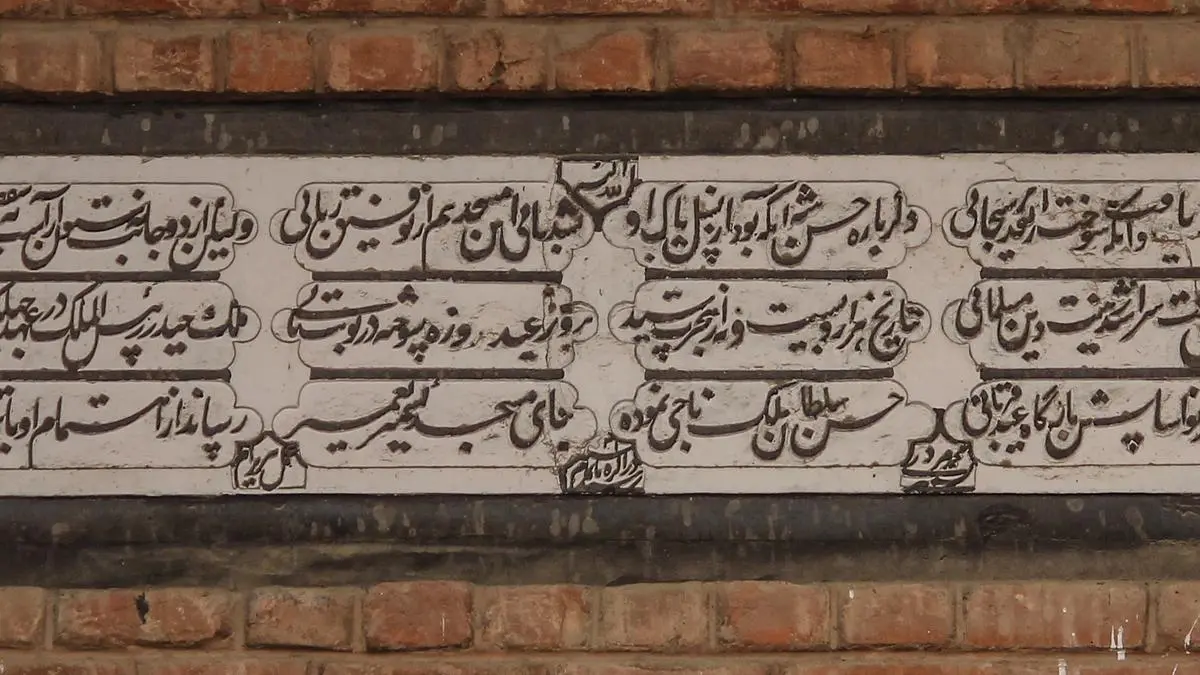
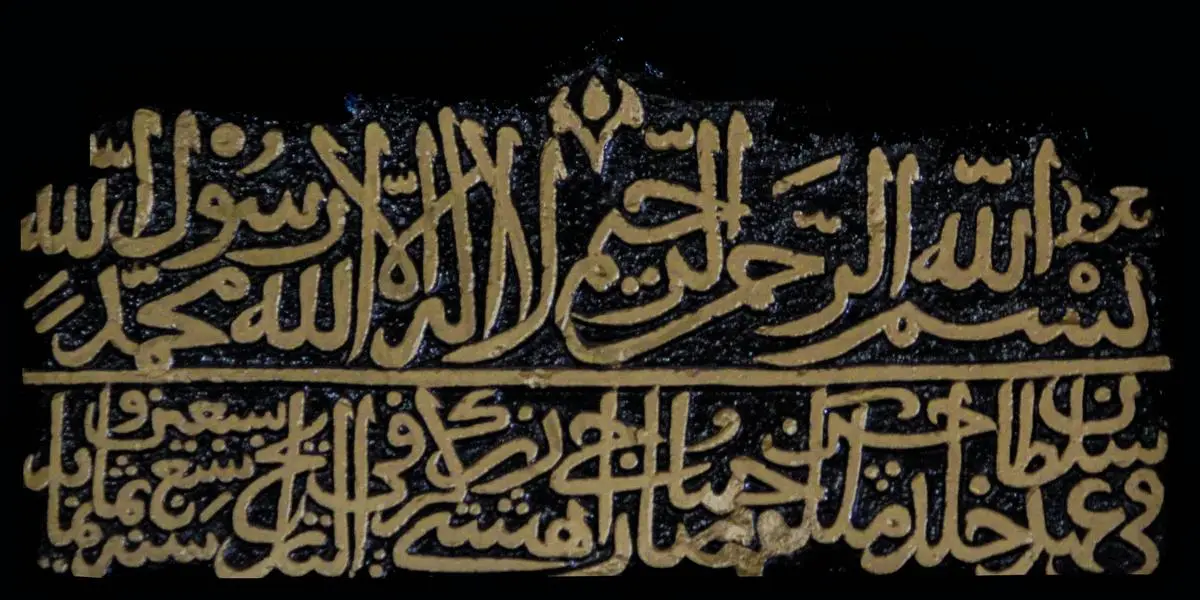
The 17th century limestone slab in the walls of Jamia Masjid in Srinagar. At the bottom, a small engraving reads, “the work of Hari Ram”. | Photo Credit: Tabish Haider, Barakat Trust
Strolling inside the quadrangle of Kashmir’s 600-year-old Jamia Masjid, worshippers stop to take pictures of the mosque’s large steeple, its outlines sharpened against the backdrop of Hari Parbat, the famous fort-hill of Srinagar. What they usually overlook is a limestone plaque with Persian inscriptions embedded in the wall just above the mosque’s entrance.
In January 2024, when the Srinagar-based art historian Hakim Sameer Hamdani (he is currently the Design Director of the Jammu and Kashmir chapter of the Indian National Trust for Art and Cultural Heritage) examined the slab, he found that it mentioned names of medieval-era sultans and their governors involved in the repeated repair and rebuilding of the mosque since its original construction in 1402. At the bottom, he noticed the name of the engraver: Hari Ram. Hamdani told Frontline: “Based on our investigation, it appears that Hari Ram, who inscribed the text on the limestone plaque, was a master carver in the Mughal atelier. There is no information about Hari Ram in any Mughal source. But from this slab we know now that he was Hindu and part of the overall Mughal patronage system.”
The Jamia mosque was constructed during the reign of Sultan Sikandar Shah Miri in 1402, a few decades after the Turkic-origin Shahmirid dynasty took over the reins of the kingdom from the royal house of the Loharas, who were Hindus. In Kashmir’s narrative tradition, the mosque is invested with great symbolism: Jamia Masjid embodies not just the crowning of Islam as the State religion of Kashmir after eight centuries of Hindu rule, but also the start of the spread of a culture heavily influenced by Persia.
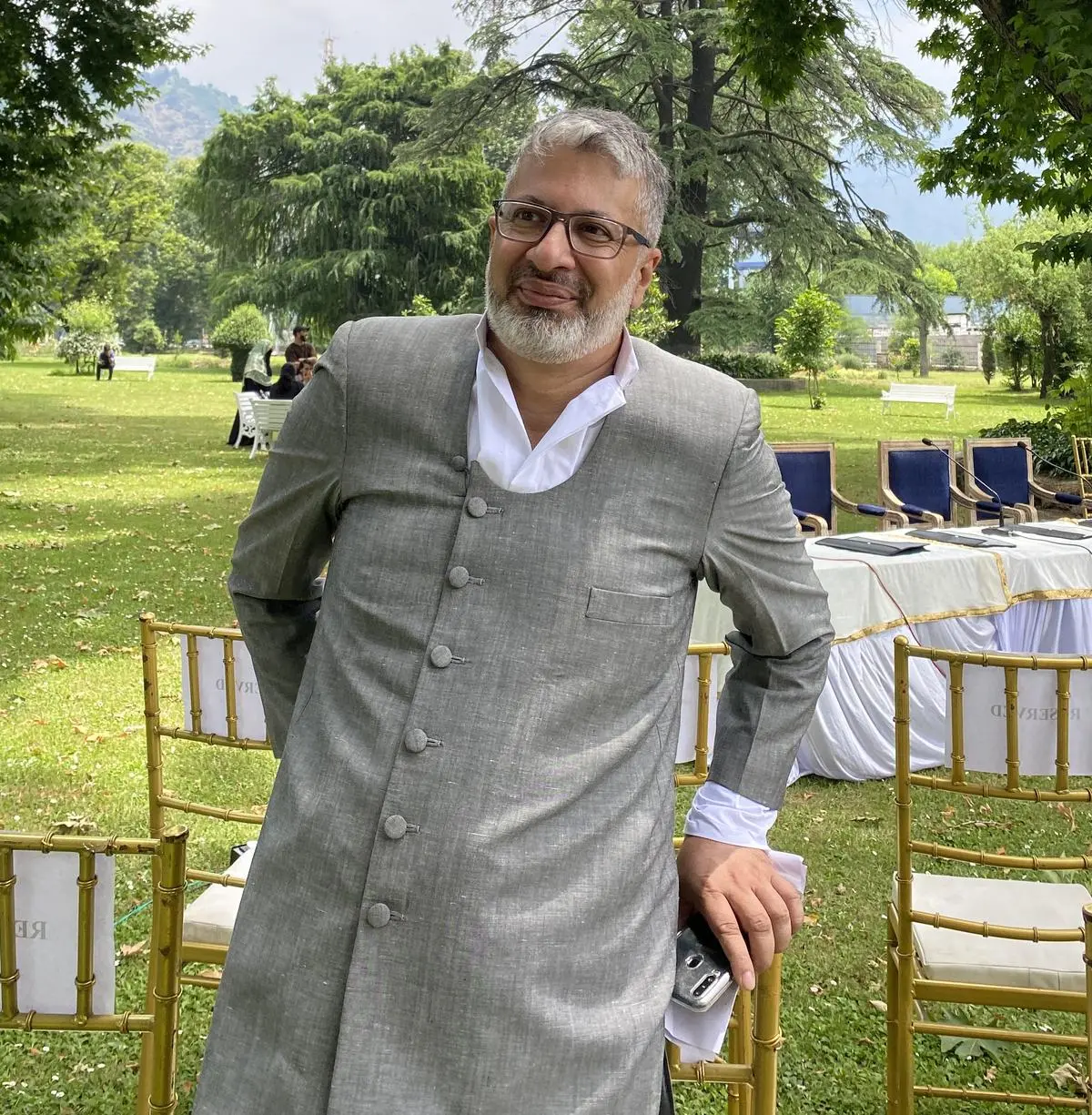
Hakim Sameer Hamdani, Srinagar-based architect and art historian who led the documentation project. Hamdani is Design Director with INTACH, Jammu & Kashmir. | Photo Credit: By Special Arrangement
The medieval era in Kashmir, particularly the 14th and 15th centuries, when it gradually transitioned to Islam, has been sought to be presented in contemporary political and cinematic discourse as a period of widespread persecution of Hindus. The movie The Kashmir Files (2022), for example, has a scene where the protagonist describes the Kashmir of yore as a thriving seat of Hindu learning until it was despoiled by Islamic rulers in the 14th century. However, historic epigraphs such as the one in Jamia Masjid and elsewhere in Srinagar point to a culture that was more syncretic than confrontational.
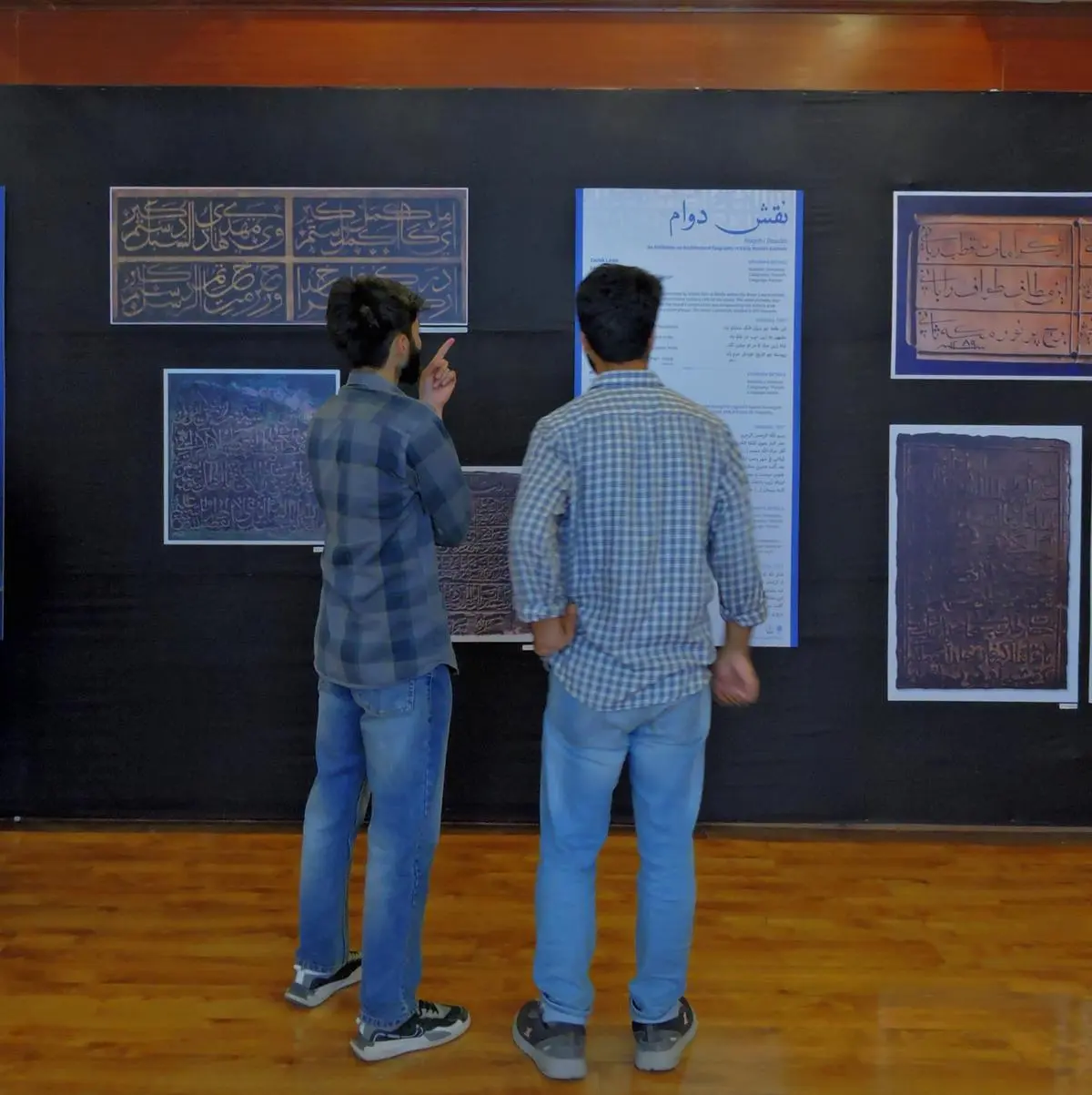
With such discoveries, Hamdani’s project intends to counter the politically motivated narratives around Kashmir’s history. He embarked on the project earlier in 2024, roping in a team of heritage architects and graphic designers from Srinagar. The team consisted of Umar Farooq (Assistant Professor, Department of Architecture, Islamic University of Science and Technology, or IUST, Jammu and Kashmir), who surveyed the inscriptions; Tabish Haider (cultural activist and Young India Fellow, 2022, at Ashoka University), who took life-size images of the plaques; Mehran Qureshi (Assistant Professor, Department of Architecture, IUST), who investigated the epigraphs and translated them into English; and Taha Mughal (a specialist in preservation), who rendered them into measured drawings. The team has examined several epigraphs, dating from the 15th to the 19th centuries, engraved in various heritage sites across the Valley. While the majority of them are in Persian, there are texts in Arabic and Sharda (an ancient script of Kashmir) as well.
Many of these inscriptions have been rendered almost undecipherable by the passage of time—the main reason why they had escaped the attention of historians so far. Hamdani and his team used technology and linguistic expertise to decipher their content and to bring the information to the public domain for the first time. Of the over 100 slabs that the team has investigated across Kashmir, the details of 40 were catalogued and put on display in an exhibition, “Naqsh-i-Dawaam”, held in Srinagar in June 2024. Hamdani is currently writing a coffee-table book that will make the findings accessible to readers across India and the world. Qureshi is further expanding the scope of the investigation by surveying similar inscriptions found in medieval-era tombstones in Kashmir. Qureshi’s work is sponsored by the Netherlands-based Prince Claus Fund while the grant for Hamdani’s project came from London’s Barakat Trust, which researches the art, architecture, and history of the Islamic world.
_______________
Highlights
A documentation project undertaken by Srinagar-based architect and art historian, Hakim Sameer Hamdani, has added layers to Kashmir’s history, challenging its unipolar representation in popular narratives.
———— Of the over 100 slabs that Hamdani’s team has investigated across Kashmir, the details of 40 were catalogued and put on display in an exhibition, “Naqsh-i-Dawaam”, held in Srinagar in June 2024.
———— Hamdani is currently writing a coffee-table book that will make the findings accessible to readers across India and the world.
________________________________
“The idea was to add a layer of nuance to Kashmir’s history,” Hamdani said while talking about his project. “We tried to flesh out what we already knew about the transmission of knowledge and culture from the Central Asian regions into Kashmir at the onset of the Sultanate period in the 14th century.”
Adding layers
The investigation has added layers to the understanding of Kashmir’s history. Take the Jamia Masjid slab, for instance. It dates back to 1622, when Jahangir was the emperor of Hindustan. In 1589, Jahangir’s father, Akbar, had forced Kashmir to surrender its sovereignty to the larger Mughal Empire. This created resentment, sparking off rebellion and political unrest that continued for years until a semblance of stability was achieved during Jahangir’s rule. To mark the end of hostilities, Jahangir commissioned a renovation of the mosque and installed the slab, which attempts to naturalise him as the legitimate ruler of Kashmir.
The 15th century Aali Masjid, Srinagar’s second largest mosque. It combines Mughal, Kashmiri and Safavid architectural styles. | Photo Credit: Tabish Haider, Barakat Trust
Hamdani said: “The text seeks to connect Jahangir to a historical project, showing him as continuing the work of the sultans of Kashmir, who reigned before the Mughal annexation.” The association of a Hindu craftsman with a major imperial programme tells us something about the prevailing milieu, where royal patronage could be sought and obtained regardless of the craftperson’s religious affiliation.
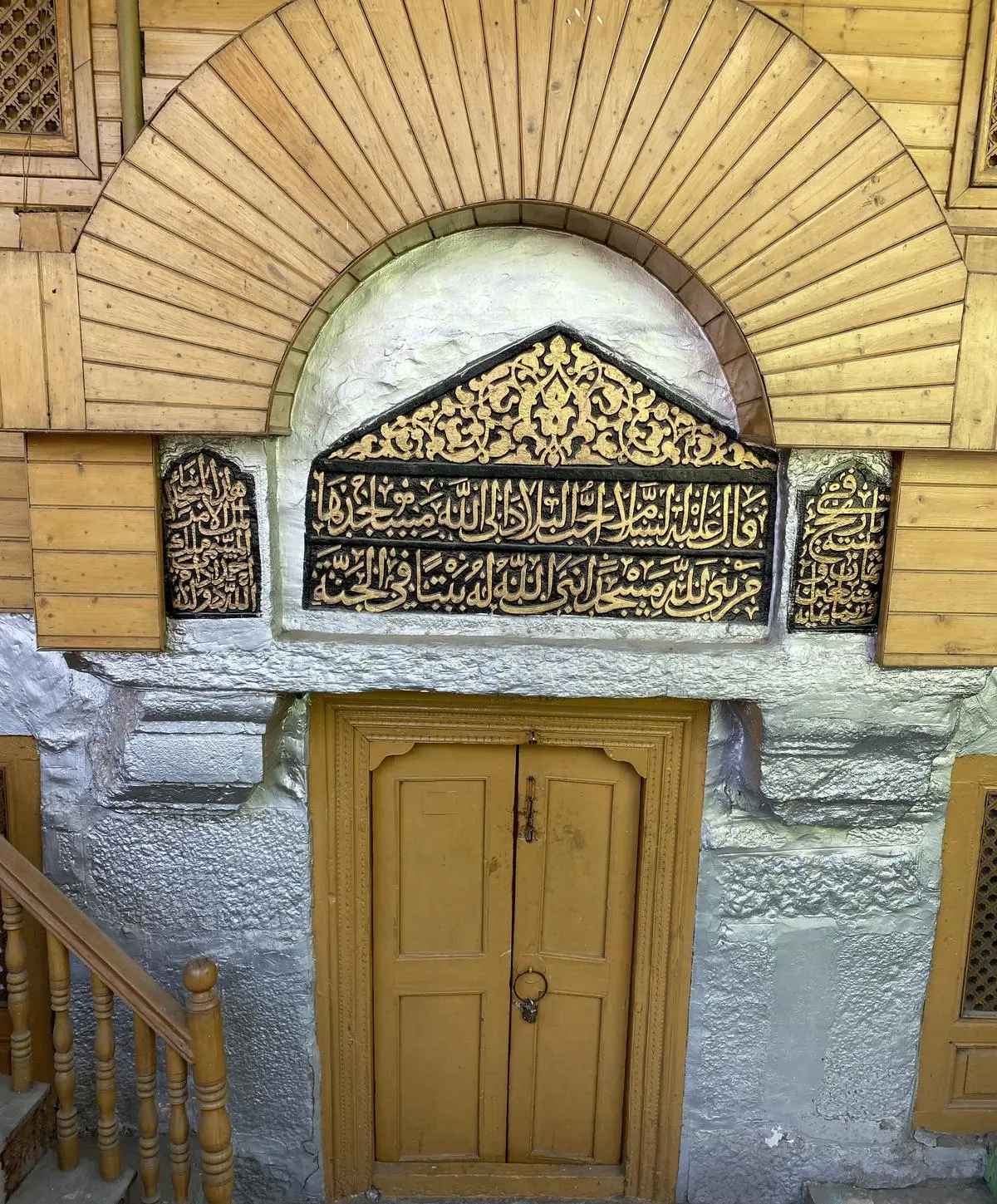
The idea of exploring epigraphs to unravel history came to Hamdani when he was working on his thesis on Islamic architecture at the School of Planning and Architecture, New Delhi, six years ago. As part of his study, he examined extant Islamic epigraphs in the monuments and buildings of Kashmir. Among the ones he analysed was an Arabic hadith (essays on the words and actions of the Prophet Muhammad) etched on the 15th century hospice of a Sufi mystic, Malik Ahmad Itoo, located at Safa Kadal in Srinagar city. It is a small hermitage on the banks of the Jhelum river. The verses, engraved on the shrine’s tympanum, remind the faithful of the spiritual rewards that would accrue to the builder of a mosque.
The Persian slab inside Aali Masjid which identifies the architect of the mosque as Raja Bihisti Zargar. | Photo Credit: Tabish Haider, Barakat Trust
Hamdani said: “Such inscriptions, commonly seen in Kashmiri shrines, are different from medieval Islamic epigraphy found in Delhi.” Speaking of the latter, the scholar Anthony Welch said that their “principal function in late-twelfth-century India was to warn the non-Muslim majority to accept Islam” (in his 2008 essay, “The Emperor’s Grief: Two Mughal Tombs”). The epigraphs associated with early Islam in Kashmir, by comparison, are devoid of such hegemonic overtones. “Their stress is rather on cultivating personal piety,” Hamdani said.
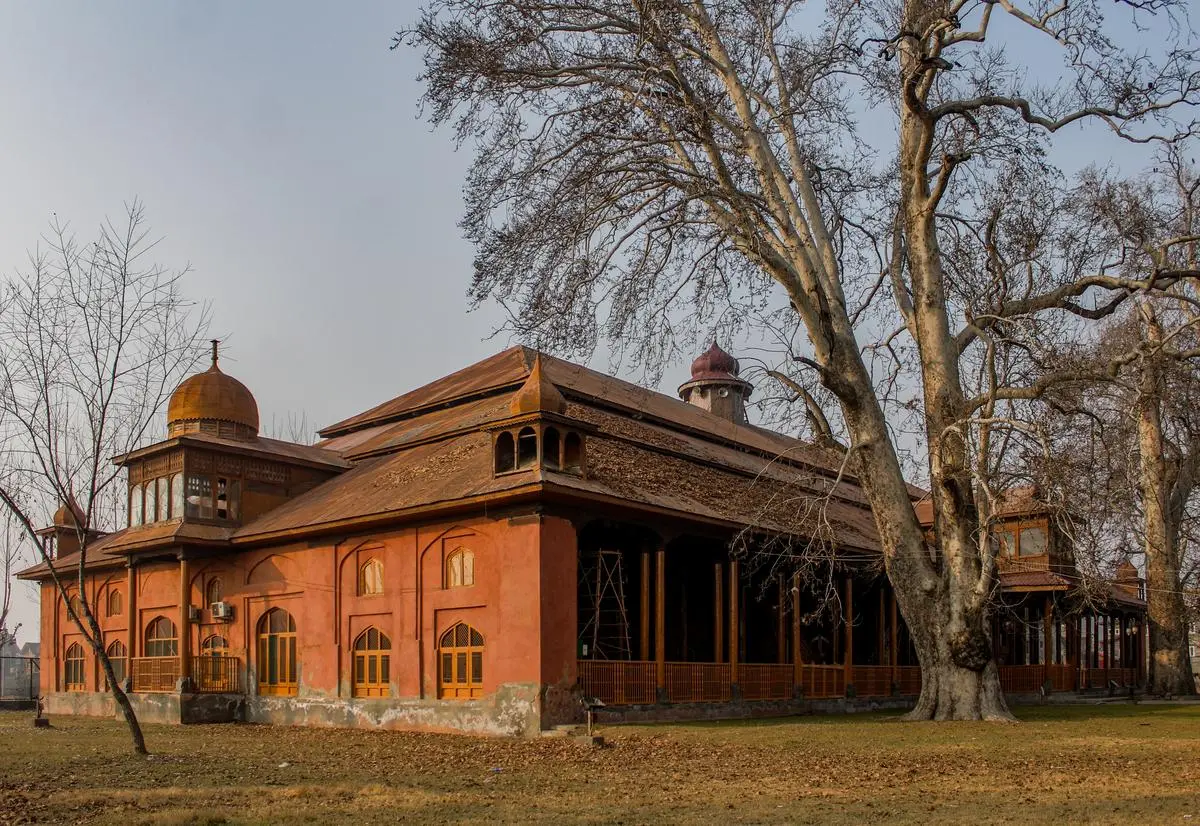
His project has thrown up unexpected stories that often go against the recorded textual histories of Kashmir. Consider the case of Aali Masjid, Srinagar’s second largest mosque. The 15th century mosque embodies a fusion of Iranian, Mughal, and Kashmiri architectural styles. Added during a renovation in the 17th century, the balusters of its portico rest on distinct stone bases reminiscent of those of Safavid pavilions in Iran; the technique was brought to Kashmir by the Mughals. Although the 1887 Persian text Tarikh-e-Hasan—thought to be an authoritative commentary on Kashmir’s medieval history—attributes its construction to Ali Shah, the eighth sultan of the Shahmirid dynasty, the stone slab restored by Hamdani names a different patron: Sultan Hasan Shah, who reigned 50 years later. The epigraph identifies Raja Bihisti Zargar as the architect of the mosque.
Startlingly, the same name was once engraved on a stone pillar inside Srinagar’s Shankaracharya temple. Today, no trace of this inscription remains in the temple, but it is important to remember its existence in view of recent attempts to polarise sentiments by creating a controversy over the name of the Shankaracharya hill, also called Takht-e-Suleiman.
The Shankaracharya temple is one of the oldest temples in Kashmir, mentioned by Kalhana, author of the 12th century Sanskrit text Rajatarangini (River of Kings), which gives a history of Kashmir. The Rajatarangini remained a text in progress for a long time, with Brahmin court historians adding bits to it at different periods. After Kalhana, Jonaraja took it up in the 15th century, followed by Srivara and Shuka in the 16th century.
The hadith inscription on the shrine of Sufi mystic, Malik Ahmad Itoo, in Srinagar. It is one of the earliest surviving Islamic epigraphies in Kashmir. | Photo Credit: Shakir Mir
Hamdani’s team was able to access a preserved facsimile of the temple epigraph in a book titled Illustrations of Ancient Buildings in Kashmir (1869), based on a survey conducted under the Archaeological Survey of India by Henry Hardy Cole. In the survey, Cole suggested that the inscriptions (there were more than one) were linked to repair work done in the temple in the 16th century. But he could not identify the ruler under whose leadership the work was carried out.
Cole was not the only one whose interest was piqued by the presence of Persian inscriptions inside a Hindu temple. The British explorer Alexander Cunningham (1814-93) also mentioned them in his “Essay on the Arian Order of Architecture in Temples of Kashmir” (1848), which says that he had copied out an inscription (a different one at the same site): “but since then it has been so completely defaced by the Dogar [Dogra] soldiery that I could with difficulty trace the name of Takht-i-Suliman”.
Later, in 1875, a group of European travellers made another attempt to decode the writings, scrawling a rudimentary translation in their diary. “This idol… was made by Haji Hashti… in the year 54 of the Samut (Samvat) or Hindoo era,” they wrote, adding that “the foot of the back part of the pillar states that he who raised up this idol was Quajah Rukm, son of Mirjan.”
The case seems to be have been buried in 1935 after it received a clumsy dismissal from an antiquarian, Pandit Anand Koul, who concluded: “Islam was unknown in that remote period when this temple was built, so there could not have been a Khwaja or a Mir then…. Nor would a Muhammadan build a temple as his own” (Archaeological Remains in Kashmir, 1935).
The restored epigraphs were put on display at an exhibition in Srinagar in June 2024. | Photo Credit: Tabish Haider, Barakat Trust
But when Hamdani’s team examined the Aali Masjid slab, a different story emerged: the Muslim architect (Raja Bihisti Zargar) responsible for designing the mosque was the same one who oversaw the repair of the Shankaracharya temple in the 16th century. This suggests that even in the late Sultanate era, often depicted as a period of widespread destruction of Hindu places of worship, Muslim rulers continued to extend their patronage to Hindu cultural spaces. Understandably, the Dogra militia had tampered with this evidence in the 19th century.
Folds of history
Another epigraph documented by Hamdani was written in Sharada on the limestone wall of a 15th century almshouse at Khonmoh in Srinagar, built by a Hindu merchant, Purnaka. The text seems to heap praises on one of the Shahmirid kings by describing him as the son of the “illustrious Sakandra” (Sultan Sikandar). The effusive language used for Sikandar by a Hindu merchant is especially significant because the sultan was depicted as an iconoclast by the contemporary Brahmin chronicler Jonaraja in Rajatarangini. Jonaraja’s characterisation of Sikandar was perpetuated by colonial historiographers. In his 1848 booklet, Cunningham invoked the “destroying hand of Mahomedan [sic] bigotry” to explain the ruin into which Kashmir’s ancient temples had fallen.
But the Khonmoh inscription reveals that there existed a multiplicity of narratives around Sikandar in the 15th century and not all of them told the same story. “We are not denying that persecutions have happened in the past,” Hamdani said. “Our project drives home the point that history never uncoils in a linear way. History has many folds, each one with layers and textures of its own.”
Shakir Mir is a freelance journalist based in Srinagar. He was previously a correspondent with The Times of India.
source: http://www.frontline.thehindu.com / Frontline / Home> Arts & Culture> Heritage> History / by Shakir Mir ./ September 13th, 2024
A short excursion through the towns of Bijapur, Gulbarga, Bidar and Yadgir in north-eastern Karnataka can turn into a marathon heritage walk with serendipitous sightings of monuments from the medieval era.
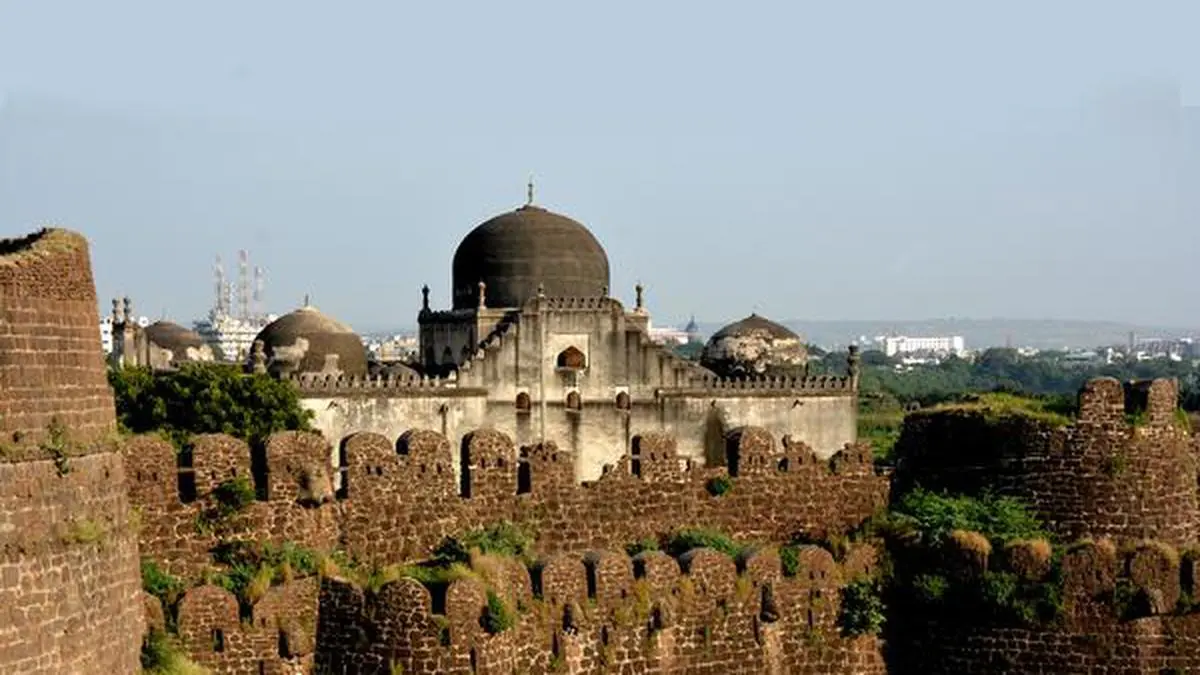
The Gulbarga fort and the Jama Masjid inside it.
SARMAST is said to have been the first Sufi to have come to the Deccan. He settled down in what is now the outskirts of Sagar village in Yadgir district of Karnataka. His grave is now venerated as a dargah. Rocky hillocks with generous splashes of greenery run along the road leading to Sagar from Gulbarga, a distance of 90 kilometres, belying the strong notion that all of the Hyderabad-Karnataka region is dry and dusty.
Tajuddin Dervish, the keeper of the holy grave, sat outside the arched entrance smoking a beedi. As we entered the dargah, we struck up a conversation with him about Sarmast. He recalled the legend, which must have got corroded by retellings over generation. In this tale, the necromancer Karmatgaar, who was up to mischief all the time, flew across the skies and disturbed the Sufi’s meditation. Enraged, Sarmast flung him across the Deccan plateau. In this fantastic tale, the goddess Yellamma (who is worshipped in the northern parts of Karnataka) also makes an appearance; her role is one of heroism. A temple supposedly dating back to the time of the incident is dedicated to her at Sagar.
If we link these hagiographical stories to actual events as the historian Richard M. Eaton has done in Sufis of Bijapur, 1300-1700: Social Roles of Sufis in Medieval India , it is certain that Sarmast was part of the raiding parties from the north sent by Alauddin Khalji (r. 1296-1316), who made forays into the Deccan and further south. The Deccan later became a part of the expanding Delhi Sultanate under the rule of the Tughlaqs. A bloody battle is supposed to have taken place at the site of Sarmast’s dargah, and many warriors were buried where they fell. The large circular area around the open grave of the saint is a medieval graveyard.
Unnamed tombs, locally called gumbad s, in various states of decrepitude and portions of walls with vestiges of fine carvings lie scattered around the area. Tomb raiders, probably lured by stories of treasures, have broken the graves inside these sepulchres. In the town of Sagar, there is a single-arched gateway so broad that an elephant can pass through it. A magnificent and well-maintained tomb on an imposing platform lies on the path a little ahead, next to a baoli (stepwell). None of these historical structures come under the purview of national or State-level archaeological conservation authorities.
The Bahmani sultanate
A few decades after the rulers from the north made forays into the Deccan, another Sufi saint, Sheikh Sirajuddin Junaydi (d. 1380), gained prominence. He blessed Alauddin Bahman Shah (r. 1347-1358), who broke away from the Tughlaq empire to establish the first independent Bahmani Sultanate in 1347, thereby inaugurating the rule of Muslim kings in the Deccan. While Junaydi’s tomb, marked by two imposing minarets, has flourished and is venerated to this day in Gulbarga, the tomb of Alauddin Bahman Shah is empty and the small compound in which it is situated is surrounded by illegal constructions.
Basavanappa, employed by the State Archaeological Department, guards the four Bahmani-era monuments. He said: “This is the man whose descendants built so many grand monuments. Guarding these gives us our daily bread and I have the responsibility of safeguarding his tomb.”
Alauddin Bahman Shah’s rule was brief. The moving of the capital from Daulatabad to Gulbarga, after severing links with the Delhi Sultanate, marked his reign. He also set up a dynasty that lasted two centuries (between 1347 and 1527) which, along with its legatee kingdoms, matched the Delhi Sultanate and later the Mughals in the splendour of their courts. At the centre of Gulbarga is the fort from where the Bahmanis ruled their vast empire which at its peak extended from Gujarat to Goa, all the way across modern-day Maharashtra, Karnataka, Telangana and Andhra Pradesh. While the Bahmanis constantly went to war with the Vijayanagara Empire, they also had deep cultural encounters with their neighbours.
The Bahmani kings ruled over a multi-ethnic and linguistically diverse empire whose citizens included indigenous residents, who spoke Marathi, Kannada and Telugu and other local languages, and migrants from north India. There was a regular stream of immigrants coming from Iran and Turkey to the royal cities via the sea route. African slaves, who rose up in the ranks, also played important roles in the matters of the Bahmani court.
The Bahmani Empire shifted its capital to Bidar in the 15th century, but an implosion was imminent because of differences between its ruling nobles. The waning empire gave birth to five independent sultanates that shone brilliantly in their maverick existences. They subsumed their differences and combined forces to defeat the Vijayanagara king at the Battle of Talikota (1565), but the sultanates were annexed by the Mughal Empire during the reign of Aurangzeb (r. 1658-1707), whose campaigns in the Deccan were to keep him occupied for half of his regnal period.
The Bahmani Sultanate and its splinter kingdoms have had a long impact on the culture and society of the Deccan. Magnificent architectural specimens of their reign can be seen in the entire region. Tombs, mosques, idgah s (prayer grounds), palaces and forts stud the entire area. These structures have a distinct style, which the architectural historian Helen Philon calls a “unique Deccan architectural vocabulary” in her book Gulbarga, Bidar, Bijapur . She says that this style is augmented by “building forms and decorative motifs introduced from Arabia and Persia, as well as from Turkey and Central Asia”.
A short excursion through Bijapur, Gulbarga and Bidar can turn into a heritage walk, marked by serendipitous sightings of monuments. While some of these edifices, such as the Gol Gumbaz, are fairly well known, there are others such as the royal necropolis of Ferozabad, around 30 kilometres from Gulbarga, which are known only to heritage enthusiasts.
One the most significant public works of the Bahmani kings was the karez system, in which water was supplied through tunnels from stepwells and other underground sources. Such tunnels supplied water to civilian settlements and the garrison inside the Bidar fort. The karez system is now being revived by Team Yuva, a Bidar-based non-governmental organisation led by Vinay Malge.
The Muslim kings also gave importance to landscape gardening and decorations. Local material such as basalt, granite and laterite have been used for buildings; lush gardens dominate the landscape around larger monuments. Vestiges of decorative motifs, murals and tile work can be seen in the monuments in Bidar.
A grand Jama Masjid is at the centre of the Gulbarga fort. It is a simple but imposing structure made even more stately because of the vacant space around it. There is a watchtower inside the fort on which a 29-foot cannon, said to be the longest in the world, is mounted.
Visitors are told that the Jama Masjid was the original congregational mosque of the Bahmani capital; actually, a large rectangular mosque in the crowded Shah Bazaar area of the city was the original Jama Masjid of Gulbarga. Prayers are held every Friday at this mosque, which is now known as the Shah Bazaar mosque. Visitors are allowed to go to the terrace, which is crowned with cupolas. This architectural style of domes on the terrace, mirroring the arches on the ceiling, can be found in prominent mosques from this era in the Deccan. Another historical site in Gulbarga that is worth seeing is the funerary complex, called the Haft Gumbad, of the Bahmani kings. Five rulers of the Bahmani dynasty until Feroz Shah Bahmani (r. 1397-1422) are buried at this site. The tombs, constructed over a period of a few decades, help one see the evolution of the architectural style. The early tombs have slightly sloping walls and are less distinguished, while the later tombs such as that of Feroz Shah, are larger, have a cleaner finish and are embellished with fine carvings.
Feroz Shah’s tomb reflects the king’s aesthetic sense as he was said to be a man of refined taste, was interested in local culture, and was also a polyglot who married the daughter of a Vijayanagara king. He built the city of Ferozabad. If one is visiting Ferozabad for the first time, one will get the feeling of discovering new things. The necropolis, which was inhabited briefly, can now be accessed only after passing through a village off the main road. The main entrance, which is through an arched gateway, is visible, although blocked. One must enter through an agricultural field. Ferozabad reveals itself little by little. It is a complete city with a fort, a palace, a mosque and royal residences, all of which are in ruins now. The apathy towards the upkeep of the architectural splendour of the region is evident from the poor maintenance of Ferozabad. Stone walls that formed part of the ramparts of the fort stand precariously on the ground. A tur dal field is being ploughed inside the premises of what was once the main mosque. The Bhima river glints some distance away. The city was abandoned towards the end of the 15th century after a deluge caused by the overflowing Bhima.
Shifting the capital to Bidar
A strange aspect of Feroz Shah’s tomb is that it has twin domes and separate chambers although only one of these was used for burial with the other lying vacant. Local legend has it that the second chamber was the designated burial space of Feroz Shah’s brother, Ahmed Shah (r. 1422-1436), who was not buried there. During the reign of Ahmed Shah, in 1432, the Bahmani capital shifted to Bidar, and Khwaja Hazrat Bandenawaz (d. 1422), the most well-known Sufi of the Deccan, is supposed to have been one of the causes for this. The Bahmani kings had close ties with Sufi saints, and Ahmed Shah continued the tradition but he was also considered a saint; the only king to be treated as such by his followers. His tomb in the funerary complex of Ashtur, just outside Bidar, is venerated by Muslims, who consider him to be a wali (friend of God), as well as by Hindus, who consider him to be an avatar of Allama Prabhu, a Vachana poet who lived before Basava. Ahmed Shah’s tomb has well-preserved murals and verses from the Quran. The resident caretaker at the tomb used a mirror to ingeniously cast splotches of reflected sunlight on the interior of the dome, which gave us an idea of the bright hues that are still intact.
The funerary complex of Ashtur is far more majestic than the Haft Gumbad. The tombs are bigger and more imposing and the well-maintained lawns add to the beauty of the location. Since the tombs must have been built at different times over a period spanning a century, each tomb has a different architectural style. One tomb that stands out is that of Humayun Shah (r. 1458-61). Lightning has damaged its dome, leaving only a portion of it intact. Visitors are told an apocryphal story of divine justice. Humayun Shah was such a cruel ruler that the word zaalim (tyrant) was affixed to his name. When this tyrant died, God in his infinite wisdom struck his tomb so that he would be exposed to sun and rain for eternity. As the influence of the dynasty waned and independent sultanates began to emerge, the tombs of its rulers also lost their magnificence. The tombs of the last two rulers remain poor cousins of the larger tombs at Ashtur, both in size and form.
From Ashtur, one can see the ramparts of the fort of Bidar, along the short drive to Bidar. This grand Bahmani era fort is surrounded by three moats and impressive bastions. The monuments of Bidar are in much better shape than those in Gulbarga. In the precincts of the fort, which has a massive gateway, are palaces and a mosque, an austere building with 16 arches crowned with a dome. Pathways run through gardens in the royal enclosure. Some of the best examples of exquisite woodwork (a hallmark of Hindu architecture) and mother-of-pearl inlays can be seen in Rangin Mahal, the palace inside the fort. Mahmud Gawan, a powerful prime minister in the Bahmani court, built a madrasa (theological school) bearing his name in 1472. The madrasa is located some distance away from the fort. There are remnants of turquoise tile work of Central Asian design on the tall minaret.
Adil Shahi dynasty
As the Bahmani Sultanate began to fall, it split into separate sultanates, the strongest of which was the Adil Shahi dynasty of Bijapur under Yusuf Adil Khan (r. 1490-1510).
“The period between accessions of Sultan Ali I (1558) to the death of Sultan Muhammad (1656) can be called the Golden Age of the Adil Shahis, as the kingdom flourished in all walks of life,” writes Abdul Gani Imaratwale, a historian based in Bijapur, in his book Studies in Medieval Bijapur . This is reflected by the grandeur of the monuments during this period.
Mohammed Adil Shah’s tomb, the Gol Gumbaz, is often featured on tourism brochures of the Karnataka Tourism Department. It would not be wrong to say that it is the grandest edifice in the modern State of Karnataka. The Gol Gumbaz is visible from many places in Bijapur and is overwhelming at close quarters because of its sheer size. Inside the large tomb, the cenotaph of Mohammed Adil Shah and his close family members can be seen, but these are replicas, with the original graves lying in an underground crypt. At the four corners of the room, steep and winding stairs that test the climber’s stamina lead up to the gallery. The vastness of this free-standing dome accentuates the acoustics within it. Schoolchildren can be seen clapping and yelling to hear the echo. Each burst of sound echoes several times making it difficult to stay there long enough to appreciate the engineering marvel.
The Ibrahim Rauza complex consisting of the tomb of Ibrahim II and a mosque is a delicately built structure and looks as if it has been laid out in front of visitors as they approach it from the garden. Bijapur has many other gems, such as the main congregational mosque, the Jama Masjid, which is an incomplete structure but is remarkable for its large and decorated mihrab (the prayer niche). The largest cannon in the world, the Malik-e-Maidan (lord of the field), which was truly a weapon of mass destruction in the medieval age, can also be found in Bijapur. A palace associated with the early Adil Shahis, the Chini Mahal, is now converted into a government office, and the throne room is now the treasury officer’s cabin.
The towns situated near Bijapur also have historical monuments. There is a 17th century mosque in Afzalpur built by Afzal Khan, a general who was killed by Chhatrapati Shivaji. This smart structure, ignored by archaeological authorities, is being maintained through the personal initiative of Maqsood Afzal, a descendant of the general.
This overview hardly does justice to the extensive architectural heritage in this part of Karnataka. These spectacular monuments do not figure in the itinerary of most tourists.
A wonderful monument like Ibrahim Rauza has only around 500 visitors in a day. In fact, some of the conservation authorities are not even aware of the necropolis of Ferozabad or the Afzal Khan mosque. Infrastructure essential for the growth of tourism is poor in the Hyderabad-Karnataka region. Information on the architectural sites in the region is limited. Efforts to get this heritage corridor recognised as a United Nations Educational, Scientific and Cultural Organisation (UNESCO) World Heritage Site have failed. Ayazuddin Patel, a Lalit Kala Akademi awardee based in Gulbarga, who has photographed the architecture of the region, laments: “We have been completely ignored and forgotten.” The Hyderabad-Karnataka region has been ignored by successive governments since Independence.
The Bahmani kingdom has receded into history although its rulers governed the Deccan for several centuries. This is partly due to the peripheral status of the Deccan and southern India in history writing in India. The long reign of the Bahmani Sultanate and its descendant sultanates has left behind another kind of legacy: a syncretic culture that is visible in harmonious communal relations, the participation of all communities at the shrines of various Sufi saints, and even during events that mark Muharram. The lingua franca of the region, Dakhni Urdu, is also a legacy of the Bahmanis. Many of these medieval rulers openly embraced non-Muslim practices and patronised local cultures, but a communal reading of history pits these kingdoms against the “Hindu” empire of Vijayanagara in a biased understanding of history.
Historians have often disproved this and have stressed aspects of mutual interpenetration and a fusion of cultures and practices (most recently in Power, Memory, Architecture: Contested Sites on India’s Deccan Plateau, 1300-1600 by Richard M. Eaton and Phillip B. Wagoner), but the religious reading of history continues in popular discourse. In February, a small attempt was made to celebrate the legacy of this regional history, with the district administration of Gulbarga deciding to hold a Bahmani and Rashtrakuta Utsav simultaneously. (The Rashtrakuta dynasty ruled this region between the eighth and 10th centuries.)
The Bharatiya Janata Party (BJP) instantly opposed this, with its Member of Parliament from Karnataka, Shobha Karandlaje, even tweeting: “Who is Bahamani Sulthans? Who killed lakhs of hindus, who burnt thousands of villages, who raped hindu women, who destroyed temples…. now congress celebrating thier festival… more dangerous” (sic). Considering that this was just a few months before elections to the Karnataka Assembly were to take place, the ruling Congress government quietly withdrew permission for the event. Needless to say, the inaugural edition of the Rashtrakuta Utsav was held in all its splendour. The BJP’s move of selectively opposing events on communal lines is part of its agenda. The partisan reading of history, where the history of Muslim rulers is ignored, will affect inter-religious relations.
Surreal experience
While Sarmast was the first Sufi of the Deccan, Bandenawaz, who was not averse to taking part occasionally in courtly intrigues, was the most well known. At his 15th century tomb in Gulbarga, the interiors of which have been garishly redecorated without any consideration to its architectural significance, Hindus and Muslims arrive in droves and bow in reverence before his grave.
Behind the tomb are a number of unmarked graves. A supplicant, his eyes closed, was ardently praying, with his head bent towards the direction of Bandenawaz’s tomb. Some things must not have changed at this place since the death of Bandenawaz in 1422. Walking through these lands where Sufis lived and kings ruled, where the detritus of empty tombs and unknown crypts can be found all over, one finds myth and fable combining with fact to create a surreal experience.
(In 2014, the names of Gulbarga and Bijapur were officially changed to Kalaburagi and Vijayapura respectively by the government of Karnataka. Yadgir, which was part of Gulbarga district, attained separate district status in 2009.)
source: http://www.frontline.thehindu.com / Frontline / Home> Arts & Culture> Heritage> Architecture / by Vikhar Ahmed Sayeed / Photographs Mohammed Ayazuddin Patel / October 20th, 2018
Zoya talks about life with artist Riyas Komu, secretary of the Kochi Biennale Foundation
Zoya met Riyas Komu when they were both in the same class at the Sir JJ School of Art in Mumbai in the 1990s. “What I noticed immediately was that he had a zest and an infectious energy,” says Zoya. “Since he was from Kerala, there was an element of rawness – a kind of innocence – about him, unlike most of my other classmates.”
They were drawn to each other, because of their mutual interest in world cinema. “We attended a lot of film festivals together, and admired the films of Mohsen Makhmalbaf and Andrei Tarkovsky,” she says.
And they gradually fell in love even though they belonged to different backgrounds. Zoya’s parents are from Uttar Pradesh, but they have been settled in Mumbai for a long time, while Riyas is the son of politician M M Komu in Thrissur.
The fact that Zoya did not know Malayalam was not a hindrance for Riyas. Whenever he would come across an interesting article in a Malayalam magazine, he would translate it so that Zoya could also enjoy it. “Thanks to Riyas, I have read [Vaikom Mohammed] Basheer in an English translation,” says Zoya. “He is one of my favourite authors. I loved ‘Poovan Banana (Poovanpazham)’.”
The couple got married on April 7, 2001. And for their honeymoon, they came to visit Riya’s large family, of seven brothers and two sisters. “I am an only child, so it was an interesting experience to become part of a large family,” she says. “The language and culture were so different. You are into and still not into the family. Sometimes, it was difficult to comprehend things, but at the same time, it was quite engaging.”
What ensured Zoya’s assimilation was because she loved Riyas intensely. “He is not obsessed about art only,” she says. “Riyas has an open mind and is interested in all subjects, be it football, theatre, films, literature, and about people and happenings in his village and the world.”
And unusually, for a Malayali, Riyas gives Zoya the mental and physical space to be herself. “Riyas wants me to have my own views and feel free,” she says. “That is the case with the people who work with him. As a result, everybody feels at ease with Riyas.”
In Mumbai, on an ordinary day, Riyas gets up at 8 a m. Following breakfast, he goes to his studio: it could be the one where his sculpting works are done, or his painting studio, both of which are in the suburb of Dahisar. “If he starts work on a painting, he will spend hours on it, and continues labouring on it through the night,” says Zoya. “That is how he likes to work.”
Of course, an artist leads a different life, as compared to a banker or a businessman. “Every day is fluid,” says Zoya. “You have discipline, but you don’t have rigidity. The advantage is that you can do whatever you like, but there are different responsibilities, as compared to a person working in an office. You have to manage your own life.”
In effect, Riyas is the star of his own show. “But the only time he feels pressure is when there is a show coming up, and the works are not ready,” says Zoya.
Not surprisingly, Zoya has a few favourites, among Riyas’ works. One of them, which was displayed at the 2007 Venice Biennale, is a set of paintings called, ‘Petro Angel’. This was inspired by the plight of Iranian women, as shown in the film, ‘The Circle’ (2000). “He has been able to portray the different emotions of women very well,” says Zoya.
Riyas, himself, has gone through an emotional roller-coaster because he, along with Bose Krishnamchari, struggled to set up the landmark art event, the Kochi-Muziris Biennale. “He was asked to take the responsibility, and did so,” says Zoya. “Riyas knew that it was important not only for him or Kerala, but for establishing an art culture in India.”
Incidentally, because of Riyas’s preoccupation with the Biennale, Zoya has moved to Kochi with their four-year-old daughter Mariyam. “I am happy to be here and am proud of what Riyas has achieved,” she says.
source: http://www.newindianexpress.com / The New Indian Express / Home> Kochi / by Shevlin Sebastian / December 24th, 2012
The Padma Bhushan awardee, who hailed from Jodhpur, died of kidney failure in Mumbai.
Sarangi maestro and classical singer Ustad Sultan Khan, the soulful voice behind hits such as Piya basanti re and Albela sajan, passed away in Mumbai on Sunday after kidney failure.
The Padma Bhushan awardee, 71, who hailed from a family of sarangi players in Jodhpur, was on dialysis for the past three months and died on his way to the hospital, family sources said.
Khan is survived by his second wife Bano, son Sabir – also a well-known sarangi player – and two daughters. His funeral will take place in Jodhpur on Monday.
Credited for reviving the sarangi, Khan is famous for his extraordinary control over the instrument and his husky voice. He started performing at the age of 11, and later collaborated at the international level with sitar maestro Ravi Shankar, on George Harrison’s 1974 Dark Horse World Tour.
Khan’s was a family of sarangi masters from Rajasthan. He was initially tutored by his father, Ustad Gulab Khan. Later, he trained under Ustad Amir Khan, a classical vocalist of the Indore gharana. After establishing himself as a sarangi player, Khan worked with Bollywood musicians, such as Lata Mangeshkar and Sanjay Leela Bhansali, apart from collaborating with western musicians, such as Ornette Coleman, George Harrison and Duran Duran.
Apart from the Padma Bhushan, Khan won numerous musical awards, including the Sangeet Natak Academy Award (twice), the Gold Medallist Award of Maharashtra and the American Academy of Artists Award in 1998.
Khan was also a member of the Indian fusion group Tabla Beat Science with Zakir Hussain and American bassist Bill Laswell.
The news of Khan’s death came through a post by music composer Salim Merchant (of Salim-Sulaiman fame) on Twitter.
“I lost my ustad – Ustad Sultan Khan, my guru my friend my idol. He passed away this afternoon. We will never have a sarangi maestro like him,” he tweeted.
Eminent sarod player Amjad Ali Khan also condoled his death, saying it was a great loss to the music world. “I am deeply saddened at his demise. He gave a different meaning and dimension to the sarangi ,” he said.
Among the other musicians who expressed grief were music director Vishal Dadlani, and singers Shreya Ghoshal, Abhijeet Sawant and Shaan. “Just heard about the loss of our dear ustad sa’ab :(I had the gr8 fortune and honour of working with him. Too saddened,” Ghoshal tweeted.
Actors Akshay Kumar, Rahul Bose and Dia Mirza also wrote on Twitter. “This has not been a good year what with so many great personalities leaving us. My thoughts and prayers with his (Khan’s) family,” Akshay said.
“He played on the soundtrack of my directorial feature, Everybody Says I’m Fine! Ustad Sultan Khan saab had a huge heart and an impish sense of humour,” Bose recalled.
source: http://www.indiatoday.in / India Today / Home> News> West / by India Today Online, Mumbai / November 28th, 2011
Architectural exploration in the sultanate of Ahmednagar can provide deep insights into the political history of the Deccan.
B Y the late 15th century, the Bahmani kingdom that had ruled much of the Deccan since its establishment in 1347 was imploding because of internecine differences among its nobility. Westerners, or the “Afaqis”—immigrants from Persia and Central Asia—had differences with the natives, or the “Deccanis”, an eclectic group of nobles that consisted of descendants of the early Delhi sultanate migrants, local converts to Islam, Habshis (Africans) and Marathas. The weakening of the kingdom was accompanied by ambitious provincial governors declaring independence one after the other, leading to the emergence of five separate principalities, or sultanates.
The earliest to break away and proclaim himself sultan was Ahmed Nizam Shah I, who was the governor of the north-west province of the Deccan, later to be known as Ahmednagar, after the name of the city he would build and designate as capital of the sultanate. Of the four other sultanates that would cleave away chunks of the Bahmani kingdom, Bijapur and Golconda were the large and important ones to emerge.
Ahmednagar survived as a robust Shiite polity for more than a century, until 1600, and then in a feebler form until 1636 before the Mughals, with their unceasing imperial ambitions, completely swamped the city. It took 50 more years for the Mughals to subjugate all the kingdoms of the Deccan when Aurangzeb finally defeated the sultanates of Bijapur and Golconda in 1686 and 1687 respectively. Even though it was the first sultanate to fall to the Mughals because of its location, Ahmednagar survived as an independent state for more than 100 years.
During this time, it carved out a distinct identity in statecraft apart from leaving behind a fairly rich architectural legacy, which is the subject of study of the book under review. With this clearly defined ambition, Pushkar Sohoni, who is an architectural historian, has turned the spotlight on the sultanate of Ahmednagar and presented a method by which architectural exploration can provide deep insights into the political history of a geographical region.
The art and architecture of the Deccan sultanates was the focus of many scholars in the past. In pre-independent India, the region’s architecture was studied as an addendum to the Islamic architecture of northern India (for example, the second volume of Percy Brown’s seminal work on Indian architecture, 1942). More recently, the study of the Deccan as an independent area has come into its own, with scholars such as George Michell and Mark Zebrowski ( Architecture and Art of the Deccan Sultanates , 1999) publishing detailed studies.
Among exhaustively edited volumes on the same theme, a few stand out in recent times, including Silent Splendour: Palaces of the Deccan, 14th–19th Centuries edited by Helen Philon (2010) and Sultans of the South: Art of India’s Deccan Courts, 1323-1687 edited by Navina Najat Haidar and Marika Sardar (2011).
Richard Eaton and Phillip B. Wagoner have published a book titled Power, Memory, Architecture: Contested Sites on India’s Deccan Plateau, 1300-1600 (2014) that looks in detail at secondary urban centres of the Bahmani and Deccan Sultanate era such as Kalyana, Raichur and Warangal.
Coming to the scholarship on individual sultanates: Pramod B. Gadre has studied Ahmednagar in some detail ( The Cultural Archaeology of Ahmadnagar during Nizam Shahi Period, 1494-1632 , 1986); Deborah Hutton has looked carefully at the art of Bijapur ( Art at the Court of Bijapur , 2006); Marika Sardar has extensively studied the fortifications of Golconda (“Golconda Through Time: A Mirror of the Evolving Deccan”, unpublished PhD thesis, 2007). The book under review adds to this burgeoning bibliography on the art and architecture of the Deccan sultanates.
In his prefatory chapter, Sohoni makes a forceful case for the independent study of the Deccan, which had a distinct identity from “Hindustan”, or northern India, for most of the past. He writes: “The deep connections of the Deccan with West Asia, completely independent of Northern India, along with the autonomous cultural and historical developments in the south have shaped the Deccan very uniquely. Detailed studies of the polities of the Deccan, therefore, of architecture and statecraft, need to be undertaken in order to explain how, in moments of disengagement with the north, unique formations were created independent of developments in North India.”
This disconnectedness from north India led to the emergence of a distinctive architecture as the Nizam Shahis developed their own style. Sohoni’s argument is that the “…architecture of the Nizam Shahs does not follow a linear development from its Persian origins to the creation of a regional style. The buildings are variously of broadly Persianate and Indic characteristics, at times both, but to call them derivative is unfair, as the kingdom of the Nizam Shahs was trying to create a new architectural language as a regional claim.”
This study of architecture and the politics of Ahmednagar also leads Sohoni to argue ingeniously that the Deccani kingdoms saw themselves as “regionalists” who were resisting the “Hindustani” expansion led by the Mughals. This is an interesting perspective of medieval India.
Thus, the Deccan kingdoms were resisting the cultural expressions of the north by forging links with Persianate lands, which led to autonomous architectural representations. Chaul, Dabhol, Bhatkal and Goa were the principal ports through which connections with the wider Persianate world were forged independently, bypassing north India. In their architecture and in other aspects such as coinage, literature and painting, the Deccan sultans intended to bolster their independent claims as Deccan potentates. At the time, the Deccan was a multi-ethnic society with strong and independent connections to Persia.
There was also a great deal of cultural interaction and churning in the region involving ethnicities as diverse as African, Arab, Central Asian and South Asian. Thus, Sohoni provides ample evidence to back his argument that the Deccan has to be studied independently from “Hindustan”.
Sohoni’s intervention is valuable for the much-needed nuance it provides to the story of medieval India. In the reductive nationalist and colonialist versions of the time, Muslim rulers are seen as invaders “…upsetting indigenous practices until the ‘Hindu revival’ under the Marathas in the seventeenth century which is a simplistic and naive model of regional history”. Through Sohoni’s work, we see that the Nizam Shahi’s forbears were Brahmins who converted to Islam. Sohoni goes on to demonstrate, through his close reading of visual architecture, that the Nizam Shahi state “…formed the basis of the nascent Maratha state that emerged in the mid-seventeenth century under Shivaji Bhonsale”.
Sohoni delineates his method of studying architecture: “In this book, art-historical methods of visual inspection and formal analysis, along with documentation of architecture and construction, expand on earlier attempts to overcome the limited interpretations of previous text-based histories.” His book has a detailed historiographical note on the Nizam Shahis combined with the study of other aspects, such as the role of guilds and the material used in buildings of the time, providing a fulsome interpretation of architecture.
Sohoni also looks briefly at the literature, visual culture and coins of the Nizam Shahs. It is interesting to note that Ahmednagar started minting its own coins only in the second half of the 16th century, and this was done only when it realised the implications of Mughal expansion and had to symbolically demonstrate its independent status.
Commencing his detailed look at the architecture of Ahmednagar, Sohoni dedicates a chapter to urban patterns in six settlements of Ahmednagar: Junnar (the first capital of the Nizam Shahis), Daulatabad (the older capital of the northern Deccan), Ahmednagar (the capital built from scratch by the Nizam Shahis), Chaul (a major seaport), Parenda (a fortified military centre built by the Bahmanis) and Sindkhed Raja (the hereditary fief of the Jadhavs, Maratha nobles at the court of the Nizam Shahs). He also looks at the water technology and the fortifications in these settlements.
In the next chapter, Sohoni looks at the palaces and mansions of Ahmednagar such as Farah Baksh Bagh, a large building originally set on a raised platform in a pool of water. Sohoni spends some time on this monument before moving on to detailed discussions of other monuments such as the Hasht Bihisht Bagh, Manzarsumbah and Kalawantinicha Mahal.
In a subsequent chapter, Sohoni discusses the architecture of 12 mosques spread across various settlements in erstwhile Ahmednagar. Interestingly, Sohoni points out that there was no main congregational mosque in Ahmednagar where proclamations of sovereignty could be made on Friday, which is something unique and can be attributed to the Shiite orientation of its rulers. In the next chapter, Sohoni looks at tombs. One would imagine that like their royal forbears and peers among the Deccan sultanates the Nizam Shahis would also have grand tombs, but barring the first king of the dynasty, none of the other kings are buried here as their bodies were embalmed and sent off to Karbala (Iraq) in homage to their Shiite belief.
Thus, the 14 tombs that have been discussed are of the higher nobles who were buried in the region and memorials that are attributed to Maratha nobles, such as the ancestors of Shivaji in Verul and that of Lakhuji Jadhav in Sindkhed Raja. Another chapter is dedicated to the discussion of miscellaneous buildings, including royal hamam s.
Sohoni does not claim to have catalogued all the extant buildings from the Ahmednagar era, but his list is fairly thorough and includes all the prominent monuments in the region.
Through his work, the author sounds an urgent note of caution as many of these buildings are in a poor state of preservation with a few even slated for demolition. Several noteworthy monuments are not even protected by archaeological authorities. Sohoni has provided accompanying photographs and architectural plans for many of the monuments in his work. His detailed appendix is also useful as it provides an annotated listing of inscriptions on several monuments.
Sohoni concludes by providing an overview of what the Nizam Shahis represented. They were the last medieval state that the early modern Mughal state encountered as it swept across the Deccan.
He writes: “This study locates the Nizam Shahs as a critical component of the architectural and political history of the sixteenth-century Deccan, and hopefully can restore to them some of the status that they once commanded in their own time.” Drawing a direct link from the Nizam Shahis to the incipient Marathi state that emerged, Sohoni contradicts reductive scholarship that sees the Marathas as breaking from an Islamicate past. He writes that “…it is possible to conclude that there was no nationhood or polity based on an ethnic identity, and that their ethnic identity was a marker of social rise through military service. The cultural forms of the greater Islamicate world, as expressed in the Deccan by the Bahmanis, the Vijayanagar kings, and the later sultanates, were also adopted by the Maratha courts. In conception, execution, and ornament, the architecture of the early Marathas was exactly the same as that of their sultanate overlords and peers. The structural forms, decorative details, and planning logic conform to the Islamicate architecture of the Deccan sultanates.”
This book is valuable to architectural historians and historians of medieval India. A logical expectation would be for similar research to be done on the other Deccan sultanates, each of which represented robust regional resistance to the imperial policy of the Mughals.
source: http://www.frontline.thehindu.com / Frontline / Home>Books / by Vikhar Ahmed Sayeed / July 17th, 2019
A reading of three books throws light on the culture and politics of the Persianate world of the medieval Deccan.
Through fierce forays into southern India, rulers of the Delhi Sultanate like Alauddin Khilji (reign 1296-1316) extended the boundaries of their empire to its furthest extent at the end of the 13th and the beginning of the 14th centuries by dismantling the existing Yadava, Kakatiya, Hoysala and Pandya kingdoms. Khilji’s forces even reached Madurai in the deep south, where they established a base. Mohammed bin Tughlaq (reign 1325-1351), the eccentric genius of the Tughlaq dynasty that followed the Khiljis, moved the capital of his vast empire from Delhi to Devagiri or Daulatabad, located in what is now the central part of Maharashtra, in order to have his court more centrally located. The Delhi Sultans’ rule in these far-flung domains of their realm was always tenuous, and when Tughlaq’s rule, beset by internal crises and external challenges, withdrew to north India, many provincial governors rebelled, forming independent kingdoms or sultanates.
In the Deccan, an amorphous geographical region extending from the south of the Vindhya Range to the Krishna and Tungabhadra rivers, the Bahmani Sultanate was established by rebel Tughlaq nobles in 1347 with its initial base in Daulatabad. Across the Krishna, the vacuum that had set in after the Tughlaq withdrawal had led to the founding of the Vijayanagara kingdom sometime between 1336 and 1346.
The Bahmanis would shift their capital to Gulbarga (now Kalaburagi) in 1350 and in the early 15th century, to Bidar. At its height during the reign of Muhammad III (reign 1463 to 1482), when Mahmud Gavan was the prime minister, the Bahmani Empire extended from the Arabian Sea to the Bay of Bengal, helmed in by the Khandesh Sultanate in the north and the Vijayanagara empire in the south. While the Bahmani empire was a powerful state, ethnic affiliations overlaid with sectarian differences among the ruling nobility led to its implosion at the end of the 15th century. The provincial governors of Bijapur, Ahmednagar, Golconda, Bidar and Berar established their own Sultanates, snuffing out the Bahmani dynasty. Collectively referred to as the Deccan Sultanates, the 16th century would see these legatee states frequently fight with one another. The mighty Vijayanagara to their south usually sided with one or the other sultan in these conflicts.
Recognising the threat that the powerful Vijayanagarans perennially posed to them, the Deccan Sultanates came together in a temporary alliance in 1565 to defeat Vijayanagara, leaving it to totter to its eventual demise over the next century (See “Beyond the Hindu-Muslim Binary” in Frontline , January 18, 2019). This brief friendship was soon forgotten, and the Deccan Sultanates continued to fight with one another. Berar and Bidar were gobbled up by Ahmednagar and Bijapur respectively, leaving these two states, along with Golconda, as the unchallenged rulers of the Deccan for some time until their wealth attracted the attention of the Mughals. The expansionist policy of the Mughals led to the weakening and eventual subjugation of these regional powers as first Ahmednagar (1636) and then Bijapur (1686) and Golconda (1687) succumbed to Mughal might, ending the glorious epoch of the Deccan Sultans.
In popular understanding, medieval India is usually equated with the Mughal empire, but this is not to say that the Deccan was deprived of serious explorations of its medieval history. H.K. Sherwani and P.M. Joshi were early modern historians who looked at the Bahmanis and their descendants closely ( History of the Medieval Deccan: 1295-1724 , 1973). One of the books being reviewed in this essay, T.S. Devare’s A Short History of Persian Literature: At the Bahmani, the Adilshahi and the Qutbshahi Courts—Deccan (1961) is also from an earlier era. The work of these scholars has been followed by other prominent historians such as Richard Eaton and Phillip. B. Wagoner, who have closely looked at various facets of medieval Deccan. Manu Pillai ( Rebel Sultans , 2018) has attempted to tell the political history of the Deccan (for a review of this book, see “The Deccan Chronicles”, in Frontline , May 10, 2019). The architecture of the Deccan Sultanates has also been closely studied by architectural historians like George Michell and Helen Philon (the two scholars’ new book is being reviewed here). A new generation of scholars like Deborah Hutton, Marika Sardar, Pushkar Sohoni (for a review of Sohoni’s book, see “Deccan Architecture” in Frontline , August 2, 2019) and Emma J. Flatt (whose book is being reviewed in this essay) have begun to use innovative methods to explore other dimensions of the Deccan states, moving beyond political history.
Magnificent architecture
George Michell and Helen Philon are recognised scholars of the architecture of medieval Deccan. Early in his career, Michell co-founded the Vijayanagara Research Project, which continues to have a vast scope and consists of leading researchers on the history of this grand empire. Since the 1990s, Michell has moved on to study the architecture of Vijayanagara’s traditional rivals, the Bahmanis and their legatee sultanates. That makes him the only architectural historian whose expertise spans peninsular India. His many publications attest to his reputation as the foremost authority on medieval Indian architecture south of the Vindhyas. Helen Philon has published on Sultanate architecture in the past and her guidebook on Gulbarga, Bijapur and Bidar has become classic reference material for travellers to these Sultanate-era towns.
These two historical and architectural experts have combined forces with the photographer Antonio Martinelli, leading to the publication of the gorgeous coffee-table book under review. There are 290 photographs in the book capturing various monuments and their details in a fantastic display of exquisite photography. A significant number of architectural drawings adds to the value of this book.
While it excels as a coffee-table book, Islamic Architecture of Deccan India is also a handy academic work that collates existing literature on the theme in its introductory essay. This essay is a thorough summary of the medieval history of the Deccan, displays impressive historical and architectural awareness and serves as a perfect prologue to the book whose pages are otherwise filled with photographs of monuments. There are nine chapters that follow, each focussing on a Sultanate-era town. Towns gained prominence in a linear fashion in medieval Deccan and the chapters follow that development, with the photographs and captions highlighting the evolution of architecture.
Daulatabad and its neighbour, Khuldabad, attained early importance as the peninsular headquarters of the Delhi Sultanate and later as the first capital of the Bahmanis. After this, the capital of the Bahmanis was moved to Gulbarga and briefly Ferozabad (which is a necropolis now) before being shifted permanently to Bidar. The Bahmani empire eventually broke up into five separate sultanates. Ahmednagar, Bijapur and Golconda were the headquarters of these provincial kingdoms and boasted majestic architecture that saw a boost after the 1565 “Battle of Talikota” with Vijayanagara. These extensive chapter-long surveys end with Aurangabad, which was the Mughal bridgehead for conquering the Deccan. Interestingly, Michell and Helen Philon choose to include Burhanpur, the capital of the Khandesh Sultanate which separated the Deccan from “Hindustan”, in their examination of the Deccan. This is unusual, provoking the question as to what truly constitutes the Deccan.
Seeing the photographs in the book, each of which has immortalised a monument, one cannot help but recall Susan Sontag’s thoughts from her must-read book On Photography . She writes: “All photographs are memento mori. To take a photograph is to participate in another person’s (or thing’s) mortality, vulnerability, mutability. Precisely by slicing out this moment and freezing it, all photographs testify to time’s relentless melt.” Martinelli’s alluring and breathtaking photographs, accompanied by Michell’s and Helen Philon’s notes, not only make the reader aware of the magnificence of these monuments but also the relentless passage of time.
Persian in the Deccan
The second book under review is a reprint of a classic on Persian literature in medieval Deccan by T.N. Devare. A Short History of Persian Literature: At the Bahmani, the Adilshahi and the Qutbshahi Courts—Deccan was first published in 1961 and was the PhD thesis of the author, who died in 1957 when he was only 43 years old. It continues to remain relevant because it is the only book in English that exhaustively studies the vast corpus of Persian literature produced in the courts of the Bahmanis and the Deccan Sultanates. Devare’s contemporaries had made substantial progress in the study of medieval Indian Persian literature but their main focus was on the works produced under the Delhi Sultanate and the Mughals. Thus, Devare’s intention was to correct this academic anomaly and to show that great Persian literature was also produced in the Deccan.
Considering the demand in academic circles for a reprint, the author’s family took the initiative in reprinting this valuable book last year. Methods of historical and language research have changed substantially in the six decades since Devare did his research. Thus, the book’s conceptual approach and style may seem outdated if seen from the perspective of current scholarship, but its value lies in its wide scope and its ambitious attempt at collating texts and then critically discussing them. Merely locating all of these texts in the 1950s, when they were spread across several libraries and personal collections, must have been a tedious task.
By discussing the major works produced in the Deccan, Devare has also put together what could be read as an extended annotated bibliography of the literature produced at these courts, making the book both a useful primary and secondary source for historical research on Persian literature in India and the history of the Deccan Sultanates. Devare also reads all the Persian texts directly and interprets them for his readers. His work is foundational as he does not rely or build on the work of other scholars. It is rare, or almost impossible nowadays, to find a scholar with such advanced competence in medieval Persian. Devare also frequently translates passages of Persian poetry and prose, enriching the book.
Devare’s book is divided into seven chapters, not including an introductory chapter that looks at the historical connections between Persia (now Iran) and India. Reading these chapters, one becomes aware of the easy mobility of a vast number of Persian speakers who migrated to the Deccan. Five of the seven chapters have a clear focus on different kinds of personages and their contributions to Persian literature in the Deccan. In each chapter, Devare chronologically lists the writers, thematically linking them before discussing their work, devoting several pages to noteworthy contributors.
For example, in the chapter on saints of Islam and their contribution to the development of Persian literature, the longest discussion is on the literary contributions of Khwaja Bandenawaz, the Sufi saint buried in Kalaburagi, whose enduring spiritual legacy has established him as the most prominent Sufi of the Deccan. Bandenawaz wrote a number of treatises and pamphlets on religion and Sufism apart from the poetry that has been discussed by Devare.
Discussing the Persian literature produced by the rulers of the Deccan Sultanates, Devare devotes several pages to Ibrahim Adil Shah II (reign 1580-1627) of the Adil Shahi dynasty of Bijapur. Like the Mughal emperor Akbar (reign 1556-1605), his elder contemporary in northern India, Ibrahim Adil Shah II also had an eclectic spiritual curiosity that defined his world view. He was addressed as “jagat guru” because of his love for music and veneration of the goddess Saraswati. Devare’s exhaustive survey goes on to include discussions of the works of the prominent litterateurs, architects, calligraphists and other prominent nobles in the Bahmani, the Adilshahi and the Qutbshahi courts.
In the chapter on poets, the prominent poets discussed by Devare include Isami, the composer of the Futuh-us-Salatin , a masnawi (poem in rhyming couplets) on Muslim rule in India, who was at the Bahmani court, and Zuhuri, the master of ghazal writing who was employed by the Ahmednagar and Bijapur Sultanates.
In a chapter on historians, Devare discusses the craft of history writing as practised by Muslim historians before moving on to discuss the works of individual historians. He makes a rare accusation of plagiarism against Ferishta, the historian whose works provide the maximum primary material for writing the histories of those times. The last chapter of the book looks at the influence of Persian on Marathi and Dakhni languages.
A flaw, or rather, a handicap of the book is that most of the dates are mentioned in the Islamic or Hijri calendar, which makes it tedious for the reader to correlate them with the dates of the common Gregorian calendar.
Emma J. Flatt’s fabulous book adds tremendous new knowledge to the history of the medieval Deccan. Borrowing methodological tools from anthropology and seeped in a robust reading of original Persian texts, Emma Flatt’s book is a rigorously researched work that opens up the courts of the Deccan Sultanates in exquisite detail. Emma Flatt’s main intention is to investigate the “idea of courtliness in the political, social and cultural worlds of the late fifteenth- and sixteenth-century Deccan Sultanates”. The book studies a wide set of practices among the elite of the Deccan courts and will certainly become a landmark of historical research as Emma Flatt has demonstrated how a finite set of primary sources can be interrogated to wring out new kinds of knowledge and add to our understanding of a historical period. This work is also academically exciting as there are hardly any historical works that analyse South Asian “courts” as a category apart from Daud Ali’s pioneering work on courts in early medieval India ( Courtly Culture and Political Life in Early Medieval India , 2011).
Through the book, Emma Flatt reiterates the point made by the historians Richard Eaton and Phillip Wagoner in the past that it is erroneous to view the various Deccan Sultanates and the Vijayanagara Empire as having fixed geographical boundaries and that, as the movement of the courtiers showed, there was a fluidity in these boundaries. Emma Flatt writes: “During this period, individuals of different backgrounds and cultures moved from across the Persian-speaking world to take up service at the courts of the Deccan Sultanates, and between the Deccani courts with a felicity that belies modern assumptions about the fixity of political and geographical boundaries on the one hand, and the incompatibility of Indic and Islamicate religio-cultural systems on the other.”
Emma Flatt relies on three key theoretical terms—the court, ethics and the Persian Cosmopolis—to take her argument forward. By virtue of the easy movement between a variety of courts, the courtiers acquired a certain courtly disposition that was widely shared across the “Persian Cosmopolis”, a phrase that has recently acquired tremendous heft in its expression of the shared set of cosmopolitan training in Persian texts that informed the subsequent world view of the elite across a vast swathe of land from Persia to Bengal. Emma Flatt’s book looks at facets of these courtly societies and examines certain courtly skills that were necessary for courtiers in order to become part of this courtly culture.
The book is broadly divided into two parts containing three chapters each, “Courtly Society” and “Courtly Skills”. Emma Flatt argues that there was a shared cosmopolitanism that the courtiers acquired through a shared foundational education of key Persian texts whose aim was not merely the acquisition of knowledge but the development of a “specific type of disposition within each individual”. This helped them move easily across the Persianate Cosmopolis, allowing them to find employment in various Deccani courts, as evinced in the careers of two individuals discussed in the next chapter.
By examining the careers of two elite noblemen, Muhammad Nimdihi and Hajji Abarquhi, Emma Flatt demonstrates how individuals used familial, scholarly, mercantile, religious and friendly networks in order to move across the Persian Cosmopolis.
The court society of the Sultanates was heavily influenced by “…the practices, the commodities and the vocabulary of long-distance trade”. She looks at the biographies of three powerful individuals, Khalaf Hasan, Mahmud Gavan and Asad Khan Lahri, in some detail to argue this point.
In the second half of her book, Emma Flatt looks at the courtly skills that were required for “worldly success and ethical refinement”. She writes: “By disciplined repetitive practice, the participant honed his ability at a particular skill, and simultaneously refined his soul, rendering the pursuit of skills an ethical endeavour.” Emma Flatt looks at scribal, esoteric and martial skills as part of the training for worldly success and the development of a courtly disposition.
The importance of scribal skills in the development of a refined courtier is examined through the epistolatory skills of Mahmud Gavan (1411-1481), the dynamic merchant-scholar who rose to become a vizier of the Bahmani rulers.
In a fantastic chapter that looks at the esoteric skills that courtiers could acquire to rise in the eyes of the rulers, Emma Flatt does a meticulous reading of the “Nujum al-Ulum”, the esoteric text composed in the Bijapuri court of Ali Adil Shah I (reign 1558-1580). In its divergent sourcing from both Islamicate and Indic cosmologies, she sees “conceptual commensurabilities” for a courtly society made up of a people belonging to a plurality of religious and cultural beliefs.
In the last chapter, Emma Flatt looks at “…how the acquisition of martial skills was associated with an ethical ideal known as javanmardi or young-manliness, an ideal structuring the daily lives of courtly and urban men in the medieval Persianate world”.
This brief review hardly does justice to the wide scope of Emma Flatt’s work which will be valuable for anyone interested in the history of the medieval Deccan. As this review essay shows, there is a substantial amount of ongoing research in the history of the medieval Deccan, but compared with the large body of work on the Mughals, much remains to be done for historical research of the medieval Deccan.
source: http://www.frontline.thehindu.com / Frontline / Home>Books / by Vikhar Ahmed Sayeed / December 04th, 2019
Prayagraj (formerly Allahabad), UTTAR PRADESH / NEW DELHI :
Shamsur Rahman Faruqi with Baran Farooqi. Photos courtesy: Baran Farooqi
Abba was the magician who introduced me to the wide and varied wonders of the world, taught me everything about life and its customs and kept me enamoured of his extraordinary personality. I was awe- struck by his learning, his cool, confident air and the way and adulation he commanded sat comfortably on his shoulders.
And may there be no sadness of farewell
When I embark;
Alfred Lord Tennyson
“Yeh meri akhiri bimari hai (this is my last illness),” spoke Abba with a wry smile on his face. He was addressing Dr Nandani Sharma, a homeopath in Shivalik, Malviya Nagar (New Delhi), whom we were all very fond of and trusted. That evening we had taken him there since he had expressed a desire to actually see her and not consult her over a video call to ask about the chances of curing the fungal infection which had invaded his eye during his stint at Fortis Escorts hospital where he had been hospitalised after having tested Covid positive. None of us had imagined that it was a matter of just a few days before he would be gone, transited peacefully and in full preparation of “seeing his pilot face to face.” Dr Nandani assured him that he still had long to live and accomplish some more as she was confident her medicines would be able to control the fungus. This conversation had taken place in her driveway as Abba was not able to walk since he had returned from hospital and so it was decided that instead of him having to go into her clinic, he would be seated on his wheelchair near the car and she would examine him. We returned upbeat from Dr Nandani’s place but it was as if Abba knew better than Dr Nandani this time. He had been sent the summons and he had answered them with acceptance and great sporting spirit. So, he laughed at our jokes in his weak strength and held out his hands or arms to embrace whenever he saw me or my sister or my daughters enter the room. He would kiss my hands and softly caress my head if he happened to be sitting, bolstered by the electrically operated bed we had arranged, half a dozen pillows and bolsters around him.
Of late, in fact, right from the time he would send voice notes from the hospital, he would often repeat, “I love you” or “know that I love you.” Of course, we had never had any doubts about this ever because Abba was the master of expression. A vocal person, he taught me how I need to say “thank you” even to my own parents if they got me something and to house helps and friends for services rendered or acts of kindness. I once overheard him reproaching my mother for never doing salam to him first when he got home from office or smilingly extending her hand of welcome. Always cheerful and smiling when he came home from office, he expected everyone else at home to be as smiling and welcoming as he was. Each time any of us would enter his room for something, he would beam aaiye aaiye (do come in) and show his pleasure. He used to call me “funny face” sometimes, which didn’t seem very amusing to me but I knew I was supposed to show a sense of humour and not sulk over little things. I finally asked him one day, “Why do you call me funny?” He answered that funny faces are those who are delightful and make him feel happy and full of mirth. Once, when I made him fill out my columns of questions like, who is your best friend, what’s your favourite colour, what are you scared of and so on, (this was a raging activity in my school those days that you took autographs of people in your autograph book for no reason and also made them fill columns which were made in a double page of a register.) I remember almost all his answers to this day but I’ll speak of only a couple, to the question, “If you had a wishing wand, what would you wish me to be?” he had answered “Queen of Sheba.” I immediately understood this is something divinely great and luminous and so on, since I didn’t really know who queen of Sheba was at that time. In the answer to the question, “what are you scared of?” he had answered “centipedes,” making me aware that he was human and vulnerable in his own way.
I have wandered far from what I was initially talking about — his illness and his demeanour during those days. After stretching out his hands and making me sit close, he told me one day that the time for him to leave this world had come and that I should allow him to go. That the ceaseless struggle that we were putting up to withhold him was futile and he was convinced about his departure. He needed to go back to his spacious and open house where his favourite pet dog Bholi and others were, and he wanted the birds to sing near his window before he ceased to breathe. On those nights when he was awake and not faint with weakness, I would sit by him and read out his WhatsApp messages to him and also make him listen to the voice notes people had sent. He chose to respond to one or two voice notes or emails and messages every day. He would speak the voice notes himself and dictate the written messages or emails. He once made me write a mail to CM Naim sahib though there wasn’t one from him that day and also to Frances Pritchett, informing them about his health. One of the voice notes that he sent to Amin Akhtar (a relative of ours who has been assisting him in his library-cum-office and miscellaneous affairs for many years) was about the local graveyard which Abba’s efforts had helped restore and put in order after his return to Allahabad after retirement. He asked Amin to go to my mother’s grave and convey his salam there. He also asked Amin to see if it was still possible if he could be laid to rest right next to her, but in case anyone objected, he reminded Amin, he had chosen a remote corner of the graveyard for himself as a second choice. Amin responded next day tearfully that he had carried out his instructions and that there was no question of anyone objecting to his burial next to his wife. He had written the ayat he would like to be written on his tombstone and given it to Amin many years back already. I felt heart-broken at these conversations but I, too, knew that they must happen and not be left unfinished, for the day of parting may come if it had to, and there was nothing anyone would be able to do about it.
I marvel at Faruqi’s (as he would like to refer to himself, sometimes even calling himself “saala Faruqi” or “Fraudie”), courage and foresight for the way he bore his illness. He was also very kind and forbearing towards us, always succumbing to our pleas for making him eat or drink something despite being terribly averse to both ideas. Every time he would ask when we were planning to go back to Allahabad with him, and my sister or I would give a date a week or two away, he would nod patiently and agree. Ever since Ammi passed away, Abba had been careful to hand over all that she had left behind as money or property to both of us, saying this belongs to you both as she was your mother. But when it came to caring for us and endowing us with gifts or maintaining the large house, he acted as the perfect father. Never once did he ask us to bear any financial burden of any kind, be it the property Ammi left behind — he continued to pay property tax for it — or other charities that she was used to doing at her native village.
Unselfish by nature, and generous towards the world and its people, he once told me that he had spent his life with the aim to be of help to any number of human beings he came across in the journey of his life, particularly during his career in civil service. I have never known or seen, nor do I ever hope to see, another more good-hearted person who is also competent, capable and one of the greatest literary minds of the century. Abba loved exploring new things and enjoy them if the children so wanted. Any new joke, and we wanted to share it with him, a new piece of machinery or a gadget and he would be curious to know about it, any adventurous outing, and he would want to be a part of it. In fact, most of the interesting outings in my and my daughters’ lives were either planned by him or planned for him. It was just last winter that we all went to Kochi together to explore the backwaters of Kerala and spend some part of winter there to avoid the low temperatures up North. As he grew older, he had begun dreading the winters, as they confined him to his room and restricted his hours in the study. There were arrangements to keep his room, his study, and even his bathroom warm, but the cold got to him since he was finicky about wearing “inners” and heavy quilts bothered his frail body with their weight.
Apart from travelling to new places and exploring places of historical interest or natural beauty, Abba had a penchant for stylish and tasteful clothes and good food (which he always ate very little of, but wanted to be served in good quantity). However, he had this little thing in his head about what are supposedly “manly” dishes and which foods are meant to be consumed only by women. Consequently, I never saw him relishing anything even slightly sour. He was supremely dismissive of achar and chutneys or chaat of any kind. Even remotely foul-smelling vegetables were banned in our house, not to speak of home-made sirka or ghee being extracted from malai. I once witnessed a bitter exchange he had with my mother for having gotten mooli achar prepared in the courtyard of our house. This was even worse than cooking sabzi out of the mooli! Like any other subversive spouse, Ammi would sneak such things into the house and eat them secretly when he was in office.
Abba was a great animal lover, too. As children, having animals and birds around us was as natural as breathing and it must never have occurred to us that in the eyes of the world, we qualified as “animal lovers.” At any given time in our lives, there were always dogs, cats, turtles, mynahs, peacock chicks or grown peacocks, pigeons, partridges, quails and finches and other singing birds. Abba would often send a tid-bit or two to his pets (I said “send” because the house was really so huge in area that things had to be delivered from one place to another) and tell the person he had chosen for the task, “greet him with my salam and say that Faruqi sahib has sent this. We knew a lot about birds, which ones could be tamed or caged and which couldn’t be bred in captivity. He also had a collection of coffee-table type books on birds and animals and some of the exciting times of my childhood were certainly made of browsing through those books. Sea creatures like starfish, octopus or dolphins intrigued me greatly and I was enamoured by pictures of the mighty ocean. I longed for a trip to a coastal town but my wish was deferred for quite some time as my parents had already been to places like Bombay and Calcutta many times and were more focussed on the hills or animal and bird sanctuaries.
Abba played his favourite musical records of ghazals and classical ragas in the mornings which were spent enjoying three to four cups of bed tea. The tea, which would be brewed in an elegant tea pot and had a bitter aroma, would cool gradually as he read the morning papers. The music would continue to play up until he was almost ready for breakfast. Gradually though, I, too, developed a taste for singers like Farida Khanum, Iqbal Bano, Mehdi Hassan, Kishori Amonkar, and artists like Hari Prasad Chaurasiya, Ustad Bismillah Khan and other such maestros. My sister and I were also subjected to regular doses of mushairas and seminars which we had to duly attend along with our parents; I was still wearing frocks at that time. By the time I grew up, I had sat on the laps of many a great Urdu writer, poet or artist. I grew particularly familiar with Naiyer chacha (Naiyer Masud), Shamim chacha (Shamim Hanfi), Shahryar chacha and Balraj Komal uncle. The critic Khalil-ur-Rahman Azmi was someone I don’t clearly remember but I recall Abba grieving over him so much that Ammi had to chide him about moping a couple of times.
Abba was the magician who introduced me to the wide and varied wonders of the world, taught me everything about life and its customs and kept me enamoured of his extraordinary personality. I was awe- struck by his learning, his cool, confident air and the way and adulation he commanded sat comfortably on his shoulders. He lived a life of grace and élan. Once, when on one of our usual summer holiday road trips, when we were touring Uttar Pradesh and Himachal, there was an incident which impacted me for the rest of my life. It so happened that the road we were on was broken severely, blocked, you may say, so Abba decided to take a detour through another path, which was on the lower side of the road, beside the fields. It was a water-logged path but he estimated that our Ambassador car would be able to successfully wade through it. But to our chagrin, the car got stuck in the slush beneath and water began to enter the car at a high speed! The car seemed to be floating in the water, I began to bawl loudly saying, “Hum doob jayenge, hum doob jayenge, (I’m going to drown, I’m going to drown).” I got one of the most unexpected and loud scoldings of my life from him at that time, “Abey tu apne liye ro rahi hai sirf! Aur baqi tere ma baap aur behen? (Stop crying and saying such a selfish thing! Why are you worried about only yourself drowning and not your parents and your sister?)”. I wiped my eyes and looked at him, bewildered. It was a lesson I have remembered to this day — unselfishness and courage.
So close, so friendly and participative and yet so distinguished and awe-inspiring! They don’t make men like you any longer, Abba. I conclude my piece again from the poem quoted above. Abba would sometimes teach us English poetry, too, apart from Urdu and Persian. Abba had read out the poem to me many, many years ago and explained it to me. Alfred Lord Tennyson’s “Crossing the Bar” was one of his top favourite poems of the English language. I remember his voice almost choking at the sombre grandeur and sonority of the poem:
For tho’ from out our bourne of Time and Place
The flood may bear me far,
I hope to see my Pilot face to face
When I have crost the bar.
Perhaps, the very same lines were echoing in his mind when he breathed his last, in full control of his senses, aware and courageously ready for the journey across.
source: http://www.thepunchmagazine.com / The Punch Magazine / Home> Non fiction – Essay / by Baran Farooqi / February 28th, 2021