In recent times, the country’s past has become an extremely polarising point for its citizens. Many people have been brainwashed to believe that the advent of Islam in India and the subsequent period of Muslim rule across major parts of India was a period of dark ages.
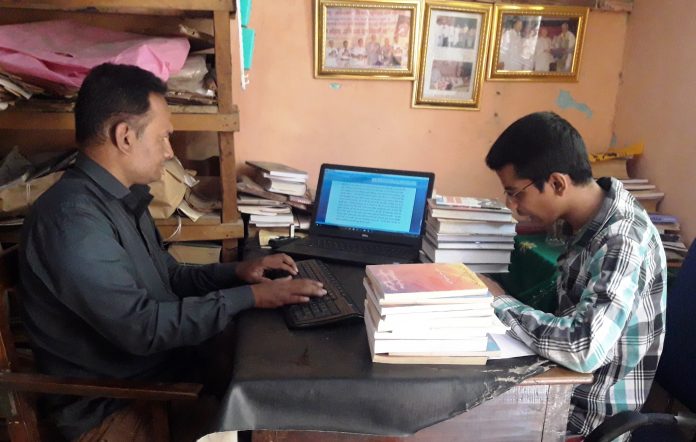
However, it is also no secret that many scholars have convincingly argued otherwise, and now a Solapur-based Research Centre is doing the same. Named after pioneering activist Advocate Sayed Shah Gaziuddin, the centre is publishing books in Marathi and Urdu languages to help people understand and value the secular fabric of the nation.
The inspiration for this works comes from the life and works of Advocate Sayed Shah Gaziuddin, who strongly believed in social binding and communal harmony and always wanted Muslims to be aware of the social conditions of India.
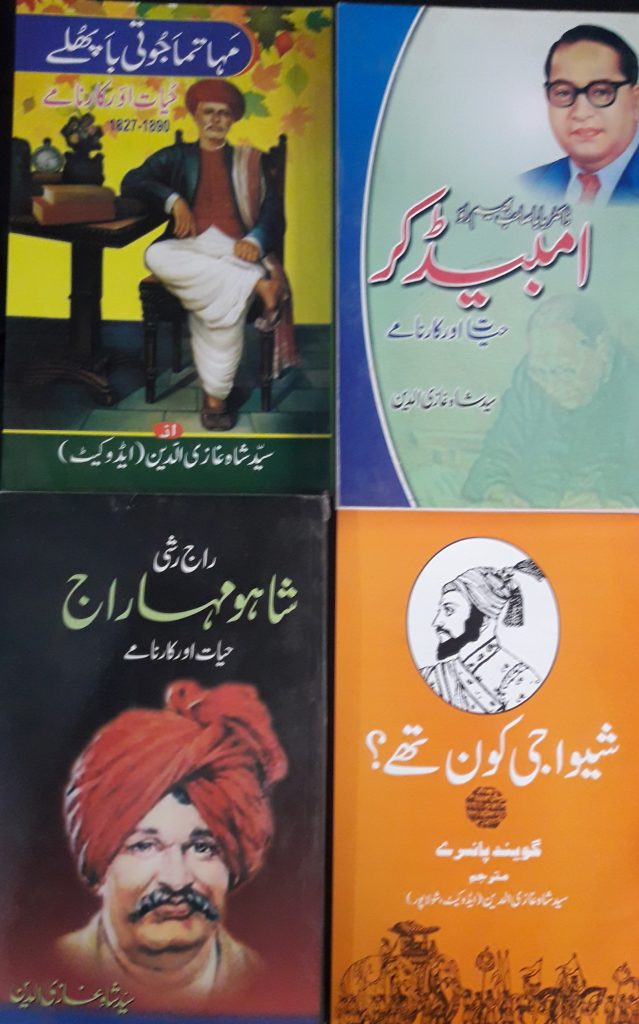
Through his Urdu books, he introduced life and work of many social reformers, including Jyoti Ba Phule, Shahu Maharaj, Dr. B.r Ambedkar and Chhatrapati Shivaji. Dr. Ambedkar Hayat aur Karname ( Life and work of Dr Ambedkar) and Urdu translation of Govind Pansare’s Marathi Book “Shivaji Kon Hota” ( Who was Shivaji) are masterpieces of his literary work.
After Adv. Gaziuddin passed away in January 2014 at the age of 79, some of his like-minded friends decided to establish a research centre to continue his vision and mission. In January 2015, the centre came into existence and started extending its literary services. Taking a cue from the works of Gaziuddin, his friends also started working on similar projects.
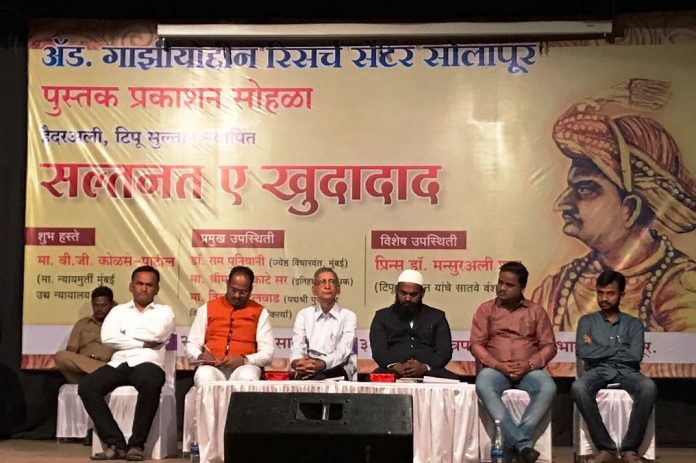
Sarfaraz Ahmed’s Marathi book on Tipu Sultan became popular in a very short time, with the book selling over 10,000 copies in a year. The fourth edition of the book is now ready to hit the market. Apart from a book on Tipu Sultan, Ahmed has also written Marathi books on Haider Ali, scholars of Medieval India.
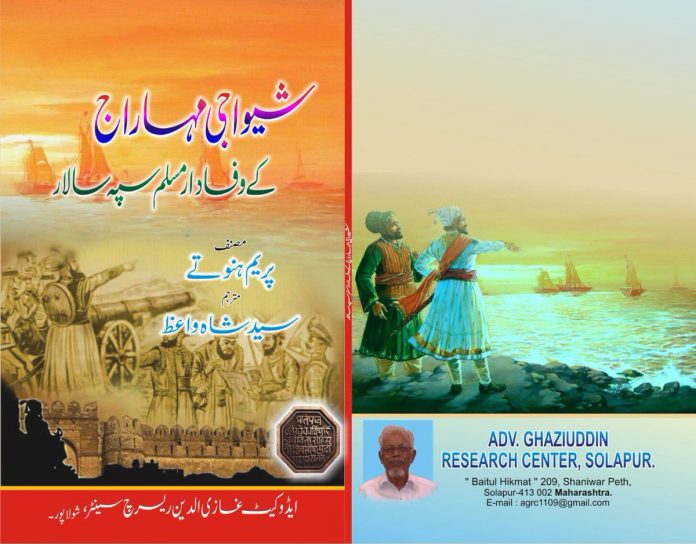
Also, Prem Hanvate’s “ Shivranche Muslim Sainik” ( Muslim soldiers of Shivaji ) was translated into Urdu by Sayed Wayez, the English book of Sayed Dawood “The Administration of the Deccan during Aurangzeb” has been translated into Urdu by Sayed Ismail.
In total, ten books have been published till now and work on some more books are in full swing, with ten young people also volunteering with the centre.
Talking about the centre, Vice president of the centre Ram Gaikwad said, “Late Adv. Gaziuddin was a dedicated progressive activist he has done a superlative job of bringing out the real history of social reformers of the majority community. His History research helps us in spreading brotherhood among Marathas and Muslims.
For the last ten years, I am also a part of his historical research panel and fortunately got an opportunity to continue this social work under his name.”
According to founder member and young historian Sarfaraz Ahmed identity of each and every community is based on its iconic personalities and social character is based on its history. “We carry out publication work by collecting donations from members. All the members from across Maharashtra are volunteers and they are all the under 30.
I must thank Sayed Ismail (Osmanabad) Sahil Shaikh (Sangli) Asif Mujawar (Latur), Kaleem Azeem (Pune) Prof. Mujeeb Kazi (Ambajogai) our President Samiullah Sheikh, Secretary Adv. Mahboob Kotimbre, Vice President Ram Gaikwad, Sayed Shah Wayez and our advisors B.G Kolse Patil, Shrimant Kokate, Sayed Iftikhar and M.I sheikh for their contributions.”
source: http://www.twocircles.net / TwoCircles.net / Home> Indian Muslim> Lead Story / by Imran Inamdar, TwoCircles.net / August 13th, 2018
Valanchery Munnakkal (Malappuram District), KERALA /Aligarh, UTTAR PRADESH :
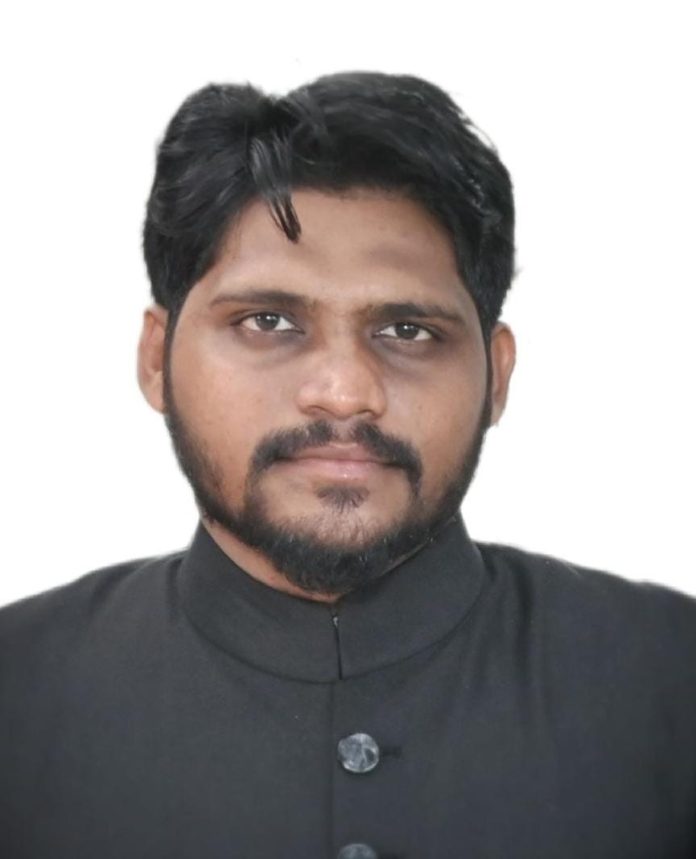
Dr Munawar Hanih, an ICSSR post-doctoral researcher under the mentorship of Professor T.N. Satheesan, Dean, Faculty of Arts, Aligarh Muslim University, has been selected for the 2023 Mahakavi Moinkutty Vaidyar Mappila Kala Akademi Literary Award
Aligarh:
Dr Munawar Hanih, an ICSSR post-doctoral researcher under the mentorship of Professor T.N. Satheesan, Dean, Faculty of Arts, Aligarh Muslim University, has been selected for the 2023 Mahakavi Moinkutty Vaidyar Mappila Kala Akademi Literary Award, instituted by the Mahakavi Moinkutty Vaidyar Smarakam under the Department of Culture, Government of Kerala.
He is being honoured for his scholarly work Malayala Sufi Kavitha, a significant contribution to the study of Mappila literature and arts.
The award will be presented at a ceremony in September 2025.
Dr Hanih holds an MA and PhD in Malayalam from AMU’s Department of Modern Indian Languages and has served as Assistant Professor of Malayalam at Sir Syed College, Taliparamba, Kerala.
source: http://www.radiancenews.com / Radiance News / Home> Pride of the Nation> Awards / by Radiance News Bureau / August 14th, 2025
How a series of breakfast conversations grew into an exhibition and a book.
On some mornings, Diba Siddiqi would sit down at the breakfast table in her parents’ home in Bengaluru, and record her father’s voice.
He would hold forth on everything under the sun – science, history, justice, conflict, photography, politics, poetry, philosophy, the evolution of language and silence. The musings continued well after the meal was over and an Olympus digital voice recorder Diba Siddiqi had placed nearby would capture her father’s thoughts.
The sheer range of topics wasn’t surprising. Obaid Siddiqi was one of India’s most eminent scientists whose pioneering work in the field of molecular biology and neurogenetics are well known.
Siddiqi was keen to have an account of her father’s stories in his own voice so that she could revisit them later. She had tried taking notes, but found the process distracting. She started using the digital recorder so that she could give him his full attention.
But the recordings, which started in 2007, ended in 2013 when the senior Siddiqi was killed in an accident while taking a stroll near his home. He was 81.
Immersed in history
Months later, Diba Siddiqi finally revisited the “breakfast monologues” as she called them.
She immersed herself in the stories her father had shared of growing up in eastern Uttar Pradesh in pre-Partition India and the sadness at how the Siddiqis lost track of family members who moved to Pakistan.
It wasn’t long before Siddiqi began to dig through old family photographs, many of them developed in darkrooms by her father and his siblings.
It didn’t stop at that. Diba Siddiqi’s mother, Asiya, is a distinguished historian, who has spent a large part of her life studying Mumbai’s past. Siddiqi began to delve into her mother’s life too.
The result is Rooh: The Enduring Spirit, an exhibition of old family photographs interspersed with new images Diba Siddiqi has taken of places that played an important part in her parents’ lives. A book of the same name is set to be released shortly.
Dominating figure
It’s obvious that Obaid Siddiqi was an overarching presence for his daughter. “My father was this colossal figure in my life,” said Siddiqi. “No language is adequate to express his continuing presence in my life. I still find myself quietly and unconsciously carrying on conversations with him.”
Born in Basti, Uttar Pradesh, in 1932, Obaid Siddiqi completed an MSc from Aligarh University before obtaining a doctorate from the University of Glasgow in Scotland. His family lived in Benares in two spells between 1932 and 1948 before finally settling down in Aligarh.
Preventive detention
The includes an account of the two years Obaid Siddiqi spent in jail from 1949 under preventive measures at a time when 30,000 communists were detained across country. Recalling his period of detention in the company of 13 Communist leaders, he said:
“So you see jail authorities, they used the criminals, who were called pukkas, to beat us up. They were prisoners who had served ten years, fifteen years, had life imprisonment… They acted like small unofficial wardens to control other prisoners. They were dressed to look like police. They beat up our friend Syed Ali badly, giving him galis, saying, ‘Pakistan se saala Pakistani Communist banta hai!’
However, Obaid Siddiqi could also recognise the benevolent side of the police officer who had beaten up the comrades, realising that human nature can never be categorised as entirely good or bad.
His parents and six siblings managed to send him letters during his imprisonment. His sisters arranged to smuggle letters in and out of jail while delivering home-cooked food to him once a week.
In 2014, Siddiqi visited Benares, where her father spent some time as a child. Waking at the crack of dawn every day, she walked around the ancient city, photographing the people and its streets.
Mumbai chronicler
Siddiqi also took many pictures in Mumbai, a city whose past her mother has written about extensively. One of Asiya Siddiqi’s celebrated works recreates the lives of people who went bankrupt in the 19th century. Roaming the bylanes of Mohammad Ali road and Dongri, in Mumbai, Siddiqui imagined that the ghosts of these people “and their descendants surely dwell in the neighbourhood I roamed in… The descendants of tailors, carpenters, blacksmiths, milk vendors, courtesans, dancing girls and prostitutes may continue to live and work here.”
Though the project is intensely personal, she believes it has broad appeal. She said she hoped viewers would let her work touch their mind and spirit and perhaps remind them of their own histories. “It is an expression of life that I have been a part of,” she said. “It has been about finding a voice in the images and bringing it together in one space.”
Rooh: The Enduring Spirit can be viewed at Bangalore’s 1 Shanthi Road gallery until February 11.
source: http://www.scroll.in / Scroll.in / Home> Photo Feature / by Zinnia Ray Chaudhuri / February 09th, 2016
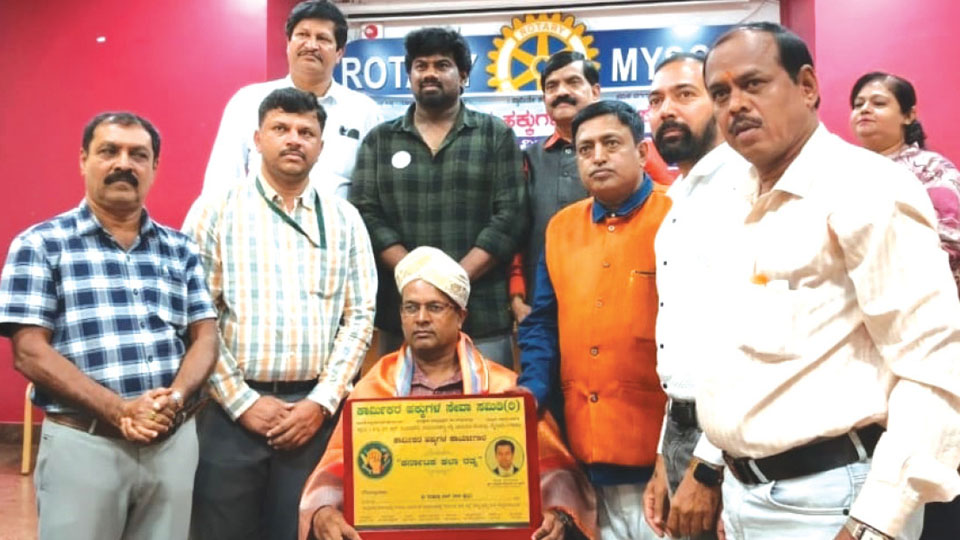
Radiulla Khan, Organising Secretary of Mysuru District Kannada Sahitya Parishat, being presented with ‘Karnataka Kala Ratna’ State Award during the workshop on ‘Labour Rights’ organised by Karmikara Hakkugala Seva Samiti at Rotary Hall on JLB Road in city recently.
The award was presented to Radiulla Khan in recognition for his works in multilingual films especially in Kannada language as a junior artiste.
M.S. Naveen, Chief Legal Aid Guardian, District Legal Services Authority (DLSA), V. Vinay Kumar from Employees State Insurance Corporation, industrialists and social workers M. Lalita Rao, Shubh Krupesh, V. Ramamurthy and Prashanth P. Aask, Actor-director Mahesh K.H. Belur, journalist Kasthurichandru and others were present.
source: http://www.starofmysore.com / Star of Mysore / Home> Photo News (headline edited) / July 26th, 2025
Let us not forget him in a hurry. Let us not reduce him to a paragraph in history books. Instead, let us pass on his memory like a worn volume of Pavangal, read and reread, loved and lived, whispered from one generation to the next.
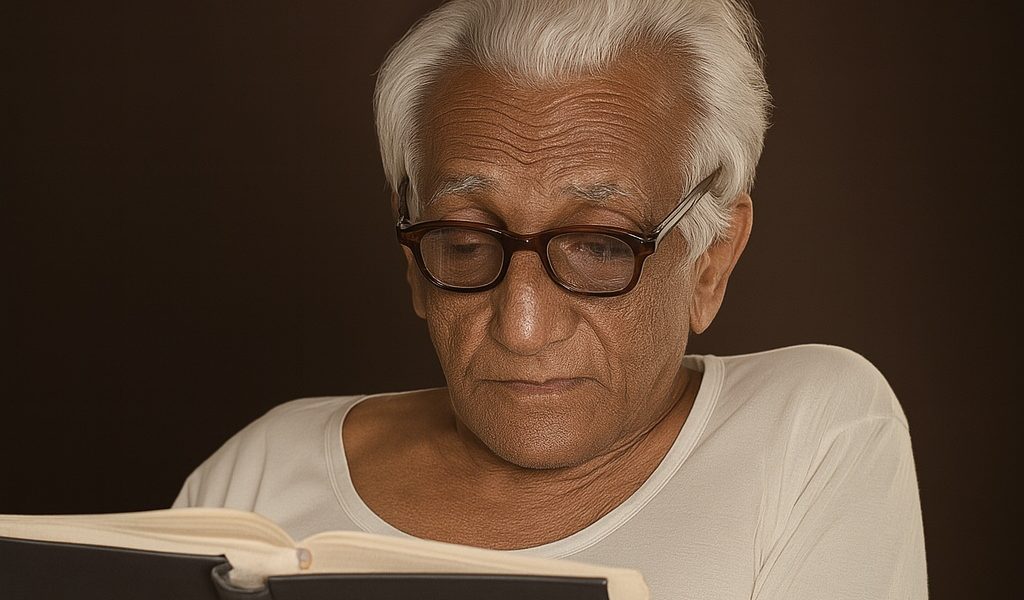
Vakkom Majeed (1909-2000). Photo: From KM Seethi’s archive.
Vakkom Majeed passed away on July 10, 2000.
“He never went out without a book under his arm, and he often came back with two.”
— Victor Hugo, Les Misérables
In the long and rolling corridors of memory, some lives stay like verses, opening out slowly, sentence by sentence, chapter by chapter, never quite closing. Vakkom Majeed’s was one such life. A life commemorated not only by its fearless engagement with history, but by its quiet, intense companionship with books. On the 25th anniversary of his passing, as we also mark the 100th year of Pavangal, the Malayalam translation of Victor Hugo’s Les Miserables , it feels almost providential to recall him through the pages he so often inhabited.
Majeed Sahib, as many called him with reverence, moved with a book always kept under his arm, a bulwark against ignorance, a lamp in times of doubt. And among the many volumes he read and reread, Pavangal held a sacred space. Nalapat Narayana Menon’s 1925 translation of Hugo’s masterpiece was more than literature to him. It was revelation. He had devoured the original edition in his youth, and its characters never left him – Valjean’s anguish, Javert’s moral rigidity, the revolt in the streets of Paris, the quiet dignity of suffering souls. When he spoke of Pavangal, it was with a fervour one reserves for scripture. He did not read the novel, rather he lived it.
A.P. Udayabhanu, a veteran freedom fighter of Kerala, once described Majeed as a “moving encyclopaedia with at least one book in his hands.” But Majeed Sahib was more than a repository of knowledge. He was a seeker, a provocateur of conscience, a gentle fire that never flickered out. I have the sweetest of memories of my time spent with him, from childhood itself, I remember the rhythm of his voice as he discussed Bertrand Russell’s three-volume autobiography, Churchill’s sprawling accounts of World War II, or the 10-volume correspondence of Sardar Patel. There was never a trace of vanity in his learning. He read not to impress but to illuminate. And when he shared his readings – Azad’s Tarjuman al-Qur’an, Muhammad Asad’s Road to Mecca, M. N. Roy’s The Historical Role of Islam, Arthur Koestler’s The Yogi and the Commissar, or Hugo’s Pavangal, like many – he spoke with the urgency of a man who felt truth must never be hoarded.
Born on December 20, 1909, in the storied Poonthran Vilakom family of Vakkom near Chirayinkil (Travancore), S. Abdul Majeed inherited a legacy of reform and resistance. His uncle, Vakkom Abdul Khader Moulavi, had already lit the flame of renaissance among Kerala Muslims. From his schooldays at St. Joseph’s High School, Anjengo, young Majeed was pulled into the vortex of reform movements and the call of the Indian freedom struggle. By the time the Quit India movement broke out, he was already a marked figure in Travancore, arrested, jailed, and later jailed again for resisting the plan of “Independent Travancore.”
But what set him apart – what made him more than just another freedom fighter – was the deep moral imagination that animated his politics. His understanding of rebellion was not ideological. It was profoundly ethical. Like Victor Hugo, he believed that human dignity must stand unshackled before the majesty of any state or creed. He condemned the ‘two-nation theory’ not because it was politically inconvenient but because it was morally vacuous. To him, the soul of India was plural, secular, and indivisible.
In 1948, he was elected unopposed to the Travancore-Cochin State Assembly from Attingal. But when his term ended in 1952, he walked away from practical politics, choosing instead the solitary path of reading, reflection, and moral clarity. While others sought power, Majeed Sahib sought wisdom. And in doing so, he became more relevant with age. Over the next decades, he would immerse himself in the philosophical and historical writings of Bertrand Russell, the radical humanism of M. N. Roy, and the emancipatory visions of Narayana Guru. He called for a “return of Ijtihad”, a freedom of thought within Islamic traditions, and dreamed of a society beyond caste and creed.
He never became rigid in doctrine. His politics was never a fixed ideology, but a conversation between ideas and reality. In our many conversations, I recall his thoughtful analysis of the Malabar Rebellion. He agreed with the thesis that it was fundamentally a revolt born of agrarian injustice but he was deeply saddened by its later communal turn. For him, the tragedy of history was when righteous anger was manipulated into sectarian hatred.
And always, there was a book in his hand. Always, a passage to quote. Always, a memory to share.
The last three decades of his life were his most contemplative. He reread the classics, interrogated nationalist histories, and engaged with young minds who came to him for guidance. To them, he gave not slogans but questions. When he spoke of Jean Valjean’s redemption, it was a commentary on our prison system. When he discussed Javert’s suicide, it became a parable about the dangers of legalism without compassion. When he recalled Fantine’s fall, it was a scathing critique of social hypocrisy.
He never forgot the moment when he visited the Indian National Army hero Vakkom Khader in the Madras Central Jail. It was Majeed Sahib who brought back Khader’s last letter to his father before his hanging, a task that broke his heart and steeled his resolve.
In 1972, when the nation celebrated the silver jubilee of independence, Majeed was awarded the Tamrapatra by Prime Minister Indira Gandhi. Later he was deeply perturbed by the excesses of Emergency.
There was no trace of ceremony in his life. No pursuit of fame or favours. He lived in quiet dignity, read in solitude, and died in obscurity, on July 10, 2000. He left behind not an estate, not a political dynasty, but an idea of what it means to live ethically, read deeply, and act justly.
Today, as we remember him, the centenary of Pavangal seems to carry the tenor of prophecy. One hundred years since Jean Valjean entered Malayalam letters, and twenty-five since Vakkom Majeed left this world, the two seem braided, one fictional, one real, both intensely human. Majeed Sahib was Kerala’s own Valjean: hunted by regimes, misunderstood by many, but ultimately redeemed by the fire of truth and the grace of humility.
Let us not forget him in a hurry. Let us not reduce him to a paragraph in history books. Instead, let us pass on his memory like a worn volume of Pavangal, read and reread, loved and lived, whispered from one generation to the next.
For in remembering Vakkom Majeed, we remember the best of what we once hoped to be.
K.M. Seethi is director, Inter University Centre for Social Science Research and Extension (IUCSSRE), Mahatma Gandhi University (MGU), Kerala, India. Seethi also served as Senior Professor of International Relations, Dean of Social Sciences at MGU and ICSSR Senior Fellow.
source: http://www.thewire.in / The Wire / Home> History / by K.M. Seethi / July 11th, 2025
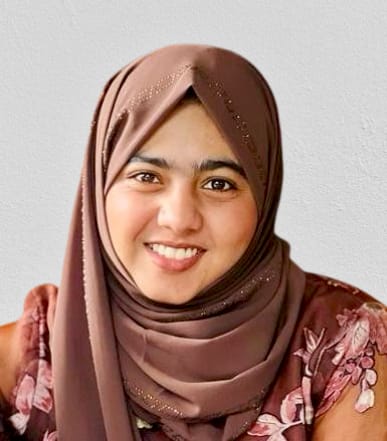
“This Too Shall Pass,” a debut poetry collection by Muskan Sufi, a young Kodagu student studying in Mysuru, has earned international recognition after being nominated for the prestigious Indie Authors Award 2025, held in memory of American poet Emily Dickinson. The book is now available for purchase online on Amazon.
Muskan Sufi, a student of English Literature and Psychology at St. Philomena’s College, Mysuru, hails from Virajpet in Kodagu and belongs to the Kodava Muslim community. Her literary achievement has drawn attention not only for its quality but also for the quiet determination that brought her recognition at a young age.
Published by the internationally acclaimed Bookleaf Publication, This Too Shall Pass was born out of Muskan’s participation in the publisher’s “21 Poems in 21 Days” challenge. She surpassed expectations by writing more than 28 poems, which resulted in a 50-page collection of emotionally rich, thought-provoking verse.
Her poems explore themes of pain, healing, nature, death, and the complexities of human emotion. With modern and socially conscious subjects, Muskan’s writing brings to life the inner turbulence of individuals and the beauty of life’s fleeting moments. She uses simple yet powerful language, aiming to connect souls and provide hope to those facing life’s darkest times.
Thousands of poets participate in Bookleaf’s global poetry initiatives, and the top entries are selected for book publication and nomination to the Indie Authors Award. Muskan’s nomination has created a ripple in the English literary community, marking a proud moment for the Kodava Muslim community.
Expressing her joy, Muskan said, “I joined the challenge after coming across the campaign on social media. I’ve always loved writing English poetry, but I never imagined my poems would be published or nominated for such a prestigious award. It’s given me great motivation to pursue more literary work.”
Muskan is the daughter of Duddiyanda H. Sufi and Masuda Sufi, who head the DHS Group of Companies in Virajpet. Her father also serves as the president of the Kodava Muslim Association (KMA).
Muskan’s poetry book, This Too Shall Pass, is now available for purchase on Amazon.
source: http://www.hindustangazette.com / The Hindustan Gazette / Home> News> Latest News / by The Hindustan Gazette / pix:kannada.hindustangazette.com / July 21st, 2025
Prof. Bilqis Bano to receive Lifetime Achievement Award, Dr. Raouf Khair to be honoured with Allama Iqbal Award.
New Delhi:
An important meeting of the Global Urdu Day Awards Committee (organised by the Global Urdu Day Organising Committee) was held under the chairmanship of senior journalist Jalaluddin at Daryaganj here.
The awards jury included Dr. Syed Ahmed Khan, Ashraf Ali Bastavi (Chief Editor, Asia Times, New Delhi), Suhail Anjum (former correspondent, Voice of America), and Javed Akhtar (Editor, D.W. Urdu, Germany, Delhi Bureau).
As per tradition, the awardees for the upcoming Global Urdu Day on 9 November 2025 have been selected.
The recipients are Prof. Bilqis Bano (Department of Biochemistry, Faculty of Life Sciences, Aligarh Muslim University) – Lifetime Achievement Award; Dr. Raouf Khair (Hyderabad) – Allama Muhammad Iqbal Award for Literature; Prof. Kauser Mazhari (Jamia Millia Islamia, New Delhi) – Mirza Ghalib Award for Poetry; Prof. Zehra Khatoon (Jamia Millia Islamia, New Delhi) – Maulana Ali Mian Award for Urdu-Persian Language; Dr. Aqeel Ahmad (Secretary, Ghalib Academy, New Delhi) – Maulana Abdul Majid Daryabadi Award for Language and Literature; K.L. Narang Saqi (New Delhi) – Kunwar Mahendra Singh Bedi Award for Literature; Yaseen Momin (Mumbai) – Qazi Mohammad Adeel Abbasi Award for Promotion of Urdu Language; Syeda Talat Nasreen (TN Bharti, New Delhi) – Noor Jahan Sarwat Award for Journalism; Syed Zubair (Muslim Mirror, New Delhi) – Maulana Usman Farqaleet Award for Journalism; Maulana Abdul Hameed Numani (New Delhi) – Maulana Sanaullah Amritsari Award for Column Writing; Abdul Mannan (Editor, Yojana Urdu, New Delhi) – Maulana Mohammad Muslim Award for Journalism; Jamshed Khan (Aaj Tak, New Delhi) – Ameen Sayani Award for Electronic Media; Saurabh Shukla (Red Manak, New Delhi) – Pandit Devnarayan Pandey Award for Journalism; Abid Anwar (UNI Urdu, New Delhi) – Mahfuzur Rahman Award for Journalism; Shohrat Ansari (Khalilabad, U.P.) – Imdad Sabri Award for Journalism; Hafeezur Rahman (Sharq Adeel, Marahra, Etah District, U.P.) – Ismail Merathi Award for Poetry; Mohammad Yamin Zaki (Editor, Hilal, Rampur) – Dr. Zakir Hussain Award for Children’s Literature; Farooq Ahmad (Doordarshan, Delhi) – Ilmat Yasin Award for Promotion of Urdu; Prof. Dr. Ziaur Rahman Siddiqui (Aligarh) – Mazharuddin Khan Award for Teaching; Master Iqbal Ahmad (Former Headmaster, Jamia Middle School, New Delhi) – Maqbool Ahmad Siddiqui Award for Best Teacher; Prof. Abdul Majid Mohammad Siddiq Siddiqui (Malegaon) – Maulana Azad Award for National Integration; Prof. Khalid Mubashshir (Jamia Millia Islamia, New Delhi) – Hafeez Merathi Award for Naat Poetry; Dr. Ibrahim Afsar (Meerut) – Naseeruddin Hashmi Award for Urdu Research; Dr. Azeer Ahmad (Islampur, West Bengal) – Maulvi Abdul Haq Award for Literature; Dr. Nihal Nazim (Moradabad) – Dr. Abul Faiz Usmani Award for Promotion of Literature; Dr. Abu Saad Asari (Jhanda Nagar, Nepal) – Indo-Nepal Friendship Award; and Hidayat Publications, New Delhi (Syed Abul A’la Subhani) – Munshi Naval Kishore Award for Publishing.
Dr. Syed Ahmed Khan, the convener of the Global Urdu Day Organising Committee, expressed hope that the selected awardees will continue to play a significant role in the promotion of the Urdu language.
source: http://www.radiancenews.com / Radiance News / Home> Pride of the Nation> Awards> Latest News / by Radiance News Bureau / July 15th, 2025
Inquilab and Mid-Day founder Abdul Hamid Ansari is an inspiration not just for journalists but millions of youngsters … A special report by Siraj Ali Quadri.
Indian journalist and Muslim nationalist Abdul Hamid Ansari founded Inquilab, an Urdu daily in Mumbai in l937. The newspaper soon became a landmark in Urdu journalism which caught the attention of Muhammad Ali Jinnah, the founder of Pakistan. But when Jinnah asked Ansari to come to Karachi to publish the newspaper in the new country, Ansari said that he would prefer to live in India like the many million Muslims who would rather stay in the country than join Jinnah. Those who joined Jinnah undoubtedly left everything behind. Some flourished while others got established. But that’s another story, which has never ended since l947.
Today’s story is about the veteran journalist, publisher and businessman Khalid A.H. Ansari, son of Abdul Hameed. After passing out from St. Xavier’s in Mumbai, Khalid did his master’s at Stanford University in the US.
Khalid returned to Mumbai to establish Sportsweek, a weekly sports magazine, which became a huge success soon after its launch. The magazine’s immediate success can be attributed to the fact that its founder was himself an excellent sportsman and did a great job with the magazine, in addition to his father’s paper Inquilab.
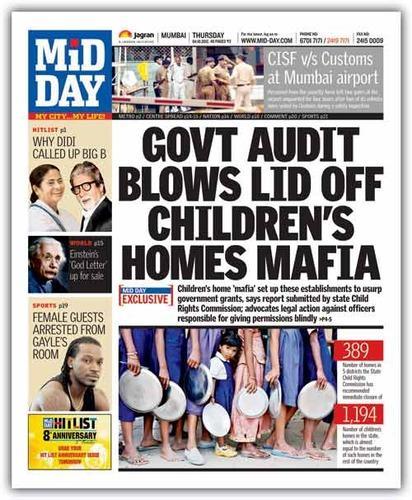
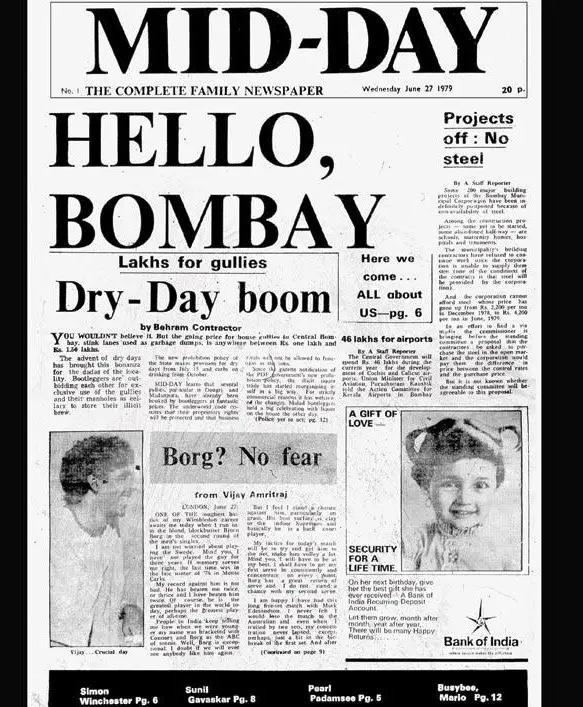
Meanwhile, the idea came to launch India’s first daily tabloid, Mid-Day, which he modelled in many ways after the English tabloids from Fleet Street. During the planning phase of their new venture, he spent hours discussing it with staff and mulled over its format to ensure success, especially since there were already two eveningers in Mumbai, one by The Times of India and the other by the Indian Express. Both suffered from a lack of innovation to attract large numbers of readers. So when Mid-Day appeared with a new face and content, the two old ones just collapsed. Although the ToI eveninger protested the pace of time for a while, it eventually perished as it had already become obsolete.
Mid-Day became a resounding success, with many comparing it to the British Daily Mirror and Daily Mail. However, being an Indian tabloid, it was much quieter and a whole lot more civilized, without the British fondness for nudity and sex, and nonsensical stories of stupidity.
Khalid was helped by his wife, Rukaya. She was very active on the administrative side and contributed to the editorial content and layout, which helped the paper sustain itself in the demanding market of Mumbai. She knew what was going on in the office and in the newspaper that was fast becoming India’s flagship eveninger.
Meanwhile, Khalid accepted an offer to become editor-in-chief of the Dubai-based Khaleej Times, and handed over the paper to his son, Tariq. After a few years in Dubai, Khalid returned to Mumbai and launched Mid-Day in Bangalore and Delhi and a regional Gujarati version for millions of Gujaratis in the country.
He has been involved in various programmes with the Indian government during conferences in Delhi and New York, launching and editing newspapers, and was awarded the Padma Shri in 2001 while continuing to play and write about his old passion, cricket.
Writing about his eveninger, Khalid says, “Mid-Day is a light-hearted, easy-to-read, entertaining, and ‘naughty’ paper that now has a new purpose which is to make work fun. Gives young professionals an entertaining newsbreak. The focus is on young, urban, mobile professionals across India and the company is leaving no stone unturned to engage with them. Today’s workplace’s fast-paced work style and crazy deadlines are full of stress and pressure. Mid-Day as a brand believes in spreading the message of reducing stress and making work fun.”
“What’s on, a host of addictive, fun sections like Hit List Crosswords, Horoscopes, and Fun at Work ensure that the newspaper remains a welcome diversion for young professionals,” he adds.
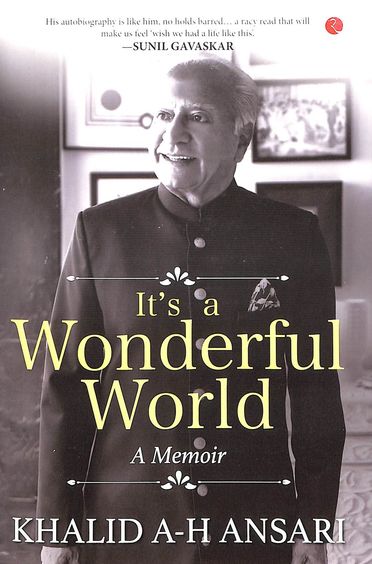
Khalid’s Sportsweek later was shut down with the television boom making it hard to garner advertisements and interest. Khalid has also published his memoir (It’s A Wonderful World) and continues to inspire a stream of journalists apart from various generations to keep the boat afloat and touch new heights.
(The Author is Journalist & associated with Dainik Bhaskar)
source: http://www.asianlite.com / Asian Lite / Home / by Siraj Ali Quadri / October 10th, 2022
The evocative recapitulation of eminent personalities provides a quick, candid, exquisite and scrupulous portrayal of those who retain their abiding presence without being physically present in the world.
The unprecedented acceptance of monolingualism has put a big question mark on the existence of numerous languages through which people stitch up a warm social rapport and seek to fulfill their cultural aspirations. India, an awe-inspiring repository of innumerable dialects, languages and different linguistic traditions, finds it nerve-racking to carry through the challenges thrown open by the technology-savvy language-English. The domination of English has taken a heavy toll on regional languages, and Urdu, once considered a significant link language, is no exception. Though Urdu is widely used as a spoken language, and its sensitively rendered poetry gets across the country, its script has been fading away with bewildering speed.
It aches much to realize that the popularity draws its sustenance from its oral rendering, and familiarity with its distinct script has been melting away steadily. Barring some notable exceptions, only faculty members and research scholars associated with various departments of Urdu of the universities and colleges use Urdu as the medium of trifling academic discourse. At a time when Urdu faces the threat of obsolescence, the gleam of hope emerges from the citadel of learning, Aligarh, where academicians not belonging to humanities draw on Urdu to initiate a perceptive discourse on a plethora of issues without bringing rhetorical flourish into play.
Professor Saeeduz Zafar Chagatai (Physics), Professor Faseeh Ahmad Siddiqui (Chemistry), Professor Athar Siddiqui (Zoology), Professor Shaan Mohammad (Political Science), Professor Iftikhar Alam Khan (Museology), Professor Zilur Rehman (Unani Medicine), Professor Mohammad Sajjad( History ), Professor Zafar Mahfooz Nomani (Law) Dr Asad Faisal Farooqui (Mass Communication) and the like seek to strengthen non-fiction prose in Urdu.
Autobiography, memories, diary, letters, sketches and anecdotal scrolls are much-adored genres of non-fiction prose, but in Urdu, they usually betray a strong sense of gushiness and sickening self-adulation. The preponderating narrative of reminisces does not go well with the celebrated author, Professor Athar Siddiqui, whose evocative recapitulation of eminent personalities appeared.
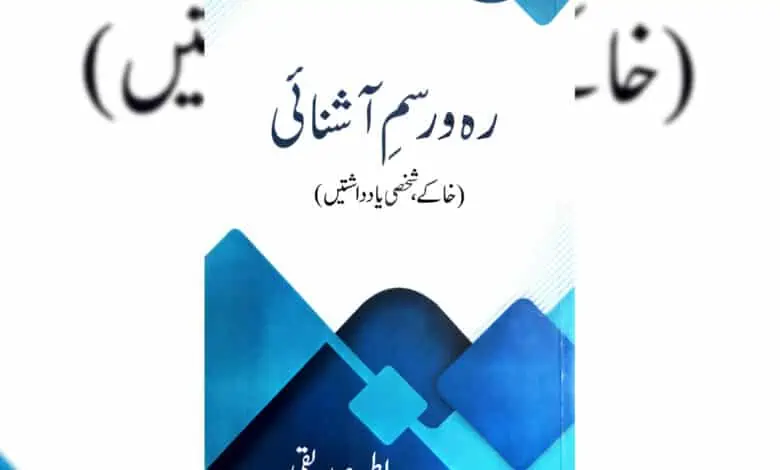
The book Rahe wa Rasm-e-Aashnai (sketches and personal memoirs) provides a quick, candid, exquisite and scrupulous portrayal of those who retain their abiding presence without being physically present in the world.
Professor Athar Siddiqui, a widely recognized scientist, has produced a captivating narrative of his eventful life, Main Keya Meri Hayat kaya, with disarming humility and jotted down travelogues vividly calling attention to down reaching human experiences that frequent foreign travels produce. Interactive media frequently carry intriguing stories featuring commonplace occurrences. The stories with a strong sense of moral tutoring dished out by the digital world need to be shared with non technology conversant Urdu knowing people.
He left Professor Athar Siddiqui to supplement what had been missing and started translating these pulsating stories into Urdu. It was left to Professor Athar Siddiqui to supplement what had been missing, and he translated these pulsating stories into Urdu.
Tahzibul Aklaqh, a prestigious periodical launched by Sir Syed in 1870, started serializing it with a suggestive title Hairat Sarai Ki Kahaniyan (The stories of wonderland), and two volumes of these laconic and absorbing stories have appeared so far.
He meticulously edited two autobiographies of two illustrious alums of Aligarh Muslim University–Dr. Sheikh Mohammad Abdullah (founder of women’s college, AMU) and Nawab Ahmad Saeed Khan Chattari ( former Governor of Uttar Pradesh). He had astutely done over translating books on Shaheryar and Musa Raza.
Athar Siddiqui’s recently published book, Rah-o-Rasam-e – Aashnai,” creatively maps out the accessible and unchartered terrains of thirty-five personalities in candour-driven idiom, and he hardly holds with the popular notion that put a lock on showing the slightest discourtesy to the deceased. The author asserts, “It is widely mentioned that the sketch writer must not use any indecent or improper word for those resting in the peace. If this sort of exhortation is adhered to, then the sketch, personal article and memories will be read as appreciation and admiration-filled text. If history writing sticks to this principle, then the authentic history of any period could not be produced. I do not buy this argument.”
The subtle wised-up mélange focuses on nine creative writers such as Shahryar, Iqbal Matin, Sajida Zaidi, Qazi Abdus Sattar, Professor Mukhtar Uddin Arzoo, Syed Hamid, Lateefuz Zaman and a couple of close relatives, teachers, friends and former vice-chancellors.
Iqbal Matin, whose awe-inspiring artistic sensibility could not get him the recognition across the country he fully deserved, has come in for a refined exploration. Athar Siddiqui’s reminiscence is peppered with unusual but fascinating details about the author. The author living in Aligarh tried desperately to contact Iqbal Matin (Hyderabad) when the letter was the preferred communication medium. He realized that his letters were not delivered to the addressee, who was prone to change houses. Iqbal changed thirty-five houses and bore testimony to his nomadic lifestyle.
Much has been written on Jnanpith awardee and prominent poet Shahryar but a comprehensive and insightful article highlighting his distinctive personal traits and oeuvre is still looked-for. The piece titled “Shahryar as a man and poet” fills the bill with remarkable ease. Athar saheb cites many instances to prove Shahryar’s unflinching loyalty to his friends but never spitting upon the rivals. The voice of modernism with strong traces of neoclassicism, Shahryar never nurtured animosity and did whatever he could for those who looked up to him in their hours of peril. People, even authors and pushover critics tend to read creative texts in the backdrop of personal details; hence when Shahryar suffering from a terminal illness- cancer–composed a couplet; Aasman ab kuch nahi tere karney ke liye/Ham ne sab taiyaariyan karli hain marne ke liye (O sky, now you have nothing to do/I have completed all the preparations for dying) it was considered as the affirmation of impending death. Employing critical acuity, Athar saheb mentioned that the couplet has nothing to do with a nagging sense of personal extinction; the poet laments how we perfected the art of self-destruction reflected in the depletion of Ozone layer manufacturing of weapons of mass destruction.
Athar Siddiqui wrote an immensely readable sketch of Qazi Abdus Sattar, a much overrated and pretentious writer who always took pride in using ornate and florid language in his fiction. His novel Tamam Sultan has been described as magnum opus, but it is hardly more than an oft-repeated titillating story of unrequited love. Athar Saheb and Qazi have had close ties for over fifty years, but Qazi was so intemperate that he pulled ties into pieces as Athar could not attend his facilitation function. It was an act of civility to describe this narcissism as uniqueness of personality.
Prof Zilur Rehman, a widely- respected academician of Unani medicine, is a well-known scholar of Urdu, Persian and Arabic and has more than fifty books to his credit. His books, especially on Ibne Sina, Hakim Ajmal Khan, Sir Ross Masood, Hakim Ehshanullah Khan, and Hakim Abdul Moid, got widespread admiration. In addition to discussing his well-documented and invigorating writings, Athar Siddiqui effortlessly unravels his amenable nature and inimitable passion for books and artefacts. He has a collection of over 70,000 and set up a museum and library, Ibne Sina Academy, which has its website.
Seldom does one attempt to spell out what essentially embodies his wife, going beyond the adulation and berating with a sense of objectivity. This nagging edginess seems to have no bearing on Athar saheb, who painted a stirring wordy portrayal of his wife Zakia Siddiqui, a renowned academician and former principal of Women’s College, Aligarh Muslim University.
One tends to agree with the author when he asserts that during the first ten years wife is treated as the beloved; with the birth of children, she takes over the role of the mother. If harmonious marital life continues, she becomes an inseparable friend who hardly gets perturbed, no matter how annoying one becomes. It is all momentary, and the bond of affinity never weakens.
Athar saheb also evocatively narrated his mother’s life story, and he recollects his memories and anecdotes to document her extraordinary considerate nature. Suhail (son) and Taab (daughter) get pat on the head by the caring and unerring father for their abiding sympathy for others.
The book turns attention to a dozen vice-chancellors and pro-vice-chancellors of AMU, such as Dr Zakir Hussain, Bashir Hussain Zaidi, Badruddin Tyabji, Abdul Aleem, Ali Mohammad Khusro, Syed Hamid, Syed Hashim Ali, Wasiur Rehman, Naseem Farooqui, Mahmoodur Rehman, Hamid Ansari and Abul Hasan Siddiqui.
The author’s appraisal of them looks convincing, but occasionally subjectivity surfaces. The assortment of sketches offers a discerning peep into the life of all who impressed the author. The nuanced and readable prose is used impeccably, and Athar Siddiqui deserves accolades for producing such picturesque vignettes.
Shafey Kidwai is an Indian academic, communication scientist, translator, columnist, and author. He is the chairman of the Department of Mass Communications at Aligarh Muslim University.
source: http://www.siasat.com / The Siasat Daily / Home> Featured News / by Shafey Kidwai / September 26th, 2025
The centuries-old Islamic educational centre, birthplace of the Urdu Qur’an translation, struggles to protect its legacy amid growing Hindu-led development projects.
New Delhi :
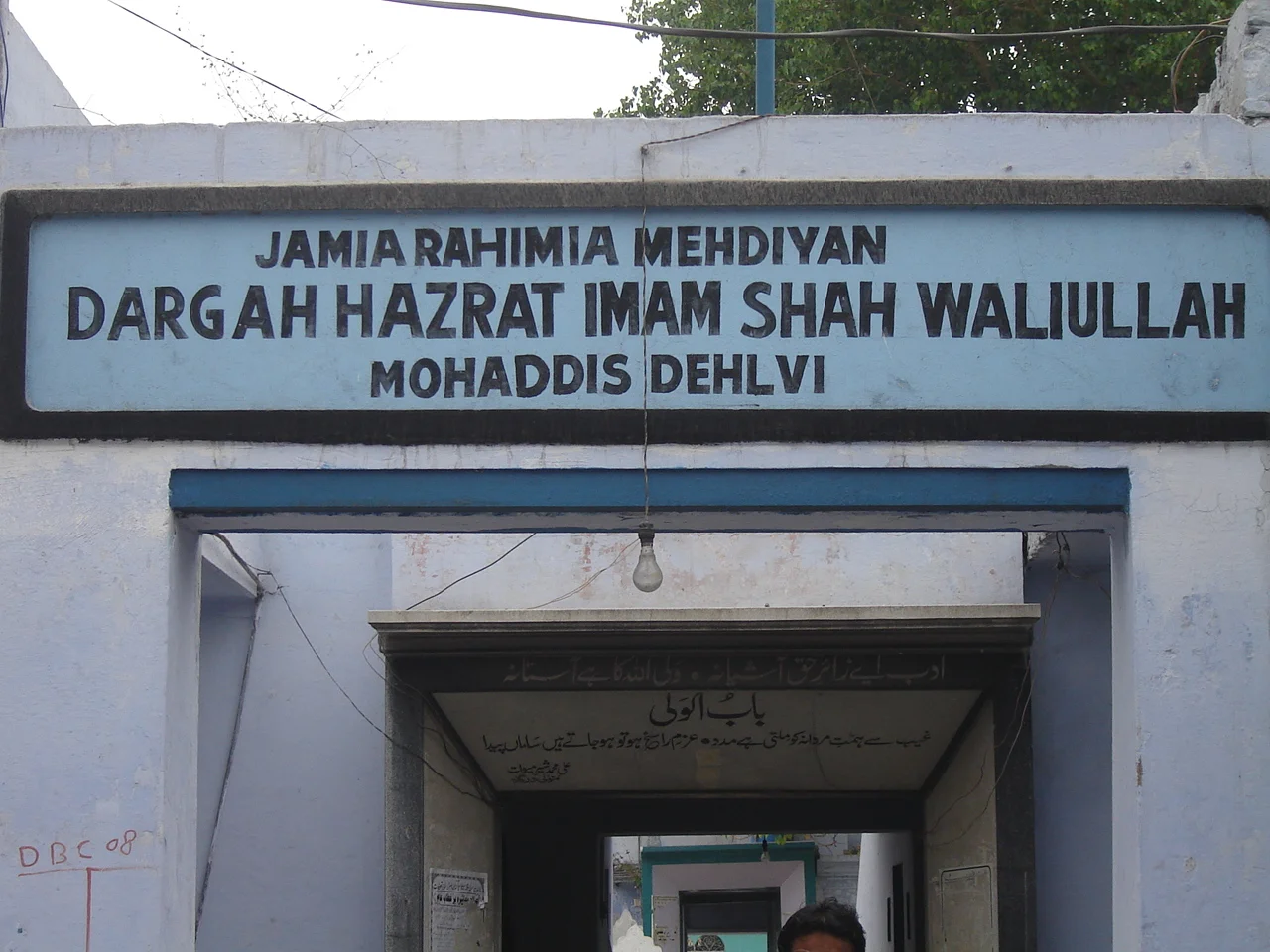
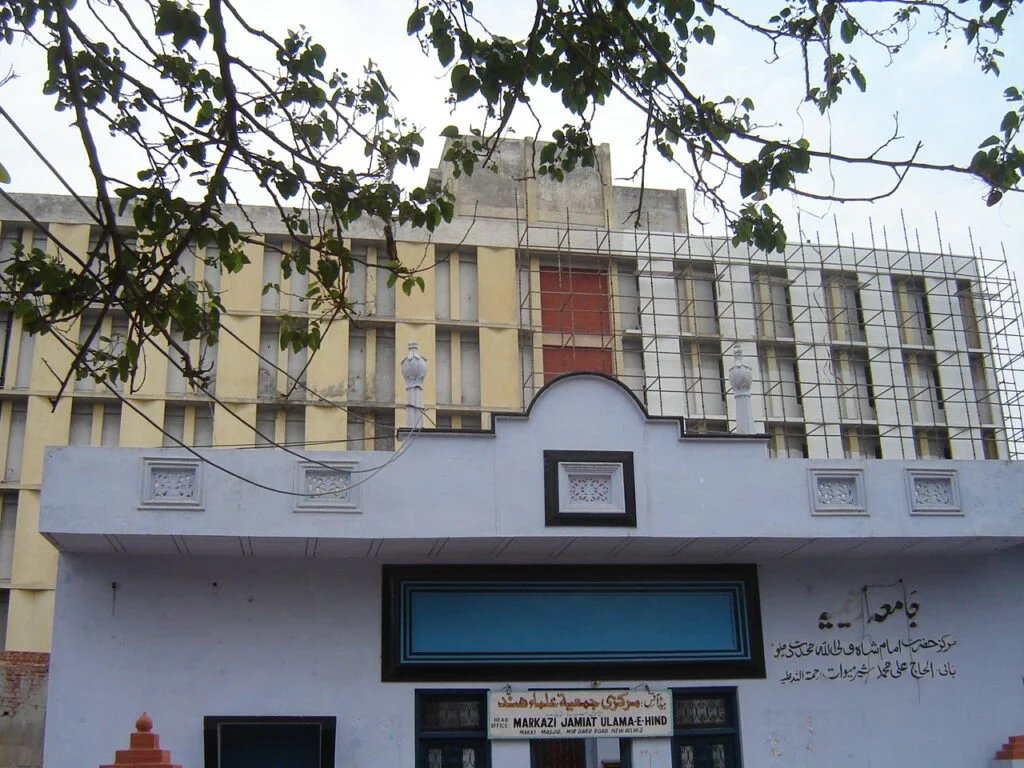
Hidden along the busy Bahadur Shah Zafar Highway, Mehdiyan — home to the revered Madrasa Rahimiya, also known as Jamia Rahimia — stands as one of Delhi’s oldest Islamic learning centres. Established by Shah Abdul Rahim, father of the famed scholar Shah Waliullah Muhaddith Dehlvi, this madrasa has for centuries served as a vital institution nurturing Islamic scholarship. However, today its existence is threatened by creeping urban development dominated by Hindu groups, threatening to erase a vital piece of Muslim heritage.
“Madrasa Rahimiya was not just a school; it was a movement to bring Muslims closer to the Qur’an’s true teachings,” explains Mufti Muhammad Sabir, a Hadith instructor at the madrasa. “But its history is being erased by those who prioritise development over our heritage.”
Madrasa Rahimiya holds a proud place in history, especially for pioneering the first Urdu translation of the Qur’an. In the late 1700s, Shah Abdul Qadir, a key scholar educated under his father and others, undertook the translation project at the Akbarabadi Mosque. This effort laid the foundation for making Islamic scripture accessible to millions of Urdu-speaking Muslims across India, who were otherwise unable to understand the original Arabic text.
“Shah Abdul Qadir’s translation was revolutionary, yet it faced strong opposition from scholars who considered translating the Qur’an sacrilegious,” says Maulana Sabir. “Despite this, his work endured and shaped generations.”
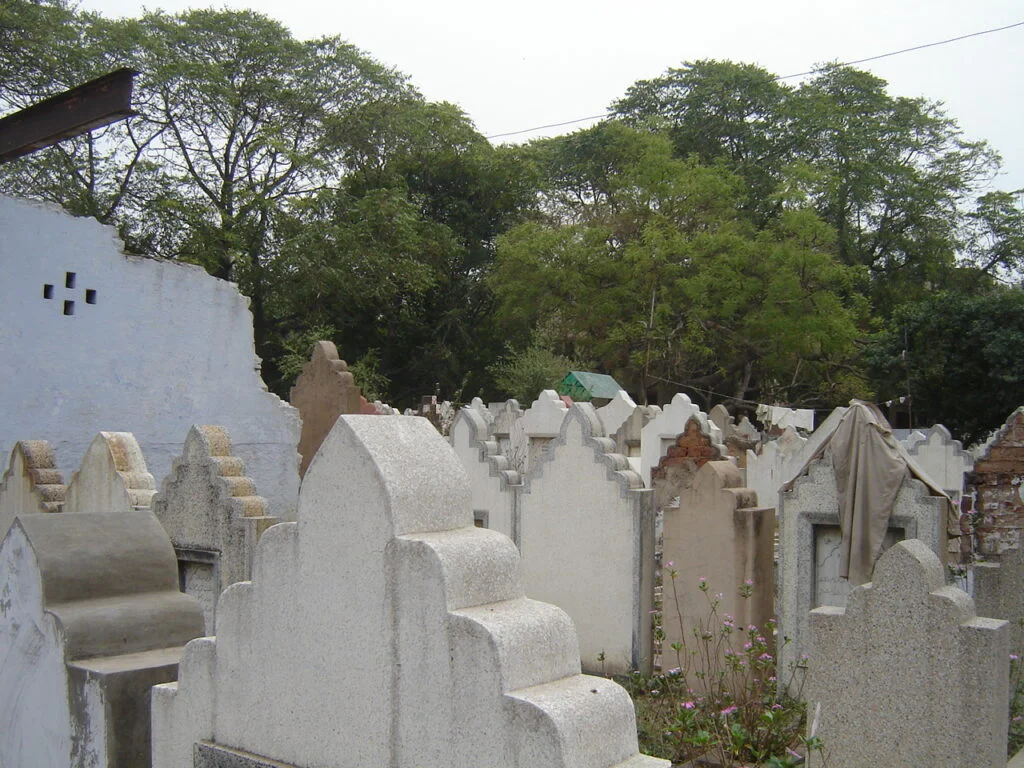
But this rich history has not been free from hardship. After the 1857 War of Independence, British colonial forces destroyed the Akbarabadi Mosque and shuttered the madrasa. The adjoining Mehdiyan cemetery, the resting place of Shah Waliullah and his family members, was drastically reduced. Historian Rana Safavi laments, “Mehdiyan was once a vast necropolis for saints and commoners alike. Now, much of it is lost to encroachment, with what remains used merely as a washing place.”
In the 1960s, Delhi’s expanding urban sprawl posed new threats. Plans to demolish Mehdiyan to build flats and houses were only halted because of the heroic resistance of Ali Muhammad, known locally as Sher-e-Mewat. “He lay down in front of bulldozers and even Pandit Nehru’s car to protect these sacred shrines,” recalls resident Bilal Ahmed. “He broke his leg but ensured our heritage survived.” Jawaharlal Nehru himself was moved by Ali Muhammad’s determination and ordered the preservation of these sites, which were later enclosed by a boundary wall.
Yet, the madrasa’s survival is once again at risk. Critics point out that the latest wave of urban planning, heavily influenced by Hindu groups, disproportionately targets Muslim heritage areas. Historian Zafar Khan asserts, “Hindu groups have long viewed places like Mehdiyan as obstacles to their vision of a ‘modern’ Delhi. This is not just about land — it’s an attempt to erase Muslim identity.”
Local Muslims feel the marginalisation acutely. “Our history is being systematically sidelined,” says Ayesha Begum, a teacher at Jamia Rahimia. “While Hindu temples receive government protection and funding, our sacred sites are neglected, ignored, or demolished.” She highlights the glaring lack of state support for the madrasa compared to the ample aid granted to Hindu religious institutions.
Despite the ongoing pressures, Madrasa Rahimiya endures as a symbol of resilience and faith. Its small mosque and student quarters continue to operate, preserving the teachings that Shah Waliullah and his predecessors established centuries ago.
“We teach the same Qur’an and Hadith that Shah Waliullah did,” says Mufti Sabir. “No matter the encroachment or neglect, that legacy will not disappear.”
The battle to save Mehdiyan reflects wider tensions in India, where Muslim cultural and religious heritage frequently confronts Hindu nationalist agendas. For now, the madrasa stands firm — a testament to Delhi’s Muslim scholars’ enduring spirit and their steadfast commitment to preserving Islamic knowledge and identity.
source: http://www.clarionindia.net / Clarion India / Home> Culture> Editor’s Pick> India / by Mohammed Bin Ismail / May 24th, 2025