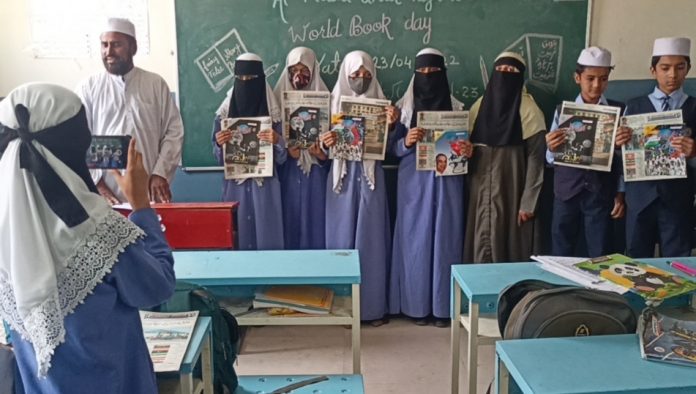
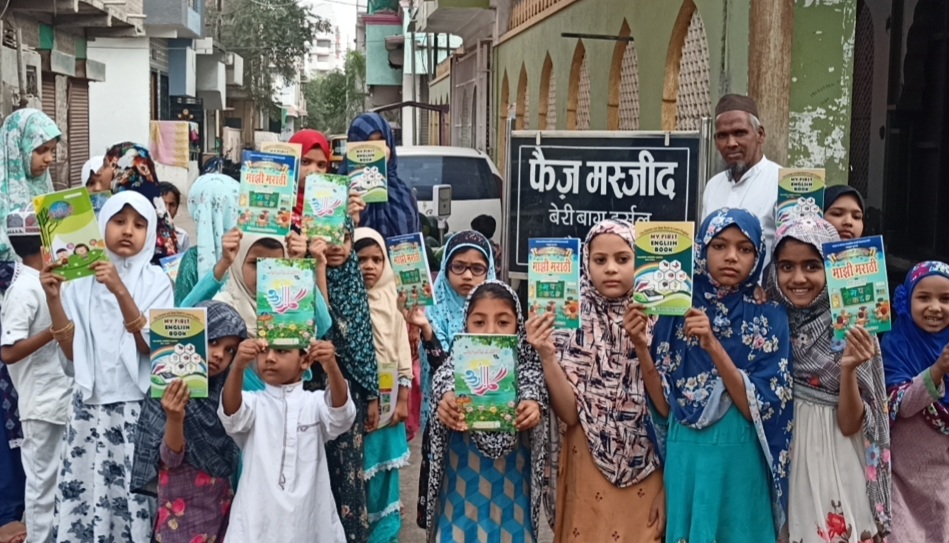
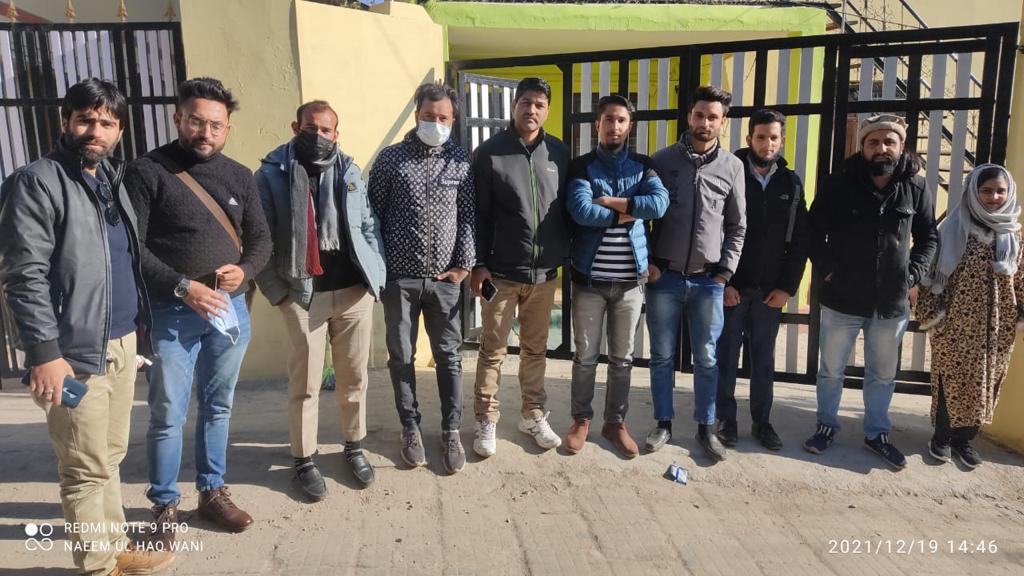
On World Book Day, the Maryam Mirza Mohilla (neighbourhood) library movement commemorated the occasion with zeal. Several book reading and distribution activities were held in city mosques and Urdu schools under the auspices of the Read & Lead Foundation.
The Foundation’s President, Mirza Abdul Qayyum Nadvi, announced the commencement of a “Book at Home, Book at Every Home” campaign at the event. He stated that the book-reading awareness campaign is only getting started because today’s young generation is losing interest in reading due to the introduction of new electronic gadgets, particularly smart phones
Urdu, Marathi, English books were distributed to the children members of Maulana Syed Abul Hassan Ali Nadvi Mohalla Library situated in Masjid Faiz Beri Bagh, Harsol area of Aurangabad.
It should be noted that for the past year in Aurangabad, 28 libraries have been working under the aegis of the Read & Lead Foundation in various sections of the city, slum mosques, Urdu schools, and neighbourhoods. More than 5,000 children are connected to these libraries.
It’s worth noting that eleven (11) of the 28 libraries are dedicated to children are located in mosques. Masjid Shadab Hina Nagar, Ahmadi Masjid, Shatabdi Nagar, Maulana Hasrat Mohani Mohalla Library, Misrarwadi, Qazi Iqbaluddin Mohalla Library, Bismillah Masjid, Madrasa Falah Darin Ghulam Mustafa, Sher Khan Pathan Mitra Mandal Library, Narey Village Mohalla Library and other places. In addition to this, Al-Huda Urdu High School Baijipura, Dr. APJ Abdul Kalam Mohalla Library Baijipura and other libraries celebrated World Book Day.
Maulana Sheikh Yusuf Nadvi, Imam of Masjid Faiz, where the Maulana Syed Abul Hassan Ali Nadvi Mohalla Library is located, stated that he would do everything in his power to ensure that the library benefits the children and women of the area as much as possible. After Friday prayers, he also declared the start of the door-to-door book drive.
Sheikh Nargis Fatima, Headmistress of Al-Huda Urdu High School, stated that her school’s students and instructors would be more active in the campaign and would offer all available assistance. Farhat Jahan, a school teacher, and other teachers took part in the presentation and offered their opinions..
Children’s monthly periodicals such as “Bachu ki Dunia,” “Umang,” “Taleemi inquilab,” “Majhi Marathi,” “Meri English Kitab,”,” “Gulzar Urdu,” and other books, magazines, and journals were distributed to members of the aforementioned libraries.
source: http://www.muslimmirror.com / Muslim Mirror / Home> Positive Story / by Special Correspondent / April 26th, 2022
Shabnam Riyaz, a Malayali qawwali singer, enthralled audience at the World of Women event underway at Kovalam Art and Craft Village.
Kochi:
Qawwali music imbibes the essence of Sufism. The ecsatcy that audience enjoy when the qawwals sing at a gathering is unexplainable. Although the genre has been traditionally male-dominated, Malayali playback singer turned qawwal Shabnam Riyaz is quite popular among the country’s Sufi singers. Recently, she performed at a qawwali concert in the ongoing World of Women (WoW) 2022 event at the Kovalam Art and Craft Village.
Her all-woman qawwali group Layali Sufiya showcased an energy-packed performance.
Shabnam says fusion helps audience relate more with the qawwali genre. Thrilled to be back on stage after the pandemic-induced lull, Shabnam, who is an ardent fan of Ustad Nusrat Fateh Ali Khan, says pure rendition of qawwali music is quite rare in Kerala, though it is common in northern India.
“Though I perform qawwali fusion for my audience, I focus more on traditional pieces. Most people hear Sufi music and think ghazals. Qawwali is an ecstatic form of music infused with divinity,” she says. Qawwalis often showcase vibrant, physically exhilerating performances, that many audience find bizzare. “I have seen many trolling popular Sufi singers, the Nooran sisters. But when you devote yourself to qawaali, it is hard to control your moves,” adds Shabnam who also offers Sufi music classes. She belives Sufi music was passed down to her from her great-grandfather, Vavaasan, a bhagavatar in Kollam who excelled in qawwalis.
The Ochira native has been living in Thiruvananthapuram for over a decade now and was the trainer for Khateeja, A R Rahman’s daughter.
According to Shabnam, there are very few qawwals still, because it is a strenuous style of singing. “After a performance, we may need at least three days of voice rest. Many girls who approached me lacked the stamina for it,” adds Shabnam whose dream is to create qawwali music using Carnatic compositions. She is the voice behind popular tracks like Vennila Chandanakinnam and Shukira.
source: http://www.newindianexpress.com / The New Indian Express / Home> Cities> Kochi / by Arya U R, Express News Service / March 12th, 2022
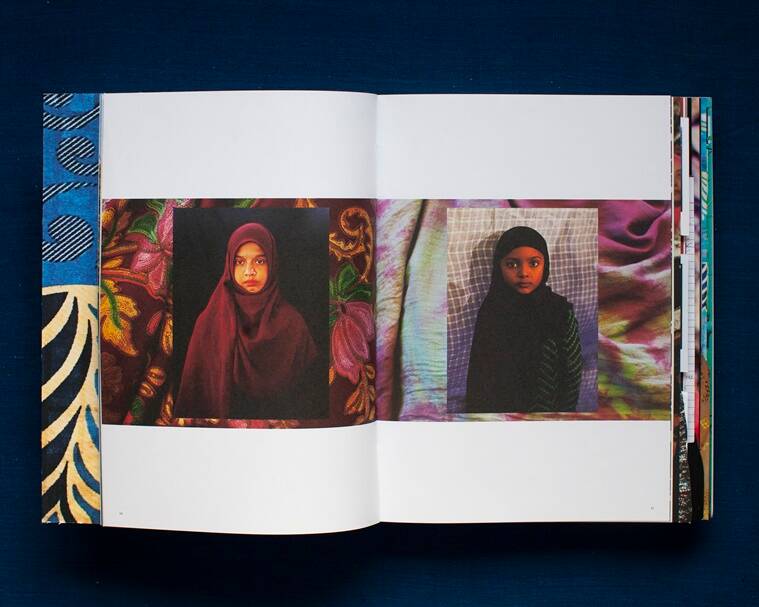
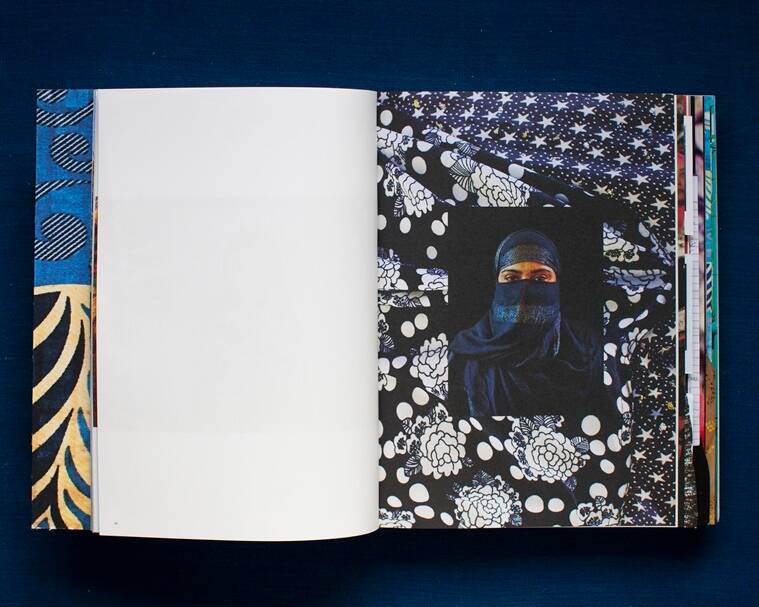
The photo-book ‘Har Shaam Shaheen Bagh’, comprising visual stories of resilience and resistance, isolates individuals from the image of the mass movement as was seen on prime-time news and press photographs.
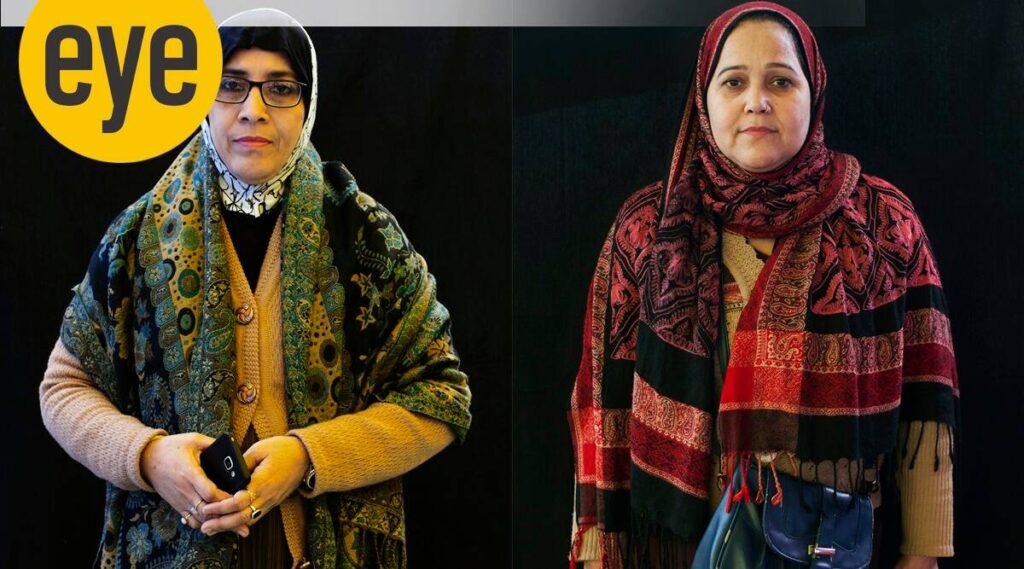
Portraits from Har Shaam Shaheen Bagh (Credit: Prarthna Singh)
Who is the perfect protester? We imagine raised fists, hurt faces, angry stances. We imagine climbing barricades, braving tear gas. If we go by this visual vocabulary, Har Shaam Shaheen Bagh (Every Evening Belongs to Shaheen Bagh) takes us by surprise. With over 150 portraits of non-violent protesters, the photo-book gently challenges the imagery of contemporary resistance movements.
Har Shaam Shaheen Bagh is Mumbai-based photographer Prarthna Singh’s first solo photo-book (she had earlier teamed up with the authors of Sar: The Essence of Indian Design in 2016). In December 2019, after the Delhi police reportedly assaulted students of Jamia Millia Islamia University who were challenging the Citizenship Amendment Act (CAA), a sit-in protest led by Muslim women started in Shaheen Bagh. Under a tent, with hundreds of women and children on any given day, the peaceful protest lasted for 100 days, until the pandemic struck.
Har Shaam Shaheen Bagh; By Prarthna Singh; 143 pages; Rs 3,300
Singh joined the anti-CAA protest in January 2020, spending most of her time on ground. Known for her women-centric narratives and portraiture work, she taps into her speciality to create portraits in an on-site photo studio, cobbled together with whatever was available at Shaheen Bagh. The result is these portraits of women, either looking directly at the camera or away, but always with a sense of pride. Poised and calm, the unnamed sitters indicate trust in the space, the purpose and the photographer.
Har Shaam Shaheen Bagh is Mumbai-based photographer Prarthna Singh’s first solo photo-book (she had earlier teamed up with the authors of Sar: The Essence of Indian Design in 2016).
Our collective memory of Shaheen Bagh, as is often the case with resistance movements, is of the masses, as seen on prime-time news and press photographs. Indeed, mass resistance movements give rise to the most recognisable images in the documented history of the world. Vulnerability and resilience coalesce into one defining moment — people standing up to power and confrontation, whether it’s one man blocking a row of tanks or a girl offering a flower to an armed soldier. Har Shaam Shaheen Bagh trades the monumental for the intimate, asking us to reconsider what we mean by “iconic”. It isolates individuals from the sea of faces, almost as if to say that a movement’s power lies not in numbers but in the will of its people.
Har Shaam Shaheen Bagh takes the form of a personal diary or a scrapbook.
Har Shaam Shaheen Bagh takes the form of a personal diary or a scrapbook. It contains drawings, a painting by artist Sameer Kulavoor, whose company Bombay Duck Designs has also designed the book, verse and a letter from one of the protesters, available in Urdu, English and Hindi. Some pages are deliberately uneven, recalling the makeshift quality of the Shaheen Bagh tent. While the book’s cost makes it inaccessible to some socioeconomic groups, Singh has shared copies with the protesters. A portion of the book sales goes towards Jeevan Stambh, an NGO working on the rehabilitation of the victims of the Jahangirpuri demolition last month.
During the pandemic, the Delhi police cleared the Shaheen Bagh site, painting over its graffiti and dismantling its art installations. In a country that is determined to erase and rewrite its history, one could say that a photo-book on a citizen protest is as good as an act of protest itself.
source: http://www.indianexpress.com / The Indian Express / Home> Books & Literature / by Benita Fernando / New Delhi – May 21st, 2022
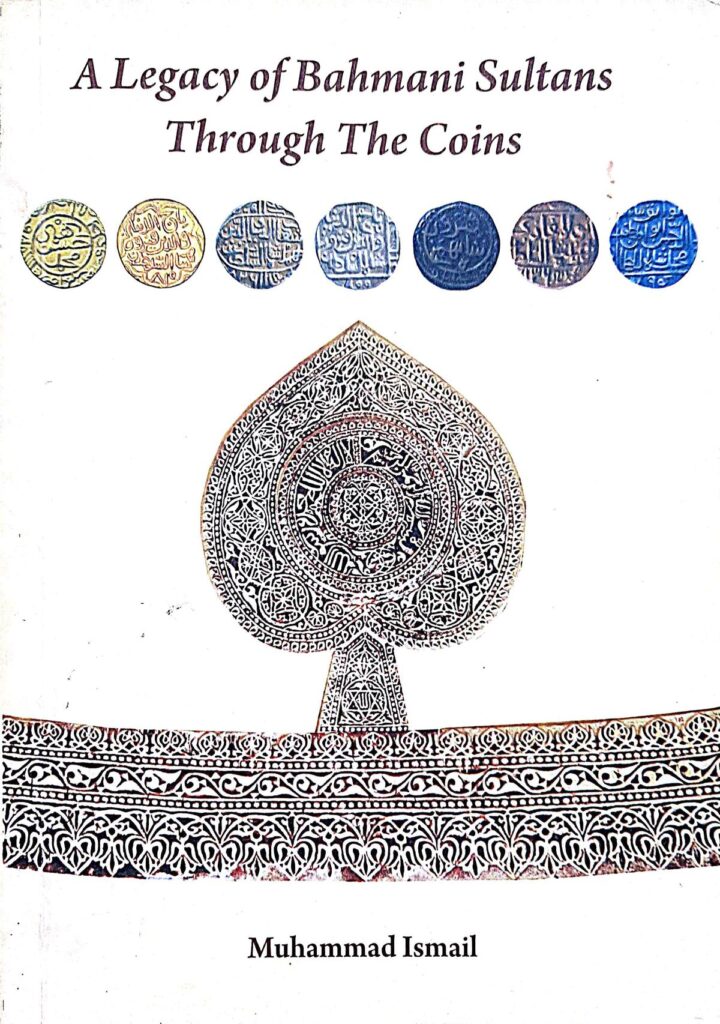
Cover page of the book ‘A Legacy of Bahmani Sultans through Coins’ published by the Gulbarga Bahmani Numismatics Research and Educational Trust. | Photo Credit: ARUN KULKARNI
Mohammad Ismail has got a rare treasure of coins dating back to Bahmani Sultans from 14th to 16th Century
The Gulbarga Bahmani Numismatics Research and Educational Trust recently published a book titled ‘A Legacy of Bahmani Sultans through coins’ authored by Numismatist Mohammad Ismail in which he depicts the numismatic journey of Bahmani Sultans through his collections.
The book traces the journey of coins belonging to all the 18 Bahmani Sultans starting from Alauddin Hasan Bahman Shah (1347-58), till the last Sultan – Kalimullah Shah (1526-1538). Mr. Ismail has meticulously worked, richly illustrated, about each coin issued during Bahmani Sultans period.
Mr. Ismail has got a rare treasure of antique coinage, belonging to Bahmani Sultans from 14th Century to 16th Century. The numismatist has more than 2,500 coins in his collection of various rulers, dynasties and kingdoms. Among his treasury are also coins dating back to 1,600 years ago.
The numismatist also organises a campaign “Save Coin Save Heritage.” The objective of this campaign is to spread awareness about ancient coins at schools and to take forward the legacy to younger generations.
Speaking to The Hindu, the numismatist explained the legacy of Bahmani Sultans and displayed a collection of nearly 80 copper coins issued in one year period between 1378-1379, and said that all the four Sultans including Dawood Shah-I, Muhammad Shah-II, Ghiyasuddin Tahmathan Shah, Shamshuddin Dawood Shah–II (4th, 5th, 6th and 7th sultans, respectively), have ruled for less than a year. His collection has got nearly 500 coins issued during Tajuddin Firoz Shah (8th Bahmani sultan), followed by 400 coins of Muhammad Shah-I (the second Bahmani sultan), and 300 coins of Kalimullah Shah (18th Bahmani sultan) Period.
According to Mr. Ismail, the study of coins gives insights into history as no other source does. The enthusiast numismatist tries to enhance his collection by getting in touch with collectors across India. His collection includes coins of various shapes, sizes and weights issued during different reigns made up of gold, silver, bronze and copper, some very rare.
When asked about the estimated value of coins in his collection, Mr. Ismail said that the value of each coin varied depending on its age, rarity and material. “But for me, as a numismatist, it is the coin’s age and rarity which matters more than its price,” he said.
Some of the rarest coins in his collections are of Tahmatun Shah, Dawood Shah, Ahmed Shah III, Muhammad Shah IV and Mujahidin Shah. Mr. Ismail’s rare collection includes 10 copper and one gold and silver coin minted during the Tahmatan Shah period. It took him eight years to find those coins. His collection also includes the rare gold and silver coins of Ahmed Shah II and Mujahidin Shah.
He also has coin collections belonging to Chalukyas, Kakatyas, Rashtrakutas, and the Vijayanagara Kingdom. Mr. Ismail wants to bring out a catalogue of these collections too.
source: http://www.thehindu.com / The Hindu / Home> News> National> Karnataka / by Praveen B Para / Kalaburagi – July 03rd, 2022
Otta Chora (Same Blood) by Shuhaib Alanallur, a student of Madin Academy in Malappuram, is being quoted by speakers in their programmes all across Malabar.
Kozhikode :
A poem that celebrates the warmth of the relationship between Hindu and Muslim families, penned by an upcoming writer, has become an instant hit after it was published in a magazine recently. Otta Chora (Same Blood) by Shuhaib Alanallur, a student of Madin Academy in Malappuram, is being quoted by speakers in their programmes all across Malabar.
In the poem, a Hindu woman, Narayani, finds solace in Nabeesu’s Islamic prayers while enduring the labour pain, and the ‘Mollakka’ (Muslim cleric) recites a verse from Quran to help her husband Velu quit drinking. Finally, Velu refuses to take his usual quota of toddy because the ‘Mollakka’ had donated his blood when he got injured after falling in a gutter. “I will not pollute Mollakka’s blood that runs in my blood by mixing it with toddy,” declares Velu at the end of the poem.
“Such relationships were quite common in our country-sides few decades ago. We are celebrating the bonding because it is fast fading away from our midst,” said the poet.
“The poem was written during the ‘Sahithyolsavam’ conducted by the Sunni Students Federation last year,” he said. It was the patronage given by Syed Ibrahimul Khaeel Al Bukhari Thangal, chairman of the Madin Academy, that shaped the writer in Shuhaib.
“Muslim Youth League leader Shibu Meeran quoted my poem in an impassioned speech that made it a discussion point on the social media,” Shihaib said. It was the fond memories that he spent with his Hindu friends in Alanallur near Mannarkkad that inspired Shuhaib to write the poem.
“There are people who argue that such relationships are normal in our midst and they need not be highlighted. But I believe that such voices should be amplified at a time when dark forces are lurking in our society,” said Basheer Faizy Deshamangalam, Islamic scholar and the leader of Samastha Kerala Sunni Students Federation.
“Narayani didn’t refuse to take the Islamic blessing saying that it is from another faith nor did Velu say no to verses from Quran. Such innocent virtues should be underlined when there are deliberate attempts to divide us,” he said.
source: http://www.newindianexpress.com / The New Indian Express / Home> Good News / by MP Prashantah, Express News Service / June 07th, 2022
The memorial has now become a pilgrimage point for locals
Half a century back, a Kali temple was built by the Border Security Force (BSF) as a war memorial at the request of two soldiers — a Christian and a Bengali Muslim — at the Border Outpost (BOP) in Srinagar, Tripura, which has now become a pilgrimage point for locals.
Major P. K. Ghosh, who was then commanding four border outposts (BOP) of BSF at Srinagar, Amlighat, Samarendraganj and Nalua in the southern part of Tripura bordering Chittagong division, in erstwhile east Pakistan, has chronicled the story in ‘Borderman’, the BSF journal.
When contacted, Major Ghosh said the Srinagar BOP was located in a very important strategic position and after the revolt by the East Bengal Regiment in 1971 against Pakistan, BSF aided the rebels in forming the first Muktibahini (Liberation army) in Srinagar.
“The MMG post at Srinagar BOP was playing a crucial role in thwarting the Pakistani army. It was the forward observation post near the Chittagong-Noakhali area. Exchange of fire was nothing new in that area, but it intensified when the liberation war started picking up”, Major Ghosh told PTI telephonically.
He said since the MMG post was causing major damage to the Pakistani side, it became a precision target for the enemy.
“A precision target receives continuous firing of shells over a period of an hour or so, it is likely to get damaged. On that day, they fired 100 shells in ten minutes”, Major Ghosh recalled.
“There were three members of the detachment at the post including a Nepali Christian, Constable Rehaman (a Bengali Muslim) and Constable Banabihari Chakraborty. The situation at the spot was terrible, and I asked them not to step out of the bunker,” he said.
As the situation became worse, Constable Chakraborty asked the others to pray to goddess Kali. “They did that without even considering their religious beliefs. The post was saved due to its position near a pond and marshy land and heavy rain a night ago. A bamboo tree also prevented the shells from torching the bunker and they ended up as air bursts”, Major Ghosh said.
When the BSF decided to build a war memorial at the spot, the Christian and the Muslim soldiers requested that a Kali temple be built instead.
“Building a Kali temple for a war memorial is very unconventional. But BSF did that to honour the request of the soldiers,” Major Ghosh said.
The funds were collected from locals and the Bangladeshis also joined in constructing the Kali temple in 1972.
“We named it Rann Kali (War Kali) temple to honour their faith. At a time of religious intolerances, such examples stand as a beacon of hope”, he said.
source: http://www.thehindu.com / The Hindu / Home> News> National> Other States / by PTI / Srinagar (Tripura) / July 03rd, 2022
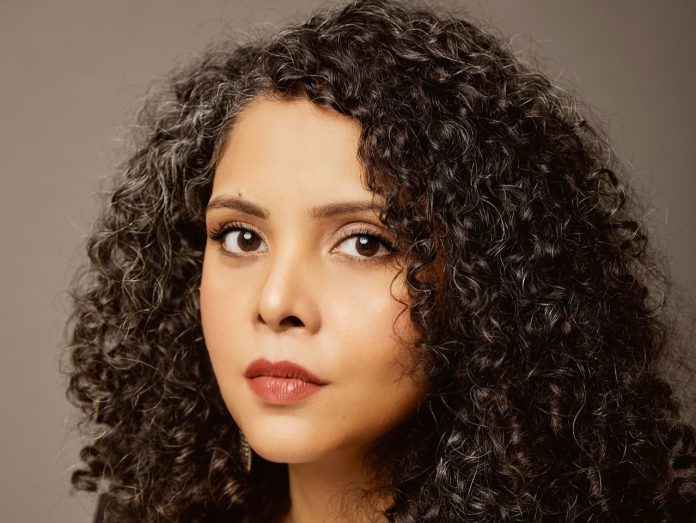
Indian Journalist Rana Ayyub was awarded the International John Aubuchon 2022. She was honoured with the award by the National Press Club of Washington DC and the Aubuchon is the Club’s highest honor for press freedom.
National Press Club President Jen Judson and National Press Club Journalism Institute President Gil Klein said, “We are pleased to name Rana Ayyub the 2022 John Aubuchon Award International Honoree. Ms. Ayyub’s courage and skill in investigative work has been evident throughout her distinguished career and her criticism of the government has been met with an unwelcome assault on her rights and freedom of expression.”
Later, Ayyub, in her statement on Twitter, thanked the Press Club and said that “it is a testing time for journalism in India”.
She further added: “Huge honour to receive this award, the first ever for an Indian.”
Ayyub dedicated the award to her colleagues who are lying in different prisons across the country. “Dedicating this to my colleagues Mohd. Zubair, Siddique Kappan and Asif Sultan, incarcerated for speaking truth to power,” she said.
source: http://www.thekashmirlwalla.com / The Kashmir Walla / Home> News> South Asia / by News Desk / July 01st, 2022
Imaginative cuisine, stylish wardrobes, magnificent palaces, and an opulent lifestyle. These are just a few things that the Nizams of Hyderabad are known for. Well, there’s one more thing: spectacular jewelry.
Most people already know that the last Nizam, Mir Osman Ali Khan was one of the wealthiest men in the history of the world. So, it comes as no surprise that he owned a fabulous collection of jewelry – diamonds, gold ornaments, and precious stones.
Almost all this collection was purchased by the Government of India, which arranges its exhibition from time to time.
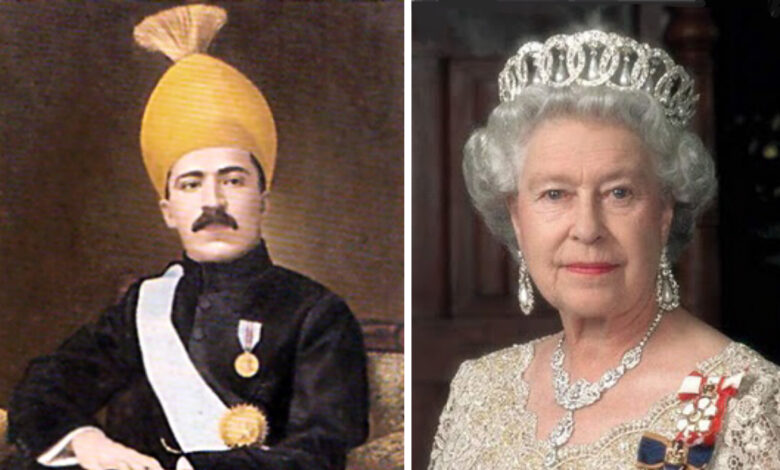
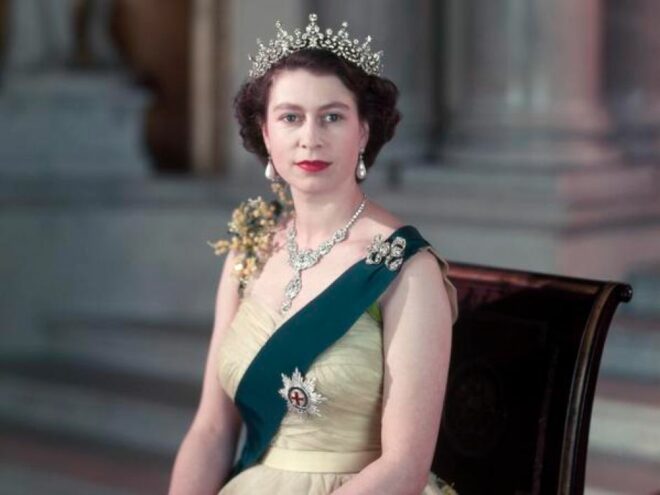
However, the most fitting exhibition of the Nizam’s jewelry occurs, albeit unwittingly, when Queen Elizabeth II, the Queen of the United Kingdom, wears the spectacular Cartier diamond necklace. It was gifted to her by the 7th Nizam on the occasion of her wedding to Prince Philip of Greece and Denmark on 20th November 1947. He had also gifted her the “Hyderabad Tiara” which had a design based on English roses with 3 detachable floral brooches, all made of diamonds and set in platinum.
The aptly named Nizam of Hyderabad Necklace is also a floral piece made of diamonds that are set in platinum.
The British art historian, Hugh Roberts who authored the best-selling book “The Queen’s Diamonds”, describes it in his book as: “The pavé-set centre with detachable double-drop pendant incorporating 13 emerald-cut diamonds and a pear-shaped drop; the chain of 38 brilliant-cut open-back collets with an elongated oval brilliant-set snap”.
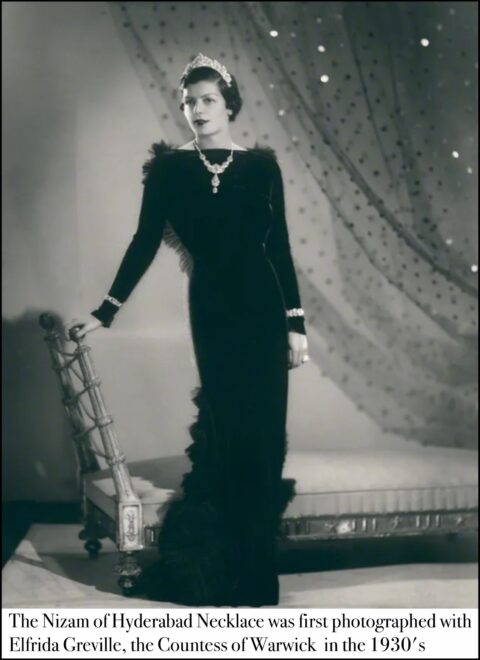
The Nizam, in his generosity, reportedly instructed Cartier to let the bride (then Princess Elizabeth) choose whatever she desired from their collection. The princess then chose the necklace and the matching floral tiara. She is not its first owner, however. Cartier made the necklace in 1935, sold it and then reacquired it from the first buyer in 1936. One of its earliest pictures is of Elfrida Greville, the Countess of Warwick who wore it for a portrait in the 1930s.
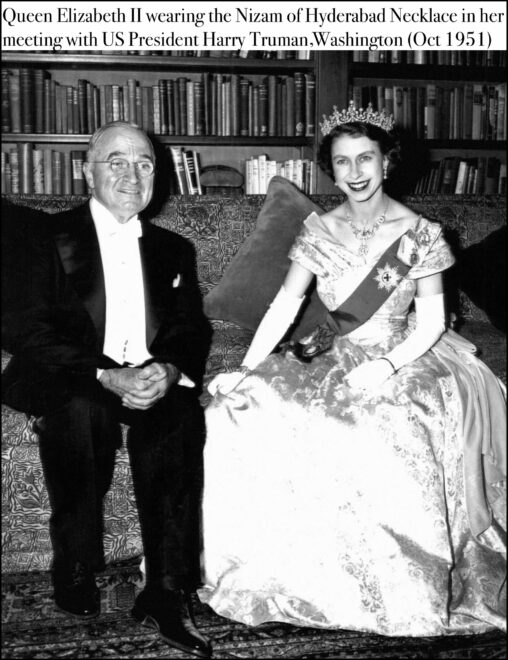
But the piece has remained a mainstay in the Queen’s jewelry collection. It appears to be one of her favorites as she has worn it on many official engagements, for instance on her first ever trip to Washington in October 1951 where she met President Harry Truman. She can also be seen posing in it for official portraits that would be used on currency bills like the Bahamas Dollar. She still wears it on important occasions.
Of late there has been a renewed interest in the necklace among jewelry enthusiasts when the Duchess of Cambridge Kate Middleton was photographed wearing it on at least two occasions. It was lent to her by the Queen as the duchess is her grand daughter-in-law due to her husband Prince William. It may now be safely assumed that the necklace has passed on from being a personal wedding present to a family heirloom and will adorn the subsequent generations of British royalty.
Dr Mohammed Najeeb Shahzore
Dr Mohammed Najeeb Shahzore is a specialist physician based in Kuwait with an interest in Hyderabad’s history & culture.
source: http://www.siasat.com / The Siasat Daily / Home> News> Hyderabad / by Dr. Mohammed Najeeb Shahzore / September 26th, 2021
The Delhi Youth Welfare Association works for the upliftment of underprivileged children in Old Delhi through many initiatives, including its Hazrat Shah Walliulah Public Library.
DYWA team with Capt Zoya and Heena Sodhi
On a hot Wednesday afternoon in June, Laxmi (14) and Ritika (11), residents of the walled city, braved the heat as they made their way through the crowded lanes of Old Delhi to arrive at a cramped quarter in Churiwalan, Jama Masjid. The dated signage and dilapidated environs may have served to put them off their mission, but they persevered. After all, they had it on the best possible authority––of their own older sister––that this was where they would receive school textbooks for the upcoming academic year.
These hardworking sisters are a few of the many girls and boys lining up outside the doors of the unassuming Hazrat Shah Waliullah Public Library, which distributes course books for children once a year, free of cost, to support them in their pursuit of education despite financial and other constraints.
In 1987, in the wake of curfew following religious tensions in Old Delhi, a group of young friends turned their energies towards the upliftment of destitute locals.
The library
They began by distributing rations, medicines, and scholarships to deserving widows and others in need, under the banner of the Delhi Youth Welfare Association (DYWA); but felt this action, though noble, did not make the desired difference to ground realities. Illiteracy due to poor financial conditions and the resultant lack of resources was a chronic problem that needed their immediate attention. Hence, they started sponsoring the education of deserving children, and opened the Hazrat Shah Waliullah Public Library, sometime in the 90s.
Muhammad Naeem, the President of the DYWA, has been associated with the organisation from the beginning. Narrating an incident that summarises the need for their organisation, he says, “Financial conditions are bad for the locals here. As soon as they clear their ninth standard exams, they want to move to Open University instead of going to school, so they can work and earn money. This is true for both boys and girls.”
Amidst this, the Hazrat Shah Waliullah Library strives to encourage a love of reading and learning–– an art that is swiftly being sidelined. SM Changezi, the General Secretary of DYWA and custodian of the library, wears his royal ascendancy from Chengez Khan with pride. However, he only displays it to the world through his passion for beautiful and rare old books.
The library’s vast collection includes a 100-year-old Quran with every page written in a different style, a copy of an illustrated Ramayana in Persian, and even one of the last copies of Bahadur Shah Zafar’s poetry, printed and sealed in the royal press while he was still in power.
About 50 percent of the books in the library are donated by locals who support the organisation, and the remaining are bought from the organisation’s funds.
With the increasing number of books, the association is now planning to open a second library in Haryana’s Nuh to cater to the local slums in the area. Apart from free course books, the DYWA sponsors the education of around 30 girls. To this effect, the DYWA collects and pays Rs 2.5-3 lakh per annum towards children’s fees, all from donations made by people who believe in the cause.
Other initiatives include inviting celebrated personalities originally from this area to speak to the children about making a success of their life. This happened recently when Air India pilot and social activist Captain Zoya Agarwal and Heena Sodhi Khera of women’s networking platform Queen’s Brigade, met the children for their course distribution ceremony.
Khera explains, “Capt Zoya shared her own experiences of being judged for her big ambitions. Yet, she achieved what she wanted and encouraged the kids to do so as well. The children were ecstatic and listened to her with rapt attention.”
source: http://www.newindianexpress.com / The New Indian Express / Home> Good News / by Noor Anand Chawla / June 24th, 2022
Anzer Ayoob (22) is a college drop out from Doda who started a news portal in 2017. | Photo by arrangement
The portal is getting recognised for reporting on issues in Chenab valley which are overlooked by the mainstream media.
Jammu :
When 22-year-old Anzer Ayoob, a journalist based in Doda district in Jammu and Kashmir’s Chenab valley heard that a literary group had announced an award for his news portal, he was editing a story on frequent power outages–a recurring issue in the region.
Ayoob is the founding editor of Chenab Times , a local multimedia news web portal that covers social, cultural, political, and current events primarily in the Chenab region.
“Apart from highlighting the lack of electricity in the region, the other objective was to bring Chenab Valley on the tourist map of Jammu and Kashmir,” Ayoob told TwoCircles.net.
Founded in 2017, the news portal has gained decent viewership in the region and has been appreciated by locals.
Inspired by the positive response, the portal launched its daily news bulletin in Urdu, Sarazi and Bhaderwahi languages (spoken by the region’s population) in January 2021.
A year on, the programmes in local languages have earned the portal a distinct fame.
On January 23, the Pahari Core Committee, which is a representative organisation of fifteen literary groups from Doda, praised The Chenab Times for the promotion of local languages, and culture and decided to confer it with this year’s ‘Best News Portal’ award.
“Chenab Times is the sole channel that has always touched the hearts of thousands of Pahari speakers who speak Sarazi, Bhaderwahi, and Kashmiri,” said Sadaket Malik, president of the Pahari Core Committee, in a statement.
The Chenab Times staff in Doda. | Photo by arrangement
From college dropout to editor Ayoob is a college dropout. He was pursuing B.Sc. from Govt. Degree College Bhaderwah. “I discontinued my education in 2019 when my mother’s health deteriorated. My father passed away in 2015 and being the only male member of the family, I had to earn a livelihood,” he said.
Ayoob believes that practicing journalism does not require a degree. “Starting a news portal began with a single idea and journalism is all about ideas,” he said.
Promoting Chenab valley as tourist destination The Chenab Times started with a Facebook page of the same name promoting Chenab valley as a tourist destination on social media. “After 4-5 months, when our Facebook page gained 16K followers, we launched the website,” Ayoob said.
The portal has regularly covered stories of the downtrodden.
Slowly, the news portal began to carry news from the outside world. At present, the portal provides current news from around the world, with a special focus on video stories from Jammu & Kashmir.
The Chenab Times has around 140K followers on Facebook, 1K on Twitter, 8K on Instagram and 45K on YouTube.
Some of the stories published by The Chenab Times have been impactful.
“There are various far-flung villages in Doda district that weren’t receiving adequate water supply and it was a crisis for the villagers. When we highlighted the issues on our portal, the villages got water supply,” Ayoob said.
Farasat Rasool is a graduate in arts and a regular reader of the website. “Chenab Times is doing a good job by providing local news and civic concerns. The portal has given voice to the voiceless,” he said.
Power outages deter journalism What bothers Ayoob are the frequent power outages and blackouts in the region. The outages, he said, are impacting the portal’s multilingual programme, for which it has been recognised.
Ironically, the Chenab valley is known as the hub of hydroelectric power projects in the region.
Due to a massive power outage in the Halla village of Doda district in late January, one of Chenab Times correspondent Fareed Ahmad Naik was unable to deliver the Sarazi language news programme. The village was without electricity for 12 days.
“In winters, the first importance is not the story but to charge our cell phones,” Ayoob said.
Involving youth in community journalism Ayoob believes in involving more youth from his region in doing community journalism.
The portal has a staff of eight reporters, six of whom are from the Doda district, one each from Kishtwar and Ramban districts and a six-person editorial board, and three legal consultants.
While press freedom in Jammu and Kashmir has been severely restricted in the last few years, Ayoob said, “poor media environment won’t deter us from doing our job.”
Ayoob is of the view that journalism is the kind of profession “where the government frequently becomes an adversary.”
Besides power outages, another challenge faced by his portal is political targeting. “We have done stories after which we faced pressure from certain political quarters. We were summoned by police on a sarpanch’s complaint and received legal notices after we reported on the absence of doctors,” he said.
Ayoob, however, added that he has received support from Doda police after his portal did a story on illicit liquor and drugs. “They cooperated with us,” he said.
His goal is to recruit female reporters at his portal. “We want to give a platform to emerging women reporters in the region,” he said.
Naseer Khora, a senior journalist and commentator from Doda, believes that “local civic concerns of the people haven’t been highlighted much in the media as politics dominates the coverage in Jammu and Kashmir.”
“Chenab Times, in particular, is making a difference by encouraging new people to enter the sector while also restoring rural journalism and reviving endangered languages,” he said.
Shadab Farooq is TCN SEED-Fellow. He tweets at @shadabfarooq_
source: http://www.twocircles.net / TwoCircles.net / Home> Lead Story / by Shadab Faarooq, TwoCircles.net / February 04th, 2022